Introduction
The World Alzheimer's Report 2015 (Prince et al., Reference Prince, Wimo, Guerchet, Ali, Wu and Prina2015) estimates that 46.8 million people are living with dementia worldwide; this number is set to rise to approximately 74.7 million by the year 2030. The impact of dementia is great; it is estimated that the global economic cost of dementia exceeds US $800 billion (Prince et al., Reference Prince, Wimo, Guerchet, Ali, Wu and Prina2015). In the United Kingdom (UK), the social care cost of dementia is calculated at £10.3 billion, 39.2% of the total estimated economic impact (Alzheimer's Society, 2014); this comprises of funding by local authorities, people with dementia, and their families. There are over 30,000 homes in England registered with the Care Quality Commission (2015), which provides the majority of institutional care for older people. Of the 850,000 people living with dementia in the UK, 280,000 people with dementia are living in care homes (Alzheimer's Society, Reference Billington, Carroll, Davis, Healey and Kinderman2016).
Dementia has become a national government priority in the UK, yet a cure is still elusive. Initiatives such as the “National Dementia Strategy” (UK Department of Health, 2009) aim at improving dementia services across the United Kingdom. Person-centered care has become a cornerstone of government policy and is recognized as best practice in health and social care provision (NICE, 2006).
The undertaking of person-centered care is to maintain identity and worth, in the face of cognitive impairment, through a partnership of positive interactions and communication strategies (Kitwood, Reference Kitwood1997). Integrating the arts within the care provision for older adults could be a means of achieving a person-centered focus by responding to a person's abilities, stimulating new interests, and developing skills. UK Department of Health standards (2003) requires that care homes provide opportunities for residents to engage in meaningful activities in terms of their capabilities and preferences. Increasingly, arts-based interventions have been suggested to play an important role in the care of people with dementia. Participation in creative activities is considered to promote motivation, purpose, and hope, which contribute to successful aging (Fischer and Sprecht, Reference Fischer and Sprecht1999). Ullán et al. (Reference Ullán2011) discovered that people with dementia were capable of participating in an artistic educational program; proving to be a positive experience and contributing to a person's sense of well-being. A review conducted by Young et al. (Reference Young, Camic and Tischler2015) evidenced a range of cognitive benefits, including attention, memory, communication, and engagement. Creative therapy sessions within day treatment and inpatient NHS organizations resulted in positive observational outcomes, including engagement, communication, and enjoyment (Rylatt, Reference Rylatt2012). Despite the demonstrated efficacy of these results, little time is available for or dedicated to providing social and emotional support to residents (Schneider et al., Reference Schneider1997). Furthermore, it is often the case that the provision of stimulating activities is an unmet need of residents with dementia in care homes (Hancock et al., Reference Hancock, Woods, Challis and Orrell2006).
Study aims
The aim of this review is to explore the involvement of care staff in creative arts interventions in residential care. Through the examination of previous research, aspects which influence outcomes in people with dementia are identified and compared; correlations are drawn from the results and used to ascertain which features of practice could be further explored in therapeutic interventions in populations with dementia.
The study questions included:
-
1. In what context are care personnel involved with creative arts programs in residential care?
-
2. What outcomes are influenced by care staff involvement in creative arts programs?
-
3. What are the mechanisms that influence outcomes when care personnel are involved in creative arts programs?
Methods
Search strategy
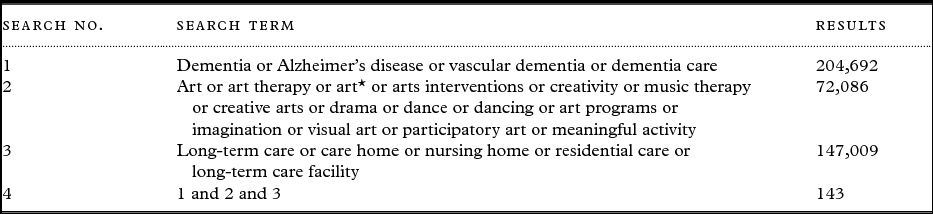
A broad literature search of the following databases was conducted: Medline, PsychInfo, Embase, CINAHL, ASSIA, Scopus, and Web of Science. As this is an emerging field, only papers from 2000 were considered for inclusion. Table 1 illustrates how the search combinations were employed. The search terms were developed iteratively to focus the review question.
Example of search in embase

Selection and appraisal of documents
Titles and abstracts of the studies identified through the electronic literature search were screened by the first author for relevance to the review questions. This process was reviewed in interdisciplinary research meetings with the other authors. The inclusion criteria were broad in order to include a large number of studies. Studies were included if they (i) pertained to persons with dementia, (ii) were conducted within the context of a health care setting such as a residential care home/or nursing home, and (iii) made reference to the interaction of professional care staff with the creative arts intervention. A broad description of creative arts interventions was utilized, which included art therapy, music, drama, dance, poetry, and visual art. No restrictions were placed on the form of creative arts intervention, as the aim of the review was to explore the context of care staff involvement with creative arts programs, rather than their efficacy.
Once the inspection of the titles and abstracts was complete, the full text was obtained. These remaining papers were assessed using a selection tool adapted from a realist review protocol conducted by Jagosh et al. (Reference Jagosh2011). The questions were modified in accordance with the aim and review questions were developed in this review.
-
1. Does the full text paper still indicate creative arts program research?
-
2. Does the full text paper indicate that creative arts programs take/took place?
-
3. Does the full text paper describe the research setting? (For example, by indicating residential care, nursing home, and care home.)
-
4. Does the full text paper describe creative arts program outcomes?
-
5. Does the full text paper describe the processes or contexts?
Results
The initial database literature search identified 3,198 papers. The titles were screened using the selection tools specified above. Subsequently, 3,021 records were excluded as they were deemed to be not relevant based on the identification questions, for example, not relating to a creative arts program, populations with dementia, or residential care context. One hundred forty-eight potentially relevant articles abstracts were screened using the selection tool. This was followed by the full text retrieval of 102 papers. Fourteen papers met the eligibility criteria. Nine of these papers were conducted in Europe, four in North America, and two in Australia.
Data extraction
Once the full text was obtained, the data was recorded in a bespoke data extraction form. Data synthesis was approached by identifying and extracting information relating to the intervention, context, mechanisms, and outcomes related to research questions. The process of data extraction was iterative; as the literature review progressed the full text was screened several times in an attempt to identify the workings of a particular program (Wong et al., Reference Wong, Greenhalgh, Westhorp, Buckingham and Pawson2013). Characteristics recorded were authors, publication date, research design, method of assessment, intervention, and summary of reported outcome; however, this list is by no means exhaustive.
Intervention characteristics
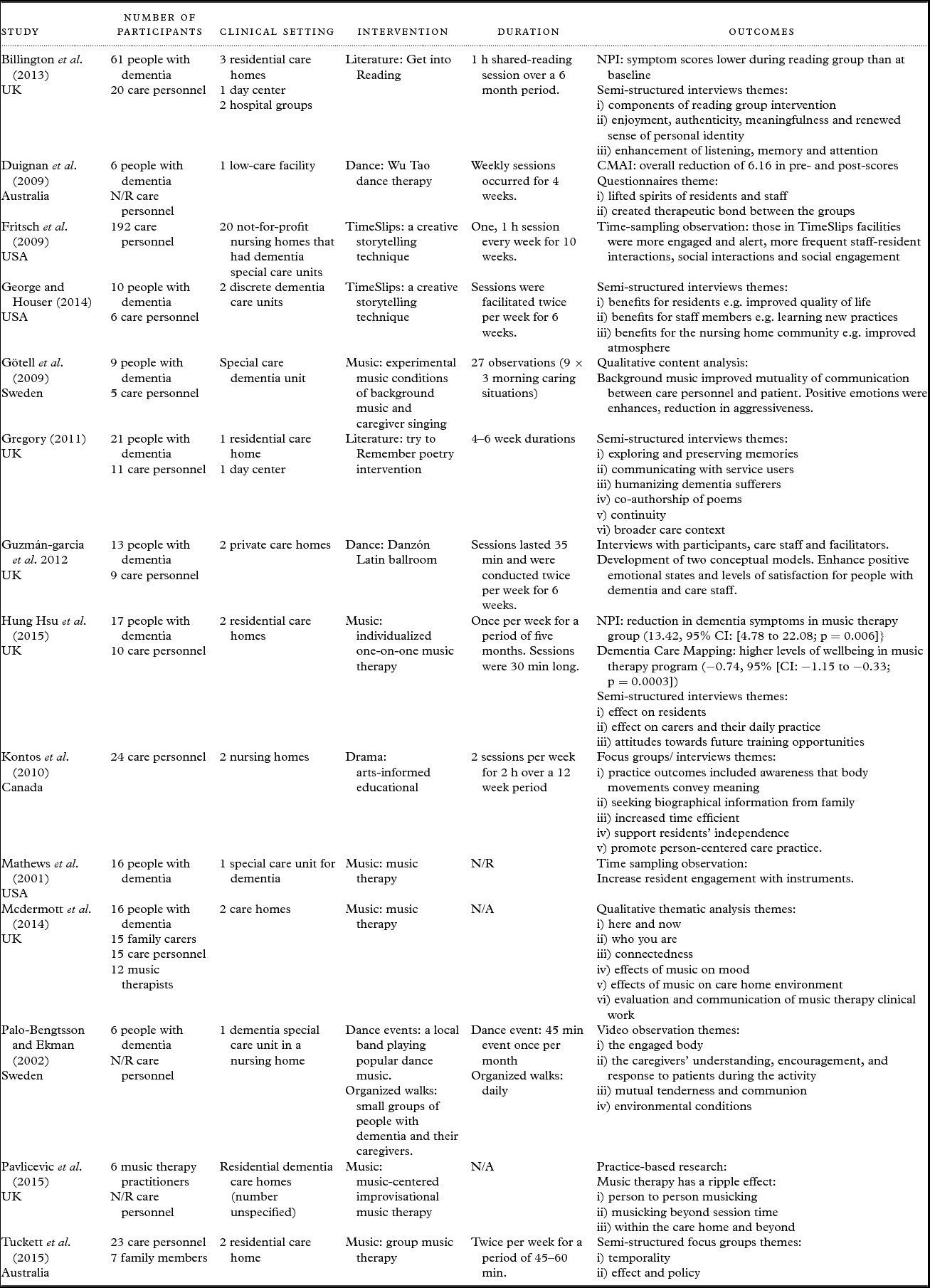
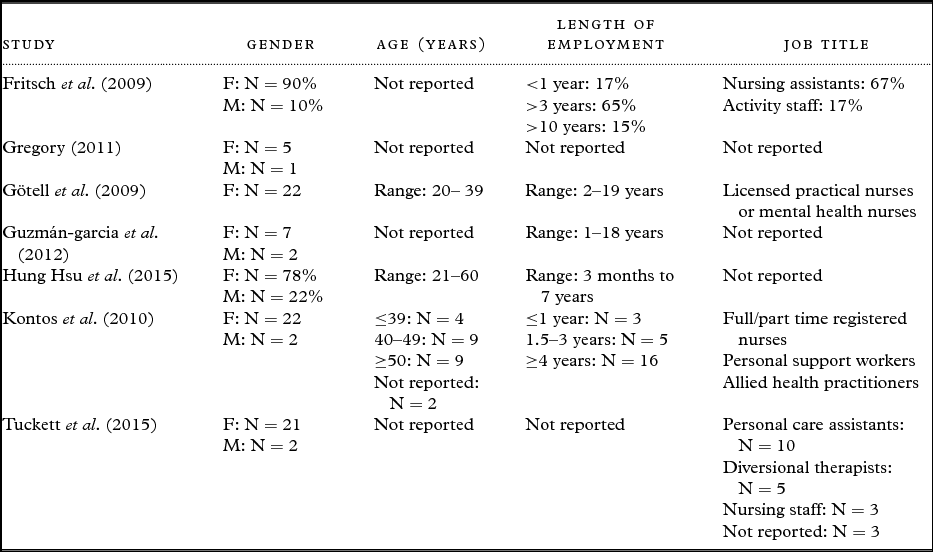
There were variations in the type of creative arts interventions as well as methods of implementation in dementia residential care facilities. Table 2 evidences a summary of the articles. A number of papers (n = 6) explored music as a creative arts intervention. Four studies examined the effect of music therapy implemented by a certified music therapist (Mathews et al., Reference Mathews, Clair and Kosloski2001; Hung Hsu et al., Reference Hung Hsu, Flowerdew, Parker, Fachner and Odell-Miller2015; Pavlicevic et al., Reference Pavlicevic2015; Tuckett et al., Reference Tuckett, Hodgkinson, Rouillon, Balil-Lozoya and Parker2015). Götel et al. (Reference Götell, Brown and Ekman2009) employed an experimental design to investigate the impact of pre-recorded background music and caregiver singing on emotional expression during morning care routines. Three studies evaluated forms of dance therapy; however, there was no standardized method of implementation. Two studies concentrated on forms of dance therapy and their effect on people with dementia in care (Duignan et al., Reference Duigan, Hedley and Milverton2009; Guzmán-García et al., Reference Guzmán-García, Mukaetova-Ladinksa and James2012). In comparison to using a specified form of dance therapy, one paper introduced social dancing in the form of a large dance event hosted once per month attended by residents and care staff (Palo-Bengtasson and Ekman, Reference Palo-Bengtsson and Ekman2002). Two literature based service evaluations explored the role of shared reading on outcomes in people with dementia (Gregory, Reference Gregory2011; Billington et al., Reference Billington, Carroll, Davis, Healey and Kinderman2013). Only one study specifically focussed on the use of drama. Kontos et al. (Reference Kontos, Mitchell, Mistry and Ballon2010) utilized a drama-based educational intervention with the aim of improving person-centered care in dementia practitioners in North America. Other research conducted in the U.S. evaluated the creative expression program, TimeSlips (Fritsch et al., Reference Fritsch, Kwak, Grant, Lang, Montgomery and Basting2009; George and Houser, Reference George and Houser2014). Only seven articles included in this review reported demographic information for the care staff who participated in the arts activity. Table 3 documents the demographic information provided by the authors, including gender, age, length of employment, and job title. It emerged that most of the care personnel involved in the programs were qualified nurses or personal care assistants (Fritsch et al., Reference Fritsch, Kwak, Grant, Lang, Montgomery and Basting2009; Götell et al., Reference Götell, Brown and Ekman2009; Kontos et al., Reference Kontos, Mitchell, Mistry and Ballon2010; Tuckett et al., Reference Tuckett, Hodgkinson, Rouillon, Balil-Lozoya and Parker2015); only one article reported that designated activity staff had participated in the creative sessions (Fritsch et al., Reference Fritsch, Kwak, Grant, Lang, Montgomery and Basting2009). The length of employment for most participants ranged from less than one to nineteen years; however, the impact of length of service or previous work experience was not critically evaluated in any of these articles. Two studies reported that staff had received dementia-specific training (Fritsch et al., Reference Fritsch, Kwak, Grant, Lang, Montgomery and Basting2009; Guzmán-Garcia et al., Reference Guzmán-García, Mukaetova-Ladinksa and James2012); however, no details of the content of this training were provided.
Study characteristics

*CMAI = Cohen-Mansfield Agitation Inventory NPI = Neuropsychiatric Inventory N/R = Not recorded.
Staff demographics

F = Female, M = Male.
Context
Six of the selected studies reported training for care staff. Two studies utilizing TimeSlips as a form of creative arts intervention opted to train care staff in the creative intervention itself with a view that staff would facilitate the sessions themselves (Fritsch et al., Reference Fritsch, Kwak, Grant, Lang, Montgomery and Basting2009; George and Houser, Reference George and Houser2014). Fritsch et al. (Reference Fritsch, Kwak, Grant, Lang, Montgomery and Basting2009) invited care staff to participate in a one day workshop facilitated by a certified TimeSlips trainer. In contrast, George and Houser (Reference George and Houser2014) introduced TimeSlips via a 1 h training session for care staff; staff then became involved with the process of facilitating the program alongside the principal investigator for two sessions per week over a period of six weeks.
Some researchers investigated the impact of training care staff in certain aspects of creative practice. For example, Hung Hsu et al. (Reference Hung Hsu, Flowerdew, Parker, Fachner and Odell-Miller2015) opted to show post-therapy video presentations to care staff with the aim of imparting knowledge of methods and techniques of music therapy for staff to apply in their own practice. Similarly, Mathews et al. (Reference Mathews, Clair and Kosloski2001) conducted an in-service training workshop to teach care staff how to employ music therapy techniques.
The specific aim of Kontos et al. (Reference Kontos, Mitchell, Mistry and Ballon2010) was to utilize drama as an educational modality with a view to influencing the direct care of staff. Care personnel were introduced to a 12-week arts-informed educational program, including critical reflection, role-play, and dramatized vignettes. Similarly, the “Try to Remember” poetry intervention (Billington et al., Reference Billington, Carroll, Davis, Healey and Kinderman2013) included a complementary skills training workshop facilitated by a poet.
Active participation
Other creative arts interventions included encouraging staff to assist in the facilitation of respective creative arts programs within their workplace. In a study conducted by Götel et al. (Reference Götell, Brown and Ekman2009), staff participated in an experimental music project to compare the impact of music on emotional expression in morning care routines. Care staff continued with their usual practice but the morning care routine was supplemented with background music, or by carers singing to the resident. Likewise, care personnel who assisted in the facilitation of the Danzon psychomotor intervention commented that the dance was easy to learn and was an opportunity to interact with residents outside of their professional caring role (Guzmán-García et al., Reference Guzmán-García, Mukaetova-Ladinksa and James2012).
Several studies report outcomes when staff attend creative arts sessions in what could be assumed to be a purely supportive or practical role (Palo-Bengtsson and Ekman, Reference Palo-Bengtsson and Ekman2002; Duignan et al., Reference Duigan, Hedley and Milverton2009; Billington et al., Reference Billington, Carroll, Davis, Healey and Kinderman2013). In their results, Guzmán-García et al. (Reference Guzmán-García, Mukaetova-Ladinksa and James2012) categorized the benefits for spectator-residents and those who observed but could not actively participate. Similarly, Billington et al. (Reference Billington, Carroll, Davis, Healey and Kinderman2013) reported benefits for those not actively involved in discussions in the “Get into Reading” program; active listening was perceived to alleviate emotional symptoms.
Environmental factors
Environmental factors affected the facilitation of the creative arts program and the way in which care staff could participate. There was a consensus among researchers that the creative arts program should take into account the daily routine of the environment (Kontos et al., Reference Kontos, Mitchell, Mistry and Ballon2010; Billington et al., Reference Billington, Carroll, Davis, Healey and Kinderman2013; Hung Hsu et al., Reference Hung Hsu, Flowerdew, Parker, Fachner and Odell-Miller2015; Tuckett et al., Reference Tuckett, Hodgkinson, Rouillon, Balil-Lozoya and Parker2015).
The nature of the setting was commonly found to influence levels of engagement and to create logistical challenges. Pavlicevic et al. (Reference Pavlicevic2015) identified how social geography can impact the efficacy of music therapy and that therapists should be aware of these limitations and the potential risks for residents. Other limitations included staff shortages, limited financial and practical resources, and overemphasis on task-oriented care (Gregory, Reference Gregory2011; Guzmán-García et al., Reference Guzmán-García, Mukaetova-Ladinksa and James2012; Hung Hsu et al., Reference Hung Hsu, Flowerdew, Parker, Fachner and Odell-Miller2015; Tuckett et al., Reference Tuckett, Hodgkinson, Rouillon, Balil-Lozoya and Parker2015).
Despite the limitations highlighted by the researchers, the majority of the literature suggested that creative art programs were well received by care personnel. Guzmán-García et al. (Reference Guzmán-García, Mukaetova-Ladinksa and James2012) reported that staff wished the management would continue to provide the dance psychomotor intervention; particularly as they believed it to be more cost effective than hiring external entertainment. One study highlighted how staff reported wishing to continue the program outside of their working hours (Duignan et al., Reference Duigan, Hedley and Milverton2009). Moreover, staff reported that working together creatively to overcome practical logistics fostered a sense of camaraderie (George and Houser, Reference George and Houser2014).
Outcomes
Clinical outcomes for residents
Nine studies demonstrated, through a mixture of quantitative and qualitative methods, the impact of the creative art intervention on the symptoms of dementia. Three papers, utilizing behavioral scales, indicated that their respective creative arts programs had a positive impact on the symptoms associated with dementia (Duignan et al., Reference Duigan, Hedley and Milverton2009; Billington et al., Reference Billington, Carroll, Davis, Healey and Kinderman2013; Hung Hsu et al., Reference Hung Hsu, Flowerdew, Parker, Fachner and Odell-Miller2015). In turn, qualitative studies, including interviews and focus groups with care staff, predominantly reported positively altered behaviors in residents with dementia, including diminished aggressiveness (Götel et al., Reference Götell, Brown and Ekman2009; Guzmán-García et al., Reference Guzmán-García, Mukaetova-Ladinksa and James2012; George and Houser, Reference George and Houser2014). These findings were supported in exploratory research to explore the meaning, value, and effectiveness of music therapy (McDermott et al., Reference McDermott, Orrell and Ridder2014; Tuckett et al., Reference Tuckett, Hodgkinson, Rouillon, Balil-Lozoya and Parker2015).
Communication
Five studies discussed elements relating to communication of residents with dementia who participated in a creative arts program. This was reported by researchers in two ways; namely by demonstrating an increase in communication in persons with dementia and the way in which staff gained an improved understanding of communication through their participation.
Care staff perceived that there was increase in verbalizations and self-expression in residents who had participated in the creative arts program, particularly in those with limited verbal capacity (George and House, Reference George and Houser2014; Hung Hsu et al., Reference Hung Hsu, Flowerdew, Parker, Fachner and Odell-Miller2015). Duignan et al. (Reference Duigan, Hedley and Milverton2009) described how residents who previously were unable to express themselves verbally used Wu Tao as an opportunity for expression. This was documented through the interaction between residents and staff, notably increased communication and the development of what was perceived to be a therapeutic bond. Similarly, staff described how their participation in the video presentation sessions improved their interaction techniques with residents, which had enhanced their communication and subsequent relationship with their residents (Hung Hsu et al., Reference Hung Hsu, Flowerdew, Parker, Fachner and Odell-Miller2015). This was highlighted in the “Try to Remember” evaluation where staff placed value on the one-to-one communication that enabled them to interact with their residents (Gregory, Reference Gregory2011).
Using qualitative content analysis, Götel et al. (Reference Götell, Brown and Ekman2009) revealed that compared to a control setting (no music) communication improved; the person with dementia was perceived to be more responsive to the caregiver and positive emotions were more predominant. Overall, music was perceived to increase the mutuality of communication.
Engagement
Four studies explored issues pertaining to the engagement of people with dementia during creative arts programs. Two studies utilizing self-developed time sampling observation techniques discovered higher levels of engagement and alertness; both studies reported high levels of inter-rater reliability. Together, these factors were considered to improve and increase staff resident interactions, social interactions, and social engagement and improve meaningful engagement (Mathews et al., Reference Mathews, Clair and Kosloski2001; Fritsch et al., Reference Fritsch, Kwak, Grant, Lang, Montgomery and Basting2009). Video observations support these results documenting positive reactions to dance interventions and an increase in responsiveness in people with dementia toward caregivers during experimental music conditions (Palo-Bengtsson and Ekman, Reference Palo-Bengtsson and Ekman2002; Götel et al., Reference Götell, Brown and Ekman2009).
Care practice
Staff-resident interaction
Creative arts programs appear to play a significant role in the way that staff and residents interact and as a result influence the care practice of staff. A few studies emphasized that staff found it important to decipher the needs of the residents and that this could be achieved through interaction (Kontos et al., Reference Kontos, Mitchell, Mistry and Ballon2010; Hung Hsu et al., Reference Hung Hsu, Flowerdew, Parker, Fachner and Odell-Miller2015). Some research suggested that the opportunity to participate in meaningful interaction, as opposed to regular caring routines, was a factor in improved staff-resident interactions (Duignan et al., Reference Duigan, Hedley and Milverton2009; Gregory, Reference Gregory2011; Billington et al., Reference Billington, Carroll, Davis, Healey and Kinderman2013; George and Houser, Reference George and Houser2014). The meaningfulness of an interaction was theorized to play a role in the positive attitude between staff and residents (Duignan et al., Reference Duigan, Hedley and Milverton2009) and developing a deeper understanding of residents (George and Houser, Reference George and Houser2014).
Challenging existing perceptions
A predominant theme in the literature was how creative arts interventions encourage carers to examine their existing perceptions of people with dementia and to recognize them as individual people beyond the limitations of the disease. Fritsch et al. (Reference Fritsch, Kwak, Grant, Lang, Montgomery and Basting2009) used a self-constructed inventory to measure attitudes towards persons with dementia to show how care staff who participated in TimeSlips came to hold more positive views and were less likely to devalue persons with dementia. They suggested that improving staff attitudes towards people in care positively influences the care that residents receive. Moreover, their quantitative data supported this supposition, with significant increases on scales of social interaction, caring touch, verbalization, and eye contact. Thus, the researchers inferred that the TimeSlips program had the capacity to enhance the quality of life of people with dementia in residential care (Fritsch et al., Reference Fritsch, Kwak, Grant, Lang, Montgomery and Basting2009).
It was also suggested that creative arts programs allow staff to focus on their residents’ strengths and competencies as opposed to the losses associated with dementia (Götel et al., Reference Götell, Brown and Ekman2009; George and Houser, Reference George and Houser2014).
Enriched knowledge
Studies reported that arts programs increase the interest of care staff in the personal histories of their residents. Qualitative data analyzed by Gregory (Reference Gregory2011) suggested that reminiscence-based poetry provided care staff with more information, beyond basic care information, about their residents’ lives. Likewise, Hung Hsu et al. (Reference Hung Hsu, Flowerdew, Parker, Fachner and Odell-Miller2015) discovered that staff appreciated gaining insight into the cognitive functioning and causation of symptoms in their residents. Focus group data from Pavlicevic et al. (Reference Pavlicevic2015) described how music therapists perceive music therapy as a way of enabling staff to see beyond the diagnosis of dementia; particularly when care personnel engage in shared musical participation. Like the aforementioned studies, Pavlicevic et al. (Reference Pavlicevic2015) perceived that music, as a creative medium, encourages care staff to think about residents on a deeper level, beyond the caring role that leads to a change in the relationship dynamic
Enjoyment
There was a sense that enjoyment played a role in the impact of the intervention. Several papers reflected that staff and residents enjoyed the creative arts program, which was thought to contribute to the well-being of those who live and work within the setting. Pavlicevic et al. (Reference Pavlicevic2015) described this as the “ripple effect”; for example, music therapy has an impact on a “macro-level”, influencing the wider context of the care home. This theory is consistent with other papers in this review, which propose, through qualitative data, that the larger community benefits from creative arts program. Benefits cited include an improved atmosphere (George and Houser, Reference George and Houser2014), a sense of joy and excitement (Guzmán-García et al., Reference Guzmán-García, Mukaetova-Ladinksa and James2012), and the opportunity for staff to understand the benefits of the creative arts (Palo-Bengtsson and Ekman, Reference Palo-Bengtsson and Ekman2002).
Influence on care strategies
The evidence suggests that care personnel who are involved in creative arts programs are encouraged to utilize aspects of what works and take it back to use in their daily practice. Both Guzmán-García et al. (Reference Guzmán-García, Mukaetova-Ladinksa and James2012) and Hung Hsu et al. (Reference Hung Hsu, Flowerdew, Parker, Fachner and Odell-Miller2015) found that care staff adopted specific care strategies from the creative arts program and applied them outside of the creative session. Observations conducted using Dementia Care Mapping (Brooker and Surr, Reference Brooker and Surr2006) demonstrated an increase in personal enhancing interactions; however, these were not statistically significant (Hung Hsu et al., Reference Hung Hsu, Flowerdew, Parker, Fachner and Odell-Miller2015).
Mechanisms that influence outcomes
Creative arts programs could be considered to allow care personnel the opportunity to interact with residents in a context outside of their practical daily care tasks, which usually focus on physical caring needs. In this sense, creative arts programs could be deemed to facilitate positive interactions between residents and staff. This was evidenced in several studies, through enhanced communication (Götel et al., Reference Götell, Brown and Ekman2009; Gregory, Reference Gregory2011), building of trust through dance (Palo-Bengtsson and Ekman, Reference Palo-Bengtsson and Ekman2002; Guzmán-García et al., Reference Guzmán-García, Mukaetova-Ladinksa and James2012) and meaningful relationship-based activity (Billington et al., Reference Billington, Carroll, Davis, Healey and Kinderman2013; George and Houser, Reference George and Houser2014). From this review, it could be suggested that involving staff in creative arts programs potentially improves person-centered care. The undertaking of person-centered care is to maintain identity and worth, in the face of cognitive impairment, through a partnership of positive interactions and communication strategies (Kitwood, Reference Kitwood1997). Mechanisms such as of gaining deeper knowledge of the resident, improved communication strategies, and the ability to focus on the remaining competencies of the residents were all perceived to be facilitated through the creative arts program.
Discussion
The aim of this literature review was to explore in what context care staff are involved in creative arts activities in residential care; outcomes that are affected by staff involvement; and the mechanisms that influence outcomes. To assess these factors, the studies identified through the search process were examined in terms of intervention, context, mechanism and outcome, and the relationships between these aspects.
Context
According to Hatton (Reference Hatton2014), the emphasis on physical task-based care, including the routines of the care home, contributes to the spatial challenge of conducting arts projects in care homes; likewise, similar challenges were identified in this review. Despite some authors identifying practical limitations such as shortage of staff and limited financial resources, there was a limited discussion on solutions. The practicalities surrounding the implementation of an arts interventions in residential care is seldom documented, but certainly worthy of future consideration. Care staff could be deemed to play an important role in overcoming logistical challenges, as they possess intimate knowledge of the space, routines, and needs of their residents.
Incorporating training sessions into the creative arts program was one context identified in this review to involve care personnel. Through the literature search, it was apparent that the type of training offered to staff varied. This included information about context and implementation strategies of the creative arts program (Fritsch et al., Reference Fritsch, Kwak, Grant, Lang, Montgomery and Basting2009, George and Houser, Reference George and Houser2014) and knowledge and techniques about music therapy (Mathews et al., Reference Mathews, Clair and Kosloski2001; Hung Hsu et al., Reference Hung Hsu, Flowerdew, Parker, Fachner and Odell-Miller2015). Results from these studies demonstrate that following training, care personnel can facilitate creative arts programs independently. Moreover, with understanding and encouragement, care personnel can incorporate elements of music therapy into their daily practice; this can be used to minimize neuropsychiatric symptoms and improve engagement (Mathews et al., Reference Mathews, Clair and Kosloski2001; Hung Hsu et al. Reference Hung Hsu, Flowerdew, Parker, Fachner and Odell-Miller2015). It is noteworthy that this aspect was most effective when care personnel were encouraged to maintain the impact of the music therapy themselves between sessions, either through diary entries or by facilitating group rhythm sessions. It could be beneficial to identify other useful methods of encouraging care staff to maintain the impact between sessions.
Several researchers make the suggestion that musical education should be incorporated into the training of care staff (Götel et al., Reference Götell, Brown and Ekman2009; Pavlicevic et al., Reference Pavlicevic2015). This is in accordance with the National Dementia Strategy that recommends that care staff have the skills, accomplished through training and professional development, to provide the best quality of care in their workplace (Department of Health, 2009). Similarly, the results of this review demonstrate that training sessions can act as an opportunity to educate care personnel on other useful techniques which are relevant to their daily care practice. Examples from this review include listening skills, non-verbal communication, and person centered care (Kontos et al., Reference Kontos, Mitchell, Mistry and Ballon2010; Gregory, Reference Gregory2011). However, further investigation is needed to demonstrate the wider effects of providing care staff with skills to support creative programs and their impact on quality of care.
Outcomes
This review of the literature demonstrates positive outcomes in persons with dementia who participate in creative arts programs in residential care; these include improved communication, engagement and well-being by improving the quality of care that is received by residents. Positive outcomes, such as improved communication and higher levels of engagement, were depicted when care personnel facilitated or attended creative arts sessions. Extended effects were revealed in literature and dance interventions and supported by anecdotal evidence that the creative arts program influenced the atmosphere in the setting in a positive way (Palo-Bengtsson and Ekman, Reference Palo-Bengtsson and Ekman2002; Duignan et al., Reference Duigan, Hedley and Milverton2009; Billington et al., Reference Billington, Carroll, Davis, Healey and Kinderman2013).
Several of the identified studies reported that the creative arts sessions had an effect on the clinical symptoms of dementia (Duignan et al., Reference Duigan, Hedley and Milverton2009; Götel et al., Reference Götell, Brown and Ekman2009; Guzmán-García et al., Reference Guzmán-García, Mukaetova-Ladinksa and James2012; Billington et al., Reference Billington, Carroll, Davis, Healey and Kinderman2013; George and Houser, Reference George and Houser2014; McDermott et al., Reference McDermott, Orrell and Ridder2014; Hung Hsu et al., Reference Hung Hsu, Flowerdew, Parker, Fachner and Odell-Miller2015; Tuckett et al., Reference Tuckett, Hodgkinson, Rouillon, Balil-Lozoya and Parker2015). Many people living with dementia in long-term care will experience the behavioral and psychological symptoms of dementia (Margallo-Lana et al., Reference Margallo-Lana2001), which can negatively impact the quality of life for both caregivers and residents (Shin et al., Reference Shin, Carter, Masterman, Fairbanks and Cummings2005). It could be inferred that creative arts sessions, through symptom reduction which consequently improves quality of life, contribute to upholding the well-being of residents and those who care for them.
In terms of staff well-being, there is some evidence that participating in creative arts sessions had a positive effect. In particular, interactions facilitated through creative interventions were identified as a way to discover more about the residents’ needs and personal histories beyond the scope of general physical care. For example, creative interventions provided a means for a deeper personal connection between staff and residents (Götel et al., Reference Götell, Brown and Ekman2009), improved understanding of communicating with residents with dementia (Duignan et al., Reference Duigan, Hedley and Milverton2009; Götel et al., Reference Götell, Brown and Ekman2009; Gregory, Reference Gregory2011; George and Houser, Reference George and Houser2014; Hung Hsu et al., Reference Hung Hsu, Flowerdew, Parker, Fachner and Odell-Miller2015), and an increase in understanding of residents’ needs and cognitive abilities (George and Houser, Reference George and Houser2014; Hung Hsu et al., Reference Hung Hsu, Flowerdew, Parker, Fachner and Odell-Miller2015). All of these aspects could be assumed to improve the caregiving relationship. In the case of Duignan et al., (Reference Duigan, Hedley and Milverton2009), staff self-identified the dance sessions as positively influencing their well-being, describing the session as enjoyable and relaxing. One study that measured the job satisfaction and burnout among care personnel reported no significant difference between the creative intervention and a control group (Fritsch et al., Reference Fritsch, Kwak, Grant, Lang, Montgomery and Basting2009). However, the authors did report that the creative arts activity fostered meaningful engagement between the caregivers and their patients (Fritsch et al., 2009), which we could cautiously assume impacts the well-being of those in the care setting.
Mechanisms
Knowledge of an individual's life history and empathy are essential elements of maintaining the identity of someone living with dementia (Kitwood, Reference Kitwood1997). Studies in this review reported that staff who participated in the creative arts program had a deeper understanding of those in their care by discovering details of residents’ personal histories. Ultimately, this knowledge resulted in staff holding more positive views about their residents, leading to them being treated with greater empathy. These elements correspond with Brooker and Latham (Reference Brooker and Latham2015) VIPS framework, in which part of the process of embedding person-centered care is “treating people as individuals, appreciating that all people with dementia have a unique history, identity, personality and physical, psychological, social and economic resources, and that these will affect their response to cognitive impairment” (p12).
Likewise, studies that prepared staff for deciphering the needs of the residents had positive outcomes in terms of well-being, improved care practice, and a reduction in the behavioral problems often associated with dementia (Götell et al., Reference Götell, Brown and Ekman2009; Hung Hsu et al., Reference Hung Hsu, Flowerdew, Parker, Fachner and Odell-Miller2015). Within the framework of person-centered care, this corresponds with the potential of the creative arts to provide staff with a deeper understanding of residents, including regard of their abilities and limitations prompting staff to become more empathetic and sensitive to the residents’ needs in what could be construed as validation.
Limitations of this review
Most of the studies within this review were employed within the experimental literature; therefore, the results are not generalizable to most care homes that have to pay for artists or creative programs on an ongoing basis. However, the fact that staff can learn how to facilitate sessions and encouraged to maintain impact is one of future investigation. A further limitation of this review is the way in which to draw comparisons between differing approaches. The studies collated differed in terms of intervention, data collection, and analysis. In addition, many of the studies included small sample sizes, making it difficult to generalize improvements across wider contexts. Although the previous literature has explored the efficacy of arts interventions, the novelty of this review is its focus on aspects of care staff involvement in creative arts interventions.
Conclusions and future recommendations
This analysis demonstrates that there are benefits for both staff and residents when care personnel become actively involved in creative arts programs. Under certain conditions, creative arts programs in residential care that involve and engage staff bring about enhanced interactions and improve staff care strategies, which leads to the recognition and validation of personhood in residents with dementia.
The majority of studies demonstrated some positive implications for care practice when care personnel are involved in creative arts programs, regardless of the level of participation. It could be reasoned that there are additional benefits when incorporating a level of staff training, for example, it could contribute to creating a sustainable long term and low cost approach to maintaining creative arts programs in residential care. Moreover, several researchers make the recommendation that care staff should be trained with regard to particular modes of creative arts for example, music (Hung Hsu et al., Reference Hung Hsu, Flowerdew, Parker, Fachner and Odell-Miller2015; Pavlicevic et al., Reference Pavlicevic2015).
The findings from this study add to the body of knowledge regarding the creative arts in residential dementia care by distinguishing which mechanisms of creative arts interventions are effective in improving outcomes when care personnel are involved in creative arts activities.
Conflict of interest
None.
Description of authors’ roles
EB, TD, JS formulated the research questions. EB conducted the literature searches, reviewed the papers, and drafted the manuscript. TD, JS, DB revised the manuscript.
Acknowledgments
This work was supported by funding from Alzheimer's Society (Grant number Ref: 225 (AS-DTC-2014-031)) and was carried out as part of a collaborative project of the University of Nottingham and the University of Worcester.