Introduction
Many efforts in academic and industrial research have been undertaken to identify new high temperature (>1500 K) oxides for next generation thermal barrier coatings (TBCs) to enable further enhancements of the efficiency of stationary and aircraft turbines [Reference Clarke, Oechsner and Padture1]. In addition to high temperature stability, further criteria for materials selection are low thermal conductivity, strain tolerance under thermal cycling, which requires phase stability, adequate toughness and high in-plane compliance, thermochemical compatibility with the thermally grown oxide that protects the metal against oxidation, and resistance to the attack of molten silicate deposits [Reference Clarke, Oechsner and Padture1, Reference Levi2, Reference Vaßen, Jarligo, Steinke, Mack and Stöver3, Reference Poerschke, Jackson and Levi4]. Phase stability limits the ultimate capability of the current material, 8YSZ (ZrO2 + 8 ± 1 mol% YO1.5), which in the as-deposited condition consists of a metastable, kinetically stabilized extended solid solution (t′) based on the tetragonal form of zirconia. At temperatures above ∼1473 K, the t′ phase starts to decompose into thermodynamically stable phases, namely, a YO1.5-rich cubic (c) fluorite phase, and a YO1.5-lean tetragonal (t) phase, which can undergo a disruptive transformation to the monoclinic phase upon cooling [Reference Krogstad, Lepple, Gao, Lipkin, Levi and Green5, Reference Krogstad, Krämer, Lipkin, Johnson, Mitchell, Cairney and Levi6, Reference Miller, Smialek and Garlick7].
Compositions based on the tetragonal phase in the ZrO2–YO1.5–TaO2.5 system have been proposed as candidate materials for next generation TBCs owing to their attractive combination of low thermal conductivity, potential phase stability up to 1773 K, toughness comparable to 8YSZ, and resistance to the attack by sulfate/vanadate melts, which are destabilizing for 8YSZ [Reference Kim and Tien8, Reference Pitek and Levi9, Reference Jones and Williams10, Reference Raghavan and Mayo11, Reference Raghavan, Wang, Porter, Dinwiddie and Mayo12, Reference Macauley, Fernandez and Levi13, Reference Macauley, Fernandez, van Sluytman and Levi14, Reference Limarga, Shian, Leckie, Levi and Clarke15]. The compositions of greater interest are generated by doping of ZrO2 with YTaO4 (hereafter Y0.5Ta0.5O2), which are thermodynamically stable from 28 to 37 mol% of Y0.5Ta0.5O2 at 1773 K [Reference Macauley, Fernandez and Levi13] but only from ∼25 to ∼31 mol% Y0.5Ta0.5O2 at 1523 K [Reference Macauley, Fernandez, van Sluytman and Levi14]. At lower doping contents, the t phase transforms to a monoclinic phase upon cooling.
In contrast to YSZ, where the stabilization mechanism involves anion vacancies that relieve the O “crowding” around the undersized Zr4+ cation, no vacancies are introduced in equimolar codoping with YO1.5 and TaO2.5, because the cations are charge compensating. Instead, short range ordering of the Y3+ and Ta5+ cations takes place and the corresponding displacements in the anion lattice relieve the O crowding stabilizing the structure [Reference Li, Chen and Penner-Hahn16, Reference Heinze, Natarajan, Levi and van der Ven17]. It is noted that this stabilization mechanism leads to stability of the tetragonal phase at much higher total concentration of dopants than when added alone, but the tetragonal solid solution phase field is narrow in homogeneity range when deviating from equimolar codoping [Reference Kim and Tien8, Reference Macauley, Fernandez and Levi13, Reference Macauley, Fernandez, van Sluytman and Levi14].
The zirconia solid solution forms a quasibinary system with yttrium orthotantalate, Y0.5Ta0.5O2. The latter has also been proposed as a potential TBC material owing to its lower thermal conductivity than 8YSZ [Reference Limarga, Shian, Leckie, Levi and Clarke15, Reference Wang, Zhou, Chong, Zhou and Feng18] and its potential for ferroelastic toughening [Reference Shian, Sarin, Gurak, Baram, Kriven and Clarke19, Reference Feng, Shian, Xiao and Clarke20, Reference Wu, Hu, Chen, Chen, Chong, Gu and Feng21]. Y0.5Ta0.5O2 exists in one of two monoclinic forms at the temperature of interest, depending of the synthesis route, and is not susceptible to phase separation but does transform to a tetragonal form at ∼1700 K [Reference Wolten22, Reference Stubičan23, Reference Mather and Davies24, Reference Komkov25]. There is significant solubility of ZrO2 in Y0.5Ta0.5O2 reported in literature (21.5–28 mol%) [Reference Macauley, Fernandez and Levi13, Reference Gurak, Flamant, Laversenne and Clarke26, Reference Flamant, Gurak and Clarke27], which reduces the transformation temperatures, but the associate volume change appears to be sufficiently low to be nondisruptive. These solid solutions are stable against decomposition at temperatures above 1500 K [Reference Macauley, Fernandez and Levi13, Reference Gurak, Flamant, Laversenne and Clarke26].
A rigorous understanding of the materials system, including phase stabilities and relations as well as quantification of the energies and driving forces for forming the stable and metastable phases, is essential for high temperature applications. Therefore, the CALPHAD (CALculation of PHAse Diagrams, computer coupling of phase diagrams and thermochemistry) method is an invaluable tool for materials development as it provides a self-consistent thermodynamic description of the materials system [Reference Kaufman and Bernstein28, Reference Kaufman and Ågren29]. However, despite the technological interest in the ZrO2–Y0.5Ta0.5O2 quasibinary, only few investigations exploring the phase relations and thermodynamics are available in the literature. The present study is part of recent efforts to elucidate phase stabilities and thermochemistry in the ZrO2–YO1.5–TaO2.5 system [Reference Macauley, Fernandez and Levi13, Reference Macauley, Fernandez, van Sluytman and Levi14, Reference Heinze, Natarajan, Levi and van der Ven17, Reference Fernandez, Macauley, Park and Levi30] and to provide a sound basis of data for a self-consistent thermodynamic assessment of this multicomponent system.
Literature review
ZrO2, the end-member of the quasibinary, has been extensively investigated [Reference Wang, Zinkevich and Aldinger31]. At room temperature, ZrO2 is monoclinic (m, badeleyite, P21/c) and transforms to the tetragonal form (t, P42/nmc) above 1478 K. The high temperature cubic fluorite phase is stable above 2650 K, which melts at ∼2983 K. Thermodynamic descriptions of the ZrO2 phases, including the solid solution resulting from YO1.5 doping, are available in the literature [Reference Fabrichnaya, Zinkevich and Aldinger32]. In contrast, there is much less information on the other end member, Y0.5Ta0.5O2. At room temperature, Y0.5Ta0.5O2 has a monoclinic structure (M′, P2/a) [Reference Wolten22] and transforms to a tetragonal structure (T, I41/a) at ∼1723 K [Reference Stubičan23], which melts at 2317 ± 50 K [Reference Yokogawa and Yoshimura33]. Upon cooling, the T phase does not transform back to M′ but to another monoclinic phase (M, fergusonite, I2) [Reference Stubičan23, Reference Komkov25] at 1699 ± 7 K [Reference Flamant, Gurak and Clarke27]. The nature of the monoclinic phase that is thermodynamically stable at ambient temperatures remains under debate. In a recent first principles investigation, M′ was suggested to be the thermodynamically stable low temperature polymorph; however, the calculated energies at 0 K differ only by less than 10 meV/atom (∼0.3 kJ/mol of Y0.5Ta0.5O2) [Reference Heinze, Natarajan, Levi and van der Ven17]. The standard enthalpies of formation of M′ and M were determined experimentally using oxide melt solution calorimetry in a companion paper and were found to be very similar [Reference Lepple, Ushakov, Lilova, Macauley, Fernandez, Levi and Navrotsky34]. To further investigate the relative phase stabilities of the monoclinic phases, it is necessary to have standard entropy data, but that has only been determined for M′ [Reference Ryumin, Sazonov, Guskov, Nikiforova, Gagarin, Guskov, Gavrichev, Baldaev, Mazilin and Golushina35]. Additional thermodynamic data in the literature are the heat capacities for M′ at low temperatures [Reference Ryumin, Sazonov, Guskov, Nikiforova, Gagarin, Guskov, Gavrichev, Baldaev, Mazilin and Golushina35]. In a preliminary thermodynamic description of the ZrO2–YO1.5–TaO2.5 system, a model of the Gibbs energy considered Y0.5Ta0.5O2 as a stoichiometric phase disregarding the solubility of ZrO2 [Reference Bhattacharya, Shklover, Steurer, Witz, Bossmann and Fabrichnaya36]. Furthermore, because of the lack of thermodynamic information, the phase transitions were not considered and the heat capacity was described as the sum of the heat capacities of the constituent oxides [Reference Bhattacharya, Shklover, Steurer, Witz, Bossmann and Fabrichnaya36].
The earlier investigations in the quasibinary concentrated primarily on the ZrO2-rich side [Reference Kim and Tien8, Reference Pitek and Levi9, Reference Raghavan, Wang, Porter, Dinwiddie and Mayo12, Reference Bhattachaya, Shklover, Kunze and Steurer37], whereas the Y0.5Ta0.5O2-rich solid solution was studied more recently [Reference Shian, Sarin, Gurak, Baram, Kriven and Clarke19, Reference Gurak, Flamant, Laversenne and Clarke26, Reference Flamant, Gurak and Clarke27] and a provisional phase diagram of the quasibinary taking these data into account was proposed [Reference Gurak, Flamant, Laversenne and Clarke26]. Furthermore, the phase equilibria and solubility limits at 1523 and 1773 K were determined carefully [Reference Macauley, Fernandez and Levi13, Reference Macauley, Fernandez, van Sluytman and Levi14].
By increasing the Y0.5Ta0.5O2 content in the ZrO2-rich solid solution, the martensitic transformation temperature of the t to m transition is reduced until t is stable at room temperature [Reference Kim and Tien8]. Two phases m and t were detected at room temperature in samples with a composition of 21–25 mol% Y0.5Ta0.5O2 heat treated at 1773 K [Reference Kim and Tien8]. This evidence was not considered in the phase diagram proposed in [Reference Gurak, Flamant, Laversenne and Clarke26]. The only thermodynamic data available within the tetragonal ZrO2 solid solution field are the heat capacities of several compositions, which were determined in the course of studies of the thermal properties [Reference Raghavan, Wang, Porter, Dinwiddie and Mayo12, Reference Shen, Leckie, Levi and Clarke38]. In the preliminary thermodynamic assessment of the ZrO2–YO1.5–TaO2.5 system [Reference Bhattacharya, Shklover, Steurer, Witz, Bossmann and Fabrichnaya36], the solubility of Y3+ and Ta5+ in the tetragonal phase was incorporated into the model of the respective Gibbs energy; however, the thermodynamic parameters were not optimized to reflect the phase field shape obtained by equimolar codoping as well as the maximum solubility of Y0.5Ta0.5O2.
The M′ → T transition temperature in the Y0.5Ta0.5O2-rich solid solution is reported to be unaffected by ZrO2 doping [Reference Flamant, Gurak and Clarke27]. Because the transformation is sluggish, the exact transition temperature could not be determined accurately for pure Y0.5Ta0.5O2; it was found to be 1711 K using differential scanning calorimetry (DSC) with a heating rate of 10 K/min [Reference Flamant, Gurak and Clarke27], 1698 K with X-ray powder diffraction (XRD), and 1773 K with DTA with a heating rate of 10 K/min [Reference Mather and Davies24]. Temperatures of 1715 and 1771 K were reported for the same transformation at doping concentrations of 10 and 20 mol% ZrO2 [Reference Flamant, Gurak and Clarke27]. In contrast, ZrO2 doping is claimed to partially stabilize the T polymorph against the transformation to M on cooling. The M → T transformation temperature decreases from 1699 ± 7 K for pure Y0.5Ta0.5O2 to 1095 ± 47 K for Zr0.2Y0.4Ta0.4O2 [Reference Shian, Sarin, Gurak, Baram, Kriven and Clarke19]. No thermochemical data are available for compositions in this solid solution.
A two phase region exists between the t ZrO2-rich and the various Y0.5Ta0.5O2-rich solid solutions; this has not been investigated and the type of the associated invariant reactions has not been elucidated to date. A fluorite solid solution stable at high temperatures over the complete composition range was proposed by Gurak et al. [Reference Gurak, Flamant, Laversenne and Clarke26] because of the similarities in crystal structure of ZrO2 and Y0.5Ta0.5O2. However, no fluorite-related phase of Y0.5Ta0.5O2 was found in a companion high temperature in situ synchrotron study [Reference Lepple, Ushakov, Lilova, Macauley, Fernandez, Levi and Navrotsky34].
In summary, many efforts have been undertaken to study the phase stabilities and relations [Reference Macauley, Fernandez and Levi13, Reference Macauley, Fernandez, van Sluytman and Levi14, Reference Heinze, Natarajan, Levi and van der Ven17, Reference Gurak, Flamant, Laversenne and Clarke26, Reference Flamant, Gurak and Clarke27, Reference Fernandez, Macauley, Park and Levi30], but much less information is available on the relevant thermochemical properties. The knowledge of the thermochemistry will be a valuable first step in improving the understanding of the relationships in the ZrO2–Y0.5Ta0.5O2 quasibinary system and should improve the accuracy of CALPHAD thermodynamic assessments. Thus, the present work focuses on determining the enthalpies of formation from the oxides and the heats of mixing using high temperature oxide melt solution calorimetry and the heat capacities of Y0.5Ta0.5O2-rich compositions using DSC.
Results and discussion
Sample synthesis and characterization
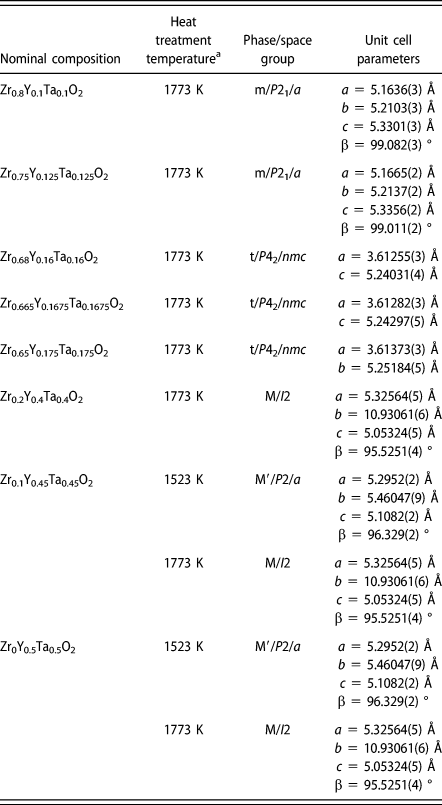
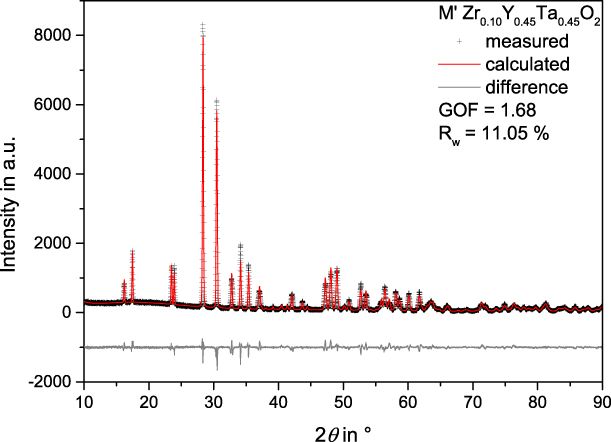
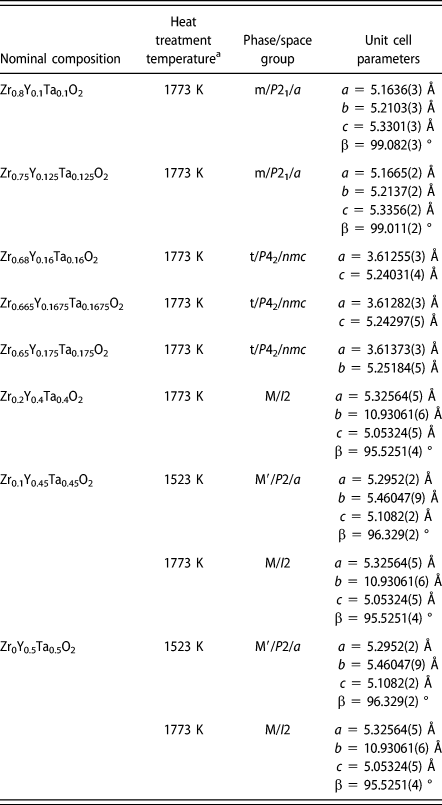
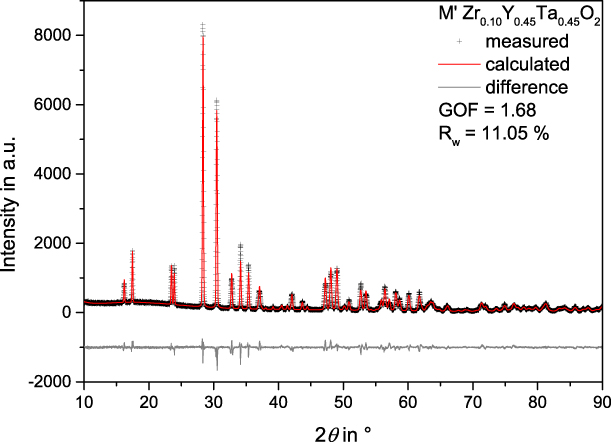
The phase constitution of the samples was characterized using XRD. The results and the refined unit cell parameters are given in Table I. The XRD pattern of the sample with nominal composition Zr0.1Y0.45Ta0.45O2 heat treated at 1523 K with the results of the Rietveld refinement using the M′ phase is shown in Fig. 1, exemplarily. The XRD patterns and Rietveld refinements of the other samples are given in the Supplementary material Figs. S1–S9. The Y0.5Ta0.5O2-rich samples heat treated at 1523 K showed only single M′ phase, whereas after exposure to 1773 K, the powders comprise pure M phase. The ZrxY0.5−x/2Ta0.5−x/2O2 sample with x = 0.2 heat treated at 1523 K was not phase pure and was therefore not investigated further in the present study.
Phases and refined unit cell parameters of the samples synthesized and heat treated at different temperatures.
a All heat treatments were performed for 100 h in a box furnace in air.
XRD pattern of the sample with nominal composition Zr0.1Y0.45Ta0.45O2 heat treated at 1523 K for 100 h in air including the results of the Rietveld refinement.
The ZrO2-rich samples were all heat treated at 1773 K to reach equilibrium faster. Besides a slightly different extension of the tetragonal t solid solution phase field, no differences are expected due to the heat treatment temperature (compare the studies at 1773 K [Reference Macauley, Fernandez and Levi13] and 1523 K [Reference Macauley, Fernandez, van Sluytman and Levi14]). The ZrxY0.5−x/2Ta0.5−x/2O2 sample with nominal composition 0.65 ≤ x ≤ 0.68 were tetragonal t phase, whereas the samples with higher ZrO2 content were monoclinic m phase, in accordance with Ref. [Reference Macauley, Fernandez and Levi13].
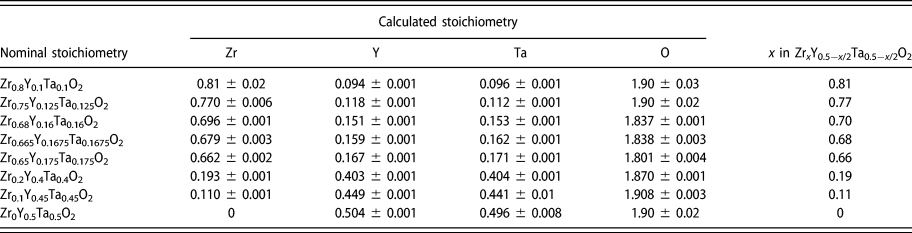
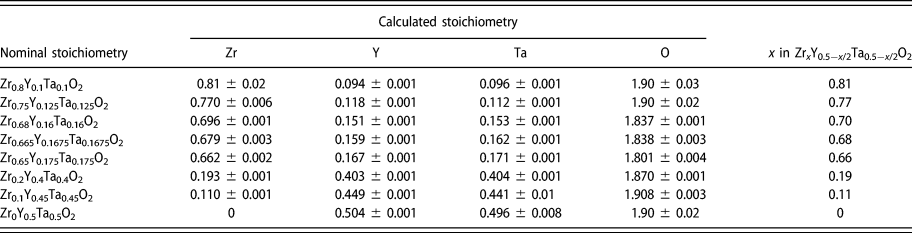
The chemical composition of the samples was investigated using electron probe microanalysis (EPMA) and the results are given in Table II, confirming that Y3+ and Ta5+ are equimolar in all samples within experimental uncertainty. In the samples on the zirconia-rich side, the Zr4+ content is slightly higher than anticipated in the nominal compositions. Additionally, in all samples the oxygen content is underestimated. Therefore, the experimentally determined cation ratio was used for calculation of the enthalpies of formation and it was assumed that oxygen charge balances the cations. The calculated composition x in ZrxY0.5−x/2Ta0.5−x/2O2 is given in Table II as well (the measured data in at.% are given in Table S1 in the Supplementary material section).
Chemical composition of the samples determined using EPMA and calculated actual composition x in ZrxY0.5−x/2Ta0.5−x/2O2. The error is two standard deviation of the mean of at least three measurements.
Enthalpies of formation
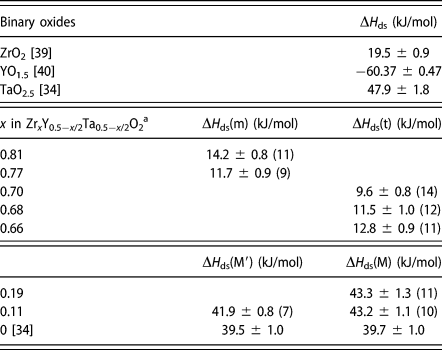
The drop solution enthalpies ΔH ds in sodium molybdate melt at 974 K are given in Table III for the M′ and M, t and m solid solution samples, as well as for the constituent oxides. The latter are needed to calculate the enthalpies of formation of the solution at room temperature.
Average drop solution enthalpies of the samples along the quasibinary ZrO2–Y0.5Ta0.5O2 and their constituent binary oxides in sodium molybdate melt at 974 K. The values in parentheses indicate the number of drops. The error is two standard deviation of the mean.
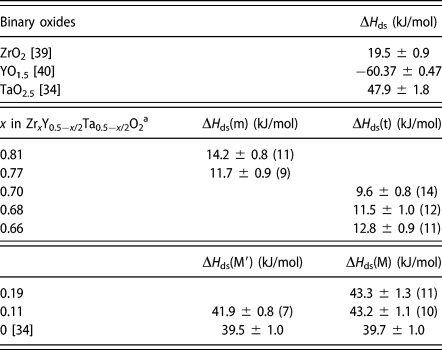
a Calculated from chemical composition determined using EPMA.
The enthalpies of formation from the constituent oxides have been calculated using the following thermodynamic cycle, where s means solid and sln means dissolved in the sodium molybdate solvent:
 $$\eqalign{x \cdot {\rm{Zr}}{{\rm{O}}_{2\left( {{\rm{s}},298\;{\rm{K}}} \right)}} + \left( {0.5 - {x / 2}} \right) \cdot {\rm{Y}}{{\rm{O}}_{1.5\left( {{\rm{s}},298\;{\rm{K}}} \right)}} + \left( {0.5 - {x / 2}} \right) \cdot \cr{\rm{Ta}}{{\rm{O}}_{2.5\left( {{\rm{s}},298\;{\rm{K}}} \right)}} \to {\rm{Z}}{{\rm{r}}_x}{{\rm{Y}}_{0.5 - {x / 2}}}{\rm{T}}{{\rm{a}}_{0.5 - {x / 2}}}{{\rm{O}}_{2\left( {{\rm{s}},298\;{\rm{K}}} \right)}}:\quad \Delta {H_{{\rm{f,ox}}}}\quad ,$$
 $${\rm{Zr}}{{\rm{O}}_{2\left( {{\rm{s}},298\;{\rm{K}}} \right)}} \to {\rm{Zr}}{{\rm{O}}_{2\left( {{\rm{sln}},974\;{\rm{K}}} \right)}}:\quad \Delta {H_{{\rm{ds}}}}\left( {{\rm{Zr}}{{\rm{O}}_2}} \right)\quad ,$$
 $${\rm{Y}}{{\rm{O}}_{1.5\left( {{\rm{s}},298\;{\rm{K}}} \right)}} \to {\rm{Y}}{{\rm{O}}_{1.5\left( {{\rm{sln}},974\;{\rm{K}}} \right)}}:\quad \Delta {H_{{\rm{ds}}}}\left( {{\rm{Y}}{{\rm{O}}_{1.5}}} \right)\quad ,$$
 $${\rm{Ta}}{{\rm{O}}_{2.5\left( {{\rm{s}},298\;{\rm{K}}} \right)}} \to {\rm{Ta}}{{\rm{O}}_{2.5\left( {{\rm{sln}},974\;{\rm{K}}} \right)}}:\quad \Delta {H_{{\rm{ds}}}}\left( {{\rm{Ta}}{{\rm{O}}_{2.5}}} \right)\quad ,$$
 $$\eqalign{{\rm{Z}}{{\rm{r}}_x}{{\rm{Y}}_{0.5 - x}}{\rm{T}}{{\rm{a}}_{0.5 - x}}{{\rm{O}}_{2\left( {{\rm{s}},298\;{\rm{K}}} \right)}} \quad\to {\rm{Z}}{{\rm{r}}_x}{{\rm{Y}}_{0.5 - x}}{\rm{T}}{{\rm{a}}_{0.5 - x}}{{\rm{O}}_{2\left( {{\rm{sln}},974\;{\rm{K}}} \right)}}: \cr\quad\Delta {H_{{\rm{ds}}}}\left( {{\rm{Z}}{{\rm{r}}_x}{{\rm{Y}}_{0.5 - x}}{\rm{T}}{{\rm{a}}_{0.5 - x}}{{\rm{O}}_2}} \right)\quad ,$$
 $$\eqalign{\Delta {H_{{\rm{f,ox}}}} = - \Delta {H_{{\rm{ds}}}}\left( {{\rm{Z}}{{\rm{r}}_x}{{\rm{Y}}_{0.5 - {x / 2}}}{\rm{T}}{{\rm{a}}_{0.5 - {x / 2}}}{{\rm{O}}_2}} \right) + x \cdot \Delta {H_{{\rm{ds}}}}\left( {{\rm{Zr}}{{\rm{O}}_2}} \right) \cr+ \left( {0.5 - {x / 2}} \right) \cdot \Delta {H_{{\rm{ds}}}}\left( {{\rm{Y}}{{\rm{O}}_{1.5}}} \right) + \left( {0.5 - {x / 2}} \right) \cr\cdot \Delta {H_{{\rm{ds}}}}\left( {{\rm{Ta}}{{\rm{O}}_{2.5}}} \right)\quad .$$
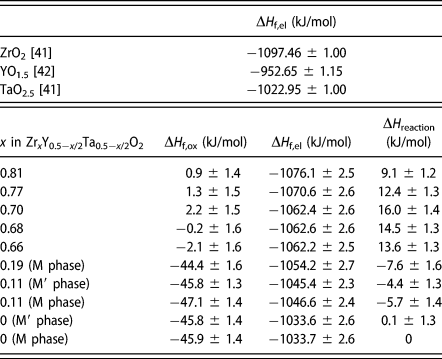
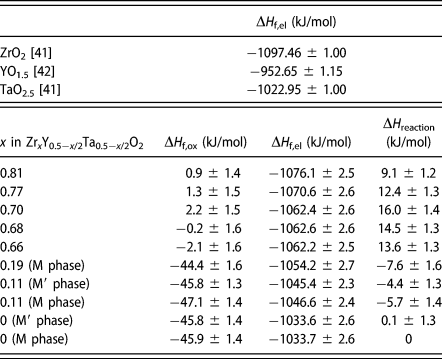
Table IV shows the resulting enthalpies of formation from the constituent binary oxides at room temperature. Using the standard enthalpies of formation of the constituent oxides ZrO2, YO1.5, and TaO2.5 given in Table IV, the standard enthalpies of formation from the elements ΔH f,el as well as the enthalpies of reaction ΔH reaction from the end members ZrO2 and Y0.5Ta0.5O2 were also calculated and are tabulated in Table IV.
Enthalpies of formation at 298 K from the constituent oxides ΔH f,ox, from the elements ΔH f,el and from ZrO2 and M Y0.5Ta0.5O2 ΔH reaction.
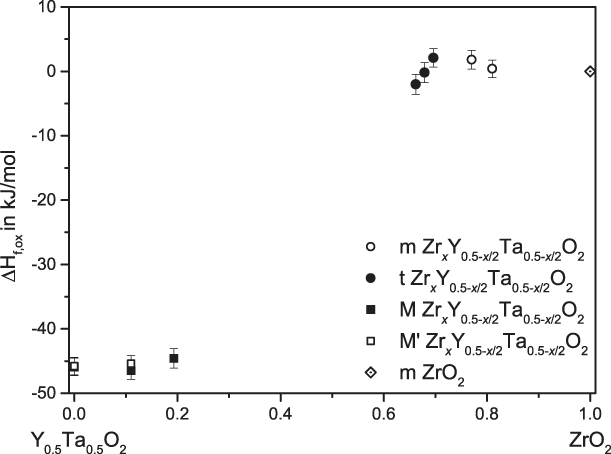
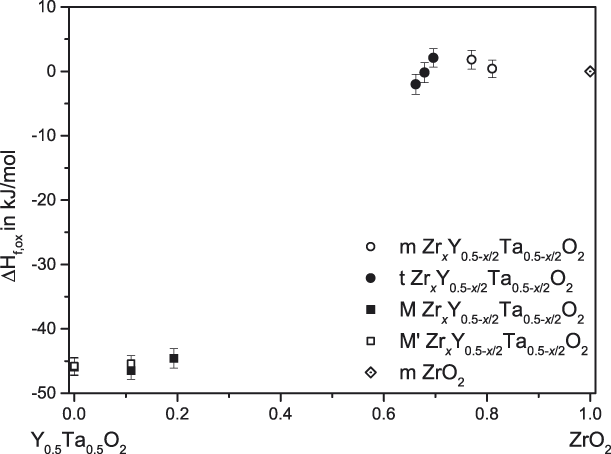
The enthalpies of formation from binary oxides at room temperature, shown in Fig. 2, shed light on the factors driving the stability in this quasibinary system. At zirconia-poor compositions near Y0.5Ta0.5O2, the M and M′ phases show substantial energetic stability of about −45 kJ/mol, with no discernible difference between M and M′ phases and little or no composition dependence in ΔHf,ox. This energetic stabilization reflects the ordered substitution of 0.5Y3+ + 0.5Ta5+ for Zr4+ and is largely an electrostatic effect, with some contribution from the lowering of symmetry associated with the cation ordering pattern [Reference Heinze, Natarajan, Levi and van der Ven17]. In contrast, the monoclinic solid solution of the zirconia-rich side of the diagram shows almost zero heats of formation from binary oxides, consistent with disordered solid solutions whose stabilization would come only from the configurational entropy of cation mixing. The tetragonal phase appears slightly more energetically stable than the monoclinic one where it occurs at more zirconia-poor compositions, but their small energetic stabilization and similarity in compositions preclude more quantitative analysis of these small differences in energetics. A tendency of short range ordering of Y3+ and Ta5+ in the ZrO2 solid solution was suggested in Ref. [Reference Heinze, Natarajan, Levi and van der Ven17]. The most striking feature in Fig. 2 is that there are two families of structures, ordered ones with substantial energetic stabilization at compositions rich in yttrium tantalate and disordered ones with little or no energetic stabilization at compositions near zirconia. These two regimes are separated at intermediate compositions by a wide gap or two phase region where no additional compounds or solid solutions are found.
Enthalpies of formation from the constituent oxides at 298 K of phases in the quasibinary ZrO2–Y0.5Ta0.5O2 system.
Besides gaining valuable thermochemical data of the solid solution phases in the ZrO2–Y0.5Ta0.5O2 quasibinary, the additional goal of this study was to determine the stable room temperature phase of the Y0.5Ta0.5O2 solid solution. However, the measured values of the two monoclinic polymorphs M′ and M at the different compositions are the same within experimental uncertainty. This was already observed and is discussed for pure Y0.5Ta0.5O2 in a companion article [Reference Lepple, Ushakov, Lilova, Macauley, Fernandez, Levi and Navrotsky34]. Further thermodynamic parameters such as entropy data to calculate the Gibbs energies or other experimental techniques would be needed to elucidate the phase stabilities of the two monoclinic polymorphs. However, it is likely that any differences in the free energies and entropies of the two monoclinic polymorphs are small and difficult to determine experimentally. The observed small enthalpy differences support the DFT study of Heinze et al. [Reference Heinze, Natarajan, Levi and van der Ven17] where the energy difference of M′ and M Y0.5Ta0.5O2 was calculated to be less than 10 meV/atom (∼0.3 kJ/mol) at 0 K.
Heat capacities of the compositions in the Y0.5Ta0.5O2 solid solution
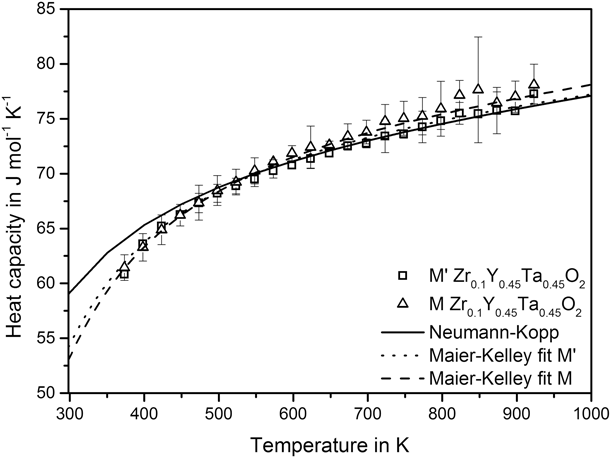
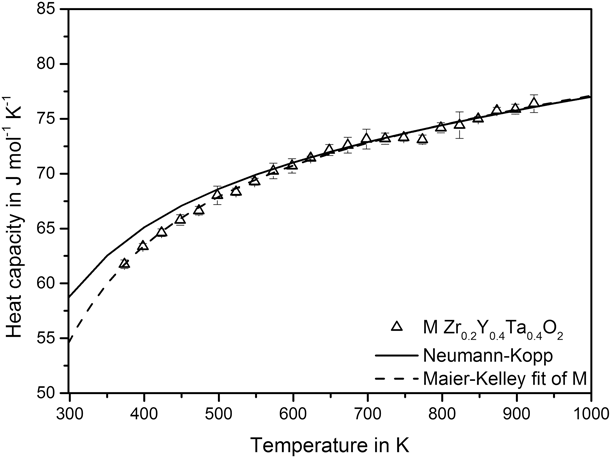
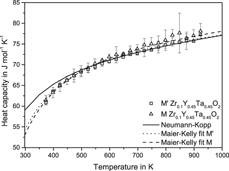
The dependence of the heat capacity of the phases on composition is needed to model the temperature dependence of the Gibbs energy. The measured heat capacities of the two monoclinic polymorphs of the composition x = 0.11 are plotted in Fig. 3 and the heat capacity of M with composition x = 0.19 is given in Fig. 4. A Maier–Kelley type function,
 $${C_{\rm{p}}}\left[ {{{\rm{J}} / {\left( {{\rm{mol}}\;{\rm{K}}} \right)}}} \right] = A + B \cdot T + C \cdot {T^{ - 2}}\quad ,$$
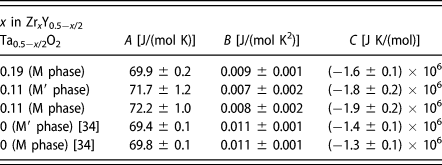
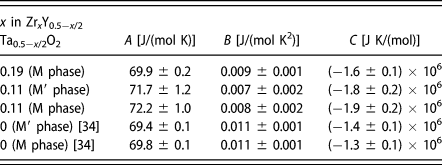
was fitted to the averaged experimental data using the least squares method. The coefficients obtained are given in Table V and the resulting curves are given in Figs. 3 and 4. For completeness, the coefficients for undoped Y0.5Ta0.5O2 obtained in a companion study [Reference Lepple, Ushakov, Lilova, Macauley, Fernandez, Levi and Navrotsky34] are given in Table V as well. Additionally, the experimental data are compared to estimated heat capacities derived from the constituent oxides according to the Neumann–Kopp rule using the following equation:
 $$\eqalign{{C_{\rm{p}}}\left( {{\rm{Z}}{{\rm{r}}_x}{{\rm{Y}}_{0.5 - x}}{\rm{T}}{{\rm{a}}_{0.5 - x}}{{\rm{O}}_2}} \right) = x \cdot {C_{\rm{p}}}\left( {{\rm{Zr}}{{\rm{O}}_2}} \right) + \left( {0.5 - {x / 2}} \right) \cr\cdot {C_{\rm{p}}}\left( {{\rm{Y}}{{\rm{O}}_{1.5}}} \right) + \left( {0.5 - {x / 2}} \right) \cdot {C_{\rm{p}}}\left( {{\rm{Ta}}{{\rm{O}}_{2.5}}} \right)\quad .$$
Measured heat capacities of M′ (squares) and M Zr0.1Y0.45Ta0.45O2 (triangles) (measured composition x = 0.11) and respective Maier–Kelley fits compared to the heat capacity calculated from the binary oxides using the Neumann–Kopp estimate (black line). The uncertainties are two standard deviations of the mean of three measurements.

Measured heat capacities of M Zr0.2Y0.4Ta0.4O2 (triangles) (measured composition x = 0.19) and respective Maier–Kelley fit compared to the heat capacity calculated from the binary oxides using the Neumann–Kopp estimate (black line). The uncertainties are two standard deviations of the mean of three measurements.

Coefficients of the Maier–Kelley type fit to the averaged experimental heat capacity data.
The calculated heat capacity using the sum of the heat capacities of the constituent oxides describes the experimental data well.
Conclusion
The enthalpies of formation from oxides and the heat capacities of compositions along the ZrO2–Y0.5Ta0.5O2 quasibinary described as ZrxY0.5−x/2Ta0.5−x/2O2 (0 ≤ x ≤ 0.2 and 0.65 ≤ x ≤ 1) were determined in this work. The ordered phases near Y0.5Ta0.5O2 are energetically stabilized by about −45 kJ/mol and there is no measurable difference between M and M′ polymorphs of the Y0.5Ta0.5O2-rich compositions. The disordered ZrO2-rich phases show little or no energetic stabilization. The heat capacities of the M′ and M ZrxY0.5−x/2Ta0.5−x/2O2 with x = 0.11 and 0.19 were measured in the temperature range 373–923 K. The heat capacities of M′ and M phase are similar and can be estimated from their constituent oxides using the Neumann–Kopp rule. The results of this work provide key data for the assessment of a self-consistent thermodynamic database of the quasibinary, containing models for all stable solid solution phases.
Materials and methods
Sample synthesis
Powders of different compositions along the ZrO2–Y0.5Ta0.5O2 quasibinary listed in Table I were synthesized using reverse coprecipitation as described in Ref. Reference Macauley, Fernandez and Levi13. Precursor solutions of zirconium oxynitrate hydrate (99.9% metals basis, Alfa Aesar, Kandel, Germany) as well as yttrium nitrate hexahydrate (99.9% rare earth oxide basis, Alfa Aesar) in deionized water and tantalum chloride (99.99% trace metals basis, Alfa Aesar) in ethanol were mixed in the required proportions just before precipitation. The solution compositions were calibrated by gravimetric means before use. The mixed solution was added dropwise into ammonium hydroxide with a pH above 10 to ensure concurrent precipitation of all cations. The precipitates were then filtered, washed with ethanol, and dried overnight at 373 K followed by a calcination step at 1173 K for 4 h in a box furnace in air. Subsequently, the ZrO2-rich compositions were heat treated for 100 h at 1773 K in air, whereas the ZrO2-lean powders were heat treated for 100 h in air at 1523 K or 1773 K to obtain M′ or M polymorph, respectively.
Crystal structure characterization and chemical analysis
The phase composition of the samples was characterized using X-ray powder diffraction (XRD) and Rietveld method. The XRD measurements were conducted on a STOE Stadi-P diffractometer (linear PSD) with Cu Kα1 radiation (Ge monochromator, λ = 1.540598 Å) in transmission geometry in a 2θ range between 10° and 90°. The software GSAS-II, Advanced Photon Source, Argonne National Laboratory, Argonne, Illinois [Reference Toby and von Dreele43] was used for the Rietveld analysis of the diffraction patterns.
The chemical composition was analyzed using electron probe micro analysis (EPMA). The powder samples were pressed into small pellets, embedded in epoxy resin, and ground to 1 μm. The EPMA was conducted on a JEOL JXA-8100 (JEOL, Japan) with an accelerating voltage of 30 kV. At least three spot measurements per sample were conducted for quantitative analysis.
Differential scanning calorimetry (DSC)
DSC was used to determine the heat capacities of M’ and M polymorphs of the Y0.5Ta0.5O2-rich samples in a temperature range from 373 to 923 K. The measurements were performed in a STA 449 F3 Jupiter (Netzsch, Selb, Germany) in Pt/Rh crucibles in argon atmosphere and a heating rate of 10 K/min. The measurements were conducted as suggested by IUPAC [Reference Della Gatta, Richardson, Sarge and Stølen44] starting with a baseline measurement, followed by the reference measurement using a sapphire disc of known mass and then the sample measurement with a pressed powder sample with a diameter of 5 mm and a similar thermal mass as the reference sample.
High-temperature oxide melt solution calorimetry
High-temperature calorimetry was performed at 974 K using a custom-built Calvet calorimeter as described in [Reference Navrotsky45, Reference Navrotsky46]. Drop solution experiments were conducted to determine the standard enthalpies of formation. Sodium molybdate melt (3Na2O·4MoO3) was used as a solvent; synthetic air (80% N2/20% O2) gas with a flow rate of 6 mL/min was bubbled through the solvent to help dissolution of the gently pressed samples. Additionally, air was flushed over the melt with a rate of 35 mL/min. Approximately 5–8 mg of samples were dropped into 20 g solvent. The measured heat effect, called drop solution enthalpy, consists of the heat content of the compound from room temperature to 974 K and the enthalpy of solution.
Supplementary material
To view supplementary material for this article, please visit https://doi.org/10.1557/jmr.2019.213.
Acknowledgments
ML was funded by the German Research Foundation (grant LE-3727/1-1). The calorimetric work at UC Davis was supported by the US Department of Energy, Office of Basic Energy Science, grant DE-FG02-03ER46053 and grant DMR-1105672 from the National Science Foundation. The authors are grateful to Gerald Schmidt for chemical analysis and Chandra A. Macauley and Sergey V. Ushakov for fruitful discussions.