Owing to the ongoing improvement of life expectancy, the number of grown-up patients with congenital heart disease is generally increasing, and more and more patients receive tertiary care in specialised centres for adult congenital heart disease.Reference Moons, Sluysmans and De Wolf 1 Tetralogy of Fallot accounts for about 5% of all congenital heart diseases and is the most common cyanotic congenital heart disease.Reference van der Linde, Konings and Slager 2
Physical activity guidelines allow adults who underwent successful surgical correction for tetralogy of Fallot to perform low to moderate dynamic and static sports.Reference Takken, Giardini and Reybrouck 3 All competitive sports are allowed in patients with an excellent repair and clinical status. If not, patients are instructed to participate only in low-intensity competitive sports.Reference Graham, Bricker, James and Strong 4 Normal to severely reduced physical activity levels in adults with congenital heart disease have been reported recently.Reference Dua, Cooper, Fox and Graham 5 , Reference Muller, Hess and Hager 6 However, data regarding physical activity levels or attitudes towards exercise focussing specifically on adults with tetralogy of Fallot are lacking but seem important, as adult patients with tetralogy of Fallot do need to accept certain exercise restrictions, but they generally do not feel limited. As a consequence, a patient with tetralogy of Fallot who is not adequately informed about physical exercise with his condition might remain inactive because he is too scared to exercise, or, on the other hand, he might be too active and cross the limits of safe exercise.
Despite very good outcomes from surgical correction and the allowance to be physically active, researchers report a significantly reduced exercise capacity as assessed by peak oxygen uptake compared with healthy persons of similar age and gender.Reference Diller, Dimopoulos and Okonko 7 – Reference Buys, Cornelissen and Van De Bruaene 9 Different mechanisms underlying this reduced peak oxygen uptake in tetralogy of Fallot have been previously investigated, but to our knowledge the extent to which physical activity levels contribute to the reduced exercise capacity has hardly been studied.
Furthermore, although adult patients with tetralogy of Fallot or other congenital heart diseases generally experience a good health status, poorer perceived physical functioning and perceived general health has been reported, which is correlated with exercise capacity.Reference Hager and Hess 10 – Reference Daliento, Mapelli and Russo 12
Therefore, our aim was to investigate physical activity behaviour and perceived health status in adults with corrected tetralogy of Fallot and to investigate determinants of physical activity in daily life.
Materials and methods
Between 2009 and 2010, all patients with tetralogy of Fallot who were scheduled for their routine follow-up appointment at our outpatient clinic were also scheduled for cardiopulmonary exercise testing. We excluded study patients with other cardiac defects for which surgical intervention was needed and only included patients who terminated the exercise test because of exhaustion, as defined by shortness of breath and/or fatigue of the legs. In all, 74 consecutive patients who performed the exercise test until exhaustion were recruited for the study and were asked to complete the paper version of the Flemish Physical Activity Computerized Questionnaire about physical activity in their daily life and the short form 36 about their health status. All patients were between 16 and 46 years of age. There was one patient who was not mentally able to fill in the questionnaires, as assessed by the parents, and thus was excluded from the study. The study was approved by the Ethical Committee of the University Hospitals Leuven.
Maximal cardiopulmonary exercise tests on a bicycle ergometer (Ergometrics 800S, Ergometrics, Bitz, Baden-Württemberg, Germany) were performed in a laboratory in which the temperature was stabilised at 18–22°C. The initial workload of 20 W was increased by 20 W every minute until exhaustion, as defined by shortness of breath and/or fatigue of the legs, was reached. Systolic and diastolic blood pressures were measured at rest and every 2 min during the exercise test. Heart rate was calculated from the continuously registered 12-lead electrocardiogram (Max Personal Exercise Testing®, Marquette, Wisconsin, United States of America), and respiratory data were continuously measured through breath-by-breath analysis (Oxygen Alpha®, Jaeger, Mijnhardt, Bunnik, The Netherlands). Before each test, the gas analysers and the flowmeter were calibrated according to the manufacturer's instructions. During the exercise test, oxygen uptake and carbon dioxide production were determined from the continuous measurement of oxygen and carbon dioxide concentration in the inspired and expired air. Peak oxygen uptake was defined as the highest 30-s average of oxygen uptake at the end of the test. The percentage of predicted peak oxygen uptake (peak oxygen uptake%) was calculated as peak oxygen uptake divided by the maximal predicted oxygen uptake, using the values reported by Wasserman and Whipp.Reference Wasserman and Whipp 13 Exercise testing data were compared with data from a control group of apparently healthy subjects of similar age who performed the same exercise testing protocol at the same laboratory.
Routine transthoracic echocardiography was performed with standard gray-scale, and Doppler imaging examinations using a Vivid 7 or 9 ultrasound system (General Electric Vingmed Ultrasound, Horten, Norway) equipped with a 3-MHz transducer. All echocardiographic studies were performed with the participant in the supine position.
Qualitative evaluations were used for the evaluation of right ventricular hypertrophy (0 = no hypertrophy, 1 = hypertrophy), right ventricular dilatation (no, slight, moderate, and severe dilatation, scaling from 1 to 4), right ventricular contractility (normal, mild, moderate, and severe dysfunction, scaling from 1 to 4), pulmonary valve insufficiency, and tricuspid valve insufficiency.
A postal survey was used to collect information regarding physical activity and perceived health status. Patients who did not return their questionnaires by post were asked to complete them during the next follow-up visit at the outpatient clinic (maximum 1 year later).
Self-reported physical activity was assessed by the Flemish Physical Activity Computerized Questionnaire. This questionnaire indicates how long and according to which intensity the patients are involved in different physical activities during a usual week in a usual year. The Flemish Physical Activity Computerized Questionnaire is a reliable and valid questionnaire about regular physical activity.Reference Matton, Wijndaele and Duvigneaud 14 Reference values from the Policy Research Centre Sport, Physical Activity and Health (based on 1170 Flemish men and women between 18 and 75 years) were used for comparative purposes.Reference Scheers, Philippaerts and Van Langendonck 15 Health-related sports participation was based on all sports of which the associated metabolic equivalent was at least 4.5 for patients younger than 35 years old, or at least 4.0 for patients older than 35 years old.Reference Scheers, Philippaerts and Lefevre 16
The short form 36 health survey questionnaire was used to evaluate the general health perception. The short form 36 is an eight-scale profile, which provides a score between 0 and 100 for following eight subscales: physical and social functioning, role limitations attributed to physical and emotional problems, mental health, vitality (energy/fatigue), pain, and general health perception. Higher scores indicate a better health perception. This questionnaire has previously been used in adult populations with congenital heart disease.Reference Hager and Hess 10 , Reference Gratz, Hess and Hager 11 , Reference Kamphuis, Ottenkamp and Vliegen 17 The validity of the Dutch version of the questionnaire was showed by Aaronson et al.Reference Aaronson, Muller and Cohen 18 Their reference values (1742 adults; 56% male; mean age 47.6 ± 18 years; age range 16–94 years) were used for comparison with a general population.Reference Aaronson, Muller and Cohen 18
Statistical Analysis Software version 9.3 was used for data analysis (SAS Institute Inc., Cary, North Carolina, United States of America). Data are reported as means ± standard deviation, as median (range), or as numbers for dichotomous variables. The Shapiro–Wilk statistic was used to check the normality.
Exercise testing data were compared with data from 196 healthy adults of similar age, gender, and body mass index by Student's unpaired t-test. Possible determinants of physical activity were investigated by Pearson and Spearman correlation coefficients. The following variables were investigated: demographic characteristics, clinical characteristics, educational level, employment status, marital status, and all fields of perceived health status. Results from the questionnaires were compared with reference values, according to age and gender, by calculation of mean standardised differences. For each patient, the score of the reference group was subtracted from the patient's score and this was divided by the standard deviation of the reference group, generating a standardised difference for that patient. The average of the patients’ values resulted in a mean standardised difference. The one sample t-test was used to evaluate whether the mean standardised differences significantly differed from zero. All statistical tests were two sided at a significance level of 0.05. Correction for multiple testing was applied according to the false discovery rate method of Benjamini.Reference Benjamini, Drai, Elmer, Kafkafi and Golani 19
Results
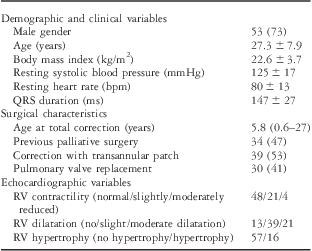
Patients’ mean age was 27.3 ± 7.9 years and ranged between 16 and 46 years. Demographic characteristics and clinical characteristics are summarised in Table 1. Of all patients, 34 underwent palliative surgery. Final correction was established in 29 patients with a valvotomy, in 39 patients with a transannular patch, and in five patients with a homograft.
Demographic and clinical characteristics (n = 73).

RV = right ventricle.
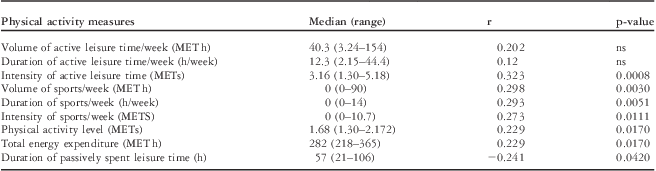
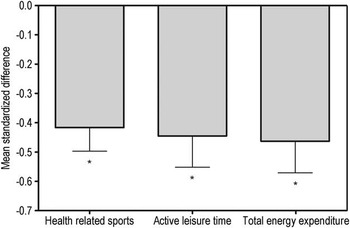
A summary of all data concerning physical activity can be found in Table 2. In all, 55% of all patients were involved in sports activities, most often fitness, swimming, jogging, cycling, and football. Of this group, seven patients (10%) were involved in competition (3 × football, 1 × tennis, 1 × skateboarding, 1 × dressage, 1 × fishing). Time spent in sports ranged from 0 to 20 h/week. In addition, if activities such as housekeeping, gardening, and walking/biking for transportation were taken into account, patients spent between 0.5 and 46 h in active leisure time. Total energy expenditure, volume of health-related sports, and volume of active leisure time were significantly lower compared with the general population (see Fig 1).
Daily physical activity measures and correlation with peak oxygen uptake.

METs = metabolic equivalent of tasks; ns = not significant
Mean standardised differences of physical activity measures in comparison with healthy counterparts. *Statistically different from 0 (p < 0.0001).

On the basis of the classification of physical activity levels of the World Health Organisation, 55% of all patients were sedentary, 27% had an active or moderately active lifestyle, and 18% of the group had a vigorously active lifestyle. Out of all investigated determinants of physical activity, only body mass index was weakly correlated with the volume of health-related sports (r = 0.263; p = 0.026).
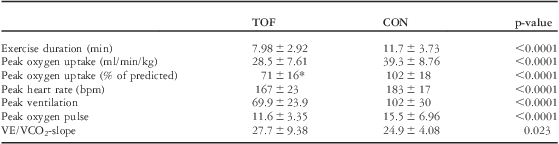
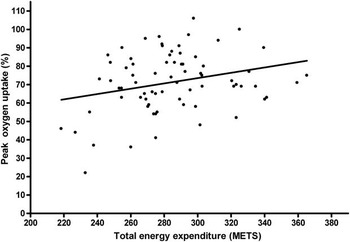
Table 3 lists all exercise data. Mean peak oxygen uptake was 28.3 ± 7.80 ml/min/kg or 71 ± 16% of predicted values, which is significantly lower than expected in a general population (p < 0.0001). Significant correlations were found between peak oxygen uptake and reported measures of physical activity in daily life (see Table 2 and Fig 2).
Exercise variables in comparison with healthy controls.

CON = control group; TOF = tetralogy of Fallot; VE/VCO2 = ventilatory efficiency
Measures are expressed as mean ± standard deviation
Relationship of percentage of predicted peak oxygen uptake with total energy expenditure in daily life (r = 0.229; p = 0.017). METS = metabolic equivalent of tasks.

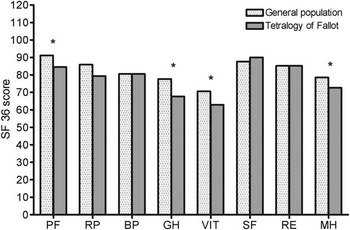
Perceived health status scores are shown in Figure 3. Perceived physical functioning, general health, vitality, and mental health were significantly lower than the healthy reference population. Perceived physical functioning was weakly correlated with peak oxygen uptake (r = 0.361; p = 0.002; Fig 2) and the intensity of health-related sports/week (r = 0.271; p = 0.023).
Mean short form 36 scores in patients with tetralogy of Fallot compared with the general population. *Significant difference between general population and patients with tetralogy of Fallot (p < 0.05). BP = bodily pain, GH = general health, MH = mental health, PF = physical functioning, RE = role-emotional functioning, RP = role-physical functioning, SF = social functioning, VIT = vitality.

Discussion
Patients with tetralogy of Fallot report lower physical activity levels compared with the general population and show a significantly lower exercise tolerance than healthy persons. Furthermore, adult patients with tetralogy of Fallot report lower scores in the fields of physical functioning, vitality, general health, and mental health compared with the general population. Parameters of daily physical activity are related with perceived physical functioning and show relationships with exercise capacity. Patients with a higher level of physical activity in daily life have a higher body mass index.
To the best of our knowledge, this is the first study that investigates determinants of physical activity in daily life in adult patients with tetralogy of Fallot. First, our results show that adult patients with tetralogy of Fallot are significantly less active compared with the general population. The World Health Organization states that a desirable physical activity level includes the regular practice of physical activity at work or during leisure time with an intensity and duration that will reduce the risk of becoming overweight and developing a variety of non-communicable chronic diseases usually associated as comorbidities with obesity. This corresponds to physical activity levels of 1.75 and higher. 20 Our study shows that a large part of patients with tetralogy of Fallot did not reach this recommendation. Reduced physical activity levels have previously been reported in adolescents and adults with congenital heart disease.Reference Dua, Cooper, Fox and Graham 5 , Reference Muller, Hess and Hager 6 , Reference Lunt, Briffa, Briffa and Ramsay 21 Reasons for reduced daily physical activity seem to be overprotection by the environment, fear for adverse reactions or sudden death triggered by exercising, and insufficient or unclear information given by the patients’ healthcare providers.Reference Reybrouck and Mertens 22 – Reference Harrison, Silversides, Oechslin and Kovacs 24 Indeed, adult patients with tetralogy of Fallot need to take certain guidelines on physical activity into account; however, they are not entirely restricted from physical exercise.Reference Takken, Giardini and Reybrouck 3 Moreover, Therrien et alReference Therrien, Fredriksen, Walker, Granton, Reid and Webb 25 showed that a moderately intense exercise training programme seems to be safe and has beneficial effects on the exercise capacity in clinically stable patients with tetralogy of Fallot. Furthermore, our study now provides evidence for the relationship of low physical activity levels with reduced exercise capacity of adult patients with tetralogy of Fallot. It has already been suggested that the reduced exercise tolerance could be explained by the fact that adults with congenital heart disease have a low level of daily physical activity; however, this was not based on an evaluation of physical activity levels.Reference Fredriksen, Veldtman and Hechter 8 Muller et alReference Muller, Hess and Hager 6 showed this relation in a large group of adults with various congenital heart conditions. It remains to be further investigated whether physical activity increases cardiopulmonary exercise capacity or whether patients with a better cardiopulmonary condition are more likely to be physically active.
Second, we investigated which other variables are related with physical activity in daily life. We did not find any differences in physical activity levels according to demographic, clinical, and educational characteristics. We only found a relationship between body mass index and volume of health-related physical activity in daily life. It might seem contradicting that patients with a higher body mass index are more active in daily life. However, as most patients with tetralogy of Fallot are generally rather thin, this probably reflects a higher muscle mass in the more physically active part of our study group.
Third, we evaluated the patients’ perceived health status by the short form 36 questionnaire. Lower scores compared with the normal population in the fields of physical functioning and general health have previously been reported and our results are consistent with these findings.Reference Hager and Hess 10 , Reference Gratz, Hess and Hager 11 , Reference Lane, Lip and Millane 26 , Reference Lu, Cotts, Agarwal, Attili and Dorfman 27 Perceived physical functioning was correlated with objective exercise capacity, even though many patients overestimated their physical functioning. This phenomenon has been mentioned before and can be attributed to the fact that these patients have always had their cardiac problem and therefore their limitations seem normal for them.Reference Hager and Hess 10 Furthermore, we found reductions in perceived vitality and mental health. It seems that the cardiac condition, even if optimally treated, causes the patient to feel tired and somehow limited, leading not only to physical limitations but to emotional problems as well.
Regular follow-up in order to keep the adult patient with tetralogy of Fallot healthy is the primary goal of the tertiary care centre for adult congenital heart disease. Patients therefore undergo regular medical check-ups including clinical examination, electrocardiography, cardiac imaging, and exercise testing. Furthermore, it is generally accepted that most adult patients with congenital heart disease should be stimulated to be physically active at an appropriate intensity, especially when it is taken into account that a reduced exercise capacity is related to a worse long-term prognosis of patients with tetralogy of Fallot.Reference Giardini, Specchia and Tacy 28 We therefore believe that the incorporation of individual patient counselling on physical activity, based on the advice of the patients’ cardiologist and performed by adequately trained physiotherapists or exercise scientists, might be a low-cost, high-benefit measure that will probably improve the patient's objective exercise tolerance and perceived health status, improve outcome and reduce the risk of the early development of cardiovascular and other diseases associated with inactivity.Reference Booth, Laye and Roberts 29
Some limitations of the present study should be recognised. We evaluated a small study group in a single-centre design. Our results should therefore be interpreted with caution when applied to the general population of adult patients with tetralogy of Fallot. Second, levels of physical activity were subjectively assessed by questionnaires and might therefore be overestimated and not comparable with results from objective measurements of physical activity.
Conclusions
In conclusion, adult patients with tetralogy of Fallot are less engaged in physical activities compared with the general population. This sedentary lifestyle seems to contribute significantly to reduced exercise capacity of adult patients with tetralogy of Fallot, in addition to the impairment based on the cardiac condition. Moreover, reduced exercise capacity and the intensity of sports performed in daily life are related with perceived physical functioning in daily life. Individual patient counselling on physical activity might be a low-cost, high-benefit measure to be taken in this patient population.
Acknowledgements
The authors greatly appreciate the work of Jan Meertens and Dirk Schepers in the exercise testing laboratory, as well as the help of Sonia Rens and Sara Van Damme with the collection of the questionnaires.