

The recovery of Bell Beaker pottery from megalithic graves in north-western France has often led to this phenomenon being tightly tied to the ‘megalithic phenomenon’ (Salanova Reference Salanova2003). However, while the bearers of the Bell Beaker material (2550–1950 bc) appear to have re-used these Neolithic collective funerary monuments primarily as burial places, the deposition of Bell Beakers and associated artefacts are never related to the monuments’ initial construction (ibid.). It is widely assumed that Bell Beaker funerary practices saw a shift from Neolithic collective burial to individual inhumation (Salanova Reference Salanova2007). Megalithic graves have long constituted our main source of information about the Bell Beaker complex in north-western France and this started to change only in the 1990s with the rise of development-led archaeology and the discoveries of settlements (Le Bihan Reference Le Bihan1993). However, most of these monuments were excavated in the 19th and the early 20th centuries and, due to the acidic soils present in a large part of north-west France, few of them contained extant human bones. Thus, old excavations have not necessarily provided reliable information about funerary practices. Turning to insights provided by the wider study of Neolithic funerary practices in France (Boulestin Reference Boulestin2019), a variety of depositional practices could actually have been employed, including single burial (of one individual), multiple burial (of several individuals buried simultaneously), and collective burial (of several individuals buried successively). The re-assessment of old finds, together with recent large-scale excavations, has brought a large number of new sites to light and has revealed a greater diversity than hitherto suspected in Bell Beaker funerary practices in the region.
The review presented here is situated within a wider review of Bell Beaker burial customs across north-western France, comparing them with preceding Recent and Late Neolithic funerary practices. The area considered here encompasses Brittany, Normandy, Pays de la Loire, and the former Poitou-Charentes region. It covers diverse geological settings, ranging from the Armorican Massif with its acidic soils to the fringes of two sedimentary basins (the Paris and Aquitaine Basins), where bones are better preserved. However, throughout the paper, references to neighbouring regions, principally the Channel Islands and the Paris Basin, will be used to fill some gaps and to set finds from north-western France into perspective. The heterogeneity of the dataset due to the differential preservation of bones and the history of research precludes any quantitative approach. Instead, this paper will focus on an overview of sites with reliable data rather than a detailed inventory. In the first part, we examine funerary practices during the Recent and Late Neolithic (3350–2550 bc), before the beginning of the Bell Beaker phenomenon. We then discuss the various Bell Beaker burial practices (2550–1950 bc) found in north-western France, their chronological and regional variability, and, above all, the research biases that might have affected their understanding.
BURIAL PRACTICES IN NORTH-WESTERN FRANCE DURING THE RECENT AND LATE NEOLITHIC ( c. 3350–2550 bc)
Recent and Late Neolithic funerary architecture
Historically, the end of the Neolithic in north-western France has been identified primarily through the abundance of megalithic monuments, known variously as gallery graves, lateral entrance tombs, or V-shaped or T-shaped graves that were constructed at that time (L’Helgouac’h Reference L’Helgouac’h1965). Most of these monuments are found in Brittany but many were excavated prior to the development of radiocarbon dating and few have been excavated since. The available radiocarbon dates suffer from many problems as the samples do not have reliable contexts and, often, the results have extremely wide standard deviations compared to more recently-dated samples. This being the case, the absolute chronology of the monuments and the period in north-western France rely heavily on cross-dating architecture and artefact associations with reliably dated extra-regional comparators, especially the gallery graves of the Paris Basin, dated to the second half of the Recent Neolithic and the beginning of the Late Neolithic (3350–2750 bc; Chambon & Salanova Reference Chambon and Salanova1996), which are of similar design to those in north-western France. No synthesis has been produced on these monuments in north-western France since that of Jean L’Helgouac’h (Reference L’Helgouac’h1965; Reference L’Helgouac’h1970) and we still rely on his assumption that these monuments were built around the same time as the gallery graves of the Paris Basin (3350–2750 bc). The few radiocarbon dates on charcoal available from these monuments, while being of dubious reliability and not directly dating monument construction, agree with this chronology (Le Roux Reference Le Roux1984; Le Goffic Reference Le Goffic1990; Reference Le Goffic1994; Lecornec Reference Lecornec1996). As regards lateral entrance tombs and V-shaped monuments, while it had previously been assumed that these were built during the Recent–Late Neolithic (Boujot & Cassen Reference Boujot and Cassen1992), the striking similarities between these megalithic monuments and the building plans of newly discovered Late Neolithic settlement structures (2900–2550 bc; Laporte et al. Reference Laporte, Fromont, Ghesquière, Marcigny, Tinevez, Blanchet, Jallot and Wattez2018) raise new questions about their chronological placement. In addition to the building of gallery graves and similar monuments, there are indications that at least some passage tombs in Brittany were still in use during the Recent and Late Neolithic (Closmadeuc Reference Closmadeuc1863; Le Roux & L’Helgouac’h Reference Le Roux and L’Helgouac’h1967; Giovannacci Reference Giovannacci2006). Such re-use also seems to be common in west-central France (Bailloud et al. Reference Bailloud, Burnez, Duday and Louboutin2008), contradicting the idea that re-use is a novelty solely attributable to the Bell Beaker phenomenon (Jeunesse Reference Jeunesse2014).
Collective burials
Questions still surround the nature of funerary practices in north-western France prior to the Bell Beaker Phenomenon. Indeed, collective burial forms the dominant rite throughout the Recent and Late Neolithic in France but, in Brittany, evidence for burial during this period is harder to interpret (Chambon Reference Chambon2003).
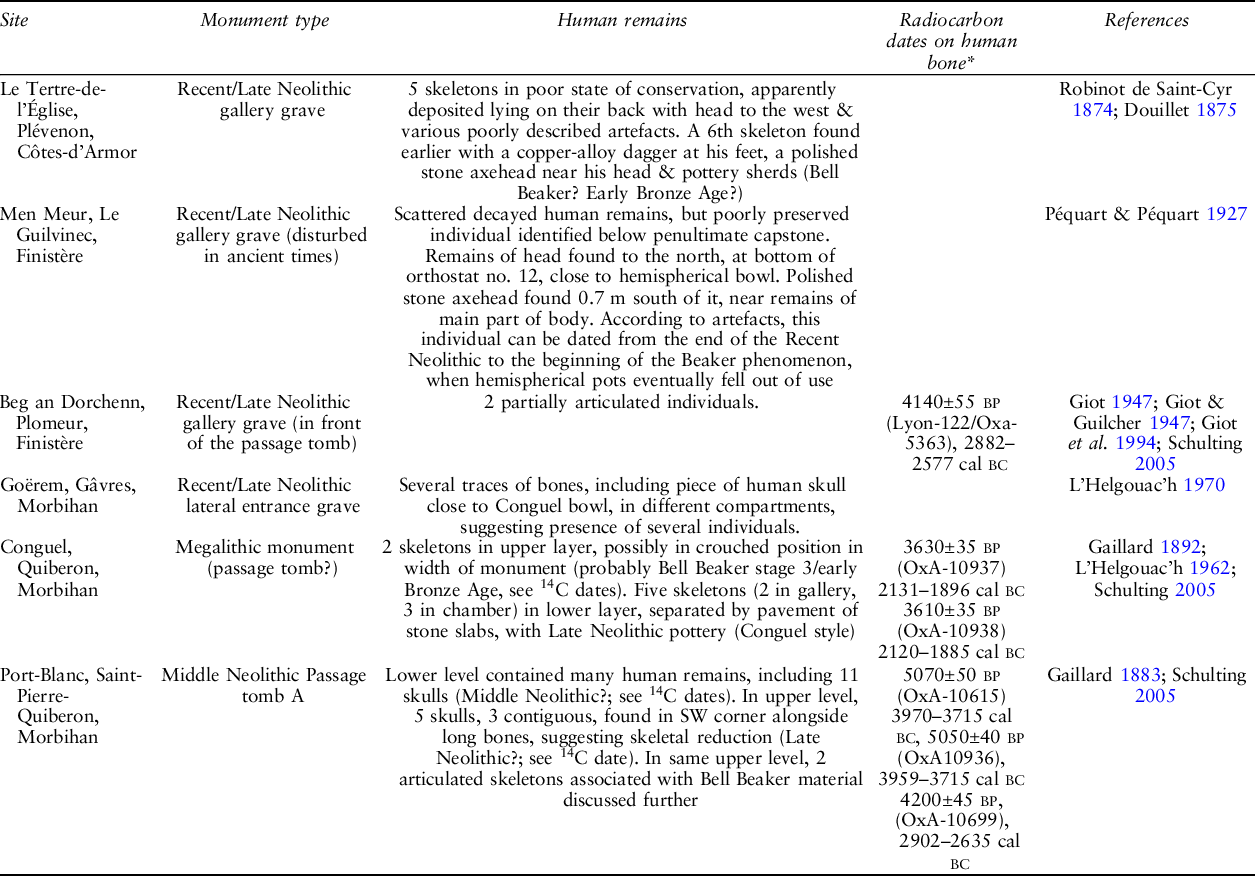
Whilst numerous gallery and lateral entrance graves are known and have been excavated in Brittany since the 19th century, few contain human remains due to soil acidity (Table 1). From the few recorded examples where human remains have survived we can state, at least, that inhumation was practised in Recent/Late Neolithic times, attested by both articulated skeletons and possibly disarticulated bones (eg, Port-Blanc). For these two periods, few individuals (fewer than a dozen), are found in each monument, implying either regular emptying of the chambers or that only a limited sub-section of the population was interred within a given megalithic monument. The presence of several sets of unburnt remains suggests that these monuments, apparently designed to be re-opened, were used as collective burial sites. Nevertheless, these rare pieces of evidence contrast sharply with the numerous individuals recorded in the gallery graves used as collective tombs in the Paris Basin, with up to a hundred in a single monument (Leclerc & Masset Reference Leclerc and Masset2006; Marçais et al. Reference Marçais, Chambon and Salanova2016).
EVIDENCE FOR THE DEPOSITION OF UNBURNT HUMAN REMAINS WITHIN COLLECTIVE MEGALITHIC GRAVES IN BRITTANY DURING THE LATE 4TH AND 3RD MILLENNIA bc

* calibrated using IntCal13, 95.4%
During the Recent and Late Neolithic the practice of cremation is attested at the lateral entrance grave of Beaumont (Saint-Laurent-sur-Oust, Morbihan; Tinevez Reference Tinevez1988; Tinevez et al. Reference Tinevez, Baud, Grévin, Lagier, Giot and Morzadec1990), the Allée sépulcrale at Sur la Mare (Poses, Eure; Billard et al. Reference Billard, Le Goff, Évin, Lanting, Reckinger and Munaut2006), and the Aire crématoire at Fontenay-le-Marmion (Calvados; Caillaud & Lagnel Reference Caillaud and Lagnel1972). At Beaumont, in addition to the cremated remains of at least three individuals, several objects with evidence of burning were recovered, suggesting that in situ ‘fire rituals’ could have taken place, although the use of fire to ‘remove’ skeletons or deposited materials in order to create space for new burials cannot be ruled out (Billard et al. Reference Billard, Le Goff, Évin, Lanting, Reckinger and Munaut2006).
Several gallery graves or lateral entrance tombs were compartmentalised during the Recent and Late Neolithic periods. Sometimes a portion of the monument was closed shortly after its construction, as seen in the terminal compartment of Le Goërem lateral entrance tomb (Gâvres, Morbihan; L’Helgouac’h Reference L’Helgouac’h1970). In other cases, the gallery grave is compartmentalised into several stone cists, as at Bod er Mohed (Cléguerec, Morbihan; Aveneau de la Grancière Reference Aveneau de la Grancière1901). These divisions of space were designed from the outset and pre-date the Bell Beaker depositions (ibid.). Finally, collective burials are found in caves in Poitou-Charentes (Boulestin Reference Boulestin2008), like the Abri de Bellefonds (Patte Reference Patte1971) or Artenac at Sainte-Mary (Bailloud et al. Reference Bailloud, Burnez, Duday and Louboutin2008).
Recent/Late Neolithic grave goods have been found both in contemporary megalithic architecture and in re-used older megalithic tombs. These include, for instance, the Late Neolithic Groh Collé and Conguel styles of pottery (Giovannacci Reference Giovannacci2006). It is notable that these ceramic finds tend to form only a minority of the associated material, with Groh Collé pottery having only been recorded from seven sites (a single vessel each time) and Conguel style pottery from 12 monuments (20 vessels in total). Instead, stone artefacts appear to be more common as grave goods during this period, in Brittany and Pays de la Loire 109 Grand-Pressigny daggers are known from collective tombs (Ihuel Reference Ihuel2019a) and 165 are recorded in Poitou-Charente (Ihuel Reference Ihuel, Mallet, Pelegrin and Verjux2019b), while polished stone ‘axehead-pendants’ are not uncommon (L’Helgouac’h Reference L’Helgouac’h1965).
Further activities around and inside megalithic graves
Sometimes hearths were built in and outside the monuments. Three hearths are known inside and in front of the gallery grave at Bilgroix (Arzon, Morbihan). Charcoal (of unspecified type) from the two hearths located in front of the entrance was radiocarbon dated to 3370–2640 cal bc (4320±140 bp; LQG-568s), and 3030–2710 cal bc (4280±45 bp; Ly-5706), while charcoal from the one found inside the monument was dated to 3310–2920 cal bc (4400±60 bp; Gif-9406; Lecornec Reference Lecornec1996; all radiocarbon dates rounded out to 10 years). Before or contemporary with the development of the Bell Beaker complex, some small deposits of cremated remains were made, such as on the cairn of the Angers Castle, Maine-et-Loire, accompanied by Quessoy style pottery (Marcigny et al. Reference Marcigny, Gaumé and Guesquière2008). Charcoal from this layer was radiocarbon dated to the middle of the 3rd millennium bc, 2580–2330 cal bc (3955±40 bp; Lyon-2432(GrA)). Another date on charcoal found inside one of the pots provided a similar result, 2650–2430 cal bc (90.2% probability; 3995±45 bp; Lyon-2431(GrA)).
Moreover, the entrance of a megalithic monument was sometimes sealed at the end of its initial phase of use. For instance, this occurred not only during the end of the Recent Neolithic at Bilgroix gallery grave (Lecornec Reference Lecornec1996), but also at passage tomb 2 of Le Souc’h cairn (Plouhinec, Finistère) which seems to have been closed within the same period, as suggested by a date of 3310–2910 cal bc (4440±40 bp; Beta-176517) provided by charcoal from behind the closing drystone wall (Le Goffic Reference Le Goffic2003).
Individual and multiple burials
Despite the dominance of megalithic monuments during the later 4th and first half of the 3rd millennium bc (Laporte Reference Laporte2012), several forms of non-megalithic burial pre-dating or contemporary with the initial appearance of the Bell Beaker phenomenon in north-western France have been recorded, examples of which include both individual or multiple inhumation (ie, with several individuals deposited simultaneously; Chambon & Lerclerc Reference Chambon and Leclerc2007).
Poorly documented individual graves might indicate dates from the earlier 3rd millennium. In Brittany at Mané Meur (Saint-Pierre-Quiberon, Morbihan), a secondary stone cist inserted into the passage tomb mound contained a contracted inhumation with a boat-shaped shaft-hole stone axehead, or ‘battle-axehead’ (Le Rouzic Reference Le Rouzic1965, 65). At Kervadel (Plobannalec-Lesconil, Finistère), a pit grave under a small round barrow (6 m in diameter, 0.7 m high) contained a roughout of a massive shaft-hole stone axehead, three polished axeheads, a quartz tool, and a fired clay item (du Chatellier Reference Chatellier1881b). In both cases, the shaft-hole stone axeheads are of metahornblendite from Pleuven, in south-western Brittany (Giot & Cogné Reference Giot and Cogné1955). At Gâts (Tancoigné, Maine-et-Loire), a pit grave yielded a contracted inhumation placed on its left side associated with a small jadeitite axehead and a shaft-hole stone axehead (Patte Reference Patte1953). Although these shaft-hole stone axeheads are not necessarily directly comparable with Central European battle axeheads, their association with contracted inhumations evokes the Corded Ware complex. But the radiocarbon date gives a result in the Recent Neolithic, 3500–3100 cal bc (4570±35 bp; Ly-3624; Bailloud et al. Reference Bailloud, Burnez, Duday and Louboutin2008). In la Bruyère du Hamel (Condé-sur-Ifs, Calvados) a secondary burial containing a contracted inhumation was found in the rockslide of a cairn, between two passage graves (Dron et al. Reference Dron, Seignac, Marguerie, Ghesquière, Charraud, Clément-Sauleau, Marcigny, Fromont, Germain and Savary2004). This individual was buried lying on its back, head to the east, facing south, lower members flexed on the left side, right arm contracted on the chest, left arm along the body. A bone awl was found between the left arm and the thigh. Some slabs were placed on his knees, a fragment of skull cap on top of it. But it remain unclear if this was the whole deposit or the remains of a likely disturbed secondary burial. A radiocarbon date on human bone gives a result in the Late Neolithic 2880–2470 bc (4090±60 bp; Gif-9651). An AOO potsherd was found on the site but it is not associated with this burial, therefore the relationship with the Bell Beaker remain highly uncertain.
In Poitou-Charentes, several (individual?) stone cists (c. 1.8 × 0.5 m in three cases), destroyed by bulldozer and containing at least seven individuals and Recent Neolithic, Peu-Richard style pottery, were found within the western part of the La Grosse Motte long barrow (Bouhet, Charente-Maritime; Joussaume Reference Joussaume2003). Several Recent Neolithic non-megalithic multiple graves are also known at Les Châtelliers duVieil-Auzay (Vendée), including three pits lined and covered with stones beneath a long mound, and each yielding double male inhumations of an adolescent or subadult and an adult (contracted or lying on their back) and Peu-Richard style pottery (Large et al. Reference Large, Birocheau, Cros and Duday2004). Several cists are known in the Charente valley, such as the Bois des Chailles (Saint-Ciers, Charente), with eight individuals and material dating to the Recent Neolithic. A cist at Trizay (Charente-Maritime) was re-used by Bell Beaker users but the monument is likely to have been built earlier, during the Recent or Late Neolithic (Burgaud Reference Burgaud1941). In the eastern fringe of mid-western France, several cists are also reported to have been excavated during the 19th century but their chronological placement is uncertain (Burnez Reference Burnez1976).
More recently, two individual graves in pits have been found at La Grande Sablière (Buxerolles, Vienne). There are no grave goods but radiocarbon dates on charcoal samples give a result in the first half of the 3rd millennium (Merleau et al. Reference Merleau, Poissonnier, Marchand, Farago-Szekeres, Rouquet, Georges, Baudry-Dautry, Wattez and Poirier2016). The first grave is dated on bone, 2910–2700 cal bc (4230±40 bp; Beta 370196). It contained a contracted inhumation of a 5–7 year old child on is left side, head to the north-east, facing south. The second grave (1.88 × 1.16 × 0.40 m) is dated on a part of the femur, 2920–2880 cal bc (4290±30 bp; Beta-351461). It contained an adult individual contracted on the right, head to the south-west, facing south-east. The body is bordered on each side by at least two rows of limestone blocks but their function in the original architecture is hard to determine.
Discussion of Recent and Late Neolithic burial practices in north-western France
As the preceding review shows, there are only a few clues about Recent Neolithic burial practices in Brittany and the situation is confused in west-central France, even if collective burial dominates (Burnez Reference Burnez1976; Bailloud et al. Reference Bailloud, Burnez, Duday and Louboutin2008). There is even less information for the Late Neolithic. Megalithic architecture seems to be dominant, but stone cists or pit graves occur as well. Few contexts attest to individual or multiple burials that might reflect endogenous or exogenous traditions – in the cases of contracted inhumations with shaft-hole stone axeheads possibly related to the Corded Ware complex. The limited examples of burials from inside megalithic tombs in north-western France suggest that collective burial took place but a variety of practices occurred, including articulated (and disarticulated?) inhumation and cremation, but these are poorly recorded, and traditions may have differed chronologically and geographically. For instance, the role of grave goods in burial practices is largely unknown in north-western France while eastwards in the Paris Basin a shift is observed in the collective burials from collective offerings during the Recent Neolithic towards more individualised belongings during the Late Neolithic (Salanova & Söhn Reference Salanova and Söhn2007). If collective burial is likely during the Late Neolithic, we now have evidences of individual burial as well. This means that this practice pre-dates the Bell Beaker phenomenon but its representativeness and origin are still unclear.
BELL BEAKER FUNERARY PRACTICES IN NORTH-WESTERN FRANCE (2550–1950 bc)
The discovery of Bell Beaker pottery and related artefacts in megalithic monuments has frequently been interpreted in terms of funerary deposits (L’Helgouac’h Reference L’Helgouac’h1961; Reference L’Helgouac’h2001; Salanova Reference Salanova2000; Reference Salanova2003; Guilaine et al. Reference Guilaine, Claustre, Lemercier and Sabatier2001). However, the absence of human remains (Giot Reference Giot1946), coupled with a lack of secure contexts for much of the material, has made interpreting the precise nature of these deposits difficult in regions with acidic soils such as the Armorican Massif. Notwithstanding, the legacy of previous excavations has also had an impact. The numerous excavations of the 19th and early 20th centuries were often focused on producing basic structural plans of monuments (Le Rouzic Reference Le Rouzic1933). During the second half of the 20th century this developed into obtaining complete monument plans, including the shape of the mound or the facing levels of the cairn. This shift in focus benefited from advances in architectural archaeology (Laporte et al. Reference Laporte, Jallot and Söhn2011; Cousseau Reference Cousseau2016). When recovered from megalithic monuments, Bell Beaker material was often regarded as purely circumstantial and its interpretation was largely side-lined, as the objectives of excavations were not directed towards Bell Beaker associated activities but only aimed to understand the megalithic phenomenon. As a consequence, few syntheses explaining the role and chronology of the Bell Beaker phenomenon in France were produced during the 20th century (L’Helgouac’h Reference L’Helgouac’h1961; Joussaume Reference Joussaume1986). Subsequently, an overarching interpretation of the Bell Beaker phenomenon in north-western France was proposed by Laure Salanova (Reference Salanova2000) and, while it was produced using an incomplete catalogue of finds, a global inventory of sites and ceramics was subsequently produced a few years later (Prieto Martinez & Salanova Reference Prieto Martinez and Salanova2009; see also Noël Reference Noël2008). It should be added that excavations around megalithic monuments remain rare in north-western France but discoveries of Bell Beaker sherds or later surrounding burials are not infrequent on more extensively excavated sites (Cassen & François Reference Cassen and François2009; Fromont Reference Fromont2011). In fact, the nature of Bell Beaker activity cannot be limited to the deposition of objects between orthostats, especially when evidence for re-occupation has been repeatedly identified outside the most imposing megalithic monuments, at sites such as Barnenez in Plouezoc’h (Giot Reference Giot1987) or Kercado in Carnac (Pollès Reference Pollès1986; Salanova Reference Salanova2000). It is obvious that previous approaches to excavation have hindered our understanding of these monuments and the repercussions on our comprehension of the Bell Beaker phenomenon in north-western France should not be under-estimated.
The rise of development-led archaeology has changed the picture of the Bell Beaker phenomenon in north-western France. An update of the inventory of Bell Beaker sites in this region has been underway for several years (Gadbois-Langevin Reference Gadbois-Langevin2013; Favrel Reference Favrel2015; Rousseau Reference Rousseau2015), building in part on earlier work by various scholars (L’Helgouac’h Reference L’Helgouac’h1961; Joussaume Reference Joussaume1981; Reference Joussaume1986; Salanova Reference Salanova2011; Nicolas et al. Reference Nicolas, Pailler, Stéphan and Gandois2013). At present 670 Bell Beaker findspots are known in north-western France, with around 324 of these being funerary and 215 related to megalithic sites (including standing stones and stone cist) with Bell Beaker pottery and/or associated artefacts. Moreover, although outside the scope of the current study, it may also be noted that while primarily associated with funerary contexts the number of domestic sites with Bell Beaker material in the region has also risen in recent years (Favrel Reference Favrel2015).
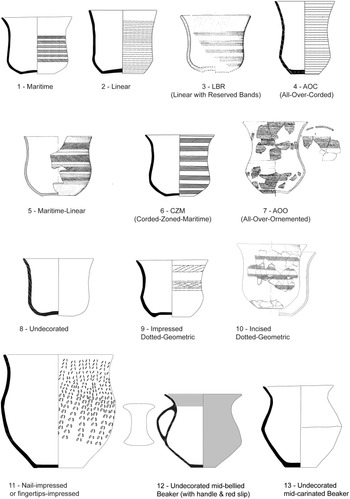
In north-western France, as in other parts of Europe, Beaker pottery can be divided into three stages: stage 1 (2550–2350 bc), stage 2 (2350–2150 bc) and stage 3 (2150–1950 bc), the last corresponding to the beginning of the Early Bronze Age (Fig. 1; Salanova Reference Salanova2011; Favrel Reference Favrel2015; Nicolas et al. Reference Nicolas, Favrel, Rousseau, Ard, Blanchet, Donnart, Fromont, Manceau, Marcigny, Marticorena, Nicolas, Pailler and Ripoche2019). The range of pottery includes fine and common ware. The fine ware is represented by Beakers with S-shaped profiles and some carinated bowls. These can be divided into several styles depending on the decoration technique and pattern. During stage 1 (2550–2350 bc), the most renowned style is the ‘standard’ (Salanova Reference Salanova2000). This standard style incorporates three distinct types, all of which are decorated with shell or comb impressions: Maritime or ‘international’ Beakers (decorated with hatched and blank bands), linear-ornamented Beakers (decorated only with horizontal lines), and Beakers with regularly spaced groups of lines interspersed with blank bands. There are also some Rhine-style beakers (All-Over-Ornamented and All-Over-Corded; Lanting & van der Waals Reference Lanting and van der Waals1976b) and further pottery showing Rhenish influence with fine horizontal cord impressions. There are also some hybrid-style Beakers whose decoration falls between these traditions; some examples merge decorative patterns from the standard sub-types, others mix the standard with Rhine influence, all of which are interpreted as variations of the standard (Favrel Reference Favrel2015). The Cord-Zoned Maritime Beaker, for example, is a Maritime Beaker whose horizontal lines are created using a thin S-twisted cord.
Beaker ceramic by stage. 1, 2, 4, 8, 9, and 11–13 after Favrel (in prep.); 3. after Le Roux (Reference Le Roux1978); 5. after Le Roux (Reference Le Roux1979); 7. after Le Roux et al. (Reference Le Roux, Lecerf and Gautier1989); 10. after Le Provost (Reference Le Provost1982)

The dotted-geometric style also exists during stage 1 but seems most common during stage 2 (2350–2150 bc). It is found on any Beakers and carinated or hemispherical bowls that have geometric patterns, such as hatched triangles, chevrons, crosses, lozenges, and horizontal ladders. Beakers are decorated by impression or incision during stage 2. Other styles are harder to define because of the scarcity of discoveries but Beakers with unpatterned, nail-impressed decoration and undecorated Beakers have been recorded.
During stage 3 (2150–1950 bc), fine ware includes the late Bell and S-profile Beakers with a higher belly (mid-bellied), some handled, and printed decoration seems to disappear, with most being simply decorated with red slips. Carinated or hemispherical bowls are not observed during stage 3, but both trunconic cups and some polypod bowls are known. To date no unquestionable association between both primary late Beaker types exists but they are found with the same coarse ware variants (see Nicolas et al. Reference Nicolas, Favrel, Rousseau, Ard, Blanchet, Donnart, Fromont, Manceau, Marcigny, Marticorena, Nicolas, Pailler and Ripoche2019).
The Bell Beaker common ware in north-western France is mainly comprised of coarse ceramics with a horizontal under-rim cordon. Shapes vary over time, however, with these being mostly simple and open forms in stage 1, including vessels with bucket, barrel, and cylindrical profiles. There is a rise of S-profiled Beakers in stage 2 followed by those with a more carinated or shouldered profile in stage 3, with this latter shape also occurring without the horizontal cordon. Some coarse undecorated S-shaped Beakers might fall into the category of the common ware.
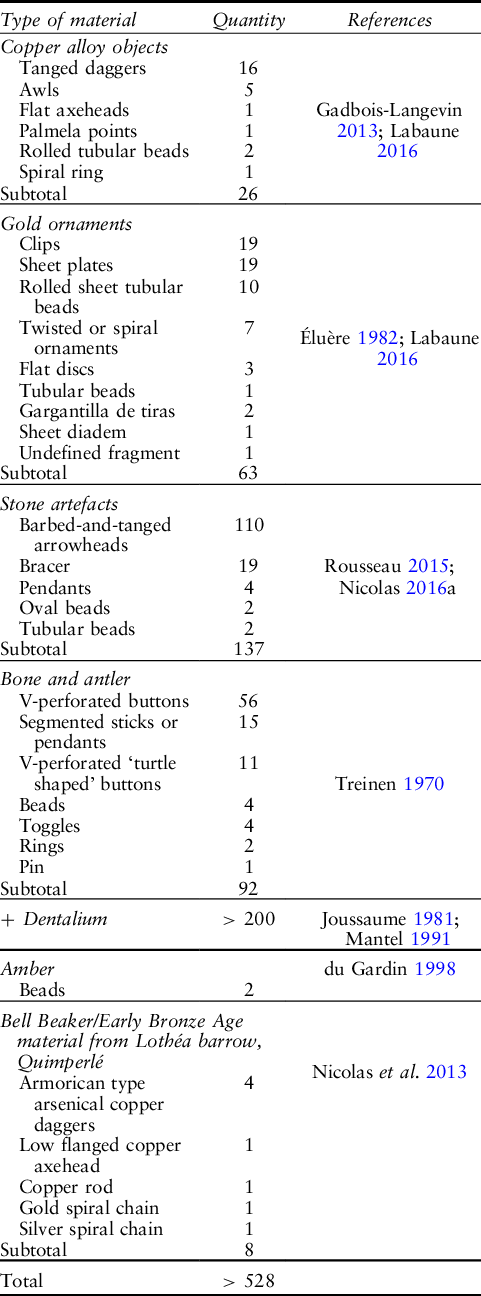
Other artefacts associated with Bell Beaker pottery in funerary sets include copper-alloy objects (daggers, awls, flat axes), stone bracers (wristguards), barbed-and-tanged flint arrowheads, and ornaments of gold, bone, or antler (Nicolas Reference Nicolas2016a; Reference Nicolas2016b; Table 2).
LIST OF BELL BEAKER-ASSOCIATED PARAPHERNALIA IN NORTH-WESTERN FRANCE

Bell Beaker burials in megalithic tombs
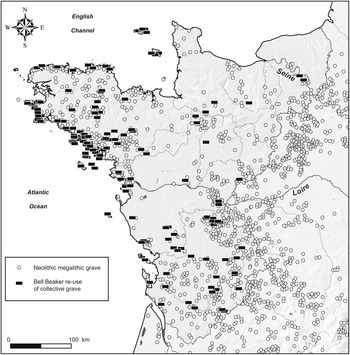
In north-western France the deposition of Bell Beaker material in Neolithic megalithic tombs is very common (Fig. 2) and frequently corresponds to a final, even terminal, use of these monuments as burial places (Salanova Reference Salanova2007) although this funerary practice continued, to a lesser extent, into the Early Bronze Age (2150–1600 bc; Nicolas Reference Nicolas2016b). In contrast to the Late Neolithic (2900–2550 bc) where ceramics were infrequent, Bell Beaker pottery totalling 514 vessels has been recorded from 138 megalithic monuments in north-western France. These differences suggest a change in depositional practices with the beginning of the Bell Beaker phenomenon, with the inclusion of pottery playing an increasingly important role. Bell Beaker associated artefacts are also relatively frequent and varied in megaliths in the region (Fig. 2). Nevertheless, there are few copper daggers (16, Table 2), in contrast to the previous Recent/Late Neolithic Grand-Pressigny daggers (c. 250), whose production came to an end during the early stage of the Bell Beaker complex (Mallet et al. Reference Mallet, Pelegrin and Verjux2019).
Distribution map of megalithic graves and the ones re-used by the bearers of the Bell Beaker in north-western France and the Channel Islands. Megalithic graves after Soulier (Reference Soulier1998); Bell Beaker graves after Gadbois-Langevin (Reference Gadbois-Langevin2013) and Favrel (in prep.)

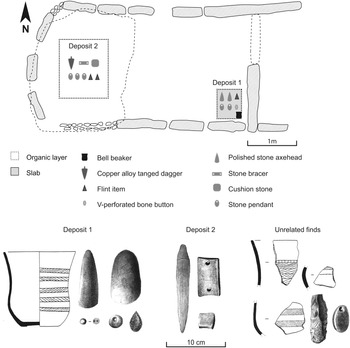
Most of the time, Bell Beaker discoveries from inside megalithic monuments consist of only a few sherds but in several cases multiple complete Beakers have been recorded, while on other occasions they are associated with other paraphernalia attributed to the Bell Beaker phenomenon. For instance, one of the most complete Bell Beaker artefact sets in western France was discovered within the funerary monument at Penker in Plozévet, Finistère (du Chatellier Reference Chatellier1883b). This included a Maritime Beaker found with V-perforated bone button in a corner of the monument (deposit 1), a copper dagger, a cushion stone, and a stone bracer at the end of the monument (deposit 2), as well as various common ware and stone artefacts that might be Bell Beaker related or could represent older pre-Beaker depositions (Fig. 3).
Approximate position of the material found in the short gallery grave of Penker in Plozévet. Plan, stone and copper artefacts after du Chatellier (Reference Chatellier1883b); Beakers, after Salanova (Reference Salanova2000)

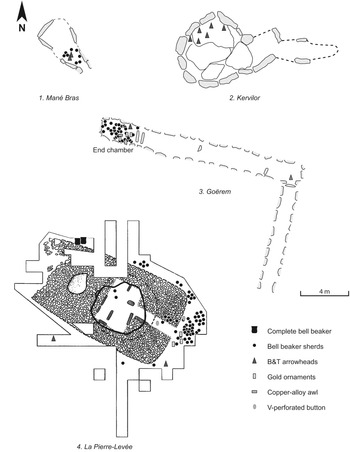
Where plans are available these show that Bell Beaker items are concentrated in particular locations within the monuments (Fig. 4; Salanova Reference Salanova2007). Moreover, the artefact distributions appear to correspond to arrangements found within single graves, suggesting that megaliths were used for depositing individual burials (ibid.). In Brittany, an exceptional case is Port-Blanc passage tomb A (Saint-Pierre-Quiberon, Morbihan) where the sand dune facilitated the preservation of bone thanks to the alkaline conditions. The excavator recorded two (contracted?) inhumations in the chamber (Gaillard Reference Gaillard1883). The first individual was associated with a round-headed bone pin and the second with a copper-alloy awl. Moreover, a Bell Beaker had also been found during an earlier exploration of the chamber but the degree of association of this pot with the skeletons is less clear. Results from recent DNA analysis hint at family-based grouping in the Bell Beaker re-use of Port-Blanc passage tomb; indeed, two female individuals were second- or third-degree relatives, one being dated to 2440–2140 cal bc (3825±25 bp; PSUAMS-9404; Patterson et al. Reference Patterson, Isakov, Booth, Büster and Fischer2021, I15028 and I15034). The gallery grave of La Forêt-du-Mesnil (Tressé, Ille-et-Vilaine) contained only one individual, found in a stone cist below the penultimate capstone (Collum Reference Collum1935). The four associated ceramic vessels include a hemispherical bowl and three pots with horizontal cordons under the rim, that can be attributed to the mid-3rd millennium and might be slightly older than, or contemporary with, the beginning of the Bell Beaker phenomenon (Favrel Reference Favrel2015).
Examples of localised Bell Beaker materials in megalithic tombs, within chambers (1–3) and outside the monument (4): 1. Mané Bras passage tomb, Plouhinec, Morbihan; 2. Kervilor passage tomb, La Trinité-sur-Mer, Morbihan; 3. Goërem lateral entrance grave, Gâvres, Morbihan; 4. La Pierre-Levée passage tomb, Nieul-sur-l’Autise, Vendée (1. after Gaillard Reference Gaillard1884; 2. after F. Gaillard in P. du Chatellier, Archives départementales, Quimper; 3. after L’Helgouac’h Reference L’Helgouac’h1970; 4. after Joussaume Reference Joussaume1976, with permission)

In several megalithic tombs, including Men ar Rompet, Kerbors (Côtes-d’Armor; Giot et al. Reference Giot, Briard and L’Helgouach1957) or La Ville-ès-Nouaux on Jersey (Salanova Reference Salanova2007), Bell Beaker finds represent the only archaeological material recovered. Neolithic tombs were sometimes emptied by secondary users, some of these being Bell Beaker users. The clearest example is the lateral entrance grave at Le Goërem (Gâvres, Morbihan; L’Helgouac’h Reference L’Helgouac’h1970). The material found in the end chamber was almost entirely related to Bell Beaker stage 1 (2550–2350 bc), except for a Recent Neolithic Kerugou-style bowl (3350–2900 bc) found beneath the pavement, and two sherds of late Bell Beaker/Early Bronze Age beakers (2150–1950 bc). The Bell Beaker material is associated with the removal of the last capstone, presumably for inserting an individual by breaking into the end chamber, the original access having already been closed by upright slabs and rubble stones. As argued by L’Helgouac’h (Reference L’Helgouac’h1970), the Bell Beaker mourners probably emptied the end chamber behind the closing wall before depositing the deceased and an array of grave goods including an AOC Beaker, a fingernail-impressed Beaker, one barbed-and-tanged and one tanged arrowhead, one arsenical copper awl, and four small perforated gold-sheet ornaments (Fig. 4.3).
Considering the Port-Blanc case, and the limited number of plans with Bell Beaker grave good distributions (which mainly consist of one to five pots), it appears that in funerary terms the re-use of older megaliths in the Bell Beaker period was limited to the burial of a small number of individuals in each monument. In this respect, it may be proposed that while the re-use of megalithic tombs constitutes a highly visible element of Bell Beaker funerary practice in north-western France, it is probably not representative of funerary practices as a whole within the area. One clue to interpreting this sub-set of burials may be provided by the relatively high number of Bell Beaker gold sheet ornaments which occur, especially in the Carnac area (in c. 20% of the graves; Nicolas Reference Nicolas2016b), as well as in west-central France (Éluère Reference Éluère1982; Labaune Reference Labaune2016). Elsewhere in Bell Beaker Europe, such finds occur in well-furnished graves and are interpreted as indicators of high social status (eg, Heyd Reference Heyd2007; Fitzpatrick Reference Fitzpatrick2011; Endrődi Reference Endrődi2012). If this was also the case in north-western France, these personal ornaments may indicate that burial within old megaliths, the ‘graves of the ancestors’, is a sign of some specific status.
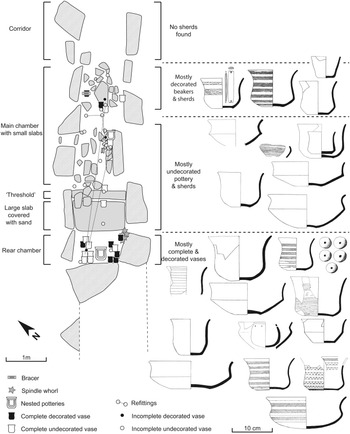
Men ar Rompet and Crugou gallery graves – exceptional deposits: The excavation of the Men ar Rompet gallery grave (Kerbors, Côtes-d’Armor) uncovered the largest assemblage of Bell Beaker pottery from a megalithic monument in western France (Fig. 5; Giot et al. Reference Giot, Briard and L’Helgouach1957). The minimum number of vessels is 44 but, as most of the pots have a complete profile, it is unlikely that the total could have been much higher. In addition to the ceramics, a stone bracer was deposited inside a complete Beaker near the entrance, and five spindle-whorls were found under a Cord-Zoned Maritime (CZM) Beaker in the end of the monument close to the south-east corner. One of the spindle-whorls is decorated externally with an impressed horizontal line on the perimeter. A flint scraper and several more or less used stone pebbles (including a possible ‘smoother’) were also found in the monument. No evidence for pre-Bell Beaker depositions or activity was recorded, except a hemispherical bowl and a bucket-shaped vase which show similarities with Late Neolithic wares. However, the bowl was found inside a carinated Bell Beaker bowl suggesting contemporaneity. This unusual situation has led to several hypotheses – burial or as a potter’s deposit (Giot et al. Reference Giot, Briard and L’Helgouach1957; Salanova Reference Salanova2000) – although the current authors consider the removal of Neolithic remains to be the most plausible explanation as there is no evidence that gallery graves were built by Bell Beaker using communities.
Location plan and drawings of the material discovered inside the gallery grave of Men ar Rompet at Kerbors, Côtes-d’Armor, after Giot et al. (Reference Giot, Briard and L’Helgouach1957)

The spatial distribution of Bell Beaker pots at Men ar Rompet shows two concentrations: a majority of largely complete and decorated vessels in the rear chamber and a second, consisting of more fragmentary, mainly undecorated vessels in the main chamber (Fig. 5). A space with little pottery is noted just past the ‘threshold’ between the rear chamber and the main chamber, where a carinated bowl was placed alone on a bed of sand deposited on a wide slab (Giot et al. Reference Giot, Briard and L’Helgouach1957). It seems safe to assume that there were several episodes of deposition in a short period of time (Salanova Reference Salanova2000, 54) as no individual graves with over 40 Beakers are known within the Bell Beaker phenomenon. The vessels are certainly related to stage 1 and possibly also to stage 2.
At Men ar Rompet it is possible to identify groups of two or three pots that have been stacked together: a small red undecorated Beaker was found inside a medium-sized black Beaker in the corridor and, in the rear chamber of the monument, a small round bottomed bowl with a row of perforations under the rim was deposited inside a carinated bowl, which was itself stacked inside a carinated bowl. This is strikingly similar to the situation in the La Ville-ès-Nouaux gallery grave on Jersey (Salanova Reference Salanova2007) and the same situation probably occurs in the V-shaped monument of Crugou (Plovan, Finistère; du Chatellier Reference Chatellier1876), but here Bell Beaker vessels were found alongside earlier deposits of Recent Neolithic, Kerugou style pottery. Unfortunately, due to the small number of examples in north-western France, recurring associations between stacked ceramics have yet to be identified. In Britain, the Boscombe Bowmen communal grave from Wiltshire is the only example known of stacked ceramics, coupled with isotope analysis and the beakers styles it is strongly reminiscent of Bell Beakers from Brittany (Barclay in Fitzpatrick Reference Fitzpatrick2011).
One possible interpretation is that several acts of inhumation took place in the Men ar Rompet gallery grave. But there is a clear difference between the groups of ceramics found in the rear chamber (mostly complete and decorated) and in the main chamber (mostly incomplete and undecorated). Overall, Men ar Rompet gallery grave shows a wide variety of Bell Beakers and bowls: decorated and undecorated, thin and thick, coarse or fine, polished or smoothed. The decoration techniques belong to the standard or the dotted-geometric style made either with shell or cord and shell (CZM Beaker). It is therefore an intriguing case, showing strong similarities with the V-shaped gallery grave of Crugou (Plovan). Both sites show a high number of complete and incomplete Beakers and some carinated bowls. They represent by far the two largest sets of complete Bell Beakers in the western half of France and both were found in gallery graves. It may be suggested that these particular sites could have been ‘places of memory’, with a succession of deposits (not all necessarily funerary) being made over an extended period of time by different local communities, which might help to explain the variability of the ceramics recovered. This proposition does not rule out the burial hypothesis; indeed, the two concepts may be complementary. As such, it may be suggested that Men ar Rompet witnessed one or a small number of burials of notable individuals but we cannot rule out votive deposition of Bell Beaker ceramics for the ‘ancestors’; it also reminds us of the situation known in Scotland (Wilkin Reference Wilkin, Brophy, Macgregor and Ralston2016). On a broader scale, the possible meaning behind theses depositions was recently discussed by Ulrike Sommer (Sommer Reference Sommer, Bernbeck, Hofmann and Sommer2017).
Finds around megalithic monuments
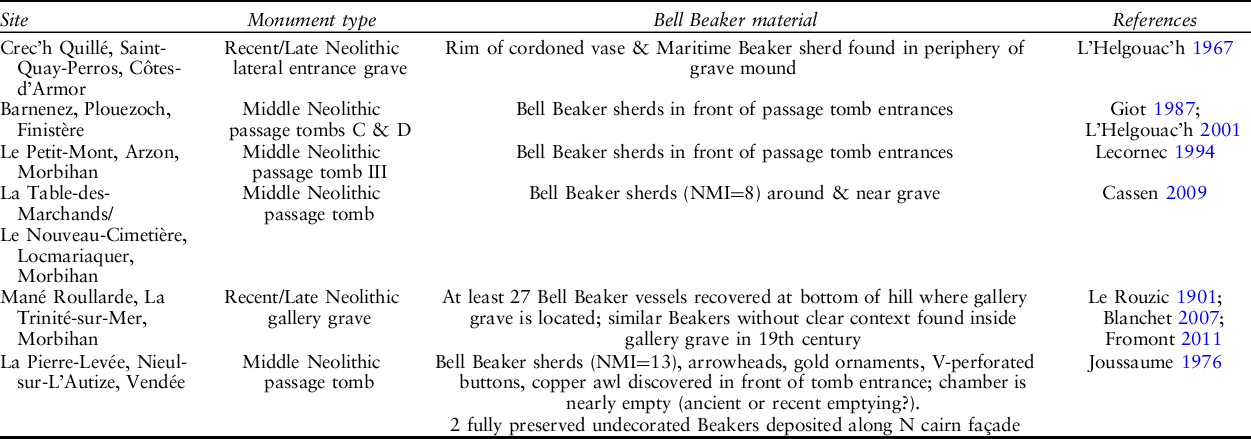
Around megalithic tombs: As noted previously, even today in north-western France excavations of megalithic tombs tend to focus on the monuments themselves and few projects involve investigation of the surrounding areas. However, where such information exists it is evident that Bell Beakers occur around megaliths (Table 3). These finds include Bell Beaker sherds scattered over fairly extensive areas surrounding the monuments (eg, La Table-des-Marchands/Le Nouveau-Cimetière, Mané Roullarde), concentrated around tomb entrances (eg, La Pierre-Levée, Le Petit-Mont, Barnenez), or in other peripheral external areas of the monuments themselves (Crec’h Quillé). But, to date, the most securely contextualised example consists of two complete undecorated Beakers deposited along the northern cairn façade of the La Pierre-Levée passage tomb (Fig. 4.4).
INVENTORY OF BELL BEAKER POTTERY FOUND AROUND MEGALITHIC TOMBS

Without excluding hypotheses of ancient emptying or unrecorded excavations, it could be argued that these remains may reflect various activities, including ceremonial, or even final closing deposits rather than deposition as grave goods (Cooper et al. Reference Cooper, Garrow, Gibson and Wilkin2022). Considering the few excavations extended around megalithic monuments in north-western France, the amount of Bell Beakers discovered is noteworthy. This focus on external areas perhaps reflects further aspects of sustained interest in these monuments beyond their original construction and use into the second half of the 3rd millennium. Furthermore, such finds also highlight the fact that we may be misguided in our focus on the deposition of Beakers inside megalithic monuments in north-western France, as we still have little knowledge about the nature of additional Bell Beaker associated activities around these sites, which could include non-megalithic burials and various ceremonial or domestic activities.
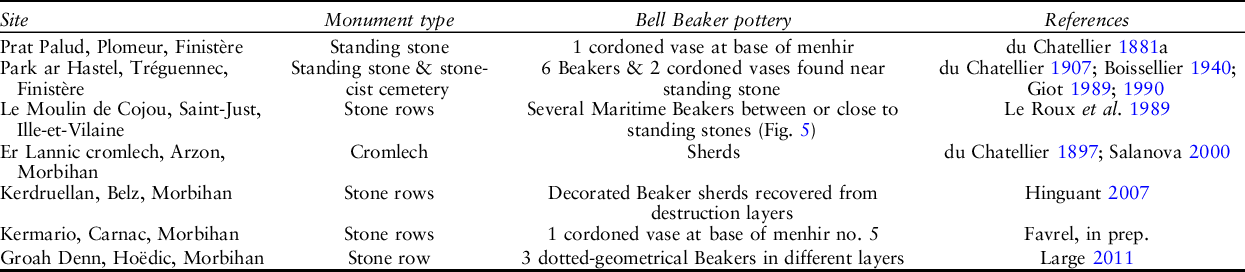
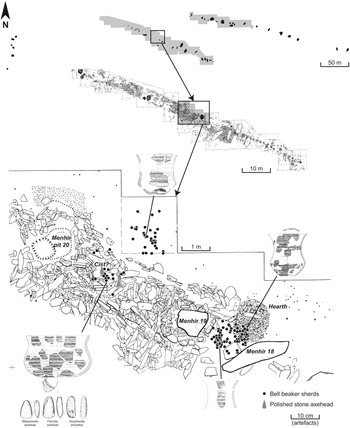
At standing stone monuments: Similar activities involving the deposition of Bell Beaker artefacts appear to have taken place at a range of standing stone monuments including cromlech, stone rows, and menhirs (Table 4). For instance, three Beakers were found at the Groah Denn stone row (Hoëdic, Morbihan; Large Reference Large2011), and several Maritime Beakers at the Le Moulin de Cojou alignments (Saint-Just, Ille-et-Vilaine; Fig. 6; Le Roux et al. Reference Le Roux, Lecerf and Gautier1989). In addition, decorated Beaker sherds were recovered from destruction layers at Kerdruellan (Belz, Morbihan), suggesting that the stone row may have been removed by Bell Beaker users (Hinguant Reference Hinguant2007). These instances of ceremonial activities, or the dismantling of standing stones, closely resemble activities recorded at passage tombs or gallery graves in the region, as outlined above. As such, the types of ceremonial activity performed at these sites during the Bell Beaker period appears to have been part of a wider sphere of practice (Prieto Martinez & Salanova Reference Prieto Martinez and Salanova2009).
INVENTORY OF BELL BEAKER POTTERY FOUND ON STANDING STONE SITES

Possible stone cist and deposits of Bell Beakers at Le Moulin-de-Cojou alignement, Saint-Just, Ille-et-Vilaine (after Le Roux et al. Reference Le Roux, Lecerf and Gautier1989, with permission)

Caves
Just five caves in west-central France have evidence for Bell Beaker activities (Gadbois-Langevin Reference Gadbois-Langevin2013) and, to date, the best example is La Trache 2 (Château-bernard, Charente; Burnez et al. Reference Burnez, Riquet and Poulain1962). In the middle of the cave, a contracted inhumation (right-sided?) was recorded among the remains of at least seven individuals who had possibly been disturbed previously. The grave goods associated with this individual include an arsenical copper tanged dagger placed on the thorax, possibly a barbed-and-tanged arrowhead, and a series of further finds which were not securely associated with the body. As seen in the case of Neolithic megaliths, this Bell Beaker grave seems to re-use an old burial place.
Stone cists
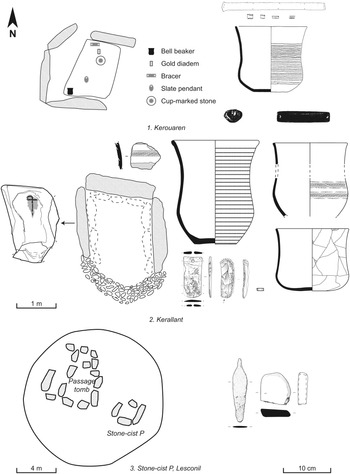
‘Megalithic’ stone cists, often called ‘simple dolmens’, are widely identified but poorly documented in north-western France, thus their chronological attribution cannot be restricted with certainty to the Bell Beaker period (Gouézin Reference Gouézin2017). Eight from Brittany have included Bell Beaker artefacts which, in this context, seem to correspond to individual graves (Nicolas et al. Reference Nicolas, Pailler, Stéphan and Gandois2013). They are typically quadrangular or pentagonal structures (1–2 m long) built above or in the ground with walls composed of large upright slabs covered by a single large capstone, although a few examples combine slabs and drystone walling (Fig. 7). The earliest stone cists (2550–2350 bc) are north–south orientated, while later examples (2350–1950 bc) are east–west orientated. They are known from Bell Beaker stage 1, as highlighted by the Kerallant stone cist (Saint-Jean-Brévelay, Morbihan), which yielded four Beakers (2 Maritime style, 1 AOC, and 1 undecorated), a sheet gold tubular bead, a slate bracer, and a Grand-Pressigny flint scraper (Fig. 7.2; de Cussé Reference Cussé1886). However, we cannot assume that all were necessarily individual burials, as indicated by evidence from the La Pierre-Couvertière ‘dolmen’ (Ancenis, Loire-Atlantique). Here the deposits within a ruined possible dolmen were sealed below a limestone layer and included the remains of 4–10 inhumed individuals and a variety of Bell Beaker pots and other artefacts, including common ware, fingernail impressed and Maritime sherds, a perforated rectangular sheet gold ornament, a copper-alloy awl, and a flint barbed-and-tanged arrowhead (L’Helgouac’h Reference L’Helgouac’h1973; Reference L’Helgouac’h1975).
Examples of Bell Beaker stone cists in Brittany: 1. Kerouaren stone cist, Plouhinec, Morbihan; 2. Kerallant stone cist, Saint-Jean-Brévelay, Morbihan; 3. Stone cist P at Lesconil, Plobannalec-Lesconil, Finistère (1. plan, pendant and bracer, after Gaillard Reference Gaillard1884; gold objects after Éluère Reference Éluère1982, with permission; Beaker, after Salanova Reference Salanova2000; 2. plan, after de Cussé, unpublished, © Société polymathique du Morbihan; grave goods and carved slab, drawings C. Nicolas; 3. plan, after du Chatellier Reference Chatellier1883a, grave good drawings C. Nicolas)

These stone cists are not just linked to megalithic architecture through the use of large slabs; some in fact re-used material from, or were spatially connected with, Neolithic monuments. An example of the former is Kerallant stone cist where one of the wall-stones is a re-used Neolithic stela featuring a hafted stone axe carving (Fig. 7.2). The latter includes a secondary stone cist, which yielded a tanged copper dagger and a cushion stone, inserted into the mound of a Middle Neolithic 2 (4000–3600 bc) passage tomb at Lesconil (Plobannalec-Lesconil, Finistère; Fig. 7.3; du Chatellier Reference Chatellier1883a) and a possible stone cist built in the middle of the southern alignment of menhirs at Le Moulin de Cojou (Saint-Just, Ille-et-Vilaine), which was loosely associated with a CZM bowl, a type A metadolerite axehead with a slightly flattened cutting edge, a fibrolite axehead, and an amphibolite ‘smoother’ (Fig. 6; Le Roux et al. Reference Le Roux, Lecerf and Gautier1989). Another notable example was recorded in the southern passage grave of La Croix-Saint-Pierre (Saint-Just, Ille-et-Vilaine), where a stone cist containing a Beaker sherd with incised decoration was built into the cairn (Briard et al. Reference Briard, Gautier and Le Roux1995). Interestingly, in this instance one of the slabs is carved with at least eight pediform shapes, each of which was made by merging pairs of cup-marks. Lastly, a pit lined with four small upright stones and covered with a large slab functioning as a capstone was found recently in Keranroué/Penester (Étel, Morbihan; Brisotto Reference Brisotto2017). Here the covering slab is probably a re-used standing stone. A similar case occurs at the Early Bronze Age stone cist of Le Tombeau-des-Géants at Campénéac (Briard Reference Briard1989). Only a spindle-whorl was recovered at Keranroué/Penester, but a radiocarbon date on a burnt cereal grain suggests that the cist was constructed between 2400 and 2190 cal bc (3810±30 bp; Beta-466393), during the second stage of the Bell Beaker phenomenon.
Cairns and barrows
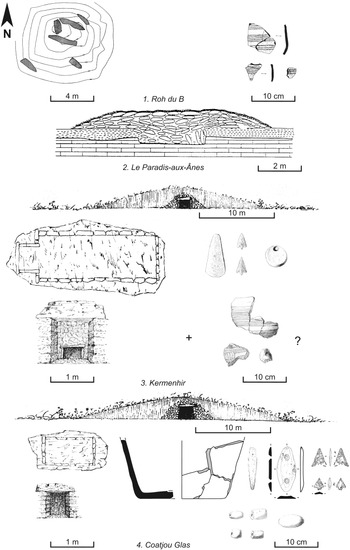
From stage 2, cairn and barrow structures appear. One of the earliest Breton Bell Beaker barrows is Roh Du B (La Chapelle-Neuve, Morbihan). The cairn (8 m in diameter, 0.8 m high) surrounds a rectangular east–west oriented stone cist (1.80 × 1.15 × 0.70 m), constructed from three upright slabs and a basal slab. Finds included sherds from an Epi-maritime Beaker (stage 2) and a finger-impressed pot (Fig. 8.1). Two similar structures have been recognised in the neighbourhood but remain unexcavated (Briard Reference Briard1989). Although outside the area under consideration here, it is worth mentioning that the cist-in-circle tradition of the Channel Islands is very similar to the Roh Du stone cists and barrows, the main difference being the ring of upright slabs surrounding the grave which may indicate that small covering mounds once existed. Pottery finds point towards the cist-in-circle tradition having a chronology primarily spanning the second half of the 3rd millennium (Driscoll Reference Driscoll, Nash and Townsend2016). A good example is La Platte-Mare on Guernsey, which yielded Bell Beaker and Late Neolithic pottery, two stone axeheads, and a barbed-and-tanged arrowhead (Kendrick Reference Kendrick1928; Salanova Reference Salanova2000) and might correspond to an individual burial.
Examples of Bell Beaker barrows: 1. Roh du B barrow, La Chapelle-Neuve, Morbihan; 2. Le Paradis-aux-Ânes barrow, Saint-Jard-sur-Mer, Vendée; 3. Kermenhir barrow, Poullan-sur-Mer, Finistère; 4. Coatjou Glas barrow, Plonéis, Finistère (1. after Briard Reference Briard1989; 2. after Joussaume Reference Joussaume1981, with permission; 3. after P. du Chatellier, Archives départementales du Finistère, Quimper; 4. after P. du Chatellier, Archives départementales du Finistère, Quimper, with exception of the pottery, bracer, and arrowheads, drawings: C. Nicolas)

For the same stage in north-western France we should mention the cairn (8 m in diameter, 1 m high), at Le Paradis-aux-Ânes (Jard-sur-Mer, Vendée; Joussaume Reference Joussaume1968). Here, a pit grave (3 m long, 0.7 m deep) was dug into the limestone bedrock. The pit was filled by stones from the cairn, made of large pebbles (Fig. 8.2), suggesting the former presence of a wooden structure, the stones having collapsed into the void following its decay. The grave goods found within the pit amounted to a hundred or so Dentalium shells. In addition, there were two further deposits towards the top of the cairn, these being two Beakers (one dotted-geometrical style) deposited in a small depression and an undecorated pot (Joussaume Reference Joussaume1981). At Kermenhir (Poullan-sur-Mer, Finistère), a larger barrow (24 m in diameter, 2 m high) covered an east–west oriented drystone grave (2.9 × 1 m), which contained two late Bell Beaker arrowheads, a copper-alloy flat axehead, and a slate pendant (du Chatellier Reference Chatellier1907). Some Epi-maritime beaker sherds and a flint scraper might also stem from this grave but their context is unclear (Fig. 8.3; Nicolas et al. Reference Nicolas, Pailler, Stéphan and Gandois2013).
During Bell Beaker stage 3, and into the earliest Bronze Age (2150–1950 bc), this barrow tradition developed and became a common practice in Brittany (Nicolas Reference Nicolas2016a). Few of these barrows have actually yielded Bell Beaker material but a number of notable examples have been recorded. For instance, at Coatjou Glas (Plonéis, Finistère), a drystone grave covered by an earthen barrow (14 m in diameter, 1.5 m high) with a cairn core (du Chatellier Reference Chatellier1887) produced grave goods which included a flat-bottomed pot, a riveted copper-alloy tanged dagger, a slate bracer, two barbed-and-tanged arrowheads, two olive-shaped and two tubular slate beads, and four egg-shaped polished stones (Fig. 8.4). However, the late Bell Beaker barrow burial which most resembles or foreshadows the barrow tradition and associated funerary assemblages of the succeeding Early Bronze Age Armorican Tumulus culture is the Lothéa Barrow (Quimperlé, Finistère; Nicolas et al. Reference Nicolas, Pailler, Stéphan and Gandois2013). Here the stone cist (2.25 × 1.65 × 1.45 m) composed of nine upright slabs and a large capstone was covered by a large barrow (26 m in diameter, 4 m high) with a massive (c. 1.7 m high) cairn core. An extensive assemblage of grave goods was recovered, including a trapezoid jadeitite pendant (which evokes Late Neolithic tradition), a slate bracer and seven barbed-and-tanged arrowheads (Bell Beaker related), three long daggers (Quimperlé type), and a mid-ribbed dagger (Trévérec type) of arsenical copper, a low-flanged copper-alloy axehead (more common during the EBA), two chains of spirals (one gold, the other silver), and a copper-alloy rod (Nicolas et al. Reference Nicolas, Pailler, Stéphan and Gandois2013).
Flat graves
In northern France flat graves are generally rectangular or oval pits which sometimes contain the remains of wooden chambers. Most represent individual burials but pits containing two or three individuals are known, overall 44 graves from 33 sites were included in the latest inventory for northern France (Salanova Reference Salanova2011). Flat graves have been recorded from across the study area, mainly in Normandy but also in west-central France and Brittany. Here we present all the most certain cases, along with uncertain flat graves in places where regional gaps are known, such as Brittany, due to the acidity of the soil.
Normandy: The first examples discovered in Normandy were a pair of closely spaced graves at La Rive (Bernières-sur-Mer, Calvados) which were partially destroyed by a bulldozer (Verron Reference Verron and Guilaine1976; Marcigny & Ghesquière Reference Marcigny and Ghesquière2003; Noël Reference Noël2011). The first, a pit dug into the bedrock, contained an undecorated Beaker, a copper-alloy tanged dagger, and the contracted remains of an adult male (c. 50 years old) placed on his left side. The second, a largely destroyed grave, yielded the bones of a young adult female (18–20 years old), an Epi-maritime Beaker, a segmented antler ornament, and a few flints, including a microdenticulate blade similar to those regionally in Late Neolithic contexts (Renard Reference Renard2010).
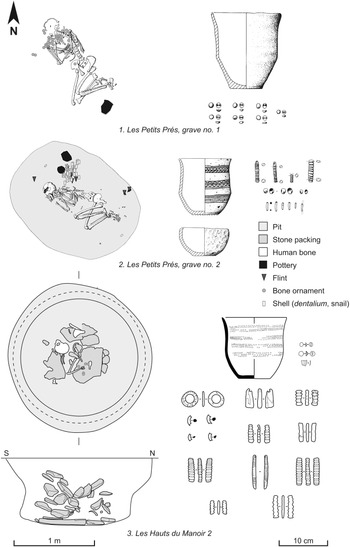
A flat cemetery discovered at Les Petits-Prés (Léry, Eure), included five pit graves, three of which are securely dated to the Bell Beaker period (Mantel Reference Mantel1991; Billard Reference Billard2011). Grave 1, an irregular pit with no distinguishable outlines, contained a crouched adult female aged 30–35 years orientated NW–SE and placed on her right side facing west, along with an undecorated Beaker and 38 V-perforated bone buttons (Fig. 9.1). A radiocarbon date on human bone of 2470–1950 cal bc (3760±90 bp; GIF-7456) places this individual broadly within the Bell Beaker period. Grave 2, located 190 m west of the first, comprised an NW–SE orientated oval pit (1.5 × 1.25 × 0.5 m) containing a contracted adolescent aged 15–18 with the same orientation, laid on the right, facing south-west, together with an Epi-maritime Beaker, a bowl, 100 dentalium and 11 gastropod shells, and four segmented antler pendants or ornaments (Fig. 9.2). Grave 5, 100 m west of Grave 2 and damaged during stripping, contained an east–west oriented, contracted, young adult female aged 18–25, placed on her right side facing south; the shape of the pit remains unknown. Two new-born children were found side by side to the right of her chest. There were no associated grave goods but a radiocarbon date on human bone of 2570–2140 cal bc (3880±70 bp; GIF-7457) places this grave within the Bell Beaker period.
Examples of Bell Beaker flat graves from Normandy (1 & 2. after Mantel Reference Mantel1991; 3. after Giazzon Reference Giazzon2012, with permission)

At Les Hauts du Manoir 2 (Cairon, Calvados; Giazzon Reference Giazzon2012), a more unusual Bell Beaker grave has been found (Fig. 9.3). It was inserted into a grain silo-like pit (1.9 m diameter × 1 m deep), at the base of which was a 0.75 m thick layer of stone packing covering a circular slab-built pavement. The inclination of several of the packing stones suggests an internal collapse following decay of a wooden structure, while a slight curve within an adjacent later EBA field ditch suggests the pit may have also been covered by a small barrow. The grave goods included an Epi-maritime Beaker, a small, perforated sheet gold plate, a trapezoid slate pendant, and several bone ornaments including a dot-decorated bone ring, four ring fragments, two V-perforated buttons, seven segmented ornaments, and a segmented pendant. Human bones of an adult woman aged 30–35 were found 0.1 m above the pavement and, while no anatomical connections were observed, the skeleton retained its anatomical coherence. Moreover, the grave goods do not appear to have been displaced excessively, including the sheet gold plate which was in contact with the skull. Without excluding taphonomic processes, the anthropologist proposed that this disposition may represent a seated burial. Radiocarbon dates on human bones of 2460–2200 cal bc (3845±35 bp; Lyon-8255(OxA)), and 2140–1930 cal bc (3650±30 bp; Beta-302244) place this individual in the second half of the 3rd millennium bc.
For Normandy, further putative graves that could expand this corpus are suggested from the discovery of isolated Beakers (Billard Reference Billard2011).
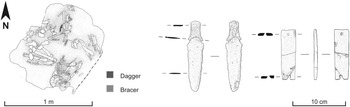
West-central France: There is good evidence for pit graves in west-central France, including examples without grave goods. At La Belletière (Champigny-le-Sec, Vienne), an east–west oriented pit grave contained the contracted inhumation of an adult placed on the left side with head facing south. The accompanying grave goods included five or six leaf-shaped (rough-outs?) and barbed-and-tanged arrowheads, a pair of arrow-shaft smoothers, a flint knife, a flint strike-a-light, and a boar’s tusk (Patte 1934; Reference Patte1963). At Les Bouilloires (Saint-Martin-de-Fraigneau, Vendée), a double interment was found within a NE–SW oriented pit (1 × 0.85 m) dug into the calcareous bedrock (André Reference André1998a). Two contracted adult male individuals were placed top to tail facing east, one left-sided and the other right-sided (Fig. 10), and the individual with the head to the north was equipped with an arsenical copper tanged dagger and a green marly limestone bracer. A radiocarbon date on human bone of 2280–1940 cal bc (3700±50 bp; Ly-7487) places the grave at the end of the Bell Beaker period.
The Bell Beaker double burial at Les Boulloires, Saint-Martin-de-Fraigneau, Vendée (after André Reference André1998a, with permission)

Graves without grave goods radiocarbon dated to the Bell Beaker period in this region include a pit grave at Les Sables-de-l’Oie (Auzay, Vendée) which contained an east–west contracted inhumation dated on human bone to 2580–2230 cal bc (3935±55 bp; Lyon-43/OxA-4723; André Reference André1998b) and a possible example at La Passe de l’Écuissière on Oléron island (Charente-Maritime). Here, the remains of an adult dated to 2490–2200 cal bc (3885±50 bp; Ly-7469) were found close to the top of a peat layer a few hundred metres away from a Bell Beaker settlement that might be contemporary (Laporte et al. Reference Laporte, Cros, Fontugne, Gebhardt, Gruet, Marguerie, Oberlin and Camps1998).
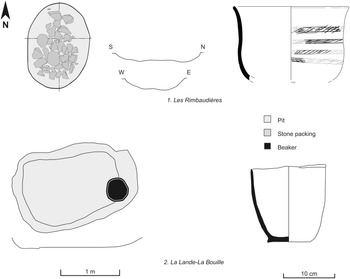
Brittany: In Brittany the situation is still unclear, as the absence of human remains complicates the identification and interpretation of flat graves. Possible examples include a north–south oriented oval pit (1.10 × 0.76 × 0.12 m), at Les Rimbaudières (Rannée, Ille-et-Vilaine) which contained a Maritime Beaker (Fig. 11.1; Sicard Reference Sicard2017), and an ENE–SWS oriented oval grave-like pit (2.10 × 1.40 × 0.20 m), at La Lande/La Bouille (Saint-Caradec, Côtes-d’Armor), which produced an undecorated Beaker (Fig. 10.2; Roy Reference Roy2005). Another potential example comes from Lavallot (Guipavas, Finistère), where a heap of 81 sherds, representing 19 fine geometric-style Beakers (stage 2) with red slip and white inlay, was discovered within a 1 m2 area along with a hard hammer/anvil pebble and a bevelled pebble. Unfortunately, no pit could be identified (Pailler Reference Pailler2015) and it is unclear whether this deposit represents the remnants of a burial location, a votive deposition, or another form of hoard.
1. Oval pit from les RimbaudièresRannée (after Sicard Reference Sicard2017, with permission); 2. oval pit from La Lande/La Bouille, Saint-Caradec (after Roy Reference Roy2005, with permission)

Ring-ditches
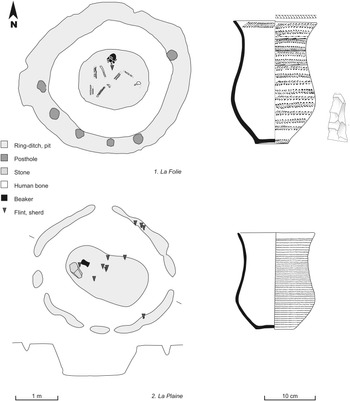
Ring-ditches with central pit: Few Bell Beaker ring-ditches are known in north-western France. However, examples with strikingly similar morphology have been recorded at La Plaine (Poses, Eure; Billard & Penna Reference Billard and Penna1995) and La Folie (Poitiers, Viennes; Tchérémissinoff et al. Reference Tchérémissinoff, Convertini, Fouéré and Salanova2011), these being slightly oval ditches enclosing c. 3 m diameter areas with centrally located, oval pit graves (Fig. 12.1). At La Folie, the ring-ditch contained at least six post-holes, while the ditch at La Plaine was segmented into six sections. At La Folie, the surviving skeletal elements suggest an adult male lying on his back with his head to the east. On his left side were an AOO Beaker and the distal end of a Grand-Pressigny flint blade. At La Plaine, the grave goods were an AOC Beaker and some scattered flints and sherds (Fig. 12.2), but no human remains. Based on the material culture these two graves correspond to Bell Beaker stage 1. However, radiocarbon dates on bones of 2460–2140 cal bc (3815±35 bp; GrA-17489), and 2470–2140 cal bc (3835±45 bp; GrA-18765) from La Folie indicate contemporaneity with stage 2. These two graves are tightly related to a ‘Dutch-style’ tradition, as highlighted by the pots (AOO and AOC Beakers), the Grand-Pressigny flint blade association, the ring-ditches, and especially the post-holes inside the ditch (Lanting & van der Waals Reference Lanting and van der Waals1976b). However, the AOO Beaker from La Folie does not find a close parallel in the lower Rhine Basin, and the blade end looks to be an imitation rather than a genuine end of a Grand-Pressigny dagger (Tchérémissinoff et al. Reference Tchérémissinoff, Convertini, Fouéré and Salanova2011). If this is the case, the radiocarbon dates of La Folie may in fact point towards this grave representing a distantly inherited tradition in both spatial and chronological terms. This ‘Dutch-style’ ring-ditch tradition is rare in north-western France and does not appear to continue directly into the later stage of the Bell Beaker complex in the region. As such, there appears to be a time-gap between these ‘Dutch-style’ circular monuments and larger EBA ring-ditches (Marcigny & Ghesquière Reference Marcigny and Ghesquière2003) and, in essence, these may represent two distinct and unrelated traditions.
The two Bell Beaker ring-ditches from north-western France (1. after Tchérémissinoff et al. Reference Tchérémissinoff, Convertini, Fouéré and Salanova2011, with permission; 2. after Billard & Penna Reference Billard and Penna1995, with permission)

Ring-ditches without a central grave: On the site of Les Terriers (Avrillé, Maine-et-Loire), two concentric ring-ditches were dug around a pit which is assumed to have held a standing stone that was moved to the border of the field a few years before the excavation (Bénéteau et al. Reference Bénéteau, Cros and Gilbert1992). Whilst no burial pit was identified, the scattered remains of at least five or six individuals were found within the inner circle around the pit that held the menhir. Some decorated sherds and a radiocarbon date on bones of 2280–1930 cal bc (3690±40 bp; Gif 8303) situate the earliest ring-ditch activity at the end of Bell Beaker stage 2. This suggests that the standing stone may have acted as a locus for funerary-related activities during the mid–late Bell Beaker period.
THE CHRONOLOGICAL EVOLUTION OF BELL BEAKER FUNERARY PRACTICES IN NORTH-WESTERN FRANCE
Stage 1 (c. 2550–2350 bc)
From the earliest stage of the Bell Beaker complex, both the re-use of older megalithic sites and individual graves (pits, stone cists) occur. The re-use of Neolithic monuments follows an Atlantic tradition within the Bell Beaker world (Salanova Reference Salanova2003). At present, only two probable individual graves can be securely situated within this stage, the Kerallant stone cist (Fig. 6.2) and La Plaine ring-ditch (Fig. 11.2). The former finds close parallels in Galicia (Vázquez Liz et al. Reference Vázquez Liz, Nonat and Prieto Martínez2015) and more broadly in Britain (Parker Pearson et al. Reference Parker Pearson, Needham and Sheridan2019), while the latter is related to a Continental tradition, the ‘Dutch-style’ ring-ditch (Lanting & van der Waals Reference Lanting and van der Waals1976b). It is not possible to determine which of these two traditions appeared in north-western France first. However, the presence of both Maritime and AOC Bell Beakers at Kerallant raises the possibility that both traditions were somewhat contemporary or were established within such a short timespan that the periodisation is not distinguishable using radiocarbon dates.
Stage 2 (c. 2350–2150 bc)
During stage 2, funerary practices appear to have been broadly similar to those of the previous stage. Most of the stone cists and flat graves yielding Bell Beakers belong to this stage and, based on the radiocarbon dates from La Folie, the ring-ditch tradition also seems to have continued into this period. In addition, stone cists covered by round barrows with cairn cores appear in Brittany during this phase, which might be the result of a local development as well as part of a broader Atlantic trend (Vázquez Liz et al. Reference Vázquez Liz, Nonat and Prieto Martínez2015; Parker Pearson et al. Reference Parker Pearson, Needham and Sheridan2019).
Stage 3 (c. 2150–1950 bc)
This timespan corresponds to the earliest stage of the Early Bronze Age, during which the last expressions of the Bell Beaker complex occur in north-western France. Beakers were no longer bell-shaped, but mid-bellied and biconical. The practice of individual burial seems to dominate during this period, as it did generally throughout the EBA (Tonnerre Reference Tonnerre2015; Nicolas Reference Nicolas2016a). It has been recognised in the form of barrows, stone cists, and drystone graves in Lower Brittany, as well as pit graves across the whole area under consideration. The re-use of megalithic monuments for depositing unburnt remains also continued into this phase but examples are few in number and only rarely (if ever) appear to represent the burial of ‘elites’. Few, if any, arrowheads or copper-alloy objects were deposited in megalithic monuments during this stage, but there are occasional pots and British faience beads (Sheridan & Shortland Reference Sheridan and Shortland2004), as well as a few unaccompanied individuals highlighted by radiocarbon dates (Nicolas Reference Nicolas2016b). It is also notable that megalithic entrance blocking events continued into this late Bell Beaker phase in north-western French collective graves (L’Helgouac’h Reference L’Helgouac’h1967). Notwithstanding, it seems certain that the re-use of megalithic monuments was no more than sporadic during stage 3 but it remains to be seen whether there was a gradual decrease in the frequency of burials in the preceding centuries, or if a dramatic shift or sudden break in tradition occurred at some point. Nevertheless, when stage 3 grave goods are found in megalithic contexts they are generally individual pots, which does not imply collective burial but, rather, deposits similar to those documented in barrows. Outside north-western France, however, collective funerary practices were still current at this time further east in the Paris Basin (Chambon Reference Chambon2003; Reference Chambon, Besse and Desideri2004).
DISCUSSION
Bell Beaker users and megalithic monuments
The interest in older megalithic monuments by Bell Beaker communities in north-western France and, to a larger extent, in Atlantic Europe, does not occur everywhere, for instance in the Paris Basin or inner Portugal (Salanova Reference Salanova2003; Reference Salanova2007). Thus, there is no correlation between a dense concentration of Bell Beaker material culture and a place where megalithic monuments are plentiful. However, the question of the continuity in use of megalithic monuments on the Atlantic coast must be addressed. South of the River Loire, the construction of megalithic tombs is not certain during the Late Neolithic period but re-use of monuments from older periods is attested (Hébras Reference Hébras1965; Bailloud et al. Reference Bailloud, Burnez, Duday and Louboutin2008; Ard Reference Ard2011).
Moreover, these monuments do not seem to have been used solely as tombs and they probably had a complementary commemorative function. In several cases during the whole Neolithic sequence megalithic funerary monuments show evidence of re-use several centuries after their initial phase of use. This may involve non-funerary activities, including the building of hearths and deposition of pottery, as in the gallery grave at Bilgroix (Arzon, Morbihan) where several hearths were built inside and in front of the monument at the end of the Recent Neolithic (Lecornec Reference Lecornec1996).
The practices connected with the re-use of megalithic sites by Bell Beaker users in north-western France, whether funerary or commemorative in nature, have clearly identifiable precedents within the preceding local Neolithic. These should not be regarded as newly introduced concepts. Furthermore, the Bell Beaker deposits are primarily distinguished from these earlier rites through the type of objects deposited, their large quantities, and the large number of sites involved. In fact, it may be argued that the greatest disparity between the Neolithic and Bell Beaker records is largely quantitative, and this disparity could be partly explained by the lack of re-use of the sites during the Early Bronze Age. This being the case, there was probably no widespread subsequent emptying of the Bell Beaker material, as was the case with Neolithic funerary deposits since these monuments were almost certainly abandoned afterwards. The re-use of megalithic monuments appears to have been frequent during the Bell Beaker period and it must be considered as an archaeological fact; its ‘visibility’ cannot be dismissed as a product of biased research activities. Undoubtedly, this re-use was a deliberate and conscious choice made by populations in north-western France but the ongoing utilisation of megalithic monuments seems to have witnessed a clear shift following the appearance of the Bell Beaker phenomenon (L’Helgouac’h Reference L’Helgouac’h1976; Reference L’Helgouac’h2001; Salanova Reference Salanova2003). However, the lack of information about Late Neolithic burial customs in this region means that it is not possible to determine whether this represents some form of continuity or a clear break from local tradition. Nevertheless, processes of individualisation and the grouping of grave goods have been noted from the Late Neolithic in the Paris Basin (Söhn Reference Söhn2002; Chambon Reference Chambon, Besse and Desideri2004; Salanova and Söhn Reference Salanova and Söhn2007), before the appearance of the Bell Beaker phenomenon. If funerary practices did gradually move away from the collective burial at the beginning of the Late Neolithic in the region where they are best known, did the introduction of the Bell Beaker phenomenon actually bring something different or introduce novel concepts? Did it change or accentuate certain trends that were developing or already in place?
The diversity of Bell Beaker funerary practices
Bell Beaker period burial practice in Atlantic France has been characterised by the large number of re-used Neolithic megalithic monuments for so long, and to such an extent, that until now it has been regarded as the main funerary custom in the region (Salanova Reference Salanova2011). Beyond this stereotype, one created by research biases (Favrel Reference Favrel2015), it can now be argued that Neolithic monuments only represent the final resting place of a fraction of the Bell Beaker-using population, and evidence shows that a much more diverse situation existed. On the one hand, there was the re-use of old burial places (megalithic sites, caves, etc), following an Atlantic trend (Guilaine Reference Guilaine2004), while, on the other, there was the use of pits or stone cists, some of which have, or may have had, a covering cairn/barrow or a surrounding ring-ditch. These latter constructions are less monumental than the megalithic tombs and are, as discussed, harder to identify in the landscape.
A wide range of Bell Beaker funerary customs are now documented in Atlantic France. As in Britain (eg, Parker Pearson et al. Reference Parker Pearson, Needham and Sheridan2019), flat graves are generally scattered in the landscape and, to date, no large Central European-style flat cemeteries (eg, Dvořák et al. Reference Dvořák, Matějíčková, Peška and Rakovský1996; Heyd Reference Heyd2007; Lefranc et al. Reference Lefranc, Denaire and Jeunesse2014) have been identified although, as noted previously, flat graves have only been recognised in the region since the expansion of development-led archaeology. Identification of flat graves is further complicated in the Armorican Massif by the acidity of the soils as it is difficult to differentiate between funerary and ceremonial deposits without the presence of bones, let alone identify the presence of burials with no grave goods, as highlighted elsewhere by radiocarbon dates. Furthermore, such scattered and poorly interpretable finds discovered during trial trenching rarely trigger large-scale stripping and are rather found casually thanks to the excavation of larger settlements. However, it is conceivable that, in time, flat graves may emerge as a significant, if not common, element of Bell Beaker funerary practice throughout north-western France.
Although any quantitative approach is limited by the number of poorly documented sites and research biases, we can identify a certain degree of spatial diversity within the present funerary dataset. From a geographical perspective, the use of stone cists is mainly limited to Brittany (and the Channel Islands), while flat graves dominate individual burial contexts across the eastern part of the study area. The re-use of megaliths mainly occurs in western France, where these Neolithic monuments are plentiful, but the phenomenon is almost non-existent in Normandy (Fig. 2). Burial within caves is documented in west-central France but its distribution is essentially limited by the fact that fewer caves occur north of the River Loire. Notwithstanding, as is the case for megalithic tombs, where Bell Beaker depositions have been documented in such caves, they were already in use during the Neolithic (Boulestin et al. Reference Boulestin, Gomez de Soto and Laporte2002; Boulestin Reference Boulestin2008) and represent a similar re-use of old burial places.
Whatever the funerary architecture, the practice of contracted inhumation seems to have been common in north-western France. Right-sided and left-sided individuals are equally represented and, as elsewhere in Bell Beaker Europe, this patterning is related to gender differentiation (Salanova Reference Salanova2011; Shepherd Reference Shepherd2012). Burial in the supine position is not rare in the northern half of France (Salanova Reference Salanova2011) and seated individuals might have occurred. Grave orientation is quite diverse and seems less standardised than in Central Europe, although there are indications of gender differences.
To sum up, the Bell Beaker funerary practices of north-western France are far from standardised, although variously documented. They were the result of a combination of factors including environmental settings (availability of building stones, caves) and the amalgamation of aspects of various cultural traditions, including (among others), the re-use of old burial places, a possibly local invention (stone cists), and a Dutch/Central European custom (ring-ditches). While exogenous components are obvious in some aspects of the burial record and material culture, as well as a shift in settlement patterns (Nicolas et al. Reference Nicolas, Favrel, Rousseau, Ard, Blanchet, Donnart, Fromont, Manceau, Marcigny, Marticorena, Nicolas, Pailler and Ripoche2019), questions still remain about the degree of Bell Beaker acculturation of local Neolithic groups and the inception of foreign trends in the genesis of Bell Beaker complex in Atlantic France. Most of these issues come from a lack of knowledge related to the funeral practice of the Late Neolithic. Indeed evidence for collective burial after the Recent Neolithic are objectively scarce in our study area, except for central-western France, on the other hand individual burial in contracted inhumation are likely to pre-date the Bell Beaker period.
Acknowledgements:
We would like to thank several people for having provided us unpublished data: Vérane Brisotto (Inrap), Yves Coativy (Université de Bretagne Occidentale), N. Fromont (Inrap), David Giazzon (Inrap), Yvan Pailler (Inrap/UMR 8215 Trajectoires), Christophe Le Pennec (Musée de Vannes), Eddie Roy (Inrap), Sandra Sicard (Inrap).