[Popular Culture] is a theater of popular desires, a theater of popular fantasies.
It is where we discover and play with the identifications of ourselves, where we are imagined, where we are represented, not only to the audiences out there who do not get the message, but to ourselves for the first time.Footnote 1
A Hallucinatory, Ch'ixi Mix
On a cold night in Bolivia's mountainous capital city of La Paz, standing outside a hip-hop concert at a popular music venue, I spoke with some of the concertgoers and fans of the large, vibrant hip-hop scene in the greater La Paz/El Alto metropolitan area. I had come to Bolivia initially as a former Spanish/English bilingual teacher from the United States involved in a collaboration with bilingual teachers from across the Americas.Footnote 2 Although my research collaborations began in conventionally educational contexts, I shifted my research towards other realms of cultural life where the cultivation of linguistic expertise served to intervene against trends of language shift from Indigenous languages to Spanish. The Aymara and Quechua lyricism of the La Paz region's hip-hop scene was central among these.
One of that night's concertgoers, Javier Gutiérrez Velázquez, accounted for his appreciation of the local hip-hop scene in terms of both affect and history:
The hip-hop movement in Bolivia and especially in the city of El Alto … is very Aymara. Very Aymara-tized, but also very aligned with what's gringo, no? With what's from the US and even the European because there's a lot of influence, right? … and, well, it's beautiful because it unites what is Black with what is Aymara and a hallucinatory mix of Aymara hip hop comes out that's so “sick.” Muy sick. You listen to it, to Ukamau and it's like he makes you fly. It's a mix of a Black, Aymara, Bolivian, Latin American, it's incredible, right?Footnote 3
His comment was surprising to me for many reasons. For one thing, it was surprising how he coupled a term so often denoting whiteness in Latin America—”gringo”—with Blackness, even when addressing me, a person of European descent from the United States. In addition to this, to be “aligned with what's gringo” was an astounding thing for a young, Aymara Bolivian to speak of favorably within the political context in which the exchange took place. This was 2013, only ten years after many of these concertgoers and the artists themselves had participated in an insurrection, also known as the “Gas War,” against a US–backed neoliberal government and seven years after the election of the nation's first Aymara president, Evo Morales.Footnote 4 It was only four years after the refounding of the country as a Plurinational Republic through the ratification of a new constitution recognizing thirty-six Indigenous languages within its borders and promising the overturning of centuries of colonialism.Footnote 5 Our conversation took place within a historical moment described by actors both within and outside of the government as a “proceso de cambio,” or “process of change,” that would establish the hegemony of the nation's Indigenous majority and put an end to the domination of the United States and multinational corporations. Yet, in this context, in the thoroughly anti-imperialist milieu of working-class Bolivia, this young man mentioned US and European cultural influence favorably and as an account of how a mixed Black and Aymara musical form emerged.
The mixing of “Black and Aymara,” the adoption of US and European influences, combined for him to produce an effect he describes as hallucinatory; it made him feel like he could fly. For some, to hallucinate is to leave one's body, or at least the confines of everyday sensation—to fly! To escape the weight of gravity, to leave your context, to become unmoored from the everyday. Tripping—to be here, but be far away, to be in one's body, but to be in another's.
Responding to my follow up question about why he thought it was so unusual to hear music that was both Black and Aymara, he continued on this trip:
Whether you like it or not, Bolivian land is more Aymara, like, ancestrally. And Blackness (lo negro) comes with Spanish colonization, right? Well they bring the Blacks. First they bring them to Potosí, from Potosí they die from the cold, because of the change of climate and all that, and so they bring them to Yungas (a region with Afro Bolivian towns). … Now this mix of music together with Saya (traditional Afro Bolivian music) and all that, they're also bringing Black hip-hop, even Yankee hip-hop, here to Bolivia. And this mix with the people of El Alto who live in the suburbs, you could say in the favelas of El Alto, is a mix more of protest, so we've made hip-hop our own, we've made it our own and in our own style.Footnote 6
That this music's aesthetics tie together intimate knots of language, history, and political economy is not lost on this concertgoer, and it seems to be, in part, what had roped him in. His account of what produces a hybrid musical form like Bolivian hip-hop slips quickly from Spanish colonialism into the arrival of “Yankee” music and establishes homologies between El Alto and Rio de Janeiro, connecting Aymaras in El Alto to the African diaspora, to Afro-Bolivians, to US African Americans and also Afro-Brazilians by way of his mention of favelas. His response is similarly hallucinatory, reaching back to the seventeenth century to the mining of gold in Potosí and then flying across the continent to the favelas of Rio and north to the United States. Situated as such, he affirms hip-hop's status as a music of protest and as a protest that is “our own and in our style.” His connecting of music to trajectories of colonial racialization and movement of peoples underscores connections both historic and on-going between notions of Blackness and Indigeneity.Footnote 7 His comments also resonate with Stuart Hall's call for a dialogic, rather than an essentialist, understanding of race that takes into account the historical and situated character of racial categories themselves.Footnote 8
Velásquez mentions the music of Ukamau, referring to the hip-hop project of the late Abraham Bojórquez, a prominent figure of this scene who died an untimely death in 2009. The full name of Bojórquez's project was Ukamau y ké, a name that demonstrates one way Aymara rappers make rap their own. The name combines words from Aymara, the Indigenous language of the La Paz region, and Spanish, the dominant language of Bolivia. The highly agglutinative Aymara language produces words with complex morphology. Although just one “word,” ukhamau is a composite of three morphemes that together mean “that's how it is.” The second part, “y ké,” is an orthographically non-standard rendering of “¿y qué?” meaning “and what?” The name itself, both in meaning and form, provides an example of both the mixing of distinct elements and also the oppositional stance of protest to which Velázquez refers in his comments above.
Among the rappers Velázquez had come to hear on that night in 2013 was the group Nación Rap, which includes members who had been alongside Bojórquez in the same El Alto hip-hop scene which coalesced during and in the wake of the 2003 Gas War around the youth community center and radio station Wayna Tambo.Footnote 9 Eber Miranda Quispe, for example, began performing with the group Wayna Rap during this period and then later would help form Nación Rap in 2007. Like Ukamau y ké, Nación Rap's lyrical and musical style mixes linguistic codes in ways consistent with Velázquez's description of Bolivian hip-hop more generally. Perhaps the most notable mixing of elements in Nación Rap's music is the interplay of linguistic codes within their lyrics, a thing they do more than any other group in this scene. The group includes four members who, between them, rap in Aymara, Quechua, and Spanish, as well as in English and French. They set Aymara, which has usually been framed as a local, provincial language, lyrically alongside and on equal footing with “international” lingua francas of Empire. The sonic elements of their musical production include loops from tracks both foreign and domestic and often the reformatting of Andean music through programs like Fruity Loops Studio. “Andean” here refers to musical practices shared by both Aymaras and Quechuas, including the use of percussion and wind instruments like siku (zampoña), tharqa (tarka), qina (quena), and pinkillo and the use of pentatonic scales, often minor. This mixing extends to their sartorial presentation of self in their music videos, performances, and daily lives. They incorporate elements of US hip-hop fashion alongside elements that would otherwise be identified as rural and “Indian” in the Bolivian context, such as ponchos and luch'us, the conical knit hats often worn by Quechua and Aymara men.Footnote 10 Across these diverse modalities, they draw on mediatized signs enregistered on a global scale that index participation in a global hip-hop nationFootnote 11 alongside signs that locally index Quechua and Aymara identity. To the extent that any of these diverse signs are enregistered as indexing “Aymara-ness” or “hip-hop” in stable ways, their participation in and drawing from each of these supposedly separate spheres of life to create a local style resists this very semiotic regimentation, underscoring how such register formations are themselves living, dynamic categories.Footnote 12
When asked by local media who their inspirations are, the artists of Nación Rap name Túpac Katari, the eighteenth-century leader of an Aymara revolt, as well as Malcolm X and Martin Luther King Jr. This embrace of figures from US Black history as part of their own lineage may seem surprising, but it represents an extension of earlier Aymara nationalist impulses to look to the Black diaspora as a source of anti-colonial inspiration. The mid-twentieth century Aymara thinker Fausto Reinaga (1906–1994), for example, introduced Bolivian readers to thinkers from the Black radical tradition like Stokely Carmichael and Frantz Fanon in the 1970s through works of his, like “La Revolución India” which includes long quotations of both of these thinkers.Footnote 13 There are Aymara and Bolivian nationalist currents within the lyrics of Nación Rap's music, but within a cosmopolitan framework that is multilingual and anchored to a genre that, for them, is squarely rooted in African American protest.
Nación Rap's configuration of diverse elements—linguistic, musical, and sartorial—into a coherent style that is at once local and indexical of participation in a global hip-hop culture is by definition particular to the La Paz region and simultaneously similar to global hip-hop cultural expressions.Footnote 14 Hip-hop musical communities that incorporate local languages and styles while drawing on translocal, global elements of hip-hop culture exist across the globe. Global hip-hop is an arena of cultural production which has exemplified the tensions between homogenization and heterogenization within contexts of advanced capitalism, otherwise known as globalization.Footnote 15 Global hip-hop has been understood as both a motor and a precipitate of processes of globalization and as an arena of particular interest for scholars of language, music, and popular culture more broadly.Footnote 16 Scholars of Indigenous hip-hop have noted how hip-hop has served as a means of positive self-expression among Indigenous youth and as a vehicle for countering stereotypes of Indigenous culture as anti-modern.Footnote 17 Here and elsewhere, I have been interested in how hip-hop has served as a domain for the cultivation of Aymara and Quechua languages in the face of trends of language shift towards Spanish in Bolivia.Footnote 18
The vigorous mixing of foreign and local cultural forms in the Andes, however, predates the arrival and popularity of hip-hop. There is a rich analytic lexicon describing the cultural forms that have emerged during and since European invasion and colonization of the Americas, like hybridity, mestizaje, syncretism, creolization, transculturation.Footnote 19 My aim in this brief essay is to take an Aymara concept of mixture that has been relatively less considered, the “ch'ixi,”Footnote 20 alongside discussions of the political economy of Indigenous cultural productionFootnote 21 and also considerations of the relational, dialogic dynamics of race and Indigeneity to argue that these Bolivian hip-hop artists engage in a counterconquest of a US popular culture import that makes it their own and, in the process, challenges dominant racial logics in Bolivian society. Beyond describing the formal qualities of the music, Bolivian hip-hop provides a rich beginning point for understanding how these aesthetics are both precipitates of, and interventions within, the racialized political economy of Bolivian society in the early twenty-first century.
If we can think about the work of Nación Rap and other Quechua and Aymara rappers as a kind of counterconquest of a US cultural form, this suggests that there has already been a US conquest of their cultural terrain. This may seem to overstate the dynamics of power, particularly when set against the example of the Baroque during the age of Spanish colonialism. What is being resisted then? The process of rural to urban migration in Bolivia is often a racializing one which potentially erases Quechua and Aymara cultural practices, most notably linguistic practices, styles of dress, and, yes, also chewing coca. The process of rural to urban migration for many Quechua and Aymara migrants may be a process whitening. Others, like these artists, reject this process.
Aymara sociologist, historian, and activist Silvia Rivera Cusicanqui draws on the Aymara color lexicon to use the term “ch'ixi” (pronounced [tʃ ’ ɛXɛ]) to describe Indigenous Andean appropriation of the foreign in ways that produce novel forms, an Aymara term for the dialectic incorporation of opposites:
Ch'ixi has many connotations: it is a color that is the product of juxtaposition, in small points or spots, of opposed or contrasting colors: black and white, red and green, and so on. It is this heather gray that comes from the imperceptible mixing of black and white, which are confused by perception, without ever being completely mixed. The notion of ch'ixi, like many others (allqa, ayni), reflects the Aymara idea of something that is and is not at the same time. It is the logic of the included third … ch'ixi combines the Indian world and its opposite without ever mixing them.Footnote 22
The artistic practice of these hip-hop artists fits her description of cultural practices that are ch'ixi for how they bring together and set in juxtaposition elements of the foreign alongside the local, sounds that are widely perceived in Bolivia to be rural alongside others that considered urban, within a unified field of performance, creating something new, a “logic of the included third.”Footnote 23
In addition to a consideration of Aymara hip-hop as a ch'ixi cultural form, we could turn our eyes and ears to attend to its resonance with other moments in the long trajectory of Indigenous Andean production of transnational, ch'ixi cultural forms. Specifically, the work of Andean artisans during the colonial era serves as an interesting counterpoint in which a presumably universal aesthetic, the Spanish colonial Baroque, became a framework in which Indigenous artists intervened and introduced native elements into genres emanating through the machinations of Empire. The temporal remove between the seventeenth century and the twenty-first is great, and the qualitative differences between the character of US imperialism and the early Spanish Empire stark. I set these two moments in a relation of apposition,Footnote 24 to regard one alongside another without claims of continuity, in order to consider the relationship of Indigenous aesthetics with a global political economy. Furthermore, to recall the seventeenth century is also to recognize the often overlooked central location Indigenous Andeans have occupied in relation to global capitalism. Such an apposition of the contemporary moment and a colonial one also makes sense, if nothing else, because Indigenous Andeans make such connections themselves. Recall the ease with which the young Aymara hip-hop fan moved from discussing the arrival of enslaved Africans to Potosí to the arrival of “Yanqui” hip-hop.
The question of racialization, both of the artists’ affirmation of their Aymara and Quechua identities and also of hip-hop's association with Blackness, and in Velásquez's account of hip-hop's appeal or in any consideration of art from the seventeenth century alongside hip hop of twenty-first, introduces a crucial but productive complication. In the Andean Bolivian context, race is not narrowly a question of physical phenotype or biological inheritance but also one of rural versus urban residence, language use, occupation, and dress.Footnote 25 Anthropologist Andrew Canessa has documented how, rather than being essential and prediscursive categories, racial and ethnic categories in highland Bolivia are flexible, relational, and organized such that individuals can move in and out of being more or less “Indian” by way of occupation, dress, language, and rural versus urban residence.Footnote 26 By resisting the “whitening” effect of urban residence and Spanish language dominance through the use of Indigenous language and dress, and also through embracing and literally embodying a musical genre understood as proximal to Blackness (hip-hop), these Indigenous Andean artists not only transform this genre but, in the process of doing so, also counter racial ideologies of what the late Ecuadorian-Mexican philosopher Bolívar Echeverría called “civilizatory whiteness.”Footnote 27
The Potosí Principle
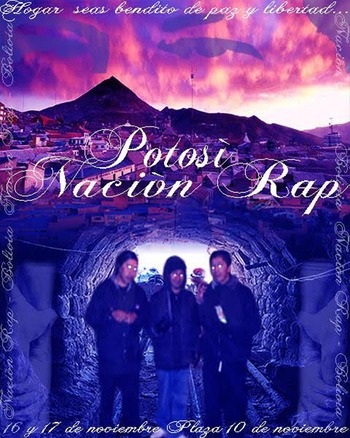
A flyer promoting one of Nación Rap's performances in the city of Potosí shows the artists situated underground in the entrance to a mine (Figure 1). Above them and in the background, behind cursive text of the names of the city and group, is an image of the city with the mountain Cerro Rico (“Rich Hill”). Over the horizon and through the clouds of a setting sun, eyes peer back at the viewer under more cursive text, “Hogar seas bendito de paz y libertad” (“Home be blessed by peace and freedom”). Thanks to the mines of Cerro Rico, as its name suggests, Potosí was among the most important centers of mineral extraction for Spanish colonialism, so much so that the name Potosí came to stand for wealth after the Golden Age writer Miguel de Cervantes Saavedra introduced the phrase “valer un Potosí” (to be worth a Potosí) into Spanish to denote being “worth a fortune.” Potosí is possibly the site of the longest and most intense mining of the Western Hemisphere. Official records account for forty-five-thousand tons of silver mined during its first two hundred years of operation, between 1556 and 1783.Footnote 28 An estimated eight million Indigenous conscripted mita laborers and enslaved Africans died in its mines during this same period. The steady stream of silver that flowed into Europe, through Spain into the coffers of Dutch and British banks, also produced the basis for the excessive style typical of Spanish Baroque, the style that became the universal brand of Spanish colonialism.
Nación Rap flyer for a concert in Potosí.

Recognizing the importance of Potosí to both the genesis of a world capitalist system and in shaping its early aesthetic forms was the beginning point for a 2010 Bolivian and German collaborative exhibition titled “The Potosí Principle,” in which curators Alice Creisher, Max Jorge Hinderer, and Andreas Siekmann juxtaposed New World Baroque with contemporary art. The curators proposed “the Potosí Principle” to assert that “… the roots of modernity and its art production do not lie in Enlightenment and rationalism, but in the process of colonization, which has not yet come to an end.” The curators posed a series of questions with implications for how we understand this region's role in the formation of capitalism more broadly, asking:
What would happen if we substituted the ego cogito of Descartes for the ego conquiro of Hernán Cortés, or the principle of pure reason for what Marx called the principle of primitive accumulation? What would happen if instead of beginning with the story of modernity in England's Industrial Revolution, or in France of Napoleon the third, we were to begin in the America of the Viceroys?Footnote 29
Scholars in Native American and Indigenous Studies would add: What would happen if we confronted how dominant conceptualizations of “the West” obscure its intimate, violent, and mutual constitution with Native America and Africa through centuries of colonialism?
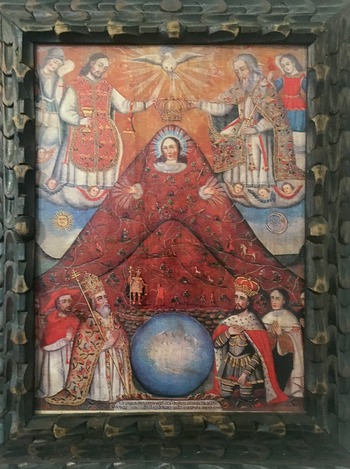
Imported European aesthetic traditions were both transformed and transformative in the Andean context: “The saints and virgins were reactualized in festivals and Indigenous rites, and fomented in this way a hybrid religiosity whose function was resistance to the colonial project.”Footnote 30 A classic example of such hybrid, ch'ixi religious imagery can be found in an anonymous painting of Cerro Rico dating from the late 1500s (Figure 2). Europeans figure not only into the foreground but preside over the heavens and are enormous in relation to the tiny Indians on the slopes of the mountain, or better, at the foot of the mountain, as the mountain is animate, the figure of Mary. To the mother mountain's right and left are the sun and the moon. They too are subordinated to the divine Europeans above them. Here, there is a visual incorporation of both Quechua and Aymara religiosity on the one hand and Catholic religiosity on the other. The veneration of the mountains, the sun, and the moon are made coterminous with the adoration the Virgin Mary within a frame that subjugates these elements to divine, white men.
Anonymous painting from the 1500s of Cerro Rico in Potosí as Virgin Mary. Photo by the author.

Writing of this period, literary scholar Lois Parkinson Zamora has drawn on the work of Latin American scholars of the New World Baroque, including using Cuban literary critique José Lezama Lima's term “counterconquest” to describe how Indigenous artists reshaped colonial aesthetic practices, making them their own.Footnote 31 Again writing of artistic production in highland Bolivia, Argentine architect and art historian Ángel Guido wrote that, “Despite the infamous cruelty of slavery and the death throes of indigenous cultures, Indian art survived underground in the form of a moan.”Footnote 32 For Guido, this moan was durable and audible, perceivable through the incorporation of Quechua and Aymara elements within Baroque architecture of colonial rule on the facade of the church in Potosí as an act of resistance, an assertion of Quechua and Aymara identity:
While Túpac Amaru caused part of America to tremble by rousing his Quechua and Aymara supporters to rebellion, the Quechua Indian José Kondori sculpted the sun and moon, indigenous flora, and his extraordinary indiatids (indiátides) on the façade of the San Lorenzo Cathedral in Potosí. … the Quechua Kondori [similarly] transfigured all his bitterness at the bloody enslavement of the mita, and all his stifled impulse to rebellion, into criollo beauty.Footnote 33
For Bolívar Echeverria, this radical mixing of aesthetic forms was also a form of survival in hostile conditions: “The Baroque appeared in America first as a strategy of survival, as a method of life invented spontaneously for that tenth part of the indigenous population that managed to survive the extermination of the XVI century and had not been expelled to inhospitable regions.”Footnote 34 “Baroque” in his sense here refers to ch'ixi cultural forms, those which seem to have been imported but have been, in fact, Indigenized. This approach to survival in hostile social conditions demanded the production of what Rivera Cusicanqui terms ch'ixi cultural forms and led Echeverría to argue that the societies built by Indigenous peoples of the Andes and Mesoamerica operate with a Baroque ethos still today, suggesting that the expansive, excessive incorporation of diverse cultural registers is the default state of capitalist modernity.
Counterconquest of a US-Centric Culture Industry
Juan Eber Miranda Quispe of Nación Rap expressed his understanding of the dialectic nature of global hip-hop's rise in a 2011 interview with a journalist for the Finnish news agency YLE, for which I served as translator. Framed partly in terms of “conscious” versus “commercial” hip-hop, the journalist had asked Quispe to reconcile an apparent contradiction between these Aymara rappers’ investment in anti-imperialist politics, on the one hand, and their embrace of hip-hop, on the other. Quispe's response to the question was revealing for how it undermined its very framework:
Rap in the United States was born with that thought of revolution, protest from the ghettos of Latino and Black neighborhoods. Little by little it has been transforming, right? I think it has gotten to a point where rap music has become so popular that industries have grabbed it in order to commercialize it, grabbing it like an object to make it marketable, to sell it everywhere. I don't think that is bad. Because if it wouldn't have been for rap getting to the point where there was commercial rap, it wouldn't have arrived to all parts of the world. I never would have become a rapper. I never would have had a group.Footnote 35
Quispe's account of hip-hop's commercialization does not serve as a preamble to a lament of hip-hop's degeneration, nor is what follows a denunciation of a crass culture industry deformation of earnest art, nor is it a nostalgia for some more conscious, more political “good old days.” Instead, Quispe points to the rise of commercial hip-hop as a necessary step for it to reach a global audience. If it wouldn't have been for a global expansion facilitated by a capitalist culture industry, hip-hop never would have arrived in Bolivia and he never would have heard the music that now organizes his daily life and inspires his aspirations for the future. Quispe lays out his conception of hip-hop's genesis as a musical expression of social protest by Blacks and Latinos in the United States “born with that thought of revolution” and its ultimate development into a commercially lucrative commodity, a genre of music that he understands as having become universal in its potential appeal across the globe. The music industry grabs it, “like an object to make it marketable, to sell it everywhere.” Quispe's view of hip-hop's universality is echoed, if reformulated, by historian and Black studies scholar George Lipsitz, who has argued that Black vernacular culture has become a form of global lingua franca.Footnote 36 This promise and hope of universalism is shaped by a dynamic similar to what Lois Parkinson Zamora identified in the New World Baroque—a purportedly universal style being reshaped through its local producers, who, by embracing its excessive quality, its impulse to expand and include ever more, incorporate Indigenous elements alongside ones emanating from a colonial center, and, in the process, transform the genre itself.Footnote 37
We hear the global and local, the transformation of genre through the incorporation of Indigenous elements in the music of Nación Rap. As an example, we can listen to their homage to the coca leaf, “Mama Koka,” a track released on the group's first album La palabra es un arma (The word is a weapon), released in 2011. This is also the track for their first professionally produced music video. The song itself is an homage to a prominent element of Andean culture, the coca leaf. Coca is both sacred and quotidian, used in religious ceremonies and divination but also consumed widely and daily throughout the Andes as a stimulant. Coca is chewed to endure a long day's work or simply brewed to make tea. Although its legal production and consumption in Bolivia is widespread, its illegal commercial uses are infamous. The illegal extraction and refinement of its alkaloids for the production of cocaine justified decades long campaigns by the US and Bolivian governments for its eradication. The struggle against these campaigns became the primary vehicle through which Bolivia's first Aymara president, Evo Morales, rose to political prominence as a leader of the Coca Growers Union. More broadly, the conflict over coca made it a metonym for Indigenous cultural resilience and also for Bolivian national sovereignty.Footnote 38 In this song, the rappers defend the dignity of coca, announce their allegiance to coca in an idiom of religious veneration, and celebrate the friendly and familial sociality it facilitates, as well as its role in ritual divination by Aymara shamans, or yatiris:Footnote 39

The very topic of the song is one particular to Aymara cultural practice, yet one shared with the broader Bolivian society: chewing coca. The way in which coca is celebrated here is particularly Aymara, however, in how coca is venerated as sacred, as Inal Mama, and as a divination tool used by yatiris. As mentioned above, the insistence that “coca is not cocaine” became not just a description of fact but a political stance of opposition to international efforts to eradicate the coca leaf and coca production. This stance came to feature prominently within Bolivian nationalist discourses opposed to US encroachment on Bolivian national sovereignty, a position which dovetailed with the defense of Indigenous cultural practices. The association of coca with narcotrafficking is explicitly denounced and, instead, coca is celebrated as a medicinal gift of Mother Earth, or Pachamama.
The Aymara element of the lyrical content extends beyond the lyrics’ topic to their linguistic form. Aymara rhymes are included alongside Spanish, French, and English. Although the longest verses are in Spanish and English, interspersed with the affirmation in French that “coca ce n'est pas cocaína (Coca is not cocaine),” Aymara is included alongside them on a lyrically equal footing. The Aymara interludes introduce the ritual name of coca's spirit, Inal Mama—”Inal mama satawa” ([she] is called Inal Mama)—and declaring the artists’ commitment to her—”Munat Inal mamita, jumampi saraskä, munat Inal mamita jumampi sarnaqä” (Beloved Inal mamita, with you I will go. Beloved Inal mamita, with you I will go all over).
The music sampled for the track comes from the popular 1987 song “Hoja verde de la coca” (Green coca leaf) by Peruvian Andean fusion “ethnorock” musician Miki González. The track prominently features the native Andean lute, the charango, and intermittent female vocals. Nación Rap's Eber Miranda Quispe described his own practice of searching for inspiration and samples from diverse genres as in line with the practice of “the greats” of hip-hop:
I think, the same bases of hip-hop we hear now like 2Pac, Eminem, Wu-Tang Clan or of Cypress were born in those DJs’ search for those, those loops, those pieces of music on vinyl, you understand they were born from hip-hop itself, you understand? And that's the same process that, will be here too, right? And sometimes rappers don't realize, I think what's lacking is to investigate a little the musical base. Where has it come from? From the god of the Americans, from the African American, from jazz, from other genres of, from the diverse genres the DJs have taken. I've made some loops of music that's from Proyección, That's a national group then too, eh, I look for little pieces that have the “beat.” The tempo from then I adapt it, I mix it with something. Then it's the same process, just that it's different genres. And, yes, some say, “How can you mix that, how?” But alright, I think that's why music is music, isn't it? It born of the mix. Many genres have been born from the mix. If it's not mixed, new genres aren't born. If it wouldn't be mixed it would be static. It would be, I think boring. That's the dynamic music has then, no?Footnote 40
Quispe's approach to sampling echoes the practices of early US hip-hop artists from what Kembrew McLeod and Peter DiCola have called “the golden age of hip-hop sampling.”Footnote 41 Nación Rap is one hip-hop group and “Mama Koka” one song, but hip-hop being made by Quechuas and Aymaras in the Andes provides numerous examples of Quechua and Aymara sonic elements intermingling with samples of 1990s US hip-hop and digitally composed beats. For Quispe, this is both a feature of hip-hop musical practice but also, crucially, a feature of music more universally. In his account of the kind of mixing that produced a track like “Mama Koka,” he also reveals his admiration for the “god of the Americans, the African American,” a comment that resonates with the concertgoer's earlier comment at the opening of this essay.
Ads for Rhinoplasty near the public university in La Paz, Bolivia. Photos by the author, 2011.

Marka Aru's branding with Andean design elements.

Marka Aru's “MA” logo (left) echoes the Wu-Tang “W” (right).

The embrace of African American cultural forms, however they are understood from an Andean perspective, is notable in a context thoroughly permeated with racial ideologies of what Bolívar Echeverría called “civilizatory whiteness,” where, even without large populations of European descendants, such as is the case in Bolivia, a logic of allegiance to a Eurocentric civilizatory order of white supremacy prevails.Footnote 42 Images upholding European phenotype as beautiful abound in Bolivia media. The pressures to submit to white beauty standards result in situations such as the following. Flyers and other advertisements for rhinoplasty can be easily found surrounding the public university in La Paz, an important site of class aspiration. The suggestion is clear—upward mobility through education may also come with upward mobility in the racial hierarchy through a change phenotypical facial profile, from Amerindian to more European. If signs such as dress, regional provenance, and language figure prominently into racialization in highland Bolivia,Footnote 43 this is certainly not to deny the body as a site of racialization.
The logo of the collective Khana Aru Imanthata (KAI) with the “four elements of hip hop” within a chakana, Andean cross.

Against this backdrop of anti-Black and anti-Indian racism, the Andean hip-hop scene's orientation to African American material culture within a broader affirmation of Indigenous cultural practices is notable. Examples of reworking US-based hip-hop imagery and sartorial styles are numerous. Take, for example, the logo of the El Alto hip-hop collective, Khana Aru Imanthata (KAI), which replicates a “four spheres of hip-hop” discourse (turntablism, rapping, graffiti, and breakdancing) presented within the chakana, or Andean cross—a symbol of the Inca Empire. Or the La Paz clothing company Marka Aru, whose designs incorporate Indigenous Andean iconography alongside graffiti and whose logo iconographically reproduces the W of the ’90s New York hip-hop collective Wu Tang Clan within the negative space of the initials MA.Footnote 44 Also notable is hairstyling, where one encounters both a reaffirmation of Indigenous hair styling through men wearing their hair long, such as David “Tawit” Lipan of Nación Rap, but also the widespread use of cornrows.
Conclusion
In this brief essay, I have considered the music of Nación Rap as a complex ch'ixi cultural phenomenon—one that mixes Aymara forms with other forms legible transnationally, whether linguistic, musical, or sartorial—belonging to the realm of hip-hop. This vigorous mixing of the local with the global has a precedent in the Andes from the earliest days of colonialism in the Baroque of the colonial period. The Baroque arrived to the Andes as a symbolic register of power and colonialism, yet one that was not too powerful as not to be transformed by those in its grip, through what scholars of that period termed a counterconquest of the aesthetic form.
Hip-hop arrived to the Andes through the workings of a hemispheric order dominated by a US culture industry, one that, in the words of hip-hop scholar Christopher Dennis, “bombards the world's urban poor with US popular culture, such as hip-hop and rap, essentially producing the desire to consume these products.”Footnote 45 Hip-hop arrived within a context of US Empire, but those listening to and aligning with it, like these Aymara rappers, are aware of the tensions within US society. Setting the Baroque alongside contemporary hip-hop may help us to consider resonances with earlier moments of Indigenous cultural production under conditions of globalization, but the point is not to say that these two are somehow the same or even straightforwardly analogous. Here, the Blackness of hip-hop and how this is understood in this Andean context presents an important complication.
In both Quispe's comments and Velásquez's remarks at the opening of the essay, we find Blackness as both the possibility of a decolonial solution, “born in that spirit of revolution,” and a trace of colonialism itself. For Quispe, hip-hop's association with the rebellion of African Americans in the United States makes it compatible with his own anti-imperialist politics. Their ch'ixi melding of what is understood as Black and urban alongside what is understood as Aymara and rural intervenes in new framings of race and place, while simultaneously exalting the Aymara language and Aymara cultural practices. By reformulating what is understood as Aymara, by situating the Aymara language as poetically equivalent to the colonial lingua francas of Spanish, English, and French, and by wearing Aymara clothing and hairstyles in the performance of an urban musical genre with proximity to Blackness, rather than whiteness, these artists challenge dominant racial logics of their society.