

Introduction
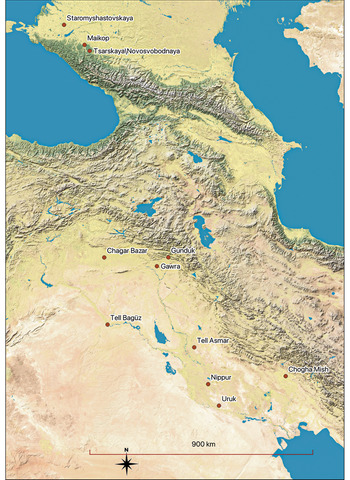
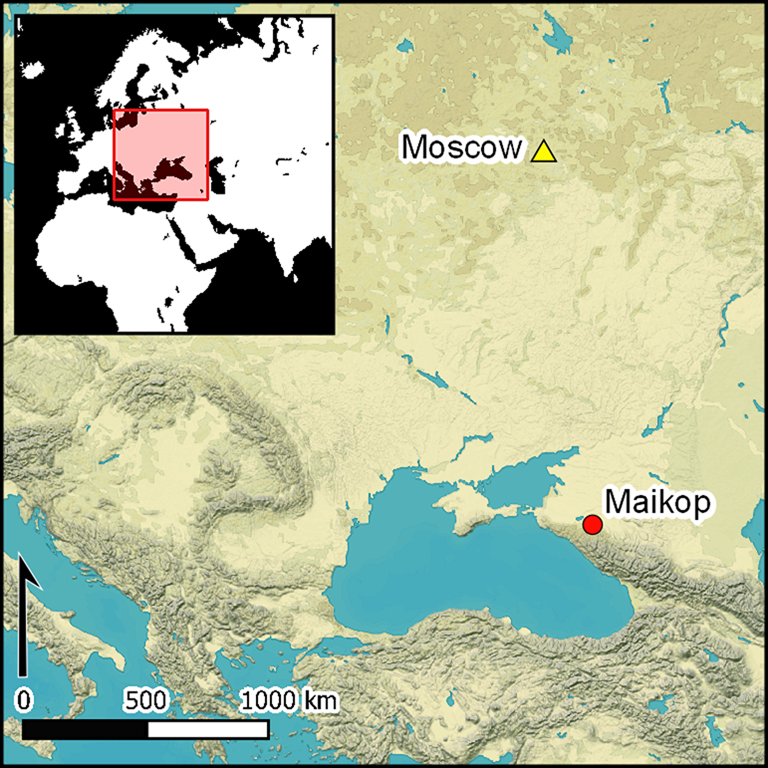
In summer 1897, Professor Nikolai Veselovsky of St Petersburg University excavated a huge mound located on the outskirts of Maikop, a small town in the north-western Caucasus, on the edge of the steppe (Figure 1) (Veselovsky Reference Veselovsky1900: 2–11). In due course, the Maikop mound, famed for its extremely rich burial and evidence for extensive cultural connections, would lend its name to the Maikop Early Bronze Age Culture (c. 3700–3000/2900 BC) (Kohl & Trifonov Reference Kohl, Trifonov, Renfrew and Bahn2014).
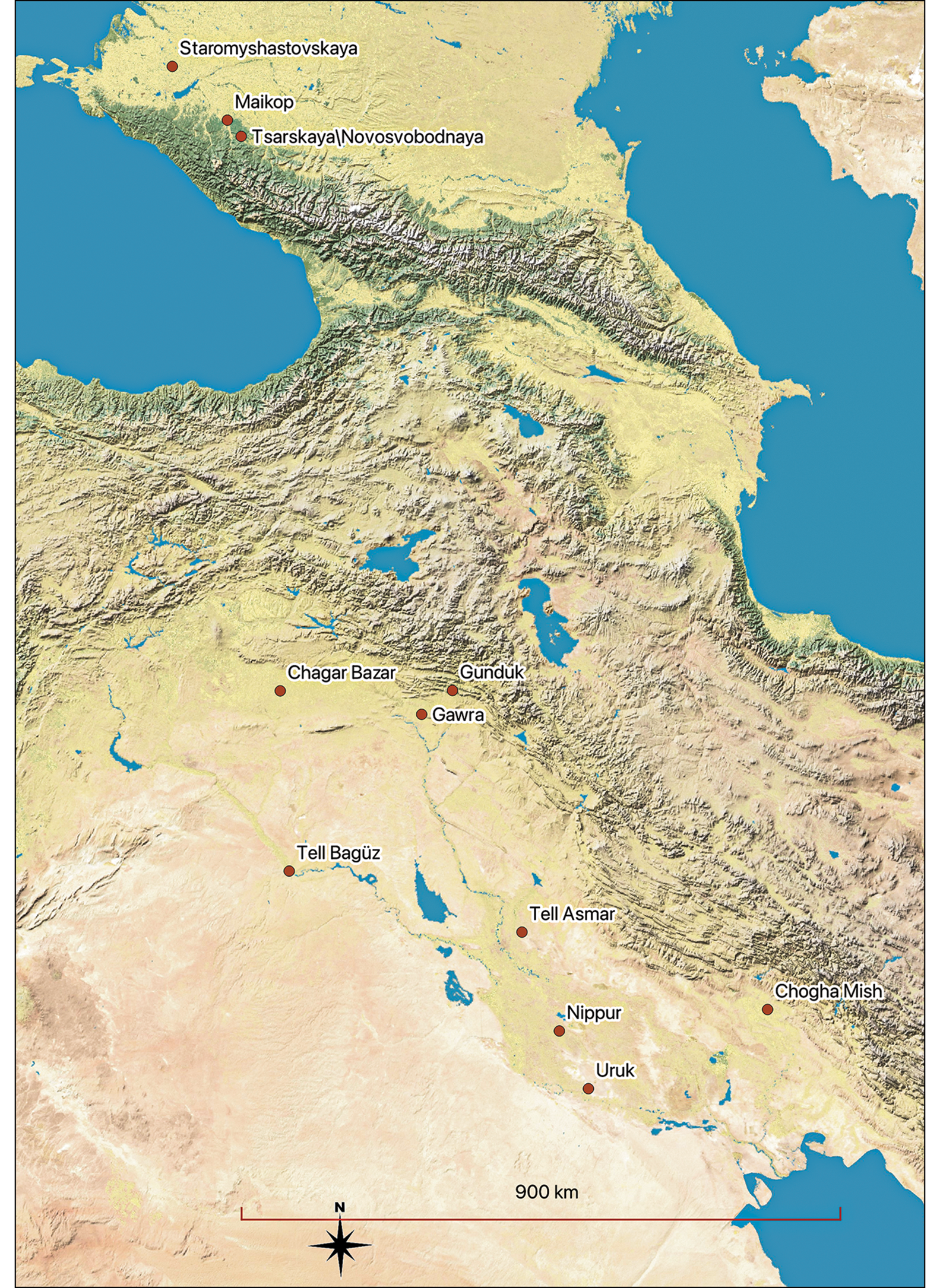
The Caucasus and Western Asia, showing sites mentioned in the text (map by V. Trifonov).
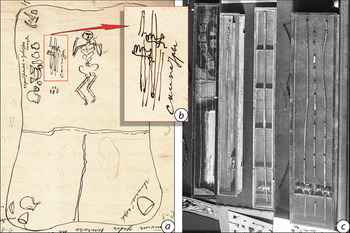
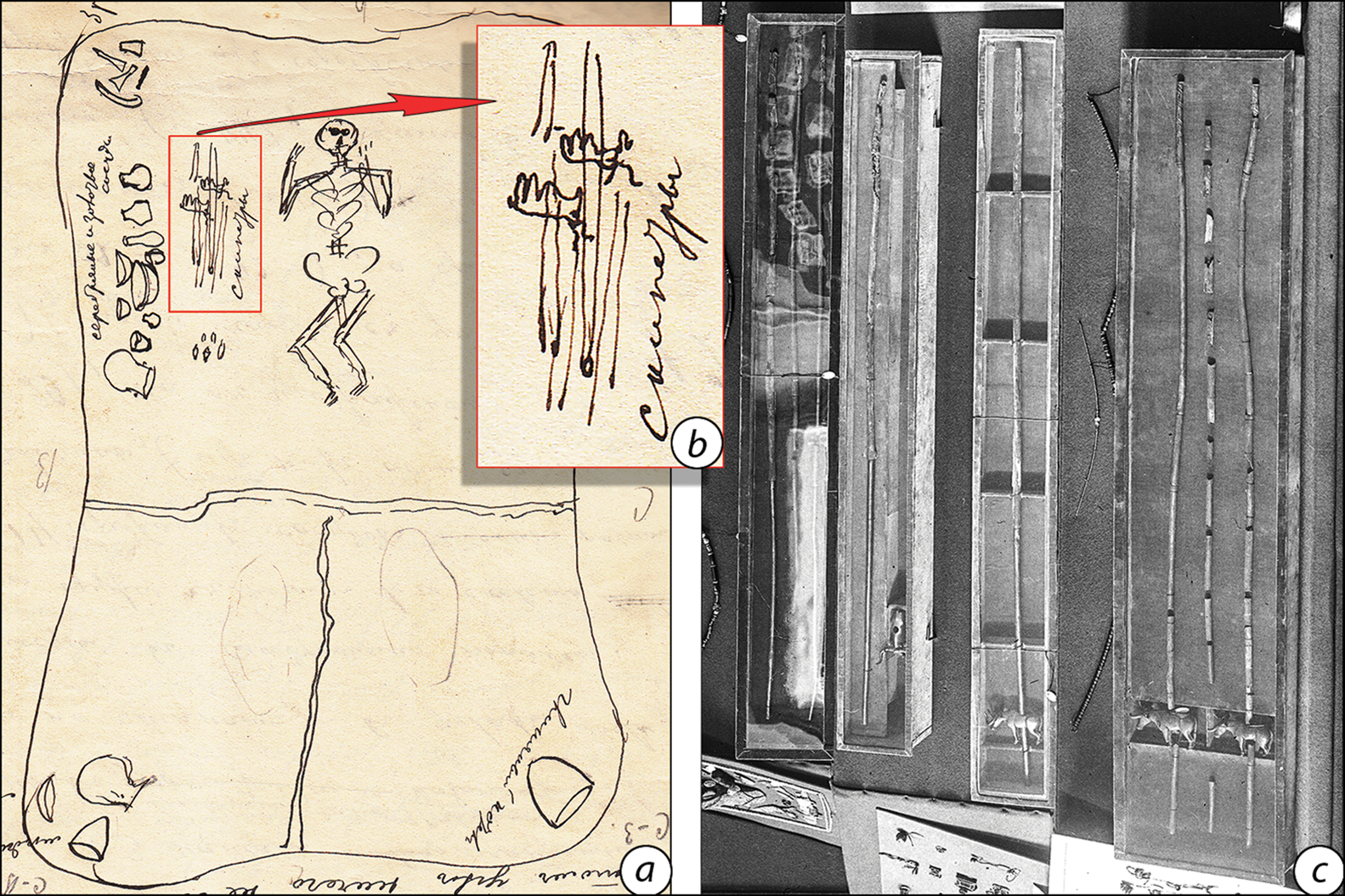
The burial mound, or kurgan, contained a large chamber divided into three differently sized compartments, each accommodating an adult individual lying in a crouched position. It is believed that the largest compartment contained the burial of the primary (i.e. most important) individual (Figure 2: a), as it was furnished with the most luxurious set of funerary offerings, compared with the other two burials in the same grave (Veselovsky Reference Veselovsky1900: 10). The skeleton of this individual was covered with the remains of a richly decorated garment, along with hundreds of beads of semi-precious stone and gold. Most of the grave goods, both plain and precious (including ceramic vessels, precious metal cups, weapons and tools), were arranged along the walls of the chamber, except for a set of eight long, thin gold and silver tubes, four of which were each decorated with a small gold or silver bull figurine. The tubes were placed to the immediate right-hand side of the skeleton (Figure 2: a–b). Veselovsky (Reference Veselovsky1897: 51) referred to these artefacts as ‘sceptres’. By autumn 1898, the entire assemblage of material from the Maikop kurgan, including the sceptres, had been transferred to the Hermitage in St Petersburg, where it was presented to the tsar's family and special guests at the annual exhibition of the Imperial Archaeological Commission. Contrary to Veselovsky's description of six sceptres (Veselovsky Reference Veselovsky1900: 4), a photograph of the exhibition shows one complete and seven broken, partly corroded ‘sceptres’ on display in four boxes (Piotrovskij Reference Piotrovskij, Kašuba, Reinhold and Piotrovskij2020: 122 & 140–41) (Figure 2: c).
The Maikop kurgan: a–b) Veselovsky's (Reference Veselovsky1897 sketch of the primary burial, showing the position of the eight gold and silver tubes (marked in Russian as ‘sceptres’); с) part of the 1898 photograph, showing one complete and seven broken, partly corroded ‘sceptres’ in four boxes (images courtesy of the Institute for the History of Material Culture, Russian Academy of Sciences, St Petersburg, Russia).
Here, we provide a review of previous interpretations of the Maikop tubes and advance an alternative hypothesis of their function and significance. We argue that these objects were drinking implements, and we relate this interpretation to a taste for Sumerian luxury and commensality in the Caucasus in the fourth millennium BC.
The ‘sceptres’: description and design
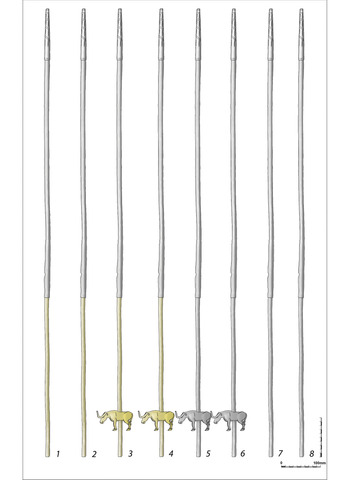
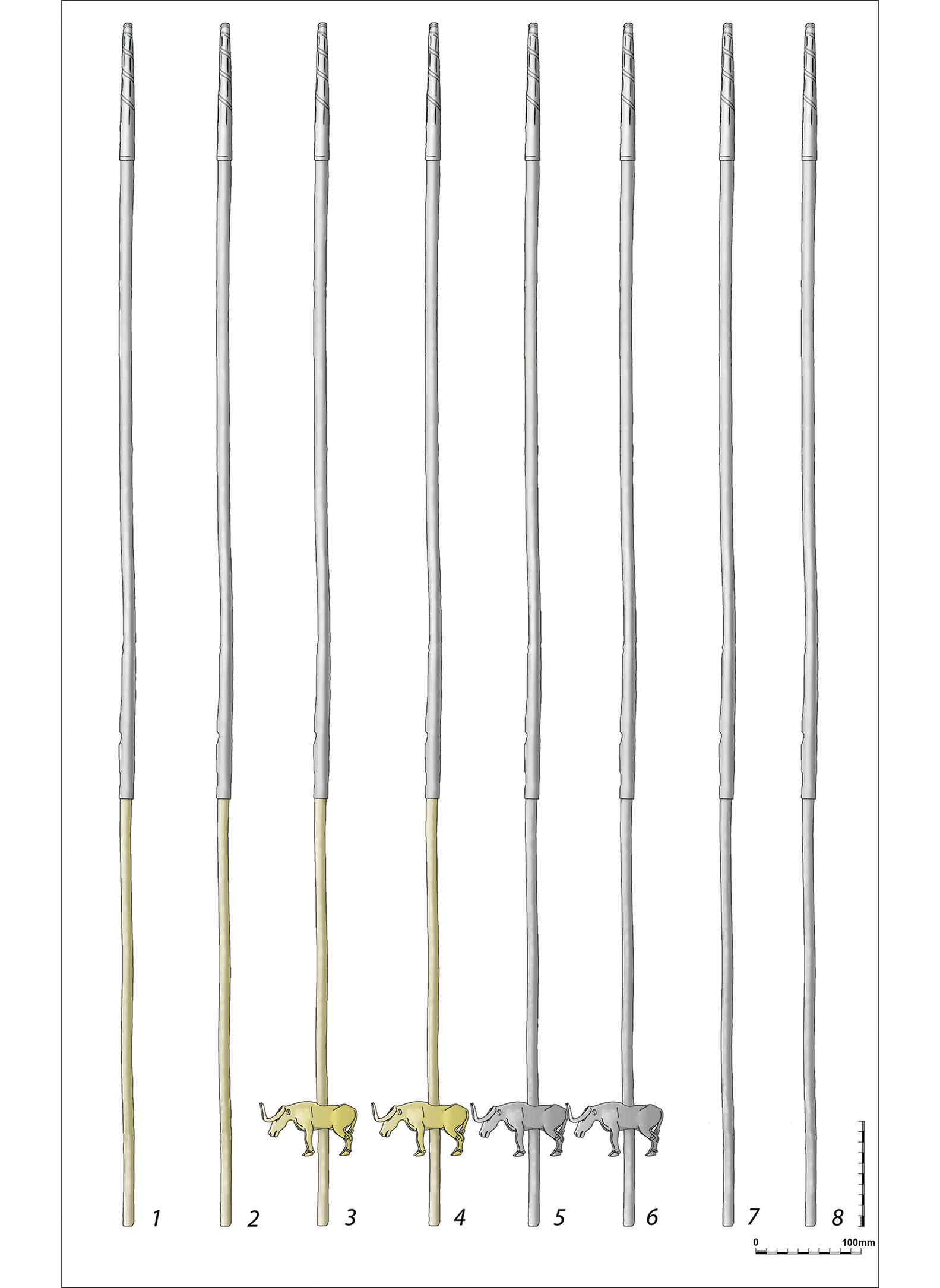
The complete set of ‘sceptres’ comprises eight composite gold and silver tubes, each with a narrowed, perforated tip. All are approximately 1.12m long and 10mm in diameter. Wall thickness varies from 0.27–0.70mm. The average interior diameter is approximately 5mm. Despite their length, they are light, each weighing approximately 200g, excluding the detachable bull figurines. Four of the tubes were each assembled from two or three silver segments, whereas the other four tubes were assembled from a combination of gold and silver segments. Two of the silver tubes are decorated with silver figurines of bulls and two of the gold and silver tubes feature bull figurines of gold (Figure 3).
Schematic drawing of the set of ‘sceptres’ from the Maikop kurgan: 1–2) gold and silver tubes; 3–4) gold and silver tubes with gold bull figurines; 5–6) silver tubes with silver bull figurines; 7–8) silver tubes. Note that this figure shows the objects with the tips pointing upwards, as assumed by previous scholars (figure by V. Trifonov).
The technology required to produce these thin-walled tubes, with their leak-proof longitudinal seams and socket joints, is of particular note. Although neither X-ray nor tomographic analyses have yet been undertaken, a thorough external examination reveals traces of their manufacture (Figure 4). All the tubes were made of flat silver and gold strips, each up to 0.7m long and approximately 30mm wide. The strips were then made into a tube by coiling them along their long axes, forcing the edges together and sealing the seam by forging and probably soldering (Figure 4: 5–6). Deep, parallel, lengthwise scuff marks on the surfaces suggest that the tubes could have been finished by cold-drawing through successively smaller dies.
The design of the ‘sceptre’ components from the Maikop kurgan: 1) one of eight silver perforated tips; 2) joint between two segments of the silver tube, and longitudinal seam; 3–5) types of fittings; 6) probable soldered longitudinal seam (photographs by V. Trifonov).
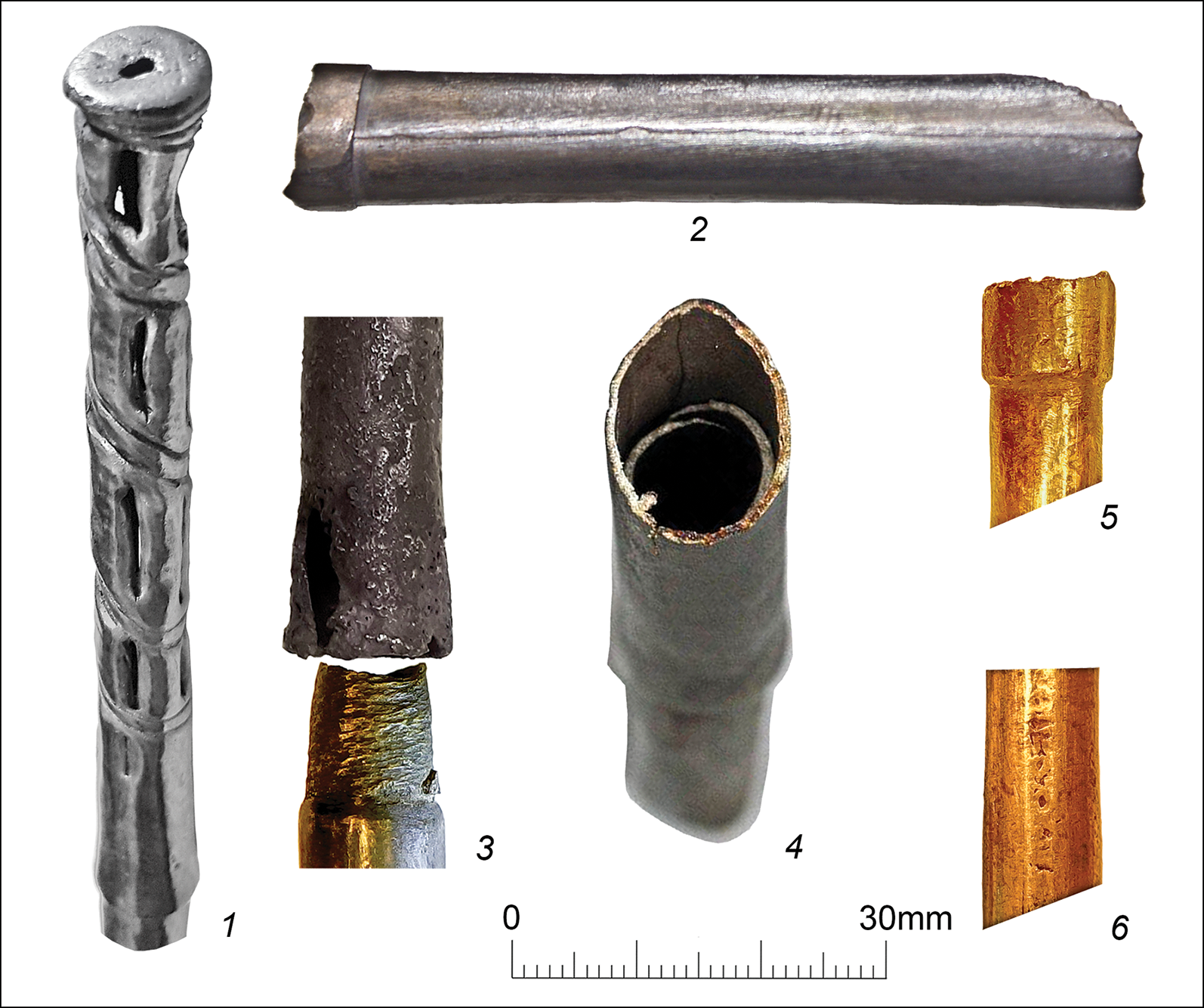
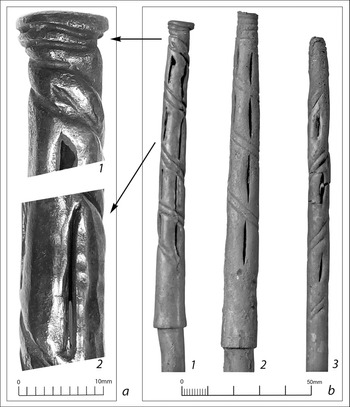
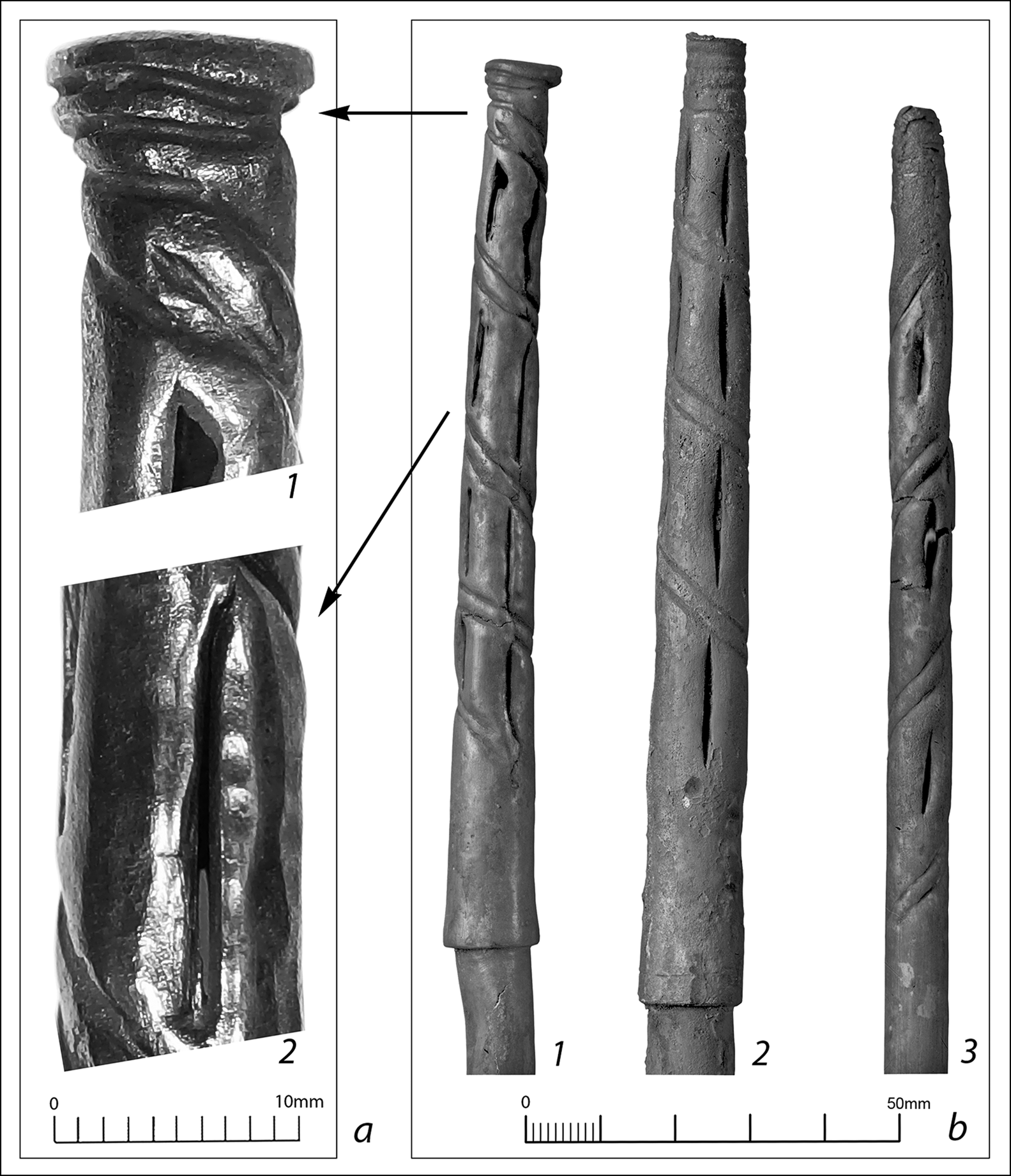
Tube segments of similar diameters were connected by sliding one into the other, before crimping or soldering around the joint (Figure 4: 3 & 5). To make two ends fit together, one end was narrowed by forging or rolling it into a spiral (Figure 4: 4). The tips of the eight tubes are similar and deserve special attention (Figure 5). Each tip has an engraved, spiral design representing three or four narrow coils or ribbons around the flattened end of the tip. Each tip also features four rows of aligned, narrow, vertical slits set within the spiral design. These slits were cut through the metal walls of the tubes from the outside (Figure 5: a1–2). They are a maximum of 1mm wide and demonstrate no visible wear marks. In one example, the slits and spiral design form a non-removable part of the long silver tube (Figure 5: b3). The flattened tip end of each tube is pierced by a single small hole.
Three of eight silver perforated silver tips from the Maikop kurgan: a) enlarged images of the design and slits; b) the silver tips in their original position (photographs a1–2 by V. Trifonov; b1–3 courtesy of the Institute for the History of Material Culture, Russian Academy of Sciences, St Petersburg, Russia).
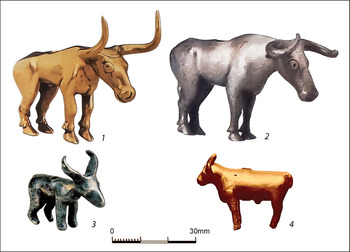
Four of the eight tubes have a detachable decorative element: a gold or silver figurine of a bull (Figure 6). These figurines are solid cast, probably using the lost wax technique, and probably represent an aurochs (Bos primigenius) (Friederichs Reference Friederichs1933: 33–34). Each figurine is pierced by a hole, allowing it to be slid onto one of the tubes. The figurines are quite small, measuring approximately 70–90mm from the tips of the horns to the tip of the tail (Figure 6: 1–2). A similar silver figurine—possibly of a gazelle—featuring a hole for a tube to pass through, is known from the Staromyshastovsky hoard, found in 1897 approximately 100km north-west of Maikop. This figurine, however, is even smaller than the Maikop examples, measuring just 35mm in length (Figure 6: 3) (Tallgren Reference Tallgren and Ebert1928; State Hermitage Museum 2021).
Figurines with vertical perforations: 1–2) gold and silver bull figurines from the Maikop kurgan; 3) silver figurine of a gazelle (?) from the Staromyshastovsky hoard; 4) animal (Ovis) figurine from Uruk made from bitumen and covered in gold (after Becker Reference Becker1993: 105, pls. 116 & 1234, colourised) (photographs 1–3 courtesy of the State Hermitage Museum, St Petersburg, Russia).
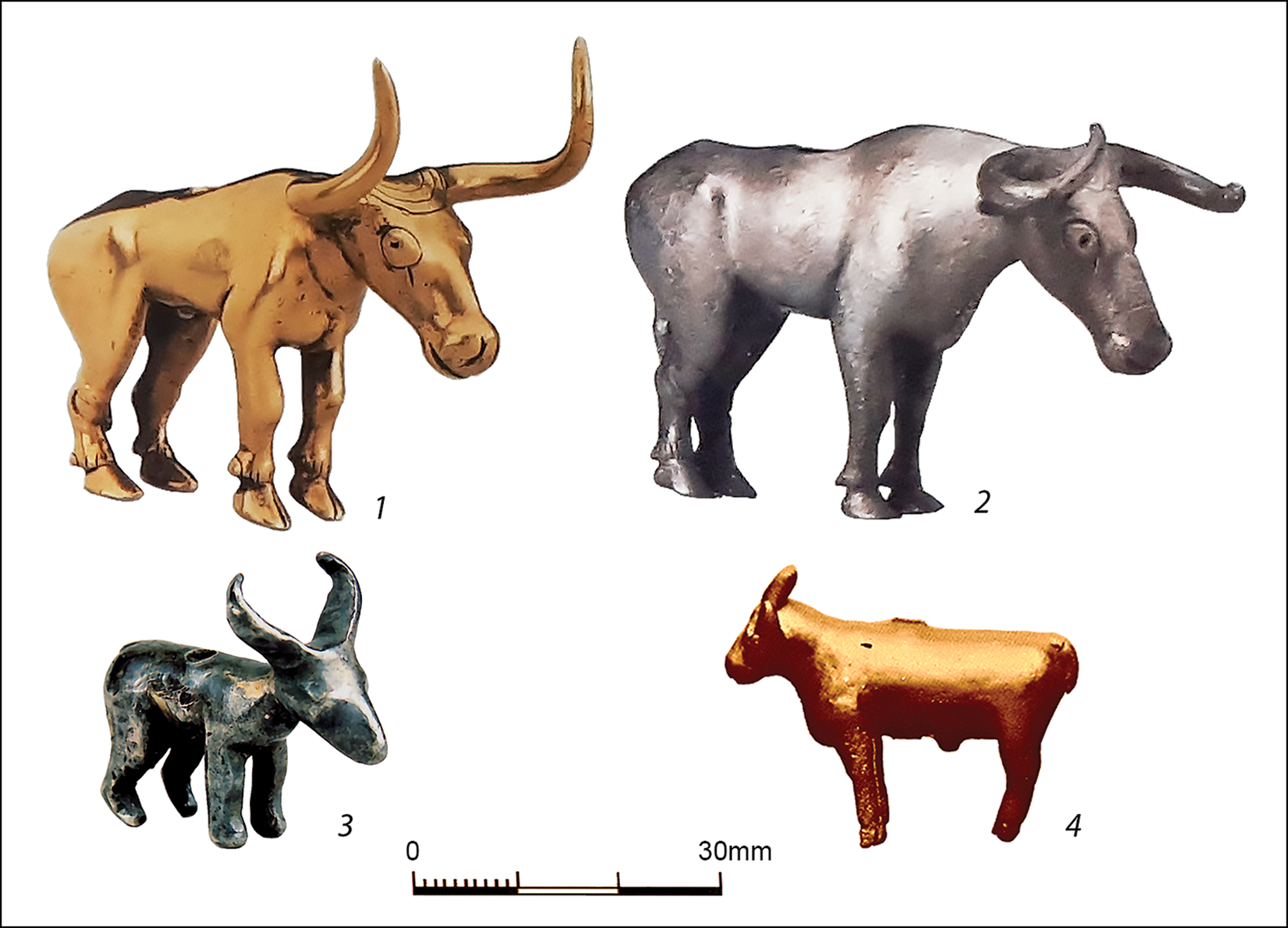
The bull figurines are not fixed in place and can slide up and down the tubes. They cannot, however, be moved beyond a certain point—roughly 0.14m from the end opposite the tip. In other words, when a tube is held vertically, with the tip pointing upwards, the figurine can slide down almost to the other end of the tube, coming to a stop where the tube widens slightly. One of the Maikop tubes in the Treasure Chamber at the Hermitage is displayed in a vertical position, with the bull close to the tip of the tube; however, this is purely because the figurine has become stuck and is no longer free to slide to other end of the tube.
The ‘sceptres’: previous interpretations
Veselovsky was the first to label the tubes from the Maikop kurgan as ‘sceptres’. He speculated briefly that the slits and hole in the tip of each tube were designed for tying or attaching some form of additional decoration, such as ornaments made from textile or horse-tail hair (Veselovsky Reference Veselovsky1897: 51).
In 1914, Farmakovsky (Reference Farmakovsky1914) introduced the idea that the tubes were part of a folding canopy held by four servants above the deceased during the funeral procession; the canopy was then dismantled and deposited in the burial. He believed that each tube was held immediately below the bull figurine, with the tip pointing upwards. Matching the span of a human palm, this part of the tube, he noted, “just feels right in your hand …” (Farmakovsky Reference Farmakovsky1914: 53). He imagined the tips of the tubes to have been decorated with ribbons and bows. Although Farmakovsky called the tubes ‘folding sticks’, this is misleading, since the crimped or soldered tube joints cannot be separated. Furthermore, he offered no explanation for why the putative canopy was supported by hollow tubes instead of solid poles, which would have been easier to make. Farmakovsky was, however, the first scholar to record the correct length (1.13m) of the only complete tube with a tip and bull figurine.
In a review of the evidence, Chernopitsky (Reference Chernopitsky1987) identified a number of issues with Farmakovsky's canopy interpretation. First, he discovered that the original number of tubes was eight, rather than the six described by Veselovsky and accepted by Farmakovsky. He also drew attention to the alignment of the tubes within the grave and their possible association with a set of flint arrowheads and microliths (Figure 2: a). Chernopitsky suggested that a tube piercing a bull figurine symbolises an arrow shaft, recalling the Sumerian myth about the killing of the Bull of Heaven. He surmised that the set of tubes with pierced bull figurines was used as a single bundle of rods, in the manner of a ‘barisman’ or barsom—a bunch of twigs used as a ritual instrument by priests in the Zoroastrian act of worship (Yasna) and mentioned in the Avesta, the liturgical texts of Zoroastrianism (Chernopitsky Reference Chernopitsky1987: 37). His hypothesis, however, conflicts with the number of arrowheads and tubes, and with the fact that neither the arrowheads nor the microliths fit into the slits in the tubes. Moreover, the tubes and the arrowheads were positioned some distance apart in the grave.
Despite the differences between the views of Veselovsky, Farmakovsky and Chernopitsky concerning the function of the tubes, they share a common assumption about these items: regardless of their identification as sceptres, sticks or rods, when in use, they were held with their tips pointing upwards. Recently, Yuri Piotrovskij, curator of the Maikop collection in the Hermitage, concluded that Veselovsky's interpretation of the tubes “is still correct” (Piotrovskij Reference Piotrovskij, Kašuba, Reinhold and Piotrovskij2020: 142).
An alternative interpretation
A major problem with the previous interpretations is that they either overlook technical details of the tubes or lean towards simplistic explanations for them. They do not address the simple question: why tubes and not solid poles? Besides their technical aspects, the number of tubes and their inverted position in the grave with respect to the skeleton (Figure 2: b) are inconsistent with their interpretation as sceptres, standards or banners. To address this problem, we pose three questions requiring investigation:
1) How to explain the complete design of the devices, including tube length and diameter, joint construction, and the location, size and purpose of the slits and holes?
2) Why were these objects grouped into a set of eight?
3) What does the deposition of the tubes mean in the context of the funerary ritual?
To help answer these questions, we hypothesise that these objects were drinking tubes designed for sipping a type of beverage that required filtration during consumption.
Drinking tubes and straw-tip strainers
Given our hypothesis that the Maikop tubes may have been used for drinking, we start by briefly reviewing the evidence for beer consumption in the ‘Sumerian’ style. In the Near East, the fermenting of barley into beer probably dates back to the Natufian period, around 13 000 years ago, and pre-dates the appearance of cultivated cereals by several millennia (Liu et al. Reference Liu2018). The onset of large-scale brewing in Western Asia in the fifth to fourth millennium BC (Hartman & Oppenheim Reference Hartman and Oppenheim1950; Hornsey Reference Hornsey2003; Damerow Reference Damerow2012) is associated with evidence of a specific way of drinking beer through long tubes. The earliest depictions of drinking through a straw come from seal impressions found in Chalcolithic (fifth to fourth millennium BC) Gawra XII in northern Iraq and Chogha Mish in western Iran (Tobler Reference Tobler1950: pl. CLXIII, 91; Kantor Reference Kantor and Brinkman1978–1979: 34). In the third millennium BC, during the Early Dynastic I–III period (c. 2900–2250 BC), banquet scenes showing groups of people sipping beer through long tubes from a shared vessel (Figure 7: 1) became popular in Mesopotamian art (Selz Reference Selz1983; Collon Reference Collon, Gyselen and Bernus-Taylor1992: 24 & fig. 2; Pinnock Reference Pinnock and Milano1994: pls. 1 & 2; Schmandt-Besserat Reference Schmandt-Besserat, Dietler and Hayden2001: 396 & fig. 14.5; Renette Reference Renette, Altmann and Fu2014: 64 & fig.1: a–b). Such a scene, for example, is displayed on a votive stone relief plaque from Nippur (Hansen Reference Hansen1963), and possibly on a rock-cut panel in Gunduk, Kurdistan (Edgeworth Reade & Anderson Reference Edgeworth Reade and Anderson2013: 88–89 & fig. 24).
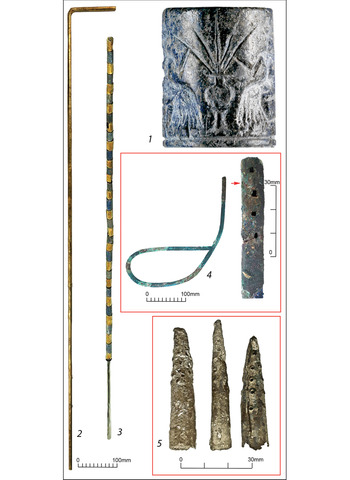
Drinking tubes and tip strainers: 1) depiction of shared drinking from the Royal Cemetery at Ur, PG 1237; 2–3) from Ur, GP 800; 4) from Tell Asmar; 5) from Chagar Bazar (after Mallowan Reference Mallowan1937: pl. XIV: c) (photographs 1–2 courtesy of the Penn Museum (image 295993, object 30-12-2; image 296355, object B16688); photograph 3 courtesy of the British Museum; photograph 4 courtesy of the Oriental Institute of the University of Chicago).
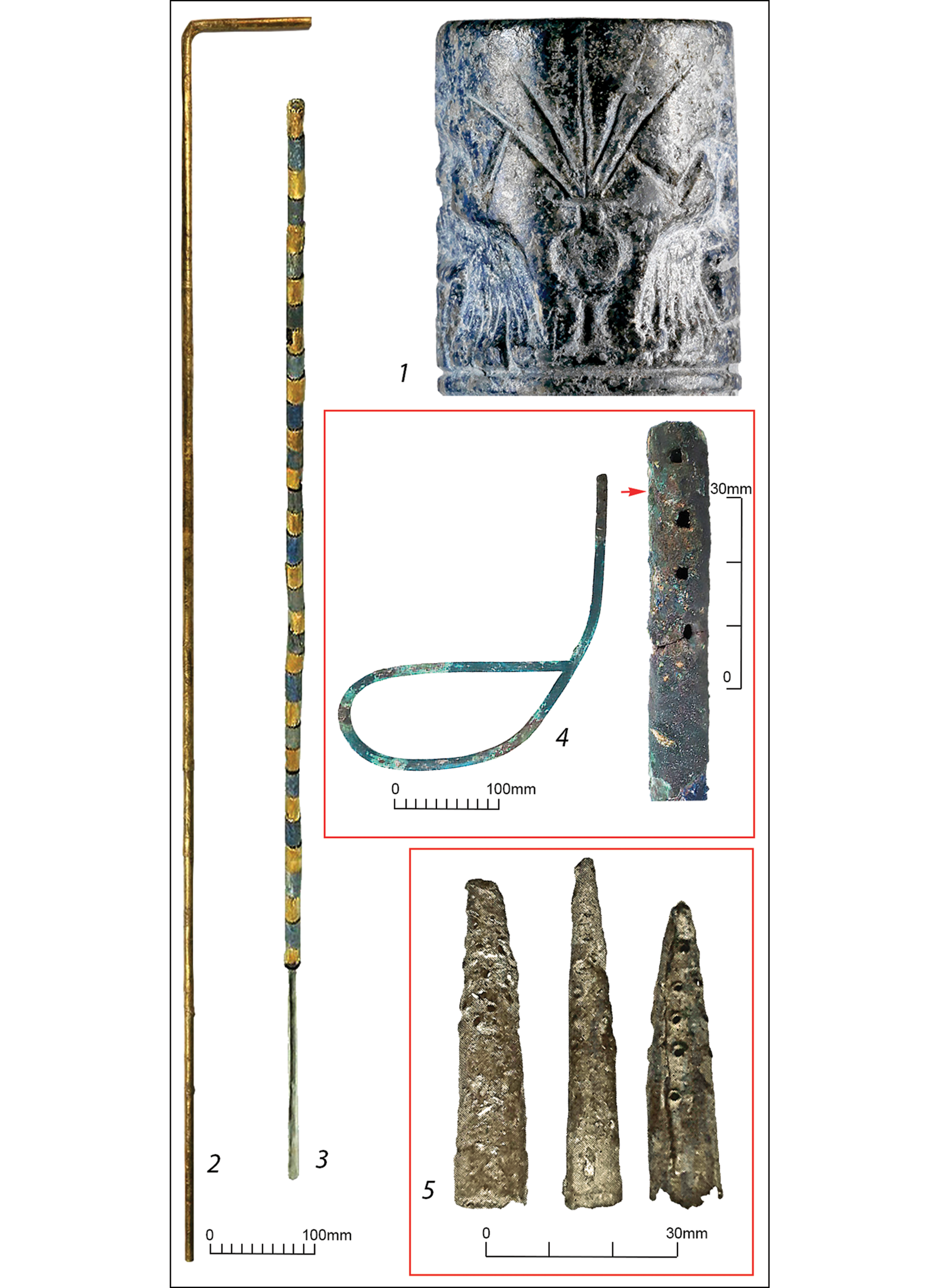
The common ancient Sumerian implement for consuming beer was a tube made of a long reed, allowing the user to sit or even stand and drink from a large vessel positioned on a low pedestal. The representation on seals of tubes made of reed stems, with their distinctive nodes (Moortgat Reference Moortgat1940: no. 526), corresponds with material traces of a reed stem wrapped in gold foil recorded during conservation of a drinking tube from Queen Puabi's grave in the Royal Cemetery at Ur. This reed tube was 1.24m long and 10mm in diameter (Figure 7: 2), and its end was bent at a right angle. Two other drinking tubes from this tomb were made of metal: a silver tube, 0.93m long and 10mm in diameter, covered with gold and lapis lazuli (Figure 7: 3) and with an L-shaped detachable component that extends the tube by 0.19m, and a copper tube decorated with lapis lazuli and preserved to a length of 0.45m (Weber & Zettler Reference Weber, Zettler, Zettler and Horne1998: 139).
We can assume that gold and lapis lazuli were not the only materials used to decorate luxurious drinking tubes in the ancient Near East. Pre-dating the Maikop example, but similar in form, tubes such as that found at Uruk (Figure 6: 4) could be decorated with small animal figurines. The Uruk figurine (Ovis) is made from bitumen and covered in gold, and is roughly the same size as the silver gazelle from the Staromyshastovsky hoard; it also has a vertical perforation (Becker Reference Becker1993: 105, pls. 116 & 1234).
Another drinking tube comes from Tell Asmar in eastern Iraq, and formed part of a hoard of copper objects placed inside a large jar, together with bowls and a strainer (Frankfort Reference Frankfort1934: 39 & fig. 35). This hoard is contemporaneous with the Royal Cemetery at Ur. The tube, which is now housed in the Oriental Institute Museum in Chicago, is approximately 0.7m long and a little over 10mm in diameter (Figure 7: 4). One end has a strainer consisting of a row of four square perforations, each roughly 1mm across, intended to filter any chaff or sediment as the drinker consumed the beer. As this part is heavily corroded, it is uncertain whether or not the perforated part was detachable (S. Allison, pers. comm.).
Detachable straw-tip strainers made of copper (and less frequently of bone) were widely used across the Levant and Mesopotamia in the second millennium BC. These tip-strainers were intended to be fitted to the end of straws made of reeds. They consist of a narrow cone, approximately 60–90mm long, made from a perforated sheet of copper. The narrow end of each cone has an opening roughly the same size as the side perforations: around 1mm across (Figure 7: 5) (Mallowan Reference Mallowan1937: pl. XIV: c; Hrouda Reference Hrouda, Tunca and Kupper1990: 105; Maeir & Garfinkel Reference Maeir and Garfinkel1992; Einwag & Otto Reference Einwag, Otto, Evans and Roßberger2019: 166–69). The tip-strainers were probably fitted to the end of the reed that was immersed into the beer, in order to filter the liquid as it was drawn into the tube. The wide distribution of these detachable tip-strainers suggests that reeds continued to be used as drinking straws, and that the metal tubes found at Uruk and Maikop represent prestigious exceptions.
Reed and metal tip-strainers: experimental evidence
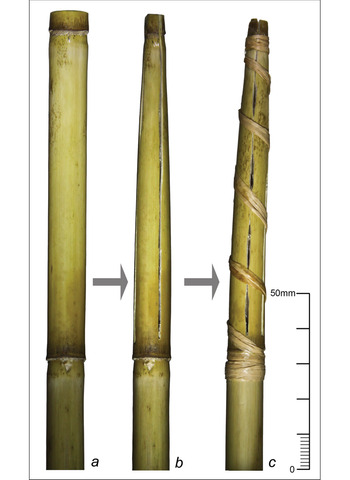
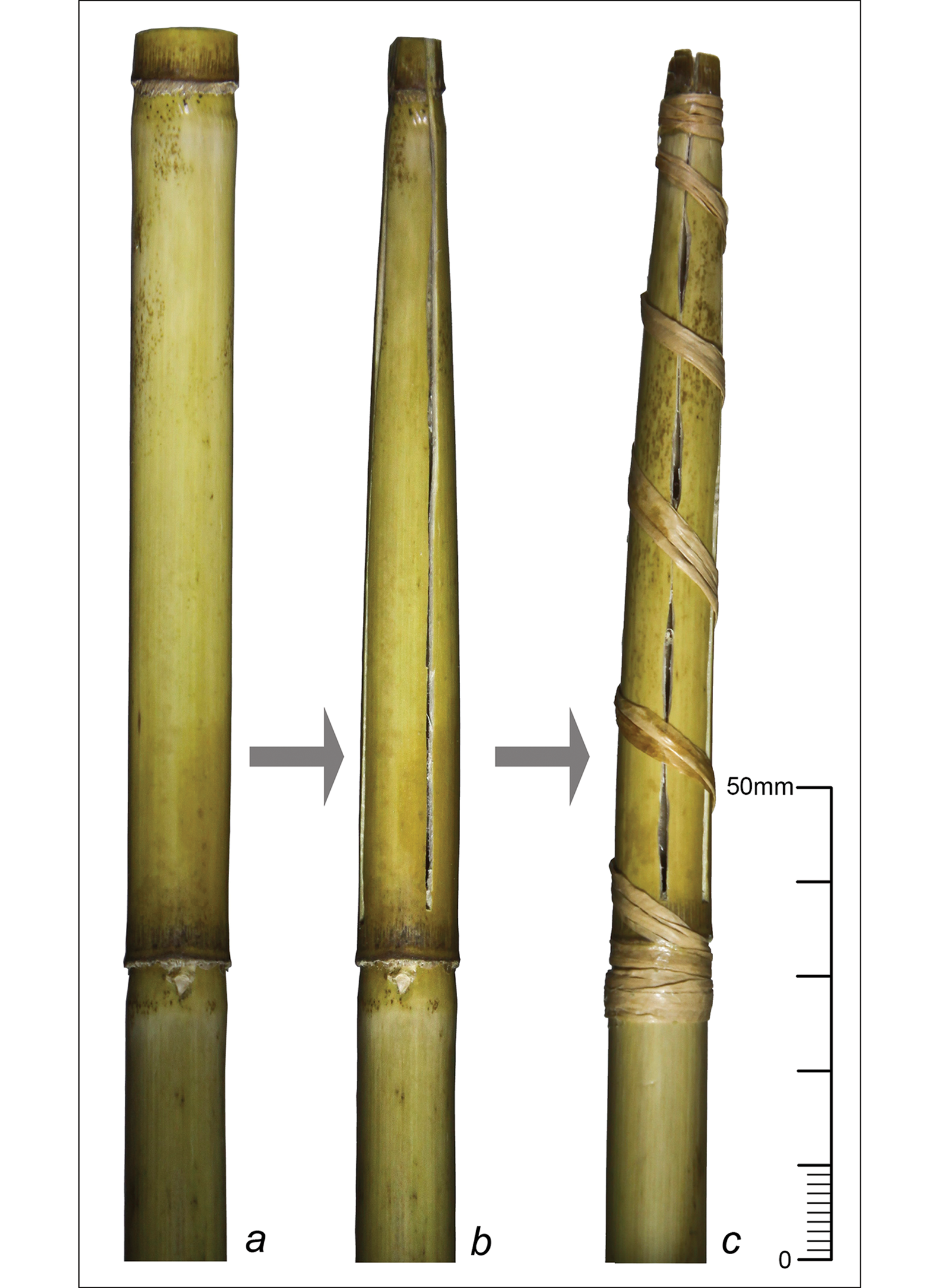
The drinking tubes from Queen Puabi's tomb, made from reed stems wrapped in gold foil, provide clear evidence that the shape and size of natural reeds influenced the design of metal drinking tubes, including their tip filters. Drinking straws made from reeds may have originally featured an integral strainer at the tip of the tube that was intended to be immersed into the beer. The design of the silver tube tips from the Maikop tomb provides clues as to how the end of a natural reed stem can be converted into a tip-strainer. Our own experiments have shown that it takes around 20 minutes to make a tip filter using only basic tools and processes. First, the segment between the last two nodes of a cut reed (Phragmites australis) stem (Figure 8: a) is split along the line of the fibres into four equal sections. Then, the long edges of all four sections are trimmed to produce a tapered shape (Figure 8: b). These tapered sections are then held around a mandrel (shaping device), and a handwoven plant fibre is wound round the ends of the four sections to reclose the tube, and then spiralled down to the node below where the stem was split (Figure 8: c). A coat of adhesive (bitumen?) can then be applied to prevent fraying. Slits, 1mm wide, are then opened along the original cut edges, and the mandrel removed. Hence, the appearance of the spirals and the positioning of the slits on the silver tip filters (Figures 5: b & 8: c), as well as the joints between the sections of the Maikop drinking tubes, all suggest that these elements derived from an original method for shaping reeds to use as drinking straws with integral filters (Figures 4: 2–6 & 8: a–b).
The chaîne opératoire of an experimental tip strainer made from common reed (Phragmites australis) (photographs by V. Trifonov).
The silver Maikop strainer: residue analysis
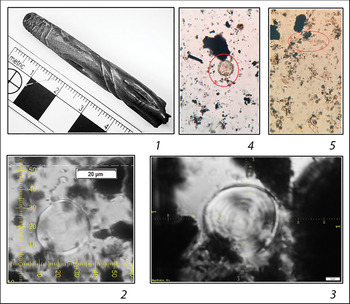
In order to test the hypothesis that our Maikop artefacts were used as drinking tubes, we analysed a small sample of the residue from the inner surface of one of the eight filters (Figure 9: 1). The object was partly damaged, and contamination of the residue during excavation in 1897 and later curation at the Hermitage cannot be excluded. Due to the small sample size, only micro-botanical analysis could be undertaken. The sample reveals the presence of barley starch granules, cereal phytoliths (as yet unclear whether wild or domestic) and a pollen grain from a lime tree (Tilia sp.) (Figure 9: 2–5). The latter's pale green colour and inner structure could indicate a recent origin.
Evidence from residue analysis of the silver tube tip-strainer from the Maikop kurgan: 1) fragment of the silver tip-strainer; 2–3) barley starch granules; 4) pollen grain from a lime tree; 5) cereal phytolith (photographs by V. Trifonov and D. Petrov).
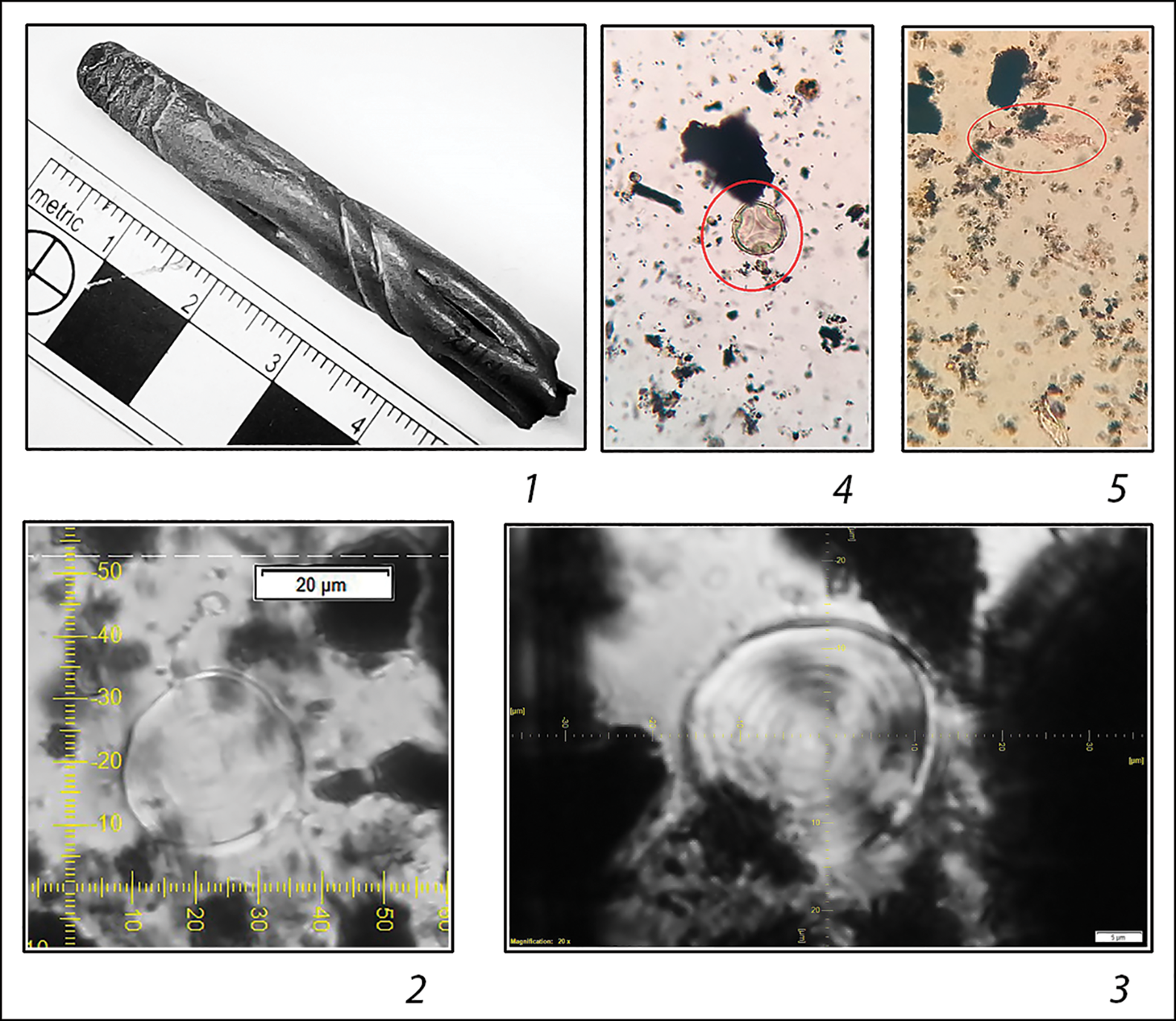
Although it is tempting to assume that these botanical data provide direct evidence for the straw-tip strainer being used to filter the sediment and suspended chaff in a flavoured barley beer, we cannot prove conclusively the presence of a fermented beverage (Guerra-Doce Reference Guerra-Doce2015). These results should therefore be treated with caution, as further analyses are needed (Wang et al. Reference Wang2017). The wider context of Maikop Culture subsistence could provide additional information with which to assess the results of our residue analysis, but no flotation has yet been undertaken on any Maikop settlement sites. Indeed, this has contributed to the perception that the Maikop Culture was dominated by cattle breeding rather than agriculture (Korenevskiy Reference Korenevskiy2004: 73–77). In fact, the presence of grinding implements in almost every Maikop household, along with lithic sickle blades, storage pits and a great variety of ceramic vessels (Koreneskiy Reference Korenevskiy1995), suggests that the contribution of agriculture has been underestimated. We know that in the fifth and fourth millennia BC, the Eneolithic population of the northern Caucasus grew wheat (Triticum aestivum L.) and barley (Hordeum vulgare L.) in abundance (Ostashinsky et al. Reference Ostashinsky, Cherlenok and Loskutov2016). This was probably also the case for the subsequent Maikop Culture and, if so, households could have brewed barley beer flavoured with herbs and lime flowers.
Drinking tubes in the Maikop funerary context
If our Maikop drinking tubes hypothesis is correct, it may also explain the position of the tubes within the grave and their grouping in a set of eight. The upside-down position of the bull figurines on the tubes (Figure 2: b) with respect to the skeleton—an alignment inappropriate for standards or sceptres—accords with the ‘working’ position of the drinking tubes: with the tip-strainer pointing downwards, as though ready to immerse in a vessel of beer, with the inverted bulls appearing the right way up to the drinker.
The significance of the drinking tubes being placed next to the body of the deceased becomes clearer when considered in the context of contemporaneous images of banqueting scenes. These frequently show two individuals flanking a large vessel, each with a tube held to their mouth and the other end inside the vessel. Often two to four more straws are depicted protruding from the same vessel (Figure 7: 1), alluding to the presence of other individuals sharing the beverage, even if space and style constrained the artist from portraying the whole group of drinkers (Renette Reference Renette, Altmann and Fu2014: 78; Hafford Reference Hafford2018).
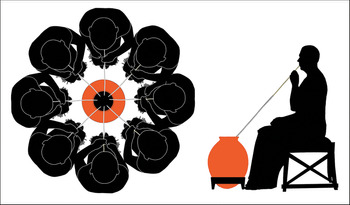
The single, early second-millennium BC burial in Tell Bagüz near Mari in eastern Syria, containing eight bronze tip-strainers, appears to support our hypothesis (Hrouda Reference Hrouda, Tunca and Kupper1990: 105). The set of eight drinking tubes in the Maikop tomb may therefore represent the feasting equipment for eight individuals, who could have sat to drink beer from the single, large jar found in the tomb (Figure 10). The volume of this vessel (32 litres) suggests that each participant's share would be about four litres (or seven pints) per person.
Reconstructed use of the drinking tubes from the Maikop kurgan (figure by V. Trifonov).
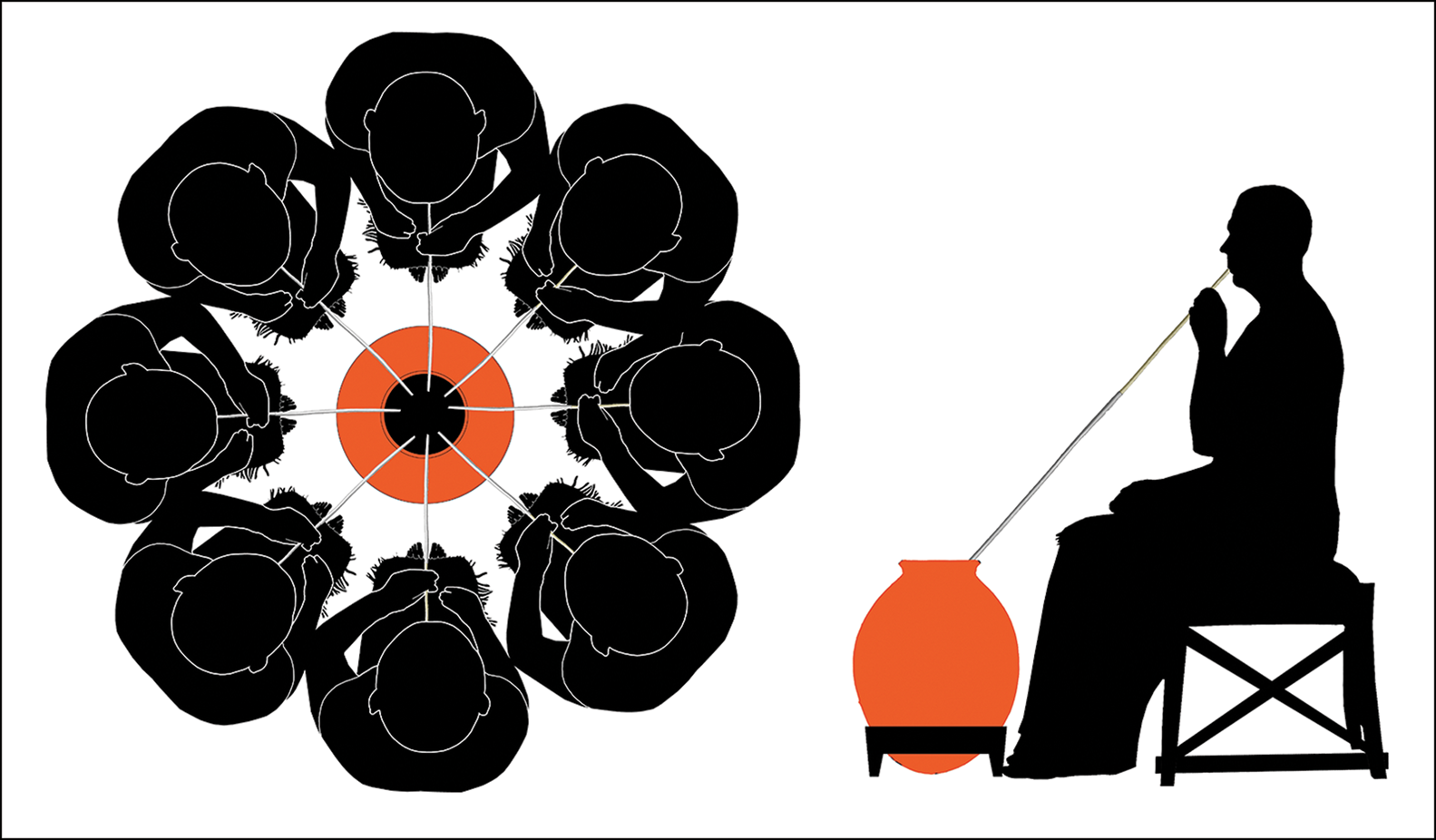
We do not know the identity of the individuals feasting during the funeral and/or in the afterlife, but the different precious materials (silver or gold and silver) from which the tubes and bull figurines were made may indicate differences in the status of those who used them in life and in the afterlife, reflecting their gender, social position and identity (Pollock Reference Pollock and Bray2003: 27; Steel Reference Steel, Steel and Zinn2017). These objects were probably intended for display and to mediate social relationships during a ceremonial feast—perhaps the climax of the Maikop funerary ritual.
The Maikop burial context indicates that high-status objects used for feasting were skilfully made, and that a ‘Sumerian’ taste for luxury and spectacle drove the Maikop aristocracy. The drinking tubes speak of a mutual language of elite consumption within a shared cultural milieu (Gosden Reference Gosden2003).
Conclusions
The set of eight tubes of precious metal from the Maikop kurgan have been interpreted in diverse ways since their discovery over a century ago. Here, we have argued that they were used as drinking tubes. If our interpretation is correct, these represent the earliest known drinking tubes, recovered not from the heart of the ancient Near East, but from the remote periphery of that world, in the northern Caucasus. While this does not mean that drinking tubes were invented in the Caucasus, it implies long-distance contacts, and that by the middle of the fourth millennium BC, these devices had become part of local funerary practices.
The composition of the Maikop assemblage suggests neither loot buried with a local warlord—as suggested by Tallgren (Reference Tallgren1924: 25) and Childe (Reference Childe1926: 194–95)—nor the imported or exotic personal belongings of a noble individual in exile from further south. Rather, the arrangement of the grave goods appears symbolic and intentional.
It is clear that, of all the items in the primary burial (except the jewellery), the tubes were placed closest to the body. This emphasises the importance of the feast in the funerary rite. Indeed, feasting and games at a funeral are deeply rooted in local tradition, and are expressed in the bronze fleshhook with anthropomorphic figures from the late Maikop Culture dolmen (c. 3200–2900 BC) near the village of Tsarskaya (present-day Novosvobodnaya) in the north-western Caucasus. The hook features a pair of nude men in a boxing stance, representing a ritual fight in the presence of, or in honour of a bull-horned deity, on which the opponents are standing. The item is thus associated with both ceremonial meals and ritual games (Trifonov et al. Reference Trifonov, Shishilina, Loboda, Khvostikov and Hansen2020). The remains of a harp or lyre from another elite tomb at the same cemetery (Rezepkin Reference Rezepkin2000: 61 & pl. 47: 1) suggest that these ceremonies may have been accompanied by music. Drinking beer from a shared vessel, banqueting, and boxing or wrestling to music accord with Sumerian funeral rituals (Sjöberg Reference Sjöberg1985; Katz Reference Katz and Lanery2007).
This tradition pervaded the ideology and spirituality of the Maikop Culture, mainly because of the area's close affinity with the wider cultural sphere of western Asia at that time; neither before nor after the fourth millennium BC was the northern Caucasus so profoundly integrated into the world of the ancient Near East. Unexpectedly, therefore, the Maikop drinking equipment illuminates not only the burial customs in the Caucasus, but indirectly also the early ‘royal’ funerals of the Near East in the fourth millennium BC.
Acknowledgements
We thank Yuri Piotrovskij for his assistance with our work in the Hermitage (St Petersburg) and Susan Allison (Oriental Institute Museum, Chicago) for her kind help in archival research. We are indebted to the following for advice, comment and criticism: Jan Bakker, Kelvin Wilson, Chris Gosden, Phil Kohl, Elena Izbitser and Eugeny Zaitsev. Special thanks are due to Svend Hansen for the opportunity to present and discuss a version of this article at the German Institute of Archaeology in Berlin in February 2020.
Funding statement
This work was supported by grant 18-09-40058 from the Russian Foundation for Basic Research and by grant 13.1902.21.0023 (system number 075-10-2020-116) from the Ministry of Science and Higher Education of the Russian Federation.