




No CrossRef data available.
Rural Monasticism as a Key Element in the Christianization of Byzantine Palestine
Published online by Cambridge University Press: 02 August 2005
Extract
In Palestine, Christian monasticism began early in the fourth century C.E. The first monks known to us by name are Hilarion of Thavata, who lived in the region of Gaza; Epiphanius, who settled near Eleutheropolis, in the Shephelah; and Chariton, a native of Iconium in Asia Minor who became the founder of monasticism in the Judean Desert. The monastic movement spread throughout Palestine during the Byzantine period (324–642 C.E.), and the remains ofmonasteries have been found in diverse areas. Many monasteries were establishedin or around large cities, or at holy places and sites of pilgrimage, while others were set in desert areas.
Information
- Type
- ARTICLES
- Information
- Copyright
- © 2005 Cambridge University Press
Introduction
In Palestine, Christian monasticism began early in the fourth century C.E.1
The research on which this paper is based covers the territory of the state of Israel, Judea, Samaria, and the Golan Heights. These territorial boundaries do not necessarily parallel those of the province of Palestine during antiquity. This geographic area was selected in order to take advantage of the fruits of the research undertaken in the region over the past few years. For this geographic delineation, see Yoram Tsafrir, Lea Di Segni, and Judith Green, Tabula imperii Romani, Iudaea Palaestina (Jerusalem: Israel Academy of Sciences and Humanities, 1994) viii. In accordance with historical reality in Palestine, it is common to distinguish Late Roman (70–324 C.E.) and Byzantine (324–642 C.E.) periods, even though this periodization differs from the chronologies used elsewhere in the Roman and Byzantine worlds.
For a short summary of Palestinian monasticism, see Lorenzo Perrone, “Monasticism in the Holy Land: From the Beginnings to the Crusaders,” Proche Orient Chrétien 45 (1995) 31–63.
Our knowledge of Palestine's monasteries has expanded in the past few decades with the publication of several monographs on the subject.3
See Yizhar Hirschfeld, The Judean Desert Monasteries in the Byzantine Period (New Haven, Conn.: Yale University Press, 1992); Joseph Patrich, Sabas, Leader of Palestinian Monasticism: A Comparative Study in Eastern Monasticism, Fourth to Seventh Centuries (Washington, D.C.: Dumbarton Oaks, 1995); John Binns, Ascetics and Ambassadors of Christ: The Monasteries of Palestine 314–621 (Oxford: Clarendon, 1994); and Uzi Dahari, Monastic Settlements in South Sinai in the Byzantine Period: The Archaeological Remains (Israel Antiquity Authority Reports 9; Jerusalem: Israel Antiquities Authority, 2000). See also the relevant articles in CAHL.
On Gaza monasticism, see Derwas J. Chitty, The Desert a City: An Introduction to the Study of Egyptian and Palestinian Monasticism Under the Christian Empire (London: Mowbrays, 1977) 71–76; and Bruria Bitton-Ashkeloni, “Gaza Monasticism During the Byzantine Period” (in Hebrew), Cathedra 96 (2000) 69–110.
Andrew Jotischky, “Israel/Palestine,” in Encyclopedia of Monasticism (ed. William M. Johnston; Chicago: Fitzroy Dearborn, 2000) 673–75; Robert L. Wilken, The Land Called Holy: Palestine in Christian History and Thought (New Haven, Conn.: Yale University Press, 1992) 149–66; idem, “Loving the Jerusalem Below: The Monks of Palestine,” in Jerusalem: Its Sanctity and Centrality to Judaism, Christianity, and Islam (ed. Israel L. Levine; New York: Continuum, 1999) 240–50; and Lorenzo Perrone, “Monasticism as a Factor of Religious Interaction in the Holy Land during the Byzantine Period,” in Sharing the Sacred: Religious Contacts and Conflicts in the Holy Land (ed. Aryeh Kofsky and Gedaliahu G. Stroumsa; Jerusalem: Yad Izhak Ben Zvi, 1998) 91.
Hirschfeld, The Judean Desert Monasteries; and Patrich, Sabas.
As Perrone (“Monasticism in the Holy Land,” 41 n. 22) observes, “Contemporary research on Byzantine monasticism in the Holy Land tends quite understandably to concentrate of the desert of Judaea because of the availability of sources.” My article does not deal with the urban monasteries that were erected in many of Palestine's cities or with the monasteries erected at holy sites, again a major component in map of monasteries in Palestine.
For Judean monasticism, see Hirschfeld, The Judean Desert Monasteries; and Patrich, Sabas.
For a summary of monasteries mentioned in historical sources, see Siméon Vailhé, “Répertoire alphabétique des monastères de Palestine,” Revue de l'Orient Chrétien 4 (1899) 512–42; 5 (1900) 19–48, 272–92.
What was the role of these rural monasteries in the Christianization of rural Palestine? Were they a vehicle for introducing Christianity into the countryside, or were they founded in areas that had already been Christianized? Until only a few years ago, historical and archaeological research on the Christianization of Byzantine Palestine focused mainly on the urban sector and on the Christianization of the towns. Recent excavations and surveys in the countryside permit a re-evaluation of the customary views about settlement patterns during the Byzantine period and the progress of Christianization in rural areas. Thus, in the final section of this essay I shall consider whether the rural monasteries were a cause or an effect of the spread of Christianity to the villages.
Rural Monasticism: Archaeological Evidence
A rural Palestinian monastery is usually a squarish complex situated in the middle of an agricultural area in an inhabited part of the countryside.10
The largest monastery yet to be found in Palestine is the monastic complex in Kursi, which measures 140 m by 120 m. See Vassilios Tzaferis, with Elizabeth Kessin and Dan Urman, The Excavations of Kursi-Gergesa (ʿAtiqot 16; Jerusalem: Department of Antiquities and Museums, 1983).
Yizhar Hirschfeld, The Desert of the Holy City: The Judean Desert Monasteries in the Byzan-tine Period (in Hebrew) (Jerusalem: Yad Izhak Ben Zvi, 2002) 224–28. Sometimes the similarity between rural monasteries and farmhouses makes their identification very problematic.
Ibid., 261–65; Joseph Patrich and Yoram Tsafrir, “A Byzantine Church Complex at Horvat Beit Loya,” in ACR, 265; and Yitzhak Magen, The Monastery of Martyrius at Maʿale Adummim (trans. Edward Levin and Peter Schertz; Jerusalem: Israel Antiquities Authority, 1993) 17–20.
Hirschfeld, The Desert of the Holy City, 241–53; Yizhar Hirschfeld, “Deir Qal'a and the Monasteries of Western Samaria,” in The Roman and Byzantine Near East (ed. John H. Humphrey; 3 vols.; JRA Supplement 49; Portsmouth, R.I.: Journal of Roman Archaeology, 2002) 179.
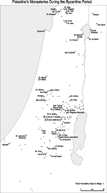
My updated map of monasteries in Palestine's countryside (p. 52) shows the location of more than 170 such establishments.14
The database on which this map is based is continually expanding as more monasteries are discovered and published.
Here, examples are extensive. See, e.g., Rina Avner, “Deir Ghazali, A Byzantine Monastery Northeast of Jerusalem,” ʿAtiqot 40 (2000) 25*–52*; Simon Gibson, “Ras Et-Tawil: A Byzantine Monastery North of Jerusalem,” BAIAS (1985–1986) 69–73; R. W. Hamilton, “Note on a Chapel and Winepress at ‘Ain el Jedida,” QDAP 4 (1935) 111–17; Virgilio C. Corbo, Gli Scavi di Kh. Siyar el-Ghanam (Campo dei Pastori) e i monasteri dei dintorni (Jerusalem: Franciscan Printing Press, 1955); Patrich and Tsafrir, “A Byzantine Church,” 265–72; Hanan Eshel, Jodi Magness, and Eli Shenhav, with Joanne Besonen, “Interim Report on Khirbet Yattir in Judaea: A Mosque and a Monastic Church,” JRA 12 (1999) 411–22; Rudolph Cohen, “Monasteries,” NEAEHL 3:1067–70; Yizhar Hirschfeld, “Khirbet el-Quneitra—A Byzantine Monastery in the Wilderness of Ziph” (in Hebrew), Eretz-Israel 18 (1985) 243–55; Yitzhak Magen and Yuval Baruch, “Khirbet Abu Rish” (in Hebrew), ʿAtiqot 32 (1997) 135–46.
Motti Aviam assembled all the relevant material on the monasteries of the region; see the various articles in his Jews, Pagans and Christians in the Galilee: 25 Years of Archaeological Excavations and Surveys, Hellenistic to Byzantine Periods (Rochester, N.Y.: University of Rochester Press, 2004). See also Edna J. Stern, Hana Abu Uqsa, and Nimrod Getzov, “Horvat Qav,” Excavations and Surveys in Israel 112 (2000) 11*–14*.
Tzaferis et al., The Excavations of Kursi; and Vassilios Tzaferis, “An Early Christian Church at Khirbet Samra,” in Studies in the Archaeology and History of Ancient Israel (ed. Michael Heltzer, Arthur Segal and Daniel Kaufman; Jerusalem: University of Haifa, 1993) 248–49.
Joseph Elgavish, Shiqmona on the Seacoast of Mount Carmel (in Hebrew) (Tel Aviv: Association for the Study of the Land of Israel and Its Antiquities, 1994) 110–11; and Raz Kletter, “Haifa, Tel Shiqmona,”

adashot Arkheologiyot 114 (2002) 24*–26*.
Yitzhak Magen, “A Roman Fort and a Byzantine Monastery at Khirbet el-Kilia” (in Hebrew), Qadmoniot 85–86 = vol. 22 (1989) 45–50; Hirschfeld, “Deir Qal'a,” 155–89; Moshe Fisher, “Ex-cavations at Horvat Zikhrin” (in Hebrew), Qadmoniot 71–72 = vol. 18 (1985) 114; Emmanuel Eisenberg and Ruth Ovadia, “A Byzantine Monastery at Mevo Modi'im,” ʿAtiqot 36 (1998) 1*–19*; and Uzi Dahari and Uzi ʿAd, “Shoham Bypass Road,” Excavations and Surveys in Israel 20 (2000) 56*–59*.
Rudolph Cohen, “A Byzantine Church and Mosaic Floor Near Kissufim” (in Hebrew), Qad-moniot 45 = vol. 12 (1979) 19–24; and Ran Gophna and Nurit Feig, “A Byzantine Monastery at Kh. Jemameh,” ʿAtiqot 22 (1993) 97–108.
Pau Figueras, “Monks and Monasteries in the Negev Desert,” Liber Annuus 45 (1995) 401–50. For a monastery in the vicinity of the Roman-Byzantine settlement of Tel Malhata, see Bruce C. Cresson, “The Monastery,” in Tel ʿIra: A Stronghold in the Biblical Negev (ed. Itzhaq Beit-Arieh; Tel Aviv: Tel Aviv University, Institute of Archaeology, 1999) 88–96.
For a monastery in the village of Na'aran, see Claudine Dauphin and Jeremy J. Schonfield, “Settlements of the Roman and Byzantine Periods on the Golan Heights: Preliminary Report on Three Seasons of Survey (1979–1981),” IEJ 33 (1983) 197–200. But Zvi U. Ma'oz (“Comments on Jewish and Christian Communities in Byzantine Palestine,” PEQ 117 [1985] 60–61) objects to the identification of the building as a monastery. For the possible identification of monasteries in the villages of Squfiyye and Ramsaniyye, see Robert C. Gregg and Dan Urman, Jews, Pagans, and Christians in the Golan Heights: Greek and Other Inscriptions of the Roman and Byzantine Eras (Atlanta, Ga.: Scholars, 1996) 46–47, 187–192; and Zvi U. Ma'oz, “Deir Qeruh,” NEAEHL 1:348–49.
See, for example, Yohanan Aharoni, “Excavations at Beth-Hashitta” (in Hebrew), BIES 18 (1954) 209–15.

The irregular spatial distribution of monasteries in Palestine is not simply the result of their association with holy sites, since monasteries are found in various parts of Palestine, including such areas as western Galilee and the Negev, that were not associated with particular sanctity by Christians or Jews. The distribution of monasteries reflects, rather, the divisions among different religious groups during the Roman and Byzantine period. The lack of monasteries in eastern Galilee and the northern parts of Samaria is rooted in the resentment that the Jewish and Samaritan populations felt toward any Christian attempts to penetrate their regions.24
The objection of the Jews to the establishment of churches in the Lower Galilee region is reflected in the story of Joseph of Tiberias, a convert elevated by Constantine to the rank of comes. See Stephen Goranson, “Joseph of Tiberias Revisited: Orthodoxies and Heresies in Fourth-Century Galilee,” in Galilee Through the Centuries: Confluence of Cultures (ed. Eric M. Meyers; Winona Lake, Ind.: Eisenbrauns, 1999) 335–43. On Jewish resistance to Christian penetration of the Galilee, see Zeev Rubin, “Joseph the Comes and the Attempts to Convert the Galilee to Christianity in the Fourth Century C.E.” (in Hebrew) Cathedra 26 (1982) 105–16. On a parallel phenomenon, Samaritan opposition to Christian penetration of Samaria, see Antoninus Placentinus, Itinerarium 8, ed. P. Geyer, in Itineraria et alia geographica (2 vols.; CCSL 175–76; Turnholt: Brepols, 1965) 1:133.
For the circumstances that led to the erection of the church of Mary Theotokos on Mount Gerizim, the holiest place for Samaritans, see Yitzhak Magen, “The Church of Mary Theotokos on Mount Gerizim,” in CAHL, 333–34. As for the dozen rural monasteries on the western slopes of the hills of Samaria, see Hirschfeld, “Deir Qal'a,” 155–89. Hirschfeld speculates that the erection of these monasteries in the midst of a Samaritan settlement was a punishment decreed by the Byzantine ruler. A Samaritan synagogue, erected during the fourth or fifth century and ruined during the Samaritan revolt, was discovered in Horvat Migdal, in western Samaria. See Etan Ayalon, “Horvat Migdal (Tzur Natan)—An Ancient Samaritan Village,” in The Samaritans (in Hebrew) (ed. Ephraim Stern and Hanan Eshel; Jerusalem, 2002) 272–88. Following the destruction of the synagogue, a monastery was founded nearby. The location of the monastery, south of the village, may indicate an intention to promote Christianity in the region.
Western Galilee
Motti Aviam's research on the Christianization of western Galilee demonstrated that an imaginary borderline separated western and eastern Galilee during the Byzantine period.26
Aviam, “Christian Galilee,” 281–300.
See n. 24, above.
This was a wide-ranging phenomenon characterizing Palestine in general and western Galilee in particular. See Doron Bar, “Geographical Implications of Population and Settlement Growth in Late Antique Palestine,” Journal of Historical Geography 30 (2004) 1–10.
On changes in burial practices during late antiquity, see Nimrod Getzov and Edna Stern, “Studies in Phoenician Burial Customs in the Western Galilee During the 2nd–3rd Centuries C.E.” (in Hebrew), in Settlement, Civilization, and Culture: Proceedings of the Conference in Memory of David Alon (ed. Aharon M. Maeir and Eyal Baruch; Ramat-Gan: University of Bar-Ilan Press, 2001) 193–98; and Refael Frankel et al., Settlement Dynamics and Regional Diversity in Ancient Upper Galilee: Archaeological Survey of Upper Galilee (Israel Antiquity Authority Reports 14; Jerusalem: Israel Antiquities Authority, 2001) 110–16.
Aviam, “Christian Galilee,” 281–300; and Lea Di Segni, “Horvath Hesheq: The Inscriptions,” in CAHL, 379–90.
The hagiographic literature contains no indication that monks were present in western Galilee. Yet of the approximately fifty churches surveyed in western Galilee, approximately fifteen have been identified as belonging to monasteries.
31Aviam, “Christian Galilee,” 281–300.
Frankel et al., Settlement Dynamics; and Aviam, “Christian Galilee,” 281–300.
Motti Aviam, “Remains of Churches and Monasteries in Western Galilee” (in Hebrew), Qad-moniot 109 = vol. 28 (1995) 59.
Claudine Dauphin (“A Byzantine Ecclesiastical Farm at Shlomi,” in ACR, 43–48) suggested identifying this archaeological complex as a farm belonging to a monastery. Nevertheless, Aviam, who surveyed the region, identified the site as a monastery (“Remains of Churches and Monasteries,” 57).

eir was built near the village of Biar.
35Refael Frankel, “Some Oil Presses from Western Galilee,” BASOR 286 (1992) 49–59.
Aviam, “Christian Galilee,” 293; and Dina Avshalom-Gorni and Motti Aviam, “Horvat Kenes,” Excavations and Surveys in Israel 15 (1996) 25–26.
Aviam, The Christian Community in Western Galilee, 137–38.
The Negev
In southern Palestine we find numerous examples of monks and settlers living in proximity. Although in the history of Palestine this desert area had usually been a nomadic region, during the Byzantine period the Negev witnessed a process of settlement, sedentarization, and Christianization, and the presence of monks is therefore to be expected. In Iethira (Yattir), a large village located on a rugged hill in the remote fringes of the desert bordering the Hebron hills, a monastery was erected to the settlement's west, separated from the village homes by a large reservoir.38
Eshel, Magness, and Shenhav with Besonen, “Interim Report,” 411–22; Hanan Eshel, Jodi Magness, and Eli Shenhav, “Khirbet Yattir, 1995–1999: Preliminary Report,” IEJ 50:3–4 (2000) 153–68.
Cohen, “A Byzantine Church,” 277–82.
Gophna and Feig, “A Byzantine Monastery,” 97–108
Yehuda Govrin, Map of Nahal Yattir (139) (Archaeological Survey of Israel; Department of Antiquities, Jerusalem, 1991) 43*–45*.
Ibid., 67*.
Beit-Arieh, Tel ʿIra, 88–96; and Volkmar Fritz and Aharon Kempinski, Ergebnisse der Ausgrabungen auf der
irbet el-Mšāš (Tēl-Māšōš) 1972–1975 (Wiesbaden: Harrasowitz, 1983) 138–85.
Several monasteries were identified in the “cities” of the Negev, semi-urbanized villages to the south of the region. A monastery was built in Oboda around the atrium of the southern settlement's church.44
Avraham Negev, The Architecture of Oboda: Final Report (Qedem 36; Jerusalem: Institute of Archaeology, Hebrew University of Jerusalem, 1997) 122–52.
Yoram Tsafrir, Excavations at Rehovot-in-the-Negev, I: The Northern Church (Qedem 25; Jerusalem, 1988); and idem, “The Early Byzantine Town of Rehovot-in-the-Negev,” in ACR 294–302.
For Nessana, see Avraham Negev, “Nessana,” NEAEHL 3:1148–49; H. Dunscombe Colt, Excavations in Nessana (London: British School of Archaeology, 1962) 18–20; and Casper J. Kraemer, Excavations at Nessana, III: Non-Literary Papyri (Princeton, N.J.: Princeton University Press, 1958) 6–11.
The northern church from the fifth century47
Renate Rosenthal-Heginbottom, Die Kirchen von Sobota und die Dreiapsidenkirchen des Na-hen Ostens (Wiesbaden: Harrasowitz, 1982); Avraham Negev, “Sobata,” NEAEHL 4:1405–6; and Yehuda Guvrin, “Appendix A,” in Arthur Segal, Shivta: Portrait of a Byzantine City in the Negev Desert (Haifa: University of Haifa Press, 1986) 87–96.
Rural Monasticism: Literary Evidence
From the very beginning of Christian monasticism in the Roman world, monks related to society in a variety of ways. Some monks favored solitude and seclusion, living alone or in isolated communities as far as possible from the human environment, devoting themselves exclusively to the work of God.48
Susan Ashbrook-Harvey, “Asceticism,” 317–18, and Conrad Leyster, “Monasticism,” 583–84, in Late Antiquity: A Guide to the Postclassical World (ed. Glen W. Bowersock, Peter Brown, and Oleg Grabar; Cambridge, Mass.: Harvard University Press, 1999); Marilyn Dunn, The Emergence of Monasticism: From the Desert Fathers to the Early Middle Ages (Oxford: Blackwell, 2000) 6–19; and Clifford H. Lawrence, Medieval Monasticism: Forms of Religious Life in Western Europe in the Middle Ages (London: Longman, 1984) 123–27.
Philip Rousseau, Basil of Caesarea (Berkeley: University of California Press, 1994) 190–232; and Dunn, The Emergence of Monasticism, 34–41.
Sometimes these two monastic lifestyles were integrated: Chariton, for example, founded monasteries in places of solitude as well as in relative proximity to settled places that were inhabited, at least partly, by pagans. From his vita we learn how his cell in Pharan attracted “an innumerable crowd of pagans and Jews [who] were induced to receive the saving bath, as a consequence of the miracles made by God through the holy man.”50
The Life of Chariton, 14, translated by Leah Di Segni in Ascetic Behavior in Greco-Roman Antiquity (ed. Vincent L. Wimbush; Minneapolis: Fortress, 1990) 405.
Ibid., 23, trans. Di Segni, 410; and Yizhar Hirschfeld, “Life of Chariton in Light of Archaeological Research,” in Ascetic Behavior in Greco-Roman Antiquity (ed. Vincent L. Wimbush; Minneapolis: Fortress, 1990) 425–47. In Tekoa itself, another monastery was founded by two monks, Marcianus and Romanus, according to Cyril of Scythopolis (V. Euth. 30, 49; all references to Cyril follow E. Schwartz, ed., Kyrillos von Skythopolis [TUGAL 49/2; Leipzig: Hinrichs, 1939]).
Contact between monks and villagers occurred both on the desert fringes of Palestine and in the more inhabited rural regions. The hagiographic literature hints at the involvement of the monks, as “holy people,” in the day-to-day lives of the residents of the countryside.52
Most of the hagiographic sources, it must be admitted, refer to the fringes of Palestine, mainly to the Judean Desert. Much less information is available on the monks' activity in the more fertile regions of Palestine.
Cyril of Scythopolis, V. Euth. 8, 15–16; idem, V. Sab. 120, 25.
The fact that the churches of Ziph, Aristoboulias, and Caperbaricha were built rather late in the Byzantine period, mainly during the sixth century, may hint at the relatively slow process of Christianization in this region; if this was the case, then some of the locals were probably still pagans during the fifth century, when Euthymius was active there. On the churches of this region, see Yuval Baruch, “Tell Zif and the Establishment of Christianity in the Wilderness of Ziph” (in Hebrew), in Judea and Samaria Research Studies: Proceedings of the Eighth Annual Meeting (ed. Yaakov Eshel; Qedumim-Ariel: Judea and Samaria Research Institute, 1999) 171–84.
Cyril of Scythopolis, V. Euth. 12, 22. If Hirschfeld is correct in his identification of the site, then the monastery was situated on the edge of a crag in the vicinity of the Roman-Byzantine villages of Aristoboulias and Caperbaricha: Yishar Hirschfeld, “List of the Byzantine Monasteries in the Judean Desert,” in CAHL, 13–15. The fact that this monastery bears the name of the nearby village of Caperbaricha may be seen as another proof of the close connections between the monks and the villagers who donated money for the erection of the monastery. On the heresy of Manes, presumably a popular blend of superstition and ancient religious practice, see Epiphanius, Pan. 66 (trans. Philip R. Amidon, The Panarion of St. Epiphanius, Bishop of Salamis [New York: Oxford University Press, 1990] 221–43); and Samuel N. C. Lieu, Manichaeism in Mesopotamia and the Roman East (Leiden: Brill, 1994).
Relationships between the monks and the villagers were varied and complex. Unlike the monastic movements in Egypt and Syria, Palestinian monasticism was not an indigenous movement but mainly a Greek-speaking one. Activity in the villages required the use of Aramaic, a language unfamiliar to the monks, as most of them were strangers to the local rural areas.56
For the international character of the monks in Palestine, see Edward D. Hunt, Holy Land Pilgrim-age in the Later Roman Empire (Oxford: Oxford University Press, 1982) 244.
Cyril of Scythopolis, V. Cyr. 8–10, 228. See also the story of Romanus, from the village of Bêtakabea, near Gaza; he was seized with paralysis and cured by the spirit of Euthymius (Cyril of Scythopolis, V. Euth. 57, 78–79).
Ibid., 25, 38–39.
Ibid., 54, 76.
Frequently we hear of monks casting out demons and cleansing places made dangerous by previous pagan practices. A good example of this phenomenon is found in Sozomen's story of the pagan families of his grandfather and of Alphion, who were the first to convert in Bethelea, a small semi-urbanized settlement to the north of Gaza, as a consequence of Hilarion's activity. The monk succeeded in curing Alphion, who was tormented by a daemon, after pagans and Jews had failed. In return, Alphion converted and decided to found churches and monasteries in the same region, the southern coastal plain of Palestine.60
Sozomen, Hist. eccl. 5, 15, 14–15.
There was a complicated give-and-take between the monks and villagers. The local villagers enjoyed the protection, religious patronage, and various religious services that the monks offered them, elements that previously were lacking in these remote areas.61
During the Byzantine period, the monk replaced the village patron as a source of protection, security, and patronage. For a summary of the place of the pagan holy man during late antiquity, see Garth Fowden, “The Pagan Holy Man in Late Antique Society,” JHS 102 (1982) 33–59. For the founding of the monastery of Caperbaricha by Euthymius, see n. 55, above. Cyril of Scythopolis mentions the miracle performed by Euthymius, as well as the protection and patronage he supplied to villagers residing in the vicinity of the new monastery.
See, for example, the baptistery in the monastery church of Horvat Kenes, discussed in Motti Aviam, “Christian Galilee in the Byzantine Period,” in Galilee Through the Centuries, 293. See also Malka Ben-Pechat, “Baptism and Monasticism in the Holy Land: Archaeological and Literary Evidence,” in CAHL, 501–22.
For a summary of this subject, see Haim Goldfus, “Tombs and Burials in Churches and Monasteries of Byzantine Palestine (324–628 A.D.)” (Ph.D. diss., Princeton University, 1997).
Richard M. Price, trans., A History of the Monks of Syria by Theodoret of Cyrrhus (Kalamazoo, Mich.: Cistercian Publications, 1985) xxvii–xxix; ibid., trans., Lives of the Monks of Palestine by Cyril of Scythopolis (Kalamazoo, Mich.: Cistercian Publications, 1991) x–xi. See, for example, the monastery of Horvat Beit Loya, where the inscription “Azizos and Kyrikos, giving thanks, dedicated this shrine” attests a donation made by the villagers of this remote settlement (Patrich and Tsafrir, “A Byzantine Church Complex at Horvat Beit Loya,” 269).
Cyril of Scythopolis, V. Sab. 79, 185.
Ibid., 35, 120–21.
Idem, V. Euth. 8, 16; V. Cyr. 8–10, 227.
Hieronymus, Vita Sancti Hilarionis eremitae 25, trans. R. J. Deterrari in Early Christian Biographies (FOC 15; Washington D.C., 1952) 263.
Cyril of Scythopolis, V. Euth. 52, 76.
Joannes Moschos, Pratum Spirituale (Leimonarion) 56, in The Spiritual Meadows (trans. John Wortley; Kalamazoo, Mich.: Cistercian Publications, 1992) 44–45.
It is important, however, not to draw too idealized a picture of Christian success in penetrating the countryside in general and Western Galilee in particular on the basis of the literary evidence for close relations between monks and farmers. The spread of monasteries in the countryside was prolonged, not rapid, lasting throughout the Byzantine period, and fear of the villagers' hostility may have caused monks to hesitate to operate in the more remote regions.71
For the Syrian countryside, see Peter Brown, Society and the Holy in Late Antiquity (Berkeley: University of California Press, 1982) 114–15.
Christianizing the Rural Areas of Palestine
In a recent article on Palestinian monasticism during the Byzantine period,72
Perrone, “Monasticism as a Factor,” 90–91.
To put these relationships in a larger context, I would like to pose the question of the role that monasteries played in the Christianization of rural Palestine. Were the rural monasteries founded in a countryside already inhabited by Christians, or did the monks venture into the countryside with the intention of converting the pagan population to Christianity? The question may be approached chronologically: How long did the Christianization of rural Palestine take, and when were the rural monasteries founded?
The prevailing assumption among scholars dealing with the history of Palestine during the Byzantine period is that the process of converting the local pagan population to Christianity had been completed as early as the fifth century.73
See the summary in Yoram Tsafrir, “Introduction,” in Tsafrir, Di Segni, and Green, Tabula, 19.
Wilken, The Land Called Holy.
Gregory T. Armstrong, “Imperial Church Building in the Holy Land in the Fourth Century”, BA 30 (1969) 90–102.
Hunt, Holy Land Pilgrimage, 83–106.
Yoram Tsafrir, “Foreword,” in ACR, xi; Joseph Patrich, “Church, State and the Transformation of Palestine—The Byzantine Period (324–640 CE),” in The Archaeology of Society in the Holy Land (ed. Thomas E. Levy; London: Leicester University Press, 1995) 470.
Yoram Tsafrir, “The Spread of Christianity in the Holy Land,” in Cradle of Christianity (ed. Yael Israeli and David Mevorah; Jerusalem: Israel Museum, 2000) 33.
Robert L. Wilken, “Byzantine Palestine—Christian Holy Land,” BA 51 (1988) 217, 233–37; Patrich, “Church, State,” 472; and Yoram Tsafrir, “The Fate of Pagan Cult Places in Palestine: The Archaeological Evidence with Emphasis on Beth Shean,” in Religious and Ethnic Communities in Later Roman Palestine (ed. Hayim Lapin; Bethesda, Md.: University of Maryland Press, 1998) 177–79.
In contrast to this prevailing opinion, I have suggested elsewhere that conversion to Christianity among the rural population of Palestine occurred relatively late, slowly and spontaneously, and that the process of adopting the new Christian faith in the countryside was neither chronologically nor spatially uniform.80
Doron Bar, “The Christianisation of Rural Palestine during Late Antiquity,” JEH 54 (2003) 401–21.
This can be judged from fourth-century pilgrims' accounts and detailed descriptions that reveal how well established the monks were in the holy places. See, for example, the itinerary of Egeria or Egeria, in John Wilkinson, Egeria's Travels (London: S.P.C.K., 1971) 89–147; and Hunt, Holy Land Pilgrimage, 83–106.
Lea Di Segni, “Epigraphic Documentation on Buildings in the Provinces of Palestina and Arabia, 4th–7th c.,” in The Roman and Byzantine Near East (ed. John H. Humphrey; 3 vols.; JRA Supplement 31; Portsmouth, N.H.: Journal of Roman Archaeology, 1999) 149–78.
Assuming that the process of rural Christianization lasted long beyond the fifth century, were the rural monasteries founded in the early or later centuries of this process? Until recently, scholars believed that a majority of the monasteries in Palestine were built during the fourth and fifth centuries in bursts of activity conducted under the auspices of different emperors.83
See, for example, Michael Avi-Yonah, “The Economics of Byzantine Palestine,” IEJ 8 (1958) 39–51; and S. Thomas Parker, “The Byzantine Period: An Empire's New Holy Land,” Near Eastern Archaeology 62 (1999) 152. Indeed, the Church of the Holy Sepulcher had been dedicated in 335 C.E.
Asher Ovadiah, Corpus of the Byzantine Churches in the Holy Land (Bonn: Hanstein, 1970) 188, 193; Lea Di Segni, “Dated Greek Inscriptions From Palestine From the Roman and Byzantine Periods” (Ph.D. diss., Hebrew University, 1997); and eadem, “Epigraphic Documentation,” 149–78.
See, for example, Yoram Tsafrir, “Monks and Monasteries in Southern Sinai,” in ACR, 315–33; It was only in the sixth and the beginning of the seventh centuries that Judean desert monasticism reached its peak. See Yizhar Hirschfeld, “Monasteries and Churches in the Judean Desert in the Byzantine period,” in ACR, 149–52; and the introduction by Price, Lives of the Monks, x–xi.
Armstrong, “Imperial Church Building,” 90–102.
Ovadiah, Corpus of the Byzantine Churches, 188, 193; Vassilios Tzaferis, “Recent Discoveries of Churches in Eretz-Israel” (in Hebrew), Qadmoniot 33 = vol. 9, no. 1 (1976) 23–25; and Di Segni, “Epigraphic Documentation,” 149–78. Di Segni's work focuses on the churches, including monastic churches, from the province of Palestine that can be dated through inscriptions (57 of the 450 archaeologically known churches). Her research indicates that only 10 of the 57 churches had been established up through the early sixth century, while 34 churches were established in the remainder of the sixth century, and another 11 were added during the seventh century.
Thus, I would like to suggest that while the lengthy process of the Christianization of rural Palestine was essentially non-institutional in nature, a semi-institutional component that facilitated the introduction of Christianity into the countryside was the deliberate foundation of monasteries near rural settlements. The spread of rural monasteries should be seen as a contributing factor in the gradual Christianization of the countryside, and not as a result of the early acceptance of Christianity by rural populations.
Research on the phenomenon of rural monasteries in the Roman world in general, and in its eastern part in particular, is only in its initial phases.88
Major work has been done on rural monasteries in Britain. See, for example, Roberta Gilchrist and Harold Mytum, The Archaeology of Rural Monasteries (BAR British Series 203; Oxford: B.A.R., 1989). For Byzantine monasteries, see Konstantinos Smyrlis, “Une puissance économique: les grands monastères à Byzance: de la fin du Xe au milieu du XIVeV siècle” (Ph.D. diss., University of Paris, 2002); and B. Brenk, “Monasteries as Rural Settlements: Patron-dependence or Self-sufficiency?,” Recent Research on the Late Antique Countryside (ed. W. Bowden, L. Lavan, and C. Machado; Leiden: Brill, 2004) 447–76.
A parallel is supplied by the Pachomian monasteries of Upper Egypt. There, several monasteries were located within or in close proximity to the towns and villages whose names they bore. See James E. Goehring, “Withdrawing From the Desert: Pachomius and the Development of Village Monasticism in Upper Egypt,” HTR 89 (1996) 267–85; and idem, Ascetics, Society, and the Desert: Studies in Early Egyptian Monasticism (Harrisburg, Pa.: Trinity Press International, 1999) 89–109. On monasteries in Syria, see Andrew N. Palmer, Monk and Mason on the Tigris Frontier: The Early History of Tur ʿAbdin (Cambridge: Cambridge University Press, 1990) 107–12. On monasteries in Jordan, see Michele Piccirillo, “Rural Settlement in Byzantine Jordan,” in Studies in the History and Archaeology of Jordan II (ed. Adnan Hadidi; London, 1985) 258–59.
Christianization in the countryside was not achieved through institutional coercion and the eradication of pagan rituals; rather, it occurred as part of a prolonged sociocultural development. In this process, so I propose, the monks had a central and important role in introducing and promoting the Christian faith. By the end of the sixth century, the heyday of the Byzantine period in Palestine, Christianity was thoroughly integrated into the lives of the inhabitants, rural as well as urban.90
Lea Di Segni (“Monk and Society: The Case of Palestine,” in The Sabaite Heritage in the Orthodox Church from the Fifth Century to the Present [ed. Joseph Patrich; Leuven, Peeters, 2001] 31–36) claims that Palestinian monasticism was essentially an urban phenomenon with only minor influence on the countryside.
Peter Schäfer, The History of the Jews in Antiquity: The Jews of Palestine From Alexander the Great to the Arab Conquest (Luxembourg: Harwood Academic Publishers, 1995) 158–60; and Zeev Safrai, “The Bar-Kokhba Revolt and its Effect of Settlement” (in Hebrew), in The Bar-Kokhba Revolt: A New Approach (ed. Aharon Oppenheimer and Uriel Rappaport; Jerusalem, 1984) 182–214.
For examples, see Yitzhak Magen, Yoav Zionit, and Erna Sirkis, “Kiryat Sefer—A Jewish Village and Synagogue of the Second Temple Period” (in Hebrew) Qadmoniot 117 = vol. 32 (1999) 25–32; and Boaz Zisu and Amir Ganor, “Horvat ʿEtri—The Ruins of a Second Temple Period Jewish Village on the Coastal Plain” (in Hebrew), Qadmoniot 123 = vol. 35 (2000) 18–27. These two villages were destroyed after the second Jewish revolt and were later inhabited by pagans.
Bar, “The Christianisation of Rural Palestine.”
Other factors may have affected the decision to found a monastery near a particular village; the perceived sanctity of a given location, or prior ownership of the land by the founder or donor, would no doubt influence a monastery's location. Other founders of rural monasteries may have been motivated by more practical considerations such as security, food, water, and the need for laborers, especially during the busy agricultural seasons. Accessibility and communication with other monastic communities were also essential.94
Alice-Mary Talbot, “Founders' Choices: Monastery Site Selection in Byzantium,” in Founders and Refounders of Byzantine Monasteries (ed. M. Mullett; Belfast: forthcoming).
By deciding to erect their monasteries in the more populated areas of Palestine, near villages and farms, the monks expressed, so it seems, their ambition to exert a strong influence on the local population and to energize the Christianization process. D. J. Chitty's statement that during the sixth century, Palestinian monasticism was well integrated into the organization, both ecclesiastical and civil, of the Christian oikoumene refers, we now see, not only to the monks' central position in local political life but also to their geographical spread throughout Palestine.95
Chitty, The Desert a City, 179.
In most of the above-mentioned examples of contacts between monks and society, the religious identity of the villagers was deliberately, so it seems, left obscure, and we cannot tell whether they were already Christianized at this stage. This, in part, can be explained by the biased perception of the sources available to us, all internal to the Christian camp and almost exclusively theological or hagiographical in nature.
Footnotes
I am grateful to Alice-Mary Talbot, Linda Safran, and Yizhar Hirschfeld for their advice and com-ments. Note the following abbreviations: ACR, Ancient Churches Revealed (ed. Yoram Tsafrir; Jerusalem: Israel Exploration Society, 1993); CAHL, Christian Archaeology in the Holy Land: New Discoveries (ed. Giovanni C. Bottini, Lea Di Segni, and Vergilio C. Corbo; Jerusalem: Franciscan Printing Press, 1990); and NEAEHL, The New Encyclopedia of Archaeological Excavations in the Holy Land (ed. Ephraim Stern; 4 vols.; Israel Exploration Society & Carta; New York: Simon & Schuster, 1993).
 You have
Access
- 13
- Cited by