Introduction
One of the longest-running debates in child language acquisition concerns the acquisition of finiteness (Blom, Reference Blom2008). The lynchpin in this debate is the infinitive functioning as main clause predicate, or ‘root infinitive’ (Wexler, Reference Wexler, Lightfoot and Hornstein1994; Rizzi, Reference Rizzi1994; Hoekstra & Hyams, Reference Hoekstra and Hyams1996; inter alia). This has been well documented for children acquiring Dutch, French, and Russian, among other languages (Wijnen, Kempen, & Gillis, Reference Wijnen, Kempen and Gillis2001; Rizzi, Reference Rizzi1994, Brun, Avrutin, & Babyonyshev, Reference Brun, Avrutin and Babyonyshev1999). To date, most contributions to the literature on the acquisition of finiteness have focused on a single non-finite form and its distribution as main clause predicate in child speech (Lustigman, Reference Lustigman2012, does describe different non-finite forms at different developmental stages for Modern Hebrew). This paper aims to expand this with a case study comparing a child's use of two different non-finite verb forms as main clause predicates in the Papuan language Nungon (1,000 speakers, Papua New Guinea). Both forms are non-finite and both occur in ‘root’ contexts, as main clause predicates. Thus, if the distributions of the two forms in the child's speech differ significantly, factors besides their root non-finiteness must be the reasons for the difference. Further, if one form is acquired at a different stage than the other, this would seem to be evidence against theories that vouch for finiteness to be acquired in a single stage of the child's linguistic development.
Longitudinal observation of a child, Towet Oe (female; 2;1 to 3;3), acquiring the Papuan language Nungon indicates that she uses a non-finite verb form, called a ‘deverbal nominalization’ (Sarvasy, Reference Sarvasy2017a), in main clauses in a way that is unacceptable in adult speech. The degree and developmental stage in which she uses this form, while still also using tensed verbs in some contexts, is reminiscent of root infinitives in child speech for other languages (Blom, Reference Blom2008). But previous work also established the functions of a different non-finite verb form in adult Nungon main clauses (Sarvasy, Reference Sarvasy2015a). The major question addressed here is how these two different root non-finite verb forms pattern in Towet Oe's speech in the early stages of language acquisition. Once this is established, we also examine how the two forms pattern in caregivers’ speech to Towet Oe in the same period. As nominalizations are otherwise extremely rare in the input, it seems that Towet Oe learns the nominalizations from an auxiliary construction special to Nungon child-directed speech. Thus, we investigate this construction in Towet Oe's and her parents’ speech, as well.
General linguistic background
Nungon (Sarvasy, Reference Sarvasy2013, Reference Sarvasy and Sarvasy2014a, Reference Sarvasy and Sarvasy2014b, Reference Sarvasy2014c, Reference Sarvasy2015a, Reference Sarvasy, Jurgensen, Sande, Lamoureux, Baclawski and Zerbe2015b, Reference Sarvasy2015c, Reference Sarvasy, Ershova, Falk, Geiger, Hebert, Lewis, Munoz, Phillips and Pillion2016a, Reference Sarvasy2016b, Reference Sarvasy2017a, Reference Sarvasy, Paperno and Keenan2017b, Reference Sarvasy, Aikhenvald and Dixon2017c, Reference Sarvasy2018a, Reference Sarvasy and Aikhenvald2018b) is a Papuan (non-Austronesian) language spoken by about 1,000 people in remote villages at about 1500 m above sea level in the Saruwaged Mountains, Morobe Province, Papua New Guinea. The region can be accessed only by small airplane or by foot (it takes locals two to three days to hike to the port city Lae through leech-infested alpine rainforest). There is no electricity. Water sources are mountain springs and waterfalls. A cell phone tower constructed in mid-2015 enabled regular communication with the outside world, but there is still no Internet access.
‘Nungon’ is the umbrella term for the language spoken by the five southern, high-elevation villages in a dialect continuum. Historically, each village in the entire dialect continuum – including those in the other half of the continuum, referred to by the umbrella term ‘Yau’ (Wegmann, Reference Wegmann1994a, Reference Wegmann1994b) – had its own distinct dialect. Unless otherwise noted, language description and Nungon examples here are all drawn from the Towet village dialect.
Nungon is the first language of all children of Nungon speakers living in the area. While communities in more accessible parts of Papua New Guinea have experienced massive shifts to national lingua franca Tok Pisin in recent years, Nungon speakers continue to speak Nungon in all domains in the villages. Children's early literacy training in the Nungon language has been conducted by local teachers since 1998 (Sarvasy & Ögate, Reference Sarvasy, Ögate, Sherris and Peyton2019); the orthography was adapted from one developed for neighboring, related language Yau by Bible translator Urs Wegmann (Wegmann, Reference Wegmann1994a). Formal schooling in Tok Pisin, largely conducted by teachers who do not speak Nungon, has been a new phenomenon in the area since 2007.
Nungon is a verb-final language with clause chaining (shown in example (2), below). The language is largely agglutinating, with some fusion. Three number systems co-exist within the grammar (Sarvasy, Reference Sarvasy2017a, Reference Sarvasy2018a); there is no grammatical gender. Grammatical relations are indicated through enclitics. The most complex agglutinating morphology is found on verbs, which mark five different tenses, several aspects, reality status, and mood, in addition to subject person/number and, for certain transitive and ditransitive verbs, object person/number.
Nungon verb roots are morphologically limited to primarily one- or two-syllable forms that must end in either a vowel, /t/, or /n/. They are thus more restricted in form than, for instance, Nungon nouns or verbal suffixes, which can end in a vowel, or any nasal or oral stop. Vowel-final verb roots form an overarching morphophonological class, with five subclasses. Consonant-final verb roots form another class. There is no apparent semantic or syntactic underpinning to verb class assignment.
Nungon verbs take four main basic forms: a fully inflected ‘final’ form, a partially inflected ‘medial’ form, an uninflected ‘Dependent’ form, and an uninflected ‘nominalized’ form. (Additional forms exist with additional modal or other specification; the four described here are neutral as to modality or other additional categories. See Sarvasy, Reference Sarvasy2017a, for full details of these other forms.)
Final verb forms are the typical predicates of: (a) single, main clauses functioning alone or coordinated with others using conjunctions such as worok koi ‘however’; and (b) the final clauses in clause chains (see below). These verbs bear an obligatory tense or mood suffix and subject person/number suffix, as in (1):

The morphophonological class of the verb root determines the forms of the post-root suffixes on final verbs. For instance, when the /t/-final verb ut- ‘cry’ is inflected for 1sg subject and Near Future tense as in (1), it takes the form ur-engka-t.
Nungon is a typical Papuan clause chaining language, in that descriptions of sequences of related events and actions almost always involve morphologically marked ‘chains’ of clauses (Sarvasy & Ögate, Reference Sarvasy, Ögate, Sherris and Peyton2019). In these chains, only the last clause can have a fully inflected final verb as predicate. The preceding clauses have ‘medial verb’ predicates. Nungon medial verbs never have tense marking, and only inflect to indicate their subject if the subject of the following clause will differ from the current subject (‘switch-reference’ marking). When not inflected for subjects, all medial verbs have an unchanging post-root suffix. This is -nga after vowel-final roots and -a after consonant-final roots.
Medial verbs in a clause chain are shown in (2), an utterance by Towet Oe's father, directed at Towet Oe (3;0) in a transcript in the current study. Clauses are separated by commas within the chain. The child is cooking a meal, with her father as her helper.

In (2), the medial verbs to-nga and na-nga feature no subject inflection because the subject of the following clause is the same as theirs. The medial verbs e-i-ya and di-un-a are marked for their own subjects because the following clauses will have different subjects. The form motdaina is a special inflection called the Perfect, where a medial-like form has subject marking even though the following clause's subject is the same.
While medial verbs prototypically function as predicates of non-final clauses in chains, they are attested in adult speech as main clause predicates in certain pragmatic contexts, such as commands, afterthoughts, and elliptical speech. For instance, in a sample of 59 Nungon adult recorded monologual narratives, on average 11% of clause chains either comprised just a single medial clause as an afterthought or command, or were multi-clausal but lacked a final verb at the end (hence, ended in a root medial clause). Sarvasy (Reference Sarvasy2015a) suggested, however, that root medials might prove to be more frequent in conversation than in monologual narrative.
The even more morphologically reduced ‘Dependent’ verb form serves as non-final member of multi-verb predicates. Here, multiple verbs combine within a single clause, as opposed to clause chains, where multiple clauses combine in a single sentence. The Dependent form lacks tense marking, and only bears subject marking in particular constructions with special meaning, such as the Causative and Iterative constructions (Sarvasy, Reference Sarvasy2017a). The multi-verb predicates that host Dependent forms are typically combinations of very closely related actions or events, as in (3):

The Dependent form of a vowel-final verb root must bear a Dependent suffix, -ng, while consonant-final verb roots stand alone in such contexts, with no suffix.
Dependent verb forms are attested as main clause predicates in the absence of a final or medial verb in adult speech (Sarvasy, Reference Sarvasy2017a), but such ‘root Dependents’ are much less common than root medials, and have much more restricted pragmatics.
Unlike infinitives in English and other European languages, Nungon medial and Dependent verb forms never refer to a general state or action, without an implied subject argument and tense or mood; nor are they used as the predicates of complement clauses in ‘raising’-type constructions (I want to see). Sarvasy (Reference Sarvasy2015a) argued that these forms had inherent relationality because of their canonical occurrence within larger constructions. In all this, they differ from the last verb form discussed here.
The last major form of a Nungon verb is referred to as a nominalization by Sarvasy (Reference Sarvasy2017a). Nominalizations are identical to the Dependent form for consonant-final roots, but differ from the Dependent form for vowel-final roots, which receive a nominalizing -k or -p suffix (the choice of these depends upon morphophonological subclass), instead of the Dependent form -ng. Unlike final verbs, medial verbs, and Dependent verbs, nominalizations can function as arguments of other verbs, host grammatical relation-marking enclitics, and form the basis for adjectivized verbs. But, still unlike true nouns, nominalizations cannot be possessed, nor serve as transitive subject arguments. Unlike the other forms, the semantics of nominalizations are context-independent enough for them to serve as citation forms. All this means that these forms, while they are called ‘nominals’, not ‘infinitives’, are very similar to infinitives in more familiar Romance and Germanic languages.
In adult usage, nominalizations most often occur reduplicated. An example is (4), from a narrative in the Nungon adult corpus (Sarvasy Reference Sarvasy2015c):

In (4), the deverbal noun it-it ‘being/staying,’ from it- ‘be’, maintains verbal semantics and argument structure (girang wo ‘that boat’ being the erstwhile subject argument, and wo-ndo ‘there’ an erstwhile oblique argument), but is marked with the Benefactive enclitic, which would not be possible in this context for a non-nominalized verb.
Which of these forms are finite? Of the various definitions offered for finiteness, tense or mood specification and subject marking have both been proposed (Klein, Reference Klein and Van Geenhoven2006). Since the presence or absence of subject marking on medial verbs is independent of the verb itself (dictated by subject co-reference with the following clause), and similarly depends on construction type for Dependent verbs, tense or mood specification alone will be used here as the primary criterion for finiteness. Finite status according to this criterion coincides for Nungon final verbs with their canonical function as main clause predicate. Thus, the major Nungon verb forms include one finite form (the final verb) that canonically occurs as predicate of a main clause, and three non-finite forms that do not (medial, Dependent, nominalization). Of the non-finite forms, only the nominalization has truly context-free semantics, where the action of the verb can be referred to without any subject or temporal setting implied. As noted above, it is thus most similar, of the Nungon non-finite forms, to the ‘infinitive’ of Spanish or Dutch. Indeed, infinitives are noun-like in many languages in that they can function as arguments of other verbs, as in Dutch piano spelen maakt slim ‘to play piano makes (one) smart,’ where the infinitive piano spelen serves as subject of the verb maakt ‘makes’.
Nominalizations together with the auxiliary verb to- ‘do’ are a special syntactic feature of Nungon child-directed speech (CDS). These ‘do’ auxiliary constructions are the last area of focus in the present study.
CDS in the Towet village dialect of Nungon has been observed to have at least the following characteristics: syntactic expansions into ‘do’ auxiliary constructions, lexical substitutions, and phonological substitutions. Phonologically, word-final /k/ is optionally replaced with a glottal stop (written <c> in the examples here), and /r/ is optionally replaced with /l/. Acoustically, preliminary results point to greater pitch range and reduced duration distinction in vowels in CDS over Nungon adult-directed speech (ADS) (Sarvasy, Elvin, Li, & Escudero, Reference Sarvasy, Elvin, Li and Escudero2019).
Towet Nungon CDS ‘do’ auxiliary constructions involve optional expansion of individual simplex verbs into complex predicates. Here, the lexical verb (which contributes the action's semantics to the construction) occurs as an uninflecting deverbal nominalization followed by an inflecting support verb to- ‘do’. In ‘do’ auxiliary constructions, unlike in (4) and elsewhere in adult speech, the nominalization is usually not reduplicated. This is illustrated in the pair of examples in (5) and (6); (5) is the usual adult form, and (6) is the attested CDS expansion.

In adult Nungon, to- ‘do’ can also function as an auxiliary, but does so primarily to support loaned verbs, nouns describing actions, and ideophonic expressives. In this, Nungon is similar to many languages, including Japanese (Iwasaki, Reference Iwasaki2002) and Korean (Sohn, Reference Sohn1999). None of these can inflect directly as verbs, so they can only function as verbal predicates when paired with an auxiliary verb, usually to- ‘do’. For instance, ‘swimming’ is described using the Tok Pisin loan verb sugim ‘swim’ followed by the Nungon verb to- ‘do’; to- bears all inflectional morphology but has little lexical weight. The difference in CDS use of the ‘do’ auxiliary frame is that the CDS nominalized verb could actually inflect in its own right (as seen in example (5)), while loans, nouns like youp ‘work’, and ideophonic expressives like pinggap pinggap ‘drip liquid from the eye of a skull of a bird that has been roasted’ cannot directly host verbal suffixes. The Nungon CDS expansion of a single verb into a two-verb auxiliary construction would seem to sacrifice brevity for morphological simplicity: a child need not master all morphophonological verb class inflection patterns to use/understand it, only know the pattern for ‘do’.
Nungon child and child-directed speech also features lexical substitution. Only lexical substitution of verbs will be discussed here. Baby talk lexical verbs are uninflecting forms that are attested in CDS either alone or in ‘do’ auxiliary constructions. Some of these apparently have expressive or onomatopoeic origins, such as aing ‘bite’ (adult corresponding verb yii- ‘bite’). Others are phonetically altered equivalents of adult verbs, such as hoit ‘grab’ (adult verb honggit- ‘grab’). Two common baby talk verbs originate in Tok Pisin: dai ‘lie down, sleep’ (Nungon adult duo- ‘sleep’) and pait ‘fight’ (Nungon adult emo- ‘fight’). The origin of other baby talk verbs is unknown; an example is purik ‘turn’ (adult iwan- ‘turn’).
Finally, another Nungon form that is of relevance to the current study's results is a multi-functional clitic = ma. This clitic can occur with syntactic elements as small as adjectives and as large as clauses. It serves as a specifier with adjectives, enables nouns to modify other nouns, and relativizes clauses, as well as serving as a general subordinator of sentences. These functions are shown in (7a–d).

Sentences ending in =ma, like (7d), are common in discourse. They have varied pragmatic implications; perhaps underlying most of them is the notion that the information is known to both speaker and addressee, taken as a given, and thus will be followed up with more information. As will be seen in the ‘Results’ sections, =ma is an unexpected component in a non-finite default verb form used by Towet Oe for several months of the study period.
For the current study, drawing on speech of the child Towet Oe and her caregivers’ speech to her between her ages of 2;1 and 3;3, our targets are: (a) the distributions of main clause use of two non-finite verb forms, medial verbs and nominalizations, in the speech of Towet Oe and her caregivers over this period; and (b) the distribution of the ‘do’ auxiliary form in the speech of Towet Oe and her caregivers in the study period.
Methods
The child Towet Oe, fourth child of a Towet Nungon-speaking couple, was recorded monthly interacting with her mother and/or father and others over a period of 24 months, beginning at age 2;1. This was part of a larger longitudinal study of five children acquiring Towet Nungon in the village setting. Some of the study recordings and transcriptions are accessible on CHILDES (MacWhinney & Snow, Reference MacWhinney and Snow1985, Reference MacWhinney and Snow1990). Towet Oe was the youngest of an original group of four target children; a fifth, Abraham, was added to the study after the first year at the age of 1;5, but transcription of his recording sessions is still in progress. Each recording session lasted for approximately one hour. Sessions took place in Towet Oe's home or outside it, with participants seated on the floor or ground. At the beginning of each session, the interviewer (a local Nungon speaker and classificatory kin of Towet Oe) positioned a small tripod-mounted Zoom H5 audio-recorder on the floor or ground, with the two built-in microphones pointing toward Towet Oe. This was set to record at a 44.1 kHz sampling rate and into WAV format. A second interviewer held a Canon digital camera recording in VGA video for the duration of most sessions. After the interviewer turned on the audio-recorder and pressed ‘record’, s/he sometimes left the scene, leaving parent and child alone to converse (or accompanied by the video-recording interviewer). The interviewer told the parents to end the session after approximately one hour, unless the child was in distress or other factors meant the session had to end early. The parents understood that the goal of the sessions was to track Towet Oe's linguistic development, and that they were meant to solicit speech from her. They prompted her to talk about recent excursions to mountain farm plots, the high forest, or the coast, recount recent village events, and comment on or call out to people passing by the scene of the recording. In one session (at 3;0), Towet Oe and her father chat as Towet Oe prepares a meal and her father serves as her assistant.
The recording sessions were digitally transcribed by the interviewers on Lenovo 10.1″ laptops in the villages in Wordpad using mid-CHAT format (MacWhinney, Reference MacWhinney2000), or, for sessions after September 2016, directly into CLAN. Of these transcriptions, the first five were thoroughly checked by the author against the audio-recordings. Although two of the transcribers used more orthographic idiosyncrasies (such as separating the final syllable of polysyllabic words from the rest of the word with a space) than the others, these transcriptions were found to be highly faithful to the recordings.
For the current study, all verbs in the first 15 transcripts for Towet Oe (from 2;1 through 3;3) were coded according to inflection (e.g., 1pl subject, present tense), function (e.g., root nominal), and speaker (Towet Oe, mother, father, and others). Baby talk verbs were included in the counts and coded as such. In addition to verbs, the presence of utterance-final =ma and relativizing =ma were also coded. All but one recording session were between 50 and 59 minutes long; one (at 2;11) was only 22 minutes long. In nine of these 15 transcripts, Towet Oe's main interlocutor is her mother. In two, the main interlocutor is her father, and her mother is mostly or fully absent. In four, mother and father share interlocution. Older siblings and a cousin interact with Towet Oe to limited degrees in three transcripts.
In utterances with a medial verb but no final verb, the medial verb was coded as a ‘root medial’. Similarly, where a nominalization occurred but no final verb, the nominalization was coded as a ‘root nominal’. In a few cases, this was structurally ambiguous. For instance, the nominalization ongo-k of the verb ongo- ‘go’ happens to be homophonous with the Near Past 3sg inflection of this verb, ongo-k ‘s/he went’. This verb form is also one of the forms attested very early in Towet Oe's speech – hence likely acquired as a frozen form. Where ongo-k was clearly used with non-Near Past semantics, it was coded as a root nominal. But where the context was compatible with Near Past semantics, it was coded as ‘ongok’, i.e., unanalyzable.
Results for Towet Oe
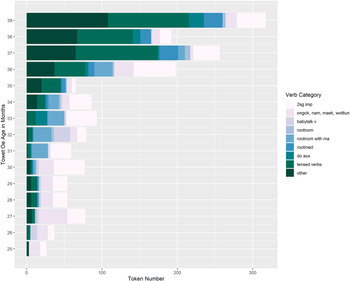
First, all of Towet Oe's verbs were counted in every transcript of the study period. Figure 1 shows the numbers of tokens of the target phenomena – root medials, root nominals alone and with the subordinator =ma, and ‘do’ auxiliary constructions – along with all other verb forms, such as tensed verbs, 2sg imperatives, baby talk verb forms, and the unchanging (apparently frozen) forms ongok ‘went’, ma=ek ‘not there’, nam ‘give me’, and wo ittun ‘let it be’. The category ‘other’ includes medial verbs in clause chains, Dependent verbs, other imperatives, and other special verbal inflections, such as the Counterfactual and Imminent.
Distribution of verb forms in Towet Oe's speech.

As seen in Figure 1, Towet Oe's verbs at 2;1 are largely divided among 2sg imperatives, other imperatives, and unchanging forms. By 3;3, however, not only is she producing many more verbs per recording session, but tensed verbs make up a much greater proportion of all verbs than before.
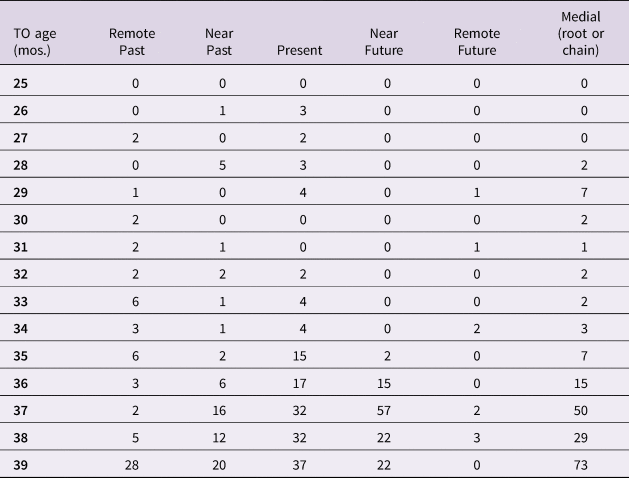
The number of tokens Towet Oe produces of the five Nungon tenses and medial verb forms (both root and within chains) are in Table 1. Table 1 shows that of the tenses, the Near Future seems to be produced markedly later than the other tenses. The Near Future tense has the only disyllabic tense suffix, seen in examples (1) and (2), so it is possible that the length of Near Future-inflected forms affect the timing of the onset of Towet Oe's production of them. This delay in production of longer forms could be related to Towet Oe's preferred default verb form, discussed below. Table 1 also shows that by 3;3 Towet Oe produces over twice as many medial verb tokens as tokens of any single tense inflection. The increase in medial verb forms is consistent with her production of increasingly complex clause chains (comprising several medial verbs and a single tensed final verb) at the end of the study period.
Tokens of the five Nungon tenses and medial verb forms in Towet Oe's speech

This overview of verb forms in Towet Oe's speech provides background for more detailed investigation of the three target phenomena. As seen in Table 1, Towet Oe uses root nominals from the sessions at 2;3 onward, including at age 3;3. It should be noted that three of four verbs coded as root nominals at age 3;3 are consonant-final, meaning it is unclear whether they should be considered root nominals or root Dependent forms (which, as mentioned above, are found to limited degrees in adult speech as well). But Towet Oe further shows a special construction with root nominals, where she pairs the root nominal with a subordinating enclitic =ma. There is no indication yet that the nominalization with =ma is a general feature of Nungon early child speech. It may have been innovated by Towet Oe. It never occurs in adult-directed adult speech. This construction occurs in the Towet Oe transcripts between 2;5 and 3;1. While root nominals alone do not show a major increase or decrease over time in the study period, the root nominal with =ma construction shows a marked increase from nil and then decrease back to nil in this period.
Before moving to results for the other target phenomena, we explore the functions of this special non-finite form. Context and her parents’ responses to her utterances indicate that Towet Oe uses root nominals with =ma in a variety of contexts. These include ‘modal’ ones expressing requests and desires, but also include many descriptions of past occurrences and on-line observations.
An example of the root nominal with =ma with a modal function is in (8):

Here, the father clearly interprets Towet Oe's root nominal with =ma as indicating her desire to drink water. This was also the interpretation of the original Nungon-speaking transcriber in a comment tier in the transcription.
In the sequence in (9), Towet Oe refers to an action she sees in a photograph using a root nominal with =ma.

In (9), Towet Oe's mother first reframes the child's root nominal with =ma as a ‘do’ auxiliary construction, then as a normal adult-like utterance. Further examples in the transcripts show Towet Oe producing root nominals with =ma to describe past events, such as a death.
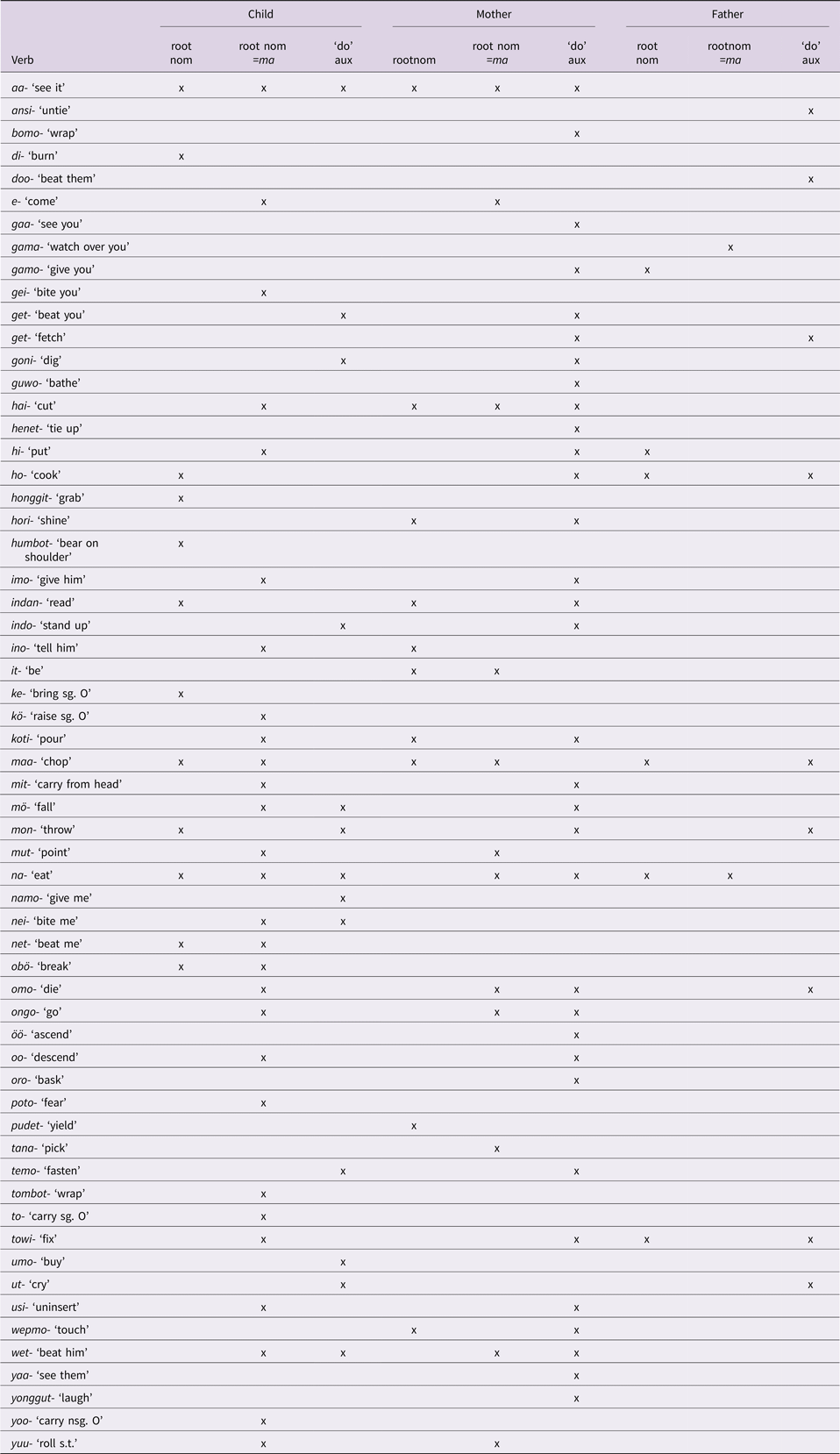
Not only does Towet Oe use root nominals with =ma in a variety of contexts (modal, factual, and with varied temporal reference), but she and her parents use a wide range of verbs in this form, with various transitivity values and semantics. Table 7 in the Appendix gives an exhaustive list of all verbs produced as root nominals, root nominals with =ma, and ‘do’ auxiliary constructions in the 15 transcripts for Towet Oe and both parents.
In the period in which Towet Oe produces root nominals with =ma, even in the transcript in which these forms make up over 30% of all verbs, she also produces fully inflected final verbs. Most important, there are tokens in Towet Oe's speech in the same period of the same verb in various inflections and as a root nominal with =ma. Some of these inflected verbs are also paired with utterance-final =ma. A sampling with the verb root omo- ‘die’ are in (10):

The first two tokens of omo- ‘die’ in (10) are inflected for past tenses (Remote and Near) with =ma, while the third token is a root nominal with =ma.
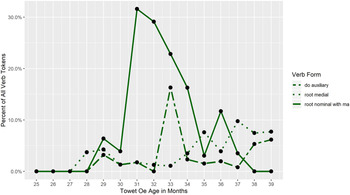
In contrast to the root nominals with =ma, root medials show an overall gradual increase in their percentage of Towet Oe's verbs from 2;3 onward. Figure 2 shows the percentages of Towet Oe's verbs that are root nominals with =ma, root medials, and nominalized within the ‘do’ auxiliary construction.
Percentages of root nominals with =ma, root medials, and ‘do’ auxiliary constructions of all verbs in Towet Oe's speech, 25 months to 39 months.

Towet Oe's root medials show a very different trajectory in Figure 2 than do root nominals with =ma. Her root medial verbs also contrast functionally with her root nominals, with and without =ma. Root nominals occur in contexts where adults would use finite, final verb forms. But there are no clear instances in the study period in which Towet Oe uses a root medial where an adult would obligatorily use a finite, final verb. Instead, Towet Oe uses root medials in contexts attested for adults (Sarvasy Reference Sarvasy2015a), such as commands and elliptical speech. A command is shown in (11):

The ‘do’ auxiliary construction begins to appear in the transcripts for Towet Oe's speech from 2;5 and also shows a general gradual increase. (The spike in tokens at age 33 months/2;9 in Figure 2 is due to an extended conversation using a single lexical type.) By age 3;3, Towet Oe uses the ‘do’ auxiliary construction within otherwise adult-like complex clause chains, as in (12):

In the following section, the results for Towet Oe are compared with results in her parents’ speech. The section after that will summarize and discuss broader implications of these findings.
Results for Towet Oe's parents
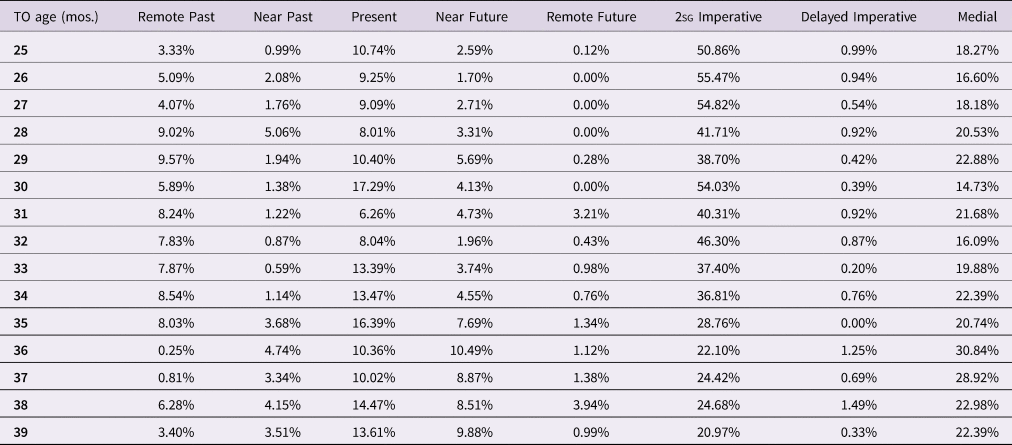
First, general distributions of major verb forms in parental input are shown in Table 2, for comparison with Towet Oe's distributions in Table 1.
Percentages of the five tense inflections, imperatives, and medial verbs of all verbs in Towet Oe's mother's and father's child-directed speech

The forms presented in Table 2 are diverse in application. Choice of the tense inflections depends on the content of conversation between parent and child (whether they are discussing events framed in the recent or remote past or future, or in the present), while 2sg imperative use most often relates to the speech act goal of the parent. Medial verb form use, on the other hand, occurs wherever sequences of related events or actions are discussed – independent of the time frame or speech act type of the utterance.
Table 2 reveals some frequency trends in child-directed speech in the transcripts from the study period. For instance, 2sg imperatives (the vast majority of these directed at Towet Oe herself, with others ‘fed’ to her in prompts to command others) represent around half of all verbs in child-directed speech in the first part of the study period, but this proportion shows a decreasing trend in the second half of the study period. The proportion of all child-directed verbs that are medial in form (including both root medials and medial verbs within clause chains) is relatively stable over the study period, ranging between 15% and 31%. In the early transcripts, parental use of the Remote Future tense is nil or negligible.
Particularly striking about Table 1 was the apparent delay in Towet Oe's production of the Near Future tense: her first tokens of this form are in the transcript at 2;11, while even the low-frequency Remote Future form first occurs at 2;5. It seems unlikely that her lag in production of the Near Future form is related to patterns in the input. As shown in Table 2, Towet Oe's parents consistently produce more Near Future tokens than tokens of the Near Past and Remote Future throughout the study period. It seems more likely, then, that Towet Oe's delay in production of this tense may be related to its being longer than the other tense inflections.
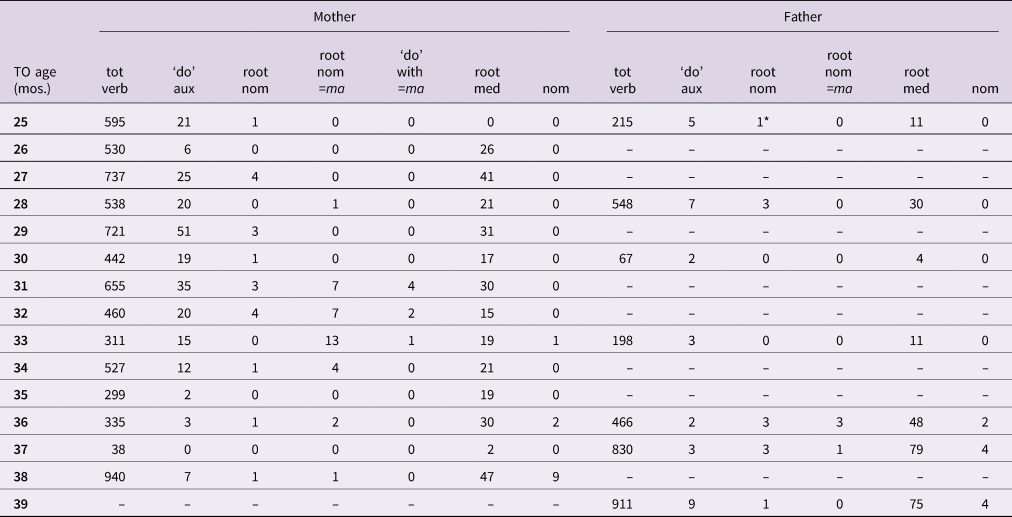
With the background from Table 2, we turn to counts for the target phenomena in the speech of Towet Oe's parents. Table 3 shows total verb counts for Towet Oe's mother and father, as well as token counts in their speech for the target phenomena: ‘do’ auxiliary constructions, root nominals alone, root nominals with =ma, and, in the case of Towet Oe's mother, a combination of the ‘do’ auxiliary construction and nominal with = ma. Further, counts are given for regular (non-root) nominalizations in the parents’ speech. Where no data is given in a cell, that parent was not present at the recording session.
‘Do’ auxiliaries, root nominals, root nominals with =ma, root medials, and regular nominalizations in Towet Oe's parents’ speech. An asterisk indicates that form is ambiguous between a root Dependent and root nominal.

First, both of Towet Oe's parents consistently produce medial verbs as main clause predicates (root medials). On average, 7% of her father's verbs in addressing Towet Oe are root medials, and nearly 5% of her mother's verbs are root medials.
Second, non-root nominalizations are rare in both parents’ speech to Towet Oe until the last three sessions in the study period (from when Towet Oe is 3;0), when these show a distinct uptick. This can be taken as indicative of more complex syntax in child-directed speech, with case-marked nominalizations as in (4) above. Non-root nominalizations differ from the nominalizations in ‘do’ auxiliary constructions in that they are almost always reduplicated in form, and occur with Benefactive or other case-marking clitics. Towet Oe's root nominals, and root nominals produced by her parents, follow the model of the nominalizations in the ‘do’ constructions in that they are not reduplicated, and never bear case marking. Both parents produce fewer non-root nominalizations than ‘do’ auxiliary constructions until Towet Oe is 3;0; after that, both parents produce more regular nominalizations than ‘do’ auxiliary constructions. The prevalence of ‘do’ auxiliary constructions over regular nominalizations up to age 3;0 suggests that Towet Oe initially learned the nominalization forms from the CDS ‘do’ auxiliary construction, rather than from nominalizations occurring in more ‘nominal’ contexts.
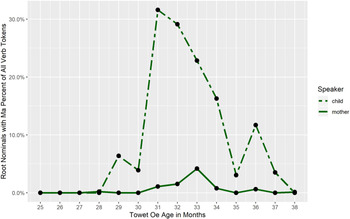
Data from Towet Oe's parents seems to support the notion that the root nominal with =ma form is an idiosyncratic innovation of Towet Oe, in contrast to the ‘do’ auxiliary construction, which is a known feature of Nungon CDS. While Towet Oe's mother and father use the ‘do’ construction multiple times in almost every transcript, they use root nominals with =ma much less, and with distributions that seem to correlate with that of Towet Oe herself. Further, Towet Oe's mother uses a variation on the ‘do’ auxiliary construction that actually substitutes a nominalization with =ma for the usual nominalization, but she only uses this during the period in which Towet Oe's use of root nominals with =ma is at its peak. Indeed, the percentage of Towet Oe's mother's verbs that are root nominals with =ma (excluding those nominals with =ma in the ‘do’ construction) correlates significantly with the corresponding percentage in Towet Oe's speech (r(13) = 0.69, p = .006). Root nominals with =ma are compared in Towet Oe and her mother's speech in Figure 3.
Percentages of all Towet Oe's and her mother's verb tokens that are root nominals with =ma.

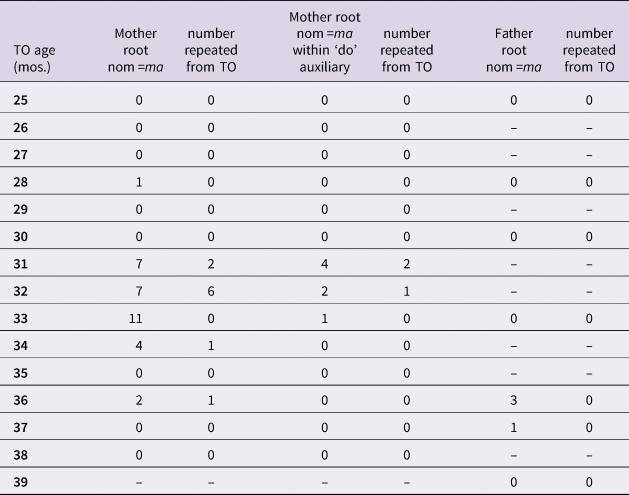
This correlation between Towet Oe's and her mother's root nominals with =ma is not simply a matter of her parents’ repeating Towet Oe's own utterances. Of Towet Oe's parents’ tokens of root nominals with =ma, most are not direct repetitions of Towet Oe's preceding utterances, as seen in Table 4.
Parental tokens of root nominals with =ma

Towet Oe's parents thus seem to adopt a feature of their child's speech that is unacceptable in adult Nungon, in what seems to be an extreme case of parental ‘fine-tuning’ (Bohannon & Marquis, Reference Bohannon and Marquis1977). The parents’ apparent pragmatism here contrasts with Schieffelin's (Reference Schieffelin and Slobin1986) report for Bosavi-speaking parents, who were said to avoid modifying their speech when addressing children so that the children would only learn correct, ‘hard’ speech.
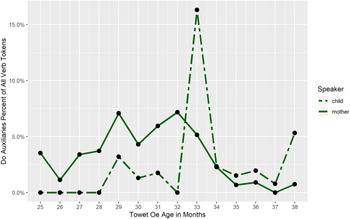
In contrast to the correlation between root nominals with =ma in Towet Oe's and her mother's speech, the percentages of root medials in Towet Oe's speech do not correlate with the percentages in her mother's speech with any significance (r(13) = 0.34, p = .23). Similarly, the percentages of ‘do’ auxiliaries in mother's and child's speech do not correlate significantly (r(13) = 0.21, p = .48). In fact, the mother shows a general decrease in the proportion of ‘do’ auxiliaries from 2;9, as seen in Figure 4. This decrease is consistent with the author's observations of Nungon child-directed speech with other caregivers and children: the ‘do’ auxiliary construction seems to be mainly used when addressing preverbal children and children who are still in the early stages of language acquisition.
Percentages of all Towet Oe's and her mother's verbs that are framed in the ‘do’ auxiliary construction.

While ‘do’ auxiliary constructions in the mother's and child's speech do not pattern similarly for the study period, there is slight correlation between the mother's use of ‘do’ auxiliaries and Towet Oe's use of root nominals with and without =ma (r(13) = 0.61, p = .04). This could offer some support for the hypothesis that the ‘do’ auxiliary construction is the source in the input of Towet Oe's nominal form.
To evaluate whether these results could be a sampling artifact, I used a Poisson regression and ANOVA test to regress the three measures (root nominals with =ma, root medials, and ‘do’ auxiliaries) against Towet Oe's age for both the mother's speech and the child's speech. Results are in Table 5.
Results of Poisson and ANOVA tests for child age as a factor

Table 5 shows that, for each measure, the child's age was highly significant as a factor. This implies that the results are not simply an artifact of sampling, and should indeed be taken as partially representative of trends in the child's and her mother's speech.
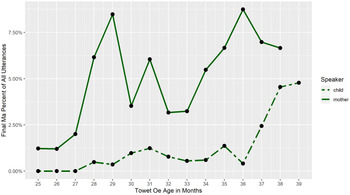
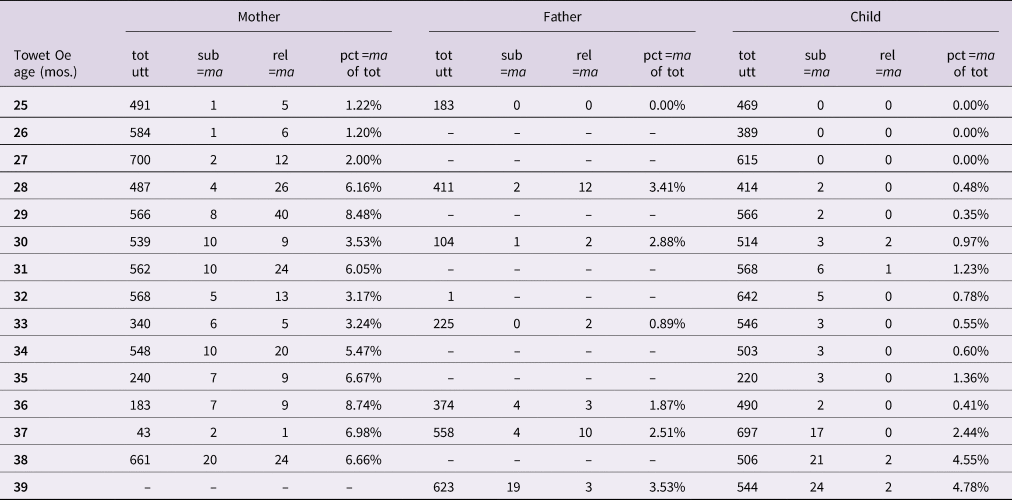
Where does the =ma come from in Towet Oe's root nominal with =ma construction? To explore this, I also coded all instances of relativizing and subordinating =ma in the transcripts. These are instances where =ma follows a verb, albeit almost always a final (finite) verb. It is assumed that an utterance generally includes maximally one token of =ma. Thus, the percentages of all utterances that contained clause-final =ma (either relativizing or subordinating) were calculated for each speaker for each transcript. This data is in Table 6. Figure 5 visualizes the percentages of clause-final =ma of all utterances for just Towet Oe and her mother.
Percentages of all Towet Oe's and her mother's utterances with relativizing and subordinating =ma.

Subordinating and relativizing =ma relative to total utterances

As seen in Table 6, Towet Oe's parents produce some tokens of clause-final =ma in every transcript; percentages of utterances containing =ma range from 1% to 9% for Towet Oe's mother. Around 3;0, Towet Oe herself begins to use clause-final =ma, in particular, relativizing =ma, more; this may be taken as an indication that her syntax is becoming more complex. While final =ma is present in speech directed to her, it is still unknown why Towet Oe apparently seizes upon this clitic to accompany root nominals. Perhaps it is particularly salient because it often occurs utterance-finally, and follows the verb (Slobin, Reference Slobin and Slobin1985).
Discussion
The results show that the child Towet Oe uses two different non-finite verb forms in ‘root’ function (main predicate) and position (last verb in a clause or sentence). These forms pattern differently from each other, and, indeed, the root nominal type has two further subtypes that also pattern distinctly: bare root nominals, and root nominals with the subordinator = ma. It is this last form that Towet Oe appears to use, with relatively large numbers of tokens, as an optional default form in the middle months of the study period. She uses this alongside inflected final verbs in the same recording session, and tokens of the same verb occur inflected and in root nominal form in different sessions, within one or two months of each other. It appears from general knowledge about the Nungon CDS style and from distributions in Towet Oe's mother's and father's speech that the root nominal with =ma type is an innovation by Towet Oe, picked up on by her parents. This section focuses on explaining these results, and exploring how they might contribute to broader discussions of the cross-linguistic acquisition of finite forms.
Towet Oe uses the root nominals and root nominals with =ma for a range of contexts and temporal references, ruling out any correlation with modal contexts, as has been proposed for root infinitives in German (Ingram & Thompson, Reference Ingram and Thompson1996). Additionally, a very wide range of verbs occur in Towet Oe's and her parents’ speech as root nominals, root nominals with =ma, and as nominals within the ‘do’ auxiliary construction, as seen in Table 7 in the Appendix. These include ‘volitional’ and ‘non-volitional’ verbs; even it- ‘be’ is attested as a root nominal and in the ‘do’ auxiliary construction. Further, since Nungon clauses often lack an explicit subject, there is no correlation with subject dropping to pursue along the lines of other root infinitive studies.
Some of the proposals relating to children's ‘root infinitives’ in major world languages involve the deletion of a finite auxiliary, leaving behind an infinitive by itself (Boser, Lust, Santelmann, & Whitman, Reference Boser, Lust, Santelmann and Whitman1992, Ferdinand, Reference Ferdinand1996; discussed in Blom, Reference Blom2008). Indeed, structurally, Nungon root nominals that do not include =ma would appear to relate to the CDS ‘do’ auxiliary construction, which involves a nominalization just like that of the root nominals, accompanied by an inflecting, finite auxiliary verb to- ‘do’. Repetitions of the ‘do’ auxiliary construction do occasionally involve omission of the auxiliary, as in (13), from Towet Oe's mother's speech in the transcript at age 2;3:

But, as with root infinitives in other languages (Blom, Reference Blom2008), it is unlikely that Towet Oe's root nominals involve synchronic deletion of an auxiliary. As seen in her data, only later in the study period does she use the ‘do’ auxiliary construction in greater proportions. Further, the ‘do’ auxiliary construction in Nungon CDS does not usually involve a nominal with =ma, so this could not explain Towet Oe's use of nominals with = ma.
Where did Towet Oe learn the nominalized form? The nominalized form is morphologically spare, representing the verb root alone (for consonant-final roots) or the verb root with a final -k or -p (for vowel-final roots), and one line of reasoning might hold that it represents a childish truncation of longer inflected forms. But only phonetic truncation of certain tense and subject person/number inflections would result in a consonant-final root; in others, the final consonant of the root is realized as /r/. Further, more than half of all known Nungon verbs, including many with high frequency such as yo- ‘speak’ and na- ‘eat’, have vowel-final verb roots that get nominalized with -k (Sarvasy, Reference Sarvasy2017a). For these, the nominalized form is never equivalent to any truncated verb form. And when Towet Oe produces nominalized forms, they are consistently the correct forms and number of syllables (except her addition of =ma); no intermediate forms with approximated additional syllables are found where nominalized verbs were coded.
Adult-directed Nungon speech does not feature nominalizations in root contexts. (For consonant-final verb roots, the Dependent form is homophonous with the nominalization, and root Dependent forms are attested, though highly infrequent, in adult-directed speech. For vowel-final roots, there is no homophony between Dependent and nominalized forms.) Examination of Towet Oe's parents’ speech shows extremely few non-root nominalizations of the adult type. Almost all the nominalizations in her parents’ speech are either root nominals, as in Towet Oe's speech, or framed in the special Nungon CDS ‘do’ auxiliary construction. Since her parents consistently produce many more tokens of the ‘do’ auxiliary construction than of root nominals alone, it seems most likely that Towet Oe learned the nominalized forms from the ‘do’ auxiliary construction in Nungon CDS. Here, then, this special construction, used by Nungon adults in interacting with children who have not yet mastered Nungon verbal inflections, indeed seems to be giving the child morphological training wheels to be able to use a range of lexical verbs without mastery of all their complex inflectional forms.
Since it would appear that the ‘do’ auxiliary construction and root medials occur in roughly equal proportions in Towet Oe's parents’ speech throughout the study period (Table 3), why does the child use nominalizations (apparently extracted from the ‘do’ construction in the input) as an optional default root form in the middle of the study period, and not medial verbs? Both nominalizations and medial verbs are non-finite, dependent forms. But while Towet Oe's use of medial verbs in a main verb context does not seem to diverge extremely from adult use, she uses the nominalizations as a default verb form in contexts where adults would use fully finite verbs.
One factor in Towet Oe's use of root nominals as default forms, instead of root medials, could be relative length. Comparison of Tables 1 and 2 show that Towet Oe's apparent delay in producing the Near Future tense form could be due to its length, with the only disyllabic tense suffix in the language. Medial verbs all have one more syllable than nominalizations: they all end in a final -a. Again, here, length in syllables could be a factor in Towet Oe's preference for the shorter nominalization over the medial form.
Another factor could be the unchanging nature of the nominalization, versus the inflecting medial verb form. While medial verbs can occur with no subject marking, they also can occur with subject marking before the final -a suffix (in switch-reference contexts). This means that each verb root has eight different possible medial forms (seven subject person/number inflections for switch-reference contexts, and the uninflected ‘same-subject’ form). The child might be sensitive to this variance, and prefer the form that never inflects for subject as a default.
A last potential factor is the prominent place of the nominalization as the focal piece of the ‘do’ auxiliary construction in child-directed speech. As noted above, ‘do’ auxiliary constructions occur in adult-directed speech mainly as a vessel for loan verbs or other word forms that are unable to inflect as verbs in Nungon. The construction could be construed as setting up ‘air quotation marks’ around the element that precedes ‘do’, as in ‘do “pinggap pinggap”’, or ‘do (what those people call) “swimming”’. This would seem to lead to a heightened salience of that element. The same could be said of the ‘do’ auxiliaries in child-directed speech. There, the parent consciously or unconsciously draws the child's attention to the nominalized form of a verb. Towet Oe seems to pick up on this and take on the nominalized verb, for some of the study period, as a default form.
Conclusion
This paper has reported on a case study of a child acquiring the Papuan language Nungon, focusing on two different root non-finite verb forms in her speech. This seems to be the first case study tracking two different root non-finite forms in the speech of one child in a single developmental period. For Towet Oe, these two forms pattern very differently from each other.
Root nominals with =ma increase dramatically from around 2;5, then decrease again to nil by 3;2. This form is not found to even a limited degree in adult-directed adult speech. But Towet Oe's parents do produce the form in CDS, in small numbers, in some of the transcripts in the study period. Her mother's production correlates significantly with Towet Oe's use. It is proposed that Towet Oe innovated the form, then her mother also adopted it for the period in which Towet Oe used the form most intensively. (Her father uses the form with some lag, after the child's use has decreased.) Here, parental willingness to use an un-adult-like form in interacting with the child diverges from the attitudes reported by Schieffelin (Reference Schieffelin and Slobin1986) elsewhere in Papua New Guinea. Schieffelin writes that adult Bosavi speakers aimed to pass on only well-formed adult speech to their children.
The other non-finite form used in main clauses in the child's speech is the root medial. Root medials, in contrast to the root nominals with =ma, increase gradually in the child's speech to near-adult levels over the study period. Root medials are found in main clause function in adult Nungon speech of various genres (Sarvasy, Reference Sarvasy2015a), and are robustly present in Towet Oe's parents’ speech for most of the period under study.
This study also illuminated the distribution of an unusual syntactic feature of Nungon CDS: ‘do’ auxiliary frames. These involve the optional expansion of what would be simplex verbs in ADS such as aa- ‘see it’, it- ‘be’, and wet- ‘beat it’ into a nominalized lexical verb plus to- ‘do’ auxiliary: aa-k to- ‘do seeing it’, it to- ‘do being’, and wet to- ‘do beating it’. This ‘do’ auxiliary frame seems to be the primary source in CDS of the nominal forms that Towet Oe then uses as root verbs, without any auxiliary, and often with a =ma subordinating clitic.
There is no definitive answer yet as to why Towet Oe uses the root nominal as a default verb form between 2;5 and 3;1, while using root medials in similar contexts and distributions as her parents. Clearly, non-finiteness is not the reason. In fact, since the two root non-finite forms have different distributions in the child's speech, this study would seem to provide a new type of evidence for theories of the acquisition of finiteness. In particular, theories that attribute children's root infinitives to a single syntactic deficiency, such as the Agreement and Tense Omission Model (Schütze & Wexler, Reference Schütze and Wexler1996), will fall short in explaining the Towet Oe case study. But similarly, input alone (e.g., Freudenthal, Pine, Jones, & Gobet, Reference Freudenthal, Pine, Jones and Gobet2015) does not yet transparently explain the two different patterns for Towet Oe's two root non-finite forms: the apparent source for the root nominals in the input occurs with similar frequency to root medials in Towet Oe's parents’ speech, and the addition of the subordinator =ma to the root nominal seems to be an innovation by Towet Oe.
Three possible factors were suggested in Towet Oe's choice of the root nominal as default verb form. First, word length may have been the reason that Towet Oe's production of the long Near Future form lagged behind other tense inflections, and the nominalization is also shorter than the medial verb form by one syllable. Second, nominalizations never inflect for subject person and number, but medial verbs sometimes do, in switch-reference contexts. In selecting a default verb form, the child could be sensitive to this mutability of medial forms, and disprefer them for general-purpose default contexts. Third, the nominalization is presented to the child with high salience within the ‘do’ auxiliary construction, which was proposed to function as ‘morphological training wheels’ to limit the number of inflectional forms the child must know to be able to use a range of lexical verbs.
Abbreviations
- =
clitic
- 1sg, etc.
first person singular
- adj
adjectivizer
- adv
adverbializer
- ben
benefactive
- bt
baby talk
- dep
Dependent
- dist
distal
- ds
different-subject
- du
dual
- foc
focus
- gen
genitive
- imm.imp
Immediate Imperative
- irr
Irrealis
- loc
locative
- mid
middle distance
- mv
medial verb
- near
near distance
- nf
Near Future
- nmz
nominalizer
- np
Near Past
- nsg
non-singular
- o
object
- perf
Perfect
- pl
plural
- poss
possessive
- pres
Present
- pro
pronoun
- prox
proximal
- rel
relativizer
- rf
Remote Future
- rp
Remote Past
- sg
singular
- spec
specifier
- sub
subordinator
- top
topic
- xxx
unintelligible
Acknowledgements
Foremost thanks to the Nungon-speaking families, children, and recording and transcription team: Lyn Ögate, Stanly Girip, James Jio, Nathalyne Ögate, and Yongwenwen Hesienare. Research on Nungon child language was carried out with generous support from the Australian Research Council, grant CE140100041. Research was approved under Australian National University Ethics approval 2013/055. Thanks to: Alan Rumsey, Ruth Berman, Pat Clancy, Robert Clark, Katherine Demuth, Paola Escudero, Nicholas Evans, Nina Hyams, Evan Kidd, Lyle Lustigman, Brian MacWhinney, William O'Grady, Jane Simpson, Sabine Stoll, Gillian Wigglesworth, and audiences at IASCL 2017, the Australian National University, the University of Hawai'i, the University of Oregon, and the University of Sydney. Two anonymous reviewers and Associate Editor Elma Blom provided extremely detailed and helpful comments on earlier versions.
Appendix
Comprehensive list of lexical verbs found as root nominals, root nominals with =ma, and/or in the ‘do’ auxiliary construction in Towet Oe and her parents’ speech between 2;1 and 3;3