Introduction
Heat-related mortality is a growing public health concern as average global surface temperatures continue to rise. Recent and recurrent heat waves have impacted the US Midwest in 1995 and 1999,Reference Ghumman and Horney 1 , Reference Whitman, Good, Donoghue, Benbow, Shou and Mou 2 Western Europe in 2003 and 2006,Reference Naughton, Henderson and Mirabelli 3 - Reference Conti, Meli and Minelli 6 and Asia in 1998 and 2003.Reference Fouillet, Rey and Wagner 7 , Reference Tan, Zheng, Song, Kalkstein, Kalkstein and Tang 8 In the largest cities, rapid urbanization is affecting local climate through the urban heat island effect, while population growth outpaces cities’ capacity to provide adequate housing and health care infrastructure.
In June 2015, a heat wave resulted in above average temperatures in Karachi, Pakistan, which is usually protected from the most excessive temperatures due to its coastal location. Karachi, the world’s third largest and most densely populated city, has a population of approximately 23 million people (63,000 per square mile), approximately 95% of whom are Muslim. Approximately 90% of the residents of Karachi are migrants from rural Pakistan or other parts of South (eg, Bangladesh, Burma, and Sri Lanka) and Central (eg, Afghanistan and Iran) Asia, and at least 50% are believed to live in slum conditions. Nearly one-third of urban residents lack any formal education (32.9%), and for approximately 20.0%, the only options for accessing health care are government-run hospitals. However, most households have access to on-site improved drinking water (77.6%), improved sanitation (78.0%), and electricity (99.8%).Reference Huang, Kan and Kovats 9 This heat wave occurred during the Muslim holy month of Ramadan, a time when healthy Muslims who have reached puberty are obliged to abstain from eating and drinking during daylight hours. Exceptions are allowed for those who are sick, traveling, and for pregnant, nursing, or menstruating women. Frequent electrical outages meant to ease the pressure on an inadequate power grid and a city-wide water shortage exacerbated the effects of the extreme heat. Using mortality data from hospitals and private clinics in Karachi, Pakistan, the risk factors for heat-related mortality during June 2015 were assessed.
Methods
A record of deaths attributable to the heat wave by attending medical personnel in seven public hospitals and private clinics were obtained via an in-person examination of the death certificates by a trained physician. A reference period of the same number of days as the heat wave period, June 2014, was selected in order to compare the ratio of the numbers of cases during the two time periods to indicate the relative impact of the heat event. Excess deaths were calculated as the difference in the total number of deaths attributable to a heat-related cause of death during the two time periods. Bivariate analyses were performed to calculate risk differences (RD) and 95% confidence intervals (95% CI) to identify any associations between mortality and demographic variables, including gender, age, income, home sufficiency, education, and religion. Rate ratios (RR) and 95% CIs were calculated to compare the number of deaths in the heat wave period and the reference period. In each case, the referent category was selected based on being at lower risk. All analyses were done in EpiSheet (2012; Rothman. Modern Epidemiology. Lippincott Williams & Wilkins; Philadelphia, Pennsylvania USA). Weather data, including daily high temperatures for June 2014 and June 2015, were obtained from AccuWeather.com (AccuWeather; State College, Pennsylvania USA).
Results
The monthly average high temperature for June 2015 was 37.7°C, with temperatures averaging 41.2°C during the week of June 17-23, 2015. The hottest day occurred on June 20, 2015 with a maximum temperature of 45.0°C. The monthly average high temperature for the reference period of June 2014 was 31.1°C.
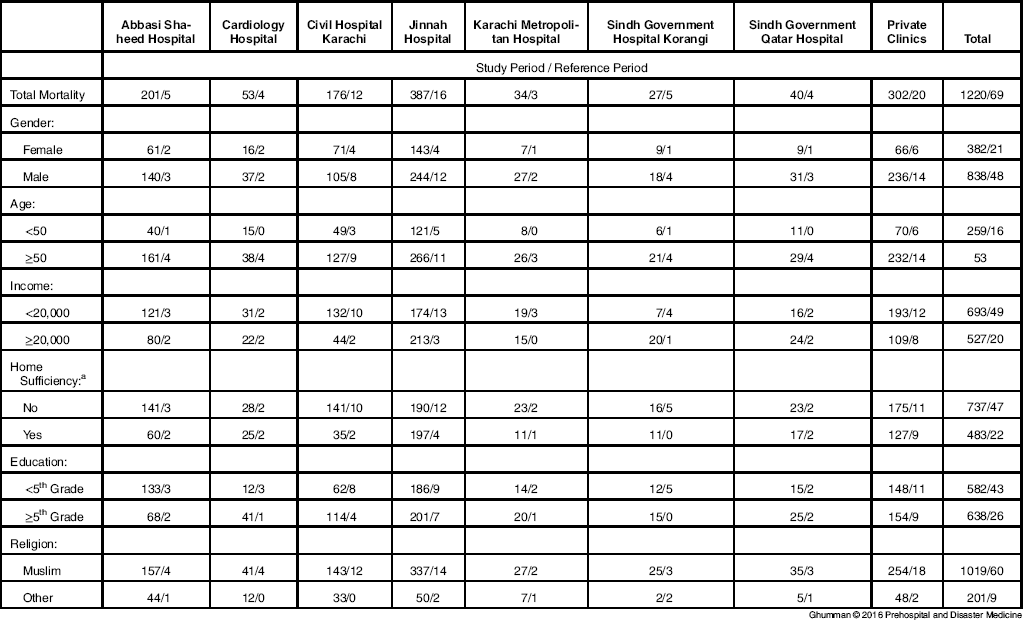
Twelve-hundred and twenty deaths were reported at government hospitals and private clinics during the month of June 2015, an excess of 1,151 deaths in the study population when compared with the reference period of June 2014 (Table 1). Reported deaths were predominately male (n=838; 69%), over the age of 50 (n=900; 74%), and among those reporting they were homeless or living in a home with insufficient electricity and water service (n=737; 60%). Eighty-four percent of deaths were among Muslims; however, since the population of Pakistan is approximately 95% Muslim, 10 the deaths do not appear to be associated with the practice of daylight fasting during Ramadan.
Demographics of Reported Heat-related Mortality, Karachi, Pakistan, June 2015 (N=1,220) Compared to Reference Period, June 2014 (N=69)

a Water and electric service.
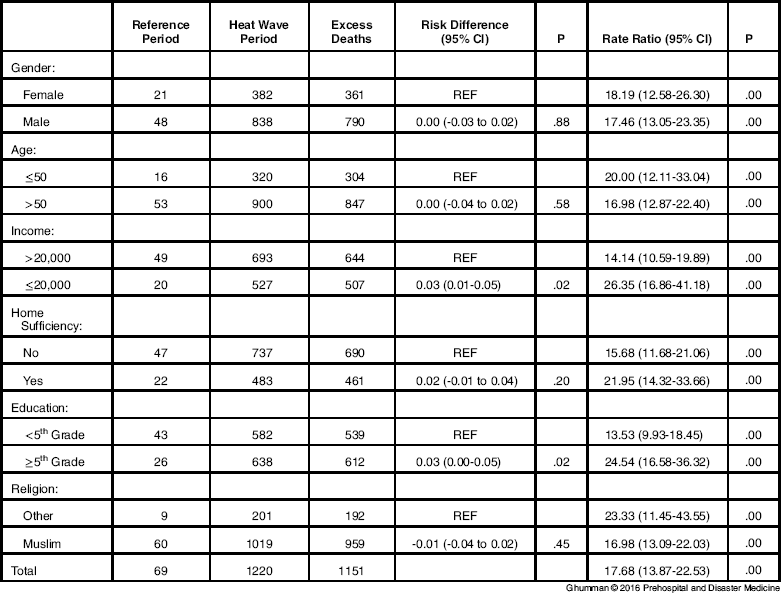
Residents with a monthly income lower than 20,000 Pakistani Rupees (US $196; RD=0.03; 95% CI, 0.01-0.05) and those with less than a fifth grade education (RD=0.03; 95% CI, 0.00-0.05) were at significantly higher risk of death during the heat wave compared to the reference period (Table 2). Gender, age, home sufficiency, and religion were not significant risk factors for heat-related mortality in the study period when compared to the reference period. All groups were between 13 and 25 times as likely to die of a heat-related cause of death during June 2015 when compared with the reference period of June 2014.
Stratified Total Mortality during the June 2015 Karachi Heat Wave versus the June 2014 Reference Period

Discussion
Consistent with other published research, an excess risk of mortality from heat-related illness was found among the poor 11 and those with lower levels of educationReference Jones, Liang and Kilbourne 12 during the 2015 heat wave period when compared with the reference period of June 2014. Deaths among these groups are likely attributable, in part, to interactions with other demographic characteristics, such as inadequate housing or homelessness, or the result of social isolation or the inability to comply with public safety recommendations or access any type of relief from the heat. Unlike other studies, significant elevated risks for males or older adults was not found in 2015 as compared to 2014, or for interactions between gender and age (eg, males or females age 50 and over).
No association between heat-related mortality and the practice of daylight fasting during Ramadan by Muslims was found, as had been reported in the popular media. Pregnant and nursing mothers, the elderly, and those who are ill generally are exempt from fasting, and instructions were given by religions leaders during the heat wave to avoid fasting during extreme heat in order to protect health. If fasting was a substantial contribution to mortality during the heat wave, more deaths likely would have been seen across all levels of income and education, as well as increased deaths among Muslims in other regions experiencing heat waves that summer, including Europe, South Asia, and the Middle East.
Limitations
This study had several limitations. Due to the large number of excess deaths, the burden of record keeping during a public health emergency, and the decision to use only death certificates with complete information, these data are almost certainly an underestimate of total mortality. However, these data are consistent with reports of 1,233 deaths in Karachi during the heat wave by Al Jazeera and other news outlets. Mortality data were collected by a trained physician who examined death certificates at hospitals and private clinics; however, those who died at home or in other facilities not visited are also not included. Due to limitations in the data, interaction effects are unable to be assessed statistically at this time; although, it is suspected that synergistic interaction may be occurring, increasing the risk of death for those with more than one risk factor.
Conclusion
The June 2015 heat wave had a substantial effect on mortality in Karachi, Pakistan. Infrastructure improvements clearly are needed to address the large number of excess deaths due to this heat emergency, which came at a time when water and electricity services already were unreliable for many of Karachi’s approximately 24 million residents. New public health programs should be implemented to address those at risk, including the poorest residents and those with the lowest levels of education, who may be unable or unaware how to access care during a heat emergency.