Latino youths in the United States experience heightened vulnerability for multiple types of risk-taking behaviors in adolescence. National high school surveys indicate Latino adolescents had the highest rate of past-month alcohol use in 8th, 10th, and 12th grade relative to Caucasians and African American adolescents (e.g., r = .31; Johnston, O'Malley, Bachman, & Schulenberg, Reference Johnston, O'Malley, Bachman and Schulenberg2012). They also reported the second highest rates of binge drinking (22.6%), the highest rates of consuming 10 or more consecutive drinks (7.1%), and the highest rates of having 4 or more sexual partners compared to all other groups (Centers for Disease Control and Prevention, 2016). Research has shown that multiple sex partners and alcohol and drug use are the primary causes of HIV/AIDS infection among minority youth, and when these behaviors occur together, risk grows tremendously (Santelli, Lindberg, Abma, McNeely, & Resnick, Reference Santelli, Lindberg, Abma, McNeely and Resnick2000). Understanding whether and how these behaviors are linked for Latino adolescents is critical to prioritize public health and prevention programming, especially for Mexican American, who experience higher rates on these outcomes compared to other Latino subgroups (Child Trends, 2015).
Problem behavior theory, the dominant developmental model for understanding adolescent risk taking, attributes these behaviors to a common set of risk processes that are set into motion before adolescence (Jessor & Jessor, Reference Jessor and Jessor1977). These processes involve an interplay between family and peer influences in childhood that lead over time to dysregulated youth behavior, lack of bonding to conventional norms and peers, and a predisposition toward deviance that accounts in turn for the co-occurrence of risky behaviors in middle to late adolescence (e.g., Hawkins, Catalano, & Miller, Reference Hawkins, Catalano and Miller1992; Jessor et al., Reference Jessor, Turbin, Costa, Dong, Zhang and Wang2003). Although numerous longitudinal studies support cascade models of childhood externalizing and later adolescent risk taking (Zucker, Donovan, Masten, Mattson, & Moss, Reference Zucker, Donovan, Masten, Mattson and Moss2009), cascading pathways that extend from childhood to late adolescence have rarely been tested with Latinos. This gap is noteworthy because many of the most widely disseminated prevention programs specifically target these linked processes (National Research Council and Institute of Medicine, 2009).
Several studies have supported associations among multiple problem outcomes such as conduct problems, illicit drug use, and risky sexual behavior for Latino youth (Lopez et al., Reference Lopez, Schwartz, Prado, Huang, Rothe, Wang and Pantin2008; Prado et al., Reference Prado, Huang, Maldonado-Molina, Bandiera, Schwartz, de la Vega and Pantin2010; Schwartz et al., Reference Schwartz, Mason, Pantin, Brown, Wang, Campo and Szapocznik2009). However, epidemiologic patterns raise the possibility that these outcomes may not coincide and unfold in similar ways for Latinos. For example, Latino adolescents ages 13 to 19 have substantially higher prevalence of health consequences linked to risky sexual behavior compared to the general population (i.e., birth rates and sexually transmitted infections [STIs] twice as high, HIV four times greater (Centers for Disease Control and Prevention, 2011, 2012); they do not, however, experience similar disparities in child externalizing problems that are antecedent in models of unfolding risk (Watt & Martinez-Ramos, Reference Watt and Martinez-Ramos2009). Hence, peer-related risk taking may not be explained predominantly by externalizing psychopathology for Latinos. Rather, contextual influences such as greater exposure to deviant peers or limited opportunities in lower income communities (Tolan, Guerra, & Montaini-Klovdahl, Reference Tolan, Guerra, Montaini-Klovdahl, Wolchik and Sandler1997) may account for Latino risk taking independent of externalizing psychopathology. As well, Mexican American adolescents report more symptoms of depression and anxiety than other ethnic groups (Glover, Pumariega, Holzer, Wise, & Rodriguez, Reference Glover, Pumariega, Holzer, Wise and Rodriguez1999; Roberts & Chen, Reference Roberts and Chen1995; Roberts, Roberts, & Chen, Reference Roberts, Roberts and Chen1997; Siegel, Aneshensel, Taub, Cantwell, & Driscoll, Reference Siegel, Aneshensel, Taub, Cantwell and Driscoll1998), owing in part to experiences of discrimination that elevate their risk for internalizing symptoms (Unger, Reference Unger2014). It is possible these antecedent pathways should also be prioritized as additional prevention targets.
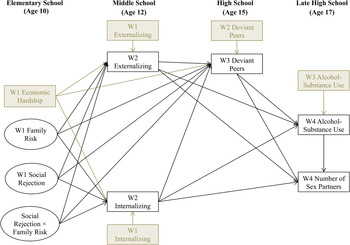
To test whether externalizing and internalizing psychopathology each operate as distinct pathways to Latino youth risk taking, this study examined a sequence of risk processes linking late childhood contextual risks to late adolescent problem substance use and number of sex partners in a diverse Mexican-origin sample. Data were first collected when the youths were in 5th grade, prior to substance use and sexual onset for most. Informed by conceptual work on developmental cascade models (Masten & Cicchetti, Reference Masten and Cicchetti2010), analyses examined the sequential pathways shown in Figure 1 linking contextual risk within the family and peer ecological domains in late childhood to compromised psychological functioning in early adolescence, specifically externalizing and internalizing problems that were each hypothesized to operate in turn as distinct pathways to risky substance use and risky sex in late adolescence. Grounded in ecological systems theory (Bronfenbrenner, Reference Bronfenbrenner1979; Szapocznik & Coatsworth, Reference Szapocznik, Coatsworth, Glantz and Hartel1999), we also examined interactive effects between family and peer contexts that may be important to identify youths most likely to succumb to negative cascades across adolescence (Benson & Buehler, Reference Benson and Buehler2012; Lansford, Criss, Pettit, Dodge, & Bates, Reference Lansford, Criss, Pettit, Dodge and Bates2003). Association with deviant peers was included for its role as the context in which risk taking typically escalates in middle to late adolescence (Dodge, Dishion, & Lansford, Reference Dodge, Dishion and Lansford2006), and to examine whether deviant peers intervene in externalizing and internalizing pathways to risk taking during this period.
(Color online) Conceptual model.

Childhood Precursors of Adolescent Psychopathology and Risk Taking
Family contextual adversity
Developmental cascade models specify ways in which earlier risk factors unfold through progressive or cascading effects on behaviors and experiences over time, and from one domain and point of assessment to another (Dodge et al., Reference Dodge, Malone, Lansford, Miller, Pettit and Bates2009; Haller, Handley, Chassin, & Bountress, Reference Haller, Handley, Chassin and Bountress2010; Sitnick, Shaw, & Hyde, Reference Sitnick, Shaw and Hyde2014). The most common cascades link risky family contexts (harsh, conflictual, and rejecting) to escalation of early externalizing behaviors (aggressive, impulsive, and undercontrolled) that predispose and interact with rejecting peer contexts in childhood to set the stage for later involvement in peer-related risk taking. These processes have been supported in multiple studies, even when adjusting for poverty and neighborhood socioeconomic contexts (Burnette, Oshri, Lax, Richards, & Ragbeer, Reference Burnette, Oshri, Lax, Richards and Ragbeer2012; Patterson, Reid, & Dishion, Reference Patterson, Reid and Dishion1992; Pettit, Bates, Dodge, & Meece, Reference Pettit, Bates, Dodge and Meece1999).
Because harsh and hostile family contexts also increases risk for internalizing symptoms such as depression and anxiety, internalizing may offer yet another path through which family contextual adversity leads to later risk taking (Cicchetti & Carlson, Reference Cicchetti and Carlson1989; Davies & Cummings, Reference Davies and Cummings1998). Repetti, Taylor, and Seeman (Reference Repetti, Taylor and Seeman2002) reviewed extensive evidence showing children from risky families experience disruptions in psychological competencies and neuroendocrine functioning, especially in response to stress, which cause them to become more physiologically reactive over time. These responses may also make youth more vulnerable to negative peers and more apt to engage in behaviors, such as drinking or sex, to compensate for physiological or psychological deficiencies (Dodge et al., Reference Dodge, Malone, Lansford, Miller, Pettit and Bates2009). For example, alcohol abuse frequently co-occurs with affective disorders and a common explanation is that adolescents with anxiety and depressive symptoms may attempt to self-medicate through frequent or heavy drinking (Hussong, Jones, Stein, Baucom, & Boeding, Reference Hussong, Jones, Stein, Baucom and Boeding2011). A few studies with non-Latinos found a positive relationship between internalizing and early sexual intercourse (Donenberg, Emerson, & Mackesy-Amiti, Reference Donenberg, Emerson and Mackesy-Amiti2011; Monahan & Lee, Reference Monahan and Lee2008). Although developmental cascades have not been tested among Latinos, risky family contexts predict internalizing, externalizing, and substance use for Latinos (Gonzales, Deardorff, Formoso, Barr, & Barrera, Reference Gonzales, Deardorff, Formoso, Barr and Barrera2006; Pasch et al., Reference Pasch, Deardorff, Tschann, Flores, Penilla and Pantoja2006; Schwartz et al., Reference Schwartz, Des Rosiers, Zamboana, Unger, Knight, Pantin and Szapocznik2013; Smokowski, Rose, & Bacallao, Reference Smokowski, Rose and Bacallao2008). Family conflict is considered a key marker of risk for Latinos because of the high cultural value placed on family harmony (Alegría et al., Reference Alegría, Canino, Shrout, Woo, Duan, Vila and Meng2008; Prado, Szapocznik, Maldonado-Molina, Schwartz, & Pantin, Reference Prado, Szapocznik, Maldonado-Molina, Schwartz and Pantin2008).
Peer contextual adversity
Considerable research also links various forms of peer social rejection, conflict, and victimization with symptoms of psychopathology in adolescence, including aggression, antisocial behavior, depression, and anxiety (Hanish & Guerra, Reference Hanish and Guerra2002; Kochenderfer-Ladd & Wardrop, Reference Kochenderfer-Ladd and Wardrop2001; Lev-Wiesel, Sarid, & Sternberg, Reference Lev-Wiesel, Sarid and Sternberg2013; Platt, Kadosh, & Lau, Reference Platt, Kadosh and Lau2013). Rejection and victimization experiences have greater etiological significance as children transition into adolescence because peer relationships become more important (Brown, Reference Brown, Lerner and Steinberg2004; Steinberg & Morris, Reference Steinberg and Morris2001) and peer rejection becomes more prevalent and predictive of psychopathology (Brown, Reference Brown, Lerner and Steinberg2004; Coie, Dodge, & Kupersmidt, Reference Coie, Dodge, Kupersmidt, Asher and Coie1990; Juvonen, Graham, & Schuster, Reference Juvonen, Graham and Schuster2003), particularly internalizing symptoms (Larson & Ham, Reference Larson and Ham1993; Masten & Cicchetti, Reference Masten and Cicchetti2010; Nolan, Flynn, & Garber, Reference Nolan, Flynn and Garber2003; Rudolph & Hammen, Reference Rudolph and Hammen1999). Some evidence also links social rejection in childhood to adolescent risk taking. For example Prinstein and La Greca (Reference Prinstein and La Greca2004) found peer rejection in Grades 4 to 6 predicted externalizing, substance use, and multiple sex partners in Grades 10 to 12.
For Latinos and other cultural minorities, peer social rejection and associated developmental cascades may be especially threatening when they involve hostility, exclusion, and other types of discrimination experiences tied to their ethnic group (Gibbons et al., Reference Gibbons, Yeh, Gerrard, Cleveland, Cutrona, Simons and Brody2007; Grigsby, Forster, Soto, Baezconde-Garbanati, & Unger, Reference Grigsby, Forster, Soto, Baezconde-Garbanati and Unger2014; Okamoto, Ritt-Olson, Soto, Baezconde-Garbanati, & Unger, Reference Okamoto, Ritt-Olson, Soto, Baezconde-Garbanati and Unger2009). Perceived ethnic discrimination has been associated with heightened physiological arousal, anger, and especially internalizing symptoms among Latino adolescents (Greene, Way, & Pahl, Reference Greene, Way and Pahl2006; Lorenzo-Blanco, Unger, Ritt-Olson, Soto, & Baezconde-Garbanati, Reference Lorenzo-Blanco, Unger, Ritt-Olson, Soto and Baezconde-Garbanati2011; Umaña-Taylor & Updegraff, Reference Umaña-Taylor and Updegraff2007; Zeiders, Doane, & Roosa, Reference Zeiders, Doane and Roosa2012), including prospective findings showing discrimination experiences precede and predict internalizing more than the reverse (Berkel et al., Reference Berkel, Knight, Zeiders, Tein, Roosa, Gonzales and Saenz2010). Studies also report correlations between perceived discrimination and Latino adolescent substance use (Kulis, Marsiglia, & Nieri, Reference Kulis, Marsiglia and Nieri2009). Cano et al. (Reference Cano, Schwartz, Castillo, Romero, Huang, Lorenzo-Blanco and Szapocznik2015) examined cultural stressors, including discrimination among Latino high school students, and showed longitudinal prediction of both internalizing and externalizing problems (i.e., aggression, rule breaking, smoking, and alcohol use). Consistent with our hypothesized model, these authors suggest these experiences may be tied to common underlying processes that link multiple risky outcomes developmentally.
Mixed Evidence for Internalizing Pathways to Adolescent Risk Taking
In contrast to research on externalizing and risk taking, the role of internalizing has been studied less often and is far less conclusive, including in research with Latinos (Grigsby et al., Reference Grigsby, Forster, Soto, Baezconde-Garbanati and Unger2014; Kelder et al., Reference Kelder, Murray, Orpinas, Prokhorov, McReynolds, Qing and Roberts2001). Some studies report negative prospective associations that suggest internalizing may have a protective function to reduce risk taking for some youth (Rogosch, Oshri, & Cicchetti, Reference Rogosch, Oshri and Cicchetti2010; Scalco et al., Reference Scalco, Colder, Hawk, Read, Wieczorek and Lengua2014), similar to the hypothesized “braking effect” of internalizing on antisocial development (Burt, Obradović, Long, & Masten, Reference Burt, Obradović, Long and Masten2008). Explanations center on core internalizing symptoms. For example, adolescents with internalizing problems and low propensity to risk taking may be more inclined to avoid drinking and sexual activity due to fear of STIs, unwanted pregnancies, or being caught by parents (Blinn-Pike, Berger, Hewett, & Oleson, Reference Blinn-Pike, Berger, Hewett and Oleson2004; Capaldi, Crosby, & Stoolmiller, Reference Capaldi, Crosby and Stoolmiller1996). Internalizing also might decrease risk taking by impeding friendship formation with deviant peers (Boivin, Vitaro, & McCord, Reference Boivin, Vitaro, McCord and McCord1995). It is possible these prohibiting influences would be stronger in subgroups, such as girls and immigrant youth, who encounter more intense pressures to avoid such behaviors.
All told, evidence for an internalizing pathway to adolescent risk taking is not only inconsistent but also contradictory, signifying that effects are far from straightforward and may vary across samples and subgroups. Recent studies also suggest the positive effects of internalizing reported in some studies may be inflated because of the strong correlation between internalizing and externalizing that is not controlled in studies that examine them separately (King, Iacono, & McGue, Reference King, Iacono and McGue2004). Oshri, Rogosch, Burnette, and Cicchetti (Reference Oshri, Rogosch, Burnette and Cicchetti2011) found childhood maltreatment predicted late adolescent substance use problems through externalizing but not internalizing when they were examined as simultaneous cascading paths. The relationship between internalizing and sexual behavior also has been shown to disappear (McLeod & Knight, Reference McLeod and Knight2010) when examined in multivariate models. Hence, we examined internalizing and externalizing simultaneously to tease out their “nonoverlapping” effects, and moderating variables to test for subgroup or individual differences within our sample.
Gender and Culture as Moderators: Testing Generalizability Within Group
We examined differences in hypothesized cascades based on adolescents’ gender, nativity (United States vs. Mexico), and two dimensions of cultural orientation (traditional and mainstream). Each of these moderators has been associated with one or more of the cascading variables in Figure 1. However, our emphasis here was not to test these as main effects but, rather, to examine whether downstream cascades from internalizing and externalizing symptoms to later risk taking varied based on these moderators. While a test of gender differences may be especially important for understanding internalizing pathways, as summarized earlier, gender differences are also relevant to externalizing pathways. For example, there is evidence that boys are more vulnerable to deviant peer processes than girls (Moffitt & Caspi, Reference Moffitt and Caspi2001; Toro, Urberg, & Heinze, Reference Toro, Urberg and Heinze2004), although opposite effects have also been shown (Burnette et al., Reference Burnette, Oshri, Lax, Richards and Ragbeer2012). Gender differences in paths to risk taking may be especially pronounced for Latinos due to more differentiated norms and expectations about drugs, alcohol, and sex for Latino boys and Latina girls (Deardorff, Tschann, Flores, & Ozer, Reference Deardorff, Tschann, Flores and Ozer2010; Raffaelli & Ontai, Reference Raffaelli and Ontai2004).
Because externalizing problems and risk-taking behaviors are typically more prevalent among US-born Latinos compared to first-generation immigrants (Alegría et al., Reference Alegría, Canino, Shrout, Woo, Duan, Vila and Meng2008; Almeida, Johnson, Matsumoto, & Godette, Reference Almeida, Johnson, Matsumoto and Godette2012; Gonzales, Germán, & Fabrett, Reference Gonzales, Germán, Fabrett, Chang and Downey2012), developmental cascades might also vary based on youth nativity. The “immigrant paradox” whereby immigrants have more favorable health outcomes than those born in the United States is most robust for risk-taking behaviors (alcohol, drug use, and sexually transmitted diseases) than for other health outcomes (Alegría et al., Reference Alegría, Canino, Shrout, Woo, Duan, Vila and Meng2008). Explanations often focus on the disruptive effects of acculturation on family and peer processes that may render US-born youth more susceptible to deviant peers (Bacio, Mays, & Lau, Reference Bacio, Mays and Lau2013; Frauenglass, Routh, Pantin, & Mason, Reference Frauenglass, Routh, Pantin and Mason1997; Germán, Gonzales, & Dumka, Reference Germán, Gonzales and Dumka2009). However, several scholars suggest that more nuanced cultural dimensions may better account for the heterogeneity and vulnerability of Latino populations than simple measures of nativity (Schwartz, Unger, Zamboanga, & Szapocznik, Reference Schwartz, Unger, Zamboanga and Szapocznik2010). A robust findings in the Latino acculturation research is that youth who become more oriented to the mainstream culture, including its language, norms, and values, are at increased risk for externalizing, substance use, and sexual risk taking (for a review, see Gonzales et al., Reference Gonzales, Dumka, Millsap, Gottschall, McClain, Wong and Kim2012). Hence, mainstream cultural orientation might potentiate the likelihood for developmental cascades to occur. Research also shows a consistent protective effect for youth who retain stronger ties to their traditional culture (Blanco et al., Reference Blanco, Morcillo, Alegría, Dedios, Fernández-Navarro, Regincos and Wang2013; Unger, Reference Unger2014) that also may operate to inhibit developmental cascades. Strong cultural ties bolster family support, values, and youth motivation to avoid behaviors that might bring shame to the family (Stein, Gonzalez, Cupito, Kiang, & Supple, Reference Stein, Gonzalez, Cupito, Kiang and Supple2015). Grounded in bidimensional acculturation models (Berry, Trimble, & Olmedo, Reference Berry, Trimble, Olmedo, Lonner and Berry1986; Schwartz et al., Reference Schwartz, Unger, Zamboanga and Szapocznik2010), we examined moderating effects of youths’ mainstream cultural values (MCV) and traditional Mexican American cultural values (MACV), in addition to youth nativity, to test these hypotheses.
Current Study and Hypotheses
Although our theoretical model was based in theory and prior research testing developmental cascades with predominantly non-Latino samples, we incorporated culturally informed measures of family and peer contextual adversity and tests of cultural moderation. Using this integrative approach (Garcia Coll et al., Reference Garcia Coll, Lamberty, Jenkins, McAdoo, Crnic, Wasik and Vazquez-Garcia1996) with a diverse Mexican-origin sample, we addressed three novel questions. First, we examined whether childhood contextual adversity predicts risk taking in late adolescence because it leads to compromised psychological functioning that, in turn, predisposes youths to greater involvement in risk taking (problem alcohol and drug use, and multiple sexual partners). Second, we examined whether externalizing and internalizing psychopathology represent independent pathways to adolescent risk taking, and whether deviant peers play a role in each. Third, we examined whether the cascading pathways shown in Figure 1 vary based on youth gender, immigrant status, and cultural orientation.
The study utilized four waves of data collected when the youths were in 5th (Wave 1 [W1]), 7th (Wave 2 [W2]), 10th (Wave 3 [W3]), and 12th (Wave 4 [W4]) grades. Our hypothesized model in Figure 1 examined whether contextual risk at W1 (family risk, peer social rejection, and their interaction) leads to developmental cascades across adolescence in which W2 externalizing and internalizing symptoms provide pathways linking risky family and peer contexts with more problematic substance use (alcohol and other substance use problem symptoms) and higher rates of risky sex (a greater number of past-year sex partners) at W4. Family risk and peer social rejection were each latent constructs (indicators are not shown in Figure 1), and the latent variable interaction between these risk domains was included as a predictor. Gender and nativity were dichotomous variables, and mainstream and traditional values were continuous measures in tests of moderation. The following hypotheses guided the study:
-
1. We hypothesized family risk and peer social rejection in elementary school (5th grade) would combine as unique and interactive influences to predict increased externalizing and internalizing symptoms in middle school (7th grade) and greater deviant peer involvement in high school (10th grade).
-
2. We hypothesized externalizing symptoms would in turn predict more substance use problems and a greater number of sexual partners in late high school (12th grade), both directly and indirectly through adolescents’ increased deviant peer involvement (10th grade).
-
3. We hypothesized internalizing symptoms would in turn predict more substance use problems in late high school (12th grade), and internalizing symptoms would be linked indirectly to a greater number of sexual partners through adolescents’ increased alcohol and substance use.
-
4. We hypothesized youth gender would moderate internalizing and externalizing paths to risk taking. Given prior inconsistencies, we tentatively hypothesized stronger positive effects of externalizing and internalizing on deviant peers for males, and increased likelihood for negative effects of internalizing on deviant peers and alcohol–substance use for females.
-
5. We hypothesized youth nativity, MACV, and MCV would moderate internalizing and externalizing paths to risk taking. Given limited prior evidence, we tentatively hypothesized increased likelihood for negative effects of internalizing on deviant peers and risk taking for immigrant youths and for those endorsing higher levels of MACV; and stronger developmental cascades linking externalizing, deviant peers, problem alcohol and drug use, and number of sex partners for US-born youth and for youth endorsing higher levels of MCV and lower levels of MACV.
Methods
Participants
The study utilized data from a longitudinal study of culture and context in Mexican American families (Roosa et al., Reference Roosa, Liu, Torres, Gonzales, Knight and Saenz2008). The sample comprised 749 students and their families who met the following criteria: (a) the family had a fifth grader attending a sampled school; (b) both mother and child agreed to participate; (c) the mother was the child's biological mother, lived with the child, and identified as Mexican or Mexican American; (d) the child's biological father was of Mexican origin; (e) the child was not severely learning disabled; and (e) no stepfather or mother's boyfriend was living with the child. Using a stratified random sampling strategy, the research team identified economically, culturally, and socially diverse communities served by 47 public, religious, and charter schools throughout the metropolitan area. Youths were also sampled from different school types to provide an accurate representation of the cultural, socioeconomic, and linguistic diversity of the target populations. All of the study materials were available in English and Spanish. Recruitment materials were sent home with all 5th graders in these schools, and interested families were screened for eligibility. We completed the initial interview with 73% of eligible families in 47 schools where the mean Latino ethnic concentration was 72.8% (range = 22.4–96.1, SD = 22.4); 91% of the Latinos in the state were of Mexican origin (Roosa et al., Reference Roosa, Liu, Torres, Gonzales, Knight and Saenz2008). This sampling strategy resulted in a diverse representation of 154 neighborhoods (i.e., census tracts) where the mean level of Latino ethnic concentration was 52.9% (range = 1.08%–90.71%, SD = 22.8; White et al., Reference White, Zeiders, Knight, Roosa and Tein2014).
The resulting sample is diverse on indicators of socioeconomic status and language. W1 annual family incomes ranged from less than $5,000 to more than $95,000, with a mean of $30,000–$35,000. At W1, 30.2% of mothers, 23.2% of fathers, and 82.5% of adolescents were interviewed in English and the remainder in Spanish. The mean age of mothers was 35.9 (SD = 5.81), and mothers reported an average of 10.3 (SD = 3.67) years of education. The mean age of adolescents at W1 was 10.42 (SD = 0.55), and 48.7% were female. A majority of mothers were born in Mexico (74.3%), while a majority of adolescents were born in the United States (70.3%).
From the initial sample, 710 (94.8%) families were reinterviewed at W2, 641 (85.6%) at W3, and 636 (84.9%) at W4. Attrition analyses compared those families who had dropped out at W4 with those who completed an interview at W4. With only one exception (child gender), results showed no baseline differences on variables in the present study nor on any other mother or child demographic. Families who dropped out of the study were more likely to have a male than a female child, χ2(1) = 8.431, p = .004.
Procedures
Complete sampling and research procedures are described in detail elsewhere (Roosa et al., Reference Roosa, Liu, Torres, Gonzales, Knight and Saenz2008), but key features are included here. At each of the four waves mothers (required), fathers (optional), and children (required) participated in in-home computer-assisted personal interviews. Interviews lasted approximately 2.5 hr. Interviewers read each survey question and possible responses aloud in participants’ preferred language to reduce problems related to variations in literacy levels. Families were compensated $45, $50, $55, and $60 per participating family member at W1, W2, W3, and W4, respectively.
Measures
Reports from the youths and their mothers were used. Specifically, the youth and mother each reported on the youths’ internalizing and externalizing symptoms, and these scores were then tested in separate models. Family economic hardship and child nativity were reported by mothers. Youths were selected as the most reliable reporters of peer social rejection, sexual behavior, and substance use, and were also used to assess family risk to achieve a parallel operational perspective on risk within the family and peer contexts.
Economic hardship (W1)
Economic hardship was assessed by mother report using items from the four economic hardship subscales developed by Barrera, Caples, and Tein (Reference Barrera, Caples and Tein2001) that were based on subscales originally used by Conger et al. (Reference Conger, Lorenz, Elder, Melby, Simons and Conger1991) and validated for Mexican Americans: inability to make ends meet (two items), not enough money for necessities (seven items), financial strain (two items), and economic adjustments/cutbacks (nine items). Scores were based on item averages from the first three subscales that used a 5-point rating scale (5 = greater hardship), and a count of items on the economic adjustment subscale. These scores were standardized and averaged, with higher scores representing greater hardship.
Family risk (W1)
Family risk was a latent variable with three indicators: scores on maternal harsh parenting, parent–adolescent conflict, and family conflict, that were each validated for use with Mexican Americans. We utilized an adapted version of the harsh parenting subscale of the Children's Report of Parent Behavior Inventory (Schaefer, Reference Schaefer1965), which has demonstrated cross language equivalence (Nair, White, Knight, & Roosa, Reference Nair, White, Knight and Roosa2009).
Youths reported on their perceptions of their mothers’ harsh parenting on 8 items (e.g., “Your mother screamed at you when you did something wrong”). The Cronbach α value was 0.82. Youths rated conflict with their mothers using the Parent–Adolescent Conflict Scale (Ruiz, Gonzales, & Formoso, Reference Ruiz, Gonzales and Formoso1998) that has shown good psychometric properties in multiple studies with Mexican Americans (Corona et al., Reference Corona, McCarty, Cauce, Robins, Widaman and Conger2012; Jensen et al., Reference Jensen, Wong, Gonzales, Dumka, Millsap and Coxe2014; Telzer, Gonzales, & Fuligni, Reference Telzer, Gonzales and Fuligni2014; Vargas, Roosa, Knight, & O'Donnell, Reference Vargas, Roosa, Knight and O'Donnell2013). Adolescents responded to 10 items reporting how often they had experienced minor and serious disagreement (e.g., “How often did you and your mother disagree with each other?”). The Cronbach α value was 0.72. The 9-item family conflict subscale of the Multicultural Events Scale for Adolescents (Gonzales, Tein, Sandler, & Friedman, Reference Gonzales, Tein, Sandler and Friedman2001) was employed to assess discord or hostility at the family level, including culture-related conflicts among family members. Children rated items such as “Your parents had a serious disagreement or fight with each other” and “Family members disagreed about cultural traditions” as happened or did not happen. A count of the happened events was computed.
Peer social rejection (W1)
Peer social rejection was a latent variable with three indicators: scores on perceived peer hassles and conflict, ethnic discrimination, and relational aggression. Self-report (vs. parent or peer report) is the most common method for assessing experiences of victimization, especially those that are very personal in nature such as relational aggression and discrimination experiences that may only be known by the aggressor and the victim (Siegel, La Greca, & Harrison, Reference Siegel, La Greca and Harrison2009). Although self-perceptions are subject to overreporting (“paranoia”) and underreporting (“denial”) biases, validity has been established through significant overlap with peer perceptions (e.g., r = .31; Graham & Juvonen, Reference Graham and Juvonen1998), and by similar relations with child outcomes when compared to peer nominations (Crick & Bigbee, Reference Crick and Bigbee1998).
The peer hassles/conflict subscale from the Multicultural Events Scale for Adolescents (Gonzales et al., Reference Gonzales, Tein, Sandler and Friedman2001) includes 14 items tapping conflict, victimization, and social rejection experiences with same age peers. Youths responded happened or did not happen to items (e.g., “Kids tried to fight with you.”). A count of happened events was computed. A 5-point scale assessed ethnic discrimination experiences from peers (e.g., “Kids called you names because you are Mexican or Mexican American”). The measure demonstrated good psychometric properties in samples of Mexican origin youths (Berkel et al., Reference Berkel, Knight, Zeiders, Tein, Roosa, Gonzales and Saenz2010; Delgado, Updegraff, Roosa, & Umaña-Taylor, Reference Delgado, Updegraff, Roosa and Umaña-Taylor2011). Adolescents indicated how true or how often events happened (e.g., Kids called you names because you are Mexican or Mexican American). Cronbach α at W1 was 0.78. A mean score was computed. The 5-item Relational Aggression Scale was adapted from Prinstein, Boergers, and Vernberg's (Reference Prinstein, Boergers and Vernberg2001) version of the Revised Peer Experiences Questionnaire (Vernberg, Jacobs, & Hershberger, Reference Vernberg, Jacobs and Hershberger1999). Youths indicated how often each behavior had been directed toward him/her. Example items include “A kid your age that you liked would not sit near you at lunch or in class.” Cronbach α at W1 was 0.82. A mean score was computed.
Internalizing and externalizing symptoms (W1 and W2)
Mothers and youth separately completed the Diagnostic Interview Schedule for Children (C-DISC-IV; Shaffer, Fisher, Lucas, Dulcan, & Schwab-Stone, Reference Shaffer, Fisher, Lucas, Dulcan and Schwab-Stone2000), a structured diagnostic instrument based on the Diagnostic and Statistical Manual of Mental Disorders—Fourth Edition (American Psychiatric Association, 1994). Internalizing symptoms was a sum of generalized anxiety, major depression, and social phobia symptoms. Externalizing symptoms was a sum of conduct disorder and oppositional defiant disorder symptoms. Interrater reliability was low (r = .23 for externalizing, r = .17 for internalizing), which is expected for child symptom ratings because each reporter has access to different aspects of the child's functioning and in different settings (De Los Reyes, Reference De Los Reyes2013).
We did not use diagnostic categories in the current study; however, we compared our rates of diagnoses at W1/W2 with rates from the National Health and Nutritional Examination Survey (Merikangas et al., Reference Merikangas, He, Brody, Fisher, Bourdon and Koretz2010) that reported 12-month prevalence separately for ages 6 to 11 and ages 12 to 15. Our sample spanned these two age ranges. To be consistent with their reporting framework, we used youth report for generalized anxiety disorder and the combined (either parent or youth) report for major depressive disorder (MDD), conduct disorder (CD), and oppositional defiant disorder. Our respective rates compared to the younger and older national samples were 1.2% versus 0.1% and 0.7% for generalized anxiety disorder; 3.2% versus 1.6% and 3.8% for MDD, 4.8% versus 0.8% and 1.1% for oppositional defiant disorder, and 2.4% versus 1.5% and 2.7% for CD. Compared to data available on Hispanics in other national samples, our rates of past-year diagnosis were 3.2% versus 2.4% for MDD and 7.5% versus 2.5% for social phobia and the rates of lifetime diagnoses were 3.6% versus 3.9% for MDD and 3.4% versus 3.2% for CD (Centers for Disease Control and Prevention, 2013).
Deviant peer association (W2 and W3)
Youths responded to the 14-item Peer Delinquent Behavior Scale (Dishion, Patterson, Stoolmiller, & Skinner, Reference Dishion, Patterson, Stoolmiller and Skinner1991; Thornberry, Lizotte, Krohn, Farnworth, & Jang, Reference Thornberry, Lizotte, Krohn, Farnworth and Jang1994). They answered statements such as “How many of your friends have used alcohol or drugs, or sniffed things to get high or drunk?” and “How many of your friends have purposely damaged, destroyed, or tagged property that did not belong to them?” Alpha values were 0.89 and 0.92 at W2 and W3, respectively.
Problem alcohol and substance use (W3 and W4)
The youths reported on their past-year experiences with alcohol, tobacco, marijuana, and other illicit drugs on the C-DISC-IV (Shaffer et al., Reference Shaffer, Fisher, Lucas, Dulcan and Schwab-Stone2000). The combined alcohol and other substance use disorder symptom count score was used. Although diagnoses were not used, our rate of past-year alcohol use disorder was 3.9% versus 4.5% reported for Hispanics in the National Survey on Drug Use; drug abuse disorder was 3.9% versus 5.7%, respectively (3.9% vs. 5.7%; Centers for Disease Control and Prevention, 2013). Our rates of ever use compared to a national Latino high school sample (Kann et al., Reference Kann, Kinchen, Shanklin, Flint, Kawkins, Harris and Zaza2014) were 62.8% versus 71.2% for alcohol and 27.7% versus 48.8% for marijuana, respectively.
Number of sexual partners (W4)
Using a computer-assisted method that allowed anonymous responses on the keyboard, youths reported the number of sexual partners they had in the past 12 months, an established measure of risky sex (Prinstein & La Greca, Reference Prinstein and La Greca2004). Our rate of ever having sex was 42.8% versus 46.6% for a national Latino sample (Kann et al., Reference Kann, Kinchen, Shanklin, Flint, Kawkins, Harris and Zaza2014).
Gender and nativity (W1)
Mothers reported on adolescent gender (0 = male, 1 = female) and nativity (0 = US born, 1 = Mexico born).
Youth cultural orientation (W2)
Adolescents completed the Mexican American Cultural Values Scale (MACVS; Knight et al., Reference Knight, Gonzales, Saenz, Bonds, German, Deardorff and Updegraff2010) to assess Mexican American values and mainstream values. The MACVS was developed through focus groups with Mexican American mothers, fathers, and adolescents. Two broad factors were validated using confirmatory factor analyses across three data sets with Mexican American adolescents and adults. Adolescent indicated their endorsement of each item by responding with a 5-point Likert-type scale ranging from (1) not at all to (5) very much. MACV was the mean score across 36 items from the six Mexican American value subscales: familism-support, familism-obligation, familism-referents, respect, religiosity, and traditional gender roles. MCV was the mean score across 14 items from the three mainstream value subscales: material success, independence/self-reliance, and competition/personal achievement. The Cronbach α values were 0.89 and 0.83 for MACV and MCV, respectively.
Analytic strategy
Figure 1 illustrates our analytical model. W1 economic hardship was included as a covariate when estimating paths from W1 contextual risk (latent constructs of family risk, peer social rejection, and their interaction) to W2 internalizing, W2 externalizing, and W3 deviant peers. When estimating effects of earlier to subsequent domains in the sequential cascade model (contextual risk to mental health symptoms, mental health symptoms to risk taking), the level of the corresponding construct from the previous measurement wave was included as a covariate, except for the sexual risk outcome because we focused on the number of sexual partners only in the past 12 months. The covariances or residual covariances among constructs within the same assessment period (e.g., W1 internalizing symptoms and W1 externalizing symptoms; W2 internalizing symptoms and W2 externalizing symptoms) were included in the model. W1 peer and family subscales based on the same measure were correlated to control for method effect.
Structural equation modeling (SEM) was used to estimate the hypothesized model, using Mplus 7 (Muthén & Muthén, Reference Muthén and Muthén1998–2012). Maximum likelihood estimation was used to handle the missing data in the model (Enders, Reference Enders2010); thus, the full sample was included in model testing. We utilized the sandwich estimator in all analyses to adjust the standard errors of path coefficients for nonnormality (Muthén & Muthén, Reference Muthén and Muthén1998–2012). The latent variable interaction term between W1 family risk and W1 social rejection was created using the XWITH option in Mplus (for testing interaction effects). If the interaction was found to be significant, we would probe simple slopes of W1 social rejection on W2 internalizing, W2 externalizing, or W3 deviant peers at ±1 SD of the factor mean of W1 family risk and simple slopes of W1 family risk at ±1 SD of the factor mean of W1 social rejection. To obtain interpretable simple intercepts, relevant predictors/covariates were mean centered.Footnote 1
We used Poisson regression to model the two outcomes, W4 alcohol–substance use symptom counts and W4 number of sex partners in the previous year, which were count variables and had highly nonnormal distributions (skewness = 6.897, kurtosis = 59.203 and skewness = 5.075, kurtosis = 36.445, respectively).Footnote 2 As both outcomes displayed many zero counts,Footnote 3 we compared the zero-inflated Poisson model with the standard Poisson model (using the Akaike information criterion [AIC] and the Bayesian information criterion [BIC]) to decide which model to use. The zero-inflated Poisson model makes the assumption that the zero counts observed in the data come from two groups (Coxe, West, & Aiken, Reference Coxe, West and Aiken2009), those who produce structural zeroes (e.g., nonproblem users of alcohol and other substances, who would never get a nonzero count on alcohol–substance use symptoms), and those who produce counts of zero with some probability (e.g., users and occasional users of alcohol and other substances, who happened to have zero alcohol–substance use symptoms in the year before our W4 data collection). With a zero-inflated Poisson model, two regressions are estimated: the first one is a logistic regression that predicts the odds of being in the group with structural zeroes, and the second one is a regular Poisson regression for the count part of the outcome that does not contain structural zeroes (Coxe et al., Reference Coxe, West and Aiken2009; Muthén & Muthén, Reference Muthén and Muthén1998–2012). When estimating a zero-inflated Poisson model, we used the same set of predictors for these two parts. Note that when being used to predict W4 number of sex partners, the W4 alcohol–substance use symptom count variable was treated as a whole, as a continuous predictor. We reported unstandardized path coefficients because standardized coefficients are not available for Poisson models.
The model in Figure 1 was tested in the following order. First, we fit a measurement model for W1 family risk and W1 social rejection, and examined the equivalence of the latent factor structures across youth nativity and gender. Second, we fit the overall model as hypothesized and determined the form of Poisson regression (zero-inflated Poisson vs. standard Poisson) for the two count outcomes, using youth-reported internalizing and externalizing symptoms in the model. Third, we fit the overall model using the form of Poisson regression for the two count outcomes determined in the previous step,Footnote 4 this time using parent-reported internalizing and externalizing symptoms. Fourth, we used multiple-group SEM to examine separately the moderation effects of youth nativity and gender on the hypothesized cascade paths. If the multivariate Wald test showed that the cascade paths differed across groups, we used the Wald test to investigate which paths differed. Then to probe the moderation effect by youth gender or by nativity, we reran the multiple group SEM constraining the W1 factor loadings and the invariant cascade paths to be the same across groups, but freely estimating the cascade paths that were different across groups as the final model. Fifth, we examined separately the moderation effects of youth-reported Mexican American cultural values and those of youth-reported mainstream values, on the relations between youth-reported or parent-reported internalizing and externalizing symptoms and downstream outcome variables.
Results
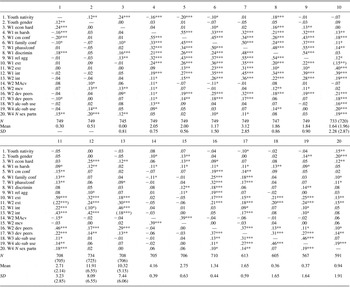
Table 1 provides the means, standard deviations, and correlations of study variables. Most of the correlations involving the contextual risk, internalizing, externalizing, and risk-taking variables were in expected directions.
Sample correlation matrix, means, and standard deviations for study variables

Note: For the sample correlations, sample size = 477 due to listwise deletion. For the sample mean and sample standard deviation, the sample size for each study variable was included in the table. In the correlation matrix, the lower and upper triangles reflect the sample correlations among variables in the models based on youth-reported versus parent-reported internalizing and externalizing symptoms, respectively. Intercorrelations of youth- and parent-reported internalizing and externalizing symptoms are reported in the parentheses along the diagonal of the correlation matrix. For the sample size, sample mean, and sample deviation of the internalizing and externalizing symptoms, those of the youth report were reported first, followed by those of the parent report in parentheses. Youth nativity was coded 0 = US born, 1 = Mexico born; youth gender was coded 0 = female, 1 = male. W1, Wave 1; econ hard, economic hardship; m harsh, mother harsh parenting; cm conf, child conflict with mother; phass/conf, peer hassles/conflict; discrim, discrimination; rel agg, relational aggression; ext, externalizing; W2, Wave 2; int, internalizing; MAcv, Mexican American cultural values; mcv, mainstream values; dev, deviant; alc-sub, alcohol–substance use; W4, Wave 4; N sex partn, number of sex partners.
*p < .05. **p < .01. ***p < .001.
Measurement model
Prior to fitting the full SEM model, we fit a measurement model for W1 family risk and W1 peer social rejection. The measurement model suggested good fit of the data, χ2 (7) = 21.97, p < .05; comparative fit index = 0.98, root mean square error of approximation = 0.05, standard root mean square residual = 0.03. The resulting standardized factor loadings were all significant, ranging from 0.53 to 0.80 for W1 family risk and 0.66 to 0.81 for W1 peer social rejection. The two constructs were correlated at 0.59. Equivalence of the measurement model across youth nativity and gender was tested using multiple group analyses. Two nested models were conducted, with one freely estimating all parameters in each comparison group, and the other constraining all factor loadings to be equal across groups. Nested model tests for the W1 measurement model showed the factor loadings were not significantly different across youth nativity, Δχ2 (4) = 2.16, p = .71, and across youth gender, Δχ2(4) = 0.68, p = .95.
Cascading model based on youth-reported internalizing and externalizing symptoms
We fit a zero-inflated Poisson model and a standard Poisson model to W4 alcohol–substance use symptom counts, and the zero-inflated Poisson model produced better fit to the data (AIC = 36,680.548 and BIC = 37,091.61for the zero-inflated Poisson model vs. AIC = 37,089.762 and BIC = 37,477.736 for the standard Poisson model). Fitting a zero-inflated Poisson model to W4 number of sex partners led to nonconvergence in many of the follow-up models testing for moderation effects; thus, a regular Poisson model was used to model W4 number of sex partners. Therefore, we continued with a zero-inflated Poisson model for W4 alcohol–substance use symptoms and a standard Poisson model for W4 number of sex partners.
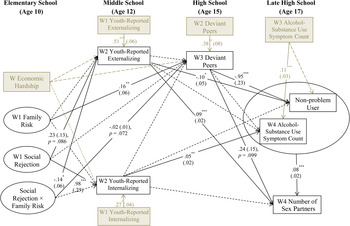
Figure 2 shows the results of our SEM model based on youth-reported internalizing and externalizing symptoms (see online-only supplementary materials and http://reachinstitute.asu.edu/MexicanAmericanRiskTaking). W1 social rejection was positively associated with W2 youth-reported internalizing symptoms. The main effect of W1 social rejection on W2 youth-reported externalizing was marginally significant. In addition, the moderation effect of W1 Family Risk × W1 Social Rejection on W2 youth-reported externalizing was significant. The relationship between W1 social rejection and W2 youth-reported externalizing symptoms tended to be positive, and the positive relation was stronger at lower levels of W1 family risk. However, W1 family risk was not significantly associated with W2 youth-reported externalizing at low (1 SD below the mean), mean, or high (1 SD above the mean) levels of W1 social rejection.
(Color online) Model based on youth-reported internalizing and externalizing symptoms. Unstandardized path coefficients are reported. Significant or trending paths are solid lines, and nonsignificant paths are dashed. *p < .05. **p < .01. ***p < .001.

The main effect of W1 family risk on W3 deviant peers was significant. In addition, the moderation effect of W1 Family Risk × W1 Social Rejection on W3 deviant peers was marginally significant. The relationship between W1 family risk and W3 deviant peers tended to be positive, and the positive relation was stronger at lower levels of W1 social rejection. However, the relationship between W1 social rejection and W3 deviant peers was not statistically significant at low (1 SD below the mean), mean, or high (1 SD above the mean) levels of W1 family risk.
For the zero-inflated Poisson model of W4 alcohol and substance use problems, higher W2 youth-reported externalizing symptoms was associated with lower odds of being a nonproblem user, B = −0.10 (0.05), p < .05; odds ratio (OR) = 0.90; higher W3 deviant peers was associated with lower odds of being a nonproblem user, B = −0.95 (0.23), p < .001; OR = 0.39; and higher W2 youth-reported internalizing symptoms was associated with more W4 alcohol and substance use problems, among the problem users of alcohol and substances. The Poisson model of W4 number of sex partners revealed a positive relationship between W2 youth-reported externalizing and W4 number of sex partners, a positive relationship between W4 alcohol and substance use problems and W4 number of sex partners, and a trending positive relationship between W3 deviant peers and W4 number of sex partners.
Cascading model based on parent-reported internalizing and externalizing symptoms
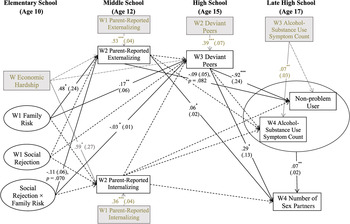
Figure 3 shows the results of our SEM model based on parent-reported internalizing and externalizing symptoms (see online-only supplementary materials). The findings were mostly consistent with those based on the youth-reported internalizing and externalizing model. The main effect of W1 family risk on W2 parent-reported externalizing was significant. The moderation effect of W1 Family Risk × W1 Social Rejection on W2 parent-reported externalizing was marginally significant. W1 social rejection was not significantly associated with W2 parent-reported externalizing at low (1 SD below the mean), mean, or high (1 SD above the mean) levels of W1 family risk. The relation between W1 family risk and W2 parent-reported externalizing tended to be positive, and this positive relationship was stronger at lower levels of W1 social rejection.
(Color online) Model based on parent-reported internalizing and externalizing symptoms. Unstandardized path coefficients are reported. Significant or trending paths are solid lines, and nonsignificant paths are dashed. *p < .05. **p < .01. ***p < .001.

The main effect of W1 family risk on W3 deviant peers was significant. In addition, the moderation effect of W1 Family Risk × W1 Social Rejection on W3 deviant peers was significant. The relationship between W1 family risk and W3 deviant peers tended to be positive, and the positive relation was stronger at lower levels of W1 social rejection. Although the relationship between W1 social rejection and W3 deviant peers was not significant at the mean or low levels of W1 family risk, the relationship became negative at higher levels of W1 family risk.
For the zero-inflated Poisson model of W4 alcohol and substance use problems, higher W2 parent-reported externalizing symptoms was associated with lower odds of being a nonproblem user, B = −0.09 (0.05), p = .082; OR = 0.91; higher W3 deviant peers was associated with lower odds of being a nonproblem user, B = −0.92 (0.24), p < .001; OR = 0.40. The Poisson model of W4 number of sex partners revealed positive relationships between W2 parent-reported externalizing and W4 number of sex partners, between W3 deviant peers and W4 number of sex partners, and between W4 alcohol and substance use problems and W4 number of sex partners.
Moderation of the cascading paths by youth gender
Model based on youth-reported internalizing and externalizing
We assessed the extent to which the cascading model based on youth-reported internalizing and externalizing was equivalent across youth gender. Multivariate Wald test showed the hypothesized cascading paths were significantly different across youths’ gender, χ2 (21) = 41.01, p <.01. As a result, we investigated which cascading path(s) in the model were different across gender, focusing on paths that were significant (or trending) in at least one gender group. Wald tests for the equality of paths across gender groups revealed one path that was different: W4 alcohol–substance use symptoms → W4 number of sex partners, Wald χ2(1) = 6.96, p = .008. Multivariate Wald test showed that the rest of the cascading paths in Figure 2 were not significantly different across youths’ gender, χ2(20) = 19.88, p = .47. Retaining the invariant paths to be the same while freely estimating this path that was different across youth gender, we found the positive relation between W4 alcohol–substance use symptoms and W4 number of sex partners was stronger for females, B = 0.17 (0.04), p < .001, than for males, B = 0.04 (0.02), p < .05.
Model based on parent-reported internalizing and externalizing
We assessed the extent to which the cascading model based on parent-reported internalizing and externalizing was equivalent across youth gender. Multivariate Wald test showed the hypothesized cascading paths were significantly different across youths’ gender, χ2(21) = 54.15, p <.001. As a result, we investigated which cascading path(s) in the model were different across gender, focusing on paths that were significant (or trending) in at least one gender group. Wald tests for the equality of paths across gender groups revealed one path that was different: W2 parent-reported externalizing symptoms → W4 alcohol–substance use symptoms, Wald χ2(1) = 16.74, p <.001. Multivariate Wald test showed that the rest of the cascading paths were still significantly different across youths’ gender, χ2(20) = 31.87, p = .045. However, none of the other cascading paths were significantly different across youths’ gender. Retaining the invariant paths to be the same across youths’ gender while freely estimating the path from W2 parent-reported externalizing to W4 alcohol–substance use symptoms in each gender group, we found that there was a positive relation between W2 parent-reported externalizing and W4 alcohol–substance use symptoms for females, B = 0.19 (0.03), p < .001, but not for males.
Moderation of the cascading paths by youth nativity
Model based on youth-reported internalizing and externalizing
We assessed the extent to which the cascading model based on youth-reported internalizing and externalizing was equivalent across youth nativity. Multivariate Wald test showed that the hypothesized cascading paths were not significantly different across youths’ nativity, χ2(21) = 28.95, p = .12.
Model based on parent-reported internalizing and externalizing
We assessed the extent to which the cascading model based on parent-reported internalizing and externalizing was equivalent across youth nativity. Multivariate Wald test showed that the hypothesized cascading paths were not significantly different across youths’ nativity, χ2(21) = 26.99, p = .17.
Moderation effect of youth-reported MACV
We examined the moderation effects of W2 youth-reported MACV on the relations between W2 youth-reported or parent-reported internalizing and externalizing and downstream variables (W3 deviant peers, W4 alcohol–substance use symptom count, W4 nonproblem use of alcohol and substances, and W4 number of sex partners).
Model based on youth-reported internalizing and externalizing
The interaction between W2 MACVS and W2 youth-reported externalizing was a significant predictor of W3 deviant peers, B = 0.04 (0.02), p < .05. There was a significant positive relation between W2 youth-reported externalizing and W3 deviant peers at a high level (1 SD above the mean) of W2 MACV, but not at a low (1 SD below the mean) or mean level of W2 MACV. None of the other interaction effects between W2 MACV and W2 youth-reported internalizing or externalizing significantly predicted any other downstream outcome.
Model based on parent-reported internalizing and externalizing
The interaction between W2 MACV and W2 parent-reported externalizing was a significant predictor of W4 alcohol–substance use symptom counts among the problematic users, B = 0.18 (0.09), p < .05. There was a significant positive relation between W2 parent-reported externalizing and W4 alcohol–substance use symptoms at a high level (1 SD above the mean) of W2 MACV, a trending positive relation at the mean of W2 MACV, but no association at a low (1 SD below the mean) level of W2 MACV. None of the other interaction effects between W2 MACV and W2 parent-reported internalizing or externalizing significantly predicted any other downstream outcome.
Moderation effect of youth-reported MCV
We examined the moderation effects of W2 youth-reported MCV on the relations between W2 youth-reported or parent-reported internalizing and externalizing and downstream outcome variables (W3 deviant peers, W4 alcohol–substance use symptom count, W4 nonproblem use of alcohol and substances, and W4 number of sex partners).
Model based on youth-reported internalizing and externalizing
None of the interaction effects between W2 MCV and W2 youth-reported internalizing or externalizing was significantly predicting any downstream outcome.
Model based on parent-reported internalizing and externalizing
The interaction between W2 MCV and W2 parent-reported internalizing was a significant predictor of W4 alcohol–substance use symptoms among the problematic users, B = −0.10 (0.03), p < .001. The relation between W2 parent-reported internalizing and W4 alcohol–substance use symptoms (among the problematic users) was positive and significant at a low level (1 SD below the mean) of W2 MCV, but trending negative at a high level (1 SD above the mean) of W2 MCV. The interaction between W2 MCV and W2 parent-reported externalizing was a significant predictor of W4 number of sex partners, B = −0.10 (0.03), p < .01. The positive relation between W2 parent-reported externalizing and W4 number of sex partners was stronger at lower levels of W2 MCV. None of the other interaction effects between W2 MCV and W2 parent-reported internalizing or externalizing was significantly predicting any other downstream outcome.
Discussion
This study of US Mexican origin youths examined developmental cascades linking hostile and rejecting family and peer contexts in childhood to a sequence of unfolding problems involving externalizing and internalizing symptoms, deviant peers, and risky substance use and sexual behavior in adolescence. Findings supported several hypothesized cascades, confirming that risky family contexts and peer social rejection are significant precursors to compromised psychological functioning in early adolescence, and that externalizing and internalizing problems each play a unique role as pathways to later risk taking in middle to late adolescence. The strength of several findings varied when examined with parent versus youth report of internalizing and externalizing symptoms, yet the pattern of findings replicated in most cases. Several cascades from psychopathology to later risk taking were moderated by youth gender or cultural orientation (MACV and MCV), but not by youth nativity.
Results supported our hypothesis that risky family and peer contexts in childhood would combine to predict problem behaviors in middle school. The interaction between family risk and peer social rejection was a significant predictor of externalizing symptoms in the model based on youth report of externalizing. Peer social rejection generally had more powerful effects in the prediction of youth- versus parent-reported externalizing, perhaps because parents are less likely to directly observe problem behaviors prompted by difficulties in the peer context. However, while peer social rejection had significant effects on youth-reported externalizing at lower levels of family risk, peer social rejection was unrelated to later externalizing for youth reporting high levels of family risk. This is because youths in risky families (+1 SD) generally reported more externalizing symptoms regardless of the peer context. In contrast, family risk had more powerful and significant, unique effects on parent report of youth externalizing, perhaps because youth in hostile and rejecting families are especially likely to display aggressive, oppositional behavior when interacting with parents (Patterson et al., Reference Patterson, Reid and Dishion1992). Although the Family × Peer interaction was marginal in the parent-report model, the influence of family risk attenuated and became nonsignificant at high levels (+1 SD) of peer social rejection.
Across both models, risky family contexts showed robust, unique effects to predict increased involvement with deviant peers as adolescents moved from middle to high school, independent of earlier externalizing psychopathology. However, in addition to these significant main effects, the Family Risk × Peer Social Rejection interaction predicted deviant peer involvement in the parent-report model and marginally predicted deviant peer involvement in the youth-report model. In both models, and similar to effects on externalizing, the negative effects of family risk attenuated at higher levels of peer rejection. Altogether, these findings illustrate the importance of examining family–peer interplay in ecological models of risk. However, the pattern of this interplay was not consistent with a cumulative risk interpretation (i.e., Rutter, Reference Rutter1979). Instead, findings showed family and peer risk were each important, but they did not always work in tandem. Rather, vulnerability for externalizing increased when either or both were elevated.
The results did not support family–peer interplay in the prediction of internalizing symptoms. Instead, peer social rejection uniquely predicted internalizing symptoms in middle school, but only in the model with youth-reported internalizing symptoms Family risk was unrelated to internalizing in both models. These findings are consistent with prior research showing peer rejection is increasingly negative consequences on internalizing symptoms, such as depression, in adolescence (Larson & Ham, Reference Larson and Ham1993; Masten & Cicchetti, Reference Masten and Cicchetti2010; Nolan et al., Reference Nolan, Flynn and Garber2003; Rudolph & Hammen, Reference Rudolph and Hammen1999; Schwartz et al., Reference Schwartz, Unger, Baezconde-Garbanati, Zamboanga, Lorenzo-Blanco, Des Rosiers and Szapocznik2015). In the current study, perceptions of peer-related conflict and victimization, relational aggression, and ethnic discrimination combined to form a latent construct that predicted youth-reported but not parent-reported internalizing symptoms. Although this finding did not replicate across reporters, evidence has shown that parents and youth have access to different samples of behaviors relevant to youth psychological and behavioral functioning and that each perspective is valid and meaningful (De Los Reyes et al., Reference De Los Reyes, Augenstein, Wang, Thomas, Drabick, Burgers and Rabinowitz2015). Evidence also indicates that self-reports of symptomatology become more important as youth spend more time outside the home, and when reporting on their own internal distress (Achenbach, McConaughy, & Howell, Reference Achenbach, McConaughy and Howell1987; De Los Reyes et al., Reference De Los Reyes, Augenstein, Wang, Thomas, Drabick, Burgers and Rabinowitz2015; Meyer et al., Reference Meyer, Finn, Eyde, Kay, Moreland, Dies and Reed2001).
Externalizing pathways and developmental cascades to risk taking
Study findings supported several expected linkages between externalizing and subsequent risk taking. Externalizing was consistently supported as a key pathway to problem alcohol–substance use and to the number of sex partners across both reporters of externalizing. Youth-reported externalizing predicted increased likelihood of being a problem alcohol and substance user and having a greater number of sex partners. Parent-reported externalizing predicted a greater number of sex partners and showed marginal effects to predict decreased likelihood of being a nonproblem substance user. Adolescents’ involvement with deviant peers predicted both the likelihood and the extent of problem substance use, as well as the number of sex partners. In addition, as expected, problem substance use and number of sexual partners were positively associated, adding to existing evidence that the presence and quantity of substance use over time, and at the time of sexual activity, increases the likelihood of having sexual intercourse and having more than one sexual partner. For example, in an African American and Latino sample, Bazargan-Hejazi, Gains, Bazargan, Seddighzadej, and Ahmadi (Reference Bazargan-Hejazi, Gains, Bazargan, Seddighzadeh and Ahmadi2012) found alcohol use before sex increases the number of sexual partners, but the magnitude of this effect is significantly increased among alcohol misusers.
Altogether, the multiple cascades found in the current study supported our central hypotheses, based in problem behavior theory, that problems such as deviant behavior, substance use, and risky sex are driven, in part, by common antecedents and developmental processes (Hawkins et al., Reference Hawkins, Catalano and Miller1992; Jessor & Jessor, Reference Jessor and Jessor1977). However, moderation analyses clarified that these paths were less explanatory for some youths. The prospective link between externalizing symptoms in middle school and number of sex partners in late high school was one of our most robust findings across reporter. Yet, in the parent-report model, the relation of parent-report externalizing with number of sex partners was only significant for females (not males) and was significantly stronger for youth reporting low mainstream values. Parent-reported externalizing predicted problem alcohol–substance use symptoms for youth reporting higher Mexican American values, but not for those low on Mexican American values. Youth-reported externalizing predicted increased deviant peer involvement only at higher levels of Mexican American values, and the link between substance use and number of sexual partners was significantly stronger for females than for males (yet significant for both).
Internalizing pathways and developmental cascades to risk taking
We found evidence that internalizing also contributes to later risk taking. In the youth-reported model, internalizing symptoms in middle school predicted problem alcohol and substance use symptom counts in late high school. In tests of moderation, we also found parent-reported internalizing predicted alcohol and substance use symptom counts for adolescents who endorsed low levels of MCV (–1 SD), but not at higher levels of mainstream values. These patterns conform with the perspective that some youth with elevated internalizing symptoms may turn to drugs and alcohol to cope with their symptoms (Hussong et al., Reference Hussong, Jones, Stein, Baucom and Boeding2011). Specifically, internalizing predicted increased alcohol–substance use symptom counts among youth with some probability of being a problem user (i.e., users and occasional users); internalizing was not predictive of whether youth were likely to be users or not. This is an important distinction that parallels other studies that have found internalizing may be more relevant in the etiology of alcohol and substance use problems that emerge in late adolescence and early adulthood, and not as a predictor of substance use onset for which externalizing may have greater relevance (Hussong, Curran, & Chassin, Reference Hussong, Curran and Chassin1998; King et al., Reference King, Iacono and McGue2004), as we also found. That internalizing was only related to alcohol–drug use symptoms, and not directly related to other aspects of risk taking (i.e., deviant peers) also indicates a more specific mechanisms may be at play in this association, including possible shared genetic risk (Zucker et al., Reference Zucker, Donovan, Masten, Mattson and Moss2009).
Although these findings provide relatively circumscribed support for internalizing paths to risk taking, they offer an important contribution to the literature. The role of internalizing on alcohol and substance use has remained unclear among both Caucasian and Latino adolescent populations (see Hussong et al., Reference Hussong, Jones, Stein, Baucom and Boeding2011). Extant studies have produced equivocal findings, likely due to a host of methodological factors, such as not controlling for prior substance use or co-occurring externalizing behavior. Thus, by using methods that addressed these prior limitations, this study provides strong, longitudinal evidence that internalizing predicted problematic alcohol and substance use for Mexican American adolescents.
Culture- and gender-specific pathways to risk taking
We extended our test of problem behavior theory and internalizing pathways by examining moderation of theorized paths by gender, nativity, and cultural orientation. Two paths were stronger for females than males (externalizing → number of sex partners, problem alcohol–substance use → number of sex partners), two were stronger for youth reporting more traditional Mexican American values (externalizing → deviant peers, externalizing → alcohol–substance use symptoms), and two were stronger for youth reporting weaker MCV (externalizing → number of sex partners, internalizing → alcohol–substance use symptoms).
However, the specific moderation effects were not as hypothesized. Because female, less acculturated, and more traditional youths have been shown in prior research to be less vulnerable to risk taking, we hypothesized developmental cascades would be weaker for these groups. We found the opposite effects, similar to Vaughan, Gassman, Jun, and Seitz de Martinez (Reference Vaughan, Gassman, Jun and Seitz de Martinez2015), who found Latina females had greater predicted probabilities than Latino males for alcohol use, binge drinking, and substance use problems across a range of risk and protective factors. Burnette et al. (Reference Burnette, Oshri, Lax, Richards and Ragbeer2012) also found early adolescent externalizing predicted rule-breaking behaviors in girls, but not boys, in late adolescence and explained that because rule breaking is gender atypical for girls, it may be more indicative of an underlying problem for girls than for boys. Research also has shown the disinhibiting effects of alcohol may have stronger associations with risky sex for girls because they are less likely than males to have sex with more than one partner; the less normative or sanctioned sexual intercourse is within a group, the stronger these effects are expected to be (Cavanagh, Reference Cavanagh2004). We found this effects as well. We only found gender differences in the prediction of sexual risk taking, possibly because prohibitions about sex are especially pronounced for Latina girls (Deardorff et al., Reference Deardorff, Tschann, Flores and Ozer2010; Raffaelli & Ontai, Reference Raffaelli and Ontai2004).
Similar arguments about differing norms may also apply to the moderation effects shown for youth cultural orientation. It is possible externalizing predicted deviant peers and alcohol–substance use only among traditionally oriented youth because risk taking is less normative and less compatible with the values of these youth (e.g., respect toward elders, religious values, and family obligations), and therefore less likely to occur in the absence of externalizing psychopathology. Likewise, risk-taking behaviors (i.e., deviant peer involvement and drinking) are more normative and prevalent in the lives of acculturated youth (Prado et al., Reference Prado, Huang, Maldonado-Molina, Bandiera, Schwartz, de la Vega and Pantin2010), potentially explaining why externalizing showed weaker relations with number of sex partners and internalizing was less predictive of alcohol–substance use among youth with stronger ties to MCV. While the pattern of these effects lends credence to this explanation, additional cultural explanations may also apply. For example, it is possible that other culturally linked processes not included in this study but shown to be important for Latinos, such as intergenerational–acculturative family conflicts or loss of protective cultural identity (Schwartz et al., Reference Schwartz, Unger, Rosiers, Huang, Baezconde-Garbanati, Lorenzo-Blanco and Szapocznik2012; Unger, Reference Unger2014), may play a more salient etiological role for these youth.
Limitations, future directions, and implications
Although this study had several notable strengths, including a representative and diverse Mexican origin sample, culturally informed assessments of contextual risk, longitudinal data with excellent retention, and modern modeling approaches, there were several limitations. Because we used youth report to assess contextual adversity as well as risk taking, it is possible that some effects are inflated by shared method variance. To reduce such biases, we used both maternal and youth report to assess internalizing and externalizing symptoms, and we controlled for stability of youth symptoms and alcohol–substance use when estimating longitudinal effects. Nevertheless, such biases may still be a factor, particularly in the association between perceived peer rejection and internalizing symptoms. The design of the current study did not allow for a test of all possible cross-domain and cross-time reciprocal effects among our study variables (i.e., cross-lag models), as in traditional cascade models (e.g., Burt et al., Reference Burt, Obradović, Long and Masten2008). Rather, we examined a specific sequence of effects (Lynne-Landsman, Bradshaw, & Ialongo, Reference Lynne-Landsman, Bradshaw and Ialongo2010; Martel et al., Reference Martel, Pierce, Nigg, Jester, Adams, Puttler and Zucker2009; Sitnick et al., Reference Sitnick, Shaw and Hyde2014) to test externalizing and internalizing as intervening pathways from early adversity to later risk taking. Nevertheless, we cannot rule out that several variables in our model likely have recursive effects over time that were not tested. We also note that our measure of problem substance use based on the C-DISC-IV is not equivalent to the more widely used substance use items typically used for this age group. This should be considered when making comparisons to other studies. Finally, the study was limited to Mexican Americans in the Southwestern United States. Although this subgroup represents a large and growing demographic in the United States, findings cannot be generalized to other Latinos. Nor can we isolate whether effects are specific to our Mexican American sample. Nevertheless, our ethnic-homogenous design fills an important gap in research on developmental pathways to risk taking for a population that is now the single largest ethnic group in the United States (US Census Bureau, 2012).
Study results highlight that paths to risk taking are diverse and variable, and that future theory and research with Mexican Americans should account for both externalizing and internalizing paths and for gender and cultural orientation. Future studies also are needed to replicate and advance understanding of the internalizing path to alcohol and substance use among Mexican American and other Latinos, including studies that can tease out the specific dimensions of negative affect that account for these effects, and for which substances. Although our tests of moderation were conceptualized broadly, they offer guidance for future replication and extension. One potential avenue is to examine whether similar gender differences in the prediction of sexual risk taking are found in other populations or whether they arise from cultural factors specific to Mexican Americans (i.e., traditional gender roles). Our evidence of cultural moderation also merits extension, including more focused tests of specific mainstream and ethnic cultural dimensions and processes that alter developmental cascades. As well, future research that examines “bicultural” adaptation is needed, rather than focusing separately on ethnic and mainstream dimensions as distinct processes.
Despite these limitations, our findings have implications for programs and strategies to reduce several high-impact health consequences in adolescence (e.g., unplanned pregnancy, alcohol and drug abuse, STIs, and HIV). Specifically, they recommend a focus on the family as a key target to protect youth from problematic risk-taking behaviors in adolescence, including those that stem from prior psychological problems and from more normative risk taking with peers. Support also has been provided by efficacy trials of prevention programs that intervened to improve family relationships before or during middle school and demonstrated lasting effects to prevent multiple high-risk outcomes (Catalano, Hawkins, Berglund, Pollard, & Arthur, Reference Catalano, Hawkins, Berglund, Pollard and Arthur2002), including behavioral problems, substance use, and risky sex among Latino youths (Catalano et al., Reference Catalano, Hawkins, Berglund, Pollard and Arthur2002; Gonzales, Dumka, et al., Reference Gonzales, Dumka, Millsap, Gottschall, McClain, Wong and Kim2012; Pantin, Schwartz, Sullivan, Prado, & Szapocznik, Reference Pantin, Schwartz, Sullivan, Prado and Szapocznik2004). Findings here illustrate how effects from these programs may unfold over time to produce such broad, long-term benefits.
Study findings also highlight gaps in culturally adapted programs that have yet to address contextual threats outside the family context, such as difficulties in peer relations. Accumulating evidence suggests that peer social rejection and particularly ethnic and racial discrimination are pervasive in the lives, and Latinos and have lasting effects on development, even in the context of well-functioning (low-risk) families. Yet few interventions include strategies to specifically address these pervasive threats. Greater sensitivity to gender-specific paths, such as the stronger link between alcohol–drugs and sex for girls, are also important new directions for broadening prevention models. Although Latina females are often considered at low risk for drug and alcohol use, prevalence is increasing due to changing cultural norms (Johnston, O'Malley, Bachman, & Schulenberg, Reference Johnston, O'Malley, Bachman and Schulenberg2011). The prevalence of alcohol and drug use before sex also is increasing among high school students (Centers for Disease Control and Prevention, 2010). Thus, strategies focused on health sexual lifestyles, and the risks of combining sex with alcohol and drugs, are important avenues for prevention and health promotion.
Supplementary Materials
To view the supplementary material for this article, please visit https://doi.org/10.1017/S0954579417000323.