


Introduction
The term Computer-Mediated Communication (CMC) has been widely used since the 1990s to refer to a wide range of computer technology that facilitates human communication through the Internet, and applied linguists are increasingly concerning themselves with the influence of computer networks on language use (Crystal, Reference Crystal2006; Hassan & Hashim, Reference Hassan and Hashim2009; Lewin & Donner, Reference Lewin and Donner2002). In the English as a foreign language (EFL) context, text-based CMC has been widely adopted as a learning tool as it provides learners with authentic input, as well as opportunities to communicate with native speakers of English and to participate in the target social and cultural contexts (Liaw & Master, Reference Liaw and Master2010; Lin, Reference Lin2015; Sasaki, Reference Sasaki2010).
While there is a burgeoning field of studies looking at language development in CMC, particularly in the development of vocabulary and lexical richness, little is known about language acquisition as evidenced by developmental use of multi-word sequences (e.g. I don't know, a lot of), which play a prominent role in language learning and language use, as has been demonstrated in a wide range of studies (e.g. Biber, Reference Biber2009; Ellis et al., Reference Ellis, Simpson-Vlach and Maynard2008; Qi & Ding, Reference Qi and Ding2011; Wray, Reference Wray2002). Biber (Reference Biber2009) notes that multi-word sequences are ‘important building blocks in discourse,’ providing ‘a kind of pragmatic ‘head’ for larger phrases and clauses, where they function as discourse frames for the expression of new information’ (pp. 284–85). Shin and Nation (Reference Shin and Nation2008) also state that multi-word formulaic expressions ‘enable learners to reduce cognitive effort, save processing time, and have language available for immediate use’ (p. 340). Given that multi-word sequences have a crucial part to play in language use and learning, it is reasonable to propose that assessing the development of multi-word sequences would provide another way of assessing the success of CMC as a language learning method.
Multi-word sequences and language use
Research demonstrates that natural language contains a considerable number of recurrent formulaic patterns of language use (Biber et al., Reference Biber, Johansson, Leech, Conrad and Finegan1999; Ellis et al., Reference Ellis, Simpson-Vlach and Maynard2008; Nation & Webb, Reference Nation and Webb2011; O'Keeffe et al., Reference O'Keeffe, McCarthy and Carter2007). This suggests that words have a strong tendency to co-occur in extended phraseological units. Despite the fact that a wide range of technical terms are used to describe the phrasal nature of language, including prefabricated patterns, routine formulae, lexical phrases, lexical bundles, chunks, clusters, multi-word units, formulaic sequences, and so on, they all indicate an observable tendency for particular items to co-occur in the written and spoken discourse of both native and non-native speakers of English, and for these co-occurrences to make up an appreciable proportion of attested language use.
In this paper, multi-word sequence is used as an umbrella term to cover all types of recurrent sequences of words, that is, ‘frequently occurring contiguous words that constitute a phrase or a pattern of use’ (Greaves & Warren, Reference Greaves, Warren, McCarthy and O'Keeffe2010: 213). In this regard, a multi-word sequence does not necessarily have to be a complete grammatical structure or idiom. This definition is similar to Biber et al.'s (1999) definition of lexical bundles as ‘recurrent expressions, regardless of their idiomaticity, and regardless of their structural status. That is, lexical bundles are simply sequences of word forms that commonly go together in discourse’ (p. 990).
While different approaches have been employed in the analysis of multi-word sequences, there seems to be a paucity in the research area of acquisition by EFL learners. Adolphs and Durow (Reference Adolphs, Durow and Schmitt2004) conducted a longitudinal case study of two EFL postgraduates’ improvement in their use of three-word sequences in spoken English, showing that the level of social integration into the native speaker community has an impact on the acquisition of multi-word units in language use. Li and Schmitt (Reference Li and Schmitt2009) investigated collocation use in academic writing in a longitudinal learner corpus to identify the learners’ improvement over the course of one academic year. Qi and Ding (Reference Qi and Ding2011) analysed the use of sequences by 56 Chinese university English majors in their prepared monologues at the beginning and end of a three-year period and compared the student performance with that of 15 American college students. The most challenging area for the Chinese English majors to tackle was the use of sequences containing prepositions and articles.
Although a number of studies have demonstrated developmental changes in the use of multi-word sequences using a longitudinal approach (e.g. Adolphs & Durow, Reference Adolphs, Durow and Schmitt2004; Crossley & Salsbury, Reference Crossley and Salsbury2011; Qi & Ding, Reference Qi and Ding2011), the majority have focused on advanced, mature EFL/ESL learners; that is, young learners of English at a beginner-intermediate level do not seem to be a group upon whom focus has been concentrated. This study therefore attempts to answer the following central research question:
To what extent does intercultural contact with native English speakers facilitate the development of multi-word sequences by adolescent Taiwanese learners in a one-year online exchange?
The present study
The participants recruited for the study were 10 learners of English from Taiwan and 10 native English-speaking students from the UK. All of them were between 14 and 15 years of age and participated in the intercultural exchange project. Most of the Taiwanese participants were at a beginner-intermediate level (CEFR level A2), having learned English for on average six to seven years. The project lasted 12 months, during which time the participants interacted with one another on an electronic discussion board. They were asked to participate in online discussion at least twice a week. Such regular correspondence between participants is fairly important since personal relationship building in CMC settings mainly relies on consistent interaction. In this setting, English was used as the major language of communication, and the students had the choice to create any topics they felt interested in or respond to any topics created by other participants on the website.
The data were collected from messages posted on the electronic discussion board in the project, including a total of 1,942 messages, comprising 49,646 words, posted by the Taiwan participants (23,413 words) and the British participants (26,233 words). The messages were further divided into four data subsets according to the time of posting, resulting in four three-month phases. Since the participants recruited in the study were under 18 years old, consent was acquired from all of the participants’ parents before the study commenced. Participants were guaranteed anonymity in all communication and correspondence relating to the study.
Data analysis
Three-word sequences
This paper focuses particularly on three-word sequences (e.g. I don't know, I would like). The unit of three words per sequence was chosen because three-word units are embedded with sufficient contextual information regarding functional language use, as has been shown in previous studies (e.g. Adolphs & Durow, Reference Adolphs, Durow and Schmitt2004; Lin, Reference Lin and Romero-Trillo2013). Empirical research also shows that the majority of high-frequency core phrases in written discourse are three-word phrases (Simpson-Vlach & Ellis, Reference Simpson-Vlach and Ellis2010). These three-word phases often form the basis of the larger sequences of four or more words and may be acquired or processed as parts as well as wholes (Conklin & Schmitt, Reference Conklin and Schmitt2008). In addition, three-word sequences are analytically more manageable: analysing two-word sequences (e.g. of the, to be) would include too many phrasal verbs and grammatical colligations, while considering a larger unit in the sequence (e.g. at the end of the) would reveal too few examples.
The keyness approach: Analysing key sequences
With a view to examining the development of three-word sequences during the online interaction, the items frequently used by Taiwanese participants were analysed to examine their approximation to those sequences used by native English-speaking participants. In doing so, this study employed a corpus linguistic approach using Wordsmith Tools 5.0 (Scott, Reference Scott2008) to identify the key sequences, which refer to those sequences that occur unusually frequently or unusually infrequently in a text as compared with some kind of reference corpus (O'Keeffe et al., Reference O'Keeffe, McCarthy and Carter2007; Scott, Reference Scott, McCarthy and O'Keeffe2010). The procedure works by comparing the observed frequency of each three-word sequence in the target corpus with its equivalent in the reference corpus. For this study, the Taiwanese and British participant datasets were set as the target and reference corpus respectively, working on the basis of the relative frequencies of each three-word sequence in the two datasets and further identifying the sequences with significant unusual frequencies in the Taiwanese participants’ discourse; accordingly, the key sequences are generated and ranked by keyness, which the software calculates by applying the log likelihood (LL) test of statistical significance to the difference between the target and reference corpus frequencies for each item.
Although previous studies have extensively employed keyword analysis in the investigation of different contexts of language use (e.g. Baker, Reference Baker2006; Bondi & Scott, Reference Bondi and Scott2010; Harvey, Reference Harvey2012), few, if any, have applied this method for understanding language development online. This present study thus intends to demonstrate the merit of keyness analysis as a tool for examining the level of approximation with regard to the use of three-word sequences by Taiwanese and British participants.
Findings & Discussion
Key three-word sequences
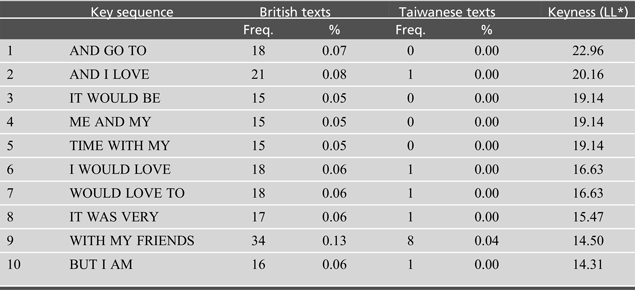
Using the Keyword function of Wordsmith Tools 5.0, for p < .01, the cut-off LL value of 6.64 reveals 73 unusually infrequent three-word sequences used by Taiwanese learners, as compared with British participants’ discourse. Table 1 illustrates the items that were commonly used by the British participants. As can be seen, most of these were not used by the Taiwanese learners. In this list, it can be noted that the three-word sequences based on the coordinating conjunction and, such as and go to, and I love and me and my, occurred in the native speakers’ discourse frequently, while no instances of these three sequences can be found in the Taiwanese pupils’ discourse. Also, the sequences with the modal would, such as I would love, would love to and it would be commonly used by natives are not found in the Taiwanese learners’ texts either. A further investigation of the context indicates the high frequency with which modal would was used by British students to respond to requests in online communication, as these are generally perceived as more polite and less forceful.
List of underused three-word sequences in the Taiwanese datasetc

*LL > 10.83 indicates p < .001.
Decline of key sequences over time
Table 2 presents the number and percentage of three-word key sequences that were identified based on each phase of Taiwanese discourse in comparison with the sequences used by British participants. For p < .01 with 1 d.f., 6.63 as the cut-off of LL value, 76 (15.51%) and 65 (13.10%) items were identified as key out of the total 490 and 496 sequences for Phase 1 and 2 respectively. This figure then dramatically decreases to 32 (4.87%) in the last phase of the programme. This continuous decline in the number and percentage of key sequences indicates that the Taiwanese participants gradually used fewer three-word sequences that are identified as statistically significantly different relative to those used by the British participants.
Number and percentage of key sequences in Taiwanese dataset

The decline of key sequences shows an increasing convergence between the use of three-word units by Taiwanese and British native speakers of English. This confirms previous findings (Adolphs & Durow, Reference Adolphs, Durow and Schmitt2004; Crossley & Salsbury, Reference Crossley and Salsbury2011; Qi & Ding, Reference Qi and Ding2011) that intercultural contact with native speakers of English fosters the longitudinal development of the use of multi-word sequences, and this also contributes additional evidence that online interaction can achieve such positive results even with adolescent EFL learners at a beginner level. The method here, which focuses on naturally occurring language output online, diminishes the effects of the artificial contexts often created in language testing settings.
While the findings indicate that online exchanges with native speakers show an increase of approximation with the British participants in terms of the use of multi-word sequences, other factors influencing such approximation also need to be considered. First, the decrease of key sequences over time may be associated with the topic shifts; that is, the participants initially talked more about their own cultures and the differences between them (e.g. the different food cultures), but as time went on they discussed shared topics in order to build friendships and maintain relationships. Another possible reason for the approximation between the two groups can be attributed to the fact that some correspondence extracts show Taiwanese learners occasionally imitated British native speakers, in which case the learner may have control of part of the holistic or the componential meaning (Wray, Reference Wray2002). Crystal (Reference Crystal2006) also observes that in online communities, although members come from different backgrounds and write in different styles, they tend to accommodate each other, and as such their contributions progressively develop a shared linguistic style.
Another issue that needs to be stressed in this discussion is that there is debate as to whether native-speaker models are the most appropriate basis for language learners. From the perspective of World Englishes or English as a Lingua Franca (ELF) (e.g. Jenkins, Reference Jenkins2009; Rajagopalan, Reference Rajagopalan2004), learners who use specifically native-speaker norms may well risk adopting a false identity. Although there has been considerable debate on this issue in EFL contexts, learners still need models of some kind as a point of reference, particularly novice learners (Cullen & Kuo, Reference Cullen and Kuo2007; Lin, Reference Lin2015). Research on students’ perspectives shows that learners across a diverse range of countries and contexts of language use regard the approximation to native-speaker English as a main goal in the language learning process (e.g. Timmis, Reference Timmis2012). This notwithstanding, I would argue that raising EFL learners’ awareness of the multi-word units commonly used by native speakers of English does not necessarily mean training our learners to be like them. The aim is to make learners aware of how human beings interact with each other and how they create and sustain successful interactions. To that end, those sequences that commonly occurred in authentic communication are crucial for language learning, and it is upon those language patterns that we should focus in EFL pedagogy.
Conclusions
This paper has examined the extent to which online contact with native English speakers facilitates the use of multi-word sequences by adolescent Taiwanese learners in a one-year online exchange programme. The study considered the key sequences used by the Taiwanese and British students over the course of the programme. There was a continuous decline in the number and percentage of sequences that the Taiwanese participants used significantly differently from those used by the British participants. These results therefore showed an increasingly close approximation by Taiwanese participants to the use of three-word sequences by British participants. Although this approach did not measure the appropriateness or correctness of recurrent multi-word sequences used by Taiwanese participants, it showed that exposure to native English-speaking participants through online communication significantly increased the approximation of Taiwanese participants’ use of three-word sequences to that of native speakers of English. The research findings also demonstrate the merit of key sequence analysis, in that striking differences in the use of multi-word sequences between Taiwanese and British participants were found, and could be a stepping-stone to further pedagogical applications.
Although this study sheds light on the acquisition of multi-word sequences in online intercultural communication by adolescent learners, there remain a number of caveats to be noted. Firstly, due to the small size of the datasets, the results cannot be generalisable until they have been replicated on a larger sample of data. This notwithstanding, this study has shown how corpus-based techniques can be used to assess some aspects of the development of multi-word sequences. The size and composition of the specialised corpus also makes it more manageable for qualitative studies and permits a closer link between the corpus and the contexts of its data. Secondly, although a longitudinal approach is employed in the study involving a one-year online communication programme, a richer and longer-spanning longitudinal corpus would be more valuable to trace evidence for the long-term impact of the use of multi-word sequences (Ortega & Iberri-Shea, Reference Ortega and Iberri-Shea2005). Moreover, future research may also analyse the individual differences among participants, and a larger unit (i.e. four or more words in the sequence) could also be considered. While some possible limitations are recognised, this study nevertheless illuminates important developmental aspects of three-word sequences in an intercultural setting, and also has pedagogical merit in providing EFL learners with authentic socio-cultural context in which the target language is used.
 YEN-LIANG LIN is currently an Assistant Professor in the Department of English at National Taipei University of Technology, Taiwan. He received his Ph.D. in Applied Linguistics in 2013 from the University of Nottingham, UK. He has taught EFL at secondary and university levels for more than 10 years. His research interests include corpus linguistics, speech and gesture, intercultural interaction, computer-mediated communication and language teaching methodology. Email: ericlin@ntut.edu.tw