Introduction
Given the occurrence of a broad range of physical, cognitive, emotional, and social changes (Garber et al., Reference Garber, Keiley and Martin2002), the transition from childhood to adolescence may represent a critical developmental period for increased and co-occurring internalizing and externalizing problems (Caspi & Moffitt, Reference Caspi and Moffitt2018; Georgiou & Symeou, Reference Georgiou and Symeou2018). Moreover, the experiences of internalizing and externalizing problems during childhood and adolescence are each associated with various psychiatric and conduct disorders (e.g., Nivard et al., Reference Nivard, Lubke, Dolan, Evans, St. Pourcain, Munafo and Middeldorp2017) and predict persistent life-course sequelae, including substance abuse, educational underachievement, poor interpersonal functioning, and ongoing mental health difficulties (e.g., Achenbach et al., Reference Achenbach, Ivanova, Rescorla, Turner and Althoff2016; Oland & Shaw, Reference Oland and Shaw2005).
Based upon a developmental psychopathology perspective (Cicchetti et al., Reference Cicchetti, Rogosch and Toth1994) and previous longitudinal studies, internalizing and externalizing problems in childhood and adolescence may show different co-developmental patterns, exhibiting individual differences in both the initial levels (e.g., high/moderate/low) and further developmental patterns (e.g., increasing or decreasing and pure or co-occurring) over time (e.g., Shi et al., Reference Shi, Ettekal, Deutz and Woltering2020). Moreover, the existing evidence suggests that there are significant gender differences in the development of internalizing and externalizing problems during childhood and adolescence (e.g., Hinnant & El-Sheikh, Reference Hinnant and El-Sheikh2013). However, there are limits to our knowledge about gender-specific co-developmental trajectories of internalizing and externalizing problems, especially for youths in non-western contexts. Mapping differences in gender-specific trajectories from childhood to adolescence has important clinical implications for gender-specific prevention and treatment insight into the pathways leading to different subtypes of internalizing and externalizing problems. Furthermore, few studies have been conducted to identify key multisystemic predictors of the maladaptive developmental trajectories of internalizing and externalizing problems. The identification of robust predictors should facilitate a greater understanding of the development and maintenance of internalizing and externalizing problems and further inform effective monitoring, prevention, and intervention approaches for addressing internalizing and externalizing problems. Therefore, this study aimed to identify co-occurring patterns (i.e., heterogeneous developmental trajectories) of internalizing and externalizing problems in boys and girls separately and to investigate key environmental and individual predictors that differentiate the identified trajectories.
Developmental trajectories of internalizing and externalizing problems from middle childhood to early adolescence
Most investigations of the development of internalizing and externalizing problems have examined them as distinct processes, exploring the heterogeneity of their developmental trajectories separately (Fanti & Henrich, Reference Fanti and Henrich2010; Hauser-Cram & Woodman, Reference Hauser-Cram and Woodman2016; Nivard et al., Reference Nivard, Lubke, Dolan, Evans, St. Pourcain, Munafo and Middeldorp2017; Papachristou & Flouri, Reference Papachristou and Flouri2019; See Table S1 in the supplementary materials for a summary of the details of these studies). The general psychopathology model (Caspi et al., Reference Caspi, Houts, Belsky, Goldman-Mellor, Harrington, Israel, Meier, Ramrakha, Shalev, Poulton and Moffitt2014; Caspi & Moffitt, Reference Caspi and Moffitt2018), directional model (Lee & Bukowski, Reference Lee and Bukowski2012) and reciprocal model (Keiley et al., Reference Keiley, Bates, Dodge and Pettit2000) have all suggested the importance of considering internalizing and externalizing problems together, not separately. The general psychopathology model assumes that both internalizing and externalizing problems share a generalized underlying vulnerability etiology (i.e., common syndrome explanation) in which symptoms of distinct problematic behaviors are, in part, explained by one general psychopathology factor (p-factor) that reflects common features across all forms of psychopathology (Caspi & Moffitt, Reference Caspi and Moffitt2018). Conceptually, like the g-factor of intelligence in cognitive studies, the p-factor assumes that symptoms are influenced by a common etiology, which can “measure a person’s liability to mental disorder, co-morbidity among disorders, the persistence of disorders over time, and severity of symptoms” (Caspi & Moffitt, Reference Caspi and Moffitt2018). Thus, co-occurrence could be indicative of a general psychopathology factor (p-factor) characterized by the manifestation of both internalizing and externalizing symptoms (e.g., Deutz et al., Reference Deutz, Shi, Vossen, Huijding, Prinzie, Dekovic, van Baar and Woltering2018). Additionally, the directional model (Capaldi, Reference Capaldi1992) highlights that internalizing and externalizing problems often do not develop in isolation, rather they usually develop through the causal/directional influences of the sources. This process involves developmental cascading, which refers to situations in which changes in one problem area trigger a series of events that affect another problem area in a lasting way (Moilanen et al., Reference Moilanen, Shaw and Maxwell2010). The reciprocal model also assumes that internalizing and externalizing problems may be reciprocally related to each other, that is, changes in one are often associated with changes in the other (Gilliom & Shaw, Reference Gilliom and Shaw2004; Measelle et al., Reference Measelle, Stice and Hogansen2006). These multiple theoretical perspectives on psychopathology also emphasize the importance of considering the co-occurrence of problem behaviors, proposing that internalizing and externalizing behaviors often develop in conjunction with one another (e.g., Caspi & Moffitt, Reference Caspi and Moffitt2018).
A few empirical studies have examined the co-developmental trajectories of internalizing and externalizing problems among children and adolescents using person-centered methods (Duprey et al., Reference Duprey, Oshri and Liu2020; Hinnant & El-Sheikh, Reference Hinnant and El-Sheikh2013; Shi et al., Reference Shi, Ettekal, Deutz and Woltering2020; Shi & Ettekal Reference Shi and Ettekal2021; Wiggins et al., Reference Wiggins, Mitchell, Hyde and Monk2015; Wu et al., Reference Wu, Hsieh, Chang, Lin and Buu2020; also see Table S1 in the supplementary materials). In contrast to the more frequently used variable-centered methods that assume a common association between the variables of interest and time for all individuals, the use of person-centered methodology is important because it allows the identification of meaningful subgroups of youth with respect to the variables of relevance. All of these studies have identified a congruent-low level group of youth characterized by initially low, stable/declining levels of internalizing problems and externalizing problems. Moreover, a co-occurring group characterized by either moderate/high stability for both internalizing and externalizing problems, or a parallel developmental pattern (e.g., internalizing and externalizing problems are both increasing or decreasing) has been shown in most studies. These findings provide support for a general psychopathology factor, indicating a shared commonality between internalizing and externalizing problems. These two classes (i.e., congruent-low and co-occurring groups of internalizing and externalizing problems) have been identified, despite some variations, in studies that have examined distinct developmental periods (Duprey et al., Reference Duprey, Oshri and Liu2020; Shi et al., Reference Shi, Ettekal, Deutz and Woltering2020; Shi & Ettekal, Reference Shi and Ettekal2021; Wu et al., Reference Wu, Hsieh, Chang, Lin and Buu2020). In addition to these co-occurring groups, classes of youth reporting pure externalizing or internalizing problems trajectories have also been identified. For instance, high-internalizing and low-externalizing problems (Wu et al., Reference Wu, Hsieh, Chang, Lin and Buu2020) and high-externalizing and low-internalizing problems classes (Duprey et al., Reference Duprey, Oshri and Liu2020; Shi et al., Reference Shi, Ettekal, Deutz and Woltering2020; Shi & Ettekal, Reference Shi and Ettekal2021; Wu et al., Reference Wu, Hsieh, Chang, Lin and Buu2020) have been identified in studies encompassing the childhood to adolescence time period. Taken together, prior research with children and adolescents indicates three or more subtypes or classes of developmental trajectories for internalizing and externalizing problems, with starting levels of low, medium, and high; however, inconsistencies have been observed in the specific developmental patterns of these trajectories. Notably, these studies did not consider gender differences in heterogeneous developmental trajectories.
Some studies have observed heterogeneity in the gender-specific developmental trajectories of internalizing problems among children and adolescents. For example, a study exploring the gender-specific developmental trajectories of internalizing problems in American children (i.e., from ages 2 to 11 years old) identified three latent trajectory classes for each gender: Elevated-stable (boys: 13%; girls: 21%), decreasing then increasing (boys: 22%; girls: 10%), and low-risk group (Sterba et al., Reference Sterba, Prinstein and Cox2007). In another study of American children from ages 3 to 14 years, four trajectories of internalizing problems were identified in boys and girls separately; specifically, the developmental trajectories of internalizing problems in boys displayed high (11.3%), increasing (17.1%), decreasing (12.6%) and low developmental patterns; girls’ developmental trajectories displayed high (6.5%), increasing (16.6%), moderate (21.7%) and low developmental patterns (Gutman & McMaster, Reference Gutman and McMaster2020). Furthermore, another study examining developmental trajectories of depressive symptoms in Chinese children (Grades 3, 4 at baseline), found that two trajectories were identified for boys: High (13.5%) and low whereas four trajectories were identified for girls: High (12.4%), increasing (9.8%), high-start (17.5%) and low (Zhong et al., Reference Zhong, Huebner and Tian2020).
Furthermore, studies have also explored the different developmental trajectories of externalizing problems in boys and girls separately. For example, a study of American children from ages 6 to 11 years examining aggressive-disruptive behavior trajectories by gender, revealed three developmental trajectories of aggressive-disruptive behavior in boys: Chronic high aggression-disruption (15%), increasing aggression-disruption (52%), and low aggression-disruption, and three development trajectories of aggressive-disruptive behavior in girls: Chronic high aggression-disruption (9%), low moderate aggression-disruption (67%), and low aggression-disruption (Schaeffer et al., Reference Schaeffer, Petras, Ialongo, Masyn, Hubbard, Poduska and Kellam2006). Another study reported four latent trajectory classes of delinquency in American adolescents (Grades 7 at baseline) in boys and girls separately: Chronic (boys: 21%; girls: 9%), increasing (boys: 41%; girls: 40%), desisting (boys: 16%; girls: 13%) and non-problem (Miller et al., Reference Miller, Malone and Dodge2010). Similarly, a study of American youth examining the developmental trajectories of aggression from late childhood through adolescence revealed four heterogeneous trajectories for each gender: High aggression (boys: 19%; girls: 10%), increasing (boys: 22%; girls: 21%), decreasing (boys: 21%; girls: 18%) and low aggression (Xie et al., Reference Xie, Drabick and Chen2011). Another study using a sample of German children and adolescents (aged 7–14 years) identified three different externalizing behavior trajectories for both boys and girls: High-decreasing (boys: 4.6%; girls: 1%), moderate (boys: 30.2%; girls: 18.4%) and low (Castelao & Kröner-Herwig, Reference Castelao and Kröner-Herwig2014).
To date, only two studies have examined gender-specific trajectories of internalizing and externalizing problems separately. One study followed 15-year-old American adolescents and identified four distinct developmental trajectories of depression problems among boys: High level (13.2%), medium level (51.2%), low level (31%) and rarely depressed; four distinct developmental trajectories of delinquency: High-level peakers (7.0%), medium level (17.3%), low level (37.8%) and rarely delinquents; for girls, three depression trajectory groups were identified: High level (26%), medium level (52.6%) and low level; three delinquency trajectory groups were identified: High-level peakers (20.3%), low level (38.1%), and rarely delinquents (Wiesner & Kim, Reference Wiesner and Kim2006). Another study examining the developmental trajectories of depressive symptoms and conduct problems in American students from Grades 6 to 9 found four distinct developmental trajectories of conduct problems for each gender: Started high decreasing (boys: 26%; girls: 9.1%), medium-high levels (boys: 17%; girls: 8.1%), medium levels (boys: 15.7%; girls: 14%), and lowest conduct problems. Four depressive symptom trajectory groups were identified in girls: High-decreasing (6.1%), low-increasing (5.4%), medium level (50.5%), and low; for boys: High (3.8%), increasing (10.6%), medium level (41.7%) and low (Chen & Simons-Morton, Reference Chen and Simons-Morton2009).
These studies of gender-specific developmental trajectories for internalizing or externalizing and internalizing and externalizing problems have all included high-, medium-, and low-risk groups for boys and girls. Nevertheless, these aforementioned studies are difficult to compare or aggregate, given their differences in the starting age and cultural backgrounds of the samples. In the studies examining the developmental trajectories for internalizing or externalizing problems during the period from middle childhood to early adolescence (close to the age range of the sample in our study), girls were more likely to demonstrate high stability or high-start trajectories of internalizing problems; and girls were also more likely to display increasing developmental patterns of internalizing problems (Zhong et al., Reference Zhong, Huebner and Tian2020). For externalizing problems, boys were more likely to exhibit high stable or increasing trajectories of externalizing problems. Although a small proportion of girls was identified with high stable or increasing trajectories of externalizing problems, most girls were more likely to exhibit moderate low or low stable trajectories of externalizing problems (Castelao & Kröner-Herwig, Reference Castelao and Kröner-Herwig2014; Schaeffer et al., Reference Schaeffer, Petras, Ialongo, Masyn, Hubbard, Poduska and Kellam2006; Xie et al., Reference Xie, Drabick and Chen2011).
Although the aforementioned studies provided important knowledge about gender-specific trajectories of internalizing and externalizing problems in children and adolescents, they nevertheless reflected some major limitations. First, past studies have not systematically explored patterns of co-occurring or joint developmental trajectories of internalizing and externalizing problems for different genders, ignoring the fact that internalizing and externalizing problems jointly change over time among boys and girls, respectively. Second, existing studies of the different developmental trajectories of internalizing and externalizing problems in children and adolescents have mostly been conducted with Western children. However, the educational philosophy of the Chinese culture is distinct from that of Western countries, placing more emphasis on the morality of benevolence, righteousness, and propriety; this emphasis holds harsher attitudes toward externalizing problems (Chen et al., Reference Chen, Zhang, Ji and Deater-Deckard2019). Traditional Chinese culture also shows a higher acceptance of harsh discipline practices (e.g., corporal punishment) because both Chinese parents and children tend to perceive harsh discipline as an indication of parental involvement, concern, and love, as indicated by a Chinese proverb, which states “Beating and scolding is the emblem of love” (e.g., Wang & Liu, Reference Wang and Liu2018). When Chinese children and adolescents exhibit externalizing problems, parents punish them severely. Thus, the Chinese culture is less tolerant of externalizing problems (Yang et al., Reference Yang, Jiang, Pan, Xu, Liang and Li2014). Moreover, Confucian teachings emphasize emotional restraint and submissiveness, which are more likely to lead to the development of internalizing problems (Yang et al., Reference Yang, Jiang, Pan, Xu, Liang and Li2014). Internalizing problems are difficult to detect in China because internalizing problems in Chinese youth have largely been neglected because appraisals and feelings about one’s accomplishments and life experiences reflect more on one’s family and community than the self in collectivistic cultures (e.g., Orth & Robins, Reference Orth and Robins2013). The prevalence of internalizing problems among Chinese youth has been increasing significantly during the past two decades due to a lack of systematic or widespread empirically informed prevention or intervention efforts (e.g., Ding et al., Reference Ding, Han, Zhang, Wang, Lei, Wang, Yang and Yu2017, for a meta-analysis). Studies of youth from China may thus yield different findings from studies in Western nations given cultural differences. Therefore, the purpose of this study was to examine and identify distinctive developmental pathways of co-occurring internalizing and externalizing problems across time for Chinese boys and girls from middle childhood to early adolescence, using a longitudinal design combined with a person-centered approach (i.e., parallel process latent class growth models (PP-LCGM)).
Environmental and individual predictors of internalizing and externalizing problems trajectories
The developmental psychopathology framework proposes that the emergence and development of maladjustment reflect the joint contributions of environmental predictors and individual characteristics (Rutter & Sroufe, Reference Rutter and Sroufe2000). Similarly, the multiple risk factor model (Atzaba-Poria et al., Reference Atzaba-Poria, Pike and Deater-Deckard2004; Greenberg et al., Reference Greenberg, Speltz, DeKlyen and Jones2001) also suggests that more severe and persistent forms of maladjustment are likely to be the result of multiple, co-occurring risk factors. Thus, it would be expected that children with chronic co-occurring problem behaviors are likely to exhibit a combination of early childhood risk factors across multiple domains (i.e., at the environmental and individual levels). Investigations of multisystemic risk factors that differentiate internalizing and externalizing problems trajectories should help identify which risk factors might serve as etiologic factors influencing adverse developmental patterns of internalizing and externalizing problems during childhood and adolescence. Such investigations should also contribute to the theoretical understanding of why children are at risk for manifesting different forms of internalizing and externalizing problems in childhood and adolescence, yielding implications for intervention and prevention efforts targeting the development of internalizing and externalizing problems.
Based on these theoretical models and previous empirical studies, this study selected key environmental (family, school) and individual risk predictors for the developmental trajectories of internalizing and externalizing problems in children and adolescents. Specifically, at the family level, child maltreatment as family-based adversity experienced by children refers to all types of abuse, neglect, or other exploitation by parents and caregivers causing an actual or potential detriment to the child’s complete health (World Health Organization, 2006). Child maltreatment progressively contributes to compromised adaptation in a number of developmental domains (Meng et al., Reference Meng, Fleury, Xiang, Li and D’arcy2018) and has been implicated as a significant risk factor for the development of internalizing and externalizing psychopathology (e.g., Godinet et al., Reference Godinet, Li and Berg2014; Oshri et al., Reference Oshri, Kogan, Kwon, Wickrama, Vanderbroek, Palmer and Mackillop2018). At the school level, teachers and peers represent the most prominent interpersonal relationships for children at school. Reformulations of attachment theory and other relationship-driven models (Hamre & Pianta, Reference Hamre and Pianta2001) have evaluated the premise that teacher-child relationships influence the development of children’s problem behaviors. Psychological maltreatment by teachers as negative school-based adversity has been associated with a variety of detrimental outcomes including internalizing and externalizing problems for the children and adolescents (see Fromuth et al., Reference Fromuth, Davis, Kelly and Wakefield2015, for a review). Moreover, peer victimization is defined as the harm that occurs to children caused by exposure to aggressive behavior from peers, which is one of the most common and worrisome adversities experienced by children (Salmivalli & Peets, Reference Salmivalli, Peets, Rubin, Bukowski and Laursen2008). Meta-analyses have documented significant links between peer victimization and subsequent internalizing and externalizing problems in children and adolescents (Reijntjes et al., Reference Reijntjes, Kamphuis, Prinzie and Telch2010, Reference Reijntjes, Kamphuis, Prinzie, Boelen, Van der Schoot and Telch2011).
At the individual level, the dual systems model posits that adolescent and young adult behavior is shaped by a developmental imbalance between two neurobiological systems. The first involves the socioemotional system, which is housed in the amygdala and ventral striatum regions of the brain and is responsible for generating responses to new experiences and rewards; the second system involves the cognitive control system, which is housed in the prefrontal cortex region of the brain and governs impulse control and decision making (Casey et al., Reference Casey, Jones and Hare2008; Steinberg et al., Reference Steinberg, Albert, Cauffman, Banich, Graham and Woolard2008; Steinberg, Reference Steinberg2010). Sensation-seeking belongs to the socioemotional system and is a personality trait characterized by strong and uncontrollable urges for novel, intense, and exciting experiences (e.g., Zuckerman & Aluja, Reference Zuckerman, Aluja, Boyle, Saklofske and Matthews2014). Several previous studies have examined the association between sensation-seeking and externalizing problems. For example, a meta-analysis provides support for the premise that high sensation-seeking is associated with externalizing problems (Wilson & Scarpa, Reference Wilson and Scarpa2011). Furthermore, in a longitudinal study, individual increases in sensation-seeking were associated with increases in delinquency from childhood to adolescence (Harden et al., Reference Harden, Quinn and Tucker-Drob2012). However, studies of the link between sensation-seeking and internalizing problems remain sparse. Self-control is categorized as a cognitive control system that refers to the capacity to override or alter unwanted behavioral responses and refrain from acting on them (Tangney et al., Reference Tangney, Baumeister and Boone2004). Ample cross-sectional and longitudinal research has shown that low self-control is a risk factor in the development of internalizing (e.g., DeWall et al., Reference DeWall, Gilman, Sharif, Carboni and Rice2012) and externalizing problems (e.g., Nijhof et al., Reference Nijhof, Te Brinke, Njardvik and Liber2021) over time.
In addition, family socioeconomic status (SES) and age have been demonstrated to influence children’s internalizing and externalizing problems (e.g., Wang & Liu, Reference Wang and Liu2021). Therefore, when examining the effects of environmental (e.g., child maltreatment, SES, psychological maltreatment by teachers, peer victimization) and individual (e.g., sensation-seeking, self-control) predictors, the effects of age and SES were controlled.
The present study
On the basis of the existing literature, it is crucial to investigate gender differences in the co-developmental patterns of internalizing and externalizing problems and the predictors related to the identified developmental trajectories, especially among non-Western children. This study thus addressed two major aims.
First, this study aimed to explore and describe the anticipated differing co-developmental trajectories of internalizing and externalizing problems in childhood and adolescence for Chinese boys and girls separately. Based on the majority of the existing findings related to adolescent and child samples, this study expected to identify several distinct trajectories varying in terms of the severity and stability of internalizing and externalizing problems for both boys and girls. Because of the exploratory nature of this analysis, no specific hypotheses were formulated regarding the number or shape of the co-developmental trajectories. In general, this study hypothesized that most of the boys and girls would be placed in trajectories reflecting no or few internalizing and externalizing problems. Based on Chinese culture and empirical findings, this study hypothesized that a trajectory with high internalizing problems would be identified for Chinese boys and girls separately. Moreover, according to the gender paradox of co-morbidity (Loeber & Keenan, Reference Loeber and Keenan1994), girls might be less likely than boys to have externalizing problems, but when they do, they might be more likely to be depressed and anxious (e.g., Zahn-Waxler et al., Reference Zahn-Waxler, Crick, Shirtcliff, Woods, Cicchetti and Cohen2006). Thus, girls might be more likely than boys to have internalizing problems co-occur with externalizing problems. Thus, this study hypothesized that a trajectory with a co-occurring group of internalizing and externalizing problems would be identified in girls.
Second, the present study aimed to identify key multisystemic predictors that differentiated membership in these groups of Chinese boys and girls. This study hypothesized that environmental (e.g., child maltreatment, psychological maltreatment by teachers, peer victimization) and individual (e.g., sensation-seeking and self-control) variables would predict the likelihood of being in the adverse trajectories of internalizing and externalizing problems in boys and girls separately. Specifically, more severe child maltreatment, psychological maltreatment by teachers, peer victimization experiences, higher sensation-seeking and lower self-control would predict developmental trajectories characterized by higher or increasing levels of internalizing and/or externalizing problems in boys and girls separately.
Method
Participants
For this longitudinal study, 13 public elementary schools were randomly selected through the local education authorities in a city located in Guangzhou, Guangdong Province, in China. Guangzhou is a city with a population of approximately 18.68 million (see The People’s Government of Guangzhou Municipality, 2021) located in the southeast part of China. Nearly all the participants were of Chinese Han ethnicity (which constitutes the largest ethnic group in China, at 92% of the total population). According to the information provided by the local education authorities, there were no significant differences among these schools in terms of the levels of the schools’ characteristics (e.g., the quality of students, school size, class size, and teachers’ teaching ability). Notably, in China, the elementary school system includes grades 1 through 6, and there are two semesters (first and second semesters) in a school year. All of the students in the second semester of grade 3 from these 13 schools were invited to participate. At baseline, participants included 1653 students (54.57% boys). Students participated in assessments at six time points across three years, using 6-month time intervals. In the present study, data from six waves were used: Time 1 (M age = 9.40, SD age = 0.51); Time 2 (M age = 9.90, SD age = 0.51); Time 3 (M age = 10.40, SD age = 0.51); Time 4 (M age = 10.90, SD age = 0.51); Time 5 (M age = 11.40, SD age = 0.51); and Time 6 (M age = 11.90, SD age = 0.50). Almost all of the participants were from middle-income families with parents who had earned at least a middle school degree. The employment history of the participants’ parents showed that 81.67% of the fathers and 66.97% of the mothers held a stable job during the past year. Of the total 1653 students who participated at Time 1 (T1), 1612 (97.52%) at Time 2 (T2), 1607 (97.22%) at Time 3 (T3), 1621 (98.06%) at Time 4 (T4), 1606 (97.16%) at Time 5 (T5), and 1515 (91.65%) at Time 6 (T6) of the T1 students were retained, respectively. Of the total of 1563 parents (94.56%) who participated at Time 1 (T1), 1475 (89.23%) at Time 2 (T2), 1516 (91.71%) at Time 3 (T3), 1496 (90.50%) at Time 4 (T4), 1534 (92.80%) at Time 5 (T5), and 1398 (84.57%) at Time 6 (T6) were retained, respectively. A total of 70% of the parent participants were mothers.
Procedure
This study was approved by the Human Research Ethics Committee of South China Normal University in China and the relevant school boards, principals, and teachers. Informed consent was obtained from all parents and student assent was obtained from all children in the study. The tracking of the participants was made possible by a specific code assigned to each participant to protect their identity. At each time point, a questionnaire was administered in the same manner to students in a regular classroom by two trained graduate assistants, with the students receiving identical verbal and written instructions. Parents completed the questionnaire by answering questions online. Participants were informed that their responses were confidential. Participants were allowed to take as much time as needed to complete the questionnaires and allowed to drop out of the study at any time they felt uncomfortable.
Measures
The scales used in this study were originally developed in English; nevertheless, previous studies have shown good reliability and validity for the scales when used with Chinese youths (see below). Generally, these scales were first translated from English to Chinese and then back-translated to English by bilingual scholars who had mastered both Chinese and English. Both Chinese and English items were also evaluated by professors of psychology to ensure equivalence in meaning and comparability.
Internalizing and externalizing problems
Internalizing problems were assessed using the Chinese version of the Youth Self-Report form (Achenbach, Reference Achenbach1991; Su et al., Reference Su, Yang, Wan, Luo and Li1999), which includes 17 items assessing internalizing problems. Sample items of internalizing problems included “Unhappy, sad, or depressed” and “Nervous or tense.” Externalizing problems were assessed using the Chinese version of the Parent-Report form of the Child Behavior Checklist (Achenbach, Reference Achenbach1991; Su et al., Reference Su, Yang, Wan, Luo and Li1999), which includes 12 items assessing externalizing problems. Sample items of externalizing problems included “steal things from places other than home” and “cruelty, bullying, or meanness to others.” Responses ranged from 0 (not true) to 2 (very true or often true). Mean scores were analyzed with higher scores indicating higher levels of internalizing and externalizing problems. This scale has demonstrated good reliability and validity with Chinese students (Su et al., Reference Su, Yang, Wan, Luo and Li1999). In this study, Cronbach’s coefficients α for the Youth Self-Report were 0.88 (T1), 0.91 (T2), 0.92 (T3), 0.92 (T4), 0.93 (T5), and 0.94 (T6), respectively; and Cronbach’s coefficients α for the Child Behavior Checklist were 0.75 (T1), 0.80 (T2), 0.82 (T3), 0.86 (T4), 0.83 (T5), and 0.83 (T6), respectively.
T-scores (i.e., with a mean of 50 and SD of 10) for the internalizing and externalizing problems were used to indicate the prevalence of internalizing and externalizing problems. T-scores above 70 (2 SD) indicate a clinical disorder (Uchida et al., Reference Uchida, Fitzgerald, Woodworth, Carrellas, Kelberman and Biederman2018). The sensitivity of these measures for detecting variation within the normal range is reduced by the fact that the transformation of raw scores to T-scores involves compressing scores within the normal range. As a result, T-scores may be of relatively little value in making distinctions among children with mild symptoms that are below the threshold for the clinical range. Depending on the research population, the resulting reduction of sensitivity in T-scores could affect study findings by limiting detection of potentially meaningful differences between groups (Drotar et al., Reference Drotar, Stein and Perrin1995). To address this problem, Achenbach (Reference Achenbach1991) suggested that investigators who are interested in making distinctions among children with mild symptoms use raw scale scores rather than T-scores in statistical analyses because raw scores reflect all differences among individuals. Therefore, consistent with the approach used in previous studies (Duprey et al., Reference Duprey, Oshri and Liu2020), raw subscale scores were used in all analyses to maximize variance (Dunbar et al., Reference Dunbar, McKee, Rakow, Watson, Forehand and Compas2013).
Childhood maltreatment
Childhood maltreatment was assessed using the Childhood Trauma Questionnaire (Bernstein et al., Reference Bernstein, Stein, Newcomb, Walker, Pogge, Ahluvalia and Zule2003), which includes 23 items assessing childhood maltreatment. Sample items included “people in my family said hurtful or insulting things to me.” and “I got hit or beaten so hardly that it was noticed by someone like a teacher, neighbor or doctor.” Responses ranged from 1 (never true) to 5 (very often true). Mean scores were analyzed with higher scores indicating more maltreatment of the children. This scale has demonstrated good reliability and validity with Chinese students (Ding et al., Reference Ding, Han, Zhang, Wang, Lei, Wang, Yang and Yu2017). In this study, Cronbach’s coefficient α for the Childhood Trauma Questionnaire was 0.79 at T1.
Psychological maltreatment by teachers
Psychological maltreatment by teachers was assessed using the Psychological Maltreatment by Teachers Scale (Fromuth et al., Reference Fromuth, Davis, Kelly and Wakefield2015), which includes 10 items assessing psychological maltreatment by teachers. Sample items included specific teacher behaviors such as “swore at me.” and “called me names such as stupid.” Responses ranged from 1 (Not at all) to 4 (A lot). Mean scores were analyzed with higher scores indicating more teacher maltreatment. In this study, Cronbach’s coefficient α for the Psychological Maltreatment by Teachers Scale was 0.87 at T1.
Peer victimization
Peer victimization was measured by the Chinese version of the Multidimensional Peer Victimization Scale (Zhang et al., Reference Zhang, Chen, Ji, Zhang, Chen and Wang2009), which includes 10 items assessing peer victimization. Sample items included “Other kids hurt me physically in some way.” and “Some kids tried to get me into trouble with my friends.” Participants reported how many times an event occurred using a 4-point scale ranging from 0 (never) to 3 (always). Mean scores were analyzed with higher scores indicating higher frequencies of peer victimization. This scale has demonstrated good reliability and validity with Chinese children (Zhang et al., Reference Zhang, Chen, Ji, Zhang, Chen and Wang2009). In this study, Cronbach’s coefficient α for the Multidimensional Peer Victimization Scale was 0.89 at T1.
Sensation-seeking
Sensation-seeking was measured using the Brief Sensation-Seeking Scale (Stephenson et al., Reference Stephenson, Hoyle, Palmgreen and Slater2003), which includes items such as “How often do you do dangerous things for fun?” and “How often do you do exciting things, even if they are dangerous?” Responses ranged from 1 (not at all) to 5 (very often). Mean scores were analyzed with higher scores indicating higher sensation-seeking. This scale has demonstrated good reliability and validity with Chinese students (Chen et al., Reference Chen, Li, Nydegger, Gong, Ren, Dinaj-Koci, Sun and Stanton2013). In this study, Cronbach’s coefficient α for the Brief Sensation-Seeking Scale was 0.66 at T1.
Self-control
Self-control was measured using the Brief Self-Control Scale (Tangney et al., Reference Tangney, Baumeister and Boone2004), which includes 10 items assessing self-control. Sample items included “I am good at resisting temptation.” and “I have a hard time breaking bad habits.” Responses ranged from 1 (not at all) to 5 (very often). Mean scores were analyzed with higher scores indicating higher self-control. This scale has demonstrated good reliability and validity with Chinese students (Chen et al., Reference Chen, Fan, Cheng and Wang2014). In this study, Cronbach’s coefficient α for the Brief Self-Control Scale was 0.71 at T1.
Covariates
Several demographic covariates were reported by the students at T1, including age and SES. Father’s and mother’s education levels were used as indicators of children’s family SES separately because together they reflect the most stable and common aspect of SES (see Sirin, Reference Sirin2005, for a review). Parental education levels were reported by the participants including the education levels of their fathers and mothers. There were eight alternative categories from 1 (never to school) to 8 (doctoral degree).
Analytic strategy
Preliminary analyses
The Missing Completely at Random test was conducted for all variables (Little & Rubin, Reference Little and Rubin2002). This analysis of the six waves of longitudinal data revealed a normed χ2/df of 1.19, p < 0.05, indicating the pattern of missing data was not materially different from a random pattern (Bollen, Reference Bollen2014). Missing values produced by this design were well handled with full information maximum likelihood estimate (Parker et al., Reference Parker, Marsh, Morin, Seaton and Van Zanden2015), which used all available information from the participants at each time point.
Descriptive statistics and bivariate correlations for all study variables were calculated in Mplus version 8.0 using the full sample after missing data were estimated by full information maximum likelihood. All other analyses were also performed with Mplus version 8.0.
Longitudinal measurement invariance
Confirmatory factor analysis was used to constructed latent constructs for internalizing and externalizing problems, and longitudinal measurement invariance was tested to determine the degree of consistent measurement across time. The following models were compared: (1) configural invariance (same pattern of free loadings), (2) weak invariance (common loadings over time), and (3) strong invariance (common loadings and intercepts over time). Differences in Comparative Fit Indexes (CFI) that did not exceed a threshold of 0.01 were considered indicative of invariant measurement (Cheung & Rensvold, Reference Cheung and Rensvold2002). Model fit was assessed by the chi-square statistic, the Tucker-Lewis Index, CFI, and the root-mean-square error of approximation (Anderson & Gerbing, Reference Anderson and Gerbing1988). Because the chi-square statistic is sensitive to large samples, other model fit indices were also considered necessary to evaluate model fit. CFI and Tucker-Lewis Index values greater than 0.90 and root-mean-square error of approximation values less than 0.08 were considered indicative of good fit (Marsh et al., Reference Marsh, Hau and Wen2004).
Latent class growth model analyses
Parallel process latent growth curve modeling (PP-LGCM) was first estimated to determine the overall shape (linear or quadratic) of the co-developmental trajectories of internalizing and externalizing problems. Prior to the gender-specific PP-LCGM analyses, the multi-group analysis for the PP-LGCM of the total sample was explored to provide a basis for the separate analyses for girls and boys. The PP-LGCM approach also provided guidelines for subsequent latent class growth model (PP-LCGM) analyses.
Then, PP-LCGM were used to determine the heterogeneity of internalizing and externalizing problems trajectories. The robust maximum likelihood estimator in Mplus was used to handle nonnormally distributed data. All sets of PP-LCGMs were estimated for two- to five-class solutions. Evaluation of the best fitting models was based on the following criteria: (1) low Akaike Information Criterion (AIC), Bayesian Information Criterion (BIC), and Sample Size Adjusted Bayesian Information Criterion scores (2) high entropy (> 0.80); (3) statistically significant Lo-Mendel-Rubin Likelihood Ratio Test (LMR-LRT) and bootstrap likelihood ratio tests (BLRT), (4) high average latent class probabilities (> 0.70) (e.g., Wickrama et al., Reference Wickrama, Lee, O’Neal and Lorenz2016), and (5) sample size (> 5%). More importantly, extant research findings and theoretical justification as well as the usefulness and interpretability of the trajectories were considered.
After the optimal model was selected, predictors of latent class membership were entered into the model using the 3-step approach, which is based on logistic regression analysis (Asparouhov & Muthén, Reference Asparouhov and Muthén2014). This approach first estimates the unconditional latent class model and then takes class uncertainty rates into account prior to estimating the effects of the covariates. This procedure protects the formation of latent trajectory classes from the influence of predictors and covariates (Asparouhov & Muthén, Reference Asparouhov and Muthén2014). The effects of each predictor were examined independently while controlling for the other predictors using multivariate models.
Results
Preliminary analyses
The means, standard deviations, and bivariate correlations of the study variables for the total sample, the sample of boys, and the sample of girls are displayed in the supplemental materials.
Longitudinal measurement invariance
All variables measure showed strong invariance, suggesting that observed changes in these constructs over time were meaningful rather than reflecting measurement artifacts or item biases. For more details on the results of the tests of measurement invariance, see the supplementary materials.
Parallel process latent class growth model (PP-LCGM)
Comparisons of parallel process latent growth curve modeling (PP-LGCM) showed that the quadratic model fit the data better than the linear model for the overall co-developmental trajectories of internalizing and externalizing problems. Analysis of PP-LGCM also revealed that the variances of the growth parameters were statistically significant, which suggested individual differences in the development of internalizing and externalizing problems. In addition, the multi-group analysis revealed statistically significant gender differences in growth parameters between the model in which these were constrained to be equal, and a model in which they were allowed to vary; therefore, gender-specific developmental trajectories were conducted via PP-LCGM. More detailed information about the results of the PP-LGCM and multi-group analysis are displayed in the supplementary materials.
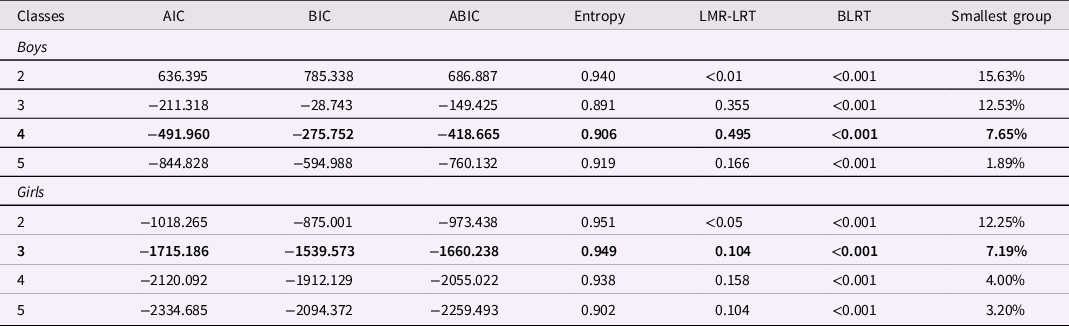
A quadratic pattern of growth model was thus used to examine PP-LCGMs. Table 1 displays the fit indices derived from unconditional PP-LCGMs investigating the relative fit of models ranging from two to five latent classes of internalizing and externalizing problems trajectories. Fit indices and theoretical interpretability of each model were considered. The AIC, BIC, and Adjusted Bayesian Information Criterion decreased as the number of classes increased, and the bootstrap likelihood ratio tests remained statistically significant for each class solution.
Fit indices for unconditional LCGM by gender

Note. AIC = Akaike information criteria; BIC = Bayesian information criteria; ABIC = sample size adjusted BIC; LMR-LRT = Lo-Mendell-Rubin likelihood ratio test; BLRT = bootstrap likelihood ratio test. Bold indicates the final class solution.
For boys, the LMR-LRT was not statistically significant for the three-class solution, suggesting that the two-class solution fit the data better. Although the LMR-LRT favored the two-class solution, the four-class solution added two meaningful classes to the two-class solution (moderate-decreasing internalizing and moderate-stable externalizing problems and high increasing-internalizing and low-stable externalizing problems). Furthermore, although the five-class solution exhibited good statistical fit criteria in terms of entropy, AIC, and BIC, the fifth class was less than 5% of the sample (only 1.89%), which was deemed to be statistically unrepresentative and to have limited generalizability. Examination of the fit indices and considering the usefulness and interpretability of the trajectory patterns, the four-class solution was accepted for boys. The average latent class probabilities for the most likely class membership ranged from 0.91 to 0.96, further demonstrating the robustness of the four-class model.
For girls, the LMR-LRT was not statistically significant for the three-class solution, suggesting that the two-class solution fit the data better. Although the LMR-LRT favored the two-class solution, the three-class solution added a meaningful class to the two-class solution (moderate co-occurring). Furthermore, although the four-class solution exhibited good statistical fit criteria in terms of entropy, AIC, and BIC, the four-class model contained similar trajectories as the three-class model. The addition of the fourth trajectory served only to split one trajectory in the three-class model into two similar trajectories, and the fourth-class was less than 5% of the sample (only 4.00%). Thus, the four-class model was deemed to be statistically unrepresentative and to have limited generalizability. Examination of the fit indices and considering the usefulness and interpretability of the trajectory patterns and the principle of parsimony, the three-class solution was accepted for girls. The average latent class probabilities for the most likely class membership ranged from 0.94 to 0.99, further demonstrating the robustness of the three-class model.
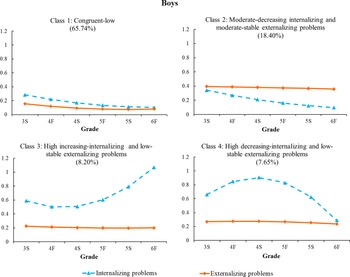
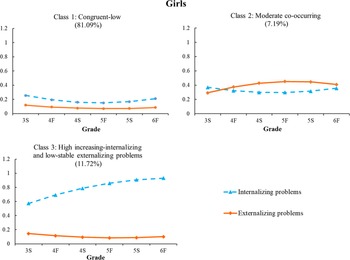
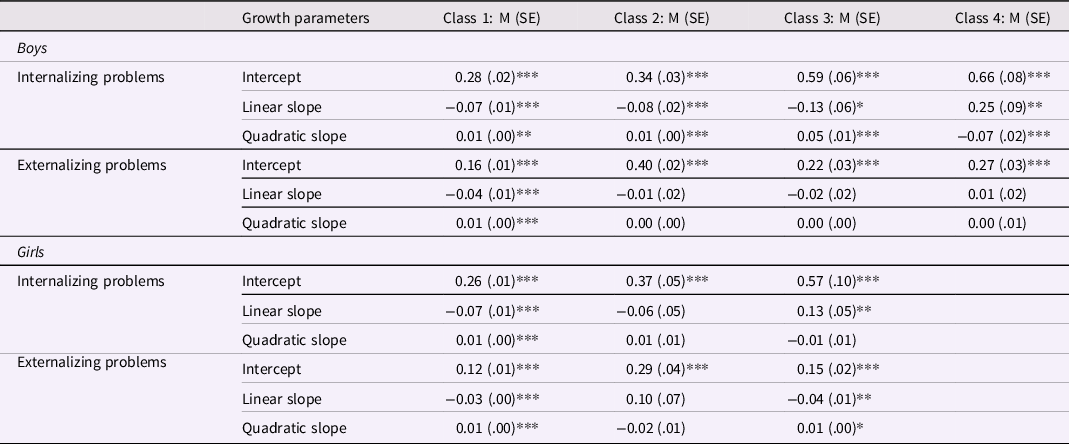
The characteristics of the developmental trajectory classifications for boys and girls are presented in Table 2, Table S4 and Figures 1 and 2. Thereinto, Table S4 presents the T-score for each classification. Raw scores were used for classification and naming of the classes in this study, and the results of the T-scores were for reference only.
Estimated means of internalizing and externalizing problems in parallel process Latent Class Growth Model for boys. Y-axis indicates the means of internalizing and externalizing problems; X-axis indicates the time (i.e., grades). F = First semester; S = Second semester.

Estimated means of internalizing and externalizing problems in parallel process Latent Class Growth Model for girls. Y-axis indicates the means of internalizing and externalizing problems; X-axis indicates the time (i.e., grades). F = First semester; S = Second semester.

Parallel process latent class growth model parameter estimates

Note. Class 1 = Congruent-low; Class 2 (boys) = Moderate-decreasing internalizing and moderate-stable externalizing problems; Class 2 (girls) = Moderate co-occurring; Class 3 = High increasing-internalizing and low-stable externalizing problems; Class 4 = High decreasing-internalizing and low-stable externalizing problems.
* p < 0.05;
** p < 0.01;
*** p < 0.001.
For boys, the characteristics of the four profiles were as follows (see Table 2 and Figure 1). Class 1 (65.74%, n = 593), which was labeled “congruent-low,” showed initially low and subsequently stable or decreasing trajectories for internalizing and externalizing problems. Class 2 (18.40%, n = 166), which was labeled “moderate-decreasing internalizing and moderate-stable externalizing problems,” showed an initially moderate level with a subsequent decrease of internalizing problems, as well as a stable, moderate level of externalizing problems. Class 3 (8.20%, n = 74), which was labeled “high increasing-internalizing and low-stable externalizing problems,” showed initially high, decreasing, and then increasing internalizing problems, whereas externalizing problems remained consistently low over time. Class 4 (7.65%, n = 69), which was labeled “high decreasing-internalizing and low-stable externalizing problems,” showed initially high and increasing then decreasing internalizing problems, whereas externalizing problems remained consistently low over time.
For girls, the characteristics of the three profiles were as follows (see Table 2 and Figure 2). Class 1 (81.09%, n = 609), which was labeled “congruent-low,” showed initially low and decreasing, then increasing internalizing and externalizing problems. Class 2 (7.19%, n = 54), which was labeled “moderate co-occurring,” showed initially moderate and stable trajectories for internalizing problems, and consistently moderate levels of externalizing problems. Class 3 (11.72%, n = 88), which was labeled “high increasing-internalizing and low-stable externalizing problems,” showed initially high and increasing internalizing problems, along with consistently low levels of externalizing problems.
Predictors of class membership
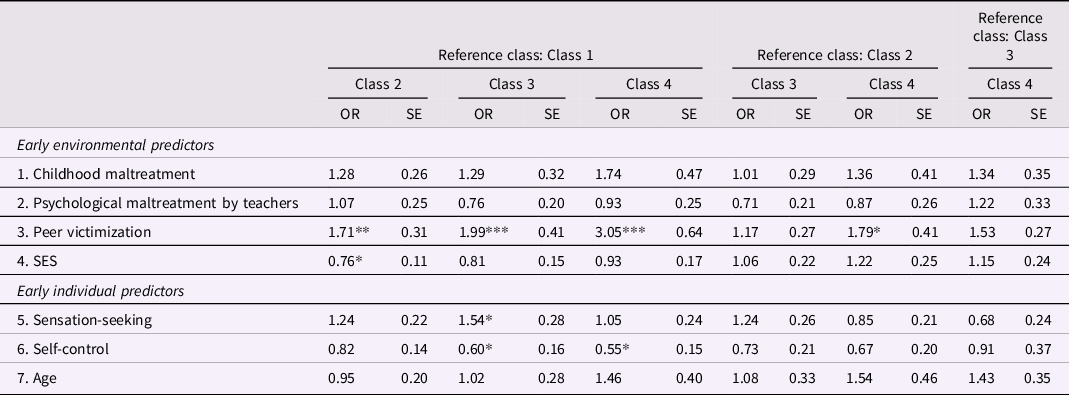
For boys, see Table 3 for the results of the multinomial regression analysis. Boys who experienced peer victimization (OR = 1.71) and lower SES (OR = 0.76) were more likely to belong to the moderate-decreasing internalizing and moderate-stable externalizing problems group compared with the congruent-low group. Also, boys who experienced peer victimization (OR = 1.99), higher sensation-seeking (OR = 1.54), and lower self-control (OR = 0.60) were significantly more likely to be in the high increasing-internalizing and low-stable externalizing problems group rather than the congruent-low group. Further, boys who experienced peer victimization (OR = 3.05), and lower self-control (OR = 0.55) were more likely to belong to the high decreasing-internalizing and low-stable externalizing problems group compared with the congruent-low group. Specifically, boys who experienced peer victimization were significantly more likely to be in the high decreasing-internalizing and low-stable externalizing problems group (OR = 1.79) rather than the moderate-decreasing internalizing and moderate-stable externalizing problems group.
Logistic multinomial regression of predictors on internalizing and externalizing problems trajectories for boys

Note. Class 1 = Congruent-low; Class 2 = Moderate-decreasing internalizing and moderate-stable externalizing problems; Class 3 = High increasing-internalizing and low-stable externalizing problems; Class 4 = High decreasing-internalizing and low-stable externalizing problems.
* p < 0.05;
** p < 0.01;
*** p < 0.001.
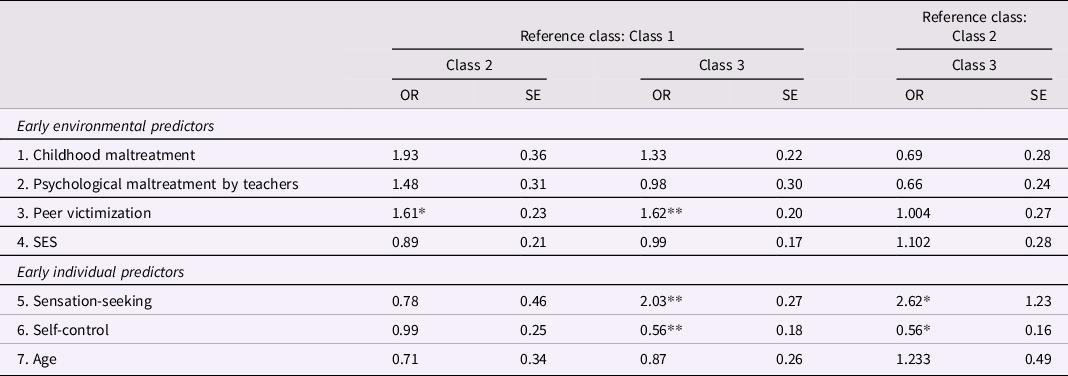
For girls, see Table 4 for the results of the multinomial regression analysis. Girls who experienced peer victimization (OR = 1.61) were more likely to belong to the moderate co-occurring group compared with the congruent-low group. Also, girls who experienced peer victimization (OR = 1.62), higher sensation-seeking (OR = 2.03), and lower self-control (OR = 0.56) were significantly more likely to be in the high increasing-internalizing and low-stable externalizing problems group rather than the congruent-low group. Further, girls with higher sensation-seeking (OR = 2.62), and lower self-control (OR = 0.56) were more likely to belong to the high decreasing-internalizing and low-stable externalizing problems group compared with the moderate co-occurring group.
Logistic multinomial regression of predictors on internalizing and externalizing problems trajectories for girls

Note. Class 1 = Congruent-low; Class 2 = Moderate co-occurring; Class 3 = High increasing-internalizing and low-stable externalizing problems.
* p < 0.05;
** p < 0.01;
*** p < 0.001.
Discussion
Gender differences in the co-development of internalizing and externalizing problems
This study revealed differences in the co-development of internalizing and externalizing problems for boys and girls, with four trajectories identified for boys and three trajectories identified for girls. The identified subgroups displayed different mean levels, courses of symptoms, and percentages of members. The congruent-low group was the most pervasive pattern for both genders in this study; the finding is consistent with the existing literature (e.g., Chen & Simons-Morton, Reference Chen and Simons-Morton2009; Wiesner & Kim, Reference Wiesner and Kim2006). In this group, the mean T-score for internalizing and externalizing problems was below 50, which was significantly below the clinical level of 70, indicating a lower risk of internalizing and externalizing symptoms in this group.
A subgroup of moderate-stable externalizing problems was identified in both boys and girls (i.e., the group of moderate-decreasing internalizing and moderate-stable externalizing problems for boys and the group of moderate co-occurring for girls). In the moderate externalizing problems groups, T-scores for internalizing problems were below 50 for boys and above 50 for girls at each time point. T-scores for externalizing problems for both boys and girls were almost above 60 but did not reach the clinical level. This finding indicates that youth in these groups were at risk of developing clinical symptoms of externalizing problems compared to other groups. Moreover, previous findings have also revealed that moderate-stable externalizing problems trajectories occur in children and adolescents (Hauser-Cram & Woodman, Reference Hauser-Cram and Woodman2016; Shi et al., Reference Shi, Ettekal, Deutz and Woltering2020). However, boys and girls showed different trends of internalizing problems within this subgroup. Specifically, boys (18.40%) showed a moderate decreasing trend in internalizing problems whereas girls (7.19%) showed moderate stability in internalizing problems. The findings supported the gender paradox hypothesis of co-morbidity which states that girls’ externalizing behaviors are more predictive of internalizing symptoms compared to boys’ externalizing behaviors (Loeber & Keenan, Reference Loeber and Keenan1994), and this overlap of internalizing and externalizing was greater for girls than for boys, relative to the prevalence rates of externalizing behaviors for each gender. This finding underscores that girls’ externalizing problems in mid-childhood were often accompanied by internalizing problems, which suggests that interventions for children and adolescents with externalizing problems should likely address internalizing problems in girls as well.
Moreover, this study identified a group of high increasing-internalizing and low-stable externalizing problems for both boys (8.20%) and girls (11.72%). In the increasing-internalizing problems groups, the T-scores for externalizing problems were below 60 for both boys and girls. In contrast, the T-score for internalizing problems gradually increased from 57 to approximately 70, approaching or reaching clinical levels. This result indicates that youth in this group are at higher risk of internalizing problems, and they have a tendency to develop clinical level symptoms of internalizing problems. Moreover, the identification of the group with an increasing trajectory corroborates the epidemiological findings of increased depressive symptoms in early adolescence (Thapar et al., Reference Thapar, Collishaw, Pine and Thapar2012). The developmental pattern for this group supported previous findings of an increase in internalizing problems among children nearing adolescence (Gutman & McMaster, Reference Gutman and McMaster2020; Hauser-Cram & Woodman, Reference Hauser-Cram and Woodman2016). Some researchers argue that when children enter early puberty, their cognitive and emotional regulation skills may not be adequate for them to cope with the complicated emotional, psychological, and biological changes during the transition, and thus their internalizing problems tend to increase (Llewellyn et al., Reference Llewellyn, Rudolph and Roisman2012; Stewart et al., Reference Stewart, Shields, Esposito, Cosby, Allen, Slavich and Auerbach2019). Moreover, girls were more prevalent than boys in the high-growth internalizing problems group. This finding is consistent with existing evidence that suggests that girls have a higher prevalence rate of internalizing problems and are more likely than boys to be represented in developmental groups with high internalizing problems (e.g., Xu et al., Reference Xu, Rao, Cao, Wen, An, Che, Bressington, Cheung, Ungvari and Xiang2020).
A subgroup with high decreasing-internalizing and low-stable externalizing problems was identified only for boys (7.65%) in this study. In this subgroup, the T-scores for externalizing problems were below 60 for boys, and the T-score for internalizing problems first increased to over 70 and then decreased to approximately 50. This trend indicated that the boys in this group were at risk of developing internalizing problems at clinical levels; however, the risk gradually decreased over time. This subgroup has not been identified in previous studies of boys. This finding may increase our knowledge of the diversity of developmental patterns of internalizing problems as boys transition from childhood to adolescence. This finding might also indicate that the qualitative and quantitative shifts in boys’ cognitive abilities during adolescence may enable them to think in more strategic ways than in the prepubescent years (e.g., Blakemore & Choudhury, Reference Blakemore and Choudhury2006), thereby reducing their risk of ongoing experiences of internalizing problems. Thus, the transition to adolescence does not always act as a catalyst to increase the development of internalizing problems. In addition, this subgroup was not identified in girls. This difference might be due to the fact that Chinese society and culture advocate perseverance, courage, and masculinity for boys; in contrast, girls are perceived as soft and in need of protection. As a result, girls may become more sensitive when faced with stress or adversity, which promotes the development of internalizing problems and makes it more difficult for girls to recover from negative experiences than boys (Liu et al., Reference Liu, Zheng, Chu, Ding, Song, Wang and Yi2021). However, this subgroup is of clinical concern and warrants mental health attention compared to the low stable group, although the downward trajectories of internalizing symptoms may suggest evidence of resiliency and recovery.
Most notably, this study did not identify a high-externalizing trajectory group, despite the fact that this subgroup has been identified by other investigators (Duprey et al., Reference Duprey, Oshri and Liu2020; Shi et al., Reference Shi, Ettekal, Deutz and Woltering2020; Wu et al., Reference Wu, Hsieh, Chang, Lin and Buu2020). One explanation may be due to the differing informants in the studies. For instance, in contrast to the employment of parent reports in the current study, Shi et al. (Reference Shi, Ettekal, Deutz and Woltering2020) utilized teacher reports and Wu et al. (Reference Wu, Hsieh, Chang, Lin and Buu2020) utilized self-reports. It is possible that the different respondents (i.e., teachers, parents, and children) may differentially detect and/or report children’s externalizing symptoms. Another explanation may involve cultural differences, that is, the generally low tolerance for externalizing problems in the Chinese culture may lead to reduced reporting of such behavior by various informants. In the Chinese context, externalizing problems may threaten the harmony and the welfare of the collective. When youth exhibit externalizing problems, parents and teachers may be more likely to employ harsh discipline methods with them to encourage more appropriate behavior in the future (e.g., Wang & Liu, Reference Wang and Liu2018). Compared to externalizing problems, our findings identified high internalizing problems groups, which was consistent with the basic Chinese context. On the one hand, parents and teachers appear highly insensitive to youth’s internalizing problems, such as somatic complaints, feelings of fearfulness, and depression (Chen et al., Reference Chen, Liu, Rubin, Li, Li, Cen and Li2003). On the other hand, associated with the collectivistic nature of Chinese culture, Chinese children display personality characteristics, such as emotional restraint and submissiveness, which may make them more likely to manifest depressive symptoms when encountering external stress (Tafarodi & Smith, Reference Tafarodi and Smith2001).
Overall, our results revealed that gender-specific developmental patterns for internalizing and externalizing problems were divided into four classes for boys and three classes for girls; this result differed from existing results suggesting an equivalent number of classes for boys and girls in childhood (Chen & Simons-Morton, Reference Chen and Simons-Morton2009; Wiesner & Kim, Reference Wiesner and Kim2006). Along with cultural variations, differences in sample sizes and ages, time periods, and estimation methods may account for these discrepancies.
Predictors of internalizing and externalizing problems gender-specific trajectories
The investigation of predictors for each trajectory of internalizing and externalizing problems should help identify which risk factors might act as warning signals for children’s further development of internalizing and externalizing problems. Environmental and individual predictors were investigated in this study and discussed below.
After controlling for the effects of multiple factors, peer victimization predicted differential trajectories of internalizing and externalizing problems for boys and girls. Consistent with previous findings (see Reijntjes et al., Reference Reijntjes, Kamphuis, Prinzie and Telch2010, Reference Reijntjes, Kamphuis, Prinzie, Boelen, Van der Schoot and Telch2011 for reviews), the results demonstrated that peer victimization was a key risk factor for internalizing and externalizing problems. The relations between peer victimization and internalizing and externalizing problems could also be explained by the interpersonal risk model (Kochel et al., Reference Kochel, Ladd and Rudolph2012), in that poor peer relations constitute a significant stressor, which will increase the likelihood of internalizing problems or externalizing problems over time (Holfeld & Mishna, Reference Holfeld and Mishna2019). Children who experience bullying would increase their likelihood of future internalizing and externalizing problems (Schwartz et al., Reference Schwartz, Lansford, Dodge, Pettit and Bates2015).
Moreover, after controlling for the other predictors, individual differences in students’ self-control significantly related to two internalizing and externalizing problems trajectories (i.e., high increasing-internalizing and low-stable externalizing problems for boys and girls, high decreasing-internalizing and low-stable externalizing problems for boys). Namely, low self-control increased the likelihood of displaying problematic developmental trajectories, especially for internalizing problems. In line with previous studies (e.g., McDermott et al., Reference McDermott, Donlan, Anderson and Zaff2017), low self-control appears to be a robust risk factor for the development of internalizing problems, and conversely, higher self-control may protect against the development of internalizing problems (White et al., Reference White, Jarrett and Ollendick2013). Children with high self-control may achieve better psychological adjustment by controlling their behavior and adopting positive coping styles when faced with adversity. In contrast, children with low self-control are more likely to attribute negative events to other people or externally-controlled circumstances and adopt unhealthy coping strategies, such as avoidance, and are therefore likely to develop internalizing problems (Boals et al., Reference Boals, Vandellen and Banks2011). Thus, the (risk) role of low self-control in increasing youth’s internalizing problems needs to be given special attention. However, the findings also revealed that self-control did not serve as a significant predictor for the group of moderate-stable externalizing problems (i.e., the group of moderate-decreasing internalizing problems and moderate-stable externalizing problems for boys and the group of moderate co-occurring for girls); this finding was inconsistent with previous findings (e.g., Nijhof et al., Reference Nijhof, Te Brinke, Njardvik and Liber2021). This difference in findings may be due to the overall low level of externalizing problems reported by these Chinese parents, decreasing the variability in externalizing problems to the point of being unable to detect a significant association with self-control.
Sensation-seeking was also a risk factor that significantly distinguished the high increasing-internalizing and low-stable externalizing problems group from the congruent-low group. This result was inconsistent with those of previous studies (Harden et al., Reference Harden, Quinn and Tucker-Drob2012; Wilson & Scarpa, Reference Wilson and Scarpa2011), namely that sensation-seeking differentiated the high increasing-internalizing and low-stable externalizing problems group from the congruent-low group. Only a few prior studies have reported similar results in which sensation-seeking was positively associated with depression (Ortin et al., Reference Ortin, Lake, Kleinman and Gould2012). This difference may be due to the fact that the tendency of high sensation-seeking adolescents is to seek stimulation, but their stimulation-seeking behavior may be hindered by the environment. For example, as mentioned earlier, the Chinese culture displays a low tolerance for externalizing problems, and parents and teachers are more likely to address children’s externalizing problems quickly. Therefore, it is speculated that when stimulation-seeking needs remain unmet for a long time, they may be transformed into internalizing problems. It would be valuable for future studies to further explore the relations between sensation-seeking and internalizing problems in the context of Chinese society and culture.
Specifically, girls exhibiting higher sensation-seeking along with lower self-control were more likely to belong to the high decreasing-internalizing and low-stable externalizing problems group compared with the moderate co-occurring group. Typical behaviors of Chinese girls, as perceived by the public, are being helpful, quiet, well-mannered, and neat and clean (Kollmayer et al., Reference Kollmayer, Schober and Spiel2018). Especially in China, traditional images of Chinese girls portray submissiveness, shyness, conforming to others’ needs, and gentleness (Johansson, Reference Johansson and Shoma2001). When girls display higher sensation-seeking, pursuing adventure with low self-control, they violate cultural and gender stereotypes. Thus, they may not be accepted or understood by others, yielding an increased risk of internalizing problems. Therefore, prevention and interventions efforts should focus on girls displaying higher sensation-seeking and lower self-control in China.
Strengths, limitations and future research
Compared to prior research, the current study demonstrated some important strengths. Given that previous, similar studies have been limited to studies of Western youth, the first major strength involved its sampling from a novel population of youth (i.e., Chinese) encompassing the critical transition from middle childhood to early adolescence. The second major strength of this study was that using a large sample and multi-wave longitudinal design along with parallel process latent growth curve modeling to identify meaningful gender differences regarding trajectory patterns of internalizing and externalizing problems should yield more robust conclusions compared to earlier, less methodologically rigorous studies. Taken together, the findings provided valuable information for the development of gender-specific, empirically informed monitoring and intervention programs for the prevention or alleviation of internalizing and externalizing problems in Chinese youths. The final major strength of this study was its consideration of multisystemic predictors that related to different courses of internalizing and externalizing problems. Such analyses inform the development of empirically informed assessment methods and preventive or treatment programs.
Beyond the strengths, some limitations of this study bear noting. First, although this study examined internalizing and externalizing problems in youths as young as middle childhood, it did not follow their development into middle or late adolescence. Future studies are required to replicate and extend these findings across the full range of adolescence. Second, predictors in this study were assessed only at baseline. This approach helped establish the time ordering of these factors; however, this approach did not address subsequent changes in these variables. Future work should examine dynamic relations among risk factors and internalizing and externalizing problems. Finally, our sample was from elementary school students in the southeast area of China and was not representative of the population of elementary school students in China. Future studies will need to replicate and extend these findings in China and elsewhere.
Implications
This study yielded several important implications for the assessment, prevention, and treatment of internalizing and externalizing problems in youths. First, the findings underscored that middle childhood to early adolescence is a crucial period for screening for internalizing and externalizing problems as well as an important intervention window to prevent the escalation of such problems in adolescence. In particular, the results identified gender-specific co-developmental patterns of internalizing and externalizing problems, which thus require a different focus and targeted strategies for youth in differing gender-specific trajectories. Second, the study identified key environmental and individual risk factors that should be addressed in comprehensive screenings of youth. Given that peer victimization was robustly related to the more severe courses of internalizing and externalizing problems, school professionals and families should especially consider identifying youths who have been victimized by peers for prevention and intervention programs geared toward decreasing internalizing and externalizing problems among youths. For instance, educators may consider infusing social and emotional learning (e.g., Durlak et al., Reference Durlak, Weissberg, Dymnicki, Taylor and Schellinger2011) instructional materials into classes, which can be drawn from a variety of skill-based universal prevention programs designed to build social skills. Such approaches should help to inspire students to build closer relationships with peers and reduce peer relationship stress. Third, low self-control predicted the trajectories of high increasing-internalizing and low-stable externalizing problems for boys and girls, and the trajectories of high decreasing-internalizing and low-stable externalizing problems for boys. Accordingly, school educators and parents should focus on developing self-control in children and adolescents with internalizing problems, especially in boys. Moreover, programs that teach specific skills related to self-control enhancement are likely to benefit youth at risk for internalizing and externalizing problems. For example, Stop Now and Plan (Augimeri et al., Reference Augimeri, Walsh, Liddon and Dassinger2011) has recently emerged as a promising program designed to teach effective emotional regulation, self-control, and problem-solving skills to children with behavioral problems and their parents. The primary goal of Stop Now and Plan is to help children to stop and think before they act, and stay out of trouble. In addition, sensation-seeking was identified as an individual risk factor associated with the group of high increasing-internalizing and low-stable externalizing problems. Indeed, neuroimaging research has shown that the capacity to regulate tendencies toward impulsive behavior can be improved by parental involvement (Telzer et al., Reference Telzer, Ichien and Qu2015). Improving the parent-adolescent relationship (see Kuntsche & Kuntsche, Reference Kuntsche and Kuntsche2016, for a review) may thus attenuate their child’s impulsivity and improve the ability to regulate the adolescent increase in sensation-seeking, subsequently reducing problem behaviors.
Supplementary material
The supplementary material for this article can be found at https://doi.org/10.1017/S0954579422000207
Funding statement
This work was supported by the National Natural Science Foundation of China (No. 31971005), Guangdong Basic and Applied Basic Research Foundation (No. 2021A1515012515), and Guangdong Basic and Applied Basic Research Foundation (No. 2022A1515011233).
Conflicts of Interest
None.