The 1993 Copenhagen European Council recognized the membership eligibility of the countries of Central and Eastern Europe and spelled out concrete accession criteria, setting in motion the political process of EU enlargement. Early on, the Greek government expressed its full support to the EU enlargement on political and economic grounds, especially associated with the future of the Cypriot candidacy.Footnote 1 For a long time, Turkey's participation in this process came up against long-held Greek political and security concerns. The Greek objections were lifted at the Helsinki European Council in December 1999, reversing a long-standing Greek course of action and initiating an ongoing but still incomplete process of Greek–Turkish rapprochement.Footnote 2
How should we study a major foreign policy change that constitutes the outcome of intersecting, complex and multidimensional domestic and international processes? After a period of relatively limited breakthroughs in the analysis of foreign policy change due to the rigidity of the bipolar Cold War, dynamic aspects of foreign policy have come to the fore, not least because of systemic changes in international politics and paradigm shifts in the study of foreign policy. A few contributions have explicitly addressed the issue of foreign policy change, most of them adhering to multi-causality.Footnote 3 Drawing on the public policy literature, we complement these studies by bringing to the foreground explicitly domestic policy entrepreneurs, arguing that their role is critical in any strategic foreign policy realignment.Footnote 4 Our analysis lies in the broader literature that examines domestic sources of foreign policy-making, drawing especially on scholarly works that attribute to the statesmen a key role in the interaction between domestic and international levels of analysis.Footnote 5 The concept of policy entrepreneurship that constitutes the analytical backbone of this article has not been applied previously in foreign policy-making analysis, and is usually mistakenly conflated with political leadership.
In our understanding, policy entrepreneurs embrace and push forward specific proposals for alternative courses of action, advocating policy change in the hope of a future political return that will exceed the cost they have incurred in taking any such entrepreneurial activity. In a given systemic international setting, the entrepreneurs' capacity to orchestrate policy change depends on domestic structural parameters associated with the political and institutional features of the policy-making process. An element that crucially affects their change-inducing potential is their ability to capitalize on ‘opportunity windows’ that facilitate their political venture, such as international political developments and security crises that testify to the failure of the old course of action and pave the way for them to seek foreign policy change.
Our analysis does not intend to discredit other accounts of the Greek foreign policy shift. The collapse of the bipolar world did substantially alter the structural conditions of Greek–Turkish relations; constructivist insights have rightly pointed to the ascendance of a new policy paradigm and a political culture of engagement associated with a generational shift, social learning processes and effects of socialization, not least as a result of EU membership. Rather, we want to complement these other accounts, adhering to the view that it is very difficult to employ mono-causality to account for such change, attributing it to a single factor or by reference to a single theoretical paradigm.Footnote 6 Thus, we seek to highlight the role of Greek policy entrepreneurs in the process, stressing the analytical value and aptness of this conceptualization.
In the next section we elaborate on the concept of policy entrepreneurs and the conditioning political and institutional features that delineate their capacity to intervene. Then we turn to our case study, examining first the international background, then the domestic political and policy-making system and finally the ‘opportunity window’ that facilitated the political endeavours of the Greek policy entrepreneur. We revisit and discuss the insights of the case study in a separate section, focusing on the interplay between foreign policy entrepreneurs and the other explanatory factors offered in the relevant literature.
POLICY ENTREPRENEURS AND FOREIGN POLICY CHANGE
Policy entrepreneurs are individual actors at local, national or international level who initiate policy change in their respective political environments. They may have any status and location in the hierarchy of the policy-making process, from policy ‘outsiders’ to members of the upper bureaucratic and political echelons of the legislative and executive branches.Footnote 7 They have a transformative effect on politics, policies or institutions, shaping the terms of the political debate, (re)framing issues, (re)defining problems and (re)setting policy agendas. They not only constitute a source of innovation in terms of policy content or direction but also manage to consolidate innovation into lasting change.Footnote 8 Very much like economic and business entrepreneurs, they invest their resources – special skills and expertise, vision and/or leadership capacity – advocating policy change in the hope of a future return.Footnote 9 The expected return may take the form of political and electoral success, policy outcomes that they favour, satisfaction from participation in a policy process or even personal aggrandizement in the form of increased reputation and/or better career prospects.Footnote 10 In that respect, policy entrepreneurs admittedly have a complicated utility function, not only comprising material benefits but also related to policy success and personal status.Footnote 11
In most of the early research, policy entrepreneurship has been conflated with political leadership.Footnote 12 Such confusion is reasonable on three grounds: first, the two concepts do have many similar attributes – for example, the interpersonal skills that are relevant to both entrepreneurs and leaders. Second, it is possible for the same person to act as an entrepreneur in one case and simultaneously be a leader in a different situation evolving in parallel. Third, there are several grey areas where a political actor may be labelled a leader or an entrepreneur, depending on which of the actor's actions are given primary causal significance.Footnote 13 In general, leadership is a broader concept than policy entrepreneurship, the latter being explicitly and exclusively associated with policy change, successful or not. In contrast, initiating change is only one aspect of leadership, in the form of ‘entrepreneurial leadership’, which blurs the distinction between the two concepts.Footnote 14 Furthermore, the two concepts differ in the origins of the pursued objectives: leaders act on behalf of some larger group, notably their respective or potential followers. They are associated with the collective pursuit of some common good or joint purpose, inducing followers to take a certain course of action espoused by both leaders and perspective followers.Footnote 15 Conversely, individualism is an omnipresent feature of entrepreneurship. Policy entrepreneurs follow a lonely path, exploiting opportunities to push forward their own preferred agenda with little direct intervention in its formulation.Footnote 16
The most important structural institutional parameter that facilitates or frustrates entrepreneurial activity is the level of entry barriers that policy entrepreneurs face in any given policy arena.Footnote 17 The permeability of such barriers, which are most often – but not exclusively – institutionalized, dictates the amount of resources that the entrepreneurial interloper has to invest in order to advocate policy change. Low entry barriers may encourage policy entrepreneurs; however, if the barriers are too low they may actually discourage entrepreneurial activities since any return may well be rapidly decreased by competition from future newcomers. High entry barriers may provide more incentives to entrepreneurs in that they can secure a temporary policy monopoly, but again very high barriers will have an adverse effect discouraging entrepreneurial ventures. Therefore, the relationship between entry barriers and entrepreneurship is curvilinear, with policy entrepreneurs least likely to emerge when entry barriers are very high or very low.Footnote 18 Thus the main condition for the emergence of a policy entrepreneur is a positive cost–benefit analysis, in which potential return exceeds the cost of overcoming the entry barriers embedded in the status quo.Footnote 19 Of course, the emergence of a policy entrepreneur should not be conflated with the success of any political campaign.
In the foreign policy realm, policy entrepreneurs are usually political figures who manage to overcome the inertia of previous foreign policy action, providing directional leadership.Footnote 20 Their preference for change and the drive of their policy differentiation originate from a different understanding, conceptualization and prioritization of international challenges, stemming fundamentally from their belief systems, cognitive factors and other idiosyncratic features.Footnote 21 Given the high salience of many foreign policy issues, their entry barriers – associated with the domestic political electoral and institutional setting – are usually very significant, which largely explains the relative continuity and stability of foreign policy. Still, occasionally there do emerge ‘critical junctures’ and ‘opportunity windows’ that lower these entry barriers. Although there is always some degree of overlap between the two, critical junctures are primarily related to system-wise developments that alter the terms of international interactions, thus making foreign policy in general more amenable to change in order to adjust to the new international environment. Critical windows are mostly case-specific developments, such as a security crisis that highlights the shortcomings of the current foreign policy and renders the domestic policy-making setting more conducive for a policy entrepreneur to pursue policy change.
Entry barriers for a foreign policy entrepreneur emanate from specific political and institutional features of the foreign policy-making process, related to its permeability and the degree of insulation of the political locus of power from political dependence. The process that captures the ‘aggregation function’ of the multiple societal inputsFootnote 22 assumes an ‘authoritative decision unit’, namely an individual or a set of individuals with the ability and authority to make a decision and commit the resources of a society on a foreign policy issue. Three types of such decision units have been identified in the literature: the powerful leader (e.g. monarch, dictator or a predominant political figure in a democratic system), the single group (e.g. Politburo in the former Soviet Union, a group of army officers collectively engaged in a military coup or cabinet under a prime minister with a collective policy-making style, etc.) and the multitude of autonomous actors (e.g. coalition governments, actors with veto power over foreign policy decisions, etc.).Footnote 23
The features and properties of each type condition its capacity to induce foreign policy change. Of particular interest are the number of formal and/or informal veto points, the scope of societal involvement, the electoral system that leads to strong or weak, majoritarian or coalition governments, and the policy-making style of the regime leader. Ceteris paribus, changes occur less frequently in highly bureaucratic states with democratic regimes than in autocratic regimes with a minimal policy-making role for the bureaucracy and little or no regime accountability.Footnote 24 In general, autonomy and insulation of the unit from political dependence (e.g. the army, actors with veto power, electoral concerns, coalition partners, etc.) create a policy-making environment more conducive to change. For example, in a democratic regime, foreign policy change is more likely to occur in cases of strong, single-party governments with a prime minister dominating decision-making in the cabinet, few or no veto points (by a president, constitutional court or other) and low societal involvement or interest.
This discussion of domestic entry barriers to a foreign policy entrepreneur assumes that there is a stable international environment. Systemic changes constitute critical junctures in the evolution of the system of international relations on which policy entrepreneurs may capitalize to induce foreign policy change. The more fundamental and wide-ranging these changes are, the more they increase the entrepreneurial potential of a domestic foreign policy actor. Furthermore, international crises open opportunity windows for policy reform, paving the way for a foreign policy entrepreneur.Footnote 25 A security crisis, such as a political or military imbroglio, highlights the inappropriateness of current policies and practices, triggering their re-evaluation and providing impetus for change. As mentioned before, both the systemic changes and the conjunctural security crises lower existing entry barriers for policy entrepreneurs, not least by increasing public acquiescence to the necessity of foreign policy redirection and marginalizing domestic opposition to it.Footnote 26
However, challenging the old foreign policy orthodoxy, or even its collapse, does not inevitably entail its replacement by a new dominant one. In other words, external or internal shocks of great magnitude do not always lead to change but rather constitute an opportunity for change, with alternative potential ‘orthodoxies’ vying for domination.Footnote 27 In that respect, change is more likely to occur after crises and policy failures, when policymakers who espouse new approaches assess that these new approaches not only address the old deficiencies but also constitute credible political options that can master the necessary political support.Footnote 28 At this stage, the role of policy entrepreneurs is crucial in delineating the future course of action, pushing forward their own preferred policy agenda and struggling for its consolidation as the ‘new’ foreign policy orthodoxy. New ideas apparently endure if they appear to generate desirable results or are expected to do so in the near future. In the absence of such results, especially in the early years of the consolidation process, setbacks and reversals are possible, which would undermine the political investment of the policy entrepreneur.
THE SIMITIS ADMINISTRATION AND GREEK–TURKISH RELATIONS
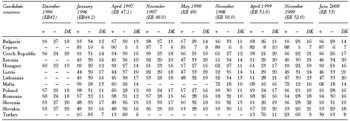
For a long period, the entry barriers for any Greek policy entrepreneur in pursuit of normalization in Greek–Turkish relations were discouragingly high. Following the 1974 Cyprus imbroglio, the Greek foreign and security policy was reoriented to the ‘threat from the east’, signalling the beginning of a relationship with Turkey that escalated occasionally very close to total military engagement. After 1981, the EC/EU framework became one of the main Greek foreign policy reference points. Once inside the club, Greece vehemently and consistently opposed the enhancement of a EU–Turkish relationship through the 1980s and most of the 1990s, blocking financial support to the frail Turkish economy and rejecting the Turkish candidacy for EU membership. In that respect, the Greek–Turkish relationship was fully securitized and thus much less amenable to change.Footnote 29 Throughout the 1990s, the Greek public overwhelmingly rejected the Turkish candidacy by around 80 per cent (see Table 1). That indicates the existence of a considerable political barrier that the Greek government had to overcome in order to realize the 1999 foreign policy shift. This lack of public alignment with the new foreign policy orthodoxy contributed significantly to the government's electoral concerns in the approach to the spring 2000 parliamentary elections.
Greek Public Support to Candidate Countries and Turkey (1994–2000) in %

Source: Eurobarometer.
Notes: + = in favour; − = not in favour; DK = don't know.
Question:
From January 1995 to May 1997: For each of the following countries, are you in favour or not of it becoming part of the European Union in the near future?
From December 1997 to December 1998: For each of the following countries, would you be in favour or against it becoming part of the European Union?
From May 1999: For each of the following countries, would you be in favour of or against it becoming part of the European Union?
In institutional terms, the entry barriers for a policy entrepreneur were not particularly high, considering the relatively insulated political and policy-making environment. To avoid fragmentation and political instability, since the collapse of the junta regime in 1974 the Greek political and electoral system has overwhelmingly nurtured strong parliamentary majorities and single-party governments. The preference for a powerful, unified executive and the charismatic figures that headed political parties further contributed to the concentration of political power almost exclusively in the hands of the prime minister. In that respect, the prime minister evolved from primus inter pares to primus solus within the cabinet, minimizing the role and autonomy of other ministers. Therefore, changes in the prime ministerial post would entail substantial policy shifts, even if there is no change in the political party in power. In the foreign policy domain in particular, limited institutionalization and the personalized policy-making style and ethos suggest that a change in the political leadership of the ministry might spell abrupt changes in Greek foreign policy.Footnote 30
Of course, the problem is how the policy entrepreneur would find a place in this inner circle of the Greek foreign policy-making. Such a change occurred after the domination of the ‘modernization’ faction in the succession race within the ruling PASOK party in the mid-1990s, after the octogenarian prime minister and founder of PASOK, Andreas Papandreou, resigned from his post due to health problems at the end of 1995. The faction, led by C. Simitis, ran on a political platform of socio-economic modernization, expressing an alternative political culture.Footnote 31 The ‘modernization’ period marked the shift from the socialist-populist period to one characterized by pragmatism, a managerial discourse and a technocratic approach to policy-making. All these aspects were packed in a project for the rationalization and Europeanization of Greek society and its economy, as well as Greece's gradual reinstatement at the EU level, especially through economic convergence with the European partners and membership of the Economic and Monetary Union (EMU).Footnote 32
The new prime minister had long been an advocate of European integration as a means to achieve domestic political and social modernization; he had distanced himself from the official party rhetoric and had clashed in the past with other important political figures in PASOK.Footnote 33 In the 1980s, as a minister of agriculture in the early PASOK governments, he kept channels of communication open with the European Commission, in contrast to the usual practice in the other Greek ministries at that time. He also orchestrated the short-lived stabilization programme of 1985–87, which is generally regarded as a short successful fiscal interlude in an otherwise short-term and myopic macroeconomic policy.Footnote 34
Accession to the EMU became the central point of reference for the readjustment of PASOK's ideological, programmatic and social profile as well as the major national priority of this period.Footnote 35 For the new Greek government, the EMU – and more specifically the Maastricht criteria – functioned as a crucial factor in induced modernization, providing the impetus for long-awaited structural adjustment and macroeconomic stability, as well as a binding environment to pursue a reform process that was costly in political terms.Footnote 36 In this new political environment, an adversarial and conflict-prone foreign policy would have endangered Greek chances of achieving EMU membership. Thus, associated with EMU and more broadly with the future of the ‘modernization venture’, the return for the prime minister's entrepreneurial activities in the foreign policy domain was very high.
According to prime minister Simitis, support for national foreign policy interests could be achieved through a ‘stronger Greece not merely in military terms but primarily in economic, political, institutional and cultural resources, a Greece fully integrated into the European Union’.Footnote 37 Hence, the main foreign policy objective of the modernization of action became the rehabilitation and normalization of relations with the EU, with the long-term goal of registering the country in the vanguard of European integration.Footnote 38 This development pointed towards a partial, albeit substantial, reconceptualization of Greek foreign policy and a less confrontational approach under the new administration. The new foreign policy approach combined adherence to a Kantian-cosmopolitan, ideological and philosophical operational code in foreign policy together with a rational strategy of deterrence.Footnote 39 Furthermore, Greece entered the normalization period with very limited political capital, which would have to be used to achieve EMU accession. Hence, ideological and political adherence to European integration and tactical calculations generated to a large extent a constructive and accommodating national stance at the EU level.
The reprioritization of the Greek foreign policy objectives after the 1996 ‘change of the guard’ in PASOK was fleshed out only after a considerable time lag and only after the modernization faction sidelined domestic – not least intra-partisan – political concerns and opposition. It took off after the change of leadership at the Greek Ministry of Foreign Affairs at the beginning of 1999 that brought George A. Papandreou to the forefront. An ardent supporter of an engaging and constructive relationship with Turkey, G. A. Papandreou orchestrated the final stage of the Greek foreign policy shift regarding the European future of Turkey.Footnote 40 G. A. Papandreou had already argued in favour of a total reappraisal of Greek foreign policy in the mid-1990s when he still held junior posts in the PASOK governments. He posited that bilateral dialogue over the broad set of bilateral disputes should not be a priori overruled but should be evaluated on an ad hoc basis according to circumstances and its form and structure. In this context, the European perspective on Turkey should be seen as a new strategic option for Greece.Footnote 41 Following his speech in the UN General Assembly, in September 1999, Papandreou reinstated the new Greek approach that reversed the order of the ‘Greek conditionality policy towards Turkey’.Footnote 42 Instead of waiting for Turkey to make the first step, Greece would support the enhancement of EU–Turkish relations. The underlying assumption was that a closer entanglement with the EU would bring forward a series of reforms in Turkey that would eventually necessitate the abandonment of aggression in the bilateral relationship.Footnote 43
Two unexpected developments substantially lowered the political barriers for the prime minister and the minister of foreign affairs. The first opportunity window opened in the first days of the Simitis administration. In January 1996 the Imia/Kardak imbroglio brought Greece and Turkey to the brink of war over a couple of islets in the Aegean Sea, with military escalation avoided only after a last-minute intervention by the USA. In the eyes of prime minister Simitis, the incident illustrated the failure of earlier approaches to the containment of Turkey and put the new, EMU-related, policy priorities in great jeopardy. The incident demonstrated continuing Turkish aggression and Greek vulnerability to it, providing an impetus for a new strategic approach to the relationship. Thus, in the aftermath of the crisis, the need for a new course in the Greek foreign policy vis-à-vis Turkey became apparent to the upper echelons of the Greek foreign policy-making community.Footnote 44
Second, the devastating earthquakes in August and September 1999 in the two countries led to an outburst of popular solidarity across the Aegean Sea, assisting the build-up of mutual confidence. The ‘earthquake diplomacy’ used the mutual public sympathy caused by these humanitarian disasters to counter long-standing and history-driven negative stereotypes. It gave an extra boost and dynamism to the existing bilateral committees at high-ranking, administrative and diplomatic levels, but these were limited, however, to ‘low-politics’ issues of mutual interest, keeping ‘high politics’ (i.e. Cyprus and the status at the Aegean Sea) out of the agenda. This conducive environment increased the political feasibility of the shift in Greek foreign policy, a previously unthinkable option that would have constituted political suicide for any Greek government in the past. However, the importance of this development should not be overemphasized, as it would give the erroneous impression that the political barriers for Greek policy entrepreneurs had been minimized. Although in November 1999 there already existed a gradual shift in public perceptions vis-à-vis Turkey, such support was too meagre to account for the Helsinki policy change (see Table 1; 23 per cent in favour and 69 per cent against). Such figures are another indication of the top-down, elite-driven direction of the 1999 Greek foreign policy-making shift.
ACCOUNTING FOR THE GREEK U-TURN
For a long time, Greece was portrayed conveniently among the EU member states as the sole culprit in the lack of progress in EU–Turkey relations. Thus Greek consent to the Turkish EU candidacy at the Helsinki European Council in December 1999 constituted a major breakthrough in EU policy vis-à-vis Turkey and a significant shift in Greek foreign policy. The Greek stance in Helsinki marked the culmination of a process of gradual transformation from a conflictual to a more constructive foreign policy approach. This transformation entailed, among other components, the full communitarization of the Greek–Turkish relationship, counting on the effects of engagement and socialization to bring about the normalization of bilateral relations.Footnote 45
In such a multidimensional process, two factors played a special role. First, at the international level, the new systemic environment that emerged after the cataclysmic events of 1989 and the turmoil in the Balkan region raised new security challenges for Greece at the northern borders of the country. At the same time, the end of bipolarity loosened NATO constraints over Turkish foreign policy, resulting in its greater assertiveness in the Balkans and the wider region, not least through its strategic partnership with Israel in the mid-1990s.Footnote 46 Thus Greece, facing a challenge on two fronts, had to seek alternative means to counter the perceived Turkish threat. Second, at the EU level, in the 1990s the EU incrementally articulated its enlargement policy. The 1993 eligibility criteria linked EU membership with domestic reforms in the candidate countries and adjustment to the EU norms and modus operandi. Given Turkey's desire for a closer relationship with the EU and eventual membership, the conditionality of the EU enlargement policy provided the overarching framework for the communitarization of the Greek–Turkish relationship.Footnote 47 The Cypriot candidacy for EU membership further cemented the linkage of the EU enlargement and the Greek–Turkish relationship. In the Cold War environment, the Cypriot political leadership had consistently rejected the prospect of EU membership so as not to impede the negotiations for the settlement of the island's political problem.Footnote 48 The systemic changes addressed these concerns and paved the way for the Cypriot application and eventual membership.
These valid insights do not contradict but rather complement our conceptualization of prime minister C. Simitis and foreign affairs minister G. A. Papandreou as policy entrepreneurs who advocated and orchestrated the change of course of Greek foreign policy. Both figures at the centre of the foreign policy change had long held views on the necessity of economic and political modernization of the Greek state and the relationship with Turkey. The two policy agendas became inexorably linked in the 1990s as the two EU ventures of EMU and enlargement gained significant political momentum. As discussed in the previous section, these views had been shaped at large long before Simitis and Papandreou came to office, casting doubt on the causal significance of the EU and Europeanization on the Greek foreign policy shift, at least in terms of policy problem definition.Footnote 49
Previous accounts have argued that the European integration process has had a tangible impact on the style and approach of Greek foreign policy. They have attributed change to the country's ever-deepening institutional embedding in the EU architecture and ongoing political socialization as well as the eventual take-off of a learning process among the Greek administration and the diplomatic service.Footnote 50 However, norm internalization through socialization is only one means to account for the EU impact on national foreign policy-making, instrumentality being the other. The adherence of national foreign policy to EU foreign policy norms and procedures may be the outcome of strategic calculation, in which the conceptualization of policy problems remains fixed but the means of addressing them change, channelled through EU practices and policies.Footnote 51 The latter seems to fit better the Greek shift vis-à-vis Turkey in 1999, with the EU offering the framework and overarching political environment for a policy change that had already been espoused by the two policy entrepreneurs.
The political and institutional features of the Greek policy-making system provide to a large extent an insulated environment to initiate a policy turn, not only by means of the indisputable political role of the prime minister but also through the personalized style of foreign policy-making. In the Greek case, the authoritative decision unit took the form of a predominant political figure, thus rendering foreign policy change seemingly feasible for a policy entrepreneur at the heart of the system. However, the political domination of the Simitis administration was neither easy nor uncontested. The ascendance of the alternative political culture advocated by the modernization faction of the PASOK ruling party was incremental, both in Greek society and in the party itself. The rise of Simitis to the premiership in 1996 did not bring forward the full consolidation of his power and authority, which explains to some extent the time lag in the foreign policy U-turn, from 1996 to 1999. Long-held security and threat perceptions within PASOK and across the electorate more generally constituted severe political obstacles to this venture and held the new strategy in abeyance until a few months prior to the Helsinki deal.Footnote 52 Thus, despite a conducive institutional and policy-making environment, there existed severe entry barriers, mainly related to domestic intra- and cross-partisan political opposition that put into question the political viability of the prospective new foreign policy course and its agents.
Despite the existing high political entry barriers that should normally dissuade any foreign policy entrepreneur from initiating change, two elements rendered the cost–benefit analysis positive for the Simitis administration. First, the 1996 Imia/Kardak security crisis led to the overwhelming realization of the inefficiencies of the existing strategy, constituting ‘a qualitative change in Turkey's revisionist behaviour towards Greece’.Footnote 53 In view of such large-scale failure, the crisis opened an opportunity window to revisit bilateral relations. Although it would take some time to communicate this failure to the Greek public – and this effort was still incomplete by 1999, as discussed earlier – the crisis set in motion the process of articulating a full-blown alternative strategy that could generate credible expectations for addressing old deficiencies. This window of change was further opened by the humanitarian crisis on both sides of the Aegean after the August and September 1999 earthquakes.
Second, the return of this foreign policy change for the Simitis administration was very high. The normalization of the Greek–Turkish relationship was considered of critical importance for meeting the primary objective of EMU accession, with which the PASOK modernizers had been fully associated. More than the economic benefits that derived from membership in the eurozone, the Simitis administration treasured the political connotations of such a development, with Greece moving to the EU political core, and the induced modernization of the country as a result of the required structural adjustments to meet the Maastricht criteria.Footnote 54 Military expenditures – a direct corollary of the continuing tension with Turkey – constituted an extremely heavy burden for the Greek economy, which was at the time in the process of macroeconomic convergence, and any new crisis could easily destabilize and undermine the Greek efforts. Thus foreign policy change entailed a high political return for Simitis's entrepreneurship in the form of the broader success of the modernization venture in Greek politics.
CONCLUSION
The Greek case study highlights the significance of policy entrepreneurs in initiating foreign policy change. In an environment where the international system was in flux, they associated their political future with a new course of foreign policy action in pursuit of their existing political agendas of modernization and Greek–Turkish rapprochement. In this venture, prime minister Simitis had to overcome political and institutional entry barriers: the former related to the strong inertia of long-held security and political preoccupations, and the latter deriving from the institutional features and bottlenecks of the domestic policy-making system. The high entry barriers were substantially lowered by the advent of the security crisis of the Imia/Kardak islets that testified to the failure of old practices.
Taking the analysis one step further, policy entrepreneurship may be useful in addressing one additional issue that we have not touched upon, namely consolidation of the new foreign policy. We analyse national critical junctures in the foreign policy domain without claiming that these changes are necessarily consolidated in the end or that they may not be upturned or remain incomplete as the change-inducing policy entrepreneurship evolves. Greek–Turkish relations have not been fully normalized, with, of course, other developments having played their role in this lack of progress. The change in direction of Greek foreign policy has been compromised at some point, either because it failed to deliver the expected results or because the policy entrepreneur was removed from office before the new course of action became embedded. The causal mechanisms of transforming foreign policy change to a new foreign policy path differ – and equally so may the role and importance of policy entrepreneurship differ in the policy entrenchment process.
Finally, directly linked with the entrenchment prospects of a foreign policy shift, the effect of policy entrepreneurship may not only be exhibited in the content of foreign policy but may also bring about structural changes in the terms and the institutional milieu of policy-making. To ensure the consolidation and longevity of the new foreign policy course, the policy entrepreneur may be inclined to raise the political and institutional entry barriers further to dissuade future competitors. This may be possible, for example, by reinforcing the role of the authoritative decision unit he/she occupies in the policy-making process or by altering the electoral system to shed political dependence. This point highlights and reinforces our underlying assumption of an evolving and reciprocal relationship between human agency and social structures which lies at the heart of the agency structure problématique in international relations.