


1. Introduction
I begin by pointing to recent U.S. data that motivate this article. The debt-GDP ratio has nearly tripled since the new millennium. During that period, short-term interest rates have averaged well below 2%. Despite accelerating debt levels and unusually low rates, inflation by any measure has stayed subdued and averaged less than 2% until the post-pandemic era. Meanwhile, long-term Treasury yields have been trending down, suggesting that financial markets do not expect inflation to rise.Footnote 1 Why haven’t these been inflationary over the past two decades? As Leeper (Reference Leeper2017) puts it: “In a phrase: bond-market pessimism. During the financial crisis, there was a world-wide flight to safety; investors have an insatiable appetite for Treasuries.” That ensures the demand for bonds more than absorbs its expanding supply. But what happens to inflation if such an appetite is quenched? In a word: goods-market euphoria. With rising interest receipts and no anticipation of higher offsetting taxes, bond holders feel wealthier and demand more goods and services. At the time of writing, inflation soared over 9% at its peak and showed little signs of cooling off for the foreseeable future.
This article studies the time-varying properties of inflation and the stance of fiscal policy while recognizing that investors value the extreme convenience services (e.g., safety and liquidity) of U.S. Treasuries. Before I present the formal results, it is useful to look at some unstructured data summary of fiscal financing over time. Sims (Reference Sims2011) emphasizes the most natural single measure of fiscal stance is the primary surplus as a proportion of the outstanding debt, which must average out to the real interest rate. On the other hand, as shown in Krishnamurthy and Vissing-Jorgensen (Reference Krishnamurthy and Vissing-Jorgensen2012), the credit spread between Treasuries and assets that do not share the same extent of safety and liquidity should reflect investors’ desire for these attributes offered by Treasuries. Figure 1 displays prima facie evidence for these assertions. When the economic condition deteriorates, investors’ demand for the convenience services of Treasuries is high. As a result, the Treasury yield is low relative to (say) the corporate bond yield, allowing the fiscal authority to expand deficits at a low (or even negative) real cost. This transpired during the 1970s to early 1980s and the Great Recession of 2007–2009 when both the credit spread and deficit-debt ratio surged. The opposite applies when the economic condition improves, such as the 1990s. The overall fiscal stance, though, seems profligate as the surplus-debt ratio has averaged at negative 0.3%.
Scatter plots for measures of financial stress, real interest rate, and fiscal stance.
Notes: Credit spread in panel A is measured by annualized percentage spread between Baa corporate bond yield and 10-year treasury constant maturity rate. For comparison ease, real rate in panel B is non-annualized and adjusted for economic growth. Surplus-debt ratio is given by primary surplus as a percentage of market value of privately held debt. Solid lines denote linear least-squares regressions. Dashed lines indicate sample mean (
 $-0.3\%$
) of surplus-debt ratio. All data are aggregated by quarterly average to annual frequency.

Figure 1. Long description
Two scatter plots depict relationships between financial stress, real interest rates, and fiscal stance. Panel A: A scatter plot shows the relationship between credit spread and surplus/debt ratio. The x-axis represents the surplus/debt ratio, ranging from -5 to 5. The y-axis represents the credit spread in annualized percentage, ranging from 1 to 4.5. Each point represents a year, with a linear least-squares regression line indicating a negative correlation of -0.49. A dashed vertical line marks the sample mean of the surplus/debt ratio. Panel B: A scatter plot shows the relationship between real rate and surplus/debt ratio. The x-axis represents the surplus/debt ratio, ranging from -5 to 5. The y-axis represents the real rate, ranging from -1.5 to 3. Each point represents a year, with a linear least-squares regression line indicating a positive correlation of 0.32. A dashed vertical line marks the sample mean of the surplus/debt ratio.
Recently, a growing literature has found the convenience yield of public debt as a sizable lever by which to achieve debt sustainability [see, e.g., Reis (Reference Reis2022) for a review]. Many economic models have been built to justify various sources of debt premium. For example, public debt serves as a safe storehold of value that makes up the limitations of private credit markets. Moreover, government bonds are traded in highly liquid markets. The U.S. public debt extracts an additional source of premium that stems from the hegemony of dollars in which Treasuries are denominated—nearly 60% of worldwide trade transactions are settled in dollars and two-thirds of global central bank reserves are held in dollars. Dalio (Reference Dalio2021) documents the dollar’s path to being the world’s predominant reserve currency and its future challenges. From 1945 until 1971, because dollar-denominated debt was considered as good as gold and was convertible to gold, foreign central banks shrank their gold holdings relative to their dollar-denominated debt holdings. After the Bretton Woods system broke down in 1971, the reserve currency status of dollars was protected by the U.S. military power and the U.S.-Saudi petrodollar agreement. Having the leading reserve currency gives the U.S. an enormous amount of borrowing, spending, and geopolitical power.
Within this literature, Jiang et al. (Reference Jiang, Krishnamurthy and Lustig2024) develop a model of the global financial cycle centered on international demand for safe dollar assets, emphasizing how dollar safety drives global capital flows and the international transmission of U.S. monetary policy. While their focus is on the international dimension and exchange rate implications, their finding that demand for safe dollar assets varies with global financial conditions complements the domestic monetary-fiscal analysis in this article. Krishnamurthy and Vissing-Jorgensen (Reference Krishnamurthy and Vissing-Jorgensen2012) provide seminal empirical evidence on the convenience yield of Treasuries. They show that the convenience yield widens during financial crises as investors place greater value on Treasury safety and liquidity. This empirical foundation supports the flight-to-safety mechanism central to my analysis. While these studies focus primarily on measuring and documenting the convenience yield, this article examines its macroeconomic implications for inflation dynamics within a fiscal theory framework. The key insight is that the convenience yield is not just a passive reflection of Treasury safety, but an active stabilization mechanism that can offset the inflationary effects of fiscal expansions.
This article also relates to an extensive literature on monetary and fiscal policy regime identification [see, e.g., Davig and Leeper (Reference Davig, Leeper, Acemoglu, Rogoff and Woodford2006), Bianchi (Reference Bianchi2012), and Bianchi and Melosi (Reference Bianchi and Melosi2017)]. While much of this regime-switching literature focuses on identifying when monetary and fiscal policy parameters cross the determinacy boundary, this article examines how Treasury demand—through the bond preference channel—interacts with fiscal policy to affect inflation outcomes. The change-point approach used here differs from the Markov-switching framework commonly employed in this literature. Rather than assuming states can recur with fixed transition probabilities, I allow for permanent structural breaks in the policy process, capturing the idea that policy regime changes may reflect institutional or political shifts rather than temporary swings in policymaker preferences.
The rest of the article is planned as follows. Section 2 establishes a set of stylized patterns of inflation and fiscal stance that characterizes long-term U.S. debt cycles. An archetypal debt cycle consists of alternating phases of persistent deficits and surpluses in tandem with alternating patterns of inflation and fiscal stance. Section 3 provides a structural interpretation using a simple analytical model based on the fiscal theory of the price level (FTPL) [see Leeper (Reference Leeper1991), Sims (Reference Sims1994), Woodford (Reference Woodford1995), and Cochrane (Reference Cochrane, Bernanke and Rotemberg1999) for early FTPL contributions]. It is argued that a high convenience premium on government bonds allows fiscal policy to pursue profligate budget plans without imposing as much inflationary pressure on monetary policy as the standard fiscal theory predicts. Section 4 quantifies these mechanisms in a more elaborate model with Bayesian methods. A key empirical finding is that fiscal policy and bond preference shocks exhibit a strong negative correlation across all subsamples. As a result, the flight-to-safety mechanism may have suppressed fiscal inflation over the past two decades. Section 5 concludes.
2. Navigating big debt cycles
While a particular data pattern may reoccur in a subsequent episode, it is neither predestined to repeat in exactly the same manner nor to take exactly the same amount of time. To this end, I estimate a Bayesian vector autoregression (VAR) model subject to multiple change points with non-recurrent state transitions.Footnote
2
Consider the following
 $p$
th-order VAR model for the
 $n\times 1$
observable vector
 $y_t$
 \begin{gather} y_t=\Phi _{0,s_t}+\Phi _{1,s_t}y_{t-1}+\cdots +\Phi _{p,s_t}y_{t-p}+u_t,\qquad u_t\sim \mathbb{N}(0,\Sigma _{s_t}) \end{gather}
where
 $u_t$
is a vector of one-step-ahead forecast errors that follows a multivariate Gaussian distribution conditional on past observations of
 $y_t$
, and
 $s_t\in \{1,\ldots ,m+1\}$
is a latent discrete state variable that indicates the population from which
 $y_t$
has been drawn. To produce change-point dynamics, I follow Chib (Reference Chib1998) and assume that
 $s_t$
evolves according to a discrete-state Markov chain with its transition probability matrix constrained such that
 $s_t$
can either stay at the current value or jump to the next higher value
 \begin{gather} P= \begin{bmatrix} p_{11} &\ \ 1-p_{11}\ \ & 0 & \cdots & 0 & 0\\ 0 & p_{22} & 1-p_{22}\ \ & \cdots & 0 & 0 \\ \vdots & \vdots & \vdots & \ddots & \vdots & \vdots \\ 0 & 0 & 0 & \cdots & p_{mm} &\ \ 1-p_{mm} \\ 0 & 0 & 0 & \cdots & 0 & 1 \end{bmatrix} \end{gather}
where
 $p_{ii}$
is the probability of remaining at state-
 $i$
from one period to the next. The chain begins in state-1 at time
 $t=1$
and the terminal state is
 $m+1$
. Note that the state transitions identify
 $m$
change points
 $\{\tau _1,\ldots ,\tau _m\}$
: the
 $i$
th change occurs at
 $\tau _i$
if
 $s_{\tau _i}=i$
and
 $s_{\tau _i+1}=i+1$
.
Debt cycles, fiscal stance, and inflation.
Notes: Panel A plots debt-GDP ratio (left axis, GDP is annualized) against posterior probability for each state (right axis). For comparison ease, panel B plots surplus-debt ratio (left axis) against non-annualized inflation and annualized credit spread (right axis). Vertical lines delineate change points. Shaded bars indicate NBER dated recessions. Panels C–E plot subsample patterns between surplus-debt ratio and annualized inflation.

I consider a parsimonious specification with
 $p=2$
lags,
 $m=2$
change points (or equivalently, three distinct states), and
 $n=5$
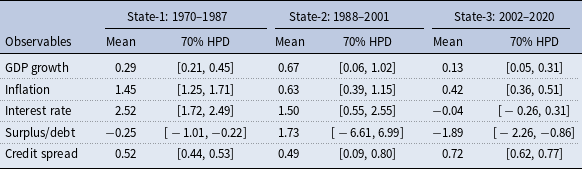
quarterly observables, including GDP growth rate, inflation rate, nominal interest rate, surplus-debt ratio, and credit spread. Online Appendix A contains details about the data construction and estimation procedure. Table 1 reports the estimated population means for the observables conditional on each state. Panel A of Figure 2 depicts the debt-GDP ratio (left axis) against the posterior probability series for each state (right axis) over the full sample 1970–2020. It clearly identifies that the first break occurs at 1987 or so and the second at around 2001. Accordingly, the model uncovers three fiscal states that fall more broadly into two defining phases of a long-term debt cycle—phase-D and phase-S—as described below.
Posterior estimates of state-dependent population means

Table 1. Long description
A table titled Posterior estimates of state-dependent population means. The table compares economic observables across three distinct states: State-1 (1970-1987), State-2 (1988-2001), and State-3 (2002-2020). The table has five rows and six columns. The columns are labeled as State-1: 1970-1987, State-2: 1988-2001, and State-3: 2002-2020. Each state column is further divided into Mean and 70% HPD. The rows are labeled with different economic observables: GDP growth, Inflation, Interest rate, Surplus/debt, and Credit spread. Row 1: GDP growth, Mean: 0.29, 70% HPD: [0.21, 0.45], Mean: 0.67, 70% HPD: [0.06, 1.02], Mean: 0.13, 70% HPD: [0.05, 0.31]. Row 2: Inflation, Mean: 1.45, 70% HPD: [1.25, 1.71], Mean: 0.63, 70% HPD: [0.39, 1.15], Mean: 0.42, 70% HPD: [0.36, 0.51]. Row 3: Interest rate, Mean: 2.52, 70% HPD: [1.72, 2.49], Mean: 1.50, 70% HPD: [0.55, 2.55], Mean: -0.04, 70% HPD: [-0.26, 0.31]. Row 4: Surplus/debt, Mean: -0.25, 70% HPD: [-1.01, -0.22], Mean: 1.73, 70% HPD: [-6.61, 6.99], Mean: -1.89, 70% HPD: [-2.26, -0.86]. Row 5: Credit spread, Mean: 0.52, 70% HPD: [0.44, 0.53], Mean: 0.49, 70% HPD: [0.09, 0.80], Mean: 0.72, 70% HPD: [0.62, 0.77].
Notes: For each VAR parameter draw, I compute the implied state-dependent population means for observables. Posterior means and 70% highest probability density (HPD) intervals are computed using 10,000 posterior draws. Interest rate is measured by the shadow federal funds rate and thus can drop into negative territory. All observables are non-annualized.
Phase-D (“D” for “deficit”) captures the common properties of state-1 (1970–1987) and state-3 (2002–2020). It prevails when the fiscal stance becomes extravagant and the economy experiences a prolonged period of fiscal imbalance (left axis of Panel B). The resulting increases in the debt-GDP ratio will unfold over many years, typically starting small and then gaining momentum. Prominent fiscal events in this phase include: the Ford tax cut and tax rebate of 1975 when the surplus-debt ratio reached its postwar low; the Reagan Economic Recovery Plan of 1981 when the debt-GDP ratio was picking up from its postwar low in the early 1980s; the Bush Economic Growth and Tax Relief Reconciliation Act of 2001 and the Jobs and Growth Tax Relief Reconciliation Act of 2003 when the debt-GDP ratio was rising again in the early 2000s; and more recently, the Obama American Recovery and Reinvestment Act of 2009 and the Trump Coronavirus Aid, Relief, and Economic Security Act of 2020 when the debt-GDP ratio was accelerating.
Phase-D also features elevated financial distress as can be seen from several spikes in the credit spread under state-1 and state-3 (right axis of Panel B), implying a high market demand for Treasuries. As alluded to earlier, fiscal inflation did not materialize over the past two decades because investors’ unquenchable demand for Treasuries soaked up any of its excess supply. While the long-run inflation can take both high and low values (see Table 1), the short-run inflation turns out to be positively correlated with the underlying fiscal stance (Panels C and E) in phase-D, which is somewhat contrary to the conventional belief that a lack of fiscal discipline can be inflationary.
Phase-S (“S” for “surplus”), on the other hand, summarizes the properties of state-2 (1988–2001). It is in place when the fiscal authority is virtuous and the economy experiences a period of sustained and growing primary surpluses, such as the latter part of the 1990s during the Clinton administration. In contrast to phase-D, it features on average higher output growth, modest inflation and interest rate, stabilized debt-GDP ratio, and lower credit spread (see Table 1), suggesting a low market demand for Treasuries. Moreover, the short-run inflation is negatively correlated with the prevailing fiscal stance (Panel D).
In a nutshell, an archetypal debt cycle consists of alternating phases of persistent deficits (phase-D) and surpluses (phase-S) joint with alternating patterns of inflation and fiscal stance. In line with these key features found in the data, I present a structural model that draws on the fiscal theory literature in the next section. To determine the price level, for example, the central bank can set an interest rate target to anchor expected inflation, while news about the present value of fiscal surpluses drives unexpected inflation. This model is simple enough to admit an analytical characterization, yet rich enough to illustrate the general mechanism at work. It addresses the following positive questions: If inflation depends importantly on the fiscal behavior and financial market conditions, what coordination of monetary and fiscal policy can jointly determine inflation and stabilize debt? Can permanent fiscal deficits be sustained in the long run? And how does inflation respond to monetary and fiscal policy shocks?
3. A structural interpretation
The model’s essential elements include: an infinitely lived representative household endowed each period with an amount of non-durable goods
 $Y_t=g^ty$
, which grow at a constant rate
 $g$
; a cashless economy with government-issued nominal one-period bonds
 $B_t$
that sell at price
 $1/R_t$
, where
 $R_t$
is the monetary policy instrument; the household has a time-varying preference for the various benefits derived from the convenience services of government debt [see, e.g., Fisher (Reference Fisher2015)]; the price level
 $P_t$
is defined as the rate at which bonds exchange for goods; lump-sum taxes (net of transfer payments)
 $T_t$
and zero government spending so that consumption equals output,
 $C_t=Y_t$
, and net taxes equal primary surpluses,
 $T_t=S_t$
; a monetary authority and a fiscal authority.
3.1 Steady-state analysis
The household chooses a sequence of consumption and bonds
 $\{C_t,B_t\}$
to maximize the expected lifetime utility
 \begin{gather*} \mathbb{E}_0\sum _{t=0}^{\infty }\beta ^tU(c_t,b_t) \end{gather*}
subject to the period-by-period budget constraint
 \begin{gather*} P_tC_t+\frac {B_t}{R_t}+T_t=P_tY_t+B_{t-1} \end{gather*}
taking
 $P_t$
and
 $B_{t-1}$
as given. Here
 $\beta \in (0,1)$
is the discount factor,
 $c_t=C_t/g^t$
is the detrended real consumption,
 $b_t=B_t/(g^tR_tP_t)$
is the detrended real debt at the beginning of period
 $t$
, and
 $\mathbb{E}_t$
represents the conditional expectation given information available at time
 $t$
. Since they are inconsequential for the main result but ease the algebraic exposition, I assume that consumption and debt are additively separable in the preference, i.e.,
 $U(c_t,b_t)=u(c_t)+v(b_t)$
, where
 $u(c_t)=\ln c_t$
,
 $v(b_t)=v_t\ln b_t$
, and
 $v_t\geqslant 0$
is a scalar that determines the steady-state debt-output ratio.Footnote
3
The private sector’s optimization problem leads to the following first-order condition
 \begin{gather*} \mathbb{E}_t[M_{t+1,t}R_t]=1,\qquad M_{t+1,t}=\beta \frac {1}{1-v'(b_t)/u'(c_t)}\frac {u'(c_{t+1})}{u'(c_t)}\frac {1}{g\pi _{t+1}} \end{gather*}
where
 $M_{t+1,t}$
is the stochastic discount factor for pricing any nominal contingent claims, and
 $\pi _t=P_t/P_{t-1}$
is the inflation between periods
 $t-1$
and
 $t$
.Footnote
4
Let a variable without a time subscript denote its steady-state value. Imposing the goods market clearing condition
 $c=y$
, the steady-state real interest rate is given by
 \begin{gather} r=\frac {R}{\pi }=\frac {g\lambda }{\beta },\qquad \lambda =1-\frac {v}{b/y} \end{gather}
where
 $b/y$
is the debt-output ratio, and
 $\lambda =R/R^*\in (0,1]$
is the discount on the nominal interest rate
 $R$
relative to its value
 $R^*=g\pi /\beta$
in the absence of a preference for holding risk-free government bonds (i.e.,
 $v=0$
). It follows from equation (3.1) that a lower value of
 $\lambda$
(or higher
 $v$
) raises the marginal benefits of saving and thus increases the household’s demand for convenience. In particular, when
 $\lambda$
is smaller than the household’s time discount rate, this will drive the steady-state real return on debt below the economy’s growth rate, i.e.,
 $r\lt g$
if
 $\lambda \lt \beta$
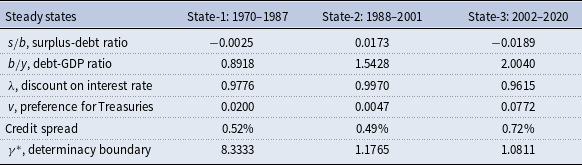
. Table 2 reports the calibrated values of
 $(\lambda ,v)$
under each of the three U.S. fiscal states.
Calibrated steady states and implied parameter values

Table 2. Long description
A table comparing economic ratios and parameters across three U.S. fiscal states from 1970 to 2020. The table has four rows and seven columns. The columns are labeled as follows: Steady states, State-1: 1970-1987, State-2: 1988-2001, State-3: 2002-2020. The rows are labeled with the following economic parameters: s/b, surplus-debt ratio, b/y, debt-GDP ratio, λ, discount on interest rate, ν, preference for Treasuries, Credit spread, and γ*, determinacy boundary. Row 1: s/b, surplus-debt ratio, -0.0025, 0.0173, -0.0189. Row 2: b/y, debt-GDP ratio, 0.8918, 1.5428, 2.0040. Row 3: λ, discount on interest rate, 0.9776, 0.9970, 0.9615. Row 4: ν, preference for Treasuries, 0.0200, 0.0047, 0.0772. Row 5: Credit spread, 0.52 percent, 0.49 percent, 0.72 percent. Row 6: γ*, determinacy boundary, 8.3333, 1.1765, 1.0811.
Notes:
 $\beta =0.98$
is used in calibration. Steady states of surplus-debt ratio and credit spread correspond to their posterior estimates reported in Table 1. GDP is non-annualized in debt-GDP ratio.
Turning to the public sector, any policy choice must satisfy the flow government budget constraint
 \begin{gather*} b_t+s_t=\frac {b_{t-1}R_{t-1}}{g\pi _t} \end{gather*}
where
 $s_t=S_t/(g^tP_t)$
is the detrended real primary surplus. It follows that the steady-state surplus-debt ratio equals to the growth-adjusted net real interest rate
 \begin{gather} \frac {s}{b}=\frac {r}{g}-1=\frac {\lambda }{\beta }-1 \end{gather}
where the second equality holds due to equation (3.1). Particularly, insofar as this real return on debt stays negative (i.e.,
 $\lambda \lt \beta$
), the real value of debt becomes self-stabilizing even with the fiscal authority running some perpetual budget deficits.
Some long-run implications of equations (3.1)–(3.2) for the observables are worth highlighting. First, the actual surplus-debt ratio must approximately average to the net real return on debt over time. Second, a high market valuation of Treasuries may push the real interest rate below the GDP growth rate, making it possible for the fiscal authority to seek prolonged debt financing at a low real cost. Third, for a given choice of the policy instruments
 $(R,s)$
, a stronger preference for Treasuries can effectively alleviate the inflationary pressure of rising debt-GDP ratio even with a lack of fiscal discipline. These implications find corroborating evidence as documented earlier. Lastly, Table 2 suggests that periods of tightened financial conditions, such as in state-1 and state-3, also come with strong appetite for Treasuries, so the ranking of the calibrated values of
 $v$
aligns well with that of the credit spread estimates.
3.2 Model dynamics
Let
 ${\hat{\kern-1pt x}}\equiv (x_t-x)/|x|$
denote the percent deviation of a variable
 $x_t$
from its steady state
 $x$
.Footnote
5
A linear approximation to the model’s equilibrium conditions leads to the following bare-bones FTPL equations. The household’s optimizing behavior implies a bond demand curve
 \begin{gather} (1-\lambda )(\hat {b}_t-\epsilon _t^{v})=\lambda (\hat {R}_t-\mathbb{E}_t\hat {\pi }_{t+1}) \end{gather}
linking the real debt
 $\hat {b}_t$
to the real rate
 $\hat {r}_t=\hat {R}_t-\mathbb{E}_t\hat {\pi }_{t+1}$
, where
 $\hat {v}_t=\epsilon _t^{v}$
is a bond preference shock. The monetary authority reacts to inflation
 \begin{gather} \hat {R}_t=\alpha \hat {\pi }_t+\epsilon _t^R \end{gather}
where
 $\alpha \geqslant 0$
and
 $\epsilon _t^R$
is a monetary policy shock. In addition, the fiscal authority responds to lagged debt
 \begin{gather} \hat {\kern-1pt s}_t=\gamma \hat {b}_{t-1}+\epsilon _t^s \end{gather}
where
 $\gamma \geqslant 0$
and
 $\epsilon _t^s$
is a fiscal policy shock. Lastly, the government budget constraint is linearized as
 \begin{gather} \hat {b}_t=(\lambda /\beta )(\hat {b}_{t-1}+\hat {R}_{t-1}-\hat {\pi }_t)-|\lambda /\beta -1|\,\hat {\kern-1pt s}_t \end{gather}
where the real value of outstanding debt at the beginning of period
 $t$
,
 $\hat {b}_{t-1}+\hat {R}_{t-1}-\hat {\pi }_t$
, is determined in equilibrium at time
 $t$
.
Together with the steady-state equilibrium relations in equations (3.1)–(3.2), equations (3.3)–(3.6) constitute a system of expectational difference equations in the variables
 $\{\hat {\pi }_t,\hat {b}_t,\hat {R}_t,\,\hat {\kern-1pt s}_t\}$
. In the absence of bond preference (
 $\lambda =1$
), the steady-state budget is always in surplus, and the monetary and fiscal authorities can coordinate to determine inflation and stabilize debt in two manners. Under the conventional monetarist paradigm, active monetary policy controls inflation by raising nominal interest rate more than one for one with inflation (
 $\alpha \gt 1$
), and passive fiscal policy stabilizes debt by sufficiently adjusting primary surpluses (
 $\gamma \gt 1$
). Under the fiscal theory, policy roles are completely reversed with passive monetary policy stabilizing debt by responding weakly to inflation (
 $0\leqslant \alpha \lt 1$
), and active fiscal policy determining inflation by reacting weakly to debt (
 $0\leqslant \gamma \lt 1$
). In what follows, I focus on the model dynamics under the fiscal theory with bond preference (
 $0\lt \lambda \lt 1$
) because the overall fiscal stance in the U.S. seems profligate.
Assume that all shocks
 $(\epsilon _t^R,\epsilon _t^s,\epsilon _t^{v})$
are serially uncorrelated with bounded supports. To simplify the exhibition, substitute equations (3.4)–(3.5) into equations (3.3) and (3.6) to eliminate
 $(\hat {R}_t,\,\hat {\kern-1pt s}_t)$
. The following proposition characterizes the local determinacy and closed-form solution for
 $(\hat {\pi }_t,\hat {b}_t)$
.
Proposition 3.1.
For
 $\lambda \neq \beta$
, define
 $\gamma ^*=(1-\beta )/|\lambda -\beta |$
. Given a passive monetary policy
 $\alpha \in [0,1)$
and an active fiscal policy
 $\gamma \in [0,\gamma ^*)$
, there exist two disjoint regions of the parameter range
 $\lambda \in (0,1]$
within which the model admits a locally unique, bounded equilibrium:
-
1. Region-D (permanent deficits):
 $\lambda \in (0,\beta )$
;
-
2. Region-S (permanent surpluses):
$\lambda \in (\beta ,1]$
.


Under both regions, the unique equilibrium inflation and real debt take the form of
 \begin{gather} \begin{bmatrix} \hat {\pi }_t \\ \hat {b}_t \end{bmatrix}= \begin{bmatrix} \dfrac {L}{1-\alpha L} & -\dfrac {|\beta /\lambda -1|}{1-\alpha L} & \dfrac {\lambda -1}{\lambda (1+\gamma \beta -\gamma \lambda )}\dfrac {\beta -(\lambda +\gamma \beta -\gamma \lambda )L}{1-\alpha L} \\ 0 & 0 & \dfrac {1-\lambda }{1+\gamma \beta -\gamma \lambda } \end{bmatrix} \begin{bmatrix} \epsilon _t^R \\ \epsilon _t^s \\ \epsilon _t^{v} \end{bmatrix} \end{gather}
where
 $L$
denotes the lag operator, i.e.,
 $L^k\, {\hat{\kern-1pt x}}_t={\hat{\kern-1pt x}}_{t-k}$
.
Several remarks about Proposition 3.1 are in order. First, inflation follows an autoregressive moving average (ARMA) process of order
 $(1,1)$
, and a passive monetary policy ensures that its autoregressive component remains stable. On the other hand, real debt only responds to the bond preference shock because its real return
 $\hat {r}_t$
is unaffected by the policy shocks in this endowment environment. Second, consistent with phase-D (resp. phase-S) of a debt cycle, the steady-state equilibrium features a negative (resp. positive) real return on debt with permanent deficits (resp. surpluses) under the determinacy region-D (resp. region-S). Third, compared to the special case of
 $\lambda =1$
, the calibrated values of
 $\lambda$
extend the determinacy boundary of fiscal policy beyond unity (i.e.,
 $\gamma ^*\gt 1$
), implying that a broader range of policy responses are indeed consistent with an active fiscal policy (see Table 2).Footnote
6
Although not explored here, it follows that an active monetary policy would otherwise require a more-passive-than-usual fiscal policy in place, which may be practically difficult to implement in highly indebted economies. See Online Appendix B for a proof of the proposition.
To understand how exogenous shocks are transmitted to influence endogenous variables, it is useful to rewrite the ARMA solution in equation (3.7) as linear combinations of all past and present shocks. Without loss of generality, I consider a special case of active fiscal policy that sets primary surpluses or deficits exogenously, i.e.,
 $\gamma =0$
. Then inflation follows
 \begin{gather} \hat {\pi }_t=\sum _{k=1}^{\infty }\underbrace {\alpha ^{k-1}}_{\geqslant 0}\epsilon _{t-k}^R+\sum _{k=0}^{\infty }\underbrace {-|\beta /\lambda -1|\alpha ^k}_{\leqslant 0}\epsilon _{t-k}^s+\underbrace {(\lambda -1)(\beta /\lambda )}_{\leqslant 0}\epsilon _t^{v}+\sum _{k=1}^{\infty }(\lambda -1)(\alpha \beta /\lambda -1)\alpha ^{k-1}\epsilon _{t-k}^{v} \end{gather}
and real debt follows
 \begin{gather} \hat {b}_t=\underbrace {(1-\lambda )}_{\geqslant 0}\epsilon _{t}^{v}. \end{gather}
The economic interpretations of equations (3.8)–(3.9) arise from a ubiquitous relation in any dynamic macro model—the real value of government liabilities must equal to the present value of current and expected future primary surpluses
 \begin{gather} \hat {b}_{t-1}+\hat {R}_{t-1}-\hat {\pi }_t=|1-\beta /\lambda |\sum _{k=0}^{\infty }\beta ^k\mathbb{E}_t\,\hat {\kern-1pt s}_{t+k} \end{gather}
where
 $\hat {b}_{t-1}$
and
 $\hat {R}_{t-1}$
are predetermined in period
 $t$
.Footnote
7
This relation holds in any determinate bounded equilibrium, regardless of the policy rules in place.
Given an exogenous path for primary surpluses
 $\{\,\hat {\kern-1pt s}_t\}$
, equation (3.10) makes clear that an increase in government debt generates a positive wealth effect which in turn transmits into higher inflation. For example, consider the effects of a monetary contraction. A positive realization of
 $\epsilon ^R_t$
lowers the price of newly-issued bonds at period
 $t$
and induces the household to substitute consumption into more bond. But this substitution effect is entirely offset by the wealth effect due to the household’s anticipation of no future tax increases to finance the rising government debt. As a result, the contemporaneous aggregate demand and hence inflation stay unchanged as in equation (3.8). In the absence of future fiscal adjustments, however, inflation must rise in the subsequent periods to devalue the nominal government debt so as to ensure its sustainability, which is evident from equation (3.10).
The preceding wealth effect channel triggers a similar inflationary impact under a fiscal expansion. From equation (3.10) it can be seen that a deficit-financed fiscal stimulus (i.e., a negative realization of
 $\epsilon ^s_{t}$
) engenders higher current inflation as in equation (3.8). But why fiscal inflation has largely remained nil in the data over the past twenty years or so? Recall from Figure 1 that periods of fiscal stress are oftentimes accompanied by tightened credit conditions. Now flight to safety comes into play. A shift in the risk appetite towards safety and liquidity (i.e., a positive realization of
 $\epsilon _t^{v}$
) induces investors to happily hold onto more Treasuries as in equation (3.9). As such the aggregate demand for goods decreases and hence inflation falls as in equation (3.8). Under the determinacy region-D (i.e., with lower values of
 $\lambda$
), this deflationary effect may outweigh fiscal inflation, thereby producing a positive correlation between inflation and fiscal stance that characterizes phase-D of a debt cycle. The opposite correlation may arise under the determinacy region-S (i.e., with higher values of
 $\lambda$
), a pattern reminiscent of phase-S of a debt cycle.
Going forward, the fiscal theory warns that the reemergence of inflation in the post-pandemic era needs to be tamed by coordinated monetary and fiscal policy. Meanwhile, the declining power of dollars as the leading reserve currency, which weakens investors’ appetite for Treasuries, will undoubtedly make this task more challenging. The amount of dollar-denominated debt in foreigners’ portfolio are now disproportionately large in relation to the size and importance of the U.S. economy. At some point it will become difficult to find adequate demand for Treasuries without the Federal Reserve having to monetize some of the debt. Indeed, this liquidity issue already surfaced at the time of writing as the 10-year Treasury yield topped 4.2% for the first time since 2008. The roughly $1 trillion of U.S. debt that China holds, though a small percent of the overall $30 trillion outstanding, is also at risk due to the U.S.-China geopolitical tensions. Moreover, the possibility of Saudi Arabia pricing some of its oil sales to China in yuan could potentially dent the dollar’s dominance in global petroleum markets. Finally, many countries are actively developing alternative payment systems, such as cryptocurrency and central bank digital currency, which may further make the world less dollarized.
4. DSGE estimation results
The analytical model presented above provides a useful benchmark for understanding the basic economic forces at work. However, to assess the quantitative importance of bond preference, we need a more elaborate framework that can be taken to the data. This section estimates a prototypical dynamic stochastic general equilibrium (DSGE) model that extends the baseline model along several dimensions while preserving its key fiscal theory features.
4.1 DSGE model
The extended model departs from the endowment economy by incorporating several new Keynesian elements. First, monopolistic competition and nominal price rigidities generate a short-run inflation-output tradeoff captured by the new Keynesian Phillips curve. Second, households make optimal consumption-savings decisions subject to a standard dynamic IS equation. Third, the model allows for persistent technology trend and price markup shocks that drive output fluctuations. Fourth and most importantly, the bond preference parameter is time-varying and stochastic, capturing the notion that investors’ appetite for Treasuries fluctuates with economic and financial conditions.
A linear approximation of the model’s equilibrium conditions yields
 \begin{align} \text{Dynamic IS equation:} && \hat {y}_t&=\mathbb{E}_t\hat {y}_{t+1}+\hat {\lambda }_t-\hat {R}_t+\mathbb{E}_t\hat {\pi }_{t+1}+\mathbb{E}_t\hat {z}_{t+1}& \end{align}
 \begin{align} \text{Nominal rate discount:} && \hat {\lambda }_t&=(1-1/\lambda )(\hat {v}_t+\hat {y}_t-\hat {b}_t)& \end{align}
 \begin{align} \text{New Keynesian Phillips curve:} && \hat {\pi }_t&=\beta \mathbb{E}_t\hat {\pi }_{t+1}+\kappa \hat {y}_t+\kappa \hat {u}_t& \end{align}
 \begin{align} \text{Monetary policy:} && \hat {R}_t&=\rho _R\hat {R}_{t-1}+(1-\rho _R)(\alpha _{\pi }\hat {\pi }_t+\alpha _y\hat {y}_t)+\epsilon _t^R& \end{align}
 \begin{align} \text{Fiscal policy:} && \,\hat {\kern-1pt s}_t&=\rho _s\,\hat {\kern-1pt s}_{t-1}+(1-\rho _s)\gamma \hat {b}_{t-1}+\epsilon _t^s& \end{align}
 \begin{align} \text{Government budget constraint:} && \hat {b}_t&=(\lambda /\beta )(\hat {b}_{t-1}+\hat {R}_{t-1}-\hat {\pi }_t-\hat {z}_t)-|\lambda /\beta -1|\,\hat {\kern-1pt s}_t& \end{align}
 \begin{align} \text{Technology trend shock:} && \hat {z}_t&=\rho _z\hat {z}_{t-1}+\epsilon _t^z & \end{align}
 \begin{align} \text{Markup shock:} && \hat {u}_t&=\rho _u\hat {u}_{t-1}+\epsilon _t^u & \end{align}
 \begin{align} \text{Bond preference shock:} && \hat {v}_t&=\rho _{v}\hat {v}_{t-1}+\epsilon _t^{v} & \end{align}
where
 $\kappa$
is the slope of the Phillips curve,
 $\{\rho _R,\rho _s\}$
measure the persistence of policy instruments, and
 $\{\rho _z,\rho _u,\rho _v\}$
govern the persistence of structural shocks. In the absence of bond preference (
 $\lambda =1$
), the above system incorporates the key building blocks of the standard new Keynesian model and captures the core dynamics of most monetary DSGE models.
As a counterpart to the time-varying volatility in the change-point VAR analysis, I adopt a flexible specification for the structural shock innovations that follow a multivariate Student-
 $t$
distribution with stochastic volatility, i.e.,
 $\epsilon _t\sim t_{\nu }(0,\Sigma _t)$
. Here
 $\nu$
denotes the degrees of freedom and
 $\Sigma _t$
is a diagonal matrix with the time-varying volatility
 $\sigma _{i,t}^2$
for each individual innovation
 $\epsilon _t^i$
on its main diagonal, where
 $i\in \{R,s,z,u,v\}$
refers to the shock index. This specification serves two purposes. First, the Student-
 $t$
distribution accommodates occasional large shocks (fat tails) that are prevalent during periods of financial and fiscal stress. Second, stochastic volatility allows shock variances to evolve over time, reflecting changes in economic uncertainty and policy regimes.
For estimation convenience, it is useful to represent each element of
 $\epsilon _t$
as a mixture of normals by introducing a Gamma distributed random variable
 $\lambda _t$
,
 \begin{gather} \epsilon _{t}^i=\lambda _t^{-1/2}e^{h_{t}^i/2}\varepsilon _{t}^i,\qquad \lambda _t\sim \mathbb{G}\left (\frac {\nu }{2},\frac {\nu }{2}\right ),\qquad \varepsilon _{t}^i\sim \mathbb{N}(0,1) \end{gather}
The mixture representation in equation (4.10) facilitates Bayesian inference by treating
 $\lambda _t$
as an additional latent variable in the posterior sampling algorithm. For further realism, the logarithm of each volatility
 $h_{t}^i=\ln \sigma _{i,t}^2$
evolves as a stationary
 $(|\phi _i|\lt 1)$
autoregressive process
 \begin{gather} h_{t}^i=(1-\phi _i)\mu _i+\phi _ih_{t-1}^i+\eta _{t}^i,\qquad \eta _{t}^i\sim \mathbb{N}(0,\omega _i^2) \end{gather}
where
 $\mu _i$
governs the unconditional mean of log-volatility,
 $\phi _i$
controls its persistence, and
 $\omega _i^2$
determines the variability of volatility shocks. The stochastic volatility specification in equation (4.11) has proven to substantially improves model fit and allows for richer shock dynamics.
The observable variables are linked to the model variables through
 \begin{gather} \begin{pmatrix} \text{YGR}_t \\ \text{INF}_t \\ \text{INT}_t \\ \text{SBR}_t \end{pmatrix}= \begin{pmatrix} \bar {g} \\ \bar {\pi } \\ \bar {\pi }+\bar {r} \\ 100(\lambda /\beta -1) \end{pmatrix}+100 \begin{pmatrix} \hat {y}_t-\hat {y}_{t-1}+\hat {z}_t \\ \hat {\pi }_t \\ \hat {R}_t \\ |\lambda /\beta -1|(\,\hat {\kern-1pt s}_t-\hat {b}_t) \end{pmatrix} \end{gather}
where
 $\bar {g}=100(g-1)$
,
 $\bar {r}=\bar {g}+100(\lambda /\beta -1)$
, and
 $\bar {\pi }=100(\pi -1)$
. The measurement equation (4.12) map output growth rate (YGR), inflation rate (INF), nominal interest rate (INT), and surplus-debt ratio (SBR) to their model counterparts. These four observables match those used in the change-point VAR analysis to ensure consistency across the two approaches.
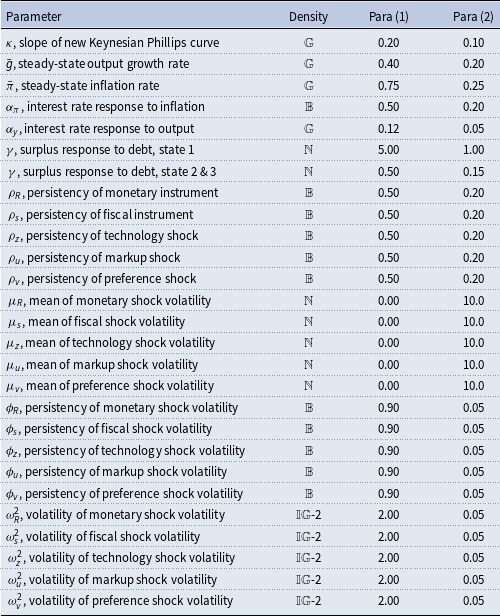
I estimate the model separately for each of the three subsamples identified by the change-point VAR: state-1 (1970:Q1–1987:Q4), state-2 (1988:Q1–2001:Q4), and state-3 (2002:Q1–2020:Q4). This subsample approach allows all parameters to vary across states, providing a flexible characterization of how monetary-fiscal interactions have evolved over time. Table 3 summarizes the prior distributions for all model parameters. Most priors are relatively diffuse to let the data speak, but several choices deserve comment. For the Phillips curve slope
 $\kappa$
, we center the prior at 0.20, consistent with estimates from the new Keynesian literature suggesting moderate price stickiness. The steady-state output growth rate
 $\bar {g}$
and inflation rate
 $\bar {\pi }$
are centered at values close to their sample averages. The monetary policy parameter
 $\alpha _{\pi }$
is specified with a Beta prior centered at 0.50, reflecting our focus on passive monetary policy (
 $\alpha _{\pi }\lt 1$
) under the fiscal theory. Crucially, the fiscal policy parameter
 $\gamma$
receives state-dependent priors informed by the calibration exercise in Table 2. For state-1 (1970–1987), the prior is centered at 5.00, well within the determinacy boundary
 $\gamma ^*=8.33$
. For state-2 (1988–2001) and state-3 (2002–2020), the prior is centered at 0.50, reflecting the lower determinacy thresholds (
 $\gamma ^*=1.18$
and
 $1.08$
, respectively) implied by higher debt-GDP ratios in these periods. This state-dependent prior specification ensures that the estimated fiscal policy rules remain consistent with the fiscal theory throughout all three states.
Prior distributions of model parameters

Table 3. Long description
A table with 30 rows and 4 columns. The columns are labeled Parameter, Density, Para (1), and Para (2). The table lists various parameters related to economic models, their density types, and two associated values. Row 1: κ, slope of new Keynesian Phillips curve, G, 0.20, 0.10. Row 2: g Macron, steady-state output growth rate, G, 0.40, 0.20. Row 3: π Macron, steady-state inflation rate, G, 0.75, 0.25. Row 4: α_π, interest rate response to inflation, B, 0.50, 0.20. Row 5: α_y, interest rate response to output, G, 0.12, 0.05. Row 6: γ_1, surplus response to debt, state 1, N, 5.00, 1.00. Row 7: γ_2, surplus response to debt, state 2 & 3, N, 0.50, 0.15. Row 8: ρ_R, persistency of monetary instrument, B, 0.50, 0.20. Row 9: ρ_S, persistency of fiscal instrument, B, 0.50, 0.20. Row 10: ρ_z, persistency of technology shock, B, 0.50, 0.20. Row 11: ρ_μ, persistency of markup shock, B, 0.50, 0.20. Row 12: ρ_ψ, persistency of preference shock, B, 0.50, 0.20. Row 13: μ_R, mean of monetary shock volatility, N, 0.00, 10.0. Row 14: μ_S, mean of fiscal shock volatility, N, 0.00, 10.0. Row 15: μ_z, mean of technology shock volatility, N, 0.00, 10.0. Row 16: μ_μ, mean of markup shock volatility, N, 0.00, 10.0. Row 17: μ_ψ, mean of preference shock volatility, N, 0.00, 10.0. Row 18: φ_R, persistency of monetary shock volatility, B, 0.90, 0.05. Row 19: φ_S, persistency of fiscal shock volatility, B, 0.90, 0.05. Row 20: φ_z, persistency of technology shock volatility, B, 0.90, 0.05. Row 21: φ_μ, persistency of markup shock volatility, B, 0.90, 0.05. Row 22: φ_ψ, persistency of preference shock volatility, B, 0.90, 0.05. Row 23: ω_R^2, volatility of monetary shock volatility, IG-2, 2.00, 0.05. Row 24: ω_S^2, volatility of fiscal shock volatility, IG-2, 2.00, 0.05. Row 25: ω_z^2, volatility of technology shock volatility, IG-2, 2.00, 0.05. Row 26: ω_μ^2, volatility of markup shock volatility, IG-2, 2.00, 0.05. Row 27: ω_ψ^2, volatility of preference shock volatility, IG-2, 2.00, 0.05. Row 28: Notes: Para (1) and Para (2) refer to the means and standard deviations for Gamma (G), Beta (B), and Normal (N) distributions; and for the Inverse-Gamma Type-II (IG-2) distribution with density. The effective prior is truncated at the boundary of the determinacy region. Row 29: κ, slope of new Keynesian Phillips curve, G, 0.20, 0.10. Row 30: g Macron, steady-state output growth rate, G, 0.40, 0.20.
Notes: Para (1) and Para (2) refer to the means and standard deviations for Gamma (
 $\mathbb{G}$
), Beta (
 $\mathbb{B}$
), and Normal (
 $\mathbb{N}$
) distributions;
 $\alpha$
and
 $\beta$
for the Inverse-Gamma Type-II (
 $\mathbb{IG}$
-2) distribution with density
 $p(\omega ^2)\propto (\omega ^2)^{-\alpha -1}\exp {({-}\frac {\beta }{\omega ^2})}$
. The effective prior is truncated at the boundary of the determinacy region.
The persistence parameters
 $\{\rho _R,\rho _s,\rho _z,\rho _u,\rho _v\}$
receive symmetric Beta priors centered at 0.50. For the stochastic volatility processes, the unconditional means
 $\mu _i$
have diffuse Normal priors centered at zero (in log scale), the persistence parameters
 $\phi _i$
have tight Beta priors centered at 0.90 (reflecting typical volatility persistence in macroeconomic data), and the volatility parameters
 $\omega _i^2$
have Inverse-Gamma priors with small scale parameters to favor moderate volatility of volatility.
4.2 Posterior estimates
I follow the Bayesian estimation procedure detailed in Chib et al. (Reference Chib, Shin and Tan2023) to obtain 10,000 draws from the joint posterior distribution of all model parameters and latent variables. The degrees of freedom for the Student-
 $t$
distribution is set at
 $\nu =5$
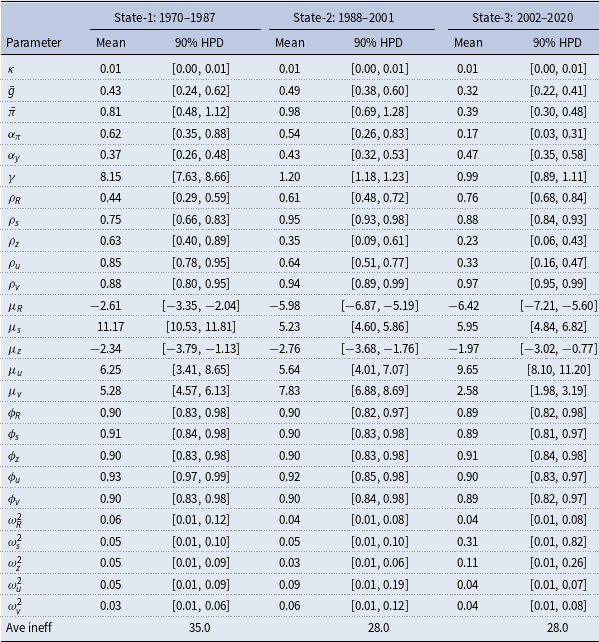
to allow for fat-tailed shocks. Table 4 reports the posterior means and 90% highest probability density (HPD) intervals for all model parameters across the three states. Convergence diagnostics confirm that the chains mix well and explore the posterior distribution adequately, as evidenced by the low inefficiency factors.
Posterior estimates of model parameters

Table 4. Long description
A table with three columns and twenty rows. The columns are labeled State-1: 1970-1987, State-2: 1988-2001, and State-3: 2002-2020. Each column contains the mean and 90% highest probability density (HPD) intervals for various model parameters. The rows are labeled with different parameters such as kappa, gamma, pi, alpha, and others. Each row provides the mean and 90% HPD intervals for the respective parameter across the three states. The table also includes a note explaining the computation of the posterior means and HPD intervals using 10,000 posterior draws. The last row reports the average inefficiency factors for the three states.
Notes: The posterior means and 90% highest probability density (HPD) intervals are computed using 10,000 posterior draws. The last row reports the average of inefficiency factors defined as
 $1+2\sum _{j=1}^Kw(\,j/K)\rho (\,j)$
, where we set the truncation parameter
 $K=200$
and weight the autocorrelation function
 $\rho (\cdot )$
using the Parzen kernel
 $w(\cdot )$
.
Several findings emerge from these posterior estimates. First, the Phillips curve slope
 $\kappa$
is estimated to be quite flat (around 0.01) across all subsamples, implying substantial nominal rigidities. This finding aligns with microeconomic evidence on infrequent price adjustment and suggests that monetary policy has limited ability to exploit short-run inflation-output tradeoffs. On the other hand, the steady-state parameters
 $\bar {g}$
and
 $\bar {\pi }$
vary across states in ways consistent with the VAR analysis: output growth was relatively high in state-2 (0.49%) and lower in state-3 (0.32%), while inflation declined from 0.81% in state-1 to 0.39% in state-3.
Second, the monetary policy estimates reveal an important evolution in central bank behavior. The inflation response coefficient
 $\alpha _{\pi }$
averages around 0.60 in state-1 and state-2, but drops sharply to 0.17 in state-3. This pattern suggests that monetary policy became decidedly more passive during the post-2001 period, consistent with the zero lower bound constraint and unconventional policy measures adopted during and after the Great Recession. Meanwhile, the output response coefficient
 $\alpha _y$
remains fairly stable around 0.40 across all subsamples. The persistence of the policy rate
 $\rho _R$
increases from 0.44 in state-1 to 0.76 in state-3, indicating greater interest rate smoothing in recent decades.
Third, the fiscal policy parameter
 $\gamma$
exhibits the most dramatic variation across states, declining from 8.15 in state-1 to 1.20 in state-2 and 0.99 in state-3. This evolution reflects the combination of rising debt levels (which lower the determinacy boundary
 $\gamma ^*$
) and increasingly active fiscal policy. Notably, in state-3 the estimate of
 $\gamma =0.99$
sits just below the determinacy threshold of
 $\gamma ^*=1.08$
, suggesting that fiscal policy was operating near the boundary between determinacy and indeterminacy during 2002–2020. The fiscal instrument also exhibits high persistence (
 $\rho _s$
between 0.75 and 0.95), indicating that surplus adjustments occur gradually over time rather than in response to short-term fluctuations in debt.
Lastly, turning to the structural shock processes, the technology shock displays moderate persistence in state-1 (
 $\rho _z=0.63$
) but becomes less persistent in state-2 and state-3 (
 $\rho _z$
around 0.30). In contrast, the markup shock exhibits high persistence in state-1 (
 $\rho _u=0.85$
) but declines in later periods. Most strikingly, the bond preference shock becomes increasingly persistent over time, rising from
 $\rho _v=0.88$
in state-1 to
 $\rho _v=0.97$
in state-3. This finding suggests that shifts in investors’ appetite for Treasuries have become more long-lasting in recent decades, potentially reflecting structural changes in global financial markets and the growing importance of Treasuries as safe haven assets. The stochastic volatility estimates provide further insights into the changing nature of macroeconomic fluctuations. The unconditional mean of monetary shock volatility (
 $\mu _R$
) is lowest in state-3 (−6.42), consistent with reduced policy activism during the zero lower bound period. Conversely, the fiscal shock volatility (
 $\mu _s$
) is highest in state-1 (11.17), reflecting the turbulent fiscal policy of the 1970s–1980s. The technology shock volatility (
 $\mu _z$
) remains relatively stable across states, while the markup shock volatility (
 $\mu _u$
) spikes in state-3 (9.65), possibly capturing the effects of the Great Recession and subsequent recovery. The bond preference shock volatility (
 $\mu _v$
) is lowest in state-3 (2.58), which suggests that while bond preference shocks have become more persistent, their typical magnitude has diminished.
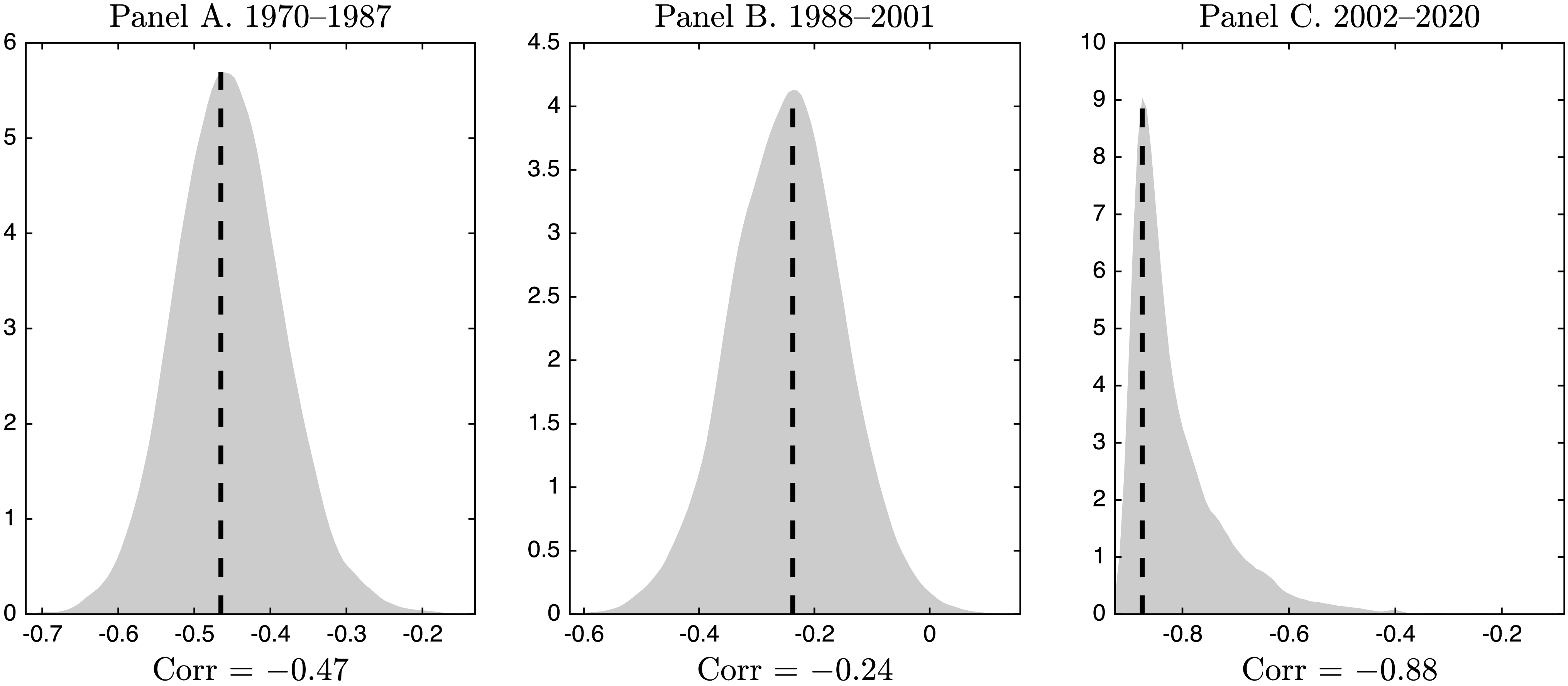
Posterior distributions of
 $\text{Corr}(\epsilon _t^s,\epsilon _t^v)$
.
Notes: Panels A–C plot subsample distributions of correlation between fiscal policy and bond preference shocks. Dashed lines denote posterior modes. Kernel smoothed densities are estimated using 10,000 posterior draws.

Figure 3. Long description
Three panels depict kernel smoothed density plots of the correlation between fiscal policy and bond preference shocks over different time periods. Panel A covers the years 1970 to 1987, Panel B covers 1988 to 2001, and Panel C covers 2002 to 2020. Each panel features a density plot with a horizontal axis ranging from -0.7 to -0.2 and a vertical axis indicating density values. Dashed lines in each panel denote the posterior modes of the distributions. Panel A shows a peak density around -0.47, Panel B around -0.24, and Panel C around -0.88. The distributions illustrate how the correlation between fiscal policy and bond preference shocks has evolved over these time periods.
A key insight of the analytical model is that flight-to-safety episodes—when investors’ demand for Treasuries surges—can generate deflationary effects that offset or even dominate the inflationary effects of fiscal expansions. This mechanism hinges on the correlation between fiscal policy shocks
 $\epsilon _t^s$
and bond preference shocks
 $\epsilon _t^v$
. To investigate this channel empirically, I sample from the posterior distribution of structural shocks with the disturbance smoother of Durbin and Koopman (Reference Durbin and Koopman2002) and compute
 $\text{Corr}(\epsilon _t^s,\epsilon _t^v)$
for each subsample.
Figure 3 plots the posterior distributions of the shock correlation across the three states. Several striking patterns emerge. First, the correlation is robustly negative in all three subsamples, with posterior modes of
 $-0.47$
in state-1,
 $-0.24$
in state-2, and
 $-0.88$
in state-3. This finding provides strong support for the flight-to-safety mechanism: periods of fiscal stress (negative realizations of
 $\epsilon _t^s$
, i.e., deficit-financed fiscal expansions) systematically coincide with heightened demand for Treasuries (positive realizations of
 $\epsilon _t^v$
). Second, the correlation is most negative in state-1 and state-3, which correspond to phase-D (deficit) periods characterized by elevated credit spreads and financial market stress in the VAR analysis. Third, the correlation is less negative in state-2, which corresponds to phase-S (surplus) when credit spreads were low and the economy was growing robustly.
These empirical findings align well with the theoretical predictions from equation (3.8). Recall that a negative fiscal shock (i.e.,
 $\epsilon _t^s\lt 0$
, representing an unexpected deficit) raises inflation through the wealth effect channel, with the impact proportional to
 $|\beta /\lambda -1|$
. Simultaneously, a positive bond preference shock (i.e.,
 $\epsilon _t^v\gt 0$
, representing increased demand for Treasuries) lowers inflation, with the impact proportional to
 $(1-\lambda )(\beta /\lambda )$
. The net effect on inflation depends on which force dominates. When the correlation
 $\text{Corr}(\epsilon _t^s,\epsilon _t^v)$
is sufficiently negative and
 $\lambda$
is smaller than
 $\beta$
(as in state-1 and state-3), the deflationary bond preference effect can outweigh the inflationary fiscal effect, producing a positive correlation between inflation and the fiscal stance as documented in Panels C and E of Figure 2.
This mechanism provides a potential explanation for the “fiscal inflation puzzle” that motivates this article: why has inflation remained subdued over the past two decades despite massive fiscal expansions and rising debt? The answer may lie in the systematic correlation between fiscal policy and bond preference. During episodes of fiscal stress—the 1970s–1980s oil shocks and stagflation, the 2008–2009 financial crisis, and the 2020 pandemic—investors’ flight to the safety and liquidity of Treasuries generated powerful disinflationary forces that dampened or even reversed the inflationary impulse from deficit spending. Put differently, the convenience premium on Treasuries effectively subsidized fiscal expansions by reducing their inflationary cost.
5. Concluding remarks
Measures of U.S. fiscal stance reveal that the federal government has on average remained profligate. Yet a maintained assumption in many existing models of monetary and fiscal policy is that the government must run budget surplus in the long run. Several recent papers have proposed to relax this assumption, but few provide ample empirical relevance for the mechanisms established therein [see, e.g., Miao and Su (Reference Miao and Su2021) and Brunnermeier et al. (Reference Brunnermeier, Merkel and Sannikov2021), among others]. Using a change-point VAR model, this article estimates the time-varying properties of U.S. inflation and its fiscal stance while recognizing that investors value the extreme convenience services provided by Treasuries [see also Kliem et al. (Reference Kliem, Kriwoluzky and Sarferaz2016)]. A number of stylized features that characterize long-term debt cycles are obtained. Particularly, an archetypal debt cycle consists of alternating phases of persistent deficits and surpluses together with alternating patterns of inflation and fiscal stance. A related study that inspires this article is Dalio (Reference Dalio2022), who categorizes big debt cycles into two types—deflationary and inflationary—and provides a framework for understanding their mechanics.
In line with the estimated properties from the data, I provide a structural interpretation based on a simple FTPL-type model where the household has a preference for holding government bonds [see also Cochrane (Reference Cochrane2022) for a FTPL interpretation of historical episodes]. A strong appetite for bonds can drive the steady-state real interest rate below the economy’s growth rate, allowing the fiscal authority to run permanent deficits in the long run without posing an inflationary threat. When a standard passive monetary policy is in place, the determinacy region of this model admits a broad range of active fiscal policy that maps into different phases of a debt cycle. The closed-form solution derived herein is useful for understanding why fiscal inflation has largely remained benign over the past two decades.
To quantify these mechanisms, I extend the analysis to a DSGE model with new Keynesian features and estimate it separately for each of the three states identified by the change-point VAR. The Bayesian estimation reveals a key empirical regularity: fiscal policy shocks and bond preference shocks exhibit systematically negative correlations across all states. This finding provides direct empirical support for the flight-to-safety mechanism—when the government expands fiscal policy, private demand for Treasuries tends to rise simultaneously, generating disinflationary forces that partially offset the fiscal expansion. This systematic negative correlation helps explain the absence of significant fiscal inflation during the massive deficit expansions of the past two decades, particularly following the 2008 financial crisis.
Looking forward, these results carry important policy implications. The recent surge in inflation during 2021–2023 may signal a regime shift in which the negative correlation between fiscal policy and bond preference shocks has weakened or reversed. Such a shift could arise from several sources: the erosion of the dollar’s reserve currency status, reduced geopolitical stability that undermines Treasury hegemony, or simply satiation of investors’ appetite for government debt after decades of accumulation. If the flight-to-safety mechanism that suppressed fiscal inflation over the past two decades continues to weaken, the fiscal authority may need to exercise greater restraint, or the monetary authority may need to tolerate higher interest rates, to keep inflation anchored. The coordination of monetary and fiscal policy will become even more critical in an environment where the convenience premium on Treasuries is no longer a reliable buffer against fiscal inflation.
Supplementary material
The supplementary material for this article can be found at http://doi.org/10.1017/S1365100526101230.
Acknowledgments
This study originated in a conversation with David Rapach. I thank William Barnett (the editor), two anonymous referees, and participants of the 2023 Symposium of the Society for Nonlinear Dynamics & Econometrics in Orlando for helpful comments. Financial support from the Chaifetz School of Business summer research grant is also gratefully acknowledged.





 −0.3%

 Corr(ϵts,ϵtv)


 Open access

