

Introduction
Our paper examines what happens to performance when public services become social enterprises. Defined as businesses with social aims, social enterprises, often labelled ‘hybrids’, combine elements of the private and voluntary sectors (Battilana & Lee, Reference Battilana and Lee2014; Doherty et al., Reference Doherty, Haugh and Lyon2014). We focus on a subset of social enterprises; those operating in the English health and social care sector that have transitioned or ‘spun-out’ of the public sector (Hall et al., Reference Hall, Miller and Millar2016). Our analysis is underpinned by ‘publicness’ theories that to date have largely compared the performance of public and private organisations, with few considering the relative performance of hybrid organisational forms. We therefore seek to understand if introducing profit motives into public services through social enterprise mechanisms leads to better or worse performance.
In the 2000s, England saw a dedicated movement to spin-out government-run health and social care services into social enterprises. The policy rationale was that independently run social enterprises would perform well by maintaining the social focus of the public sector in their commitment to high-quality services, but combine this with the efficiencies, flexible management structures and innovative service arrangements of commercial businesses (Dearden-Phillips, Reference Dearden-Phillips2014; DH, 2009). These spin-outs received some research attention as they emerged (e.g. Addicott, Reference Addicott2011; Hall & Hazenberg, Reference Hazenberg and Hall2014; Hall et al., Reference Hall, Alcock and Millar2012; Hall et al., Reference Hall, Miller and Millar2012), but there has been little follow-up now that they are well-established as part of the health and social care sector.
In this study, we address this omission through a quantitative analysis of quality outcomes in spin-out social enterprises, comparing them to non-spin-out (independently created) social enterprises and government-run services operating in the health and/or social care sector. Our analysis is important for political, policy and theoretical reasons. First, some political actors remain sceptical about transferring health and social care services to independent providers, including social enterprises, as this separates them from the fiscal protections and quality assurances associated with public provision (Harel, Reference Harel2019; Teasdale, Reference Teasdale2012). Second, policy reform in health and social care remains ongoing, and by providing a better understanding of how spin-out and independent social enterprises perform, we offer policy and political guidance. Third, from a theoretical perspective, the often-called-upon theory of ‘publicness’ used to disentangle the performance of public-versus-private provision is less useful in its current dichotomous form for understanding hybrid social enterprises. Our empirically grounded quantitative research provides evidence for a ‘hybrid’ third path to understanding the publicness of service-providing organisations.
Our paper therefore begins to fill important gaps by seeking to answer the question: How does the service quality of spin-out social enterprises compare to government-run organisations and independent Community Interest Companies (CIC) social enterprises in English health and social care? To enable the robust comparison of social enterprises and government-run services, we draw on quality data collected by the government’s regulatory body, the Care Quality Commission (CQC), which undertakes regular inspections of all health and social care services using a standardised ratings protocol. Our data covers CQC inspections carried out between 2014 and 2017. Further, the widely reported difficulties of identifying social enterprises (Kerlin, Reference Kerlin2006; Teasdale, Reference Teasdale2012) lead us to focus on a particular legal form specifically dedicated to social enterprises in England, the CIC (discussed further below). Before presenting our findings, we first review key debates around public and private ownership and set out the key policies and contexts underpinning spin-out social enterprises in English health and social care.
The publicness puzzle: the relationship between ownership and performance
As the public sector faces growing economic pressure, governments are turning to alternative organisational models to balance efficiency and effectiveness in service delivery (Hodgkinson et al., Reference Hodgkinson, Hughes, Hughes and Glennon2017). Ownership has emerged as a critical issue, prompting researchers and policymakers to seek a stronger understanding of how different types of organisations perform. A growing body of research has explored whether organisational ‘publicness’ or ‘privateness’ leads to differences in performance (Andrews et al., Reference Andrews, Boyne and Walker2011; Billis & Glennerster, Reference Billis and Glennerster1998). This research suggests that the degree of ‘publicness’ in an organisation can be distinguished by a combination of three factors: (1) ownership (public or private); (2) economic authority (government or market-based income); and (3) control (by political or market forces) (Boyne, Reference Boyne2002; Bozeman, Reference Bozeman1987). The discussion has thus largely been dominated by a dichotomous understanding of the provision of public services as either mostly public or mostly private with unique characteristics ascribed to each, and with few exceptions (e.g. Anderson, Reference Anderson2012; Andrews & Hodgkinson, Reference Andrews and Hodgkinson2024; Emmert & Crow, Reference Emmert and Crow1988; Hall et al., Reference Hall, Miller and Millar2016), overlooked the emergence of hybrid organisations that combine both social and market missions.
It is widely recognised that all organisations have both ‘publicness’ and ‘privateness’ traits (Bozeman, Reference Bozeman1987). Public ownership tends to be associated with high ‘political authority’ (high state control) and low ‘economic authority’ (limited freedom to make financial decisions) (Moulton, Reference Moulton2009). Subsequently, public organisations are often subject to greater external scrutiny and accountability and have less autonomy than private organisations (Heinrich & Fornier, Reference Heinrich and Fournier2004). It is often contended that a high degree of publicness correlates negatively with organisational performance, especially in relation to innovation, effectiveness and efficiency (Andrews et al., Reference Andrews, Boyne and Walker2011), as well as lower levels of work satisfaction and responsiveness (Anderson, Reference Anderson2012; Andrews et al., Reference Andrews, Boyne and Walker2011; Rainey & Bozeman, Reference Rainey and Bozeman2000). However, while high levels of public control can serve to constrain organisations, such characteristics can also better enable them to achieve strong social value outcomes (Moulton, Reference Moulton2009) and put them at a lower risk of organisational dissolution (Andrews & Hodgkinson, Reference Andrews and Hodgkinson2024). Service differences may exist, with human and social services potentially benefiting from a higher degree of public ownership, compared with those providing technical services (Andrews & Hodgkinson, Reference Andrews and Hodgkinson2024).
Alternatively, private ownership is associated with low political authority and high economic authority. Therefore, private organisations have greater financial autonomy and less external accountability than public organisations. They are instead controlled through market forces, assumed to promote more innovative management and greater efficiency (Andrews et al., Reference Andrews, Boyne and Walker2011; Boyne et al., Reference Boyne, Poole and Jenkin1999; Rainey & Bozeman, Reference Rainey and Bozeman2000). Advocates of outsourcing and privatisation suggest that the introduction of private sector mechanisms can promote competition and improve efficiency and responsiveness (Andrews et al., Reference Andrews, Boyne and Walker2011; Harel, Reference Harel2019); however, opponents often point out the problems with private entities, including market failures, monopolies, and informational asymmetry, which can and do negatively affect performance. While increased market competition can bring benefits by lowering prices and limiting excessive profit (Forder et al., Reference Forder, Knapp and Wistow1996), it may lead to quality-shading, whereby quality is degraded to maintain profitability or cost-advantage (Jensen & Stonecash, Reference Jensen and Stonecash2005).
We argue that social enterprises that combine a social value focus with commercial revenue generation (Battilana & Lee, Reference Battilana and Lee2014; Doherty et al., Reference Doherty, Haugh and Lyon2014) combine key public and private attributes and may therefore deliver better performance than government-run and private organisations. Specifically, on the public side, they have a regulatory framework that prioritises public (social) value outcomes over profit maximisation. Meanwhile, on the private side, they have more flexible management structures and service arrangements than government providers – in other words, higher economic authority – that are more typical of businesses (DH, 2008). Their hybrid structure may help overcome systemic weaknesses and provide a ’comparative advantage’ (Billis & Glennerster, Reference Billis and Glennerster1998). This view is further supported by Andrews and Hodgkinson (Reference Andrews and Hodgkinson2024), who draw on resource dependency theory to demonstrate that the survival of government-spinout social enterprises is influenced by their ability to obtain public sector resources, whilst also leveraging private sector governance and financial strategies. Similarly, Salamon (Reference Salamon1987) recognises the interdependence of government and non-profit entities (third-party government) and that, due to voluntary failure, government support and regulation remain necessary for the survival of non-profit and social enterprise organisations.
Public versus private in health and social care
In the health and social care sector, researchers have attempted to compare the performance of public and private, as well as non-profit organisations. However, with the exception of research by the authors showing that government-run, not-for-profits and social enterprise (CIC) social care providers outperform for-profits (Kerlin et al., Reference Kerlin, Ye and Hall2025), no research to date has isolated social enterprises. This current paper is the first to explicitly include the performance of both social enterprises and spin-outs in health and social care.
Findings from prior research on performance that excludes social enterprises are mixed, but most Western studies show that for-profit health and social care providers deliver higher efficiency and effectiveness (Wheeler et al., Reference Wheeler, Fadel and D’Aunno1992), whilst public and non-profit organisations perform better across quality and equity outcomes, including quality of care, mortality, accessibility, staff turnover and pay (Amirkhanyan et al., Reference Amirkhanyan, Kim and Lambright2008; Comondore et al., Reference Comondore, Devereaux, Zhou, Stone, Busse, Ravindran, Burns, Haines, Stringer, Cook, Walter, Sullivan, Berwanger, Bhandari, Banglawala, Lavis, Petrisor, Schünemann, Walsh, Bhatnagar and Guyatt2009; Corlett-Walker et al., Reference Corlet-Walker, Kotecha, Druckman and Jackson2022; Herrera et al., Reference Herrera, Rada, Kuhn-Barrientos and Barrios2014; Rosenau & Linder, Reference Rosenau and Linder2003; Tynkkynen & Vrangbæk, Reference Tynkkynen and Vrangbæk2018). Studies in England and Scotland have compared quality inspection ratings in residential and nursing homes and show that public and non-profit providers are more likely to be rated higher quality and lower risk than for-profits (Bach-Mortensen & Movsisyan, Reference Bach-Mortensen and Movsisyan2021; Bach-Mortensen & Montgomery, Reference Bach-Mortensen and Montgomery2019; Barron & West, Reference Barron and West2017).
Other studies point to more mixed results. For example, public and non-profit nursing homes in Scandinavia perform well on ‘structural’ quality indicators (e.g. staffing level), whilst for-profits perform better on ‘process’ indicators (e.g. flexibility in mealtimes for residents) (Hjelmar et al., Reference Hjelmar, Bhattia, Petersen, Rostgaarda and Vrangbækc2018; Winblad et al., Reference Winblad, Blomqvist and Karlsson2017). In hospital settings, Perotin et al. (Reference Pérotin, Zamora Talaya, Reeves, Bartlett and Allen2013) reported few differences in quality when they compared public and private ownership, with any differences being attributable to patient and individual hospital characteristics, rather than to hospital ownership. Looking generally across the literature, however, public and non-profit health and care organisations overall appear to more consistently outpace for-profits on most performance measures. What is unknown is what happens to quality when health and social care organisations are transitioned to a hybrid public-private mix in the form of social enterprises.
In the broader social enterprise literature, there is little large-scale empirical research on the performance of social enterprises in health and social care or other service areas. Some qualitative studies have shown that when compared to public service providers, social enterprises can achieve positive health and social outcomes for beneficiaries, including increased self-confidence and wellbeing, due to flexible structures and community connectedness (Calo et al., Reference Caló, Roy, Donaldson, Teasdale and Baglioni2019; Macaulay et al., Reference Macaulay, Mazzei, Roy, Teasdale and Donaldson2018). However, scholars warn that reliance on commercial revenue may prioritise economic over social objectives – a risk termed ‘mission drift’ (Ebrahim et al., Reference Ebrahim, Battilana and Mair2014). This may occur through ‘quality shading’, offering only profit-generating products or services (Jensen & Stonecash, Reference Jensen and Stonecash2005), or by shifting provision to private-paying markets rather than those who most need them (Ebrahim et al., Reference Ebrahim, Battilana and Mair2014). Small qualitative studies provide some support for these concerns, but findings are not generalisable (Garrow & Hasenfeld, Reference Garrow, Hasenfeld, Gidron and Hasenfeld2012; Hustinx & De Waele, Reference Hustinx and De Waele2015). Missing from the social enterprise literature is large-dataset research comparing government and social enterprise providers, particularly examining what happens to performance when public services are transferred to hybrid social enterprises that intentionally combine public and private characteristics.
Health and social care ‘spin-outs’ in England
In most Western nations, New Public Management (NPM) reforms established a mixed economy of public service provision to deliver service improvements (Entwistle & Martin, Reference Entwistle and Martin2005). Governments have increasingly turned to the independent sector to attain performance outcomes, with the outsourcing and commercialisation of public services driven by a desire to reduce costs, but also to achieve public service improvements (Alonso & Andrews, Reference Alonso and Andrews2025). A mixed economy of care was created, involving greater roles for private and voluntary agencies, the introduction or extension of contracts and increased competition between care providers (Forder et al., Reference Forder, Knapp and Wistow1996). NPM was underpinned by ‘publicness’ theoretical assumptions that business-like practices would enhance the efficiency and effectiveness of public organisations (Alford & Hughes, Reference Alford and Hughes2008; Andrews et al., Reference Andrews, Boyne and Walker2011), leading to the replacement of some public delivery with private mechanisms.
In England, successive governments have looked to social enterprises to deliver public services. The policy rationale maintained that while delivering public services and social outcomes, these organisations would have more flexibility to empower employees, improve services and tackle social problems in innovative and commercially savvy ways, thereby improving quality and user satisfaction (DCMS, 2018). Government policy on spin-outs (also known as ‘public service mutuals’) suggested that combining elements of ‘publicness’ and ‘privateness’ would prioritise social benefits, while increasing political and economic authority. Government guidance has described spin-outs as ‘public’ in their commitment to high-quality services and community focus, and ‘private’ in adopting flexible management structures, distinctive governance and innovative service models (DH, 2009, p. 5).
Policy support for social enterprises began in 2006 and included the Social Enterprise Investment Fund (SEIF) (2007–2012) and Social Enterprise Pathfinders (2006–2007) (Hall et al., Reference Hall, Alcock and Millar2012). In 2008, the Transforming Community Services programme gave the English National Health Service (NHS) community health care services a ‘Right to Request’ to form new social enterprises into which public services could be transferred (i.e. to ‘spin-out’). Approved spin-outs received financial and technical support and guaranteed contracts for three to five years (DH, 2009; Hall et al., Reference Hall, Miller and Millar2012; Miller et al., Reference Miller, Millar and Hall2012). Policy support continued under ‘Right to Provide’ (DH, 2011) and ‘Mutual Support Programme’ (McCarthy et al., Reference McCarthy, Edgar and Rose2020) but without guaranteed contracts or funding. Spin-outs typically transferred their staff, assets and activity from the NHS or local authorities, while also diversifying their income and activities as independent providers. There are around 120 spin-outs in England, with approximately half delivering health and/or social care (DCMS, 2018).
Social enterprises can adopt various legal forms (e.g. charities, industrial and provident societies, limited liability companies), making them difficult to identify (Teasdale, Reference Teasdale2012). However, most spin-outs adopted a legal form specifically designated for social enterprises, the CIC, introduced in the United Kingdom (UK) in 2005. The CIC form limits profit distribution through a dividend cap and asset lock, ensuring profits and assets are retained for community benefit, rather than directed to shareholders. To address definitional challenges, this paper focuses exclusively on CIC social enterprises.
Research to date has largely focused on the emergence of spin-outs, including motivations for spinning out (Addicott, Reference Addicott2011; Hall et al., Reference Hall, Miller and Millar2012) and the spin-out process (Hazenberg & Hall, Reference Hazenberg and Hall2016). Evidence on their performance is limited, though studies from sectors such as social housing suggest that transferring services to commercialised, not-for-profit organisations can improve quality and citizen satisfaction (Alonso & Andrews, Reference Alonso and Andrews2025). Referring specifically to healthcare spin-outs, qualitative research by Hall et al. (Reference Hall, Miller and Millar2016) found that spinning out increased economic authority (through capital access and income diversification) and political authority (through reduced bureaucracy that enabled innovation). However, continued reliance on government contracts and state regulation constrained their autonomy, indicating ongoing resource dependency (Andrews & Hodgkinson, Reference Andrews and Hodgkinson2024). Context also matters, as austerity and policy conditions that prompted some spin-outs also restricted their autonomy and diversification (Hall et al., Reference Hall, Miller and Millar2012). As Hall et al. (Reference Hall, Miller and Millar2016) note, the continued ‘publicness’ of spin-outs can therefore make them vulnerable and limit their ability to distinguish themselves from the public services they left behind.
Despite this early research, there has been little follow-up about their longer-term performance now that they are firmly established as a pillar of health and social care delivery in England. In particular, how does their quality compare to services that did not spin-out? Also overlooked has been the question of: does spinning out impact quality when compared with independently established social enterprises? Our study attempts to address these questions by comparing the quality outcomes of spin-out CICs, independent (non-spin-out) CICs and government-run organisations in English health and social care.
Methods
Data
This study draws on CQC data to compare the quality of care delivered by health and social care CIC social enterprises (including spin-outs and independent CICs) and government run services. All data used in this research were drawn from publicly available, secondary sources, as such no human subjects were involved or impacted through the course of this research. The CQC is the independent regulator of health and social care providers in England, rating them on the quality of their services on a three-year rolling basis. The CQC determines their quality rating by collecting information from a variety of sources, including administrative data, client surveys and on-site inspections (CQC, 2022). We acknowledge the reported critiques of CQC data, including that inspections are not always carried out consistently and at fixed intervals, that there can be inter-inspector variability and subjective professional judgements during inspections, and that they include limited analysis of financial and workforce data (Burton, Reference Burton2017; Smithson et al., Reference Smithson, Richardson, Roberts, Walshe, Wenzel, Robertson, Boyd, Allen and Proudlove2018). However, CQC is the only standardised measure of quality across all English health and social care providers and provides a unique research opportunity to directly and rigorously compare the performance of different organisational models across multiple performance domains. Further, since the CQC rates all providers that deliver health and social care in England, this data provides an unbiased sample across different organisational forms, including the governmental and CIC providers that this paper focuses on. Our study focuses only on the CIC legal form for two reasons; first, the broadly defined and nebulous nature of social enterprises, particularly in the health and care sector, makes non-CIC legal forms difficult to identify (Hall & Alexander, Reference Hall and Alexander2023); and second, most (around three-quarters) of the health and social care spin-outs took the CIC form (Dearden-Phillips, Reference Dearden-Phillips2014; Vickers et al., Reference Vickers, Lyon, Sepulveda and McMullin2017).
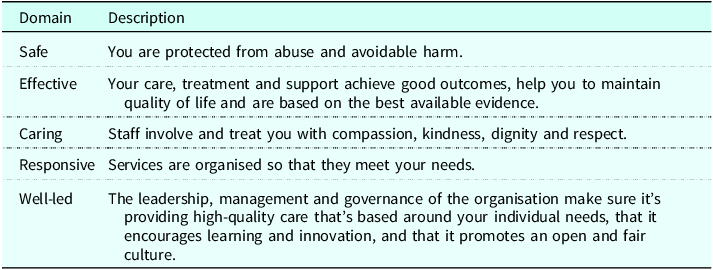
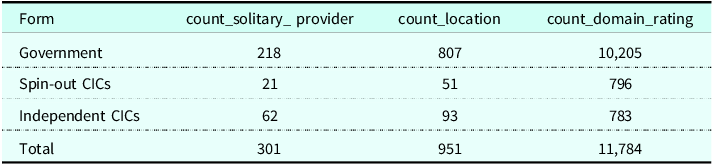
Our data set includes 11,784 rating observations and has a nested structure (see Figure 1). The CQC rates health and social care services either by the more common location level (which are nested under providers) or the solitary provider level (which have no corresponding locations), with no overlap of the providers across these two levels of data sources. We merged the two types of data to create a larger and more complete sample size for spin-out and independent CIC performance ratings. The locations and solitary providers are rated individually as a whole and, when warranted, across their different target service groups, e.g. ‘older people’ and ‘people experiencing poor mental health’, according to the six quality rating domains (as explained in Figure 1 and Table 1). Table 2 provides the counts for unique locations and solitary providers, and also the number of quality domain ratings by each type of organisational form.
Illustration of the nested structure of the data.
Notes: Under the CQC rating system, most health and social care services (252 out of the 301 providers) are rated at the location level (one provider can have multiple locations) both relative to the location as a whole and, if warranted, according to groups served by that location, such as ‘older people’ and ‘people experiencing poor mental health’. Additionally, ratings are given at the solitary provider level (providers with no corresponding locations). It has a similar nested structure where each solitary provider is also rated relative to the provider as a whole, and, if warranted, according to the target groups it serves. Locations and solitary providers are rated across the six quality domains described in Table 1.

Figure 1. Long description
A diagram illustrating the nested structure of data. The diagram is divided into two main sections: Location Level Data and Provider Level Data. In the Location Level Data section, a provider is connected to two locations, Location 1 and Location 2. Each location is further connected to two target groups, Target group 1 and Target group 2. Each target group is linked to six domains labeled Domain 1 through Domain 6. In the Provider Level Data section, two solitary providers, Solitary Provider 1 and Solitary Provider 2, are each connected to six domains labeled Domain 1 through Domain 6. Solitary Provider 1 is also connected to two target groups, Target group 1 and Target group 2, each of which is linked to six domains labeled Domain 1 through Domain 6.
Description of CQC quality domains

Table 1. Long description
A table with two columns: Domain and Description. The table has six rows, each describing a different quality domain. Row 1: Domain, Safe; Description, You are protected from abuse and avoidable harm. Row 2: Domain, Effective; Description, Your care, treatment and support achieve good outcomes, help you to maintain quality of life and are based on the best available evidence. Row 3: Domain, Caring; Description, Staff involve and treat you with compassion, kindness, dignity and respect. Row 4: Domain, Responsive; Description, Services are organised so that they meet your needs. Row 5: Domain, Well-led; Description, The leadership, management and governance of the organisation make sure it’s providing high-quality care that’s based around your individual needs, that it encourages learning and innovation, and that it promotes an open and fair culture.
Adapted from CQC (2022).
Distribution of the provider and location sample by organisational form

Table 2. Long description
The table has four rows and four columns. The columns are labeled ‘Form’, ‘count_solitary_provider’, ‘count_location’, and ‘count_domain_rating’. The rows are labeled ‘Government’, ‘Spin-out CICs’, ‘Independent CICs’, and ‘Total’. Row 1: Form, Government; count_solitary_provider, 218; count_location, 807; count_domain_rating, 10,205. Row 2: Form, Spin-out CICs; count_solitary_provider, 21; count_location, 51; count_domain_rating, 796. Row 3: Form, Independent CICs; count_solitary_provider, 62; count_location, 93; count_domain_rating, 783. Row 4: Form, Total; count_solitary_provider, 301; count_location, 951; count_domain_rating, 11,784. The table shows the distribution of solitary providers, locations, and domain ratings across different organizational forms, with notable differences in counts across the categories.
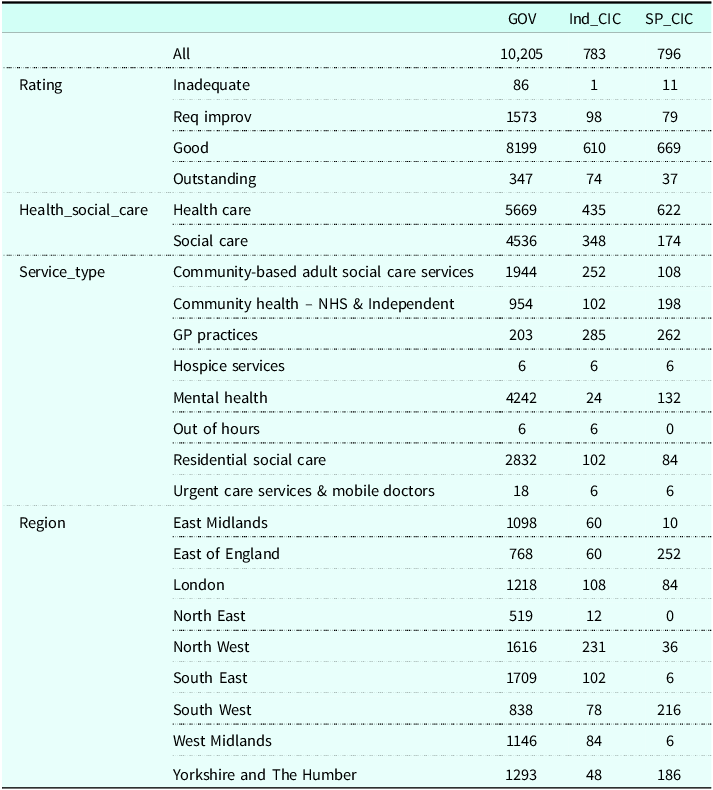
We analyse the quality rating data of health and social care locations and solitary providers in service areas that include spin-out and independent CICs and government-run organisations (see Table 3). We exclude acute hospitals, ambulance services and dentists where we found no evidence of CICs operating. We analyse CQC data from December 2017, a point in time before the onset of Covid-19, but at least three years after the spin-out CICs in our dataset were formed via the abovementioned policy programmes. This three-year gap ensures that all spin-outs had received CQC quality ratings to include in our analysis and had completed their three years of guaranteed contracts where applicable. The CQC conducts comprehensive ratings of health and social care providers in England on a three-year rolling basis. Our data from December 2017 covers ratings given to providers and locations in 2014 (543 ratings), 2015 (1495 ratings), 2016 (5250 ratings) and 2017 (4496 ratings). Since the CQC maintains the latest ratings without cumulatively keeping ratings given at earlier times, our data is cross-sectional. In other words, our rating observations reflect the quality performance of social and health care providers and locations for multiple target groups and multiple domains, but there are no repeated ratings across years. Therefore, our analysis includes overall changes in rating trends across these years but does not capture longitudinal changes of each provider or location over time.
Cross-tabulation of the domain ratings sample by key variables

Table 3. Long description
The table presents a cross-tabulation of the domain ratings sample by key variables, focusing on the quality ratings of health and social care locations and providers. It includes data for government-run organizations (GOV), independent community interest companies (Ind_CIC), and spin-out community interest companies (SP_CIC). The table has 21 rows and 4 columns. Column headers are Rating, Health_social_care, Service_type, and Region. Row labels include categories such as Inadequate, Requires improvement, Good, Outstanding, Health care, Social care, Community-based adult social care services, Community health – NHS & Independent, GP practices, Hospice services, Mental health, Out of hours, Residential social care, Urgent care services & mobile doctors, East Midlands, East of England, London, North East, North West, South East, South West, West Midlands, and Yorkshire and The Humber. The table lists the number of ratings for each category and region. For example, Row 1: All, GOV, 10205; Ind_CIC, 783; SP_CIC, 796. Row 2: Rating, Inadequate, GOV, 86; Ind_CIC, 1; SP_CIC, 11. Row 3: Rating, Req improv, GOV, 1573; Ind_CIC, 98; SP_CIC, 79. Row 4: Rating, Good, GOV, 8199; Ind_CIC, 610; SP_CIC, 669. Row 5: Rating, Outstanding, GOV, 347; Ind_CIC, 74; SP_CIC, 37. Row 6: Health_social_care, Health care, GOV, 5669; Ind_CIC, 435; SP_CIC, 622. Row 7: Health_social_care, Social care, GOV, 4536; Ind_CIC, 348; SP_CIC, 174. Row 8: Service_type, Community-based adult social care services, GOV, 1944; Ind_CIC, 252; SP_CIC, 108. Row 9: Service_type, Community health – NHS & Independent, GOV, 954; Ind_CIC, 102; SP_CIC, 198. Row 10: Service_type, GP practices, GOV, 203; Ind_CIC, 285; SP_CIC, 262. Row 11: Service_type, Hospice services, GOV, 6; Ind_CIC, 6; SP_CIC, 6. Row 12: Service_type, Mental health, GOV, 4242; Ind_CIC, 24; SP_CIC, 132. Row 13: Service_type, Out of hours, GOV, 6; Ind_CIC, 6; SP_CIC, 0. Row 14: Service_type, Residential social care, GOV, 2832; Ind_CIC, 102; SP_CIC, 84. Row 15: Service_type, Urgent care services & mobile doctors, GOV, 18; Ind_CIC, 6; SP_CIC, 6. Row 16: Region, East Midlands, GOV, 1098; Ind_CIC, 60; SP_CIC, 10. Row 17: Region, East of England, GOV, 768; Ind_CIC, 60; SP_CIC, 252. Row 18: Region, London, GOV, 1218; Ind_CIC, 108; SP_CIC, 84. Row 19: Region, North East, GOV, 519; Ind_CIC, 12; SP_CIC, 0. Row 20: Region, North West, GOV, 1616; Ind_CIC, 231; SP_CIC, 36. Row 21: Region, South East, GOV, 1709; Ind_CIC, 102; SP_CIC, 6. Row 22: Region, South West, GOV, 838; Ind_CIC, 78; SP_CIC, 216. Row 23: Region, West Midlands, GOV, 1146; Ind_CIC, 84; SP_CIC, 6. Row 24: Region, Yorkshire and The Humber, GOV, 1293; Ind_CIC, 48; SP_CIC, 186.
Measurement and models
Our dependent variable, ‘rating’, is the quality rating of the health and social care services available in the CQC dataset. The CQC rates services on five dimensions or rating ‘domains’, which are ‘safe’, ‘effective’, ‘caring’, ‘responsive’ and ‘well-led’, and then aggregates these dimensions into a sixth ‘overall’ domain (see Table 1). The rating is an ordinal level variable with the values of ‘inadequate’, ‘requires improvement’, ‘good’ and ‘outstanding’, from low to high. We use ordinal logistic regressions to model the quality rating on different domains. We respectively model the quality ratings in each of these domains, and compare how government, spin-out CICs and independent CICs perform across each domain.
Our main independent variable is ‘form_spinout’, which indicates whether the rated services are government-run, spin-out CICs or independent CICs. We coded and filtered out the government and CIC providers from the CQC dataset based on the legal names of the corresponding service providers. Specifically, the list of characters ‘NHS’, ‘Foundation Trust’, ‘Council’, ‘ CC’, ‘MDC’, ‘DC’, ‘BC’, ‘Borough’ were used to identify government providersFootnote 1 and ‘CIC’ and equivalents (‘C.I.C.’ or ‘Community Interest Company’) were used to identify CICs. The spin-out status of health and social care providers for CICs was then coded based on public disclosure using lists of spin-outs and public service mutuals (e.g. Public Service Mutuals, 2023). After this data cleaning process, we had 10,205 government rating observations across the six quality domains for 807 government locations and 218 solitary providers; 796 spin-out rating observations from 51 spin-out locations and 21 solitary providers; and 783 independent CIC rating observations for 93 independent CIC locations and 62 solitary providers (see Table 2). The government has a larger sector size, while the representation of spin-out and independent CICs is balanced.
We controlled for the year the rating was given after comparing the models using year as factors (fixed effects for each year) and using year as a numeric variable for the general temporal trend. The results are consistent, and the coefficients are quite close across the two ways of fitting the models. Since the models controlling for year as a numeric variable had a slightly better fit in general, we report their results in the main text, and the results with year fixed effects can be found in Appendix Table 1. As detailed in Table 3, the spin-out CICs were proportionately more represented in certain geographical areas (East of England, South West, Yorkshire and Humber) and in some service areas (community health and mental health). We therefore also included fixed effects for the nine regions across England to account for the confounding effects of any socio-economic variances in each area. In addition, we included effects by service type to account for any baseline variance in the rating resulting from the different nature of services provided across the sub-sectors, including ‘community-based adult social care services’, ‘residential social care’, ‘community health’, ‘GP practices’, ‘hospice services’, ‘mental health’, ‘out of hours’ and ‘urgent care services & mobile doctors’. Since the service types are a more specific classification of health and social care services, we did not include the dichotomous typology of ‘health care’ and ‘social care’ in our regression model. The descriptive statistics of the distribution of our sample over the key variables and across the three service provision types of government, spin-out CIC and independent CIC are presented in Table 3.
We used ordered logit models to analyse how the quality rating for health and social care services is associated with providers’ affiliation with government, spin-out CICs or independent CICs. Specifically, our formulas are as follows, with the ordinal rating in the six domains as the dependent variable, alternatively.
 $${{log}} - {odds}\left( {{{rating\;}} \le {{j}}} \right)= {{\;\beta_{j0}}}{\rm{\;}}+ {{\;\beta}}_1{\bf{form}}+ {{\;\beta}}_2{\rm{service}}\_{\rm{type\;}}+ {{\;\beta}}_3{\rm{region\;}}\\+ {{\;\beta}}_4{\rm{year\;}}+ {{\;u}}$$
The results of our analysis are presented below.
Results
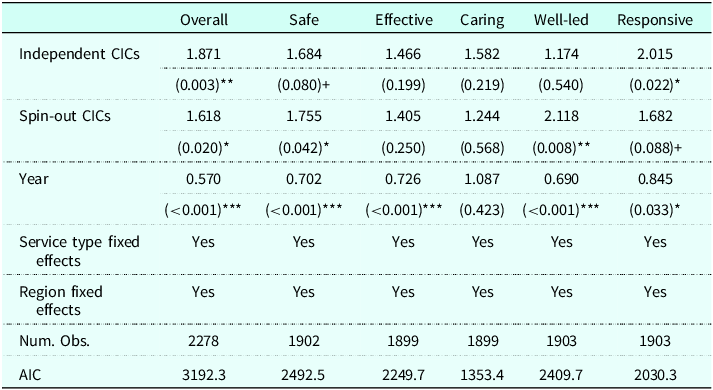
Table 4 summarises our regression results. We present the exponentiated coefficients, which indicate the odds ratio that a solitary provider or location has a higher rating level compared to a lower rating level. For the overall rating, both independent and spin-out CICs performed better than government services, with independent CICs performing the best overall. Compared with government-run service providers, the odds that independent spin-out CICs received a higher rating were 1.871 times as high as the odds that a comparable government-run location received a higher rating, while the odds for a spin-out to be rated higher were 1.618 times as high. The higher rating odds for both independent and spin-out CICs are significant at the 0.05 level.
Ordered logit model results (showing exponentiated odds ratio)

Table 4. Long description
The table compares the performance metrics of Independent CICs and Spin-out CICs against government services. It includes columns for Overall, Safe, Effective, Caring, Well-led, and Responsive ratings. Each row provides exponentiated odds ratios and their respective standard errors. Independent CICs have an overall odds ratio of 1.871 with a standard error of 0.003, while Spin-out CICs have an overall odds ratio of 1.618 with a standard error of 0.020. The table also includes yearly data and fixed effects for service type and region. The number of observations and AIC values are provided at the bottom.
+ p < 0.1, *p < 0.05, **p < 0.01, ***p < 0.001.
However, we observed some variability in performance when considering individual domains of quality, though this variability only appeared between the spin-out and independent CICs and not with respect to government-run, which saw both types of CICs outperform them on every individual domain. The spin-out CICs performed best in the well-led domain, in comparison with government-run as the reference group, they had 2.118 times higher odds of better performance, significant at the 0.05 level. They outperformed independent CICs on the well-led domain by a solid margin, which had only 1.174 times higher odds of better performance than government-run (not significant). Spin-out CICs also performed slightly better in the safe domain, where their odds of receiving a higher rating were 1.755 times higher (significant at the 0.05 level) than government-run, while the odds for independent CICs were 1.684 times higher (significant at the 0.1 level). By contrast, independent CICs performed best in the responsive domain, where the odds that they would receive a higher rating were 2.015 times higher (significant at the 0.05 level) than government-run, versus 1.682 times higher (significant at the 0.1 level) for spin-out CICs. The two types of CICs performed similarly and were both better than government-run in the effective domain, which was 1.466 times higher for independent CICs and 1.405 times higher for spin-out CICs; however, the results were not significant. Independent CICs had a slightly higher rating (1.582 times) in the caring domain than spin-out CICs (1.244 times the government-run). This pattern for the caring domain matched the overall rating domain but was also insignificant. To ensure robustness of results, we also ran the models controlling for different levels, that is, whether the ratings are assigned at the provider or location level. The results are consistent with our main model (see Appendix Table 2).
Discussion
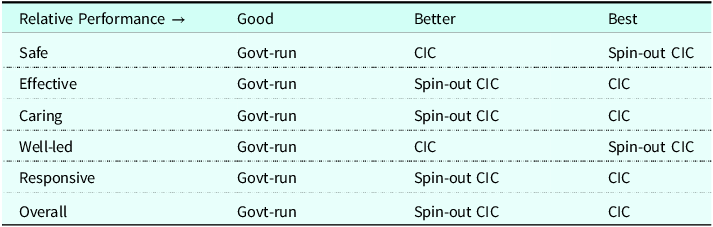
In summary, our analysis indicates that health and social care services spun out from government into social enterprise CICs perform better than those remaining as government-run. However, they do not perform as well as CICs that are set up independently (i.e. not spun out). However, the difference between the two groups of CICs is small, indicating similar levels of performance. The two exceptions are in the well-led domain, where spin-out CICs perform best, and the responsive domain, where independent CICs perform much better than spin-outs. We set out our key findings in Table 5, where we characterise the relative ratings between different organisational models as ‘good’, ‘better’ and ‘best’, recognising prior research by the authors that shows both government-run and CIC social care providers out-perform for-profits and perform on par with non-profit providers on all CQC performance measures (Kerlin et al., Reference Kerlin, Ye and Hall2025). The wider research literature also shows that in health and social care, for-profits perform worse than government-run providers when it comes to quality (Bach-Mortensen & Montgomery, Reference Bach-Mortensen and Montgomery2019; Comondore et al., Reference Comondore, Devereaux, Zhou, Stone, Busse, Ravindran, Burns, Haines, Stringer, Cook, Walter, Sullivan, Berwanger, Bhandari, Banglawala, Lavis, Petrisor, Schünemann, Walsh, Bhatnagar and Guyatt2009; Herrera et al., Reference Herrera, Rada, Kuhn-Barrientos and Barrios2014; Wheeler et al., Reference Wheeler, Fadel and D’Aunno1992). Thus, we emphasise that government-run health and social care providers are neither the ‘poorest’ nor ‘poor’ providers.
Relative performance of health and social care organisations on six quality domains

Table 5. Long description
A table with six rows and four columns comparing the relative performance of health and social care organizations across different quality domains. The columns are labeled ‘Relative Performance’, ‘Good’, ‘Better’, and ‘Best’. The rows are labeled ‘Safe’, ‘Effective’, ‘Caring’, ‘Well-led’, ‘Responsive’, and ‘Overall’. The values in the table are as follows: Row 1: Safe, Govt-run, CIC, Spin-out CIC. Row 2: Effective, Govt-run, Spin-out CIC, CIC. Row 3: Caring, Govt-run, Spin-out CIC, CIC. Row 4: Well-led, Govt-run, CIC, Spin-out CIC. Row 5: Responsive, Govt-run, Spin-out CIC, CIC. Row 6: Overall, Govt-run, Spin-out CIC, CIC.
We draw on publicness frameworks to theorise why performance varies across these organisational models. First, in relation to why government-run health and social care services perform worse than CICs overall, publicness theory posits that low economic authority and high political authority in governmental organisations leave them subject to state control and with limited freedom to make financial decisions (Andrews et al., Reference Andrews, Boyne and Walker2011; Boyne, Reference Boyne2002; Bozeman, Reference Bozeman1987). Such characteristics have been viewed as a constraining influence, including in healthcare settings (Anderson, Reference Anderson2012), and associated with lower performance, especially relating to effectiveness, work satisfaction and consumer responsiveness (Anderson, Reference Anderson2012; Rainey & Bozeman, Reference Rainey and Bozeman2000). Hybrid organisations can potentially overcome both political market failure (when political pressure leads to inefficient decision making) and formal hierarchy failure (when rigid, bureaucratic structures create inefficiencies) that can lead to performance failures in public organisations (Bills & Glennerster, Reference Billis and Glennerster1998).
Second, in relation to why spin-outs perform better than government-run services, we theorise that spinning out creates the conditions for health and social care providers to retain their publicness, yet their newfound economic authority as social enterprises enables them to make profits and deliver efficiency savings. But unlike for-profits, regulatory controls built into the CIC structure limit profit maximisation and quality-shading (Jensen & Stonecash, Reference Jensen and Stonecash2005), i.e. the pursuit of profit undermining quality. The same legal structures enable CICs, unlike public organisations, to retain and reinvest profits back into the organisation, staff or community (Hall & Alexander, Reference Hall and Alexander2023), including investment in staff and new ideas (Hall et al., Reference Hall, Alexander, Hayward and Kinghorn2022; Vickers et al., Reference Vickers, Lyon, Sepulveda and McMullin2017), which may lead to enhanced service quality. Spin-outs also remain subject to political authority, which continues to embed public or social values, i.e. normative publicness, within these organisations. Such values are often carried into the new social enterprises by the transfer of public sector leaders and staff, helping to sustain a public service ethos or ‘publicness culture’ (Hall et al., Reference Hall, Miller and Millar2016; Witesman et al., Reference Witesman, Walters and Christensen2024).
Spin-outs also remain subject to political authority through government regulatory processes both as CICs and as health and care providers (e.g. CQC regulation). These regulatory processes can, however, constrain their operational autonomy. It is important to note that all health and care providers are subject to similar regulatory oversight. Additionally, political authority also arises from what Anderson (Reference Anderson2012) terms ‘resource publicness’, as health and social care spin-outs are reported to remain highly dependent on government funding and contracts after becoming social enterprises (Addicott, Reference Addicott2011; Hall et al., Reference Hall, Miller and Millar2016; Hazenberg & Hall, Reference Hazenberg and Hall2016). Although government funding can reduce the financial volatility of social enterprises (Andrews & Hodgkinson, Reference Andrews and Hodgkinson2024), heavy reliance on such contracts can erode their comparative advantage, leading them to lose community legitimacy and cause them to resemble the public agencies from which they originated (Billis & Glennerster, Reference Billis and Glennerster1998). Thus, the new economic freedom that spin-out CICs experience – along with some state control that was maintained through regulatory requirements and government funding – may have been underlying factors that led to their higher-quality performance over government-run providers. The high performance of spin-outs in the ‘well-led’ domain may also partly result from this ongoing political authority, in that they are able to carry forward regulatory and management processes from their days as government providers, unlike new independent CICs, which must navigate such processes themselves.
Finally, regarding why independent CICs perform better overall, we argue that the path-dependent factors that strengthen spin-out CICs in the well-led domain may also undercut their performance elsewhere. We surmise, based on path dependency theory (Pierson, Reference Pierson2020), that the public origins of the spin-outs, including the staff, bureaucratic processes and funding that they brought with them (Hall et al., Reference Hall, Miller and Millar2016), may result in more rigid organisational structures and management practices that forestall their innovation and flexibility (Dearden-Phillips, Reference Dearden-Phillips2014). These traits may also help explain why the independent CICs perform much better than the spin-outs on the ‘responsive’ CQC domain, relating to person-centred, flexible and equitable care (CQC, 2022). Our findings also support the wider publicness literature that associates political authority with lower levels of responsiveness (Anderson Reference Anderson2012; Andrews et al., Reference Andrews, Boyne and Walker2011; Rainey & Bozeman, Reference Rainey and Bozeman2000).
Conclusion
The spinning out of public health and social care into social enterprises has been met with a mixture of excitement and trepidation. Excitement that social enterprises could improve the performance of services through greater financial flexibility and freedom to innovate, and trepidation that the vagaries of the market could undermine any such gains. Our study provides the first large dataset analysis of how health and social care services that are spun out into CICs perform in comparison with government-run services and those established as independent CICs. Though some individual government agencies may perform better and some CICs may perform worse than their counterparts, our study shows that services spun out into CICs perform better overall across all CQC quality ratings than those that are government-run; however, they do not perform quite as well as independently established CICs. Our study therefore provides significant support for the continuing creation and maintenance of health and social care CICs. To be clear, we argue that government-run services still deliver solid quality outcomes for recipients, but the CIC structure appears, on the whole, to provide a higher level of performance quality. This is important information for policymakers deciding where to direct limited public funds for health and social care services.
Our research provides a new contribution to publicness theory, which, to date, has focused on public and private organisations (Bozeman, Reference Bozeman1987), and largely overlooked social enterprises that combine elements of both (except see Anderson, Reference Anderson2012; Emmert & Crow, Reference Emmert and Crow1988; Hall et al., Reference Hall, Miller and Millar2016). We argue that the advantage of social enterprises lies in their combination of public and private attributes to create both economic and public (social) value, and may generate improved performance. Specifically, social enterprises may be able to realise their public value creation through organisational cultures, practices and regulatory frameworks that prioritise social outcomes over profit maximisation. They may also create economic value through flexible management structures and innovative service arrangements – in other words, high economic authority – that are typical of businesses (DH, 2009). Yet, such advantages are fragile: a reliance on government contracts and regulatory control can erode the distinctiveness that enables their superior performance. While the analysis controls for organisational form, service type, region, year and whether ratings are assigned at the provider or location level, the CQC dataset does not contain detailed information on organisational size, budget or funding composition. These characteristics may themselves be shaped by organisational form and could plausibly operate as mechanisms through which different ownership models influence quality. As a result, the analysis does not permit causal claims or singling out direct effects of ownership types on quality ratings, holding factors such as resources and budgets constant. Rather, the findings should be interpreted as identifying systematic associations between ownership form and quality ratings within English health and social care and comparable institutional contexts.
Future research is needed to confirm and extend our proposed explanations, including to empirically explore the publicness dimensions of these organisations. Organisational performance could also be evaluated over a longer period, including post-Covid-19, using panel data, and include a wider range of indicators, especially economic performance indicators (e.g. efficiency and financial sustainability). Further, in addition to our above-reported critiques of CQC data, we also recognise the wider challenge of assessing and reporting quality in care settings. In particular, inspection reports tend to focus on organisational processes rather than on the often unobservable human relationships that underpin care quality (Forder et al., Reference Forder, Knapp and Wistow1996). Further, smaller providers may be particularly disadvantaged as they can lack the resources to fully engage with formal regulation processes (Burton, Reference Burton2017). However, as outlined earlier, CQC is the only standardised measure of quality across all health and social care providers in England and so offers a unique opportunity to quantitatively compare the performance of different organisational models across multiple performance domains. Our paper is the first to isolate both CIC social enterprises and spin-outs in this data and, in doing so, can be used to address lingering fears in some political circles that spinning out health and social care services weakens the quality of services. To the contrary, services that are spun out into CICs were found to do better overall across all quality domains than government-run services, offering significant support for the continuing creation and maintenance of health and social care CICs from a policy perspective.
This research also has implications for health and care policy beyond England. There are a growing number of countries with specified social enterprise legal structures that support the generation of commercial revenue while also pursuing social benefit (Brakman Reiser et al., Reference Brakman Reiser, Dean and Huber2023; Chandra et al., Reference Chandra, Shang and Roy2022). The findings in our study suggest that such social enterprise legal structures may also hold the potential for performance quality that is at least on par with, if not better than, government-run services, regardless of whether they are spun out from government-run entities or created as independent organisations. However, similar research is needed to confirm the performance of social enterprise legal structures operating in other social care country contexts.
Supplementary material
The supplementary material for this article can be found at https://doi.org/10.1017/S0047279426101482
Competing interests
The authors declare none.



 Open access

