INTRODUCTION
Chilika lagoon is one of the repositories of aquatic biodiversity in the world and is a steady source of fishery, sustaining the livelihood and nutritional need of about 150,000 fisher folk and local communities situated in the State of Orissa. It is the largest brackish water ecosystem in the Indian sub-continent and a Ramsar site of international importance. Due to its estuarine character the lagoon supports a diverse and dynamic assembly of fish, invertebrate and crustacean species belonging to marine, brackish and freshwater habitats. The economic valuation of the Chilika ecosystem has distinctly established the importance of fisheries resources, which account for more than 71% of the total value in monetary terms (Ritesh, Reference Ritesh2003). The decadal fisheries output during 1950–1951 to 1999–2000 fluctuated between 2586 t (tons) and 7206 t (CDA, 2005). After the opening of the new mouth in the year 2000, however the annual fish and crustacean production was drastically improved. The total fish production in the year 1999–2000 was only 1556.32 t and it increased to 3592.95 t in 2000–2001 and 9530.03 t in 2001–2002 (Mahapatra et al., Reference Mahapatra, Mahanty, Mahanty, Bhatta and Das2007). Similarly the mud crab production increased from 9.03 t in the year 1999–2000 to 93.54 t in 2000–2001 and 115.57 t in 2003–2004. The production of the blue swimming crab Portunus pelagicus also improved after this hydrological intervention (Mahapatra et al., Reference Mahapatra, Mahanty, Mahanty, Bhatta and Das2007). Though there is enough information on the fisheries and biology of mud crabs (Scylla serrata and Scylla tranquebarica), information is very scarce in the case of P. pelagicus from Chilika lagoon.
The swimming crab Portunus pelagicus (Linn.) is one of the dominant edible crab species found in Chilika lagoon and its fishery occupies a significant place due to its high nutritive value, delicacy and good market price. Distributions of the species also extend from the southern Mediterranean Sea, Red Sea, the east coast of Africa and across the Indian Ocean to Japan and the western Pacific Ocean (Stephenson, Reference Stephenson and Leeper1962). Although the species has not been studied in detail in Chilika lagoon, many aspects have been studied on the south-west coast of India (Pillay & Nair, Reference Pillay and Nair1973; Sukumaran & Neelakantan, Reference Sukumaran and Neelakantan1997) and in Egyptian waters (Badawi, Reference Badawi1971; Hilmy et al., Reference Hilmy, Abd El-Hamid and Adham1986; Abdel Razek, Reference Abdel Razek1987, Reference Abdel Razek1988; Bawab & El-Sherief, Reference Bawab and El-Sherif1988; El-Sherief, Reference El-Sherief1991; Zaghlour, Reference Zaghloul2003).
The present work gives a detailed account of the reproductive biology and ecology in Chilika lagoon, Orissa, India during the period from December 2007 to December 2008. It also deals with the population structure and morphometric relationship of the crab species.
MATERIALS AND METHODS
Study area
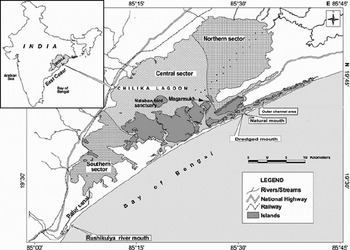
Chilika lagoon, the largest brackish water lagoon in Asia is situated between latitude 19°32′ to 19°54′N and longitude 85°08′ to 85°35′E along the east coast of India in the State of Orissa (Figure 1). It has an area of water of 1165 sq km during the monsoon season which shrinks to 906 sq km during summer. It is approximately 65 km long with a width of 5–18 km. The lagoon is ecologically divided into four sectors, i.e. southern sector which is marine in nature, the central sector which is brackish in nature, while the northern sector is dominated by fresh water, and an outer channel sector which is marine in summer and freshwater in the monsoon season due to monsoonal outflux. Hydrologically the lagoon is influenced by the Mahanadi distributaries (Delta River), 52 rivulets and streams draining into the lagoon from the western catchments which are the main source of releasing freshwater in the monsoon season to the lagoon and the sea (Bay of Bengal). A 14 km long Palur channel is connected in the southern sector of the lagoon to the sea (Bay of Bengal) through the Rushikulya River mouth and a dredged mouth of 100 m average width in the outer channel sector. But very recently (1 August 2008) another natural mouth of average width of 400 m has opened up in the outer channel area, i.e. 1 km from the dredged mouth towards the north.
Location map of Chilika lagoon.

The salinity of the lagoon varies from 0.0–35.6 ppt, pH varies from 6.8–9.67, dissolved oxygen (DO) varies from 1.83–12.46 ppm, the water temperature varies from 21.8–32.4°C while the depth of the lagoon varies from 18.0–628.0 cm (CDA, 2008). The bottom of the lagoon is sandy in the outer channel area, clay dominated in the northern and central sectors whereas it is muddy–sand in the southern sector. Fishery is carried out in the lagoon throughout the year. However, the P. pelagicus fishery is seasonal being restricted from the end of December to the end of July.
Collection of data
Monthly random sampling of P. pelagicus was performed at the major fish landing centres of the lagoon. The specimens were sexually differentiated by observing their abdomens, i.e. the males have a slender and triangular shaped abdominal flap on the ventral side of the body whereas the females have a semi-circular shaped abdominal flap (Kathirvel et al., Reference Kathirvel, Kulasekarapandain and Balasubramanian2004). A total of 688 specimens were examined for this work. Then the following measurements were carried out using a standard slide caliper. The carapace width (CW) is the distance from the tip to tip of the last antero-lateral teeth, carapace length (CL) is the distance from the tip of the frontal teeth to the posterior end of the carapace. The CW, CL and the total body weight (TW) were measured in a standard electric balance (Denver Instrument, USA) of 0.01g accuracy. After taking the morphometric data, the specimens were dissected and the guts were collected, and then preserved in 4% formaldehyde solution immediately for gut content analysis. By studying the coloration of the gonads, the maturation stages of female P. pelagicus were analysed. Then the weights of the gonad were taken in an electric balance (Denver Instrument USA, 0.01g accuracy) for the gonadosomatic index (GSI) studies.
Data analysis
Out of this total of specimens, for the CW–CL relationship 600 specimens (male N = 300 and female N = 300) were studied whereas CW–TW and CL–TW relationship 688 specimens were studied (male N = 344 and female N = 344). The results were analysed by regression analysis and by the test for equality of two populations co-relation co-efficient (Zar, Reference Zar1996).
The CW–CL relationship was estimated in each sex, from the linear equation of y = a + bx,
where, y is the carapace width in cm
x is the carapace length in cm,
‘a’ and ‘b’ are constants.
The CW–TW and CL–TW relationships were estimated according to the formula W= a Lb
where,
W is the total weight in gm and
L is the length or width of the carapace in cm
‘a’ and ‘b’ are constants.
The analysis of gut content was carried out after the method discussed by Hynes (Reference Hynes1950) All the semi-digested food were identified to the lowest possible taxonomic level and they were divided into six groups (i.e. prawn appendages and carapace, molluscan remaining, fish scales and skeletons, seagrass, unidentified and mixed). Variation of feeding type in relation to different months was also determined. The feeding index (FI) was calculated in relation to month, and the FI was determined by following the method suggested by Mohanty (Reference Mohanty2002).
Number of crabs with food in stomach:

A total of 344 specimens were analysed for this experiment. The maturity stages were determined by analysing the coloration of the ovary of fresh female specimens according to the classification used by Sumpton et al. (Reference Sumpton, Potter and Smith1994), i.e.
Stage I: gonad immature, white or translucent.
Stage II: gonad maturing, light yellow/orange, not extending into hepatic region.
Stage III: gonad maturing, yellow/orange, not extending into hepatic region.
Stage IV: gonad mature, dark yellow/orange, extending into hepatic region.
Stage V: ovigerous female bearing fully mature eggs (pale to dark yellow eggs) externally.
The variation of different maturity stages in relation to different months was determined. For determining the GSI, the total live weight of the specimen and weight of the gonad was taken in an electronic balance of 0.01g accuracy. Then the variation of GSI in relation to different months was also analysed. The GSI was calculated by the following formula:

RESULTS
Population structure in Chilika lagoon
Monthly variation of crab production
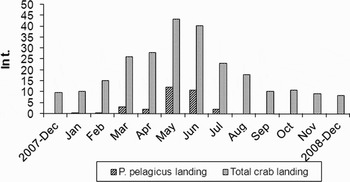
During the study period, the production of P. pelagicus in the lagoon was found from December to July. The landing is much lower (<3 t) in December, January and February, whereas in May it is at its highest, i.e. 14.31 t (Figure 2). The production of P. pelagicus was only 20% of the total crab production during the present study period.
Monthly variation of crab landing in Chilika lagoon.

Size-distribution in both sexes of crab population
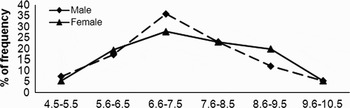
The CW ranges for both the sexes from 4.5 to 10.5 cm. The maximum abundance of male was at 6.6 to 7.5 cm CW whereas the females predominate from 6.6 to 9.5 cm CW (Figure 3).
Population size-structure of Portunus pelagicus in Chilika lagoon.

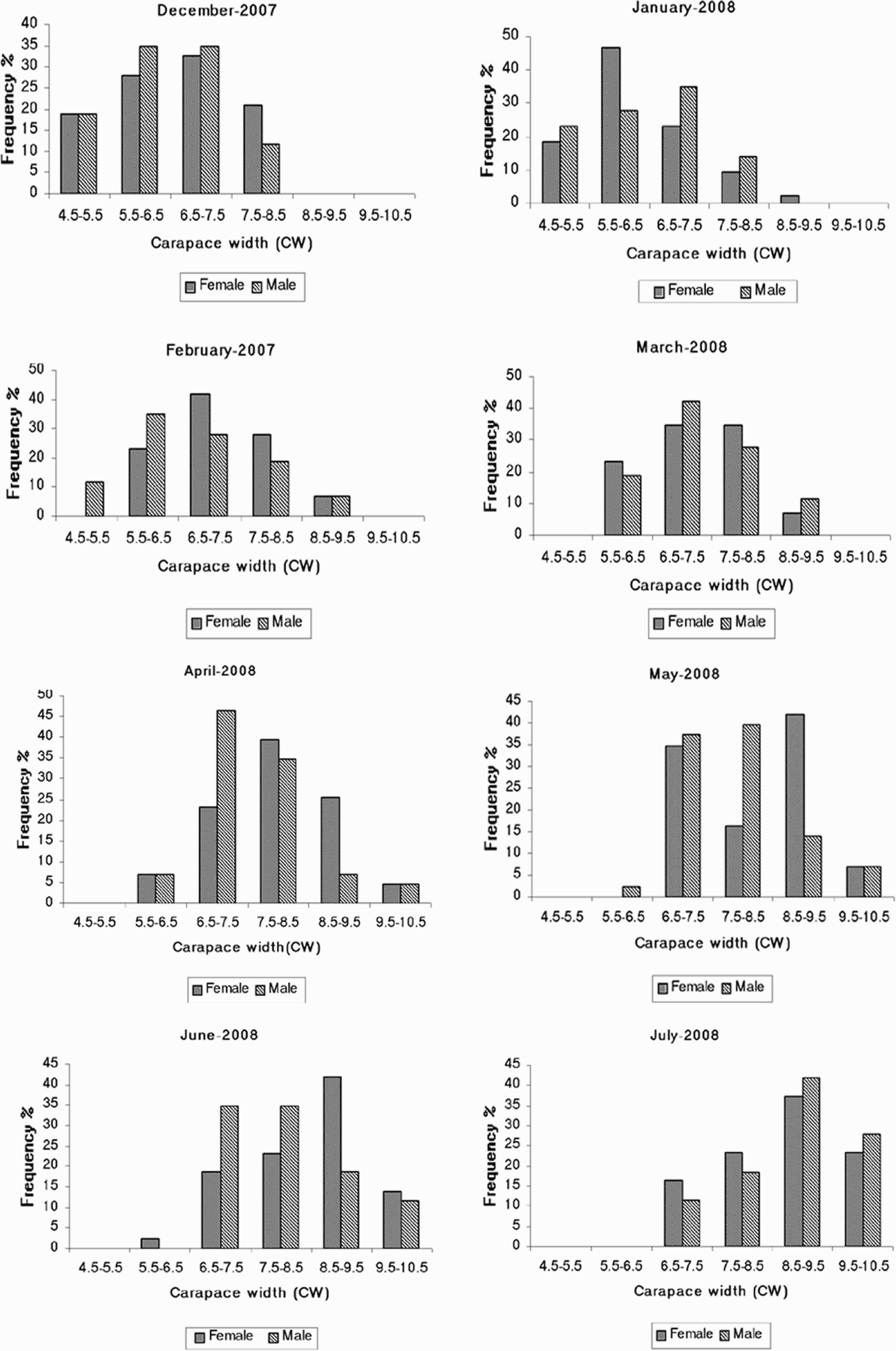
Monthly frequency distribution
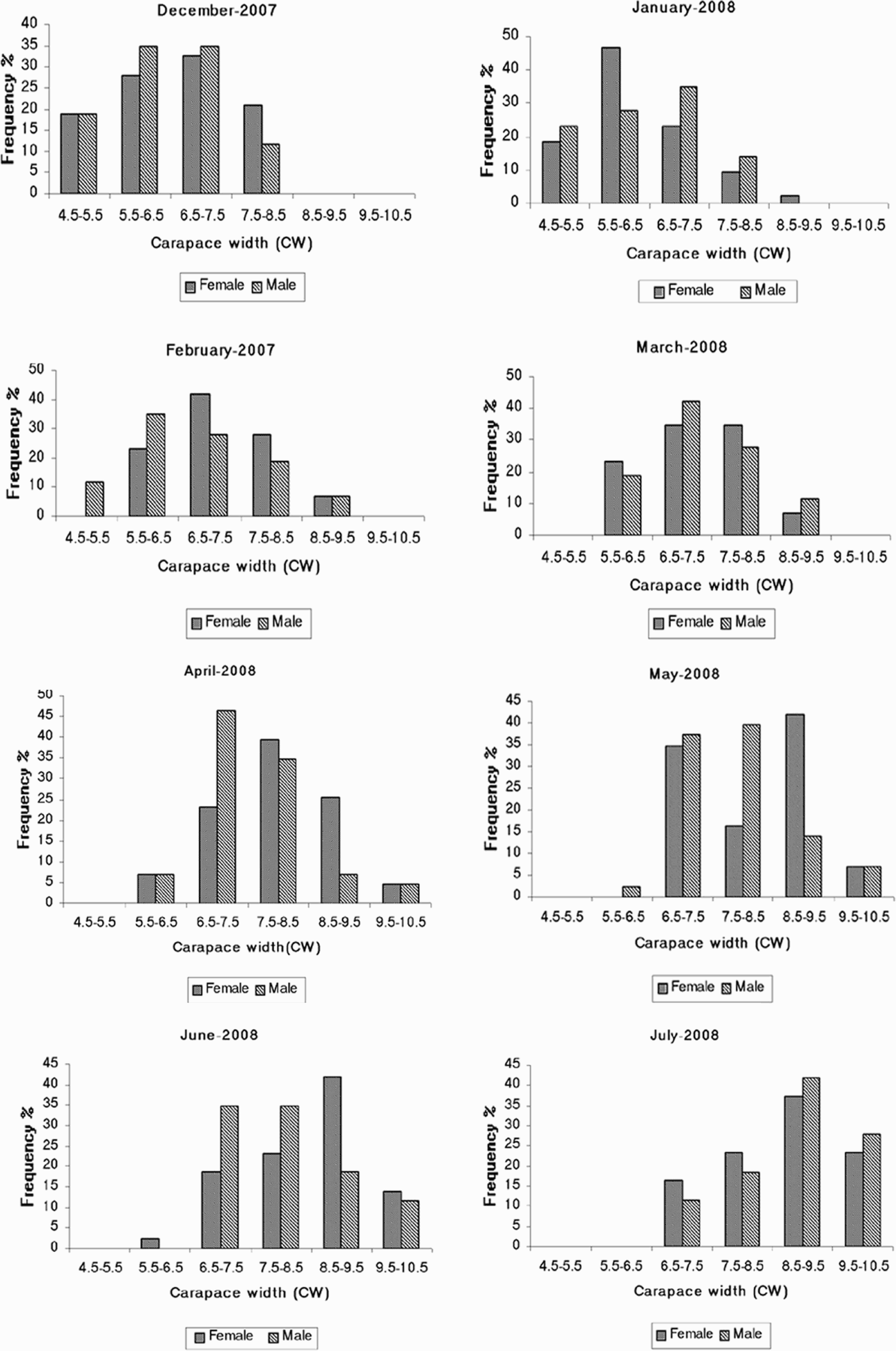
The largest sized male and female were found in June and July, during which the CW ranges from 9.5 to 10.5 cm while the smaller sizes of both the sexes were found in December and January with CW ranging from 4.5 to 6.5 cm (Figure 4).
Monthly percentage width frequency of both male and female Portunus pelagicus.
Morphometric characteristics
Length–width relationship
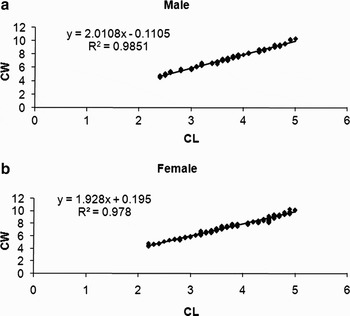
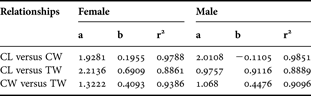
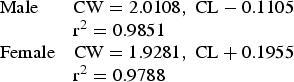
The CL of P. pelagicus varies from 2.4 to 5 cm. and the CW varies from 4.3 to 10.5 cm. The relationship between the two variables for both sexes are given in Figure 5a & b and represented by the following equation (Table 1):
(a) Carapace length–carapace width relationship of male Portunus pelagicus; (b) carapace length–carapace width relationship of female P. pelagicus.

Summary of the different morphometric relationships of Portunus pelagicus in Chilika lagoon.
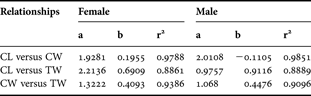
CL, carapace length in (cm); r2 = regression coefficient; CW, carapace width; (cm); a = intercept; TW, total weight (gm); b = coefficient of determination.
There is a significant difference between the sexes in the slopes of CW–CL relationships (P > 0.05).
Weight–width relationship
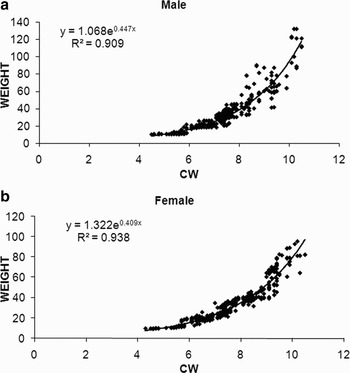
The TW varies from 9.89 to 121 g in case of males, whereas it is 9.54 to 82.11 in case of females. The relationships between CW and TW in both sexes are given in Figure 6a & b and represented by the equation (Table 1):
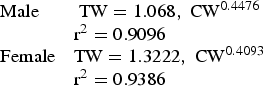
(a) Carapace width–total weight relationship of male Portunus pelagicus; (b) carapace width–total weight relationship of female P. pelagicus.

A significant difference was marked between the males and females in the slopes of the TW–CW relationships (P > 0.05).
Weight–length relationship
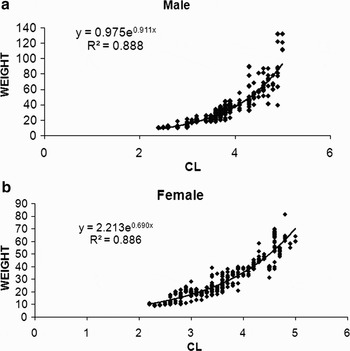
The relationships between CL and TW for both the sexes are given in Figure 7a & b and represented by the equation (Table 1):
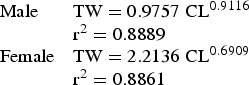
(a) Carapace length–total weight relationship of male Portunus pelagicus; (b) carapace length–total weight relationship of female P. pelagicus.

No significant difference was marked among the sexes in CL–TW relationships (P < 0.05).
Food habit
DIET COMPOSITION
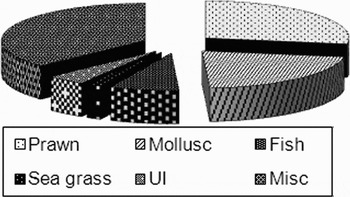
A total of 504 crabs were examined out of which 75.2% had stomachs with food items. The identifiable food items consisted of prawn appendages and carapace (27.58%), molluscan scales (21.55%), fish skeletons and scales (7.75%), seagrass (1.72%), mixed food content (37.06%) and unidentified (4.31%) (Figure 8). The molluscan group comprises mainly Mytilus, Nassarius, Littoraria, etc.
Average percentage frequency of occurrence of various food items found in the guts of Portunus pelagicus.

Monthly variation in frequency occurrence of main food items and the feeding index (FI)
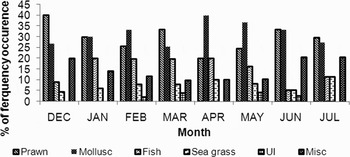
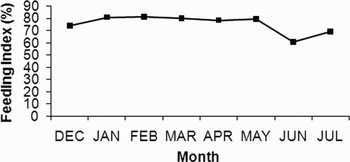
Analysis of monthly variation in food items of the crabs shows that the prawn and molluscans remaining were the dominant food content. The prawn remaining were found highest during December (40%) and lowest in April (20%) whereas the molluscan remaining were highest in April (40%) and lowest in March (25.49%) (Figure 9). The FI varies from 73.77–80.95% during the dry season, i.e. from December to May, whereas it is from 60.4%–68.75% in the wet season, i.e. June and July (Figure 10).
Monthly variation in frequency of occurrence of main food items of Portunus pelagicus.

Monthly feeding index in Portunus pelagicus.

Maturation
Distribution of maturity stage
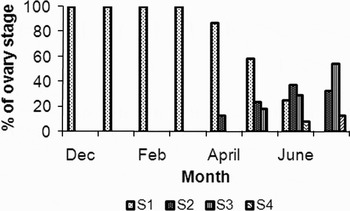
Figure 11 shows the monthly variation of different maturity stages of 344 collected female specimens of P. pelagicus. The Stage I specimens with immature ovary were found abundantly from December to April, whereas the Stage II with early mature ovary were found in the months from April to July, and the Stage III with mature ovary from May to July. The Stage IV specimens with late mature ovary were found only in the months of June and July, whereas the berried female specimens (Stage V) were not found during the study period.
Percentage of different ovary stages in Portunus pelagicus.

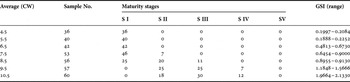
Table 2 describes the distribution of female maturity stages according to their average CW during the period of study. The stages, mature (Stage III), late mature (Stage IV) were observed with crabs' CW starting from 8.5 cm to 10.5 cm and the percentage of abundance increased with increasing the size. The immature (Stage I) individuals were found from 4.5 to 8.5 cm with a maximum occurrence from 4.5 to 6.5 cm.
Size distribution of different maturity stages and the gonadosomatic index (GSI) range of Portunus pelagicus in Chilika lagoon.

CW, carapace width; S I, immature; S II, early mature; S III, mature; S IV, late mature; S V, berried.
The present distribution indicates that the immature individuals of P. pelagicus entered into the Chilika lagoon in winter from December to March with smaller crab size whereas the mature and ripe gonads appear in summer and early in the monsoon season with large size individuals. The absence of berried females indicates that the species are migrating towards the sea for their breeding purpose to fulfil their catadromous habit.
Gonadosomatic index (GSI)
The monthly variation of GSI in females is shown in Figure 12, which indicates that during December to February the GSI was less than 0.5. Then it was slightly increased (0.5–1.0) during March and April; after April it is suddenly increased to 2.0–2.5 in May to July, with a peak in July. This observation proves that the maturation of Portunus pelagicus in Chilika lagoon takes place during May to July.
Monthly distribution of the gonadosomatic index (GSI) in female Portunus pelagicus.

DISCUSSION
The population size-structure of the P. pelagicus during the present study had a wide range (4.5 cm to 10.5 cm) of CW. The population size also shows that the species were not found throughout the year and are available from December to July. This may be due to their catadromous habit. The juveniles were abundantly found during December to February whereas the sub-adults and adults are mostly seen from March to July. This indicates that P. pelagicus in Chilika lagoon had a single recruitment period in a year from December to February (in winter). However, the species has two recruitment periods in Suez Bay during spring and summer (Zaghloul, Reference Zaghloul2003), and in the south-east Mediterranean, near Alexandria (Abdel Razek, Reference Abdel Razek1988). This difference between the Suez Bay and Chilika lagoon may be due to the fact that the Indian climate is mostly monsoonal and this has a regulatory effect in water exchange between the lagoon and the sea (Bay of Bengal). This water exchange in turn plays an important role in the water circulation, regulation of salinity level and the migration of the juveniles during onset of the winter season from the sea to the lagoon and egg-laden matured females from the lagoon to the sea.
The CW–CL relationship showed linear relation in both the sexes which indicates isometric growth of this species in Chilika lagoon and this result supports the findings of Warner (Reference Warner1977). The CW is approximately twice the CL. This also matched with the findings of Motoh & Kuronuma (Reference Motoh and Kuronuma1980) and Devi (Reference Devi1985). Similarly, in both the sexes an exponential growth is seen in TW and CW and there is a significant variation in both the sexes (P > 0.05). However, TW and CL though show an exponential growth in both the sexes; no significant variation was marked between males and females (P < 0.05). The P. pelagicus was predominantly carnivorous in Chilika lagoon, which agrees with the findings of Patel et al. (Reference Patel, Chhaya and Bhaskaran1979) in India and by Sukumaran & Neelakantan (Reference Sukumaran and Neelakantan1997) in south-west India. Prawns and molluscans form the major part of the diet in the present study. Plant materials specifically seaweeds were vary rare in the diet and could have been ingested when crabs fed on the macro-fauna of molluscan types like Mytilus, etc. The smaller fish also constitute a major part of the food materials of the specimen due to scavenging activity on dead individuals.
During the study period, the sexual maturity in case of females was found with CW ranging from 8.5 to 10.5 cm. About 12.28% females with average CW of 9.5 cm and 20% of females with average CW of 10.5 cm were found to have late mature gonads during the study period. The abundance of the ripe females was recorded during May to July with a peak in July. The highest GSI value was noted in the crabs with average CW of 10.5 cm in the present study, whereas, this species reach sexual maturity at 8.28 cm in Suez Bay (Zaghloul, Reference Zaghloul2003) and at 9.0–10.0 cm CW on the south-east Mediterranean coast (Abdel Razek, Reference Abdel Razek1988). The size of the carapace at which maturity occurs can vary with the latitude or locations and within individuals in the same location (Campbell & Fielder, Reference Campbell and Fielder1986; Sukumarn & Neelakantan, 1997).
In Chilika lagoon P. pelagicus with mature and late mature gonads were found during May to July having a peak in July. However, in different parts of the world, different peak periods were observed. In the Suez Gulf, April is the peak period for the breeding of these species (Alkholy & El-Hawary, Reference Alkholy and El-Hawary1970), whereas Zaghloul (Reference Zaghloul2003) noted that the breeding season extends from March to September in some areas. Abdel Razek (Reference Abdel Razek1988) reported that this species spawned earlier from March to the end of summer.
The breeding in these tropical crustaceans extends for several months of the year, with pronounced activity during certain months (Pillay & Nair, Reference Pillay and Nair1973). An extended breeding season may mean that individuals of a species are producing several successive broods during the year (Giese, Reference Giese1959). The absence of berried females in the lagoon indicated that the species did not spawn inside the lagoon and migrates to the sea for spawning. That variable breeding season may mean that difference in environmental conditions could be one of the reasons for the difference in the findings.
ACKNOWLEDGEMENTS
We would like to acknowledge with thanks the financial support and instrumental facility provided by the Chilika Development Authority (CDA), Department of Environment and Forest Department, Government of Orissa. We are also thankful to Dr S.K. Palita of Kendrapara Autonomous College, Kendrapara, Orissa, and Dr R.K. Mishra of CDA for their help during preparation of the manuscript.