Political philosophers have long argued that an active and engaged polity is critical for thriving democracies (Galston Reference Galston2001). Developmental psychology researchers have labored to identify antecedents of active adult civic engagement (Sherrod and Lauckhardt Reference Sherrod, Lauckhardt, Lerner and Steinberg2009) including adolescents’ developing conceptualizations of civic responsibility (Metzger and Smetana Reference Metzger and Smetana2009). Adolescents who view involvement as an obligatory dimension of citizenship may be more likely to become engaged adults (Carr Reference Carr2006), and individual differences in these nascent civic beliefs could aid in explicating heterogeneity in adult political and community participation (Metzger and Smetana Reference Metzger, Smetana, Sherrod, Torney-Purta and Flanagan2010). Adult civic participation is also correlated with sociopolitical values including religious ideals, reverence for country, and orientation toward authority (Schatz, Staub, and Lavine Reference Schatz, Staub and Lavine2003). This study further elucidates the social-cognitive foundations of citizenship by examining associations among adolescents’ civic conceptualizations (moral and social judgments of civic behaviors) and “sociopolitical values” (patriotism, authoritarianism, and spirituality).
Despite legal barriers (e.g., voting age) and limited social and economic capital necessary for various forms of community and political action, adolescents develop beliefs about active civic participation including whether such behavior is important, obligatory, and morally worthy (Metzger and Smetana Reference Metzger, Smetana, Sherrod, Torney-Purta and Flanagan2010). Measurement of individual variation in adolescents’ evaluations of civic behavior has been informed by moral philosophy and assessed whether adolescents believe individuals should participate in civic activities, whether it is wrong not to engage (obligation judgments), and whether civic behavior is “worthy of social praise” (Metzger and Smetana Reference Metzger and Smetana2009) Early, middle, and late adolescents differ in their application of should, wrong, and social praise (respect) judgments to various forms of civic behavior, hinting at developmental change in civic understanding (Metzger and Ferris Reference Metzger and Ferris2013).
Citizenship is a multifaceted construct, and individuals vary in how they conceptualize civic obligation (Westenheimer and Kahne 2004). Political scientists have stressed the importance of voting as a critical citizenship expectation (Walker Reference Walker2002), but civic participation also includes helping others through community service, engagement in protests or demonstrations, and participation in community organizations and events (Zaff et al. Reference Zaff, Hart, Flanagan, Youniss, Levine, Lamb and Freund2010). Previous developmental research suggests that adolescents apply different levels of should, obligation (wrong if not done), and social praise judgments concerning community service (e.g., volunteering), standard political (e.g., voting), social movement (e.g., protesting), and community gathering involvement (e.g., community group membership) (Metzger and Smetana Reference Metzger and Smetana2009).
To account for potential age and socioeconomic effects on study hypotheses, multigroup models explored whether associations between adolescents’ civic judgments and sociopolitical values varied by adolescent age and family socioeconomic status (parents’ education).
Adolescence is also marked by the coalescence of divergent facets of individual identity and the expansion of personal belief systems (Smetana and Villalobos Reference Smetana, Villalobos, Lerner and Steinberg2009). Increased abstract reasoning abilities allow adolescents to question the limits and necessity of adult authority and societal regulations (Adelson Reference Adelson, Kagan and Coles.1972). Individual differences also begin to emerge in spiritual and religious principles (King Reference King, Lerner, Roeser and Phelps2008). Adolescents are developing individualized “sociopolitical values” concerning their attachment to community and country, their relationship to institutional authority, and their religious/spiritual identity.
These expanding and transforming belief systems may interact with and influence adolescents’ conceptualization of political and community involvement. For instance, patriotic attitudes (i.e., attachment to and reverence for country), have been linked with various types of political behavior (Huddy and Khatib Reference Huddy and Khatib2007). Similarly, adolescents who strongly identify with the United States may prioritize mainstream forms of civic involvement such as voting or community service.
Adolescents’ civic judgments might also be influenced by their views of laws and institutional power structures. Individuals vary in their “right-wing authoritarian” beliefs that endorse existing hierarchies and conformity to social rules and order (Altemeyer Reference Altemeyer1996). Such authoritarian orientations are hypothesized to develop during adolescence (Duckitt Reference Duckitt, Leary and Hoyle2009). Adolescents with elevated authoritarian beliefs may value conformity and conventional participation while looking negatively on forms of social movement political engagement (e.g., protests) designed to change existing laws and policies.
Finally, adolescence is a period of considerable religious and spiritual transition including beliefs about God and a search for self-transcendence, purpose, and connectedness (King Reference King, Lerner, Roeser and Phelps2008). Associations with formal religious institutions decline during late adolescence (Kerestes, Youniss, and Metz Reference Kerestes, Youniss and Metz2004); adolescents engage in higher levels of spiritual exploration compared to adults and younger children (Good and Willoughby Reference Good and Willoughby2008). Spirituality has been consistently associated with youth civic engagement and prosocial behavior (Lerner, Roeser, and Phelps Reference Lerner, Roeser and Phelps2008) and also may bolster adolescents’ prioritization of civic activities focused on improving the welfare of others.
This study used structural equation modeling to explore associations among adolescents’ judgments (should, wrong (obligation) and social praise) concerning different forms of civic involvement and their patriotic, authoritarian, and spiritual values. It was anticipated that adolescents’ authoritarian and patriotic beliefs would predict the prioritization of standard political engagement (e.g., voting), while spirituality would predict adolescents’ judgments about community service. To account for potential age and socioeconomic effects on study hypotheses, multigroup models explored whether associations between adolescents’ civic judgments and sociopolitical values varied by adolescent age and family socioeconomic status (parents’ education).
METHOD: PARTICIPANTS
Participants were 467 students in grades 6–12 (Mage = 15.26, age range = 11–19 years, 53.7% female) from a middle and high school in a rural area of a mid-Atlantic state (87 early, 233 middle, and 146 late adolescents). The sample was primarily white (n =437, 94.8%) but was socioeconomically diverse. Adolescents’ combined reports of their mothers’ and fathers’ education (r = .51, p < .001) indicated that 54% of participating adolescents had at least one parent who had graduated from college (n = 235).
METHOD:MEASURES
Civic Judgments
Civic involvement categories
Similar to previous research (Metzger and Ferris Reference Metzger and Ferris2013), adolescents made a series of should, obligation, and respect judgments for 17 civic involvement behaviors selected from established measures of citizenship and civic engagement. Five items assessed standard political involvement (keep up with current events and politics, join a political party, work on a political campaign, vote in a political election, know who their elected representatives and leaders are), four items examined social movement activities (write to a newspaper, magazine, blog, or website about a social or political issue, take part in a political protest or rally, work to change a law that they disagree with, distribute a petition for a cause), four items assessed community service (volunteer for a fundraiser aiding victims of a natural disaster, volunteer to help disabled students at your school, volunteer to help the people in your community, volunteer to help feed the homeless people), and four items examined community gathering involvement (join a neighborhood social club, join a community sports or music club, attend a community social event or dance, attend a community festival or theater event).
Should Scale
Participants reported whether individuals “should ” take part in each of the 17 civic items using a 5-point Likert scale ranging from 1 (doesn’t matter) to 5 (definitely should). Higher ratings indicate stronger beliefs that an individual should engage in the activity (α’s =.73 to .84).
Obligation scale (wrong)
Consistent with previous research (Metzger and Ferris Reference Metzger and Ferris2013), participants reported whether it was wrong if individuals did not engage in the 17 civic activity items using a 5-point Likert scale ranging from 1 (not at all wrong) to 5 (very wrong). Higher ratings indicate stronger beliefs that the activity is obligatory (α’s = .63 to .93).
Respect Scale
Similar to previous research (Metzger and Smetana Reference Metzger and Smetana2009) Participants reported the social-praiseworthiness of the 17 civic activity items by rating whether they found different forms of civic involvement to be worthy of respect (“How much would you RESPECT someone who takes part in the following activities?”) on a 5-point Likert scale ranging from 1 (none at all) to 5 (a lot) (α’s = .76 to .89).
Sociopolitical Values
Spirituality
Participants completed seven items, which assessed spirituality (Seidlitz et al. 2002; e.g. I maintain an inner awareness of God’s presence in my life, My spirituality gives me a feeling of fulfillment) using a 6-point Likert scale ranging from 1 (strongly disagree) to 6 (strongly agree). Higher scores indicate more transcendental spiritual beliefs (α = .97).
Patriotism
Four items were taken from an established measure to assess patriotic beliefs and American identity (Kosterman and Feshbach Reference Kosterman and Feshbach1989; e.g. I am proud to be an American). Items were scored on a 6-point Likert scale ranging from 1 (strongly disagree) to 6 (strongly agree). Higher scores indicate greater patriotic beliefs (α = .83).
Authoritarianism
Four items were taken and adapted from established measures of right-wing authoritarian attitudes (Altemeyer Reference Altemeyer1996) for adolescent respondents (e.g., Our country will be great if we honor the ways of our forefathers and do what the authorities tell us to do). Responses ranged from 1 (strongly disagree) to 6 (strongly agree). Higher scores indicate greater authoritarian beliefs (α = .83).
Procedure
Questionnaires were administered in the middle-school cafeteria for sixth through eighth-grade students. High school students completed questionnaires in social studies classrooms during their regular class time. Only students who obtained signed parental permission were allowed to participate. Members of the research team were present to answer questions and to make sure participants understood all survey items. Participants were eligible for randomly drawn cash prizes ranging from $25 to $100.
Analytic Strategy
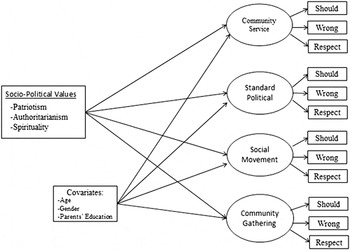
Structural equation models examined associations among adolescents’ sociopolitical values and social and moral judgments concerning different forms of civic engagement (figure 1). Multigroup analyses explored whether predictive parameters varied based on adolescent age (early, middle, and late adolescents) or socioeconomic status (at least one parent completed college vs. no parent completed college) with critical ratios assessing significant parameter differences across groups (z > 1.96).
Conceptual Model of Proposed Associations between Sociopolitical values and Civic Judgments

RESULTS
Patriotism, authoritarianism, and spirituality were all significantly and positively correlated (r’s(467) = .36 - .48). Civic judgments were significantly correlated within judgment type (should, wrong , respect, (r’s(467) = .36 - .48, p’s < 05) and civic involvement category (community service, standard political, social movement, community gathering (r’s(467) = .40 - .68, p’s < 05).
Associations between Sociopolitical Values and Civic Judgments
Measurement model
Adolescents’ should, wrong, and respect ratings were modeled as indicators of first-order latent variables encapsulating youth civic beliefs for community service, standard political involvement, social movement, and community gathering. To improve model fit, measurement error terms for the civic judgment indicator variables (should, wrong, and respect) were allowed to covary across civic activities (χ²/df = 4.02, CFI = .97, RMSEA = .08).
Structural model
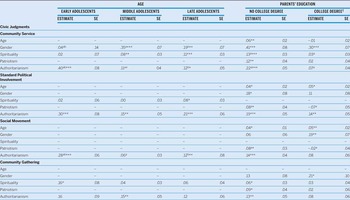
Structural models tested associations among adolescents’ sociopolitical values and latent variables representing adolescents’ judgments of community service, standard political involvement, social movement, and community gathering judgments (figure 1b, table 1 for parameters). Nonsignificant pathways were trimmed leading to the removal of parents’ education from the model (χ²/df = 4.45, CFI = .92, RMSEA = .09). Authoritarianism predicted positive judgments for all four civic activities. Spirituality predicted judgments for community service and community gathering, and patriotism predicted community service judgments.
Unstandardized Estimates and Standard Errors of Age and Parents' Education Differences in Sociopolitical Values Predicting and Civic Judgments

Note: *p < .05, **p < .01, ***p < .001. Coefficients with similar superscripts significantly differ with a critical ratio > 1.96. †At least one parent obtained a college degree.
Age groups
A multigroup model comparing early, middle, and late adolescents provided good fit to the data (χ²/df = 2.24, CFI = .93, RMSEA =.05) and significantly better fit than the constrained model (Δ χ² = 36.83, df = 16, p =.002). Compared to both middle and late adolescents, early adolescents’ authoritarian views were more strongly associated with prioritization of community service (C.R.’s: middle = -3.33, late = -3.14) and social movement involvement (C.R.’s: middle = -2.95, late = -2.00.
Parents’ education groups
A multigroup model comparing adolescents with parents who did and did not complete college provided a good fit to the data (χ²/df = 2.53, CFI = .92, RMSEA = .06) and significantly better than the constrained model (Δ χ² = 41.91 df = 17, p = .001). For adolescents with parents who had not completed college, authoritarianism (C.R. = -2.36) and spirituality (C.R. = -2.95) were more strongly associated with the prioritization of community service, and patriotism was more strongly associated with positive judgments concerning standard political involvement (C.R. = -2.45) and social movement (C.R. = -1.97).
DISCUSSION
Adolescence represents a potentially significant period in both citizenship and social-cognitive development including the emergence of a civic-political identity (Zaff et al. Reference Zaff, Hart, Flanagan, Youniss, Levine, Lamb and Freund2010). This study explored the intersection of adolescents’ budding understanding of civic responsibility with their inchoate nationalistic, authoritarianism, and spiritual values. Adolescents’ multidimensional conceptualizations of civic engagement were assessed via latent variables representing the intersection of adolescents’ should, obligation (wrong if not done), and social praise judgments. Structural models indicated significant associations between values and civic beliefs that varied by type of civic behavior, adolescent age, and parents’ education.
Thus, it is not surprising that those youth, who orient toward social stability and obedience, prioritize mainstream civic activity within the established political system.
Consistent with hypotheses, authoritarian beliefs predicted adolescents’ prioritization of standard political participation, such as voting and keeping up with current political news. In previous research, adolescents’ justifications for standard political behavior focused on conventional norms and shared communal expectations (Metzger and Smetana Reference Metzger and Smetana2009). Thus, it is not surprising that those youth, who orient toward social stability and obedience, prioritize mainstream civic activity within the established political system. Authoritarianism was also associated with adolescents’ judgments about community gathering activities, such as community events and membership in community social clubs, which are indicators of community social capital, civic health, and societal unity (Putnam Reference Putnam2000). A heightened veneration of social harmony and the established order might lead adolescents to value activities that contribute to community cohesion, togetherness, and support.
Contrary to expectations, adolescents’ authoritarian attitudes also predicted the prioritization of community service and social movement involvement. However, authoritarian beliefs have been associated with measures of moral self-righteousness (Altemeyer Reference Altemeyer1996). Thus, adolescents who are highly authoritarian may prioritize community service for its intrinsic and constructive value, as helping others may make them “feel good.” In contrast, social movement involvement includes “unconventional” civic activities, such as protests or rallies, that are designed to influence laws or social policy (Torney-Purta et al. Reference Torney-Purta, Lehmann, Oswald and Schulz2001). Thus, it had been anticipated that youth focused on upholding existing authority and rules would not prioritize social movements. However, the links between authoritarianism and both community service and social movement involvement beliefs were significantly weaker for older compared to younger adolescents. Older adolescents’ authoritarian beliefs were aligned with their prioritization of mainstream political involvement and less associated with their judgments about community service or judgments about political activities aimed at altering the established social order. These findings point to potential developmental expansions in youths’ civic understanding and increased convergence of adolescents’ core sociopolitical values and, with age, their grasp of civic responsibility.
As anticipated, adolescents with stronger spiritual beliefs judged community service to be obligatory and worthy of social praise. Although spirituality can exist outside of formal religious activity, it is often highly correlated with church attendance during adolescence (Benson, Roehlkepartain, and Rude Reference Benson, Roehlkepartain and Rude2003), and formal religious teachings often stress the importance of caring for the less fortunate (King Reference King, Lerner, Roeser and Phelps2008). Spirituality is also positively associated with attitudes concerning the importance of societal contributions involving community-level helping behaviors (Lerner, Roeser, and Phelps Reference Lerner, Roeser and Phelps2008). However, spirituality was significantly linked with community service judgments for older but not for younger adolescents. Although the critical ratio only approached significance (C.R. = 1.22), this pattern hints at the intriguing possibility that with age, adolescents’ spirituality becomes more strongly associated with beliefs that community service is obligatory and worthy of social praise.
Contrary to hypotheses, adolescents’ patriotic attitudes were only associated with the prioritization of standard political involvement and social movement involvement and only for adolescents from homes in which no parent had graduated from college. Patriotism was not associated with any civic judgments for adolescents from homes with at least one parent who graduated from college. Although parents’ education is merely one indicator of socioeconomic status, these findings suggest that patriotic values may differentially influence the interpretation of civic duty for adolescents from different socioeconomic strata. Identification with community and country may be more integral to the individual identity of youth from lower socioeconomic families (Huddy and Khatib Reference Huddy and Khatib2007). This may lead highly patriotic youth from lower socioeconomic status families to apprize civic contributions, while youth from more affluent families may rely on different sets of beliefs when evaluating civic participation.
These findings need to be interpreted in light of several limitations including the use of self-report data that is vulnerable to shared method variance and social desirability biases. Although heterogeneous in terms of socioeconomic status (parents’ education), participants all came from a rural town and were overwhelmingly white. Future research should explore the intersection of political values and civic judgments within urban contexts or communities with greater ethnic and racial diversity. Finally, this study used abridged measures of authoritarianism and patriotism, which were adapted for use with an adolescent sample. These adapted measures exhibited strong internal reliability and were uniquely associated with adolescents’ civic judgments, but they may not fully encapsulate adolescents’ developing patriotic or authoritarian values.
The current study indicates that adolescents’ emerging spiritual values, identification with the United States, and orientation toward authority may differentially influence their prioritization of community and political behaviors. Findings contribute a burgeoning body of research that argue for the inclusion of attitudes, beliefs, and cognitions as integral to civic development (Sherrod and Lauckhardt Reference Sherrod, Lauckhardt, Lerner and Steinberg2009; Zaff et al. Reference Zaff, Hart, Flanagan, Youniss, Levine, Lamb and Freund2010). Adolescents’ nascent religious and political belief systems and their emerging understanding of civic duty do not develop in isolation. Future research should continue to explore intersections among civic and value development.
Aaron Metzger is an assistant professor in the department of psychology at West Virginia University. He can be reached at Aaron.Metzger@mail.wvu.edu.
Benjamin Oosterhoff is a graduate student in the department of psychology, West Virginia Univeisty. He can be reached a tboosterh@mix.wvu.edu.
Cara A. Palmer is a graduate student in the department of psychology, West Virginia University. She can be reached at cpalmer9@mix.wvu.edu.
Kaitlyn Ferris is a graduate student in the department of psychology, West Virginia University. She can be reached at kferris3@mix.wvu.edu.