Introduction
Host plant resistance has been defined as the property that enables the host plant to avoid, tolerate or recover from injury caused by insect populations that would cause greater damage to other plants of the same species under the same environmental conditions (Kogan, Reference Kogan, Metcalf and Luckmann1982; Thomas and Waage, Reference Thomas and Waage1996). Resistance to insects has been classified into non-preference (antixenosis), antibiosis and tolerance (Painter, Reference Painter1951). Antibiosis is the ability of host plants of herbivorous insects to affect the development of immature stages, i.e. mortality and survivorship (Cheng and Pathak, Reference Cheng and Pathak1972), development duration, adult size and subsequent fecundity (Chan et al., Reference Chan, Waiss and Lukefahr1978; Thomas and Waage, Reference Thomas and Waage1996; Klinger et al., Reference Klinger, Powell, Thompson and Isaacs1998).
An understanding of how resistance influences herbivore development is important for two reasons. Firstly, such information would direct breeding programmes to address factors that have an impact on relevant herbivore development parameters. Secondly, these parameters can be used to screen cultivars for resistance. Development of laboratory methods for prediction of resistance in the field is particularly appealing because it can lead to reduction of time periods required to screen cultivars compared with growing plants in the field. In particular, this is important for crops such as banana that have long growth cycles.
The banana weevil Cosmopolites sordidus (Germar) (Coleoptera: Curculionidae) is an important pest of banana in the Great Lakes region of eastern Africa, where the crop is the major staple food for millions of people (Gold et al., Reference Gold, Ogenga-Latigo, Tushemereirwe, Kashaija, Nankinga, Gold and Gemmill1993). Larvae feed on the corm, interfering with water and nutrient transport and root development. Yield loss results from lengthened crop cycles, reduced fruit (bunch) size, plant loss through snapping, toppling and death, and mat die-out following failure to produce suckers. Yield losses of up to 60% have been reported in a crop cycle (Rukazambuga et al., Reference Rukazambuga, Gold and Gowen1998). Compared with introduced cultivars (AA, AB, ABB and ABB genome groups), endemic highland cultivars (AAA-EA genome group) are particularly susceptible to this pest (Kiggundu et al., Reference Kiggundu, Gold, Labuschagne, Vuylsteke and Laow2003).
Banana weevil biology has been reviewed by Gold et al. (Reference Gold, Pena and Karamura2001). Eggs are laid in the corm, at the base of the pseudostem, or in crop residues of harvested plants. Developmental times are temperature dependent. In Uganda, where daytime temperatures are in the mid-20s (in °C), egg duration averages 7 days, while the larval stage lasts 25 days on a susceptible cultivar. The prepupal period (quiescent larva) averages 4 days, while the pupal stage lasts 7 days. The life cycle of the banana weevil typically lasts 6–8 weeks in the laboratory. The banana weevil has a long lifespan and a low fecundity. Individuals have been recovered alive 4 years after marking and release in banana fields (N. D. Rukazambuga and C. S. Gold, unpublished observations). Egg production has been estimated at 1–4 eggs per female per week in the laboratory (Koppenhofer, Reference Koppenhofer1993), and at 0.5–1.2 eggs per female per week in the field (Koppenhofer, Reference Koppenhofer1993; Abera et al., Reference Abera, Gold and Kyamanywa1999). Field observations suggest that mortality is highest in the egg and the early instar larval stages (Abera et al., Reference Abera, Gold, Kyamanywa and Karamura2000).
Mechanisms of resistance to the banana weevil have been reviewed by Kiggundu et al. (Reference Kiggundu, Vuylsteke, Gold, Frison, Gold, Karamura and Sikora1999), Kiggundu (Reference Kiggundu2000) and Gold et al. (Reference Gold, Pena and Karamura2001). Little work has been done on tolerance of different cultivars to the banana weevil. Studies on various banana genotypes suggest that antixenosis is not important in resistance to C. sordidus as ovipositing females do not discriminate between cultivars. By contrast, antibiosis has been implicated in resistance of banana to C. sordidus. Previous studies of banana resistance to banana weevil suggested that antibiosis is expressed as increased larval mortality, as damage did not reflect field oviposition rates (Abera et al., Reference Abera, Gold, Kyamanywa and Karamura2000), and as increased development duration as shown in laboratory bioassays with larvae (Mesquita et al., Reference Mesquita, Alves and Caldas1984; Kiggundu, Reference Kiggundu2000). For example, the cultivar Yangambi Km5 (AAA genome) rarely displays larval damage in the field, although females readily oviposit on it. In feeding bioassays using agar impregnated with methanol extracts of plants of different cultivars, Kiggundu (Reference Kiggundu2000) found that extracts of resistant cultivars increased developmental time of larvae and reduced larval activity, with larval tunnelling ceasing by the third day. By contrast, larvae on agar that was infused with extracts from susceptible cultivars remained active over the 4-day experimental period. One resistant cultivar (Kayinja, ABB) produced 100% larval mortality by the third day. Rearing larvae on pieces of corms in the laboratory, Kiggundu (Reference Kiggundu2000) observed differences in survivorship that were not consistent with resistance patterns observed in the field, and he did not find differences in pupal weight for individuals fed on different cultivars.
Mesquita et al. (Reference Mesquita, Alves and Caldas1984) reared larvae on plantain (AAB genome) corms in Brazil. They observed significant prolongation of development on resistant cultivars. Their data on survivorship were inconclusive as they used only ten individuals per cultivar for the determination of survivorship. Moreover, they were unable to carry out statistical analyses on the survivorship data. Seshu-Reddy and Lubega (Reference Seshu-Reddy, Lubega and Ganry1993) observed faster build-up of banana weevil populations on susceptible cultivars both in a laboratory experiment and in an experiment with potted plants.
The main objective of this study was to evaluate laboratory screening of banana cultivars as a rapid screening method for resistance to the banana weevil by determining the survivorship, developmental period and adult weight of C. sordidus reared on cultivars that express different resistance levels in the field.
Materials and methods
Experiment site
Laboratory experiments to compare development of larvae fed corms of different cultivars under ambient conditions were carried out in March and April 2003 at the Kawanda Agricultural Research Institute (KARI), Uganda. This site has 12-hour day length throughout the year. Mean daily temperatures are 16 °C minimum and 29 °C maximum. The relative humidity averages 76%.
Larval rearing
Larvae were reared on nine cultivars: two susceptible (Atwalira (AAA-EA genome) and Kibuzi (AAA-EA genome)), three intermediate (Nsowe (AAA-EA genome), Kabula (AAA-EA genome) and Mbwazirume (AAA-EA genome)), and four resistant (Calcutta 4 (AA genome), Kisubi (AB genome), Kayinja (ABB genome) and Yangambi Km5 (AAA genome)). Resistance levels were based on results obtained by Kiggundu et al. (2003) in a field screening trial. We used five (Nsowe), six (Kibuzi), nine (Kisubi) or ten replications per cultivar, each replication consisting of five or ten larvae. Unequal replication was due to shortage of plants of certain cultivars. Similarly, unequal numbers of larvae per replication arose because it was not always possible to raise enough larvae, due to low hatchability of eggs in some batches.
Suckers of Atwalira, Nsowe, Mbwazirume, Kabula, Calcutta 4 and Yangambi Km5 were obtained from a cultivar screening trial at KARI, while those of Kibuzi, Kisubi and Kayinja were obtained from farmers' fields about 3 km from KARI. Suckers selected were those in the sword or maiden stage (1–6 months old). Suckers were pared to expose and eliminate damaged areas. Heavily damaged suckers were discarded. Source of suckers did not influence damage levels. Plants were used on the same day they were uprooted. Corm pieces (3 × 2.5 × 0.5 cm) were cut out for rearing the first instar ( < 24 h old) larvae, making sure to include both regions of the corm (inner cylinder and cortex). Rearing material was changed every 5 days, with larger pieces (up to 5 × 3 × 1 cm) being used for older larvae.
Larvae used in these experiments emerged from eggs produced in banana weevil colonies maintained under ambient conditions. These colonies were established with adult banana weevils of unknown ages collected from farmers' fields in Kisekka sub-county, Masaka District, Uganda, using pseudostem traps. Weevil colonies were maintained in the laboratory for 3–4 months in perforated, covered 15 or 20 l plastic buckets (pails), and were provided with corms obtained from the harvested plants of cultivar Atwalira for feeding and perching. Corms were removed every 3–4 days, the weevils were cleaned by washing with water containing 0.035% sodium hypochlorite and new corms were provided. To collect eggs, corms were removed, and weevils were provided with fresh suckers in the sword sucker or maiden sucker stage consisting of corm and about 30 cm of pseudostem. Suckers were pared, and dead leaf sheaths were removed. One to three suckers were then placed overnight in a bucket containing about 1000 adult weevils. The following day, eggs laid in the suckers were exposed by peeling off thin layers of the leaf sheaths near the collar region of the suckers (where most eggs are laid), and eggs were removed using the tip of a knife. Eggs were placed in a 100 mm diameter Petri dish containing 5 ml water to keep them moist, and were washed with water containing 0.035% sodium hypochlorite. Eggs were incubated in 100 mm diameter Petri dishes lined with moistened tissue paper, and the Petri dishes were sealed using masking tape. The Petri dishes were placed on laboratory benches, and were checked daily for hatching. Hatching occurred in 5–8 days.
Inoculations were carried out by incising cone-shaped entry holes (approximately 0.6 cm wide and 0.4 cm deep) in the corm using a small knife. A single larva was inserted in each hole, and was then covered lightly with the tissue that was scraped out. A single corm piece was placed in a Petri dish, and the Petri dish was covered and sealed using masking tape. Every 5 days, the corm piece was dissected to reveal the larva in its feeding tunnels. The larva was then transferred to a fresh piece of corm.
The experiment was continued until all individuals either turned into adults or died. After a larva reached the prepupal stage, it was checked daily, and the date of pupation was recorded. Larval periods recorded in this study included the prepupal period. If a larva tunnelled into the corm before reaching the quiescent prepupal stage, precluding observation, the date of transfer to a fresh piece of corm when the pupa was first seen was assumed to be the date of pupation. In such cases, time to pupation (the larval period) was overestimated. Burrowing into the corm by the larva before the prepupal stage was common in Atwalira, but not in other cultivars. It is not clear what factors are responsible for this larval behaviour. Emergence date and weight of adults were measured.
Data analysis
Data were analysed using Statistical Analysis Software (v.9.1; SAS Institute, Inc., Cary, NC, USA). Analysis of variance was employed to analyse development duration and adult weight. Planned contrasts were used to compare susceptible, intermediate and resistant cultivars. Cultivar means were compared using Tukey's test. Logistic regression was used to analyse survivorship data.
Results
Survivorship
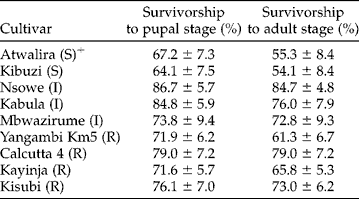
Survivorship data are summarized in Table 1. Survivorship to the pupal stage (Wald χ28 = 8.52; P = 0.3844) and to the adult stage (Wald χ28 = 12.82; P = 0.1183) was not significantly influenced by cultivars.
Mean % survivorship (±SE) of weevils feeding on banana cultivars with varying levels of resistance to banana weevil
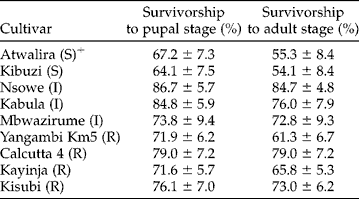
S, susceptible; I, intermediate; R, resistant.
+ Number of replications: six for Kibuzi, five for Nsowe, nine for Kisubi and ten for all other cultivars.
Development duration
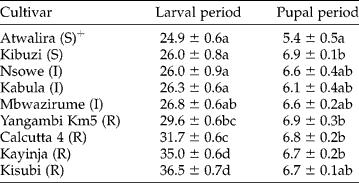
Cultivars had a significant effect on the length of the larval period (F 8,62 = 42.99; P < 0.0001; Table 2). Larvae that fed on resistant cultivars had significantly longer periods than those that fed on susceptible (t = − 13.07; P < 0.0001) or intermediate cultivars (t = − 13.25; P < 0.0001). However, larval periods for susceptible and intermediate cultivars were not significantly different (t = − 1.40; P = 0.1666). Cultivars had a significant effect on the pupal period (F 8,61 = 3.05; P = 0.0088), with susceptible cultivars having the shortest pupal period (Table 2). Pupal periods on susceptible cultivars were significantly shorter than those on resistant cultivars (t = − 2.59, P = 0.0119). Contrasts between pupal periods on susceptible and intermediate cultivars (t = − 1.16, P = 0.2523) or between those on intermediate and resistant cultivars (t = − 1.70, P = 0.0950) were not significant.
Mean (±SE) length of larval and pupal periods in days on cultivars of banana with varying levels of resistance to banana weevil
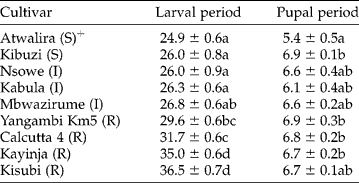
S, susceptible; I, intermediate; R, resistant.
Mean values in each column accompanied by the same letter are not significantly different (Tukey's test).
+ Number of replications: six for Kibuzi, five for Nsowe, nine for Kisubi and ten for all other cultivars.
Adult weight
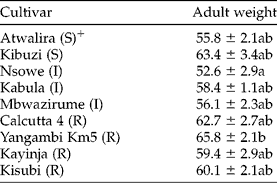
Adult weights were significantly affected by the cultivars on which larvae fed (F 8,59 = 3.05; P = 0.0061) (Table 3). The highest adult weight was observed for larvae raised on Yangambi Km5 (resistant). Larvae raised on resistant cultivars had the highest adult weight, and those raised on intermediate cultivars had the lowest adult weight. A contrast of susceptible against resistant cultivars (t = − 1.24, P < 0.2181) or susceptible against intermediate cultivars was not significant (t = 1.60, P < 0.1154). However, individuals raised on intermediate cultivars had significantly lower adult weights than those raised on resistant cultivars (t = − 3.60, P < 0.0007).
Mean (±SE) adult weight (mg) of banana weevils raised on banana cultivars with varying levels of resistance to Cosmopolites sordidus
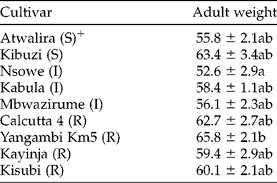
S, susceptible; I, intermediate; R, resistant.
Mean values accompanied by the same letter are not significantly different (Tukey's test).
+ Number of replications: six for Kibuzi, five for Nsowe, nine for Kisubi and ten for all other cultivars.
Discussion
Host plant resistance in the form of antibiosis may be expressed through increased mortality, delayed development, reduced body size and reduced fecundity of herbivores. In the current study, development duration of larvae feeding on resistant cultivars was prolonged. However, survivorship was similar among cultivars with different resistance levels, and adult weights were higher for weevils raised on resistant cultivars than for those raised on susceptible and intermediate cultivars.
Larval mortality for individuals feeding on different cultivars was not significantly different. It is therefore likely that some components of resistance break down when plants are excised. Breakdown of resistance is presumed to be partial since development of larvae is nevertheless delayed on resistant cultivars. However, delayed development of larvae does not explain damage differences in the absence of increased mortality in growing plants for these cultivars. Kiggundu et al. (2003) reported total cross-sectional corm damage of 10.3% for Atwalira, 1.5% for Kisubi and 0.4% for Yangambi Km5. Longer larval periods would be expected to result in the consumption of larger quantities of plant tissue per individual if consumption rate were unchanged, leading to higher damage in resistant cultivars. Equal damage would be expected if the longer period were just adequate to compensate for reduced consumption rates. We propose that survivorship is actually reduced on resistant cultivars in living plants, and that this component of resistance breaks down in excised tissue.
Altered resistance behaviour of cut plants or plant organs to insects has been reported. Excision of plant parts can alter their chemical and structural properties, probably due to breakdown of resistance factors. In alfalfa Medicago sativa L. (Fabaceae), for instance, for clones selected for resistance to the spotted alfalfa aphid, survival of adults and nymphs was significantly greater on excised trifoliates than on intact trifoliates (MacKinnon, 1961; cited by van Emden and Bashford, Reference van Emden and Bashford1976). In banana, cultivar resistance to weevil attack changes after plant harvest. Gold and Bagabe (Reference Gold and Bagabe1997) found that the cultivar Kisubi is resistant while alive, but that it is heavily attacked when dead. This suggests the presence of components of resistance that function in living plants and are lost once plants die. In living plants, reduced survivorship of larvae feeding on resistant cultivars results in differences in the damage levels observed.
Larval developmental period was prolonged in cultivars Yangambi Km5, Calcutta 4, Kayinja and Kisubi. Prolonged development duration has been reported for other insects (e.g. Chan et al., Reference Chan, Waiss and Lukefahr1978) and the banana weevil feeding on resistant cultivars (Mesquita et al., Reference Mesquita, Alves and Caldas1984; Seshu-Reddy and Lubega, Reference Seshu-Reddy, Lubega and Ganry1993; Kiggundu, Reference Kiggundu2000). Delayed development could be a result of reduced feeding (de Wilde, 1958; Cheng and Pathak, Reference Cheng and Pathak1972) or poor utilization of ingested food (Scriber and Slansky, Reference Scriber and Slansky1981). Reduced feeding may be caused by toughness of the food material and/or chemical antifeedants. In banana, studies of the relationship between corm hardness and larval feeding have not yielded conclusive data (Ortiz et al., Reference Ortiz, Vuylsteke, Dumpe and Ferris1995; Kiggundu, Reference Kiggundu2000; Kiggundu et al., Reference Kiggundu, Gold, Labuschagne, Vuylsteke and Laow2003).
The pupal period was shorter on Atwalira than on all other cultivars. We suggest that this is due to overestimation of larval developmental period in Atwalira. Time of pupation was missed in most of the larvae feeding on Atwalira. Whereas in other cultivars prepupae remained outside the corm, in most cases, in Atwalira, larvae burrowed inside the corm before the prepupal stage so that the exact day of pupation was unknown. Pupal period is probably between 6 and 7 days for all cultivars, as was observed by Kiggundu (Reference Kiggundu2000). To determine the actual pupal periods, these experiments should be repeated with thin layers of corm to prevent the entry of larvae into the corms.
Adult weights were similar for larvae feeding on susceptible and resistant cultivars. Insects generally pupate after they attain critical weight, resulting in delayed pupation if larvae cannot accumulate weight fast enough. These observations probably explain the longer larval period of individuals feeding on resistant cultivars. Thus larvae feeding on susceptible cultivars attained a critical weight for pupation in a shorter time than larvae that fed on resistant cultivars. It is noteworthy that larvae fed on resistant Yangambi Km5 had the highest adult weight.
Yangambi Km5 appears to have unique mechanisms of resistance. In the field, this cultivar experienced the lowest damage level of all the cultivars in the current study. Kiggundu (Reference Kiggundu2000) reported total cross-section corm damage of 0.4% for Yangambi Km5 compared with 1.0% for Kisubi, for instance, and 7.0% for Atwalira. Moreover, larvae feeding on Yangambi Km5 did not take the longest to pupate in the current study. In fact, the larval developmental period was the shortest for those that fed on all resistant cultivars in the laboratory. In the field as well (data not shown), development of larvae feeding on Yangambi Km5 was less prolonged than that of those feeding on other resistant cultivars such as Kisubi or Kayinja. This cultivar may contain a factor that acts as a toxin, or that causes complete failure to feed, causing rapid mortality of larvae. If so, our data would suggest that this toxin breaks down after harvest.
Another anomaly with Yangambi Km5 is that the larvae that fed on it had the highest adult weight. The balance between rate of accumulation of body mass and the length of the larval period determine final pupal or adult weight. For Yangambi Km5, therefore, the balance between these two factors resulted in a higher body weight. For individuals raised on Yangambi Km5 that survive, the rate of accumulation of body weight may actually be higher than that of those raised on other resistant cultivars. Consequently, the development duration of larvae feeding on this cultivar is lower than that of individuals feeding on other resistant cultivars.
Kiggundu (Reference Kiggundu2000) carried out high-performance liquid chromatography analysis of extracts of cultivars over a range of resistance levels. Cluster analysis of peaks resulted in three clusters of cultivars: resistant, intermediate and susceptible. The first two clusters consisted of cultivars expected in those categories based on damage observed in the field. However, Yangambi Km5 (and Cavendish) was placed in the susceptible cluster. Kiggundu (Reference Kiggundu2000) suggested that the chemical content of these cultivars is not responsible for their resistance. He suggested corm hardness as a mechanism of resistance for this cultivar against banana weevil.
In follow-up studies, we examined survivorship and larval development rates in living plants in a pot experiment (Night, Reference Night2006). The results support the notion of partial resistance breakdown in excised banana plants, and point to the limitations of laboratory bioassays for assessing resistance to the banana weevil. Moreover, laboratory studies on food utilization by larvae feeding on different cultivars carried out to determine mechanisms of delayed development of larvae feeding on resistant cultivars suggest that food utilization is less efficient on resistant cultivars. Biochemical studies should be carried out to identify chemical factors responsible for resistance to banana weevil.
In the current study, development duration on excised plant material in the laboratory reflected relative levels of resistance. Survivorship and adult weight, however, did not relate to resistance levels observed in the field. These phenomena may be due to breakdown of some components of resistance in excised tissue. Therefore, laboratory screening of excised corm tissue may be inappropriate for screening of varieties for resistance to the banana weevil.
Acknowledgements
Funding for this study was provided by the Rockefeller Foundation as part of a PhD fellowship to G. N. We are grateful for the support of Dr Wilberforce Tushemereirwe, Head of the National Banana Research Program, and the National Agricultural Research Organization of Uganda. Valentine Nakato assisted with data collection.