Introduction
In conservation biology, it is of basic importance to recognize the appropriate conservation units, which are usually species or various populations with divergent properties. It is problematic to devise good conservation strategies if the basic conservation units remain unknown. In lichens, there are many species with unclear boundaries (e.g. Kroken & Taylor Reference Kroken and Taylor2001; Crespo & Lumbsch Reference Crespo and Lumbsch2010). Characters such as morphology and secondary chemistry are often insufficient to differentiate closely related lineages of lichens (Lumbsch & Leavitt Reference Lumbsch and Leavitt2011). Molecular data have revolutionized our understanding of the evolution of lichenized fungi (see review by Printzen Reference Printzen and Lüttge2010 and references therein). Phylogenetic analysis of DNA sequence data, preferably from several unlinked loci, is a useful approach to unravel species boundaries (Taylor et al. Reference Taylor, Jacobson, Kroken, Kasuga, Geiser, Hibbett and Fisher2000; Kroken & Taylor Reference Kroken and Taylor2001; Lumbsch & Leavitt Reference Lumbsch and Leavitt2011).
The lichen Fuscopannaria confusa P. M. Jørg is difficult to distinguish morphologically from two other Fuscopannaria species, F. ahlneri P. M. Jørg and F. mediterranea (Tav.) P. M. Jørg., as well as from Parmeliella parvula P. M. Jørg. These species are characterized by greyish to brownish, small-squamulose thalli attached to a bluish black hypothallus. Moreover, they are sorediate and often without apothecia (see Fig. 1A). The genus Fuscopannaria comprises c. 46 species and Parmeliella c. 150 species (http://www.indexfungorum.org/). Both genera belong in the family Pannariaceae, order Peltigerales. However, molecular investigations have shown that Fuscopannaria and Parmeliella are not phylogenetic sisters, each being more closely related to other genera in the family (Ekman & Jørgensen Reference Ekman and Jørgensen2002; Miądlikowska et al. Reference Miądlikowska, Kauff, Hofstetter, Fraker, Grube, Hafellner, Reeb, Hodkinson, Kukwa and Lucking2006; Wedin et al. Reference Wedin, Wiklund, Jørgensen and Ekman2009).
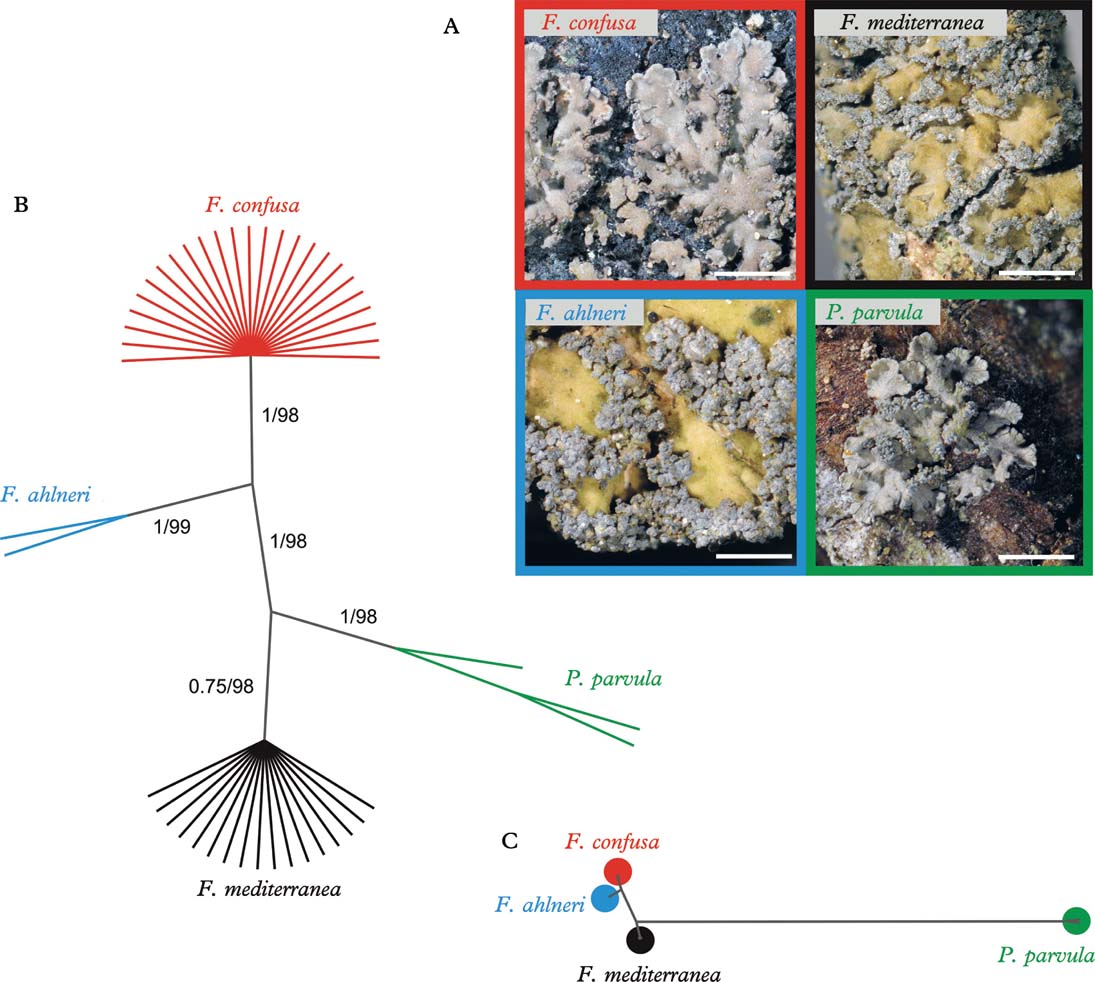
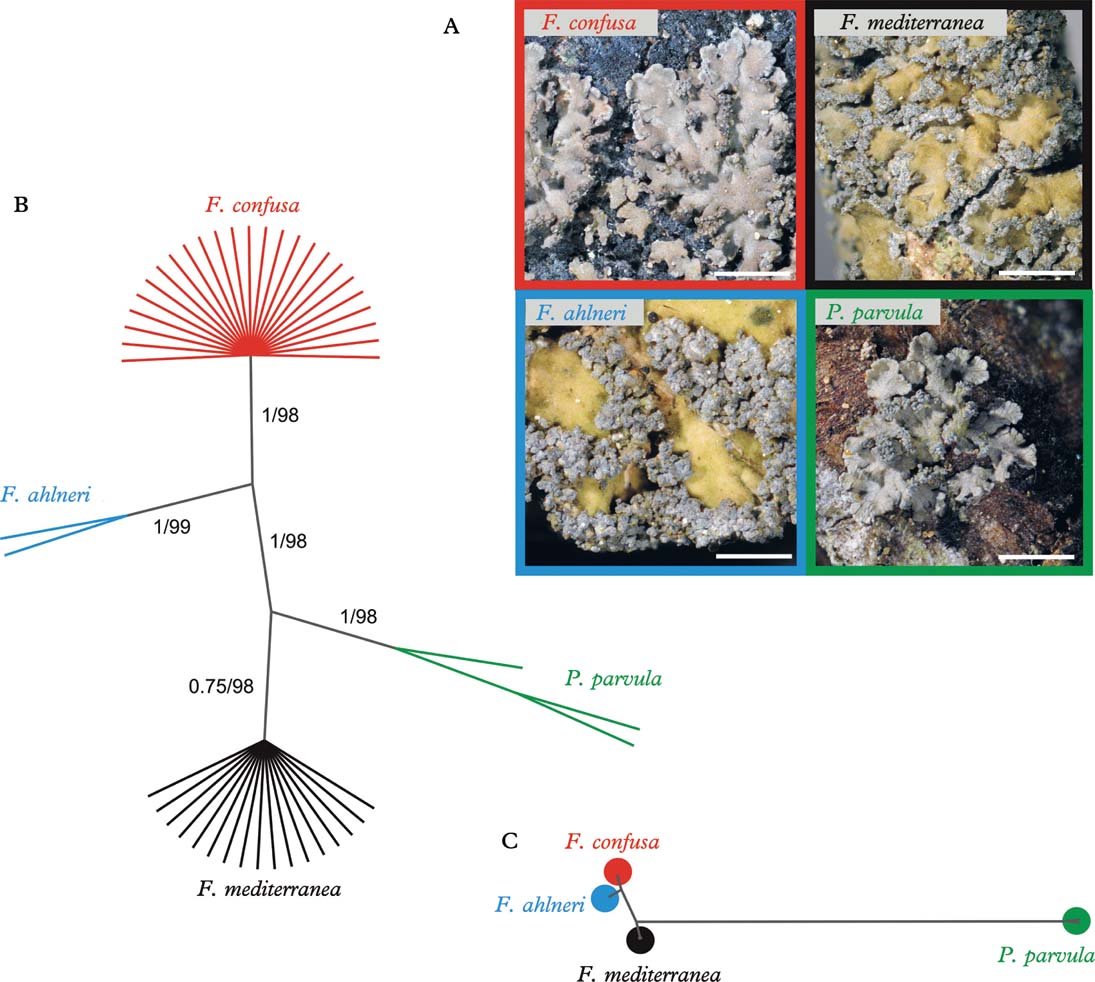
A, photographs of Fuscopannaria confusa, Hofton 08452 (O), F. mediterranea, Hofton 08445 (O), F. ahlneri, Holien (TRH L-10368), and, Parmeliella parvula, Holien (TRH L-9978); it is not possible to distinguish Fuscopannaria confusa from P. parvula by thallus morphology; both F. confusa and P. parvula have greyer squamules than F. mediterranea and F. ahlneri. Scales=0·5 mm. B, unrooted molecular tree showing that Fuscopannaria confusa is genetically distinct from F. ahlneri, F. mediterranea, and Parmeliella parvula. The unrooted tree (transformed to equal branch lengths) is a 50 % majority rule consensus topology from a Bayesian phylogenetic analysis of a concatenated dataset with 54 accessions of four taxa and three unlinked genetic regions. The single most parsimonious tree (identical in topology) was 190 steps long and had a rescaled consistency index of 0·96 and a homoplasy index of 0·03. Branch labels indicate posterior probabilities from Bayesian analysis/jackknife support values from parsimony resampling. C, same as B, but with branch lengths proportional to molecular change. In colour online.
Most documented findings of the morphotaxon F. confusa are from Fennoscandia, but it is known also from European Russia (Hermansson & Kudryatseva Reference Hermansson and Kudryatseva1995), two localities in the Alps (Vonarburg & Zimmermann Reference Vonarburg and Zimmermann2006), and some scattered localities in North America (Jørgensen Reference Jørgensen2000). Fuscopannaria confusa seems to be associated with brook ravines, and especially the spray zone of waterfalls. Prior to this study, F. confusa was known from nine Norwegian localities (documented in university herbaria), mainly in central Norway. We have collected material, tentatively assigned to F. confusa, from several additional localities, mainly in south-east and central Norway (Table 1; Fig. 2).
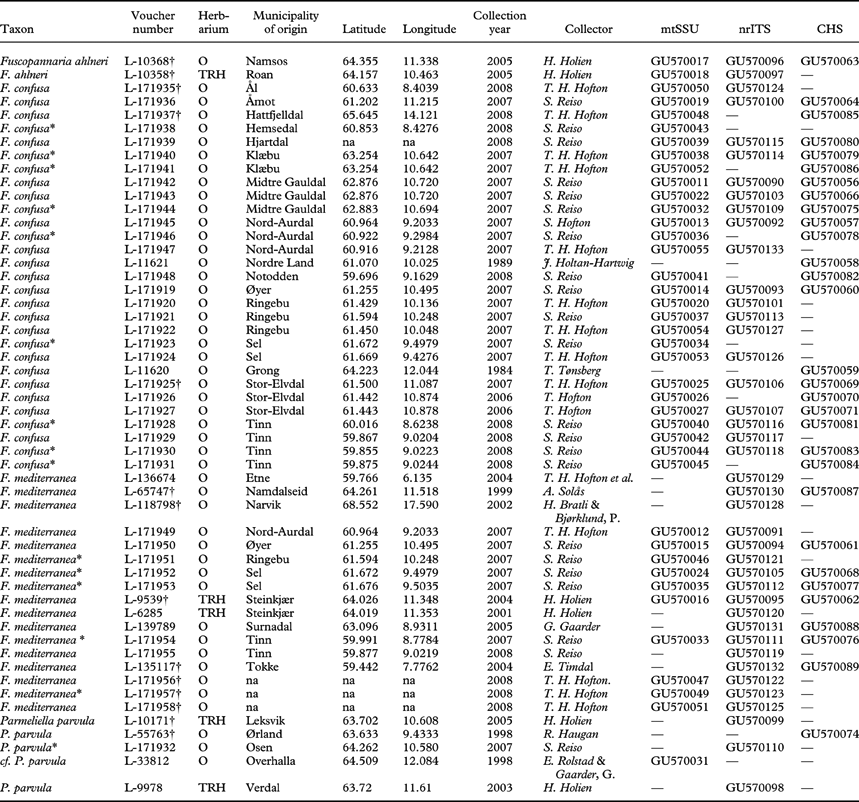
Specimens used in this study with voucher information (taxon name, voucher number, herbarium, locality with coordinates, year of collection, and name of collector) and GenBank accession numbers. All sequences listed were generated for the present study
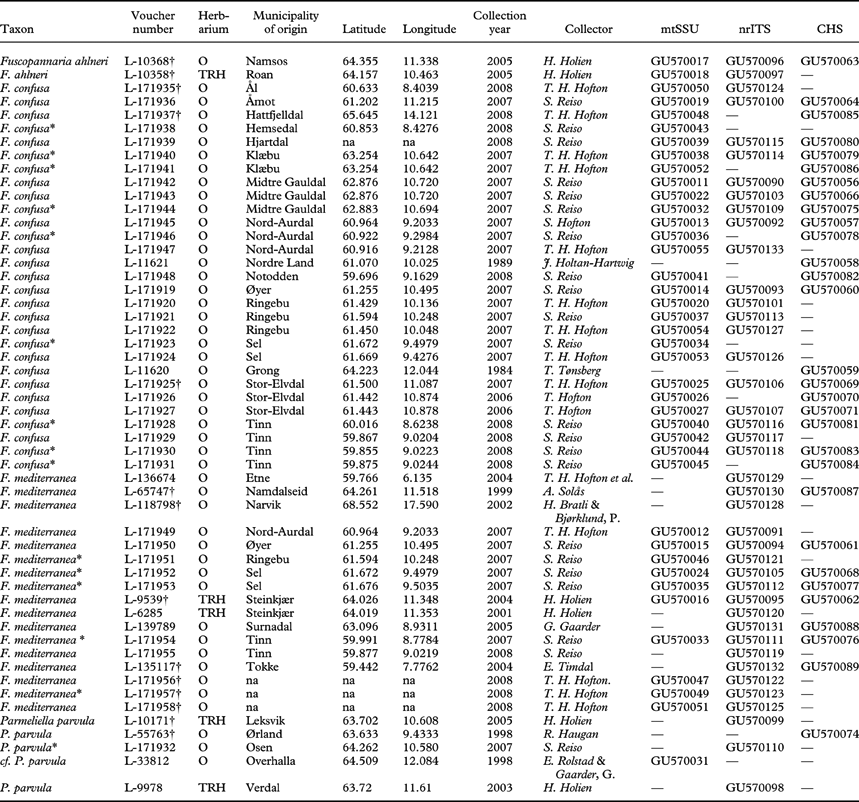
* Specimens collected as uncertain or unknown species within the complex and named after careful morphological investigation after the DNA results were known.
† Specimens examined for secondary metabolites using standard thin-layer chromatographic technique.
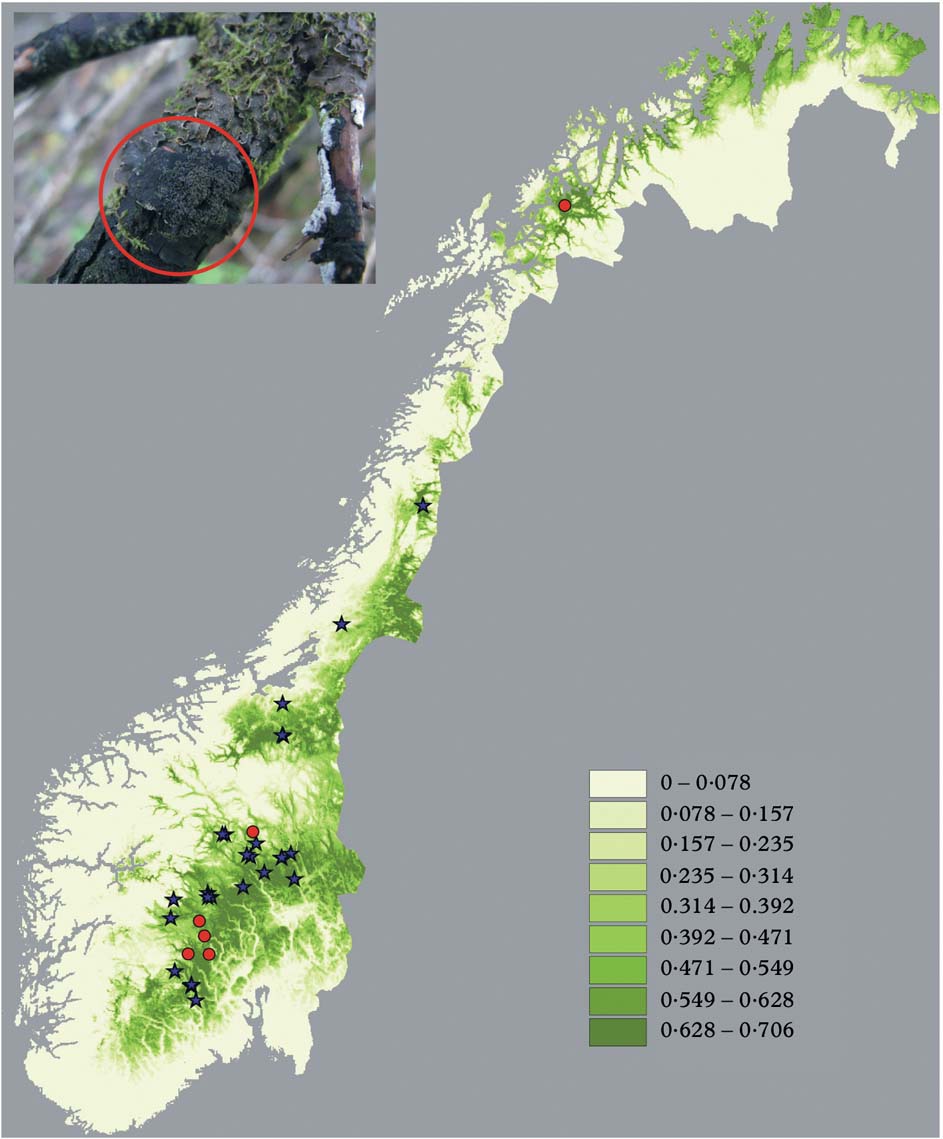
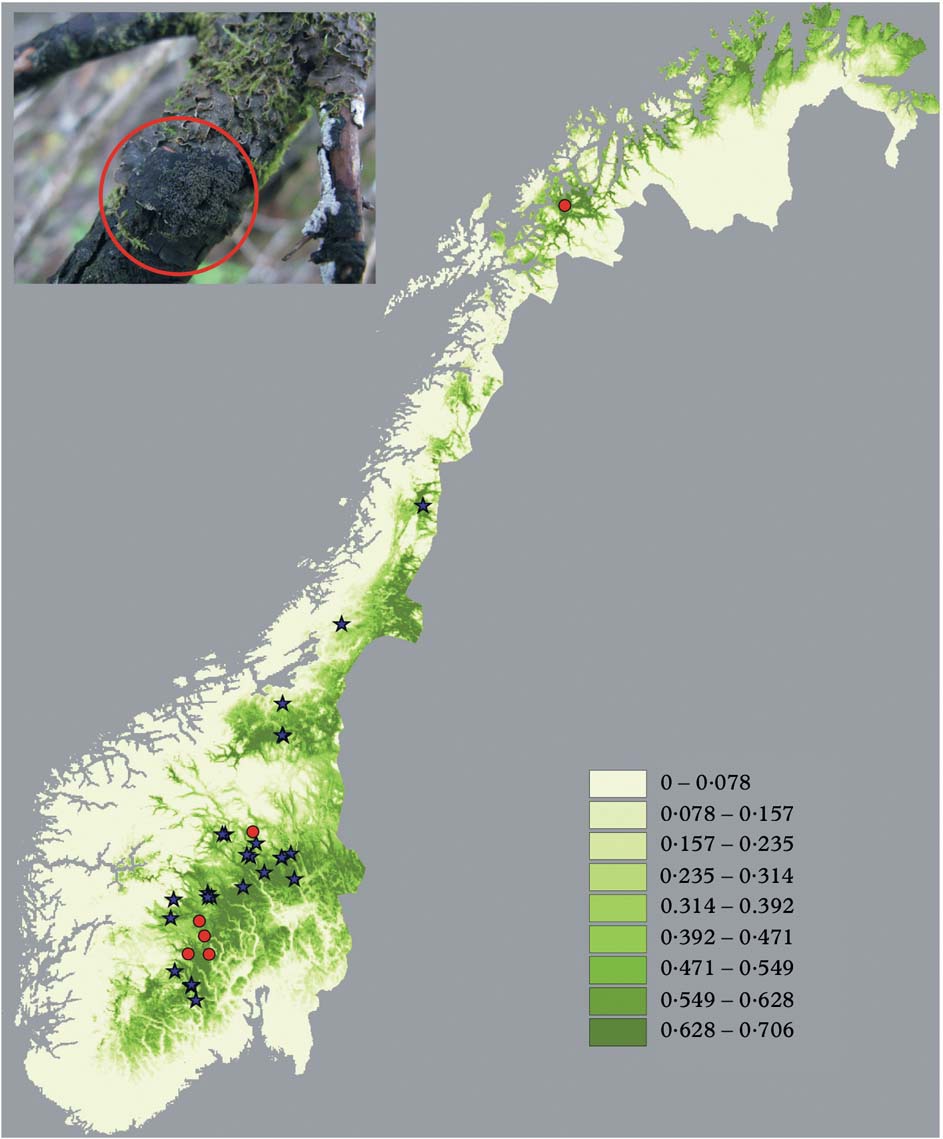
Map showing habitat suitability for Fuscopannaria confusa according to a maximum entropy model. Shading indicates the predicted probabilities of species occurrence on a scale of 0 to 1, with darker shades showing higher predicted areas. Asterisks (*) indicate sampling sites for F. confusa collections analyzed; dots (•) indicate new reports of F. confusa after the modelling was performed. Inset: F. confusa, Hofton 0810x (O). In colour online.
The specialized ecology and few known occurrences make it likely that F. confusa is a threatened species in Norway. During preparation of the former Norwegian red list (Timdal et al. Reference Timdal, Bratli, Haugan, Holien, Tønsberg, Kålås, Viken and Bakken2006), however, the authors found it difficult to identify collections of this complex and hence to evaluate the conservation status of F. confusa. For that reason it was given the status NE (not evaluated). Our principal aim with the present study is to test, by use of molecular data, whether F. confusa is a distinct species or rather falls within the variation of F. ahlneri, F. mediterranea or even P. parvula. We also calculate the potential regional distribution of F. confusa in Norway through species distribution modelling. Finally, in light of the new data, we propose a new conservation status of F. confusa for the Norwegian red list, which has already been adopted based on preliminary results of this study (Timdal et al. Reference Timdal, Bratli, Haugan, Holien, Tønsberg, Kålås, Viken, Henriksen and Skjelseth2010).
Materials and Methods
We analyzed two collections of F. ahlneri, 29 collections of F. confusa, 17 collections of F. mediterranea, and five collections of P. parvula; most were sampled through fieldwork covering all major parts of Norway and a few older herbarium specimens (Table 1). The species names given in Table 1 represent our post-analysis conclusions. Several specimens could not be identified in the field (collected as sp. or cf.; indicated in Table 1). These were re-examined after the more morphologically distinct specimens had been sequenced and tested with TLC. Most of the specimens sampled for this study were collected during species inventories in various habitats throughout Norway (less so in the far north).
DNA was extracted from these specimens using a 2% CTAB (cetyltrimethylammonium bromide) miniprep protocol (Murray & Thompson Reference Murray and Thompson1980). DNA fragments from three different regions were amplified: the nuclear ribosomal internal transcribed spacer (nrITS), an anonymous nuclear region [presumably Chalcone Synthase (CHS)], and a part of the mitochondrial ribosomal small subunit (mtSSU) region.
The nrITS and mtSSU regions were amplified and sequenced using the primer pairs ITS5/ITS4 and MS1/MS2, respectively (White et al. Reference White, Bruns, Lee, Taylor, Innis, Gelfand, Sninsky and White1990), and the partial CHS region using the primers CHS1F and CHS1R (James & Vilgalys Reference James and Vilgalys2001). The polymerase chain reaction (PCR) was performed in 25-µl reactions (5 µl of 1/100 dilution of DNA extract added) using PuReTaq Ready-To-Go ™ PCR Beads (GE Healthcare Limited, Buckinghamshire, UK) and the following cycle conditions: 4 min at 94°C, 34 cycles of 25 s at 94°C, 30 s at 55°C, 90 s at 72°C, and a final elongation step at 72°C for 10 min. PCR products were purified using 2 µl of a 1-in-10 dilution of ExoSAP-IT (USB Corporation, Cleveland, Ohio, USA) to 8 µl PCR product and otherwise following the provider's instructions. Cycle sequencing was performed by the CEES ABI-laboratory (http://www.bio.uio.no/ABI-lab/) using the ABI BigDye Terminator sequencing buffer and v3.1 Cycle Sequencing kit (Applied Biosystems, Foster City, California, USA). Sequences were processed on an ABI PRISM 3100 Genetic Analyzer (Applied Biosystems). All sequence chromatograms were controlled manually and sequence alignments established in BioEdit (Hall Reference Hall1999). All new sequences are deposited in GenBank, and the accession numbers are listed in Table 1.
We performed both parsimony and Bayesian phylogenetic analyses on each genetic region separately and in combination, and always with insertions/deletions coded as missing. Also expanded datasets that included taxa with similar sequences obtained through BLAST searching our self-generated sequences against public DNA sequence databases, were analyzed. TNT (Goloboff et al. Reference Goloboff, Farris and Nixon2008) was used for parsimony analyses and MrBayes 3.1.2 (Huelsenbeck & Ronquist Reference Huelsenbeck and Ronquist2001; Ronquist & Huelsenbeck Reference Ronquist and Huelsenbeck2003) for Bayesian analyses. We performed parsimony heuristic searches with one thousand random addition sequences and TBR branch swapping. For parsimony jackknifing, we used 10 000 replicates, 36% removal probability, and absolute frequencies as output. The jModelTest (Posada Reference Posada2008) was used to estimate the optimal models of nucleotide substitution for the various genetic regions. We ran two independent Bayesian runs with five chains (4 heated) for 10 million generations and summarized after discarding about 25% as burn-in (approximately the point where the standard deviation of split frequencies fell below 0·015). We used 50% majority rule consensus trees to calculate posterior probabilities.
We examined 12 specimens of F. confusa, two specimens of F. ahlneri, four specimens of F. mediterranea, and two specimens of P. parvula (Table 1) for secondary metabolites using standard thin-layer chromatographic techniques (TLC), in accordance with the methods of Culberson (Reference Culberson1972), modified by Menlove (Reference Menlove1974) and Culberson & Johnson (Reference Culberson and Johnson1982).
In light of the DNA-sequence and TLC results, the morphology of the specimens were re-examined.
We performed ecological distribution modelling for F. confusa in Norway using Maxent version 3.1.0 (Phillips et al. Reference Phillips, Anderson and Schapire2006; Phillips & Dudík Reference Phillips and Dudík2008) with default settings. Maxent is a maximum-likelihood modelling method based on the maximum entropy principle (Jaynes Reference Jaynes1957). Maxent was chosen because it has proven to be one of the most reliable distribution modelling methods currently available (Elith et al. Reference Elith, Graham, Anderson, Dudík, Ferrier, Guisan, Hijmans, Huettmann, Leathwick and Lehmann2006; Phillips et al. Reference Phillips, Anderson and Schapire2006; Guisan et al. Reference Guisan, Graham, Elith and Huettmann2007; Elith & Graham Reference Elith and Graham2009). Input for the distribution model was location co-ordinates of the collected and analyzed material listed in Table 1, and the two first principal components extracted from a set of 54 environmental variables (1×1 km resolution) analyzed by Bakkestuen et al. (Reference Bakkestuen, Erikstad and Halvorsen2008, Reference Bakkestuen, Erikstad and Halvorsen2009). The first principal component represents a regional variation (gradient) from coast to inland and from oceanic/humid to continental areas. The second principal component represents a regional variation from north to south and from high to low altitudes. These two axes corresponded to the two bioclimatic gradients used in Bakkestuen et al.'s (Reference Bakkestuen, Erikstad and Halvorsen2008) classification of Norway into biogeographical regions: vegetation sections (from highly oceanic to slightly continental) and vegetation zones (from nemoral to alpine).
Results
We obtained high quality DNA sequences of at least one genetic region of each accession listed in Table 1; in total, 113 new sequences (42 nrITS, 31 CHS, and 40 mtSSU). We had generally lower success rate for older specimens of all species. That only single and/or different genetic regions could be amplified from some specimens (see Table 1: e.g. Parmeliella parvula) might indicate poor quality of the template DNA (M. Bendiksby, unpublished). Best-fit models of nucleotide substitution using the Bayesian information criterion were: K80+G for nrITS; HKY for mtSSU; JK for CHS. Parsimony and Bayesian analyses produced identical results. The gene trees obtained from both of these analyses were congruent, were strongly supported, and data matrices contained low or no homoplasy. With low or no homoplasy, the tree-lengths (L) depict the level of molecular variation; nrITS being the most variable (L=178), mtSSU the second (L=46), and CHS being the least variable marker of the three (L=16). The corresponding numbers of parsimony informative characters are: 134 in nrITS, 22 in mtSSU, and eight in the CHS matrix. The same characteristics apply for the gene trees of the expanded datasets (those that include sequence data of additional taxa from public databases), which are presented with tree statistics and additional descriptions as Supplementary Figure 1 (SF1) in the Appendix. Among all datasets, only the expanded mtSSU dataset generated more than a single most parsimonious tree (SF1C).
In the concatenated matrix, we included all accessions for which we had sequenced the nrITS, or both CHS and mtSSU (see Table 1). The Bayesian 50% majority rule consensus tree (identical to the single most parsimonious tree) is presented with tree statistics in Fig. 1B. All accessions of each of the four morphospecies (F. ahlneri, F. confusa, F. mediterranea, and P. parvula) group with high support, respectively.
In the TLC analyses, we found two unknown fatty acids and one unknown triterpenoid in F. confusa, F. ahlneri and F. mediterranea, and no metabolites in P. parvula. The metabolites occurred in low concentration, but the results were reproducible and constant over all representatives of the same species investigated. We did not notice any diagnostic difference in the secondary chemistry between the three Fuscopannaria species.
The habitat suitability for F. confusa according to a maximum entropy model is shown in Figure 2. When taking only bioclimatic variation into consideration, the darker colours show higher predicted areas. The habitat suitability model obtained an area under the curve value of 0·885, which suggests a potentially useful model (1 indicates a perfect model, and 0·5 indicates a random prediction; Pearce & Ferrier Reference Pearce and Ferrier2000). The two ‘composite’ environmental variables (oceanic to continental areas, and north to south / high to low altitudes; see Bakkestuen et al. Reference Bakkestuen, Erikstad and Halvorsen2008 for further explanation) contributed almost equally to the performance of the model and show that F. confusa responds to both of the two main recognized regional bioclimatic gradients in Norway.
Discussion
Accurate species delimitation is crucial in biodiversity assessments and conservation biology. Multi-locus DNA sequencing provides an invaluable tool for robust species delimitation (Lumbsch & Leavitt Reference Lumbsch and Leavitt2011). In this study, we have tested, by multi-locus DNA sequencing, whether Fuscopannaria confusa is a species distinct from the three morphologically highly similar species, F. ahlneri, F. mediterranea and Parmeliella parvula (Fig. 1A). Our DNA sequence data from three unlinked genetic regions clearly show that F. confusa represents a separate species (Fig. 1B). Moreover, phylogenetic results from the extended datasets (those including additional taxa; SF1) show that none of the three morphologically similar species represent the closest relative of F. confusa. Fuscopannaria mediterranea is the genetically most divergent among the three Fuscopannaria species included (Fig. 1C), whereas F. ahlneri is the morphologically most readily distinguishable species by its more prolonged and wider lobes (up to 1·5 mm wide vs up to 1·0 mm in F. mediterranea, 0·8 mm in F. confusa, and 0·6 mm in P. parvula). Moreover, our morphological re-examination revealed that F. mediterranea differs from F. confusa and P. parvula in forming somewhat larger, more olivaceous brown squamules with contrasting blue-grey soralia. In F. confusa and P. parvula, both squamules and soralia were uniformly grey. Fuscopannaria confusa and P. parvula remain the most difficult to separate morphologically. Jørgensen (Reference Jørgensen1991) reported P. parvula to have isidioid soralia and F. confusa to have needle-like crystals in the soralia in herbarium specimens. The latter character develops slowly and reflects the presence of triterpenoids in the thallus. We failed to separate F. confusa from P. parvula on thallus morphology. Fuscopannaria confusa may have a somewhat darker thallus than P. parvula, but chromatography or DNA sequencing seems to be required for distinguishing these two species. Our TLC results support Jørgensen's (Reference Jørgensen1991) report of two unknown fatty acids and one unknown triterpenoid in F. confusa, as well as no observable metabolites in P. parvula. Although in low concentration, the metabolites do seem to represent reliable characters for distinguishing between F. confusa and P. parvula. The hymenial character reported by Jørgensen (Reference Jørgensen1991; i.e. colour reaction by iodine) could not be studied in our sterile material.
Although the three Fuscopannaria species, F. ahlneri, F. mediterranea, and F. confusa, are sometimes found growing side by side, they exhibit rather clear differences in ecology and distribution, F. mediterranea being the most divergent. Whereas both F. ahlneri and F. confusa have narrow ecological niches, being mostly Picea-associated and strongly hygrophilous, F. mediterranea has a much wider ecological amplitude and distribution. It is found in all parts of Norway (except the most northern parts) with its main occurrences in coastal areas. It is less hygrophilous and grows mainly on mature deciduous trees or sometimes on more or less calcareous rock walls. Only a few findings of F. mediterranea are recorded from Picea twigs in the spray zone of waterfalls. Fuscopannaria ahlneri has the most restricted distribution, and is almost totally confined to lowland, old-growth Picea forests of central Norway (Timdal Reference Timdal2011). The species belongs to an exclusive biogeographical element of boreal rainforests (Holien & Tønsberg Reference Holien and Tønsberg1996). It grows mostly on twigs of spruce, but also on Sorbus aucuparia and on cliffs, in extremely humid situations, especially at the bottom of ravines. Parmeliella parvula also grows mainly on twigs of spruce in old-growth Picea forests. It occurs in Norway along the west coast from Rogaland to Nordland (Timdal Reference Timdal2011). In contrast to F. ahlneri, F. mediterranea and P. parvula, the distribution of F. confusa in Norway is more continental.
There are now c. 43 records of F. confusa from Norway, of which 29 are included in our present molecular and modelling investigation. Most of these 43 records are from areas of natural Picea-forest in continental and eastern parts of south central Norway. We wanted to calculate the potential regional distribution of F. confusa in Norway through species distribution modelling. The Maxent habitat model for F. confusa (Fig. 2) suggests, when taking only bioclimatic variation into consideration, that the species may be found also in areas further north; that is, in areas outside the range of Picea. Indeed, recent observations of F. confusa, found after the modelling was performed (T. H. Hofton, S. Reiso & P. M. Jørgensen, pers. comm.), support the reliability of the habitat model, also in northern parts of Norway (Fig. 2). In addition, F. confusa seems to have its main distribution in the middle boreal zone, with quite a few localities in the northern boreal zone, while being rarer in the southern boreal zone. Although collections performed for this study have doubled the total number of findings recorded, we want to emphasize that F. confusa is rare, also in its preferred habitats. Our hope is that this study will guide our search, and conservation efforts, for this species. We anticipate new findings in the predicted habitats.
Finally, we wanted to re-evaluate, in light of the new data, the conservation status of F. confusa for the Norwegian red list. Hygrophilous lichen species connected to waterfalls in forest regions seem to be very sensitive to periodically low water flow, especially during warm periods of the summer. The drainage areas of rivers supporting populations of these species tend to be rather large, and with a large percentage of mires and swamps, which act as water reservoirs preventing very low water flow during dry periods. Many rivers in Norway lack such properties and have periodically very low water flow. Thus, potentially suitable habitats for species like F. confusa are restricted. As the species is confined to very small forest patches in today's landscape, it is also sensitive to small-scale stochastic natural and human-induced events that destroy the trees and cause rapid changes in sunlight and wind exposure. In addition, a large number of suitable localities have been destroyed due to clear-cut logging and especially hydroelectric power development. Habitat loss is a common and very serious threat to lichens (Wolseley Reference Wolseley1995; Scheidegger & Werth Reference Scheidegger and Werth2009). Due to changes in the landscape, it is likely that F. confusa has experienced a strong population decline since the 1890s, when the first large waterfalls were developed for hydroelectric power (http://www.riksantikvaren.no/?module=Articles;action=Article.publicShow;ID=3059).
Although the overall delimitation of F. confusa must take into consideration additional species and geographic regions, our results clearly show that F. confusa must be considered and managed as a distinct and threatened species in Norway; that is, endangered (EN; high risk of extinction in the wild) based on C1 (less than 2500 individuals and 20 % reduction/5 years) and D1 (50–250 reproducing individuals) criteria (Kålås et al. Reference Kålås, Viken, Henriksen and Skjelseth2010). Continued mapping of F. confusa in boreal regions should be undertaken to assess its global status. Fuscopannaria confusa might be overlooked, but despite a potentially wide geographical distribution, it is likely to be threatened throughout its distribution area because it occupies a habitat in decline.
The authors thank Cecilie Mathiesen and Siri Rui for laboratory help, Nansenfondet for grant 31/2009, and BioFokus and Artsdatabanken for financial support.
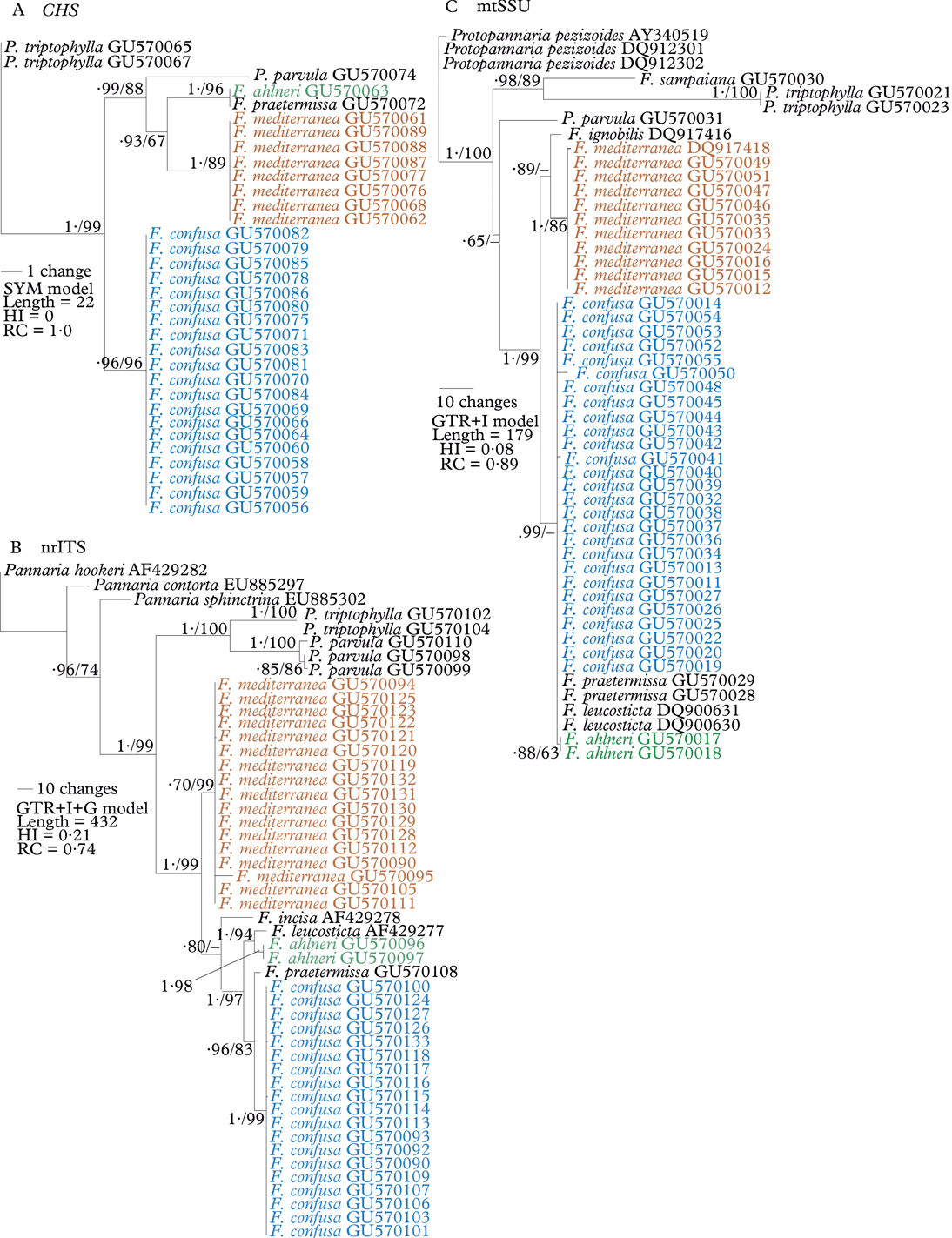
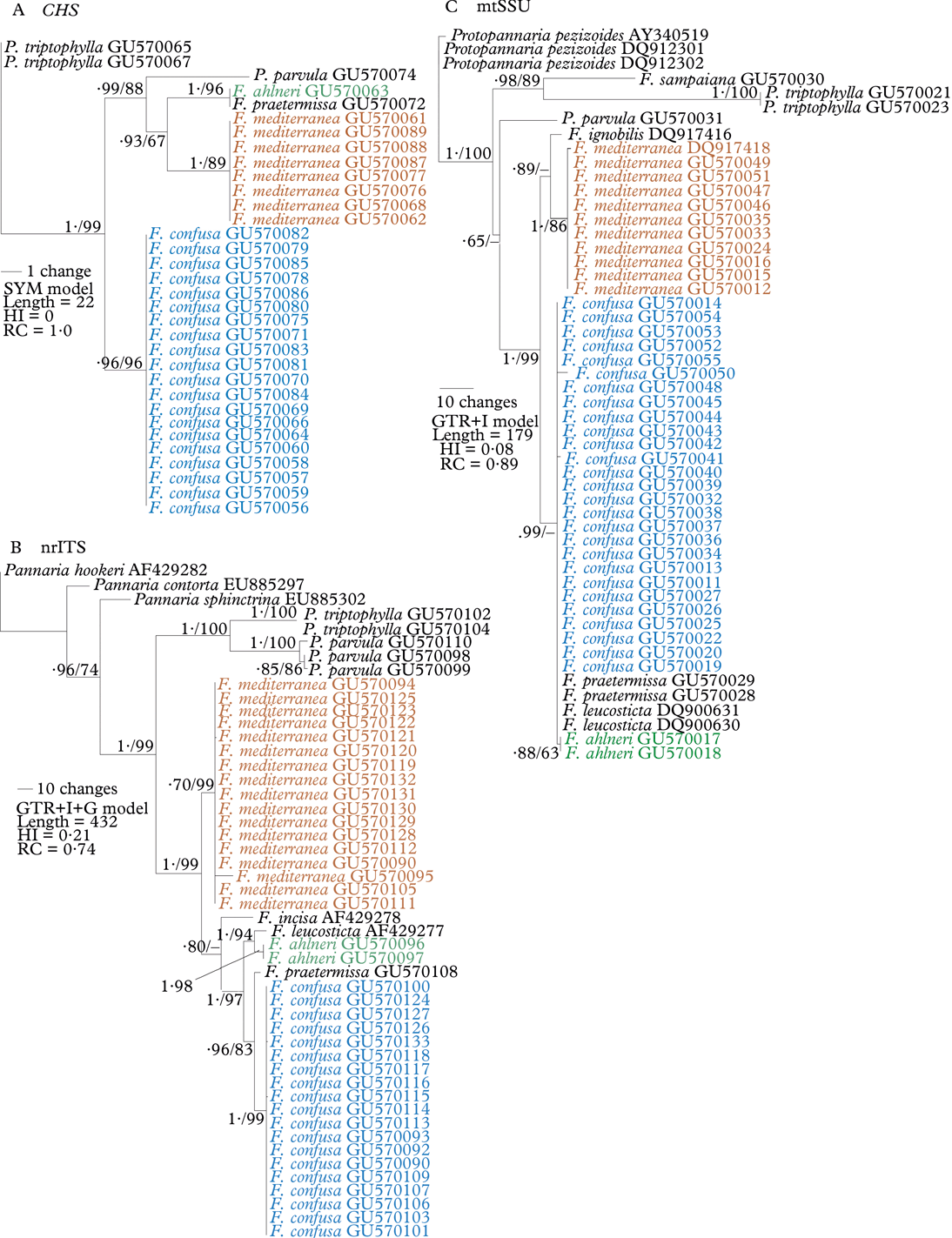
Appendix. Gene trees of expanded data sets including including sequence data from additional taxa from in data bases from the three DNA regions
(Suppl. Fig. A1)
A, CHS (single most parsimonious tree); B, nrITS (single most parsimonious tree); C, mtSSU (one of the three most parsimonious trees). Generic names for Fuscopannaria (F.) and Parmeliella (P.) are abbreviated. Results from parsimony and Bayesian analyses were similar. Branch labels indicate posterior probabilities from Bayesian analysis/jackknife values from parsimony resampling. Reported are also best-fit models of nucleotide substitution, lengths of trees, and homoplasy and rescaled consistency indices (HI and RC, respectively). In the nrITS and CHS phylogenies, F. confusa comes out as a separate and well-supported group, while in the mtSSU phylogeny, F. confusa groups with F. ahlneri, F. praetermissa and F. leucosticta. The mtSSU marker is a slower evolving region, and is not expected to distinguish between closely related species. Overall, the results clearly show that F. confusa represents a species genetically distinct from F. ahlneri, F. mediterranea and Parmeliella parvula. In colour online.