Considerable research shows that negative affect toward Muslim Americans is pervasive (Jamal and Naber Reference Jamal and Naber2008; Kalkan, Layman, and Uslaner Reference Kalkan, Layman and Uslaner2009; Oskooii, Dana, and Barreto Reference Oskooii, Dana and Barreto2019) and driven by exposure to negative media and elite rhetoric, particularly since the events of September 11, 2001 (Lajevardi Reference Lajevardi2020). Recent studies and polls find a small minority of Americans have a positive view of Muslim Americans (e.g., Khan and Ecklund Reference Khan and Ecklund2012; Oskooii, Dana, and Barreto Reference Oskooii, Dana and Barreto2019),Footnote 1 and Muslims are often politically constructed as symbolic threats (Argyle, Terman, and Nelimarkka Reference Argyle, Terman and NelimarkkaN.d.), and the victims of sociopolitical harassment (Welborne et al. Reference Welborne, Westfall, Russell and Tobin2018; Hobbs and Lajevardi Reference Hobbs and Lajevardi2019) and even violence (Westfall et al. Reference Westfall, Russell, Welborne and Tobin2017; Müller and Schwarz Reference Müller and Schwarz2018). Within this context of widespread Islamophobia, we test whether Muslim identity will have a negative effect on perceived trust, even when that individual is engaged in prosocial behavior.
Scholarship on prejudice reduction shows consistent evidence that exposure to individual members of a marginalized group—either through interpersonal contact or through mediated contact—has the potential to substantially shift attitudes. The key is for the positive exposure to an individual to be generalized to a group. Then, the public must update its attitudes toward the entire group to which the individual belongs (rather than dismiss the individual as an exception). The ability to generalize from individual to group depends on contact being perceived as an intergroup encounter rather than as an interpersonal encounter (Hewstone and Brown Reference Hewstone and Brown1986; Brown, Vivian, and Hewstone Reference Brown, Vivian and Hewstone1999).
To maximize generalization, the psychological link between subjects and their respective groups cannot be too salient during the interaction (Miller, Brewer, and Edwards Reference Miller, Brewer and Edwards1985; Scarberry et al. Reference Scarberry, Ratcliff, Lord, Lanicek and Desforges1997). Generalization also depends on the degree to which an outgroup representative is seen as typical according to an individual's prior attitudes about the outgroup (Skipworth, Garner, and Dettry Reference Skipworth, Garner and Dettry2010). Negative affect toward stigmatized group members can generate resistance to exposure to positive information due to confirmation bias or one's privileging of negative information (Baumeister et al. Reference Baumeister, Bratslavsky, Finkenauer and Vohs2001; Albertson and Gadarian Reference Albertson and Kushner Gadarian2015; Merolla and Zechmeister Reference Merolla and Zechmeister2018). The variable nature of this process helps explain why negative racial attitudes are deeply resistant to change, even in the face of stereotype-correcting information (Sears and Funk Reference Sears and Funk1999; Paluck Reference Paluck2009; Nyhan and Reifer Reference Nyhan and Reifer2010; Tesler Reference Tesler2015). Conversely, there is some evidence that exposure to positive information about an outgroup can improve attitudes (Williamson Reference Williamson2019; Lajevardi Reference Lajevardi2021), especially in contexts where ingroup familiarity with an outgroup is low (Stephan and Stephan Reference Stephan and Stephan1985; Blascovich et al. Reference Blascovich, Mendes, Hunter, Lickel and Kowai-Bell2001; Voci and Hewstone Reference Voci and Hewstone2003). In American politics, and regarding marginalized racial and ethnic minorities specifically, members of the socially dominant ingroup might view minorities with higher affect when learning that outgroup members demonstrate behaviors that align with democratic engagement. In the process, ingroup members may be less impacted by negative outgroups stereotypes (Dovidio et al. Reference Dovidio, Piliavin, Gaertner, Schroeder and Clark1991; Dovidio, Gaertner, and Kawakami Reference Dovidio, Gaertner and Kawakami2003).
We assess how the public responds to positive information showing Muslim Americans engaged in behavior closely aligned with the democratic process and contradicting contemporary (and historical) stereotypes about Muslims as anti-American. We also assess whether stereotypes conflate Arabs with Muslims (D'Urso Reference D'UrsoN.d.). In the process, we examine public perceptions of positive information about Arabs, since there is often confusion about whether the widespread discrimination in the current era is targeted at ethnicity (e.g., Arab) or religion (e.g., Muslim). In the years before and immediately after the attacks on September 11, 2001, scholarly research wavered between a focus on Arab American mobility and discrimination and a focus on Muslim discrimination (see Lajevardi Reference Lajevardi2020 for a review).
The lack of consistent focus on both groups is understandable given that, prior to 2001, groups differentiated themselves by language (e.g., Arabic, Turkish, and Farsi), religion (e.g., Muslim, Christian, Bahai, and Jewish), ethnicity (e.g., Arab, Turkish, and Persian), and immigration histories to the United States. But today Muslim Americans are perceived as monolithic, despite being a demographically diverse religious group (Khan and Ecklund Reference Khan and Ecklund2012; Lajevardi Reference Lajevardi2020). Recent analysis shows that a shift in media coverage—and by proxy, the national attention—from Arab American to Muslim American occurred between 2003 and 2007 (Lajevardi Reference Lajevardi2020). Since then, Arab Americans have all but disappeared from the spotlight, and negative attention has been re-centered on the religious group: Muslims. As such, in recent years, scholarship largely has focused on unpacking the antecedents and consequences of discrimination centered on adherents of Islam (Islamophobia).
This does not necessarily mean that anti-Arab prejudice disappeared. Cainkar (Reference Cainkar2006, 244) notes that after 9/11, “persons with Arabic-sounding names, whether Christian or Muslim, reported experiencing job discrimination and anti-Arab comments, and that persons with the ‘Arab/Middle Eastern’ phenotype have been physically attacked regardless of religion.” What is unclear, however, is whether these perceived experiences of discrimination among Arab Americans extend to the public's current behavior now that the focus has turned to Muslims and whether the public continues to conflate Arab and Muslim Americans.
To clarify, we do not expect exposure to information of Muslims support of democratic engagement to lead the public to consider Muslim Americans as ingroup members (i.e., with non-Muslims). Rather, we test whether exposure to prosocial democratic behavior by a Muslim American can nudge the public toward more positive evaluations of the person engaging in the behavior. Specifically, we conduct a randomized survey experiment to assess whether a person taking on the role of deliberation facilitator in local politics improves public affect assessments of the facilitator when the person is identified as Muslim, Arab, Arab and Muslim, or not identified at all. Compared to the control, we find that when the facilitator is identified as Muslim, respondents evaluate the organizer as having negative personal attributes, making them see the facilitator as less trustworthy. In addition, respondent purported contact with Muslims and reported party ID play no role in changing affect outcomes. As such, our results are fresh evidence that the opportunities for Muslim political incorporation in America remain limited.
THEORY AND EXPECTATIONS
Societal scrutiny of Muslims predates 9/11 and is rooted in a belief about the supposed incompatibility between Islam and core American values (Kalkan, Layman, and Uslaner Reference Kalkan, Layman and Uslaner2009; Lajevardi and Oskooii Reference Lajevardi and Oskooii2018; Lajevardi Reference Lajevardi2020, Dana et al. Reference Dana, Lajevardi, Oskooii and Walker2019). Negative views of Islam paint its followers as monolithic, barbaric, intolerant, violent, and at odds with democratic norms and principles (Said Reference Said1979; Dana, Barreto, and Oskooii Reference Dana, Barreto and Oskooii2011; Dana, Wilcox-Archuleta, and Barreto Reference Dana, Wilcox-Archuleta and Barreto2017; Jamal, Naber and Kazemipur 2014).
These negative stereotypes have become more pervasive over the past decade: Muslim Americans report psychological stressors when confronting their own stigma (Sediqe Reference Sediqe2020) and heightened social and political discrimination (Oskooii Reference Oskooii2016; Dana et al. Reference Oskooii, Dana and Barreto2019; Lajevardi et al. Reference Lajevardi, Oskooii, Walker and Westfall2020), which peaked during the 2016 presidential campaign (Calfano, Lajevardi, and Michelson Reference Calfano, Lajevardi and Michelson2017) and resulted in a reduction of their online presence (Hobbs and Lajevardi Reference Hobbs and Lajevardi2019). Hostility toward Muslim Americans was an important predictor of Trump support in the 2016 election and is rooted in old-fashioned racism (Lajevardi and Oskooii Reference Lajevardi and Oskooii2018; Lajevardi and Abrajano Reference Lajevardi and Abrajano2019).
Notwithstanding this sociopolitical context, scholarly work has largely contradicted negative Muslim stereotypes. American Muslims mirror non-Muslim whites (who comprise the country's dominant social group) on many socioeconomic dimensions; American Muslims are also politically mobilized and active (Jamal Reference Jamal2005; Suhay, Calfano, and Dawe Reference Suhay, Calfano and Dawe2016; Dana, Wilcox-Archuleta, and Barreto Reference Dana, Wilcox-Archuleta and Barreto2017; Calfano Reference Calfano2018; Ocampo, Dana, and Barreto Reference Ocampo, Dana and Barreto2018). But when Muslims try to build on this political enfranchisement, they are often denied access to politics relative to the public at large (Kalkan, Layman, and Green Reference Kalkan, Layman and Green2018; Lajevardi Reference Lajevardi2018). This reflects concerns by non-Muslims that Muslim participation poses a threat, e.g., that Muslims want non-Muslims to be forced to obey their religious beliefs.
Our theoretical framework focuses on ingroup projection and perceptions of identity prototypicality on affect toward outgroups. One possibility is that Muslim American participation in prototypically democratic activities signals a superordinate American identity to non-Muslims, which might reduce negative ingroup affect toward Muslim Americans, as predicted by self-categorization theory (Turner et al. Reference Turner, Hogg, Oakes, Reicher and Wetherell1987). Alternatively, the tendency for ingroup members to view themselves as more prototypical of the superordinate identity than outgroup members (Mummendey and Wenzel Reference Mummendey and Wenzel1999; Weber, Mummendey, and Waldzus Reference Weber, Mummendey and Waldzus2002), may make the signaling of identity prototypicality more difficult for outgroup members. In the case of Muslim Americans, recognition of their prototypicality as Americans when engaging in democratic behaviors hinges on whether non-Muslims can be convinced to update their beliefs about negative stereotypes of Muslims and Islam.
There is reason to suspect that positive (i.e., group prototypical) signals intended to overcome negative information are at a disadvantage. The power of negative information in motivating individuals to “tune in” outstrips attraction to positive news (Merolla and Zechmeister Reference Merolla and Zechmeister2018). Moreover, exposure to negative information about Muslim Americans, in particular, has a greater impact on shaping attitudes toward Muslim Americans and on increasing resentment toward them compared to positive coverage (Lajevardi Reference Lajevardi2021). Yet, although political engagement by scrutinized minority groups may pose a threat to socially dominant groups, some basic forms of political activity are less confrontational and potentially have the capacity to generate more positive perceptions of minority group members. This is especially true of deliberation facilitators on local political matters. Political deliberation is a hallmark civic value the general public holds in repute (Durr, Gilmour, and Wolbrecht Reference Durr, Gilmour and Wolbrecht1997), albeit a norm with which Muslims have not been associated with as facilitators in public settings that include non-Muslims (Papacharissi Reference Papacharissi2004).
To test these competing theories, we conducted a randomized survey experiment in three states selected for their variation in Muslim density. Using a block-randomized vignette experiment, we examine how residents respond to a newspaper article detailing the efforts of a person who coordinated and hosted a local candidate forum for city council. Under the control conditions, no information was given about the forum organizer's racial or religious identity. Under the treatment conditions, the organizer was identified either as Arab, Muslim, or as an Arab Muslim. We assess respondent affect by measuring attitudes toward the fictitious organizer's trustworthiness. Our full models control for anti-Muslim sentiment, using the “Muslim American Resentment” (MAR) scale.Footnote 2 Specifically, we hypothesize that respondents assigned to the treatment condition where the organizer is identified as Muslim will rate him as less trustworthy compared to respondents assigned to other conditions.
DATA AND METHODS
Data were collected using Lucid Academic, an online marketplace of opt-in responses that has been shown in multiple tests to be a strong replacement option for Amazon's Mechanical Turk, with the advantages of a less professionalized pool of respondents (Coppock and McClellan Reference Coppock and McClellan2019). Data were collected July 18–23, 2018 from state-representative samples drawn from residents of Michigan, California, and Ohio.Footnote 3 These states were selected to build on likelihood differences of subject contact with Arabs and Muslims based on relative Muslim densities, with Michigan having a high concentration of both minority groups, California a moderate concentration, and Ohio a low concentration (see Appendix for density maps). In our sample, 69.6, 76.8, and 79.2% of respondents reported knowing a Muslim personally in Ohio, California, and Michigan, respectively. Treatment and control condition assignments by state are listed in Table 1.
Assignment to control and treatment conditions

Note: N = 1,548. Data collected July 18–23, 2018.
We include both Arab and Muslim American identity as treatments to reflect societal conflation of these two identities, and as a way to compare public reaction when the signaling of dominant ingroup prototypicality comes from an Arab, a Muslim, or both. Despite similarities between Arabs and Muslims in terms of social scrutiny and otherization, Arab Americans likely do not face as much of a backlash as Muslim Americans. Indeed, the social psychology literature shows that while ratings of both groups are negative, the public generally evaluates Arabs more positively and more human-like than Muslims (Kteily et al. Reference Kteily, Bruneau, Waytz and Cotterill2015). This suggests that prototypical behaviors, like encouraging political deliberation, when associated with Arabs, or even Arab Muslims, will be accepted more readily than those attributed to Muslims solely.
Respondents first answered three demographic questions, including their sex, race, and state of residence. These were used to ensure the state subject pools matched U.S. Census demographics for each state. Respondents were then shown one of four vignettes about the “Be Civil, Be Heard” city council candidate forum organized by local resident Ralph Georgy (Figure 1). The manipulated language is shown in bold. We selected “Ralph Georgy” because it is a common name that could be construed as Muslim or Christian.Footnote 4
Experimental template.

After reading the vignette, respondents were asked to indicate their perception of Georgy's trustworthiness on a scale of “0” = completely untrustworthy to “10” = completely trustworthy. Respondents were then asked whether they have personal contact with Muslims and Arabs. Both of these variables were masked by additional survey questions, including other evaluations of the organizer and questions about contact with members of other groups. Respondents then answered a series of demographic questions including information about their age, employment status, education, ideology, and political interest. Random assignment was not predicted by respondent demographic characteristics including gender, age, race, education employment status, or party identification. Table A1 displays the balance table. We found no evidence of non-random attrition across the three respondent groups.
RESULTS
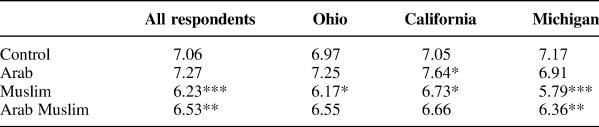
Respondents in all three states rated the forum organizer (Georgy) as less trustworthy when he was identified as Muslim, as shown in Table 2. The finding persists whether Georgy is identified as Muslim or Muslim and Arab, but not when he is identified as Arab. This is evidence that the negative effect is due in the Muslim Arab condition to Georgy's religious identity. The effect is strongest in Michigan, but persists across almost all states and conditions, with the exception of the Arab Muslim condition among California respondents.
Evaluations of mean trustworthiness of forum organizer, by condition and state

Note: Outcome variable from survey question: “On a scale of 0–10, how trustworthy do you believe Ralph Georgy is?” Responses ranged from “0” = completely untrustworthy to “10” = completely trustworthy. Differences in means are between the treatments and the control. *p < 0.05, **p < 0.01, ***p < 0.001 (two-tailed tests).
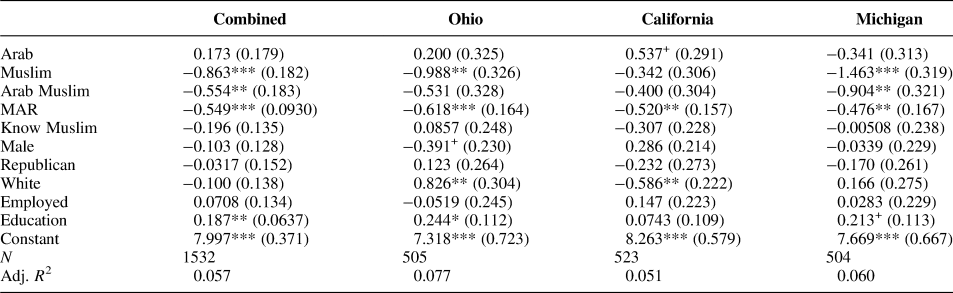
Adding covariates, including the MAR, changes the results somewhat, as shown in Table 3, but we still find that a Muslim or Arab Muslim forum organizer is generally considered less trustworthy.Footnote 5 In the aggregate (Model 1), the effect of the Muslim treatment and the Arab and Muslim treatment are both negative and statistically significant, though the Muslim treatment's coefficient indicates a larger effect. This pattern holds for the overall results and in all three state subsamples, although in a few cases the coefficient estimates fail to reach statistical significance (most notably in California). The coefficient on the Muslim coefficient remains large, negative, and statistically significant (relative to the other treatment conditions).
Evaluations of trustworthiness of forum organizer, multivariate model (standard errors in parentheses)

Note: Outcome variable from survey question: “On a scale of 0–10, how trustworthy do you believe Ralph Georgy is?” Responses range from “0” = completely untrustworthy to “10” = completely trustworthy. Model 1 includes all respondents, whereas models 2, 3, and 4 include only respondents in Ohio, California, and Michigan, respectively. The experimental reference group is the control. +p < 0.10, *p < 0.05, **p < 0.01, ***p < 0.001 (two-tailed tests).
In terms of specific covariates, Republican were not more likely to rate Georgy as trustworthy compared to Democrats and Independents, whereas respondents who reported higher levels of education were more likely to rate Georgy as trustworthy. White respondents in Ohio found Georgy to be more trustworthy than their non-white counterparts, whereas white respondents in California found him to be less so. In the aggregate, however, race is not a consistent predictor of attitudes. Respondents with higher levels of anti-Muslim sentiment are significantly more likely to rate Georgy as less trustworthy.
For robustness, we use interactions to determine whether anti-Muslim hostility and partisanship condition the treatment effects; these tests are detailed in Appendix Tables A3 and A4. The signs on those interactions are almost universally negative, but are not particularly close to statistical significance. We conclude from those analyses that MAR and partisanship do not condition the treatment effects.
DISCUSSION AND CONCLUSION
Our hypothesis is supported by these data: participants rated the organizer of the forum less favorably if he was identified as Muslim or as a Muslim Arab, compared to when his race and religion was not identified. When the organizer was identified as Arab alone, however, he was not rated less favorably. Americans hold distinct, negative stereotypes against Muslims in particular, and not against Arabs, consistent with the shift in elite and media rhetoric that evolved in the years after 9/11.
This null finding for Arab Americans emphasizes the power of ongoing elite and media rhetoric for framing public attitudes toward stigmatized minorities. In the absence of constant external reinforcement, negative prejudices toward Arab Americans faded. This is an important reminder of the power of elites to allow prejudices to fade and be updated by positive interpersonal and mediated contact and information.
Further research is needed to better understand whether increased contextual contact with Muslims increases anti-Muslim hostility. Our results indicate that greater likelihood of contact with Muslims makes individuals less receptive to Muslims in political life. Future research should consider how Muslim participation in American politics and civic life might lead to lower levels of resentment or might mitigate feelings of suspicion and distrust. For example, additional experiments might test different forms of engagement, or use different message delivery methods (e.g., videos or photos). This will enable scholars to better understand the depth of Islamophobia held by the public and how those attitudes might be shifted toward increased inclusion and equality.
Supplementary material
The supplementary material for this article can be found at https://doi.org/10.1017/S1755048320000668
Financial support
This research was funded by the Dr. Philip A. Kayal Fund for Arab American Research from the Center for Arab American Philanthropy.