Heraldry might seem an arcane topic of study restricted in time and space to European architecture, numismatics, and museums. The emancipation of the American continent from European rule created republican ideologies that fiercely opposed titles of nobility and their associated material and symbolic privileges. Nonetheless, from the sixteenth to the early nineteenth century heraldic iconography was widely distributed throughout the Americas. Colonial heraldry was displayed on a great variety of media, including currency, banners, bureaucratic papers, pottery, clothing, and on the façades of rich palaces and distant royal outposts. Objects stamped with heraldic iconography helped people to demarcate areas of influence and visually expressed local allegiances to different European royal houses. One factor that often escapes archaeological attention is that the indigenous societies of Mesoamerica quickly embraced the practice of European heraldry. Indigenous rulers and community councils adapted heraldic charges and used them to promote their agendas and goals, creating a large catalog of royally granted and self-assumed coats of arms that have survived over time and need to be studied as part of the archaeological legacy of Mesoamerican cultures. I argue in this paper that coats of arms created by native artists exhibit a pragmatic recognition of the Spanish monarch, who embodied the ultimate source of authority and symbolic power in Spanish America. Indigenous heraldry is critical for understanding acts of corporate allegiance to the royal image as a strategy to mitigate or deflect oppressive practices of the Spanish colonial system.
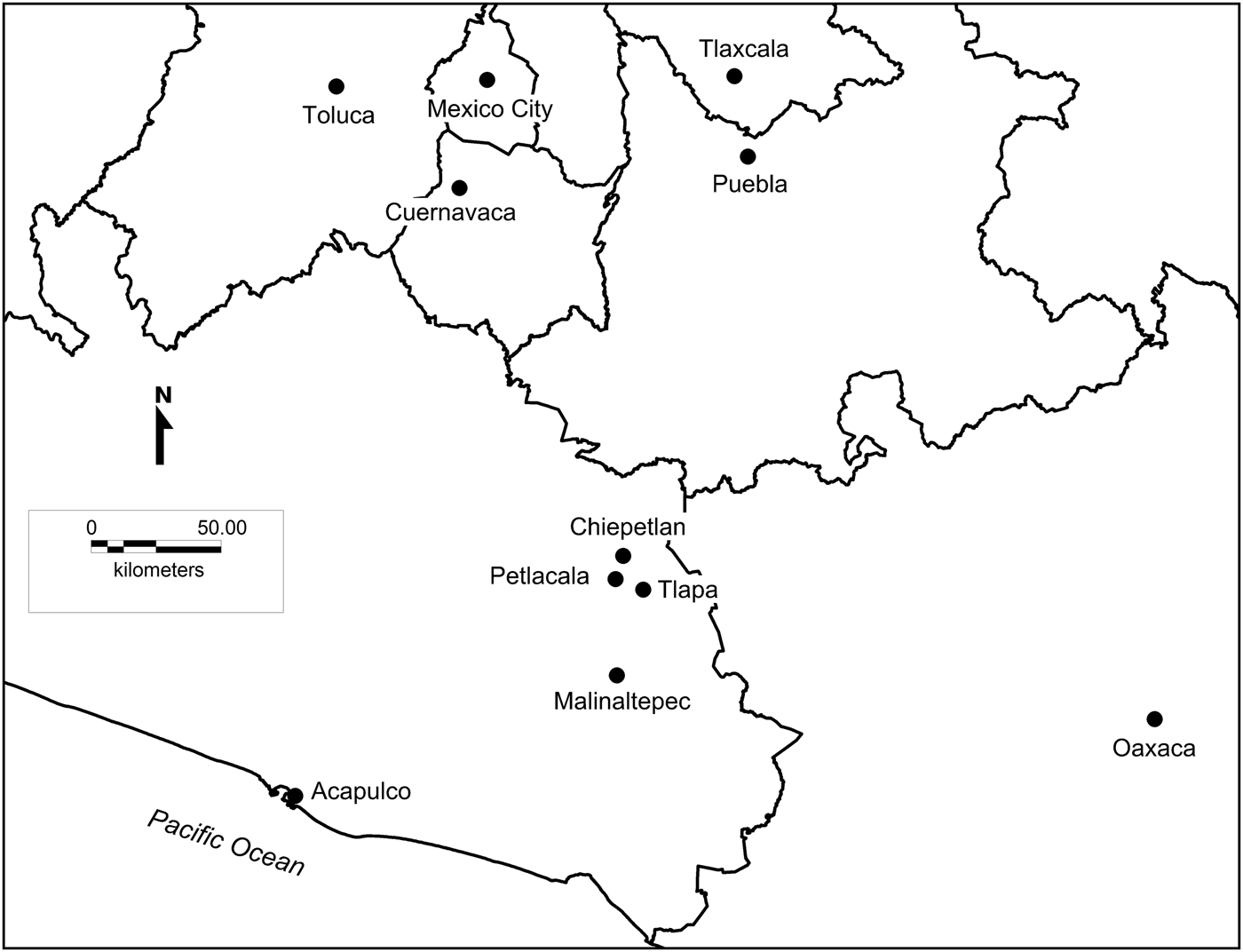
The analysis presented here is based on the direct study of a group of six large-format cotton paintings kept in the archive of San Miguel Chiepetlan, a Nahua community in eastern Guerrero, Mexico (Figure 1). The existence of the Lienzos de Chiepetlan was originally reported in an eighteenth-century geographic description of that parish written by the priest, Don Joseph Mariano Hurtado de Mendoza (Barlow Reference Barlow1949). The Lienzos were not presented to Mexican authorities during the agrarian reforms of the first half of the nineteenth century and were believed to have been lost. Fortunately, they resurfaced in 1970 when they were shown to a photographer of the French ethnographic mission in Mexico and published by Joaquín Galarza in Reference Galarza1972. Four decades have passed since Galarza's first analysis, and no one has since evaluated or expanded on his ideas. I had the opportunity to photograph two of the original paintings in 2000, while undertaking an archaeological survey of Chiepetlan. I was invited to return to Chiepetlan for a festival in 2010 and, during that visit, the Asamblea de Comuneros de Chiepetlan allowed me to analyze thoroughly all the pictorial documents kept in the community under the custody of the Comisariado de Bienes Comunales: Lienzos I, II, III, IV, V, VI; the Techialoyan Panel de Chiepetlan; and the proceedings to legalize their landholdings in the Libro de Títulos de 1758. Using Galarza's detailed descriptive publication, I expand his study further by arguing here that each Lienzo de Chiepetlan needs to be understood as an individual chapter of a larger narrative that, once put together, creates a visual título primordial. By this, I mean that together these pictorial documents form a memoir, painted with the intention of recounting the origins and hardships faced by the ancestors of Chiepetlan during the foundation of their community. The colonial genre of títulos primordiales usually highlights the diligence exerted by these altepetl/pueblo founders and its later leaders working for the recognition of the community landholdings by the Spanish colonial regime (Florescano Reference Florescano2002; Haskett Reference Haskett2005; Lockhart Reference Lockhart1991; Wood Reference Wood2003). Based on oral tradition and the memory of “lost” older codices, many indigenous communities of Mesoamerica telescoped their history into the first 50 years of Spanish rule (Vansina Reference Vansina1985:117). In a surprising turn, many indigenous painters depicted their Mesoamerican-colonial transition not as oppressive domination, but as an alliance with the “altepetl” of Castile and León. This visual message was achieved by symbolic use of the royal image of the king or by a metonymy/metaphor, such as: the royal crown, the cross, the Holy Spirit, the royal coat of arms, or a key representative of royal power (that is, Hernando Cortés, as Marquis of Oaxaca, or the first two viceroys, Antonio de Mendoza or Luis de Velasco).
Location of San Miguel Chiepetlan, Guerrero, Mexico.

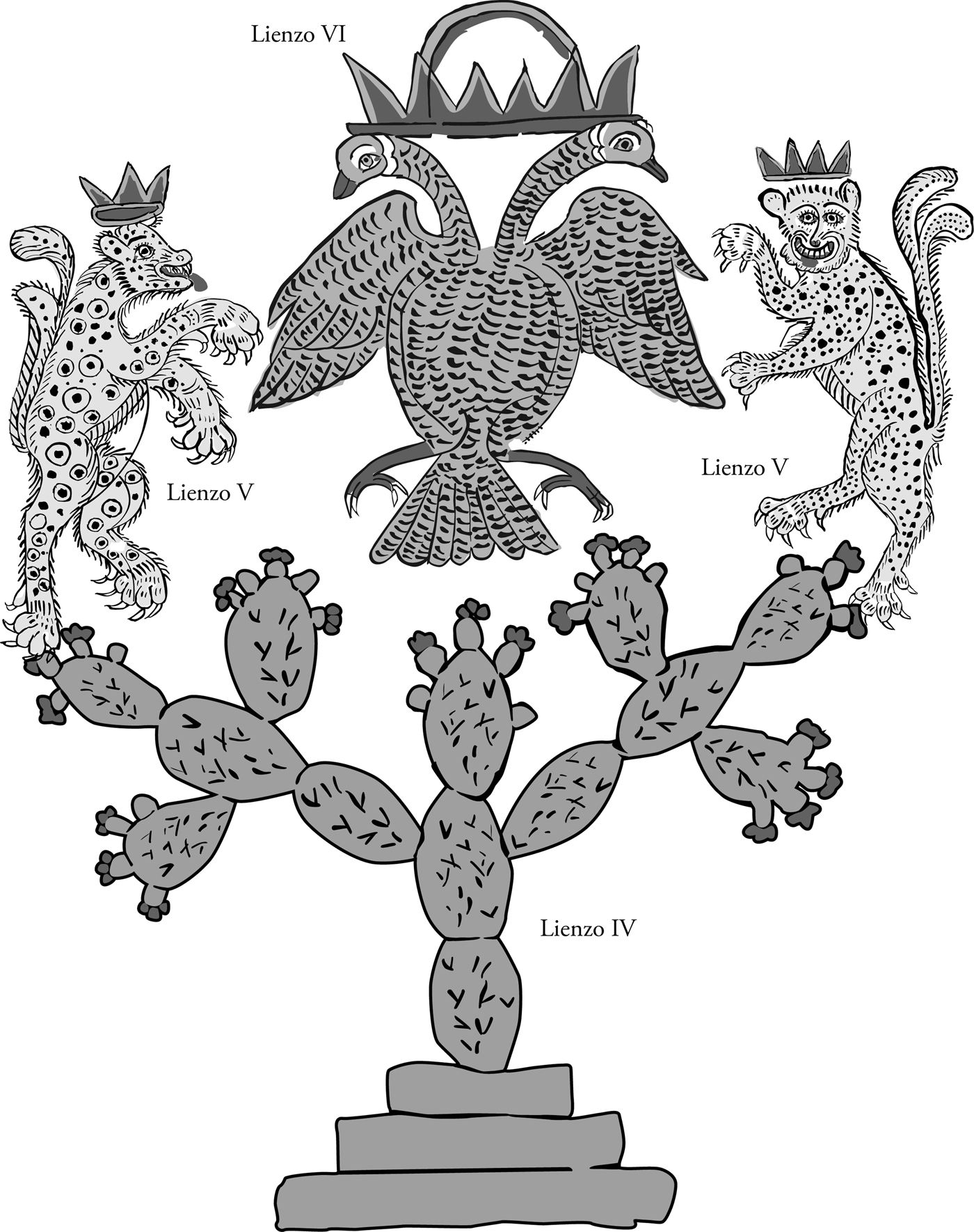
In the particular case of the Lienzos de Chiepetlan interpreted as a título primordial, Lienzo II depicts the Nahua migration that eventually led to the founding of Chiepetlan and other sister communities in the province of Tlapa. Lienzo I presents the pre-Columbian wars fought by the Nahuas of Chiepetlan against the Tlapanec and Mixtec rulers of the complex altepetl of Tlapa to gain their land. Lienzo III narrates the proceedings to have their lands recognized by the Spanish crown through a lengthy judicial case known as a composición de tierras. Lienzos V and VI display charges of the regal coat of arms. Finally, Lienzo VI presents a “nopal cactus” as a heraldic device, presumably to announce that the Nahuas of Chiepetlan had their origin in or were associated with the ancient nobility of Tenochtitlan. Given that each of these lienzos contains a lengthy and complex narrative, in this article I will focus only on the analysis of the Lienzos de Chiepetlan IV, V and VI, as a special category of civic indigenous heraldry.
These lienzos are located together with files related to the tenure of communal lands of San Miguel Chiepetlan y sus Barrios. The files include a set of documents comprising legal actions dated to 1696–1697, and a second set with legal procedures from 1705–1712. The narrative of this material can be summarized following a general time line proposed by Galarza (Reference Galarza1972). In 1691 there was a fire in the pueblo of Chiepetlan that destroyed the church and the building where local authorities kept the community land deeds and maps. When news of the destruction of the deeds spread, the neighboring pueblos of Tenango, Zacualpa, Quiahutepec, and Coachimalco opportunistically invaded the lands of Chiepetlan, harassing the community to the point that its corn bins were set on fire by aggressive neighbors. The native authorities of Chiepetlan looked for assistance from colonial authorities. So, in October of 1696, Captain Gerónimo Marchena, Lieutenant General of the province of Tlapa, undertook a composición de tierras, a procedure that involved visiting the landmarks delimiting the boundaries between Chiepetlan and its neighbors, listening to litigants, and negotiating in situ any grievance or border dispute. After hearing witnesses confirm the destruction of the old land titles in the fire, he visited the borders of Chiepetlan, listing the position of the landmarks and their names, placing crosses and stone piles to make them visible. Copies of the composición were given to each community and everyone swore to respect them. Despite this solemn arrangement, the people of Tenango invaded Chiepetlan's parcels of Teohuaxi y Tututepec. The dispute continued until September of 1711, when the new Lieutenant General of Tlapa, Don Pedro Álvares de Moxardí, performed another composición de tierras resolving the dispute between Chiepetlan, Tenango, and other neighbors, dividing the lands into equivalent parts. This negotiation was confirmed in January of 1712, in Mexico City by Licenciado Araujo, invalidating the composición of 1696. All these events took place during the decline of the last Habsburg king and the War of Spanish Succession, a moment when the royal coffers required extra resources and the bureaucracy was willing to undertake a new cycle of composiciones de tierra.
I believe it was after this second resolution that the heraldic banners of Chiepetlan were painted in a variant of the Techialoyan style of the early eighteenth century, as defined by Robertson (Reference Robertson, Cline and Wauchope1975), and with further treatment by Wood (Reference Wood1989). During this period the province of Tlapa derived significant revenues from the production of grana-cochineal dye (Monségu Reference Monségur1994:100), and Chiepetlan was part of a network of communities connecting the Pacific Coast to the markets of Puebla and Mexico through the commercial sheep trade. Tlapa and Chiepetlan were important gateways for mule trains loaded with contraband from the Manila Galleon trade. Thus, the indigenous communities of eastern Guerrero were deeply connected with central Mexico and exposed to all the political and economic developments of New Spain, including the need to create pictorial narratives demonstrating their land rights. Nowhere in the legal file does any authority mention the Lienzos de Chiepetlan, and the only colonial reference we have for them comes from the Relación Geográfica de Chiepetlán written by the aforesaid Hurtado de Mendoza (Barlow Reference Barlow1949), who claims he saw five large format documents in the community in 1777. This is intriguing as it might indicate that despite having been through a successful legal composición de tierras in 1712—without possessing any native painting or dubious título primordial—San Miguel Chiepetlan still felt compelled to own a set of such documents. The set documented in 1777 consisted of: (1) a título primordial written by someone named Buenaventura Flores, now missing; (2) a narrative of their community's story consisting of five lienzos painted after the composición de tierras (perhaps Lienzos II, III, IV, V and VI); and (3) an older lienzo painted during the sixteenth century that survived the fire of 1691 (Lienzo I) but was not present during the composiciones of 1696 and 1712. The historical experience of San Miguel Chiepetlan reinforces the idea that many títulos primordiales and Techialoyan-style codices were not for Spanish legal consumption, but for promoting indigenous regional agendas, as Florescano (Reference Florescano2002) and Wood (Reference Wood, Noguez and Wood1998) have reported for other cases in central Mexico and Guatemala.
The physical presence in the Chiepetlan archive of the Panel de Chiepetlan, painted in the likeness of a Techialoyan-style codex of central Mexico and showing a date of 1766 for its manufacture, reinforces the idea that this group of pictorial documents can be compared to the content and intentions associated with that style (Wood Reference Wood2003). It also signals the need to reevaluate the current definition of the Techialoyan codices, a group of colonial documents found in Matlatzinca, Otomí, and Nahua communities of central Mexico that Wood (Reference Wood, Lockhart, Sousa and Wood2007:1) believes to have been painted only between 1685 and 1703 by scribes of Azcapotzalco. I agree with Wood (Reference Wood, Noguez and Wood1998) that the Techialoyan codices are a special class of títulos primordiales, but I would not restrict their dating to those 17 years. In this respect, I agree with Robertson's proposal (Reference Robertson, Cline and Wauchope1975:263) that this widespread indigenous style began during the late seventeenth century, but became popular during the first half of the eighteenth century. I believe the vast majority of títulos primordiales and other Techialoyan codices were produced during or after the composición de tierras cycle of 1696–1712. Inexplicably, it has escaped the attention of researchers that this time frame (1696–1712) was the most dramatic moment in the history of the Spanish empire and their American colonies, with the War of Spanish Succession beginning in 1702. This conflagration dragged all the European powers into a conflict with consequences that lingered well into the middle of eighteenth century (Francis Reference Francis1975). The immediate outcome was the effective supplanting of the Habsburg dynasty from control of the Spanish empire and the accession of the French Bourbons, with the crowing of the Duke of Anjou as King Phillip V of Spain.
One of the most interesting elements in some títulos primordiales/Techialoyan codices is the conspicuous display of painted coats of arms supposedly granted by the Crown to award meritorious actions rendered by corporate groups, embodied in their early indigenous rulers, to assist in the conquest and guarding of American domains (Fernández de Recas Reference Fernández de Recas1961; Paz y Mélia Reference Paz y Mélia1892; Ruíz Reference Ruíz Medrano and Olivier2008:445; Villar Villamil Reference Villar Villamil1933). I argue that these coats of arms exhibit a practical and goal-oriented use of the image of the Spanish monarch to promote native agency, as well as to protect communal lands from the Spanish bureaucracy and individual colonists. I further propose that although ambivalent narratives of pro- and anti-Spanish sentiment can be found in indigenous heraldic practices (Haskett Reference Haskett1996; Wood Reference Wood2003), one faces a continuum of strategies that changed according to particular historical circumstances confronting each community in the formation of New Spain.
I review first the development of the European heraldic tradition, its introduction in New Spain, and then assess the social practices of the legitimately granted sixteenth-century coats of arms for insight into late colonial practices manifested in these self-assumed ‘Indian’ coats of arms. Finally, I propose some viable interpretations for the three heraldic banners of San Miguel Chiepetlan.
EUROPEAN HERALDRY AND ITS INTRODUCTION TO THE NEW WORLD
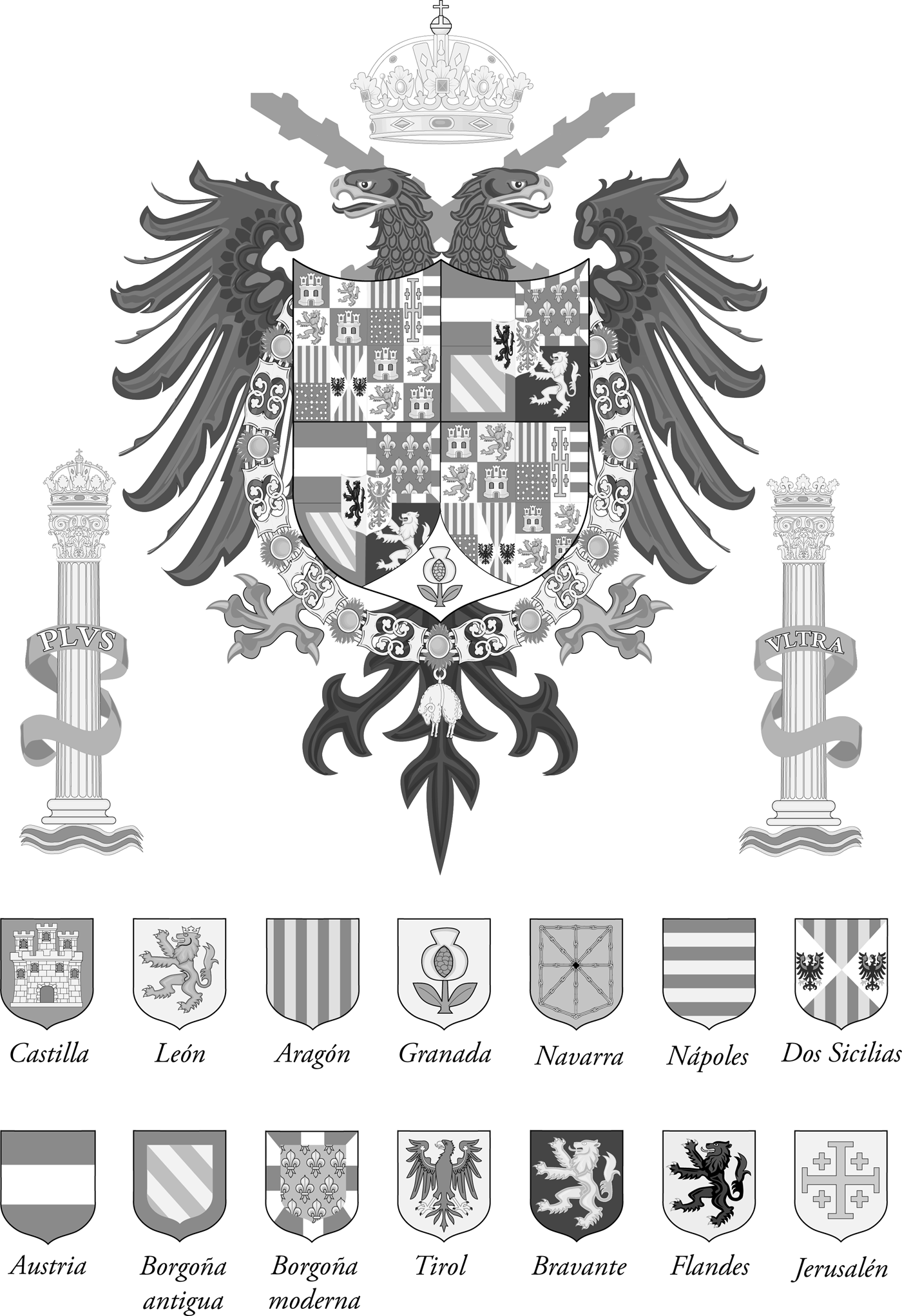
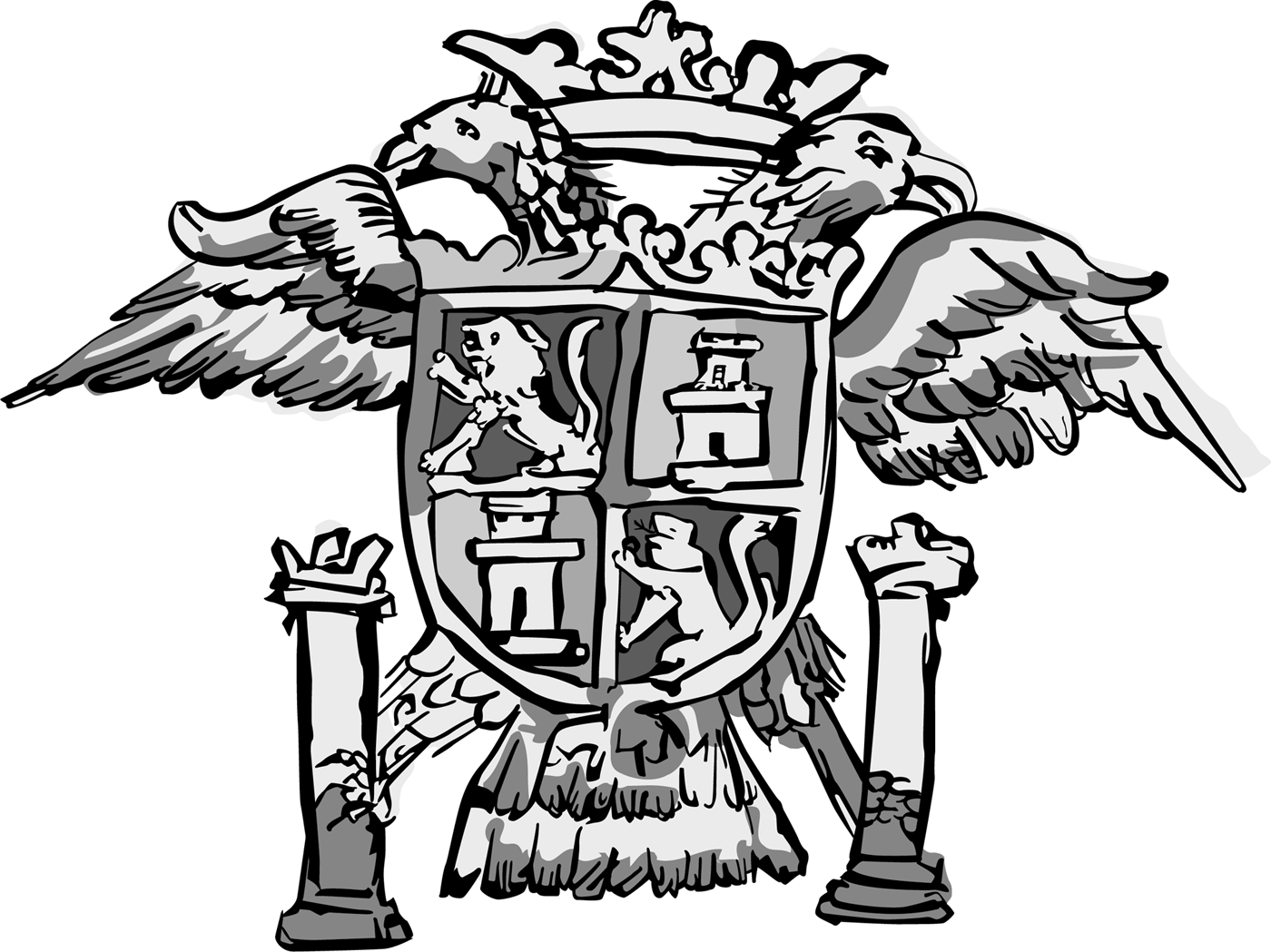
European heraldry is the symbolic use of arms to denote achievements of empires, states, towns, dynasties, families, individuals, or institutions. Heraldry comprises two broad fields of knowledge: armory and blazon. Armory is the use of specialized visual insignia granted by a royal house to reward achievements of an individual or corporate group. Blazon is the art that succinctly describes and interprets verbally, or in written form, the symbolic elements represented in coats of arms (Slater Reference Slater2002:12–15). Heraldry has been used in Europe since at least the second half of the twelfth century as a medium to transmit and efficiently display complex statements about military or bureaucratic feats, civic pride, and advances in social rank (Fox-Davies Reference Fox-Davies and Brooke-Little1985:13). The practice of heraldry mattered at state, family, and individual levels as the embodiment of symbolic capital and status (Bourdieu Reference Bourdieu1977:179). With the crowning of the Habsburg Charles as Spanish king (1516) and Holy Roman Emperor (1519), Iberian heraldry had to accommodate armorial practices from the Low Countries. Of special importance was the inclusion of the new monarch's heraldic heritage to the already complex coat of arms of the Catholic kings. Thus, the usual arms of Isabel and Ferdinand (the charges of Castile, León, Aragon, the Two Sicilies, and Granada) were complemented by those of Austria, ancient and modern Burgundy, Brabant, Flanders, Tyrol, Jerusalem, and Naples, as well as Navarra, with the double-headed eagle as supporter (Figure 2).
Armorial heritage of Charles V of the Holy Roman empire. Drawing by Gerardo Gutiérrez (image modified from http://www.blasoneshispanos.com/Heraldica/Heraldica.htm).

All these early sixteenth-century heraldic developments were taking place almost in parallel to the time when the Spanish expedition of Hernando Cortés and large contingents of indigenous allies conquered the powerful Triple Alliance of Tenochtitlan, Texcoco, and Tacuba. In the decades after this military deed, both Spanish and Indian conquistadors began requesting privileges and royal grants from the Crown. Dominant among the petitions were coats of arms to perpetuate the memory of the event and the deeds of conquistadors (Villar Villamil Reference Villar Villamil1933). Cortés was granted a royal coat of arms on March 7, 1525, and other conquistadors followed suit and filed petitions for similar honors. Notably, indigenous themes, iconography, as well as events that took place during the conquest, were appropriated as war trophies by the conquistadors and transformed into heraldic charges for their coats of arms. The conquest of the Triple Alliance in central Mexico provided numerous novel heraldic achievements, iconography, and narratives, which, overall, had a great impact on the practice of colonial heraldry.
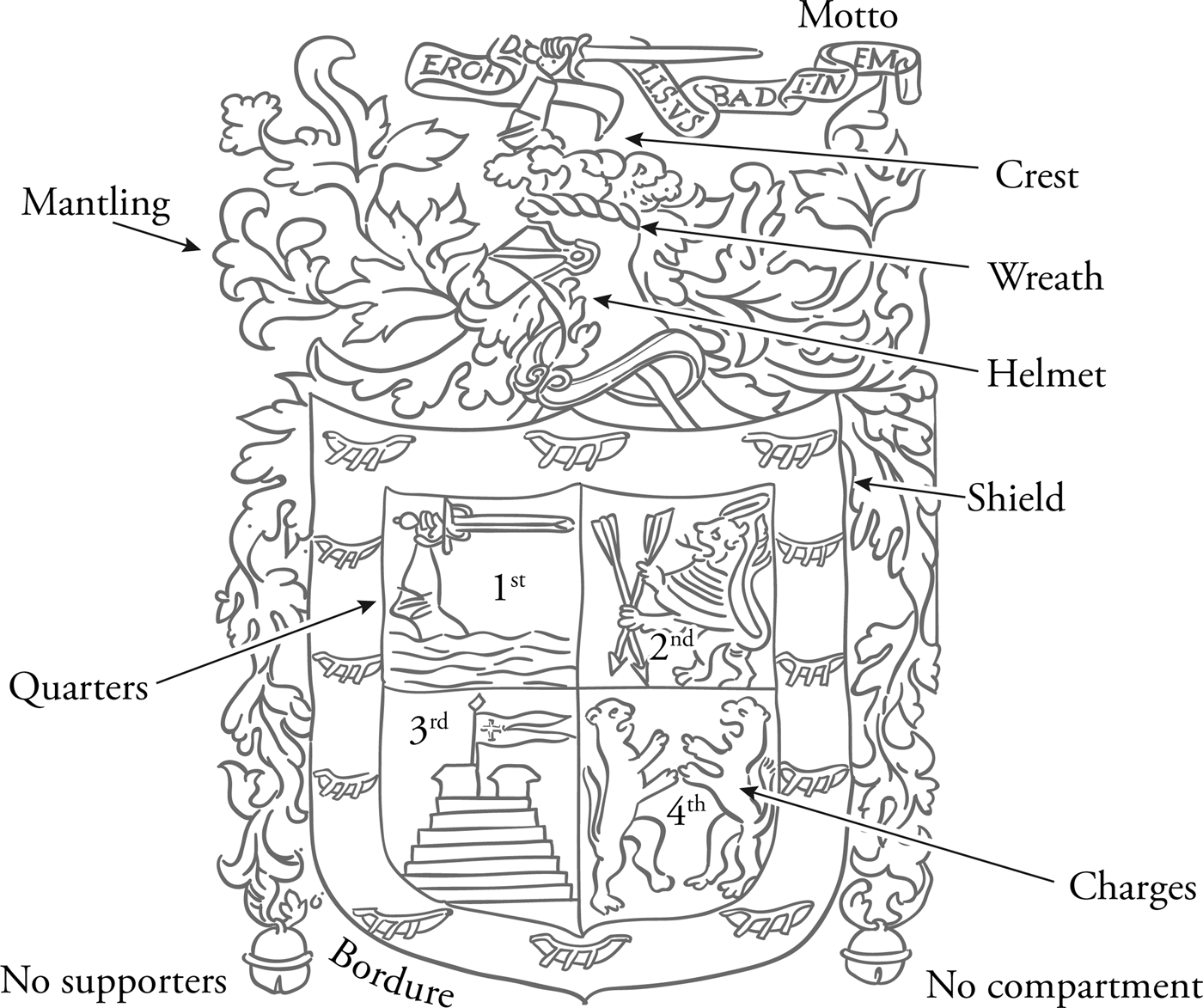
One of the best examples of appropriation into heraldic charges is found on the coat of arms granted to Rodrigo Gómez de Ávila (Figure 3). According to the recorded account in his cédula, one day during the siege of Tenochtitlan, Cortés forced an Indian battalion to retreat, which led to the Spaniards breaking their ranks to pursue the escaping warriors. Apparently this was a feint, because a native chief was lying in wait with 4,000 canoes to attack the disbanded Spaniards. The indigenous warriors would have caused great damage with such a formidable armada had not Gómez de Ávila killed their chief with two crossbow bolts. Supposedly this single action halted the attack by the Indian fleet, which immediately retreated with their dead leader. To highlight the memory of this action, Gómez de Ávila received, on January 6, 1534, a beautiful quarterly coat of arms with bordure, helmet, wreath, mantling, crest, and motto (Villar Villamil Reference Villar Villamil1933:Entry 37). His heraldic achievements were blazoned as follows (Figure 3): a quartered shield, the first quarter with a gold field and as charge, an armored arm with sword, emerging from water. The second quarter is charged with a lion springing forward, front paws off the ground (lion salient). The lion presents a pattern of black and gold horizontal stripes, with a green feathered headdress, and holds two crossed arrows. Together, these two quarters represented the insignia of the Mexica captain killed by Gómez de Ávila with his crossbow. The third quarter presents as a charge a pyramid surmounted by a banner decorated with a cross. The fourth quarter has two lions in a rampant combatant position. The bordure's field is blue, charged with 12 canoes with oars. Adjunct elements include a closed helmet with a mantling and a wreath. The crest is formed by an arm embowed in armor with a sword emerging from feathers and a motto stating: Ero Fidelis Usque ad Finen (Be faithful even to the end).
Coat of arms granted to conquistador Rodrigo Gómez de Ávila. Drawing by Gerardo Gutierrez (after Villar Villamil Reference Villar Villamil1933, Entry 37).

Quarters two and three and the bordure present the most meaningful charges of the shield. The bordure uses a semasiography of 12 canoes to represent the Indian armada and its ambush attempt on the disorganized Spaniards, while the second quarter appropriates the native insignia of the indigenous leader killed with a crossbow by Gómez de Ávila. This leader was most likely a jaguar warrior with an elaborate feathered banner (cuauchpantli) typically carried into battle by high-ranking nobles (Hassig Reference Hassig1988:57). The third quarter likely represents the capture of the main temple of Tenochtitlan, the destruction of its shrines, and the imposition of the Catholic faith represented by the military banner carrying the Christian cross. On the shield of Gómez de Ávila there is a detailed personal account of a specific event of the conquest, depicted by adapting indigenous insignia into heraldic charges.
A privilege for all recipients of heraldic achievements was the public display of the coats of arms on the façades of their houses and on personal banners. During the yearly celebration of the Pendón de San Hipólito to commemorate the fall of Tenochtitlan, some personal banners of the conquistadores were displayed together with the royal banner. Similar opportunities to display these heraldic achievements occurred during the reception of a new viceroy (O'Gorman Reference O'Gorman1970:410, 568). Most heraldic shields of the early Colonial period were removed from building façades in Mexico City with the passage of the law of May 26, 1813, issued by the Cortes Españolas Generales y Extraordinarias, which authorized any city or town to remove royal coats of arms from their buildings if they were considered offensive or used as a reminder of oppressive vassalage. Subsequent laws issued by the Republic of Mexico, especially that of 1828, banned the use of Spanish heraldry and instead promoted the use of civic coats of arms based on designs particular to each municipality (Marroquí Reference Marroquí1969:I:51–52). Nonetheless, many streets in Mexico City took their names after relevant charges of coats of arms that had existed at the entrances to specific colonial palaces, such as Cadena, Cruz, Canoa, Venero, Conde, and Vergara (Marroquí Reference Marroquí1969). Here, the coats of arms were used as landmarks to navigate within the city and became place names. A similar situation occurred in the iconography of some altepetl, where their pre-Columbian glyphs were replaced or complemented by colonial coats of arms as I analyze below.
THE ADOPTION OF COATS OF ARMS BY INDIGENOUS AND CORPORATE COMMUNITIES
Although formally speaking there was no pre-Columbian Mesoamerican heraldry, indigenous political systems used complex sets of military insignia to reward meritorious actions on the battlefield and, together with civic and religious iconography, to create institutional hierarchies based on birthright or bureaucratic achievements (see essays in Olivier Reference Olivier2008). Such similarities facilitated the selective appropriation of European heraldic values and practices by the indigenous nobility as part of their forced or willing integration into the Spanish empire. During the sixteenth century at least 22 native rulers or their descendants received legal coats of arms as part of their alliances with Spanish conquistadors (Villar Villamil Reference Villar Villamil1933). The coats of arms and charges granted at this stage, along with some pre-Columbian devices, became the basic templates of indigenous heraldry that flourished in New Spain throughout the Colonial period. Some authors have proposed that the indigenous nobility was somehow fooling the Spanish colonial system by inserting and thus perpetuating pre-Columbian religious iconography in their royally granted coats of arms (see Castañeda de la Paz Reference Castañeda de la Paz2009; Castañeda de la Paz and Luque-Talaván Reference Castañeda de la Paz and Luque-Talaván2010a, Reference Castañeda de la Paz, Luque-Talaván and McKeown2010b; Domínguez Torres Reference Domínguez Torres, Cascione, Mansueto and Guarino2007). I disagree with this position for various reasons, not least of which is because European heraldry was filled with fantastic animals, including griffins, double-headed creatures, winged lions, unicorns, dragons, and horned beasts of all types which were completely accepted and legally sanctioned. Nor do I believe the Spaniards of the sixteenth century would have questioned the inclusion of decorative designs associated with pre-Columbian deities on municipal coat of arms, since the conquistadors made wide use in their coats of arms of indigenous iconography captured as war trophies on the battlefield. The accepted hybridity of the coats of arms granted to the indigenous nobility is clearly present in the 1585 heraldic grant to Don Zacarías de Santiago from a noble house of Tlaxcala (Villar Villamil Reference Villar Villamil1933:Entry 142). In this grant, the Crown states that given that Don Zacarías's father was among the first Indian rulers who assisted the Spanish conquistadors he had the right to continue using the pre-Conquest insignia of his noble house. These insignias are expressed in the first, second, and third quarters: in the first quarter, a bird with a blue breast and head and green feathers in its wings; in the second quarter, the figure of a fortified mountain with a spring water flowing from it (the typical glyph of an altepetl); and in the third, a shield; all this painted in indigenous pre-Columbian style. Only the fourth quarter displayed an allegiance to colonial order expressed through the habit and cross of Saint James. Therefore, the survival of pre-Columbian elements and meanings embedded in sixteenth colonial heraldry was apparently acceptable.
It is perhaps more intriguing that late seventeenth- and eighteenth-century coats of arms continued to display elements that can be interpreted as Mesoamerican (see Wood Reference Wood, Noguez and Wood1998, Reference Wood2003; and also Haskett Reference Haskett1996, Reference Haskett2005), especially after 1642, when Don Juan Palafox y Mendoza, bishop of Puebla, engaged the cabildo of Mexico City to cease using the symbolic triad of eagle, serpent, and nopal cactus as the crest for the coat of arms of the city (Marroquí Reference Marroquí1969:I:47). The cabildo did indeed stop using the founding glyph of Tenochtitlan on its crest, not because of the bishop's religious arguments, but because those symbols were not actually mentioned in the royal armorial grant for the city. Such nuanced legal argument thwarted the bishop's meddling in the heraldic practices of New Spain. The endurance of pre-Columbian iconography within the medium of European armory demonstrates how heraldry became a liminal space in which Spanish and indigenous insignia were accepted and their hybridity allowed multiple narratives of domination, cooperation, allegiance, and resistance to the colonial regime. Clearly, indigenous groups manipulated European heraldry to promote their own agendas inside and outside of native communities. The latter was possible because in Spanish domains the granting of armorial achievements was not restricted to coats of arms; armorial achievements also came attached with other privileges, such as a certain degree of judicial protection from local authorities, the right to bear European weapons and clothing, and other honors that the Indian caciques eagerly embraced (Fernández de Recas Reference Fernández de Recas1961:XXI). Hence, the “paper shields” painted in indigenous colonial documents (Haskett Reference Haskett1996; Terraciano Reference Terraciano2001:60) carried, as a metonymy, the image of the Spanish king with a latent legality to demand justice from him through the Spanish court system (Kellog Reference Kellog1992), as well as to make use of all the protections and related privileges that the colonial system selectively granted to Indian caciques.
Civic coats of arms had a parallel development to that of individual shields. In 1523 the Spanish cabildo of Mexico City was granted the well-known coat of arms consisting of a blue field representing Lake Texcoco and charged with a castle and three converging causeways with gaps representing the movable bridges of Tenochtitlan. A lion rampant stands on the left causeway and another lion rampant stands on the right; their front paws touch the castle. The shield has a bordure charged with 10 nopal cactus leaves. The lions' bodies bridge the causeways to the castle representing the siege of the native city. This coat of arms was granted in recognition of the Conquest and was ordered to be used on the banners, shields, and seals of the city (Marroquí Reference Marroquí1969:I:46–47). In 1529, the cabildo also requested the use of the king's coat of arms (O'Gorman Reference O'Gorman1970:52). Considerable sums of money were regularly spent to decorate the casas de cabildo with shields in 1530 and 1531. Two banners embroidered on expensive damask were ordered in 1532: one displayed the royal coat of arms and the other depicted the arms of Mexico City. In 1540 and 1591, new sets of coats of arms for the city were embroidered (O'Gorman Reference O'Gorman1970:62, 72, 95, 168). Thus, the cabildo of Mexico City had become a repository of heraldic banners to such a degree that in 1557 it provided an embroidered version with the royal coat of arms to Viceroy Luis de Velasco for swearing the allegiance of New Spain to the new King Phillip II. During this solemn act, a Herald of Arms dressed in an expensive tabard with the royal coat of arms proclaimed: “Castilla, Castilla; Nueva España, Nueva España; por el rey Don Felipe nuestro señor” (O'Gorman Reference O'Gorman1970:330). Acts of allegiance and displays of heraldic armory were repeated during the succession and death of each king. Such ceremonial practices associated with religious and royal banners were appropriated and selectively modified by indigenous societies. An early example of this was depicted in Section VIII of the Codex Tlatelolco (Valle Pérez Reference Perla, Noguez and Woods1998:44), in which the royal banner was paraded together with an indigenous banner while Mexica warriors danced in full pre-Columbian warrior insignia.
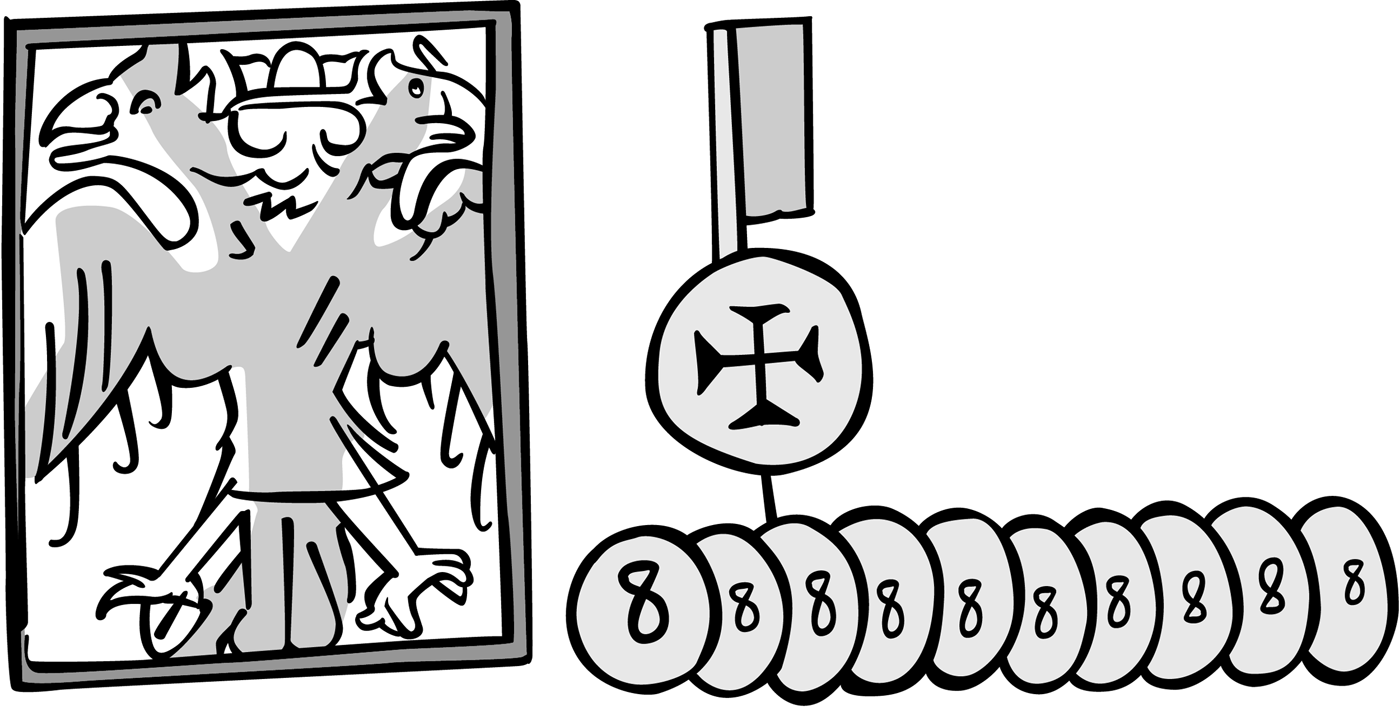
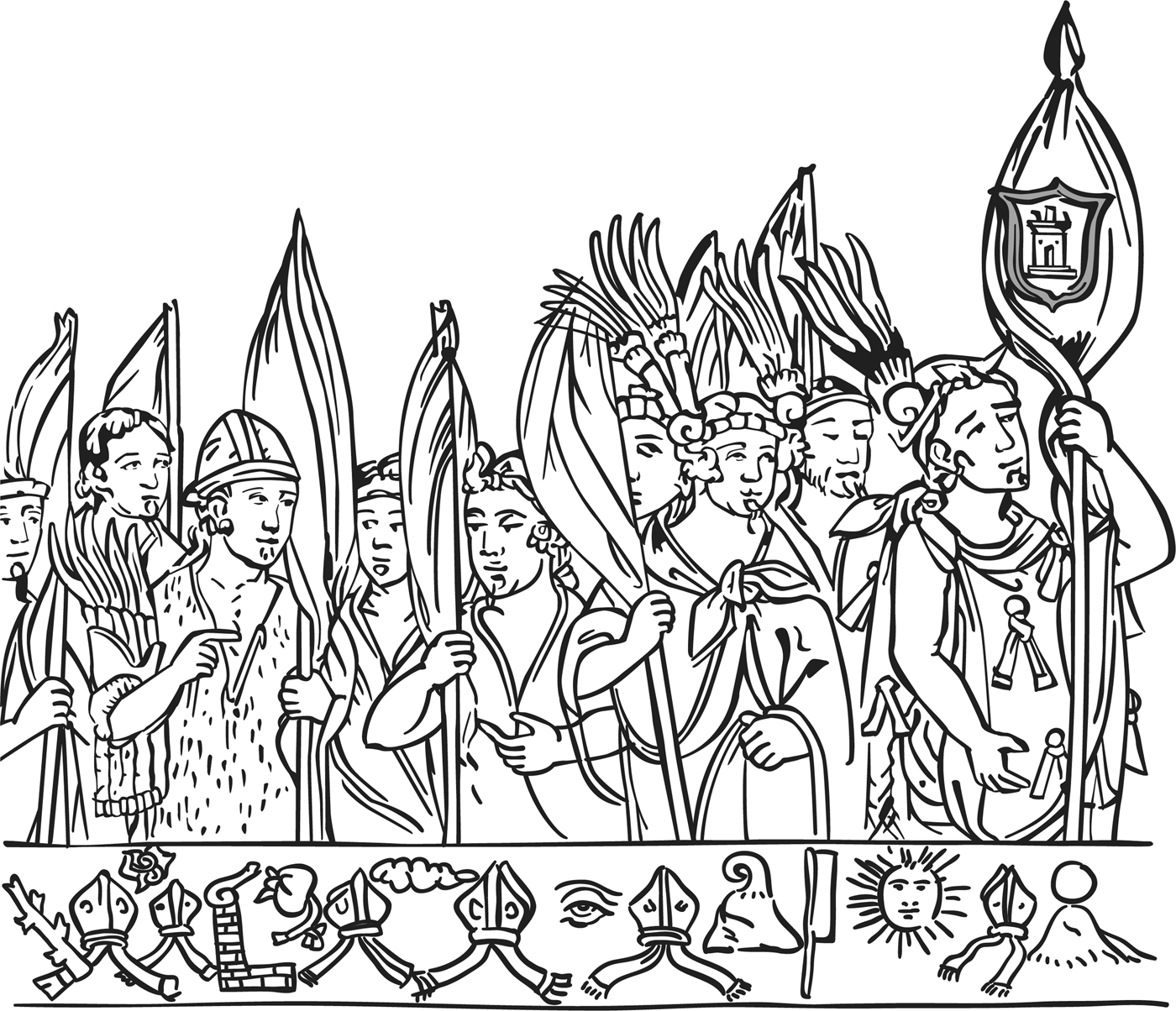
After Mexico City was granted its coat of arms, many other Spanish and indigenous political centers followed suit: Guatemala (1532), Chiapa (1535), Guadalajara (1539), Huejotzingo (1553), Michoacan (1553), and Coyoacan (1561) (see Paz y Mélia Reference Paz y Mélia1892:282–296). Slowly but surely, the practice percolated to smaller political systems, so that by 1559 the pueblo of Santa Catarina Texupa in the Chocho-Mixtec region of Oaxaca was reported to have paid the considerable amount of 30 gold pesos for an official seal depicting the coat of arms of the Habsburg dynasty (Figure 4) (Codex Sierra Reference León and Rojas1992:Folio 26). Six decades after the fall of Tenochtitlan, the Indian cabildo of Tlaxcala was ready to lecture both Spaniards and natives on the lore of European heraldry. In 1580 Diego Muñoz Camargo reported that in the cabildo and audiencia rooms of the municipal building of Tlaxcala the walls were decorated with equestrian portraits of the primary conquistadors and all the viceroys who had ruled New Spain (Acuña Reference Acuña1984:47–48). Surviving in the Relación Geográfica de Tlaxcala (Acuña Reference Acuña1984) are sketches of these civic paintings that once decorated Tlaxcala's municipal building, including a fragment of a scene with nine Indian rulers holding at least eight banners (Figure 5). Place names of the conquered provinces are displayed in a lower band alternately spaced between six bishop's miters. In this complex scene the artists depicted what they considered to be the major components of the territorial and political exploits of the Conquest led by Cortés and his allies from Tlaxcala. Each indigenous ruler embodies an important native region, at the head of which friendly caciques helped the Spaniards establish the political hegemony of the Spanish Crown and the rule of the Catholic faith. With these paintings the Indian cabildo underscored the notion that Tlaxcala led this colonial arrangement by placing one of their rulers at the forefront of the provinces holding a heraldic banner with the coat of arms of Castile/Tlaxcala. The representation of indigenous rulers with heraldic banners is a powerful symbolic pledge of allegiance to the Spanish Crown.
Seal depicting the coat of arms of the Habsburg dynasty purchased by Santa Catarina Texupa in 1559. Drawing by Gerardo Gutiérrez (after Codex Sierra [Reference León and Rojas1992:Plate 26]).

Indian rulers representing the provinces of New Spain, pledging allegiance to Cortés and the Spanish kings. The ruler of Tlaxcala holds the dominant heraldic banner with the coat of arms of Castile/Tlaxcala. Drawing by Gerardo Gutiérrez (after Relación Geográfica de Tlaxcala [Acuña Reference Acuña1984:Cuadro 19]).

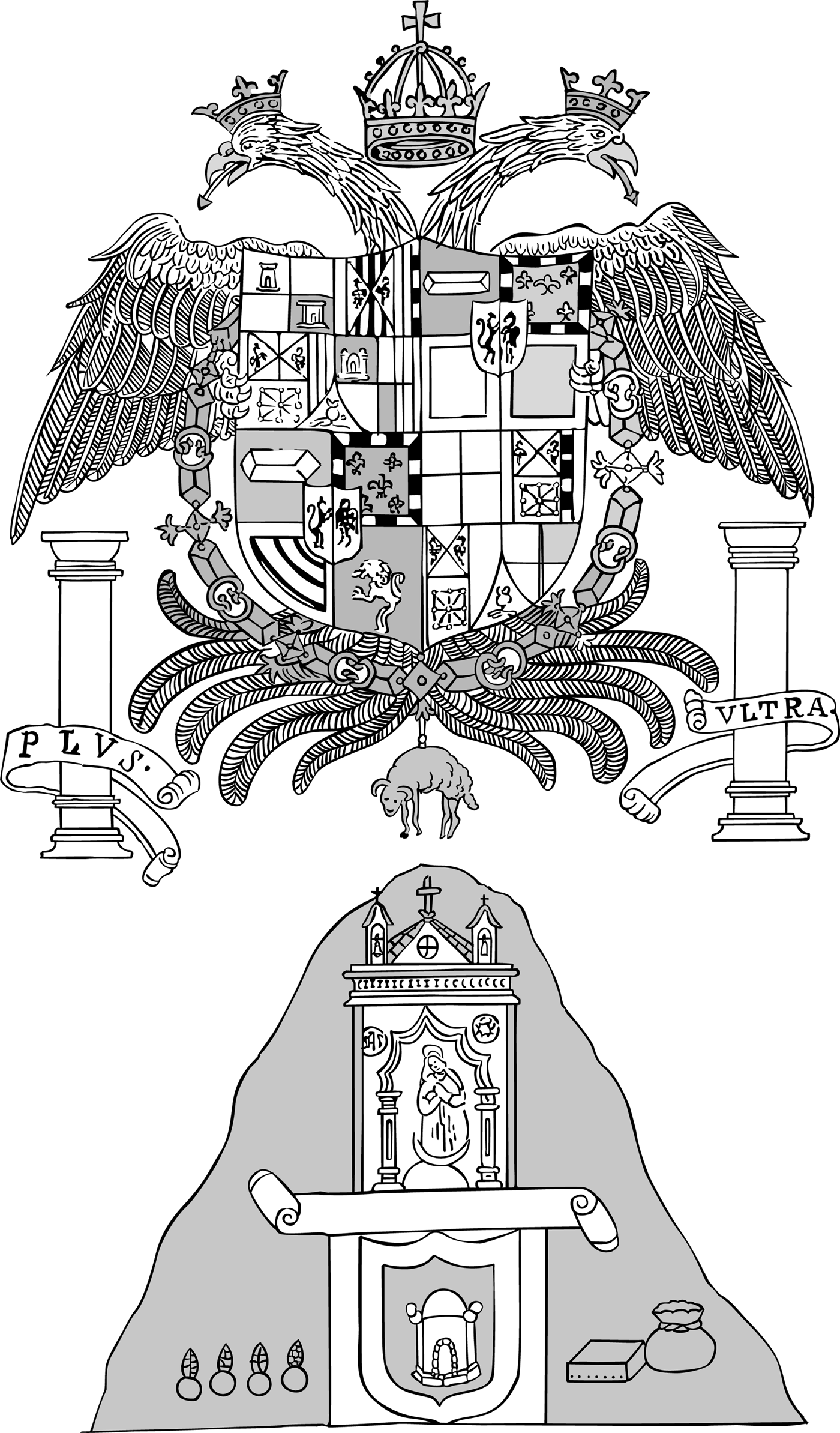
This public statement by Tlaxcala demonstrates pride in being part of the Spanish empire—a pride manifested through overt use of the imperial coat of arms masterfully represented in the Lienzo de Tlaxcala (Figure 6) (Chavero Reference Chavero1964:LXXXVI). An indigenous altepetl glyph was painted below an oversized imperial coat of arms. The altepetl glyph is used as a heraldic supporter to marshal the representation of the façade of the Franciscan convent of the city and the coat of arms granted to Tlaxcala with its golden castle (Messmacher Reference Messmacher, Ruiz Naufal, Lemoine and Medrano1982:630). Of relevance is the substitution of the indigenous place name with the heraldic shield of the altepetl, creating a heraldic place name for Tlaxcala based on the hybridity between the mountain glyph and a European armorial device. Tlaxcala was not the only Indian political system demonstrating their allegiance openly to the Spanish Crown. Likewise in Mexico City, Indian cabildos wanted to use the abbreviated Castile-León and full imperial coats of arms together with their own municipal shields.
Bottom: Depiction of the “heraldic altepetl” of Tlaxcala with the façade of the Convent of San Francisco of Tlaxcala dedicated to the Virgin de la Asunción; under it is a simplified coat of arms of Tlaxcala. Top: Coat of arms of the Holy Roman empire. Drawing by Gerardo Gutiérrez (after Lienzo de Tlaxcala [Chavero Reference Chavero1964:LXXXVI]).

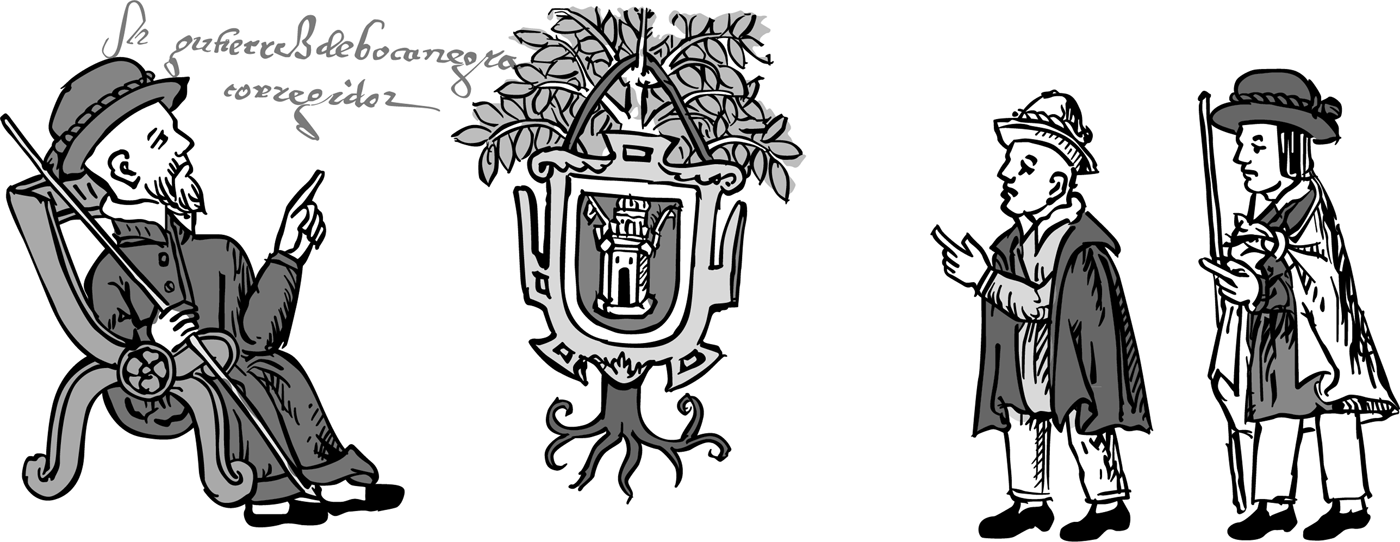
In another example, Huejotzinco received an elaborate coat of arms charged with a silver castle with a blue banner carrying the cross of Jerusalem and a palm leaf (Paz y Mélia Reference Paz y Mélia1892:286). In the Codex Guillermo Tovar, the Huejotzincas displayed their royally granted coat of arms as an enormous framed painting hanging from a willow tree (Figure 7) (Brito Reference Brito2011:II:Plate 2r); the willow tree represents the ancient place name of Huejotzinco. The granted coat of arms and willow tree together foreground the image and represent an open and flattering statement of Huejotzinco's allegiance to the Crown, despite the fact that during this same time period Huejotzinco was involved in several disputes over excessive tribute demands (see Brito Reference Brito2008; Prem Reference Prem1974). Because many altepetl participated in the conquest of Tenochtitlan as allies of the Spaniards and received the symbol of a castle as a heraldic achievement, it is difficult to interpret with certainty whether such a charge was intended to commemorate the fall of Tenochtitlan or was just a variant of the arms of Castile. Late colonial indigenous heraldry perhaps made use of this vague meaning in self-assumed coats of arms, placing symbols for the kingdom of Castile and the indigenous altepetl on equal footing.
Coat of arms of Huejotzingo displayed in front of its pre-Columbian place name. Drawing by Gerardo Gutiérrez (after Codex Guillermo Tovar [Brito Reference Brito2011:2:Plate 2r]).

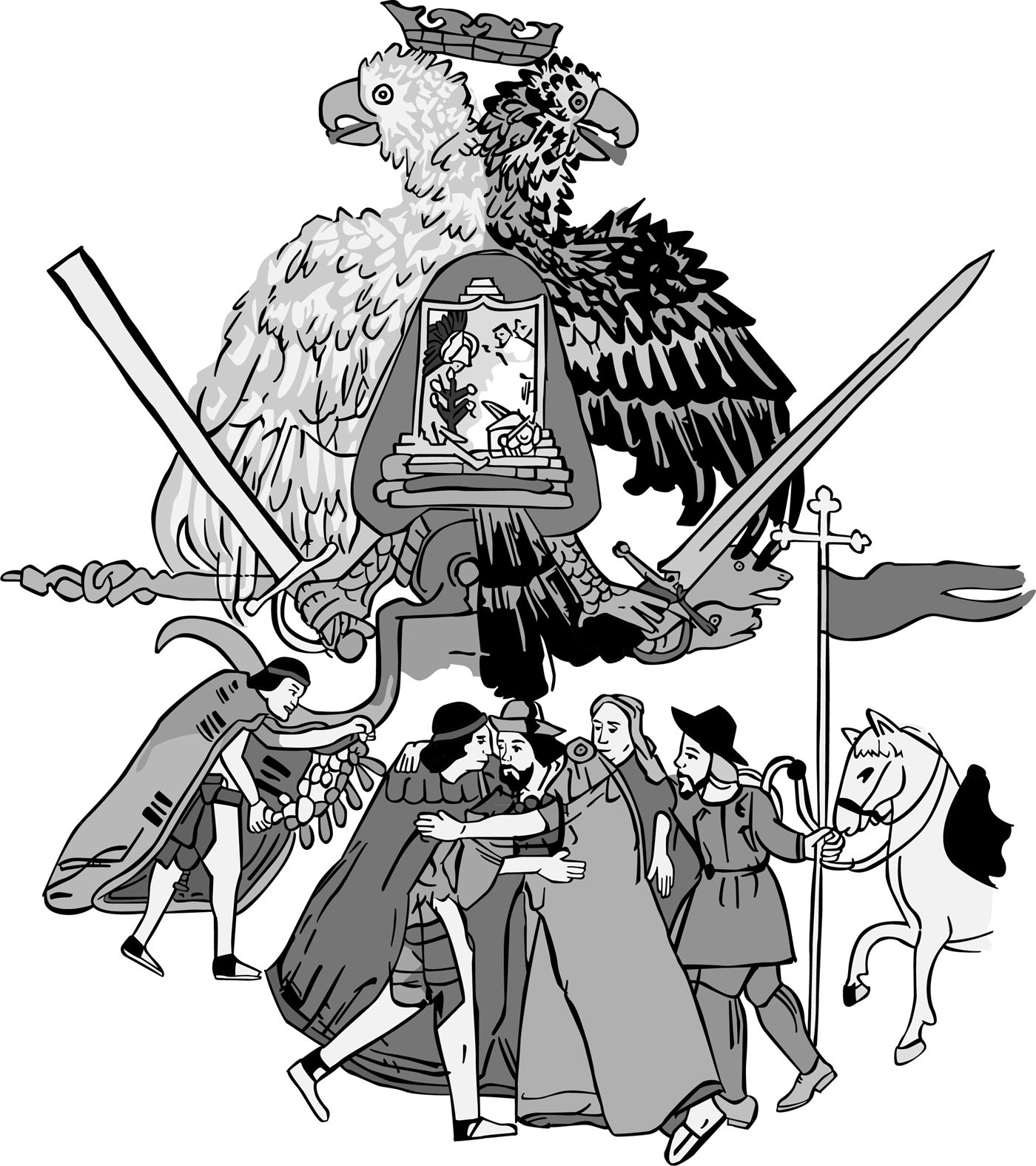
The Lienzo de Quauhquechollan presents a self-assumed coat of arms with another “heraldic altepetl” using the mountain glyph to support a shield with charges that are now mostly illegible (Figure 8) (Glass and Robertson Reference Glass, Robertson, Cline and Wauchope1975:116). The altepetl glyph is itself supported by two dimidiated eagles wearing a “mural crown.” The right eagle is gold and the left one black. The tail of the left eagle was painted emerging from the bottom of the mountain glyph in a visual representation that mimics flowing water. Phonetically, the mountain and the water create the composite word/concept of altepetl and its metaphor for the seat of the native state (Lockhart Reference Lockhart1992:14). Each of the two eagles clutches a sword, and there is a double-headed serpent at the base. An overly theatrical scene of European-Indian friendship, represented by the embrace of Cortés with an Indian lord, was painted below the aforementioned coat of arms. The dimidiated eagles in the Quauhquechollan coat of arms may depict an indigenous version of the heraldic supporter of the Habsburg dynasty, a standardized metaphor representing the voluntary alliance of a native state with the Spanish monarchy (Asselbergs Reference Asselbergs2010:209–211). The interesting feature of this shield is that the Indians of Quauhquechollan are also consciously transforming their pre-Columbian place name into a heraldic charge, similar to the examples from Tlaxcala and Huejotzinco. Moreover, the Quauhquechollan coat of arms offers the opportunity to address the legality of self-assumed coats of arms by native caciques and corporate communities. Under political and financial pressure European monarchs arrogated to themselves the right to authorize the bearing of arms so as to obtain revenue from heraldic patents, and Spain was no exception in the creation of statutory rules. Nonetheless, the right to bear arms, known in Europe as “la capacité heraldique,” is a general right, and not a privilege, and belongs to any person or corporate body by consuetudinary law (Heim Reference Heim1978:18–21). Therefore, self-assumed indigenous coats of arms in New Spain were not illegal, and their status could always be “made official” by obtaining a royal patent. Still, indigenous corporate coats of arms in New Spain quickly became self-assumed and predominated in seventeenth and eighteenth century documents. These coats of arms were primarily appropriated based on vague associations to original heraldic grants purportedly obtained legally during the sixteenth century.
Coat of arms of Quauhquechollan representing a “heraldic altepetl” with a native interpretation of the supporter of the coat of arms of the Holy Roman empire. Below, is a scene demonstrating the alliance between the rulers of Quauhquechollan and Hernando Cortés. Drawing by Gerardo Gutiérrez (after Lienzo de Quauhquechollan [Asselberg Reference Asselbergs2010:209]).

HERALDIC ICONOGRAPHY OF THE LIENZOS DE CHIEPETLAN
Coins, sealed royal edicts, banners, and flags were perhaps the most widely used media to display heraldic coats of arms. Normally stored in cabildo houses, banners were conspicuously displayed in the many civic and religious processions; their portability and visibility made them a central component of large public gatherings. Their role as military standards, used to lead armies into battle should not be overlooked; this practice was seen in both Mesoamerican and European cultures. Compared with other media, banners were more likely to suffer exposure to the elements, capture, or destruction on battlefields. Early colonial heraldic banners are rare finds compared to images that were stamped on currency, legal documents, or painted in scenes on framed canvases.
The heraldic study of the Lienzos de Chiepetlan IV, V, and VI provides a special opportunity to examine indigenous heraldic practices of the late Colonial period, when both native communities and caciques used coats of arms to protect themselves, at least symbolically, from abuse by individual Spaniards and the colonial bureaucracy and clergy (Wood Reference Wood1991:179, Reference Wood2003:57). The heraldic banners of Chiepetlan are difficult to interpret because of their apparent simplicity. I argue that indigenous painters simplified the complex iconography of a full ornamented coat of arms of the Spanish monarchy, abbreviating it into basic heraldic charges, especially the supporter of the Habsburg house (Lienzo VI) and the charge of León (Lienzo V). More intriguing is why the painters decided to depict the abbreviated armorial charges on individual banners and not on a composite coat of arms. Why does one of the banners depict a nopal cactus (Lienzo IV) as an armorial charge and place it at the same hierarchical rank as the Habsburg supporter and the charges of León? It would be difficult to attempt to answer these questions by using the Lienzos de Chiepetlan alone. It is necessary, instead, to draw comparisons with other documents depicting indigenous corporate heraldry in order to grasp the regional narratives that were circulating throughout indigenous communities of central Mexico during the last decade of the seventeenth century and dynastic transition of the early eighteenth century. Below, I describe the three heraldic banners of Chiepetlan and propose several lines of interpretation.
Lienzo de Chiepetlan IV
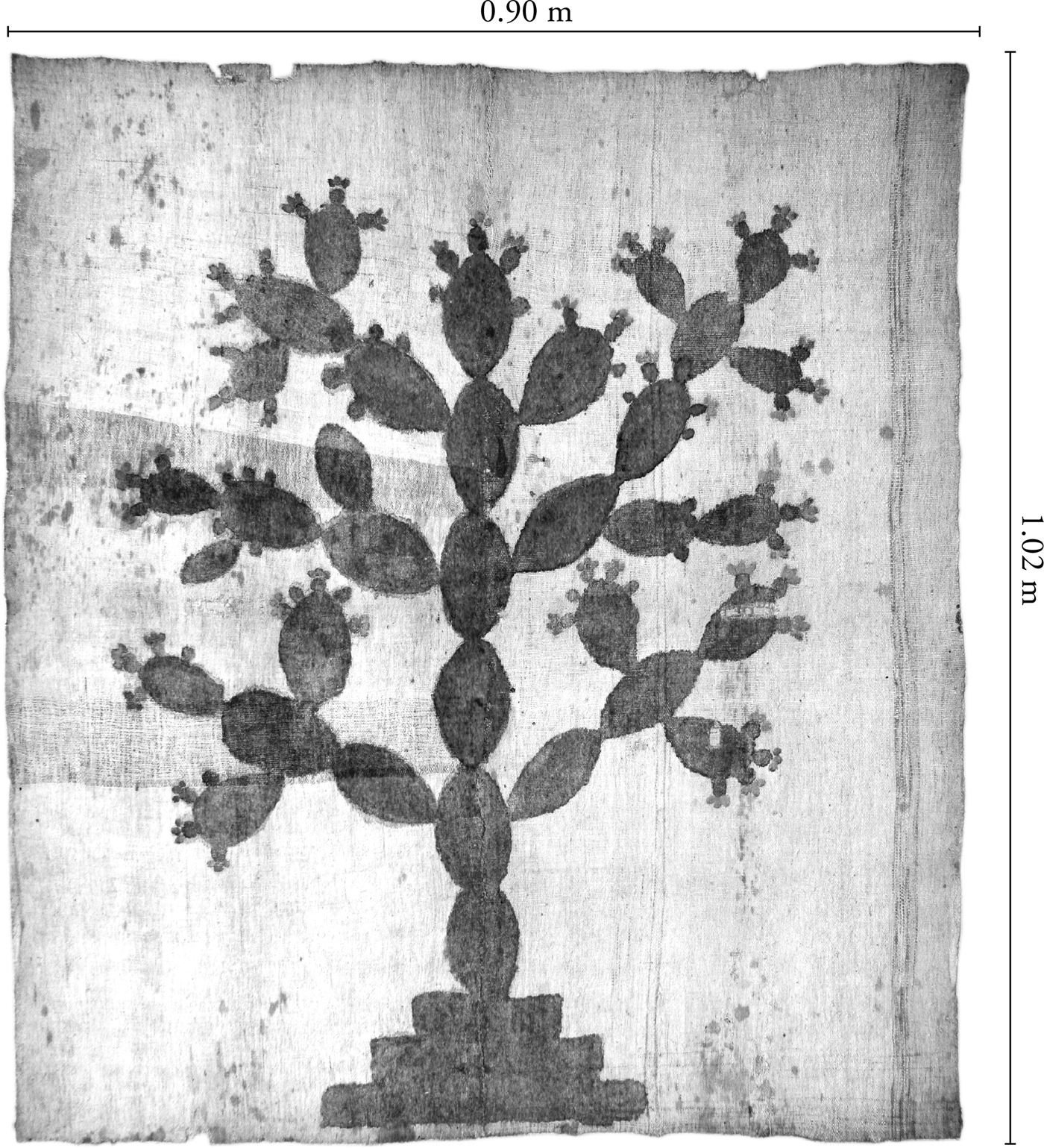
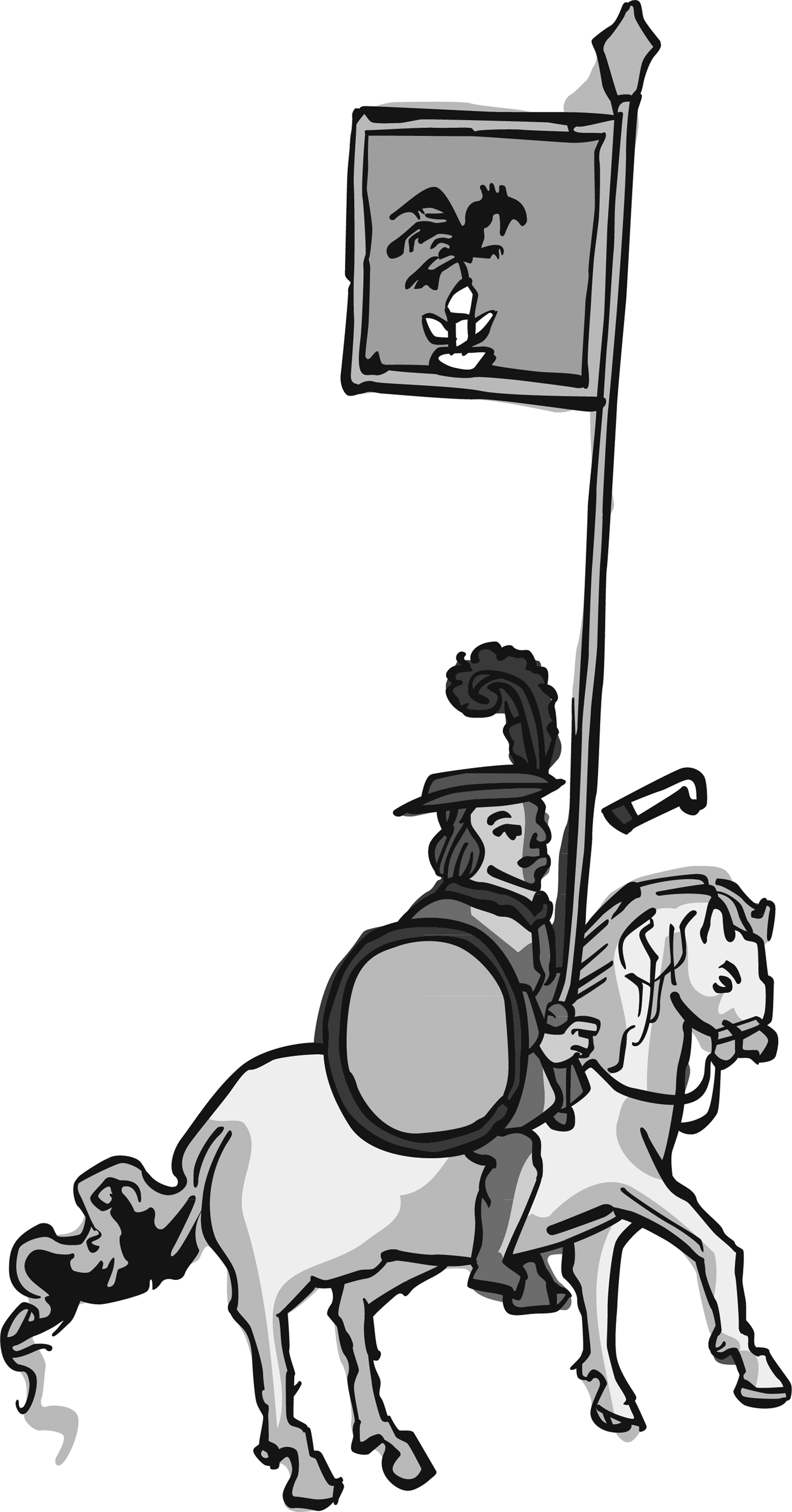
This cotton cloth lienzo measures 1.02 × .90 m (Figure 9) (Galarza Reference Galarza1972:117) and depicts a large nopal cactus painted in different hues of blue (indigo). The central nopal stem is six leaves tall with six branches, totaling 34 leaves with 76 prickly pears, of which 51 were painted with intense red flowers. The nopal cactus emerges from a pyramidal base similar to field altars found at some key landmarks delimiting the community's colonial territory or sacred places on the indigenous landscape. The nopal cactus has been used to represent multiple meanings in Mesoamerican iconography, but during the Colonial period, it came to signify either the primary glyph of Tenochtitlan (Mexico City) or the embodiment of an indigenous genealogy. Since most Nahua villages of eastern Guerrero claim to be related to key political centers in the Basin of Mexico (Dehouve Reference Dehouve1995), and all of them claimed to have passed through Chiepetlan during their migration or supposedly assisted Tenochtitlan in the conquest of Tlapa-Tlachinollan (Gutiérrez Reference Gutiérrez2002), then the nopal cactus perhaps needs to be understood as being multivalent. The Tenochtitlan glyph was depicted as a heraldic charge on a banner in the Codex Osuna (Figure 10) (Cortés Reference Cortés1976:Folio 8–470). This banner is held by an Indian captain riding a horse, dressed like a Spaniard, and leading an Indian squadron who participated in the expedition to Florida. In native discourse the warriors of Tenochtitlan, like the nopal cactus, continued to grow, expand, and leave new plantings all over New Spain and beyond. One of the most beautiful representations of the nopal cactus as a genealogical tree was painted during the late Colonial period in the Codex García Granados (715) (see facsimile in Noguez Reference Noguez1992). A mammoth-sized nopal, 21 leaves tall, emerges from a disguised earth monster and bifurcates into 12 primary branches that hold more than 20 Indian rulers, supposed heirs to the Azcapotzalco royal house. Nine coats of arms depicting the royal and imperial Spanish shields, as well as the self-assumed coats of arms of the Tepanec lineage, are used to signify the unbreakable allegiance between the indigenous nobility and the Crown. The entire design of the genealogical device also states, by means of a Spanish banner and a large cauldron, the old motto of “pendón y caldera” (banner and cauldron) (Diccionario de Autoridades 2002:203), meaning if the Spanish monarch so desires, Indian nobility could raise armies for battle and feed them at their own expense to protect the empire. Here, indigenous agents of the late Colonial period are somehow equating themselves with ricoshombres (rich men) of Spain who were originally known as “Señores de Pendón y Caldera.” This is not a hollow narrative, since some títulos primordiales (see Wood Reference Wood2003:107–133) actually claim that Indian caciques contributed money to conquer other indigenous communities and paid for the construction of churches and other civic buildings.
Lienzo de Chiepetlan IV, painted on cotton cloth, depicting a nopal cactus in blue with 34 leaves and prickly pears flowering in red. It may represent the glyph of Tenochtitlan/Mexico City. Photo by Gerardo Gutiérrez (used with permission from the Comisariado de Bienes Comunales y la Asamblea de Comuneros de Chiepetlán y sus Barrios).

Indian captain on horseback, holding a heraldic banner with the insignia of Mexico-Tenochtitlan. Drawing by Gerardo Gutiérrez (after Codex Osuna [Cortés Reference Cortés1976:Folio 8]).

Lienzo de Chiepetlan V
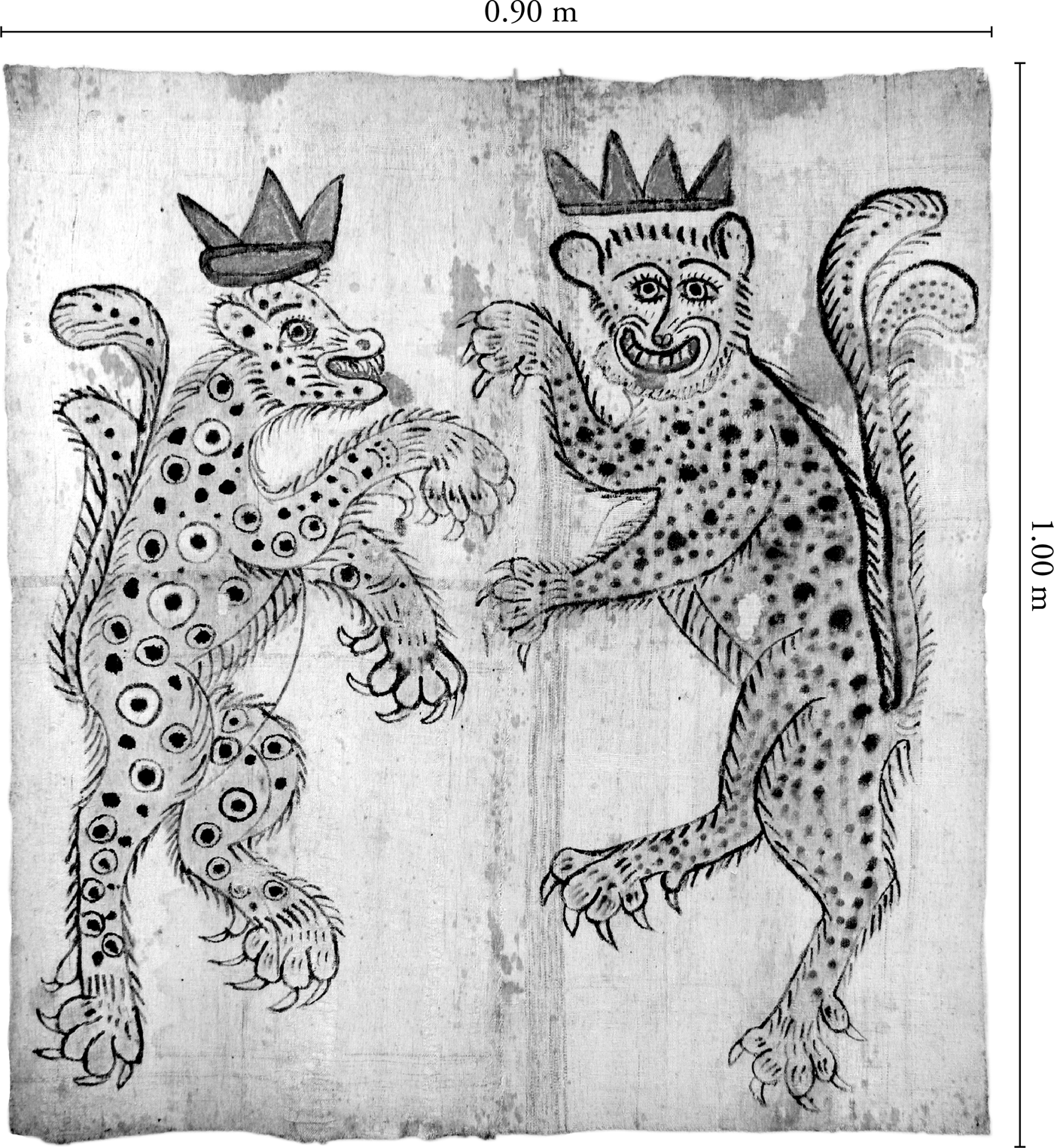
This cotton cloth measures 1 × .90 m and depicts two crowned jaguars painted with two distinct patterns of black spots: the jaguar to the left has a pattern of solid dots with circular halos, while the jaguar to the right presents only solid dots. The left jaguar is in profile and better executed than the right, which presents an anomalous dwarfed leg. Notably, the facial features of the right jaguar were humanized with penetrating eyes that look directly at the viewer (Figure 11). In terms of European heraldry, the charge in the banner can be blazoned as two “leopards” in combat. The left jaguar is rampant with a red ducal coronet, and the right one is rampant guardant (looking at the observer) with a red crown. It is probable that in the indigenous colonial tradition the two jaguars either represented the lion supporters of one of the Escudo Grande del Rey de España (The Full Ornamented Coat of Arms of the Spanish King) or simply the charges of the kingdom of León in the royal coat of arms.
Lienzo de Chiepetlan V. Photo by Gerardo Gutiérrez (used with permission from the Comisariado de Bienes Comunales y la Asamblea de Comuneros de Chiepetlán y sus Barrios).

Nonetheless, the Nahuas of Guerrero would have assigned more levels of meaning to this impressive heraldic banner. In a first assessment, the scene could represent the annual ritual of rain petitions, when men dressed in jaguar paraphernalia engaged in ritual fighting until blood was drawn. This ritual was also associated with native beliefs in animal companions and the shape-shifting capacity of the tecuannahualleque, powerful ritual specialists who could “transform” into jaguars to defend the village from internal and external enemies (Gutiérrez and Pye Reference Gutiérrez, Pye, Guernsey, Clark and Arroyo2010:46). The sense of being protected by the powerful forces of the jaguar dates back to the pre-Columbian Jaguar warriors and their association with the forces of the underworld. Oral tradition in Chiepetlan claims that the village was under the care of powerful brujos-jaguares. Such supernatural protection required blood, however, and the jaguars needed to feed on local inhabitants. The pueblo of Chiepetlan became worried when too many individuals were being killed by their protectors and decided to get rid of the brujos-jaguares by taking them to a secret door in a rock cliff, where the men-eaters were locked away forever in the heart of the mountain. This narrative closely matches others found in títulos primordiales (see Lockhart Reference Lockhart1991; Wood Reference Wood2003), in which the pre-Columbian deities abandoned their followers or the followers themselves buried or hid ancient entities in the mountains. The same observation can be applied to the allusion of shape-shifters which continues to play an important role in the rituality of indigenous communities (see Gutiérrez and Pye Reference Gutiérrez, Pye, Guernsey, Clark and Arroyo2010).
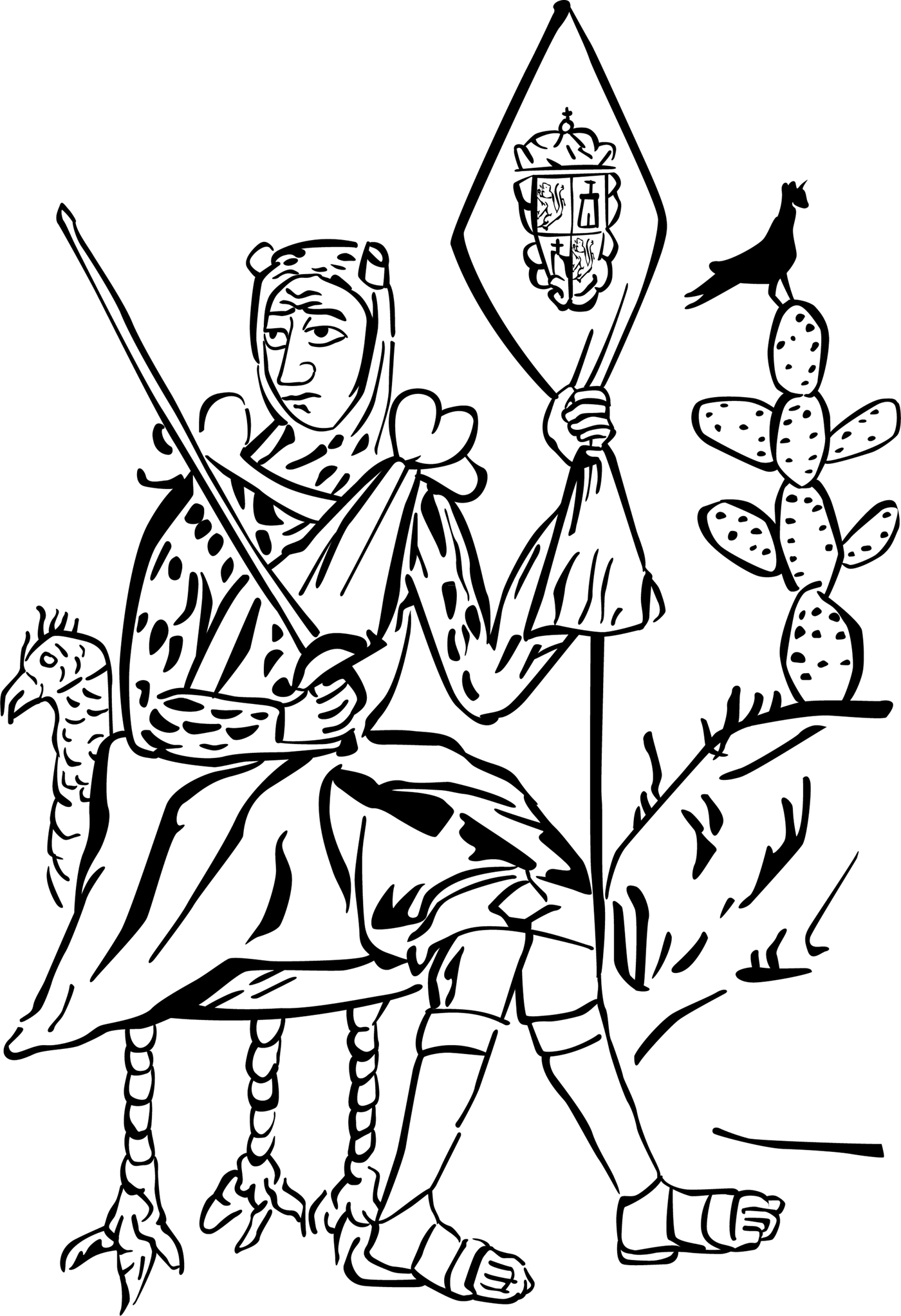
In another line of interpretation, the position of the two facing jaguars could be associated with the forces of the earth monster and their maws as liminal entrances to the underworld. These two elements together create a symbolic way to represent the chicomostoc (the mythical seven caves of the Nahua migration), a very popular element in many colonial codices, such as the Codex García Granados (715). The figure of Jaguar warriors as protectors of Indian groups was preserved until the late Colonial period, precisely in the many archaizing codices of the eighteenth century. One of the most fascinating scenes of a Jaguar-protector is embodied in the painting of the cacique, Don Jacinto Cortés, in the map of Cuauhtlantzinco, Puebla (Wood Reference Wood, Noguez and Wood1998:225; Reference Wood2003:77, passim), where the Indian leader is depicted in the costume of a Jaguar warrior, seated on an eagle-shaped stool. As if the ancient regalia of the jaguar were insufficient to fend off enemies, the cacique holds a metal sword in his right hand and a heraldic banner with the royal coat of arms of Castile-León in the left (Figure 12). The belligerent tone of the narratives in these títulos primordiales and Techialoyan codices becomes evident when one observes details like sophisticated eighteenth-century flintlock pistols in the García Manuscript (Number 8). This is interesting, given that many of them record events that supposedly happened in the sixteenth century although the majority of them were likely painted between 1696 and 1743 (Robertson Reference Robertson, Cline and Wauchope1975:264). I believe that, from the point of view of these documents, the protection of the empire begins at the local level with the protection of lands and the rights of the heirs of the ancient native nobility.
Indian cacique depicted as a Jaguar warrior seated on an eagle stool and holding a sword in the right hand and a banner with the royal coat of arms of Castilla-León in the left; in the background the insignias of the foundation of Tenochtitlan. Drawing by Gerardo Gutiérrez (after Mapa de Cuauhtlatzinco [Wood Reference Wood, Noguez and Wood1998:225]).

As previously noted, no scholars have associated the popularity of the títulos primordiales and the Techialoyan style with the dynastic change endured by the empire precisely in the first decades of the eighteenth century. In the case of Chiepetlan, the primary promoters of the composición de tierras were the local head alcalde, Gaspar Ximénez; the tlayancanqui (a title in Nahuatl referring to someone who leads or guides), Gaspar Martínez; the ordinary alcalde, Miguel Santiago; the fiscal, Balthazar Juárez; and the tequitlato (tribute collector), Miguel Nicolás. All these individuals were oficiales de República (members of a native cabildo or local government) and not hereditary caciques. Although the sixteenth-century Lienzo de Chiepetlan I depicts two ancient rulers: Quixitatzin Tlacatecutli, an Eagle warrior, and Quixitatzin Chacatecuitl, a Jaguar warrior (Gutiérrez Reference Gutiérrez, Scherer and Verano2014), the late colonial documentation of Chiepetlan is silent about what happened to their heirs. Perhaps, as local lore claims, they were locked away forever in the heart of the altepetl of Chiepetlan. The disappearance of ancient rulers conveniently opened the way for the commoners of Chiepetlan to take possession of communal land holdings. Nevertheless, the images of the ancient rulers endured in the Lienzo V (the crowned jaguars) and Lienzo VI (the crowned eagles). While the gender of the jaguars and eagles in Lienzos V and VI is not explicit, some sexual dimorphism can be inferred in the body size, posture, and different crowns of the two jaguars. The right jaguar with a crown of four peaks may be a male, while the left jaguar, smaller in size, with a crown of three peaks and exhibiting a light tracing in the abdomen, may represent a pregnant female. In the case of Lienzo VI, the right head of the double-headed eagle is slightly larger and has a discreet cock's crest, while the left head is smaller and displays a round face and a more elaborate eye. I propose that these two banners also capture the image of the founding couples of the altepetl in their alter ego state (see examples in Wood Reference Wood and Olivier2008).
Lienzo de Chiepetlan VI
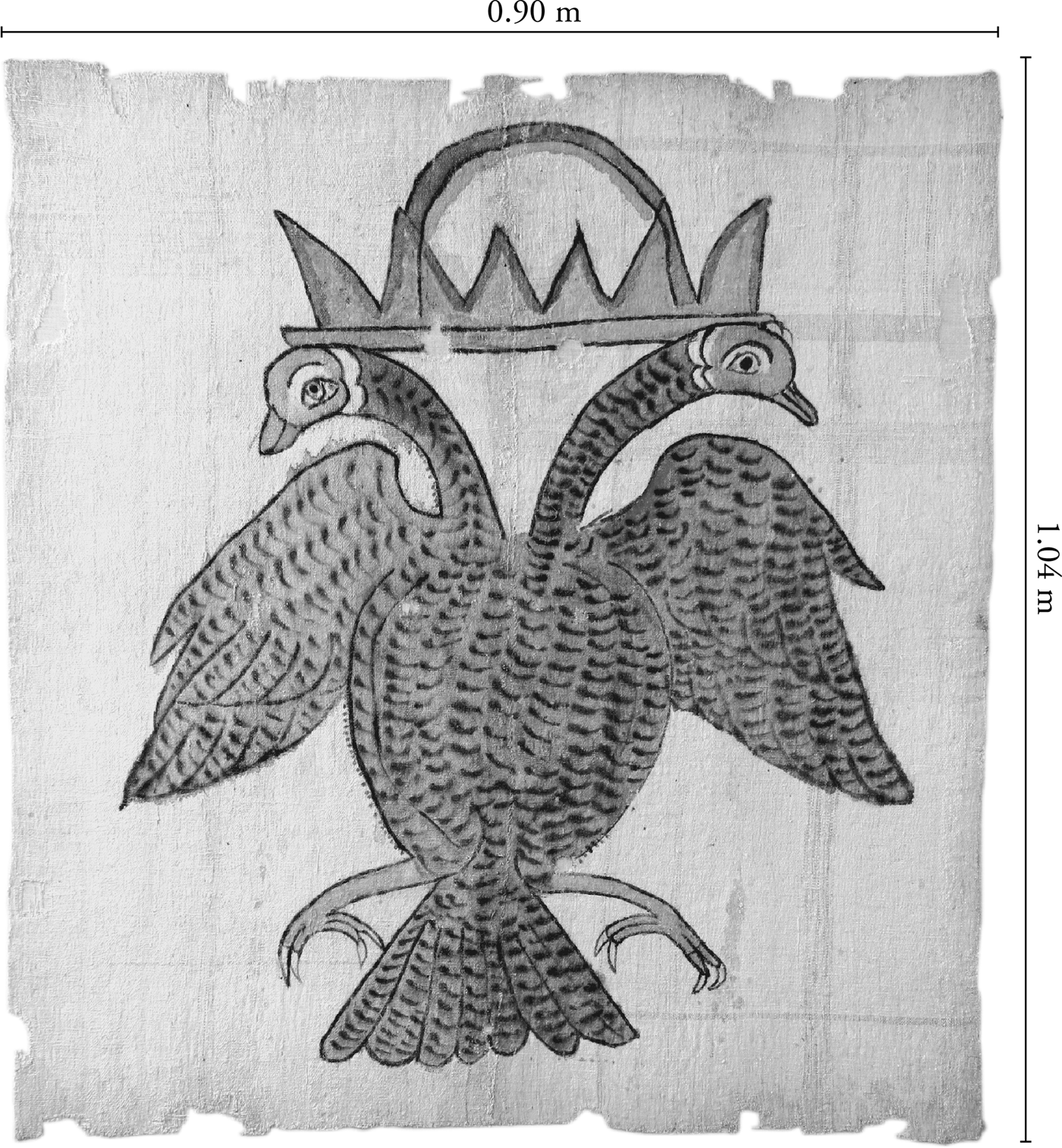
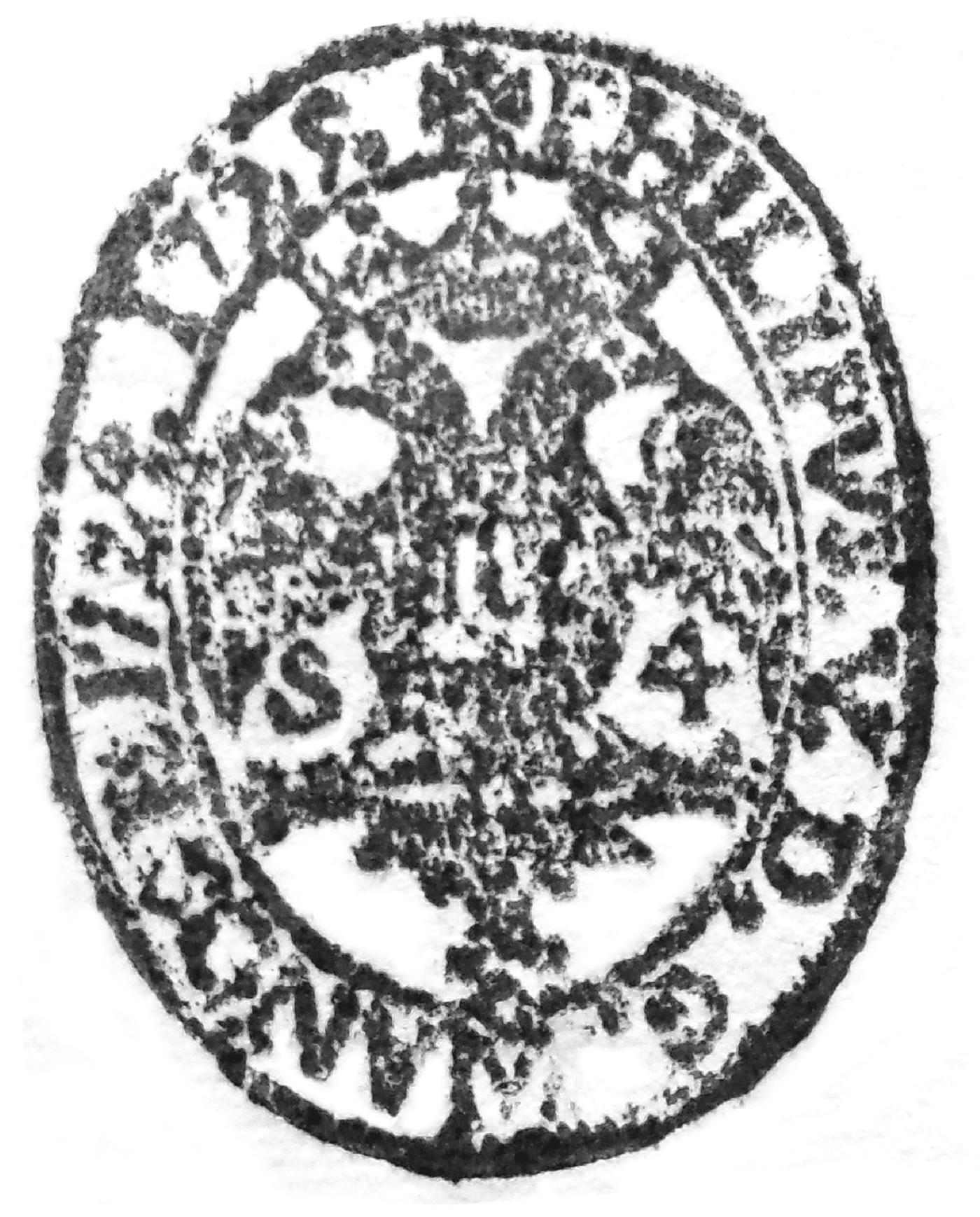
This cotton cloth measures 1.04 × .90 m and depicts a local interpretation of the crowned double-headed eagle, the primary supporter of the coat of arms of the Habsburg dynasty. This supporter was kept during Bourbon rule as part of the heraldic heritage of the Spanish monarchy. Instead of a black double-headed eagle, the banner of Chiepetlan displays hues of blue with black contours. The dual heads of the displayed bird resemble more those of geese or swans (Figure 13). Why did the artist who painted this banner modify the eagles' heads from a template of the abbreviated coat of arms used in the seals of a quartillo stamped in the legal documentation of the colony (Figure 14)? This liberal modification of the supporter of the Spanish monarchy by the artists of the Lienzo de Chiepetlan VI may have been done to depict an abbreviated indigenous version of the coat of arms of the Habsburg dynasty, using a standardized metonymy to symbolize the voluntary alliance of a native state with the Spanish monarchy.
Lienzo de Chiepetlan VI, depicting a double-headed “eagle.” It is a local interpretation of the supporter of the Habsburg house. Photo by Gerardo Gutiérrez (used with permission from the Comisariado de Bienes Comunales y la Asamblea de Comuneros de Chiepetlán y sus Barrios).

Seal of Phillip V (1725). Note the abbreviated and simplified royal coat of arms depicting only Castile on the chest of the double-headed imperial eagle. Photo and processing by Gerardo Gutiérrez.

The representations of the abbreviated royal coats of arms in the Codex García Granados (715) (Figure 15) and the seal of Phillip V (Figure 14) lead me to wonder about the absence of the charge of Castile, frequently used in heraldic iconography of the Colonial period. At some point there may have been a lienzo with this charge, although now missing. More likely, perhaps, is that the banner of the double-headed “eagle” (Lienzo VI) is used as a pars pro toto emblem to signify the complete coat of arms of the Spanish monarchy, just like the abbreviated seal of a quartillo with the charge of Castile on the chest of the double-headed eagle (Figure 14). Here, the native painter decided to highlight the symbolic relevance of the double-headed eagle with a single large crown of six peaks embracing the two heads. The apparent simplicity of this image actually demonstrates a complex understanding of heraldic interpretation. In the indigenous worldview, the double-headed eagle may represent the seat of government and was the manifestation of a dualistic principle associated with the sun as shown in the Genealogía de los Caciques de Carapan, where a crowned double-headed eagle is touched by a solar flare. The dual interpretation is highlighted by an accompanying gloss in that document stating that these elements represent the royal seat of the rulers of Carapan (Roskamp Reference Roskamp2001:16). Similarly, the double-headed eagle depicted in Lienzo VI emphasizes that Chiepetlan's claim to its patrimonial lands has been sanctioned by the Spanish monarchy.
Indian interpretation of the coat of arms of Castile-León with charges swapped into alternate quarters. Drawing by Gerardo Gutiérrez (after Codex García Granados 715 [Noguez Reference Noguez1992]).

CONCLUSIONS
The heraldic banners of Chiepetlan proclaim a long history of land tenure, sanctioned by Spanish monarchs, while at the same time they link the Chiepetlan people to the Nahuas of central Mexico, especially Mexico-Tenochtitlan. I have argued that the Lienzos de Chiepetlan openly celebrate the allegiance between indigenous allies and Spanish conquistadors by using the coat of arms of the Spanish king, who was perceived as the ultimate source of symbolic power in New Spain. The large formats of Lienzo I, depicting the conquest of Tlapa, and Lienzo II, depicting the migration history, suggest they were either displayed flat on the ground or mounted on a wall to offer the best view of their contents and narratives (Mundy Reference Mundy and Boone2005:363; Pohl Reference Pohl, Boone and Mignolo1994:141). It is possible that Lienzo III (depicting territorial boundaries) and the heraldic Lienzos IV, V, and VI were used to visit landmarks on the boundaries of communal lands. Wear patterns on the upper corners of the latter lienzos, seen in photographs from the early 1970s (Galarza Reference Galarza1972), suggest some manipulation as if they had been paraded from time to time. The community of San Miguel Chiepetlan has begun to use their documents again in civic festivities, especially on March 21, to mark the beginning of spring. In 2012, I had the opportunity to observe how the principales and contribuyentes (citizens who participate in the traditional rotational labor of the community) of Chiepetlan paraded six real-size copies of their lienzos around the main street of the pueblo with local schoolchildren marching behind them. A similar practice is also seen in the neighboring village of Petlacala, which possesses a copy of an eighteenth-century lienzo depicting an image of the Habsburg emperor Charles V dressed as a French Bourbon (Dehouve Reference Dehouve1995:72; Oettinger and Horcasitas Reference Oettinger and Horcasitas1982). Additionally, the people of Petlacala use their lienzo to celebrate the feast of the Holy Cross atop a mountain. Likewise, the nearby community of Coachimalco has celebrated traditional dances and rituals with a copy of their lienzo (Jiménez and Villela Reference Jiménez and Villela1988). This indicates a close association of these Nahua communities of Guerrero to their banners. Regardless of changes in historical contexts, the materiality and symbolism of these banners promote the continuity of practices and perhaps meanings for these communities to an immemorial past codified in ancient and not-so-ancient heraldic blazons.
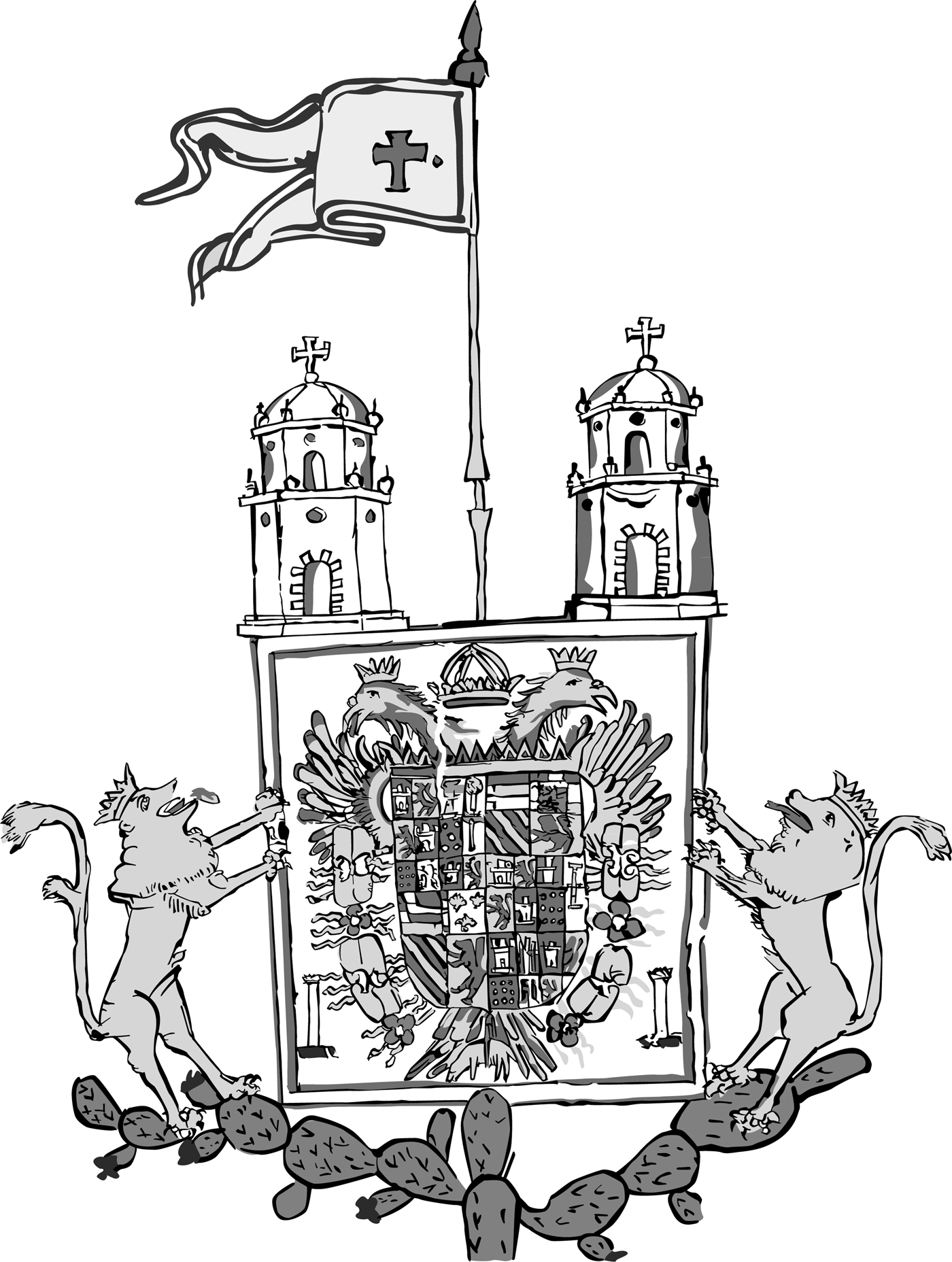
In general, the three heraldic Lienzos de Chiepetlan created a grand statement of allegiance to the Spanish Crown. Returning to the layout of the late colonial Codex García Granados (715) (Figure 16), one notes in the uppermost part of the Tepanec tlacamecayotl (the lineage from Azcapotzalco) how the Colonial period caciques pledged their allegiance to an elaborate Escudo Grande del Rey de España, presenting the arms of the Spanish monarchy with all the charges of Charles V and two lions rampant as extra supporters. Over all, there are two church towers and a banner with a red cross. This image suggests that the heraldic Lienzos de Chiepetlan could have been used to complement a larger “heraldic landscape.” The fact that they were painted as modular charges within independent frames renders them perfect for creating different arrangements and narratives, depending on how the people of Chiepetlan decided to marshal them. With this “flexible” and “portable” heraldry, the three banners could be paraded in front of the town's church, dedicated to San Miguel Archangel, to create a similar scene of the full ornamented royal coat of arms as that presented in Codex García Granados (715). I present this possibility in Figure 17, precisely to show how the three banners of Chiepetlan contain the basic elements to create a more complex Escudo Grande del Rey de España.
Uppermost part of the Tepanec tlacamecayotl (lineage from Azcapotzalco) of the Codex García Granados depicting the “full ornamented coat of arms” of the Holy Roman empire. Drawing by Gerardo Gutiérrez (after Codex García Granados 715 [Noguez Reference Noguez1992]).

Schematic re-arrangement of the charges of the Lienzos de Chiepetlan IV, V and VI to show how they could create a similar heraldic narrative to that depicted in the Codex García Granados. Drawing by Gerardo Gutiérrez.

Therefore, many of the coats of arms painted on documents from the seventeenth and eighteenth centuries represent an overt archaizing agenda intended to fuse the distant past of the first alliance with the Spanish conquistadors led by Cortés to the more pressing needs of the late Colonial period, in particular the acquisition of deeds for communal or cacicazgo lands. Although pre-Columbian transcripts survived in the iconography associated with títulos primordiales and Techialoyan codices, the documents responded to the indigenous needs of the late Colonial period. The transition between Habsburg and Bourbon dynasties created anxiety in New Spain in unexpected ways. The need for money to finance the wars of Europe started a new cycle of composición de tierras, a situation that provoked uncertainty and factionalism in some communities or union and opportunity in others. Some indigenous leaders may have hoped to create a new pact with the Bourbon dynasty, the same way their forbearers created one during the reign of Charles V. In any case, the historical context of the War of Spanish Succession certainly produced some of the most controversial indigenous documentation, paintings, and heraldry of the Colonial period generating strong opinions about its nature and authenticity that have not been completely resolved (Galarza Reference Galarza1987; Harvey Reference Harvey, Spores and Wauchope1986; Haskett Reference Haskett2005; Wood Reference Wood2003). Here, I have examined these overt acts of allegiance between indigenous communities and the Crown as displayed in self-assumed coats of arms, especially those of Chiepetlan and their practice as heraldic arms and symbolic guardians of the community.
RESUMEN
En este artículo analizo la adopción de heráldica real española por las unidades políticas nahuas (altepetl) durante el periodo colonial, de los siglos XVI al XVIII. El objetivo primario es entender el contexto, significado y prácticas sociales de tres estandartes del oriente de Guerrero, Lienzos de Chiepetlan IV, V y VI. Argumento que estos estandartes pueden ser analizados como piezas de un complejo mosaico heráldico. Cada estandarte muestra una divisa heráldica particular que al agruparse con los otros forman el Escudo Grande del Rey de España. Estos estandartes son importantes debido a su uso particular de heráldica europea por una comunidad indígena y porque fueron pintados con gran probabilidad entre 1696 y las primeras décadas del siglo XVIII—un periodo clave en la historia del Imperio Español y su dominios americanos, pues abarca la transición dinástica entre las casas reales de Habsburgo y Borbónica, en el marco de la Guerra de Sucesión Española. Se propone que sus escudos de armas exhiben un reconocimiento pragmático del monarca español, quien encarnaba la última fuente de autoridad y poder simbólico en la América española. En este trabajo se revisan las prácticas de heráldica europea en la Nueva España desde su introducción en el siglo XVI, así como la consolidación de una práctica de armería indígena en la primera mitad del siglo XVIII representada en los títulos primordiales y en los códices Techialoyan.
Al interpretarse como títulos primordiales, los Lienzos de Chiepetlan forman parte de un género de documentos coloniales tardíos de manufactura indígenas que narran eventos que supuestamente acaecieron en una época más temprana de la vida colonial, con el fin de apoyar los intereses particulares de una comunidad con respecto a la posesión de sus fundos de tierras. Tales documentos han aparecido usualmente en procedimientos judiciales. Pero muchos otros nunca fueron utilizados en el sistema legal español y tuvieron otros cometidos. Originalmente, algunos investigadores consideraron tal documentación como falsificaciones indígenas para suplantar títulos legales que únicamente pudieron haber sido expedidos por autoridades españolas durante un largo proceso de composición de tierras. No obstante, los títulos primordiales incorporaron los objetivos corporativos de las sociedades indígenas para evitar ser desposeídos de sus tierras. Estos documentos trascienden el simple intento de legalizar tierras comunales, y en su lugar son contenedores de las visiones indígenas con múltiples niveles de memoria social, significado, intención y propósito. El estudio de esta documentación y su heráldica ilumina los acomodos sociales de las comunidades y su interacción con el sistema colonial.