Introduction
Surgical resection of the primary tumour is anatomically impractical for patients with nasopharyngeal carcinoma. Radiation therapy is commonly used to treat nasopharyngeal carcinoma, and combination chemoradiotherapy has been reported to improve clinical outcomes for patients with advanced nasopharyngeal carcinoma.Reference Kwong, Sham, Au, Chua, Kwong and Cheng 1 However, when primary nasopharyngeal carcinoma cannot be controlled with initial concurrent chemoradiotherapy, salvage therapy is often difficult, leading to poor prognosis.Reference Liu, Hsieh, Chang, Lin, Huang and Wang 2 Thus, early evaluation of concurrent chemoradiotherapy resistance in the initial treatment is critical for patients with nasopharyngeal carcinoma.
CD44 is a cell surface adhesion molecule involved in cell-to-cell and cell-to-matrix interactions and movements of cells. CD44 consists of extracellular, transmembrane and intercellular domains, and acts mainly as a receptor for hyaluronic acid, an important component of the extracellular matrix. CD44 also weakly interacts with other extracellular matrix components (collagen, fibronectin, chondroitin sulphate and so on) and extracellular matrix unrelated molecules (e.g. osteopontin, mucosal addressin, serglycin).Reference Ponta, Sherman and Herrlich 3
The human CD44 gene locus maps to 11p13 and contains 20 exons. The first 5 and the last 5 exons are constant, but the other 10 exons (exons 6–15) are subject to alternative splicing, resulting in the generation of variable exons. Differential utilisation of variable exons 6–15 (also known as exons v1–v10) generates multiple isoforms of different molecular sizes with diverse structural and functional properties.Reference Goodison, Urquidi and Tarin 4 The smallest CD44 isoform, which lacks the entire variable region, is standard CD44 (CD44s), and CD44 isoforms expressing variant exons are designated as CD44v.
Specific alternative splicing variants of CD44 are often detected in cancer cells. CD44v3 is overexpressed in association with pathological malignancy and breast cancer metastasis.Reference Kalish, Iida, Moffat and Bourguignon 5 , Reference Iida and Bourguignon 6 Increased expression of CD44v4 is associated with deep invasion of colorectal carcinoma,Reference Ni, Leong, Cheong and Hooi 7 and increased expression of CD44v6 is associated with advanced tumour stage and poor prognosis in colorectal cancer patients.Reference Kuhn, Koch, Nübel, Ladwein, Antolovic and Klingbeil 8 CD44v5 overexpression is regarded as a prognostic factor in thymic epithelial neoplasmas.Reference Lee, Harn, Lin, Yeh, Liu and Tsai 9 CD44v7 is frequently overexpressed in prostate cancer.Reference Handorean, Yang, Robbins, Flaig and Iczkowski 10
With regard to head and neck squamous cell carcinoma (SCC), significant associations have been reported between: CD44v3 and CD44v6 expression and advanced tumour (T) stage; CD44v3 expression and regional lymph node metastasis; CD44v10 expression and distant metastasis; CD44v6 expression and perineural invasion; and CD44v10 expression and radiation failure.Reference Wang, Wong, de Heer, Xia and Bourguignon 11 High expression of CD44v6 and CD44v10 has also demonstrated a significant association with shorter disease-free survival in head and neck SCC.Reference Wang, Wong, de Heer, Xia and Bourguignon 11 However, it has been reported that CD44v6 expression inhibits regional lymph node metastasis in oral SCC.Reference Kunishi, Kayada and Yoshiga 12 Furthermore, low expression of CD44v3 tends to cause poor clinical outcomes in oral SCC, with no association found between CD44v6 expression and prognosis.Reference Tsuruoka, Matsuo, Ishikawa, Yamamoto, Yamashita and Takahashi 13
Thus, the clinicopathological significance of CD44 variant isoforms is unclear in head and neck SCC. In addition, in the case of nasopharyngeal carcinoma, little is known about relationship between the expression of CD44 variant isoforms and clinicopathological variables. In this study, we analysed CD44v3, CD44v4, CD44v5, CD44v6 and CD44v7 in nasopharyngeal carcinoma to determine the significance of these CD44 variant isoforms in terms of predictions of concurrent chemoradiotherapy outcome and nasopharyngeal carcinoma prognosis.
Materials and methods
Patients
Forty-two patients who received carboplatin (CBDCA) based concurrent chemoradiotherapy as an initial treatment at the Department of Otolaryngology, Hyogo College of Medicine, Japan, between 1996 and 2010, were examined.
The total dose of radiotherapy was 60–66 Gy, with daily fractions of 2.0 Gy. The CBDCA was administered via a slow intravenous bolus injection at 100 mg per person once or twice a week, to a total dose of 600–800 mg.
The clinical T stage was determined following fibrescopy, neck computed tomography (CT) and neck magnetic resonance imaging. The clinical node (N) classification was determined following neck palpation and neck CT; in addition, fluorine-18 fluorodeoxyglucose positron emission tomography (18F-FDG PET)/CT was performed after 2006. For the evaluation of distant metastasis, chest and abdominal CT, and gallium scintigraphy, were performed between 1996 and 2006, while 18F-FDG PET/CT was performed after 2006.
This work was carried out in accordance with the Declaration of Helsinki (2000) of the World Medical Association. All patients provided written informed consent. The ethics committee of our hospital granted approval for this study (approval number 1983).
Immunohistochemical analysis
Biopsy tissues obtained prior to the initial treatment were subjected to immunohistochemical staining. Briefly, the tissues were embedded in paraffin and cut into 4-μm thick sections. After deparaffinisation, the sections were heated in 10 μmol/l of sodium citrate buffer (pH 6.0) at 98°C for 20 minutes for antigen retrieval. They were incubated with mouse monoclonal antibodies against CD44v3 (clone 3G5, dilution 1:100; R&D Systems, Minneapolis, Minnesota, USA), CD44v4 (clone VFF-11, dilution 1:100; AbD Serotec, Kidlington, UK), CD44v5 (clone VFF-8, dilution 1:100; AbD Serotec), CD44v6 (clone 2F10, dilution 1:250; R&D Systems) or CD44v7 (clone VFF-9, dilution 1:100; AbD Serotec), and then with an anti-mouse immunoglobulin G antibody which was included in the EnVision kit (Dako, Glostrup, Denmark). Immunoreactive cells were visualised with diaminobenzidine tetrahydrochloride, and nuclei were lightly counterstained with haematoxylin.
Immunoreactivity classification
For immunoreactivity classification of CD44 variant isoform expression, the immunological staining of CD44v3, CD44v4, CD44v5, CD44v6 and CD44v7 in tumour cells was evaluated by a pathologist (TT) and two otolaryngologists (KS and NU). Patients with 50 per cent or more immunoreactive tumour cells were classified as having high expression, and those with less than 50 per cent immunoreactive tumour cells were classified as having low expression.Reference Uwa, Kataoka, Torii, Sato, Nishigami and Song 14
Statistical analysis
Disease-specific survival time and time to locoregional resistance to concurrent chemoradiotherapy were calculated from the date of the first concurrent chemoradiotherapy until the date of disease-specific death and until the date of observed locoregional recurrence or persistence at the primary site, respectively, or until the date of last contact if neither of these events occurred.
Categorical variables are presented as frequencies with percentages. Curves for locoregional resistance-free duration and disease-specific survival were estimated using the Kaplan–Meier method, and compared using the log-rank test for univariate analysis. Factors with a p-value of less than 0.1 on univariate analysis were included in a Cox proportional hazards regression model for multivariate analysis, in which variable selection methods, such as forward, backward and stepwise methods, were applied to select factors associated with locoregional resistance-free duration and disease-specific survival. All p values were two-sided, and values of p < 0.05 were considered statistically significant. Statistical analyses were performed using R statistical software (version 2.15.2). 15
Results
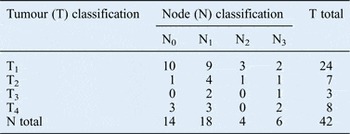
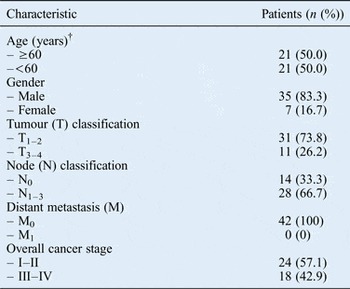
All 42 patients (35 males and 7 females) in this study received carboplatin (CBDCA) based concurrent chemoradiotherapy in the initial treatment. The median age of the patients was 59.0 years. The patients were followed up for at least 17 months or until their death, with a median follow-up period of 55.5 months. Ten patients were diagnosed with stage I, 14 with stage II, 6 with stage III, 6 with stage IVA and 6 with stage IVB disease, according to the seventh edition of the Union for International Cancer Control tumour–node–metastasis classification.Reference Sobin, Gospodarowicz and Wittekind 16 No distant metastasis was found in any of the patients involved in this study at the time of initial treatment. All tumours were non-keratinising carcinoma as classified according to the seventh edition of the Union for International Cancer Control classification. The clinical T and N stages of the patients are shown in Table I. The clinical characteristics of the patients are shown in Table II
Clinical tumour and node stages of nasopharyngeal carcinoma patients*

Data represent numbers of patients. *Total n = 42
Clinical characteristics of nasopharyngeal carcinoma patients*

*Total n = 42. †Note: 60 years represents patients' median age
In the initial evaluation of therapeutic effects by imaging, 33 (78.6 per cent) of these patients showed a complete response at the primary site and lymph nodes, 6 (14.3 per cent) developed locoregional persistence, and 3 (7.1 per cent) demonstrated neck lymph node metastasis persistence. In a subsequent follow up, 7 (16.7 per cent) of the 42 patients developed locoregional recurrence, 5 (11.9 per cent) had neck lymph node metastasis recurrence and 4 (9.5 per cent) had distant metastasis.
Of 13 patients who developed locoregional resistance to concurrent chemoradiotherapy (i.e. locoregional persistence and recurrence), 6 (46.2 per cent) underwent salvage treatment with a gamma knife and/or chemotherapy. Of eight patients developed neck lymph node metastasis persistence and recurrence, seven (87.5 per cent) underwent salvage neck dissection. The five-year disease-specific survival rate of the 42 patients was 76.7 per cent.
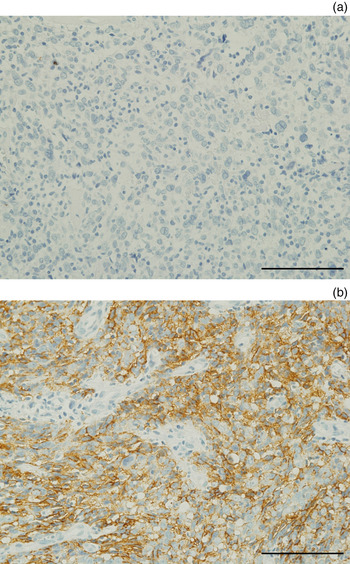
Figure 1 shows the classification of CD44v6 immunoreactivity in nasopharyngeal carcinoma. Table III shows the univariate and multivariate analysis results for factors associated with locoregional resistance-free duration, including CD44v3 through CD44v7 immunoreactivity. Both univariate and multivariate analyses showed that CD44v6 high expression was significantly associated with locoregional resistance-free duration (p < 0.001). Univariate analysis showed a significant association between CD44v3 high expression and locoregional resistance-free duration (p < 0.001); however, all multivariate analyses, with forward, backward and stepwise variable selections, failed to reveal such an association.
Immunohistochemistry of CD44v6 in nasopharyngeal carcinoma: (a) shows nasopharyngeal carcinoma with less than 50 per cent immunoreactive tumour cells, designated CD44v6 low expression; and (b) shows nasopharyngeal carcinoma with 50 per cent or more immunoreactive tumour cells, designated CD44v6 high expression. Bars indicate 100 µm.

Univariate and multivariate analyses of factors associated with concurrent chemoradiotherapy resistance at primary site

CI = confidence interval
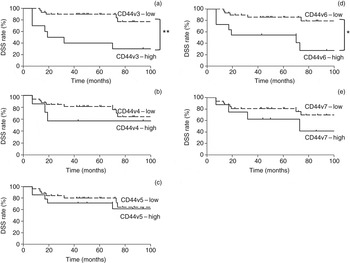
Figure 2 shows the disease-specific survival for patients stratified according to their CD44 variant isoforms. Nasopharyngeal carcinoma patients with CD44v3 high expression had a significantly lower disease-specific survival rate than those with CD44v3 low expression (p < 0.001) (Figure 2a). The disease-specific survival rate of nasopharyngeal carcinoma patients with CD44v6 high expression was also significantly lower than that of patients with CD44v6 low expression (p = 0.003) (Figure 2d).
Disease-specific survival rates in nasopharyngeal carcinoma patients with high or low expression of: (a) CD44v3 (five-year disease-specific survival rates were 40.0 and 89.9 per cent in nasopharyngeal carcinoma patients with CD44v3 high and low expression, respectively); (b) CD44v4 (disease-specific survival rates were 57.1 and 81.4 per cent); (c) CD44v5 (disease-specific survival rates were 71.4 and 80.0 per cent); (d) CD44v6 (disease-specific survival rates were 54.5 and 85.6 per cent); and (e) CD44v7 (disease-specific survival rates were 62.5 and 81.0 per cent). **Indicates p < 0.001; *p = 0.003. DSS = disease-specific survival

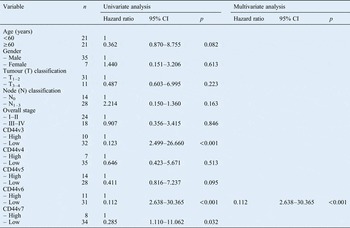
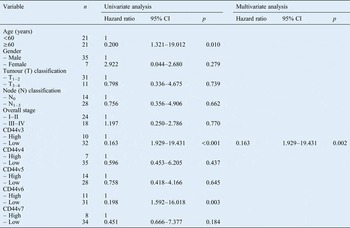
Table IV shows the univariate and multivariate analysis results for factors associated with disease-specific survival, including the immunoreactivity of CD44v3 through CD44v7. Univariate analysis showed that CD44v3 and CD44v6 were significant prognostic factors of disease-specific survival (p < 0.001 and p = 0.003, respectively); however, all the multivariate analyses, with forward, backward and stepwise variable selections, only identified CD44v3 as a significant prognostic factor.
Univariate and multivariate analyses of factors associated with disease-specific survival

CI = confidence interval
Discussion
We examined correlations between clinicopathological variables and the expression of CD44 variant isoforms, CD44v3, CD44v4, CD44v5, CD44v6 and CD44v7, in 42 nasopharyngeal carcinoma patients who received carboplatin (CBDCA) based concurrent chemoradiotherapy as an initial treatment. Univariate and multivariate analyses showed that CD44v6 high expression was significantly associated with concurrent chemoradiotherapy resistance at the primary site of nasopharyngeal carcinoma. Furthermore, CD44v3 high expression was associated with shorter disease-specific survival of nasopharyngeal carcinoma patients (poor prognosis).
Previously, Wang et al. reported that expression of CD44 variant isoforms was associated with: advanced T stages (CD44v3 and CD44v6), lymph node metastasis (CD44v3), and distant metastasis and recurrence after radiotherapy (CD44v10).Reference Wang, Wong, de Heer, Xia and Bourguignon 11 The authors also found that high expression of CD44v6 and CD44v10 was associated with shorter disease-free survival in head and neck SCC patients. Possible explanations for the differences in the results between our study and that of Wang et al. include the following. First, the expression and clinicopathological significance of CD44 variant isoforms may vary depending on tumour site. Wang et al. studied the expression of CD44 variant isoforms in SCC of the oral cavity, oropharynx and larynx, whereas we examined the expression of CD44 variant isoforms in nasopharyngeal carcinoma. Second, Wang et al. used polyclonal antibodies against CD44 variant isoforms, whereas we used monoclonal antibodies. Third, univariate analysis in this study showed associations between CD44v3 high expression and concurrent chemoradiotherapy resistance at the primary site of nasopharyngeal carcinoma (p < 0.001), and between CD44v6 high expression and lower disease-specific survival rate (p = 0.003), which are similar to the findings of Wang et al. Further examinations with an increased number of nasopharyngeal carcinoma cases might improve our understanding of the significance of CD44v3 in concurrent chemoradiotherapy resistance at the primary site and of CD44v6 in disease-specific survival.
CD44 and hyaluronic acid interaction promotes signalling mediated by epidermal growth factor receptor, phospholipase C and topoisomerase II, resulting in increased tumour cell growth, migration and chemotherapy resistance.Reference Bourguignon, Gilad, Brightman, Diedrich and Singleton 17 , Reference Wang and Bourguignon 18 It has also been reported that each CD44 variant isoform performs specific biological functions. CD44v3 expressed in the metastatic breast tumour cell line Met-1 binds vascular endothelial growth factor, suggesting that CD44v3 may promote breast tumour associated angiogenesis. In Met-1 cells, CD44v3 localises together with the active form of matrix metalloproteinase-9, promoting degradation of the extracellular matrix to facilitate tumour cell invasion. Introduction of CD44v3 into the head and neck SCC cell line without CD44v3 expression has resulted in increased tumour cell migration.Reference Wang, Wong, de Heer, Xia and Bourguignon 11 Biological functions of CD44v3 in tumour cell angiogenesis, invasion and migration might be involved in disease-specific survival rate in nasopharyngeal carcinoma patients. By contrast, CD44v6 stimulates mitogen-activated protein kinase and downstream Ras signalling, resulting in increased tumour cell proliferation. CD44v6 is expressed in the HSC-3 cell line established from a primary oral tongue SCC, and treatment of these cells with anti-CD44v6 antibody results in decreased proliferation and increased cisplatin sensitivity.Reference Wang, Wong, de Heer, Xia and Bourguignon 11 These results support our findings that CD44v6 high expression is associated with resistance to concurrent chemoradiotherapy at the primary site of nasopharyngeal carcinoma.
-
• CD44 variant isoform expression was analysed in 42 patients with nasopharyngeal carcinoma
-
• CD44v6 high expression was associated with resistance to concurrent chemoradiotherapy at the primary nasopharyngeal carcinoma site
-
• CD44v3 high expression was associated with lower disease-specific survival rate
-
• Analysis of CD44v6 and CD44v3 expression may be useful in estimating prognosis and determining effective treatments in these patients
Radiotherapy and chemotherapy generally exert anti-tumour effects by generating reactive oxygen species and DNA damage.Reference Trachootham, Alexandre and Huang 19 In contrast to cancer cells, cancer stem cells are resistant to radiotherapy and chemotherapy, as reactive oxygen species levels are not elevated in these cells by radiotherapy and chemotherapy.Reference Diehn, Cho, Lobo, Kalisky, Dorie and Kulp 20 In addition, cancer stem cells express adenosine triphosphate binding cassette transporters, which function as a pump to discharge toxins and drugs out of the cell.Reference Gottesman, Fojo and Bates 21 Prince et al. identified a subpopulation of cells with properties of cancer stem cells in head and neck SCC, and showed that CD44 could be a cancer stem cell marker of head and neck SCC.Reference Prince, Sivanandan, Kaczorowski, Wolf, Kaplan and Dalerba 22 In this study, we found that CD44v6 high expression was associated with concurrent chemoradiotherapy resistance at the primary site of nasopharyngeal carcinoma, and CD44v3 high expression was associated with a lower disease-specific survival rate. These results suggest that cells expressing high levels of CD44v6 and/or CD44v3 may include cancer stem cells of nasopharyngeal carcinoma. It is therefore possible that a combination of therapy targeting CD44v6 and/or CD44v3 with concurrent chemoradiotherapy will be effective in the treatment of nasopharyngeal carcinoma. Approaches may include therapeutic small interfering RNA and anti-sense RNAs, and inhibitors of signalling mechanisms involving CD44v3 and CD44v6.
Conclusion
High expression of CD44v6 in nasopharyngeal carcinoma was associated with resistance to concurrent chemoradiotherapy at the primary site. CD44v3 high expression of nasopharyngeal carcinoma was associated with lower disease-specific survival rate. Further examinations of CD44 isoforms should be conducted, with an increased number of patients. Nevertheless, the current study findings indicate that analysis of CD44v6 and CD44v3 expression in nasopharyngeal carcinoma may be useful for investigating patient prognosis and determining effective treatment strategies.
Acknowledgements
We would like to acknowledge Ms Michiko Kakihana and Ms Mio Ohkabe of the Department of Pathology, Hyogo College of Medicine, Japan, for their technical and secretarial assistance. This work was supported by the Japan Society for the Promotion of Science (‘JSPS KAKENHI’), grant number 23791946.