Introduction
The novel outbreak of Coronavirus disease 2019 (COVID-19) was first reported from Wuhan city in China in December 2019. Reference Gu, Chen and Wu1–Reference Afolabi and Ilesanmi3 This necessitated the World Health Organization (WHO) declaring COVID-19 a global pandemic on March 12, 2020. 4–Reference Ilesanmi and Afolabi7 The Nigerian government adopted several public health measures similar to other countries across the globe to effectively control the COVID-19 situation. Reference Dixit, Ogundeji and Onwujekwe8 These mitigation measures include social distancing, wearing of face masks in public areas, and ban on large public gatherings, including churches and mosques, through risk communication messages. 5–Reference Dixit, Ogundeji and Onwujekwe8 Risk communication is “the exchange of real-time information, and advice between experts and people facing health threats.” 9 However, trust is important to overcome public health challenges.
Trust in government’s efforts represents the confidence and satisfaction of people with the performance of public health institutions. Reference Bouckaert and van de Walle10 The Nigeria Centre for Disease Control (NCDC) oversees response to disease outbreaks and other healthcare emergencies in Nigeria. Unfortunately, distrust has become an obstacle in the effective control and containment of infectious diseases. Reference Lalot, Heering and Rullo11 In 2004, the Northern Nigerian region exhibited distrust in the government’s polio control efforts. As a result, many individuals in Northern Nigeria boycotted the polio immunization program. Reference Jegede12,Reference Ilesanmi, Afolabi and Uchendu13 The recent outbreak of Ebola virus disease (EVD) in the Democratic Republic of Congo between 2018 and 2019 provides a vivid example of how a broad environment of distrust made it difficult to combat the spread of EVD due to poor compliance despite the availability of vaccines and significant international and local efforts. Reference Vinck, Pham and Bindu14 Consequently, the transmission of EVD increased because of the citizens’ low trust in health institutions. Reference Richardson, McGinnis and Frankfurter15
The COVID-19 pandemic has not only ushered in significant health and economic challenges around the world, but also provided an opportunity for governments to restore and strengthen trust at a time when it is most needed. 16 While information on distrust in the sources of COVID-19 information remains scarce in Nigeria, the importance of determining trust of the citizens during pandemics cannot be overemphasized. The rolling out of the AstraZeneca COVID-19 vaccine and its distribution strategy makes it necessary to assess the citizen’s level of trust on the overall COVID-19 control efforts at this crucial time. Reference Afolabi and Ilesanmi3 A study of this regard is needed to quantify the potential proportion of COVID-19 vaccine hesitancy, and develop strategies to improve compliance with the recommended public health safety measures. This study, therefore, aimed to determine the level of distrust in government’s efforts toward curtailing COVID-19 in Nigeria.
Methods
Study Design and Study Setting
We conducted a descriptive cross-sectional study among residents of urban and rural communities in Ondo State. Ondo State is located in Southwest Nigeria, and its capital city is Akure. Ondo State is bounded southward by the Atlantic Ocean, westward by Osun and Ogun States, and northward by Kwara and Kogi States. As in other parts of Nigeria, the lingua franca in Ondo State is the English language, and Yoruba language is widely adopted for informal communication. 17 As of March 12, 2021, Ondo State ranked tenth on the NCDC list of COVID-19 cases with 3,083 cases recorded of the total 159,933 COVID-19 cases in Nigeria as of the reference date. 18
Study Population
We enrolled individuals aged 15 years and above from each household visited. We excluded all persons below 15 years old due to ethical issues such as the need for assent and parental consent, which may not readily be available as of the time of data collection. We sought and obtained verbal consent from each eligible individual, after the study had been fully explained. Participation was solely voluntary.
Sample Size Determination
The sample size for this study was calculated using the Leshlie Kish formula for proportional sample size calculation. Reference Israel19 The level of significance was set at 5%, and a sample size of 427 was obtained. We calculated a minimum sample size of 640 after adjusting for a design effect of 1.5.
Sampling Technique
A multi-stage sampling technique was used to select respondents from the community using the outline as shown below:
Stage 1
Using the simple random sampling technique, we selected sampling units from the list of the political wards in Akure South and North local government areas, which served as the sampling frame. Four wards were thereafter selected from each of the units.
Stage 2
We conducted enumeration of all the streets in each of the selected wards. Using the simple random sampling technique, a settlement was selected from each ward.
Stage 3
A central location was chosen by spinning a bottle. From the direction corresponding to the bottle top, we commenced data collection and continued from this point onward. All individuals who met the inclusion criteria and provided consent were defined as eligible for this study. One-quarter of the sample size was obtained from each of the enlisted streets.
Data Collection Methods and Instruments
The study used a structured interviewer-administered questionnaire as the tool for data collection. The questionnaire was adopted from the World Health Organization facilitator guide on COVID-19 knowledge and practices among members of the public. 20 The questionnaire was thereafter modified and divided into 3 sections.
Section A
Socio-demographic characteristics. In this section, data were obtained on the socio-demographic characteristics of respondents. These included respondents’ age, sex, highest educational qualification, community of residence, living with children below 18 years, average monthly income, and wealth quintiles.
Section B
Frequency of use of different sources of information to obtain COVID-19 knowledge.
Section C
Level of trust in institutional COVID-19 risk communication efforts. Trust was ranked from “1” suggesting “Low level of trust” to “7” denoting “High level of trust”.
Face validity of the questionnaire was done by a team of infectious disease experts who presently work as members of the COVID-19 outbreak response volunteers. The questionnaire was pretested in a community in Ondo State that was not enlisted as one of our study areas. Ambiguous questions were thereafter simplified. The questionnaire was back-translated to the Yoruba language by language experts who had excellent understanding of both Yoruba and English languages. Because most of the respondents had acquired minimal formal education, the questionnaire was majorly administered in English language.
The independent variables in the study included: Sociodemographic characteristics such as age, sex, highest educational qualification, occupation, living with persons in the COVID-19 high-risk group, living with children below 18 years, financial situation in the past 3 months, average monthly income, and wealth quintiles.
Outcome/dependent variables included the frequency of use of sources of information to obtain COVID-19 knowledge, and the level of trust in the COVID-19 information disseminated by the NCDC.
Research assistants (RAs) who had obtained at least a school leaving certificate were involved in the data collection process. The training lasted for two days: September 29-30, 2020. We conducted the training exercise in English and Yoruba languages to ensure that the RAs adequately understood the study. A practical session was held for the RAs to ensure mastery of the data collection procedure. Data collection by the RAs spanned from October 1 to 9, 2020, and was overseen by a field supervisor, who had obtained a Bachelor’s degree.
Data Management
The data were entered on the Statistical Software for the Social Sciences (SPSS). Data sorting and cleaning were done, and data were analyzed using SPSS version 22. 21 We assessed the association between proportions using the Chi-square test. Respondents’ ages were summarized using mean and standard deviation, while categorical variables were summarized using frequencies and percentages.
We computed the wealth quintiles using the Principal Components Analysis on SPSS. We obtained data on the presence or absence of the following household items: stove, radio, television, air conditioner, electric fan, refrigerator, pipe-borne water, bicycle, motor vehicle, upholstered chairs, sewing machine, and washing machine. Quintiles were used for the calculation of distribution cut-off points. These were arranged in 5 categories: Q1 = first, Q2 = second, Q3 = third, Q4 = fourth, Q5 = fifth, with “Q1” denoting the “lowest wealth index”, and “Q5” “the highest wealth index.”
We asked questions to obtain information on the level of trust displayed by community members on the sources of COVID-19 information such as: television, newspaper, health workers, social media, NCDC, COVID-19 hotlines, and the World Health Organization. We ranked the level of trust from “1” to “7” with “1” denoting “low level of trust” and “7” “high level of trust” in COVID-19 information disseminated by the NCDC. To obtain the proportion of community members who had a great deal of trust in the COVID-19 information disseminated by the NCDC, we reported the proportion of persons who had chosen “7”, i.e., “high level of trust,” in each instance.
We conducted bivariate Chi-square tests on respondents’ socio-demographic characteristics and the level of trust in the COVID-19 information disseminated by the NCDC. The level of statistical significance was set at p < 0.05.
Results
Table 1 shows that of the 691 respondents interviewed, 244 (35.3%) were aged 21 to 29 years, 352 (50.9%) were males, and 407 (58.9%) had attained more than 12 years of formal education (post-high school). Also, 112 (16.2%) of the community members were health professionals, and 20 (66.3%) people earned less than 30,000 naira monthly.
Socio-demographic characteristics of community members in Ondo State

a Illness: diabetes, hypertension, asthma.
b COVID-19 risk group: People over 65 years and/or with chronic diseases.
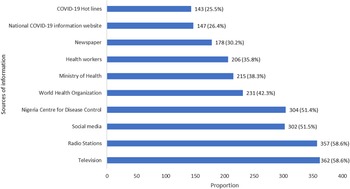
Figure 1 summarizes the frequency of use of sources of information to obtain COVID-19 knowledge among community members. Among them, 362 (58.6%) obtained COVID-19 knowledge from the television, and 357 (58.6%) of the respondents got information about COVID-19 through radio stations. Approximately 302 (51.5%) of the respondents sourced COVID-19 information through the social media, while 304 (51.4%) assessed COVID-19 information from the NCDC.
Frequency of use of sources of information to obtain COVID-19 knowledge among community members in Ondo state, Nigeria.

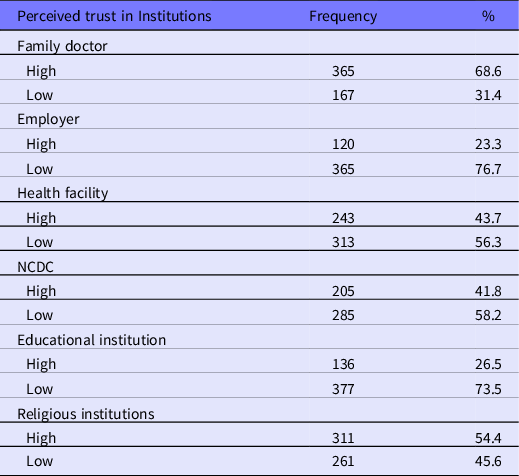
Table 2 shows the perception of community members in Ondo State, Nigeria on COVID-19 risk communication messages disseminated by the NCDC. Three hundred and sixty-five (68.6%) persons had high level of trust in their family physician, 205 (41.8%) had high level of trust in the NCDC, and 311 (54.4%) had high level of trust in religious institutions.
Level of trust in institutional COVID-19 risk communication efforts among community members in Ibadan

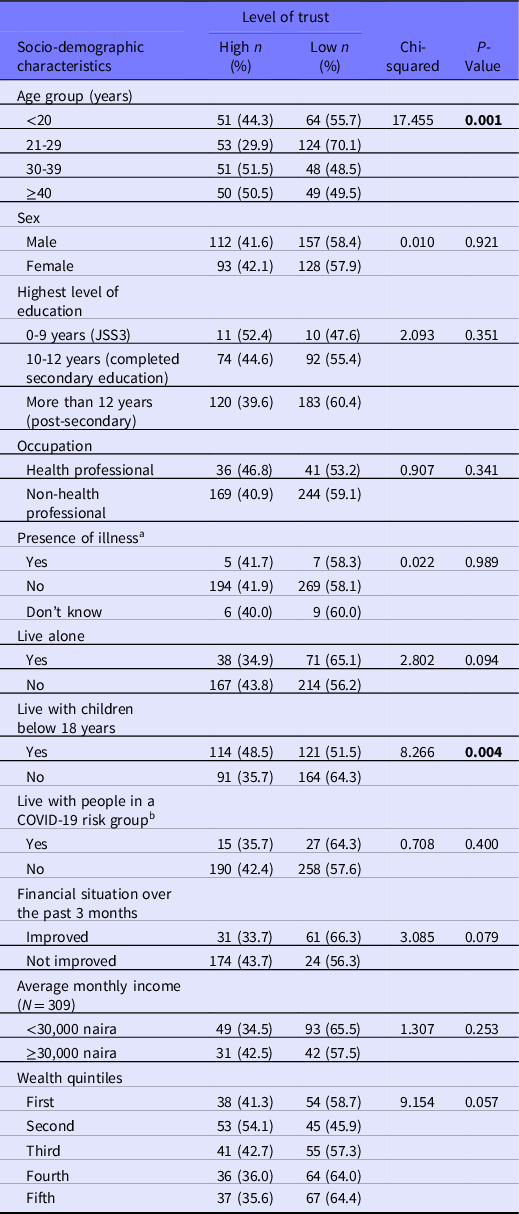
From Table 3, 51 (51.5%) individuals aged 30-39 years had high level of trust in the NCDC compared to 53 (29.9%) aged 21-29 years (χ2 = 17.455; p = 0.001). Also, 114 (48.5%) persons who lived with children below 18 years had higher levels of trust in the NCDC compared to 91 (35.7%) who did not live with children below 18 years (χ2 = 8.266; p = 0.004).
Association between trust in the NCDC and socio-demographic characteristics of community members in Ondo State, Nigeria

a Illness: diabetes, hypertension, asthma.
b COVID-19 risk group: People over 65 years and/or with chronic diseases.
Discussion
Findings from this study revealed that younger individuals had low level of trust in the COVID-19 information diseeminated by the NCDC, while older persons portrayed a high level of trust. Our finding, however, contradicts a report from the United States that younger persons had high level of trust in the CDC. Reference Kowitt, Schimdt and Hannan22 The high level of trust obtained among older persons in this study may be due to their access to limited channels of information dissemination compared to younger persons. The result obtained from this study, therefore, suggests a higher likelihood for adopting COVID-19 preventive measures among older persons compared to younger persons. Our findings corroborate existing literature from the Bowen Family Systems theory that increasing age is a determinant of health literacy. Reference Brown23,Reference Ha Wong, Wai and Zhao24 A study carried out on COVID-19 outbreak in Europe revealed that the absence of trust among young adults significantly reduced their compliance with restrictive government measures put in place in Italian and French cities. Reference Lalot, Heering and Rullo11 This is also consistent with the findings of a study conducted among young Swiss adults. Reference Nivette, Ribeaud and Murray25 Data from the Nigerian Demographic Health Survey (NDHS) reveals that Nigeria is made up of a young population. 26 If the trust level of these individuals is not strengthened, the recommended COVID-19 safety measures are likely to be disregarded especially in public areas. Thus, a higher proportion of COVID-19 cases are likely to be recorded in Nigeria. In lieu of this finding, strategies for strengthening the trust of younger persons in the NCDC need to be developed and implemented. Presently, trust in the Nigerian government seems to be absent, and this extends beyond the COVID-19 context. To improve the trust levels of young people in the government, responsive actions such as improved engagement of youths in health and related matters should be promptly commenced.
From our study, the proportion of community members who displayed high levels of trust in the COVID-19 risk communication efforts of the NCDC was 41.8%. Thus this suggests that many Nigerians have low confidence in the NCDC on COVID-19 risk communication messages. This is similar to the findings of Blair et al. that people who had low level of trust in the Liberian government’s efforts during the EVD were less cautious in their homes and less likely to accept social health advice. Reference Blair, Morse and Tsai27 Our finding is also consistent with that of Brewer et al. who identified that the unwillingness of individuals to participate in vaccine administration was as a result of lack of confidence in health authorities. Reference Brewer, Chapman and Rothman28 Thus, results from this study suggest that the low level of trust in the NCDC could translate to non-adherence to recommended safety measures during the COVID-19 outbreak. Reference Tillemann29 A likely explanation for the distrust could be due to lack of a social contract between the Nigerian government and her citizens. Reference Sanni30 In many instances, the social contract between the Nigerian government and her citizens is activated during elections, and this could contribute to distrust in the overall capacity of the government to control the COVID-19 pandemic in Nigeria. However, distrust in the government’s COVID-19 containment efforts could prompt vaccine hesitancy and negatively influence the uptake of the COVID-19 vaccine in Nigeria.
The results showed that more people with lower educational attainment had higher level of trust compared to their counterparts with higher educational attainment. A likely explanation for this observation could be the simplicity with which people who lack formal education or who have basic education absorb health-related information. Our findings, therefore, contradict the belief that education sometimes increases the propensity to trust in health institutions. Reference Charron and Rothstein31 However, in the COVID-19 context, more persons with lower educational levels are, therefore, likely to place higher level of trust in the NCDC and adopt the recommended COVID-19 preventive measures. Therefore, strategies for improving the trust of educated persons in the NCDC need to be developed and improved upon.
From this study, we found that television and radio accounted for the most frequently consulted sources of COVID-19 information. This asserts the views of Gidado et al. who found out that at the beginning of the EVD outbreak in Nigeria, different enlightenment programs were aired on television and radio stations as part of their cooperate social responsibilities. Reference Gidado, Oladimeji and Roberts32 In addition, the results of a study in Sierra Leone revealed that majority of the respondents derived information on Lassa fever from television and radio stations. Reference Winters, Jalloh and Sengeh33 These studies found the suitability of television and radio for communicating health information in West Africa. Due to the high coverage of these information sources, COVID-19 information campaigns may be reinvigorated in the communities. As a result, trust in the NCDC could be promoted, alongside an adoption of recommended COVID-19 protective measures. It is, however, advised that information on COVID-19 is communicated through short dramas and jingles on radio and television stations.
Conclusion
Public trust in risk communication messages is an essential commodity to invigorating public health vigilance, and curtailing the spread of the COVID-19 outbreak in Nigeria. The persisting low level of trust of the citizens in the Nigerian government has permeated into the COVID-19 context, delimiting the promising success of the NCDC toward curtailing the COVID-19 outbreak. Notably, low levels of trust were recorded among persons with higher educational qualification and younger persons. In many instances, the low levels of trust have been linked to poor involvement of the youths in disease control efforts and national management. For this reason, we recommend increased involvement of younger persons in the management of health affairs in Nigeria. Multi-sectoral collaboration is a necessity to ensure that the trust levels of community members are improved upon in Nigeria. In the COVID-19 context, multi-sectoral collaboration will promote the engagement of young and educated persons, among whom hope is almost lost in the Nigerian governance. The critical thinking skills of these individuals will be made use of in reaching out to other individuals in the community to achieve an improved level of trust in the NCDC’s COVID-19 control efforts. It is also expected that proactive and responsive measures are taken by the government early enough at the commencement of disease events to promote the trust of citizens in the disease control interventions.
Strengths and Limitations
This study had some limitations. First, it was a descriptive survey only, with no time course measurement. The result could change if conducted at a later period. Second, the study was conducted only in one state in Nigeria. Therefore, the findings could lack some form of generalizability. Due to the quantitative nature of the study, we could not fully explore the contributory factors toward the trust or distrust shown by community members in Nigeria regarding COVID-19 risk communication efforts from the NCDC. Despite these limitations, this study provided credible evidence on the existence of distrust toward institutional COVID-19 risk communication efforts among community members in Nigeria.
Ethical Standards
The study was approved by the Institutional Review board of the Federal Medical Centre, Owo, Ondo State, Nigeria (Ref No: FMC/OW/380/VOL.XCVI/75). No form of harm was inflicted on the study participants as a result of their participation in this study.