INTRODUCTION
In the last few years, several scholars and policymakers have explored the potential of human rights language to make claims to ownership and control of the past as well as to draw attention to unjust side effects of heritage conservation. Footnote 1 A number of them have suggested that the adoption of a human rights-based approach to cultural heritage practice could present a means to prevent rights violations. Footnote 2 Notably, one of the most popular global heritage conservation programs—the 1972 Convention Concerning the Protection of the World Cultural and Natural Heritage (World Heritage Convention) of the United Nations Educational Scientific and Cultural Organization (UNESCO)—is moving increasingly towards a human rights-based approach. Footnote 3 Its recent policy on sustainable development Footnote 4 refers to human rights widely and states that “the full cycle of World Heritage processes from nomination to management [should be] compatible with and supportive of human rights.” Footnote 5 Yet, strong empirical research on how human rights-based approaches to heritage conservation work in practice is lacking.
This article is based on my doctoral research in which I investigated the implications, challenges, and opportunities of a human rights-based approach in the context of preparations for the world heritage nomination of the historic and religious site of Bagan in Myanmar. Since 2014, UNESCO has been delivering support for the preparation of this world heritage nomination, which is aimed to be submitted in 2018. Footnote 6 Formally, human rights-based approaches are part of this support. According to UNESCO Bangkok’s “Country Programming Document for Myanmar,” “[a]ll UNESCO programmes, activities and projects in Myanmar are planned, implemented, monitored and evaluated in accordance with human rights-based principles.” Footnote 7 I spent six months in Bagan and Myanmar in 2014–15 and conducted semi-structured interviews with 37 individuals who were (indirectly) involved in, or affected by, the world heritage nomination of Bagan. These individuals can be divided into three categories: foreign experts who were asked to advise on aspects of Bagan’s World Heritage nomination (10); Burmese experts who were asked to advise on the nomination (8); Footnote 8 and residents of Bagan (including pagoda trustees, tourist guides, and representatives of local advocacy groups) (19). Moreover, I conducted observations in and around the pagodas of Bagan on a day-to-day basis as well as during special events such as pagoda festivals. These observations gave me an insight into the different ways people engage with the monuments.
Despite the increasing solidification of human rights-based approaches in the policies, I found that there were several conceptual, political, and practical factors that influenced the extent to which such policies could make a difference on the ground. In this article, I will discuss three key factors that were particularly influential in Bagan: the ambiguity about the meaning of certain categories of rights, such as cultural, land, and development rights; the politicization of the world heritage system; and the challenge of enforcing international human rights standards in uncooperative states with limited capacity. These factors partly explain why no formal rights claims related to Bagan’s nomination have been made to date. Before elaborating on these issues, I will further introduce Bagan and Myanmar.
BAGAN, MYANMAR
Myanmar is a particularly interesting place in which to investigate the dynamics between world heritage conservation and human rights. For decades, the military rulers of the country defied universalistic ideas of conservation as well as justice. Myanmar had one of the worst human rights records in the world, Footnote 9 and, in the 1990s and 2000s, the rulers’ approach to the conservation of Bagan’s monuments led to much controversy, Footnote 10 which I will return to later in this article. This changed dramatically in 2011, when the military government dissolved itself, installed a semi-democratic form of government, and initiated a series of far-reaching political and economic reforms. Part of these reforms has been an increasing engagement with the international community and its standards. In 2011, a National Human Rights Commission was established, and, in 2014, Myanmar’s first world heritage site—the Pyu Ancient Cities—was listed. The successful listing of this site encouraged the government to formally start preparations for the nomination of Bagan.
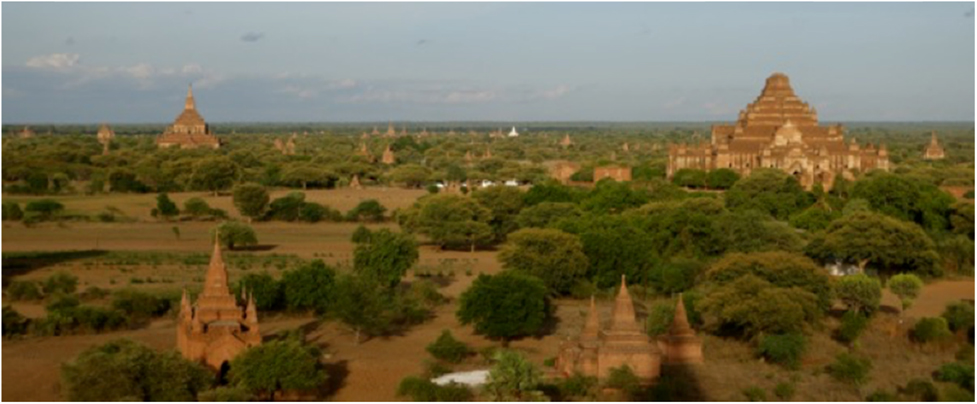
Bagan is an outstanding site of national and spiritual significance and can be found on the inside of a bend of the Ayeryarwaddy River in the heart of the dry zone of Myanmar, where the monsoon rains are intercepted by the Rakhine mountains. This area has the least annual rainfall of Myanmar, and this absence of tropical rain explains the survival of over 3,000 Buddhist brick pagodas that were built between the eleventh and the thirteenth centuries when this area was the center of the Bagan Dynasty (see Figure 1). Footnote 11 The kings of Bagan consolidated an area roughly the size of Myanmar today and constructed over 4,000 Buddhist pagodas. The incentive behind this patronage of religious buildings lies in the concept of merit making, and hundreds of stone inscriptions and votive tablets testify to this motivation. Footnote 12 The collection of merit improves one’s karma. Good karma can increase one’s chance to reach nirvana, a fortunate rebirth, or even good luck in the present life. In Theravada Buddhism, the construction or renovation of Buddhist buildings is one of the most effective ways to make merit. Footnote 13 The rich and powerful often prefer to construct new pagodas over renovating old ones since this presents a way to maintain positions of prestige in society. As a result, thousands of pagodas are scattered on Bagan’s ‘plains of merit’. Footnote 14 Over the centuries, many buildings have deteriorated as a result of earthquakes and general weathering, but the religious significance of Bagan has never ceased. Certain pagodas have been refurbished continuously as acts of merit making.
The pagodas of Bagan (photograph by author).

Today, what is officially called the Bagan Archaeological Area and Monuments is an area of around 100 square kilometers in the Nyaung U township, which has around 198,000 inhabitants, according to the 2014 census. Footnote 15 This area consists of thousands of pagodas—many of which are visited daily for religious purposes—as well as villages and farmland. It is located in a poor rural area characterized by unsealed roads and daily electricity cuts. This situation is likely to change dramatically in the coming years as the region continues to develop, and a significant increase in tourism needs to be accommodated. Military dictatorships and a poor international reputation served to keep tourism numbers low until the change of government in 2011. In 2010, Myanmar received 792,000 international tourist arrivals, but, by 2015, the tourism numbers had risen to 4.7 million. Footnote 16 By 2020, 7.5 million visitors are expected. Footnote 17 As we will see, being located in a region with an ethnic majority, which is also predominantly Buddhist, has not saved the site from contestation about how to balance its conservation and active use, which is a common tension for heritage sites around the world. In Bagan, the continued refurbishments and the religious significance of the pagodas sits uncomfortably with the universalistic conservation standards of the World Heritage Convention, which raises the question of who has rights to what if a human rights-based approach is applied.
For many people, Bagan primarily is, and always has been, a sacred site, and the buildings are Buddhist pagodas. However, with the colonization of what was then known as Burma in the nineteenth century, a different understanding of the buildings was introduced. Europeans saw them primarily as historic monuments, as remnants of a previous dynasty. The word “monument” has a different meaning from the word “pagoda.” Pagoda is a term used for a type of religious building, while monument refers to a building or structure that commemorates a person or an event and is of historical significance. Footnote 18 As Penny Edwards summarizes,
[w]here colonial archaeology came to perceive sites such as Pagan [sic] as a means of accumulating knowledge, and their preservation as a means of both marking historical time and enhancing a global, imperial “heritage” to rival that of competing empires, both Buddhism and the popular religion of nat-worship valued temples and shrines for their dynamic properties as conduits of spirituality, gateways to change in individual circumstance, and—through their construction and embellishment—as generators of merit. Footnote 19
These meanings are not mutually exclusive. Surviving Buddhist temples or sacred buildings can commemorate events of the past. Indeed, Bagan’s pagodas arguably commemorate the Bagan Dynasty. Moreover, there are additional layers of meaning and value associated with the buildings. By displaying their names and the amount of resources donated in and around the pagodas, donors not only achieve merit for the purposes of a good reincarnation but also assert or reinforce their social status in the present life. More recently, with the increase in tourism, the monuments in Bagan have gained additional value as economic resources. Importantly, different actors have prioritized different definitions and value sets, reflecting different worldviews as well as different personal and political interests. Footnote 20
In the 1990s and 2000s, these different understandings of Bagan’s buildings led to much controversy. The unpopular military regime sought legitimacy through Buddhist merit-making projects and association with Burmese kingship. Footnote 21 One way in which they did this was by organizing a major renovation campaign for Bagan’s pagodas. Between 1995 and 2008, around 1,299 monuments were completely rebuilt, and 688 were partially rebuilt. Footnote 22 Stupas were regilded, new bricks replaced old ones, and the pagodas received new finials and fresh coats of paint, sometimes obscuring ancient murals. The reconstructions and renovations were heavily criticized internationally as well as by Burmese archaeologists and historians because there was no archaeological evidence to base the work on and the methods and materials used, such as concrete and steel, were inappropriate. Footnote 23 The potential for archaeological research was compromised by the reconstruction of monuments on earth mounds, and the reconstructions and renovations have been disapproved as “a Disney style set on a historic-religious site.” Footnote 24 According to Kai Weise, “[t]he main problem is that these interventions are not documented anywhere which makes it difficult to monitor the deterioration of the concrete and steel.” Footnote 25
However, international conservation standards arguably do not represent the complex and competing local values or interests any more than the questionable work of the former military regime. If anything, they represent them less. From my fieldwork, it became clear that many—but not all—of the Buddhist devotees support the renovation of the Buddhist temples as an important act of merit making. Footnote 26 The campaign was funded by donations from the public, and it is important to understand that these contributions to the maintenance of Buddhist pagodas are considered to be very meritorious and a means of gaining societal prestige. A different perspective suggests that the junta have continued Myanmar’s cultural practices. Reconstructions and renovations of the pagodas by the rulers of the country, as a means of merit making, have been continuous throughout the centuries, if not at this scale. Conserving the Buddhist monuments in a way that is deemed internationally appropriate could even be considered an interruption to this practice.
According to one of my informants, a Burmese architect involved in the preparation of the nomination, there is no problem with using private donations as a form of merit making for the reparation of monuments:
[b]ecause in our Buddhist society it is a big merit if they donate to a pagoda. The government adopted this policy. Which is to me very acceptable. They can both be combined. The restoration activities were started by the important people of our country and sometimes they made … well, not mistakes, but they did not understand the rules of renovating such old structures. They could not understand. It was just that the Buddhist concept and the modern concept of renovation were a bit different. Footnote 27
In an interview with The Irrawaddy magazine, the director of Myanmar’s World Heritage Site Committee, Than Zaw Oo, alludes to the negotiations about such renovation work by referring to an exchange of information, where the Burmese explain their traditional technology to “conservation organizations” and request their guidance:
Our country has a Buddhist majority. The community is very generous and has over-repaired Bagan’s ancient temples. We explained this to conservation organizations and they understood. We showed them evidence of the renovations that were done after the 10th century. But, in recent years, we have let them know our methods for restoring temples with regard to tradition and ancient technology. We let them check our restoration work and request their guidance as well. Footnote 28
Importantly, the reconstructions and renovations are of little concern to many local people as they represent normal merit-making activities that they largely support.
During a community engagement workshop in Bagan in late 2014, many issues were raised, particularly regarding how the nomination may affect peoples’ livelihoods, access to land, and development opportunities, but the reconstructions and renovations were not one of the issues. Footnote 29 When I explicitly asked, the residents of Bagan I spoke with displayed diverging and ambivalent views on the issue. The leader of a local civil society group told me he disapproves of the renovations and reconstructions and would rather have ‘professionals’ maintain the pagodas, Footnote 30 while one of the pagoda trustees told me that, if it were up to him, he would give the crumbling walls inside the temple a completely new layer of paint. Footnote 31 Supposedly, ‘professionals’ could apply a layer of paint, but it remains slightly ambiguous what some of my informants mean when they say they disapprove of the renovations and reconstructions. It does not always follow automatically that international architectural conservation standards are preferred, if there is even an awareness about them. Rather, the renovations and reconstructions are sometimes disapproved of as a symbol of the previous unpopular military regime, which was known for forced relocations, oppression, and the use of violence.
Since 2011, with the aim of securing world heritage status, the government’s approach to its heritage has shifted. Reconstructions and renovations without archaeological evidence are no longer allowed, despite Buddhists’ continued interest in such merit-making activities. For the new rulers of Myanmar, the status that comes with a world heritage designation is apparently more valuable than the prestige gained from the renovation and reconstruction of Buddhist buildings. During my fieldwork, I found that although some lip service was paid to the religious significance of the pagodas, technical matters involving the conservation of archaeology and architecture dominated the nomination process.
In terms of human rights, there are two important implications of such a material-focused understanding of Bagan. First, the majority of the people that I interviewed who were involved in the preparation of the world heritage nomination (foreign and Burmese experts) were unfamiliar with human rights, unsure how they relate to Bagan, or considered it beyond their largely technical mandates, which may be to advise on the conservation of mural paintings or on the use of geographic information systems, to engage in such a discussion (despite its formal adoption in policy documents). Footnote 32 Second, the prioritization of the conservation of (inert) material over living heritage risks excluding people from their cultural and religious practices and possibly violates cultural rights, something I will further explain in the following section.
WHO HAS RIGHTS TO WHAT? A LACK OF CONCEPTUAL CLARITY
UNESCO is explicitly committed to cultural rights, as a subcategory of human rights, in its work in Myanmar:
As the UN agency with a specific mandate for culture, and in keeping with the Universal Declaration on Cultural Diversity, UNESCO strives to strengthen the recognition of cultural rights as one of the five fundamental human rights. ... UNESCO will continue to use culturally appropriate programming principles in designing all of its programmes in Myanmar. … These steps will help ensure respect for and promotion of cultural diversity and cultural rights as critical dimensions of sustainable development. Footnote 33
Despite its commitment, the category of cultural rights conceptually remains subject to contestation and several different interpretations. Footnote 34 Whether the exclusion and control of popular religious practices constitutes a cultural rights violation depends on how culture and cultural rights are understood. Elsewhere, I have elaborated in more detail on what this means for Bagan. Footnote 35 In short, the meaning of cultural rights remains ambiguous and contested, partly because the meaning of culture itself is not clearly defined. A common characterization is that culture can refer to a product, a process, or a lifestyle. Footnote 36 Accordingly, cultural rights can refer to the right to access a cultural product, the right to participate in, perform, or create cultural activities, or the right to maintain a way of life. This makes it unclear what is being referred to in the context of Bagan. Do people have cultural rights to the conservation of the monuments as forms of cultural capital of “universal value to humanity”? Or do people have cultural rights to engage with pagodas as sites of merit making and popular religious practices, even if this can have an adverse impact on the archaeological, architectural, or even “universal” values of the site? Both supporters of conventional conservation standards and those of popular religious practices could use the language of cultural rights to support their cause.
It could be argued that since their ancestors built the monuments, and since it is “their culture,” the interests of the residents of Bagan or the Buddhists in Myanmar should take priority. However, this argument simplifies the situation, mainly because these people are themselves divided about the appropriate means of engagement with the pagodas of Bagan. My informants included people from all categories who disapproved of the reconstructions and renovations as well as people who supported them. Thus, there is ambiguity about the meaning of cultural rights and contestation about the appropriate approach to the conservation of Bagan. Footnote 37
Regardless of how the category of cultural rights is interpreted, it can conflict with other categories of human rights, such as development and land rights. In order to protect the historic and religious significance of Bagan, residents in what will be the protective zone will inevitably become subject to certain regulations and development restrictions. Footnote 38 These can range from limits on the height of buildings to the types of crops that can be grown and the types of events—such as pagoda festivals—that can be organized. Such regulations and restrictions may be necessary to accord with stipulations by conservationists and local gatekeepers. Development—whether on a small or a large scale—can adversely impact the archaeology of the region, the fabric of the monuments, the integrity of the landscape, as well as the spiritual values of the pagodas, and access to the temples and means of worship can be affected. However, development and land rights are at stake when a new regime of spatial governance restricts where and what people can build and where and how they can run their businesses. In an area where most people live in poverty, such development restrictions need to be well thought through in order not to violate these categories of rights.
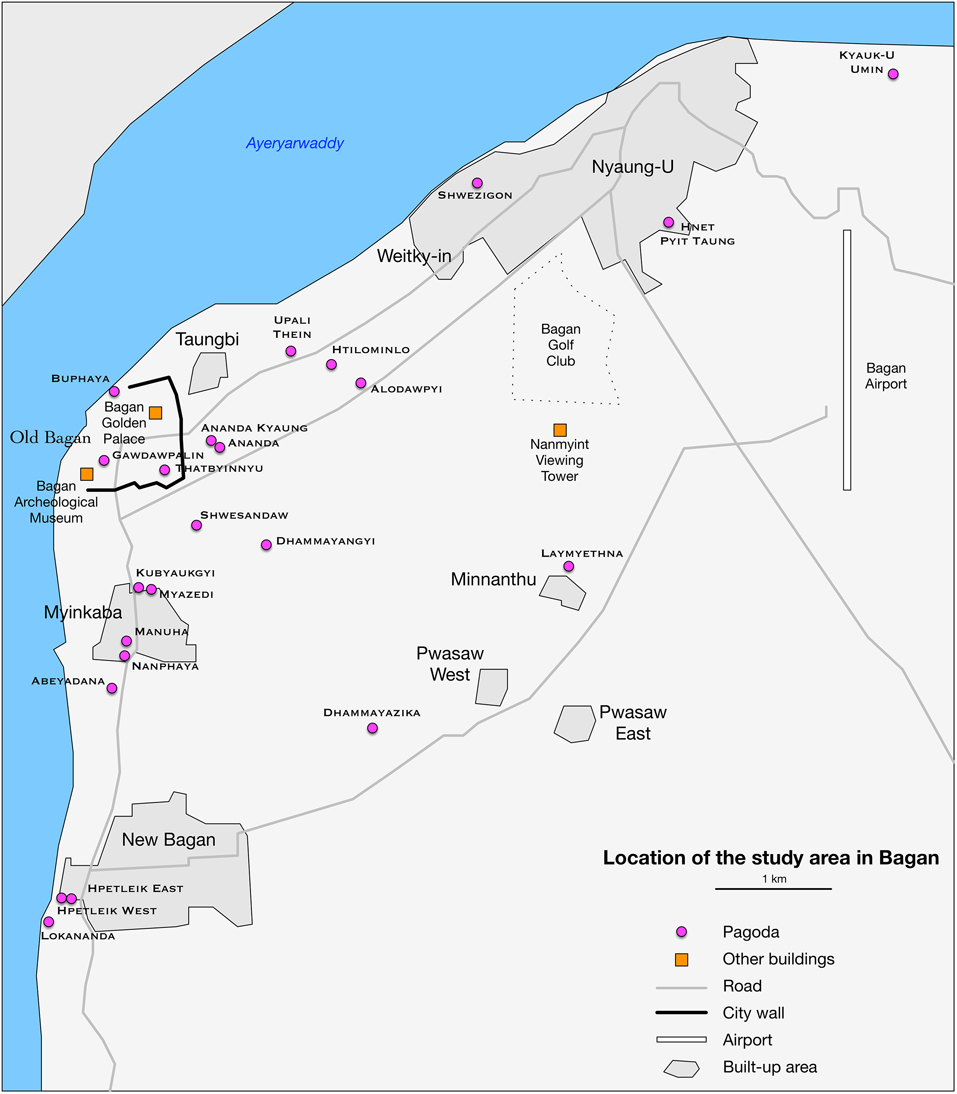
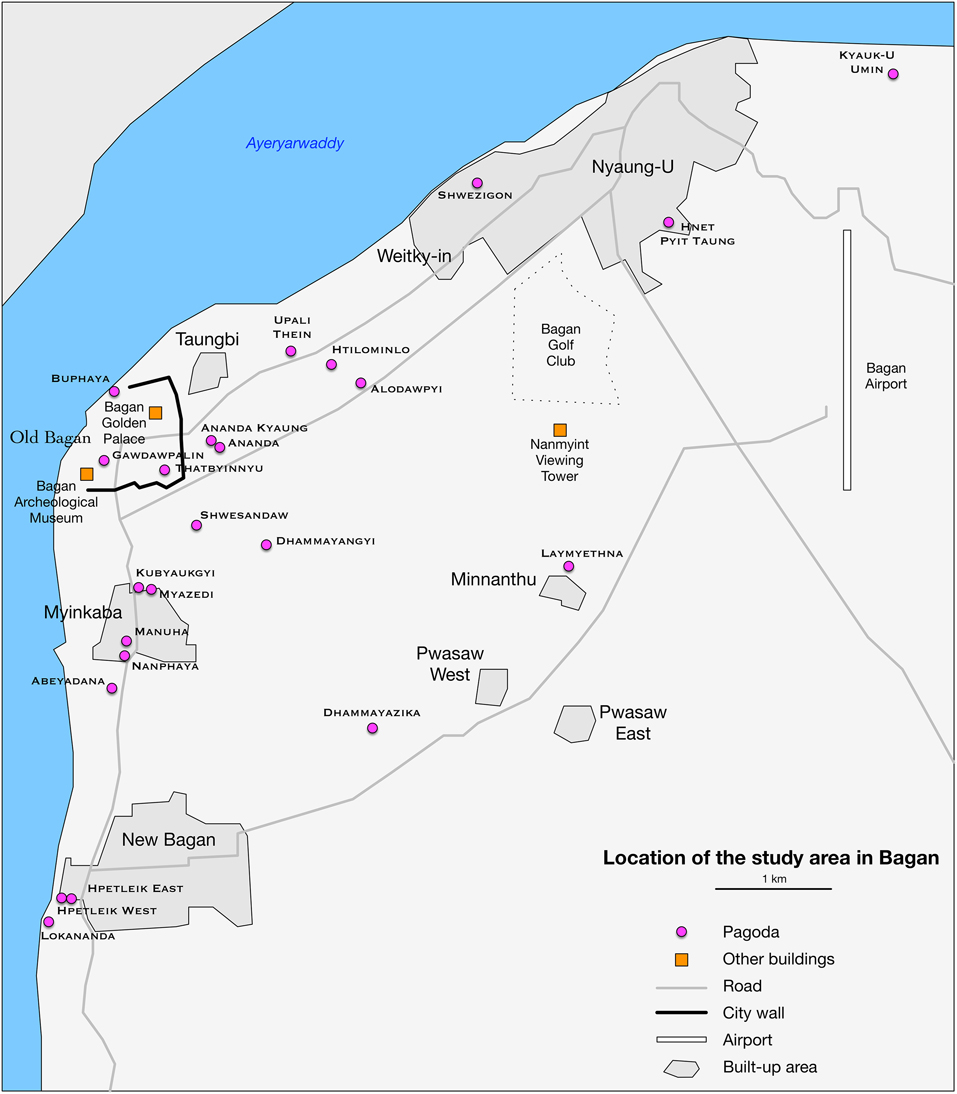
In Bagan, the tension between conservation and development is particularly apparent in ongoing negotiations about the potential relocations of villages or businesses. Footnote 39 This is a highly sensitive issue because, in 1990, the government ordered the population living in the village called Old Bagan—over 5,000 people—to move to New Bagan, four kilometers to the south (see Figure 2). Footnote 40 The eviction was deemed necessary to prevent the damaging consequences of treasure hunting. Footnote 41 However, the way in which the relocation took place led to much apprehension. The leader of a local civil society organization explained:
[I]n 1990, the people had to move to New Bagan, [for] the reason that Bagan became in the list of World Heritage. That’s why the people had to move. But they also had to face many trouble. In only 3 days they had to move from Old Bagan to New Bagan. This is a really, really short time. People face many suffering … temperature of Bagan is very hot. Aged persons, they even died because of the heat. People face this kind of suffering. But later, did Bagan become UNESCO? No. Just hotels and restaurants appeared in the area of Bagan. Footnote 42
Map of Bagan (by M.J. Kraak).
In addition to the limited time, lack of support, and perceived insufficient compensation, a key point of contention was the justification that the authorities gave for the relocations of Old Bagan. Villagers were told their move was necessary to protect the monuments and for Bagan to become a world heritage site. However, the world heritage recognition did not come, and, shortly after the relocation, several large luxury hotels as well as the museum and palace were built among the monuments of Old Bagan, raising questions about the government’s real motivation. A local tourist guide told me she believes the main reason for the relocation had nothing to do with the conservation of the monuments. According to her, the village was relocated because 93 percent of the population had voted for the National League for Democracy, the opposition party. She indicated more details about the days of the relocation:
First, they cut off the water, next day the electricity. Third day, people had to dismantle their houses. The soldiers that came to help, [were supposed to come] back from the front on leave. They did not get [their] leave at all [but were forced to help with the relocation]. Trucks and lorries to help moving were taken by force along the way. Everybody had to dismantle their own houses. Soldiers were angry at the authorities and at the villagers and would just throw things that would break. Where are the human rights? We were treated like dogs. Compensation money? To one house they only gave 3 corrugated iron sheet. Not enough for a bathroom. Footnote 43
Nevertheless, from other interviews, it became clear that there were also several local people who perceived the relocation as an appropriate measure and that the compensation had been sufficient. A hotelier, who moved from Old Bagan to New Bagan and thinks that people only look at the negative side, pointed out that people have more land in New Bagan:
They gave us compensation for this land. They paid more. If we have for example 100 hectares of the land, they give us at least 300 hectares. … Good compensation. But most people obviously don’t like the government. They never see about the compensation and they never see that the government is paying the favour—they don’t see about these things, only the negative ones. Footnote 44
Similarly, a local archaeologist told me that, while people may have disliked the relocation at first, most people are now satisfied because they have more space:
There are 70 monuments inside the walls. [It is an] important zone. That’s why we were transferred. New Bagan is also close to the monuments, but better. First people didn’t like it, but nowadays they became happy. They own compounds. Nowadays they could not buy it, more expensive now. Footnote 45
Such forced relocations were, and continue to be, in accordance with domestic law in Myanmar, Footnote 46 and they are not explicitly mentioned in international human rights legislation. Nevertheless, in Resolution 1993/77, the Office of the High Commissioner for Human Rights states that “the practice of forced eviction constitutes a gross violation of human rights,” Footnote 47 and subsequent reports on evictions and their negative impact on human rights led to the adoption of General Comment no. 7 by the Committee on Social Economic and Cultural Rights in 1997, in which forced evictions in the context of the right to adequate housing are further discussed and largely condemned. Footnote 48 In 2007, the Special Rapporteur on Adequate Housing as a Component of the Right to an Adequate Standard of Living presented the Basic Principles and Guidelines on Development-Based Evictions and Displacement to the United Nations (UN) Human Rights Council. In this document, forced evictions are defined as
acts and/or omissions involving the coerced or involuntary displacement of individuals, groups and communities from homes and/or lands and common property resources that were occupied or depended upon, thus eliminating or limiting the ability of an individual, group or community to reside or work in a particular dwelling, residence or location, without the provision of, and access to, appropriate forms of legal or other protection. Footnote 49
This definition applies to the 1990 relocation in Bagan. However, the special rapporteur also outlines certain “exceptional circumstances” under which forced evictions may be permitted:
Any eviction must be (a) authorized by law; (b) carried out in accordance with international human rights law; (c) undertaken solely for the purpose of promoting the general welfare; (d) reasonable and proportional; (e) regulated so as to ensure full and fair compensation and rehabilitation; and (f) carried out in accordance with the present guidelines. Footnote 50
In Bagan, past and potential future relocations are in accordance with domestic law, as in the first requirement above, and arguably undertaken to promote general welfare, specifically the conservation and protection of a cultural heritage site of outstanding universal value for humanity, as in the third requirement. The incident of 1990 may not have fulfilled the other criteria, but, theoretically, future relocations could.
The conflicting interests that I have outlined regarding forced relocations, popular religious practices, and conservation standards are central to Bagan’s world heritage nomination. However, they are not easily classified in terms of the global human rights framework. There is a lack of conceptual clarity about the meaning of cultural rights and whether and when they trump development rights as well as ambiguity about whether and when forced relocations constitute a human rights violation. In addition, there is the question of scope. Bagan does not exist in isolation, and some human rights issues derive from structural global inequities that cannot be resolved in a world heritage nomination dossier. For example, in Bagan, many children work as vendors of souvenirs around the pagodas, even though child labor is often considered a human rights violation. Footnote 51 If a human rights-based approach to world heritage conservation means “the full cycle of World Heritage processes from nomination to management is compatible with and supportive of human rights,” Footnote 52 does this mean that child labor is unacceptable on a world heritage property or is this beyond the scope of the world heritage process?
Some may argue that the scope should be larger than the world heritage property and include nation-wide issues. Although Bagan is relatively peaceful, there are ongoing conflicts in certain states of Myanmar, and reports of severe human rights violations remain common. In practice, whether this will influence the world heritage nomination depends, to a considerable degree, on international geopolitical relations and on which states parties are in the World Heritage Committee or the UN Human Rights Council. The politics of these international relations present a second factor that influences how human rights-based approaches to world heritage conservation work in practice and is the topic of the following section.
THE INFLUENCE OF INTERNATIONAL POLITICS AND DIPLOMACY
Recent research at the World Heritage Committee meetings sheds light on the politics of world heritage conservation. The World Heritage Committee makes decisions about the convention and the lists of sites during its annual sessions, which last 10 days and take place at different locations around the world. Each year, several issues pertaining to world heritage are addressed, ranging from finance and budgets to the inscription of new sites and reviews of existing properties. Lynn Meskell and colleagues argue that the ethnographic fieldwork at these sessions is important because “if researchers rely solely on the documents, substantive political issues are often masked as technical ones.” Footnote 53 The ethnographic fieldwork at these committee meetings has enabled the identification of several important trends that are relevant when considering the potential of human rights-based approaches. Importantly, local site communities—whose rights and participation are increasingly stressed in documentation—get little opportunity to have their voices heard during these sessions. Footnote 54
Another trend is that, increasingly, delegates on the World Heritage Committee are made up of state-appointed ambassadors and politicians rather than archaeological and environmental experts. Membership in the committee is used to argue for, and ensure, inscription of the state party’s own properties, but it is also an effective mechanism to garner support for certain positions in other UN organizations, such as the UN Security Council. Footnote 55 Moreover, states parties form alliances based on “continental, regional, religious, economic and even former colonial relationships.” Footnote 56 One such bloc includes the emerging powers of Brazil, Russia, India, China, and South Africa (BRICS). Footnote 57 The pacts that are made serve to ensure inscription of the national sites of committee members and prevent transfer to the List of World Heritage in Danger. World Heritage Committee sessions are increasingly filled with political negotiation, diplomacy, and lobbying, and observers have argued that “state agendas now eclipse substantive discussions of the merits of site nominations in tandem with issues raised over community benefits, the participation of indigenous stakeholders, or threats from mining, exploitation or infrastructural development.” Footnote 58 This is reflected by the increasing divergence between the recommendations of the advisory bodies Footnote 59 and the final decisions of the World Heritage Committee. Footnote 60
These trends were apparent when the Pyu Ancient Cities became Myanmar’s first world heritage inscription in 2014. The International Council on Monuments and Sites (ICOMOS) advised the deferral of the inscription and requested clarification of the outstanding universal value of the site as well improved maps and management and conservation plans. Footnote 61 In spite of this advice, the property was inscribed. The overturning of ICOMOS’s advice immediately received regional support from Vietnam, Malaysia, the Philippines, India, and Japan. Most delegates did not speak about the merits of site itself but, rather, about the importance of the fact that this would be Myanmar’s first world heritage inscription. Meskell argues that “the Committee’s decision to inscribe Pyu had little to do with its ancient or archaeological components and more about Myanmar’s participation in world government, its nascent democracy and development” and can be seen as a reward for its transition out of isolation. Footnote 62
Besides politics within the world heritage system, bilateral agreements between Myanmar and other states influence how the conservation of Bagan is approached, and the existing memoranda of understanding influence how state parties in the World Heritage Committee sessions vote. Following an earthquake in August 2016, several countries offered aid for the restoration of the damaged pagodas, including Germany, Footnote 63 China, Footnote 64 and India. Footnote 65 It is too early to evaluate the impact of this aid as most projects have not yet started. However, at other sites in the region, such as Angkor in Cambodia, it has become clear that donors may espouse competing ideas about conservation and that postcolonial sensitivities and (imagined) shared cultural pasts play an important role in which countries choose to collaborate with each other. Footnote 66 Importantly, it has become clear that, unlike their Western counterparts, emerging donors, such as China and India, are not (as) interested in human rights conditionality. Footnote 67
These developments are critical for the potential of human rights-based approaches to world heritage conservation. Yet, the well-known discrepancy between policy and practice in international governance does not mean human rights issues will always be ignored. The 2015 referral of the world heritage nomination of the Kaeng Krachan National Park in Thailand “in order to allow it to more fully address the concerns that have been raised by the Office of the United Nations High Commissioner for Human Rights concerning Karen communities within the Kaeng Krachan National Park” demonstrates that human rights principles can certainly be influential. Footnote 68 Their adoption in formal documents such as the Operational Guidelines for the Implementation of the World Heritage Convention may make this framework more readily available. Footnote 69 However, world heritage is undeniably part of international politics, which, in practice, means that policies and advice may be completely disregarded if they are not serving particular political and diplomatic interests. Moreover, even if a consensus is reached in the World Heritage Committee that certain human rights issues need to be addressed at a particular site—such as happened in the case of Kaeng Krachan National Park—the capacity of the international community, as well as the state in question, to enforce action is in many cases very limited, as will become clear in the following section.
ENFORCEMENT AND CAPACITY: PRACTICAL CHALLENGES
Myanmar’s recent historical context provides an example of the difficulty and dilemmas of internationally enforcing respect for human rights. One of my informants argued that the controversial reconstructions and renovations in Bagan are the result of the sanctioning policies of the United States and the European Union (EU). Footnote 70 Throughout the 1990s and 2000s, the United States and the EU “suspended nonhumanitarian bilateral aid, imposed an arms embargo, and denied tariff preferences to imports from Burma as well as preferential financing for trade and investments” in an attempt to weaken and isolate the military regime and deny its legitimacy. Footnote 71 However, the use of sanctions to pursue human rights is controversial. Critics of the sanctions policy argue that they did not hurt Myanmar’s military rulers, who “are unfazed by international opprobrium and isolations, and may even prefer it.” Footnote 72 Morten Pedersen has argued that sanctions failed “to promote political reform or substantially improve human rights” but have been harmful for the country’s long-term development prospects and increased the suffering of the ordinary Burmese. Footnote 73 According to my informant, the refusal of these Western countries to engage with the leaders of the former military regime resulted in a lack of skills and knowledge about international conservation standards.
Myanmar’s disregard for human rights resulted in heated debates about whether and how the international community should react and what measures would be most appropriate. Jared Genser has investigated the role of the global human rights regime in Myanmar over the last 20 years, and his findings illustrate the weakness of the regime in terms of implementation. Between 1994 and 2009, the primary means with which the UN engaged with the Burmese government with regard to its human rights situation was through the appointment of a special rapporteur. The rapporteurs published 36 reports to the UN Human Rights Council, the Commission on Human Rights (the predecessor of the UN Human Rights Council), and the UN General Assembly, which make for “depressing reading.” Footnote 74 Genser identifies several major challenges the UN has faced when attempting to engage with Myanmar, the biggest obstacle being “not having a serious governmental partner that is concerned about human rights.” Footnote 75 The Myanmar government did not hold perpetrators accountable, orchestrated most of the human rights abuses itself, and denied that the abuses ever existed. Furthermore, special rapporteurs in Myanmar were denied access for extended periods, and they struggled with a lack of financial and administrative support. Genser argues that these challenges has made it impossible for the UN human rights regime to have any meaningful impact on Myanmar’s human rights situation. Footnote 76
Today, most sanctions have been lifted. Since 2011, several developments have indicated a change in attitude towards human rights in Myanmar. The country ratified and signed a number of UN conventions and established a National Human Rights Commission. Footnote 77 However, despite initial optimism, the recent violent conflict in the Rakhine state demonstrates the continuing uneasy relationship between Myanmar and human rights. Importantly, once again, foreign investigators and UN officials have been refused access to key areas, and the authorities have denied any complicity in the human rights abuses. Footnote 78
The limited power of the global human rights regime and foreign policies to enforce respect for human rights demonstrates the difficulty of moving beyond “human rights talk.” If human rights abuses take place at a world heritage site, and the international community disengages or imposes sanctions by way of disapproval, the consequences for conservation, living heritage, and development could be serious. The recent history of Myanmar shows that, rather than encouraging leaders to change their ways, sanctions and disengagement have led to a lack of knowledge about international heritage standards, and, accordingly, conservation, living heritage, and development have been only further compromised. This presents a dilemma for human rights conditionality on aid and international cooperation. Moreover, if enforcement is difficult for serious (and, based on the number of signatories, relatively uncontroversial) human rights violations, such as the use of child soldiers and torture, this raises the question on how respect for more contested categories of human rights, such as cultural rights or the right to development, can be enforced. As I have demonstrated earlier, these categories are central to Bagan and many other world heritage sites, where the meaning of cultural rights can be interpreted in multiple—sometimes conflicting ways—and where exercising the right to development could compromise conservation efforts.
Even with the intention of respecting human rights, Myanmar may currently lack an appropriate governance system as well as the capacity for the implementation of a human rights-based approach. A government requires a coherent administrative structure to be able to execute policies. However, decades of mismanagement have led to the crippling of the civil service. The employees of the Department of Archaeology, who worked with UNESCO on the preparation of the world heritage nomination, are also civil servants. In 2014, the Department of Archaeology in Bagan was not connected to the Internet; neither was there a computer in the office of the deputy director. The maps of the Department of Land Administration in Bagan were hand drawn with pencil, and some were more than 100 years old. An up-to-date inventory of the monuments of Bagan or the objects in the Archaeological Museum was non-existent, not to speak of digitization. The most recent inventory was created in the 1970s and 1980s. Footnote 79 A number of foreign consultants involved in the nomination mentioned that the lack of capacity in the Department of Archaeology and the low salaries of the employees formed a challenge for Bagan’s world heritage nomination. An employee of the Department of Archaeology confirmed this concern. He regretted that there were too few staff to be able to monitor almost 3,000 monuments and admitted that his department was struggling to enforce protective rules and laws, such those that prohibit people from climbing the monuments or require permission for renovations. Footnote 80
Although my informants were specifically referring to how the country’s low capacity influences conservation, arguably, it equally influences the extent to which human rights policies can be implemented and enforced. Institutions that are tasked with upholding the rule of law in Myanmar also suffer from a shortage of capacity. Footnote 81 Universities closed regularly in the last decades (between 1988 and 2000, universities were only open for the equivalent of three years), and the quality of education is “highly questionable.” Footnote 82 Moreover, besides a brief period of 10 years following independence in 1948, the courts in Myanmar have not been independent. Since 1962, the lack of separation between the judiciary and the executive has resulted in the use of law “to justify violence, exploitation and military rule.” Footnote 83 This did not change with the current constitution, which ensures “strong executive oversight over judicial affairs, to the detriment of judicial independence.” Footnote 84 Thus, the weakness of the international human rights regime, the low capacity of the Burmese civil service, and the state of the legal system in Myanmar influence the extent to which human rights-based policies can be implemented and enforced.
CONCLUSION
Despite a clear move towards human rights-based approaches in the context of UNESCO and the World Heritage Convention, several factors are influencing the degree to which such policies can be effectively implemented in Bagan, Myanmar. I have categorized these factors as conceptual, political, and practical. Conceptually, the case of Bagan foregrounds the contestation about the meaning of certain categories of rights. The tension between conservation, living heritage, and development is central to the world heritage nomination of this property. Rather than providing a way to navigate this tension, looking at the case through a human rights lens demonstrates the diversity of the interpretations in cultural, land, and development rights. Moreover, it will become clear that these different categories of rights can be in direct conflict with each other. Lack of clarity about the scope of a human rights-based approach adds to this complexity. It is not apparent which human rights issues need to be considered part of the world heritage nomination process and which fall outside of this realm.
World heritage and human rights are both part of international politics, which has a significant influence on the dynamics of heritage conservation and human rights. Continuously changing international relations influence the extent to which, and the context within which, the engagement with human rights is considered desirable. International politics has the potential to create obstacles as well as opportunities for human rights-based approaches to world heritage conservation. The contemporary global human rights framework is a product of international politics but so is its weak enforcement. The link between cultural heritage and human rights is being solidified increasingly in documents and policies in the international political arena, but it is this same arena wherein the World Heritage Committee sessions are increasingly being politicized and where expert advice is being ignored and the (lack of) support for a world heritage listing is becoming a pawn in wider diplomatic negotiations. In this context, human rights issues at or around world heritage sites may be highlighted or ignored depending on the relations between the relevant states parties.
If a political consensus is reached indicating that respect for human rights should be pursued in world heritage contexts, and conceptual questions regarding the meaning of human rights are clarified, the question remains how to implement such a policy in practice. Effective mechanisms of accountability are lacking in Myanmar as well as in much of the world. Developing such mechanisms takes time, resources, and, above all, continuing commitment. These conceptual, political, and practical factors are intertwined and reinforce each other. The lack of effective mechanisms of accountability is the result of the absence of political consensus. Political resistance to further developing human rights institutions is partly due to concern over unresolved conceptual questions. These challenges raise the question of whether the international human rights framework is the most strategic way to address issues of justice in cultural heritage contexts, and, as Meskell has suggested, “whether a local and grounded engagement poses a more pragmatic, achievable way forward.” Footnote 85
Bagan is a helpful example of the challenges facing many world heritage sites today. Although the conceptual, political, and practical factors identified will be of varying influence depending on each property and the states party, they are likely to resonate widely and are useful to take on board when further developing human rights-related policies. Accordingly, I argue that analyzing a problem through a human rights lens can provide valuable insights, yet these insights will always be partial and subject to certain limitations. Juxtaposing human rights with alternative frameworks and approaches, such as sustainability, conflict resolution, or equality, will be necessary to engage with the multiple aspects of complex problems, such as social justice at world heritages sites.