1 Introduction
Large institutional investors, such as pension funds, which generate intensive capital flows are likely to have a substantial impact on stock prices. This effect should, naturally, be more visible and more strongly pronounced in thinly traded markets that are characterized by relatively low volume of transactions, low capitalization and low liquidity in comparison with the amounts of capital being injected on regular basis by these large institutions.
Moreover, it is known that the number of institutional investors trading on stock markets worldwide increased significantly in the past three decades, which has caused a gradually intensified interest among financial economists, practitioners and financial markets regulators in the issue of the impact of those institutions on stock prices. It is widely believed that institutional traders have an influence on stock returns and the existing empirical evidence from international markets backs this conjecture, as reported, among others, by Kraus and Stoll (Reference Kraus and Stoll1972), Chan and Lakonishok (Reference Chan and Lakonishok1993), Gompers and Metrick (Reference Gompers and Metrick2001), Bikker et al. (Reference Bikker, Spierdijk and van der Sluis2007), Coval and Stafford (Reference Coval and Stafford2007), Rakowski and Wang (Reference Rakowski and Wang2009), and more recently Foster et al. (Reference Foster, Gallagher and Looi2011) and references therein.Footnote 1 Furthermore, capital inflows generated by institutional investors can also have positive effects on economic growth, as has been evidenced recently by Slesman et al. (Reference Slesman, Baharumshah and Wohar2015).
The specific history of the Polish stock market provides a unique institutional feature and opportunity allowing us to contribute to the literature on the institutional investors’ impact on stock prices, arising from the pension system reform in Poland in 1999, when privately managed pension funds (Otwarte Fundusze Emerytalne (OFEs)) were established and allowed to invest on the capital market. We study this impact and focus on the returns dynamics of the Warsaw Stock Exchange (WSE) blue chip stocks index WIG20 after the first transfer of money to the pension funds on May 19, 1999 until the end of 2008 and, subsequently, we provide further analysis in the out-of-sample period from January 2009 to December 2011. Our data sample is deliberately restricted to the period 1999–2011 to avoid any distortions in results related to the political turmoil around pension funds, which was the case in Poland in more recent years.
An important characteristic of our dataset provides the opportunity to measure both the short-run and long-run effects in nearly laboratory conditions where positive liquidity shocks affect decisions of pension funds. Namely, the Polish pension funds have been receiving exogenous capital injections (completely independent from their earlier performance) throughout the whole sample and they have never been forced to withdraw any large amounts of capital from the market, because the future pensioners were still too young to receive any pension payments in the investigated period. In contrast to the previous studies, where endogenous transfers of capital to financial institutions were used to measure demand shocks and their impact on stock returns, we are employing data capturing truly exogenous capital transfers. These transfers flow to all pension funds from the government pension institute Zakład Ubezpieczeń Społecznych (ZUS), which in turn collects mandatory contributions from all employees’ wages from the entire Polish economy. Therefore, transfers do not depend on current developments regarding the demand shocks of investors or price developments on the stock market.
Earlier studies had to deal with the problem of endogenous demand shocks (influenced by past and present stock returns) by estimating the direct (immediate) price impact of institutional transactions, measuring the impulse-response effects between capital flows and asset returns in multi-equation models or by investigating shifts in the composition of funds (e.g. Gompers and Metrick, Reference Gompers and Metrick2001; Chiyachantana et al., Reference Chiyachantana, Jain, Jiang and Wood2004; Coval and Stafford, Reference Coval and Stafford2007; Ben-Rephael et al., Reference Ben-Rephael, Kandel and Wohl2011, Reference Ben-Rephael, Kandel and Wohl2012; Koch et al., Reference Koch, Ruenzi and Starks2016). Our data and our modeling approach has the advantage that it does not necessitate making the statistical and economic assumptions required by the above methodologies.
The appearance of large institutional traders and the resulting increase in institutional ownership allows us, therefore, to investigate directly the impact they have on stock returns. We analyze the impact of ZUS transfers on the returns of the Polish market WIG20 index from the perspective of 4 frequencies of data, namely quarterly, monthly, weekly and daily in order to examine not only the effect of those capital flows on stock prices but also to investigate, more specifically, the pattern of propagation of their impact across time. We also distinguish between the effect of global factors from international markets and the local factors related to the institutional demand generated by the capital accumulated from the pension contributions.
The problem of high and regular capital flows, generated by large institutional investors, as well as, additionally, the limited liquidity of the Polish stock market provide a motivation for this study. The empirical results obtained in this investigation allow us to conclude about the direct impact of pension funds on the movement of stock prices at the WSE. We find a significant impact of capital transfers on stock returns within the first 4 days after the transfers. In light of the existing theories, this can be interpreted as evidence of the temporary price pressure hypothesis, while the absence of significant effects in longer horizons leads to the rejection of the information-based trading hypothesis.
The paper is organized as follows. Section 2 contains review of the relevant theoretical and empirical literature. Section 3 discusses the data and methodology. Section 4 presents empirical findings. Section 5 provides counterfactual analysis and trading strategy out-of-sample. Section 6 summarizes and concludes.
2 Literature review
2.1 Institutional investors trading on stock markets
The theoretical explanations for the short-term impact of institutional trades on stock returns are the temporary price pressure hypothesis (e.g. liquidity shocks pushing prices away from fundamentals), informational trades of institutions linked to changing expectations of market participants and differences in investor preferences also involving a change in equilibrium prices (e.g. Kraus and Stoll, Reference Kraus and Stoll1972). In the long run, the price pressure hypothesis suggests that prices should reverse to fundamentals, while the latter two propositions imply deepening of the price impact effect (e.g. Gompers and Metrick, Reference Gompers and Metrick2001; Christoffersen et al., Reference Christoffersen, Keim and Musto2006; Coval and Stafford, Reference Coval and Stafford2007; Foster et al., Reference Foster, Gallagher and Looi2011; Ben-Rephael et al., Reference Ben-Rephael, Kandel and Wohl2012).
The empirical literature related to our study and based on the data from international markets presents different types of evidence about the impact of institutional trading on asset prices. Chan and Lakonishok (Reference Chan and Lakonishok1993) analyzed the price impact of institutional trades using the data from 37 large money management firms in the years 1986–1988. They documented an immediate impact of transactions on stock price changes even after controlling for market-wide stock price movements. International evidence on the impact of institutional trading on stock prices is provided also by Domowitz et al. (Reference Domowitz, Glen and Madhavan2001) and Chiyachantana et al. (Reference Chiyachantana, Jain, Jiang and Wood2004), among others.
Furthermore, Kraus and Stoll (Reference Kraus and Stoll1972) and Chan and Lakonishok (Reference Chan and Lakonishok1993) document asymmetric effects between the price impact of buy and sell orders. Several studies found that buys have larger price impact than sells. Holthausen et al. (Reference Holthausen, Leftwich and Mayers1987) argue that price effects are predominantly temporary for seller-initiated transactions and permanent for buyer-initiated transactions on the New York Stock Exchange (NYSE). According to Keim and Madhaven (Reference Keim and Madhaven1996) the buyer-initiated transactions are more often information-based than sell transactions, which in turn are more often liquidity-motivated than buy transactions. While buys are driven by the preference to hold some specific stocks and, therefore, they may set new higher values for their prices, the liquidity-driven sells do not change the prices, at least not permanently. Saar (Reference Saar2001) developed a theoretical model, where the history of price performance of stocks affects the degree of asymmetry between the price impact of buys and sells. Longer bull market periods reduce this asymmetry, or even reverse it, and longer episodes of price depreciation strengthen such asymmetric effects.
Bikker et al. (Reference Bikker, Spierdijk and van der Sluis2007) analyzed the impact of trades by Algemeen Burgerlijk Pensioenfonds (ABP), the largest Dutch pension fund, and found that price effects of buy transactions (sell transactions) tend to be larger than those of sells (buys) in bull (bear) markets. The overall price effects are also moderate in comparison to similar effects studied earlier for other types of institutions. Bikker et al. (Reference Bikker, Spierdijk and van der Sluis2007) explain this result by the fact that the analyzed ABP trades are generally rebalancing activities, not coinciding with news-driven trades and, therefore, they cause less price impact. Dasgupta et al. (Reference Dasgupta, Prat and Verardo2011) developed a theoretical model to analyze the impact of institutional herding on asset prices. They found that institutional trades in the presence of herding positively predict short-term returns, but negatively predict long-term returns.
Among the existing papers presenting empirical evidence for other developed markets, the study by Ben-Rephael et al. (Reference Ben-Rephael, Kandel and Wohl2011) discovered the temporary price pressure effects with prices reversing within 10 trading days on the stock market in Israel. For Australia, the findings provided in Comerton-Forde et al. (Reference Comerton-Forde, Gallagher, Nahhas and Walter2010) reveal that institutional trades exhibit price continuations after the execution of trade package, which is consistent with the informational trading hypothesis.
The number of studies investigating emerging markets data in light of our research is still very limited. The short-run impact of institutional trades in multiple emerging markets has been documented by Domowitz et al. (Reference Domowitz, Glen and Madhavan2001) in the context of trading costs and Chiyachantana et al. (Reference Chiyachantana, Jain, Jiang and Wood2004 and Reference Chiyachantana, Jain, Jiang and Wood2006) who reported evidence about temporary spikes in price volatility during the trade execution periods. Charoenwong et al. (Reference Charoenwong, Ding and Jenwittayaroje2010) also found that large-sized trades account for a substantial impact on stock prices in Thailand. Lee et al. (Reference Lee, Li and Wang2010) show that institutional trades affect market returns in longer (10-day) horizons on the Chinese market. There also exists evidence for the Polish market about the stabilizing effect of pension funds, as a group of large institutional investors, on stock prices volatility, presented in the studies by Bohl and Brzeszczyński (Reference Bohl and Brzeszczyński2006) and Bohl et al. (Reference Bohl, Brzeszczyński and Wilfling2009).Footnote 2 Qureshi et al. (Reference Qureshi, Kutan, Ismail and Gee2017) investigated the empirical relationship between mutual fund flows and stock market volatility in Asian emerging markets. They found that market volatility increases with the increase in equity fund flows, but decreases with the increase in balanced fund flows. In addition, equity funds seem to exhibit positive feedback trading (momentum) behavior, while balanced funds follow negative feedback trading behavior (contrarian behavior).
Empirical evidence for the Indian stock market shows that domestic and foreign institutional investors have a significant influence on the Indian equity market returns after 2008, although institutional trading was not a determinant of stock price movements before 2008 (Mukherjee and Roy, Reference Mukherjee and Roy2016). The evidence in Lakshman et al. (Reference Lakshman, Basu and Vaidyanathan2013) also shows different effects of domestic and foreign institutional investors on herding behavior. While foreign institutions do not impact herding, domestic mutual funds increase the herding tendency. Chung et al. (Reference Chung, Liu and Wang2016) investigated the trading activity of institutional investors in the stock market in South Korea and found evidence suggesting that they may be considered as the contrarian traders and that their transactions are consistent with persistent trading and/or herding behavior effects.Footnote 3 Fang et al. (Reference Fang, Lu, Yau and Lee2017) find the existence of herding effects among the foreign institutional investors also on the stock market in Taiwan, where the main reason for their herding behavior is investigative herding rather than informational cascades. Bravo and Ruiz (Reference Bravo and Ruiz2015) analyze pension system in Chile and they discuss herding effects as well; however, their research is focused more specifically on the herding behavior of pension funds managers. In relation to the institutional subject of our study, Cayon and Thorp (Reference Cayon and Thorp2014) investigate Colombian pension funds and their sensitivity to contagious volatility transmissions during the episodes of financial crises. They find that the regulations existing in Colombia, which restrict the investments made by pension funds in high-risk and foreign assets, offered protection against the contagion effects from the international market during the 2007–2009 crisis period, although contagion was detected during the more recent sovereign debt crisis.
Since the dates of transfers and the amounts of funds transferred from ZUS to OFEs are immediately known to the public and are not an insider information, the relative sophistication of pension funds with respect to individual investors in Poland should play a role only in the longer term and not in the shorter term. Thus, we are able to test the temporary price pressure hypothesis, which requires that the analyzed investors have no informational advantage over other investors in the short-run.
Even though the previous studies on the role of pension funds, as a group of very large institutional investors, and the Polish market are scarce and provide only limited evidence about their impact on the movement of stock prices, this issue has been often discussed in popular business and financial press in Poland. For example, ‘Rzeczpospolita’, a major Polish business and financial daily newspaper, reported that after the entrance of large pension funds, the liquidity of the Polish market has become too low relative to the amounts of capital they managed and invested in stocks. There exists also anecdotal evidence in the form of stories about stock market investors who have achieved very high returns by implementing a simple strategy relying on the analysis of transactions of large pension funds and predicting (or betting on) which stocks these institutional investors may favor in the future (e.g. Rzeczpospolita (1999a, 1999b and 2002)).
In this paper, we provide new evidence about the role of a group of large institutional investors (i.e. private pension funds) on the stock market prices, in particular when their impact is viewed from the perspective of various time horizons, such as quarterly, monthly, weekly and daily. In the only other study, directly related to ours, Zalewska (Reference Zalewska2006) analyzed the long-run effects of the pension reform in 1999 and found that the Polish stock market was performing worse than other emerging markets in the region afterwards. However, Zalewska (Reference Zalewska2006) did not investigate capital flows to the market, as we do in this paper, and could not assess their direct impact on stock prices in the short-run or in the long-run.
2.2 Stock market and pension system reform in Poland
In the following two sub-sections, we briefly describe the stock market in Poland, discuss the evolution of its investors’ structure and, subsequently, we concisely summarize the origins and implementation of the pension system reform in Poland.
2.2.1 Stock market and investors’ structure
Re-established in 1991, the Polish stock market has grown rapidly during the last two decades in terms of the number of listed companies and market capitalization. The capitalization of WSE is comparable to the smaller, mature European markets, like the Austrian or the Greek stock markets, and equals currently about US$ 45 billion. The present investors’ structure of the Polish stock market has its origin in the pension system reform in the year 1999, when the public system was enriched by a private component, represented by open-end pension funds. Participation in this component, often called the ‘second pillar’, is mandatory for employees below certain age.
The Act of the Polish Parliament from October 13, 1998 was a key legal document that laid the foundation for the pension system reform in Poland and which, subsequently, led to the creation of private pension funds OFEs. It describes who is covered by the compulsory and optional pension system in Poland (nearly all citizens) and who contributes to the system (i.e. insured persons and employers in equal proportions). The contributors (i.e. the employing companies play this role) are obliged to transfer pension contributions to ZUS every month. The amount of contributions was set in the Act as a specifically defined percentage share of personal gross income. This share is equal for each covered person and it was set at the level of 19.52% in this Act. It also remained at 19.52% during the entire period investigated in our study.
ZUS is obliged to transfer part of personal contributions, equal to 7.3% of each covered person's gross income, to an open pension fund selected by the insured individual. The Act requires ZUS to transfer the contributions ‘immediately’ to open pension funds using interbank settlement systems. In the first version of the Act, ZUS was allowed only 2 days for the transfer after receiving the contribution payments from the contributors. In the subsequent years, this law was made more flexible and allowed more time for ZUS to transfer larger amounts. Moreover, the Act specifically defined the roles played by ZUS, as a social insurance institute, but it did not mandate any role for ZUS as an investor of pension contributions. In case when the insured person chooses to pay any optional contributions, these payments are transferred directly from the insured individuals to open pension funds; however, they are more flexible and also much less common than the compulsory contributions.
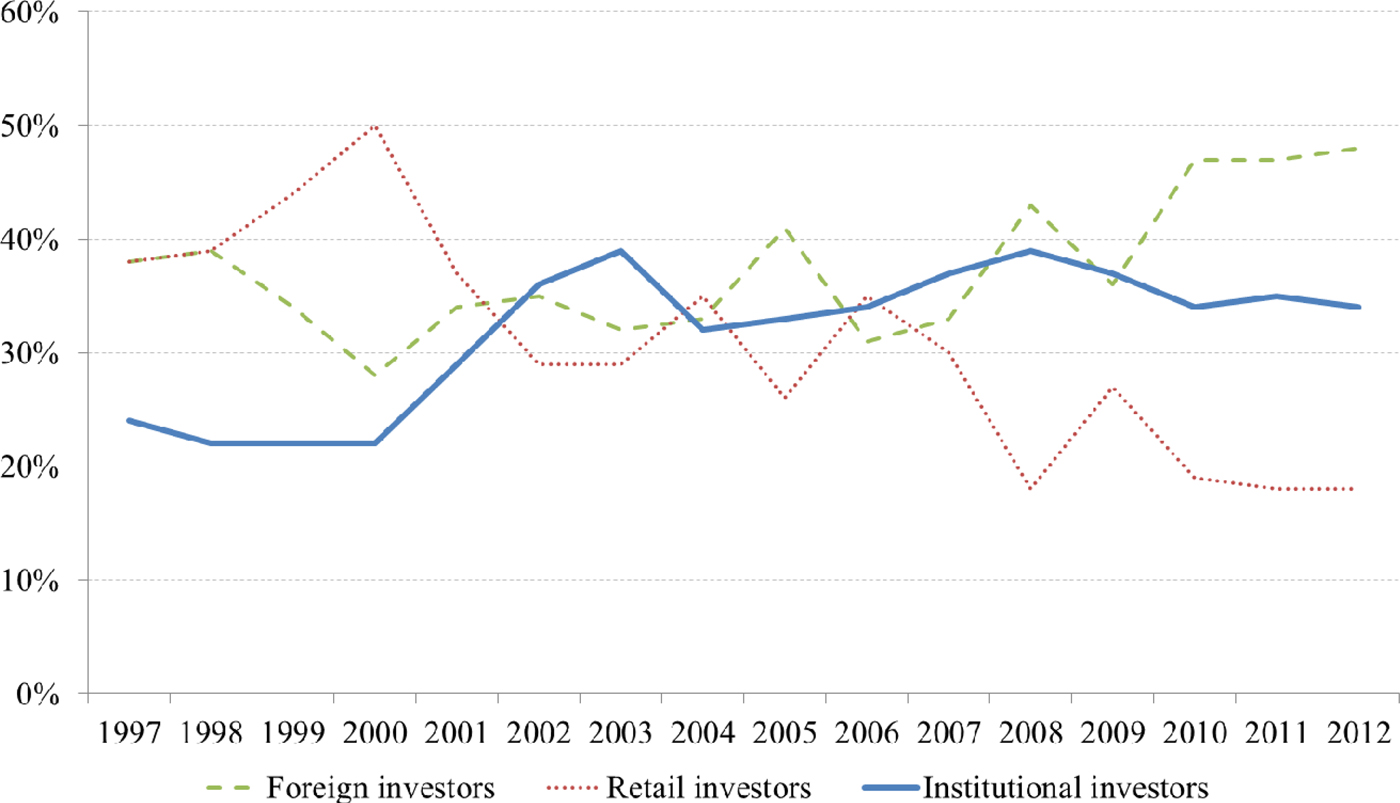
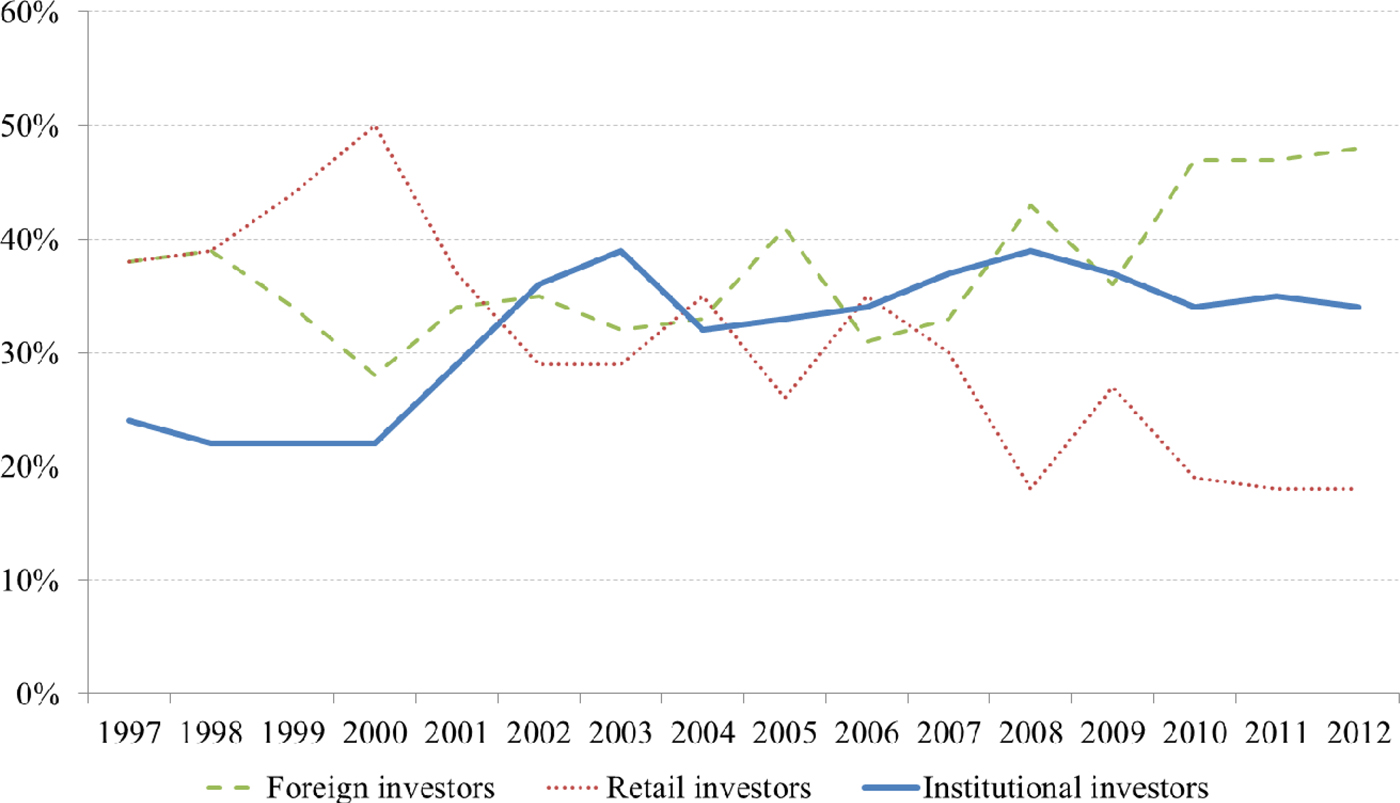
The first transfer of money from ZUS to the pension funds took place on May 19, 1999. This date marks a significant change of the investors’ structure in the Polish stock market. In 1999, about 20% of the domestic institutional investors and 45% of the domestic individual investors traded at the WSE. This situation has nearly reversed and the number of institutional traders approximately doubled after 1999 and the share of trading individual investors decreased to less than 20% in 2011 (e.g. Warsaw Stock Exchange, 2011). About 35% of the investors on the Polish stock market adhered to the group of foreign investors after 1999, but this share increased after 2007 and reached 47% in 2011.
While before May 19, 1999 the majority of traders were small, private investors, after that date pension funds became important players on the stock market in Poland. There were also some mutual funds active in the market but they had relatively small amounts of capital under management. Moreover, the role of corporate investors, i.e. companies investing their capital surpluses, was very marginal. Figure 1 depicts the evolution of the percentage shares of individual and institutional investors which trade stocks at the WSE (based on the official WSE data). It is worth noting that the share of individual (retail) investors decreased from about 45%–50% at the time around the beginning of the pension reform in Poland to less than 20% at the end of our sample period. Note also that the WSE data include foreign investors as separate group; however, foreign investors in Poland are almost entirely institutional investors, so the total percentage market share of both groups of the domestic and foreign institutional investors at the end of our sample period increased to over 80%.
Percentage shares of individual and institutional investors trading stocks at the Warsaw Stock Exchange.
The number of pension funds in Poland over the analyzed period of time varied. The change in their numbers occurred mainly due to mergers and acquisitions of the smaller funds by the larger ones. It is important to note, however, that their structure as well as the structure of the assets under their management remains rather invariant. Right after the start of the pension system reform in 1999, the share of pension funds investments in stocks was relatively very low, typically in the range of 3%–10% of their total assets, but it soon increased to 30% in 2000 and stayed consistently at that level in the subsequent years. For example, in the snapshot at the end of 2003, 16 pension funds operated in Poland with US$ 11.8 billion under management. In comparison, Polish insurance companies and mutual funds had only US$ 3 and US$ 1 billion of assets, respectively. The pension funds invested about US$ 3.8 billion in stocks listed on the WSE in that year. At the end of 2009, the total portfolio of these pension funds was almost six-fold larger than in 2003: US$ 62.8 billion including the US$ 18.7 billion invested in shares on the WSE.
The share of pension funds in the WSE turnover reached its maximum level in the years 2002 and 2003, i.e. 13.6% and 10.1% of average daily turnover, respectively. Taking into account only free floating stocks, this share was even larger, 21.7% and 23.2%, respectively. In the next years, the share of pension funds in the WSE turnover has been steadily decreasing and has fluctuated around the 5% level since 2006. More importantly, the share of Polish pension funds in free floating stocks has had a positive trend and reached the level of 30.4% in 2009, as reported by Narodowy Bank Polski (2004, 2011).
The stock holdings of pension funds predominantly consist of large capitalization stocks that are listed in the blue-chip index WIG20 and usually belong to the largest ones in their industries. Therefore, pension funds have emerged as important players on the Polish stock market with the amounts of capital capable to affect stock prices.
The mechanism through which the impact on stock prices is most likely exerted on the stock market in Poland by the pension funds’ entrance is related to the temporary price pressure effects and the interplay between the supply and the demand for stocks. According to the temporary price pressure hypothesis, the demand for equities is not fully elastic and large flows of capital into (or: out of) pension funds push security prices up (or: down), as it has been argued by Ben-Rephael et al. (Reference Ben-Rephael, Kandel and Wohl2011). This process is reversed in the subsequent periods because prices tend to return to their equilibrium levels. The reverse price movements would not be observable if the trades were information driven. In Poland, all pension funds have been receiving funds from ZUS on the same days, but they were allowed – at least to some extent – to employ their own investment policies to allocate capital in bonds, stocks and other financial instruments. Since the large volumes of capital are transferred from ZUS to pension funds not more often than every few days (or even every other week), the pension funds can potentially limit their impact on the stock market, and avoid increased costs of trading, by splitting their orders and using medium-sized trades or by trading irregularly. Heterogeneous investment strategies of pension funds may further contribute to a gradual inflow of capital to the stock market. Therefore, any price increases of stocks caused by the growing demand generated by the pension funds should be observed rather irregularly within the first few days after the ZUS transfers reach pension funds.
It is also worthwhile to mention that periodical and frequent intensification of capital flows from ZUS to private pension funds, which occurs on the relatively illiquid market with moderately low levels of free-float ratio (mentioned earlier in this section), further strengthens the mechanism described above.
2.2.2 Origins and implementation of the pension system reform in Poland
Through the entire 1990s all consecutive governments in Poland, regardless of the political orientation, were aware of the necessity of a pension system reform and they openly articulated it. It has been becoming increasingly apparent that the old pension system, inherited from the centrally planned economy overthrown in 1989, was going to bankrupt, as evidenced by, e.g. Superintendency of Pension Funds (2000, pp. 6–13). As a result of the pensions reform in the year 1999, the ‘three pillars’ system has been introduced, where the first pillar is a state pension (paid to every citizen, however in very small amounts), the second pillar are the private pension funds OFEs (with compulsory participation for people below certain age) and the third pillar are other private investment funds (with voluntary participation).
Despite political discussions, the new system started to operate in May 1999. New pension funds received a lot of media attention and positive publicity right from the start in 1999 (e.g. Rzeczpospolita, 1999); however, the implementation of the reform raised new concern connected with the concentration of capital in the pension funds industry and the stock market liquidity. First, since the start of the reform, the number of funds has been decreasing because of mergers and acquisitions. In consequence, more of fresh capital has been accumulating in a smaller number of pension funds. Second, the pension funds – forced by law to invest mainly in the domestic market – jointly gained significant control in the public companies quoted at the WSE. In some cases, the cumulated share of all pension funds in a single company exceeded 25%. Taking into account a limited number of stocks at the WSE and a small number of new issues on the one hand and the rapidly growing mass of capital in the pension funds on the other hand, this trend was likely to be continued.
The problem of limited liquidity of the Polish stock market after the new pension funds started their investments and have been accumulating increasingly larger amounts of capital from employees’ pension contributions has been reported by major Polish business and financial newspapers and magazines (e.g. Rzeczpospolita, 2002). At the start of the reform in the late 1999s, this situation may have had following two serious implications for stock market in Poland. First, pension funds could collectively execute their rights as shareholders in the public companies by appointing members of supervisory boards, thus gaining more control over these firms and possibly causing such threats as manipulation of the information from the companies (and manipulation of their prices at the stock exchange). Second, pension funds could have a too strong impact on the stock market because the amount of capital they had under management was too high and gave them power to move prices in the market characterized by relatively low liquidity. One of the possibilities this effect might have is triggering volatility and destabilizing stock market. However, evidence about the opposite effect of an impact of institutional investors in Poland on stock prices volatility was presented in, e.g. Bohl and Brzeszczyński (Reference Bohl and Brzeszczyński2006) and Bohl et al. (Reference Bohl, Brzeszczyński and Wilfling2009).
The issue of too strong concentration of pension funds industry creating the risk of damaging the competition between them has also been often discussed in popular business and financial press in Poland already after the start of the pension system reform (e.g. Rzeczpospolita, 2001).
3 Data and methodology
3.1 Data
In this study, we use a unique database composed of very detailed data about the transfers from the public pension funds institute ZUS to the private pension funds OFEs, which invest this capital on the stock market and on other financial markets. The data were obtained directly from ZUS. We also use data about the prices and returns of the blue-chip stock index of the WSE – the WIG20 index – and the Dow Jones Industrial Average (DJIA) index from the NYSE. The latter is assumed to represent the movements of the global stock market and is used as a control variable that allows us to extract the effect of the local factor (capital from ZUS invested in stocks at the WSE) comparing with the effect of the influence of the global market volatility.Footnote 4 The source of the WIG20 and DJIA data is Datastream.
The important characteristic of capital transfers from ZUS to the OFE pension funds as the main explanatory variable in our models is that it does not directly depend on any other variable used in this study. The ZUS receives funds from companies hiring employees and from individual workers as a share (19.52%) of workers’ gross wages. This share of gross wages received by ZUS has not changed since 1998. ZUS is not allowed to conduct financial policies on its own, but it transfers a regulated part of these funds to open pension funds according to the Act of October 13, 1998 on the social insurance system.Footnote 5 Since the choice of a pension fund by an insured worker may depend on the past performance of individual funds or other factors, we only investigate the aggregate value of funds transferred to all open pension funds.Footnote 6 The value of aggregate funds received by the group of all open pension funds does not depend on the past performance of funds or policy decisions in ZUS.
The transfers from ZUS obviously affect the value of pension funds’ investments on the stock market, but the transfers themselves are independent of the global and local financial market conditions in contrast to the investments of pension funds. Therefore, our proposed variable is distinctly exogenous in nature and it acts as a natural tool to analyze the impact of capital investments on stock returns.
The dataset from ZUS about the transfers to private pension funds spans over the period from May 1999 to December 2011 and covers a total of 1,857 individual observations (1,098 in the in-sample period and 759 in the out-of-sample period). All transfers are expressed in local currency (Polish zloty, PLN). Due to the political turmoil around pension funds in Poland in recent years, our data sample is deliberately restricted to the period 1999–2011 to avoid any distortions in results after the year 2011.
This data sample provides unique laboratory-like conditions not only because it allows to analyze directly the impact of transfers from ZUS to the pension funds on the stock prices, but also because during this period of time the market was completely dominated by domestic pension funds while foreign pension funds started to invest in Poland later (Parkiet, 2010). Hence, in this study, we can extract the effect of the impact of pension funds investments as a homogenous group of investors and analyze their impact on stock prices without the influence of foreign pension funds as a different type of institutional investors.
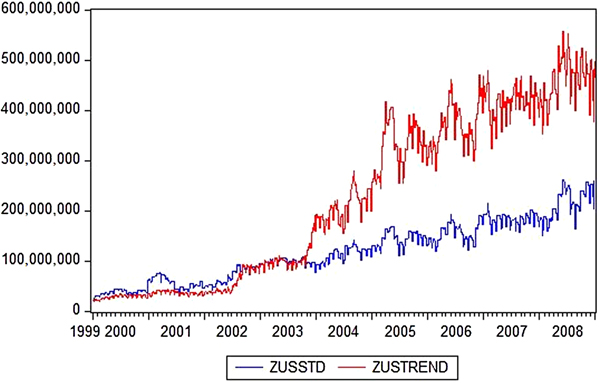
It is important to note that the ZUS transfers variable is trending upwards over time, which is most likely caused by such long-term factors as: increasing wages (both in nominal and real terms), new employees entering the second pillar of the pension system, rising number of employees in the real economy (which overall results in the increasing pension contributions) and the inflation. In order to avoid obvious problems resulting from the use of a trending variable in our models, we de-trend it by dividing the transfers for all data frequencies by their respective moving averages, which allows us to analyze the long-run impact of pension funds investments on stock prices. Hence, the variable which we use as ZUS transfers, denoted as TRANSbyMA, can be interpreted as relative (percentage) deviation of ZUS capital transfers from the long-run trend. As an additional control variable, we exploit the WIG20 volume of trade, which we also de-trend using the same technique (deviations from the moving average) as in the case of ZUS transfers.
3.2 Modeling strategy
First, we investigate the long-term effects of pension funds investments in the stock market and construct models for quarterly and monthly frequency of data. Then we turn our attention to the short-term effects and analyze models for weekly and daily data frequencies. Such modeling strategy is similar to the approach applied, e.g. in the study of Brzeszczyński and Melvin (Reference Brzeszczyński and Melvin2006). It also allows us to compare the impact of ZUS transfers on the stock prices from various perspectives and in different time horizons.Footnote 7 There exists broader evidence about the impact of capital flows on stock returns in the long-run – as documented by, e.g. Bekaert et al. (Reference Bekaert, Harvey and Lumsdaine2002), Goyal (Reference Goyal2004), Lou (Reference Lou2012) and Shive and Yun (Reference Shive and Yun2013) – and we investigate whether flows generated by investments of the group of large institutional investors in Poland, i.e. the private pension funds, have similar effects in the longer term but also in shorter time periods. Models for quarterly, monthly, weekly and daily data were constructed using the variables aggregated to their respective frequencies of observation. Additionally, we create variables that span over the period of 2, 3 and 4 days to investigate the effects of ZUS capital flows on stock prices in the intervals longer than 1 day but shorter than 1 week.
The quarterly, monthly, weekly and daily returns for the WIG20 and DJIA indices were computed using the values of those two indices at the end of every quarter, month, week and day, respectively (and similarly so for 2, 3 and 4 days long intervals). The value of individual ZUS transfers has been added within every quarter, month, week etc., and divided by respective moving averages to create the de-trended transfers variable TRANSbyMA. The same technique has been adopted for the WIG20 volume of trade, which has been aggregated in a similar way and allowed us to create the de-trended volume variable VOLbyMA.
For the quarterly data, we calculated the deviations of transfers and volume from their moving averages from the previous four quarters of the year. Due to the fact that the transfers at the very beginning of the period in the first year in the sample (i.e. year 1999, starting in May 1999) were significantly lower than later ones, we did not use this period for the measurement of the de-trended transfers (or any other variable) and we started our estimation period for all models in the year 2001. The first de-trended transfer (TRANSbyMA) and de-trended volume (VOLbyMA) was calculated for Q1 2001 (using data from four previous quarters from Q1 2000 to Q4 2000). Similarly, we use the first 12 months of the year 2000 to calculate the moving average for the de-trended transfers and the de-trended volume for the monthly data. For the weekly and daily data, we divided the transfers by their 12-week (3-month) moving averages and the 60-day (3-month) moving averages, respectively. Therefore, we were able to start our estimation sample with daily and weekly data already in the second quarter of the year 2000 and we set the end of the sample at December 31, 2008.
The variables for a respective data frequency are denoted using letters ‘q’ (for quarterly), ‘m’ (for monthly), ‘w’ (for weekly), ‘d’ (for daily) and ‘2d’, ‘3d’ and ‘4d’ (for multiple day long intervals) at the end of every variable's name. Hence, e.g. the de-trended quarterly transfers from ZUS pensions institute to the private pension funds are denoted as TRANSbyMAq t and the de-trended transfers for the monthly frequency are denoted as TRANSbyMAm t. Similarly, the names of variables for quarterly (monthly) de-trended volume of trade are VOLbyMAq t (VOLbyMAm t) and for the quarterly (monthly) stock index returns  $r_t^{WIG20q} $ and
 $r_t^{DJIAq} $ (
 $r_t^{WIG20m} $ and
 $r_t^{DJIAm} $). The same notation has been used to create names of all other variables for other data frequencies.
In all our models, we performed different diagnostic tests and we investigated such effects as any remaining heteroscedasticity, autocorrelation and multicollinearity. In the case of heteroscedasticity, we used Engle's (Reference Engle1982) LM test with 5 lags, which show that there was no remaining heteroscedasticity detected in any variant of the models which we estimated. Autocorrelation, if it existed, was eliminated by the imposition of autoregressive (AR) and/or moving average (MA) terms. In order to test for autocorrelation, we applied the Ljung–Box Q test also with 5 lags and we confirmed that all models are free from autocorrelation of the error term. We also tested for multicollinearity, and for this purpose, we calculated the Variance Inflation Factor (VIF) measures. In all cases, the VIF values were lower than the commonly accepted threshold level equal to 10 (and for most variables they were between 1.2 and 1.8). Hence, there were no issues with either heteroscedasticity, autocorrelation or multicollinearity in any specification of any of the models. All variables used in our models were also confirmed to be stationary.
3.3 Modeling long-run and short-run effects of pension funds investments
We estimated the following models for the returns of the WIG20 index for all analyzed frequencies of data:
 $$r_t^{WIG20i} = \alpha + \beta \cdot TRANSbyMAi_t + \delta \cdot r_t^{DJIAi} + \gamma \cdot VOLbyMAi_t + \xi _t $$
where: i = q, m, w, 4d, 3d, 2d, d and q = quarterly, m = monthly, w = weekly frequency and 4d = 4day, 3d = 3day, 2d = 2day and d = 1day denote the frequencies for intervals of 4, 3, 2 and 1 day length. The returns of the WIG20 and DJIA indices are denoted as  $r_t^{WIG20i} $ and
 $r_t^{DJIAi} $, respectively, and the de-trended ZUS transfers and the de-trended volume of trade of the WIG20 index volume as TRANSbyMAi t and VOLbyMAi t, for various intervals and data frequencies i as defined and explained above. The ξ t is an error term.
In addition, we extended the analysis by checking the robustness of our findings in the specifications of models with lags of transfers and volume as well as with the returns of the DJIA index. As a further robustness analysis and validation of our results, we also tested variants of all models with the VIX volatility index as an additional control variable.
The impact of capital injection from ZUS into the stock market is expected to be more pronounced when higher frequency data rather than low-frequency data are used for the analysis. Such an impact can be interpreted as evidence that the effects of pension fund investment on the stock market are short-lived in nature and that they are most likely a market microstructure phenomenon rather than the long-run tendency affecting the development of the market. For example, Zalewska (Reference Zalewska2006) suggests that the introduction of the pension fund investments on the WSE in 1999 did not improve the long-run performance of the Polish stock market in relation to other competing markets in the region. According to the market microstructure theory, the changes in stock prices are related to the mechanism of selling and buying stocks. In line with this concept, the increased supply of capital (and greater demand for stocks) usually increases the volume of long (buying) positions relative to short (selling) positions on the market and moves the prices up.Footnote 8
Therefore, we pay particular attention to the analysis of short-run impact of OFE investments on stock prices and we use a range of high frequency of data, such as daily, 2-, 3- and 4-day long intervals as well as weekly changes in WIG20 and other variables. The use of different short-term frequencies is motivated by the fact that the observed transfers of capital from the ZUS (and subsequently from the OFEs) are not likely to be immediately invested in stocks (e.g. on the same day when ZUS transfer to the OFE pension funds has taken place) and such process may, in fact, require a number of days. The investment may be postponed by the internal decision process in individual OFE pension funds, overall principles of their specific investment strategies (e.g. gradual investment of large amounts of capital, such as ‘stealth trading’ techniques) or other technical barriers. In our analysis, the lagged variables are used to control for the delayed impact of transfers, while the multi-day frequencies of data control for gradual capital investment strategies (over a number of days).
We employ the opening prices of the DJIA index to construct a proxy for the returns from the world market, i.e. the following return of the DJIA  $r_t^{DJIA} = \log (DJIA_t^{open} ) - \log (DJIA_{t - 1}^{open} )$. We use similar definitions for 2-, 3-, 4-day and weekly returns of the DJIA index. In the daily and multi-daily models, the transfers TRANSbyMAd t (and the respective variables in the multi-day models, i.e. TRANSbyMA2d t, TRANSbyMA3d t and TRANSbyMA4d t) have also been lagged to test and check the robustness of the delay effects between the actual transfer and the time during which the capital from ZUS is invested on the stock market.
4 Empirical results
4.1 Results of the long-run analysis
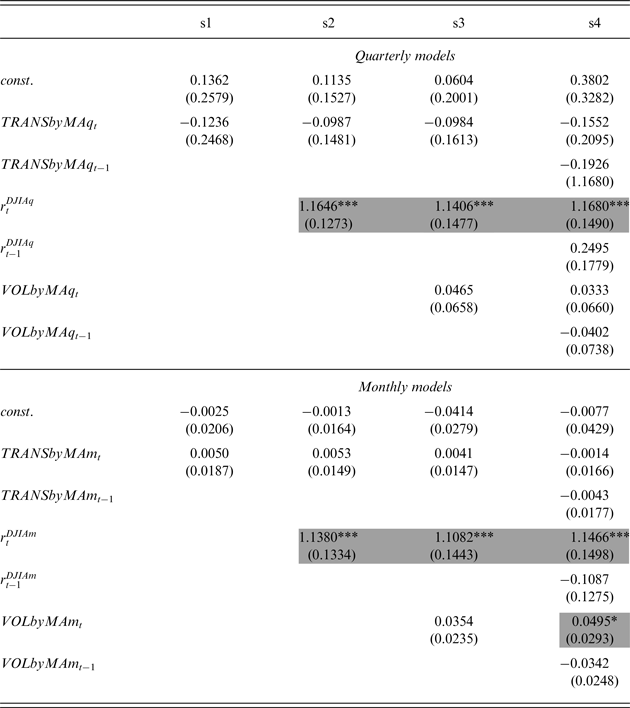
Table 1 presents the estimates of quarterly and monthly models for the returns of the WIG20 index  $r_t^{WIG20q} $ with the de-trended ZUS transfers (TRANSbyMAq t) and returns of the DJIA index (
 $r_t^{DJIAq} $) and the de-trended volume of trade (VOLbyMAq t) as control variables. The correlation between TRANSbyMAq t and VOLbyMAq t in the whole sample is only 0.04, so there is no problem with multicollinearity if those two variables are introduced simultaneously in one equation.
Estimates of parameters from the models for long-run relationships (for quarterly and monthly frequency of data)

Notes:
(a) Robust standard errors of parameter estimates are presented in parentheses.
(b) Highlighted cells indicate statistical significance, which is denoted as: *** significant at 0.01 level, ** significant at 0.05 level and * significant at 0.1 level.
The first important finding in Table 1 is that in the entire sample of data (specifications of models from s1 to s4) all estimates of the  $r_t^{DJIAq} $ are positive and significant (at the p = 0.01 level), while the estimates of the transfers TRANSbyMAq t are not significant in any specification of any model (with or without the control variables), which clearly demonstrates the dominance of the global factor represented by the DJIA index and no evidence of impact of the ZUS transfers when the entire period of analysis is taken into account. Table 1 presents also the estimates of monthly models for the returns of the WIG20 index
 $r_t^{WIG20m} $ with ZUS transfers (TRANSbyMAm t) as the explanatory variable and monthly returns of the DJIA index (
 $r_t^{DJIAm} $) as well as the WIG20 volume of trade (VOLbyMAm t) as control variables. The findings from monthly frequency data are very similar to the results from quarterly models, where DJIA returns are the main driving force for WIG20 index returns. The bottom panel in Table 1 shows that all estimates of
 $r_t^{DJIAm} $ are positive and significant at the p = 0.01 level for the whole sample and in both sub-samples.
In summary, the evidence from quarterly and monthly models clearly indicates that there is no relationship between ZUS transfers and the subsequent stock price changes in the long-run. However, it cannot be excluded that it may exist in shorter horizons and can be identified using models built for higher frequency data.Footnote 9 We investigate such short-term effects in the next section.
4.2 Results of the short-run analysis
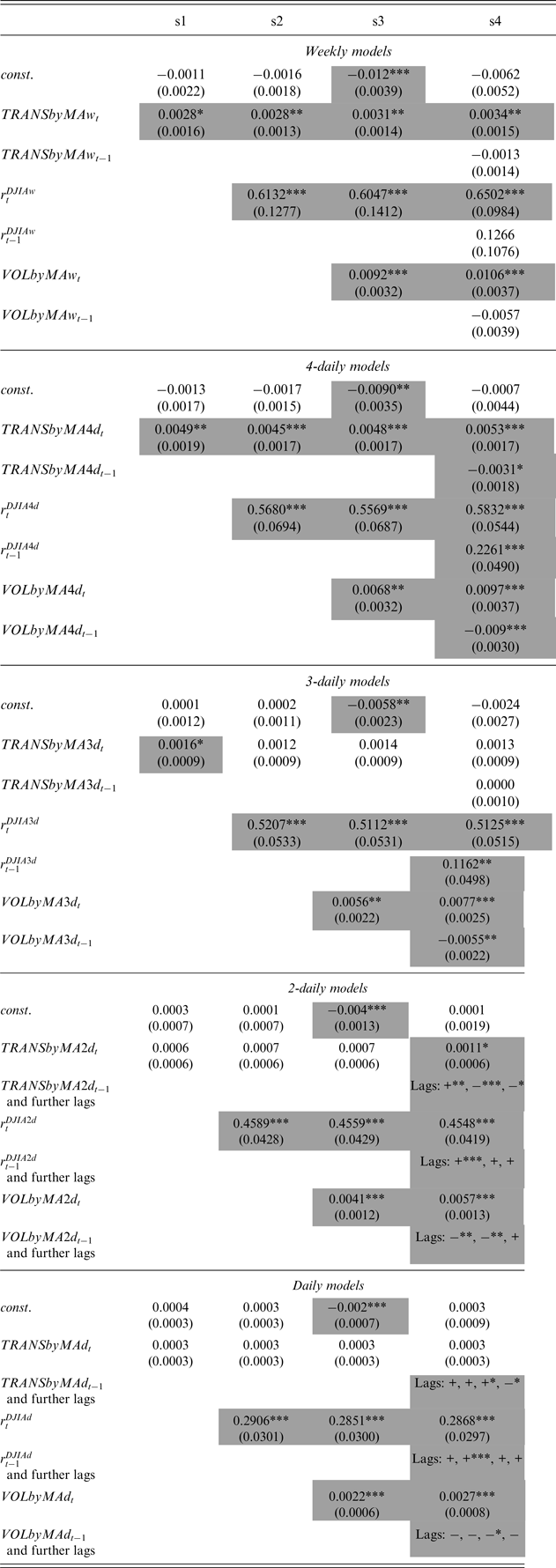
In the next step, we analyze the impact of ZUS transfers over much shorter horizons, i.e. over the weekly and daily time intervals. Table 2 presents first the estimation results for the weekly frequency models. The return from the US market ( $r_t^{DJIAw} $) is again the most significant explanatory variable in all specifications. There is also a statistically significant immediate impact of the trading volume (VOLbyMAw t) on the WIG20 returns
 $r_t^{WIG20w} $.
Estimates of parameters from the models for short-run relationships (for weekly and daily frequency of data)

Notes:
(a) Robust standard errors of parameter estimates are presented in parentheses.
(b) Highlighted cells indicate statistical significance, which is denoted as: *** significant at 0.01 level, ** significant at 0.05 level and * significant at 0.1 level.
(c) In the bottom two panels, which present estimates for daily and 2-daily models, for the parameters of lagged variables only the signs of individual parameters and their significance levels are reported and denoted with asterisks next to the sign of the respective estimate.
The most important finding in Table 2 from the point of view of the main objective of this study is the positive and statistically significant estimate of the ZUS capital transfers variable (TRANSbyMAw t) on the WIG20 returns. It means that there exists an impact of ZUS funds being injected by the OFE pension funds into the stock market. Moreover, it persists only within one week's space of time since the lagged weekly transfer variables are not statistically significant (estimates for further lags than t − 1 are not reported in Table 2 but are available upon request). We also investigated results from our models in 3-yearly sub-samples (constructed as a moving window) and found that the transfers from ZUS are positively related to WIG20 returns. It is important to emphasize that the evidence about the short-run impact of transfers on stock prices in the weekly models is robust to adding control variables, as indicated by the results in the subsequent columns in Table 2.
Given this robust finding about the impact of ZUS transfers on stock prices within the period of one week's time reported and discussed above, we further investigate shorter intervals and higher data frequencies to provide more robustness checks and to see additionally if this effect can be identified more precisely over a certain number of days within a week. We extend our analysis in order to find out how quickly (in terms of the number of days) the impact of ZUS capital injected into the stock market is materialized after the transfer of capital from ZUS to the OFE pension funds takes place and whether this effect is a gradual process (e.g. due to gradual investments of capital or possibly because investors interpret news and react to them with a lag) or rather a more rapid phenomenon. If the latter is the case, it should be possible to identify such impact on a specific day (e.g. first or second or third or fourth day etc.) after the transfer from ZUS is completed by employing lagged transfers as explanatory variables. In turn, analyzing different frequencies of data will help in identifying whether the impact is gradual in nature and if it is spread over some longer time.Footnote 10 This investigation, hence, allows to answer the question what is the degree of the delay between the transfer of capital from ZUS to the OFE private pension funds and the length of time the OFEs need, on average, to invest those funds on the stock market.
Below we discuss estimation results from models where variables are based on data using the 4-, 3-, 2- and 1-day long intervals. The parameter estimates from those models are presented in further panels in Table 2. The results from models using 4-day long intervals for the construction of all variables indicate that the impact of ZUS transfers on the stock prices is even stronger than in the weekly models – both in terms of the statistical significance (the p-values are at the 0.01 level rather than 0.05 or 0.1 levels as in case of the previous, weekly frequency, models’ estimates) and in terms of the magnitude of the estimated parameter (e.g. 0.0031 versus 0.0048 in specifications s3 and similarly so in other specifications in Table 2) which is higher by about 50% in the 4-day interval models in comparison with the weekly ones. This finding shows that the impact of ZUS transfers is stronger within 4 rather than within 5 days long (i.e. weekly) intervals and it means that the OFE pension funds usually invest the capital received from the ZUS in the periods of up to 4 days. This result is also confirmed below by estimates from higher frequency models, in particular the daily ones, with their respective lags.
The impact of ZUS capital transfer lagged by one period is significant and negative, but the cumulated impact remains positive in all cases. We additionally investigated sub-samples of 200 observations (constructed as a moving window) and found a significant positive impact of capital transfers on WIG20 during the second half of the full sample rather than during the first half of that sample. This result points to the increasing impact of trades by pension funds on stock prices, which is consistent with the increasing share of pension funds in the turnover of free floating stocks.
The estimates from models using 3-day long intervals for construction of all variables presented in Table 2 show, generally, that the impact of capital transfers is not statistically significant in most specifications. However, the estimates are mostly positive yet not as consistently so as in the previous models. Analyzing the sub-samples of 200 observations (as a moving window), we find a positive impact in most of the sub-periods with the exception only of the first 200 observations long window. We also find that this impact becomes the most significant at the end of our entire 8-year sample. Similar results are obtained from the models estimated for the 2-day long intervals. They do not allow us to identify any robust evidence on the impact of ZUS capital flows on the Polish stock market in this particular interval of time. Analyzing again the moving windows of 200 observations, we find the aggregated (instantaneous and lagged) impact of capital flows to be positive.
Finally, the last panel in Table 2, which presents estimation results from daily frequency models, provides more evidence about the length of delay between ZUS transfers and the reaction of stock prices. The estimates show that in the whole sample there is no statistically significant impact of the ZUS capital flows on day t, which is the day on which the transfers from the ZUS to the OFE pension funds take place (however, the respective parameter estimates from all model specifications are positive). Hence, the result that the ZUS transfers lose significance within the periods of time shorter than 4 days, as already observed in the models for 3- and 2-day intervals in other panels in Table 2, is confirmed also here using the daily models.
The lags in all other higher frequency models tend to confirm the above effect as well.Footnote 11 The estimates for lags in the models in full sample in the bottom panel of Table 2 in the specification s4 with all controlling variables are positive for all first three lags (t − 1, t − 2 and t − 3) and the estimate is statistically significant (at the 0.1 level) only for the lag t − 3. This means that up to the day t − 3 the impact of ZUS transfers on stock prices is positive and the strongest effect is detected for lag t − 3. However, this positive effect completely disappears already in lag t − 4, which is consistent with the findings in Table 2 presented in panels for the weekly and for the 4-day long intervals and corresponds exactly with the estimates for weekly (i.e. 5-day intervals) and 4-day interval models (c.f. the respective specifications in Table 2), where the strongest impact was observed for 4-day intervals rather than for the 5-day intervals, i.e. rather than within the entire week (this is because the lag t − 4 is the one which is included in the weekly interval but not in the 4-day interval, which covers only days t, t − 1, t − 2 and t − 3).
Moreover, this lagged effect is confirmed also by the estimates of lags in 3-day intervals (showing no statistical significance of any lags) and the 2-day interval models. The obtained estimation results provide evidence that for day t no statistically significant effect exists (only except for the specification s4, where the estimate gains significance but only at the weak p = 0.1 level); however, the lag t − 1 is significant (at the stronger p = 0.05 level) and also positive (note that the lag t − 1 in the 2-day interval models covers the lags t − 2 and t − 3 in the daily models). The estimate of the t − 2 lag is negative and significant at the p = 0.05 level (again, lag t − 2 in the 2-day interval models covers the lags t − 4 and t − 5 from the daily models), which is fully consistent with the negative and also statistically significant estimate for lag t − 4 in daily models.Footnote 12
The results discussed above, in conjunction with the findings reported already in Table 1 and previous panels in Table 2, suggest that the impact of the injection of the ZUS capital into the stock market is spread over longer time of approximately 4–5 days after the transfer from the ZUS to the OFEs takes place and it is most strongly marked within the first 4 days. In consequence, we can conclude that it is quite likely that the large institutional investors, i.e. the OFE pension funds in Poland, engage in the ‘stealth trading’ investment strategies when buying stocks.Footnote 13 Additionally, the significant influence of capital flows on stock market returns might not necessarily be solely due to the ‘price impact’ effect, but also due to the indirect effect of investors following the dates of capital injections to pension funds.Footnote 14 The findings from the short-run analysis suggest that the main effects of capital transfers from the ZUS to the OFE pension funds, and subsequently to the stock market, are most significant during the first week after the transfer takes place.
Finally, the results from the short-run analysis, using the models built for the daily frequency data, reveal an interesting finding which allows us to asses quite precisely the scale of the delay, and even estimate the average length of time, between the transfer of capital from ZUS to the OFE pension funds in Poland and its further investment in the stock market. It appears from our models that this delay is contained within the 4-day long period of time (i.e. from day t − 3 until day t, while on day t − 4 this effect already disappears), which is consistent with the ‘stealth trading’ hypothesis of stock market investors. This is a new result which sheds more light and provides more evidence about the trading habits of large institutional investors, such as large pension funds trading in a relatively small and thin market, which has not been reported in the literature before. This is also consistent with the temporary price pressure hypothesis discussed in Section 2.
4.3 Robustness analysis
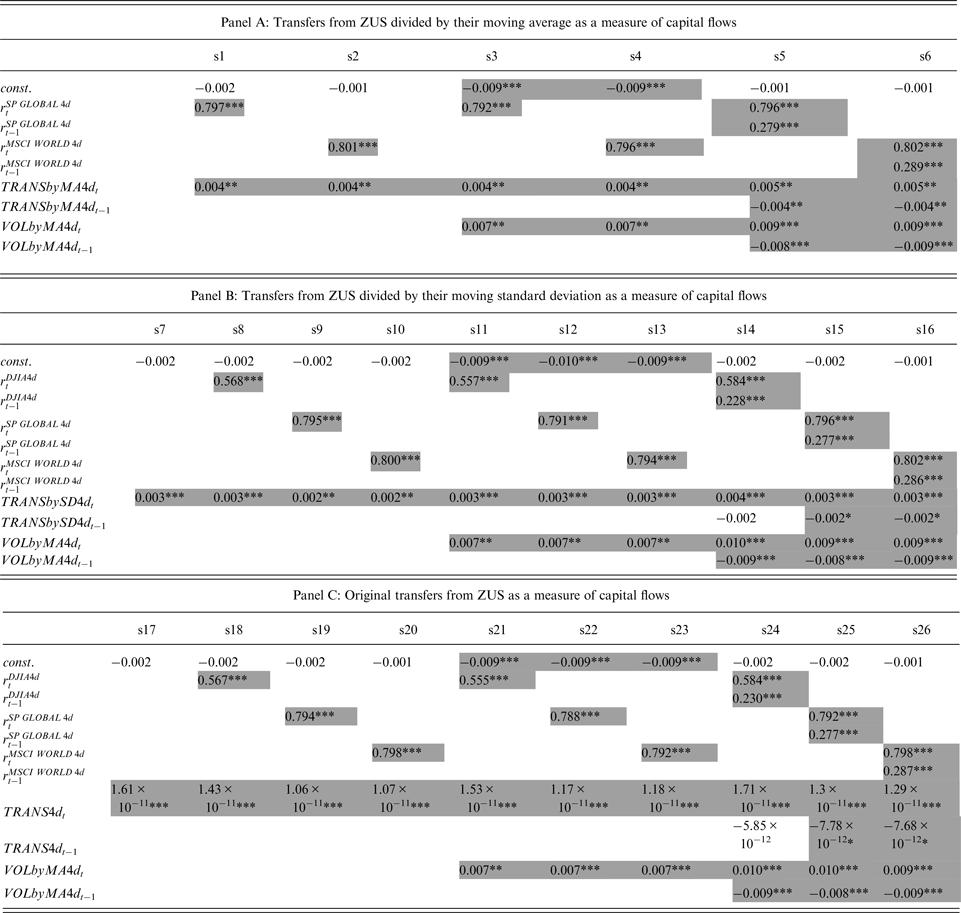
As an additional robustness analysis, we investigated two other measures of global stock market returns, namely MSCI World index returns and S&P Global index returns that contain information on more assets than the DJIA index. Since our measure of capital flows from ZUS to OFEs could be considered somewhat non-standard, we also analyzed nominal flows divided by their moving standard deviation in the past 60 days, TRANSbySD4d t, and simple nominal flows as variables explaining WIG20 returns. The first variable assures that the mean and volatility of the flows time series is constant over the sample, while the second variable contains the original trend. This analysis is based on the 4-daily data frequency, for which we had already found significant effects of capital flows on stock returns.
The results presented in Table 3 suggest that both alternative measures of global returns explain a large share of WIG20 returns. Nonetheless, the two alternative measures of capital flows remain consistently significant in our sample.
Estimates of parameters from the models for various measures of capital flows from ZUS and global returns

Notes:
Highlighted cells indicate statistical significance, which is denoted as: *** significant at 0.01 level, ** significant at 0.05 level and * significant at 0.1 level. Results are presented for 4-daily data.
In addition, we have also investigated specifications of our models which were extended to include the returns of the VIX index, i.e. the measure of global stock market volatility, as an alternative explanatory variable. We used the VIX index as a variable that captures global market uncertainty and we tested whether the estimates in our models are sensitive to it. The results from the 4-daily frequency models show that the returns of VIX index were statistically significant, which can be interpreted as a negative impact of market uncertainty on stock returns; however, from the point of view of the main subject of our research the overall picture remained broadly unaffected, i.e. the ZUS transfers still statistically significantly influence the WIG20 index returns within 4 days from the transfers.Footnote 15
Moreover, we also tested exponential generalized autoregressive conditional heteroscedasticity (EGARCH) asymmetric specification instead of simple generalized autoregressive conditional heteroscedasticity (GARCH) in our models with 4-day returns; however, the application of EGARCH models did not change the key conclusions either.Footnote 16
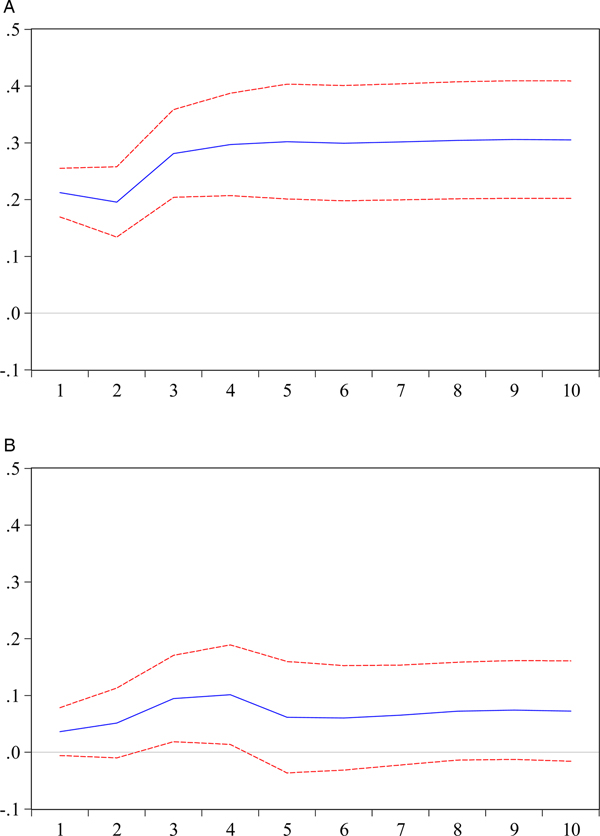
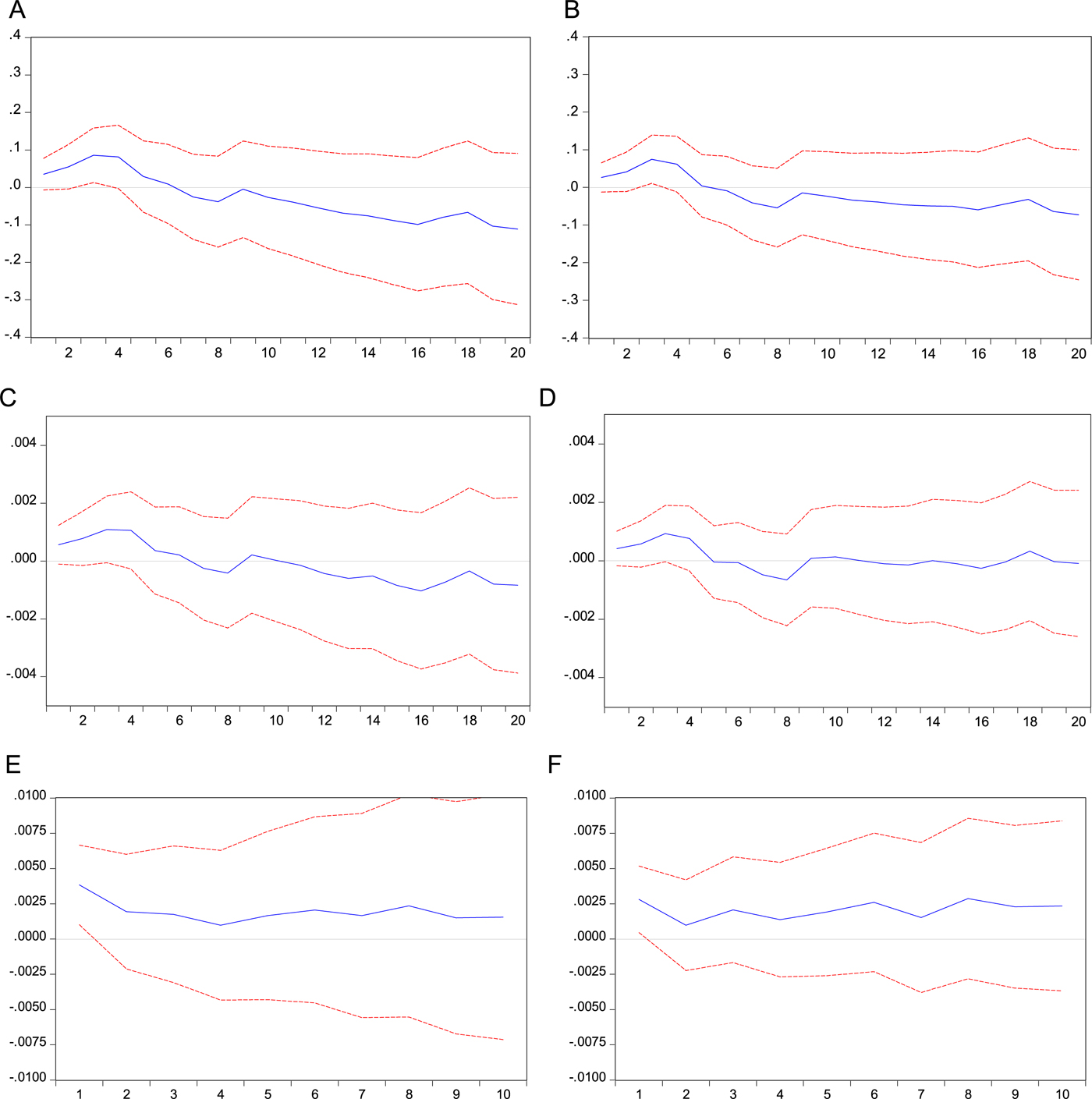
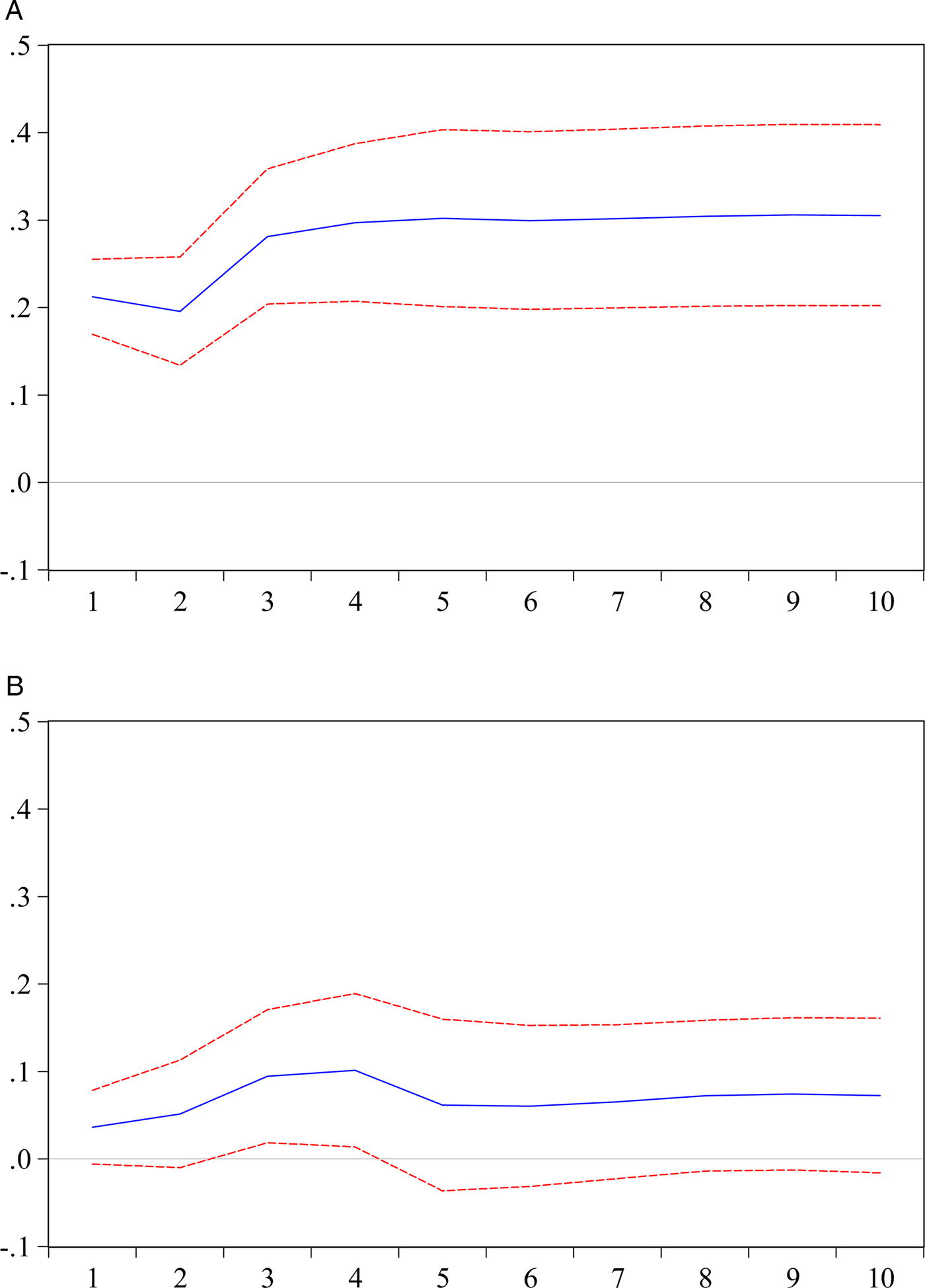
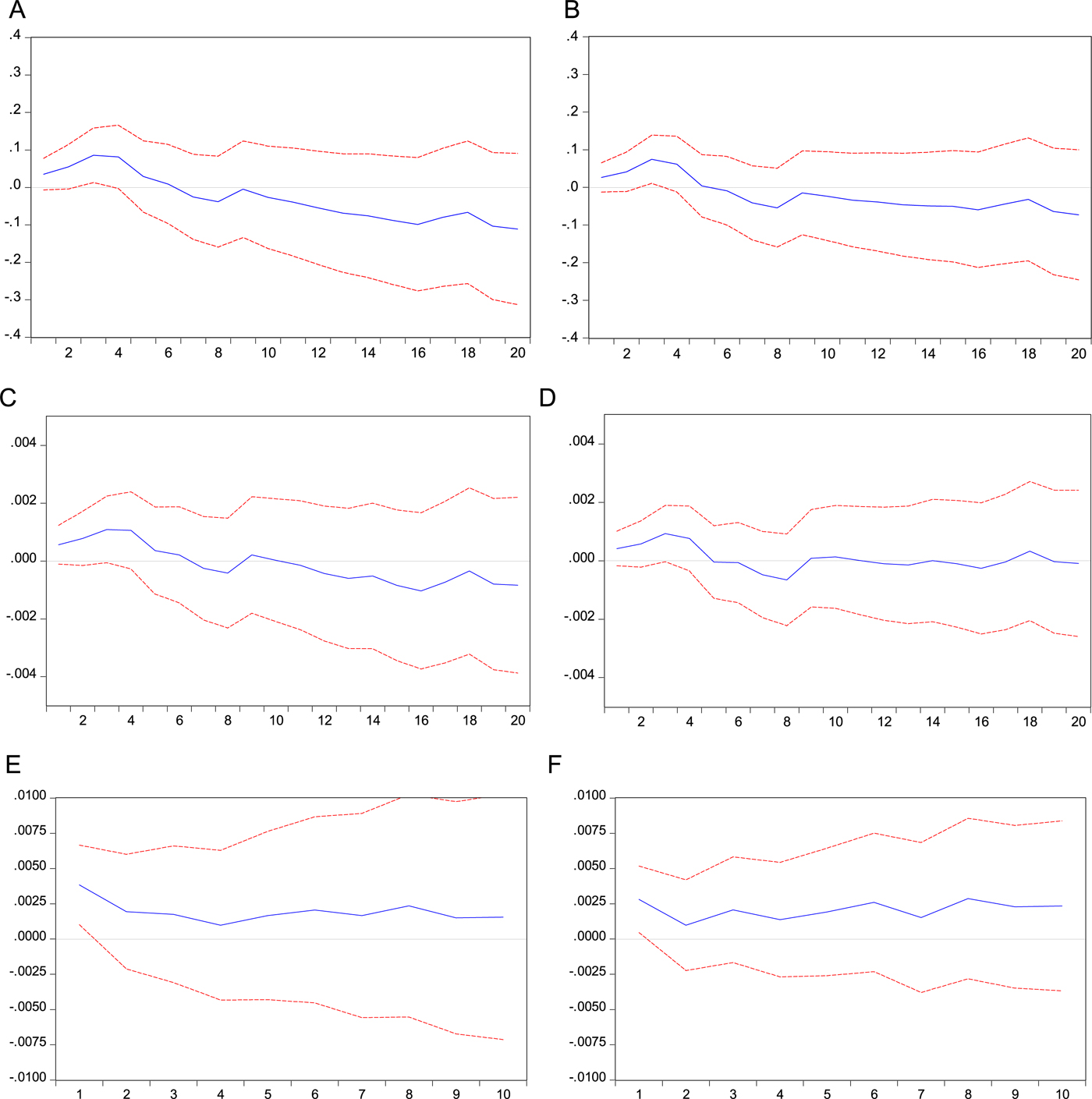
As further robustness check, we estimated the structural vector autoregression (SVAR) model with the US returns, transfers of funds from ZUS to OFEs, WIG20 returns and trading volume as endogenous variables. The results are depicted by Figure 2. This is a standard approach in the literature to analyze causal effects between capital flows and stock returns (see, e.g. Ben-Rephael et al., Reference Ben-Rephael, Kandel and Wohl2011, Reference Ben-Rephael, Kandel and Wohl2012). Again, we find a significant positive reaction of WIG20 returns to independent shocks in flows of funds to the OFE pension funds 3 and 4 days after the shock. The effect is persistent and is robust to the lag order of our SVAR model, to the inclusion of global returns as exogenous variables, and to the length of the estimation window. When we use TRANSbySD4d t instead of TRANSbyMA4d t as our measure of capital flows and when World returns are used as exogenous variables (for daily and 4-daily stock returns), the results are very similar and they all suggest that there is only a short-run effect (within 4 days) of capital flows on WIG20 returns (Figure 3).
Accumulated responses of WIG20 returns to shocks in capital inflows and to shocks in global returns. (A) Accumulated response of  $r_{}^{WIG20d} $ to one standard deviation innovation in
 $r_{}^{DJIAd} $. (B) Accumulated response of
 $r_{}^{WIG20d} $ to one standard deviation innovation in TRANSbyMAd.
Response of WIG20 returns to one standard deviation shocks in standardized capital flows from ZUS to OFEs. (A) Effects on standardized WIG20 returns (daily data). (B) Effects on standardized WIG20 returns (with World returns as exogenous variables; daily data). (C) Effects on non-standardized WIG20 returns (daily data). (D) Effects on non-standardized WIG20 returns (with World returns as exogenous variables; daily data). (E) Effects on four-daily WIG20 returns. (F) Effects on four-daily WIG20 returns (with World returns as exogenous variables).
We also used the method of Campbell et al. (Reference Campbell, Ramadorai and Schwartz2009) to analyze a possible longer term dependency between transfers from ZUS to OFEs and stock returns. This method controls for a large number of lags in a VAR model with daily flows and returns by using exponentially weighted moving averages (EWMA, with three different half-lifes of 1, 10 and 25 days, respectively) of explanatory variables in this VAR. We found no significant long-term impact of capital flows on stock returns. This outcome is also due to the fact that EWMA processes do not identify specific days or groups of days when capital flows take place but all effects are spread (averaged) over many days so they are designed to analyze longer term influences of than 1-week effects (these results are available upon request).Footnote 17
5 Counterfactual analysis and trading strategy out-of-sample
In this section, we present two different types of robustness analysis for our results obtained in the in-sample period from 1999 to 2008: (1) counterfactual analysis for the period before the pension system reform and before the entrance of the OFE pension funds in 1999 and (2) performance of a trading strategy based on the findings from the in-sample period, simulated out-of-sample in the period after 2008, i.e. from January 2009 to December 2011 (full 3 calendar years).
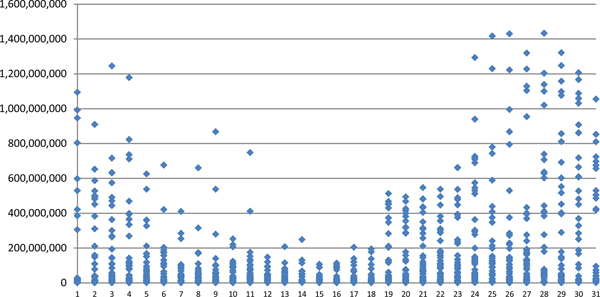
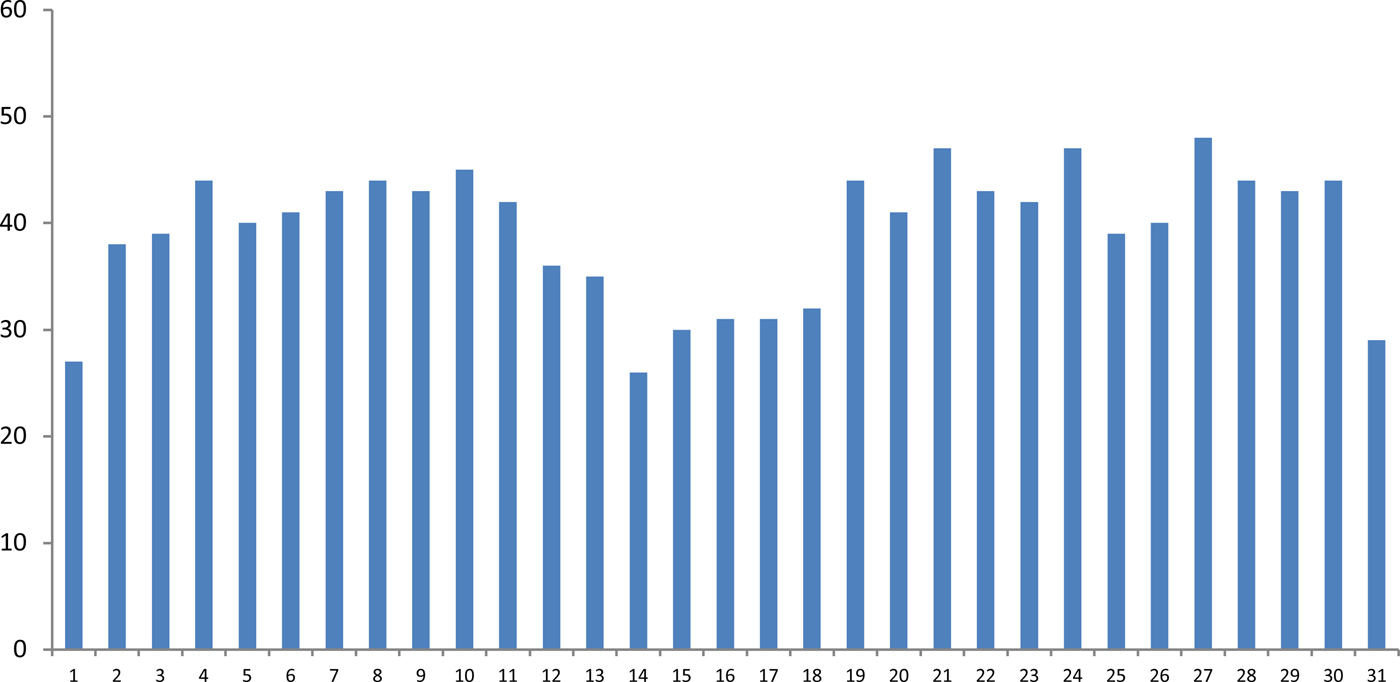
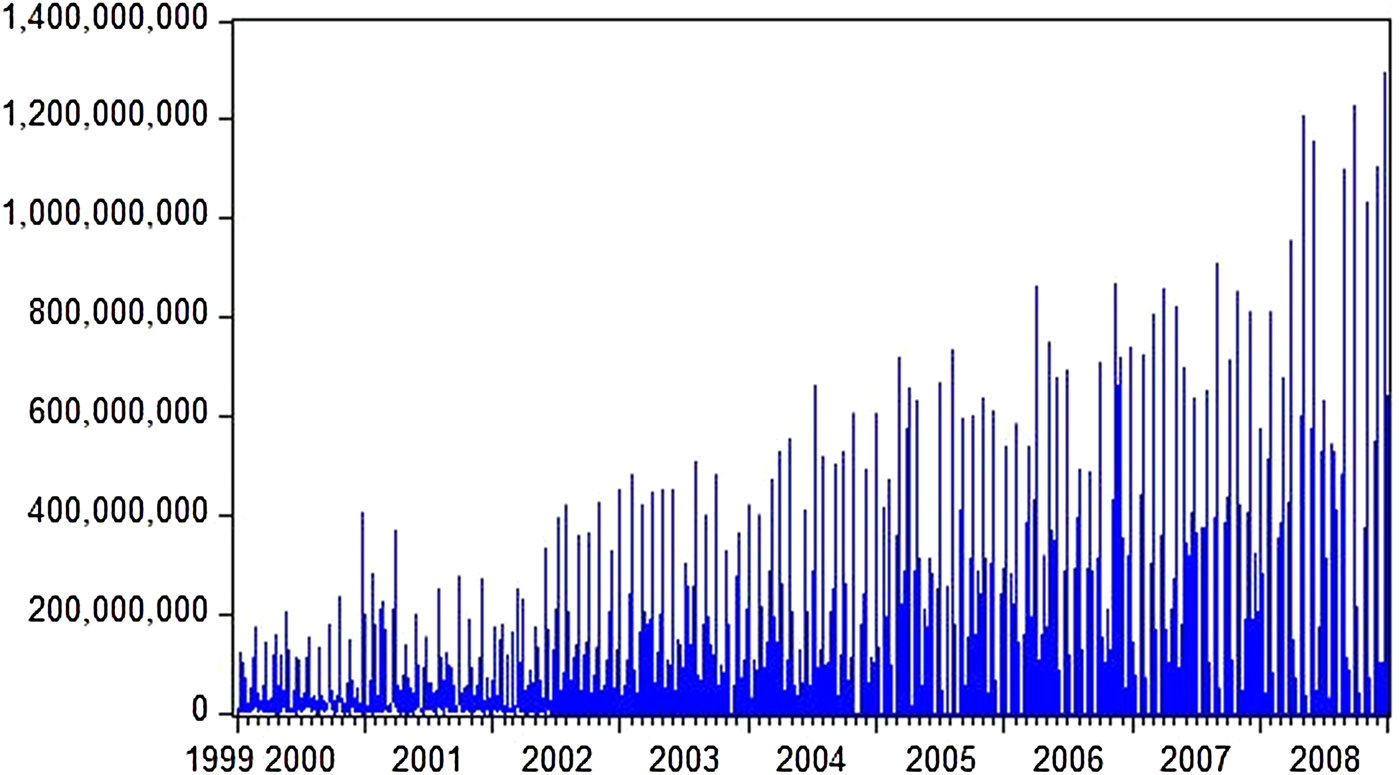
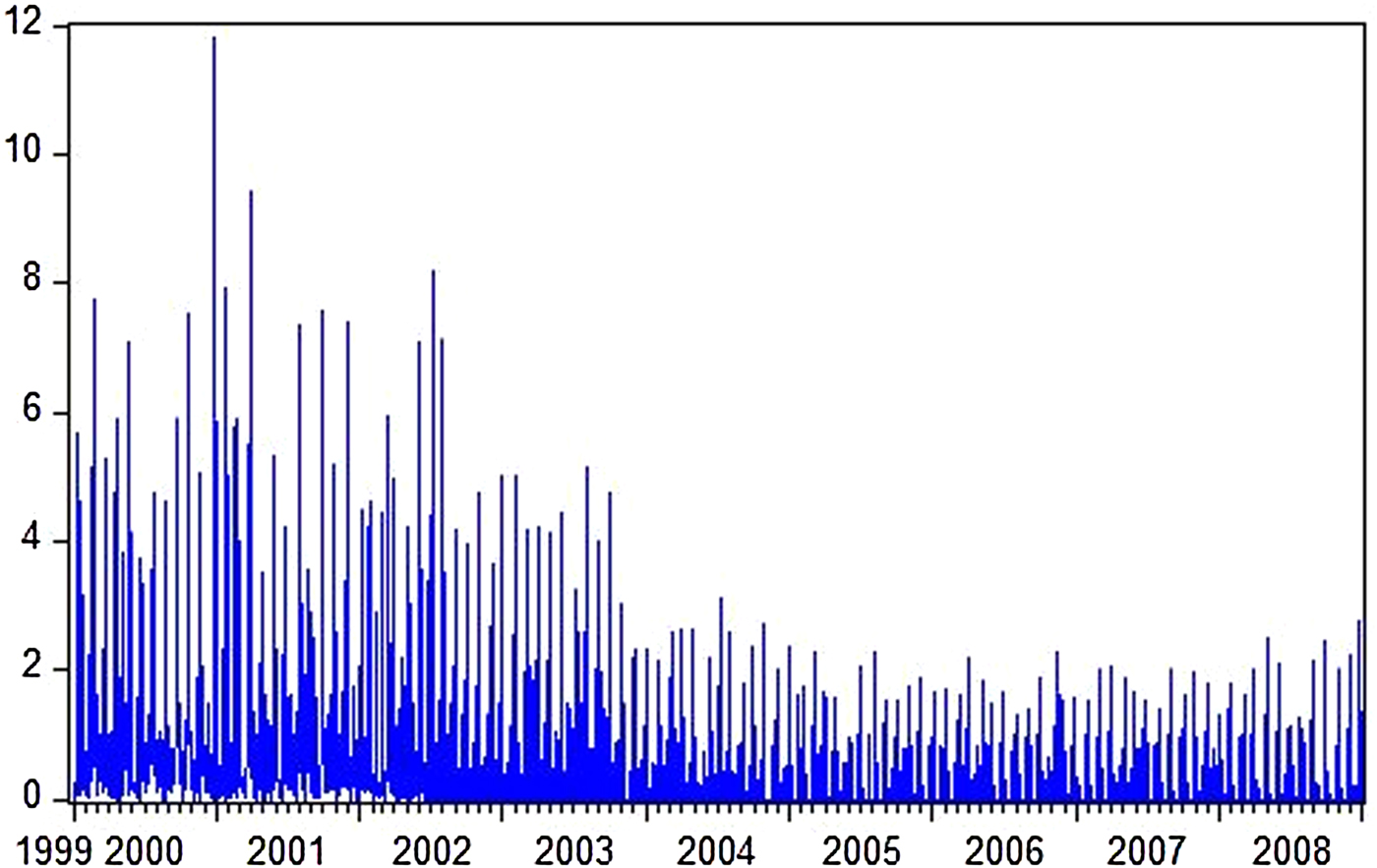
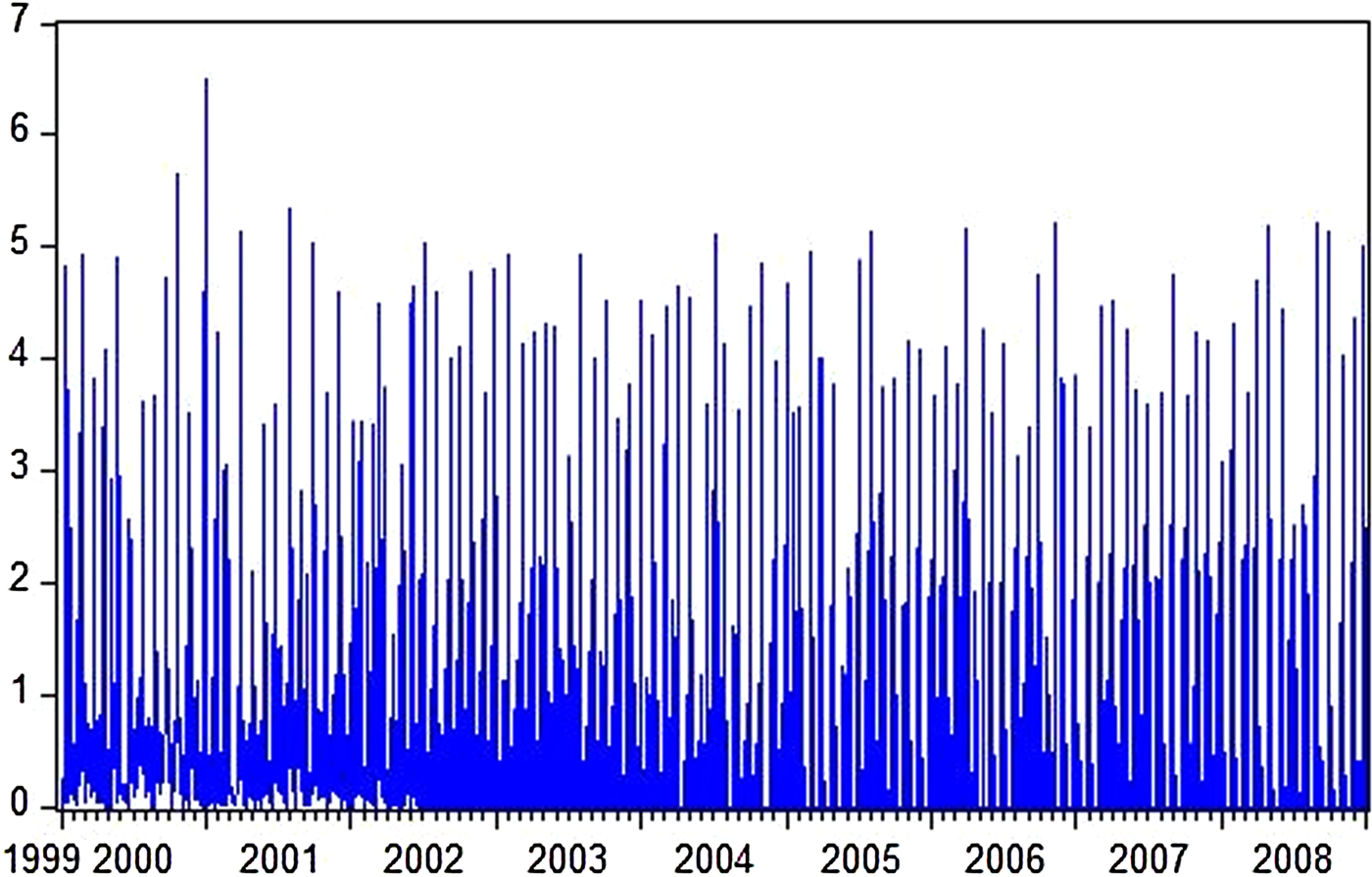
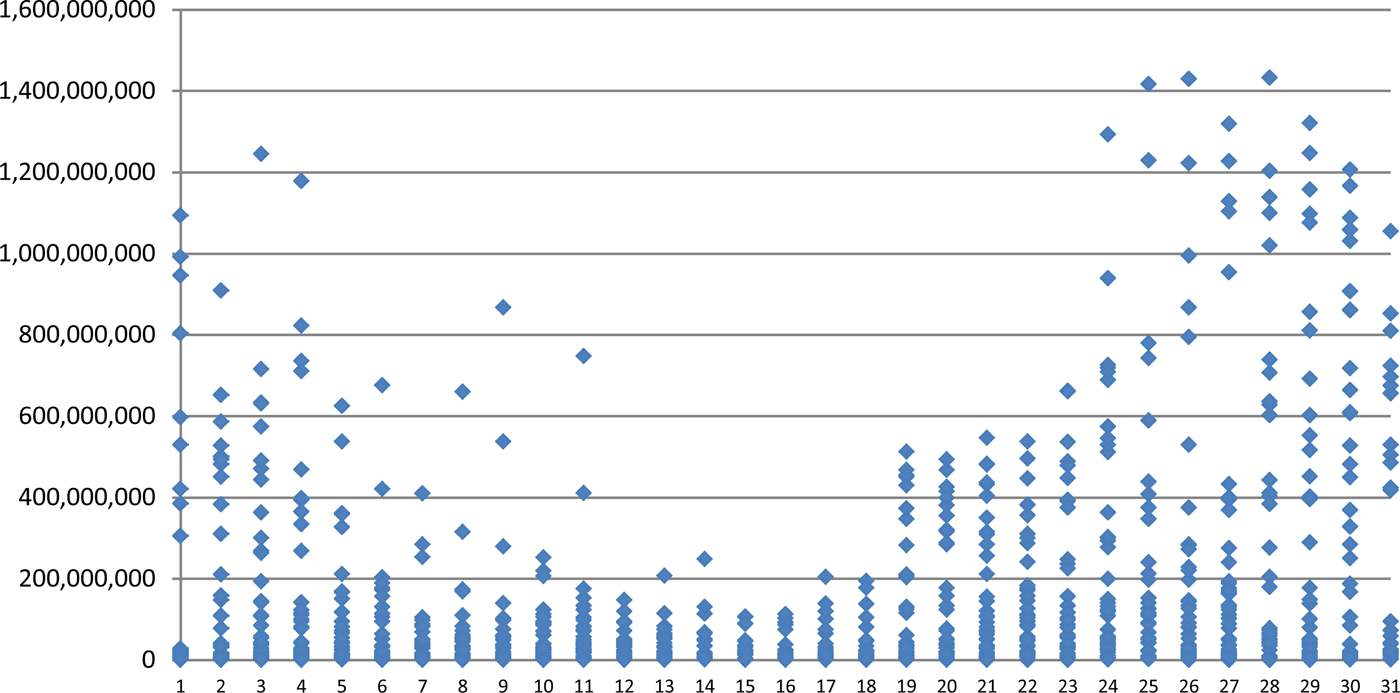
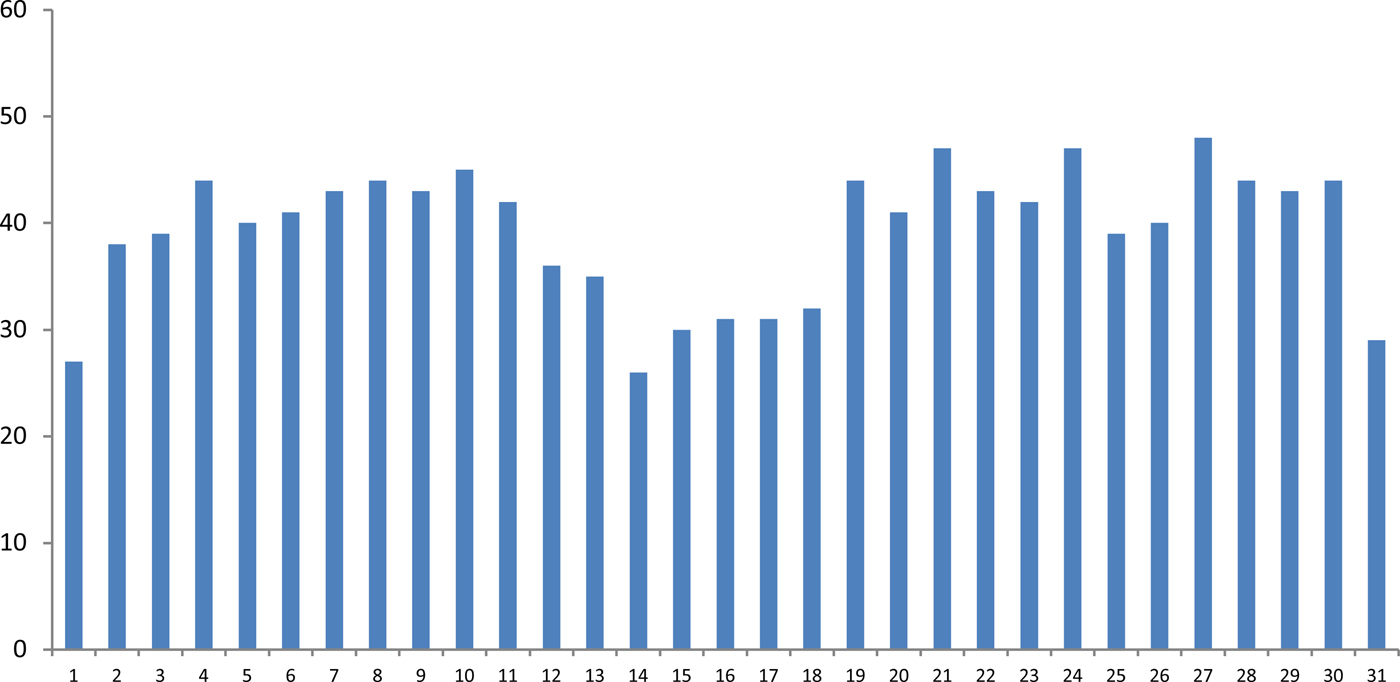
Since there are no data available about transfers from ZUS to the OFE private pension funds for the period preceding the reform, the only possibility to conduct a counterfactual analysis in the case of this study is to exploit the pattern of transfers observed in the in-sample period (after the pension system reform when ZUS started to transfer first funds) and use it for the simulation of investment results in the period before the reform. Hence, we calculated the frequency of the ZUS transfers in the period between 1999 and 2008 and noticed that the transfers after the reform were taking place mostly at the beginning and at the end of each calendar month. There were 5 days in an average month, between the 14th and the 18th day of each calendar month, when transfers were about 27% less frequent than on other days and the daily amounts transferred equaled on average only 22% of the daily amounts transferred on other days (c.f. Figures 4 and 5), meaning nearly 80% less capital being transferred by ZUS on those days.
Value of transfers of funds from the ZUS on specific days of the month between May 1999 and December 2008.
Frequency of transfers from the ZUS on specific days of the month between May 1999 and December 2008.
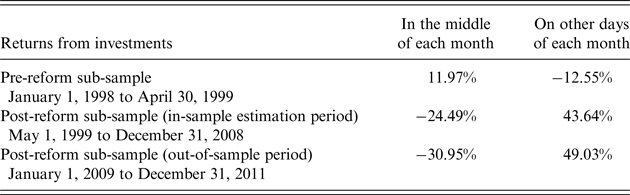
Next we compared results from investments only on the days in the middle of each month and on the other days every month. We did calculations of returns for the three sub-periods: pre-reform subsample (from January 1, 1998 to April 30, 1999), post-reform sub-sample in which we did estimations of all models (from May 1, 1999 to December 31, 2008) and out-of-sample period (from January 1, 2009 to December 31, 2011). The results are presented in Table 4. It demonstrates that the investments on the days when on average larger and more frequent transfers to OFEs took place (after the reform) resulted in positive returns, while the investments on the days with less frequent transfers were characterized by negative returns. In contrast, the investments in the middle of the month in the sample before the reform (following the ‘low-transfers strategy’) returned on average positive profits and the investments on other days (following the ‘large-transfers strategy’) led to negative returns. These findings show that the introduction of OFEs and their investments on the WSE fuelled by the funds transferred from ZUS to the OFEs could lead to the construction of simple and profitable investment strategies that were not possible to execute in the earlier period (i.e. before the pension system reform).
Results depicting investment on days in the middle of each month and on other days of each month

Finally, we checked if the results from the in-sample estimation hold out-of-sample and we investigated in more details the effects of the Polish pension reform on investment strategies in the Warsaw stock market in the out-of-sample period in years 2009–2011 (full three calendar years). The end of the out-of-sample interval was set as the end of 2011 because of the political turmoil around the ZUS and OFE pension funds in the later period, which qualitatively changed the environment within which the OFEs operated and invested their capital on the stock market (the discussion among main political parties in Poland was focused on the proposals to use the OFEs money by the government for contributions to the payment of the public debt, which was an idea that was, in turn, negatively perceived by the financial market investors). Hence, we deliberately wanted to restrict our out-of-sample period to exclude this unusual time dominated by qualitative (political) factors.
The estimation results from the in-sample period (in Tables 1–3) indicate that the stock prices react most strongly to the capital flows from ZUS to the OFEs during the first 4 days after the funds are transferred, i.e. between days t and t + 3, so we simulated an investment strategy which relies on this finding and where a hypothetical stock market investor buys the WIG20 index at the end of the day preceding the day when each transfer was made and holds the position open for the next 4 days.
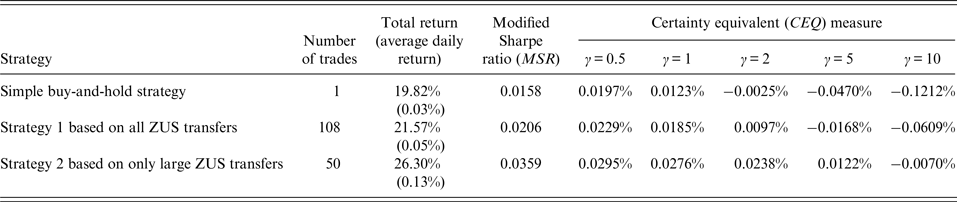
Table 5 presents results for such strategy as well as for the benchmark buy-and-hold strategy in the whole period of January 2009–December 2011. The strategy is presented in two different variants: for all ZUS transfers regardless of their size (strategy 1) and only for large transfers when a transaction is made depending on the value of the capital flows measured by the deviation from their moving average and filtered using the threshold of 1, i.e. when the transfer is larger than its moving average from the last 3 months, it is considered as large and only then the investment is made (strategy 2). Returns in strategies 1 and 2 are calculated as compounded returns after each transaction.
Results of trading strategies in the out-of-sample period (January 2009–December 2011)

Note: The values in parentheses are average daily returns in the WIG20 portfolio holding-period computed as the ratio of total return and the number of days when the investor held the WIG20 portfolio.
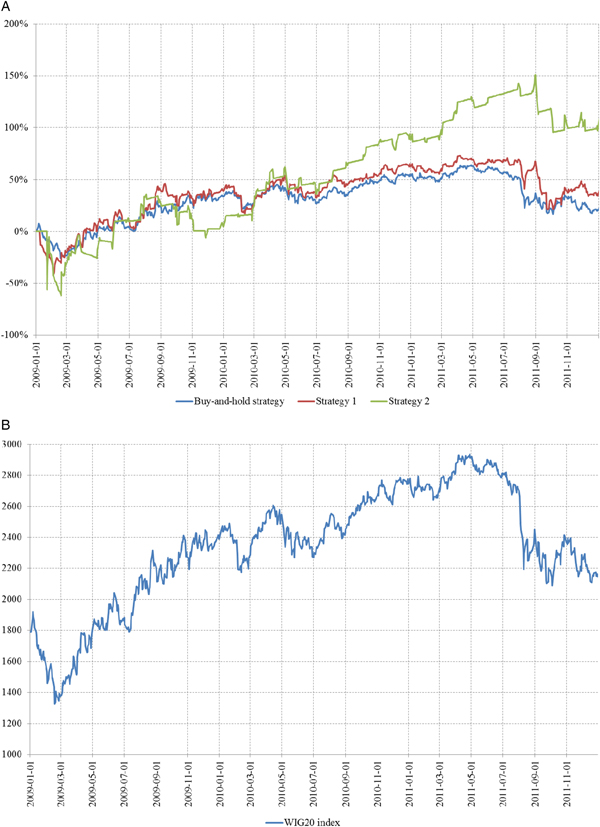
The results in Table 5 and in Figure 6 show that in the whole out-of-sample period, both strategies would have performed better than the benchmark, i.e. than a simple buy-and-hold strategy.Footnote 18 Strategy 1 based on all transfers made 21.57% profit (with 0.05% average daily return in the WIG20 portfolio holding-period computed as the ratio of total return and the number of days when the investor held the WIG20 portfolio) and strategy 2 based on only large transfers achieved even better result of 26.30% (with 0.13% average daily return), while the buy-and-hold strategy returned 19.82% in the same period of time (with 0.03% average daily return).
Cumulative returns from the three strategies adjusted for investment and non-investment days in the out-of-sample period (January 2009–December 2011). (A) Cumulative returns. (B) WIG20 Index.
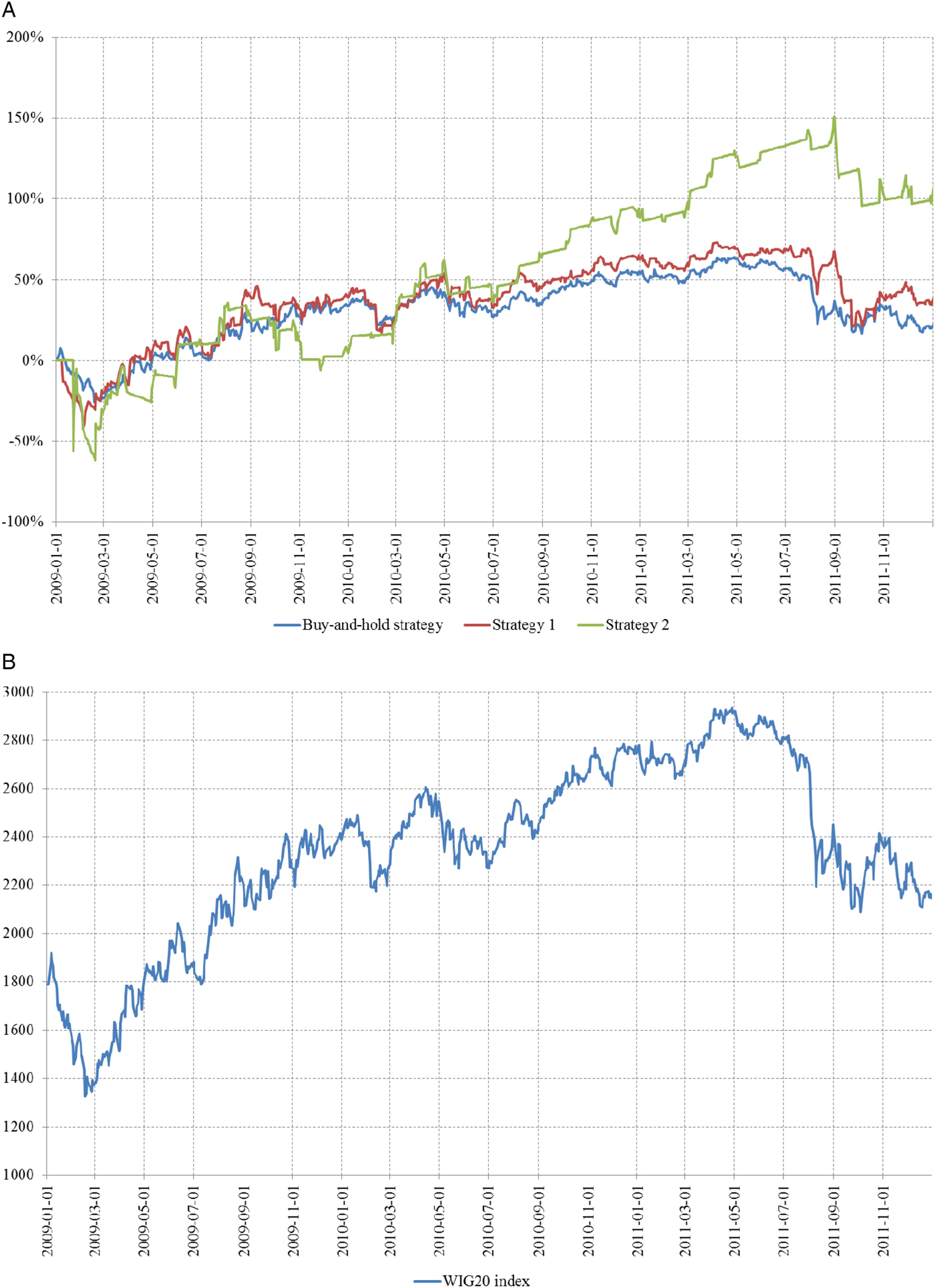
It is important to emphasize that both investment strategies have beaten the benchmark index not only from the point of view of the overall return but also in terms of the average daily returns. Strategy 1 achieved the daily average return almost twice as high as the benchmark (0.05% versus 0.03%) while strategy 2 has beaten it over fourfold (0.13% versus 0.03%). The latter result for strategy 2 relying on the information about large transfers of capital to the OFE pension funds means that it can be further extended to apply leveraged trades (e.g. using the futures contracts or other derivative instruments) by, e.g. allocating higher leverage to the individual transactions in proportion to the size of the ZUS transfer on particular days.
Moreover, the outperformance of strategies based on the information about the flows of capital from ZUS to the OFE pension funds is even clearer when the analysis is conducted on the risk-adjusted basis, which we present below.
We investigated the performance of both strategies based on the ZUS capital flows in the out-of-sample period by using the most important risk-adjusted measures, such as the modified Sharpe ratio (MSR) of Israelsen (Reference Israelsen2005) and the Certainty Equivalent (CEQ) returns (see, e.g. DeMiguel et al., Reference DeMiguel, Garlappi and Uppal2009), which we computed for strategies 1 and 2 as well as for the benchmark buy-and-hold strategy (i.e. for the WIG20 index). The Sharpe ratio measures excess return per unit of risk; however, the classical definition of the Sharpe ratio suffers from inaccuracy errors and incorrect assessment of risk when returns are negative in some sub-periods, so we calculated the MSR measure defined as:
 $$MSR{\rm} = {\rm} ER/SD^{(ER/absER)} $$
where ER is the excess return defined as mean monthly difference between the strategy (or index) return and the risk-free return computed for the number of trades in our strategies (or number of trading days for the index in the whole out-of-sample period), and SD is the corresponding sample standard deviation of the differences of returns. The risk-free rate for the Polish market which we used was the return of the 3-month Treasury Bill obtained from the National Bank of Poland. MSR is a commonly used measure to deal with the problem of negative returns and alleviates the problems with the traditional Sharpe ratio.
CEQ returns are an alternative risk-adjusted measure and they are defined as:
 $$CEQ = \hat \mu _k {\rm -} ({\gamma / {2)}}\hat \sigma _k^2 $$
where  $\hat \mu _k $ and
 $\hat \sigma _k^2 $ are the mean and variance of excess returns of the strategy or an index k and γ is the risk aversion parameter. As in the case of the MSR, the risk-free rate was the return of the 3-month Treasury Bill obtained from the National Bank of Poland. The formulation of CEQ in (2) assumes a multi-period investor with quadratic utility. The ‘normal’ level of risk aversion is γ = 1, while higher (lower) values of γ indicate higher (lower) levels of risk aversion.
Results in Table 5 show that both strategies 1 and 2 achieved better values of MSR than the passive strategy (0.0206 and 0.0359, respectively, versus 0.0158 for the simple buy-and-hold strategy) in the whole out-of-sample period. In particular, the MSR for strategy 2 based on large ZUS transfers is more than twice as high as the corresponding MSR value for the benchmark buy-and-hold investment.
The values of CEQ returns are presented also in Table 5. They have been calculated for five variants representing normal risk aversion of investors (γ = 1), lower risk aversion (γ = 0.5, i.e. half of normal risk aversion level) and higher risk aversion levels (γ = 2, i.e. double the normal risk aversion level, as well as γ = 5 and γ = 10). The CEQ measure results illustrate a similar picture as the MSR: strategies 1 and 2 have consistently higher CEQ values than the buy-and-hold strategy for all values of the γ parameter.Footnote 19
In summary, results reported in Table 5 depict a clear pattern of outperformance of investment strategies based on the information available for investors about the ZUS transfers of new capital to the OFE pension funds not only in terms of raw returns but also on the risk-adjusted basis. Since the investigated trading strategies concern short-term investments, these results corroborate our finding of significant short-term effects of ZUS transfers on stock returns and no long-term effects. They also confirm usefulness of the publicly available data about large capital flows for prediction of stock market movements, which we identified initially in the in-sample period in our study and subsequently verified in the out-of-sample experiment.
6 Policy implications
The findings, presented in this paper, have a number of different policy implications for various groups of participants of the broader financial system.Footnote 20 First, our results are directly relevant for the stock market regulators and for the stock exchange as the institution because they help to understand the occurrence of regular episodes of increased market activity that triggers stock price movements associated with the injections of pension capital. This knowledge may also help the regulators to design better investors protection mechanisms that, in turn, should lead to the increase of investors’ confidence and elevate the attractiveness of the stock market within the economy (from both domestic and international perspectives). Second, the ZUS pension institute obtains important information about how (and when) the capital, which it transfers further to private pension funds, is utilized. Third, stock market investors may benefit from better awareness of key forces that cause stock price movements and, hence, they can be better prepared and be more effective in construction and execution of their investment strategies by better understanding price pressure effects.
Last but not least, our findings can be useful for a national pension regulator and other government institutions supervising the financial system. In this case, they may benefit from the knowledge about the nature of the price pressure effect on the stock market that is caused by the capital injected into stock market by the national pension system (through the transactions executed by the OFE private pension funds). Our methodology also allows to capture very precisely the length of the time horizon between pension capital transfers and their subsequent re-investment on the stock market (in case of Poland, it appears to be very short: on average only 4 days), which makes such evaluation very practical.
If the price pressure is temporarily too high, and the ZUS transfers (periodically) affect the movements of stock prices at the stock market, then this creates opportunities for speculation and may encourage hazardous behavior of some investors. Since speculation and manipulation of stock prices are not desirable, if such effects are persistent and if they cause distortions of stock prices on regular basis, this knowledge should serve as a signal for a national pension regulator that can be very useful in diagnostic processes focused on the impact of the flows of capital, collected as pensions contributions within the entire economy, on the stock market.
The knowledge about the nature of price pressures on the stock market associated with pension capital transfers may further prompt the national pension regulator to improve its policies and enhance its decision-making processes (Koh et al., Reference Koh, Mitchell, Tanuwidjaja and Fong2008; Ammann and Zingg, Reference Ammann and Zingg2010). For example, if the influence of pension capital on the stock market is deemed harmful (due to causing or even encouraging stock market speculation or because of the stock price manipulation), the regulator may choose to adjust the mechanism governing the capital transfers in order to limit their negative impact on the stock market and, hence, to improve attractiveness of investments on the stock market. The regulator may possibly also change the percentage share of this capital that can be invested in stocks (e.g. by recommending that a larger part of the pension funds portfolios should be invested in bonds or other less risky fixed income securities than in stocks).
It is important to add also here that the models which we propose in this paper, and the results which they can deliver using the empirical data, are universal and this methodology may be helpful in decision-making processes at other government institutions which supervise national pension systems in other countries than Poland (whenever similar data are available and can be applied within the framework of this type of methodology).
The implications discussed above may naturally differ for regulators in small and large economies, which always will depend on the particular structure of the national pension systems and the channels through which pension capital is invested on these countries’ stock markets. However, it is likely that price pressure effects due to such capital transfers will be more visible, and may cause more problems for the regulators on the smaller markets in the relatively small countries, although it does not necessarily always have to be the case (see, e.g. evidence in papers by Domowitz et al., Reference Domowitz, Glen and Madhavan2001; Chiyachantana et al., Reference Chiyachantana, Jain, Jiang and Wood2004).
Finally, our methodology and our empirical findings may have important implications for the development of theoretical models in finance and economics, which take into account the role of institutional investors and the capital flows which they generate.
7 Conclusions
Using a unique database about transfers of large amounts of capital from the public social security institute ZUS in Poland to the private pension funds OFEs, which further invest it on the stock market, we investigated the impact of large institutional investors on stock prices. Our findings indicate that in the longer horizon, for quarterly and monthly data, the global factor in the form of the returns of the DJIA index returns dominates over local capital flows from the ZUS and explains better the returns of the WIG20 index than the ZUS transfers. This result suggests that capital flows to pension funds have a negligible long-run impact on stock prices. Therefore, based on this empirical evidence, the hypothesis of information-based trades of pension funds cannot be confirmed in our study.
However, in short horizon, for the weekly and daily data, we found robust evidence that the transfers of capital from ZUS to private pension funds are related to the subsequent changes of the WIG20 index. From the market microstructure perspective, this result may be explained by the price impact of capital flows to the stock market and the effect of other investors following these trades (i.e. supporting the temporary price pressure hypothesis).
We also present unique results about the exact length of time between the ZUS transfers of capital and its subsequent investment by the OFEs private pension funds on the stock market, which sheds light on the nature of trading of those large institutional investors. We find that the OFE pension funds investments affect stock prices only during the first week after the transfers of capital from ZUS, but not immediately after these transfers have been made. The stock returns reaction is strongest within the first 4 days after the ZUS transfers took place, which can be interpreted as the amount of time required by the OFEs to invest the capital, which they receive from ZUS, on the stock market. This result is consistent with the ‘stealth trading’ hypothesis but the identified delay effect is contained within a relatively small number of days.
Our findings provide new evidence about the impact of pension funds as a group of large institutional investors on stock returns on a relatively thinly traded market and may have direct and practical implications for the investment strategies of other stock market participants. They also provide useful knowledge for financial markets regulators whose aim is to supervise stock markets and understand the nature of impact of trading by large institutional investors on stock prices and on market volatility.
Last but not least, the results presented in this study may be helpful for national pension regulators in Poland and in other (both small and large) countries by guiding them in the design of better investor protection mechanisms, which should lead to the increase of financial market investors’ confidence and in enhancement of their broader decision-making processes.
Appendix
Daily capital flows from ZUS to pension funds in the estimation sample.
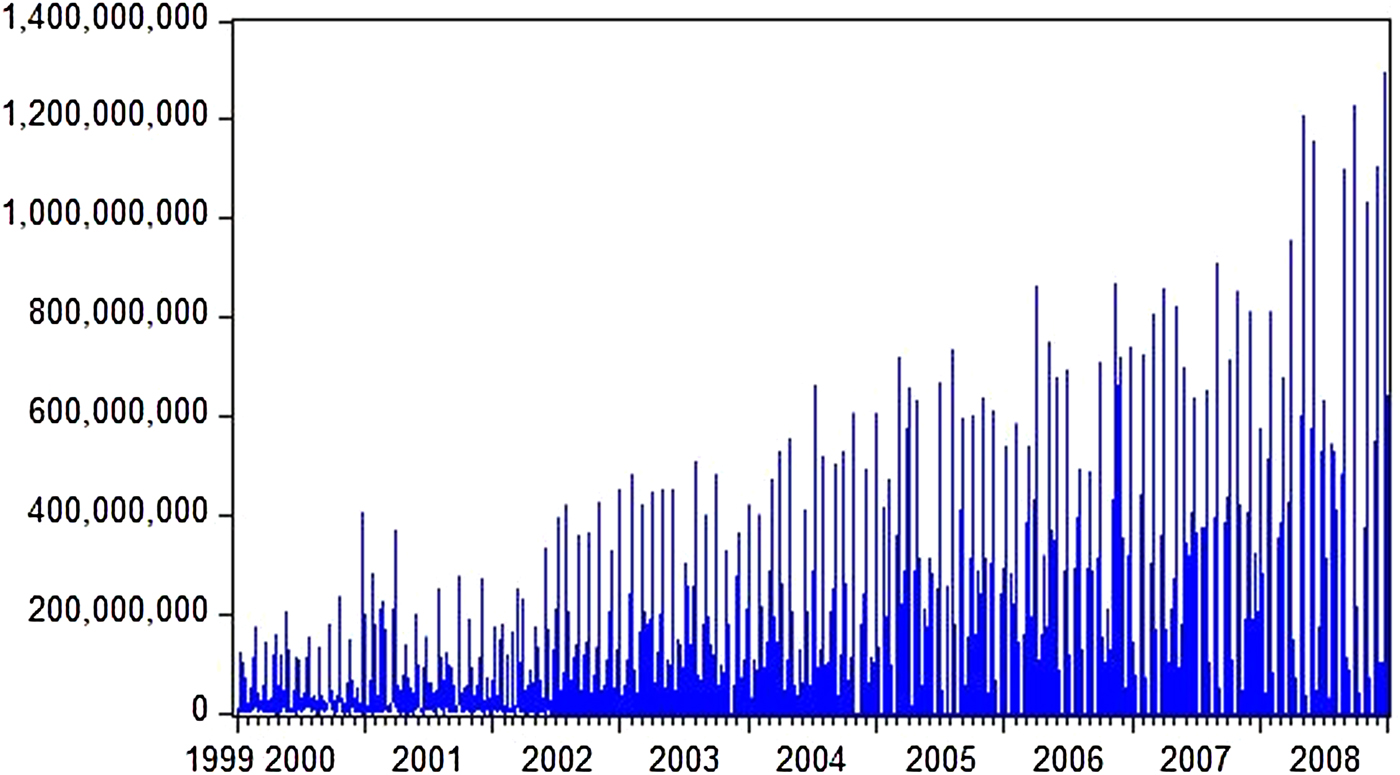
Trends of capital flows from ZUS to pension funds.
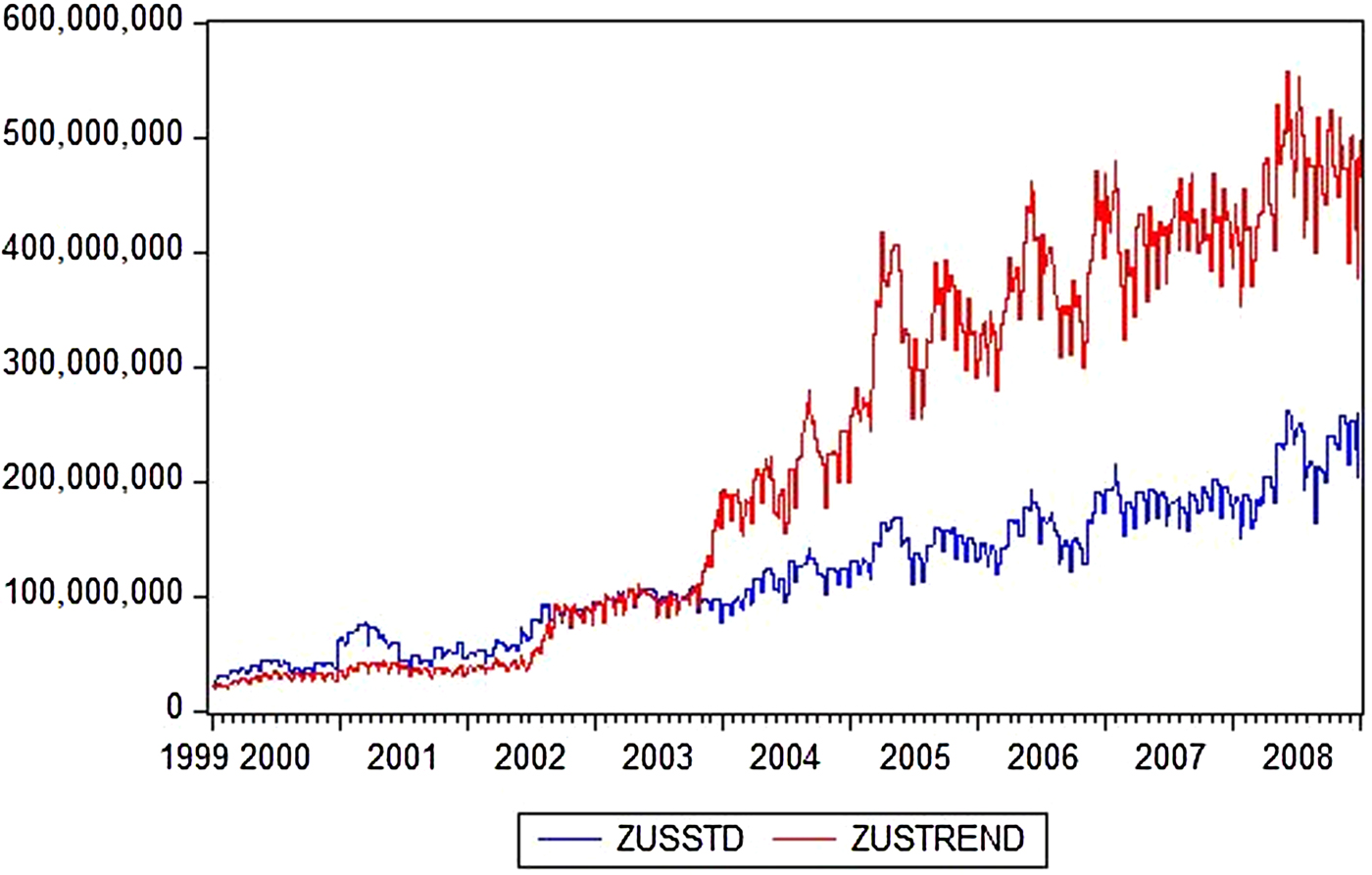
Capital flows from ZUS to pension funds detrended with the moving average function.
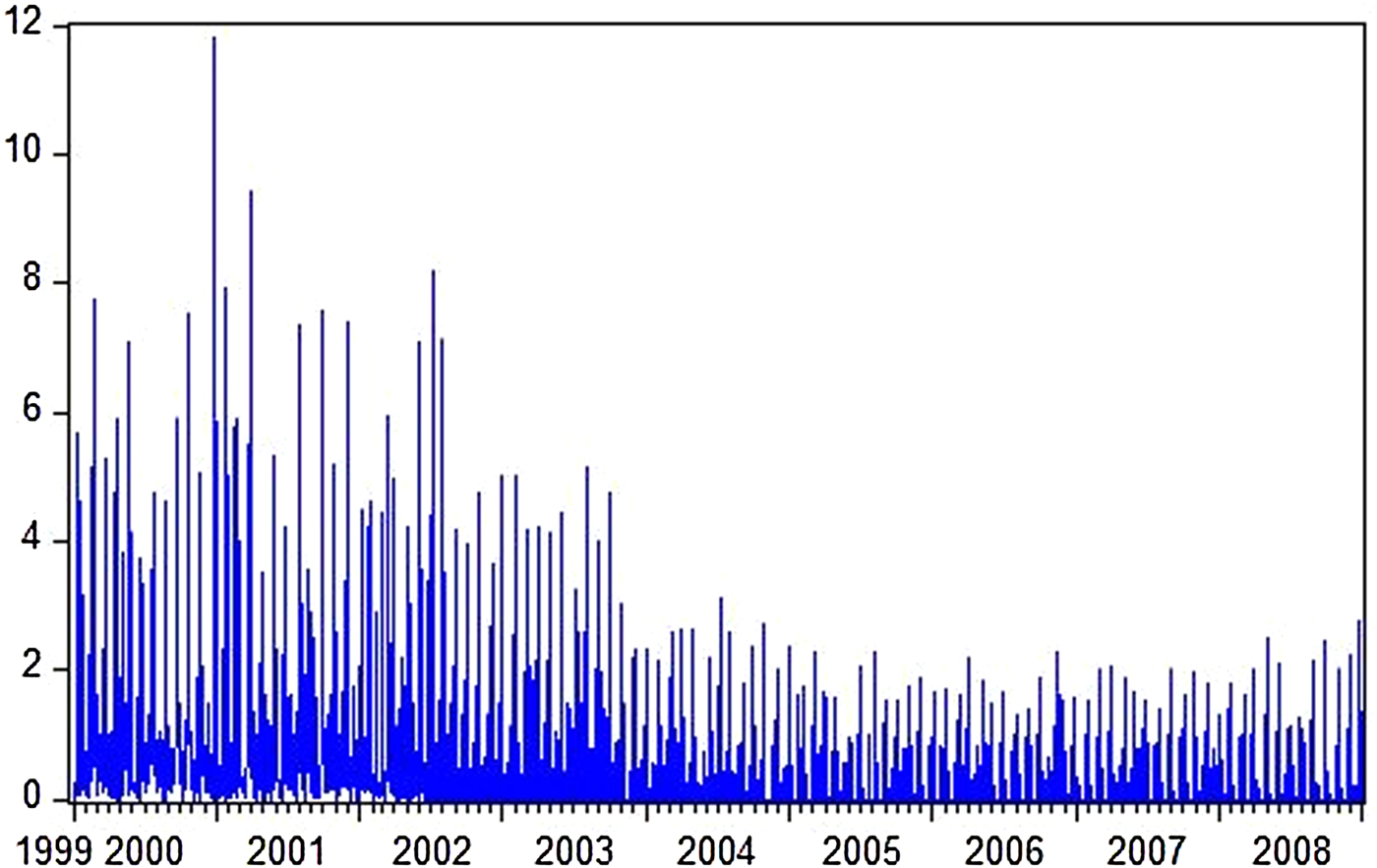
Capital flows from ZUS to pension funds detrended with the moving standard deviation function.