Introduction
Political parties are important actors in the democratic process. However, party politics research has been observing their declining importance in citizens’ minds across western democracies, most noticeably in declining party membership rates and general disenchantment (for instance Dalton and Weldon, Reference Dalton and Weldon2005; van Biezen et al., Reference van Biezen, Mair and Poguntke2012). The research findings prompt the question whether or not parties are even necessary or beneficial to a system of representative democracy. This would be a discussion for normative democratic theory to provide. However, as Elmer Schattschneider (Reference Schattschneider1942: 16) already observed, parties are the ‘orphans of political philosophy’, a situation that has only changed recently (see Muirhead, Reference Muirhead2006, Reference Muirhead2010; Goodin, Reference Goodin2008; Rosenblum, Reference Rosenblum2008, Reference Rosenblum2014; van Biezen and Saward, Reference van Biezen and Saward2008; White and Ypi, Reference White and Ypi2010, Reference White and Ypi2011; Bawn et al., Reference Bawn, Cohen, Masket, Noel and Zaller2012; Bader, Reference Bader2014). Classic and contemporary theories of representative democracy specifically, however, minimally incorporate accounts of party benefit. This article attempts to reconcile theories of representative democracy with party politics by integrating the literatures of normative political theory and positivist electoral behaviour.
My arguments evaluate party democracy’s value in comparison with its next best theoretical alternative – pluralist democracy with individual representatives – along two paths. The paths depart from two different starting points that are both important for today’s understanding of representative democracy: representation from below and representation from above (Esaiasson and Holmberg, Reference Esaiasson and Holmberg1996; Andeweg and Thomassen, Reference Andeweg and Thomassen2005). Both views are crucial for a complete account of the value of parties for representative democracy.
The first path argues that representative democracy comprises the principles of authorization and accountability, which form its core features. Only if a political agent fulfils both aspects will the representative process serve its purpose and be satisfactory to citizens. Compared with parties, individual representatives in pluralist democracy, however, only fulfil these aspects concurrently under certain conditions. Therefore, political parties are able to succeed in more instances than individual representatives.
In a second line of reasoning, I evaluate parties against individual representatives in a framework of representation from above. I extend my argument to the specific functions that parties perform because they are considered beneficial for representative democracy. I argue that individual representatives, as compared with parties, are not equally capable of fulfilling these functions. They lack the ability to provide a long-term vision that puts individual policies into a coherent framework. Overall, this article argues that parties are not necessary for representative democracy in the sense that plants need water to grow. However, it is implausible that representative democracy could be successful without parties.
The next section shows that existing accounts of party benefit do not consider theories of representative democracy, and whenever theories of representation are a subject of normative analysis justifications for parties are missing. The section argues for a core meaning of representative democracy – authorization and accountability through means of elections. One way to reconcile both literatures is to measure the value of political parties to representative democracy against this core. The third section pictures a system of representative democracy without parties in a short thought-experiment. It sketches the representative process with party democracy’s strongest competitor, democracy with individual representatives (pluralist democracy), and evaluates its implications. I then show that groups of representatives, in comparison, perform slightly better when measured against the core meaning of representative democracy. The second line of argument starts in the fifth section, in which the core functions that parties fulfil are elaborated on, before showing that individual representatives cannot fulfil them satisfactorily. The final section summarizes the argument and reflects briefly on its implications.
Justifications for political parties and theories of representative democracy
Parties have become a reality to almost any representative democracy (for exceptions see Anckar and Anckar, Reference Anckar and Anckar2000), and empirical theorists acknowledge the importance of parties for the democratic process. More so, representative democracy is conceptualized empirically through political parties (Saward, Reference Saward2008; Wessels, Reference Wessels2011). However, contemporary normative theorists of representation merely follow the tradition of their classic counterparts, like John Stuart Mill (Reference Mill1869) or Hanna Pitkin (Reference Pitkin1967), in remaining largely silent on whether or not representatives should be acting by themselves or in groups.Footnote 1 Theoretical and empirical models of representative democracy consider parties as the main actor establishing and maintaining the representative link, but normative justifications for this conception, derived from theories of representation, are missing.
The existing literature either tends to ignore representation theories for defending political parties or it takes parties for granted when using these theories to argue for party benefit. Defined as ‘voluntary organizations that channel citizens’ demands into the public political realm in order to influence the political agenda, place candidates in elections and often (but not always) aim to obtain control of government’ (Bonotti, Reference Bonotti2011: 19), it is believed that parties emerge naturally out of a need to reduce transaction costs and to solve collective action problems (Müller, Reference Müller2000). Although parties may occur in any case and their contributions to the democratic process are known, it does not mean parties are beyond normative scrutiny in a system of representative democracy.
Accounts derived from moral and legal philosophy examine party contribution to social peace, the common good, and democratic self-regulation, but they neglect theories of representative democracy (for an overview, see Bader and Bonotti, Reference Bader and Bonotti2014). Nancy Rosenblum, for example, argues that parties organize conflict, control each other, and legitimize government when in opposition. They do not only govern for their own sake but also for the benefit of citizens and the state too. Parties are partial and their discourse and conflict produce political outcomes that are more in line with public interests (Rosenblum, Reference Rosenblum2008: 120–143, Reference Rosenblum2014: 273). In addition, partisanship has been found to contribute to democratic legitimacy (Muirhead, Reference Muirhead2006: 719). Partisans offer justifications for political actions and provide the rationale and the underlying motivation for political outcomes. They glue individual political outcomes to a coherent, comprehensive, and inclusive outlet of collective self-government (Goodin, Reference Goodin2008: 211; Rosenblum, Reference Rosenblum2014: 279). Moreover, political parties outperform other political agents in fostering civic engagement because they can provide citizens with a goal, the sense of being affected by the goal, and the convictions that change is feasible (White and Ypi, Reference White and Ypi2010).
Despite the plurality of angles of these existing appreciations of political parties, theories of representative democracy are not part of them. In fact, Rosenblum (Reference Rosenblum2008: 13) explicitly discards any of the principles commonly associated with representative democracy because they illustrate ‘orthodox standards’.
In contrast, Veit Bader (Reference Bader2014) considers representative democracy in his argument for party benefit. His discussion shows that parties are not outdated and that emerging political organizations complement political parties. Other political organizations relieve parties of their burden (Bader, Reference Bader2014: 361–368). Political organizations may challenge or compete with parties on aspects of interest aggregation (Webb, Reference Webb2002), but I agree with Bader that they are generally compatible. Informal political organizations do not necessarily impede the role or value of formal political organizations, such as parties. However, Bader (Reference Bader2014: 361) follows other positivist political theorists in taking the existence of parties as such for granted by asserting that ‘political parties are irreplaceable in any version of [representative democracy]’.
This is symbolic for the position commonly taken by positivist political theory. The existence of parties has been taken for granted ever since the emergence of the mass party model and works by theorists such as Joseph Schumpeter (Reference Schumpeter1943) and Schattschneider (Reference Schattschneider1942). Both scholars are renowned for their reconciliation of political theory and party politics. Specifically, Schattschneider was a strong proponent of party government, a normative ideal of political parties and democracy that began to flourish with the responsible party model (RPM) (Mair, Reference Mair2008). Party democracy (or party government) and the RPM both mark the same partisan variant of representative democracy that sets conditions for making electoral choices effective and holding parties accountable. As such, the models acknowledge the parties’ key position in the system of representative democracy, yet each of the models also takes the parties’ very existence for granted. This exemplifies that models and ideals, developed by representation theorists, include a partisan bias and tend to assume the existence and possibly even the endurance of parties.
Theories of representation concern, amongst others, who is involved in the representative relationship. This is where a normative argument for parties and their benefit would naturally find its place but has not yet done so. Recent revisions of theories of representative democracy, instead, extend the circle of possible representative agents and stress the potential importance of unelected, symbolic, or non-territorial agents in new forms of political representation (see Birch, Reference Birch2001; Saward, Reference Saward2011). Justifications for established and formal political organizations such as parties are missing in this discussion.
Pitkin (Reference Pitkin1967: 209) famously stated that political representation ‘means acting in the interest of the represented, in a manner responsive to them’. She identified three core features of representation: authorization, promotion of interests, and accountability (Pitkin, Reference Pitkin1967; Urbinati and Warren, Reference Urbinati and Warren2008). Authorization refers to the selection of a representative to act on someone’s behalf. Pitkin (Reference Pitkin1967: 40) stresses the importance of authorization for representation when she argues: ‘True representation exists only where certain select members have authority to act for the group, but other members do not’. The act of authorization puts the representative and the represented in a relationship with one another. The representative acts in a way to promote the interests of the represented.Footnote 2 The independence-mandate controversy summarizes research on what precisely the promotion of interests is meant to include (see Dovi, Reference Dovi2008). Accountability, finally, pertains to the idea that the representative is held to account by the represented and will eventually need to answer to the represented ‘for what he does’ (Pitkin, Reference Pitkin1967: 55). These core features of Pitkin’s account embody the formalistic view of political representation.
Democratic theorists hold that elections are the tools to make political representation democratic (Manin, Reference Manin1997; Przeworski et al., Reference Przeworski, Stokes and Manin1999; Powell, Reference Powell2000). Free and fair elections under universal suffrage are the means to authorize representatives and to hold them accountable (Manin et al., Reference Manin, Przeworski and Stokes1999; Gastil, Reference Gastil2000; Urbinati, Reference Urbinati2005). Although most recent research on representation is concerned with theorizing and studying the representative relationship between elections (see Esaiasson and Narud, Reference Esaiasson and Narud2013), authorization and accountability through elections remain the pillars of representative democracy. Therefore, representative democracy’s key features can be summarized as authorization and accountability through means of regular elections.Footnote 3
This is the core of representative democracy, and any normative argument in favour of political parties, which departs from the idea of representation from below, needs to start here. It emphasizes the citizens’ role in the representative process. Parties can possibly fulfil further requirements set by the RPM or by party democracy if, and only if, they comply with this core meaning of representative democracy.
A normative justification of political parties in terms of their democratic credentials and not only according to their all-things-considered moral credentials, as exemplified through previous research, has become even more necessary with the reported decline of party importance in citizens’ minds (see, for instance Schmitt and Holmberg, Reference Schmitt and Holmberg1995; Dalton et al., Reference Dalton, Farrell and McAllister2011). In light of these empirical observations, positivist theorists of electoral behaviour stress the prominent position of parties in the democratic process and maintain that ‘political parties are as attractive as the alternatives permit’ (Strøm, Reference Strøm2000: 183). Thus, a normative justification for the parties’ role needs to show that their centrality is justifiable against the party democracy’s best alternative. This requires arguing that parties are better at fulfilling the core meaning of representative democracy than their strongest competitor.
Representative democracy without political parties
Provided that representative democracy as the overarching form of governing modern democracies prevails, not all possible alternatives to party democracy are equally likely to occur. Richard Katz (Reference Katz1987) suggests, generally, three likely alternatives to party democracy. First, referendum democracy in which citizens vote directly on policy proposals; second, a corporatist system characterized by direct negotiations between affected groups, policy-makers, and the government; and third, pluralist democracy in which mostly individuals, and not groups of representatives, stand for election, and are, thus, in a direct relationship with the represented (see also Strøm, Reference Strøm2000).Footnote 4
Strøm (Reference Strøm2000) argues that not all of these alternatives need to be seen in direct competition with party democracy, because they pose alternatives at different levels in the hierarchy of democratic forms of government, as Figure 1 illustrates. The further away the alternatives are from the current model of party democracy, the less likely they are to become an alternative, simply because each further step requires more procedural changes and shifts with a larger magnitude (Strøm, Reference Strøm2000: 184). The strongest competitor to party democracy is arguably a governing model that is closely related. Strøm (Reference Strøm2000: 203) maintains that the structural proximity makes pluralist democracy ‘the most likely alternative to party government’. He describes pluralist democracy as a non-partisan system based on representation and elections, in which parties still occur but are of less importance and in which individual representatives are more independent of their political groups. With these features, the concept of pluralist democracy is similar to Bernard Manin’s (Reference Manin1997) audience democracy.
Party democracy and its alternatives (Strøm, Reference Strøm2000: 184).

If pluralist democracy is the strongest competitor of party democracy, it needs to be shown whether or not pluralist democracy can fulfil representative democracy’s core meaning better than party democracy. In the absence of a real-world example of pluralist democracy to compare with, the imaginative Individualcountry will act as point of comparison. The following short thought-experiment sketches the electoral process in Individualcountry and will set the stage for such an assessment. It is designed to discover what the implications and limitations of pluralist democracy are in today’s politics.
It takes the idea of pluralist democracy to its extreme: instead of supplementing parties with more autonomous candidates, as described by Strøm, the thought-experiment substitutes parties with individual candidates altogether, and thus creates the most extreme and purest possible comparison. Or to be more precise, it deals with the question: ceteris paribus, what happens if the citizenry is presented with individual representatives as opposed to political parties in a parliamentary setting, selected by means of general elections?Footnote 5
The following thought-experiment is different from Robert Goodin’s (Reference Goodin2008: 205–206) No-Party Democracy in an important aspect. It is set in a framework of theories of representative democracy. In comparison, Goodin’s main goal is to uncover whether or not No-Party Democracy would be democratic at all. The particularities of the representative process are not part of his argument. He argues for the self-regulation of citizens as a necessary condition for democracy, which is impeded in the absence of political parties. Parties provide the underlying motivations and a ‘collective ratio’ for individual political outcomes. A reason or ‘the why’ of policies is, however, necessary for citizens to have in order not to merely follow commands but to be truly ‘self-legislating’ (Goodin, Reference Goodin2008: 212–214).
I agree with Goodin’s basic point that political parties provide the glue to individual policies, something I return to below when discussing parties’ value in a framework of representation from above. However, the thought-experiment below stresses a different aspect. As stated above, it deals with the more specific question of what parties contribute to a system of representative democracy in comparison with individual candidates. Therefore, the following thought-experiment is also more detailed than Goodin’s in describing the electoral process and its challenges.
Thought-experiment: representative democracy with individual representatives
The polity Individualcountry is of average size – that is, it has an average-sized electorate of 15.5 million people.Footnote 6 It has a parliamentary system that features universal suffrage for general parliamentary elections held every 4 years. The translation of votes into seats follows rules of proportional representation with no threshold in multi-member districts. Candidates need to finance their campaign themselves, but will earn a reasonable salary once they win a parliamentary seat. Being a representative is a full-time job. The system offers enough incentives for representatives to aspire for re-election. Citizens in Individualcountry care about issues and have independent, exogenous preferences, which they express in a single vote on the Election Day. It is further assumed that issue-preferences predate ideology-preferences amongst citizens.Footnote 7
Individualcountry’s citizens authorize members of parliament (MPs) by voting for one of the 124 candidates in a constituency.Footnote 8 Although reading through the list of names takes time, Individualcountry offers websites on which candidates present themselves before elections. They provide voters with a selection aid that reduces the number of possible candidates according to the user’s preferences. This enables voters to find their ideal candidate. It does not, however, simplify grasping what is actually on offer, if voters do not know what or who they want. What technology cannot answer is how candidates run a successful election campaign as individuals.
If a candidate wants to secure a seat in parliament, he/she needs to get into the top 17 ranked candidates in a constituency on the Election Day. Assuming full voter turnout and a strict stand on the theory of representative-represented policy congruence, a candidate needs to convince more than several ten thousand voters of his or her abilities. Although there is a natural overlap between the policy preferences of candidates and voters (Thomassen and Schmitt, Reference Thomassen and Schmitt1997), it is possibly too narrow to rely purely on this as a way for any candidate to get into the top 17 ranked candidates per constituency. Relying purely on the natural overlap may become an even riskier strategy, if competitors actively promote policy alternatives. Hence, in order to be on the winning side, the candidate gauges first what voters’ policy preferences are before offering a programme. In Individualcountry, a serious candidate tries to appeal to a winning majority of voter preferences. That means several ten thousand policy preference sets.Footnote 9
Before possibly adapting to them, a candidate needs to know what they actually are. Watching the media, conducting surveys, and talking to citizens are all necessary tools; nevertheless, even with all information technology readily available, a candidate can, quite possibly, not know what several ten thousand citizens demand (see Urbinati, Reference Urbinati2006). The exercise of gauging voters’ wishes and opinions is difficult, let alone feasible in a timely and financially reasonable manner.Footnote 10 Alternatively, voters could decide to collaborate and form groups that support a specific candidate. However, the problem of information and co-ordination would also be difficult to solve for citizens in a sensible time frame. Media plays a crucial role in this process, as they bundle and communicate offers and demands. Yet, doing that on each of the 124 candidates per constituency seems unattainable.
For the sake of this thought-experiment, I assume that a candidate does know, after all, what citizens want (or just guesses) and is authorized, by means of elections, to act on the citizens’ behalf to promote their interests.Footnote 11 Here, a further problem arises: MPs elected on the basis of their internet presentation and policy orientation need to form a government. MPs need to find a common ground in terms of policy sets once they are elected into the parliament. On the bases of these denominators, they select representatives from their midst. It could be considered highly time-consuming, and thus inefficient, to find common ground with all or a subset of the other MPs, but the website can shorten the process by providing the policy goals of all the candidates. The government is composed of MPs who stand for the majority of policy goals and who are elected by their peers.
Individuals as representatives: an assessment against representation’s core features
The point of this short thought-experiment is that, in principle, it is possible to replace party democracy with pluralist democracy in contemporary democracies. In such a case, individual representatives would be like freelancers or political entrepreneurs, offering their individual services to consumers. The advantages are clear. No parties would also mean absence of party discipline, which in turn implies that representatives only need to give accounts for their actions to voters, not to parties. This might increase credibility of and trust in representatives. Equally, party patronage and its negative effects would not exist.Footnote 12 However, when assessed against representative democracy’s core features, pluralist democracy poses a slightly less-preferred alternative to party democracy.
First, consider the case of authorization. Individualcountry demonstrates that the act of authorization could be accomplished by using modern technology, albeit obstacles would need to be surmounted. A more severe problem arises for the principle of authorization in the second step when the government is formed. MPs have to find common ground to govern the country and elect governing MPs from their midst. For that, it is necessary to find common denominators in each MP’s preference sets authorized by each MP’s voters. Two extreme scenarios are possible: first, most MPs are authorized with a general preference set; or second, most MPs are authorized with a specific preference set.
The first scenario of a general preference set means that citizens authorize representatives with a goal they want to have implemented. This could, for instance, be a preference for expanding the welfare state. Such a general preference is defined by the goal, but the means to accomplish this are unspecified. Contrary to that, the specific preference set includes more details about how to complete that goal. For example, within the realm of expanding the welfare state, a specific preference set could mean increasing three specific parameters of the welfare state, such as unemployment benefits, medical coverage, and pensions. Here, the means are defined next to the goal.
The implication of this distinction is that, in the first scenario, common ground amongst MPs is more easily found because MPs only need to (dis)agree on a single issue – that is, to expand, yes or no. A government is quickly put into office based on the simplicity of citizen goals and on the leeway MPs have regarding how this is achieved. It is their interpretation and bargaining that determine the shape of the final outcome. It might even be that MPs’ underlying ideological preferences help in accomplishing this.
In the second scenario, every MP has a different, specific policy set that he or she is authorized with. The three parameters above (unemployment benefits, medical coverage, and pensions) with only two characteristics each (higher or lower) still produce 23 different possible preference combinations. If the goal of expanding the welfare state is attainable by increasing only any two parameters instead of all three, the number of possible preference sets the representative can be authorized with is still four. Note that, in any country, the number is even higher with more parameters and more characteristics per parameter. The process of finding common ground with more options is more problematic, and thus takes longer.
The difference between the two scenarios not only relates to time but also to the fulfilment of representative democracy’s core features. Overall, under the conditions of Individualcountry, a general preference set is preferable. If an MP is authorized with a general preference set, he or she achieves an agreement not only quickly but also in accordance with the principle of authorization, acting on behalf of the represented with regard to what was authorized. On the other hand, in the case of a specific preference set, the bargaining process not only takes longer but also potentially requires, at some point, giving in and neglecting some specific issues to the benefit of others. Consequently, large grey areas of whether or not the representative is acting in accordance with what has been authorized may arise (see Pennock, Reference Pennock1968), which tap right into the middle of the aforementioned independence-mandate controversy (Pitkin, Reference Pitkin1967).
More precisely, independence theory holds that representatives are elected for their good judgement and not for their specific views. Accordingly, they are encouraged to act on their convictions and have the promotion of citizens’ interests as their duty. Mandate theory argues that representatives are elected on the basis of their campaigning proposals. Every action that counters the campaigning pledge makes the representative break the authorized ties with the represented.Footnote 13 Empirical research into political representation has found that the independence and the mandate style of representation are generally equally popular amongst citizens (Méndez-Lago and Martínez, Reference Méndez-Lago and Martínez2002; Carman, Reference Carman2006; Bengtsson and Wass, Reference Bengtsson and Wass2010; Barker and Carman, Reference Barker and Carman2012).Footnote 14
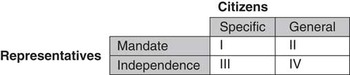
In essence, the quality of fulfilling the core features of representative democracy can vary according to how specific the preference set the representative is authorized with, and whether or not the representative is acting according to mandate or independence theory. A 2×2 matrix is depicted in Figure 2 to illustrate the four possible combinations. Citizens are faced with the decision to either authorize their representative with a specific or a general preference set (columns).Footnote 15 Representatives, in turn, can be understood as having the duty to enact what they have been authorized with, as well as giving account of what they have done, according to Pitkin. To fulfil both, they have a choice between either the mandate or the independence model as the two extremes (rows). However, it should be noted that a representative seeking re-election is also likely to be influenced in the decision by voters’ revealed preferences for either model. The four possible outcomes these combinations generate pertain to different levels in the quality of fulfilling representative democracy’s core meaning.
Citizens’ and representatives’ potential interaction.

As argued above, the specific preference set is only problematic for representatives, if they follow the mandate model (cell I). This is because the process of bargaining and forming a government from the group of representatives can easily make representatives betray their voters with regard to the policy preferences they have been authorized with. Conversely, if representatives act according to the independence model, no problem arises, as long as they account for if and why they deviated from the specific authorized preference set (cell III). As a way of exemplifying, under conditions of cell III, a representative might be authorized with expanding the earlier-mentioned welfare state parameters of unemployment benefits, medical coverage, and pensions. If acting in accordance with the independence model, representatives may opt for only fulfilling two out of those three preferences, simply because they have information about the state of medical services that constituents do not have. If, and only if, the representatives provide an account of and an explanation for their deviations, only then can these representatives still be considered as fulfilling representative democracy’s core meaning.
As for the case of the general preference set, again only the mandate model poses problems. Representatives authorized with a general preference set but following a mandate model (cell II) need to be aware of how far they can take the bargaining process for forming a government before going beyond their promises to voters. For example, authorized with a general preference set of expanding the welfare state, representatives need to accomplish that goal in the bargaining process, if they are acting according to the mandate model. In this instance, a single specific parameter running counter to that goal can already be considered as a betrayal to the voters. In contrast, faced with the independence model and a general preference set, the representative has the most independent position of all (cell IV). Here again, representative democracy’s core meaning can be fulfilled.
These four outcomes for the case of pluralist democracy suggest that representative democracy’s core meaning is accomplished more easily, whenever the representative chooses the independence and not the mandate model. Under conditions of a mandate model, the match between what the representative is authorized with and what he or she does is problematic and not easily resolved, especially under conditions of cell I. Citizens, on the other side, can foster the fulfilment of the core meaning by authorizing the representative with a general preference set. However, as most of the 124 candidates in a constituency of Individualcountry also aim at being authorized with a general preference set, differentiation amongst their proposals would naturally occur to increase the chances of being elected.Footnote 16 Therefore, being authorized with a preference set that is general enough not to run into troubles of accountability (cells I and III) is difficult to achieve for a representative. It is especially the combination of a specific preference set and the mandate model that creates problems for representative democracy’s core meaning in a model of pluralist democracy.
To avoid this problem, individual representatives could simply claim to be following the independence model. However, the mandate model is also a robustly possible outcome in real democracies. Citizens generally do not have a clear preference between the mandate and the independence model, as mentioned above. In addition, issue voters are known to be authorizing representatives with a specific goal in mind, which means that the combination in cell I, or the mandate model specifically, is not merely a theoretical possibility that individual representatives can simply avoid. It is a real-world citizen preference that a representative seeking re-election is likely to take into account. This also means that representatives’ liberty to choose between the independence and mandate model is likely to be influenced by voters’ revealed preferences. The combination in cell I presents a robustly possible outcome in which individual representatives in Individualcountry struggle to put authorization and accountability into an equilibrium.
Groups of representatives (or party democracy) in representative democracy
There are several benefits in grouping representatives, and what they aim at representing, before the Election Day. The bargaining process is largely transferred to the period before the Election Day, which expedites the act of forming the government. In party democracy, finding a consensus amongst several parties is also a time-consuming exercise, and taken to the extreme it can take years as in the case of Belgium 2007–2011. However, in general, governments are formed within a couple of weeks after the Election Day.Footnote 17 Related to that is a second benefit: voters already know about most actions that the group aims at pursuing once in government. Pre-election grouping also implies group campaigning to some extent. For the post-election period, this means more predictable government action. In support of this point, Powell (Reference Powell2000: 52–53) points at a higher level of clarity of responsibility in ‘multiparty preelection majority governments’ as opposed to ‘majority governments negotiated after the election’. In addition, individual proposals of representatives are, if anything, only to a limited extent in contradiction with one another, as all individual representatives of a group started the bargaining process before the Election Day to form a joint set. Thus, if elected, the group is authorized by its voters with regard to this set of proposals. In addition, grouping reduces the alternatives from which to choose, and thus the range of choices decreases. Speaking in economic terms, pre-election grouping reduces voters’ information costs (Jones and Hudson, Reference Jones and Hudson1998). The potentially long-lasting process of finding the ideal candidate, which proved to be an obstacle in Individualcountry, is simplified with groups of representatives and a reduced set of options.
On what basis the group is formed, or what common denominator its members have, is an entirely different question. This could be ideology, region, or religion. Yet, this does not alter the fact that grouping before the Election Day yields benefits. Groups of representatives offer more efficient means of arriving at collective decisions. Considering the benefits, it appears that authorization does not pose a problem to groups of representatives. Rather, in comparison with individuals, a group of representatives provides characteristics that make the process of authorization easier, quicker, and more transparent for voters.
However, representative democracy’s core meaning requires that both principles, authorization and accountability, are concurrently accomplished. Consider again Figure 2 depicting the two different choices that voters and groups of representatives face. For individual representatives, the case of a specific preference set combined with a mandate model has shown to be particularly difficult. Therefore, the changes brought about under conditions of party democracy will centre on this combination.
A group facing the combination represented in cell I can accomplish the core of representative democracy more easily, because the group does not run into the same amount of troubles regarding trading and bargaining after the Election Day. It bargains before even standing for election, and thus already presents voters with a coherent proposal before the election. Some might object that this is only partially true, because it only holds for one-party governments. Indeed, most coalitions require the bargaining and trading of proposals after the Election Day.Footnote 18 However, even in the case of coalition governments, the outcome of cell I is preferable to the outcome of the same cell under conditions of pluralist democracy. The reason for this is that the number of proposals on which a compromise is to be made is considerably smaller than under conditions of individual representatives. Essentially, only a handful of groups bargain as opposed to numerous individual MPs in the case of Individualcountry. This not only yields benefits of transparency and simplicity but also in terms of representation. In the case of groups, citizens who voted for one of the winning groups can be relatively certain that some of the group’s proposals will definitely be enacted. In contrast, in Individualcountry, the number of proposals to compromise on is considerably larger. This makes it uncertain how many of the individual representatives’ proposals will be enacted. Assuming that voters want to maximize their number of preferences being represented by the government, they should support groups of representatives, instead of individual representatives.
To summarize, under conditions of party democracy, representative democracy’s core features can be accomplished more easily in cell I, namely for cases of one-party government, and to a lesser degree for cases of multi-party government. In comparison, in pluralist democracy, it is hardly possible to achieve a comparable outcome in cell I because representatives would easily betray their voters when bargaining their interests in the post-election parliament. Therefore, in a system of groups of representatives acting on a specific preference set and according to the mandate model, it is still difficult to put authorization and accountability into equilibrium but slightly easier than under the same conditions with individual representatives. Just like in Individualcountry, the remaining cells do not pose serious problems in accomplishing a simultaneous fulfilment of representative democracy’s core features.
Although groups of representatives perform better in accomplishing the core, they are by no means perfect. Patronage and group discipline have already been mentioned above as caveats of party democracy. In addition, assigning accountability to several representatives of a group can be difficult for voters. For depending on the electoral law or format of the ballot sheet, elections hold predominantly individuals, groups, or a mix of both accountable. However, even if the group is stressed by an electoral law through a party vote, voters can hold representatives accountable for their choice to join one group and not the other, apart from all actions with regard to what representatives are supposed to represent.
Overall, groups of representatives having decided on a joint policy proposal before the Election Day perform slightly better at putting authorization and accountability into equilibrium, and thus fulfilling the core meaning of representative democracy, compared with party democracy’s strongest competitor – pluralist democracy.Footnote 19 This means that pre-election bargaining makes the key difference. Having a system of individual representatives who bargain and form groups before elections resembles party democracy in many important aspects.
Some might object that party democracy restricts the scope of policies unnecessarily in comparison with pluralist democracy, which negatively affects representativeness. This appears as a weakness of party democracy, or so it seems. In both settings, government formation might require the same amount of bargaining, so that the outcome in terms of policy diversity would be the same. Whether a reduction in policy alternatives happens before or after the election is extraneous for the number of alternatives. In either case, a limitation is inevitable. However, in a post-election setting, the outcome is less predictable for the voter than in a party-based, pre-election bargaining system. This means that under conditions of party democracy, the scope of policy alternatives is comparable with that in pluralist democracy, but precise policy outcomes are more predictable and more transparent.Footnote 20 The implications of this are that predictability and transparency of outcomes are maximized in a two-party system and decrease as the possibility of post-election bargaining increases, because of coalition formation.Footnote 21
The fulfilment of valuable functions in pluralist democracy
A full account of the parties’ value to representative democracy needs to consider the following two perspectives: representation from below and representation from above. The previous section argued for party benefit from citizens’ perspective and departed from the notion of representation from below. A view of representation from above, in turn, provides another important perspective on the value of parties to the representative process. It allows evaluating individual representatives’ performance against parties’ in specific activities that are commonly regarded necessary for the well functioning of representative democracy.
The rationale is that individual representatives need, at least, to fulfil the same functions and activities that parties currently fulfil in order to be a viable competitor. This is an important point because if the functions parties fulfil are not adequately served, representative democracy is put at risk, as they are considered necessary for its effectiveness and legitimacy (Mair, Reference Mair2003).Footnote 22 In addition, although parties are said to have changed in their performance of functions, as Mair (Reference Mair2003: 18, emphasis in original) argues, the functions themselves still play a major role on the ‘democracy side of representative democracy’.
Richard Gunther and Larry Diamond (Reference Gunther and Diamond2001: 7) argue for ‘a common denominator’ that forms the core of the functions that parties fulfil in relation to civil society and the state. They comprise the following seven: candidate nomination, electoral mobilization, issue structuring, societal representation, interest aggregation, forming and sustaining government, and social integration. For a detailed discussion of these functions, the reader may consult the original source.
An assessment of individual representatives against their potential performance in the functions parties fulfil shows that some of them are redundant, while others pose serious challenges to pluralist democracy. First consider, for instance, that candidate nomination as a function strongly associated with party activity becomes redundant in a system with individual representatives because candidates put themselves up on the ballot sheet. As for the function of forming and sustaining government, the preceding sections already argued that individual representatives face challenges in fulfilling this role. However, if it was only about forming and sustaining a government as such, without any further conditions, the thought-experiment did indeed reveal the feasibility.
When it comes to the more societal-based functions of electoral mobilization, societal representation, and social integration, they do not seem to pose a problem for individual representatives either. Individual representatives are as capable as political parties to mobilize the electorate, just because of the sheer number of candidates. Similarly, individual candidates are as likely to represent society as political parties. Potentially, they would even perform better in this function than political parties because, with many candidates running for election, the diversity of society might be better represented at the ballot booth compared with party democracy. Social integration refers to parties’ potential to include citizens in politics and to enable them to ‘participate effectively in the political process’ (Gunther and Diamond, Reference Gunther and Diamond2001: 8). How exactly political parties foster the social integration of citizens beyond what they do in the function of electoral mobilization is difficult to say. Therefore, it is assumed here that these activities, at least, do not present more difficulties in their fulfilment for individual representatives than for political parties.
Equally, individuals are well capable of fulfilling the functions of interest aggregation. Defined as the gathering, bundling, and transformation of interests from the bottom to the top, parties are already increasingly contested in this function by interest groups and non-governmental organizations (Webb, Reference Webb2002). In addition, Paul Webb (Reference Webb2002: 447) argues that individual representatives are more prone to challenge parties in this function when operating in presidential- and candidate-based political systems. However, in presidential- and candidate-based political systems, the benefits that parties offer, in terms of predictability of outcomes and transparency, would only be rising because there would be no post-election bargaining at all. Individual candidates might face difficulties gauging what people want, as illustrated in the case of Individualcountry, but they are certainly able to do that to the same extent as political parties. The same can be said for the transformation of interests into policy proposals. There is little to suggest that MPs cannot propose policy proposals by themselves and without any party support.
Finally, consider the function of issue structuring. Political parties are said to structure alternatives alongside issue-dimensions (Bonotti, Reference Bonotti2011). Parties communicate their views and thereby also shape voters’ opinions. Beyond the sum of these alternatives lie long-lasting visions of how a country should be governed. Although individual representatives can also structure alternatives alongside dimensions and shape preferences by communicating their own views, presenting long-lasting alternatives is more problematic. The earlier advantage of not being bound by party discipline reverses into a severe disadvantage.
Individual candidates have a hard time presenting a vision for how the country should be ruled and pursuing this vision accordingly. Not only because they are individuals but, more so, because they cannot know beforehand whether or not they are ever going to have another chance to be an MP. Therefore, it is rational for them to only pursue small, easily recognizable projects so as to ensure visibility to those who voted for them. However, a vision of a country entails more than just the sum of smaller individual projects. Nadia Urbinati (Reference Urbinati2011: 45) stresses this point by arguing that parties and partisanship need to be seen in a relationship with ‘an imagined general will’. Otherwise, she warns, particular interests would only compete, dividing the public.Footnote 23 The pursuit of this imagined general will, however, poses serious problems to the individual representative. With individual representatives, democracies would be less likely to be guided by long-term views or visions of what the country should look like in the future. A ratio or ‘the why’ of policies would be missing, as Goodin (Reference Goodin2008) rightly points out. Urbinati (Reference Urbinati2011: 44; emphases in original) is even more specific with regard to representation: ‘the currency of representation is ideological in that it is an interpretative or artificially created similarity between the representative and her electors’. This emphasizes the importance of ideology and having a long-term vision for representative democracy. It is in this mission where political parties in representative democracies contribute most, in comparison with individual representatives.
Departing from the idea of representation from above, parties not only aggregate citizen demands but they offer, and thus also articulate, something beyond individual demands. Ideology as a (more or less) coherent plan or vision of how to govern the country saves politics and policies from becoming a dispersed and possibly even contradicting set of actions. As important as the media are in the activity of issue structuring, they do not provide an ideology or long-term vision that could supplement individual representatives and their work. The pursuit of a political ideology and a long-term plan about the country’s future is what distinguishes party democracy from pluralist democracy in a framework of representation from above, and accordingly it is in the function of issue structuring where pluralist democracy cannot live up to the standards set by parties, although they might surpass them in other instances.
Summary and conclusion
This article set out to explore parties’ value in a system of representative democracy. It showed that, although party democracy is by no means flawless, it is nonetheless the better alternative to its strongest competitor – pluralist democracy with individual representatives. It outperforms pluralist democracy in terms of predictability of policy outcomes. Against the core meaning of representative democracy, pluralist democracy cannot easily fulfil authorization and accountability simultaneously under certain conditions. In some instances, party democracy performs slightly better. Especially, under circumstances of a mandate model and a specific preference set, with which the representative is authorized, political parties perform slightly better than individual representatives. When assessed for their performance in party functions, individual representatives can probably perform on par with political parties, except for in the function of issue structuring. I argued that individual representatives are perfectly capable of taking over parties’ work in structuring issues alongside policy dimensions. However, what they lack is the provision of a long-term vision or an ideology of how a country should be run, which is important for policy coherence in the long run.
With these findings, I offer an attempt to reconcile representative democracy and party politics literature by drawing on literatures from normative political theory and positivist electoral behaviour. It contributes to the recently emerged normative endeavours of exploring the value of political parties to modern democracies. My focus rested on party benefit to representative democracy as the most common form of governing modern democracies.
The implication that the discussion yields is that political parties are not necessary for representative democracy to work in the sense that plants need water to grow. However, it is implausible that representative democracy could be successful without parties. Even during times when a general disenchantment with parties can be observed amongst citizens and when scholars observe the decline of parties, it appears that parties are worth having as institutions for the well functioning of representative democracy. The qualities parties provide make them preferable over their strongest competitor.
Acknowledgements
The author thanks Kees Aarts, Jacques Thomassen, Göran Duus-Otterström, and Peter Esaiasson for their valuable comments on previous versions of the manuscript. The author is also grateful to the anonymous reviewers and the editor for their recommendations.