Introduction
Water striders have hydrodynamic structures adapted to life on the surface film of water. Most are found in freshwater and a few species have adapted to living in the ocean. Immatures as well as adults are predators and represent an important link in the food chain of aquatic ecosystems.
Marine Heteroptera of the eastern tropical Pacific were studied by Polhemus and Manzano (Reference Polhemus, Manzano, Quintero and Aiello1992) and included three of the five species covered here: Rheumatobates longisetosus, R. probolicornis and Telmatometroides rozeboomi. Later, the species of the genus Rheumatobates, distributed in the Neotropical Pacific region, were illustrated and included in a key by Padilla-Gil and Pacheco-Chaves (Reference Padilla-Gil and Pacheco-Chaves2012).
The nymphs of aquatic South American heteropterans are less studied (Mazzucconi and Bachmann, Reference Mazzucconi and Bachmann1997; Padilla-Gil and Arcos, Reference Padilla-Gil and Arcos2010; Heckman, Reference Heckman2011; Konopko and Mazzucconi, Reference Konopko and Mazzucconi2011). Padilla-Gil and Arcos (Reference Padilla-Gil and Arcos2011) and Padilla-Gil (Reference Padilla-Gil2012) described the habitat and distribution of some gerrid species in the Pacific region of Colombia. Yet, nothing is known on the development of these species.
This study intends to contribute to the knowledge on immature stages of the three Neotropical species Rheumatobates: R. longisetosus, R. probolicornis, R. peculiaris, Telmatometra whitei Bergroth and T. rozeboomi (Drake & Harris) (all Heteroptera: Gerromorpha) that occur southwest of Tumaco Bay, in the Pacific coast region of Colombia. For R. longisetosus, R. peculiaris, T. whitei and T. rozeboomi, the eggs and the five immature stages were studied, whereas for R. probolicornis only the egg and the fifth instar were studied. The descriptions and illustrations of eggs and nymphs represent a contribution to the knowledge of the morphology and biology of these Neotropical gerrid species.
Materials and methods
Nymphal instars are similar among the five studied species, the differences being mostly quantitative. Their sex is not distinguished in the first three stages, while in stages IV and V, males and females are conspicuous. The descriptions of nymphal stages I–III are presented together and stages IV and V according to sexual dimorphism. All descriptions are the stages of apterous morphs.
Only winged adults of three species are known: R. longisetosus, described by Padilla-Gil and Pacheco-Chaves (Reference Padilla-Gil and Pacheco-Chaves2012), R. peculiaris by descriptors of the species and T. whitei by Kenaga (Reference Kenaga1941), and thus only the immature stages of R. peculiaris were collected and their fourth and fifth instars with well-developed pads are described. The wing pads are recognizable from the third instar onwards.
Nymphal morphology was studied on specimens killed and preserved in 70% alcohol. Ripe ovarian eggs were dissected from the female's abdomen. One to three specimens were selected for each instar.
All measurements are in mm. Specimens were deposited in the Colección de Entomología, Universidad de Nariño (PSO-CZ), Colombia.
The abbreviations used are as follows: egg length (EL), egg width (EW), length of the body (L), width of the body (W), width of the head (wh), antenna lengths of segments I–IV (An I–IV), width of the pronotum (wp), width of the mesonotum (wm), length of the wing pad (Lwp), abdomen length/width (Ab L/W). Proportions of legs, fore leg (FL): femur/tibia/tarsal (F/T/t), middle leg (ML) and hind leg (HL).
Results and Discussion
Rheumatobates longisetosus
Specimens examined
Colombia: 1 first instar, 1 second instar, 1 third instar, 1 ♀, 1 ♂ apterous fourth instar, 2 ♀, 1 ♂ apterous fifth instar, Nariño, Tumaco, Estero Villa del Sol, 24. vi. 2010, D. N. Padilla; 5 ♀ apterous, 1 ♂ apterous third instar, 3 ♂ apterous fourth instar, Tumaco, Estuario Aguaclara, 6. ii. 2010, D. N. Padilla; 2 second instar, 5 third instar, 1 ♀, 1 ♂ apterous fourth instar, 3 ♀, 5 ♂ apterous fifth instar, the same locality and collector, 17. xi. 2010; 1 first instar, 1 second instar, 9 third instar, 12 ♀, 8 ♂ apterous fourth instar, 12 ♀, 7 ♂ apterous fifth instar, Tumaco, El Morro, 18. xi. 2010, D. N. Padilla (all PSO-CZ).
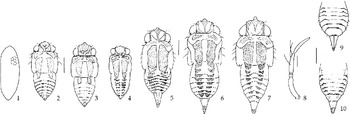
Egg (Fig. 1), EL: 0.90, EW: 0.30. Shape elongate with ventral side flat and of white colour. The surface ornamented with a delicate tracery in the form of hexagons and pentagons. Females dissected had four to five eggs.
Rheumatobates longisetosus, immature stages. 1, egg; 2, first instar; 3, second instar; 4, third instar; 5, fourth instar of apterous female; 6–7, fifth instar – 6, apterous female and 7, apterous male; 8, antenna, fifth instar of apterous male; 9–10, abdomen in ventral view, fifth instar – 9, apterous female and 10, apterous male. Scale bars: Figs 1–3, 8, 0.25 mm; Figs 4–7, 9, 10, 0.5 mm.

Nymphal instars
First instar (Fig. 2). Size, L: 0.94, W: 0.44, wh: 0.36, An I–IV: 0.04, 0.06, 0.12, 0.14, wp: 0.36, wm: 0.44, Ab L/W: 0.44/0.28. Proportions of legs, FL: 0.18/0.16/0.16; ML: 0.50/0.44/0.40; HL: 0.28/0.24/0.20.
Second instar (Fig. 3). Size, L: 1.06, W: 0.44, wh: 0.36, An I–IV: 0.06, 0.06, 0.12, 0.16, wp: 0.36, wm: 0.44, Ab L/W: 0.48/0.32. Proportions of legs, FL: 0.18/0.18/0.16; ML: 0.54/0.46/0.40; HL: 0.30/0.26/0.20.
Third instar (Fig. 4). Size, L: 1.74, W: 0.74, wh: 0.64, An I–IV: 0.12, 0.08, 0.20, 0.26, wp: 0.62, wm: 0.74, Ab L/W: 0.84/0.54. Proportions of legs, FL: 0.44/0.26/0.22; ML: 1.00/0.82/0.60; HL: 0.50/0.38/0.24.
Colour and structural characters, I–III instars. Eyes red; head, four segment rostral, antennae except first segment, middle and hind legs, proctiger, pale brown; dorsum of the thorax and abdomen, first segment antennal and fore legs, yellow; thorax with two dark brown spots (Figs 2–4); connexiva and ventral body pale yellow. Venter without dark spots. Third instar, abdominal tergites with two dark brown spots for tergite (Fig. 4). There are no conspicuous differences between the sexes in stage III; males have the abdomen slightly shorter.
Fourth instar, apterous female (Fig. 5). Size, L: 2.64, W: 1.04, wh: 0.96, An I–IV: 0.30, 0.12, 0.40, 0.44, wp: 0.96, wm: 1.04, Ab L/W: 1.28/0.88. Proportions of legs, FL: 0.76/0.40/0.32; ML: 1.90/1.54/1.08; HL: 1.04/0.72/0.48.
Fifth instar, apterous female (Fig. 6). Size, L: 3.08, W: 1.16, wh: 0.96, An I–IV: 0.30, 0.10, 0.40, 0.44, wp: 1.00, wm: 1.16, Ab L/W: 1.68/1.04. Proportions of legs, FL: 0.68/0.44/0.32; ML: 1.92/1.64/0.16; HL: 0.96/0.70/0.42.
Fourth instar, apterous male. Size, L: 2.38, W: 1.04, wh: 0.94, An I–IV: 0.44, 0.12, 0.50, 0.50, wp: 0.92, wm: 1.04, Ab L/W: 1.00/0.80. Proportions of legs, FL: 0.76/0.44/0.34; ML: 2.00/1.66/1.18; HL: 1.06/0.80/0.42.
Fifth instar, apterous male (Fig. 7). Size, L: 3.16, W: 1.20, wh: 1.08, An I–IV: 0.40, 0.12, 0.48, 0.50, wp: 1.04, wm: 1.20, Ab L/W: 1.60/0.92. Proportions of legs, FL: 0.76/0.48/0.36; ML: 2.16/1.76/1.24; HL: 1.12/0.84/0.44.
Colour and structural characters, IV–V instars apterous. Eyes red; head with darker brown spots along the middle and along the inner margin eyes; thorax with two dark brown spots (Figs 5–7); abdominal tergites with two dark brown spots for tergite (Figs 5–7). Length and width of the antennal segment of males of IV or V nymphal instar (Fig. 8) much thicker and longer than that of females of these same instars. Genital segments with projection, long for females of IV or V nymphal instar (Figs 5, 6 and 9), shorter for males of IV or V nymphal instar (Figs 7 and 10).
Abdominal venter with small, brown spots with characteristic design according to sex of V instar (Figs 9 and 10), less conspicuous in IV instar of both sexes. First genital segment of IV and V male instars entire ventrally and rounded apex of proctiger (Fig. 10) and that of IV and V female instars slightly divided and more elongated at the apex (Fig. 9). Other sexual characters of abdominal venter of male are not visible in this instar.
Rheumatobates peculiaris
Specimens examined
Colombia: 1 first instar, 3 second instar, 6 third instar; 2 ♀, 1 ♂ apterous fourth instar; 1 ♀, 1 ♂ apterous fifth instar; 1 ♀ macropterous fourth instar, 1 ♀ macropterous fifth instar (PSO-CZ), Nariño, Tumaco, Mar Agrícola, 17. xi. 2010, D. N. Padilla.
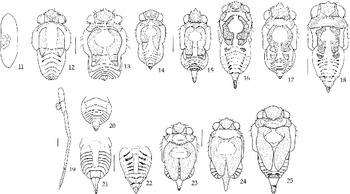
Egg (Fig. 11), EL: 0.80, EW: 0.24. Elongate in shape with ventral side flat and of white colour. The surface ornamented with a delicate tracery in the form of minute hexagons and pentagons. The dissected female had 11 eggs.
Rheumatobates peculiaris, immature stages: 11, egg; 12, first instar; 13, second instar; 14, third instar; 15–16, apterous female – 15, fourth instar and 16, fifth instar; 17–20, apterous male – 17, fourth instar and 18, fifth instar, and 19, hind leg of fourth instar; 20–22, abdomen in ventral view – 20, fourth instar, apterous male and 21–22, fifth instar, and 21, apterous female and 22, apterous male; 23–25, macropterous female, instar – 23–24, fourth instar and 25, fifth instar. Scale bars: Figs 11–13, 19, 0.25 mm; Figs 14–18, 20–25, 0.5 mm.

Nymphal instars
First instar (Fig. 12). Size, L: 1.02, W: 0.56, wh: 0.44, An I–IV: 0.06, 0.04, 0.1, 0.12, wp: 0.48, wm: 0.56, Ab L/W: 0.44/0.44. Proportions of legs, FL: 0.22/0.16/0.16; ML: 0.64/0.56/0.48; HL: 0.34/0.30/0.22.
Second instar (Fig. 13). Size, L: 1.04, W: 0.66, wh: 0.58, An I–IV: 0.10, 0.08, 0.18, 0.18, wp: 0.56, wm: 0.66, Ab L/W: 0.36/0.46. Proportions of legs, FL: 0.32/0.22/0.18; ML: 0.94/0.90/0.72; HL: 0.48/0.48/0.30.
Third instar (Fig. 14). Size, L: 1.78, W: 0.90, wh: 0.72, An I–IV: 0.16, 0.08, 0.20, 0.22, wp: 0.72, wm: 0.90, Ab L/W: 0.80/0.78. Proportions of legs, FL: 0.40/0.22/0.22; ML: 1.24/1.14/0.90; HL: 0.66/0.60/0.34.
Colour and structural characters, I–III instars: eyes red; dorsum and venter body, antennal segments, fore leg except posterior margin of tibia and tarsum, middle and hind legs: coxa, trochanter and basal half of femur yellow; head, four segment rostral, other segments of legs and apical abdominal segments, pale brown. Thorax with two pale brown spots, from second instar with round, yellow spot on the central part of the thorax (Figs 12–14); abdominal tergites with dark brown posterior margin from second instar (Figs 13 and 14). Venter without dark spots.
Fourth instar, apterous female (Fig. 15). Size, L: 2.16, W: 0.92, wh: 0.84, An I–IV: 0.22, 0.10, 0.36, 0.32, wp: 0.80, wm: 0.92, Ab L/W: 0.96/0.84. Proportions of legs, FL: 0.48/0.36/0.28; ML: 1.84/1.76/1.24; HL: 1.00/0.84/0.48.
Fifth instar, apterous female (Fig. 16). Size, L: 2.56, W: 1.00, wh: 0.88, An I–IV: 0.22, 0.10, 0.38, 0.32, wp: 0.84, wm: 1.00, Ab L/W: 1.48/1.00. Proportions of legs, FL: 0.64/0.36/0.32; ML: 1.88/1.80/1.32; HL: 1.00/0.84/0.48.
Fifth instar, macropterous female. Size, L: 2.56, W: 1.08, wh: 0.92, An I–IV: 0.22, 0.10, 0.38, 0.32, wp: 0.92, wm: 1.08, Lwp: 1.32, Ab L/W: 1.24/0.88. Proportions of legs, FL: 0.64/0.36/0.32; ML: 1.88/1.80/1.32; HL: 1.04/0.88/0.52.
Fourth instar, apterous male (Fig. 17). Size, L: 2.24, W: 1.04, wh: 0.96, An I–IV: 0.46, 0.14, 0.40, 0.36, wp: 0.84, wm: 1.04, Ab L/W: 0.96/0.84. Proportions of legs, FL: 0.76/0.44/0.36; ML: 2.08/1.80/1.24; HL: 0.80/1.00/0.56.
Fifth instar, apterous male (Fig. 18). Size, L: 2.68, W: 1.16, wh: 1.00, An I–IV: 0.48, 0.14, 0.40, 0.38, wp: 1.00, wm: 1.16, Ab L/W: 1.28/1.00. Proportions of legs, FL: 0.84/0.48/0.40; ML: 2.08/1.80/1.24; HL: 0.72/0.90/0.52.
Colour and structural characters, IV–V instars: female of IV and V instars, abdominal tergites with small, dark brown spots on lateral corners; prolongation of genital segments with dark brown apex.
Male of IV and V instars, abdominal tergites with small, dark brown spots on lateral corners; prolongation of genital segments with dark brown apex, similar in length to IV and V female instars but with different shape (cf. Figs 15, 16 and 17, 18). First antennal segment of IV and V male instars much thicker than that of female instars.
Male of IV and V instars, hind coxae long and bearing a tubercular process in the apex of the posterior inner margin (Fig. 19). Fore femur of V male instar with six long, dark brown setae along the posterior margin.
Abdominal ventrites of IV female and male instars and V female instar with dark brown posterior margins (Figs 20 and 21); abdominal ventrites of V male instar with two small, dark brown spots for tergite segment (Fig. 22). First genital segment of IV and V male instars entire ventrally (Figs 20 and 22) and that of IV and V female instars divided (Fig. 21).
Wing development in the female
Thorax of female macropterous of IV and V instars much thicker than that of apterous female of V instars (Figs 15–16 and 23–25).
The wing pads of the gerrid are slightly recognizable in the third instar, gradually to cover the basal 2–3 abdominal segments (see Møller Andersen, Reference Møller Andersen1982). In R. peculiaris, the wing pads reaching the abdominal apex (except genital segments) from III instar to IV instar, then in the fifth nymphal instar, the wing pads extending beyond the posterior margin of V abdominal tergite (cf. Figs 23–25). This is probably associated with the physical and genetic interactions of the Ultrabithorax (Ubx) gene that regulates the development of the wing as in other insects (see Weatherbee et al., Reference Weatherbee, Nijhout, Grunert, Halder, Galant, Selegue and Carroll1999; De Navas et al., Reference De Navas, Garaulet and Sánchez-Herrero2006; Pavlopoulos and Akam, Reference Pavlopoulos and Akam2011).
Rheumatobates probolicornis
Specimens examined
Colombia: 2 ♀ apterous, 2 ♂ apterous of fifth instar (PSO-CZ), Nariño, Tumaco, El Bajito, 18. xi. 2010, D. N. Padilla.
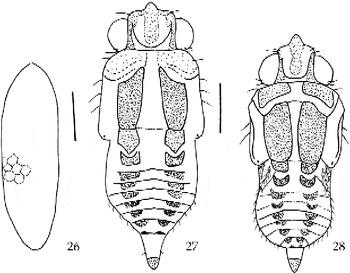
Egg (Fig. 26), EL: 0.94, EW: 0.28. Elongate in shape with ventral side flat and of white colour. The surface ornamented with a delicate tracery in the form of hexagons and pentagons. The dissected female had six eggs.
Rheumatobates probolicornis, immature stages: 26, egg; 27–28, fifth instar – 27, apterous female and 28, apterous male. Scale bars: Fig. 26, 0.25 mm; 27–28, 0.5 mm.

Fifth instar, apterous female (Fig. 27). Size, L: 2.68, W: 1.04, wh: 0.92, An I–IV: 0.30, 0.10, 0.36, 0.40, wp: 0.88, wm: 1.04, Ab L/W: 1.40/1.00. Proportions of legs, FL: 0.60/0.40/0.32; ML: 1.88/1.48/1.08; HL: 0.92/0.76/0.44.
Fifth instar, apterous male (Fig. 28). Size, L: 2.36, W: 0.92, wh: 0.92, An I–IV: 0.46, 0.08, 0.38, 0.44, wp: 0.88, wm: 0.92, Ab L/W: 1.08/0.8. Proportions of legs, FL: 0.64/0.40/0.36; ML: 1.92/1.52/1.16; HL: 0.84/0.84/0.36.
Colour and structural characters, V instars: Eyes red; head with darker brown spots along the middle and along the inner margin eyes; rostral segments, antennae except first segment, middle and HLs, proctiger, pale brown. Dorsum of thorax and abdomen, first segment antennal and all coxae, all trochanters, and femur and tibia of FL, yellow; thorax with two spots, dark brown (Figs 27 and 28); connexiva and ventral body pale yellow. Venter without darker spots; posterior margin of dark brown ventrites. Abdominal tergites with two dark brown spots for tergite (Figs 27 and 28); male abdomen with a row of setae along connexiva (Fig. 28).
First antennal segment much thicker and longer than that of females. Genital segments with projection, female longer than that of male (Figs 27 and 28).
Telmatometra whitei
Specimens examined
Colombia: 1 second instar, 1 third instar, 3 ♀, 4 ♂, apterous fourth instar, 6 ♀, 5 ♂, apterous fifth instar (PSO-CZ), Nariño, Tumaco, Consejo Comunitario Río Mejicano, Vereda El Guayabo, 3. ii. 2009, D. N. Padilla; 1 first instar (PSO-CZ), Tumaco, La Espriella, Río Caunapi, 16. xi. 2010, D. N. Padilla.
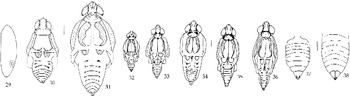
Egg (Fig. 29), EL: 1.30, EW: 0.36. Shape elongate with ventral side flat and of white colour. The surface ornamented with a delicate tracery in the form of hexagons and pentagons. Females dissected had 16–23 eggs.
Telmatometra whitei, immature stages: 29, egg; 30, first instar; 31, second instar; 32, third instar; 33–34, apterous male – 33, fourth instar and 34, fifth instar; 35–36, apterous female – 35 fourth instar and 36, fifth instar; 37–38, fifth instar, abdomen in ventral view – 37, apterous male and 38, apterous female. Scale bars: Figs 29–31, 0.25 mm; Figs 32–38, 0.5 mm.

Nymphal instars
First instar (Fig. 30). Size, L: 1.66, W: 0.80, wh: 0.36, An I–IV: 0.16, 0.14, 0.16, 0.30, wp: 0.36, wm: 0.80, Ab L/W: 0.76/0.40. Proportions of legs, FL: 0.42/0.36/0.20; ML: 1.00/1.50/1.02; HL: 1.00/0.54/0.38.
Second instar (Fig. 31). Size, L: 2.32, W: 1.10, wh: 0.64, An I–IV: 0.16, 0.14, 0.20, 0.40, wp: 0.60, wm: 1.10, Ab L/W: 1.08/0.64. Proportions of legs, FL: 0.42/0.42/0.24; ML: 1.08/1.60/1.20; HL: 1.20/0.68/0.44.
Third instar (Fig. 32). Size, L: 3.52, W: 1.40, wh: 1.00, An I–IV: 0.48, 0.32, 0.72, 0.96, wp: 0.84, wm: 1.40, Ab L/W: 1.68/1.08. Proportions of legs, FL: 1.04/0.96/0.40; ML: 1.92/2.84/1.88; HL: 2.36/1.08/0.56.
Colour and structural characters, I–III instars. Ground colour pale yellow, covered with very short, black setae; eyes red; antennae and legs pale yellow to pale brown. II and III instars, head with longitudinal stripe on lateral margins of eyes; II and III with pale brown on the vertex. Pronotum with pale brown, lateral spots; thorax with pale brown, longitudinal stripes. All instars (I–V), ventral thorax yellow with two dark brown spots below of fore trochanters and two small, dark brown spots ahead of metasternum, near to mesopleura.
Fourth instar, apterous male (Fig. 33). Size, L: 4.93, W: 1.52, wh: 1.08, An I–IV: 0.80, 0.48, 0.94, 1.14, wp: 1.00, wm: 1.42, Ab L/W: 2.20/1.04. Proportions of legs, FL: 1.48/1.36/0.64; ML: 3.20/4.86/2.60; HL: 3.60/1.76/0.88.
Fifth instar, apterous male (Fig. 34). Size, L: 5.53, W: 2.28, wh: 1.22, An I–IV: 0.80, 0.48, 0.94, 1.14, wp: 1.40, wm: 2.28, Ab L/W: 2.48/1.40. Proportions of legs, FL: 1.48/1.36/0.64; ML: 3.20/4.86/2.60; HL: 3.60/1.76/0.88.
Fourth instar, apterous female (Fig. 35). Size, L: 5.53, W: 1.92, wh: 1.24, An I–IV: 0.72, 0.48, 0.92, 1.12, wp: 0.92, wm: 1.92, Ab L/W: 2.40/1.08. Proportions of legs, FL: 1.40/1.20/0.60; ML: 3.08/3.00/2.72; HL: 3.40/1.80/0.88.
Fifth instar, apterous female (Fig. 36). Size, L: 6.13, W: 2.40, wh: 1.24, An I–IV: 0.80, 0.48, 0.92, 1.12, wp: 0.98, wm: 2.40, Ab L/W: 2.68/1.60. Proportions of legs, FL: 1.44/1.20/0.60; ML: 3.08/3.00/2.80; HL: 3.64/1.92/0.96.
Colour and structural characters, IV–V instars apterous. Eyes red; head with dark brown spots, along the inner margin eyes and on the vertex; thorax with two dark brown stripes (Figs 33–36); abdominal tergites with anterolateral angles with small spots; proctiger brown.
First genital segment of IV and V male instars entire ventrally (Fig. 37) and that of IV and V female instars divided (Fig. 38).
Telmatometroides rozeboomi
Specimens examined
Colombia: 1 first instar, 2 ♀ apterous fourth, 1 ♂ apterous fifth, Nariño, Tumaco, El Morro, 18. xi. 2010, D. N. Padilla; 1 second instar, 1 third instar, 2 ♀ apterous fourth, 1 ♀ apterous fifth, Tumaco, Estero Villa del Sol, 16. xi. 2010, D. N. Padilla; 1 second instar, 2 ♀ apterous fourth, 1 ♂ apterous fourth, Tumaco, Estuario Aguaclara, 17. xi. 2010, D. N. Padilla (all PSO-CZ).
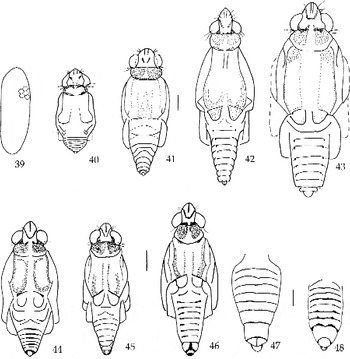
Egg (Fig. 39), EL: 1.30, EW: 0.46. Shape elongate with ventral side flat and of white colour. The surface ornamented with a delicate tracery in the form of hexagons and pentagons. Dissected females had three to five eggs.
Telmatometroides rozeboomi, immature stages: 39, egg; 40, first instar; 41, second instar; 42, third instar; 43–44, apterous male – 43, fourth instar and 44, fifth instar; 45–46, apterous female – 45, fourth instar and 46, fifth instar; 47–48, fifth instar, abdomen in ventral view – 47, apterous female and 48, apterous male. Scale bars: Figs 39–43, 47–48, 0.25 mm; Figs 44–46, 0.5 mm.

Nymphal instars
First instar (Fig. 40). Size, L: 1.30, W: 0.50, wh: 0.38, An I–IV: 0.16, 0.16, 0.24, 0.40, wp: 0.36, wm: 0.50, Ab L/W: 0.48/0.40. Proportions of legs, FL: 0.42/0.42/0.20; ML: 0.92/1.26/0.84; HL: 0.84/0.56/0.38.
Second instar (Fig. 41). Size, L: 1.94, W: 0.80, wh: 0.58, An I–IV: 0.28, 0.24, 0.34, 0.56, wp: 0.62, wm: 0.76, Ab L/W: 0.84/0.60. Proportions of legs, FL: 0.56/0.58/0.28; ML: 1.06/1.66/1.16; HL: 1.08/0.68/0.50.
Third instar (Fig. 42). Size, L: 2.64, W: 0.94, wh: 0.58, An I–IV: 0.38, 0.32, 0.46, 0.64, wp: 0.66, wm: 0.94, Ab L/W: 1.12/0.80. Proportions of legs, FL: 0.70/0.74/0.34; ML: 1.24/2.04/1.40; HL: 1.38/0.82/0.58.
Fourth instar, apterous male (Fig. 43). Size, L: 3.0, W: 1.28, wh: 0.76, An I–IV: 0.38, 0.38, 0.50, 0.68, wp: 0.74, wm: 1.26, Ab L/W: 1.32/0.88. Proportions of legs, FL: 0.72/0.74/0.42; ML: 1.40/2.20/1.60; HL: 1.50/0.88/0.64.
Fifth instar, apterous male (Fig. 44). Size, L: 3.20, W: 1.40, wh: 0.84, An I–IV: 0.60, 0.44, 0.60, 0.76, wp: 0.80, wm: 1.28, Ab L/W: 1.48/0.68. Proportions of legs, FL: 1.06/1.02/0.54; ML: 1.64/2.68/1.56; HL: 1.92/1.04/0.72.
Fourth instar, apterous female (Fig. 45). Size, L: 3.24, W: 1.06, wh: 0.8, An I–IV: 0.44, 0.44, 0.60, 0.76, wp: 0.76, wm: 1.06, Ab L/W: 1.44/0.64. Proportions of legs, FL: 0.88/0.92/0.56; ML: 1.76/2.84/2.04; HL: 2.08/1.12/0.80.
Fifth instar, apterous female (Fig. 46). Size, L: 3.64, W: 1.28, wh: 0.84, An I–IV: 0.68, 0.48, 0.68, 0.92, wp: 0.84, wm: 1.28, Ab L/W: 1.84/0.84. Proportions of legs, FL: 1.00/1.02/0.54; ML: 1.68/2.64/1.92; HL: 1.96/1.04/0.72.
Colour and structural characters, I–V instars. Ground colour pale yellow, covered with very short, black setae; eyes red; antennae and legs pale yellow to pale brown, except end of tibiae and tarsus. Head with longitudinal stripe on lateral margins of eyes and two stripes, parallel to middle line and a small, pale brown spot on the vertex. Pronotum with pale brown, lateral spots; thorax with pale brown, longitudinal stripes. Ventral thorax yellow with two dark brown spots below of fore trochanters and two small, dark brown spots ahead of metasternum, near to mesopleura. Venter yellow; from III instar to V instar abdominal sternites brown, except last abdominal segment and genital segments that are yellow. Middle femur with small, brown spot to 1/4 before the apex of femur; hind femur with three small spots, the first to 1/4 basal and the others to equal distance along of femur. All instars with long ocular setae.
First genital segment of IV and V female instars divided (Fig. 47) and that of IV and V male instars entire ventrally (Fig. 48). Genital segments with dark brown margins.
Ecological notes
Adults and nymphs of R. longisetosus and R. probolicornis were collected from mangrove swamps and estuaries on the Pacific coast and those of R. peculiaris from freshwater streams and lakes in Colombia.
Adults and nymphs of the same species cohabit. Yet, species of Rheumatobates do not cohabit. For example, R. probolicornis inhabits the El Bajito estuary and cohabits only with Rhagovelia arcuata (Polhemus & Manzano) and T. rozeboomi (Padilla-Gil, Reference Padilla-Gil2012).
The latter species is widely distributed in the Pacific coast and cohabits with R. longisetosus in estuaries.
On the other hand, R. peculiaris and T. whitei were occasionally found together on the Pacific plain (lowland humid forest extending to the base of the Andean foothills). These were collected on Río Mejicano, 30 km north of the Tumaco city and La Espriella, 45 km south-west of the Tumaco city.
Acknowledgements
Thanks are due to the Universidad de Nariño and to two anonymous reviewers for their comments on the manuscript.