


1. Introduction
In Word & Object, W. V. Quine presents a naturalistic account of language use, wherein meaning is grounded in the neural stimuli undergone by language users. Quine proposes that when translating an observation sentence from one language to another, the invariant element is not the distal referent, but rather the neural stimuli (Quine, Reference Quine1960, p. 45). This departure from Fregean referential semantics, despite its foundational contributions, highlights a fundamental difference: while the referential framework lacks a direct causal connection between meaning and the language user, Quine’s approach emphasizes the crucial role of neural stimuli in shaping meaning.
One might think that Quine rejects the notion of meaning altogether. As a result, one may assume that the proximal approach discussed here is not a concept of meaning at all. However, Quine does not reject all concepts of meaning. In fact, this empirical, proximal meaning — what he calls “stimulus meaning” — is his “concept of meaning,” not something separate from it (Quine, Reference Quine1960, p. 31). I agree with Miriam Solomon’s assessment that, at least before the 1990s, “empirical meaning is all the real meaning there is” in Quine’s philosophy (Solomon, Reference Solomon1989, p. 130). In this article, whenever I use the term “meaning,” I will restrict myself to this epistemologically motivated sense. In other words, by “meaning,” I will not be referring to the notion of meaning for which Quine is famous for rejecting (i.e., intensional approaches).
Later, Quine acknowledges a problem with this approach: the idiosyncratic nature of neural states. Each language user experiences unique neural stimuli, with no homology existing across individuals. This lack of uniformity prompted Quine to propose that, due to their evolutionary background, human beings with different neural stimuli can still align with each other. In other words, the harmony between language users is not due to a homology in their neural stimuli but rather to their shared evolutionary background. Understanding what harmonizes language users with idiosyncratic stimuli is a task for evolutionary psychologists.
Recently, Gary Kemp proposes an adjustment to Quine’s account by introducing the concept of “stimulus fields” as an alternative to Quinean stimulus meaning. These fields are described as ordered pairs of physical/chemical forces that impact the language user, with one set associated with assent and the other with dissent.
In this article, I argue that while stimulus meaning is too personal, the concept of total sensory forces affecting subjects proves overly broad for representing linguistic meaning. It is doubtful that there is a unique way to assign the same set of weights to the forces that language users encounter. In the end, the agent decides whether to assent or dissent to a given linguistic expression through the weighted sum of these forces. Therefore, the total forces influencing a linguistic agent cannot singularly determine meaning. Conversely, focusing solely on the relevant portion of the total sensory envelope, as Kemp posits, also presents challenges, as there is no guarantee that subjects will identify the same subset of forces as relevant, as I will discuss.
After rejecting Kemp’s proposal, I suggest that adopting a more Wittgensteinian approach could assist Quine in better accounting for the public nature of meanings. While neural states and stimuli may be private, language users are capable of generating public states through interaction. Drawing a parallel to Ludwig Wittgenstein’s “beetle in the box” argument, these rich private states become extraneous in communication, emphasizing the shared, public aspects of meaning.
2. Background
Quine’s theory of language is deeply intertwined with his perspectives on science and epistemology, most notably illustrated in his continuum approach. Within this viewpoint, all interactions with our environment — from the basic cognition of a baby or primitive people to the complex reasoning of contemporary scientists — are regarded as a form of theorizing about the world. The degree of complexity and sophistication is what differentiates these scenarios rather than the inherent process of theorizing (Quine, Reference Quine1957, pp. 2–6).
Within this framework, Quine naturalizes epistemology, considering our sensory interactions as the critical epistemic layer mediating between the world and our beliefs. It situates our understanding of the world within the context of our biological engagement with it (Quine, Reference Quine and Quine1969a, pp. 82–83).
Similarly, Quine’s theory of language also adopts a naturalistic stance. According to him, language operates in a holistic manner, with sentences being interdependent and interconnected. However, a privileged group of expressions, called “observation sentences,” are an exception to this rule. These sentences, capable of carrying meaning in isolation, form the semantic bedrock. This is the juncture where the interconnected web of expressions ceases, marking the beginning of language’s interaction with reality.
To further emphasize the distinctive status of observation sentences within Quine’s holistic theory of language, consider the following quote from Quine himself:
Observation sentences peel nicely; their meanings, stimulus meanings, emerge absolute and free of all residual verbal taint …
Stimulus meanings of observations sentences aside, most talk of meaning requires tacit reference to a home language in much the way that talk of truth involves tacit reference to one’s own system of the world, the best that one can muster at the time.
There being (apart from stimulus meanings) so little in the way of neutral meanings relevant to radical translation, there is no telling how much of one’s success with analytical hypotheses is due to real kinship of outlook on the part of the natives and ourselves, and how much of it is due to linguistic ingenuity or lucky coincidence. (Quine, Reference Quine and Brower1959, p. 171; see also Quine, Reference Quine1991, pp. 273–274, Reference Quine1996, pp. 162–162)
In Quinean semantics, isolated observation sentences bear stimulus meanings. A stimulus meaning for an expression S comprises a pair. The first element of the pair is the set of stimulations followed by an assent to the expression S, while the second element includes a set of stimulations followed by a dissent (Quine, Reference Quine1960, pp. 32–33).
This approach interestingly forgoes the use of distal references. Instead, it naturalizes the relationship between meaning and expression through causality. Another key aspect of Quine’s approach is its shift away from a compositional view of language in the context of observation sentences, adopting instead a holophrastic stance where the sentence, particularly in its observational capacity, serves as the foundational unit. This is why Quine asserts, “my theory has to do primarily with sentences of a sort and not, like Carnap’s, with terms” (Quine, Reference Quine1960, p. 35). It is important to note that Quine does not reject the compositional features of language. However, compositionality emerges at a later stage in the development of language. For this reason, Quine suggests that it is the holophrastic stance, not the compositionality, which may be the origin of language, as seen in “the cries of the apes” or “the infant’s entry to language” (Quine, Reference Quine1993, p. 110).
The degree of observationality inherent in a sentence plays a pivotal role in determining its shared, intersubjective meaning within a community. Sentences at the observational edge possess stimulus meanings that are commonly accepted and understood by members of the community. Conversely, sentences further removed from this observational edge tend to reflect more of an individual’s personal history. Quine elaborates on this distinction:
What makes an occasion sentence low on observationality is, by definition, wide intersubjective variability of stimulus meaning. Language as a socially inculcated set of dispositions is substantially uniform over the community, but it is uniform in different ways for different sentences. If a sentence is one that (like “Red” and “Rabbit”) is inculcated mostly by something like direct ostension, the uniformity will lie at the surface and there will be little variation in stimulus meaning; the sentence will be highly observational. If it is one that (like “Bachelor”) is inculcated through connections with other sentences, linking up thus indirectly with past stimulations of other sorts than those that serve directly to prompt present assent to the sentence, then its stimulus meaning will vary with the speakers’ pasts, and the sentence will count as very unobservational. The stimulus meaning of a very unobservational occasion sentence for a speaker is a product of two factors, a fairly standard set of sentence-to-sentence connections and a random personal history; hence the largely random character of the stimulus meaning from speaker to speaker. (Quine, Reference Quine1960, p. 45)
Quine’s explanation underscores the complex interplay between personal experiences, social inculcation, and the inherent properties of sentences in shaping their observationality and, by extension, their shared meaning within a community. This also reflects Quine’s centre-periphery model of beliefs. Observation sentences, being in direct contact with the outside world, tend to have consistent patterns of assent and dissent across different contexts. In contrast, other sentences reside at the centre of an agent’s web of beliefs, where assent or dissent depends on their relation to other held beliefs. Where we, as cognitive agents, position beliefs within our webs and how we relate them to other beliefs depends on our personal experiences and histories. Consequently, we cannot expect two different people to have isomorphic webs of beliefs.
At this juncture, it’s crucial to understand how Quine delineates the concept of similarity in terms of neural stimuli. He draws a distinction between receptual and perceptual similarity, explaining:
Each global stimulus is an ordered subset of the subject’s nerve endings, and two such subsets are more or less similar in the obvious sense according as they comprise more or less the same nerve endings in more or less the same order. This I call receptual similarity.
Perceptual similarity, on the other hand, is a matter rather of effect on the subject: a question of reaction. Two receptually very similar global stimuli are indeed apt to be perceptually similar, but two receptually very dissimilar ones can be perceptually similar too; for many of the receptors triggered on a given occasion are indifferent to the response. (Quine, Reference Quine1998, p. 17)
Expanding this concept to the intersubjective level, Quine then addresses the challenge of applying similarity across different subjects. He notes the limitations inherent in this approach, as subjects do not share receptors. This leads to the consideration of anatomical homology:
But now we have appealed to receptual similarity between episodes a and a’ of two subjects. The subjects share no receptors, so it is no longer a question of matching the two classes of receptors on the score of their sharing most of their members. It becomes a question rather of how nearly homologous, anatomically, most of the members of one class are with those of the other. (Quine, Reference Quine1974, p. 23)
However, Quine acknowledges the potential absence of such homology across different individuals’ neural stimuli, thereby highlighting a significant challenge in his theory (Quine, Reference Quine and Quine1969b, pp. 157–160). Only after about 30 years did he propose a solution that resorts to Gottfried Wilhelm Leibniz’s notion of pre-established harmony. This principle, he argues, is made manifest in an evolutionary context, thereby serving as the foundation for our shared language. This concept is akin to his evolutionary justification of natural kinds: just as human survival necessitates the reality of our concepts, the fact that humans communicate implies a harmony in our stimulations (Quine, Reference Quine1996, pp. 160–162).
Pre-established harmony, as a result of human evolutionary development, is a pivotal factor that aligns our neural responses to a shared environment. This concept is a cornerstone in Quine’s naturalistic account of meaning, as illustrated by his example:
Why, after the mother has got the child to affirm “Milk” once in an appropriate situation, does the child’s usage continue to agree with the mother’s? The answer can lie no longer in intersubjective similarity of stimulus meaning. It now lies rather in an intersubjective parallelism of subjective scales of perceptual similarity. If A and B jointly witness two events, and A’s neural intakes on the two occasions are perceptually similar by A’s standards, then B’s intakes will tend to be similar by B’s. (Quine, Reference Quine, Janssen-Lauret and Kemp2016, pp. 30–31)
This underscores Charles Darwin’s influence on epistemology, transforming the concept of final cause into that of efficient cause (Quine, Reference Quine, Janssen-Lauret and Kemp2016, p. 31). Our shared evolutionary history is what facilitates mutual understanding — it underpins how a child comprehends the meaning behind a parent’s words. In this framework, pre-established harmony is necessary for the empathy that allows one person to grasp another’s intended meaning (Quine, Reference Quine1992, pp. 42–43, Reference Quine1993, p. 112).
Kemp proposes an alternative approach to Quine’s proximal model. Kemp’s theory replaces stimulus meaning with the forces that affect our sensory organs. He conceptualizes a stimulus field as a set of ordered quadruples, “<O, L, f, v>, where O is a queried observation sentence, L is a location, f is a force present at L, and v is a verdict, affirmative or negative” (Kemp, Reference Kemp2022, p. 818). A typical example would be <‘Rotten eggs?,’ the nose, Hydrogen sulphide, affirmative> (Kemp, Reference Kemp2022, p. 818).
In Kemp’s approach, only a portion of the sensory envelope is considered in the stimulus field. He defines the sensory envelope as follows:
Imagine the scene involving a subject’s body, then imagine that exact scene but vacated by the body, as in a lost wax casting. The sensory envelope is the region immediately outside the region where the body (the wax) had been. The total forces at a given interval are those present at the envelope during that interval. (Kemp, Reference Kemp2022, p. 816)
In the stimulus field tuple, f represents the relevant part of the sensory envelope, rather than the entirety of it.
In the following section, I will argue that Kemp’s model fails to adequately model the context-dependent, dynamic nature of language cognition. Then, I will develop Quinean naturalism further in light of Wittgenstein’s “beetle in the box” argument. As stimulus will be likened to the beetle in Wittgenstein’s argument, it will be dropped from the meaning in the model I propose.
3. Critique of the Stimulus Field Approach
To understand the problem, let’s first elaborate on Kemp’s theory. What is crucial in a stimulus field, denoted as <O, L, f, v>, is f, the forces. Kemp initially discusses the role of “total forces” affecting linguistic agents, which encompass phenomena like light waves from distant galaxies, internal organ pressures, or molecules emanating from rotten food in a trash bag. Since the total forces are vague, Kemp continues that “For our purposes we must abstract away the forces which one cannot sense as well as any forces which one can sense but are irrelevant to observation sentences” (Kemp, Reference Kemp2022, p. 816). In other words, f, in the stimulus represents the relevant ones, not the overall sensory envelope. Once all the irrelevant ones are removed from the sensory envelope, only the relevant ones remain. My criticism of Kemp’s approach revolves around this move. I doubt whether we can move from the total forces to the relevant ones so easily. To lay out my criticism, I will illustrate Kemp’s model with the simple and neat mathematics of artificial neural networks.
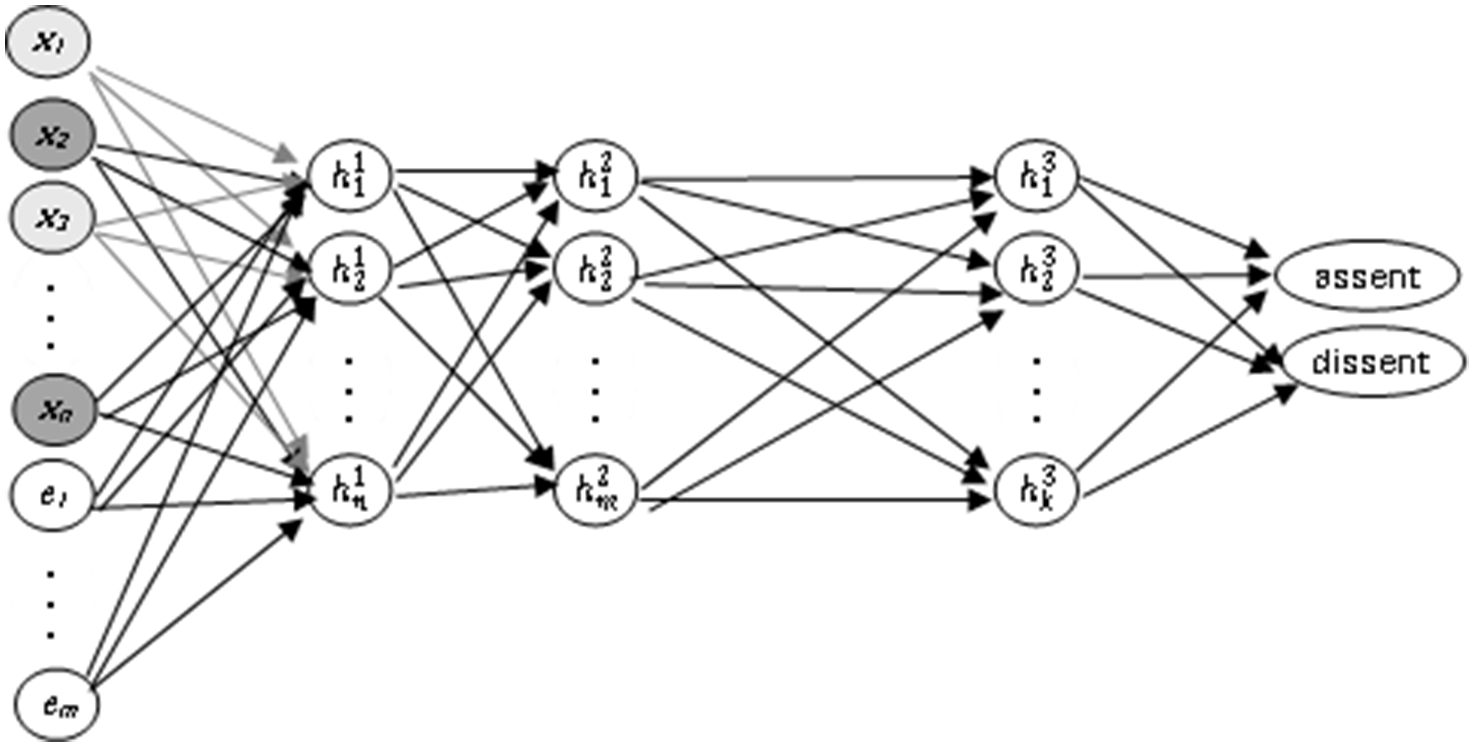
Let’s represent the total forces with a vector [x0, x1, x2, …, xn] and the expression as [e0, e1, e2, e3, …]. Sending these two to an m-layered neural network results in a vector of two [y0, y1], where y0 represents assent and y1 represents dissent. Through several repetitions, we can distinguish which components of the total forces vector are relevant for the neural network. For example, in Figure 1 below, after several experiments, the relevant part of the sensory envelope is identified. In the figure, irrelevant forces are represented with a lighter shade, while the relevant ones are shown in a darker shade. In other words, the content of perception is associated with the darker nodes. To note, the model does not include a representation of the agent’s initial state. Is this the correct understanding of perception and language use? In other words, in perceiving something, do we identify contents with certain subsets as illustrated above, or are we capable of arriving at the same content by focusing on different subsets of the total forces?
In the artificial neural network, the forces radiating from the environment are labelled as x1, …, xn, and the verbal input is labelled as e1, …, em. The hidden states of the system are represented by h 1, h 2, h 3. Each state is the output of the previous computation and serves as the input for the following computation.

Consider the following scenario: two agents are in the forest, both fluent in English, observing a rabbit in motion. Relative to their locations, L1 and L2, which is a component of Kemp’s stimulus field tuple, do agents process the same subset of the total forces in the shared environment? I will argue that how we are affected by the environment is more contextual than Kemp thinks. Even a single agent, at different times, may arrive at the same content by processing different subsets of the total forces. The underlying idea is that processing the input is not akin to finding an invariant part of the input and considering it as the content of our perception. Rather, the input leads us to certain conclusions in a dynamic, contextual, inferential manner. In terms of the artificial neural networks model above, the content is not a sub-vector of [x0, x1, x2, …, xn]. Rather, it is the projection of this vector onto a totally different space.
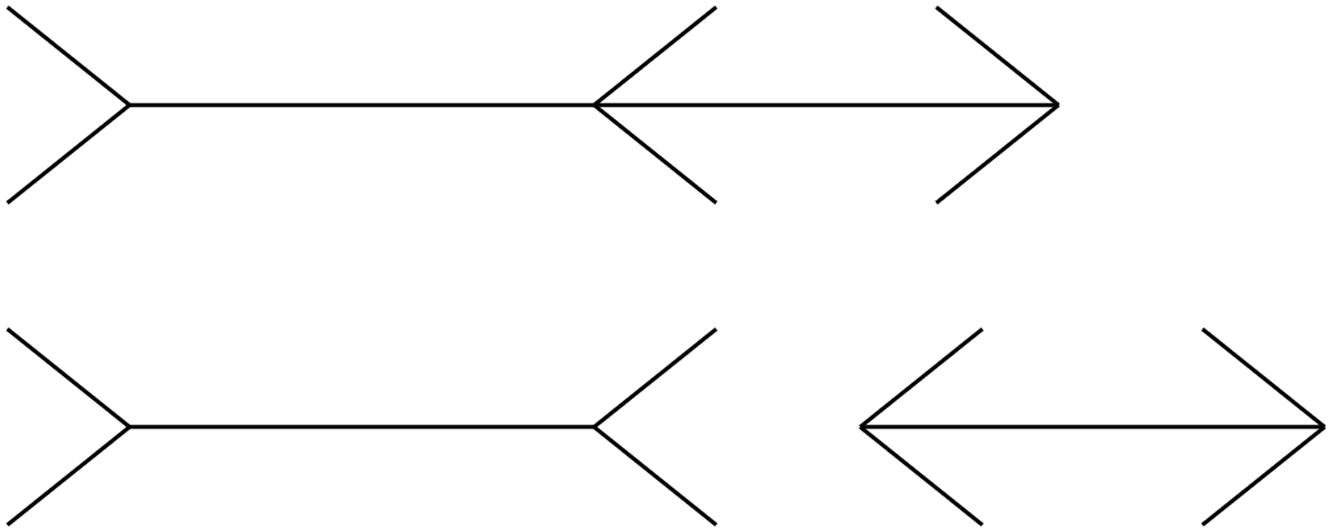
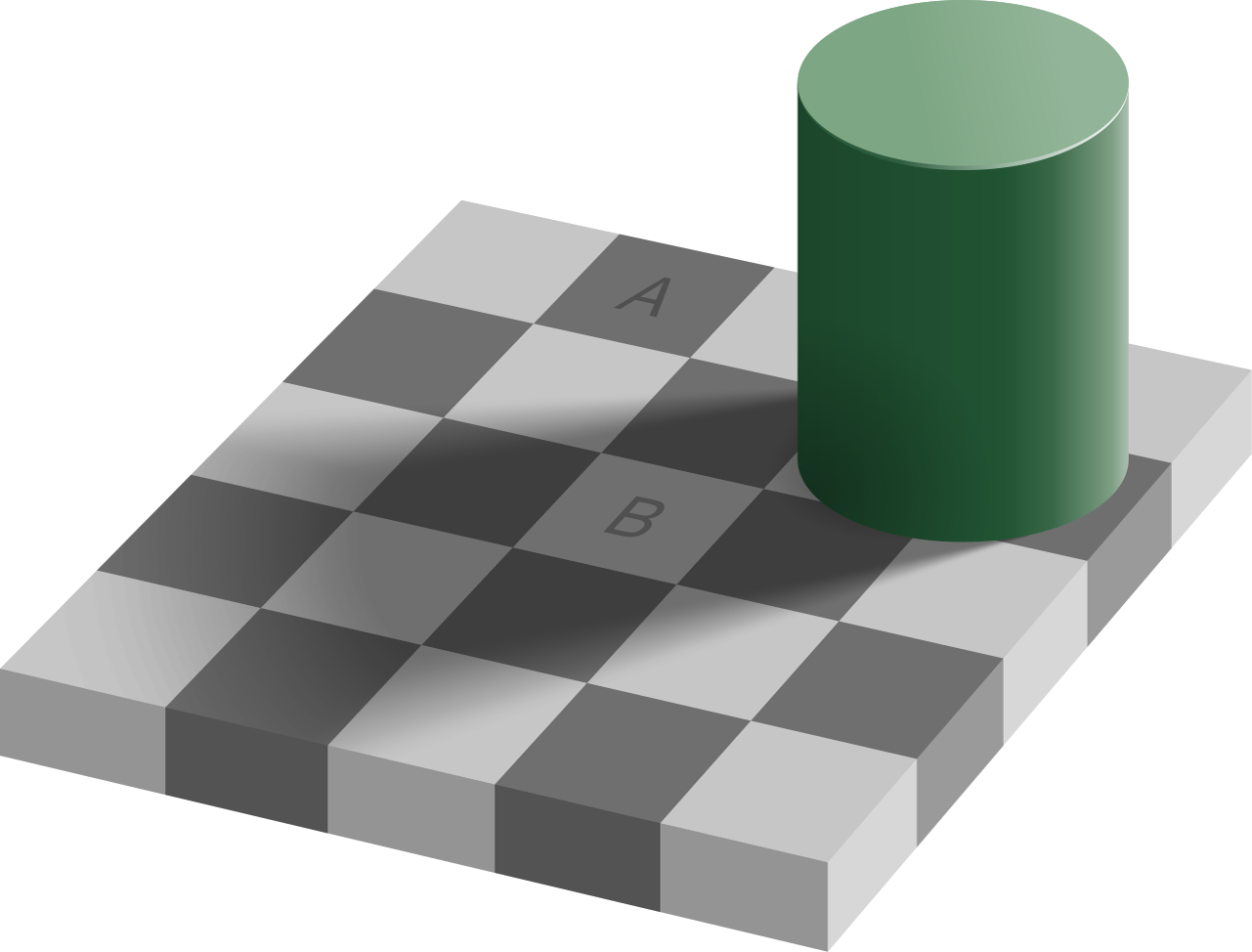
Let us begin by rejecting the notion that in perceiving objects or events, we find invariant forces. To identify these invariant elements, the subject might be tested by masking different subsets of the total forces. However, her responses might vary depending on her previous state. Let’s alter the scenario above so that there is only one agent, A, in the forest, but at different times. Consider the first scenario: agent A, unaware of the presence of a rabbit in the environment, encounters a certain subset of the total forces, such as molecules radiating from the environment, and cannot observe the presence of the rabbit (Quine, Reference Quine1996, pp. 162–163). In the second scenario, the same agent, A, actively searching for the rabbit, encounters the same subset of the total forces and observes the presence of the rabbit. The distinction between these scenarios lies in the agent’s different states of beliefs, moods, etc. One may object that this is not perception but rather inference. Since she is already searching for the rabbit, she considers the subset, which would not typically lead her to observe the presence of a rabbit, as a clue for its presence. However, it’s essential to note that the situation I describe is not an instance of conscious inference. The example does not involve her reporting that she observes the rabbit but only thinking that there must be a rabbit, given the clue. In this example, she reports perceiving a rabbit. At this point, the so-called “inference” can only occur subconsciously. The second scenario might seem like an exception in life rather than the norm. However, in daily life, we frequently encounter similar situations. It’s akin to seeing water while driving in a desert; certain inputs from the environment lead one to believe that there is water on the highway. To illustrate the context dependency of human perception, consider popular images below. In Figure 2, the sizes of the lines depend on the surrounding drawings. Even though both lines are equal, one appears longer than the other. In Figure 3, the colours of the squares depend on the surrounding colours.
Müller-Lyer Illusion. Adapted from “Müller-Lyer illusion” by Franz Carl Müller-Lyer, 1889. Even though two lines are equal in length, surrounding context makes them look unequal. Retrieved from https://en.wikipedia.org/wiki/M%C3%BCller-Lyer_illusion

Checker Shadow Illusion. Despite the appearance of the squares labelled “A” and “B” having different colours due to the context, they are actually the same colour. Retrieved from https://en.wikipedia.org/wiki/Checker_shadow_illusion

Not only is spatial context important, but temporal context also plays a significant role. Depending on our previous state, in Figure 4, we may see a rabbit or a duck. At one moment, we perceive a rabbit; at another, we observe a duck. Let’s suppose two individuals are observing this so-called “Wittgenstein’s rabbit-duck illusion.” Even though they are exposed to the same stimulus field, they process the image differently.
Rabbit-Duck Illusion. Depending on what we are looking for, we may see a rabbit or a duck. Retrieved from https://en.wikipedia.org/wiki/Rabbit-duck_illusion

Far from being exceptional occurrences, such visual illusions — pertaining to depth, length, colour, shape, and more — are fundamental aspects of human cognition. As highlighted by Lothar Spillmann, these illusions represent the brain’s interpretation superimposed upon the raw stimulus. They underscore the brain’s effort to maintain a stable visual environment amid constant changes in perspective, movement, and environmental interaction. Spillman notes, “Without these compensations, we would be seeing images that are out of register and incoherent, preventing us from getting around and ever reaching a target” (Spillmann, Reference Spillmann2009, p. 1509). What do all these examples tell us? In perception, our job is not to find invariant elements and code them as objects, events, situations, etc. Rather, perception is too contextual, dynamic, and inferential to revolve around certain invariant elements. From George Kingsley Zipf’s perspective, ambiguity in perception is adaptational, allowing for the effective utilization of free natural resources, or context (Zipf, Reference Zipf1949, p. 19). Zipf’s point is empirically and computationally supported in recent works (Ferrer i Cancho & Solé, Reference Ferrer i Cancho and Solé2003; Piantadosi et al., Reference Piantadosi, Tily and Gibson2012; Solé & Seoane, Reference Solé and Seoane2015). Furthermore, recent research delves into the role of visual illusions in neurodevelopmental disorders (Gori et al., Reference Gori, Molteni and Facoetti2016) and psychiatric conditions interpret visual illusions as a normal output of the mind, particularly within a Bayesian model of perception that views “sensory inputs as inherently ambiguous” (Notredame et al., Reference Notredame, Pins, Deneve and Jardri2014, p. 8). Interestingly, the ability to resist visual illusions is often associated not with neurotypical individuals but with those experiencing schizophrenia. In summary, perception is much more dynamic than merely identifying an invariant portion of the sensory input affecting the subject, whether this portion is temporal (i.e., a modulus) or not. The same set of forces can be interpreted as different objects depending on our expectations.
Now, let’s transition from a single-agent perspective to a multi-agent scenario. Agents, depending on their previous moods or internal states, may focus on different subsets of the total forces to recognize objects or events. Does perception also depend on the agent? It seems that the answer is yes. Intersubjective variance is a natural consequence of intrasubjective variance. Each agent in the same environment is exposed to forces in an idiosyncratic manner, depending on their location, prior beliefs, exact state of nerve endings, and other factors. There is no guarantee that they are affected by the same set of forces to the same degree. This raises a question: suppose that two agents hear an utterance while sharing an environment. They will attempt to match the utterance with the forces to which they are exposed. However, if my claim above is correct, they will match the utterance with different sets of forces. Does this mean that, according to my argument, communication does not occur?
I believe the answer is no. Wittgenstein’s beetle in the box argument can provide insight into understanding how two agents can communicate without attending to the same parts of the shared environment. If the focused part of reality, or the stimulus on the subject, is dropped from communication, akin to Wittgenstein’s argument, Quine’s naturalistic framework for meaning can address the public nature of meaning. In the next section, I will elaborate on this perspective.
4. Proposal of a New Model
Above, we questioned the notion that meaning involves a subset of the inputs emanating from the environment to the agents. This stance assumes that for two agents to communicate, they must attend to the same portion of the forces and molecules radiating from the shared environment. And this presupposes that meaning is the invariant part of the overall inputs coming from the environment. However, it is not the stimulus that is common to the agents. If the above reasoning is correct, neither is the input from the environment shared. Thus, nothing from the external world — whether inputs or the traces of those inputs on their neural surfaces — is common between the agents.
Alternatively, I propose that intersubjectivity can be better understood by delving deeper into the internal processes of the agents rather than focusing solely on external objects or inputs. While an object-oriented perspective may provide an account of intersubjectivity by assuming that meaning exists externally and is thus publicly available, it is not the only approach. In my view, shared meanings can emerge from the interactions between different agents rather than solely from their relation to external objects. This suggests that intersubjectivity arises from the subject side, highlighting the importance of interaction among agents rather than their indirect connection through external objects.
To note, this approach is an extension of Quine’s combination of stimulus meanings with the idea of pre-established harmony. Stimulus is something idiosyncratic. According to Quine, due to our evolutionary background, we somehow manage to communicate despite the idiosyncrasies of our nerve endings. One mechanism that he mentions in this context is empathy. Here, by “empathy,” I simply mean our ability to understand another’s perspective, even though we are not actually in that perspective. Although we are situated in different positions, a biological capacity allows us to put ourselves in others’ positions. Consider any use of the concept of empathy in real life. For example, we sometimes feel empathy for people in very different socioeconomic situations. In our case, we apply it to a simpler scenario: agents in the same environment feel empathy for other agents who observe that environment from different perspectives and with different backgrounds. Thus, I limit my use of the term “empathy” to this straightforward sense. Quine emphasizes the role of empathy in the process of language acquisition, particularly in the context of a child learning language from their parent. He notes, “In the child’s case it is the parent’s empathy. The parent assesses the appropriateness of the child’s observation sentence by noting the child’s orientation and how the scene would look from there” (Quine, Reference Quine1992, p. 42). This perspective underscores that joint attention and empathy are forms of interaction crucial for language development.
To return to my proposal, in my model, each interacting agent directs their attention to a portion of the shared environment in an idiosyncratic way. However, their interaction ensures that they produce a more simplified, communal content — effectively projecting their private meanings into a shared, intersubjective space.
To start, the alternative picture I propose is simply integrating Wittgensteinian elements into Quine’s neural theory of meaning. We will explore how Wittgenstein’s philosophy can aid in the development of Quine’s naturalist theory of meaning, without delving into the exegesis of either philosopher’s works.
Wittgenstein’s private language argument is relevant to this issue because we are attempting to rescue Quine’s stimulus meaning from being considered private. Wittgenstein offers a crucial insight into understanding what constitutes a private language and how language ultimately becomes public. Initially, he defines a private language as one in which an individual can refer to their personal, internal sensations and feelings, comprehensible only to themselves (Wittgenstein, Reference Wittgenstein and Anscombe1953, § 243). In this framework, for two people to communicate effectively, they must share the same ideas. Otherwise, as John Locke suggests, they may “fill one another’s heads with noise and sounds; but convey not thereby their thoughts, and lay not before one another their ideas” (Locke, Reference Locke and Nidditch1975, Book III, Chapter IX, § 6). Conversely, in line with Quine (Reference Quine and Quine1969a, p. 81), Wittgenstein proposes an alternative notion of meaning in which anything private is irrelevant to the meaning of expressions.
Now someone tells me that he knows what pain is only from his own case! — Suppose everyone had a box with something in it: we call it a “beetle”. No one can look into anyone else’s box, and everyone says he knows what a beetle is only by looking at his beetle. — Here it would be quite possible for everyone to have something different in his box. One might even imagine such a thing constantly changing. — But suppose the word “beetle” had a use in these people’s language? — If so it would not be used as the name of a thing. The thing in the box has no place in the language-game at all; not even as a something: for the box might even be empty. — No, one can “divide through” by the thing in the box; it cancels out, whatever it is.
That is to say: if we construe the grammar of the expression of sensation on the model of “object and designation” the object drops out of consideration as irrelevant. (Wittgenstein, Reference Wittgenstein and Anscombe1953, § 293)
Without delving deeper into Wittgenstein’s later philosophy, we can emphasize that what renders meaning public is not the sharing of designated entities (ideas, sensations, objects, etc.), but rather the language games in which language users participate. In this sense, children’s acquisition of language, or their integration into a linguistic community, is crucial for understanding the dynamics of Wittgenstein’s language games. To elaborate on this point, I will refer to Merril B. Hintikka and Jaakko Hintikka’s interpretation of Wittgenstein’s language games. In their analysis, they delineate two types of language games: primary and secondary.
Primary language games exemplify the natural expressions of a child conveying her sensory experiences, where the relationship between a sensation like pain and its corresponding expression isn’t epistemological but grammatical. This relationship is incorrigible, yet contingent, given that a participant of this game, a child for instance, may lie.
The secondary language game involves a more complex relationship between different language games. Unlike its primary counterpart, a secondary language game is corrigible, inherently carrying the possibility of error. This transition from the spontaneous actions of the primary game to the regulated nature of the secondary game introduces a set of rules. An example of this can be seen when expressing past pain experiences, which introduces criteria of persistence (Hintikka, Reference Hintikka1996, pp. 338–340; Hintikka & Hintikka, Reference Hintikka and Hintikka1986, pp. 279–286).
Now, we can liken the idiosyncratic nerve endings in Quine’s perspective to the Hintikkas’ primary language games. Each language user, on each occasion, is free to associate their idiosyncratic stimulus with an utterance they either produce or hear. Just like the Hintikkas’ primary language games, there is no error regarding the nerve endings of any user. But the question arises: how can we talk about the public use of language if there is no rule for using any expression? In the Hintikkas’ primary language games, we cannot speak of public use because there are no criteria for using expressions in a consistent way. However, secondary language games emerge from mediating primary language games. Since there are criteria for language use in a secondary language game, we can talk about publicness. In other words, corrigible secondary language games can emerge from incorrigible primary language games. Extending the Hintikkas’ derivation of secondary language games from primary language games, I aim to develop a path to the public use of language from idiosyncratic stimulus meanings.
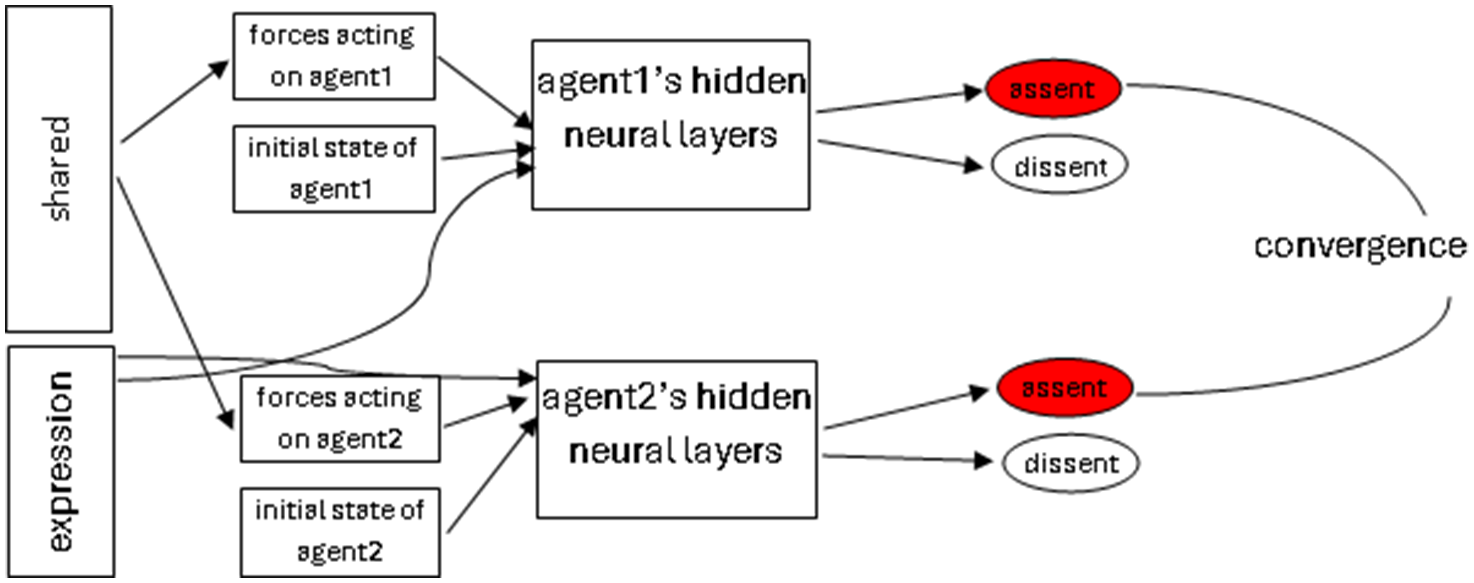
Hence, I propose that Quine’s naturalistic settings can be developed in a Wittgensteinian fashion: since anything private drops out of the communication, linguistic meaning is essentially public. The publicness of meaning evolves from interaction, rather than from sharing some entity like distal objects, stimulus, or a set of impacting forces. Let us now elaborate on how we apply Wittgenstein’s point to Quinean naturalism. First, in Wittgenstein’s example, what is private is the object one has in her mind, and in the Quinean setting, what is private is the stimulus of each linguistic agent, as the problem of idiosyncrasy of stimulus meaning is mentioned above. Consider the scenario where two agents are positioned in a forest where a rabbit is moving behind the tree. Given the expression, “there is a rabbit behind the tree,” both agents assent. Let’s formulate the expression as input e, the stimulus on agents as vectors s1 and s2, and the agents as artificial neural networks which take a vector for the verbal input and another for the molecules radiating from the environment, and give a vector of two which consists of a value for assent and a value for dissent. Even though s1 and s2 are different, and the internal layers of these two neural networks are different, given the verbal input e with stimulus s1 and s2 respectively, these two neural networks process the input in a way that ultimately converges on the same value (see Figure 5). In other words, they both give a higher value to the component of the output vector that represents the assent value.
By being subject to different aspects of the environment, with varying initial states and hidden neural layers, two agents can converge on assenting to the same sentence. Their evolutionary background and interpersonal history, represented through multi-agent reinforcement learning, may facilitate this convergence.

How do these two neural networks converge on assenting even though they are different networks starting with different stimuli? The answer lies in the interaction between these networks. They are trained not only through input-output pairs but also through each other. The reason is that they supervise each other’s behaviour. Without such supervision, convergence would only be a coincidence. Mutual supervision can be understood as providing positive feedback (e.g., rewards) and negative feedback (e.g., punishments). Instead of directly pairing utterances with stimuli, agents update their linguistic behaviour based on this feedback. This approach can be modelled mathematically. By employing multi-agent reinforcement learning, their training involves interaction, updating the parameters in the internal layers such that despite starting with different stimuli, they end up with similar values when using language. In other words, the private part, the stimulus, drops out of the picture.
The reinforcement between these two neural networks corresponds to the normativity in Wittgenstein’s private language argument. If there is only one agent labelling her particular sensation at different times as “S,” then there is no correct or incorrect use of the word “S” (Wittgenstein, Reference Wittgenstein and Anscombe1953, § 258). This violates the normativity of language use. However, in the multi-agent settings I described above, mutual reinforcement between agents gives rise to the normativity of meaning. Here, normativity means that agents follow certain norms when using expressions, as opposed to a normless or “anything goes” approach. A multi-agent reinforcement setting is based on feedback from both the environment and other agents. If an agent receives negative feedback from either the environment or another agent after using an expression in a certain way, they adjust their linguistic behaviour accordingly. This is similar to how children receive negative feedback from their parents or the environment when learning how to behave, encountering the concept of error. The notion of error introduces the concept of a norm. The norm they pursue is the one that results in positive feedback. Thus, due to the presence of both negative and positive feedback, the “anything goes” approach no longer applies.
To sharpen my proposal, let us consider the approach within a multi-agent reinforcement learning setting. For this purpose, I will adapt the framework described in David Simões et al. (Reference Simões, Lau and Reis2019) to my project. In this context, the evolution of communication between two agents can be modelled as a game with two players, each observing only a portion of the environment, denoted as
 $s_t^i$
. Each agent sends messages to the other sequentially, receiving messages from the other agent, denoted as
 $m_t^i$
. Both agents have three possible actions: assent, dissent, or silence. Since this is a reinforcement learning scenario, each agent receives a reward
 $r_t^i$
at each step. Depending on the setting, the agents may receive equal or different rewards. For instance, if there is cooperation between the two agents, they receive the same reward; otherwise, their rewards may differ. The agents act according to the following policy function:
 $a_t^i\;\sim \;\pi _{}^i(a_t^i|m_t^i,\;s_t^i,\;\theta _a^i)$
, where
 $\theta _a^i$
represents the parameters that guide agent i’s actions. Here,
 $\pi $
is the policy function through which the agent chooses what to do. In other words, it governs their linguistic behaviour. In our case, it is the function that determines whether the agent assents or dissents. For example, two agents sharing the same environment may assent to a message m if their respective policy functions compute so:
assent
 $\sim {\pi ^1}{\rm{(}}a_t^1\;{\rm{|}}\;m,\;s_t^1,\;\theta _a^1)$
assent
 $\sim {\pi ^2}{\rm{(}}a_t^2\;{\rm{|}}\;m,\;s_t^2,\;\theta _a^2)$
Even though they encounter different portions of the environment (i.e.,
 $s_t^1$
and
 $s_t^2$
), they both assent to the same message, m.
Now, the question is this: can such models be trained? First, we need a function for both agents such that, given different inputs from the environment and messages from another agent, they produce outputs that are compatible with each other. For a finite number of cases, this function can be constructed by listing all of the desired outcomes for each input observation and input message for each agent. For example, given observation
 $s_t^1$
and message m, agent A produces an assent, while given observation
 $s_t^2$
and the same message m, agent B produces the same response — an assent. If this function is finite, it can already be computed. However, we must consider that the potential number of input and output pairs is likely to be infinite. So, the question becomes: would this function be computable?
Determining whether such a function is computable in the precise mathematical sense is beyond the scope of this article. However, I assume that it is computable, or at least that it can be approximated by a computation. If it is not computable in any sense, then my entire project fails. But if it is computable, the next question is: can we find a way to compute it? Is the example above the right approach to computing such a function? Earlier, I illustrated the agents as distinct neural networks that process inputs from the environment and messages from the other agent. There is a mathematical proof that anything computable by a Turing Machine is also computable by a neural network (Siegelmann & Sontag, Reference Siegelmann and Sontag1992). Therefore, the remaining challenge is to determine how to train these two neural networks using positive and negative feedback, so that they ultimately maximize positive feedback while minimizing negative feedback.
The specifics of the reinforcement learning model described above — such as the number of neurons (parameters), layers, reward function, and observational setting needed to train the agents — are subject for future research. The main point here is to demonstrate that even with partial observations — meaning that two agents do not observe the same parts of the environment — they may still converge on how to use linguistic expressions. In this scenario, the driving force is the rewards the agents receive. I believe this situation closely resembles real-life communication. For instance, consider two people discussing their pains or pleasures, even though each person can only experience their own. Or think of two lovers sharing their unique feelings about their relationship. The better they understand each other’s messages about their emotions, the more reward they derive from their relationship, even though each person experiences their own feelings.
Now, the question is: what is the semantic value in the picture I propose? It is neither the stimulus nor the objects out there, because in the picture I propose, two agents can communicate even though they share neither the same portion of the environment nor the same neural stimulus. My primary aim in this article is to show how language can be used publicly without assuming the same outer objects, forces, molecules radiating from the environment, or identical traces on nerve endings. The above framework addresses that aim. However, we still face the semantic question: what is the semantic value of expressions? Three answers are compatible with my approach.
The first approach is to reject semantic value altogether, meaning we can reject the view that language users encode and decode semantic values during communication (for a similar view, see Gauker, Reference Gauker2003). The second approach suggests that the meanings of expressions are fictional objects constructed by communicators (Rey, Reference Rey2020, p. 333). In other words, these objects do not actually exist, but communicators act as if they do. The third approach posits that the semantic values of expressions are abstract objects. In this view, even a concrete term like “car” is assigned an abstract object as its semantic value. Among these three options, I prefer the last one. Since I cannot thoroughly compare these three views in this article, I will only briefly explain why I do not prefer the first two. Regarding the first view, I find referential semantics, which originates from mathematical logic, is a powerful tool for analyzing natural language expressions, so I do not wish to abandon it. As for the second approach, I believe that entities like tables, chairs, and other objects that language users discuss are real, so I do not consider them fictional. Thus, I am left with the third view.
In the picture I propose, two agents, without sharing the same stimulus or the same molecules radiating from the environment, can still talk about the same objects. I classify these objects as “abstract objects.” They are abstracted from the internal mechanisms of each agent that govern their assenting or dissenting behaviour upon receiving a message (e.g., hearing an utterance). For example, the semantic value of “cat” could be an object abstracted from the set of active neurons or relevant neural organizations in different human beings and at different spatiotemporal positions upon hearing the word “cat.”
To summarize, agents do not need to observe the same things in order to develop a common language. What is required is verbal interaction that may converge on certain patterns. A cooperative game like the one described above is a good example of this. Does this mean that language can emerge without sharing the same local environment? For instance, could we decode the language of a Martian if they intentionally sent us signals? I believe this is possible in a setting like the one described above. In a game-like environment with rewards and punishments, whether cooperative or non-cooperative, we may be able to decode the Martian language. What is needed is systematic feedback. Similarly, using an algorithm like the one I sketched above could help decode it. Whether such an algorithm would successfully decode the language is an empirical question. This empirical question could be explored through computer simulations in future studies that aim to support the general framework I propose here.
Indeed, Quine himself contemplated the alternative direction I propose. He pondered but did not embrace the idea that “The receptors that are triggered on an occasion that prompts a given observation sentence are mostly irrelevant to it. How about locating the subject’s neural intake farther in, at appropriate places within his brain?” (Quine, Reference Quine1993, p. 114). He further observed that the internal neural structures and activities create as much heterogeneity and disunity as the external environmental stimuli, arguing that it’s at the surface receptors where this complex causal chain presents a more coherent cross-section (Quine, Reference Quine1993, p. 115).
In response to this point, I presented a simplified explanation of how public meanings emerge from idiosyncratic entities. The remaining task involves detailing the neural network, such as the number of layers, nodes, non-linear functions, etc., and determining how to update the parameters in the mutual reinforcement process. Therefore, the focus shifts to the empirical aspect rather than the philosophical one. Progress can be achieved through various computer simulations using appropriate data. With a given set of idiosyncratic stimulus vectors, expressions, and assent/dissent vectors, computer simulation can reveal the empirical details. The philosophical insight here is that interaction between different agents creates an interpersonal space where anything private becomes irrelevant. As language users, we do not require any invariant aspect of the external world, sensory envelope, or stimulus to communicate. In Wittgensteinian terms, we do not need beetles. Without sharing entities or labelling forces affecting us, we can converge on assenting/dissenting expressions through interaction.
5. Conclusion
In summation, Quine’s naturalistic semantics, an integral part of his overall naturalist epistemology, assigns two sets of neural stimuli to each observation sentence. The first set encompasses stimuli triggering agent assent upon exposure to the sentence in question, whereas the second set comprises stimuli eliciting dissent. This approach ensures that the relationship between meaning and the agent is not left unexplained and adheres to a causal, naturalistic sequence. Nevertheless, a challenge arises from the inherently idiosyncratic nature of neural stimuli, which can vary substantially among language users. This idiosyncrasy poses a considerable problem for Quine’s assertion of the public nature of meaning.
The more recent solution proposed by Kemp tries to tackle this problem. In Kemp’s theory, the semantic value does not come from the neural stimuli, but from the relevant part of the sensory input to the agent. This seemingly reconciles the need for causal links between meaning and the language user with the public nature of meaning. However, in this article, I lay out my doubts about the sufficiency of Kemp’s approach to account for the dynamic, contextual nature of cognition. In other words, I reject that there are invariant parts in the always-changing sensory input that are same for different users of the same language, which we can consider as meaning. In the last part of the article, I tried to find an alternative to any theory that identifies meaning with a set of effecting molecules or effects on us while still being naturalist. With this purpose, I developed Quine’s naturalist account of meaning under the light of Wittgenstein’s later philosophy in a way that answers the intersubjectivity issue.
Acknowledgements
I am grateful to Jill Flohil, Nancy Salay and two anonymous reviewers for their constructive feedback on this article.
Competing interests
The author declares none.