I. INTRODUCTION
Considering the lack of petroleum, renewable energy sources are critical for the society. For example, gasoline-powered vehicles must be replaced by hybrid or pure electric vehicles in the near future. Therefore, electrical energy storage devices with high energy and power densities, fast recharge rates, and long charge–discharge cycle lifetimes are required. Lithium-ion batteries (LIBs), as the most popular rechargeable batteries, have been considered to be among the most important energy storage devices of the future due to their long cycle life and high capacity.Reference Tarascon and Armand1–Reference Kang, Meng, Bréger, Grey and Ceder3 In the past decades, many researchers have focused their attention on the development of cathode materials for LIBs. However, it still remains a great challenge to enhance capacity and charge–discharge cyclability for most electrode materials.Reference Okubo, Hosono, Kim, Enomoto, Kojima, Kudo, Zhou and Honma4, Reference Jiao, Shaju and Bruce5 LiCoO2 is one of the most attractive lithium battery materials because of its outstanding electrochemical performance in terms of long cycle life and high specific energy density, which has drawn considerable attention for many years.Reference Chen and Grey6 However, the high cost and toxicity have hindered extensive application and driven researchers to turn to other suitable materials. Although LiNiO2 and LiMn2O4 are developing rapidly, they still cannot guarantee the stability of charge–discharge cycle and good electrochemical performance.Reference Li, Cheng, Guo and Chen2 Therefore, researches on positive electrode materials for LIBs are typically focused on LiNixMnyCozO2 (e.g., LiNi1/3Mn1/3Co1/3O2) in an attempt to combine the advantages of the aforementioned materials.Reference Lee, Myung and Sun7 LiFePO4 is also a particularly attractive cathode material for LIBs, because of its low cost, nontoxicity, and safety properties. However, LiFePO4 is a poor conductor of both electrons and Li+ ions, which prevents it from being used on a large scale.Reference Kang and Ceder8 Another candidate, LiV3O8, a layered trivanadate similar to the structure of LiCoO2, is becoming one of the most promising cathode materials, because its layered structure can reversibly insert about 3.8 Li atoms per formula unit.Reference Hui, Juan, Zhang and Jia9–Reference Patey, Ng, Buchel, Tran, Krumeich, Wang, Liu and Novak12
At nanoscale, materials exhibit unique electronic, magnetic, and optical properties that markedly differ from their bulk counterparts because of the surface effect and quantum-size effect, thus having potential applications in many promising fields, such as rechargeable cells and catalysis.Reference Wang, Xie and Li13–Reference Wang, Xu, Wang and Li15 In past decades, with worldwide continuous concern regarding the “nanocrystal” concept and the advanced synthetic techniques for preparation, this area has been greatly developed and exploited. In previous studies, there are a great number of reports involving various morphologies of nanocrystals as cathode materials.Reference Yang, Li, Zhang and Jin16–Reference Liu, Wang, Wang, Wang and Zhou18 The results of these works have shown there is a significant relationship between nanocrystal morphology and the intrinsic chemical properties, which emphasizes the importance of morphology control synthesis of nanocrystals.Reference Liu, Wang, Peng and Li19–Reference Hao, Wang, Zheng and Peng21 What is generally accepted now is the nanomaterials provide a short diffusion pathway for Li ions transport, along with the merits of high specific surface areas, more active intercalation sites, and better accommodation of the strain.Reference Lou, Deng, Lee, Feng and Archer22
To obtain such different morphologies of lithium intercalated materials with nanoscaled and well-ordered structures, a myriad of methods have been invented and applied.Reference Lee, Manesh, Kim and Gopalan17, Reference Liu, Wang, Wang, Wang and Zhou18, Reference Lou, Deng, Lee, Feng and Archer22–Reference Kim, Muralidharan, Lee, Ruffo, Yang, Chan, Peng, Huggins and Cui24 Among them, the hydrothermal synthesis is an effective method. It is reported that LiMnO2 and LiCoO2 could achieve electrochemical performance (about 190 mA·h·g−1) treated with the hydrothermal method. Nanoscaled LiV3O8, however, was far less researched compared with other materials. The traditional method is to use raw V2O5 or NH4VO3 as the vanadium resources, and accomplished by solid-state reaction. But irregular shape and structure as well as low electrochemical performance suggest that they are still needed to be improved in the future. In 2004, Wang and coworkers successfully synthesized LiV3O8 nanorods via a two-step method, which is based on the hydrothermal reaction. A precursor gel was first prepared by a hydrothermal treatment with the mixture solution of LiOH, V2O5, and NH4OH. The gel was then heated at different temperatures in the range of 300–600 °C, leading to the formation of LiV3O8 nanorods.Reference Xu, Wang, Song, Wang, Yan and Yoshimura25 In this work, LiV3O8 nanorods have been prepared using V2O5 nanowires as precursors, which were obtained through a method based on the hydrothermal reaction. Their electrochemical performance was compared with LiV3O8 samples synthesized by the traditional one-step solid-state method using raw V2O5 and LiOH as precursors. Compared with the 2004 article and other papers, the unique feature of the current work is the use of V2O5 nanowires as vanadium resources. The advantage is that the morphology of precursors can be approximatively maintained. Another aim of our work is to confirm shape-dependent electrochemical performance of LiV3O8 electrodes.
II. EXPERIMENTAL PROCEDURE
A. Synthesis of V2O5 nanowires
Under magnetic stirring, 0.01 mol of NH4VO3 was added into 20 mL of deionized water slowly. The solution was initially clear. After formate was added into the solution slowly, the color of the solution turned to bright orange until the pH of the solution reached 2–3. The obtained bright orange solution was then transferred into a 50 mL teflon lined autoclave. The autoclave was sealed and heated at 180 °C for 48 h. After hydrothermal treatment, the solution was air cooled to room temperature. A dark green solution with a mass of deposit was then obtained. The deposit obtained was washed several times with deionized water and ethanol, and air dried at 60 °C to obtain V2O5 powders.
B. Synthesis of LiV3O8 nanorods
We used V2O5 samples synthesized as above to prepare final LiV3O8 products. The obtained V2O5 nanowires were calcined with LiOH (Li:V = 1:3, mol ratio) in muffle furnace at different temperatures in the range of 400 to ~550 °C for 4 h, respectively. After naturally cooling in the furnace, the dark brown products were collected. As a comparative experiment, we synthesized LiV3O8 products via the traditional one-step solid-state method using raw V2O5 as vanadium resources instead of V2O5 nanowires.
C. Characterization
The powder x-ray diffraction (XRD) patterns were recorded with a Bruker (Karlsruhe, Germany) D8-advance x-ray powder diffractometer with monochromatized Cu Kα radiation (λ = 1.5406 Å). The samples were ground and placed on a glass substrate for XRD characterization and the 2θ range used in the measurement was from 10° to 70° in steps of 0.02° with a count time of 1 s. The size and morphology of as-synthesized samples were determined by using Hitachi model H-800 transmission electron microscope (TEM, Tokyo, Japan) and JSM-6301F scanning electron microscope (SEM; JEOL Ltd., Tokyo, Japan). The specimen was prepared as follows: a small amount of product was dispersed in ethanol, then, one drop of the resulting suspension was transferred onto a standard holey carbon-covered copper microgrid and air dried at room temperature.
D. Electrochemical measurements
The electrochemical properties of the LiV3O8 samples were evaluated using coin type cells with lithium metal as the counter electrode. The working electrode was fabricated by mixing the active material, acetylene black, and polyvinylidene fluoride (PTFE) with a weight ratio 80:10:10. The electrolyte was 1 mol/L LiPF6 solution in 1:1 mixture of ethylene carbonate (EC)/diethyl carbonate (DEC) and the separator was Celgard 2500. The cell was assembled in a glove box filled with highly pure argon gas. The galvanostatic charge/discharge experiments were performed between 1.8 and 4.0 V at different current densities. All the tests were operated at room temperature.
III. RESULTS AND DISCUSSION
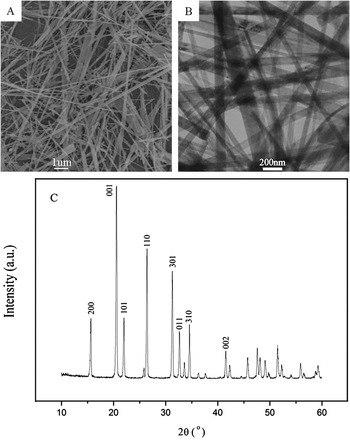
The prepared V2O5 precursors were characterized by SEM, TEM, and XRD. Figure 1(a) displays a panoramic SEM image of the V2O5 nanowires. As seen from the micrograph, the nanowires are 100–200 nm width and 5–15 μm length. The surface of the wires is smooth and flat, suggesting a complete growth of the nanowire under the present hydrothermal condition. The TEM image in Fig. 1(b) gives further support that uniform V2O5 nanowires were produced. Figure 1(c) shows an XRD pattern of the products. It can be observed that all diffraction lines are perfectly in accordance with those in standard JCPDS data of V2O5. The d-spacings in (001), (110), and (301) planes are 4.3 Å, 3.4 Å, and 2.9 Å, respectively. Through the above characterization, we can identify the precursor as pure V2O5.
Characterization of V2O5 nanowire precursors: (a) SEM image; (b) TEM image; (c) XRD pattern.

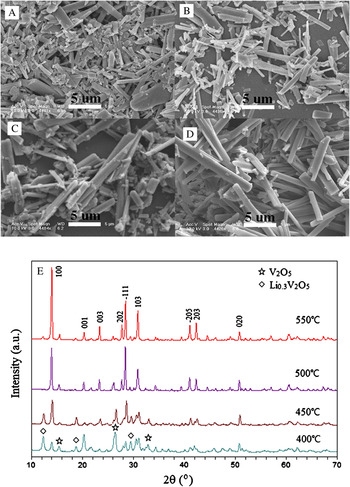
Figures 2(a)–2(d) depict panoramic SEM images of as-obtained final products at different temperatures. The SEM micrographs reveal little difference in the morphology of these samples. It can be observed from the micrographs that the morphology is influenced by heat-treatment temperature. The samples sintered at 400 °C show irregular shapes, indicating they are poorly crystallized. Compared with samples obtained at 400 °C, the products sintered at 550 °C are rod-shaped, consisting of longer rods. With the increase of heat temperature from 400 to 550 °C, the diameter of the rods decreases from 1 to 2 μm to about 200–500 nm while the lengths are diverse in the 5–20 μm range, causing the products to become more slender and crystallized.
SEM images of as-obtained products at different temperatures: (a) 400 °C, (b) 450 °C, (c) 500 °C, (d) 550 °C, and (e) XRD patterns of these samples.

The XRD measurement results of the samples calcined at different temperatures are shown in Fig. 2(e). As marked in the patterns (stars represent peaks of V2O5 and diamonds represent peaks of Li0.3V2O5 according to standard PDF cards), with the sintering temperature increasing, the intensity of peaks of these two kinds of substances gradually disappears. Because the atomic ratio of LiV3O8 (Li:V = 1:3) lies between those of V2O5 (Li:V = 0) and Li0.3V2O5 (Li:V = 1:6.7), it makes sense that the existence of V2O5 and Li0.3V2O5 is due to an insufficiently high temperature. Only when the sintering temperature is higher than 500 °C can most Li ions from LiOH freely diffuse among nanowire V2O5 and be embedded in the aperture wall, so as to refrain from uneven distribution and form lithium vanadium oxides with the exact atomic ratio, that is, Li:V = 1:3. When the temperature increases to 550 °C, the stronger intensity of peaks and the narrower full width at half-maximum intensity indicate that the crystallinity of the LiV3O8 samples become higher. Most of the diffraction lines can be attributed to LiV3O8, while, particularly, the strongest peak appeared at 13.897° implies oriented growth of the LiV3O8 sample. According to the research of West et al.,Reference West, Zachau-Christiansen, Skaarup, Saidi, Barker, Olsen, Pynenburg and Koksbang26 the high intensity of the (100) peak indicates that the dimensions of the crystallites in the (100) plane are considerably larger than that in the out-of-plane directions, leading to relatively long diffusion paths for the lithium ions inserted between these planes.
It has been demonstrated by several researchers that the morphology plays an important role in electrochemical performance of electrodes.Reference Kim, Muralidharan, Lee, Ruffo, Yang, Chan, Peng, Huggins and Cui24, Reference Xiao, Wang, Wang, He, Peng and Li27, Reference Wang, Ma, Wang, Wang, Wang, Zheng, He, Li, Peng and Li28 The intercalation process of Li+ ion between different layers of the cathode is a diffusion process. The larger grains and lower specific surface area that would lead to a long path for Li+ ions’ transfer, hampers the progress of intercalation. Therefore, the LiV3O8 nanorods should have better electrochemical performance compared to samples obtained by a traditional process.
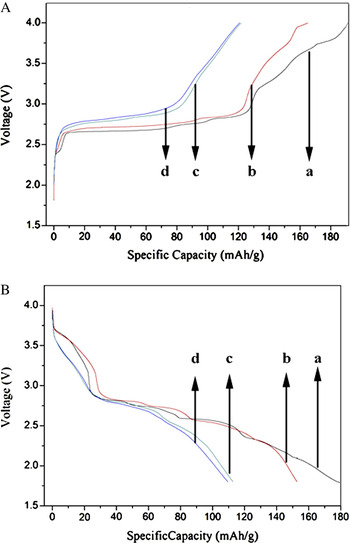
The first charge–discharge curves of LiV3O8 products obtained at different temperatures are illustrated in Fig. 3. According to the literatures,Reference Pistoia, Pasquali, Tocci, Moshtev and Maner29–Reference Kawakita, Miura and Kishi31 over three equivalents of Li+ ions can be inserted/extracted in LiV3O8 reversibly because of both the outstanding structure stability and empty sites for Li+ ion occupation between the layers. The lithium insertion reaction of Li1+xV3O8 can be described as three steps composed of a single-phase reaction for the range 0 < x < 2.0 in Li1+xV3O8, a two-phase reaction for 2.0 < x < 3.2, and a single-phase reaction for 3.2 < x < 4.0. In Fig. 3(A), the charge capacity of LiV3O8 nanorods obtained at 550 °C is 192.9 mA·h·g−1, which is higher than that of the LiV3O8 sample (117.3 mA·h·g−1) synthesized via the traditional solid-state method at the same temperature. In Fig. 3(B), the discharge capacity of LiV3O8 nanorods obtained at 550 °C is 179.7 mA·h·g−1, which is much higher than that of LiV3O8 sample (111.2 mA·h·g−1) prepared by the traditional solid-state method at 550 °C. Therefore, it is cogent to infer that the product with a small radius and rodlike structure has higher specific capacity, which also conforms to the previous consequence that there is a significant relationship between material’s morphology and its electrochemical performance.
First (A) charge–(B) discharge curves of samples prepared under different conditions: products obtained at (a) 550 °C and (b) 450 °C using V2O5 nanowires as vanadium resources; products obtained at (c) 550 °C and (d) 450 °C via the traditional solid state method using raw V2O5 as vanadium resources.

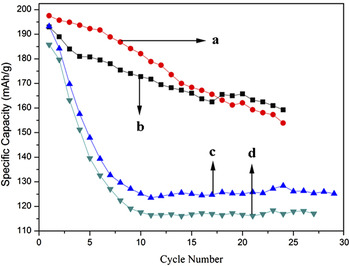
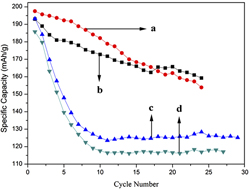
Discharge capacity versus cycle number plots of samples obtained at 450 and 550 °C are shown in Fig. 4. The initial specific discharge capacity of the LiV3O8 obtained at 550 °C is 193 mA·h·g−1, and after 20 cycles it is 168 mA·h·g−1. The products obtained at 450 °C have the highest initial discharge capacity, but the cycling stability is worse than the products obtained at 550 °C. According to the XRD results, this phenomenon is due to the insufficient synthesis of the LiV3O8 at 450 °C. Because the intercalation process of Li+ ions between the layers of the cathode is a diffusion process, the form of aggregation and the size of the products will undoubtedly play a critical role in the initial capacity, while their crystal shape seems to be the key factor influencing the cycle performance.Reference Jouanneau, Verbaere, Lascaud and Guyomard32 LiV3O8 nanorods obtained at 550 °C have better crystallinity and a slender well rodlike morphology, thus it is beneficial to maintain much higher specific surface area and to promote the transfer of Li+ ions, which allow the sample to acquire higher specific discharge capacity. Furthermore, after cycling, the shape of LiV3O8 nanorods with smaller diameters can be nearly kept unchanged. Such results incited us to synthesize well rodlike LiV3O8 samples to realize its considerable applications as a cathode material with wide developing prospect in the field of rechargeable lithium batteries.
Discharge capacity versus cycle number plots of samples prepared under different conditions: products obtained at (a) 450 °C and (b) 550 °C using V2O5 nanowires as vanadium resources; products obtained at (c) 550 °C and (d) 450 °C via the traditional solid state method using raw V2O5 as vanadium resources.

IV. CONCLUSION
In summary, we synthesized LiV3O8 nanorod materials using V2O5 nanowires as precursors. Electrochemical measurements show that LiV3O8 powders with slender rodlike morphology displayed a superior electrochemical performance compared to that of LiV3O8 materials synthesized via the traditional solid-state method using raw V2O5 as vanadium resources. Furthermore, the results also demonstrate that the heat-treated temperature has a significant effect on the morphology, crystallization, and specific surface area of the samples, which consequently affects their electrochemical performance. Nanorods with one-dimensional electronic pathways facilitate charge and electron transport, and could potentially improve the electrode-filled ratio. We believe that one-dimensional nanostructured materials have great potential applications in the battery electrode materials area.
ACKNOWLEDGMENTS
This work was supported by NSFC (20921001, 90606006) and the State Key Project of Fundamental Research for Nanoscience and Nanotechnology (2006CB932300).