Introduction
Protein disulphide isomerase (PDI) catalyses the formation and isomerization of disulphide bonds in nascent proteins targeted to the endoplasmic reticulum. Different studies on its expression and intracellular localization in wheat and maize (Shimoni et al., Reference Shimoni, Zhu, Levanoy, Segal and Galili1995; Li and Larkins, Reference Li and Larkins1996), as well as the characterization of the rice esp2 mutant that lacks PDI expression (Takemoto et al., Reference Takemoto, Coughlan, Okita, Hikaru, Masahiro and Tohihiro2002), suggest that PDI is involved in regulating the folding of seed storage proteins and their deposition into the protein bodies of the endosperm. Wheat storage proteins are synthesized in the developing endosperm cells and targeted to their endoplasmic reticulum lumen, wherein they are folded and connected by intermolecular disulphide bonds to form large aggregates (Shewry and Tatham, Reference Shewry and Tatham1997), whose molecular weight is directly related to higher dough elasticity and better technological quality. Even though wheat storage proteins have been the object of a wide range of studies both at chemical and at genetic levels (reviewed by Shewry et al. (Reference Shewry, Halford, Tatham, Popineau, Lafiandra and Belton2003, Reference Shewry, Underwood, Wan, Lovegrove, Bhandari, Toole, Mills, Denyer and Mitchell2009)), knowledge of factors affecting their folding and deposition is still extremely limited. The genomic and complementary DNA sequences of three PDI homoeologous genes located in the chromosomes 4A, 4B and 4D of bread wheat cv. Chinese Spring (CS) and their putative promoters had been cloned and sequenced previously (Ciaffi et al., Reference Ciaffi, Paolacci, d'Aloisio, Tanzarella and Porceddu2006). The three genes showed a very high sequence conservation in the coding region and their exon/intron structures, which consisted of ten exons. The putative promoter sequences of the three genes shared some regulatory motifs involved in endosperm-specific expression; consistently with this observation, expression analysis of the three homoeologous PDI genes showed the constitutive presence of their mRNAs in several wheat tissues, but the expression level was much higher in developing caryopses. This study reports the isolation and characterization of a ~700 bp region, comprising ~600 bp of the putative promoter sequence and 88 bp of the first exon of the PDI gene from wild diploid relatives of wheat, Triticum urartu (AA), Aegilops speltoides (BB) and Aegilops tauschii (DD).
Materials and methods
A total of 15 accessions, five each from T. urartu (AA), A. speltoides (BB) and A. tauschii (DD), were used in this study. A total of 120 plants (8 plants/accession) were grown and analysed. Flag leaves were collected at heading stage from plants grown in green house (January–June 2008), immediately frozen in liquid nitrogen and kept at − 80°C until use. About 200 mg of leaf tissue were ground in liquid nitrogen, and genomic DNA was extracted using Sigma Gen Elute Plant Genomic DNA Kit (G2N-350; Sigma Aldrich, St. Louis, MO, USA). F2 (5′-ACTCCAAATTTGGAACGGG-3′) and R1 (5′-GGTGAGCACTGCCTCGGG-3′) primers were chosen to amplify the genomic DNA, and amplification products were directly sequenced. Sequences were analysed in Chromas version 2.3 (http://technelysium.com.au/chromas.html) to identify any unresolved bases and subjected to visual inspection. Multiple sequence alignment was performed with Clustal X software version 2.011 (Larkin et al., Reference Larkin, Blackshields, Brown, Chenna, McGettigan, McWilliam, Valentin, Wallace, Wilm, Lopez, Thompson, Gibson and Higgins2007), International Union of Biochemistry as DNA weight matrix with default parameters. Haplotype diversity, polymorphic sites and evolutionary relationship were calculated using DnaSP v5 software (Librado and Rozas, Reference Librado and Rozas2009). Sequences were then searched for regulatory elements in PlantCARE (http://sphinx.rug.ac.be:8080/PlantCARE/), a database of plant promoters, and PLACE databases (http://www.dna.affrc.go.jp/htdocs/PLACE/; Higo et al., Reference Higo, Ugawa, Iwamoto and Higo1999).
Results and discussion
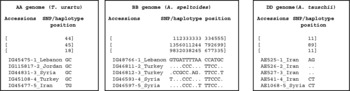
Analysis of the 120 sequences revealed that there was no variability among plants within accessions, thus a total of 15 sequences one from each accession were further analysed and compared with the three homoeologous sequences from CS (GPDI-4A, AJ868102; GPDIA-4B, AJ868103; GPDI-4D, AJ868104; Ciaffi et al., Reference Ciaffi, Paolacci, d'Aloisio, Tanzarella and Porceddu2006). The alignment of the five sequences derived from the accessions of T. urartu revealed the presence of two haplotypes: one common to the accessions from Lebanon, Turkey, Jordan and Syria and the other characteristic of the accession from Iran; in total, two variable sites were identified (Fig. 1). Both cases involved transversions (G–T and C–G). Haplotype diversity (Hd) was 0.400. This high level of conservation of PDI gene promoter in the proximal region of T. urartu may reflect its important function or the effect of a bottleneck. The alignment of the five sequences from A. speltoides revealed a higher number of polymorphic sites and the presence of five haplotypes, each characteristic of one of the five analysed accessions. Out of the 16 identified single nucleotide polymorphisms (SNPs), whose positions are reported in Fig. 1, ten were transitions (A–G and C–T) and six were transversions (A–C, A–T, G–C and G–T); moreover, one Indel at position − 7 bp from the ATG was also identified. Hd was 1.000. The number of polymorphic sites found in A. speltoides was thus higher than in T. urartu, consistently with its partial outcrossing nature. Finally, the alignment of the sequences from the five analysed accessions of A. tauschii (DD) revealed the presence of only two haplotypes, one common to three out of the four analysed accessions from Iran and one shared by accession number AE541-4 from Iran and the accession from Syria (Fig. 1). In total, only two variable sites were identified (Fig. 1), both of which were transversions (G-T and C-G). Hd was 0.600. The presence of fewer polymorphic sites is probably partially due to self-fertilizing nature of the species (Dvorak et al., Reference Dvorak, Luo, Yang and Zhang1998) and partially to the lower level of overall diversity present. The 15 sequences were further compared with their counterparts described previously in bread wheat cv. CS (Ciaffi et al., Reference Ciaffi, Paolacci, d'Aloisio, Tanzarella and Porceddu2006), and the percentage of nucleotide identity is reported (Supplementary Table S1, available online only at http://journals.cambridge.org) Furthermore, the evolutionary relationship between the 18 sequences, five sequences each from T. urartu, A. speltoides, A. tauschii and the three homoeologous sequences from the bread wheat cv. CS, was investigated (data not shown). The sequences from A. speltoides (BB) closely clustered together with that located on chromosome 4B of CS, those from A. tauschii (DD) with that on 4D and those from T. urartu (AA) with that on 4A.
SNP positions identified in the ~700 bp amplicon comprising the partial PDI promoter sequences and partial first exon from T. urartu (AA), A. speltoides (BB) and A. tauschii (DD). Dots denote consensus sequences.

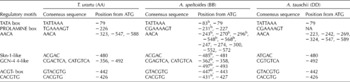
All sequences were further searched for regulatory elements in two databases, PlantCARE and PLACE. Several regulatory elements, among which many involved in endosperm-specific expression, were identified. The TATA box, a cis-regulatory element found in the promoter region of many eukaryotic genes and considered as the core promoter sequence, was identified at position − 79 from the ATG (Table 1). The combination of four motifs, namely GCN-4 motif, prolamine box, AACA and ACGT box, seems to be a minimal requirement for endosperm-specific expression (Wu et al., Reference Wu, Suzuki, Washida and Takaiwa1998, Reference Wu, Washida, Onodera, Harada and Takaiwa2000). All four motifs were identified in the putative PDI promoter sequences analysed. Furthermore, the Skn-1-like motif, an additional motif that together with ACGT and the prolamine box modulates the level of endosperm-specific expression, was also identified. The presence of these regulatory motifs is consistent with the higher PDI expression found in developing caryopses with respect to other tissues (Ciaffi et al., Reference Ciaffi, Paolacci, Dominici, Tanzarella and Porceddu2001). The regulatory elements are identified, and their consensus sequence and position are reported (Table 1). The present study revealed a high level of conservation of regulatory elements conferring endosperm-specific expression between sequences from CS and those isolated in this study. Further studies should involve large number of accessions as well the characterization of the proximal and distal ends of the typical PDI promoter in diploid and tetraploid progenitor from diverse geographic origin of the world.
Regulatory motifs identified in the ~700 bp amplicon comprising the partial protein disulphide isomerase promoter sequences and partial first exon from T. urartu (AA), A. speltoides (BB) and A. tauschii (DD)a

NA, not applicable.
a Their consensus sequence and position are also reported.
b The position of motifs for IG48766-1.