The immigration of Muslims to Germany introduced elements of Islamic law that do not have counterparts in the German legal tradition. The institution of dower, referred to in Islam as mahr, is one example of the resulting legal side effects of migration. The present article was written in the context of the research project Understanding Property in Muslim Transitional Environments (PROMETEE) at the Erlangen Centre for Islam and Law in Europe (EZIRE).Footnote 1 We look at mahr as part of Islamic family law and in the context of marriage from three different perspectives: (1) the complexity of changes that the emergence of Islam has brought to the modalities of marriage and property allocation associated with it; (2) the associated sociological implications with regard to the family; and (3) the complexities of addressing mahr in a country such as Germany, in which family law is not shaped by Islamic tradition. This is especially important in cases of divorce.
Following an introduction to the typology of marriage-related property transfers that allows us to classify the Islamic custom of dower, we explore mahr's development and functions. An outline of the social changes brought about by the rise of Islam and their impact on gender relations and property rights is then given. A closer look at the property transfers related to dower and their possible impact on marriage follows. Such an approach casts a new light on the social and economic functions of dower. The article will explore how German law and jurisdiction conceptualize and address a legal concept alien to their system. The example of Morocco is used to illustrate how elements of shariʿa-related family law surrounding dower found their way into national codified law. In the conclusion, we summarize the value of applying multidisciplinary approaches to this topic, and point to further avenues for research.
Marriage-Related Property Transfers: An Overview
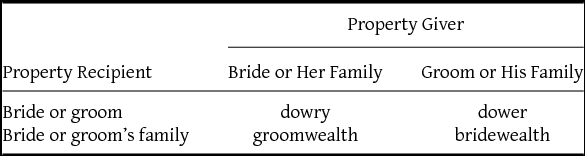
To distinguish between different types of property transfers at the beginning of a marriage, sociologists usually refer to the system proposed by Spiro (Reference Spiro1975), which uses the categories of dowry, dower, bridewealth, and groomwealth to distinguish the types of property transfers. Dowry and groomwealth flow from the family of the bride; dower and bridewealth from that of the groom. Another distinguishing feature is whether the payments are made directly to the married couple or to their families. In the latter case, the property often represents an offer to the family submitted prior to their agreement to the match. In the case of dowry and dower, the couple or one of the partners is the beneficiary. Bridewealth and groomwealth go to the families of the spouses (see Table 1).
Types of marriage-related property transfers, after Spiro (Reference Spiro1975)

Spiro's system has become the standard for several reasons. First, his typology provides systematic criteria to differentiate between cultural practices. This allows a more precise record of customs across different societies. Second, it represents a structured point of departure from which to identify the determinants of the different types of marriage-related property transfers and thus contributes to explaining these practices.
According to Spiro (Reference Spiro1975), the category of groomwealth has no empirical validity. It was not observed at the time of Spiro's fieldwork, nor has it been since. However, before Spiro's typology was developed, the prevalence of the dower had been systematically underestimated (Spiro Reference Spiro1975). Although dowry and bridewealth are still considered the most widespread forms of property transfer in the context of marriage, dowers are far more common than previously thought. Because it is paid by the groom or his family to the bride, mahr is a special form of dower. Literature in the field often portrays it as the only empirically observed form of dower.Footnote 2
The development and retention of a particular type of marriage-related property transfer in a society can be explained using a number of criteria. Economic conditions play a major role. The functional specification of “price” in a great deal of anthropological and sociological literature has proven fruitful for theory development (e.g., Becker Reference Becker1993, Papps Reference Papps1983, Anderson Reference Anderson2007).
One criterion is the value a woman is considered to add to a household (Papps Reference Papps1983). In a society in which women play an important role in the economic survival of the household, a dower or bride price is more likely to be required (Hill and Kopp Reference Hill and Kopp2006). This is most often the case in small, tribal societies in which families survive by subsistence agriculture (Anderson Reference Anderson2007). Dowries tend to predominate in complex societies with a high degree of division of productive labour and social stratification. This is closely tied to the idea that the marriage market, like other markets, is regulated by supply and demand (Becker Reference Becker1993). Marriage markets in societies in which women are a scarce resource owing to their important contribution to a household's prosperity are more likely to develop the custom of paying dower or bride price.Footnote 3 In societies in which marriage ensures a woman's ability to secure her economic future and social position, and in which grooms who meet these criteria are scarce, marriage-related property transfers are more likely to match the dowry type (Botticini and Siow Reference Botticini and Siow2003).
Mahr as a Pre-Islamic Practice and Innovative Changes through Islam
Social transformation processes had already begun on the Arabian Peninsula before the rise of Islam, but the expansion of the new religion also had broad societal impact. Several factors need to be emphasised: One of the most striking changes is that the religiously promised egalitarianism within the Muslim community was to be implemented through legal means. The speed of the political expansion beyond the geographic boundaries of the Arabian Peninsula also presented many organizational, political, and practical challenges to the process of building and solidifying the new political and social structure. Finally, it was necessary to engage constructively with the structures and traditions found in conquered territories while placing Islamic tenets at the core of the new social order (Watt and Welch Reference Watt and Welch1980, Esposito Reference Esposito1982). This explains the extremely dynamic nature of social, political, and economic development in the first centuries of Islam.
The legal schools whose emergence and differentiation was part of this dynamic process played an important role in structuring the new order. They were characterized by local practices and living traditions as well as the doctrine developed by a teacher and carried on by his students. Their emphases in terms of hermeneutic approaches and their different understandings of legal source texts reflected the cultural and social context of their environments (see Takim Reference Takim and Suad2005). Without this ability to creatively combine extant structures and practices with the innovations introduced by Islam, classical Islamic law could hardly have had the impact it did.Footnote 4
Prior to the rise of Islam, the bridewealth, a practice common in many tribal societies and also recorded as a custom of the ancient Israelites (Motzki Reference Motzki and McAuliffe2001), was commonly handed over to the bride's father or guardian and remained with her birth family. In pre-Islamic sources (e.g., Arabic poetry), it is referred to as mahr. In this form, it is usually interpreted as a form of compensating the family for the loss of a daughter's productive labor, since Arab tribal society was not only patrilinear but also patrilocal. The bride herself occasionally received a smaller present (ṣadāq), which might be as small as a few dates (Spies Reference Spies1991).
A marriage was only considered legally contracted when the bridewealth stipulated in the marriage contract was paid in full. Thus, payment was of constitutive importance for marriage (Papps Reference Papps1983, Anderson Reference Anderson2007). Relationships that did not involve payment of a bridewealth were considered concubinage. This function of the bridewealth, as evidence of the legitimacy of a marriage, was adopted into the customs of the emerging Islamic community.
One important contribution Islam made to the re-ordering of an Arab society defined by tribal structures was to rewrite the rules for relationships between the men and women. This went hand in hand with a shift in property transfer. Generally, the position of women and girls was considerably improved through, for example, the prohibition of female infanticide, changes in marriage customs, and the fact that female relatives could now inherit defined shares of their family's wealth.Footnote 5 The new Islamic marriage prescription abolished Levirate marriage (a dead man's brother's obligation to marry his widow if the decedent had no son), legally required a marriage contract, and instituted the dower to which the wife had sole legal claim independent of her husband (cf. Qurʾan 4:24, 4:3, 4:25, 5:5, 9:10, 4:20). The independent nature of this property claim is evident from the fact that it was not to be used to furnish the shared household. This allowed a wife to hold property to which her husband or other male relatives had no (legal) access. In the event of a divorce or her husband's death, it passed into her property. That distinguishes it from non-Islamic forms of dower.Footnote 6
Islamic Dower (Mahr) and Its Characteristics
The Qurʾan uses different terms to refer to dower: ajr (reward, wage, payment), farīḍa (religious obligation), and ṣaduqa (nuptial gift). This is likely done to distinguish the innovative practice from the pre-Islamic institution of mahr. In the Qurʾan itself, this term only occurs occasionally (Motzki Reference Motzki and McAuliffe2001). The early writings of fiqh use the word ṣadāq (Motzki Reference Motzki and McAuliffe2001). The fact that most European literature on the topic nonetheless uses the term mahr can only be pointed out in passing here.Footnote 7
The dower custom initiated by Muhammad and the Qurʾan, and gradually established in society and in law, had an impact in the legal sphere and beyond. Legally, it created a set of standardized forms of dower: mahr muqaddam is payable immediately, while mahr al-muʿajjal and mahr al-muʾakhkhar may be deferred. An agreed part is usually paid on consummating the marriage, with the remainder payable at a later date (Rohe Reference Rohe2011). The sources agree that the dower must be paid to the wife in its entirety after the marriage has been consummated. In practice, we often find some form of deferred mahr with only a symbolic payment made in order to alleviate the financial burden on the husband, but the principle stands (Rohe Reference Rohe2011).
This connection between the consummation of marriage and the payment of the dower has given rise to speculation—especially prevalent in Islamic studies—that the husband acquired the right to his wife's marital duties through the payment of the dower and other economic obligations such as maintenance, clothing, and medical care.Footnote 8 However, a closer look at formal aspects of the marriage contract and the dower stipulated in it yields a different reading. From a philological perspective, a marriage contract is an agreement of exchange (muʿāwaḍa). Therefore the conclusion that this makes it equal to a sales contract in which the dower is exchanged for something of equal value (sexual access) seems convincing. However, an argument developed from the perspective of Islamic law would caution that Islamic law has no general theory of contract and therefore relies on model contracts such as a sales contract for guidance. In other words, the “link to the sales contract does not reflect the nature of the mahr being a sale or leasing contract of the female sexuality, but is owed to the structure of Islamic contract law” (Yassari Reference Yassari, Mehdi and Nielsen2011a, 196).
One might object that other rules in connection with the dower do provide evidence of such a link to marital sexuality. For example, a wife who is divorced before the marriage is consummated or because the marriage is invalid only receives half the stipulated sum. However, such regulations do not consistently indicate such a link because the wife can claim the full sum in the event of the husband's death before consummation. Although a wife may refuse her conjugal duties while the stipulated dower remains outstanding, the husband has no corresponding legal recourse to demand them once it has been paid (Yassari Reference Yassari, Mehdi and Nielsen2011a).
The Qurʾan is silent on the value of the dower except for 4:20. Whether the qinṭār (unit of weight, differing locally) mentioned there should be considered a median value applicable among wealthy families or a very large sum cannot be reconstructed from the sources (Motzki Reference Motzki and McAuliffe2001). However, the sunna of the Prophet allows us some conclusions as to what a customary dower might have been in the Arabian Peninsula of the eighth century CE. We find, for example, mention of an ounce of gold, ten wuqiyya (unit of weight, differing locally), and a bowl or iron ring. Even after the emergence of the legal schools, we find no concrete figures stipulated, only occasional references to a minimum amount that reflects the economic context of the respective legal school's geographic reach (Spies Reference Spies1991).
Mahr and Its Social and Economic Functions
Giving the wife claim to her dower went hand in hand with a re-evaluation of the role and status of a bride. Women were accorded legitimate economic needs and rights that extended to a measure of financial security in the event of a divorce. This was no insignificant step but rather must be seen as an almost radical innovation in the early period of Islam, a time when no legal provision existed for supporting a woman after the end of a marriage. This security was also (and continues to be) important in the event of a husband's death, since agnatic inheritance rules stipulate a childless wife is only entitled to one-quarter of her husband's inheritance (Yassari Reference Yassari, Mehdi and Nielsen2011a).Footnote 9
These economic aspects illustrate the function of mahr in terms of providing economic support and security. From these emerges a social function: to provide a secure social position for women. For example, a deferred mahr is considered a means of protecting a wife against arbitrary divorce by her husband, as he would be liable to pay the full amount in that event (Siddiqui Reference Siddiqui2007, Wurmnest Reference Wurmnest2007). A wife can also use her mahr to put pressure on a husband who wishes to take a second wife (Mehdi and Nielsen Reference Mehdi, Nielsen, Mehdi and Nielsen2011, Esposito Reference Esposito1982, Yassari Reference Yassari, Mehdi and Nielsen2011a). These examples refer to the effect of mahr on the power structure inside a marriage and could be considered a bargaining tool (Fredriksen Reference Fredriksen, Mehdi and Nielsen2011; on models of negotiation in family sociology, see Abraham et al. Reference Abraham, Auspurg and Hinz2010).
Beyond that, further functions of mahr can be observed, although with different emphasis according to the context: Mahr symbolically corresponds (as does a wedding ring) to the binding nature of the promise of marriage (Yassari Reference Yassari, Mehdi and Nielsen2011a, Papps Reference Papps1983). Furthermore, the payment can be regarded as an expression of esteem for the bride (Yassari Reference Yassari, Mehdi and Nielsen2011a). Depending on the amount of mahr stipulated in the marriage contract, it can be a source of social prestige. Finally, mahr may be considered evidence of a particularly religious lifestyle (Mehdi and Nielsen Reference Mehdi, Nielsen, Mehdi and Nielsen2011).
A Concept Unknown to German Law
The complexity of mahr as a legal concept becomes evident when it is transplanted into legal contexts in which family law is not governed by Islamic tradition. In German jurisprudence and legal science, mahr (frequently referred to as Brautgabe or Morgengabe in German legal literature) has been studied with two approaches: private international law and national civil law. This is primarily because German law does not provide specific rules for dealing with dower contracts of any kind, either in private international law or in national family law. It is obvious that this is liable to cause difficulties: Courts that are called on to judge a conflict must apply a legal concept for which no legislation provides either concrete regulation or guidance. They are thus reduced to applying general principles. It was initially unclear which rules would apply, although by now, more or less viable working hypotheses have emerged for use in both private international law and domestic civil law.
Mahr Incorporated in Contemporary Islamic Law
It may seem surprising that German courts are called on to judge mahr cases at all. This has come about in two ways. On the one hand, the growing number of Muslim immigrants living in Germany since the 1960s and 1970s has resulted in couples who have agreed to a dower when marrying in their country of origin and then appealed to a German court to resolve a conflict at a later date. In such cases, they are often no longer dealing with the institution of classical Islamic law. As national legal systems emerged across the Muslim world (Otto Reference Otto and Otto2010), concepts from classical Islamic law were incorporated into national legislation. Emerging (nation) states thus appropriated institutions of Islamic law and integrated them into their specific legal systems. In the course of this process, the dower also became part of the national laws of most Muslim countries. We find regulations inspired by classical Islamic law in the family laws of Muslim states across the Arab world and beyond (with the exception of Turkey, which modelled its family law after the Swiss pattern). This transfer of a classical Islamic legal concept into modern (statutory) law marks an important turning point for the legal system: The object of legal application must now be the rule of the requisite formalized national family law.
Where German courts are called on to judge in mahr disputes, they look at the specific form this legal institution took in a specific set of positive national laws. That this transformation was not uniform is obvious. This is due in part to the lasting influence of different schools of Islamic jurisprudence, but also to the changing relationship between political and religious authorities and the political (and legal) orientation of governments. Also, these changes were shaped by the tension between a continuing dedication to conservative religious values and the need to adapt to new socio-economic conditions (Vikør Reference Vikør2005, Otto Reference Otto and Otto2010).
In Moroccan law, for example, the codification of the mudawwana Footnote 10 of 1958 marks the incorporation of Islamic legal concepts into a national statutory law system.Footnote 11 Developed by ten legal scholars under the influence of the locally dominant Maliki school shaped by the Egyptian jurist Khalīl bin Ishāq al-Jundī (d. 1365), this law code represented an important step toward national and legal unity following the country's independence from France in 1956. While the 1958 version still closely followed traditional (Maliki) doctrine with little innovation, its reform in 2004 (Law No. 70–03)Footnote 12 represented a further step toward modernization.
The relevant rules on dower known as ṣadaq (the official version of the law is in Arabic) are found in the first book (on marriage), in chapter 2 (on dower) of Title 2. They stipulate that a marriage may only be concluded if no intention or agreement to exclude the dower is present (Art. 13 No. 2). The law emphasizes its ideal and symbolic importance and sets no limitations to its nature: Anything that constitutes a source of legal commitment can serve as a dower (Art. 28 sentence 1). The amount is specified in the marriage contract (Art. 27 paragraph 1, Art. 67 No. 7), with the law specifically recommending a modest amount (Art. 28 sentence 2). Where no agreement on the amount exists after the marriage has been consummated, this will be set by a court taking into account the social backgrounds of both partners (Art. 27 paragraph 2). The dower is the wife's to do with as she wishes, and the husband has no right to demand any part of it to contribute to household furnishings (Art. 29). The time of payment may be agreed between the spouses. Payment of a partial or full amount may be stipulated for the beginning (or the end) of the marriage (Art. 30).
Different Regulatory Contexts
Migration can lead to German courts being asked to apply such laws. This has proved to be a challenge not only because German law does not provide for the concept as such, but also because its regulatory context is different in the case of marriage and divorce (Gernhuber and Coester-Waltjen Reference Gernhuber and Coester-Waltjen2010, 350–474; Schwab Reference Schwab2014, 88–151). These differences contribute greatly to the difficulty German jurists have with categorizing the institution. The issue is one of matrimonial property rules (Güterstand) and alimony claims (especially after a marriage is dissolved). Matrimonial property rules govern the property rights of spouses vis-à-vis each other. In Western legal tradition, they are free to choose one of several options, although they differ in detail according to national jurisdiction. The range covers everything from property held entirely in common (universal community of property, so-called Gütergemeinschaft) to a strict separation (separation of assets, so-called Gütertrennung). In Germany, the most common form of matrimonial property is that of Zugewinngemeinschaft (joint participation in acquired assets).Footnote 13 This means that the properties of a husband and wife on concluding the marriage remain separate, but any assets acquired in the course of the marriage are divided equally. The underlying concept is that any gain in assets by the spouses during their marriage (which may turn out to be negative in practice) is ultimately achieved by both together and should thus be shared equally. Nuptial agreements may differ from this within certain legal and constitutional boundaries, but the great majority of German marriages follow this pattern. In the event of a divorce, jointly acquired assets are shared (usually in the form of a payment by the husband to the wife). In addition, women may gain a further measure of financial security after divorce (if they are in need and their divorced partners are found financially capable) through alimony payments, which may be limited in time.
Islamic law differs considerably in its view of matrimonial property. Its conjugal law is dominated by the concept of separate properties held by husband and wife and it does not provide for any kind of transfer to balance jointly acquired assets. Alimony payments are equally unknown in Islamic law except for a few very specific and restrictively applied cases. This demonstrates that matrimonial property and alimony law in Germany differ greatly from that in the Islamic world. While the wife gains financial security under the German model by equal participation in asset growth and the possibility of alimony claims, these are absent from Islamic family law. Islamic family law, on the other hand, provides for payment of dower.
Mahr as a General Effect of Marriage: Its Place in Private International Law
Any legal discussions on dower must be viewed against this distinction between German and Islamic law. As already indicated, it is necessary to broadly distinguish two aspects: private international law and domestic civil law. With regard to private international law, or “facts of a case [that] have a connection with a foreign country” (Art. 3 EGBGBFootnote 14 ), the question that German courts face is whether German (substantive) law or that of the country of origin (e.g., Morocco) applies. In the context of mahr, the latter is the case because it was often agreed to in a state with Islamic family law before the spouses moved their habitual residence to Germany. Private international law offers a number of abstract criteria to make this decision, such as common nationality and habitual residence. Which of these criteria should apply had been controversial for a long time. The issue was finally settled on 9 December 2009 in a verdict by the German Federal Court of Justice (i.e., Bundesgerichtshof (BGHZ) 183, 287–299). Although this decision is not a binding precedent on all courts—as it would be in a Common Law system—it provides strong guidance to the Court of Appeals. Their willingness to accept that guidance has been demonstrated, for example, by the decision of the Oberlandesgericht Hamm of 4 July 2012 (Az. 8 UF 37/12).
The core argument of the Federal Court was that agreements on dower represent a contract relating to marriage. It opposed regarding mahr too much as a regulation of matrimonial property. This was a possible approach because mahr could easily be seen as a type of compensation for the “lack” of participation in asset gains under Islamic law. However, the court rejected this argument, pointing to the significant differences of the two legal institutions: The amount of the dower is guided by the couple's economic status prior to the marriage, not assets acquired during it. If the gift stipulated is purely symbolic, it cannot be used as a parallel at all. The Federal Court also rejected the classification of mahr as a general contract with no specific relationship to marriage or its differentiation depending on the point in time at which it was requested by the woman (for more on the verdict of the Federal Court of Justice, see Henrich Reference Henrich2010, Wurmnest Reference Wurmnest2010, Yassari Reference Yassari2011b).
The practical impact is this: For couples married in their (common) country of origin (outside the EU) who agreed on the payment of dower, the law that applies to their suit before the German court is determined first of all by their nationality. Where both parties have retained the nationality of their country of origin, the law of that country is used, even by a German court. However, the solution argued by the Federal Court—unlike that of viewing dower as a form of matrimonial property allocation—means that the law under which the marriage was concluded need not necessarily continue to apply. Changes are possible, and German law may be applied, especially if the spouses have taken German nationality. If both have their habitual residence in Germany, it is enough for one of them to have adopted German nationality.
Although some voices in the academic community continue to argue against the position of the court (Mörsdorf-Schulte Reference Mörsdorf-Schulte2010, Wurmnest Reference Wurmnest2010, Yassari Reference Yassari2011b), it remains to be seen whether they will have any impact on future decisions. But even if academic debate continues, the Federal Court's verdict has provided significant guidance that is now being felt in practice throughout the legal system.
Integrating Dower into German Divorce Law
Since neither German private international law nor domestic family law is familiar with the concept of mahr, the question arises of how to treat such a promise if German family law applies. This would be the case both for couples where both spouses hold German citizenship and mixed-nationality couples whose habitual residence is in Germany. The verdict of the Federal Court allays fears that the husband's obligation may become void, interpreting it as a stipulation in a nuptial contract. That means that a German court could uphold the claim of a wife to mahr in principle in a formal lawsuit.
If this is the case, the question in the case of divorce is how this claim would compete with those arising from participation in acquired assets and alimony claims. To prevent a divorced wife from engaging in Rosinenpicken or cherry-picking (Iranbomy Reference Iranbomy2011) the advantages of both systems to the detriment of the husband, some approaches to adjudicate this balance have already emerged. Thus, while the dower is to stand independently alongside claims to acquired assets and alimony in principle, a generous gift (i.e., mahr) will need to be taken into account when calculating both the wife's need for alimony and her share of assets (Henrich Reference Henrich2010, Wurmnest Reference Wurmnest2010).
Despite such early efforts, the tension between Islamic and German law in this instance continues to represent a challenge to academia as well as to the courts, and it is impossible to predict how it will eventually be resolved. The frictions clearly show that it is not enough to identify rules for enforcing a promise of dower in the national law of a non-Islamic country. Rather, the discrepancies in the regulatory context of German and Islamic-inspired matrimonial law demonstrate that an eventual integration of mahr into the German legal system will require careful attention to the contexts and a concerted effort to arrive at a coherent overall solution.
Conclusion
Exploring from a variety of perspectives the practice of transferring mahr to the wife for her sole and independent use allows us to better grasp the complexity of the phenomenon. It illustrates the continuing impact of the circumstances it emerged under, not least through the collective memory of narratives on early Islamic practices, but also in the present forms that the institution takes in different legal contexts.
Just as studying the history of a legal institution can help us understand its present shape, the insights gained from an Islamic studies perspective can be useful in a legal analysis of mahr. This is true both for the innovative character of early Islamic practices of transferring the dower to the wife and the process of translating mahr into the national legal systems of modern (nation) states. In addition, Islamic studies and sociology can help us determine its social and economic functions. This is especially important in the transnational context studied. When mahr is addressed in the context of a legal system such as the German one (which has no such institution), understanding its purpose provides vital criteria for placing/embedding it within that context and in relation to its own institutions of property-related family law, such as alimony claims and participation in marital asset growth. Thus, the insights provided by sociology and Islamic studies are important contributions to a sound legal interpretation of mahr in the context of German law.
In return, legal insights form a legal perspective that can enrich the perception of mahr in Islamic studies and deepen its understanding. This especially applies to studying the further development of dower in the different legal contexts of the Islamic diaspora. Migration to countries in which Islamic family law as such does not apply can affect the practice of mahr materially. Studying these changes in detail provides avenues for future research.