

Western governments have long seen biotech innovation as a promising motor for high-tech economic progress, and the explosion in DNA-related patents is a testimony to the faith in patenting as an incentive. Studies have shown, however, that the general public is ambivalent about patents in the arena of biotechnology (Andreasen, forthcoming; Einsiedel, Reference Einsiedel and Einsiedel2008), and observers predict that the ongoing policy controversy may spread to this group (Caulfield et al., Reference Caulfield, Einsiedel, Merz and Nicol2006; Gold and Gallochat, Reference Gold and Gallochat2001). In technology-related policy-making, which is usually dominated by advice from certified ‘experts’, consultations with the general public have increasingly been seen as a way of fostering socially more robust and democratically more legitimate policies (Evans and Collins, Reference Evans, Collins, Hackett, Amsterdamska, Lynch and Wajcman2008; Irwin, Reference Irwin2006). This development illustrates how the concept of ‘the general public’ has gained a prominent position in policy negotiations (Gottweis et al., Reference Gottweis, Braun, Haila, Hajer, Loeber and Metzler2008), a prominence also mirrored in the increased academic productivity in the ‘public understanding of science’ (PUS) field. The specific field of biotech patenting, however, has been a curious exception to both tendencies (Andreasen, forthcoming), rendering core PUS questions about public understandings relatively unexplored in this field. A reason for this may be that it is less visibly about scientific authority; much PUS research has been devoted to the debunking of implicit power structures in the meetings between certified and alternative ‘experts’, and their publics (Irwin and Wynne, Reference Irwin, Wynne, Irwin and Wynne1996; Wynne, Reference Wynne, Irwin and Wynne1996). Yet, even if claims to ‘science’ are less frequent, the field of biotech patenting displays its own ‘clash’ of expertise (Dutfield, Reference Dutfield2003); accordingly, similar questions about how the general public constructs expertise can be raised in this area. Such findings shed light on patterns of authority in the emerging bioeconomy. The PUS literature, as I show, provides a valuable starting point for analysis, while the issue of DNA patenting brings out some new aspects of how the general public understands ‘expertise’, including expertise of the ‘scientific’ kind.
This article addresses the question of how members of the general public attribute ‘credibility’ to some actors, and, in particular, why they do so. Credibility is strongly related to trust, and both involve ideas about the perceived relationship between ‘experts’ and publics. But, where trust studies tend to focus only on the perceived role of ‘experts’, studies into how credibility is ascribed have been able to highlight self-reflection, i.e. reflections about the social identity of publics themselves (notably as ‘ignorant’; see Michael, Reference Michael, Irwin and Wynne1996). To investigate attributions of credibility, I convened six focus groups with members of the ‘silent majority’Footnote 1 in Copenhagen, Denmark; two weeks later I convened these focus groups again. Statements from actors potentially seen as ‘experts’ were provided in order to generate discussion about credibility. In defining credibility as a relationship of recognition established by respondents to other actors, I identify two different and partly contrasting positions assumed by the respondents. When assuming a ‘partisan position’, the respondents negotiate the credibility of others by considering whether they find their agenda appealing; the preferences seem to cluster around two contrasting ideals of a good society. When assuming a ‘hierarchical’ position, the respondents equate credibility with the possession of knowledge and the display of objectivity. The ‘partisan’ position, which can be interpreted as involving negotiations over ‘expertise’ as an expression of power relationships, has been thoroughly dealt with in the STS (science and technology studies) literature. Sheila Jasanoff, for instance, has repeatedly made the point that when an area becomes politicized, ‘expertise’ becomes the product of cultural negotiations and therefore cannot serve to bring closure to controversy (Jasanoff, Reference Jasanoff2003b, Reference Jasanoff2005; see also Evans and Collins, Reference Evans, Collins, Hackett, Amsterdamska, Lynch and Wajcman2008; Irwin and Michael, Reference Irwin and Michael2003). The most surprising finding in the present context, however, is that some view an industry representative as more credible than, for instance, a medical professor. To understand this, it is necessary to develop a more comprehensive understanding of the importance attached to objectivity and knowledge. For this purpose, I discuss how to interpret the finding that the respondents position themselves as actors whose views are deficient in terms of objectivity and informedness, and thus not credible. By connecting this finding to recent sociological theory about justification, I argue that we might understand this position as an effort to build consensus.
I begin by introducing the key findings from the public understanding of science literature that are of analytic relevance. This is followed by reflection on their applicability to the public understanding of ‘expertise’ more broadly. Following some notes on methodology, I present and discuss the interview data.
The public understanding of ‘expertise’
Within the PUS literature, two very different perspectives can be found on ‘expertise’. Whereas traditional PUS (tPUS) tends to naturalize the authority traditionally assigned to certified ‘expertise’, thereby essentializing it (see discussion in e.g. Peters, Reference Peters, Dierkes and von Grote2000; Sturgis and Allum, Reference Sturgis and Allum2004), constructivist PUS (cPUS) challenges this perspective by showing that ‘expertise’ can be a highly fluid and contested category. Particularly in the course of a controversy, some actors come to be broadly recognized as ‘experts’ while others are rejected (Jasanoff, Reference Jasanoff2003b; Wynne, Reference Wynne, Jasanoff, Markle, Petersen and Pinch1995).Footnote 2 The cPUS interest in the social construction of ‘expertise’ makes the social negotiation of credibility a natural starting point for analysis. As this is also the approach taken here, some findings are briefly reviewed.
Ascriptions of credibility are to some extent unrelated to the methodological (e.g. scientific) training of those seen as ‘experts’, as shown by findings. This makes sense because most people have no way of directly evaluating the methodological rigorousness of the accounts available; moreover, contrasting accounts may all come from certified ‘experts’. Instead, people contextualize ‘expert’ information, that is, they take an interest in the societal interests and institutional affiliations of the ‘experts’ (Wynne, Reference Wynne1991). An important aspect of this is to judge whether ‘experts’ are ‘disinterested’ or are likely to be subjectively ‘biased’ (Blok et al., Reference Blok, Jensen and Kaltoft2008), demonstrating the close association between credibility (defined here as an epistemic question) and trust (defined here as instances of faith in others), and explaining why, typically, the same credibility is not ascribed to industry representatives as public researchers (Gaskell et al., Reference Gaskell, Allansdottir, Allum, Corchero, Fischler and Hampel2006).
This shows credibility to be a matter of disinterestedness. On the other hand, a remarkable property of many technological controversies is the way in which ‘experts’ are mobilized to support the contrasting claims made by different publics, linking credibility to culture (Irwin and Michael, Reference Irwin and Michael2003). Likewise, different patterns of credibility across regions—the EU and the USA, for instance—illustrate the importance of culture for the societal ‘selection’ of ‘expertise’ (Jasanoff, Reference Jasanoff2005, refers to these differences as ‘civic epistemologies’). Credibility thus becomes the product of having the ‘right’ interests. What is regarded as ‘expertise’ at any given time and place reflects a process of selection according to how its implicit emphases and interests interact with local understandings and priorities—in a word: worldviews.
The way in which ‘fact’ and ‘value’ become intertwined thus resembles the image drawn by Mary Douglas, who argues that our views of what the world is like are shaped by our socio-cultural commitments; in particular whether we see ourselves as believers, in a broad societal sense, in collectivity versus individualism, and hierarchies versus no hierarchies, respectively (grid/group identities, see Douglas, Reference Douglas1978, Reference Douglas1992, Reference Douglas1996). Even if everyone pursued the collective good, there would be different ideas about what the collective good is. Douglas’s system implies that such worldview differences render different ‘expert’ accounts credible (Douglas, Reference Douglas1992). Thus, to ascribe credibility to a specific ‘expert’ can be seen as proclamation of ‘allegiance’ (Douglas, Reference Douglas1996: xiii) to a given worldview. A primary function of expressing our views or taste on a given issue is to team up with allies and justify the worldview supporting it. Expressions of allegiance can be both positive and negative: choosing something is simultaneously a strong signal about what we find to be wrong or bad taste—and vice versa: an equally important way of establishing our views is to judge others (Douglas, Reference Douglas1996:xiv; see also Douglas, Reference Douglas1978: 6).
Analytic frame
I have mostly referred to studies into the role of scientific ‘expertise’, but their conclusions appear to apply also to the study of understandings of ‘expertise’ more broadly. This concerns the way in which ‘expertise’ and ‘fact’ can be used for persuasive purposes. Like natural scientific matters, patents are often treated as purely technical matters, even though they, like science, contain an implicit normativity whose naturalization privileges some groups and views at the expense of others (Jasanoff, Reference Jasanoff2005; Kevles, Reference Kevles2002; Parthasarathy, Reference Parthasarathy2005). Therefore, I henceforth refer to the analytic object pursued here as ‘the public understanding of expertise’. From an analytic point of view, moreover, it is interesting to try to disentangle the study of ‘expertise’ from the study of science and to study how some come to be seen as ‘experts’ in a context where forms of authority are present that differ from the ‘institutional authority’ of science (Jasanoff, Reference Jasanoff2003b: 392).
For analytic purposes, I employ the perspective from cPUS on ‘expert’ and ‘lay’ as social identities (e.g. Michael, Reference Michael, Irwin and Wynne1996)Footnote 3 rather than the perspective of tPUS where ‘expertise’ is treated as a substantive property.Footnote 4 In the definition suggested by Thomas Gieryn, ‘epistemic authority’ denotes ‘the legitimate power to define, describe, and explain bounded areas of reality’ (1999: 1). To present someone as an ‘expert’ means to demand broad recognition of his/her epistemic authority. Certified ‘experts’ may often rightfully achieve this, but the purpose here is to study this process, not to evaluate it or take it for granted. The emphasis on ‘expertise’ as recognition fits well with Mary Douglas’s point that to describe someone as an ‘expert’ is to qualify the relationship to an actor, which may happen for given (though often tacit) socio-cultural purposes.
Whereas within cPUS a central finding has been that ‘expertise’ can be a product of worldview battles and persuasion, here I want to stay open to other possible underpinnings of recognition. Though the cPUS demonstration of the relationship between power and truth does not necessarily imply that ‘expertise’ cannot meaningfully be ‘set above politics’ (Jasanoff, Reference Jasanoff2003a: 160), efforts to explore this, and particularly how and whether this happens in public, have received less attention. To remedy this requires some conceptual carefulness. In the same way that ‘fact’, ‘expert’ and ‘lay person’, used substantively as in some tPUS studies, signal normative assumptions about authority (i.e. that policy should be based on the advice of certified ‘experts’), I employ ‘citizen’ as a an analytic concept that signals normative assumptions about the general public as a legitimate decision-maker, a claim whose meaning is connected to contemporary calls for ‘democratizing expertise’ (e.g. Evans and Collins, Reference Evans, Collins, Hackett, Amsterdamska, Lynch and Wajcman2008; Irwin, Reference Irwin2006; Nowotny, Reference Nowotny2003). Reserving these words for specific analytic purposes, I seek to use corresponding expressions, such as ‘member of the general public’, ‘silent majority’, ‘potential expert’ and ‘knowledge’, as a neutral vocabulary (even if this is not the case in practice).
With the focus on ‘expertise’ as recognition of epistemic authority, the analytic gaze is on how members of the general public invest credibility in a range of actors so as to (possibly) designate them as ‘experts’. The PUS literature offers at least two possible conceptualizations of the relationship between members of the general public and ‘experts’, epistemically speaking. In one model, the relation is conceived of as a hierarchy of competence between ‘lay’ and ‘experts’. Presenting this hierarchy as the turning point for deciding who is a legitimate participant in policy-making is what makes this a ‘deficit model’ of the public understanding of science (e.g. Wynne, Reference Wynne, Jasanoff, Markle, Petersen and Pinch1995). In the alternative model, the relation is conceived of as one of disparate worldviews, each of which embodies a ‘local truth’ (e.g. Evans and Collins, Reference Evans, Collins, Hackett, Amsterdamska, Lynch and Wajcman2008). When values define the ruling definition of ‘fact’ and ‘expertise’, members of the general public become the natural decision-makers; they become the ‘citizens’ whose loss of autonomy in the technoscientific field has been lamented (e.g. Jasanoff, Reference Jasanoff2003a).
Against this background the central question with which to analyse divergences in the attribution of credibility can be formulated as: how do the respondents position themselves in relation to various sources of authoritative knowledge—in particular, do they, in their attributions of credibility, position themselves primarily as the ‘citizen’ of the cPUS tradition, that is, as actors who insist on their political relevance, or primarily as the ‘lay people’ of the tPUS literature, that is, as actors whose lack of competence disqualifies them?
Method
Six semi-structured focus group interviews were undertaken (n = 38) with members of the general public from the Copenhagen area during the summer of 2006. Because the aim was to study the development of positions over time, relatively long interviews were undertaken at the expense of the total number of interviews (5–6 interviews, however, is sometimes mentioned as being normally sufficient to more or less exhaust the field of available positions; Halkier, Reference Halkier2002). A topic guide was used for all the interviews. The groups were interviewed for three hours, during which they were provided with information about the regulation of biotech patenting that was read and discussed. As the respondents left session 1, they were provided with a set of ‘stakeholder perspectives’; they reconvened two weeks later for another two hours of interviews.
The ambition was to interview a broad segment of the general population. Other studies have shown that whereas people's awareness of biotech patenting may be low, and that they find the issue challenging, they are capable of discussing it (Einsiedel, Reference Einsiedel and Einsiedel2008; Haddow et al., Reference Gottweis, Braun, Haila, Hajer, Loeber and Metzler2007). A broad distribution was ensured in terms of age (18–70 years), gender (17 men and 21 women) and educational level (three groups had a minimum of four years of higher education, and included for example a public school teacher, an engineer and a telecommunication analyst; three groups had less than three years of higher education, and included craftsmen, social and healthcare assistants, a photographer, etc.). Respondents were excluded who were suspected to possess strong views about biotech patents or to consider themselves authorities on the matter, for example, scientists from the life science area and patent specialists. Further, a maximum of two informants with serious inherited diseases were included in each group. Recruiting, video recording and transcription was carried out by a professional qualitative research company (Gad's Research, Copenhagen).
One of the purposes of the provision of information was to provoke discussion about credibility. This design was adapted from an interview on cloning where it generated interesting insights into the way in which people contextualize ‘expert’ information (NOP Family and Research Business International, 1998). The interview set-up can be seen as an attempt to combine a ‘social experiment’ approach with a constructivist epistemology (Demant, n.d.). Hence, the purpose of informing the respondents was not to rank the understandings explored against some epistemic ideal, but to investigate how its meaning was negotiated.
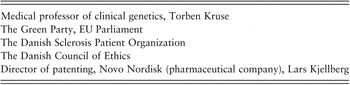
Initial discussions of DNA patenting were followed by responses to short introduction texts that the respondents read during the interview, about (1) the regulation of biotech patents (authored by a patent specialist at the Danish Patent and Trademark Agency), and (2) human genetics and gene technology (authored by a university geneticist). The function of the latter was to familiarize participants with the vocabulary in the document about the regulation of biotech patenting.Footnote 5 Following the intermission, responses were sought to a set of stakeholder perspectives presented as ‘views from participants in the debate’, that were handed out and read by most respondents (see Table 1). These were chosen as a sample of some of the most well-known voices in the debate about gene patents in Denmark and the EU, and to represent a broad range of positions. The advantage of presenting such stakeholder perspectives, as opposed to more abstract arguments pro and con, is that they present not only attitudes but also descriptive assessments (about what patents will do, etc.); this means that when someone declares his or her sympathy for such a perspective, it signals a subscription to a broader understanding of the meaning of DNA patenting. While responses to these texts provided an important source of analysis, insights about the attribution of credibility were gathered from discussion throughout the interviews.
Stakeholder perspectives provided prior to interview session 2

The intermission was also viewed as an opportunity for the respondents to consider their impressions from session 1 and to discuss them with people outside the groups. Hence, convening the groups made it possible to gather relevant data that is often not accessible in interviews, which was extremely useful in this study because it provided further insights into the way in which ‘authority’ was constructed.
Interviewing non-specialists about biotech patents presents particular challenges. First, in contrast to the typical interview, respondents have no previous experience with biotech patents (cf. Haddow et al., Reference Haddow, Laurie, Cunningham-Burley and Hunter2007). Second, wider public debate about biotech patenting has been far less intense than with regard to a number of other technology issues. Consequently, ideas about who the different ‘experts’ are and who they represent may be poorly developed. Additionally, the positions assumed by the respondents, against which attributions of credibility might be expected to form, may be relatively weak. On the positive side, this provided an opportunity to study the formation of positions. To give room for the development of positions, I allowed for two hours of discussion before providing the first texts.
Analysis
In order to explore ascriptions of credibility in the case of DNA patents, the transcripts were analysed inductively and discussions involving epistemic reflections on the relationship between the respondents and other actors were identified.
The following analysis shows that the way the respondents relate to other actors indicates the coexistence of two partly contrasting positions. First, it is demonstrated how ascriptions of credibility are sometimes based on a perceived match or mismatch of hopes and concerns. This demonstrates the kind of active ‘worldview navigation’ conceptualized in the cultural approach to ‘expertise’ (cPUS and Mary Douglas). Subsequently, I show how the respondents' ascription of credibility is related to more traditional distinctions, for instance between ‘experts’ and ‘lay’; ‘expertise’ is here defined in terms of the substantial properties of disinterest and knowledge. The former position, I refer to as ‘partisan’ because here the negotiation of credibility was marked by an assessment of the interests represented by the stakeholders; the latter I refer to as ‘hierarchical’ because here the negotiation of credibility pointed to the existence of what appeared to be a shared set of evaluative standards, according to which anybody's credibility could be ranked. What the coexistence of these seemingly contrasting ways of relating to ‘experts’ may be taken to mean is the subject of the discussion. In what follows, all quotes are translated by the author and respondents are cited with a code according to the group (A–F) and number in the group (1–10).
The partisan position
Providing the respondents with an introduction to the regulation of DNA patenting (explicitly authored by a patent specialist at the Danish Patent and Trademark Agency) gave rise to general concerns about controllability but provoked only little discussion about the credibility of the information as such. In contrast, the five different perspectives from what were introduced as ‘views from participants in the debate’ produced much more vivid negotiations of credibility, perhaps because they present more explicit judgements of the social and cultural significance of DNA patents and ‘made visible’ possible perspectives on the matter.
The stakeholder perspectives were presented in a symmetrical fashion,Footnote 6 which allowed me to see whether the respondents would spontaneously stratify them. Despite positions having generally developed at this point, this did not happen with the spontaneity that one would have expected if the issue had previously been more publicly exposed. Nonetheless, plenty of examples of ‘credibility hierarchies’ emerged. Respondents were often explicitly judging the credibility of the stakeholders on their perceived agendas.
The first excerpt illustrates how the respondents displayed a clear preference with respect to the different stakeholder accounts:
I: Did anything strike you as interesting when you read the texts?
A.1: Yes, I think that the best account was given by the guy from Novo, I think I can support that; in contrast, the others didn’t really appeal to me. I liked what the Novo guy wrote and the attitude he has.
A.6: I think he was the business man, so I lean towards Torben Kruse, the genetics professor.
A.7: (…) I would say that Torben Kruse clearly articulates my anxiety about this.… He articulates my anxiety and the provisos I have about this. I don't know anything about it, I am a lay person in this context, and he is not. (…)
I: Do you have something in particular in mind?
A.7: Yes, he [reads from interview with Torben Kruse] says, ‘when there isn’t money for the development of medicine for diseases that only few suffer from’—I still believe that all this about patenting genes benefits companies. I think we benefit from the development of this medicine they are developing, but whether it is particularly good for mankind and the not so privileged part of it, and benefits it or the contrary, I am not so sure about that, as a lay person.
I: What do the rest of you think?
A.1: But what is the economic incentive to start the development of medicine and start researching in the first place? You know, then there is no reason, if it is for the poor who can’t pay for the medicine as you say, then there is no reason to do it.
To some (A.1), the way in which the industry representative defines the role of DNA patents as an indispensable instrument for medical progress is found to be the most compelling perspective. Others (A.6 and A.7) are more inclined to ‘team up’ with the more concerned perspective presented by the medical professor. This illustrates how preferences regarding which authority presents the better account of what role DNA patenting is and should be playing in society are based on assessments of whether or not there is a perceived correspondence of hopes and concerns, and in this sense a stratification of ‘experts’ is appearing. Credibility negotiations involve both ‘positive’ expressions of agreement with the stakeholders and continuous attempts to reject or downgrade the credibility of certain other perspectives as ‘biased’:
I: Lars Kjellberg argues that there is no need for moral limits on patenting. What do you think about that?
1.D: I think that this is seen from an economic and legal perspective, and then I think that he forgets to tell the other half of the story (…) He is incredibly efficient in his position as seen from the perspective of his company. There are only certain angles that they take on patenting. And then they forget about the rest.
Hence, the fact that an actor pursues private interests is taken by some to account for his ‘economic and legal’ and therefore partial perspective, and thus limits the possibility for him to be considered unbiased. The following quote illustrates how a perceived display of anti-social behaviour also undermines the credibility of industry. Yet, again, negotiations over what constitutes anti-social behaviour result in different factions:
A.3: Now, one might say that precisely these companies like Novo belong to the very richest; they do not exactly suffer from a shortage of money or live a life in misery from one patent to the next, they shovel money into their pockets and have so much money that if one wants to apply for project financing, this is where you go, ’cause they are the ones who have money, and they hardly know what to do with it.
A.7: It's kind of funny that he mentions the shareholders at the end, it's really conspicuous—all the nice things about further research and then: the shareholders.
A.3: That's where it gets kind of hollow, ’cause if one knew that there were a bit of soul in it, then one might better … but precisely because it is somebody who has so much money, it sounds kind of …
A.8: Incredibly greedy!
A.3: Yes, it does sound kind of …
A.4: There can be heartfelt feeling in it, even if one is a company that pursues a profit. What also adds to it is that they actually are threatened on their insulin business, which is one of their largest sources of income, because in the long run someone may be able to cure diabetes permanently, so that you don't have to take insulin. Novo is researching what they are going to profit from in that event.
In one perspective (A.7 and A.3), the views of the industry representative are rejected as biased, both because he is not perceived as ‘disinterested’ and because the way in which his company deals with their interests contrasts with an egalitarian ideal. To others (A.4), however, who see no contradiction between pursuing profits and contributing to common progress—and indeed who are more worried about companies being economically ‘threatened’—such perspectives are considered to be perfectly credible. Opposing perspectives in terms of the role that private interests have and should play in public health have been shown to be central to an attitude polarization with respect to DNA patents; some adopt a communitarian perspective whereas others see DNA patenting in a more libertarian perspective (Andreasen, forthcoming; Pálsson and Rabinow, 2001). Both of these perspectives express a hope for better public health, but they disagree about private incentives as a means. The fact that this difference is also reflected in attributions of credibility shows how credibility and attitude, fact and value, are intertwined and reflect worldview affiliations.
The distinction between those considered to be pursuing private motives and those serving the public good is central to attributions of credibility because some see the pursuit of private goals as creating a conflict of interest. Many see the medical professor as representing a detached and therefore credible position in contrast with that of the patient association. Others, however, find his perspective to be no less biased:
B.7: It is definitely evident that they hold different stakes in this; that is, the guy from the university wants more money for research and the other guy is from a company.
B.8: There is also the patient association that has an acute interest in helping their members, and that also is prepared to sell out on the ethics dimension; they have a tangible problem, one can easily imagine what that is like, and it even sounds sensible too. If one had a serious affliction, one would probably be more biased.
Contrasting views of who is disinterested underpin heterogeneous ascription of credibility. As a further example, whereas many see the Danish Council of Ethics as an important moral authority in virtue of its role in defining a common morality—a central element in the communitarian ideal—and pay great reverence to this perspective, others object to its authority because this body does not devise an answer to a question that is important to the libertarian position: ‘But who's gonna pay?’ (A.4). Moreover, some reject the idea of the Danish Council of Ethics defining a common morality in the first place:
I: Let's move on to what the Danish Council of Ethics says: it conflicts with public morality that someone can patent genes or laws of nature.
F.5: It depends on what ‘public’ means, if they mean those from the patient association, I’m not sure that they feel offended about patenting (…) I think that it is quite funny that they say ‘the public morality’—that's not my morality! It's a council that has come up with something called ‘the public morality’.
So far, we have seen how credibility is negotiated as part of positions regarding the right place for profit, morality and societal progress, which divide into more or less discrete worldviews manifesting themselves as what I have designated ‘libertarianism’ and ‘communitarianism’. It appears as if credibility becomes a function of political choice, and so the respondents position themselves primarily as ‘citizens’ who actively distinguish between areas of expertise. Thus, such negotiations illustrate a central finding in cPUS about worldviews underpinning the social production of ‘expertise’; a plurality of candidates constitute a ‘supply’ of ‘expert’ positions that are ‘demanded’ by different publics.
The hierarchical position
The above excerpts also illustrate a different way of relating to the stakeholders. The accusation of various actors of being ‘biased’ signals a belief in the possibility, at least, of being unbiased. Hence, some discussions suggest that, for respondents, perceived disinterestedness is something that strengthens the credibility of the stakeholders—irrespective of the societal concerns they express:
F.5: (…) I tend to agree more with the guy from Novo Nordisk. Torben Kruse is really interesting, though, because he is a detached spectator.
Another quote illustrating the importance attached to the disinterestedness of the stakeholders shows how this idea is related to ideas about the possibility of pursuing objectively superior perspectives by employing thoroughness, argument and knowledge:
B.3: I really think that when you summarize and when one reads the texts, that precisely those from the Cystic Fibrosis Association, they don't really get into the detail and go into depth on advantages and disadvantages, they sort of consider it like we did, that it gives hope. (…)
B.3: But then the hard thing is, as you mentioned, to stick to the attitudes and not mix them with the emotions, because when they become part of it, then it all becomes very muddled.
B.5: Then it becomes muddled.
B.3: Yes then it becomes muddled and we can’t really figure it out.
B.4: One aspect is that when we sat down here for the first time, our knowledge was very limited, and then one's attitudes are really emotionally based.
In the quotes in the previous section, respondents referred to the stakeholders more as politicians than as arbiters of truth, but the point is not that the respondents simply give up on the idea that some kinds of arguments are essentially more credible than others. Hence, to gain credibility, one has to avoid being too emotional, to become informed and to pursue more objectively valid ‘attitudes’.
The relationship between objectivity and credibility was also visible in the interaction between the respondents themselves. The respondents associated credibility with two criteria, a positive and a negative one. First, more credibility was ascribed to those possessing knowledge. Credibility was not a question of being an ‘expert’ or not, it followed a gradual scale—more knowledge, more credibility:
B.5: (…) When I went home I thought that it was much more complicated than when I normally see a headline, and you [B.7] seem like someone who knows something about research.
I: You are a researcher yourself.
B.7: I do research but I don't make money, yes, well, I get a salary.
B.5: But that gives you a different take on it than if you just approach it in a broad moral, political, ethical, ideological context.
Second, arguments that were seen to strike a more personal note influenced the level of credibility negatively. It is not enough to see things in a ‘broad moral, political, ethical and ideological context’; respondents tended to make excuses when their assessments became ‘political’ as if saying that when assessments become too subjective they should not be regarded as relevant. Moreover, when positions were justified with reference to interpretations that deviated too much from what appeared to be a conception of mainstream or consensus, they were met with polite silence. One example was a situation where an informant referred to reincarnation to justify her disbelief in conventional medicine (B.4). Another example involved a situation where an informant justified his view that genetic engineering is desirable with reference to the eugenic idea that ‘biologically defective’ genes or individuals ‘are really not meant to be propagated’ (A.6). The way in which these justifications were not ‘picked up’ and defended or criticized by possible worldview ‘allies’, and were instead met by silence, indicates that some kinds of argument were collectively seen as irrelevant. Thus, the silence can be seen as structured by common ideas about what can plausibly be argued, and this is what leads to the ignoring of certain types of justification.
The frequent reference to the stakeholders as ‘experts’, opposing this to themselves as ‘lay’ (for an example, see the first quote in the previous section), shows how the respondents imagine themselves to be at the low end of an epistemic hierarchy. Credibility is here ranked according to levels of knowledge and objectivity, and this implies constraints in terms of what may plausibly be argued.
Another illustration of this emerged when the groups were reconvened, and I interviewed them about their experience of discussing the issue with others outside the group. Here, the issue of being ‘informed’ turned out to be immensely important. When referring to the discussions, the respondents positioned themselves as quasi-experts, now dismissing the views of others outside the group as excessively emotional and ill-informed, and thus reducing the validity of their attitudes to a matter of having sufficient knowledge:
A.9: I talked a lot to my friend about the process, what you [A.3] also said before about having an opinion about something, but then, suddenly, new implications entered, and the process where you sit there and are so ambivalent, that is, you have these basic attitudes to specific things, and that was also what she did spontaneously; that is, we learned new things and then changed our opinion entirely, this is what I talked to her about.
I: What did she think about these things?
A.9: She was shocked about it [that it is possible to patent genes], but when I told her that we had thought so too and then we had been told about some of the rules regulating patents, she also realized that it is quite secure.Footnote 7
‘Level of knowledge’ and the validity of opinions are here directly linked. Thus, both knowledge and objectivity are seen to mark a distinction between what is to be considered credible in this setting and what is not.
If this ‘expert regime’ ranked and placed constraints on what kinds of statement were considered credible, it did not imply that consensus was actually achievable, and it did not mean that only technical authority counts. The Danish Council of Ethics was considered by some to be an important moral authority. We saw, however, that others were less inclined to accept their authority because they were seen to fail to provide a common moral ground. The same was true of industry representatives from reverse perspective. More generally, few of the perspectives provided were seen, by all, to live up to the expert criteria of being well-informed and objective; nevertheless, the criteria of knowledge and objectivity lingered as ideals according to which they, and the respondents themselves, were evaluated. Put differently, if everyone agreed that objectivity and knowledge are fundamental to the ascription of credibility—and enforced these criteria among themselves—they found it harder to agree about who, among the stakeholders, lived up to them.
Discussion
In this article I described how members of the ‘silent majority’ negotiate credibility in relation to various actors and sought to explain this pattern. The focus groups were particularly useful to this end by bringing out areas of conflict and consensus; differences that would have seemed vague in individual interviews (e.g. a suspicion about the credibility of an industry actor) provoked strong reactions; and common evaluative standards became visible as certain statements were variously collectively ignored (e.g. the relevance of reincarnation) or supported (e.g. the view that the respondents' own lack of knowledge and objectivity detracts from their credibility). At the outset, credibility was defined in terms of a relationship of recognition formed by respondents towards other actors. In the same way that the literature describes how people contextualize ‘expert’ information as a way of assessing its credibility, the interviews provide examples of respondents contextualizing the information coming from the different (potential) DNA patenting ‘experts’ whose assessments were introduced. That is, the analysis demonstrated how respondents base attributions of credibility on assumptions about the societal interests of the ‘experts’.
We saw how this contextualization was marked by expressions of acceptance and rejection, a process during which the credibility of the stakeholders was negotiated and ranked. This process was informed by the identification of the different stakeholders' societal concerns and hopes, and created factions. The process may be seen as a process of ‘allegiance’ in Mary Douglas's sense: attributions of credibility as displays of worldview commitments. Thus, respondents frequently position themselves as ‘citizens’, that is, they treat biotech patenting as a political matter on which they have a legitimate say, drawing on (sub)culturally embedded ideals about the social order. The visibility of the underlying worldviews designated as ‘communitarianism’ and ‘libertarianism’ suggests that the respondents draw on a limited number of well-defined worldviews, supporting the idea that ascriptions of credibility can be used to build identity.
In the perspective of constructivist PUS, this is all business as usual: ‘expertise’ can be the product of cultural negotiations (cf. Evans and Collins, Reference Evans, Collins, Hackett, Amsterdamska, Lynch and Wajcman2008; Jasanoff, Reference Jasanoff2003b; Turner, Reference Turner2001). We also saw, however, that there was a simultaneous concern about avoiding subjectivism and pursuing well-informed objective decisions. Here, the respondents positioned themselves as ‘lay people’—as actors who lack the competence and therefore the credibility necessary to be taken seriously. This seems to demonstrate the essentialist view of ‘expertise’, whose constraints on political participation have been criticized as unjustifiably and tacitly privileging certain worldviews, notably technoscientific ones, in cPUS (e.g. Jasanoff, Reference Jasanoff2003b; Nowotny, Reference Nowotny2003; Wynne, Reference Wynne, Jasanoff, Markle, Petersen and Pinch1995, Reference Wynne2003). This finding is in line with previous research into what Wright and Nerlich (Reference Wright and Nerlich2006) dubbed ‘the public understanding of the public understanding of science’, concluding that a kind of thinking resembling the deficit model is maintained and reproduced among the general public. Wright and Nerlich (Reference Wright and Nerlich2006) characterize this finding as a somewhat enigmatic ‘seduction by reduction’. Leaning towards a tradition (Gieryn, Reference Gieryn, Jasanoff, Markle, Petersen and Pinch1995, Reference Gieryn1999; Hilgartner, Reference Hilgartner1990) that conceptualizes authority as a form of ‘social control’ (Turner, Reference Turner2001: 129), this portrays its presence among ‘citizens’ as the result of scientific or media propaganda.
Such conclusions find some support in the history of science. During the formative period, in which objectivity as ‘disinterest’ became canonized, scientists did not simply see it as something ‘essential’ to science but related it to ideals of self-restraint, that is to certain ideas about virtue and morality (Daston and Galison, Reference Daston and Galison1992). Common to various historical meanings of objectivity as an ideal among scientists has been an effort to avoid the personal and subjective. The implications were never seen as purely epistemic. Theodore Porter summarizes: ‘There is a vision of community and of political order implicit in this pursuit of objectivity, one that matters for the making of impersonal knowledge and at the same time for the bureaucratic regulation of modern pluralistic democracies’ (1992: 595). That is, objectivity has always seemingly involved a pursuit, and perhaps enforcement, of (a specific idea about) socio-political order.
This makes it no less mysterious, however, why—in present times, when the authority of expert systems is otherwise reported to be breaking down as publics become increasingly reflexive (Beck, Reference Beck1992; Giddens, Reference Giddens1991)—objectivity as an ideal persists among the general public, as shown here. Wright and Nerlich's (Reference Wright and Nerlich2006) picture of a public inclined to adopt deficit thinking as ‘duped victims of ideology’ would be more plausible if one could show that people were somehow caught in the ‘hierarchical position’ and had no other way of ascribing credibility available to them. However, they do—as plenty of studies (including their own) show. The well-justified rejection of the naturalization of certified ‘expertise’ in cPUS literature leaves an explanatory gap by not accounting for the self-imposed regime of objectivity by members of the general public. In the specific case of DNA patenting, this explanatory gap leaves unaddressed one of the most surprising findings of this study, namely that an industry representative can be regarded as credible despite his obvious vested interests. Therefore, in the following, I sketch an analytical frame that may contribute to our understanding of the importance attached to objectivity and knowledge by members of the general public before turning to this specific question about the credibility of industry with respect to DNA patenting.
The fixation on the potential of objectivity claims for persuasion overlooks the particular meaning objectivity has for the respondents, namely disinterest. As a value underpinning the formation of social order, objectivity conveys ideas about what it takes to coexist despite mutual differences. This account of objectivity as part of a ‘credibility regime’ mirrors ideas by Luc Boltanski and Laurent Thévenot about people's ‘sense of justice’ (e.g. Boltanski and Thévenot, Reference Boltanski and Thévenot1999; Moody and Thévenot, Reference Moody, Thévenot, Lamont and Thévenot2000). They argue that an account according to which actors are simply strategic (e.g. rational choice, discourse psychology) or socially determined (i.e. structuralism) fails to take seriously the effort people make during disputes to appeal to ‘forms of worth’ that are generally recognized. Our use of these ‘orders of worth’ illustrates that we share ‘a common capacity’ to distinguish between socially legitimate and illegitimate arguments. A common order of worth establishes a form of equivalence, a common ground freed from private interests. People apply this ‘constraint’ of disinterest when they justify and criticize arguments. In the analysis we saw how disinterest was a fulcrum of credibility: in relation to the stakeholder perspectives, institutional affiliations were considered as a way of assessing the disinterestedness of other actors; in relation to each other, arguments were rejected if they were based on excessively personal interpretations. Boltanski and Thévenot's portrayal of controversy is one in which people may hold and defend personal views but do so within the confines of what the authors refer to as a ‘regime of justice’. People cannot simply ignore the forms of justification that others find to be legitimate, and in this way world(view)s are made to overlap. Whereas Boltanski and Thévenot rightly point out that such ‘common orders of worth’ may be used for persuasive purposes, they also emphasize the active maintenance of a common ground implicit in the fact that we seek legitimation in these shared ‘worlds’ (even if these ‘worlds’ might themselves be (pan-)culturally specific, and so they may seem more rhetorical in other cultures than in ours!).
If we assume that submitting to the objectivity regime is an example of such a justificatory regime, the explanatory gap disappears. The contention, then, is that the objectivity norm is actively maintained and reproduced because it serves as a kind of fair-play rule for public discussion. In this way, the policing of objectivity can be seen as a way of bridging rather than building conflict. As we saw, the respondents may not bother about what kinds of questionable views the others hold when they keep them to themselves, but in the course of common discussion and solution-finding, they expect each other to stick to objectivity. Seen this way, the study of how expertise is construed does not simply shed light on the perceived relationship between members of the general public and ‘experts’, but also on the social bond in a broader sense.
The data presented does not directly reveal what motivates people in holding on to a regime of objectivity, but we may improve our ‘guesses’ by taking into account the performative effect of imposing common epistemic standards. Returning to the question of what ‘seduces’ people to position themselves as ‘lay people’, we may think of it now as the striving for a common epistemic ground. It is a desire, or perhaps a sense of need, for societal coherence that motivates people when they privilege the ‘expert’ account over their own. In this way, the apparent subservience implied in positioning oneself as ‘lay person’ may be seen as a contextualization of ‘expert’ knowledge—in this case expressing faith not in particular institutional affiliations or worldviews but in the possibility for us to make common progress through reason. In the sense that this expresses a much-criticized appeal to the Enlightenment idea of ‘pure reason’, some may find this evidence of naivety on the part of the general public. With the simultaneous capacity to navigate agendas demonstrated by the ‘partisan’ position, this would be an unfair judgment. In my view, the explanation has the further advantage of providing a counterweight to the conflict perspective in constructivist PUS (cf. Evans, Reference Evans2008; Turner, Reference Turner2001). The ‘hierarchical position’ can be seen as a self-imposed regime that sets up strict criteria for participation.
I did not track, for the individual respondents, the extent to which they adhered to one position or another; my general impression was that all of the respondents to some degree changed between or mixed the positions. It may seem contradictory that respondents move between the position of ‘citizens’ (negotiating credibility by forming worldview alliances) signalling that they have much to contribute within policy-making, and that of incompetent lay people by pointing to objectivity and knowledge as the focal points of credibility. Both positions, however, can plausibly be seen as part of building citizen identity. As social beings we are strung out between the sometimes-conflicting efforts to promote our own ideals (i.e. a communitarian versus liberalistic society) and the effort to promote a common understanding (i.e. a well-informed disinterested understanding). As pointed out by Boltanski and Thévenot, the two motivations may, and do, get mixed up. When candidate authorities are subjected to both an ‘objectivity test’ and an ‘allegiance test’, this may amount to what Thomas Gieryn refers to as ‘a credibility contest’: ‘bearers of discrepant truths push their wares wrapped in assertions of objectivity, efficacy, precision, reliability, authenticity, predictability, sincerity, desirability, tradition’ (1999: 1). The point made here, however, is that many of these assertions may be seen as part of conflict resolution rather than strategic ‘contest’.
Awareness of the coexistence of two credibility modes brings to light some interesting dynamics regarding the contextualization of ‘expertise’ in the specific field of biotech patenting. The ‘hierarchical position’ demonstrates that even if this area is not dominated by claims to science, and even if the distribution of credibility depends on worldviews and agendas, people enforce certain common credibility standards. Knowledge and objectivity are seen as indispensable criteria for the attribution of credibility, even when this disqualifies people themselves as decision makers. This had performative effects. For instance, the insistence on this regime meant that many, to my surprise, rejected the patient association's position as ‘biased’—thereby conveying the message that their view could not serve as a basis for common decisions. On the other hand, it also meant that the industry representative, due to his knowledge about turning patents into profits and applications, was seen by some as credible.
This indicates that disinterestedness is perhaps a more ambiguous concept in this field than in related areas dominated by claims to ‘science’ (cf. Blok et al., Reference Blok, Jensen and Kaltoft2008), illustrating a potentially important difference between the public understanding of ‘expertise’ and ‘science’. Whereas a personal involvement undermines the credibility of a risk ‘expert’, it substantiates it, to some, in the area of patenting: for those to whom patenting forms a natural part of private entrepreneurship, and private entrepreneurship is considered to have a natural place in good society, the industry representative becomes the natural ‘expert’ by virtue of his experience in pursuing profits. On the other hand, while his possession of specialized knowledge is a prerequisite for his ‘expert’ status, his perceived disinterest seems to depend on the extent to which his knowledge is considered relevant. Some find profit experience to be relevant because they see profit as an incentive to drive progress in public health, but to those who think that such progress should be based on a genuine commitment to community, institutions like science and the Danish Council of Ethics possess the ‘right’ kind of knowledge and, accordingly, are seen as disinterested.
Conclusion
I analysed the attribution of credibility within the field of biotech patenting by members of the silent majority by looking at how they position themselves in relation to various actors. I drew on conceptualizations of the relationship between the general public and ‘experts’ from the public understanding of science field as a starting point for analysis, and while employing a constructivist epistemology, it was an explicit intention to steer clear of the normative assumptions of these traditions so as to be as open-minded as possible about the positions assumed by members of the general public. I show that members of the general public frequently position themselves as actors whose views lack objectivity and informedness and thus are not credible. How can we interpret the finding that respondents in this way assume a hierarchical position in relation to ‘experts’, to each other, and to others outside the group? Constructivist PUS has paid only limited attention to the expression by members of the general public of more essentialist criteria for ‘expertise’; it has been portrayed as the result of propaganda. By drawing on recent theory about justification, I suggest instead that such common evaluative standards stem from an interest in maintaining some common ground, as illustrated by the persistent canonizing of disinterested and well-informed opinion; an effort that is strong in spite of the difficulties of achieving consensus in practice. Agaisnt this background, the hierarchical position can be interpreted as an effort to build consensus—that is, to find ways of agreeing despite differences of perspective—and not simply to make way for persuasion. This adds balance to the conflictual ontology in much cPUS, concerned as it is with ideas about ‘expertise’ as a product of socio-cultural clashes. The findings thus contribute to an explication of the ‘social robustness’ that expertise patently has (cf. Jasanoff, Reference Jasanoff2003a; Nowotny et al., Reference Nowotny, Scott and Gibbons2001).
Making visible these different modes of ascribing credibility exposes how the move from a field dominated by claims to ‘science’ to a field such as biotech patenting implies changes in the meaning of ‘expertise’: whereas disinterest is still seen as an essential trait, it need not mean ‘not personally involved’; to those for whom patenting is seen to drive societal progress, the industry representative can qualify as an ‘expert’ due to his commercial experience. Conversely, the finding that neither the industry representative, nor the Danish Council of Ethics, nor the public researcher is seen by all as ‘disinterested’ shows how negotiations over credibility ‘continue’ on the level of what is to be seen as ‘relevant’ knowledge.
Central to an understanding of how the bioeconomy is shaped is looking at how the heterogeneous types of ‘expertise’ associated with it are constructed in public. By decoupling ‘expertise’ from ‘science’, this article contributes to a fuller view of their construction among the wider public. The finding presented here that the submission to ‘expert’ understandings, and the corresponding positioning as ‘lay person’, in its commitment to objectivity is ‘grounded’ in social norms that guide our common day-to-day resolution of conflict, expands on findings from, for example, the public understanding of science field that have relevance far beyond the realm of ‘science’ and, indeed, may be relevant to any situation involving policy reliance on ‘expertise’. With the increased use of public consultancy as a way of ensuring political legitimacy in areas that used to be dominated by a narrowly defined ‘expert core’, this study contributes to a field—the public understanding of ‘expertise’—that would benefit from further exploration.
Acknowledgements
I thank Klaus Høyer for his never-ending comments and help in improving the manuscript. I also thank Henriette Langstrup for very useful inputs to the conceptualization of the article. Finally, I thank Maja Horst for her comments on an earlier version.