





Introduction
Repeated scientific warnings (IPCC, 2023) and noticeable effects of climate change in the form of floods, storms, and fires led to a global rise in climate activism from 2018 onward. This increase was subsequently followed by a strong backlash: The public climate turned hostile against climate activists. How did this backlash come about? Specifically, what roles did politicians and the media play? What impact did the deteriorating social climate have on the movement and its activists? These are the research questions this article is aiming to answer.
This article provides an empirical analysis of the rise and subsequent fall of the climate movement in Austria. Austria provides an illustrative example of global dynamics, as its environmental movement was historically quite successful. Additionally, during the time of the backlash, the Green Party (an offspring of earlier environmental protests) was part of a coalition government. Hence, the political opportunities were quite favorable (Marks & McAdam, Reference Marks and McAdam1996). However, Austria, like many Western countries, experienced a shift toward right-wing populism (Liebhart, Reference Liebhart, Kukovič and Just2022). Thus, the country mirrors global dynamics, but additionally provides highly unlikely conditions for a backlash against the climate movement.
Our theoretical basis is the model of civil society capture. The model suggests that the reduction of civic spaces, which is happening in many developed democracies (Chimiak et al., Reference Chimiak, Kravchenko and Pape2024; Toepler et al., Reference Toepler, Zimmer, Fröhlich and Obuch2020), is a gradual process of diverse steps. The first step is the discursive polarization of civil society through negative narratives toward those actors that are not in line with the government, followed by reduced participation, and financial and legal restrictions (Simsa, Reference Simsa2019).
The repressions and the public hostility toward climate activists have had a clear chilling effect on the movement. The activists in our interviews report in detail about the social and emotional consequences they face. We connect these findings with the literature from social movement studies, highlighting the impact of discursive delegitimization as a basis of repression. Finally, we discuss consequences for the climate movement. We use the term climate activism/movement broadly, including all forms of civil society activism relating to climate justice (O‘Brian et al., Reference O’Brian, Selboe and Hayward2018).
Literature review
The growing field of research on climate-focused CSO activities
Research on climate activism has gained importance since about 2018 (Neas et al., Reference Neas, Ward and Bowman2022). However, the literature so far focuses on the framing applied by the movement (Chen et al., Reference Chen, Molder, Duan, Boulianne, Eckart, Mallari and Yang2023; Della Porta & Parks, Reference Della Porta and Parks2014; Fernandes-Jesus et al., Reference Fernandes-Jesus, Lima and Sabucedo2020; Molder et al., Reference Molder, Lakind, Clemmons and Chen2022), strategies and practices in the movement (Buzogány & Scherhaufer, Reference Buzogány and Scherhaufer2023; Fisher et al., Reference Fisher, Azedi, Mead and Jayko2025; Gazley & Prakash, Reference Gazley and Prakash2023; Nelson & King, Reference Nelson and King2020), the role of the climate movement in governance networks (Gazley & Prakash, Reference Gazley and Prakash2023; Kagan & Dodge, Reference Kagan and Dodge2023; Sun, Reference Sun2024), and the outcomes of climate protests (Fisher & Nasrin, Reference Fisher and Nasrin2021; Fritz et al., Reference Fritz, Hansmann, Dalimier and Binder2023; Neas et al., Reference Neas, Ward and Bowman2022). For this article, we will focus on discursive and repressive strategies as part of broader attempts to change the civic space, a topic that has not been researched for the climate movement beyond single protest incidences.
Shrinking civic spaces
The framework conditions for civil society are deteriorating in many countries. In 2024, the “Freedom in the World” index reported the 18th consecutive year of democratic decline, due to armed conflict and threats of authoritarian aggression (Freedom House, 2024). Scholars diagnose a crisis of liberal democracy (Castells, Reference Castells2018; Jörke, Reference Jörke2022). Right-wing populism is growing, going along with shifts toward autocratic democracies (Cassani & Tomini, Reference Cassani, Tomini, Cassani and Tomini2019; Owen, Reference Owen2022). Autocratic governments use complex methods to influence civil society (Froissart, Reference Froissart2014; Gilbert & Mohseni, Reference Gilbert and Mohseni2018; Greskovits, Reference Greskovits2015), trying to restrict its autonomy (Cassani & Tomini, Reference Cassani, Tomini, Cassani and Tomini2019; Lührmann & Lindberg, Reference Lührmann and Lindberg2018). CSOs can be subjects of repression, co-optation, and carriers of legitimizing discourses (Toepler et al., Reference Toepler, Zimmer, Fröhlich and Obuch2020). There is a global deterioration of the political climate and growing restrictions for CSOs (Chimiak et al., Reference Chimiak, Kravchenko and Pape2024). Even countries with consolidated democracies increasingly combine democratic and authoritarian elements, thus turning to “hybrid regimes” (Diamond, Reference Diamond2002). In all European countries, mistrust and antagonism between the state and civil society are high (Strachwitz, Reference Strachwitz, Hummel and Strachwitz2023).
What seems to be common for autocratic governments is the process of reducing the space for civil society. The model of civil society capture (Simsa, Reference Simsa2019) identifies steps in the development of autocratic regimes: First, discourses attempt to delegitimize those parts of civil society whose ideology does not align with the government’s with polarizing and delegitimizing narratives, followed by systematic verbal attacks. This was observed in different countries, such as Russia (Acheson, Reference Acheson2021), Turkey (Doyle, Reference Doyle2017), Hungary (Ágh, Reference Ágh2015), or Poland (Korolczuk, Reference Korolczuk2023). Those examples illustrate that autocratization first occurs on a discursive level (Gilbert, Reference Gilbert2016), often long before populists exert their authoritarian programs (Doyle, Reference Doyle2017; Moder & Pranzl, Reference Moder and Pranzl2019). Second, political participation is restricted. The expertise of critical civil-society actors is being heard less; they get less information, and they are less included in legislative processes. Third, changes at the policy level follow, namely the channeling of public funds along a polarization line from “good” to “bad” civil society, away from politically independent to dependent CSOs. Fourth, legal framework conditions are restricted. Populists and autocrats thus limit public contestation by restricting liberal civil society activities, while fostering representatives of a loyal civil society.
Repression of climate activism
Collective mobilizations demanding climate change mitigation policies have increased around the world (Della Porta & Portos, Reference Della Porta and Portos2023). This is often met with repressive strategies that raise the costs of protest (Davenport & Loyle, Reference Davenport and Loyle2012; Earl et al., Reference Earl, Maher and Pan2022). In earlier studies, repression was primarily conceptualized as originating from the state; meanwhile, the social movements literature points to multiple forms of repression, enacted by the government and the police system, as well as from public media, counter-movements, and the social environment of activists (Davenport, Reference Davenport2005; Jämte & Ellefsen, Reference Jämte and Ellefsen2020; Linden & Klandermans, Reference Linden and Klandermans2006).
Generally, repression increases when movements seem to be successful and thus threaten elites (Davenport, Reference Davenport2005; Earl, Reference Earl2003). Effects of repression have been researched mostly on the macro level, for instance, regarding mobilization (Earl, Reference Earl2011) or tactical substitution (Francisco, Reference Francisco, Davenport, Johnston and Carol2005; Moore, Reference Moore1998). Repression was found to deter as well stimulate activism, lead to resignation as well as radicalization (for an overview about the respective studies, see Honari, Reference Honari2018, p. 951). Thus, to better understand the effects of repression, micro-level studies are needed to shed light onto how individuals react to repression and why (Earl, Reference Earl2011; Honari, Reference Honari2018).
Steps into that directions are a study of extreme-right activists by Linden and Klandermans (Reference Linden and Klandermans2006), which finds that the effect of repression depends on the social position of the activists and their histories and pathways into activism. Jämte and Ellefsen (Reference Jämte and Ellefsen2020) document demobilizing effects of stigmatization and labeling to be pronounced in organizations that organize openly and inclusively, while militant and clandestine groups are less affected. Research also points out that effects on the micro level depend on the kind of repression and its legitimacy (Opp & Roehl Reference Opp and Roehl1990). Further, Honari (Reference Honari2018) develops a model of choice points, pointing to the agency of activists in reacting to repression: They may refrain from activism because the subjective costs are too high, but they may also resist repression by changing their strategy.
The role of narratives for social movements
Narratives are essential for movements to gain support (Gregg, Reference Gregg2019). The depiction of social movements in public media heavily influences whether society sympathizes with a cause. Whether a movement enjoys legitimacy in public discourse determines whether repression leads to increased or decreased mobilization (Koopmans, Reference Koopmans2005).
Communication studies have investigated how movements are framed (Benford & Snow, Reference Benford and Snow2000; Boyle et al., Reference Boyle, McCluskey, McLeod and Stein2005; Gamson, Reference Gamson1995; Gitlin, Reference Gitlin2003). The protest paradigm literature characterizes a recurrent pattern of reporting about protests: First, groups challenging the status quo face more critical framing than groups supporting the status quo. Second, official sources are prioritized over movement voices (Boyle et al., Reference Boyle, McCluskey, McLeod and Stein2005; McLeod & Hertog, Reference McLeod and Hertog1999). Third, protest coverage often emphasizes circumstances over content; that is, it highlights traffic restrictions while neglecting the protests’ causes (Gamson, Reference Gamson1995).
How does mainstream media usually portray environmental movements? Although their demand to limit global warming aligns with mainstream values, protests often focus on divisive measures such as car bans (Mau et al., Reference Mau, Lux and Westheuser2023). This likely attracts the typical protest paradigm framing. Thus, the traditional media rarely present civil society climate activities as an innovative force (Krlev & Lund, Reference Krlev and Lund2020; McAdam et al., Reference McAdam, Sampson, Weffer and MacIndoe2006). Narratives often focus on the privileged background of protesters or their youth (Della Porta & Portos, Reference Della Porta and Portos2023). Protests of “Fridays for Future” received diverse framings, with some positive coverage, but also ageist, delegitimizing language reflecting elements of the protest paradigm (Bergmann & Ossewaarde, Reference Bergmann and Ossewaarde2020; Von Zabern & Tulloch, Reference Von Zabern and Tulloch2021). Also, negative religious framing arose, calling climate activism a religion, a cult, or a “children’s crusade” (Kyyrö et al., Reference Kyyrö, Äystö and Hjelm2023). These discourses aim at delegitimizing strategic othering of activism. Furthermore, event-centric coverage frequently omits the broader context (Smith, Reference Smith2001).
Research gap
Although research on climate activism has gained prominence, our understanding of the methods and forms of repression targeting these activities remains limited. Specifically, the relationship of discursive strategies, repression, and mobilization is not covered sufficiently. Consequently, the impact of repressive strategies on the movement is not well understood either. From a theoretical perspective, research on repressive strategies toward climate activism can enrich our understanding of the model of civil society capture.
Empirical context, methods
Situation in Austria
Austria’s civil society has long been tightly interwoven with party politics and the country’s corporatist tradition (Neumayr et al., Reference Neumayr, Schneider, Meyer and Haider2007). Hence, the country is characterized as a consensus democracy (Dolezal & Hutter, Reference Dolezal and Hutter2007), in which CSOs were highly valued and considered important partners in welfare provision (More-Hollerweger et al., Reference More-Hollerweger, Simsa, Kainz, Neunteufl, Grasgruber-Kerl and Wohlgemuth2014).
From the 1970s onward, waves of different CSOs emerged. Civic action on environmental issues was prominent, notably leading to the ban on nuclear power in the 1970s and opposing a hydropower plant in the 1980s. The protests were countered with police action and were controversial among the population, but overall, there was a sense of optimism and an atmosphere of a new beginning regarding civil society (Foltin, Reference Foltin2004). They led to the founding of the Green Party, many CSOs, and public institutions. Since then, the movement has achieved numerous successes and brought about legislation in various areas. Environmental CSOs have regularly participated in political processes through advocacy and expertise. Consequently, environmental concerns have remained prominent on the political agenda, with awareness levels surpassing those in many other European countries (Kriesi & Giugni, Reference Kriesi and Giugni1996).
From 2017 to 2019, a right-wing populist government formed by the conservative peoples party (ÖVP) and the right-wing populist freedom party (FPÖ) significantly altered Austria’s established corporatist system. Decisions were increasingly made top-down, without consultations of CSOs (Simsa, Reference Simsa2019). After a scandal in 2019, from 2020 onward the ÖVP governed with the Green Party. The 2024 elections saw significant gains for the extreme right; however, a broad coalition of moderate parties has been governing since 2025.
According to Hallin and Mancini’s (Reference Hallin and Mancini2004) typology of media systems, Austria shares most characteristics of the democratic corporatist system: The media targets the general population (as opposed to the elite), there is a high proportion of printed newspapers and tabloid media, and outside the tabloid segment, professional standards in the media industry are relatively strong. Additionally, there is widespread societal recognition of the media’s crucial role in democracy, leading to broad support for state regulation to promote quality and balance. However, this state influence also means that the government can use the media to maintain or enhance its power (Rolland, Reference Rolland2008). As the concentration in the media sector is very high, this risk is severe in Austria, repeatedly leading to scandals (Grisold & Grabner, Reference Grisold and Grabner2018).
Methods
Empirically, we use a complementary mixed-methods approach (Kurzman & Leahey, Reference Kurzman and Leahey2004; Small, Reference Small2011). We combine (1) multiple qualitative investigations of conditions for civil society in Austria that were conducted between 2014 and 2024. The material (interviews and focus group discussions) provides rich and detailed insights from the perspective of civil society itself. However, qualitative data in general suffer from limited generalizability, and comparisons over time are subject to psychological biases (Kahneman & Tversky, Reference Kahneman and Tversky1984; Tversky & Simonson, Reference Tversky and Simonson1993) and a social desirability bias (Silverman, Reference Silverman2020). Therefore, we complement our study with (2) a quantitative analysis of newspaper reports to ensure that the trends we identify reflect the broader public discourse (Habermas, Reference Habermas1996) and provide for reliable comparisons over time (Grimmer et al., Reference Grimmer, Roberts and Stewart2022). To ensure the transparency and reproducibility of the results, the R and Python code are also provided in an online repository (link).
Qualitative research
Qualitatively, the article is based on interviews and focus groups collected over 10 years in four waves. In 2014, 44 interviews with representatives of CSOs and experts in the fields of CSO research, law, and consultancy were conducted and complemented with two focus group discussions. The questions asked and discussed revolved around the conditions for civil society from a legal, financial, and social perspective (More-Hollerweger et.al., Reference More-Hollerweger, Simsa, Kainz, Neunteufl, Grasgruber-Kerl and Wohlgemuth2014). Very similar questions were asked in 2019 in 53 interviews and three focus groups (Simsa, Reference Simsa2019), and in 2021 in 27 interviews with civil society representatives (Simsa, Ruth et al., Reference Simsa, Maier, Muckenhuber and Schweinschwaller2021). A last wave of data collection was conducted in 2024, this time focusing on CSOs and activists in the climate field. During this time, 31 interviews, 6 with experts in research or law and 25 with representatives of CSOs, were conducted (Simsa, Reference Simsa2024). All interviews and group discussions were recorded, transcribed, and analyzed using content analysis (Mayring, Reference Mayring2000). Quotations were translated by the authors.
Media analysis
We quantitatively analyze articles from the digital archive of Austrian print media (Ransmayr et al., Reference Ransmayr, Mörth, Ďurčo, Resch and Dressler2017). This archive spans 51 newspapers, including the 5 major national outlets, along with regional and specialized publications, as well as press releases from various actors. These newspapers have different ideological orientations and are representative of the public sphere in Austria. Hence, a selection bias based on political ideology or other factors (such as the age of readers or the availability of resources) poses no limitation in this study (Grimmer et al., Reference Grimmer, Roberts and Stewart2022, pp. 41–47).
We searched the database for all articles in which the keywords climate demonstration, climate gluers, climate activist, climate protest, environmental activist, and environmentalist occur between 2014 and 2024. We then analyzed the window of ±150 characters around the occurrence of the keyword in detail. The resulting corpus is henceforth referred to as the climate-protest corpus (Baker, Reference Baker2012; McEnery & Hardie, Reference McEnery and Hardie2011).
Our keyword search led to about 49,000 occurrences that we analyzed with natural language processing (NLP) techniques. First, we assessed whether the articles portrayed climate activists in a positive, negative, or neutral manner. Initial attempts to classify sentiment using a dictionary-based approach (Remus et al., Reference Remus, Quasthoff and Heyer2010) and a BERT (Bidirectional Encoder Representations from Transformers) model (https://huggingface.co/dbmdz/bert-base-german-cased) yielded unsatisfactory results. These methods mostly captured the overall tone of the article rather than the sentiment directed specifically at the activists. This distinction is particularly important, as many protest-related articles contain strong negative language describing the protest environment, without necessarily conveying negative opinions about the protesters. Thus, we employed target-specific sentiment analysis using GPT-4. GPT-4 proved effective in discerning sentiment toward the intended target, achieving an 85% accuracy, as demonstrated by a test sample of 100 articles hand-coded by the authors. For computational efficiency, we performed the sentiment analysis with a sub-sample of n = 4,200 documents out of the whole climate protests corpus.
Second, we leveraged the dependency parsing (Nivre, Reference Nivre2010) capabilities of the spaCy library (https://spacy.io/) to delve deeper into the structure of the texts. Dependency parsing is a valuable tool for uncovering underlying relations between words (Jurafsky & Martin, Reference Jurafsky and Martin2024). SpaCy is built on pre-trained language models that incorporate linguistic features and statistical information specific to each language, enabling it to effectively analyze the syntactic and semantic relationships within texts (Honnibal & Montani, Reference Honnibal and Montanin.d.). Thus, we identified all adjectives used to describe climate activists in our dataset. After filtering for adjectives that appear at least 5 times overall, we hand-coded the remaining adjectives to identify those with a strong positive or negative connotation, or which are otherwise of interest in the context of this research (e.g. young).
Results
Findings of the qualitative studies
“Golden times” of the past: 2014
The first interviews conducted in 2014 paint a rather positive picture of the environment for civil society in Austria: Interviewees report supportive conditions, from a legal as well as financial perspective, together with a good reputation in society and established, constructive contacts to public administration and political authorities.
Signs of autocratization in an established democracy: 2019
The interviews from 2019 paint a different picture: Interviewees report a significant rise in delegitimizing narratives by the authoritarian government and the media starting in 2017. These verbal attacks were directed at critical civil society in general, focusing on refugee and social work, feminism, and culture; climate activism was not yet in the focus.
A CSO-representative states: “There was a basic consensus that we need civil society as corrective. (…) I no longer see this basic consensus” (R29/2019). The interviewees further report more frequent verbal attacks and personal intimidation of representatives of CSOs by government officials and an increasingly hostile climate: “This is something new. I do not think we have ever experienced such brutality before” (R23/2019). Going along with financial cuts for critical CSOs, civil society came under severe pressure; many interviewees report fear, stress, and defensive behavior.
The quiet time during the pandemic: 2020/21
In 2020/21, with the new government and the focus on the pandemic, the public discourse regarding civil society improved. Interviewees report less defamation: “(…) these direct attacks no longer exist. So, this delegitimization, this criminalization of civil society” (R14/2021). Due to the pandemic, civil disobedience was reduced, and with the vulnerability of many people, social services of CSOs gained appreciation.
Still, environmental topics receive some attention. Although the relatively new climate movement states that it had difficulties maintaining its mobilization, interviewees report positive media reactions: “So it is taken up much more. Young people of the Fridays for Future are quoted much more often” (R9/2021). Albeit, already in 2021, the chancellor accused climate activists of “wanting society to go back to stone age.” Also, civil society counter-movements emerged (cf. Nachtwey et al., Reference Nachtwey, Schäfer and Frei2020, p. 52ff.).
Changes in discourse and repression of climate activism: 2024
In 2024, climate activists report that 2022 marked a turning point: Climate activism increased significantly and included more forms of civil disobedience. A week-long protest camp against an urban motorway in the city of Vienna took place, and the climate-gluers emerged, who stuck themselves on roads, blocking traffic, deflated car tires, and thereby got their messages into the media. However, the increased levels of activism were suddenly met by hostility from the public. Interviewees recall a brutalization of the discourse toward climate activists from politicians: Although activists acted non-violently, they were increasingly labeled as terrorists, extremists, hysterics, climate chaotic, or equated with right-wing extremist identitarians. Their protests were framed as “insane,” “crazy,” and “eco-terrorism.” “What we are currently seeing is a criminalization of protest. The public discourse against climate protesters has intensified” (R4/2024). The chancellor compared activists to Identitarians and Islamic hate-preachers, another politician exaggerated that “hundreds of thousands of commuters were forced into traffic jams by crazy blockade actions of climate terrorists.” High politicians framed climate activism as “not normal” and as contradicting democracy: “When the chancellor puts environmental activism on a par with radical right-wing identitarians. (…) Civil society is then just as bad as the anti-democratic movement” (R3/2024). Another activist states: “So we notice, especially in the language, that the protesters are strongly placed in a criminal corner and equated with terrorists” (R14/2024). An expert reports effects on public sympathies: “It always shocks me that they are labelled as terrorists. Of course, that has a corresponding effect on the population. There are probably many people who would perhaps show solidarity with them, but who no longer do so because politics devalues them so much” (R4/2024).
Activists recurrently report lawsuits following protests from 2023 onward. This topic did not emerge in previous studies. Many of the charges were made arbitrarily, some even targeting people who were not present at the actions in question. These so-called SLAPP (Strategic Lawsuits against Public Participation) primarily serve as a means of deterrence. They create pressure and fear: “There were minors who were afraid that they would have to go to prison because they could not pay (…) the people were simply afraid” (R6/2024). “And it really hurts, because I think it’s totally stupid that we are being criminalized. We now have masses of administrative court cases. We still have various pending criminal proceedings for damage to property (…) and (…) because of the accusation of forming a criminal organization” (R10/2024).
Interviewees also faced increasing police operations and growing police violence, even in smaller events. Their sharpness was new. A human rights expert states that the use of force was often unjustified. “We hear and observe that pepper spray, for example, is used unlawfully, as is the physical force of police officers. And we also observe that encirclement often occurs, that is that assembly participants are surrounded by the police and cannot leave the area” (R4/2024). Additionally, dogs and water cannons were also occasionally on site, which indirectly conveyed to the public that activities were dangerous or illegal: “And an incredible amount of police. (…) To the outside world, it looks like something very dangerous is going on” (R3/2024). Interviewees also report that existing laws were being interpreted increasingly restrictively to the disadvantage of activists. Some activists faced strong repression and violence in the police detention center or in prison: “For example, a court has already ruled that they are no longer allowed to pat us down in our genital area. But they do it” (R14/2024).
Representatives of CSOs working on climate issues report a deteriorating public climate. While the environmental protection and climate issue had been well received over the past 45 years, the public’s perception had turned negative: “The topics of gender and climate protection have been chosen as the big cultural battle topics, on the one hand by right-wing populist actors who are pursuing this very purposefully, systematically and with a lot of money (…) but on the other hand also by conservative parties (…). This happens through very strong discourses of devaluation (…) you suddenly have an uphill battle for the cause, and you have targeted attacks against the actors” (N9/2024). Further, activists experienced that, contrary to established practice, they were excluded from discussions and concept development, with even the ostensibly progressive Vienna city government denying dialogue and participation.
The negative public discourse prohibited activists from further action: “(…) all this has such a chilling effect on the demonstration-participants. If I must fear that there could be attacks (…) then I’m less likely to take part” (R4/2024). Many activists gave up their commitment or looked for other activities, some reduced their commitment: “So many do something else, they go into CSOs or some other context that is less stressful, (…) but many of them do not come back. (…) some slip past burnout, they just do less” (R2/2024). One extreme case was the arson of a building during a construction site occupation “When this fire attack happened (…) soon afterwards I slipped into burnout and was pretty much useless for six months and then it took me a year to get back to the level I was at before” (R2/2024).
The negative perceptions of climate activism also affect moderate, big CSOs. Their members are exposed to less personal pressure, but the organization itself has a lot to lose and therefore restricts itself. A representative explained: “The public attitude towards a certain form of activism has deteriorated significantly and that has impact on us, we tend not to do certain forms of action. In contrast to the past, when we would probably have done it, we now think about it several times” (R5/2024).
The media discourse regarding climate activism
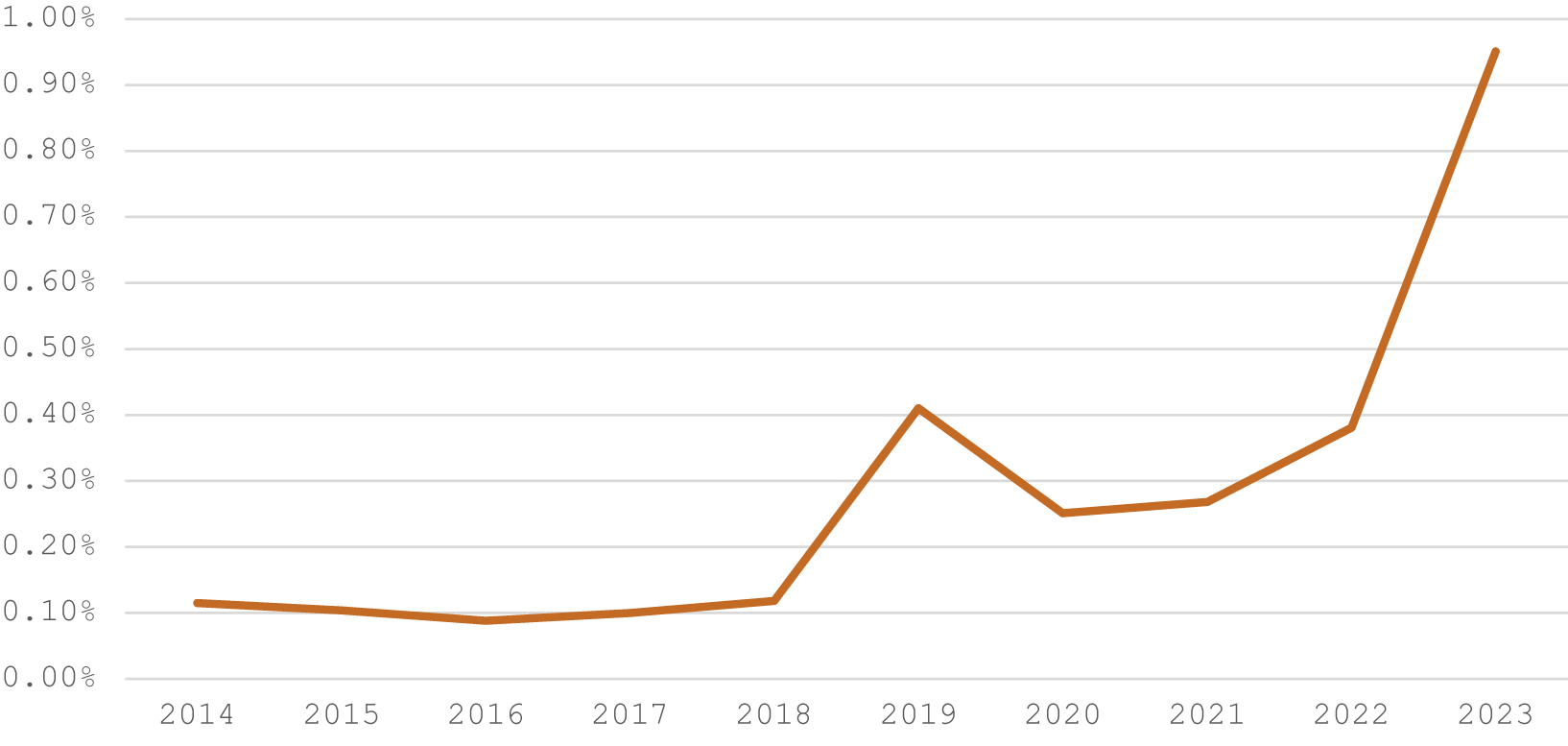
Figure 1 shows the overall frequency of reports about climate protests over time. Climate protests increase in 2019 with the emergence of the Fridays for Future movement, leading to a fourfold increase in the frequency of reports between 2018 and 2019. With Covid-19 erupting in early 2020, however, the climate crisis becomes less important; nevertheless, reports about protests stay at a higher level than before. News reporting increases again in 2023, when reports about climate protests were 9 times more frequent than in 2018.
Frequency of reports about climate protests.

The sentiment analysis (Figure 2) reveals that the average sentiment of reporting about climate protests is positive in every quarter (except the beginning of 2018) until 2022. A noticeable negative shift takes place in 2022, becoming more pronounced toward the end of the year. Since the final quarter of 2022, news coverage of climate activism in Austria is, on average, significantly negative.
Mean sentiment toward environmental activists in media articles about climate protests over time.

Fig. 2 Long description
The x axis displays time in half-year increments from 2014 underscore 1 to 2024 underscore 3. The y axis ranges from negative 0.4 to positive 0.3, representing mean sentiment. From 2014 to late 2021, sentiment fluctuates between approximately 0.1 and 0.3, with minor dips and peaks, including a notable drop near 2017 underscore 4. After 2022 underscore 1, the line sharply declines, crossing zero and reaching values near negative 0.4 by 2023 underscore 2. Sentiment remains negative and low through 2024, with small oscillations but no recovery to positive values. Each data point is marked with a dot connected by straight lines.
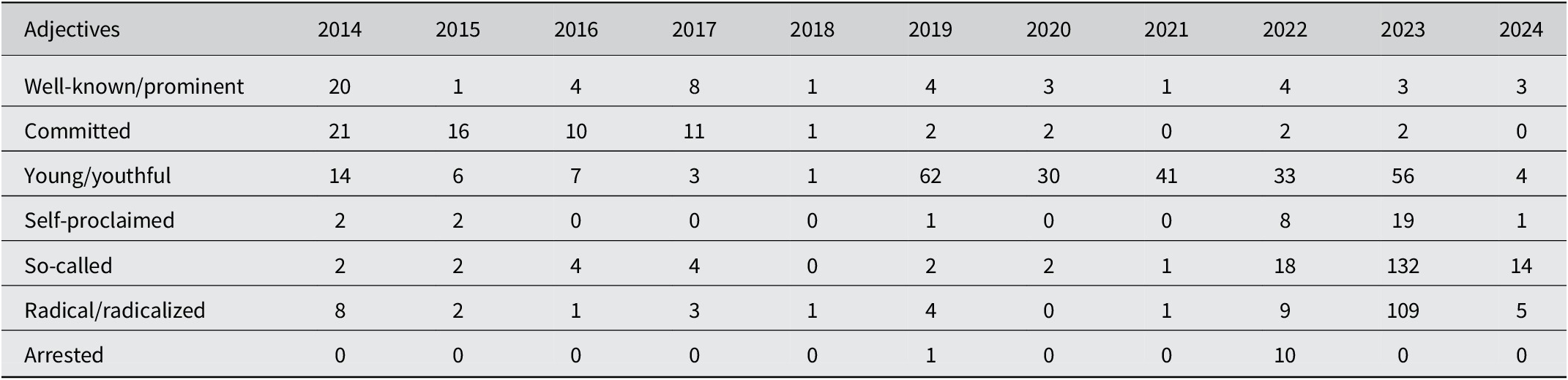
Table 1 shows changes in adjectives used in connection with environmental activists: While they are frequently described as prominent, well-known, and committed from 2014 to 2017, the framing changes in 2018 point mainly to the young age of protesters. Starting in 2018, negative adjectives such as radical, so-called or self-proclaimed are more common from the end of 2022 onward.
Adjectives used to describe environmental activists (adjectives translated to English by authors)

Table 1 Long description
The table consists of seven rows for adjectives and eleven columns for years. From left, the adjectives listed are: Well-known/prominent, Committed, Young/youthful, Self-proclaimed, So-called, Radical/radicalized, and Arrested. Moving right across the columns, the years are labeled from 2014 through 2024. For ‘Well-known/prominent’, the highest frequency is 20 in 2014, with lower values in subsequent years. ‘Committed’ peaks at 21 in 2014, then declines, reaching zero in 2021 and 2024. ‘Young/youthful’ starts at 14 in 2014, surges to 62 in 2019, 30 in 2020, 41 in 2021, 33 in 2022, and 56 in 2023, then drops to 4 in 2024. ‘Self-proclaimed’ remains low except for 8 in 2022 and 19 in 2023. ‘So-called’ is mostly low until a sharp increase to 18 in 2022, 132 in 2023, and 14 in 2024. ‘Radical/radicalized’ is low until 9 in 2022 and 109 in 2023. ‘Arrested’ is zero until 1 in 2019 and 10 in 2022. The data shows a shift in adjective usage, with recent years emphasizing ‘so-called’, ‘radical/radicalized’, and ‘young/youthful’.
Timeline of events

Table 2 Long description
Content flagged by safety filters.
Overview—Qualitative data sources

Table 3. Long description
Starting at the top row, the table lists four years: 2014, 2019, 2021, and 2024 in the leftmost column. For 2014, data sources include 44 interviews and 2 focus groups. Participants are representatives of C S Os in culture, arts, advocacy, refugee work, social services, feminism; 11 experts in C S O research, law, consultancy; and 12 interviewees in focus groups. In 2019, data sources are 53 interviews and 3 focus groups. Participants are representatives of C S Os in the same areas, 5 experts in C S O research, umbrella organizations, consultants, and 25 C S O representatives in focus groups. For 2021, data sources are 27 interviews, with participants as representatives of C S Os in culture, arts, advocacy, refugee work, social services, feminism. In 2024, data sources are 31 interviews. Participants are 25 representatives of C S Os and activists in the climate field, and 6 experts in C S O research and law. Each row details the qualitative methods and participant categories for each year, moving left to right across columns.
To get a better picture of what is happening during the negative shift at the end of 2022, we zoomed in onto the negative articles written after October 1st, 2022. The following Figure 3 depicts the most frequent words during that period in comparison with the rest of the climate-protest-corpus; these are: critique, Identitarians, attacks, blocking, protests, prohibit, hate preachers, normal, endanger, Islamist, and obstructing.
Most frequent words (by chi-square metric) after October 1st, 2022 (translated to English by authors).

A detailed chronological reading of the articles written in 2022 and 2023 reveals that the negative shift starts in April 2022 with the eviction of the protest camp in Lobau. To protest this incident, gluing to the streets is used as a protest from May 2022 onward in Austria. Throughout 2022, actions like gluing to streets, deflating tires, and soiling the protective glass in front of famous paintings become common among climate activists both in Austria and internationally. This prompts politicians to call for stricter monitoring and tougher penalties against activists. The Ministry of the Interior notes that climate activists are under state security surveillance, while the president of Vienna’s police cites rising extremism among them, with high-ranking politicians labeling them as “criminals, not activists.” By early 2023, the term “climate terrorists” is publicly used for the first time by a leading FPÖ politician.
Discussion
What were the reasons for the backlash against climate activism in 2023? The qualitative studies indicate steps of civil society capture by the authoritarian government of 2017–2019, specifically through derogatory discourses and financial restrictions on critical organizations, although climate activism was not yet targeted specifically. Nevertheless, sentiment in reports about climate protests slightly declined.
Between 2019 and 2021, conditions for civil society improved slightly, but the government minimized dissent. Until mid-2022, media portrayed climate activists overall positively to neutrally, describing them as well-known, committed, or young. This changed after the eviction of a highway occupation and the emergence of climate gluing in Austria in mid-2022, leading to negative media sentiment.
As the climate movement’s demands became more concrete and confrontational, political and media responses intensified. From November 2022, many politicians labeled activists as extremists and criminals, comparing them to extreme-right and extreme-left groups. This rhetoric was echoed in the media, and similar discourses emerged in Germany, where activists were compared to Nazism and RAF terrorists. The brutalization of discourse since late 2022 coincided with increased repression, including strategic lawsuits, financial penalties, police violence, and human rights violations. Thus, verbal delegitimization set the stage for repression against climate activists, constricting civil society’s space and chilling activism. The implications for civil society included diminished public support for climate initiatives, intimidation of activists, and increased burnout. Many activists reduced their activities, large CSOs restrained themselves from activities they would have done before, and the well-known CSO Last Generation closed its activities.
How can these results be interpreted theoretically? The model of civil society capture conceives autocratization as a multi-stage process, beginning with discursive delegitimization of critical parts of civil society, followed by restrictions on participation, financial constraints, and ultimately more repressive laws (Simsa, Reference Simsa2019). In line with other authors, our focus on discourse confirmed its role as a crucial first step in constraining critical civil society. Literature from authoritarian regimes worldwide points out the role of legitimacy discourses (Challand, Reference Challand2011; Lewis, Reference Lewis2013; Mendonça & Grandé, Reference Mendonça and Grandé2023) and movement studies highlight the importance of struggles regarding how to frame reality (Della Porta, Reference Della Porta2020; Knight & Greenberg, Reference Knight and Greenberg2011; Meyer et al., Reference Meyer, Pîrvulescu, Grasso, Zelinska, Buyantueva, Stefanovski, Kerényi, Gerő, Tsuladze, Dinev, Nikolayenko, Vrablikova, Crăciun, Stoyanov, Margarit, Hoxha, Kocyba, Gubernat, porta and Rammelt2025). Regarding the other steps proposed in the model, we also found evidence of restricted participation for CSOs, as well as for attempts to make the legal framework more restrictive or apply less favorable interpretations of existing legal ambiguities. Because climate activist CSOs typically do not receive public funding, financial cuts were not a major issue; however, financial strain emerged through numerous lawsuits linked to civil disobedience. Overall, the model fits established CSOs better than movement organizations. Our findings first indicate that repression, such as SLAPPs, strategic police operations against activists, and human rights violations should be explicitly integrated into the model as an additional and distinct stage. Moreover, they reveal that discursive devaluations typically occur first, followed by—on the same level—financial and legal constraints, reductions in participation and repression. These stages can move back and forth; however, once the ground has been prepared through delegitimization, subsequent steps can unfold very quickly.
Our model and data also help to clarify how repression affects mobilization. Earlier work proposed that repression can either hinder or trigger mobilization (Earl, Reference Earl2003; Francisco, Reference Francisco, Davenport, Johnston and Carol2005; Honari, Reference Honari2018). In our case, repression, which has gone unquestioned by the public, has stifled activism, leading activists and CSOs to scale back their efforts. This stands in contrast to previous reactions to anti-terrorism measures targeting animal rights activists in 2010, which were widely regarded by the public as excessively harsh. The comparison of these two situations underscores the power of public discourse: when repression is perceived as legitimate, it undermines activism; conversely, when the public views repression as excessive, it can actually strengthen support for a movement (Hess & Martin, Reference Hess and Martin2006; Zúñiga et al., Reference Zúñiga, Asún and Louis2023). In a climate that is skeptical of civil society in general because the ground has been prepared by polarizing discourses, repression is easily conceived of as legitimate.
On a micro level, our interviews did not reveal signs of radicalization among activists in response to repression. This finding suggests that most climate activists are not firmly embedded in networks around the issue or exclusively define their identity with the cause (Jämte & Ellefsen, Reference Jämte and Ellefsen2020; Linden & Klandermans, Reference Linden and Klandermans2006). Conversely, our data suggests that the average climate activist is deeply integrated into mainstream society, often facing the prospect of sacrificing career opportunities if they choose to persist in their activism. This perspective is reinforced by interviews indicating that some activists are responding to repression by transitioning from direct action to roles within public institutions to address climate change. Thus, we can infer that the subjective costs of engaging in climate activism are notably high (Honari, Reference Honari2018).
Why was it the climate movement that became the target of repression? It has repeatedly been suspected that the tactics of occupations, gluing to the streets, and deflating tires contributed. Although civil disobedience is often later seen as justified and effective (Chenoweth and Stephan, Reference Chenoweth and Stephan2011), most people support stronger climate policies but oppose civil disobedience (Rucht 2023). It is common for movements that challenge the status quo that media attention concentrates on their tactics rather than their underlying political causes (Gil-Lopez, Reference Gil-Lopez2021; McLeod & Hertog, Reference McLeod and Hertog1999). This focus of reporting works as a discursive strategy of delegitimization rather than a reflection of facts; other protests, such as farmers blocking roads with tractors, have caused far greater disruption without causing much rejection. Hence, the tactics alone do not explain the huge backlash. Another crucial factor could be the proclaimed necessity of socioecological transformation and the climate movement’s relative success since 2020. The literature indicates that delegitimizing narratives disproportionately target groups that challenge the status quo compared to those that uphold business as usual (Gitlin, Reference Gitlin2003; Kreuznacht, Reference Kreuznacht2020; McLeod & Hertog, Reference McLeod and Hertog1999). Furthermore, repression tends to intensify when a movement is perceived as a threat to elite interests (Davenport, Reference Davenport2005; Earl, Reference Earl2003).
Conclusion and limitations
Climate change is advancing more rapidly than anticipated (IPCC, 2023), yet civil society actors in the climate sector have been facing escalating pressure. In recent years, they have increasingly been criminalized and defamed by both politicians and the media. By now, the climate movement in Austria is showing very little activity and previous climate policies are being reversed by the new government, a coalition of moderate parties.
Discourses have played a crucial role in this process, limiting solidarization and support, preparing the ground for repression, and having chilling effects on activism. Evidently, they are not “just words” but potent strategies of delegitimizing civil society. The article thus shows the strong link between discourses and repression in established democracies and also the vulnerability of democracy itself. Our study further shows the vulnerability of climate activism. Although its causes are strongly supported by science, politics and the media were highly successful in undermining its goals. We hypothesize that this was not only due to activists using “wrong” strategies (Moss & Snow, Reference Moss, Snow and Abrutyn2016, p. 556; Rucht, 2023), but also because the issue is too fundamental and unsettling and because right-wing populist-authoritarian strategies are currently very strong.
In any case, a clear finding of our analysis is that activists operating in contested fields are well advised to understand the constraining mechanisms, anticipate them, and develop effective counter strategies. Familiarity with the process helps in recognizing even subtle forms early and responding collectively.
The article has several limitations. While the media analysis is very comprehensive, the qualitative studies could be supplemented by more interviews and systematic participant observation. Further, the qualitative analysis consists of four different studies. This has the advantage that we can provide a good picture of the conditions of civil society over time. Although climate CSOs were included in all studies, only the last study focused exclusively on climate-related activities and activists.
Future research could explore strategies that the climate movement might employ to counter negative framing and effectively engage the public on climate issues. Examining the diverse impacts of various tactics used by social movements would enhance the debate: under what conditions is civil disobedience successful, and when does it become counterproductive? Additionally, applying the model of civil society capture to other fields and contexts could provide deeper insights into the theoretical interplay between framing, repression, and the success of movements.
Funding statement
This research received no external funding.
Competing interests
The authors declare that they have no conflict of interest.



 Open access

