1. Introduction
The use of catch share systems for fisheries management has been broadly advocated in the literature for its efficiency gains compared to open access conditions (Costello et al., Reference Costello, Gaines and Lynham2008; Gutiérrez et al., Reference Gutiérrez, Hilborn and Defeo2011). However, improvement in efficiency usually implies, among other things, the reorganization of the internal structure of firms, which might lead to important distributional conflicts. These conflicts are mainly related to quota concentration, reduction in employment of fishermen, more competition in the labor market, increased working hours for active fishermen, and/or changes in the remuneration of fishing jobs (Guyader and Thébaud, Reference Guyader and Thébaud2001). Typically, regulations based on catch shares are designed to give use rights to vessel owners, implying additional distributional conflicts coming from the improved position of capital owners (Copes, Reference Copes, Pálsson and Pétursdóttir1997; Davidse, Reference Davidse1997). It is likely, then, that catch shares will redistribute bargaining power and, therefore, rents within the firm. Specifically, through the remuneration systems, catch shares can have a direct impact on rent distribution between the vessel owner and the crew.
This paper contributes to understanding how the mechanism by which output or income in fisheries is distributed between labor and capital, is adjusted when a catch shares system is introduced. The most broadly used remuneration system in artisanal fisheries is share contracts. Under a share contract remuneration regime, the crew receives a percentage of either the gross income or profit per fishing trip (Platteau and Nugent, Reference Platteau and Nugent1992). Given the potential redistribution of bargaining power and the well-known effects of catch share systems on productive efficiency, the introduction of this fisheries management instrument is likely to have an impact on labor costs and crew wages, especially in shared remuneration systems (Guillen et al., Reference Guillen, Boncoeur, Carvalho, Frangoudes, Guyader, Macher and Maynou2017). This might have important implications on fishermen's expected income. Literature studying the impact of catch share systems on efficiency-related issues is well-documented (see, for example, Copes, Reference Copes1986; Grafton, Reference Grafton1996; Scott, Reference Scott2008; Arnason, Reference Arnason2012), but information on remuneration effects is still limited. One exception is Abbott et al. (Reference Abbott, Garber-Yonts and Wilen2010) who found an increase in remunerations after the implementation of catch shares in the Bering Sea/Aleutian Island crab fisheries in the USA. The rise was explained by an increase in the base on which the share was calculated, but the authors did not find any clear evidence of changes in crew shares.
We use data on the distribution of fishing net incomes between vessel owners and crewmembers, and geographical differences in the implementation of the Extractive Artisanal Regime (or RAE, its acronym in Spanish) in Chilean hake fisheries to explore changes in crew shares. RAE is a type of cooperative catch shares regulation implemented in Chile with basically two variations: RAE by organization and RAE by area. While RAE by area represents the status quo of a restricted access regime with global quota over a specific fishing area, RAE by organization requires artisanal fishermen to build organizations that collectively decide how to organize fishing effort over their common quota. Our empirical strategy takes advantage of the fact that these different varieties of RAE were applied simultaneously in different geographic areas. We combine census data and information from official decrees by the Undersecretary of Fisheries to identify a number of fishing communities that adopted the collective quota systems, namely RAE by organization (treated group) and RAE by area (control group). To assess the effect of this regulatory change on crew shares, we estimate a switching regression model which enables us to account for pre-existing differences between fishing communities and shows differentiated effects on crew net income shares depending on the regulatory regime.
The rest of the article is organized as follows: section 2 reviews the literature on catch shares systems as a fisheries management instrument and its effects on fisheries performance. Section 3 describes the characteristics of the Chilean hake fisheries. Section 4 discusses the implementation of the RAE in Chile. Section 5 presents the empirical strategy and section 6 the data and econometric estimation. Section 7 discusses the main results, section 8 presents a series of robustness controls, and section 9 concludes with the implications of the study.
2. Literature review
The use of catch share systems has been advocated in the fisheries literature as a management device that can prevent fisheries from collapsing (Costello et al., Reference Costello, Gaines and Lynham2008; Gutiérrez et al., Reference Gutiérrez, Hilborn and Defeo2011), particularly individual transferable quotas (ITQs) as a specific type of catch share regime (Copes, Reference Copes1986; Grafton, Reference Grafton1996; Scott, Reference Scott2008; Arnason, Reference Arnason2012). Although ITQs can be an efficient solution, they can fail to enhance efficiency in intra-seasonal or spatial effort allocation (Holland, Reference Holland2004; Wilen et al., Reference Wilen, Cancino and Uchida2012) and in multispecies fisheries (Sanchirico et al., Reference Sanchirico, Holland, Quigley and Fina2006), and can generate weak incentives for biomass and ecosystem (Arnason, Reference Arnason2012).
An alternative management regime that may hold advantages over ITQs is cooperative catch shares (CCS).Footnote 1 In this case, rights are granted to an organized group of fishermen (Poon et al., Reference Poon, Bonzon and Van Leuvan2013). CCS can improve management when there is some type of externalities between fishermen (Baland and Platteau, Reference Baland, Platteau, Mäler and Vincent2003; Cheong, Reference Cheong2004; Segerson, Reference Segerson, Squires, Maunder, Vestergaard, Restrepo, Metzner, Herrick, Hannesson, del Valle and Andersen2014; Holland, Reference Holland, Halvorsen and Layton2015). In such cases, collaborative action can enhance efficiency through a reduction in monitoring and enforcement costs (Ovando et al., Reference Ovando, Deacon, Lester, Costello, Van Leuvan, Mcllwain, Strauss, Arbuckle, Fujita, Gelcich and Uchida2013), inducing efficient effort distribution between an organization's members (Schlager, Reference Schlager, Ostrom, Gardner and Walker1994; Cancino et al., Reference Cancino, Uchida and Wilen2007; Deacon et al., Reference Deacon, Parker and Costello2008; Uchida, Reference Uchida2017), reducing site search costs through information sharing (Costello and Deacon, Reference Costello and Deacon2007; Knapp, Reference Knapp2007; Deacon et al., Reference Deacon, Parker and Costello2008) and reducing bycatch through cooperation (Ovando et al., Reference Ovando, Deacon, Lester, Costello, Van Leuvan, Mcllwain, Strauss, Arbuckle, Fujita, Gelcich and Uchida2013). However, the effect of CCS on efficiency and resource conservation depends on the regulatory design of the rights, the characteristics of the fishery, the way in which fishermen organize themselves, and the goals and the cooperation tradition of organizations (Heintzelman et al., Reference Heintzelman, Salant and Schott2009; Holzer, Reference Holzer2010; Deacon, Reference Deacon2012; Castillo and Dresdner, Reference Castillo and Dresdner2013; Ovando et al., Reference Ovando, Deacon, Lester, Costello, Van Leuvan, Mcllwain, Strauss, Arbuckle, Fujita, Gelcich and Uchida2013; Segerson, Reference Segerson, Squires, Maunder, Vestergaard, Restrepo, Metzner, Herrick, Hannesson, del Valle and Andersen2014).
The effect of CCS on share contracts has received little to no attention in the literature. The little existing evidence relates to evaluating individual catch share regimes that are similar to ITQs. Conceptually, we can identify different routes through which the change in the regulatory regime might affect income shares. Which one of these routes constitutes a valid explanation in this case is an empirical question. The change in the regulatory framework is associated with changes in the productive process, altering underlying incentives for economic decision-making, with subsequent consequences on the production function, productivity, bargaining power of factors, and on the characteristics of a ‘fishing job’, such as duration, safety and content. In order to enhance efficiency in quota markets, fishers are not only encouraged to be more efficient in terms of fishing operations, but are also incentivized to reorganize their internal structure, particularly in terms of contracts between vessel owners and crews (Guyader and Thébaud, Reference Guyader and Thébaud2001).
One way to understand the determination of income shares is a basic negotiation model, in which the shares are determined by the bargaining power of the relevant agents. Brandt and Ding (Reference Brandt and Ding2008) developed a model to study this new contractual form that emerges between boat and quota owners in an ITQ setting. Basically, individual or collective quotas are considered a new form of capital, distinct from the vessel. As capital, they give rights to catch and reduce the relative importance of labor compared to other inputs (Casey et al., Reference Casey, Dewees, Turris and Wilen1995). Therefore, the possibility that the crew retains part of the vessel owners' rent and/or agrees to cover the extra costs, depends on the bargaining capacity of each of the parts (Guillen et al., Reference Guillen, Boncoeur, Carvalho, Frangoudes, Guyader, Macher and Maynou2017). This view seems to be held in most of the literature that has done research on share contracts in fisheries (McCay et al., Reference McCay, Creed, Finlayson, Apostle and Mikalsen1995; Squires et al., Reference Squires, Kirkley and Tisdell1995; Abbott et al., Reference Abbott, Garber-Yonts and Wilen2010). In this literature, there is a case when the introduction of individual fishing rights should tend to reduce the crew share. This is when a part of the income is used to pay the cost of the fishing rights. However, this effect could be counteracted if this reform, at the same time, induces the search for more skilled crew with greater labor productivity, augmenting the bargaining power of the crewmembers. This could, in principle, lead to an increase in the crew's income shares. Thus, it is not evident how an efficiency-enhancing change in the fishing rights regime will change income shares among the crewmembers in general. Empirically, Abbott et al. (Reference Abbott, Garber-Yonts and Wilen2010) explored the remuneration and employment effects of individual catch shares in the Bering Sea/Aleutian Island crab fisheries in the USA. The authors found an increase in remunerations coming from efficiency gains. These gains were the result of cost reductions and/or increases in live landings per day. There was no clear evidence that crew shares had changed, implying that this increase was founded on a larger income base from which the share was calculated.
A second way to understand the shares system is as a cooperative contract agreement between the vessel owner and the crew, where the distribution of benefits resulting from this coalition is to be determined by a consensual bargaining process. For consent to prevail, a commonly agreed concept of fairness should be adopted which, in turn, will specify how the distribution scheme will work in a consensus (Liang, Reference Liang1999). The contract agreement between the vessel owner and the crew, in accordance with the multiple crew model (McConnell and Price, Reference McConnell and Price2006), incorporates two parameters that determine the income share and the ex-ante cost share paid by the crew (e.g., fuel). If the cost share for the crew decreases, this will increase the net income share received by the crewmembers. In this model, the cost share depends, among other things, on the reservation utility of the crew. If this reservation utility increases, then the cost share will be reduced in the contract, reducing the vessel owner's net income share.Footnote 2 There are several routes in this model, through which a regulatory reform such as the RAE by organization can generate positive or negative impacts on the crew's net income shares. A change in equity considerations of what constitutes a fair share would generate an increment in the reservation utility of the crew, and an increase in its net income share. Moreover, if the regulatory reform induces more cost efficient trips, the percentage of costs per trip required to be shared among the crewmembers will be reduced, having the same effect as an increase in reservation utility.
An additional argument for analyzing the effect of the RAE by organization on income shares is considering the collective nature of the fishing right. Strictly speaking, in the RAE by organization the fishing rights are granted to the organization and not to individual vessels. This, and other features of the specific way in which collective rights were implemented, implied that the artisanal fisher organization (cooperatives) had a great deal of power to influence income shares. Specifically, fairness considerations might be very important for the fisher organizations (McCay et al., Reference McCay, Micheli, Ponce-Díaz, Murray, Shester, Ramirez-Sanchez and Weisman2013). Once again, in principle, the shares might change either way, depending on the characteristics of the organization and the manner in which collective action is organized by it.
In summary, we do not have theoretically definite predictions on what we should expect to happen with income shares when CCS are introduced. Nevertheless, the empirical evidence on what the result was on income shares is relevant, because it discards certain outcomes (decrease or increase in crew shares), and allows us to discuss the causes of the observed change.
3. The Chilean hake fisheries
In south-central Chile, there is a traditional fishery industry based on a demersal species, the Chilean hake (Merluccius gayi gayi). This species is found between the Coquimbo (29°54′28″S) and Los Lagos (41°28′18″S) regions,Footnote 3 primarily located in the first 60 miles off the coastline, and concentrated around 50–500 m depth. The primary spawning period occurs between August and September, not starting until October in the southernmost regions. The recruitment age is two years old, and they can live up to 20 years (Subsecretaría de Pesca, 2011).
Two different fleets operate over the species: the industrial and the artisanal fleets. According to Chilean law (General Fisheries and Aquaculture Law, 1991), artisanal vessels cannot exceed 50 gross tons or a length of 18 m. Vessels that exceed one of these marks are considered industrial. Artisanal fishermen have exclusive rights for fishing within the first five nautical miles off coast. To capture Chilean hake, industrial vessels use bottom trawling or dropline methods, while artisanal vessels are only allowed to use gillnet or dropline. Chilean hake is mainly used for human consumption, both domestic and foreign, in the form of frozen or fresh chilled products (Quezada and Dresdner, Reference Quezada and Dresdner2014).
The distribution of income in the artisanal Chilean hake fisheries is based on a share contracts system, which varies depending on the fishing gear used and the geographical location. As a general rule, trip costs (mainly fuel and food expenses) are discounted from the gross income of a fishing trip. This resulting income, hereafter net income, is then distributed between the vessel owner and crew in fixed percentages. For instance, vessel owners in the Biobío region that do not use trawling receive 40 per cent of the net income, and the rest of the crew receives 60 per cent (Dresdner et al., Reference Dresdner Cid, Barriga, Chávez Rebolledo, Henríquez Aste, Cubillos Santander, González Vallejos, Hernández and Baquedano2005). One particular feature of artisanal fishing's organization is that the total capital required to fish is distributed between the crew. While one of the fishers owns the vessel and, therefore, receives a higher share of the net income, the crewmembers in many locations provide their own fishing gear (H. Arancibia, leader of the Federación de Pescadores Artesanales de la Región del Biobío, personal communication, 16 March 2017); thus, the crew's share does not only reflect labor income, but also capital income. In some fishing coves, the owner of the fishing gear receives a specific share of income for this contribution. The negotiating power of the crew is stronger in these cases where they contribute capital, rather than only contributing labor.
4. Extractive Artisanal Regime in Chile
In 2001, an individual quota system was established and applied for the first time to assign the industrial share of the Chilean hake fisheries' total allowable catch (TAC). In 2004, a special regime called the Extractive Artisanal Regime or RAE was established by the Undersecretary of Fisheries (UF) to allocate the artisanal share of the TAC for those fisheries with restricted access. One of these was the Chilean hake fisheries.
The RAE can be initiated by the Undersecretary of Fisheries or upon request from artisanal fisher organizations (Reglamento del RAE, 2004). It includes different potential assignment forms for the artisanal share of the TAC among fishermen, namely: by geographic area, by fleet, by vessel-type (according to size), by fishing cove, by artisanal organizations or individually. In practice, however, only two of these assignment forms have actually been in force in Chile: RAE by area and RAE by organization.
The RAE by area assignment form can be seen as a system of several different TACs defined over limited areas and subsamples of artisanal fishermen. In fact, the division of the share of the artisanal TAC by regions is a RAE by area assignment form. Thus the status quo, should no one have requested a change in the regulatory regime, was a RAE by area assignment form. However, the RAE by area was applied, in some cases, to geographic areas that were smaller than the regional limits. For the fishermen with access rights to the area, the system worked as a restricted-access common pool regime with a TAC. Thus, the incentive was to fish as fast and as much as possible, before the area was closed.
The RAE by organization form, in contrast, required the formation of a formal fisher organization of vessel owners with legal statutes, member lists, and a democratic election of the leaders. The quota was assigned to the organization. Thus, the individual member did not have legal rights over the quota, but the organization did.Footnote 4 Moreover, the application to participate in the RAE by organization mode required a majority decision of the members belonging to the organization. The normative also included the possibility that the organization presented a managing plan for the quota. This plan should identify the rules for internal allocation of the organizational quota, which crewmembers participated in the extraction of the quota, verification mechanisms for the total landings made by the organization, and even organization-specific management and commercialization rules. This plan had to be supervised by the Fisheries authorities. Thus, the regulatory design has several incentives that framed collective action. This may have encouraged fishermen to coordinate in making fishing and income distribution decisions. However, collective catch share systems, per se, do not guarantee that fishermen will choose the collective action path (Holland et al., Reference Holland, Kitts, da Silva and Wiersma2013).
When the RAE system was first implemented, most artisanal fishermen were not organized. Many artisanal fishers joined or built organizations to secure a quota because of the RAE's specifications. Another consequence of the regulatory change was that the organizations' leaders obtained a great deal of power because the quota was owned by the organization and its sharing was supposed to be agreed upon by all the members of the organization. According to the Undersecretary of Fisheries, the RAE system in Chile was an effort to organize artisanal fishery, reduce job uncertainty in this activity and improve its management (Subsecretaría de Pesca, 2011). However, depending on the context and some particularities in each fishery, we should expect different effects from introducing these two types of RAE in terms of efficiency and distribution. For example, Chávez Estrada et al. (Reference Chávez Estrada, Quiroga Suazo and Dresdner Cid2018) found that RAE by organization reduced the technical efficiency in the common sardine and anchovy fishery in Chile, on average, and that organizations showing cooperative behavior performed better than those that do not. In spite of lack of more empirical evidence, this finding may also apply to other fisheries such as the Chilean hake fisheries. Another characteristic that is context-specific to the fisheries of interest in this study is the potential stronger negotiation power of crewmembers, who provide their own fishing gear. We hypothesize that this feature creates dissimilar effects in terms of distributional impacts of the RAE by organization.
Initially, both the RAE by area and RAE by organization forms were applied simultaneously in different geographic areas.Footnote 5 The areas with more artisanal fishermen and a prior history of artisanal organization were the ones that opted for RAE by organization, while the rest remained with the RAE by area form (Dresdner et al., Reference Dresdner Cid, Barriga, Chávez Rebolledo, Henríquez Aste, Cubillos Santander, González Vallejos, Hernández and Baquedano2005). Since this last group continued to operate in the same manner as it used to before the introduction of the RAE by area, we do not expect to find any effects on the share contracts of their crew, because of the regulatory reform. The fishermen who were authorized to operate in the fisheries in an area regulated by organizational RAE and who decided not to participate in any organization had the right to access a common pool quota of approximately 6 per cent of the total artisanal share of the quota, called ‘residual quota’ (cuota residual in Spanish). They had the right to catch fish until this quota was exhausted in a restricted-access common pool mode.
5. Empirical strategy
To estimate the impact of the regulatory regime on crew net income shares, the following model was used:

where ${y_i}$ is the crew net income share of vessel i; ${x_i}$
 is a vector of explanatory variables from vessel I; β (a vector) and δ (a scalar) are parameters; ${\varepsilon _i}$
 is a stochastic variable; and ${I_i}$
 is a binary variable taking the value of one when the vessel owner operates under RAE by organization, and zero if the vessel owner is regulated under RAE by area. The impact of the regulatory system on net income shares is captured by the δ parameter. One issue with this model is that it might result in inconsistent estimates of the regulatory impact on net income shares if the selection of regulatory system is based on a set of pre-existing observed covariates; that is, if vessel owners' characteristics under RAE by organization differ systematically from those observed in fishing communities under RAE by area, the model might present selection bias (Maddala, Reference Maddala1983). Furthermore, the explanatory variables may have different effects on crew net income shares depending on the regulatory regime.
To deal with these issues, we estimate the switching regression model (Maddala, Reference Maddala1983). In our specification, we closely follow Nguyen and Leung (Reference Nguyen and Leung2009). The selection equation is defined by a criterion function I, determining whether or not the vessel owner operates in a fishing community regulated under RAE by organization:

where ${I_i} = 1$ if vessel i operates in a fishing community regulated under RAE by organization, and ${I_i} = 0$
 if vessel i is under RAE by area; ${z_{ik}}$
 is a vector of observed variables affecting the probability that vessel i operating in a community k chooses to be regulated by RAE by organization; θ and γ are vectors of parameters; and u is a stochastic term.
The crew net income share equations for each regulatory regime are defined as follows:


where ${y_{1i}}$ and ${y_{0i}}$
 are the fractions of net incomes allotted to crewmembers of vessel i under the RAE by organization and RAE by area regulatory regimes, respectively. ${u_i}$
 , ${\varepsilon _{1i}}$
 and ${\varepsilon _{0i}}$
 are the error terms of the selection equation, the RAE by organization and the RAE by area net income share equations, respectively. These are random variables that are assumed to follow a trivariate normal distribution with zero means and variances of $\sigma _u^2$
 , $\sigma _1^2$
 and $\sigma _0^2$
 , respectively. Equations (2)–(4) form a system that requires a simultaneous estimation approach. Based on this trivariate distributional assumption of the disturbance terms, the switching regression model proposes the maximization of the following logarithmic likelihood function:

F(·) and f (·) are the cumulative distribution and the distribution function, respectively; ${\eta _{ji}}$ is defined as follows:

where ${\rho _j} = {\rm{\;corr}}( {\sigma_j^2,\;\sigma_u^2} ),\;j\; = \;0,1$ are the correlation coefficients between the error term in the selection equation and the respective error terms in the net income share equations.
This model allows us to estimate the differences in the net income shares when vessels switch from the RAE by area regime to the RAE by organization regime, and vice versa. To calculate these measures, we first need to compute the conditional expectations of the net income shares under the two regimes. The expected outcome of a vessel that is a member of RAE by organization group is defined as follows:

The expected hypothetical outcome of a vessel that is a member of RAE by organization group (since ${I_i} = 1$ ) if the ‘RAE by organization’ regime did not exist (hence ${y_{0i}}$
 ) is:

The expected change in the crew net income share of a vessel regulated under RAE by organization if it switches hypothetically to RAE by area is represented by:

The expected hypothetical outcome of a vessel that is a member of RAE by area (since ${I_i} = 0$ ) if ‘RAE by area’ regime did not exist (hence ${y_{1i}}$
 ) is

The expected outcome of a vessel that is a member of RAE by area is defined as follows:

Finally, the expected change in the crew net income share of a vessel regulated under RAE by area when switching hypothetically to RAE by organization is expressed as:

Equation (9) can also be considered as an estimation of the average treatment of the treated. It quantifies how high the crew share is among group organization members compared to what it would have been if they had not become a member (Uchida et al., Reference Uchida, Uchida, Lee, Kim and Ryu2010). In addition, we are interested in the potential impact of the RAE by group organization on the net income share. This is the average treatment effect (ATE) of the new regulation on the distribution of net incomes between vessel owners and the crew. It can be interpreted as the average gains in the crew share from changing all fishermen under RAE by area to RAE by organization. Then, we calculated the ATE as follows:

Or

6. Data and econometric estimation
We used data from the first Fishing and Aquaculture Census in Chile that was conducted by the Statistical National Institute (or INE, its acronym in Spanish). This census spanned the period from the end of 2008 until the first months of 2009 and contains information for the 2006–2007 fishing season (INE, 2009).
The census survey collected information from different economic agents related to the fisheries and aquaculture sectors. We used the census data on vessel owners operating in the artisanal sector.Footnote 6 The census consists of information on the fraction of total net incomes (fishing gross income discounting fuel and food expenses) from fishing distributed to each category of dependent workers involved in extraction activities, including vessel owners (namely skippers), fishers, divers, divers' assistants, and others. Our main share contracts' variable represents the sum of the percentages of all crewmembers belonging to these fisher categories. To identify a representative sample of fishers operating in the Chilean hake fisheries, we selected only those vessel owners reporting Chilean hake landings as one of their three main species. Thus, our sample consists of 662 observations of vessel owners operating during the 2006–2007 fishing season across the country under essentially two management regimes: RAE by area and RAE by organization.
In order to distinguish vessel owners operating under one regime or the other (the treated and control groups), we used the RAE regulatory decrees from the Undersecretary of Fisheries (Subsecretaría de Pesca y Acuicultura, 2017). These decrees give information on the distribution of the artisanal share of the TAC for the Chilean hake by area and, in the case of the RAE by organization mode, by organizations. Since this information is gathered at the organization level, we were not able to observe directly whether or not a single vessel owner was a member of an organization participating in the RAE by organization regime; however, we had information about the fishing cove (caleta in Spanish) where the organization reported performing its extractive activities and where the individual vessels were registered.Footnote 7
Consequently, we matched organizations under RAE by organization, individualized in the official decrees, with location data of the vessel's registered fishing cove to proxy whether or not each vessel owner operated under RAE by organization, that is, if he belonged to the treated group. In this way, we defined treatment and control groups at the fishing cove level, assuming that all vessels registered in a certain location belonged to the treatment group if the decrees identified at least one organization located in this fishing community settlement operating under RAE by organization. This proxy, though imperfect, is based on the fact that it is not common to find more than one organization representing the same fishing community (Subsecretaría de Pesca y Acuicultura, 2017). Thus, this assumption seems reasonable in the absence of more accurate data. Figure A1 in the online appendix shows fishing coves throughout the study area. Red dots denote fishing coves regulated by organizational RAE. As can be observed, treated fishing communities are mainly located in the Biobío region, followed by Valparaiso.
To estimate the switching regression model, we first need to specify the selection equation outlined in (2). This equation estimates the probability that the community chooses to be regulated by RAE by organization as a function of a vector of observed variables ${z_j}$ . The probability is estimated by a probit model. The procedure for implementing the RAE regulation allowed this decision to be voluntary, and we hypothesized that it responded to the following observed variables at the fishing community level. First, we introduced a variable that measures the relevance of Chilean hake in the fishing community using the total Chilean hake landings during 2000–2004,Footnote 8 the period prior to the regulation. This is a scale variable that might also capture how resource abundance in the fishing area affects the decision to choose RAE by organization. We hypothesized that the communities with larger shares of hake total landings would try to secure these landings by choosing a RAE by organization regulatory form. We also included a variable that captured differences in opportunities across fishing coves. This variable adopted a unit value if the community had access to fishing infrastructure and zero otherwise. Fishing communities lacking infrastructure were assumed to be at a disadvantage, which might strengthen the community perception that a regulatory change was necessary. It is also possible that people living in fishing communities with fewer opportunities might act more conservatively; thus, the expected sign of this variable is ambiguous. Furthermore, it has been suggested that more populated geographical areas and with a longer tradition of artisanal organization were the ones that opted for RAE by organization (Dresdner et al., Reference Dresdner Cid, Barriga, Chávez Rebolledo, Henríquez Aste, Cubillos Santander, González Vallejos, Hernández and Baquedano2005). Consequently, we controlled for population size and the ex-ante level of organization. The size of the fishing community was measured by the number of fishermen reporting to be living in the fishing community, while the ex-ante level of organization included only those fishermen who reported being members of a fisheries-related organization for at least five years prior to the regulatory reform.Footnote 9 We hypothesize that fishing communities with more organizational experience are more likely to choose the RAE by organization form.
To estimate the share contract equations for each regime (equations (3) and (4)), we followed Thuy et al. (Reference Thuy, Flaaten and Anh2013) and Salazar-Espinoza (Reference Salazar-Espinoza2015) and considered a vector ${x_i}$ of explanatory variables characterizing vessel owners, boats and state of resources.
For vessel owner characteristics, we controlled for age, education and experience to proxy for vessel owner's bargaining power. The rationale is based on the bargaining power argument supported by an extensive literature on agrarian contracts (Kvaløy, Reference Kvaløy2006). We expected that older, more educated and more experienced vessel owners would have an advantage in the bargaining process, resulting in a smaller crew profit share. In addition, we controlled for a dummy variable if the vessel owner had alternative employment in the past year. We assume that supervision costs increase if the vessel owner has less time for monitoring because he partakes in other economic activities; thus, we expect a positive association between this characteristic and the crew profit share.
Regarding boat characteristics,Footnote 10 we controlled for vessel size, vessel material, technology and crew size, intended to proxy for catchability and the use of capital-intensive technology. While vessel size is proxied by including dummies for several categories,Footnote 11 vessel material is defined as wood (value equal to one) or other materials (value equal to zero).Footnote 12 Differences in technology were proxied by a dummy for the presence of onboard echo sounders and a series of dummy variables that characterize the type of fishing gear, particularly purse-seine net and drift-net fishing technology.Footnote 13 In all cases, the variable adopted a value of one when the technology or fishing gear was present on the vessel and zero if not. In addition, we considered the number of crewmembers. We expected that vessel owners operating smaller boats made out of wood with a larger crew size, and using labor-intensive technologies would have a lower catchability coefficient, and would decide to give a larger proportion of total fishing net income to the crew.
In addition, we added a dummy variable named climate shock taking the value of one if the vessel owner reported experiencing an adverse climate event (bad weather or resource scarcity) in the last twelve months, and zero otherwise. We anticipated an increase in crew profit shares in times of resource scarcity, since it is necessary to increase labor effort in periods of difficult weather. Most likely, some absolute crew remuneration level exists under which it is no longer rewarding for the crew to make the trip. Thus, crew profit share should increase in low gross income levels.
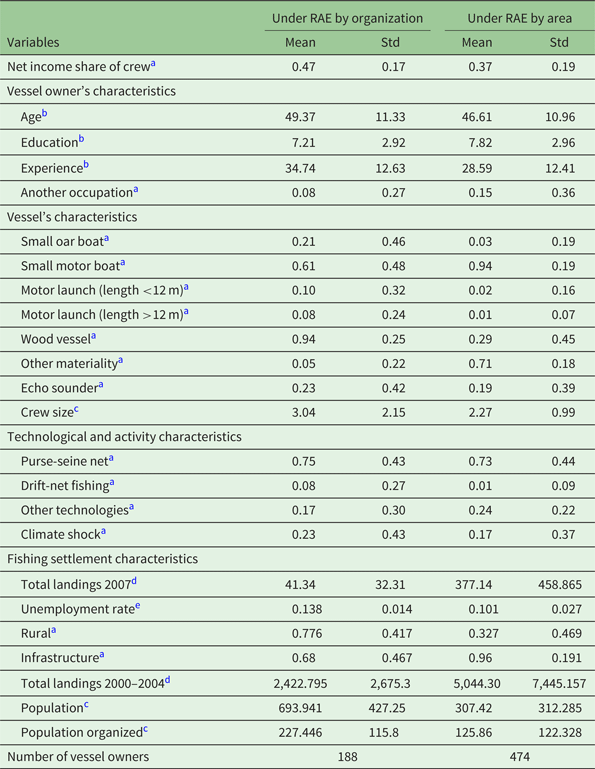
Finally, we introduced variables that capture differences in opportunities and outside options across fishing communities. These were the total Chilean hake landings in 2007 of the fishing community, the unemployment rate in the district where the fishing community is located and a dummy variable that adopts the value of one if the fishing community is located in a rural area, and zero otherwise.Footnote 14Table 1 summarizes the descriptive statistics of control and selection variables by different management regimes.
Descriptive statistics of treatment and control fishing communities for Chilean hake (Merluccius gayi gayi) artisanal fisheries

Std, standard deviation.
a Dummies.
b In years.
c Number of persons.
d In tons.
e Proportion.
Source: Own elaboration based on census data.
Descriptive statistics show substantial differences between vessel, fishing technology and fishing settlement characteristics in the RAE by organization and RAE by area. For instance, in terms of socioeconomic characteristics, vessels owners operating under RAE by organization are relatively older, more experienced, less educated and devote more time to fishing. In terms of vessel and technological characteristics, vessels under RAE by organization are mainly small motor boats made out of wood, and hire more workers. Finally, we observe that fishing coves under RAE by organization are larger, defined as rural areas, lacking infrastructure, and have historically lower landing volumes and higher levels of organization. All these characteristics suggest that the decision of opting for RAE by organization may first respond to better initial conditions to succeed under a regulation that requires cooperation efforts (i.e., fishing and organizational experience), and second, a low level of development of coves (i.e., less advanced technology, lower landing values, lack of infrastructure) that may see this new regulation as a means to improve their welfare.
Despite the above-observed dissimilarities, the switching regression model was designed to account for these differences, and thereby isolates the effect of the new regime on share contracts. First, the model assumes an equation to explain the decision to participate in RAE by organization as a function of fishing settlement characteristics, which allows us to correct by selection into the regime. Second, the set of covariates included in the share contract equations controls for any observed differences in vessel and fishing technology characteristics between the two regimes.
7. Presentation and discussion of results
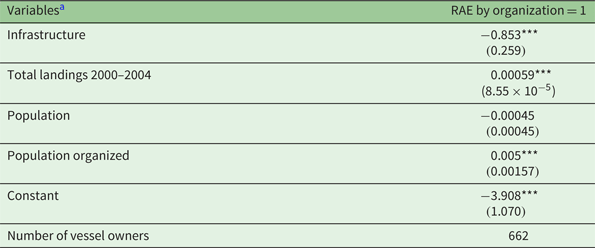
We estimated the selection and share contract equations together for each regime using the proposed econometric strategy.Footnote 15 The selection equation models the choice of management regime by the organization. The results are presented in table 2.
Estimates of RAE by organization treatment by fishing communities for Chilean hake (Merluccius gayi gayi) artisanal fisheries using a probit model

Notes: Robust standard errors in parentheses.
a Vessel owner variables are not shown for space reasons.
***p < 0.01.
We found that fishing communities reporting historically larger total landings are more likely to implement RAE by organization. They may view RAE by organization as a way of securing these larger potential catches through the allocation of collective catch shares. We also found that fishing communities with less infrastructure are more likely to adopt RAE by organization, suggesting that this regulation can be seen as an opportunity to help overcome disadvantageous conditions. Moreover, the estimations show a positive association between participation in organization and the likelihood of having RAE by organization. This indicates that in places with an existing tradition of fishermen organization, the probability of adopting RAE was greater. Results concerning fishing community size were not statistically significant.
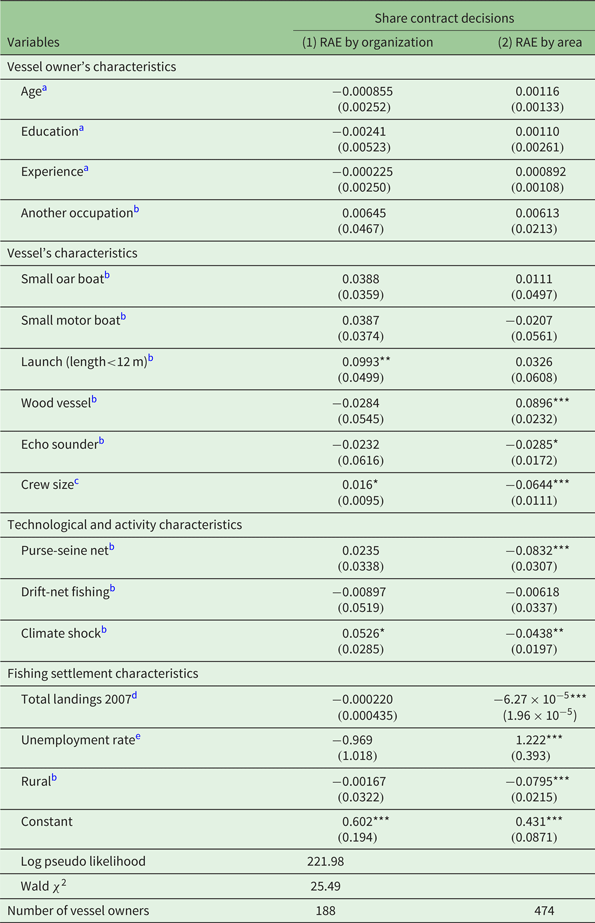
Table 3 shows estimation results of the share contract equations. Column 1 presents the estimated coefficients using the sub-sample of vessel owners operating in fishing communities under RAE by organization, and column 2 shows the ones under RAE by area.
Estimates of share contract decisions under RAE by organization and RAE by area after the switching regression model for Chilean hake (Merluccius gayi gayi) artisanal fisheries

Std, standard deviation.
Notes: Robust standard errors in parentheses.
a In years.
b Dummies.
c Number of persons.
d In tons.
e Proportion.
***p < 0.01, **p < 0.05, *p < 0.1.
Overall, the fit of the equations is adequate and the signs of the estimated parameters are in line with expectations. Results suggest that vessels' characteristics are more important in explaining share contract decisions than vessel owners' attributes. As share contracts are most often determined by social relations and respond to aspects of productivity (i.e., vessel characteristics, the organization of production, and technology), these results are not surprising.
Net income shares are larger in smaller launches under RAE by organization and in wooden boats under RAE by area. In addition, vessel owners who use purse-seine net are more likely to offer a smaller profit share under RAE by area. These results are consistent with a higher crew bargaining power in more labor-intensive vessels (Salazar-Espinoza, Reference Salazar-Espinoza2015). We found dissimilar results in the association between crew size and share contract decisions depending on the type of RAE. In line with Nguyen and Leung (Reference Nguyen and Leung2009) and Salazar-Espinoza (Reference Salazar-Espinoza2015), the results indicate that vessel owners in RAE by area tend to give a higher proportion of fishing returns when they have fewer workers. The authors explain that this negative association comes from a trade-off between the quantity and quality of labor, arguing that fewer crewmembers may lead vessel owners to care more about labor quality than quantity. Because of this, they are willing to offer a higher profit share to increase labor productivity in each crewmember. Another argument relates to the regulation itself: RAE by area is basically a TAC implemented under restricted-access common pool conditions. This has proven to be inefficient. The marginal productivity of increasing labor is so low or negative that any increase in labor generates null or negative marginal gains. Consequently, the only way that vessel owners are willing to hire an extra crewmember is if they reduce the total crew profit share in order to keep their current gains.
In contrast, we found a positive association between net income shares and crew size in RAE by organization fishing communities. Platteau and Nugent (Reference Platteau and Nugent1992) assert that positive associations between crew size and crew shares are more likely to occur in fisheries with stronger social ties. As a pre-condition to participate in the RAE by organization regime, fishers need to create a legal fisher organization of vessel owners with a democratic election system of the leaders. Thus, legal rights over the quota of individual members were limited, and many decisions required a consensus within the organization. Thereby, it is likely that members of RAE by organization not only consider economic arguments in their decisions, but also income distribution concerns. In contrast to RAE by area, it is expected that this regulation may have contributed to enhancing fishing efficiency and productivity, implying higher labor productivity and fishing gains. Since equity concerns in CCS are also important, vessel owners may decide to give up part of their profit percentage because larger fishing gains with RAE by organization allow vessel owners to keep their absolute gains in spite of a lower share. However, the impact of RAE by organization on fishermen's efficiency can be heterogeneous, depending on the characteristics of the fishermen's organization (Chávez Estrada et al., Reference Chávez Estrada, Quiroga Suazo and Dresdner Cid2018). A more probable argument that can explain this positive association is the potentially higher bargaining power of labor in Chilean hake fisheries. As discussed earlier, fishing rights under RAE by organization were granted to vessel owners, which strengthened their negotiation position as capital owners. However, in many fishing communities extracting Chilean hake, crewmembers contribute their own fishing gear and, therefore, are reimbursed for more than just their labor effort, increasing their bargaining power.
Another discrepancy between regulatory regimes was the sign associated with climate shock. While vessel owners operating under RAE by organization increase the crew profit share when facing an adverse natural event, we find the opposite result under RAE by area. One well-known negative effect of common property-based fisheries management is that it generates incentives to fish ‘as fast as possible’ (Pfeiffer and Gratz, Reference Pfeiffer and Gratz2016). In the case of RAE by area, economic incentives to fish as rapidly as possible may still exist; thus, as the total fishing gains fall during adverse natural conditions, this reduction might be passed on to the crew's profit share. The positive effect found in RAE by organization may also be related to the relatively more balanced negotiation power between the vessel owners and the crewmembers, as the latter provides fishing gear. Thus, it is more likely that losses during climate shock periods are borne by both vessel owners and crewmembers under RAE by organization.
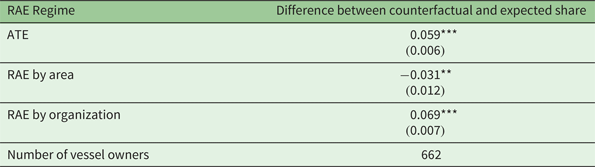
Following the expressions of equations (9)–(13), table 4 presents estimations of RAE by organization's impact on crew net income share. Results support a significant and positive effect of the regulatory reform on this share. We found that the crew profit share is, on average, 6 per cent larger in fishing communities regulated under RAE by organization, compared to RAE by area (ATE in table 4 estimated from equation (13)). The reorganization of Chilean hake fisheries, as a consequence of the CCS, also led to a reorganization of the internal structure of firms, particularly the contractual terms between vessel owners and crews. Results show that we may observe a reduction of 3 per cent in crew net income share in vessels under RAE by organization hypothetically switching to RAE by area (RAE by area in table 4 estimated from equation (9)). Finally, the estimates suggest that a vessel hypothetically switching to RAE by organization from RAE by area would increase the crew share around 6 per cent (RAE by organization in table 4 estimated from equation (12)). This can be interpreted as the average treatment of the treated.
Estimates of RAE per organization treatment in the fishing community for Chilean hake (Merluccius gayi gayi) artisanal fisheries

Notes: Robust standard errors in parentheses.
***p < 0.01, **p < 0.05.
8. Robustness controls and further discussion of results
One concern is the great geographical variation along the Chilean coast and, therefore, among fishing communities. This variable may be driving results. As a robustness check, we replicated the estimations for a more homogenous area comprised of two neighboring regions, the Biobío and Maule regions. While most of the fishing communities in the Biobío region had chosen RAE by organization by the census period, all fishing communities in the Maule region were using RAE by area. Furthermore, focusing on the Biobío region as the treated group makes it less likely that fishers in other fishing communities operate in places regulated under RAE by organization, as the residual quota is relatively smaller in this region. Results are available in tables A1 and A2 in the online appendix. Overall, they confirm a positive association between the crew size and climate shock variables in the share contract estimations under RAE by organization.
We also calculated a positive ATE, although it had a larger magnitude than the whole sample estimate. One of the arguments for a larger positive effect is that crewmembers in some locations contribute their own fishing gear, increasing their bargaining power. To explore this further, in online appendix table A3, we present a two-sample t test for the share given to equipment owners under RAE by organization and RAE by area. This data is available in the census and distinguishes the share of total fishing gains that is given to whoever owns the fishing equipment. Data does not allow us to identify whether this new participant is the vessel owner, a crewmember or another fisher, however. Having these limitations in mind, results indicate that there are not significant differences between regimes when considering the whole sample; however, equipment shares are significantly larger in the treated group when the sample is reduced to the neighboring regions. This characteristic could explain the different magnitudes found in the ATE between the whole and reduced samples.
The increase in crew shares found previously does not guarantee a welfare improvement for crewmembers if the income base from which the share is calculated is reduced as a consequence of the regulatory change. A complementary variable to explore is the absolute crew income. Following this objective, we estimated the model by using the absolute crew income as the dependent variable. To do so, we used information on total net fishing incomes reported monthly in the census from June 2007 until May 2008. Then, we computed the monthly net fishing income by dividing the total income for the number of months that the season lasted. In order to compute the absolute crew income, we multiplied this monetary variable by the crew share. Note that to ensure a cleaner association between reported incomes and hake fishing activities, we selected only those fishers reporting common hake as their main species. This reduced the number of observations to 520. The results are shown in tables A4 and A5 in the online appendix. The main findings remain. Estimations suggest that crewmembers operating under RAE by organization not only received a higher share of incomes but also higher fishing incomes compared with what they would have received under RAE by area.
As discussed in section 2, theoretically there is no definite expectation of the effect that the introduction of a collective rights system, such as the RAE by organization, will have on the crew's income share. Our estimation results show that this share increases compared with what would have occurred without this regulatory reform. One factor that could have contributed to this was the rights that were granted without costs to the organizations and that a quota trading between them was not allowed, so no formal market for exchanging rights developed. This fact could help to explain why crew shares did not fall, since there were no requirements to finance the cost of the right. However, the increase in shares could be related to a change in the bargaining power of the crew, the introduction of fairness considerations in the share distribution because of the increased power obtained by organizations, or as a consequence of increased efficiency that decreased cost shares, as discussed in section 2. We do not have conclusive evidence about which of these hypotheses has more explanatory power in this case. However, we have some evidence and we try to make a case for one of these hypotheses.
First, higher crew shares together with an increased crew income, as a result of the change in regulatory regime, do not necessarily mean that the increase in remunerations came from efficiency gains. In other words, a higher crew income was not necessarily the result of cost reductions and/or increases in live landings per day. One alternative explanation is higher crew shares, which was possible due to crewmembers owning fishing gear. This is not contradictory since previous evidence on another fisheries shows that the introduction of CCS did, on average, reduce technical efficiency for artisanal fishers in Chile (Chávez Estrada et al., Reference Chávez Estrada, Quiroga Suazo and Dresdner Cid2018). Unfortunately, we do not have data to properly measure changes in efficiency in the Chilean hake fisheries. Second, we explicitly tested with neighbor regions if equipment owners with RAE by organizations received a higher share than equipment owners with RAE by area, and the results show significant positive results. Third, we interviewed an artisanal organization leader who stressed the importance of crew shared capital as a special feature of this fishery, which made this activity resemble an association of independent entrepreneurs more than a contract between a vessel owner and a crew. Finally, it is not possible to test whether the effect of collective action contributed to this result, but certainly this possibility seems less likely with a crew composed of primarily own entrepreneurs.
9. Conclusions
In this article, we studied the impact of implementing the Extractive Artisanal Regime by organization – a form of CCS – on crew net income shares in Chile. Making use of geographical differences in the adoption of the regulation among fishing communities, we estimated a switching regression model.
Our results suggest that crew net income shares are, on average, 6 per cent larger in fishing communities regulated by ‘RAE by organization’ as compared to those regulated by ‘RAE by area’. The results also show dissimilar effects of crew size and history of climate shock on crew shares, depending on the type of RAE regime implemented. Whereas under RAE by organization both variables increase crew income shares, the opposite result was found under RAE by area. We argue that RAE by area is basically a limited access regime with TAC per area. It incentivizes rapid exhaustion of the quota, implying inefficient catch. Lower fishing rents and environmental problems may imply a lower share for crewmembers as vessel owners try to increase their incomes. The party who must bear a larger fraction of this loss depends on the bargaining power of those involved. Equity concerns may be important in regulatory settings with cooperative principles, as an increase in crew share may respond to this characteristic as well. However, the RAE by organization form gives use rights to organizations of vessel owners, suggesting a shift in bargaining power toward capital owners. If this were true, we should observe a tendency to reduce crew shares instead. We argue that specific characteristics of Chilean hake fisheries associated with crewmembers' ownership of fishing gear might have strengthened the negotiation position of the crew. If crew bargaining power increased under RAE by organization compared to the baseline, crewmembers who contributed fishing gear may have received an increase in the fraction of fishing gains. Descriptive comparisons between equipment owner shares under RAE by organization and RAE by area suggest that rewards for gear owners may be larger in the former structure. Results are robust to estimation using a reduced sample of neighboring regions, and focusing on crew incomes instead.
These results have important policy implications. Incentive-based instruments have been criticized for their distributional implications that favor capital owners. This is grounded in a potential increase in their bargaining power. Our findings do not contradict this expectation, as crews in Chilean hake fisheries also own part of the capital. But our results point out that it is not the instrument as such (the rights use system) that generates distributional consequences, but rather the pre-existing factor distribution. Therefore, our results suggest that the potential distributional effect of a right-based system is conditioned on the crew's ability to exert control over the capital, which may respond to particular characteristics of fisheries and social relationships within fishing communities.
There are some limitations to our work. First, our results rely on the assumption that vessel owners operate under RAE by organization if they belong to fishing communities whose organizations appear in the regulatory decrees. Some vessels might be misclassified, leading to less precise estimations. Second, the identification of the effect of RAE by organization relies on cross-sectional variation only. Unfortunately, limitations on share contract data before and after the introduction of the RAE do not allow us to perform a more exhaustive evaluation of the distributional impacts and economic consequences of this regulatory change. Finally, a more formal analysis of the different routes by which catch shares affect income shares is desirable. This is left for future research.
Supplementary material
The supplementary material for this article can be found at https://doi.org/10.1017/S1355770X20000133.
Acknowledgements
The authors gratefully acknowledge financial support from project FONDAP, No. 15110027.