INTRODUCTION
Background
Individual experiences of death and dying are shaped by varied social and cultural beliefs, values, practices, and expectations. To help those who are approaching the end of life (EoL) achieve a good death, it is important to understand their end-of-life beliefs, values, practices, and expectations to help ensure they are respected and cared for properly during this process. The concept of a good death is recognized as a prominent social and political priority within EoL care strategies across the Western world (Ellershaw et al., Reference Ellershaw, Dewar and Murphy2010; Watts, Reference Watts2012). However, the notion of a good death raises complex moralistic, cultural, spiritual, religious, and philosophical questions (Lloyd-Williams et al., Reference Lloyd-Williams, Kennedy and Sixsmith2007; Scarre, Reference Scarre2012). While the U.K. Department of Health (2008) describes a good death as “being treated as an individual, with dignity and respect, being without pain and other symptoms; being in familiar surroundings; and being in the company of close family and/or friends” (p. 9) and holds that EoL strategies (such as the Liverpool Care Pathway and the Gold Standard Framework) aim to improve quality of care in an individual's last hours or days of life, it is recognized that “the reality is [that] many [people] do not” (p. 9) die as they would have wished.
Culturally specific beliefs, values, practices, and expectations play a crucial role in achieving a good death. Death preparation is a process that can also include completing unfinished tasks and finding closure in life, as well as considering, preparing, and undertaking traditional customs and spiritual practices (Chan & Yau, Reference Chan and Yau2009). These are shaped by traditional cultural and spiritual beliefs. For example, according to Shih (Reference Shih2010), Chinese death rituals are based on the premise that the dead continue to exist beyond the living world: “either as ancestors, ghosts or gods, maintaining an existence in relation to the social order of the living world” (p. 123). Nevertheless, for some migrants, EoL beliefs, values and practices are quite often influenced by the dominant cultureFootnote 1 of the host societyFootnote 2 (Bowman & Singer, Reference Bowman and Singer2001; Chan & Kayser-Jones, Reference Chan and Kayser-Jones2005; Liu et al., Reference Liu, Lin and Chen1999).
In England, Chinese people make up about 1.6% of the total population and 3.5% of the population within Manchester (Office for National Statistics, 2009). However, when examined as a group, Chinese populations living in England are less likely to access healthcare services—specifically, primary healthcare services such as visits to the office of a general practitioner (Seymour et al., Reference Seymour, Payne and Chapman2007). Similarly, with respect to EoL care, utilization of health and social support services either at home or in hospices is particularly low among this population compared to white British groups (Ahmed et al., Reference Ahmed, Bestall and Ahmedzai2004; National Council for Hospices and Specialist Care Services, 2001; Seymour et al., Reference Seymour, Payne and Chapman2007). At present, no data are available on gender-specific usage of EoL services and supports among Chinese populations. The current literature suggests a need to further examine differences in the low uptake of EoL services by nonwhite groups residing in England (Evans et al., Reference Evans, Menaca and Andrew2011). Research indicates that EoL services in England focus heavily on primary healthcare (Evans et al., Reference Evans, Menaca and Andrew2011). However, EoL supports encompass much more than healthcare services alone (Hsiao et al., Reference Hsiao, Gau and Ingleton2011).
End-of-life care and support require attention to mental health, religious practices, and beliefs, and healthcare systems and supports in order to help individuals cope with the process of aging; come to terms with death and dying; and support family members and loved ones with the issues associated with bereavement. Discussions surrounding EoL care often constitute an arduous, painful, and uncomfortable dialogue, particularly within Chinese communities (Bowman & Singer, Reference Bowman and Singer2001; Chan & Kayser-Jones, Reference Chan and Kayser-Jones2005; Ho et al., Reference Ho, Radha Krishna and Yee2010; Rodriguez & Young, Reference Rodriguez and Young2006). For instance, studies reveal that communicating with health and social service providers about sensitive issues (e.g., issues related to death or dying) can generate unnecessary stress and anxiety for many ethnic minority women (Bowman & Singer, Reference Bowman and Singer2001; Chan & Yau, Reference Chan and Yau2009; Chan & Kayser-Jones, Reference Chan and Kayser-Jones2005). For some Chinese migrant women in England, challenges associated with aging and EoL preparations and practices are complicated by gendered social and cultural: norms, roles, expectations, behaviors, attitudes, and mannerisms specific to being a Chinese woman (i.e., expected behaviors of submission and subservience to their spouse and family members, caregiving roles, responsibilities, and expectations, as well as spiritual duties and responsibilities).
Culturally sensitive and safe EoL supports require consideration of crosscultural differences and gender-specific challenges by frontline workers and governing bodies, who make important decisions on health policy. The difficulties that some older Chinese adults encounter when seeking care include: language barriers; differences in food choices; inability to effectively communicate EoL supports and needs, particularly such mental health-related issues as loneliness and isolation; and differences in such spiritual and cultural beliefs and customs as practices related to appropriate funeral attire, traditional food preparation, prayer, and family-centered care (Chan & Kayser-Jones, Reference Chan and Kayser-Jones2005). On the other hand, Chinese women, particularly spouses in the caregiving role or position, may also experience the double or triple burden of: making difficult EoL decisions for their parents and parents-in-law, providing care and support for their elders and their own family, as well as working in precarious jobs within the United Kingdom's formal economy (Remmert, Reference Remmert2009).
Meanwhile, it is important to acknowledge that Chinese people are not a homogeneous group, and as such Chinese culture should not be thought of and treated as a monolithic entity (Bowman & Singer, Reference Bowman and Singer2001). The beliefs, values, and practices of Chinese people may vary according to many social factors, such as by the region or state in which they resided prior to emigration as well as their socioeconomic status (Bowman & Singer, Reference Bowman and Singer2001). Therefore, it must be noted that the experiences of Chinese women participants presented in this paper do not represent the views of all Chinese women. Rather, their narratives were extracted to help contextualize the EoL values, beliefs, and supports of some Chinese women living in England. A clearer understanding of EoL desires and expectations within Chinese groups may inform the development of a new, culturally safe, sensitive, and appropriate health policy and practice for EoL care in England and other Western societies with similar healthcare systems, including Canada and Australia.
Rationale, Objectives, and Theoretical Lens
There is to date limited research exploring the EoL beliefs, values, and supports of Chinese people living in England (Evans et al., Reference Evans, Menaca and Andrew2011). A deeper understanding of EoL issues from a unique cultural perspective would help improve the provision of personal care and assist healthcare providers in understanding the spiritual and healthcare needs of the dying in order to develop and implement strategies for furthering culturally sensitive care. In this paper, we outline the spiritual practices and beliefs and EoL wishes in a select group of 11 Chinese women service users from Manchester's Wai Yin Society in order to broaden our understandings of their attitudes, values, beliefs, and practices with respect to EoL decisions. A “cultural safety” lens was employed to generate knowledge without promoting negative stereotypes about Chinese traditions and culture.
The data were collected for an exploratory study commissioned by the Wai Yin Chinese Women's Society in July of 2011 to examine and understand traditional spiritual practices and EoL attitudes and beliefs in some of Wai Yin's Chinese service users. Because the Wai Yin Society is the largest Chinese community center in England, the organization sought to use this information to initiate EoL care research for Chinese people living in Manchester and potentially for all of England.
The cultural safety paradigm was the theoretical framework selected to guide the aims and methodology of our study. Cultural safety is a relatively new concept that emerged from the field of nursing in New Zealand to assist in providing better care for Maori communities (Browne et al., Reference Browne, Varcoe and Smye2009). Cultural safety recognizes that the concept of culture is often oversimplified and may inadvertently reinforce the negative stereotypes associated with nonwhite populations specifically within the contexts of healthcare and social service provision (Browne & Smye, Reference Browne and Smye2002; Browne & Varcoe, Reference Browne and Varcoe2006). This paradigm also acknowledges and incorporates a focus on the differential power dynamics and inequitable social relationships between the service provider and service user. Cultural safety widens the lens of culturalismFootnote 3 by directing attention toward the structural inequities and disadvantages experienced by nonwhite groups.
Although cultural safety was originally conceptualized based on issues arising from biculturalism between Maori and non-Maori peoples (Ramsden, Reference Ramsden1990), several authors have applied this framework for research in various multicultural contexts, particularly within newly arrived immigrant populations (Anderson et al., Reference Anderson, Perry and Blue2003; Baker, Reference Baker2007; Kirkham & Anderson, Reference Kirkham and Anderson2002; Kirkham et al., Reference Kirkham, Smye and Tang2002; Ogilvie et al., Reference Ogilvie, Burgess-Pinto and Caufield2008). To deal with additional issues associated with EoL that stem from the complexity of women's lives and to reframe our ways of thinking about culture and EoL care, cultural safety has also been utilized as an interpretive lens.
METHODS
Study Details
In July of 2011, staff members of the Wai Yin Society together with researchers from Manchester Metropolitan University and Simon Fraser University conducted an exploratory study on EoL beliefs, values, and service requirements within an initial sample of 14 Chinese migrant service users (13 women, 3 men). Of course, since the study aimed to contextualize the complexities of Chinese women's lives in relation to the gendered roles and responsibilities of providing care to older people, the three men were excluded from this analysis. Participants were recruited from Wai Yin's Sunshine Project, which hoped to train Chinese migrants to improve their knowledge about employment and immigration rights, and their language skills to enable them to better access support services.
Hour-long in-depth semistructured interviews were conducted by a Chinese-Canadian researcher in Mandarin and Cantonese with this group of migrants working on the margins of England's formal economy. The interviews covered the following topics: access to primary healthcare, death and dying, religious practices and beliefs, culturally appropriate health and social support services, and caregiving duties and responsibilities. They were digitally recorded and took place on the premises of the Wai Yin service, where participants felt comfortable. Recordings were fully transcribed and translated into English as well as back-translated into simplified Chinese. Two translators transcribed the interviews, compared the outcomes, and negotiated any deviations in meaning.Footnote 4 During this process, notes were added to transcripts to ensure that culturally appropriate meanings were conserved. Permission to access translated study transcripts was granted by the Wai Yin Society. A thematic analysis of the data was also undertaken as part of the initial analysis with all participants. The current paper presents the findings of our focused analysis and reports on the accounts of the 11 women participants using cultural safety as a theoretical perspective to enable the emergence of more in-depth cultural- and gender-sensitive understandings.
Study Participants
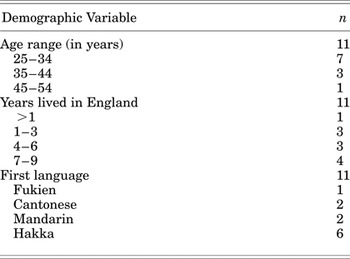
The demographic information concerning the 11 women participants is presented in Table 1. The majority of participants were younger women, aged 25 to 34 years. This decision about participant age was purposive, since the topic of EoL is extremely taboo within Chinese culture. As such, service providers from the Wai Yin Society unanimously decided that it would be more appropriate and respectful to explore this topic initially with younger women. The sample also consisted predominantly of marginalized Chinese women because the Sunshine program was designed specifically to assist migrant Chinese women (with or without appropriate work visas) in becoming work-ready for England's employment system. The length of time participants had lived in England ranged from less than a year to 7–9 years. All participants were able to understand and speak Mandarin; however, with respect to the specific dialect, many participants spoke Hakka or Cantonese. Their dialects reflect the fact that the majority of our participants came from the more rural parts of China.
Profile of 11 Chinese women participants in the study

Ethics
The study protocol was submitted for approval to Manchester Metropolitan University's divisional ethics committee, which approved our application. The research was conducted in accordance with the British Psychological Society's 2006 ethical guidelines. Informed consent was gained from each participant in written form where possible or verbally. The information sheets and consent forms were translated into the appropriate language (simplified Chinese). The project protocol ensured protection of the anonymity and privacy of all participants.
Due to the sensitivity of the study topic, confidentiality and anonymity were of paramount importance and were guaranteed to all participants. Researchers were instructed to act if signs of emotional distress were observed so that participants could then be referred to appropriate support services. Researchers were supplied with lists of such support services to facilitate referrals; however, no such referral was required during the research project. Since part of our analysis was conducted at Simon Fraser University in Vancouver, Canada, ethics approval was also sought out and granted by the Office of Research Ethics at Simon Fraser University.
Analysis
Transcripts were analyzed based on the technical analytical principles of grounded theory, which includes three phases: open coding, axial coding, and selective coding (Strauss & Corbin, Reference Strauss and Corbin1990). The first, second, and third layers of coding were analyzed using HyperResearch (v. 3.52). The first layer—open coding—required examining the text linearly for salient categories.Footnote 5 New categories or codes were introduced each time a new phenomenon emerged from the text. The constant comparison approach was employed to ensure that the data were being coded consistently and to ensure a close connection between the categories in preparation for the second layer of coding: axial coding. The first layer of coding yielded 60 codes. For axial coding, we explored the relationship between the initial set of codes and examined how they could be further grouped to reveal five broader themes. The intricacies of each broad-based theme were depicted through the use of the “code map” function in HyperResearch (v. 3.52), an example of which is shown in Figure 1.
Example of a code map created in HyperResearch (v. 3.52) in order to identify the central phenomenon.

The code-mapping process helped uncover a central phenomenon within each broad-based theme. The process of identifying a central phenomenon was informed by the third phase of grounded-theory analysis: selective coding. Selective coding required identifying and relating the core category to other categories.
Reflexivity
In accordance with the principles of “cultural safety,” it is important for visiting researchers to critically reflect upon their own upbringing and social position in order to limit any personal biases that might harm participants and negatively impact the research (Polaschek, Reference Polaschek1998). As such, the primary researchers (persons who engaged heavily with the community and who enjoyed decision-making powers) of this study were encouraged to keep reflective diaries, with particular emphasis on consideration of the “other” through an examination of their own privileges. With permission from the researcher, an extract from the journal is included at the end of this paper (see the section entitled “Critical Reflections”).
RESULTS
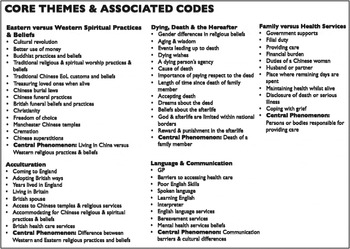
The analytical approach identified five themes: (1) acculturation; (2) differential beliefs and norms in providing care: family versus health services; (3) language and communication; (4) Eastern versus Western spiritual practices and beliefs; and (5) dying, death, and the hereafter: returning to one's roots. Each theme revealed important aspects of EoL beliefs, values, and expectations as well as the various supports and needs of these 11 Chinese women. An overview of the core themes and its associated codes can be found in Figure 2.
Main themes with codes that act as predictors or outcomes of the central phenomenon.

Theme 1. Acculturation
Crosscultural transitioning can be a difficult and lengthy process fueled by the complexities associated with acculturation. Acculturation here is defined as the gradual adoption of cultural norms, beliefs, and values in accordance with those of the host society (Berry & Kim, Reference Berry, Kim, Dasen, Berry and Sartorius1988). The participants reported differing attitudes toward the processes of acculturation when describing the need to fully assimilate as opposed to integrate into British culture. The difference between the two is that assimilation would require completely giving up the old culture (in this case, Chinese culture), and integration would encourage new immigrants to retain the old culture while learning, adapting, and combining aspects of the new culture. For example, one woman described her duty to adopt “English” ways with particular emphasis on being a law-abiding citizen: “It's like ‘when at Rome, do as the Romans do.’ As a Chinese person, you come to the U.K., you follow U.K. laws and do what English people do.” For her, the process of adopting values, practices, and beliefs consistent with the host culture was not a personal choice but a duty or responsibility.
Despite the fact that some Chinese people living in England feel an obligation to assimilate into British culture, others describe being conflicted by Western customs that pertain to EoL care, particularly social norms surrounding provision of care to the elderly:
I think the seniors here are very courageous, based on what I have witnessed. The elderly parents live separately from their children. Parents have their own lives, and children have their own lives. The children will visit their parents when they have time, and so on. If at the end, if you can't be by yourself, if you can't be independent, if you're really ill and you can't walk and have to use a wheelchair, then you'll need to go to a home because someone will be watching over you. If you can move about by yourself, then do your best to take care of yourself.
When asked about English religious practices and beliefs, it was clearly articulated that “in Western society, it's Jesus.” Christianity was described as the most popular religion in the United Kingdom. Coming to terms with cultural dissimilarities regarding EoL care extended past differences in provision of care for loved ones. Several participants described the bipolarities between Western and Eastern religious practices and beliefs, and reported feeling pressured to choose between Western and Eastern religions:
Christians do not place an incense burner or any image of “Guanyin”Footnote 6 at home like us. They do not do that. So, generally, when they have something on their mind they go to church to pray. They are like that. Even though I've been here for such a long time, I haven't been there [to church]. I've never been there. Because, after all, how can I say [it], according to them [the English], if you believe in Buddha then you can't believe in Christianity, because the two are different.
There were significant differences in the methods of worship and prayer between the Western and Eastern religions, especially Christianity and Buddhism. For instance, traditional Chinese practices included burning incense when praying to the image of Guanyin, while Christians practice their faith through prayer, often kneeling in church. These varying practices are symbolic of differences between Western and Eastern cultures (see theme 4) negotiated through processes of acculturation. While some participants described acculturation as being optional, others felt pressurized to adopt dominant religious and spiritual beliefs in England in order to be included and accepted socially. Such power differentials are critical, as they impact upon the contexts in which Chinese people experience and access EoL care.
Theme 2. Differential Beliefs and Norms in Providing Care: Family versus Health Services
Participants highlighted differences between Western and Eastern cultures in terms of the social norms related to EoL care. These differences tended to be epitomized by a tension between the differing roles and expectations of family and healthcare professionals in facilitating and supporting a dying individual. Participants noted that family members, especially children, were expected to be the primary care providers for aging parents. Indeed, while family members were indicated to be central within EoL care as part of Chinese culture, participants described these roles as mostly being filled by healthcare professionals in England:
For foreigners [the English], they tend to hire nurses. It seems very unlikely that their children would take care of them and stay with them. In China, the children would take care of aging parents, mostly daughters or daughters-in-law.
It was noted that the social norm in Western society was to hire nurses as primary care providers for aging parents. Conversely, in Chinese society, the norms and beliefs about caregiving are situated within the teachings of “filial piety.”Footnote 7 This was expressed in the following excerpt, emphasizing that it is “the Chinese way”:
According to the Chinese way, I hope it's my children. Having your family take care of you is better than having the government do it. I don't like the Western way. When people are old and retired, their children don't have those family ties. They send them [their parents] to old folks' homes. But in the homes, the nurses take care of you like automatons. Everyone's the same, and it's just a process. In China, it's different. There's a sense of family.
There was consensus that it was more important to have your family members care for an individual when approaching death rather than healthcare professionals. Several participants noted that they disagreed with Western caregiving practices for aging parents, especially the practice of sending seniors to retirement homes. Furthermore, the majority of participants emphasized that the child's duty to care for their parents went beyond responsibility, as “the traditional Chinese concept of filial piety” was described as being desired and hoped for by every Chinese parent.
Gender differentials were identified in participants' accounts, as caregiving responsibilities were typically placed on daughters or daughters-in-law. It was apparent that the duties of a Chinese woman often resided within the home, which required providing care either for their aging parents and/or for their children. This is also demonstrated in the next excerpt:
(. . .) could not find the time. Now the kids are older and are in school, but the two kids are both very good. They say, “Mom, go learn English. You can communicate with others and talk with others. After you learn English, you have many, many friends, and socialize with them.” So, I'm very happy; it's very good. Every time when I say, “Oh, I am going to study English or I'm going to school,” they will say, “Sure, I'll be very good at home.” So, the older one looks after the younger one, and the younger one listens to the older one. They are relatively good, and so now I can find the time to go out. Now that I'm studying, it's kind of tiring, because to start from the beginning is very tiring.
Issues of gender were apparent during various points of the interviews. It is very common and socially accepted that caregiver duties are not shared between spouses. In this regard, gendered notions determined the woman's responsibility, which impacted her workload, stress levels, and ability to learn a new language, build social networks, form new relationships, and pursue career choices.
Meanwhile, when describing the roles of healthcare professionals (in relation to the support that should be available to Chinese people within EoL care), all participants indicated that mental health supports and services were essential and should be available and accessible when needed to cope with bereavement. An important point to consider is that it is common in China for the elderly to die at home surrounded by family members who can provide the primary means of support. Chinese migrants in the United Kingdom, however, are described as not dying with the same degree of support and comfort:
Because if someone passes away at home, there will be a lot of people around. But here in the U.K., we've all left our home, and if a family member passed away, we will feel very depressed and will need someone to enlighten us.
According to this excerpt, having someone to speak with during a time of crisis is necessary and appropriate, particularly for those with immediate family members residing in China. It is not customary, however, for Chinese people to seek support provided by mental health service providers:
(. . .) according to traditional Chinese customs, very few people would see a psychologist because people are born, they get old, get sick and they die. This is natural. There shouldn't be any. There is more in the West.
“Cultural safety” maintains the importance of recognizing and understanding the historical origins that influence the lineage of cultural beliefs, values, practices, and norms. According to Buddhist teachings, death is a natural process of life and should be accepted as an inevitable outcome for all earthly creatures. Many of our participants interpreted aging, death, and grieving as a natural process, so that bereavement services and supports were often underutilized. Even though the majority of participants agreed that mental health supports are important and necessary for coping with grief and bereavement, “mental health” and “mental illness” are seen as Western concepts that are overemphasized within the biomedical model (Watters, Reference Watters2010). It is therefore important and necessary to consistently improve the quality of care within intercultural contexts (Cameron et al., Reference Cameron, Andersson and McDowell2010) for effective delivery of EoL services for different cultural groups.
Theme 3. Language and Communication in Primary Healthcare Settings
All participants reported English as either their second or third language and that they would prefer to speak Chinese, either Mandarin or Cantonese. Most participants could understand and speak either Mandarin or Cantonese, and several indicated that they could speak either of these in addition to another dialect of Chinese. The barriers limiting clear communication often resulted in frustrations experienced by both the healthcare provider and the health service user, which was suggested to influence the availability of support and assistance:
If the doctor is impatient, he doesn't want to spend a lot of time listening to us. Because we are limited in the English language, we have to depend on simple translations to describe the symptoms and other medically related inquiries (. . .) If we encounter good doctors, they will invest time in trying to understand and communicate with us, and as a result we will feel more comfortable to try and speak.
The importance of addressing communication barriers was heightened when taking into account a general lack of knowledge concerning EoL practices within the United Kingdom:
Like many of us who don't know English, we don't know what to do if a person dies. I don't think we know where cremation should take place, who we should look for, and which places are for burials.
Explaining health issues and describing symptoms were suggested as presenting a challenge due to language difficulties. The process of seeking healthcare services tended to yield better results with general practitioners (GPs), who were more sensitive to issues associated with emigration and cultural barriers, with language being the most common and significant challenge experienced by the nonnative English-speaking participants. Many participants indicated a desire and need for having more culturally appropriate services. It was also emphasized that service provision should come from those who embody the culture and understand the cultural intricacies distinct to Chinese people. Specifically, participants voiced appreciation for having an organization like Wai Yin, managed by Chinese people fluent in Chinese and English:
At least I have something to rely on, either this organization or places that specifically serve the Chinese and know our language. Obtaining help from them to do these things is the best. But I have never thought of or asked about these things. If they have [this kind of service], then that will be very nice, because it provides great help for us who have trouble communicating.
When participants were asked if interpreters were offered to overcome their communication barriers, all participants revealed that this service was available when they visited their GP's office. Three participants reported using such other means of communication supports as their spouse or friends to help translate, and/or they employed internet services or electronic dictionary devices during GP consultations to help facilitate understanding. The transcripts illustrate that interpretation services were available by appointment at the GP office, but the interpreters often failed to show up. Our analysis also revealed that electronic dictionary devices were insufficient to accurately translate and describe health issues:
When I take my kid to see the doctor, most of the time [the interpreter] doesn't come. But luckily, that doctor is very nice. While on the phone with me, he translates into Chinese to let me take a look. I type whatever question I have to let him take a look. This is better. But sometimes I still don't feel it's accurate enough.
Our interpretation of these findings is that existing health service provision practices are influenced by macro-level political dynamics, where culturally sensitive services (such as interpretation and translation) are available on a superficial level and not strictly regulated or monitored for uptake and effectiveness. As such, the availability of interpretation services through the National Health Service (NHS) and the provision of cultural awareness, sensitivity, competence, and safety training must be reevaluated in order to ensure that (1) interpretation services are accessible and reliable and (2) health service providers are trained in providing necessary services to individuals experiencing language difficulties.
Theme 4. Eastern Versus Western EoL Practices and Beliefs
Participants were found to have different attitudes about EoL practices, being informed through Confucianist, Buddhist, and TaoistFootnote 8 beliefs. While theme 1 provides an overview of the impacts of the processes of acculturation, whereby some participants felt pressurized to adopt Western values and beliefs, theme 4 presents an overview of and the attitudes about differing EoL practices. Several of our participants indicated that they believed in Buddha because, typically, “most Chinese people believe in Buddhism.” Interestingly, a number of participants indicated they were not particularly spiritual, religious, and/or superstitious. However, if forced to choose, they would pray to or worship Buddha or Guanyin. These practices are associated with Taoist beliefs, particularly with traditional EoL customs and beliefs:
When our old people pass away, they will burn paper money (. . .) those [paper] houses, and they will invite some Taoist priest to come and read scriptures, stuff like that. Yeah, very extravagant. Things like the burial of the elders (. . .) not to mention the paper money, it already costs a lot just to abide those customs.
Typically, when a person passes away, customary Chinese EoL practices involve burning incense to honor and respect the individual that has passed and burning paper representations of earthly materials such as money, paper houses, food, gold nuggets, and cars to symbolically epitomize the transfer of material wealth from this life to the afterlife, and the presence of a Taoist priest to conduct rituals assists the safe passage of the individual's soul from this world to the next.
In contrast, with respect to British funeral practices, many revealed not having participated in any British funerals since moving to the United Kingdom for two main reasons: (1) their social circle consisted of mainly other members of the Chinese community, and (2) their older family members resided in China. However, akin to Chinese beliefs and practices, it was described that the common Western EoL rituals that take place when someone dies serve to pay respect to and celebrate the life of the person who has passed. Common practices include a gathering of friends and family at the person's home, arranging for a hearse to take all immediate family members to the church, and having an open casket for people to say their farewells:
I've seen my neighbor die. There was a row of friends' cars. The families just came in the usual family cars, but the coffin was a different kind of car. Then they'll all go to the church, where they'll visit the open casket, seeing the person one last time. After that, they'd take the body for cremation, right? After cremation, they take it to the cemetery and bury it.
There were several discussions during interviews surrounding the burial process, for example, whether the body had to be cremated or buried. Chinese law stipulates that people are to be cremated. Some participants indicated that this law infringes on an individual's freedom and rights. Another participant emphasized that burial is not against the law in the United Kingdom: “They will not go against your will of burying the whole body. They do not do this.”
From this perspective, it can be argued that the concept of choice becomes ambiguous when EoL options are available only to those that have the financial means to exercise these rights. The responsibility for funeral arrangements may lie more with the state as opposed to healthcare professionals; however, it is important for healthcare professionals to be aware and responsive to different cultural traditions, practices, and beliefs in order to provide effective EoL care. Equally important are multilingual informational and/or educational resources for Chinese and other migrants about how such services and arrangements are provided and acquired, in order to help migrants achieve a good death.
Theme 5. Dying, Death and the Hereafter: Returning to One's Roots
Experiences of death and dying were explored to gain a deeper understanding of what a good death means to this group of Chinese women. Some of the most intriguing and valuable points raised regarding death and dying focused on facing and accepting death, respecting personal wishes and regrets, as well as the importance of paying respect to the ones who have passed on. Dying was often described as a normal process and death an inevitable outcome:
Everyone who is born dies, right? You don't know when you're going to die. That's fairly normal, I think. Of course, we'll be sad. It's family, after all. If your friend or a pet dies, you'll also be sad. There are emotional attachments. No need to see a doctor. Everyone goes through that process. It's just a matter of time, sooner or later.
When participants were asked about their dying wishes, they emphasized the fear of not having completed specific life goals, not having mastered desired skills, and ultimately, not having enjoyed life to the fullest:
If I am going to pass away today, I'm thinking (. . .) There are so many things I haven't done yet, and I would feel regretful. Why didn't I do this well? Why didn't I learn this and that? Why didn't I enjoy my life? I would feel regretful.
Another dying wish frequently mentioned by participants was being honored and respected by their children. A crucial component of Chinese culture is filial piety (see the discussion under theme 2), which involves honoring and respecting one's parents when they are alive and after they have died, not as simply a gesture or an act of kindness, but as a part of the children's duty. The difference is that a gesture or a kindness is perceived as something that can be carried out by anyone, even a stranger, whereas only a family member or individuals close to the family can take on and fulfill a duty:
If my children really want to pay me respects, in England, if you're buried in the ground, if your children are dutiful, they'll visit you, but if not, then they won't in a hundred years! If they are sincere, then they will often think, “I miss my mom.” That's enough.
As noted earlier, filial piety is a Taoist concept that has been valued by Chinese people for hundreds of years. Such eminent beliefs must be acknowledged and reflected upon when providing EoL care to this community. In terms of traditional religious beliefs and practices with respect to an afterlife, the existence of heaven and hell is a significant part of the Chinese religious and spiritual belief system. There is one belief in a hell with 18 levels, where people judged as bad end up deep down within the lowest level, and their punishment is to climb each level until they reach the top, so that they can depart hell and reincarnate:
If you believe what they usually say, good people go to heaven and become saints, and the bad go to hell and suffer. The Chinese believe there are 18 levels of hell. You would have to climb and climb and climb, all the way to the top before you can reincarnate.
More important, participants consistently discussed the principle of living a righteous life:
Regardless, I just try and not do bad stuff in my life, try your best to do good things within your ability, right? This way it'll be good, right? Some people are very bad, and they do bad stuff everyday. When he's in trouble and he goes to the temple and burns the incense, Buddha will not bless him, right?
The importance of being a good person was often emphasized, since people who committed acts of evil would lose the good graces of the Buddha. Nevertheless, some believed that the blessings and protection associated with traditional Chinese beliefs were limited within geographic boundaries:
I'm in the U.K., and I dreamt that I knocked at the door of my home over and over again, but just couldn't get in. I think God is limited within national borders. When I worshipped back home [in China], I felt that it might protect me, but maybe it's only a form of reassurance. Here, even if I worshipped God, God will not hear me. And for my grandpa, I have not dreamt about him. This could mean that I'm too far away.
Some strongly believe that protection and good fortune from God ceased to exist after emigrating to the United Kingdom, so that God is “limited within national borders.” The assumption here is that in order to regain spiritual “reassurance” and “protection,” the acceptance of a new God or image in the United Kingdom is required.
According to the transcripts, there is a general consensus that Chinese people are a very superstitious people. Several participants indicated significant gender differences that pertain to superstition, religion, and spirituality. However, “cultural safety” cautions against culturally essentialist notions—for example, that all Chinese women are extremely superstitious and encourage and practice unorthodox rituals.
DISCUSSION
We explored the end-of-life beliefs, values, practices, and expectations of a relatively hard-to-reach group of Chinese migrant women. Our analysis applied the paradigm of “cultural safety” in order to gain a deeper understanding of how the combined effect of social and cultural norms and expectations as well as the pressures associated with acculturation impact gendered roles and responsibilities for these women. Indeed, our findings illustrated how variations between/within Eastern and Western culture have resulted in pronounced, and oftentimes gendered, differences in EoL care expectations.
Westernized constructions of health tend to locate solutions and responsibility at the individual level (Watters, Reference Watters2001), an approach that positions ethnic minorities as those harboring the health problems and thus responsible for resolving their own health issues. These people are often in extremely vulnerable positions and have been denied the means to take control of their own health and life circumstances. In reference to cultural safety, the privileging of Western epistemologies and methods while simultaneously marginalizing Eastern approaches, beliefs, and practices may be ineffective in addressing the underutilization of EoL services by ethnic minorities, including Chinese groups (Cameron et al., Reference Cameron, Andersson and McDowell2010). Our findings highlighted a conflict within the processes of acculturation between assimilating to “English ways” and sustaining traditional Chinese religious and spiritual practices and beliefs. While some participants indicated that they would prefer to retain religious and spiritual traditions, they at times felt unable to do so as a result of structural barriers such as the inaccessibility of Chinese temples or due to geographically specific understandings of their faith. Consequently, the findings suggest that more attention should be given to cultural empowerment at the individual and structural levels. In other words, while individuals within ethnic minorities should be empowered within EoL care, the structures of healthcare should also accommodate and be flexible in the face of diverse needs and expectations.
In terms of language and communication, our analysis revealed how practical issues such as language hindered health service provision to immigrant Chinese women, highlighting how some women are disempowered and disenfranchised within the structures of the Western health system. For instance, the inaccessibility of translators and a perception of impatience/intolerance by GPs suggest a need to redevelop and improve language and health information services. Alternative means of information sharing, such as electronic dictionary devices, do not address the issue of the unequal power dynamic between Chinese patients and healthcare providers. While there are culturally specific community service organizations in England (such as the Wai Yin Society), it must be acknowledged that such facilities are scarce and often not financially and/or structurally equipped to cope with the high demand and the complex set of needs.
Additionally, communication and language barriers are related to issues of gender. Cultural safety privileges the standpoint of women and emphasizes that it is important to capture their voices and provide a critical lens for interpreting gendered experiences (Anderson et al., Reference Anderson, Rodney and Reimer-Kirkham2009). Issues of marital and maternal expectations were revealed in our analysis that often prevented women from learning English, which may contribute to difficulties in communicating with healthcare professionals when discussing such sensitive topics as EoL care support and needs. Participants indicated that married women are expected to adopt the husband's religious and spiritual traditions, even though these may conflict with their personal beliefs. Such gender inequities contribute to social isolation, exclusion, and marginalization of Chinese women living in England. When considering culturally safe practices within the extended realm of healthcare provision, it is crucial to consider the effects of gender on the accessibility of healthcare and social supports, which impacts health outcomes for ethnic minority women. Furthermore, it is recommended that EoL strategies encourage social and healthcare providers to learn, understand, and be sensitive to Eastern practices, which may often inform a way of thinking and decision making.
In accordance with filial piety, our findings emphasized that Chinese families are expected to care for and support one another according to a hierarchy of age in relation to EoL caregiving duties and responsibilities. Several participants noted that most Chinese people would prefer to die at home surrounded by family members, and that the young are required to respect and care for their elders until they pass on. While these preferences may be similar to Western notions, participants indicated that this is not simply a wish or a preference but an expected duty of the younger generation (Baker, Reference Baker1979), and that failure to meet these expectations may bring shame upon the family. It was noted that these familial values illustrate a key difference between Eastern and Western culture, as in Western society it is the aging parent and the aging partner or government that assumes EoL-caregiving responsibilities.
Furthermore, our findings highlighted that gender norms shape care expectations and requirements in relation to filial piety. While a Chinese man may be expected to honor, respect, obey, and care for his parents and in-laws by allowing them to live in his home and providing financial support, it is highly likely that he will not be expected to spend hours, for example, preparing congee, washing sheets, and/or changing bed pans. Indeed, it would also not be expected that Chinese men would be involved in general household maintenance such as cleaning or caring for children within the household. Conversely, Chinese women are expected to fulfill these responsibilities while at times managing part-time employment. The gendered expectations provide a simplified context in which Chinese women live, placing a strain on the time available for learning a new language, building new connections and relationships, and developing an understanding of English EoL services, structures, and available supports. The issue of gender is critical within the theme of filial piety, and this discussion illustrates how the principles underpinning filial piety may hold different values and/or be applied differently if one is a Chinese man or woman.
The cultural safety paradigm recognizes that access to and uptake of EoL services is not solely attributable to cultural identity, but involves the factors of age or generation, pre-arrival history and post-arrival challenges, political influences, dedication/obligation to traditional religious and spiritual practices, negotiation of acculturation processes, socioeconomic status, and gender. The interlocking effects of gender, age, and socioeconomic status, together with the culturally embedded concept of filial piety, shape the position of Chinese women in England. Future research should expand on this knowledge through the voices of a larger group of Chinese women living in various Eurocentric societies such as Canada, the United States, and Australia. It is important for future work to draw on the differences and similarities of lived experiences to continuously improve and redevelop EoL strategies for Chinese women living in Western societies.
Overall, the experiences presented here emphasize the importance of understanding the values, beliefs, practices, and social norms associated with the philosophical and religious and/or spiritual concepts (such as Buddhism and Taoism) that shape aspects of Chinese culture. While the current research is the only one (to the authors' knowledge) that has examined EoL care among Chinese migrant women through a cultural safety lens, our study is not without its limitations. First, the principles of grounded theory were employed exclusively as an analytic tool and were not used for theory development. Second, the sample size was relatively small and comprised predominantly younger, more marginalized Chinese migrants, primarily as Wai Yin's services are designed to cater to such populations. As such, the findings and recommendations may not be generalizable to all Chinese women living in England. Hence, to further this work, future research should explore end-of-life issues in an older group of Chinese women, potentially women living with long-term health conditions. Nevertheless, it is important to note that, despite the small sample size, the stories of these harder-to-reach Chinese women were rich and meaningful. This study also demonstrated the value of cultural safety as a framework to guide research and new public policy initiatives that aim to improve services and support for ethnic minority groups.
In terms of key messages, it should be noted first that end-of-life discussions can constitute an arduous, painful, and uncomfortable process, particularly for persons living in a new cultural setting. For some Chinese people living in the United Kingdom, end-of-life care requires attention to acculturation, particularly Western versus Eastern beliefs on religion, spirituality, burial practices, and provision of care, and the availability of culturally specific care, all of which encompass issues related to gender. Second, cultural safety was applied as a driver to conduct an in-depth exploration of the end-of-life perspectives of Chinese people living in the United Kingdom, employed as a interpretive lens when analyzing the data, and utilized to make recommendations for future research, policy, and healthcare provision initiatives. Finally, our findings indicate that the gendered responsibilities in healthcare provision and women's agency, associated with the constraints of marriage and culturally embedded gendered expectations of personal choice, are indeed key issues.
Critical Reflections
As a public health researcher trained by critical feminist scholars to have the utmost consideration for the “other,” I needed to be aware that I was entering a community that was more vulnerable, less privileged, and underserved compared to the rest of the English population, perhaps in part due to remnants of historical postcolonial practices and ideologies. I struggled immensely in dealing with the fact that I, too, embodied such characteristics having grown up as a Chinese woman in Canada, having acquired predominantly white friends and adopted Western practices and beliefs. The participants in this study viewed me as an outsider because of my North American accent and my pseudo-Canadian Chinese dialect. Even though I am extremely proud of my cultural heritage, I needed to accept that some Chinese people would not see me as a Chinese person whom they can trust.
To resolve this issue, I was adamant about critically engaging and challenging my own biases and assumptions, and, to the best of my ability, interpreting the findings guided by the tenets and assumptions of the “cultural safety” paradigm. In doing so, I was able to acknowledge, respect, and engage with the different histories and stories that shaped peoples' views and the power dynamics that existed between myself, the community staff, and the service users. More importantly, I was cognizant of my social position (privileged Chinese-Canadian woman) compared to the women who participated in our study (immigrant/refugee women, those with legal status who had been trafficked to the United Kingdom and those without legal status who were exploited by their employers). By incorporating an equity-based theoretical perspective, I felt that I was able to conduct my research in a more caring, meaningful, and ethical manner.
ACKNOWLEDGMENTS
The study would not have been possible without funding and research support from the Centre for the Study of Gender, Social Inequities, and Mental Health, an organization funded by the Canadian Institutes of Health Research, Institute of Gender and Health. The authors would like to thank the service providers from the Wai Yin Society for their support in helping the researchers build trust and communication with their service users. Finally, we would like to thank the instructors and service users from Wai Yin's Sunshine Project for their support and contribution to the research process as facilitators and study participants.