Introduction
The mantra that begins almost every recent academic contribution to the research on Euroscepticism has been that Euroscepticism has become a persistent phenomenon in EU politics, in this sense especially in the European Parliament, and/or that Euroscepticism has become a part of the European mainstream (Usherwood and Startin Reference Usherwood and Startin2013). The gap between the electorate and MEPs leads to the success of Eurosceptic parties (Brack Reference Brack2018). Scholars have been increasingly interested in anti-EU sentiment, particularly in connection with the Eurozone crisis, migration crisis and Brexit – for example Pirro et al. (Reference Pirro, Taggart and van Kessel2018) and Conti (Reference Conti2018). Since 2008, the number of articles, monothematic journal issues and books by such scholars as Fuchs et al. (Reference Fuchs, Magni-Berton and Roger2009), Leconte (Reference Leconte2010), Topaloff (Reference Topaloff2012), Brack and Costa (Reference Brack and Costa2012), Leruth et al. (Reference Leruth, Startin and Usherwood2017), Caiani and Guerra (Reference Caiani and Guerra2017), Brack (Reference Brack2018) dealing with various expressions of Euroscepticism has increased significantly. Major topics for this ‘second Eurosceptic wave’ are, for example (but not exclusively), the motivations for Eurosceptic attitudes, the numerous forms of party manifestations and public Euroscepticism (Sørensen Reference Sørensen2008). It seems that Euroscepticism has recently become a part of the political mainstream, both in terms of elites’ attitudes and public opinion (Brack and Startin Reference Brack and Startin2015). Using a metaphor, Euroscepticism has moved from the vestibule of politics to its salons.
Despite the increased attention which has been paid to Euroscepticism, neglected issues continue to exist. One of these is the theoretical understanding of this phenomenon. It is quite surprising that even though there has been a huge amount of research on Euroscepticism, very limited attention has been targeted at what it represents and how many different approaches it may contain. The initial theoretical debate on Euroscepticism (Taggart Reference Taggart1998; Kopecký and Mudde Reference Kopecký and Mudde2002; Conti Reference Conti2003) that took place around the beginning of the new millennium resulted in the ‘victory’ of Taggart and Szczerbiak’s soft and hard typology (Taggart and Szczerbiak Reference Taggart and Szczerbiak2003). Since then, it seems, the academic community has accepted Euroscepticism as a vague, elastic umbrella term. We believe that such an approach is counterproductive and should be replaced by a more nuanced discussion on the varieties of Euroscepticism. As there are more parties that have recently been labelled Eurosceptical, systematic research on these varieties is necessary in order to reveal whether all forms of EU opposition and EU critique can be satisfactorily seen as a manifestation of Euroscepticism. This question becomes apparent particularly in terms of the differences between soft and hard Euroscepticism. Are soft Eurosceptical parties close enough to their hard Eurosceptic counterparts to be regarded as the lighter variation of the latter? This article tries to resolve this puzzle by analysing the behaviour of Eurosceptical political groups in the European Parliament, as these groups represent a significant part of the opposition in the European Parliament. By analysing how soft and hard Eurosceptical MEPs use parliamentary questions – standard data that are used in research on parliamentary opposition – we aim to find out whether a common or a similar pattern can be identified between these two groups. Therefore, we seek answers to two questions. First, what are the differences between soft and hard Eurosceptic groups in using parliamentary questions? Second, what were the changes between the sixth and the seventh parliamentary terms?
Based on the results, our main findings are that Eurosceptic MEPs are not a homogeneous group and that dividing them into two distinctively separate groups makes sense. We believe that the differences between these two groups are so important that we can hardly speak about two degrees of one phenomenon but should rather speak about two fundamentally different approaches. Our research thus contributes to a better understanding of party-based Euroscepticism and provides relevant arguments for its more precise conceptualization.
The article proceeds as follows. First we define the opposition in the European Parliament. Then we describe Euroscepticism, Eurosceptics in the European Parliament, and the differences between hard and soft Eurosceptics. Next we look at parliamentary questions. After this we explain how we conducted our analysis. Then we present our findings and explain them. The final part of the article discusses the findings and offers an avenue for future research.
Research Puzzle
In general, Euroscepticism has been at the centre of study since the end of the ‘permissive consensus’ associated with the Maastricht Treaty coming into force in November 1993 (Hooghe and Marks Reference Hooghe and Marks2009). However, after more than 25 years of research it still remains a blurred, unclear and contested term. Many reasons for this lie in the fact that the EU is a moving target. Thus, the content of the term has varied over time, evolving in parallel to successive developments in the EU. In this sense, three main periods of European integration can be identified – a first phase from the early years of integration until the late 1980s; a second phase from the signing of the Maastricht Treaty until broadly the debate over the Lisbon Treaty; and a third phase linked to the Eurozone and migration crisis. This periodization points to the importance of the time factor in the study of Euroscepticism. With regard to political parties, Euroscepticism is not connected with particular values and norms, nor is position in the party system an exact indicator of Euroscepticism. The increasing extension of EU competencies has multiplied the potential sources of tension, leading to criticisms in Europe (Brack Reference Brack2012). Therefore, Euroscepticism includes both the left and the right at the national and European levels. However, Euroscepticism should not be understood as opposition to implemented policies or in reference to the left/right axis (Brack Reference Brack2018).
Diversification of negative attitudes towards the EU as well as their spread across political levels and dimensions results in persistent difficulties with a conceptualization of Euroscepticism. As such, the term tends to be applied as a generic concept that encompasses a disparate set of attitudes of rejection, opposition, reluctance, criticism and doubts levelled at European integration (Mudde Reference Mudde2012). For example, it can be used to capture any form of critique of any EU policy or activity whilst it may equally refer to an ideological position that underlies the approach particular political parties or actors take to particular issues.
Such state of the art has been caused by problems arising from two prevailing concepts that emerged in party-based Euroscepticism research tradition. First, perhaps the most influential conceptualization was developed by Taggart and Szczerbiak (Reference Taggart and Szczerbiak2008) distinguishing between soft and hard Euroscepticism. They define hard Euroscepticism as ‘… a principled objection to the EU and European integration and [which] therefore can be seen in parties who think that their countries should withdraw from membership, or whose policies towards the EU are tantamount to being opposed to the whole project of European integration as it is currently conceived’ (Taggart and Szczerbiak Reference Taggart and Szczerbiak2008). The soft version they define as
… there is NOT a principal objection to European integration or EU membership but where concerns on one (or a number) of policy areas lead to the expression of qualified opposition to the EU, or where there is a sense that ‘national interest’ is currently at odds with the EU trajectory. (Taggart and Szczerbiak Reference Taggart and Szczerbiak2008)
Earlier, another conceptualization – less applied than that of Taggart and Szczerbiak – was developed by Kopecký and Mudde (Reference Kopecký and Mudde2002). They proposed four categories laid out along the axes of attitudes towards the general principle of EU integration and attitudes towards the EU as a political system. Euro-enthusiasts support the idea of European integration and support the EU as it is. Euro-pragmatists reject the general principles of integration but agree with the EU as it is. Euro-sceptics support the underlying idea of integration but oppose the current shape of the EU. Euro-rejects disagree with both the principle of integration and with the current EU political system.
Even though these two conceptualizations have attracted criticism for various reasons (Krouwel and Abts Reference Krouwel and Abts2007; Flood and Usherwood Reference Flood and Usherwood2007; Neumayer Reference Neumayer2008; Kaniok Reference Kaniok2012), Taggart and Szczerbiak’s typology has not really been replaced by any other widely accepted concept. Neologisms such as ‘euro-realism’ (Fitzgibbon Reference Fitzgibbon2013), ‘euro-cynicism’ (Krouwel and Abts Reference Krouwel and Abts2007) did not meet with success, nor was this the case with other alternative typologies (Flood and Usherwood Reference Flood and Usherwood2007; for an overview see Crespy and Verschueren Reference Crespy and Verschueren2009). The alternative approach promoted by the so-called North Carolina school (Vasilopoulou Reference Vasilopoulou2013; Mudde Reference Mudde2014), measuring attitudes towards the EU on a linear scale, is not a solution as it leaves the issue of what Euroscepticism is unanswered.
Even though the theoretical debate has been re-ignited recently, new conceptualizations of Euroscepticism have not emerged. This is the more striking as the recent spread of critical stances on the EU across mainstream parties with different ideologies, for example, suggests that critical approaches towards the EU do not necessarily denote various categories of one stance – as the typology of Taggart and Szczerbiak, at least semantically, implies – but several different positions. Most recent studies analysing soft and hard Eurosceptics in terms of their approaches towards various policies and issues such as EU enlargement or Brexit (Kaniok and Hloušek Reference Kaniok and Hloušek2018) suggest that there are substantial differences between these two camps, implying that both are driven by a different logic and different policy goals.
An analysis of soft and hard Eurosceptics in the European Parliament can thus contribute to this debate and help clarify whether there is one Euroscepticism varying in degree, or two distinctive positions. In this regard, departing from soft and hard categories as defined by Taggart and Szczerbiak is the logical choice. As noted by Taggart (Reference Taggart1998), Euroscepticism means opposition, no matter if in qualified or principled form, to the existing reality.
The concept of political opposition has been the subject of mainstream theories in comparative politics and political theory (Dahl Reference Dahl1966; Sartori Reference Sartori1966; Schapiro Reference Schapiro1965; Ionescu and De Madariaga Reference Ionescu and De Madariaga1968; Dahl Reference Dahl1971). Various attempts have been made in political science to provide a definition of ‘opposition’ that would be universally valid (Kubát Reference Kubát2010). A classic example is that of Robert Alan Dahl, who described opposition on the basis of the alternation of groups in power. A group governing at any given point might later become the opposition, and the opposition, by contrast, might come to power. Democracy is secured when the opposition is able to take power, but only on the basis of democratic elections. Unlike most others, Dahl’s definition can be applied to any political system (Dahl Reference Dahl1966). The political opposition in the traditional approach is based on the identification of an executive power. The opposition should control and criticize the government, articulate and aggregate interests, and seek to gain a share of power. However, such classic understanding of political opposition is not fully applicable to the EU political system. The traditional difference between majority and opposition is not totally identifiable at the European level (Helms Reference Helms2008). Most importantly, there is no clearly defined relationship between the executive and the legislative branches as exists in parliamentary democracies (Corbett et al. Reference Corbett, Jacobs and Shackleton2011). Therefore, in the EU, it is difficult to distinguish who governs and who opposes (Dahl Reference Dahl1995). Even though opposition does exist in the European Parliament (Mair Reference Mair2007; Leconte Reference Leconte2010; Navarro Reference Navarro2010; Finke Reference Finke2014; Brack Reference Brack2018) it is considered weaker than in national political systems (Helms Reference Helms2008).
Another important question is who represents the opposition in the European Parliament. There are two approaches to this in the scholarly literature. First, Brack (Reference Brack2018) defines the opposition in the European Parliament on the basis of parties’ relationships to European integration, suggesting that Euroscepticism is a ‘deviant’ form of political opposition – an anti-system opposition, directed against the system and the polity. Therefore, it is essential to distinguish actors opposed to the integration process and the general ideas and values underlying it on the one hand from those opposing the EU as a polity on the other hand.
Navarro (Reference Navarro2010) considers the European Commission a government, consisting of a grand coalition, sometimes supported by other parliamentary factions such as the Greens. Therefore, he considers the remaining parties to be the opposition, i.e. he defines opposition in terms of the sharing of power.
Eurosceptics are obviously part of the opposition, no matter which approach one adopts. Literature analysing their behaviour at the supranational level is still rather rare, particularly if compared with the research on Euroscepticism within EU Member states, but has been growing in recent years (Benedetto Reference Benedetto, Taggart and Szczerbiak2008; Brack Reference Brack2012; Whitaker and Lynch Reference Whitaker and Lynch2013; Fitzgibbon et al. Reference Fitzgibbon, Leruth and Startin2016). Even this newer work considers Eurosceptics in the European Parliament (EP) to be a weak minority (Brack Reference Brack2012). Although they have become more organized within the EP’s groups in recent years, they are still fragmented and spread across various groups. Moreover, there are various patterns which they follow when pursuing their activities and various roles they adopt (Brack Reference Brack2015). Such heterogeneity, with for example Brack (Reference Brack2018) arguing that there are four different roles which Eurosceptic MEPs can assume, leads to the question of whether with regard to Euroscepticism in the European Parliament we can still speak about different degrees of the same phenomenon or whether several distinctive approaches exist under one misleading umbrella term.
Data and Method
The basic sources of data for our paper are the parliamentary questions that MEPs pose to the European Commission and the Council of the EU. Via these questions, MEPs, committees and political groups in the European Parliament can control the EC and the Council, obtain information, and highlight issues at both the EU and national levels. Parliamentary questions can also be used as a specific form of obstruction (Jensen et al. Reference Jensen, Proksch and Slapin2013).
From the sixth (2004–2009) to the seventh (2009–2014) EP terms, the number of questions issuing from the European Parliament to the European Commission rose from 31,000 to 54,000. Eurosceptic groups posed 4000 and 11,000 questions, respectively. The growth in the number of questions can be explained by the increase in the number of MEPs, and by extra powers being given to the EP. Navarro claims, however, that there is no single factor explaining the gradual increase in the number of questions posed; rather, multiple factors are involved (Navarro Reference Navarro2010).
There are three basic types of questions. The first comprises questions to be answered orally with debate (Oral questions/Question for oral answer – type O). Such questions can be posed by 40 or more MEPs, by a committee or by a political group (Article 128 of the Rules of Procedure of the European Parliament). MEPs use these questions when they want to discuss draft legislation of the European Commission, fundamental EU issues, or questions of international interest. Type O questions are asked when the issue under scrutiny demands the involvement of a greater number of participants and a broader discussion than questions answered in writing (Švecová Reference Švecová2010). The fact that oral questions demand the involvement of a greater number of MEPs can be seen as a disadvantage, as it precludes individual MEPs from asking such questions on their own.
The second type are questions requiring a written answer (Written questions/Question for written answer), with two sub-types, priority (P) and non-priority (E) questions. Defined in Article 130 of the EP’s Rules of Procedure, written questions are among those most often asked. An MEP may submit a maximum of five such questions per month. Non-priority questions should be answered within six weeks, but that limit is often exceeded. If MEPs wish to receive a quick answer, and this does not require detailed research, they may submit a priority question, which should be answered in three weeks. One such question is allowed per MEP per month. Raunio (Reference Raunio1996) emphasizes the advantage of written questions for those MEPs who wish to avoid direct interaction, as submitting questions in writing allows them to avoid speaking out. He also notes that many questions are posed repeatedly, which may indicate either an attempt to show that the matter is urgent, or to highlight that there has not been an acceptable change or shift in the agenda. A significant advantage of questions demanding written answers is that MEPs receive an official statement from the Commission, which is publicly accessible and can be referred to in the future. Written questions are used to gain information about sensitive issues, and where more detailed work is needed to prepare the answer. They are also used when EU law has been contravened, and if MEPs demand detailed technical information (Švecová Reference Švecová2010).
The third type of question relates to Question Time (Question for Question Time – type H). One or more topics, set by the Conference of Presidents a month ahead, may be discussed during Question Time. Two or three commissioners, whose portfolios relate to the given horizontal topic (Article 129 of the EP’s Rules of Procedure), reply to questions. The motive for asking questions during Question Time is not so much to gain information as to scrutinize the Commission or to spark debate. This procedure is among the most controversial and least understood. Obvious disadvantages include the limited scope of topics that can be queried: one cannot ask for specific or statistical data, etc. The limited number of commissioners means that selected commissioners speak for the whole European Commission, often on topics that are not directly part of their portfolios (Raunio Reference Raunio1996). Although these questions have long been part of EU primary law, and are used often, they have not been given sufficient attention, remaining on the margins of interest of European Parliament studies.
Generally speaking, there are three reasons why MEPs submit questions: to gain information, to scrutinize or to obstruct. Wiberg (Reference Wiberg1994) presented a range of motivations that in parliamentary democracies might lead to a question being posed: e.g. obtain information, support a certain activity, gain personal publicity, delay a government decision, point out mistakes, etc. In his study of why MEPs pose questions, Navarro (Reference Navarro2010) highlighted their concern to be re-elected. There are also situations when MEPs are themselves not particularly interested in the questions they pose but act as proxies for interest groups, lobbyists, civil servants of their nation state, or their constituents (Judge and Earnshaw Reference Judge and Earnshaw2008). Each type of question can be variously motivated, depending on the particular case coming up, for which a particular type of question might be suitable or not, and on the type of information sought or offered.
The varying motivations for and effects of posing a question play an important role in choosing the type of question. Papers studying the use of parliamentary questions most often analyse their individual types and confirm that there are differences in how they are used (Westlake Reference Westlake1994; Raunio Reference Raunio1996; Judge and Earnshaw Reference Judge and Earnshaw2008; Navarro Reference Navarro2010; Russo and Wiberg Reference Russo and Wiberg2010; Corbett et al. Reference Corbett, Jacobs and Shackleton2011; Sánchez de Dios and Wiberg Reference Sánchez de Dios and Wiberg2011; Jensen et al. Reference Jensen, Proksch and Slapin2013; Sozzi Reference Sozzi2016). Typically, there is a difference between oral and written questions. The former are particularly suitable when the issue under question is broad and the involvement of a wide spectrum of actors is desired since the purpose of these questions is to address a wider audience (including the electorate) and to express a general position. Written questions are usually addressed to a more specific audience and are more specialized (Rozenberg and Martin Reference Rozenberg and Martin2011). In contrast, Question Time can be efficiently used by MEPs to inform their colleagues about a topic on which they focus, or if they want to attract attention to themselves.
In sum, scrutiny/supervisory powers are an instrument that the opposition may use, with parliamentary questions being a key tool in this respect. Of course, MEPs may also use various other instruments (votes, budgetary procedure, Election of the Commission) for the same purpose.
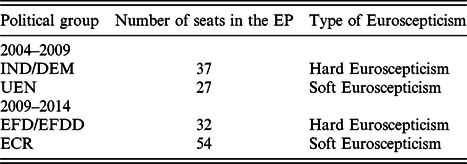
Eurosceptic groups in the European Parliament represent the second type of our data (Table 1). Their identification is based on previous research combining literature on party-based Euroscepticism in the EP (for example Brack Reference Brack2018; Whitaker and Lynch Reference Whitaker and Lynch2013). Following such an approach for each term – the sixth (2004–2009) and seventh (2009–2014) – two representative Eurosceptic groups were identified. The first consists of ‘hard’ Eurosceptics (Independence/Democracy – IND/DEM and Europe of Freedom & Democracy/Europe of Freedom & Direct Democracy – EFD/EFDD) and the other of ‘soft’ Eurosceptics (Union for a European of the Nations – UEN and European Conservatives & Reformist – ECR). We do not include another EP group – Confederal Group of the European United Left/Nordic Green Left (GUE/NGL) – as its classification as a Eurosceptic one is ambiguous.
Eurosceptic political groups in the EP.

Source: authors.
When it comes to method, our intention – interested as we are in a comparison of the two groups – was to use a t-test to ascertain whether there are statistically significant differences between hard and soft Eurosceptics in their question-asking activities. However, as the t-test expects normally distributed data – which was not so in our case, as there are huge differences among the activities of the various MEPs included in the analysed groups – we had to use non-parametric testing. Here we used the Mann-Whitney test, which can be generally described as a non-parametric equivalent of the t-test (Field Reference Field2009). Its aim is to compare differences between groups where their members greatly vary in terms of values. In our case, this means that we could compare groups when one particular MEP asked 1000 questions, while other members of the same group produced only 50 questions. We ran a series of tests comparing differences between groups in both periods and according to the type of question asked.
Analysis
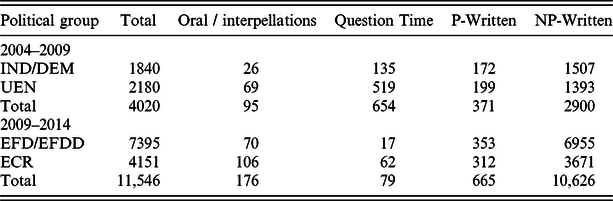
As noted above, there are three basic types of parliamentary questions. Table 2 shows the actual number of questions according to data from the European Parliament official website. These data are not influenced by doubling of questions, as when several MEPs ask one question together. MEPs from the same as well as different groups can ask a question in cooperation with other MEPs or groups.
Number of questions – actual number.

Source: authors.
A comparison of the two EP terms analysed reveals that in the 2009–2014 term the number of questions by Eurosceptic groups increased 2.87 times compared with the previous term. The bulk of this increase is accounted for by questions for written answer. In the second term, the number of normal (non-priority) written questions increased 3.66 times. It is also evident that questions demanding a written answer are the dominant type of question. In 2004–2009, they accounted for 81.4% of all questions; in 2009–2014 their share was even higher at 97.8% of the total.
The data in Table 2 clearly indicate that the share of questions for written answer (especially normal (non-priority) ones) is so large that one may deduce that the groups’ behaviour with respect to these questions will substantially affect the results of the analysis for the whole population of parliamentary questions. This needs to be taken into consideration in the interpretation.
Our data for analysis (Mann-Whitney test) comes from lower levels. To better describe the behaviour of MEPs, we have collected data for individual MEPs. The first analysis focused on the total number of questions in both periods. Beyond the coefficients of the Mann-Whitney U test and its significance we also provide effect size. We report median values rather than averages, as the median is a more precise indication for non-parametric tests than the average (Field Reference Field2009).
During the sixth term (2004–2009), the soft Eurosceptics in the UEN group (median = 27) posed statistically significantly (p < 0.1) more questions than the hard Eurosceptics in the IND/DEM group (median = 18), U = 452.50, z = –1.33. The effect size (r = –0.16) was small. However, this substantially changed in the second period. Here, the ECR faction (median = 48) posed significantly fewer questions than EFD/EFDD, representing hard Eurosceptics (median = 113), U = 479, z = –3.17. Effect size (r = 0.34) was in this case higher than during the first period, but still of only medium importance. Thus, we can note that at the most aggregate level there were very significant differences between soft and hard Eurosceptics during both terms and, at the same time, these differences changed across terms.
In the next step we analysed the various types of questions, including the two sub-types of written questions. We report the same results as in the first test: the coefficients of the Mann-Whitney U test, coefficient z, the median and the effect size.
The analysis of the first type of question (to be answered orally) led to an interesting finding, one that corrects the conclusion of the analysis of all questions. In the sixth term (2004–2009), the soft Eurosceptic UEN (median = 4) posed statistically significantly more questions than IND/DEM (median = 1), U = 298, z = –3.31. The effect size (r = 0.40) was medium. In the second analysed term, this difference disappeared. The ECR groups (median = 3) posed a similar number of questions as the EFD/EFDD faction (median = 3). A very small difference between the two groups is also documented by the values of Mann-Whitney (U = 725, z = –0.97) and their insignificance (p = 0.17).
When we proceed to the questions posed during Question Time, no difference can be found between hard and soft Eurosceptics in either electoral term. During the sixth term (2004–2009), the UEN group (median = 0) asked a similar number of such questions as did IND/DEM (median = 0). This was proved by the Mann-Whitney values (U = 535, z = –0.31). The difference between the factions was not statistically significant (p = 0.38), and it remained so during the seventh term as well. The Mann-Whitney U test did not reach a statistically significant level (p = 0.35), showing values of U = 791 and z = –0.40. The activities of the two groups were also shown to be comparable by the median values for ECR (median = 0) and EFD/EFDD (median = 0).
The last set of tests undertaken was concerned with questions for written answer, where we differentiated between priority and non-priority questions. Among the former group (priority) the analysis showed the same results in both terms. Whereas in the sixth term there was no difference between soft and hard Eurosceptics, as the Mann Whitney values did not reach statistical significance, in the seventh term the situation changed for both types of questions. When it comes to the priority questions, the ECR (median = 4) posed statistically significantly fewer questions than the EFD/EFDD (median = 9), U = 512.50, z = –2.88. The effect size (r = 0.31) was medium. Analysis of non-priority questions produced very similar results. ECR (median = 37) again posed statistically significantly fewer questions than the group EFD/EFDD (median = 97), U = 473, z = –3.23. The size of the effect (r = –0.35) can be again regarded as medium.
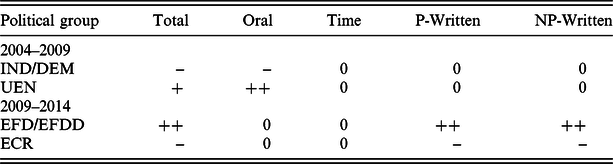
The results of our analysis are summarized in Table 3. Several interesting findings reveal the mutual relations between both forms of Eurosceptic opposition in the European Parliament, as well as their dynamics.
Summary of analysis results.

Notes: + The effect size was small, ++ The effect size was medium. Bold denotes statistical significance reached.
Source: authors.
First, Table 3 suggests that the behaviour of soft and hard Eurosceptics shifted over the course of time. Whereas the soft faction was more active during the sixth parliamentary term, the seventh Parliament was characterized by more visible hard Eurosceptics and a more silent soft Eurosceptic group. The difference between groups – if we compare values reached in both terms across type of questions asked – increased in the number of areas where a difference can be found and in the strength of significance as well.
How can we interpret these findings? First, changes between soft and hard Eurosceptics can be partly explained by changes in the factions themselves. This applies particularly to the soft Eurosceptic groups where the composition of UEN substantially differed from the composition of ECR. The latter faction was established particularly due to the activity of the British Tories and the Czech Civic Democrats. Both parties were members of EPP-ED groups during the sixth European parliamentary term. Even though, as members of the ED part of the EPP-ED group, they enjoyed some degree of independence on the EPP federalist positions, they were organizationally still part of the pro-European camp. Their activities were not included in our analysis of the first period, while they were included in the analysis of the second period. In this sense, it would be very interesting to compare the activity of ECR in the seventh and eight parliamentary terms and match them with the behaviour of hard Eurosceptics in the same period.
Second, we hypothesize that the smaller degree of ECR activity in the seventh parliamentary term can be explained by the group´s effort to establish itself as a different opposition than the hard Eurosceptic one. In this sense, our analysis confirms Brack´s (Reference Brack2018) conclusion that there are two oppositions in the European Parliament – the first against policies, the second against the whole polity. ECR politicians often introduce themselves as ‘euro-realists’ or ‘intergovernmentalists’, which suggests that they do not want to be perceived as Eurosceptics – with all the negative connotations this term bears in political reality. UEN – even though it also sometimes tried to be seen as different from the hard Eurosceptics – never spent so much energy trying to build up a similar reputation.
If we move from the aggregate level and the time perspective to the level of particular types of questions, we found some interesting trends as well. For questions during Question Time, where we would expect differences, there was no discernible trend and no difference between hard and soft Eurosceptics in either electoral term. This is interesting because we would expect more activity by hard Eurosceptic MEPs. Brack (Reference Brack2018) argues that Eurosceptic MEPs assume four ideal-types of roles: the Absentee, the Public Orator, the Pragmatist and the Participant. Her analysis shows that, despite the apparent homogeneity of their attitudes towards the EU, they develop heterogeneous strategies within the institution. In terms of both the data and our results about hard Eurosceptics, it seems that the absentee (exit strategy) prevails.
Looking at the total number of oral questions, despite the fact that statistical significance was not confirmed, soft Eurosceptics asked more questions during Question Time in the sixth and seventh parliamentary terms and the hard Eurosceptic (IND/DEM, EFD/EFDD) group do not use interpellation. We can thus claim that hard Eurosceptics do not use public appearances (oral questions, Question Time), which confirms their classification in Brack’s (Reference Brack2018) absentee category.
Differences are observable in the written questions (normal and priority) during the second period. These questions account for the bulk of all questions. However, these questions are less visible to the electorate, and less useful for gaining media exposure or for political competition, than oral questions or those asked during Question Time. Hard Eurosceptics (EFD/EFDD) posed written questions more often. This fact contradicts the media´s claim about hard Eurosceptics as troublemakers. The essential and explanatory factor might be the changes within groups. As already mentioned, the composition of the groups has fundamentally changed between both terms.
Discussion and Conclusion
The term Euroscepticism has been used – particularly if connected to party politics – as an umbrella word, no matter what degree of criticism has been identified or which message has been voiced as EU critique. As Neumayer (Reference Neumayer2008) argues, having this umbrella at hand has often led to de-legitimization of any form of opposition towards any EU policy or activity. Prevailing typologies of parties on the basis of a distinction between soft and hard versions of Euroscepticism supports such a vague approach. Soft is usually the first step towards hard, particularly if both terms are directly linked to the same leading word – in this case Euroscepticism. We believe that such elastic conceptualization is not just scholarly misleading per se, but it also hypothesizes the exact description and understanding of an increasing disapproval of European integration. Opposition and critique are a normal part of any well-functioning political system as they serve as a sort of feedback within the system. A problem arises if any opposition is ostracized and marginalized as undermining the system. The prevailing scholarly perception of Euroscepticism suffers from such connotation. Therefore, we believe that an analysis of EU opposition needs to challenge existing concepts. This article tried to do so by analysing the behaviour of Eurosceptical groups in the European Parliament, as these groups represent a significant part of the opposition in the European Parliament. By analysing how soft and hard Eurosceptical MEPs use parliamentary questions we aimed to find out whether a common or a similar pattern can be identified between these two groups. We sought answers to two questions. First, what are the differences between soft and hard Eurosceptic groups? Are soft Eurosceptical parties in fact close to their hard Eurosceptic counterparts or is their approach towards the EU substantially different? Second, what were the changes between the sixth and the seventh parliamentary terms?
The answers to our questions are as follows. First, there is a substantial difference between both groups, suggesting that they hardly represent two degrees of the same phenomenon but rather two totally different stances towards the EU. Second, this difference changed and increased over the course of time. We believe that these findings – if placed in the context of existing research – have implications for the study of party-based Euroscepticism.
First, our analysis suggests that labelling any form of EU critique as a form of Euroscepticism is not appropriate. Stances previously identified as either soft or hard types of Euroscepticism do represent two distinctively different approaches towards the EU. The first can be classified as disapproval with the tempo, speed or content of current EU policy or policies, but not as challenging the EU polity. The second approach rejects the EU as a whole and can be described as anti-systemic. We believe that we demonstrated that representatives of these two groups in the European Parliament use different tools in doing their opposition job. In this sense, our work confirms the findings of Brack´s (Reference Brack2018) comprehensive analysis of Eurosceptical MEPs, showing that there is a great variety among them in terms of patterns of behaviour and roles adopted. We also confirmed the findings of Kaniok and Hloušek (Reference Kaniok and Hloušek2018, Reference Kaniok, Hloušek, Góra, Styczynska and Zubek2019) analysing differences between soft and hard Eurosceptics on EU enlargement policy and towards Brexit. In both cases, similar important differences between both camps were identified. Second, as our analysis suggests that differences between soft and hard Eurosceptics increased over time, this indicates that there is a group of politicians in the EP that wants to be perceived as being part of the system even if not agreeing with all its activities and decisions. However, this group is distinctively different from those calling for the EU to be terminated and is perhaps closer to pro-EU groups and parties than to the hardliners. Even when proposing new names and types has not been very productive in theoretical debates on Euroscepticism, it is now perhaps time to recognize the existence of this political position as not fitting the term Euroscepticism.
Based upon our findings, we believe that research on the ways MEPs use parliamentary questions is a very promising topic for future research. Next to focusing on the aggregate level, focusing on the individual level of particular MEPs may be very interesting. We noticed considerable differences between the MEPs of the two Eurosceptic groups, as evidenced by the various number of questions posed by MEPs. MEPs face pressure from national states, national parties, and their groups. That means that MEP behaviour is influenced by several factors. In such a context, pure membership in particular group is not necessarily the most essential factor. Differences between groups may be due to the fact that some MEPs are specialized in gaining information (asking questions). For this reason, it could be appropriate to focus on individual MEPs’ motivations for asking questions. The manner in which MEPs use parliamentary questions may also be influenced by variables outside the EP. As we noted, this is an avenue for future research.
Acknowledgements
This work was supported by the Grant Agency of the Masaryk University under Grant MUNI/A/1067/2016.
About the Authors
Petr Kaniok is Associate Professor in the Department of International Relations and European Studies – Faculty of Social Studies, Masaryk University, Brno, Czech Republic. His most recent research has been published in Parliamentary Affairs, East European Politics, Journal of Contemporary European Research and European Politics and Society.
Magda Komínková is a doctoral student in the Department of International Relations and European Studies – Faculty of Social Studies, Masaryk University, Brno, Czech Republic. Her most recent work has been published in Energy Policy and the Baltic Journal of European Studies.