Alison Hood’s book Interpreting Chopin: Analysis and Performance is a thought-provoking study that concentrates, as the title tells us, on the interrelationships between analysis and performance in Chopin’s music. After first introducing its theoretical starting point (Part I), the book examines works in different genres, consisting of three analytical sections: (1) analysis of several of the Preludes, Op. 28 (Part II), whose discussion highlight some specific musical aspect of each individual piece; (2) examination of Nocturnes, Op. 27 and Op. 48 (Part III), in which Hood traces interrelationships between the two pieces in both opuses; (3) study of the Barcarolle, Op. 60 (Part IV), in which Hood interprets the coda as a final resolution of several musical issues left unresolved earlier. Hood locates her study within a Schenkerian analytical tradition, with special emphasis on issues of rhythm.Footnote
1
With each of the preludes and with the two Nocturnes, Op. 48, Hood shows multi-layered voice-leading graphs of entire works, while with the Nocturnes, Op. 27, as well as the Barcarolle, she only includes graphs of several isolated passages. The voice-leading sketches covering entire pieces, as well as Schenkerian analysis more generally, function mostly as a backdrop for the analytical commentary. That is, Hood rarely addresses tonal structure in any comprehensive way. Often she only notes, for example, where the Urlinie reaches
 $\hat {1}$
. As a result, the voice-leading graphs that show entire pieces mainly provide a general context in which Hood comments on issues like rhythm and motives.
The book’s opening, Part I, clearly describes its theoretical foundation, which Hood discusses under five headings. As these points guide the analytical commentary in Parts II, III, and IV, I will take them as my starting point, too.
(1) Rhythm. Hood locates her approach to rhythm within the Schenkerian tradition, as exemplified, in particular, by the writings of William Rothstein and Carl Schachter. She examines issues like durational reduction and rhythmic displacement, applying rhythmic analysis to local levels – like the polymetric situation in bars 17ff. in Prelude, Op. 28, No. 21, where she notes that ‘the right hand remains in strict triple metre while the left hand introduces offbeat double metre’ (p. 106) – as well as to musical spans covering entire pieces, like the durational reductions she shows of several entire preludes in Part II.
Hood also discusses motivic connections – or ‘hidden repetitions’, as she often calls them after SchenkerFootnote 2 – under the rubric of rhythm, arguing that the motives may have rhythmic characteristics in addition to their pitch-based profile. For example, she argues that motives often have a ‘natural metric organization’ (pp. 18–20); as an example, displacement of the pitches of the motive from strong to weak beats of a bar may locally shift them away from their ‘natural’ metrical position (p. 134). In many of the book’s analytical chapters, motivic associations form the main focus of analysis. As the application of the term ‘hidden repetition’ shows, Hood locates her approach to motives, too, within the Schenkerian tradition. She discusses both relatively local motivic connection and more extended ones; a clear instance of a deep-level motivic repetitions is the provocative idea that the global contrapuntal framework in the Prelude, Op. 28, No. 14, is a vast replica of the motive that opens the work (pp. 84–85).
Hood’s discussion of motives can be roughly divided into three categories, each of which can be clarified through her analysis of Prelude, Op. 28, No. 22. She interprets the third-descent B♭–A–G that opens the piece as a kind of motto. In the first category of motives there are simple contours like neighbour notes or stepwise lines that just resemble each other; in the case of the Prelude, Hood argues that the descending third at the beginning prefigures the Urlinie (p. 117). In the second category, such motivic repetitions may be affected by some special characteristics of the piece in which they occur; again in the Prelude, ‘the whole piece may be heard as an attempt to state this motif conclusively – that is, so that it ends on a stable tonic’ (p. 117). The third category includes motivic associations in which there is tension between the motive and the voice-leading structure; in the Prelude, the descending-third motive in bar 8 can be heard ‘as part of a dominant-functioning harmony. Yet, at the same time … we can also hear it as prolonging tonic harmony’ (p. 118).
Hood does not herself make this three-category distinction, which is based on my interpretation of her analyses. Indeed, there is little reference to the Schenkerian literature on motives to clarify her approach to motivic analysis apart from an article by Steve Larson.Footnote 3 This omission of practically all pertinent literature on motivic associations seems slightly odd as motivic connections arguably form, together with issues of rhythm, the primary focus of the book. For example, the distinction into three categories that I have suggested above, based on Hood’s analyses, could have been related to published literature: category 1 to the work of Allen Cadwallader,Footnote 4 category 2 to that of Charles Burkhart,Footnote 5 and category 3 to Richard Cohn.Footnote 6
(2) Foreground Emphasis. In her analyses Hood often concentrates on relatively local structural levels, ‘as these levels seem to me to provide the most useful information for performance interpretation’ (p. 25). This foreground emphasis is evident throughout the study – not only in the actual analyses of the structure, but also in the organization of the analytical prose, which often traces the course of the pieces (their motivic, rhythmic, and harmonic factors) by describing the works’ local events as they proceed from the beginning towards the end. This mode of presentation is logical, but it also has its challenges. If music-analytical text does not clearly specify the musical context in which the musical details are interpreted, as well as sufficiently explicate a research questions to which these details provide an answer, there is a danger that the local events that the analysis examines become rather isolated occurrences in a kind of pointillistic picture whose details do not form quite clear shapes.Footnote 7 Hood’s prose, with its emphasis on foreground, does not always escape, at least as I read it, this danger of somewhat losing sight of the global musical context or the general temporal trajectories that the local events elucidate.
(3) Strict Use of Analytical Notation. In her graphs Hood uses a special graphing technique of strict notation, formulated by her teacher and mentor Steve Larson.Footnote 8 She finds it ‘to be the most performer-friendly method of Schenkerian analysis’ (p. 30). Her graphs are, indeed, easy to read. However, it was not quite clear why ‘strict notation’ is preferable to more standard Schenkerian graphics. One of Hood’s main arguments seems to be that ‘strict use is particularly adept at displaying musical ambiguity’, which it can highlight ‘by the use of more than one graphic solution’ (p. 31). Yet there is only one such pairing of ‘graphic solutions’ in the book, Example 11.4 on p. 119 (exactly the same example is, incidentally, also printed on p. 32 as Example 3.2). And as far as I understand, the incongruity of these two readings might be equally well shown with standard Schenkerian graphics. Indeed, Harald Krebs,Footnote 9 for example, uses pairings of different graphs as a means of elucidating situations that can be tonally interpreted in more than one ways.
(4) Strategy/Premise. Hood sees these concepts to be important as they reveal ‘a great deal about the dramatic narrative of a work and can therefore speak more directly to the performer’ (p. 33). In the analysis of Nocturnes, Op. 27, for example, she lists five premises – ‘semitonal neighbours; melodic events becoming bass lines; the sixth; enharmonic reinterpretation; and a “new theme”/thematic similarities’ (pp. 164 and 170) – and then traces how these premises appear in the two Nocturnes. As ‘strategy’ and ‘premise’ are associated with musical narrativity, it would have been interesting to read how Hood relates these concepts to the literature specifically addressing issues of musical narrative, like the writings of Byron Almén.Footnote 10 A firmer theoretical discussion of musical narrative might have also given more precise tools for forging continuity and coherence into Hood’s examination of individual occurrences of the ‘premises’, as well as for interpreting narrative that they create. Occasionally the discussion of these premises seemed somewhat isolated from a more comprehensive and general unfolding of the musical drama, which also would take into account issues other than individual ‘premises’ like motives.
(5) Dialogue with Performance. Hood’s discussion of analysis–performance issues can be divided into three categories. First, motion from analysis to performance, where analysis gives instructions, as it were, on how to perform a given musical passage. This is the most common approach in the published literature, and in Hood’s book it can be found, for example, when she notes, after having analyzed Prelude, Op. 28, No. 14: ‘Pedalling or slightly holding certain bass notes achieves a result resembling the rhythmic reduction and can reflect harmonic and intervallic knowledge. Therefore, an interpretative approach such as this that incorporates voice-leading and rhythmic analysis can prove very helpful in preparing a performance’ (p. 86). Second, the book suggests the significance of the reverse direction from performance to analysis, where performance affects the analytical decisions. This perspective is less common in the literature, but Hood clearly advocates it when stating ‘almost all of my analytical decisions follow repeated playing and listening, and in this way performance constantly informs my analyses’ (p. 37). Third, Hood relates her analytical findings to recorded performances and traces how individual recordings could be seen to reflect her analytical insights. After her examination of the Barcarolle, for example, she notes that ‘Arrau’s performance addresses many of the kinds of performance questions that would arise from identifying the premises discussed above’ (p. 202). She then substantiates this claim through discussing some details of Arrau’s performance from the perspective of her analysis.
Hood does not herself make this distinction, so it is, like the three-category approach to motivic organization, my interpretation of her text. And, also like with the motivic structure, Hood only discusses relatively limited literature on the topic of analysis and performance, even though this is arguably the main issue of her book (as suggested by its subtitle). As her approach combines examination of Schenkerian structure and rhythm with issues of performance, she might have referred, for example, to William Rothstein’s essay on general issues on analysis and performance,Footnote 11 as Rothstein examines voice leading, rhythmic reductions, motives, alternative readings, and narrative, or to Rothstein’s essay on Chopin’s A-flat major Prelude, Op. 28, No. 17,Footnote 12 which discusses interrelations among grouping, metre, tonal structure, and performance in Chopin – both of these essays examine the very issues that Hood herself addresses. Or as Hood notes the significance of performance for her own analyses, noting that recorded performances can be understood as ‘serving’ (p. 205) her analyses, the reader might have been interested to see this topic elaborated further, and to read, for example, how she relates her approach to those of Joel LesterFootnote 13 or Patrick McCreless,Footnote 14 both of whom discuss how recorded performances may affect analysis.
I do not mean to suggest that Hood should have discussed precisely the studies mentioned above, or, more generally, that a scholar should examine earlier research just for the sake of discussing it – certainly there is much literature that is so remotely related to a given topic that its inclusion would complicate rather than clarify the issues at hand. But in my opinion Hood has also excluded literature that might have been helpful for specifying her approach, and thus might have made it more nuanced. Moreover, owing to the relatively limited literature that she refers to, the reader may find it somewhat difficult to locate Hood’s study in a larger scholarly context, and thus also to recognize its specific focus.
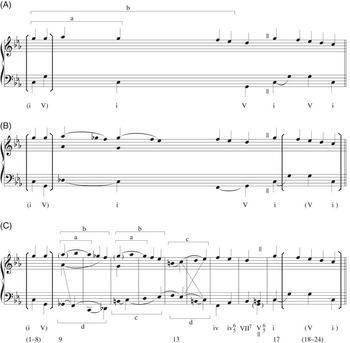
I will close this review with a detailed discussion of two short musical excerpts – bars 11–12 and 16–17 of the C minor Nocturne, Op. 48, No. 1 – also considering the function of these passages in a larger context. Ex. 1 shows an adaptation of Hood’s graph of bars 1–24, the small ternary form that constitutes the larger A section opening the ternary Nocturne. I have summarized bars 1–8 of Hood’s graph in parentheses and show bars 17–24 only in the reading of her deepest A level. Hood’s verbal commentary of the Nocturne mostly elucidates motivic connections – in particular the semitonal G–A♭–G motion in bars 1–2, a figure whose pitches have been initially rhythmically displaced (motive a in Ex. 1), as well as the continuation of this neighbouring motion via F to E♭ in the second half of bar 2 (motive b). Level A of Hood’s graph (Ex. 1) shows, convincingly, in my opinion, that both motives a and b are then expanded.
Chopin, Nocturne, Op. 48, No. 1, bars 1–24, Alison Hood’s analysis. Adapted by permission of the Publishers from Example 12.3, ‘Voice-leading graph of Nocturne Op. 48, No. 1, Section A’, in Interpreting Chopin: Analysis and Performance by Alison Hood (Farnham: Ashgate, 2014), p. 131. Copyright © 2014.

Hood notes that in bar 17, with the onset of the aʹ section, the opening motivic material returns: ‘The primary tone
 $\hat{5}$
returns in bar 17 with a modified version of the theme … The original motif of
 $\hat{5}{\minus}{\rm N}{\rm N}{\minus}\hat{5}{\minus}\hat{4}{\minus}\hat{3}$
[motive b] and the ascending fourth [motive c] both return’ (p. 134). The return of the opening motive is preceded in bar 16, according to Hood, by ‘D
 $\hat{2}$
as an interruption’ (p. 134). The motivic return in bar 17 is clear, but the musical context of this return seems to me subtler than either Hood’s prose or her graph suggest. First of all, bar 17 does not feature a C-minor triad, as the work’s beginning did, but rather a dominant-seventh chord on C, a sonority that may, of course, represent the structural tonic also in the minor mode, but that is not the most common representative of this function. (Incidentally, Hood does not note the harmonic change in bar 17, when compared to bar 1, either in her graph or prose.) Likewise, the dominant in bar 16 that constitutes, in Hood’s interpretation, a deep-level dominant of an interruption is a
 $\raster="rg2" $
sonority, which occurs, moreover, only on a relatively weak metrical position.Footnote
15
When seen more globally, the role of a C-minor tonic seems even more complex than this. In bars 11–12 Hood notes the return of the a and b motives at the original pitch level (Ex. 1C), also reading the return of the structural tonic (Ex. 1A); she notes that bars 11–12 form ‘a modified sequence of the preceding two-bar phrase, now in the tonic key’ (p. 133). But is a sequential repetition within a musical unit that has already started any more likely candidate for the return of the structural tonic than the dominant-seventh chord of bar 17? If we follow Carl Schachter and understand structural tonic ‘as significant beginning or goal of motion’,Footnote 16 neither the C-minor chord in bar 11 nor the dominant-seventh sonority in bar 17 is an unproblematic structural tonic. Thus the idiosyncratic aspects of the harmonic environment strongly colour the motivic occurrences that Hood discusses.
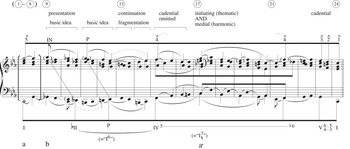
Ex. 2 shows another way of reading the harmonic structure of this passage. Briefly, one may take the C-minor chord in bar 12 as a passing sonority (Ex. 2 shows the middleground arrival at a C-minor chord only in bar 12, thus suggesting a larger prolongation of the V of C in bars 11–12 than Hood, who reads the tonic already in bar 11). Formally, bars 11–12 may be seen to represent a repetition of the basic idea within a presentation of an eight-bar sentence, thus the C-minor chord is neither beginning nor goal of motion.Footnote 17 In bar 17, in turn, one may read the dominant-seventh chord as a contrapuntal sonority within an extended prolongation of IV. It is not preceded by a clearly articulated dominant, and it begins a sequential harmonic progression, which suggests a destabilizing, medial formal function; thus it shows no unequivocal beginning or goal of harmonic motion. Significantly, bar 17 thus includes an apparent contradiction, combining a thematic initiation (the onset of the aʹ section) with medial harmonic function (a sequence).Footnote 18 In all, it is possible to read in bars 1–24 an uninterrupted top-voice fifth-progression, supported by a harmonic progression from the opening tonic via a vastly prolonged predominant to the concluding cadence in bars 23–24. According to this reading, there is a structural tonic only in bars 1–4 and 24; as a result, we might consider the postponement of the return of the structural tonic, or avoidance of an unequivocally stated tonic more generally, as a ‘premise’ in the sense that Hood uses this term, and create a narrative trajectory that takes this feature into account.
Chopin, Nocturne, Op. 48, No. 1, bars 1–24, an alternative analysis

I do not offer my alternative analysis to suggest that it is better, or, certainly, that it is more ‘correct’ than Hood’s.Footnote 19 But I feel that the alternative reading, shown in Ex. 2, indicates the significance of taking the large context and its unusual features into consideration when assessing the function of musical details. Therefore, when deciding not to elucidate the Nocturne’s harmonic structure and its idiosyncrasies almost at all, I feel that Hood leaves many of the work’s salient harmonic and linear qualities unaddressed, the book’s Schenkerian orientation and the accompanying graph notwithstanding. And if the commentary on relationships between analysis and performance is restricted to comments on motivic material, as Hood does with the Nocturne on pp. 142–43, some musical aspects that are potentially valuable for a performer – like the ‘premise’ of investing the tonic’s return with tension – are bypassed. Often Hood describes the musical details she concentrates on, like here the motivic organization, in a clear and plausible manner. What I occasionally miss is a more comprehensive discussion of the interactions among various musical parameters, as well as a clearer explication of the global musical context in which the musical details occur. I tried to provide such a context above, in a very tentative manner, by incorporating into motivic analysis some highly idiosyncratic aspects of harmony, voice leading, and form. A view like this might give a more comprehensive context for those motivic details that Hood examines, and thus be also valuable for performers, whom Hood is addressing in her book.