


In “Judicial Behavior under Political Constraints: Evidence from the European Court of Justice,” Carrubba, Gabel, and Hankla (CGH; Reference Carrubba, Gabel and Hankla2008) make two startling claims. First, after examining the impact of member state government (MSG) briefs on the rulings of the European Court of Justice (ECJ) on 3,176 legal questions over an 11-year period (January 1987–December 1997), the authors declare that its decision making has been constrained by the threat of override on the part of governments, acting collectively, and by the threat of noncompliance on the part of any single MSG: “Our analysis provides systematic evidence that judges at the ECJ are sensitive to these two constraints. Moreover, these threats have a substantively large effect on judicial rulings” (449). Second, the authors state that their findings support the tenets of “intergovernmentalist” but not “neofunctional” integration theory. Because these two claims starkly conflict with virtually all of the empirical research on the topic undertaken over the past two decades, and because they were published in the APSR, the article attracted wide notice in the European Union (EU) politics field.
In this response, we demonstrate that neither of these claims is supported by their data. Although we believe that CGH's project is flawed in fundamental respects, we sought to evaluate it from within the parameters set by their project. We gathered and analyzed data exclusively from cases in CGH's data set; we employed the basic elements of their method for assessing the impact of MSG preferences on the decision making of the court; and we accepted, for the purposes of reply, CGH's own preferred constructions of integration theory.Footnote 1
THEORY AND METHOD
CGH revive ideas put forward, but not tested, by Garrett (Reference Garrett1992) and Garrett and Weingast (Reference Garrett, Weingast, Goldstein and Keohane1993). In this account, the policy preferences of the most powerful member states constrain the evolution of the ECJ's case law, not least because the court fears being overridden. CGH also point to a well-known methodological issue that bedevils research on anticipatory reactions more generally: When the mechanism works, there is nothing for the analyst to observe. If the threat of override effectively constrains a court, then the override power need not be used.
In the mid-1990s (Kilroy Reference Kilroy1996; Stone Sweet and Caporaso Reference Stone Sweet, Caporaso, Sandholtz and Stone Sweet1998), political scientists worked to refine a method, first developed by Stein (Reference Stein1981),Footnote 2 to test these and other hypotheses about how the EU legal system works. This approach involves evaluating the influence of amici briefs—filed by MSGs and the EU Commission—on the ECJ's rulings. Because these briefs—“Observations” in EU parlance—advise the ECJ on how it should rule on the legal questions constituting any given case, they embody revealed preferences. The analysis of briefing activity provides leverage on the observational problem just discussed: How can the analyst assess the influence of the briefing parties or the threat of override on the court's rulings? If, on any legal question before the court, MSGs wish to signal their legal preferences, or threaten override, they can file briefs. The analyst then tracks the court decision making with reference to briefed positions to assess not only the influence of these positions but also the threat of override.Footnote 3 Variations on the method have been applied relatively systematically, within and across legal-policy domains (e.g., Cichowski Reference Cichowski1998; Reference Cichowski2004; Reference Cichowski2007; McCown Reference McCown2003; Nyikos Reference Nyikos2000; Stone Sweet Reference Stone Sweet2004). The results have been remarkably consistent. Scholars have found (i) that the threat of override was not credible; (ii) that formal claims of alleged noncompliance on the part of MSGs neither intimidated nor paralyzed the court, but rather provided the ECJ with opportunities to develop an expansive and progressive case law; and (iii) that the court was far more responsive to the briefs of the commission—the ECJ's presumed partner in constructing judicial and supranational authority—than to those of MSGs, even the most powerful ones. Intergovernmentalist theory was largely abandoned, and approaches compatible with neofunctionalism flourished (literature reviewed in Stone Sweet Reference Stone Sweet2010).
There is broad consensus on the view that the ECJ has been a powerful catalyst of market and political integration, in part, because its pro-integrative rulings are effectively insulated from member state override (Alter Reference Alter2008; Cichowski Reference Cichowski2007; Pollack Reference Pollack2003; Stone Sweet Reference Stone Sweet2004, Reference Stone Sweet2010; Tallberg Reference Tallberg2002a). The underlying rationale is straightforward: For any important and controversial ruling of the court, MSGs are likely to be divided and unable to muster the votes required to overturn it. We found that unanimity is the decision rule governing override in more than 90% of the cases in which MSGs filed briefs in the CGH data set. In less than 10% of these cases, the decision rule is a qualified majority (QM), which CGH (440) operationalize as 70% of the weighted votes of the MSGs in the Council of Ministers. There is not one instance of a successful override in their data set; indeed, we know of no significant case in the history of adjudicating the treaties. We identified two rulings in the CGH data set that provoked the MSGs to make formal decisions expressly designed to override the court or to constrain its latitude in future cases (discussed later). These efforts failed—the court brushed them aside—a fact that should weigh heavily in this debate.
Everyone agrees that the ECJ seeks to elicit compliance with its decisions and that it often leaves substantial room to maneuver to national officials, including judges, to enhance compliance. Yet there is also strong consensus for the view that the ECJ is not constrained in any systematic way by the threat of MSG noncompliance. After all, the EU's legal system has uniquely evolved to deal with compliance failures (Kelemen Reference Kelemen2010; Stone Sweet and Brunell Reference Stone Sweet and Brunell1998; Tallberg Reference Tallberg2002b). Over the past two decades, scholars have charted how noncompliance on the part of MSGs has generated litigation and helped organize the court's dynamic construction of EU law, thereby creating new compliance failures. However, no one has found that the progressive evolution of the ECJ's case law, a truly remarkable edifice, has been stunted by the threat of noncompliance. CGH do not identify a single instance in which a threat of noncompliance has constrained the court.
The position CGH have staked against these consensus positions is based on specific theoretical commitments, not data. In their model of the EU's legal system (439), the MSGs, rather than the ECJ and the national courts, constitute the EU's third-party enforcement mechanism.Footnote 4 The court's job in this system is to ratify the MSGs’ legal preferences on an ongoing basis.Footnote 5 Compared to any other theoretical understanding of how the EU's legal system operates, CGH's model systematically underestimates the ECJ's autonomous capacity to make law and the central role played by national judges in supervising state compliance.
Under Art. 267 of the Treaty on the Functioning of the European Union (TFEU), the national courts furnished nearly two-thirds of all of the legal questions in the CGH data set; the vast majority concerned allegations of noncompliance brought by individuals, firms, and interest groups. If, in its answers to the referring judge, the ECJ determines (or implies) that national law is in noncompliance with EU law, then it is the judiciary, not the government, that will take the authoritative decision “to comply” or “not to comply.”Footnote 6 When it comes to the implementation of a preliminary ruling by the judge sending the reference, judicial compliance is very high. In the most comprehensive study to date, Nykios (Reference Nyikos2003) found that referring judges implemented the ECJ's rulings in 96% of cases analyzed in five legal systems (Nyikos Reference Nyikos2003).Footnote 7 In the EU, it is most often national judges who work to “restore compliance” (Panke Reference Panke2007), even in “politically sensitive” areas (Panke Reference Panke2009).
JURISDICTION OF THE EUROPEAN COURT OF JUSTICE
The CGH data set contains information collected from European Court of Justice (ECJ) rulings that came to the court under three provisions of the Treaty of Rome, now the Treaty on the Functioning of the European Union (TFEU; entry into force December 1, 2009).
Under Art. 258 TFEU, the European Commission (EC) may initiate “infringement proceedings”—also called “enforcement actions”—against a member state for noncompliance with EC law. Rounds of negotiation ensue; if these fail, the commission may refer the matter to the ECJ for decision. The commission's discretion to bring such suits is absolute. In Art. 258 litigation, the defendant is always a member state, and the plaintiff is always the commission.
Under Art. 263 TFEU, the ECJ presides over “annulment actions,” suits brought by private parties, the member states, or European Union (EU) organs seeking to invalidate acts of the EU's governing bodies. In this litigation, only an EU organ can ever be a defendant; the member states can never be defendants, and national compliance with EU law is never the issue before the court.
Under Art. 267 TFEU, national judges send questions—preliminary references—to the ECJ in order to obtain an interpretation of EU law, when it is material to the resolution of a dispute at national bar. The ECJ responds in the form of a judgment—a preliminary ruling—that the referring judge is expected to apply to resolve the case. The vast majority of these cases involve an allegation on the part of a private party (an individual, firm, or interest group) that a specific national law, or practice permitted or required under national law, is in noncompliance with EU law. The national legal order is, in effect, the “defendant” in these cases. If the allegation is upheld, the national judge is expected to give priority to EU law, while setting aside conflicting national law (under the doctrine of supremacy).
Before proceeding, we need to clear away a false issue. We agree with CGH that the best practice for evaluating the robustness of “political constraints” on ECJ decision making is to analyze the court's position on every legal question briefed by an MSG and the commission.Footnote 8 Among other information, they code how the court addressed the various questions raised in each case (in binary terms: whether the court sided with or against the plaintiff) and how the commission and the MSGs briefed these same questions. Quite sensibly, CGH then “weigh” each MSG's brief according to the number of votes that MSG has been assigned in the Council of Ministers under qualified majority (QM) voting rules. They can then derive a “net weighted position,” which can be either (i) positive, when weighted briefs sum up to support the plaintiff; (ii) negative, when the weighted briefs sum up to oppose the plaintiff; or (iii) zero, when no MSG filed a brief on a question or when the briefing MSGs cancel each other out.
CGH use various statistical techniques to measure the extent to which ECJ rulings align with the positions briefed, but depart from standard practice in one crucial respect: They count every ECJ decision that is congruent with the net weighted position of the MSGs as support for their hypotheses. In such cases, CGH assume that the ECJ was “constrained” to decide as it did, because of the threats of override and noncompliance. The approach, however, can only help the analyst assess the “influence”—or persuasive effect—of briefs on outcomes; it cannot directly evaluate the proposed explanation of this influence (see the later discussion). If a court follows a line argued in one of the briefs submitted to it, why should an observer presume that the outcome can only be explained by “political” threats? We submit that CGH's approach would not make sense in any other legal system in which effective judicial review has been established, and it makes no sense for the EU.
HYPOTHESES AND RESEARCH DESIGN
Hypothesis 1 (H1) embodies the override mechanism: “The more credible the threat of override . . . the more likely the court is to rule in favor of the governments’ favored position” (CGH 439). We consider this formulation to be appropriate and reasonable. CGH further suggest, sensibly, that “the threat of legislative override increases with the likelihood that a sufficiently large coalition of member states would pursue legislation or treaty revision in response to an ECJ ruling” (440). Yet CGH then stack the deck in favor of their position, stipulating that the decision rule governing override will always be QM, arguing as follows (440): “Unfortunately, we cannot easily distinguish which legal issues can be overridden by QM and which require unanimity support.”
In fact, determining the override rule for each case is straightforward.Footnote 9 Unanimity governs override for the following: all rulings on treaty law, including every case in the domains of free movement of goods, services, and workers, antitrust, and every legal basis dispute under Art. 263; all rulings that concern EU legislation adopted under unanimity rules (the vast majority of statutes litigated in CGH's data set); all rulings pursuant to Art. 267 preliminary questions related to the doctrines of direct effect, supremacy, remedies, and general principles of EU law, including fundamental rights; and more. As noted, for more than 90% of the cases in which MSGs weighed in, the override rule was unanimity, not QM.
Because CGH do not stipulate a threshold point at which the threat of override is credible, H1 would appear to be impossible to test. Further, CGH do not describe a single instance in which a threat of override was actually made, and they do not even provide a “stylized” example of how their mechanism might work. Instead, CGH (436) declare that the necessary votes to override can be gathered through “logrolling,” the entire discussion of which is as follows (436): “Override requires a government, or set of governments, opposed to the court's preferred ruling to cobble together a logroll. Further, protocols can ease the logrolling process in treaty revision.” Although H1 implies, and rightly so, that the threat of override would be credible only when a “sufficiently large coalition” of MSGs weighs in, CGH treat the threat as present even in cases when only one MSG, which might be as small as Luxembourg or Portugal, has filed a brief in favor of a defendant member state. This move conflicts with the precepts of intergovernmentalism, which predicts that only powerful states can constrain the court (e.g., Garrett Reference Garrett1992).
Hypothesis 2 (H2) embodies their approach to noncompliance: “The more opposition a litigant government has from other MSGs, the more likely the court is to rule against that litigant government” (439). Note that testing H2 as formulated does not give us information on the extent to which the threat of noncompliance actually constrains the court's decision making. Instead, H2 focuses attention on what happens in situations in which at least one nonlitigating MSG encourages the court to punish a defendant MSG. The logic of the mechanism is permissive rather than constraining. CGH do not identify any instance in which a threat of noncompliance has constrained the court, and they do not furnish criteria for determining when a threat of noncompliance is actually made. Instead, they assume that (a) the threat of noncompliance inheres in every case and that (b) the threat will in every case constrain the ECJ except when the court is supported by the nondefendant member states. “If governments have the ability to ignore adverse rulings,” CGH (439) declare, “the court can only expect compliance with its rulings when non-litigating governments are willing to punish the defecting government for noncompliance.” CGH present no data or analysis on noncompliance, beyond alleged instances that generate a judicial ruling. Instead, CGH test H2, which does not test the effect of a threat of noncompliance on the court's decision making.
Most worrisome, CGH choose not to test H1—whether the threat of override constrains the court's decision making—as originally formulated. Instead, they operationalize H1 “as the net number of member-state observations in favor of the plaintiff (defendant) increases, the likelihood that the court rules for the plaintiff (defendant) increases” (440), which makes it virtually identical to H2 (CGH, 438: “The more opposition a litigant government has from other member-state governments, the more likely the court is to rule against that litigant government”). The move has dramatic consequences for how findings will be interpreted. CGH can now count as evidence in support of H1 any instance in which the court rules in favor of a plaintiff when that ruling is congruent with the net weight of MSG observations in favor of a plaintiff (even if only one MSG weighs in and the override rule is unanimity), and they can count as evidence in support of H2 any instance in which the court rules against a defendant MSG when that ruling is congruent with the net weight of MSG observations against that defendant. Thus altered, H1 and H2 will test the same relationships among variables, on the same data.
CGH's design—a point that applies to the standard method they have adapted—provides the observer with information on the extent to which briefs (the independent variable) predict, or presage, or are consistent with ECJ rulings (the dependent variable) on any given legal question. The design, however, is not capable of testing H1, as originally stated, because CGH do not assess the credibility of the threat. In addition, CGH do not test the effects of a threat of noncompliance on the court's decision making. Instead, they test H2, which provides information only on whether the ECJ responds favorably when MSGs urge it to censure a defendant MSG.
ANALYSIS (1): OVERRIDE AND NONCOMPLIANCE
In this section, we respond to two empirical questions. First, how credible is the threat of override? For the mechanism to constrain the court systematically, the evidence must show that the threat of override is credible. Second, to what extent does the evidence show that noncompliance on the part of MSGs constrains the court? CGH do not report the data that directly bear on these questions.Footnote 10 Nonetheless, on the basis of the case numbers contained in CGH's data set and their coding of the net weighted positions of the MSGs, we collected and analyzed this information. We report our findings here.
The data set contains cases that come to the court through three procedures, only two of which are relevant to CGH's project: Articles 258 and 267 TFEU.Footnote 11 CGH also include data from Art. 263 annulment actions in tests of H1 and H2. Yet suits under Art. 263 can only be brought against EU organs; MSGs can never be defendants. Thus, to test propositions concerning MSG noncompliance, CGH include data drawn from 593 rulings and 662 legal questions (more than 20% of the total number of observations in their data set) in which national noncompliance can never be the legal issue.
Art. 258 infringement proceedings are brought by the European Commission alleging member state noncompliance with EU law. These suits directly involve the question of whether the threats of noncompliance (the MSG has decided not to comply with the law as the commission understands it, under the threat of adjudication) and override constrain the legal system. We analyzed 444 Art. 258 rulings in the CGH data set.Footnote 12 MSGs filed zero observations or did not take a weighted position in 93.5% (415/444) of these cases. Thus, MSGs are only occasional participants in the only legal procedure specifically designed to deal with member state noncompliance with EU law. The ECJ sides with the commission against the defendant state in more than 90% of these cases.Footnote 13
The member states registered a weighted position in only 6.5% (n = 29) of these rulings. Of these 29 cases, MSGs supported the defendant state in 15Footnote 14; that is, in only 3.4% of all Art. 258 cases was override a possible consideration. Although the override rule was unanimity in each of these 15 cases, the mean weighted position of MSGs in support of the defendant state was 12.6% of the vote under QM procedures. It deserves emphasis that 12.6% of a QM is less than the weight of one large state, such as France, Germany, or the United Kingdom. Recall that Hypothesis 1 states that “threats of override are potentially credible whenever a government, or set of governments, can produce a coalition sufficient to override the court's decision.” In not one Art. 258 case does a coalition of MSGs supporting a defendant state on a legal question exceed 25% (3 of the 12–15 votes needed to override). The threat of override does not constrain the court, because it is not a credible threat.
We now turn to CGH's data on Art. 267 activity, cases in which the court responds to questions referred by national judges; most but not all of these questions relate to compliance issues. CGH code 2,048 legal questions answered in 1,209 ECJ rulings. On the majority of questions raised (1,122 of 2,048), either no MSG filed a brief or CGH coded the net position as zero. In only six instances did MSGs take a net position against the plaintiff-individual that reached at least 50% of a vote under the QM voting procedure (plaintiffs “win” three of these cases), although the rule governing override in each was in fact unanimity. In only one of 1,209 rulings does a coalition of MSGs reach as many as 6 of the 12–15 votes necessary to override the court on any question. CGH do not report this information, but instead suggest that an unexplained “logrolling” process can “cobble together” a unanimous vote.
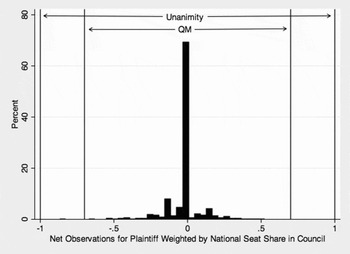
Now consider CGH's data as a whole. Figure 1 depicts the distribution of values on CGH's main independent variable: member state briefs weighted as a function of their share of votes in the Council of Ministers under QM voting procedures. In more than two-thirds of all issues coded, MSGs take no net weighted position. In 11.8% of the legal questions in the data set (375/3,176), CGH code MSGs as registering a position in favor of the plaintiff. The mean average score in such cases is 14.4% of a QM in the council, slightly more than the vote of one large state. In 20.3% of the legal questions in the data set, CGH code MSGs as taking a position in favor of the defendant (in CGH's model, override is a consideration), the mean score of which is 15.1% of a QM; again, this is short of the combined votes of, say, France and any other state. As Figure 1 makes clear, MSGs do not come close to reaching a QM, let alone unanimity, in any systematically meaningful way. Moreover, in many rulings, the net weighted positions are the result of a split, in which at least one MSG had submitted a brief supporting each side.Footnote 15 Under unanimity rules, the potential for MSGs to logroll a decision to override in cases where MSGs are split must be very close to zero. If, as CGH argue (338), the threat of override is not credible, then it cannot constrain the ECJ, let alone systematically. CGH's claims to the contrary are inexplicable.
Distribution of Net Weighted Positions Taken by the Member States on Legal Questions in the CGH Data Set

We also examined what happened when MSGs adopted measures designed to override or constrain the scope of rulings rendered by the ECJ. The data set contains two major episodes: one concerning occupational pensionsFootnote 16 and the other the designation of wildlife preservation areas.Footnote 17 In both instances, the measures taken failed to constrain the court. This outcome deserves emphasis. When MSGs actually made good on their threat to nullify the effects of ECJ rulings, the ECJ prevailed.
The CGH data set also contains a set of landmark “constitutional” rulings that established the doctrine of state liability: holding that a member state can be held financially responsible, in national courts, for damages caused to individuals due to compliance failures.Footnote 18 The court, in partnership with national judges, developed this case law in the face of an exceptional number of MSGs (France, Germany, Ireland, Italy, and the Netherlands) filing briefs on the major legal questions. MSGs argued, among other things, that EU law does not require state liability (the TFEU is silent on remedies) and that a remedy for state noncompliance with EU law must be provided through legislation or express treaty revision, not through judicial fiat. The court rejected these arguments, siding with the commission.
We provide a detailed account of all three episodes elsewhere (Stone Sweet and Brunell Reference Stone Sweet and Brunell2011). Taken together, the cases provide a crucial (qualitative) test of the claims of CGH and Garrett and Weingast (Reference Garrett, Weingast, Goldstein and Keohane1993) at issue here, in that they are cases “most likely” to fit an override model: The court should have been constrained.
In the end, CGH's major claims are based on one positive result: On a legal question in which MSGs register a net weighted position, the ECJ is likely to decide the question in congruence with that weighting. Except for CGH's assertions, however, there is no reason to believe that this result is due to the threats of override and noncompliance. The data reported in Figure 1, coupled with qualitative analysis of what happened when the MSGs formally sought to constrain the court, provide good reason to reject their claims.
ANALYSIS (2): INTERGOVERNMENTALISM VERSUS NEOFUNCTIONALISM
CGH also claim (449) that their purported findings—that the threats of override and noncompliance on the part of MSGs “have large, systematic, and substantively significant effects on judicial decision making”—strongly support intergovernmentalist integration theory. They argue that the evidence conflicts with approaches associated with neofunctionalism, which hold that “while these constraints might matter on the margin, the court has had the latitude to pursue an agenda independent of and contrary to MSGs interests” [emphasis added].
Put in the most basic terms, contemporary neofunctionalistsFootnote 19 argue that the court and the commission help the member states resolve the fierce cooperation dilemmas that attend market and political integration, not least, through forging links with national judges and transnational elites who are willing to invest in these projects (Burley and Mattli Reference Burley and Mattli1993; Mattli Reference Mattli1999; Stone Sweet Reference Stone Sweet2004). In the standard account, the legal system evolves under the tutelage of the ECJ, which works in conjunction with those who activate the court for their own purposes, including the commission under Art. 258 (enforcement actions) and private litigants and national judges under Art. 267 (preliminary references). In their empirical research, neofunctionalists found that the legal system developed in a progressive, self-sustaining way, because the court's rulings tend to promote integration (values that inhere in the treaties), and because decision rules governing override (unanimity) favor the court's dominance over treaty interpretation.
CGH (442) declare that, although “the ECJ may, on the margin, favor the commission,” the MSGs are the actors who count, because they “systematically” constrain the court; however, CGH do not test the proposition. Confronted with this binary opposition, a neofunctionalist would predict exactly the opposite—that the ECJ will side with the commission's briefs, relatively systematically, although the MSGs may influence the court on the margins, partly as supplemental to the weight of the commission. Here we assess the extent to which the ECJ “favors” the positions of the MSGs relative to those of the commission.
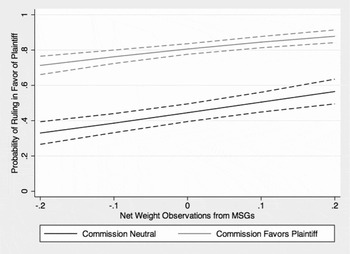
Using the analytics underlying CGH's Model 1 (CGH, Table 2: 443), we generated predicted probabilities that would be comparable to the findings they reported (CGH, Figure 1: 444), adding values for the commission's briefing activity. In Figure 2, the y-axis plots the probability that the ECJ will rule in favor of the plaintiff. The x-axis charts the distribution of the CGH's main variable of interest: the proportion of MSGs filing an observation in support of the plaintiff. The top line represents predicted probabilities when the commission favors a ruling for the plaintiff, and the bottom line plots predictions when the commission is neutral. Note the gap between the lines. When the commission favors the plaintiff, the court listens. The slope of the line indicates that the positive and statistically significant impact of MSG briefs in support of the plaintiff is actually relatively modest. A modestly significant finding such as this one is not necessarily a substantively interesting finding, and CGH provide no evidence that the finding is of substantive interest. As important, we see no reason to accept that CGH's finding constitutes sufficient support for CGH's proposed causal explanation or intergovernmentalist claims, given that the rest of the evidence strongly indicates that their theory is wrong.
The Impact on ECJ Decisions of Observations Filed by the Commission and Member State Governments

Figure 2 reports a finding for all rulings in the CGH data set. For contestable reasons, CGH do not consider the outcome of Art. 258 enforcement actions, which directly concern state noncompliance with EU law, to be a fair test of their theory.Footnote 20 As noted, the commission prevails against the defendant member state in 90% of the ECJ's Art. 258 decisions, which would presumably count against CGH's positions. We therefore examine what remains: rulings generated by the Art. 267 preliminary reference procedure.
Of the 2,048 questions on which the ECJ rendered a preliminary ruling, the commission filed observations in 77.7% (n = 1,588), and MSGs produced a weighted position in 45.2% (n = 926). When the commission takes the plaintiff's side (n = 841), the court rules in favor of the plaintiff 79.9% of the time, compared to the member states’ lower (70.8%) success rate in far fewer cases (n = 342). When the commission files observations against the plaintiff (n = 747), the ECJ rules in favor of the defendant 77.7% of the time, compared to the member states’ far lower (57.2%) success rate (n = 584). The success rate of MSGs is far higher when they encourage the ECJ to punish a member state than when they seek to constrain the court from finding against a defendant state's law and practices, although MSGs participate in the latter, less successful activity far more than they do in the former.
We see a fundamental difference between situations in which (a) the MSGs ask the court not to develop EU law in new directions and (b) the MSGs urge the ECJ to find against a defendant state on the basis of common understandings of EU law developed by the court. In the latter situation, the MSGs are not so much “constraining” the court, as enabling it. Further, as just noted, the MSGs’ rate of success is highest when they join the commission against the defendant state. In testing their theory, CGH do not distinguish between these situations. Instead, instances in which the MSGs join the commission in encouraging the court to punish a defendant state are actually counted as evidence in support of both hypotheses, and then against neofunctionalist theory.
The critical question is the following: What happens when the commission opposes the net weighted positions taken by the MSGs? If CGH are right—that the ECJ is constrained by the MSGs and favors the commission only “on the margins”—then one should expect the commission's briefs to be relatively ineffectual when opposing the MSGs. There are 96 legal questions in the data set on which the commission supported the defendant and MSGs took a weighted position supporting the plaintiff; in these, the ECJ favored the MSGs’ position in only 36.5% (n = 35) of these cases. There are 234 legal questions in which the commission filed an observation in favor of the plaintiff and MSGs took a net weighted position supporting the defendant. On 70.1% of these issues (n = 164), the court agreed with the commission, finding for the plaintiff. Thus, when MSGs oppose the commission (n = 330), the commission prevails more than two-thirds of the time—a landslide. CGH report no findings on the questions raised in this section. Instead, they assert that their more general data analysis somehow constitutes support for intergovernmentalism (449).
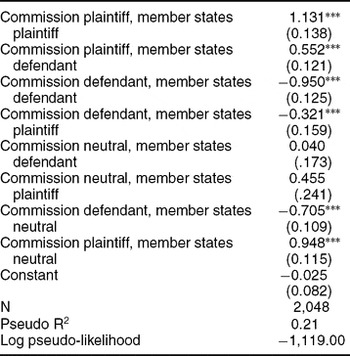
In Table 1, we present a comprehensive probit analysis of these relationships. We sought to determine the effect on ECJ rulings of two of the court's important constituents: the commission and the MSGs.Footnote 21 For the member states, we used the CGH's own “net weighted observations” variable. Following CGH's design, if, on any legal question, that variable took on positive values, we coded the MSGs position as favoring the plaintiff; if it was negative, we coded their position as favoring the defendant; and when the variable took on values of zero, we coded the MSGs preference as neutral on the question. In the same way, either the commission filed an observation for the plaintiff, the defendant, or no observation at all.Footnote 22
Probit Analysis of the Relationship between Briefs and European Court of Justice Rulings for the Plaintiff under Art. 267 TFEU

Notes: Entries are unstandardized probit coefficients with standard errors in parentheses. We used robust standard errors with clusters for each case. Source of the data: CGH (Reference Carrubba, Gabel and Hankla2008).
*** p < .001, two-tailed test.
The commission and the MSGs may take one of three different positions: in favor of the plaintiff, in favor of the defendant, or remaining neutral. Because there are nine possible combinations, we created a series of dummy variables for eight of these nine combinations (the excluded category containing those cases on which both the commission and the MSGs are neutral toward the preferred disposition of the case). For a neofunctionalist-based approach to prevail, the coefficients must take on positive values when the commission favors the plaintiff (the dependent variable takes on the value of 1 when the ECJ finds in favor of the plaintiff, and 0 when it finds for the defendant), and negative values when the commission favors the defendant. As Table 1 shows, both conditions are met. Whenever the commission favors the defendant, regardless of the position of the MSGs, the coefficient is negative and statistically significant—even when the governments’ “net weighted” position favors the plaintiff. The reverse is also true: When the commission sides with the plaintiff, the coefficient is positive and statistically significant, even when the MSGs have taken a position in favor of the defendant. Thus, when the commission and the MSGs oppose one another, the ECJ finds in favor of the side the commission supports in a statistically significant fashion.
Now consider what happens when the commission does not file an observation. When the commission is neutral and the MSGs favor the plaintiff, the coefficient takes on a bare positive value, but it is statistically indistinguishable from zero. In instances when the commission is neutral and, on balance, the MSGs favor the defendant, the coefficient takes on a positive value, which indicates that more cases are being decided for the plaintiff; yet, the variable is not statistically significant. In sum, when the commission takes a position on how a legal question should be decided, the court tends to comfort that position, in a statistically significant way, even when the MSGs prefer the opposite outcome. But when the commission takes no position on how a legal question ought to be decided, we find no statistically significant evidence that the ECJ favors the side preferred by the governments.
CONCLUSION
CGH's major claims are not supported by their own data. The threat of override was not credible and could not constrain the court in any systematic way. When member state governments did move to nullify the effects of controversial ECJ rulings, they failed to constrain the court, which continued down paths cleared by the prior rulings. CGH did not show how the substantive development of any domain of EU law has been stunted by the threat of noncompliance, and the ECJ's case law has continued to grow into a dense and imposing edifice. State noncompliance stimulated rather than paralyzed the development of the EU's legal system; the emergence of the doctrine of state liability, which was strongly opposed by MSGs but supported by the commission, is a striking example. The data also show that, in a head-to-head showdown, (i) the commission and neofunctional theory dominate (ii) the MSGs and intergovernmentalist theory as predictors of ECJ rulings. In sum, using CGH's own data, preferred methods, and theoretical constructions of integration theory, we confirm the findings of prior scholarship on the ECJ and legal integration, and refute CGH's claims.



Comments
No Comments have been published for this article.