Introduction
Niger's oil with high levels of unsaturated fatty acids and low levels of saturated fatty acids makes it suitable for many purposes. Its most common purpose is as an oilseed crop for human and avian consumption, and is primarily cultivated in Ethiopia. Niger is particularly popular among subsistence farmers since it requires few inputs (Geleta and Ortiz, Reference Geleta and Ortiz2013). In the USA, niger is primarily marketed as birdseed primarily for the American goldfinch (Spinus tristis, L.), pine siskin (Spinus pinus, Wilson), common redpoll (Acanthis flammea, L.), finches (Spinus spp., Leach) and other songbirds.
Ramadan and Mörsel (Reference Ramadan and Mörsel2003a) reported that niger seeds had a saturated to unsaturated fatty acid ratio of 25:75. Unsaturated fatty acids are predominantly linoleic (C18:2) and oleic (C18:1), whereas primary saturated fatty acids include palmitic (C16:0) and stearic (C18:0) (Ramadan and Morsel, Reference Ramadan and Mörsel2002). Linoleic acid is an essential polyunsaturated omega-6 fatty acid. Oleic acid is a monounsaturated fatty acid common in the human diet that has been associated with the reduction of low-density lipoprotein cholesterol and possibly the increase of high-density lipoprotein cholesterol (Mensink et al., Reference Mensink, Zock, Kester and Katan2003). Palmitic and stearic acids are saturated fatty acids needed to maintain proper health, but if consumed in large quantities, result in negative health effects. Together, they have been linked to an increased risk of vascular disease, reduced insulin activity (Benoit et al., Reference Benoit, Kemp, Elias, Abplanalp, Herman, Migrenne, Lefevre, Cruciani- Gulielmacci, Magnan, Yu, Niswender, Irani, Holland and Clegg2009) and increased risk of Alzheimer's disease (Patil and Chan, Reference Patil and Chan2005).
A previous study by Alemaw and Tekle-Wold (Reference Alemaw and Tekle-Wold1995) found negative correlations between oleic and linoleic acids. This can be expected since linoleic acid is synthesized from oleic acid. Likewise, a negative correlation is expected for oleic and stearic acids since oleic acid is synthesized from stearic acid. A study by Geleta et al. (Reference Geleta, Stymne and Bryngelsson2011) found that seed weight and linoleic acid had a negative correlation of −0.17. No significant correlations were found between seed weight and oleic acid nor seed weight and palmitic.
Niger, along with other members of the Asteraceae family, is influenced by sporophytic self-incompatibility (SSI) (Nemomissa et al., Reference Nemomissa, Bekele and Dagne1999). SSI is a complex system that occurs when the outcome of the interaction between the pollen tube and the style is determined by the sporophytic dipoid tissue. Here, pollen grains fail to germinate on receptive stigmas. The pollen–stigma reaction results in callose production (Takayama and Isogai, Reference Takayama and Isogai2005). In dicots, self-incompatibility (SI) is mapped to a single genetic locus called the S-locus (Geleta and Bryngelsson, Reference Geleta and Bryngelsson2010).
Quantitative traits such as yield are either the direct or indirect result of many physiological processes. Selecting for variation among genotypes via indirect selection may therefore enhance selection for yield. Greater variation indicates larger allelic diversity to make selections (Fehr, Reference Fehr1987). Determining the adaptability and genetic variation among accessions is important if new and improved varieties of niger are to be released in the USA. This is especially important for states such as Tennessee that are located in a transition zone between the Northern and Southern USA.
Materials and methods
A preliminary field trial was conducted in 2012 with seed obtained from United States Department of Agriculture/Agricultural Research Service (USDA/ARS) germplasm collection at Pullman, WA, USA. Fourteen accessions (60 seeds each) were planted in a greenhouse at the University of Tennessee, Knoxville, TN, USA on 20 July 2012. Three of these accessions were from India (PI 422242, PI 509436 and PI 511305), nine were from Ethiopia (PI 508070, PI 508072–PI 508080) and one accession was from the USA (W6 18860). Ten seedlings were randomly selected from each accession and transplanted to a field site at East Tennessee Research and Education Center (ETREC) (35.53°N, 83.57°W) in Knoxville, TN, USA on 21 August 2012 in a completely randomized design. The soil type at the Knoxville location was classified as an Etowah loam (fine-loamy, siliceous, semiactive and thermic Typic Paleudults). The field was tilled, but no herbicide was applied prior to planting.
Phenotypic traits
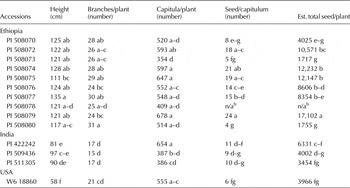
On 26 September 2012, five plants of each accession were selected and transplanted into a greenhouse located at ETREC in order to avoid a frost. The selections were based on height, number of branches and overall plant vigour. At plant maturity, plant height, capitula/plant, seed/capitulum, primary branches/plant and estimated seed/plant were recorded. Estimated total seed/plant were determined by multiplying capitula/plant by the average seed/capitulum by the average percent of mature flowers/plant. Harvesting occurred between 10 December 2012 and 21 January 2013. Phenotypic data of niger accessions were analysed with mixed model analysis of variance and Fisher's least significant difference (LSD) (P < 0.05) using SAS 9.3 (Cary, NC, USA). (Table 1)
Mean comparisons a (n = 5) of phenotypic traits among 14 niger accessions evaluated at the East Tennessee Research and Education Center, Knoxville,TN in 2012

a Means within a column followed by a letter in common are not significantly different based on Fisher’s LSD (P < 0.05).
b n/a, not available in 2012.
Seed oil content and fatty acid composition
Fourteen accessions were planted but two accessions (PI 508078 and PI 508080) did not produce enough seeds for chemical analysis due to poor germination and plant survival. Seeds from all other plants were bulked within each accession due to seed scarcity and sent to the USDA-ARS Plant Genetic Resources Conservation Unit in Griffin, GA, USA for analysis of seed oil and fatty acid composition using time-domain nuclear magnetic resonance (TD-NMR) and Gas Chromatography (Agilent 7890A) using protocol explained by Jarret et al. (Reference Jarret, Wang and Levy2011). The operating resonance frequency of the NMR analyser was set at 9.95 MHz and maintained at 40°C. For each signal acquisition, spin echo parameters consisted of a 90 pulse of 10.44 µs and reading at 50 µs followed by a 180 pulse of 21.38 µs and reading at 7 ms. A 2 s recycle delay between scans was used, and a total of 16 scans were collected for each sample. Bulk seed measurements were made in a 40 mm glass sample tube, and NMR signals were compared with oil and moisture calibration curves, generated by sample weight. Each of the 14 accessions was measured twice, and then averaged to report the value of oil content in this study. Oil standards were generated using extracted oils.
Afterwards, two replications of the same seed were analysed for each of the 12 accessions using both the Agilent 7890A at Griffin, GA, USA and Agilent 6890 at Knoxville, TN, USA, gas chromatographs (GCs). When using the Agilent 7890A, protocol from Morris et al. (Reference Morris, Wang, Grusak and Tonnis2013) was used. About 3–5 niger seeds from each sample were ground to a fine powder using a mortar and pestle. Oil from a small amount (~50−75 mg) of meal was extracted in 5.0 ml of heptane (Fisher Scientific) and converted to fatty acid methyl esters with 500 µl of 0.5 N sodium methoxide (NaOCH3) in methanol. Water was added to separate the organic layer containing fatty acids from the niger meal, and a portion of this layer was transferred to a vial for injection. Fatty acid composition was determined on an Agilent 7890A GC system with a flame ionization detector. Peak separation was performed on a DB-225 capillary column (15 m × 0.25 mm i.d. with a 0.25 µm film) from Agilent Technologies. The inlet and detector temperatures were set to 280 and 300°C, respectively. Helium, the carrier gas, was set to a flow rate of 1.0 ml/min. A sample of 1 µl was injected at a 60:1 split ratio onto the column with the following thermal gradient: 195°C for 3 min, 195–200°C at 2.5°C/min, 200–230°C at 5°C/min and 230–235°C at 1.5°C/min for a total run time of 14 min. A FAME standard mix RM-3 plus four additional FAMES (all from Sigma) were mixed and used to establish peak retention times. Fatty acid composition was determined by comparison with a standard curve constructed from oil of the same species.
When using the Agilent 6890, fatty acid analyses were performed according to the modified AOCS Ce 1-62 (American Oil Chemists Society, 1999) protocol. Two samples of approximately 117 seeds from each of the 12 accessions were crushed and transferred to a test tube where 2.5 ml extraction solvent (eight parts chloroform (CHCl3), five parts hexane (C6H14) and two parts methanol (CH3OH)) was added. Original protocol requires 1 ml of extraction solvent. The tubes were capped and left in the hood overnight. The next day, 100 µl of extract from each tube was transferred to a corresponding vial to which 750 µl of hexane and 75 µl of methylation reagent was added. The vials were capped and transferred to autosampler trays and analysed via the Agilent 6890 (Hewlett Packard) GC. Oil and fatty acid data of niger accessions were analysed with mixed model analysis of variance and Fisher's LSD (P < 0.05) using SAS 9.3 (Cary, NC).
Self-incompatibility
Of the original 14 niger accessions, three (PI 422242, PI 511305 and W6 18860) were selected for use as parents in crosses to evaluate SI. Choices of parents were based on plant height, number of branches and plant vigour. Four F 1's populations were also included in the study: PI 422242/W6 18860 and reciprocal W6 18860/PI 422242; PI 511305/W6 18860 and reciprocal W6 18860/PI 511305. This study was conducted in 2013 and 2014 at the ETREC.
Fifty capitula of each parent and selected F 1 progeny were hand pollinated with pollen from the same plant, and covered with transparent pollination bags. Viable seed from each capitulum was contrasted with total potential seed bearing achenes of the capitulum. Potential achenes were determined by counting the total number of ovaries of each capitulum. SI was calculated as: 100−((average number of seeds/capitulum/average number of potential achenes/capitulum) × 100) (Benelli, Reference Benelli2015).
Results
Seed oil content and fatty acid composition
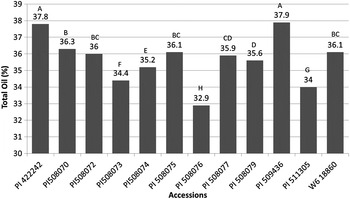
Total oil content and fatty acids composition showed significant differences among the 12 accessions for the study in 2012 (P < 0.0001). Total oil content was highest in PI 422242 (38%) and PI 509436 (38%), and lowest in PI 508076 (33%) (Fig. 1). Total oil content of seeds with Indian origin (PI 422242, PI 511305 and PI 509436) was more varied than seeds from US (W6 18860) or Ethiopian origin (PI 508070, PI 508072–PI 508077 and PI 508079) (Fig. 1).
Mean comparison of seed oil content of 12 niger accessions evaluated at the East Tennessee Research and Education Center, Knoxville, TN, USA in 2012. Seed were analysed at the USDA-ARS Plant Genetic Resources Conservation Unit in Griffin, GA, USA (Dr Ming Li Wang) using a Bruker mq10 minispec NMR analyser (Resonance Instruments, Whitney Oxfordshire, UK). Bars with a letter in common are not significantly different based on Fisher's LSD (P < 0.05).

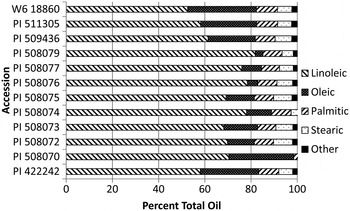
Results for linoleic, oleic, palmitic and stearic acids showed a significant variation among the niger accessions (P < 0.05). PI 508079 contained the most linoleic acid (82%) and W6 18860 had the lowest (53%) (Fig. 2). Conversely, W6 18860 had the most oleic acid (30%), while PI 508079 contained the lowest (3%). Palmitic acid was highest in W6 18860 (9%) and lowest in PI 508073 (8%). Results showed that PI 508072 contained the most stearic acid (8%), whereas PI 508079 had the lowest (5%). Across all 12 accessions, arachidic acid was <1%, and linolenic acid was <0.40% (data not shown). Additional fatty acids included sapienic (<0.20%), behenic (1%) and lignoceric (<1%) (data not shown).
Linoleic, oleic, palmitic and stearic acid percentages of 12 niger accessions for seed collected from the East Tennessee Research and Education Center, Knoxville, TN, USA in 2012. Bars represent means of seed analysed at the USDA-ARS Plant Genetic Resources Conservation Unit in Griffin, GA, USA, using an Agilent 7890A GC instrument and at the University of Tennessee using an Agilent 7683 GC instrument. Significant differences were found among accessions for all fatty acids (P < 0.05).

Phenotypic traits
Parent height, number of seeds/capitulum, number of primary branches/plant, estimated seed/plant and capitula/plant were significantly different (P < 0.05) among niger accessions (Table 1). PI 508079 had a significantly greater number of capitula (678), seed/capitulum (24) and estimated seed/plant (16417) than other accessions. Ranges of traits for all other accessions were 354–654 capitula/plant, 4–21 seed/capitula and 1800–12,486 seed/plant (Table 1). The accessions of Ethiopian origin performed better as a whole for every trait than the three accessions from India and the accession from the USA.
With the exception of height, the accession from the USA (W6 18860) performed similarly to the Indian accessions. The three accessions from India, PI 422242, PI 509436 and PI 511305, had the fewest number of branches. Ethiopian accessions accounted for the greatest and least estimated seed/plant (1755–17,102), capitula/plant (354–678) and average number of seeds/capitulum (4–24).
Self-incompatibility
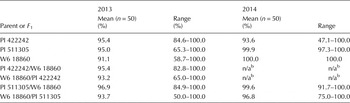
Data from 2013 revealed that the SI of the three parents and F 1 plants from the three crosses ranged from 91.1% (W6 18860) to 96.9% (PI511305/W6 18860) (Table 2). The other two parental accessions in this study, PI 422242 and PI 511305, resulted in 95.4 and 95.0% SI, respectively. The F 1 progeny from PI 422242/W6 18860 (95.4%) had similar SI to PI 422242 (95.4%). PI 511305/W6 18860 (96.9%) and its reciprocal W6 18860/PI 511305 (93.7%) had similar SI values (Table 2). The level of self-compatibility varied between the years as well as within each parent line and F 1 crosses (Table 2). Each of the three parent lines exhibited a range of self-compatibility during both years. However, W6 18860 tended to produce a broader range of self-compatibility in the F 1 progeny when used as the female parent in crosses (Table 2). This may mean that there is opportunity to select for greater self-compatibility, or even stronger SI, depending on the breeding objective. Further research is needed to determine if there are some cytoplasmic effects on SI.
Self-incompatibility (SI) a among selected niger parents and F1 progeny (including reciprocals) evaluated at the East Tennessee Research and Education Center, Knoxville, TN in 2013 and 2014
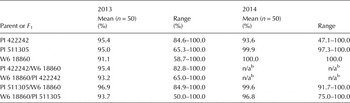
a Each year, 50 random capitula from each parent or F 1 combination were chosen and self-pollinated. Multiple plants were used within each parent of cross. SI = 100 − ((average number of seed/capitulum/number of potential achenes/capitulum) × 100).
b n/a = not available in 2014.
In 2014, PI 422242, PI 511305 and W6 18860 had SI values 93.6, 99.6 and 100.0%, respectively (Table 2). Furthermore the F 1's tested exhibited a high level of SI (96.8–99.6%).
Discussion
Of the 14 niger accessions evaluated in 2012, ten originated from Ethiopia, three from India and one originated from the USA. Total oil ranged from 33 (PI 508076) to 38% (PI 422242 and PI 509436). Ethiopian accessions produced seeds containing 33–36% oil. A study analysing Ethiopian niger populations reported a broader range of results; 27–56% (Geleta et al., Reference Geleta, Stymne and Bryngelsson2011). A study by Ramadan and Mörsel (Reference Ramadan and Mörsel2003a, Reference Ramadan and Mörselb) showed that dry niger seed contained 27–47% oil and with a mean of 35%.
Cultivation condition (environment) and extraction methods may affect the results reported from different laboratories. A study by Bhatnagar and Gopala Krishna (Reference Bhatnagar and Gopala Krishna2013) revealed the cold pressed seeds resulted in 28% oil, whereas hexane and ethanol extractions resulted in 38 and 30% oil. In studies comparing the variability of 35 accessions for oil quality, results showed that the total oil content ranged 35–40% with a mean of 38% (Yadav et al., Reference Yadav, Hussain, Suneja, Nizar, Yadav and Dutta2012a, Reference Yadav, Kumar, Hussain, Suneja, Yadav, Nizar and Duttab).
For fatty acid composition, PI 508079 had a high level of linoleic acid (82%) but low levels of oleic (3%) and stearic (5%). Conversely, W6 18860 had lower levels of linoleic acid (53%) but highest levels of oleic (30%) and palmitic (9%) acids. This result is expected since Yaun and Bloch (Reference Yaun and Bloch1961) found that oleic acid is the precursor to linoleic acid. Ethiopian accessions showed a wide range of oleic acid (3–28%). Geleta et al. (Reference Geleta, Stymne and Bryngelsson2011) reported a similar range of 3–31% oleic acid in Ethiopian populations. Other studies have found linoleic and palmitic acids to be negatively correlated to oleic acid and positively correlated to each other across all plant materials (Benelli, Reference Benelli2015; Geleta et al., Reference Geleta, Stymne and Bryngelsson2011). Previous studies have analysed variation in fatty acid profiles in niger and reported that oleic acid ranged from 24 to 53% with linoleic acid ranging from 32 to 58% (Yadav et al., Reference Yadav, Hussain, Suneja, Nizar, Yadav and Dutta2012a, Reference Yadav, Kumar, Hussain, Suneja, Yadav, Nizar and Duttab). Palmitic acid, the primary source of saturated fat, ranged 8–9%, and stearic acid, a secondary source of saturated fat, ranged 7–9%. Ramadan and Mörsel (Reference Ramadan and Mörsel2003a) found the major fatty acids in niger were linoleic (up to 63%), along with oleic (11%), palmitic (17%) and stearic (7%). Bockisch (1998) stated that niger oil may contain up to 1% arachidic and 3% linolenic acid. These studies, along with the comparison of niger accessions in this study, indicate the possibility of future breeding efforts to increase oil content, and alter fatty acids profiles for niger grown in the USA.
According to Miller et al. (Reference Miller, Zimmerman and Vick1987), seed quality is retained longer in seeds with higher oleic acid versus linoleic acid. They state that this is due to oleic acid's lower susceptibility to oxidation, thus plant breeding efforts to improve oil composition should focus on increasing oleic over linoleic acid, especially if oil for human consumption is the desired end use. The syntheses of unsaturated fatty acids are controlled by several genes and are a part of a complex metabolic pathway. Breeding efforts might therefore be most effective using marker assisted selection, when appropriate markers are available.
Ethiopian accessions produced taller plants with more branches than Indian and US accessions. W6 18860 (US) had lower estimated total seed yield than most other accessions in the study, whereas PI 508072, PI 508074 and PI 508075 (Ethiopian) resulted in the greater estimated total seed yield. In 2012, seed/capitulum ranged between 4 and 24, whereas other studies found greater results. Adda et al. (Reference Adda, Reddy and Kishor1994) reported that seed/capitulum ranged between 28 and 51. Aleminew et al. (Reference Aleminew, Alemayehu, Adgo and Herrero2015) reported that seed/capitulum ranged from 26 to 29.
Overall, the SI was very high in both 2013 and 2014. Countries of origin did not appear to have an effect on the outcome of the SI values. There were also no visible trends between parents and F 1 progeny in the data. Still, in 2013 greater amounts of self-compatibility were present when self-pollination was performed on W6 18860, W6 18860/PI 422242 and W6 18860/PI 511305. In 2014, W6 18860/PI 511305 also had greater self-compatibility than both parents, which could indicate cytoplasmic effects. When W6 18860 was used as a male, the F 1 populations resulted in greater SI. This could also point towards cytoplasmic effects.
Hosalli (Reference Hosalli2005) reported that higher self-fertility was obtained when manual pollinations were made; however, manual pollinations of the individual plants in the study herein did not appear to reduce the SI. These findings are consistent with Riley and Belayneh (Reference Riley and Belayneh1989) when they reported that niger has a small degree of self-compatibility though the plants may not necessarily be truly self-compatible. A previous study by Geleta and Bryngelsson (Reference Geleta and Bryngelsson2010) found that niger is a strictly self-incompatible crop of sporophytic nature, though nine plants out of the 340 evaluated showed some degree of compatibility.
For future breeding programs involving cross-pollination of niger, it may be beneficial to choose parents with a range of SI so as to increase the diversity of the progeny for selection. Continued study of W6 18860 is recommended because of the large difference between 2013 and 2014 outcomes.
Acknowledgements
The authors greatly thank Mr Brandon Tonnis and David Pinnow for assisting in the fatty acid analysis and oil measurement, respectively.