In a dormitory in late nineteenth-century Wellington College, a public school for boys in Berkshire, a young pupil, later to become a leading horticulturalist, attempted to cultivate a window box of rare bulbs that he had brought to the school from home. But the box was discovered by the dorm captain, who threw it to the floor and trampled the plants underfoot. According to an early historian of the school, this act was accompanied by the exclamation, “There is no room for this rotten effeminate stuff here!”Footnote 1
This anecdote is typical of the way in which the social role of public schools for boys in modern Britain has been understood. In this story, the school figures as a repressive and sometimes violent space in which an older boy, valorized by the senior system of the school, quite literally stamps out the domestic and the feminine in the younger pupil, destroying a symbol of his home life and helping to sever him from it. The anecdote sits neatly with the stereotype of British public schools, but as this article will demonstrate, the image fails to take into account some important aspects of school life in this era. The worlds of school and home were less separate than has sometimes been assumed. While women and femininity were supposedly banned, the schools were modeled on forms of domestic patriarchal authority that allowed for considerable feminine presence and influence. Schools also required boys to perform basic domestic skills within a system that created and prized a specifically masculine form of domesticity. Moreover, family and parental contacts were not necessarily severed by removal to school; both school and home remained important in the emotional life of the boys.
Public schools have long been recognized as a significant force in modern British history, not least because they shaped the characters of the men who went on to govern the nation and produce the nineteenth-century state.Footnote 2 The nine great public schools alone—Eton, Harrow, Winchester, Charterhouse, St. Paul's, Westminster, Shrewsbury, Merchant Taylors’, and Rugby—turned out hundreds of young men every year who then went off to university, government, and empire.Footnote 3 In the late 1980s and 1990s, historians turned their attention to the study of masculine identities, and public schools assumed a new importance as creators of the “masculine character.”Footnote 4 In his groundbreaking study of the formation of British male middle-class identity, John Tosh argued that the process of separating boys from the home and sending them off to boarding school from as young as seven years old was vital to the construction of masculinity.Footnote 5 The idea that institutions and associational life played a fundamental role fostering masculine identities has been further developed by Paul Deslandes in his exploration of student experience at Oxford and Cambridge.Footnote 6 Amy Milne-Smith has also demonstrated the importance of institutional life in the creation of class and gender identities in her study of London “clubland.”Footnote 7 But the everyday domestic worlds of public schools, also arguably a very significant component in the construction of upper- and middle-class British masculine identity, have yet to be considered in this way.
The idea that the function of these institutions was to separate boys from the home has been closely allied to the argument that women and the feminine were excluded from public schools. Tosh contends that public schools “effectively banned” women “as points of emotional reference.”Footnote 8 Deslandes explores gendered presence and absence in university life, arguing that the presence of women was regulated and controlled in a way that contributed to the construction of masculine identities.Footnote 9 Milne-Smith suggests that “men incorporated women into their club life in regulated ways that maintained a predominantly homosocial ethos.”Footnote 10 Taking a cue from these interpretations, this article explores ideas of gender and the presence of women in public schools. Elsewhere, the ideology of the household family was used to justify male political authority; middle-class standards of domesticity were used to control working-class living practices; and a range of residential institutions drew on domestic ideals and practices.Footnote 11 As I argue here, schools and school houses also drew on domestic models—with heads and housemasters cast in patriarchal roles. The importance of the domestic arrangements of the schools, in the form of the house system, has long been recognized,Footnote 12 yet it is usually discussed in the context of inculcating athleticism or perpetuating systems of governance.Footnote 13 For the most part, the relationship between school houses and contemporary middle-class domestic space has been overlooked, as has the role in the schools of significant women such as headmasters’ and housemasters’ wives, and the importance of female spaces, such as the housemaster's drawing room.
While school removed boys from the feminizing domesticity of the home, the everyday life of the school itself contributed to the formation of specifically masculine domestic practices, which can help us understand the relationship between masculinity and domesticity in this period. Although Tosh convincingly argues that masculinity was a fundamental part of the home, he also suggests that the later part of the century saw a “flight from domesticity.”Footnote 14 However, subsequent historians have shown that men remained involved in home life in a variety of ways.Footnote 15 While it has been argued that the increasing public status of women went alongside a “feminization” of domestic space that made it more problematic for men to inhabit, this trend produced a new kind of engagement with the home as much as it drove men away. As John Potvin and Matt Cook have demonstrated, for example, the late nineteenth century saw the emergence of queer domestic spaces, creating new forms of masculine domesticity.Footnote 16 Examining the everyday life of boys at school allows us to see how masculine domestic practices continued to be constructed and valorized in this period. As Deslandes, Milne-Smith, and Quintin Colville have shown in the case of universities, clubs, and naval schools, the everyday routines and rituals of these places, and their relationship with what was understood as normative domesticity, were fundamental to the identities of the men and boys who lived in them.Footnote 17 In the schools considered here, domesticity was performed daily through the enactment of everyday routines and rituals, and younger boys often carried out domestic tasks as part of the “fagging” system. These tasks served to create a specifically masculine form of domesticity that was often framed and valorized through the ideals of chivalric masculinity, allowing boys to acquire and assume domestic skills without the taint of femininity or domestic service. Chivalry also encouraged the exercise of a protective form of authority by senior boys.
Yet emotional links with the home, and a more “feminized” sense of domesticity, as we might understand it, were also still present in the schools. Deslandes points out that the lives of university students should be understood on a basis of both term time and holidays; the institution and home were two separate worlds, but the students inhabited both.Footnote 18 A similar approach needs to be taken to the emotional lives of public-school boys. The third part of this article focuses on letters written home by boys and considers the interaction between home and institution. Recent studies of the Victorian family have moved away from a static picture of family life, emphasizing its changing nature, the challenges of negotiating relationships over distance, and the role of “technologies of writing” in constructing family relations.Footnote 19 Examining a collection of letters written by a schoolboy at Winchester College in the 1890s, the final part of the article tracks the development of different epistolary relationships in the family and considers how the boy's emotional life was shaped both by these interactions and the world of the school. Schoolboys’ constant renegotiations of their position within the family played out on the pages of their correspondence and were an important facet of school and family life. A recent study by Patrick Joyce maintains that schools aimed to supplant the home that boys had come from: “Boys were deliberately broken or damaged in a hardening process.”Footnote 20 Conversely, this article argues that while school life could be emotionally abrasive, there was no absolute break between home and school. Indeed, schools allowed and encouraged these interconnections in a variety of ways. Boys were not severed from the homes that they had come from but were encouraged to develop new forms of domestic practices within institutional space, building a new identity that encompassed both school and home.
There is no shortage of evidence of life in British public schools, but that evidence requires careful handling. The nineteenth century saw a growing demand for institutions to educate not only the sons of the upper classes but also the well-off among the middle classes. The nine great public schools flourished,Footnote 21 and a number of new institutions were established on the public-school model, including Cheltenham, Marlborough, Rossall, and Wellington.Footnote 22 Public schools produced the leading men of the day who dominate the historical record. Such schools remain well-funded institutions with a long-term interest in preserving their heritage and records of the past,Footnote 23 and most have carefully kept a huge range of documents, including the personal papers of old boys. Historians of public schools also tend to have had personal experience of the system. Despite the range of different accounts of school life that survive, however, the tendency has been to see the schools as monolithic and to generalize about a “public-school type.”Footnote 24 The strength of the public-school stereotype, as well as the twentieth-century experiences of public-school historians, has sometimes obscured what was distinctive about nineteenth-century institutional experiences. Autobiographical writings, reflecting on early twentieth-century experience but written at mid-century, are often constructed in relation to a larger cultural shift and critique of the schools that emerged after a series of critical publications came out around the time of the First World War, notably Arnold Lunn's The Harrovians and Alec Waugh's The Loom of Youth. Footnote 25
In order to get a sense of difference between schools while providing a deep reading of these exceptionally rich archives, this article focuses on three prominent but different public schools: Winchester College, Charterhouse, and Lancing. Winchester was and is a leading public school; its historic foundation was expanded from the 1860s, and new boarding houses substantially raised the school's capacity.Footnote 26 In addition to aristocratic and upper-class boys, there were usually around seventy scholars at Winchester, the majority from the professional middle classes. Charterhouse, also a predominantly elite establishment, moved from the City of London on the recommendation of the Clarendon Commission report of 1864, produced after a government investigation into the state of public schools. Substantial new school buildings were opened just outside Godalming in 1872. In contrast, Lancing was established in 1848 by a leading churchman, Nathaniel Woodard, in a vicarage at Shoreham, before moving to new buildings on the South Downs in 1857. Lancing was part of the Woodard Schools, an initiative designed to offer a public-school education to a wider social range. An early prospectus declared the school open to “gentlemen of limited means” as well as to the sons of clergymen, professionals, and tradesmen.Footnote 27 Together, the three institutions provide a good indication of what was happening in the established but reformed public schools, as well as a newer institution that sought to extend public-school education to a broader social group. A detailed survey of the institutional archives of these schools, including headmasters’ reports, committee minutes, and school magazines, provides evidence of how these institutions drew on patriarchal power systems and dealt with daily domestic matters within the school. As Deslandes has shown, school magazines are particularly valuable, as they are both directly contemporary and usually widely distributed.Footnote 28 Autobiographies and memoirs, although written later, are also useful in that they reveal old boys’ feelings that parent-like heads and housemasters and basic domestic training had been useful and important in retrospect. However, the main focus of the final section of this article is the exchanges of letters between schoolboys and their families. Bearing in mind the cultural shifts that shaped later accounts of school life, I suggest that it is these sources, forged on a weekly or sometimes daily basis, that take us closest to the everyday life of Victorian and Edwardian schools and reveal the profound connection in this era between school and home.
Public School and the Patriarchal Family
During the nineteenth century, the patriarchal household remained an important organizing concept used in a variety of social contexts. As Matt McCormack has demonstrated, male political authority and rights continued to be based on an idea that a man represented the household he governed.Footnote 29 Shifting working practices and the decline of apprenticeship meant that the household family—in which a patriarch presided over wife, children, journeymen, and apprentices who worked together in domestic space—was no longer a dominant social form.Footnote 30 But the patriarchal household was reinvented in new, specifically nineteenth-century ways. Significantly, patriarchy was often perceived as a double act; there was an expectation that asylum superintendents and workhouse masters, for example, would be married.Footnote 31 The wives of clergymen played prominent roles in their husbands’ working lives.Footnote 32 A new Evangelical emphasis on virtuous fatherhood also placed more emphasis on patriarchy as a moral performance, both in the home and outside it. Public schools were closely attuned to the importance of this ideology and developed their own institutional versions. Historians of public schools have recognized that there was a new stress on male authority figures in this period, but they have sometimes overplayed the absence of women.Footnote 33 School life in the nineteenth and twentieth centuries tends to be seen as continuous, a perception often shaped by writers’ own experiences at school.Footnote 34 This view has obscured the distinctiveness of nineteenth-century public schools and, in particular, their emphasis on the patriarchal household. Given that Victorian middle-class culture placed a strong emphasis on fatherly authority, this should come as no surprise.Footnote 35 Schools were presented as patriarchal households led by a headmaster with a wife and family who were also closely involved in the life of the school. The idea was important as well in the structuring of domestic arrangements for the boys, who were usually organized into houses presided over by a housemaster, who again often had a wife who was actively present in the lives of the boys. These households and figures were celebrated and promoted publicly by the schools, in school magazines and later in early school histories. The boys often remarked on them in diaries and reminiscences of school life, underscoring their emotional value. Patriarchal models were not deployed in the institutional frameworks of schools in exactly the same way that they operated in households; the powers of women were more formally limited than they might be in the home, and boys were always vulnerable to expulsion, for example. Yet the implementation of these models was significant enough to have a powerful effect on the character of the school.
The affinity between the public school and patriarchal household was stressed by school reformers from the first half of the century. Thomas Arnold, the headmaster of Rugby, has often been credited with initiating widespread school reform, and although his sway has been overstated, his ideas did have a strong influence over the creation of a moral atmosphere in schools and the domestic arrangements of the boys.Footnote 36 Arnold, happily married with eleven children, and a wife who supported his work in the school, was with his family a model of patriarchy in action.Footnote 37 Indeed, at times he even seemed unconvinced that boarding school was the best mode of education for boys, as it removed them from the influence of their parents.Footnote 38 His remedy was stronger patriarchal government, giving more power to headmasters and moving boys into houses run by housemasters, a practice increasingly followed in other schools.Footnote 39 In the 1850s, French observers visiting English schools were struck by the similarity between the house system and the patriarchal family, in contrast to the more “barrack-like” arrangements in France.Footnote 40 The influence of Arnold also seems evident in the Clarendon Commissioners’ report of 1864, which recommended that boys should live in houses governed by housemasters. Eton in particular was criticized for allowing boys to live in “Dames houses”—lodgings run by local women adjacent to the school.Footnote 41 The practice, the commissioners felt, was unsatisfactory because “we cannot think that, generally speaking, a woman is as well able to take charge of the discipline of a large number of boys of the age and class that are to be found at Eton, as a man is.”Footnote 42 The commissioners did not want to completely exclude female influence but wished to ensure that overall governance took place within an institutionalized form of patriarchy. Housemasters, too, were often married, the acquisition of a house allowing them to set up a household and generate the financial means to run it.Footnote 43
In the three schools I examine here, the role of the headmaster was particularly important in the second half of the nineteenth century. The power of these men across the sector was strengthened by the 1868 Public Schools Act, which increased their autonomy and decreased the entrenched powers of systems of school government that had operated since their medieval foundations.Footnote 44 In an era of modernization, considerable dynamism was required to lead these institutions, and the men at the helm of Charterhouse, Lancing, and Winchester were all particularly praised by school historians.Footnote 45 At Charterhouse, William Haig Brown (headmaster, 1863–1898) oversaw the school's move from London to Godalming in the 1870s.Footnote 46 Lancing's second headmaster, Robert Edward Sanderson (headmaster, 1862–1889), was held responsible for the consolidation and growth of the school from the early 1860s.Footnote 47 Both men are described as “humanizing” their institutions.Footnote 48 Westward along the South Downs, George Ridding (1867–1884) and William Andrewes Fearon (1884–1901) were credited with seeing through the modernization of Winchester.Footnote 49 These men all loom large in old-boy memoirs and autobiographies, which emphasize their fatherly role and their engagement with the boys. According to one 1890s pupil, “The Head Master, Dr Haig-Brown, and his family took a loving interest in every Carthusian.”Footnote 50 Sanderson was also noted for his close relationship with the boys.Footnote 51 Prior to Ridding's arrival at Winchester, boys never entered the house of the headmaster, who was known for being distant from his charges.Footnote 52 Ridding changed the school's atmosphere and arguably did more to modernize it, but it was his successor, the expansive Fearon, whom the boys most praised (he was known affectionately as “the bear”).Footnote 53
It was important that Haig Brown, Sanderson, and Fearon were all married. The wider cultural appreciation of the role of the headmaster's wife is evident in the novel Tom Brown's Schooldays, in which Mrs. Arnold, the headmaster's wife, is portrayed as a powerful influence over the boys.Footnote 54 Thomas Hughes's novel was dedicated to her: “by the author who owes more than he can ever acknowledge or forget to her and hers.” The influence of headmasters’ wives was also recognized in the three schools I examine here, particularly at Charterhouse and Winchester. A. H. Tod, the early twentieth-century Charterhouse historian, celebrated Mrs. Haig Brown's maternal role by quoting from the school magazine, The Greyfriar, which described her as “the mother of all Carthusians.”Footnote 55 Annie Marion Haig Brown's close engagement with the school's affairs is apparent in her compilation of twenty-five volumes of clippings and ephemera relating to the life of the nineteenth-century school, now held in the school archive.Footnote 56 In all three schools, the headmaster's wife cemented her role and helped create a sense of warmth and informality by organizing regular social activities in her home.Footnote 57 At Winchester, new “men” (as the boys were known) were invited to breakfast with the Fearons. Frank Lucas, who arrived at the school in 1891, described this event in a letter home to his father: “After family prayers we sat down to breakfast, which consisted of hot rolls, toast, fish sausages eggs and coffee, besides ordinary things. Mrs Fearon is very nice indeed.”Footnote 58
At Charterhouse, Lancing, and Winchester, boys lived in the house system—that is, they inhabited houses separate from the main school buildings. (Arrangements were slightly different at Winchester but operated on the same principles.Footnote 59) Both Haig Brown and Sanderson were housemasters as well as headmasters—Fearon gave up his house on taking up the headship. The housemaster role helped strengthen the informal connection with the boys. One pupil who lived in the 1870s in Saunderites, the name given to the head's house at Charterhouse, described Haig Brown as “the best of friends.”Footnote 60 Boys often remembered housemasters’ wives fondly as well.Footnote 61 They worked quietly behind the scenes, determining the all-important accommodation arrangements. Some women, however, exerted influence that extended beyond purely domestic arrangements. In the three schools surveyed here, two figures stand out as particularly powerful: Mrs. Wilson, the wife of the second master at Lancing (1857–69), and Mrs. Richardson, the second master's wife at Winchester (1873–99), known to the boys as “Mrs. Dick.”
Old-boy reminiscences are remarkable for an outpouring of good feeling over these two women. In the 1860s, Francis H. L. Cameron recalled, “I was much struck with the kindness of Mr and Mrs Wilson, and the homelike feeling we had on Sunday mornings when those of their house looked in.”Footnote 62 According to one old boy, “Mrs Wilson was loved and adored by all.”Footnote 63 Wilson's house was remembered as “extraordinarily popular.”Footnote 64 Mrs. Richardson was also widely celebrated. Charles Oman, at Winchester in the 1870s, recalls how “Mrs. Dick” became “a sort of second mother to us all: we drank her tea, ate her excellent cakes, and confided to her all our little ambitions and grievances.”Footnote 65 In 1906, The Wykehamist, the Winchester magazine, published “Mrs Richardson: An Appreciation,” praising the woman who “left College in 1899 a vastly cleaner, healthier, and happier place than she found it in 1872.”Footnote 66 Mrs. Richardson was valued for her generosity, conversation, and strength of character: “The atmosphere that she created was one of spacious sympathies and elevating ideas, and many a College man must owe the great inspiration of his life to her encouragement and tact.”Footnote 67
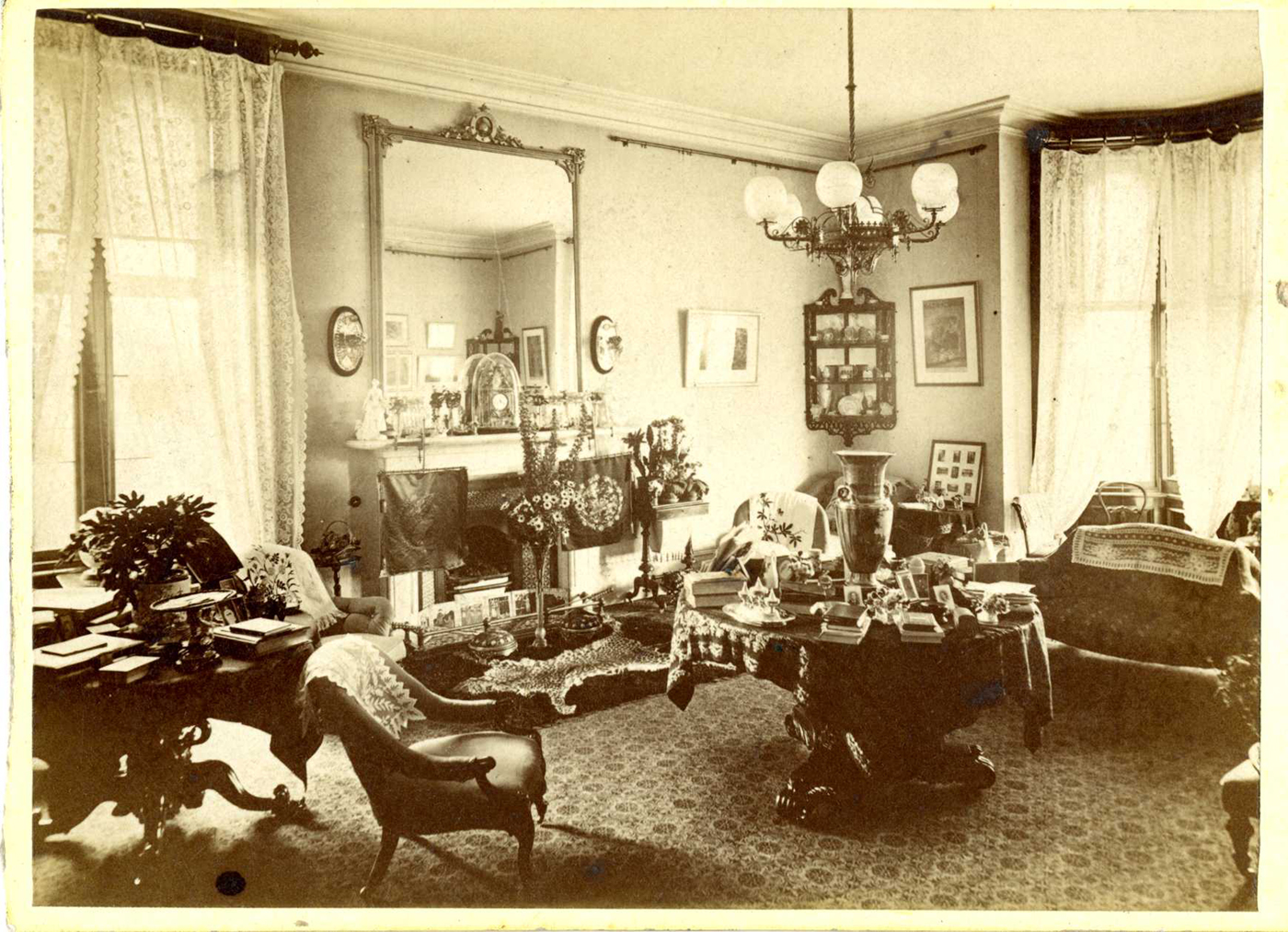
The power of these women was expressed spatially and materially through their drawing rooms. In middle-class homes, drawing rooms were associated with feminine domestic etiquette and seen as the arena in which a housewife's taste and rules held sway.Footnote 68 For Hughes, the headmaster's wife's drawing room could be as formative as the classroom. He opines in Tom Brown's Schooldays, “Many is the brave heart now doing its work and bearing its load in country curacies, London chambers, under the Indian sun, and in Australian towns and clearings, which looks back with fond and grateful memory to that School-house drawing room, and dates much of its highest and best training to the lessons learnt there.”Footnote 69 A surviving photograph of Mrs. Haig Brown's drawing room (figure 1) depicts a high-status, elaborately furnished domestic space, complete with the conventional trappings of feminine domesticity; but shields on the fire screens also convey the identity of the school. Memories of school life emphasize the importance of these spaces. G. C. White went so far as to say that one of the best features of his memories at Lancing (which he liked generally) was the “Sunday evenings in Mrs Wilson's drawing room … It was her habit to invite all the boys of the house to dinner on Sunday in each term—4 or 5 every Sunday. Her drawing room was also open to them every Sunday evening 8–10. This was much appreciated and I think it had a refining influence.” Footnote 70 The diaries of Sam Brooke, a Lancing schoolboy and inhabitant of Seconds in the early 1860s, suggests that visits to Mrs. Wilson's drawing room could be more frequent; he records playing the piano there regularly on weekday nights, as well as visiting on Sundays.Footnote 71 Mrs. Dick's drawing room was also celebrated in the historian James Matthew Thompson's poem about Winchester life in the 1890s: “On Sunday afternoons, when songs were sung,/ And we small juniors, free from daily chore, / Consumed plum cake upon the drawing-room floor.”Footnote 72 In addition to providing domestic comforts to small boys, Mrs. Dick's drawing room was the locus for a large social group beyond the school, including visitors staying with the master and his wife and local Winchester families and dignitaries. Conversational standards were high—Mrs. Dick was remembered for loving Carlyle, Balzac, and Goethe—and older boys who came into her drawing room could expect intellectual as well as social stimulation.Footnote 73
Mrs. Haig Brown's drawing room in Saunderites, Charterhouse School Archive, 0274. Photograph copyright Charterhouse School.

Also inside the drawing room, schoolboys might meet the daughters of the house. Here they made contact with the female world, practiced their manners, and even experienced their first frissons of sexual feeling for women. Deslandes has demonstrated how universities provided an institutional framing for the interactions of male students and young women by staging balls and other events that helped build normative heterosexual relationships and fashion ideas of romance and sexuality.Footnote 74 Although this happened less formally at public schools, the housemaster's drawing room also seems to have provided an institutionally mediated space for the development of early sexual attachments. At Charterhouse, a number of boys remembered the Haig Browns’ daughters, affectionately known as “the Olives.” Lucas, on an early visit to Mrs. Dick's drawing room, wrote to his parents that he had encountered one of their daughters: “Miss Marguerite Richardson at 20 years is a very dressy fashionable gay sort of young lady.”Footnote 75 Later, he got on better with “Popsy,” the Richardson's younger daughter. In a letter written in October 1895, he noted, “Took Popsy in [i.e., led her into dinner]. She was very amusing.”Footnote 76 He was perhaps rather disappointed when she got married the following year, although he enjoyed relaying details of her wedding presents and the size of the cake to his mother in a letter.Footnote 77 Schoolboys’ hearts often fluttered at housemaster's daughters, the subjects of passion from afar. C. Sandford Terry, at Lancing in the early 1880s, remembers sending a Valentine's Day card to the daughter of a master.Footnote 78 Small tokens were seized and cherished; at Winchester in 1912 the warden's daughter Dolly (Mrs. Hambey) inflamed a number of boys. In November, one boy noted in his diary, “In the evening Bell met me in the passage & pushing something scented into my face ‘like a trophy.’ He had picked up Mrs (Dolly's) Hambey's hanky which I have still got.”Footnote 79
The schools’ adoption of patriarchal roles led women to play a fundamental part in school life, yet their performance of those roles still reinforced a sense of gendered hierarchy. Mrs. Richardson had a strong influence over the boys in chambers (who were under her husband's control), and the writer of her appreciation also suggests she had an important effect on boys in other houses. Yet as housemaster's wife she could not intervene in every aspect of the boys’ lives. Bullying in the dormitory or injustice in the classroom were matters beyond her sphere (although the conversations in Mrs. Dick's drawing room at least suggest that she took a considerable interest in the boys’ intellectual lives). And while housemasters’ wives reigned supreme within the walls of their houses, they could not intervene in the schools’ broader domestic organization. When Mrs. Dick attempted to improve the food for the Winchester boys by taking a hand in the college kitchens, she was roundly told that this was not her place.Footnote 80
Nevertheless, these women did wield a considerable amount of informal power, especially those women whose personalities seem to have transcended the confines of gender. Frank Lucas, in a letter home to his mother in 1891, described how a schoolfellow avoided being sent home for illness by convincing Mrs. Dick that he was well: “Of course, as Mrs Dick's word is law with everyone that was quite conclusive.”Footnote 81 In the Wilson household at Lancing, an indication of whom the boys felt it was most important to please was their choice of present for Headmaster Wilson's birthday. Brooke writes, “We are now getting up a present for Mr. Wilson's birthday, but are as yet undecided as to what it shall be. Some think a ‘Pictorial Tennyson’ others ‘some large vases’ as Mrs Wilson announced to someone the other day, that when she got them, her drawing room would be quite complete … I fancy the vases will be fixed on.”Footnote 82 Sure enough, the vases, made of frosted glass and decorated with green and gold serpents, arrived in the drawing room a few days later.
Fagging and Performing Everyday Domesticity
While the schools drew on the idea of the patriarchal family and to a certain extent reinforced it, they also produced a distinct form of masculine domesticity through the performance of everyday rituals and routines. Housemasters and their wives had overall responsibility for the domestic management of school houses, and servants were appointed to perform some tasks, but a considerable proportion of mundane domestic activities was carried out by the boys. This practice was valorized by the system of “fagging,” in which younger boys carried out basic services for senior boys in the school. The nature of fagging varied between institutions and from house to house, but it might include running errands, fetching balls or messages, or performing basic domestic tasks such as tidying, cleaning studies, filling baths, or simple cooking. Arguably, fagging, which trained boys to obey and later to command, worked within the larger patriarchal system; boys were effectively being trained to become authority figures. However, for the junior pupils, some of the work involved came dangerously close to domestic labor—tasks culturally recognized as suitable for lower-class females and routinely performed by servants in middle-class homes. As younger boys carried out jobs for their seniors, these activities aligned the system of seniority in the school with wider social and cultural hierarchies; yet they were also imagined and framed in such a way as to avoid feminization or social demotion. The performance of these tasks allowed boys to develop domestic skills and a sense of pride in their environment appropriate to their class and gender. Drawing on the medieval heritage of the schools, fagging was linked to the performance of chivalric masculinity, the service rendered by a knight to his liege. Michèle Cohen has recently drawn attention to the renewed importance of the chivalric model of masculinity in the early nineteenth century.Footnote 83 Norman Vance argued that chivalry was reinvented as part of new understandings of Christian manliness, as well as emphasizing “personal honour and public virtue” as in older versions of knightliness.Footnote 84 A number of historians have pointed out that chivalry was an important strand in masculine identity in public schools, but there has been little consideration of how far it was embedded in everyday performances or its connection to domesticity.Footnote 85 The new emphasis on chivalric ideals of masculine honor provided the ideal framing for the performance of masculine domesticity as service, enabling young middle- and upper-class men to acquire domestic skills and knowledge in a way that enhanced rather than compromised their sense of masculinity. Chivalry also allowed relationships between senior and junior boys to be framed in such a way as to enable the former to exercise a paternal form of authority; ideally, they would protect weaker boys.
While domestic service was very much a backstage activity in the home, hidden from family and visitors as much as possible, the domestic tasks performed by “fags” were foregrounded, celebrated, and openly performed as public rituals. In all three schools, the system was passed down from one generation of boys to another, and was often viewed as a traditional practice. At both Charterhouse and Winchester, these practices were linked to the school's identities as medieval institutions. As one Wykehamist memoirist put it, it was “recognised as authentic.”Footnote 86
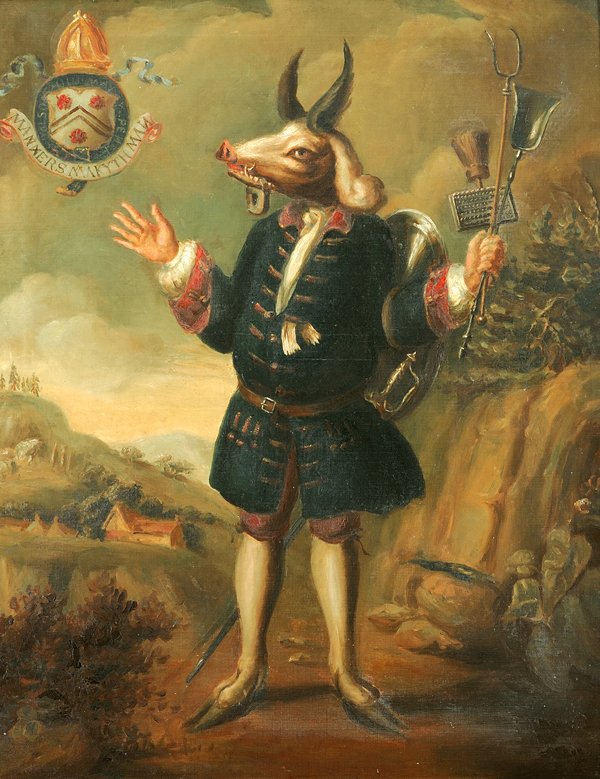
At Winchester, the connection between fagging and the chivalric service ideal was made explicit in the language of “Notions,” the extensive special vocabulary that the boys developed to describe places and customs at the college.Footnote 87 Male servants in the college were known as “sweaters,” and performing tasks for prefects was also known as “sweat.”Footnote 88 This word was derived not from names given to charwomen or maids but from a portrait named by the boys The Trusty Sweater, also known as The Trusty Servant and originally painted by poet John Hoskyns in 1579.Footnote 89 The unusual image, hanging outside the college kitchens, is of a well-dressed figure, part man, part donkey, part deer, and part pig, complete with wig and sword, a padlocked mouth, and significantly, a set of tools, including what appear to be an early modern broom and a pan (figure 2). Panels of Latin text on each side extol in verse the ideal virtues of a servant, including discretion, swiftness, and an unfussy approach to food (apparently symbolized by the pig). Particularly significant were the last two lines of the poem that emphasized this unusual figure's knightly credentials and his ability to protect as well as to serve: “Girt with his sword, his shield upon his arm, / Himself and master he'll protect from harm.”Footnote 90 According to Vance, nineteenth-century writers who developed the idea of chivalry placed a new emphasis on the value of service to others.Footnote 91 The celebration of this image, which clearly linked service with a range of different kinds of tasks, including domestic ones, shows how this played out at Winchester. This image was idolized by the boys, and often painstakingly drawn and colored in “notions books,” which new boys produced every year. The Trusty Sweater was the ultimate faithful servant and was imagined as a focus for the transmission of the school's ethos of service from one generation of boys to the next.
William Cave, The Trusty Servant, 1809. Copyright the Warden and Scholars of Winchester College.

As a newly established school, Lancing did not have the benefit of a medieval site or long-running traditions, yet one way of quickly acquiring prestige was to implement practices such as fagging that were established elsewhere. A comic skit in pseudo-medieval language, Of Fagges, published in the school magazine in 1905, clearly aligned the concept of medieval service with the school system of fagging.Footnote 92
In all three schools, the elision of fagging with medieval chivalric ideals allowed domestic work to be performed by boys without a compromising sense of femininity. As Cohen has shown, notions of chivalry in the nineteenth century were strongly gendered and predicated on the notion that the protection of women was a condition of civilized society.Footnote 93 The adoption of chivalric ideals and symbols in these schools was thus part of a wider gendered framing of boys’ behavior, which, like the patriarchal models discussed above, positioned boys in relation to women and underpinned their sense of masculinity. But the chivalric model was also valuable in public schools because it offered a compelling means of imagining relationships between men and how they might perform tasks for each other in knightly service—a brotherhood within an elite—without compromising social standing. A positive view of fagging was quite widespread, and not just among prefects or those looking back on their schooldays with rose-tinted spectacles. Some of the junior boys interviewed in the Clarendon report were quite positive about fagging; the anonymous Winchester junior who was interviewed said that it was not as bad as he thought it would be.Footnote 94 There is also some direct evidence that it was sanctioned by the boys. At the start of the autumn term in 1908, Head's House at Lancing held a debate proposing the motion “This house heartily disapproves the system of fagging.” The headmaster noted, however, “The move invoked the well-known attribute of British clemency on behalf of the down-trodden and oppressed—and melted the House to tears but not to votes only 9 being counted for, & 25 against.”Footnote 95
The widespread acceptance of the fagging system among the boys may also have been because in the ideal chivalric version, the weak were protected and even derived some benefits from it. Fagging could involve the exploitation of small boys, but at its best it helped create a system that encouraged paternalistic protection of the weak. Vance, analyzing Tom Brown, emphasizes the extent to which the Victorian chivalric ideal of service encompassed this kind of protection.Footnote 96 Those who wrote about the system in positive terms tended to emphasize the benefits of these relationships. One Wykehamist writing home in 1855 noted, “I am fag to a rather nice kind fellow.”Footnote 97 At Winchester, fagging was constructed through specific language and rituals aligning it to the idea of service for a liege, a model that idealized relationships between men and carried with it the idea of protection as well as exploitation. Frank Lucas rather liked fagging when he arrived at Winchester in 1891: “Wilkinson whose valet I shall be is awfully nice I like him awfully,” he wrote to his mother.Footnote 98 A few weeks later he continued with this theme:
I want to say a word in favour of the prefects in our upstairs shop. They are all so nice and especially Wilkinson my master. It is not rewardless fagging here, as I will shew you with a few practical instances. To begin with, whenever we have roast beef, Wilkinson had a private Yorkshire pudding. Well I think it is an extremely considerate thing to do to send a piece down to your junior and your valet … prefects always give you something of what you get for them.Footnote 99
Rather carried away with the glamour of the prefects at the new school, Lucas was anxious to praise them and to fit in. Yet his words show how the fagging system brought patronage and protection as well as exploitation, and how smaller boys might derive considerable satisfaction from small material benefits, such as a share of Yorkshire pudding or a pot of jam. Of course, a dominant or exploitative “master” could also make a fag's life very difficult and opened up opportunities for bullying. There is little evidence of routine sexual exploitation as a part of relationships in the fagging system, but it is likely that this happened from time to time as there is plentiful source material indicating homosexual relationships and activities within these schools.Footnote 100
Fagging became more problematic when it began to challenge class hierarchies by moving too close to the work of domestic servants. Arnold, for example, who promoted the system, argued that a firm line should be drawn between tasks for boys and servants and that fagging should not include everyday domestic activities.Footnote 101 According to Arnold, “those menial offices which were exacted from juniors … were only required of them because the attendance of servants was so exceedingly insufficient, and the accommodations of the boys in many particulars so greatly neglected.”Footnote 102 There were, he argued, other jobs that allowed the appropriate expression of the authority of senior boys: “There will remain many miscellaneous services, such as watching balls at cricket or fives, carrying messages, etc., which servants undoubtedly cannot be expected to perform, and which yet belong to that general authority vested in boys of the highest form.”Footnote 103 The 1864 Clarendon Commissioners’ report indicates continual slippage between domestic tasks thought appropriate for household servants and activities undertaken by junior fags. The commission spent considerable time questioning school authorities and pupils on this system, revealing anxiety about its relationship with domestic service. The interrogation of teachers and boys at Westminster on the issue ran to several pages and focused on who was responsible for slop disposal.Footnote 104 Charterhouse and Winchester were also found wanting in this area. It was felt that fagging had gone too far at the former, where fags were required to carry large coal scuttles.Footnote 105 The summary report on Winchester noted, “Some of the services done by the fags are such as might, and as we think, should, be done by servants.”Footnote 106 This problem might be compounded when the schools lacked sufficient domestic assistance. The Winchester headmaster's report in 1878 noted that the college's domestic systems were failing and that there had been a build-up of filth in “Chambers.”Footnote 107 The situation was made more acute by insufficient supervision of the boys in the early 1870s, which allowed seniors to make extensive and unreasonable demands on their juniors. Charles Oman, a Winchester pupil at the time, describes his work as including carrying prefects’ goods such as books, inkpots, and candlesticks, simple cooking tasks such as making of hot chocolate (he particularly hated cleaning the saucepan afterwards) and filling baths with water (another despised task that often led to squelching for the rest of the day).Footnote 108 Sir Francis Fletcher Vane, when he was at Charterhouse in the 1870s, observed, “I do not see any excuse why the little fellows should be expected to do household work such as attending at table, waiting on their elders, which can only be justified on the principle of economizing on domestic service for the Housemaster.”Footnote 109 For Vane, fagging was exploitation pure and simple and had little to do with the noble ideals of chivalry.
Nonetheless, the fagging system allowed men to develop domestic skills and routines for an everyday masculinity that stayed with them throughout their lives. Indeed, many boys were comfortable (although sometimes irritated) with performing what might be viewed as domestic tasks, without feeling diminished or feminized. Fagging duties were reduced as a boy was promoted through the school, reinforcing the institution's hierarchical structure and allowing boys to exercise authority and assume paternalistic responsibilities. Here fagging worked together with the schools’ broader promotion of patriarchal roles. Boys used the system to mark their progression, and could gain considerable satisfaction from this. “The wretched fags are cleaning out the library and dusting the tables, the wretched animals I do pity them,” W. S. Lawrence wrote smugly from Charterhouse in the late 1860s, showing off his new status.Footnote 110 It might be argued that fagging duties simply reinforced the notions of domestic tasks as humiliating chores to be thrown off when a boy achieved manhood. And yet the skills involved were often valued in the long term and continued to be performed as a distinctly masculine form of domesticity. As such, it was necessary to imagine them in ways that distanced them from domestic service and from constructions of femininity. Chivalry was one way in which this worked, while another was to focus on the common-sense value of rough everyday domestic tasks. Blacking shoes and frying bacon, for example, were both seen as useful masculine necessities.Footnote 111 Boys were being taught not to bake cakes or starch collars but to have enough domestic knowledge to function independently. Eustace Tennyson D'Eyncourt, a Hodgsonite at Charterhouse in the 1880s, remarked, “I have long forgotten a great many things I learned in school, but not how to fry sausages and poach eggs!”Footnote 112 In learning basic cooking skills, a boy was inculcated into a bachelor system of domestic economy in which a single man learned to provide for himself and to be physically self-supporting away from the conventional domestic unit. Even Arnold was aware of this: “Many a man who went from Winchester to serve in the Peninsula in the course of the last war must have found his school experience and habits no bad preparation for the activity and hardships of a campaign; not only in the mere power of endurance, but in the helpfulness and independence which his training as a junior had given him.”Footnote 113 This was an alternative, masculine domesticity, lived in small spaces, replete with the comforts of the small saucepan and frying pan, cooked ad hoc over an open fire. Some also suggested that the system taught boys to treat material things with discipline and respect. Sir Frank Benson, who was at Winchester in the 1890s, remembered being beaten for failing to perform domestic tasks correctly but felt that this was a good thing in the long run: “Of course, I had to be ‘cut into’ with a ground ash when I did not brush Grimwood's Sunday coat properly, and folded his trousers into the wrong crease, and of course I thank him now, although I was ungrateful at the time.”Footnote 114
Home, Family, and School
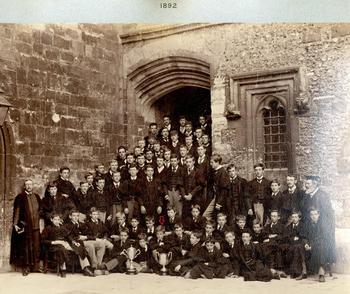
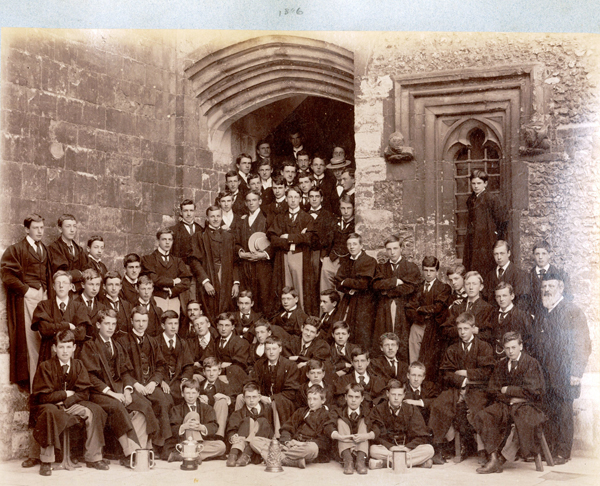
As this article has shown so far, Victorian and Edwardian public schools were places where family models, contact with paternal and maternal figures, and masculine forms of domesticity were not just present but formative. The final section goes further to reflect on the impact of the boys’ presence at school on families and to what extent home and institution were emotionally fused. Of course, many middle-class parents did believe that it was necessary to separate their boys from the familial home. That is why thousands of seven-year-olds were packed off to prep school every year, despite parental feelings of guilt.Footnote 115 The separation was not absolute, however. Rather, the habitual routine of leaving and return imposed by school life—and the means by which families negotiated this—were important to the creation of relationships. In her study of Anglo-Indian families, Elizabeth Buettner has written about the emotional character of a “family life punctuated by habitual separation,” in which letter writing was the central means of maintaining and negotiating relationships.Footnote 116 The geographical divide between most schoolboys and families was usually less stark, but these relationships, too, were characterized by the need to negotiate the gap if they were to develop and thrive. As Simon Goldhill has recently argued, the dynamic qualities of the correspondence can also show us how nineteenth-century family life was constructed through a culture of writing.Footnote 117 Drawing on these approaches, the final section of this article examines letters written home by schoolboys and considers how they can be used to understand family relationships and the interaction between home and school. In particular it focuses on a large collection of letters written by Frank Lucas, a schoolboy from Winchester in the 1890s (figures 3 and 4).
Scholars at Winchester College, 1892. Frank Lucas is probably the little boy with folded arms seated behind the large cup in the center. Photograph album of group photographs of scholars, 1867–99, Winchester College Archive, G5/8/1. Copyright The Warden and Scholars of Winchester College.

Scholars at Winchester College, 1896. Frank Lucas is probably the older boy standing under the arch, second row from the top, one in from the left. Photograph album of group photographs of scholars, 1867–99, Winchester College Archive, G5/8/1. Copyright The Warden and Scholars of Winchester College.

Although schoolboy letters are relatively common in school archives, the Lucas collection, held by Winchester College Archive, is unusual both because of its size (250 letters) and because it includes correspondence between Lucas, his father, his mother, and two of his sisters. It is not clear why this particular collection is more comprehensive than others, but the family must have made a concerted attempt to collect the letters together, perhaps after Lucas's early death in 1920.Footnote 118 Although the letter set is very large, it is possible that some missives have not survived, and as there are no responses to Lucas's letters, we are able to hear only his voice. But the breadth and scope of the collection—and the fact that Lucas's words are often phrased as a direct response to questions—do allow us to read it in a dynamic way, and we can see the back-and-forth in the construction of relationships. The letters allow an exploration of the different epistolary relationships that Lucas developed during his seven years at the school (1891–1897), and a consideration of how his family and emotional life was shaped by both institution and home. Lucas's father, Edgar, was a well-to-do solicitor who lived at Netherfield House in Streatham.Footnote 119 He was married to Alice Lucas, and their first child, Rosamond, was born in 1877. Francis Herman, or Frank, as he was usually known, was born the following year, and Phyllis arrived in 1881. In 1884 and 1885, two further siblings, Cecily and Helga, were born.
Thirteen-year-old Frank arrived at Winchester College in the autumn of 1891 and immediately began writing letters home. Initially, he wrote with considerable enthusiasm; thirteen letters were dispatched to Streatham in October alone. At this point he alternated between writing to his father and mother and his two eldest sisters, Rosamond and Phyllis. Frank looked forward to letters from home: “I received the budget of letters this morning they were all very amusing, in fact I fairly roared off the last page and the postscript of Rosamond's; it was killing. Thank Cecil and Father for their letters to me.”Footnote 120 But before long, the interests and pressures of school life reduced his output, and in November he notes, “I'm afraid that I have been writing abominably short letters to you all lately, but I have been pressed for time, owing to a good deal of hard mugging.”Footnote 121 By the spring term of his first year, he was writing noticeably more often to his mother, a pattern that continued in the following years. From 1893, his correspondence with his sisters seems to have diminished, and until September 1895 most of his letters were addressed to his mother, with the odd one to his father. At this point, when Frank was seventeen, there are a few more letters to Edgar again and a more extensive exchange with Rosamond, as his relationship with her appears to have deepened.
Frank Lucas's epistolary relationships varied in terms of the quantity of correspondence but also in tone and subject matter. Letters to his father drew on shared masculine assumptions about school life and emphasized the sense of corporate identity within the school. An early letter explains, “I like the life here very much. I prefer it to Private schools’ life. It is freer, and you feel as if the work you are doing is more voluntary here than it was before, besides feeling proud of the glorious old seminary, which it has become your happy lot to become a member of.”Footnote 122 Frank wrote to both his father and mother about academic work but drew more attention to his position within the school in missives to Edgar, frequently mentioning sporting achievement and marks.Footnote 123 There are fewer letters to Edgar after Frank's first months at the school, but he made a point of writing to him on his birthday.Footnote 124 There was some intellectual exchange between the two—Edgar was interested in history, and Frank's letters shared opinions about Froude and Horace.Footnote 125 Home topics were also discussed, and Frank often enquired after the family's dog, Pincher.Footnote 126 The letters to Edgar are even in tone throughout the correspondence period—respectful but also often quite humorous—and contain little evidence of conflict. A single letter written in October 1896, justifying Frank's expenditure at the college in the context of family financial problems, strikes a more jarring note.Footnote 127 But this is a rare moment in a correspondence that suggests a relationship that was perhaps not particularly close but underpinned by shared identity and mutual understanding.
Other evidence also reveals the way in which male members of the same family often had a shared sense of the life of the school. Indeed, many parents chose schools because of long-standing family associations. Boys expected to follow fathers, brothers, or other male relatives. When (later headmaster) William Fearon arrived as a pupil at the unreformed Winchester in the 1850s, the other boys asked him why he was there, given that he had no father, brother, or uncle who had attended the school.Footnote 128 Elder brothers might try to smooth the passage for younger siblings—Sam Brooke, who left Lancing in 1862, tried to set up friendships with suitable boys for his incoming younger brother Robert.Footnote 129 A number of Wykehamists commented on the advantages of having a brother at the school who could pass on knowledge of the institution's arcane customs.Footnote 130 At Charterhouse, it was common for brothers to share rooms.Footnote 131 Evelyn Waugh, who was prevented from going to Sherborne by his brother's expulsion and sent to Lancing instead, gives a sense of the emotional disruption created by being in a school with which he had no family links.Footnote 132
One strength of the Lucas correspondence is that it allows us to see Frank Lucas's different relationships with male and female family members and his interactions with his four sisters. In his first flush of letter writing, he wrote frequently to Rosamond and Phyllis, in the expectation of replies: “I hope you are all right at home and I expect to hear from you.”Footnote 133 The letters are lively in tone and often focused on describing Winchester customs: “Rosamund will be much surprised that I have not been tunded yet.”Footnote 134 He does not appear to have corresponded directly with Cecily and Helga, who were seven and six the year he went to school, but Phyllis appears to have been tasked with updating him on their exploits.Footnote 135 Frank's later letters show an affectionate interest in his two younger sisters,Footnote 136 but they did not become frequent correspondents, probably because of the gap in age. Both would have been infants when Frank first departed for prep school, and it was these relationships that were probably most limited by his absence at school. Following the initial flurry, he does not appear to have written to Phyllis much, although he invented a way of playing dominoes by post in which she participated enthusiastically.Footnote 137 The lack of correspondence may again be partly explained by the age gap, but Phyllis, who later became a physical-education student, may have had less in common with him.Footnote 138
In contrast, Rosamond, who is listed on the 1901 census as a Latin teacher,Footnote 139 was only a year older than Frank and shared his intellectual interests. In part, his letters to her reflect a conventionally gendered understanding of their sibling relationship. He quite often asked her to send him domestic items.Footnote 140 He devoted much ink to explaining the life of the college to her, something he clearly felt was necessary for a feminine outsider.Footnote 141 But in the last three years of the correspondence, there is a sense of genuine intellectual exchange. As was the norm in public schools in this era, Frank spent much time studying and translating classical authors, but he also developed a passion for English poets, describing himself at various points as “mad on Spenser” and “a morass of Byron.”Footnote 142 He and Rosamond discussed Greek authors and English poets and exchanged books.Footnote 143 It was not simply a case of the brother imparting the fruits of his public-school education to his sister; he also asked for her advice—in February 1896, he requested suggestions for reading for an essay on the ideal historian.Footnote 144 Both siblings were intellectually ambitious. That same month, Frank wrote to Alice, “As to Rosamond's scholarship in May year, it is quite possible that the pair of us will be scouring Oxford together for scholarships at that time, which will be highly amusing.”Footnote 145
The person whom Frank wrote to most was his mother. To a certain extent, Alice Lucas represented the rest of the family; it was expected that she would relay news to other members and report back to Frank.Footnote 146 It was part of her culturally prescribed role as the manager of a large household to maintain contact with her son. But the breadth and frequency of the letters—usually sent weekly or fortnightly but every now and then on consecutive days as mother and son took on particularly contentious issues—suggest an individual epistolary and familial relationship of range and depth. Frank tended to use a tone in letters to his mother that was different from those addressed to his father. His early letters to Alice often seem designed to reassure; for example, he describes the occupants of his dormitory as “awfully nice.”Footnote 147 Alice was also directly concerned with Frank's domestic and material needs, and his letters frequently mention “cargo” (provisions sent to the school). In the autumn of 1891, his request for “mid-term cargo” included potted meat, honey, apples, pears, biscuits, chocolate, and figs or dates.Footnote 148 Domestic detail and Frank's comfort were common themes of their correspondence. In February 1892, he writes to Alice about the quality of beds in his dormitory, noting that these are acceptable but that the pillows are poor and uncomfortable.Footnote 149
Not every schoolboy wrote home at such length, but other schoolboy correspondence suggests that it was often mothers who wrote most to their sons, and domestic and material items were frequently at the fore. Anxious mothers plied their sons with things. Food was popular, and, given the quality of school fare, supplies from home sent by mothers and other female relatives were often viewed as essential rather than luxuries. George Scott, writing home in May 1864, was particularly appreciative of “cargo” from his Aunt Susan, which apparently had included an almost never-ending ham.Footnote 150 Writing to his family in 1891, Lucas described how at Winchester “somebody splits a cake every night up in chambers.”Footnote 151 Such practices could exclude those who could not command cash or a ready supply of goods from home. Robert Graves, at Charterhouse until 1913, suggests that he was unpopular partly because he was short of pocket money and could not “conform to the social custom of treating my contemporaries.”Footnote 152 Graves's comment here can be read as an implicit criticism of his home and family, who failed to equip him with adequate means to negotiate public-school life. Learning how to ask for provisions in the right way was also important. “Please do not forget the cake I asked for next Sunday. I hope you do not think I am too grasping in the way of cakes,” wrote Geoffrey Polson to his mother from Charterhouse in 1904.Footnote 153 The boy's anxiety conveys a need for the items but also a desire not to appear too demanding or greedy.
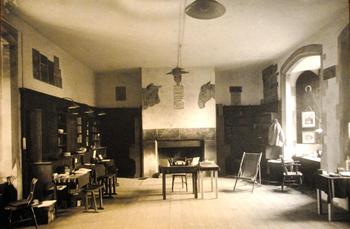
Turning again to the Lucas letters, we can see that domestic discussions were not just about mundane provisioning but also allowed a reimagining of the institutional world of the school. In January 1892, Frank Lucas was delighted to acquire a new “toys” (“Notions” slang for a lockable desk-bureau). He was obsessed with obtaining a cloth for it, which he repeatedly demanded in letters to his mother and sister.Footnote 154 When his mother produced the item, he wrote home gratefully, “I am delighted with the cloth which surpasses anyone's here. I had no idea it was anything like such a good one. The pattern is awfully nice.”Footnote 155 Figure 5 shows a photograph of Winchester's Second Chamber in the late nineteenth century and reveals the capacity of the personal spaces granted to the boys within the institution to display significant items that might make an explicit connection with home life. Lucas wrote to his mother that “Rosamond's and Phyllis's and your photographs take an important and conspicuous place in my decorations.”Footnote 156
Interior of Second Chamber, Winchester College Archive, G5/5/3/2. Photograph copyright The Warden and Scholars of Winchester College.

Lucas's ability as a correspondent and as a writer increased over time, and he often penned vivid images of his life in a semi-domestic setting, particularly in letters to his mother. In October 1896, for example, he wrote, “I am writing this comfortably ensconced in my place, with the satisfactory feeling that everything is in its place. My washing stool is in a magnificent condition with scarlet muslin hangings (3d a yard) freshly washed busts, cut narcissus and geraniums, and two geraniums in pots red and white.”Footnote 157 This imagining of the institutional world served a dual purpose of helping Lucas feel at home within the institution and of reassuring his mother of his ability to recreate the domestic world of the home.
In addition to discussing domestic matters, Frank's letters to Alice are full of current affairs, literature, and poetry, as well as his studies at the school. Both mother and son were literary enthusiasts and keen writers—she was clearly highly educated, could read in Greek, and had two translations of Danish novels published during Frank's school years.Footnote 158 In October 1893, he wrote to her about a school debate on the current coal strike,Footnote 159 and in November 1894 he outlined a speech for the debating society, in favor of taking a liberal approach to opium.Footnote 160 In the same month, he wrote that he was devoting all his spare time to reading Shelley as well as Lycida and Arnold. He preferred the former; “We will read all three in the evenings next vac and we will see if you agree with me.”Footnote 161 He wrote in depth to her about his studies and in 1895 about his struggles with an exam in composition that, despite his enthusiasm for poetry, he found very frustrating. He was anxious to know his mother's opinion: “I should like to hear your views on this matter in your next.”Footnote 162
Alice was the family member that Frank had the most intense epistolary relationship with, but their relations were also emotionally volatile.Footnote 163 He sometimes expressed frustration with her imperfect understanding of school life; there is none of the confidence in a mutual understanding of the institutional world that he had with his father. In a very early letter to Rosamond, he told her that Alice had misunderstood the system of punishment in the school (presumably in response to something she has said in her letter).Footnote 164 In 1895, in his fourth year, he had a rare argument with her. She had apparently reproached him for allowing junior boys to smoke at Waterloo Station. He defended himself by arguing that he himself had been smoking during the holidays and his mother had not objected to it, that the station was beyond his jurisdiction as a prefect, and that the boy in question had already suffered from much “sitting on” from his peers (this probably refers to verbal and physical forms of bullying).Footnote 165 The tone of this letter is unusually defensive, and it was followed by a second letter a day after, so mother and son were clearly arguing back and forth in the post.Footnote 166 For three weeks afterwards, there was no further letter to his mother, and, significantly, Rosamond and Edgar received more than their usual share of letters. When he wrote again to Alice in mid-October, he returned to the subject of school discipline, telling her how he had prevented an unnecessary “licking” of a junior boy by an overzealous prefect by bringing it before the headmaster; at this point there were three letters in quick succession that suggest more wrangling over the issue.Footnote 167 But the tone this time was more light-hearted: “The Bear was very nice and sympathetic and quite took my side in this case. Perhaps you would have formed one of the opposition!!!”Footnote 168 For the most part, their correspondence resumed its usual tone, but there were still occasional moments of conflict.Footnote 169
Other letters between mothers and sons at school reveal a spectrum of emotional engagement, but they are also often concerned with the mother's role in the negotiation between the worlds of home and school. In Winchester correspondence, these issues often crystallized in discussions of the school's annual Domun celebrations, when families were invited to visit. In 1904, George Scott Moncrieff could not wait for his mother to come to this event: “I don't know if you are coming this year. I hope that you will, as things look best in summer. You must come somewhen. When I saw all the assorted maters in Chamber Court, Oh! I thought, how proud I'd feel with you, toting you round, till you begged me to stop!”Footnote 170 This boy actively sought to pull his mother into the life of the school. Others were more circumspect, perhaps feeling a sense of embarrassment at the prospect of a parental visit. For example, a series of letters from G. R. Snow to his mother in the 1910s repeatedly attempted to put her off.Footnote 171 For Snow, these tensions also spilled over into more routine discussions of provisioning. In series of somewhat testy letters, he declared that he had no need for a winter coat: “For goodness sake don't imagine I am cold, because I am not in the slightest. There is never any difficulty in lighting the fire, as it always burns up of itself. The new vests are very nice.”Footnote 172 There was a mix-up over vests, and a large number, as well as many handkerchiefs, arrived at the school. “Thanks very much for the handkerchiefs, I now have enough for a lifetime,” wrote the ungrateful son.Footnote 173 This exchange conveys the mother's ongoing anxiety and the son's irritation, a dynamic probably enhanced by separation and not negotiated here particularly successfully by either party.
Conclusion
“The exclusion of feminine and domestic life was absolute. We never entered a human dwelling or saw a shop; to a boy like myself coming straight from home, the experience was chilling.”Footnote 174 This is how Evelyn Waugh described Lancing in 1917, in his mid-twentieth-century autobiography, A Little Learning. For Waugh, the absence of domesticity manifested itself above all in lack of women. According to Waugh, all the masters except one were unmarried.Footnote 175 “There was no element of domesticity. The headmaster's wife, living apart, had no business with our welfare.”Footnote 176 The tone of Waugh's description strikes a strong chord with the depiction of public schools in the mid-twentieth century by both the writers of autobiographies and more recent historians who have seen the schools as bulwarks of masculinity in which there was little or no place for women. Yet this is not a picture that would have been recognized by many who lived and worked in the nineteenth- and early twentieth-century schools surveyed here. The character of these schools seems to have altered to some extent in the early twentieth century. While individual housemasters and their wives continued to involve themselves in the lives of the boys at Winchester and Charterhouse, there is some evidence of less emphasis on the headmaster as a patriarchal figure following the First World War.Footnote 177 These schools were caught up in a larger climate of shifting social values that saw a loss of faith in state and nation and the authority of fathers.Footnote 178 There was a move away from the Victorian celebration of patriarchal domesticity. Arnold's emphasis on the headmaster as patriarch and the efforts of the celebrated headmasters of Charterhouse, Lancing, and Winchester would have been out of place in this new age. Just as the drawing rooms in middle-class homes began to fall out of use and become associated with excessive formality, so, too, visits to the drawing rooms of housemaster's wives declined. Accounts of school life were also increasingly shaped by a new critical cultural tide that held the schools responsible for social ills. There was less acceptance of institutional fatherly authority among boys, and trenchant criticism of the schools began to emerge in autobiographies, including Robert Graves's vitriolic depiction of bullying and sexual exploitation at Charterhouse.Footnote 179
Powerful as this picture is, it should not be allowed to obscure the ways in which patriarchy, domesticity, and the home were important in Victorian and Edwardian public schools and the lives of the boys who lived in them. It is clear that headmasters in this era drew on models of patriarchal authority that to a large extent were validated and accepted by pupils. Headmasters and housemasters offered an institutionalized version of patriarchy that drew on the power structures of the household but did not exactly replicate it. Patriarchy involved the active involvement of wives in the day-to-day functioning of the school—both headmasters’ and housemasters’ wives could be powerful presences, depending at times on individual personality. Their drawing rooms were often bastions of female domesticity in the otherwise male-dominated world of the school. While the version of patriarchy adopted by the schools ultimately served to reinforce a gendered hierarchy and placed limits on the role of women, the way in which some women were remembered by the boys suggests that some individuals transcended these limits. Paternal ideals shaped as well the way in which boys were encouraged to interact with each other and to carry out routine domestic tasks within the schools. The fagging system, often framed as chivalric service, was designed to give boys experience of governance, but it also fostered a relationship between senior and junior boys that in its ideal form offered some protection to the weak. Boys were effectively being taught to govern and to become members of a national elite, but it is worth noting that they were being taught to govern in a certain way. Fagging also had the effect of providing a basic training in domestic tasks that secured young men independence in later life and allowed for a masculine performance of domesticity. Imagining fagging as chivalric service helped masculinize work that was strongly associated with domestic servants in this era, without compromising social standing.
In addition to exploring the power of paternal and maternal roles and masculine domesticity in the world of the school, this article has also argued that there was a final, important way that the worlds of home and school remained interlinked: in the emotional lives of schoolboys. Correspondence can help us see the distinctive nature of family relationships forged by the routine of presence and absence that public schools created. The Lucas letters provide an example of how family epistolary relationships played out in different ways. Frank Lucas's relationship with his father rested on a sense of shared mutual understanding of the world of the school, whereas his relationship with his mother, although apparently deeper, was also more conflictual, especially when she commented or passed judgment on school affairs. Correspondence was a means of negotiating separation, but it also revealed the tensions this separation created. After his years at Winchester, Frank Lucas fulfilled his early promise and took up a scholarship at Cambridge before entering the civil service in the early twentieth century. He joined the India Office and rose rapidly to become secretary of the Financial Department in 1917.Footnote 180 He married in the early 1900s and had two daughters and son but died from typhoid at the early age of forty-two. His obituary gave the following description: “Lovable, ardent in argument, and inspired by the most genuine humanitarian ideals, he seemed to understand instinctively how to adapt the policy of Whitehall to the new condition of a reformed India.”Footnote 181 Lucas's skills in argument and liberal ideals were undoubtedly influenced and shaped both by his education at Winchester and by his epistolary relationship with his mother; home and school came together to create the man that he was later to become.