Introduction
True thrushes (Turdidae) are found worldwide, with 172 recognised species (Gill et al. Reference Gill, Donsker and Rasmussen2020). Of these species, only 18 have been recorded in Canada, and six of these are rare and considered of accidental occurrence (Avibase 2020). Ten species are known to occur in Manitoba; seven of these commonly breed in the province (Carey et al. Reference Carey, Christianson, Curtis, de March, Holland and Koes2003). American robin, Turdus migratorius Linnaeus, is abundant, conspicuous, and eagerly anticipated as a harbinger of spring in many parts of Canada. Others, such as grey-cheeked thrush, Catharus minimus (Lafresnaye), pass through on migration almost unnoticed as they travel to the far north of North America to breed. Other species in Manitoba include Swainson’s thrush, Catharus ustulatus (Nuttall), hermit thrush, Catharus guttatus (Pallas), veery, Catharus fuscescens (Stephens), eastern bluebird, Sialia sialis (Linnaeus), and mountain bluebird, Sialia currucoides (Bechstein). These seven species of migratory thrushes have been part of a survey for avian ectoparasites in Manitoba since 1993.
Price et al. (Reference Price, Hellenthal and Palma2003) list five species of chewing lice (Phthiraptera) as infesting T. migratorius: Amblycera – Menacanthus eurysternus (Burmeister), Myrsidea emersoni Clay, Ricinus elongatus (Olfers); Ischnocera – Brueelia brevicolor Ansari (as Brueelia ilicai (Denny), see synonymy proposed by Gustafsson and Bush Reference Gustafsson and Bush2017), Sturnidoecus simplex (Kellogg). Brueelia brevicolor is a true parasite of American robin, previously recorded in Canada by Wheeler and Threlfall (Reference Wheeler and Threlfall1986) and Galloway et al. (Reference Galloway, Proctor and Mironov2014). Brueelia vulgata (Kellogg) has been recorded from a number of species of passerine birds in Canada, including American robin (Thompson Reference Thompson1934; Whitehead Reference Whitehead1934, Reference Whitehead1954), pine siskin (Wheeler and Threlfall Reference Wheeler and Threlfall1986), dark-eyed junco (Wheeler and Threlfall Reference Wheeler and Threlfall1986), fox sparrow (Jewer and Threlfall Reference Jewer and Threlfall1978; Wheeler and Threlfall Reference Wheeler and Threlfall1986), American tree sparrow (Brown and Wilk Reference Brown and Wilk1944), house wren (Brown and Wilk Reference Brown and Wilk1944), and eastern kingbird (Whitehead Reference Whitehead1934, Reference Whitehead1954). However, B. vulgata is regarded as a true parasite of the dark-eyed junco (Price et al. Reference Price, Hellenthal and Palma2003; Gustafsson and Bush Reference Gustafsson and Bush2017). Other host records probably are either misidentifications, contaminants, or stragglers.
Catharus thrushes are infested by two species of Myrsidea (Amblycera), one of which, Myrsidea pricei Clay, is monoxenous, infesting only hermit thrush (Price et al. Reference Price, Hellenthal and Palma2003). Myrsidea incerta infests both Swainson’s and grey-cheeked thrushes (Price et al. Reference Price, Hellenthal and Palma2003). Guimaraesiella antiqua Ansari (Ischnocera) infests all three species of Catharus thrushes (Price et al. Reference Price, Hellenthal and Palma2003; see Gustafsson and Bush (Reference Gustafsson and Bush2017) for synonymy of B. zeropunctata Ansari with G. antiqua). No species of lice have been identified as infesting veery (Price et al. Reference Price, Hellenthal and Palma2003; but see Oniki Reference Oniki1990).
Eastern bluebird is infested by the ischnoceran louse, Philopterus sialii (Osborn) (Price et al. Reference Price, Hellenthal and Palma2003), and no lice have been recorded on mountain bluebird (Wheeler and Threlfall Reference Wheeler and Threlfall1989; Price et al. Reference Price, Hellenthal and Palma2003).
Considering the abundance and familiarity of most of these thrushes, surprisingly few quantitative studies have been conducted on their chewing lice. Most published literature in North America includes anecdotal records of species of lice found infesting their hosts (e.g., Peters Reference Peters1936; Malcomson Reference Malcomson1960; Keirans Reference Keirans1967; Cooper and Crites Reference Cooper and Crites1975; Reeves et al. Reference Reeves, Durden, Ritzi, Beckham, Super and OConnor2007). Threlfall and Wheeler (Reference Threlfall and Wheeler1986) and Wheeler and Threlfall (Reference Wheeler and Threlfall1986) are notable exceptions for American robin, grey-cheeked, and Swainson’s thrushes in Newfoundland. Carleton et al. (Reference Carleton, Mertins and Yabsley2012) provided quantitative data on P. sialii infesting eastern bluebirds in Georgia, United States of America. There are a number of quantitative studies on chewing lice infesting thrushes (Turdus Linnaeus spp.) in Central and South America: clay-coloured robin, Turdus grayi Bonaparte (Lindell et al. Reference Lindell, Gavin, Price and Sanders2002); creamy-bellied thrush, Turdus amaurochalinus Cabanis (Amaral et al. Reference Amaral, Bergmann, Santos, Krüger and Graciolli2013); pale-breasted thrush, Turdus leucomelas Vieillot (Enout et al. Reference Enout, Lobato, Cristiano, de Azevedo and Antonini2009); rufous-bellied thrush, Turdus rufiventris Vieillot (Amaral et al. Reference Amaral, Bergmann, Santos, Krüger and Graciolli2013); white-throated robin, Turdus assimilis Cabanis (Lindell et al. Reference Lindell, Gavin, Price and Sanders2002). Galloway (Reference Galloway2005) provided quantitative data on lice infesting two species of introduced Palaearctic thrushes in New Zealand, the blackbird, Turdus merula Linnaeus, and song thrush, Turdus philomelos Brehm. Oslejskova et al. (Reference Oslejskova, Kounkova, Gustafsson, Resendes, Rodrigues, Literak and Sychra2020) provided quantitative data on ectoparasites, including lice, infesting the former host in the Azores. Seasonal distribution of lice infesting T. merula was investigated in the United Kingdom by Ash (Reference Ash1960). However, the most extensive study on the ecology of lice on any species of turdid is that of Baum (Reference Baum1968), who examined the ecology of lice infesting T. merula in Germany.
Our objectives in the present study were to summarise data on infestation parameters and population structure for chewing lice infesting the seven species of turdids that breed in Manitoba and to compare these data with those available in other published studies. Our expectation was that thrushes, as passerines, would host a relatively low abundance of chewing lice compared with other host taxa and, in particular, exhibit low louse prevalence (Galloway and Lamb Reference Galloway and Lamb2021).
Materials and methods
Thrushes used in this study mostly came from two rehabilitation hospitals, Wildlife Haven (Ⓘle des Chênes, Manitoba) and Prairie Wildlife Rehabilitation Centre (Winnipeg, Manitoba), from 1993 to 2019. When injured or disabled birds died or were euthanised, they were individually bagged and frozen for at least 48 hours to kill all ectoparasites. A small number of birds were obtained from the Wildlife and Fisheries Branch, Manitoba Sustainable Development (Winnipeg, Manitoba) and Oak Hammock Marsh (Stonewall, Manitoba), and some birds were submitted by the public, mainly following fatal window collisions and cat mauling.
Birds were thawed to the point where limbs and head became flexible, then thoroughly washed three times – twice in warm soapy water and once with clean warm water as described for rock pigeon, Columba livia Gmelin, common nighthawk, Chordeiles minor (Forster), woodpeckers, and owls (Galloway and Lamb Reference Galloway and Lamb2014, Reference Galloway and Lamb2015, Reference Galloway and Lamb2016, Reference Galloway and Lamb2019). Water from each wash was passed through a 90-μ sieve, and retained material, including lice, was sorted from the sample under a dissecting microscope. Lice were preserved in 70% or 95% ethanol. Representative specimens of lice were mounted in Canada balsam using the method described by Richards (Reference Richards1964). Voucher specimens for all species of chewing lice were deposited in the J.B. Wallis/R.E. Roughley Museum of Entomology in the Department of Entomology, University of Manitoba, Winnipeg, Manitoba.
The following data were recorded, when available, for each individual bird: host species, collection date, location, body weight (in most cases), hospital case number, and numbers of adult males, females, and nymphs for each louse species. These data were used to calculate: prevalence – the proportion of birds infested; mean intensity – the mean number of lice on infested birds; sex ratio – the ratio of males to females; and the ratio of nymphs to females (Rózsa et al. Reference Rózsa, Reiczigel and Majoros2000). Infestation parameters were calculated using Quantitative Parasitology (QPweb), version 1.0.14 (accessed 15 January 2019), as described by Reiczigel et al. (Reference Reiczigel, Marozzi, Fabian and Rózsa2019). All other statistical analyses were conducted using SYSTAT Software, Inc. (2009).
American robins were identified as adults, juveniles, or chicks based on plumage. Chicks without feathers or with only down were excluded. Chicks in our study were covered with contour body feathers, but flight feathers had not fully emerged. Juveniles were identified as capable of flight but with spotted feathers on the breast. Categorisation of age and determinations of body weight were not consistently recorded in the early years of this study, so numbers within each category vary in subsequent analyses, using the maximum number of specimens with the relevant data. For comparison of infestation of birds of different ages, only birds that could be reliably aged and had been weighed were included (N = 355 of 570). No attempt was made to age other species because no chicks were available and juveniles could not be reliably distinguished from adults.
The life histories of American robins and the Catharus thrushes were divided into seasonal intervals to examine seasonal differences in louse abundance: winter (November–March), spring migration (April–May), breeding (June–August), and fall migration (September–October). Only adult specimens with precise collection dates that had been weighed were included.
Results
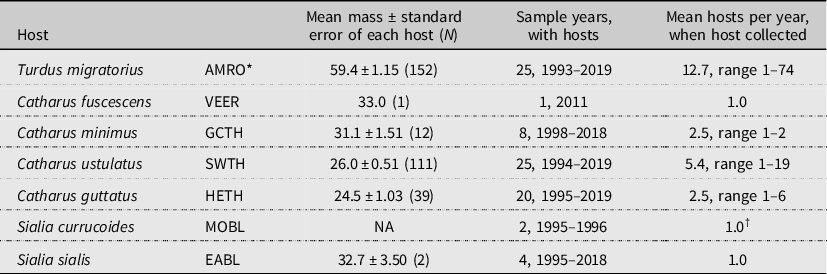
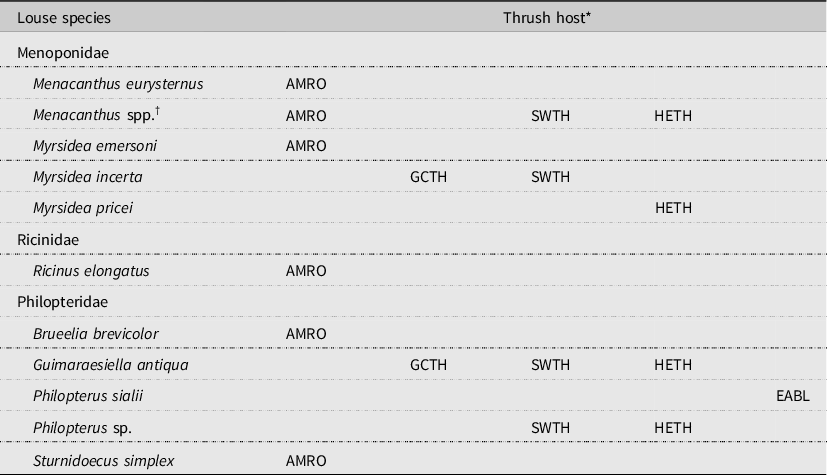
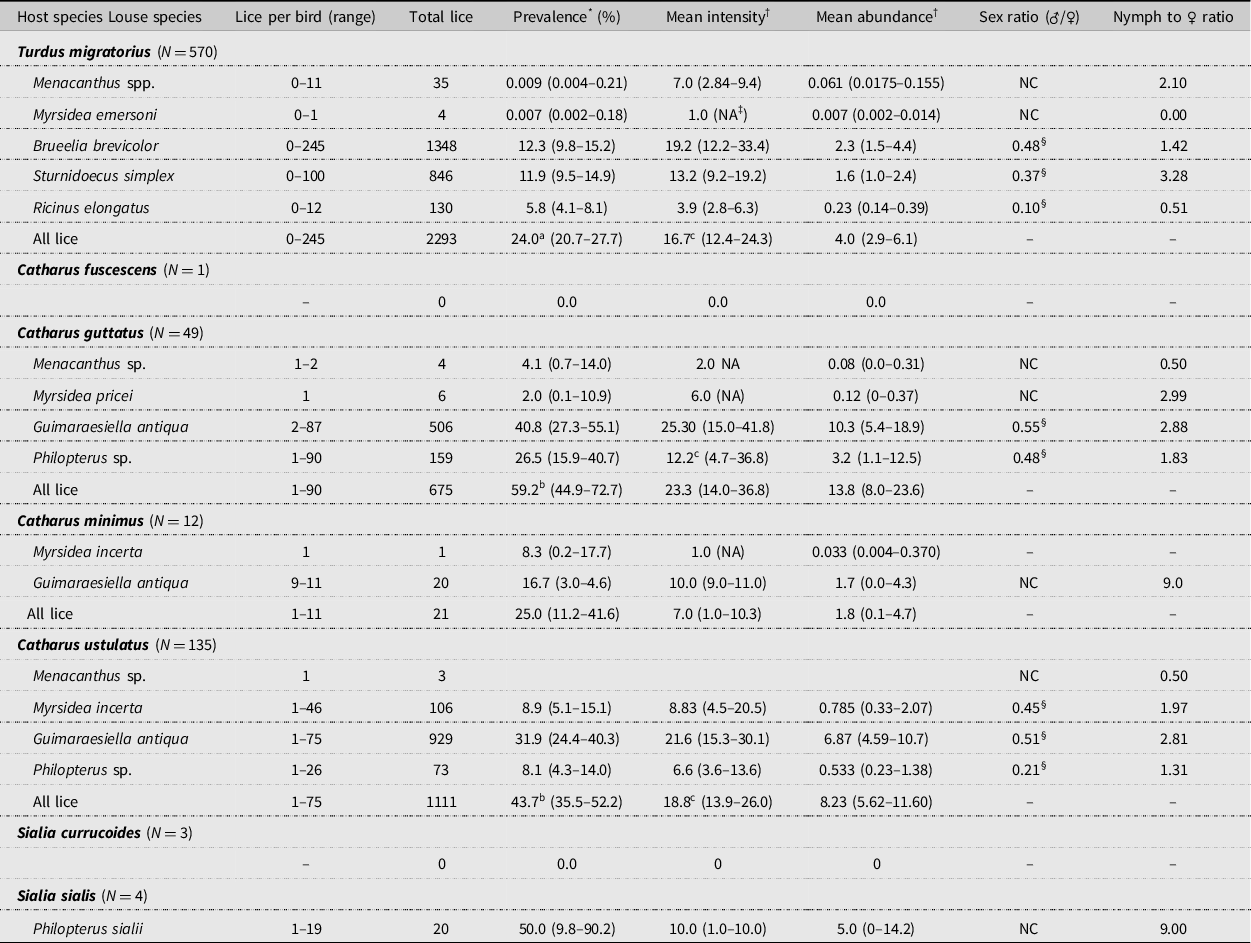
We sampled a total of 774 specimens of the family Turdidae in Manitoba during the period 1993–2019, characteristics of which are presented in Table 1. These birds include all seven species of turdids that typically nest in Manitoba, and from them, we collected a total of 4278 chewing lice of at least nine named species belonging to three families (Table 2). These include Menoponidae – Menacanthus eurysternus and Myrsidea emersoni from American robin, M. pricei from hermit thrush, and M. incerta from grey-cheeked thrush and Swainson’s thrush; Ricinidae – Ricinus elongatus from American robin; Philopteridae – Sturnidoecus simplex and Brueelia brevicolor from American robin, Guimaraesiella antiqua from Swainson’s thrush, hermit thrush, and grey-cheeked thrush, and Philopterus sialii from eastern bluebird. Unidentified species of Menacanthus and Philopterus were collected from several species of thrushes (Table 2). Summary statistics for infestation parameters from each species of host and louse are presented in Table 3.
Adult thrushes, Turdidae (arranged in order of host body mass) collected in Manitoba, Canada, 1993–2019, and parameters for the collections.

* Abbreviations for common names, according to the Institute for Bird Populations (2014): AMRO, American robin; VEER, veery; GCTH, grey-cheeked thrush; SWTH, Swainson’s thrush; HETH, hermit thrush; MOBL, mountain bluebird; EABL, eastern bluebird.
† One MOBL for which no date of collection was available.
Chewing lice (Phthiraptera: Menoponidae, Philopteridae) infesting thrushes, Turdidae, and their hosts, in Manitoba, Canada, 1993–2019.

* Abbreviations for common names according to the Institute for Bird Populations (2014): AMRO, American robin; VEER, veery; GCTH, grey-cheeked thrush; SWTH, Swainson’s thrush; HETH, hermit thrush; MOBL, mountain bluebird; EABL, eastern bluebird.
† Unidentified Menacanthus spp. presumed to be stragglers or contaminants.
Infestation parameters for chewing lice infesting Turdidae in Manitoba, 1993–2019, calculated as described by Reiczigel et al. (Reference Reiczigel, Marozzi, Fabian and Rózsa2019).

* 95% confidence limits, Sterne’s method.
† Bootstrap BCa 95% confidence limits; 2000 replicates.
‡ NA, sample size too small to calculate 95% confidence limits.
§ Sex ratio significantly different from 1.00, P < 0.05, χ2 goodness of fit, df = 1; NC, numbers of lice too few, sex ratio not calculated.
a,b,c Pairwise comparisons of prevalences of total lice among hosts followed by the same letter are not significantly different (P > 0.05, two-sided P-value, Fisher’s exact test). Sample sizes for veery, grey-cheeked thrush, mountain bluebird, and eastern bluebird are too small for valid comparisons.
Pairwise comparisons of mean intensities for total lice among hosts followed by the same letter are not significantly different (P > 0.05, bootstrap two-sample t-test, 1000 replicates).
Sample sizes were small for veery (N = 1) and for the two species of bluebirds (eastern bluebird: N = 4; mountain bluebird: N = 3). No lice were found on veery or mountain bluebird. Two eastern bluebirds were infested with one species of louse (Table 3), but the sample size was too small for comparisons with infestations of other thrushes.
Among the remaining four species of thrushes, American robin nests widely and is present throughout the migration and nesting periods (April–November) across most of southern Manitoba and, as a result, accounts for the greatest number of specimens available for study (N = 570). A small proportion of American robins winter in Manitoba, and so a small number of overwintering specimens was also examined. Hermit thrush and Swainson’s thrush nest throughout the boreal forest in Manitoba, while the grey-cheeked thrush nests in the far north. As a result, these species were available only during spring and fall migration as they passed through the southern regions of the province, where there was any likelihood that they would be submitted to rehabilitation hospitals. In concordance with the more restricted duration of availability, smaller numbers were examined (grey-cheeked thrush: N = 12; hermit thrush: N = 49; Swainson’s thrush: N = 135) than for American robin.
For the three species of thrushes for which numbers were 30 or more specimens, the prevalence of total louse infestation was greatest for hermit thrush, significantly greater than for American robin (P < 0.05) but not so compared to Swainson’s thrush (P > 0.05; two-sided P-value, Fisher’s exact test; Table 3). No significant differences in mean intensity were detected for totals of all lice between any pairs of these hosts (two-sample t-test, two-tailed P-value, 1000 replicates; Table 3).
American robins (N = 570) were infested by five identified species of lice (Table 2). Infestations by M. emersoni were rare, and no robin was infested by more than one specimen. The prevalence and mean intensity of infestations by Menacanthus spp. were also low (Table 3). Among these, two birds were infested with M. eurysternus, whereas other Menacanthus infestations were undetermined species, perhaps contaminants or stragglers. Apart from infestation by species in the genus Myrsidea, none of the other genera found infesting American robin was present on other thrushes (Table 2). The prevalence, mean intensity, and mean abundance for B. brevicolor and S. simplex were not significantly different (Table 3). However, infestation parameters for R. elongatus were extremely low, despite the large sample size for this host. The latter three species showed no evidence of co-occurring on, or excluding each other from, individual hosts, more so than expected by chance, based on Chi-squared tests of independence (P > 0.05). Too few host specimens shared two louse species (only one Swainson’s thrush was infested with three species) to test for association of intensity among louse species.
The two species of Catharus thrushes for which sample sizes were adequate were infested by G. antiqua. No significant differences in the prevalence (Fisher’s exact test, two-sided P-value > 0.05), mean intensity, or mean abundance (bootstrap two-sample t-test, two-tailed P-value, 1000 replications: P > 0.05) were detected for totals of all louse species for any pairwise comparisons between host species (Table 3). Undetermined species of Philopterus infested hermit thrush and Swainson’s thrush (Table 3). Prevalence was significantly different between hosts (Fisher’s exact test, two-sided P-value = 0.02), but mean intensity or mean abundance was not (bootstrap two-sample t-test, two-tailed P-value, 1000 replications: P > 0.05). Only a few specimens of Swainson’s thrush shared two louse species, and so no test of association for intensity was conducted. Too few specimens of grey-cheeked thrush were available to consider such analyses for this species.
Sex ratios (total males to total females) for all species of lice on all hosts were less than 1.0 and, in all cases where sample sizes were adequate for analysis, significantly so (Table 3). Of particular note is the sex ratio for R. elongatus infesting American robin, where the ratio was extremely low, 0.01. The nymph–female ratio was usually over 1.0 and often over 2.0 for nine of 10 louse species when the total number of lice assessed was reasonably high, 35–1348 lice (Table 3). The exception was R. elongatus on American robin, with a nymph–female ratio of 0.51 for the 130 lice collected; no nymphs were collected from chicks (Table 3). Species that had high mean intensity on a host tended also to have high nymph–female ratios (r = 0.62, P = 0.59, N = 10). Interestingly, G. antiqua had similar nymph–female ratios on Swainson’s thrush and hermit thrush – 2.81 and 2.88, respectively (Table 3).
In all cases where sample sizes were adequate, distributions of all species of lice on each species of host were highly aggregated, with variance–mean ratios greater than 9.0 and acceptably fitting the negative binomial distribution; similarly, Poulin’s D (Poulin Reference Poulin1993) exceeded 0.9 in most cases. For eight louse–host combinations, these levels of aggregation resulted because 71% (range: 50%–90%) of hosts had intensities of 10 or fewer lice per bird and 26% (range: 11%–57%) of all lice infested a single bird. This level of aggregation assured that statistical comparisons among mean intensities were unlikely to discriminate means, particularly when sample sizes of hosts were small or when low prevalence reduced the sample size of intensities, even when many birds were assessed.
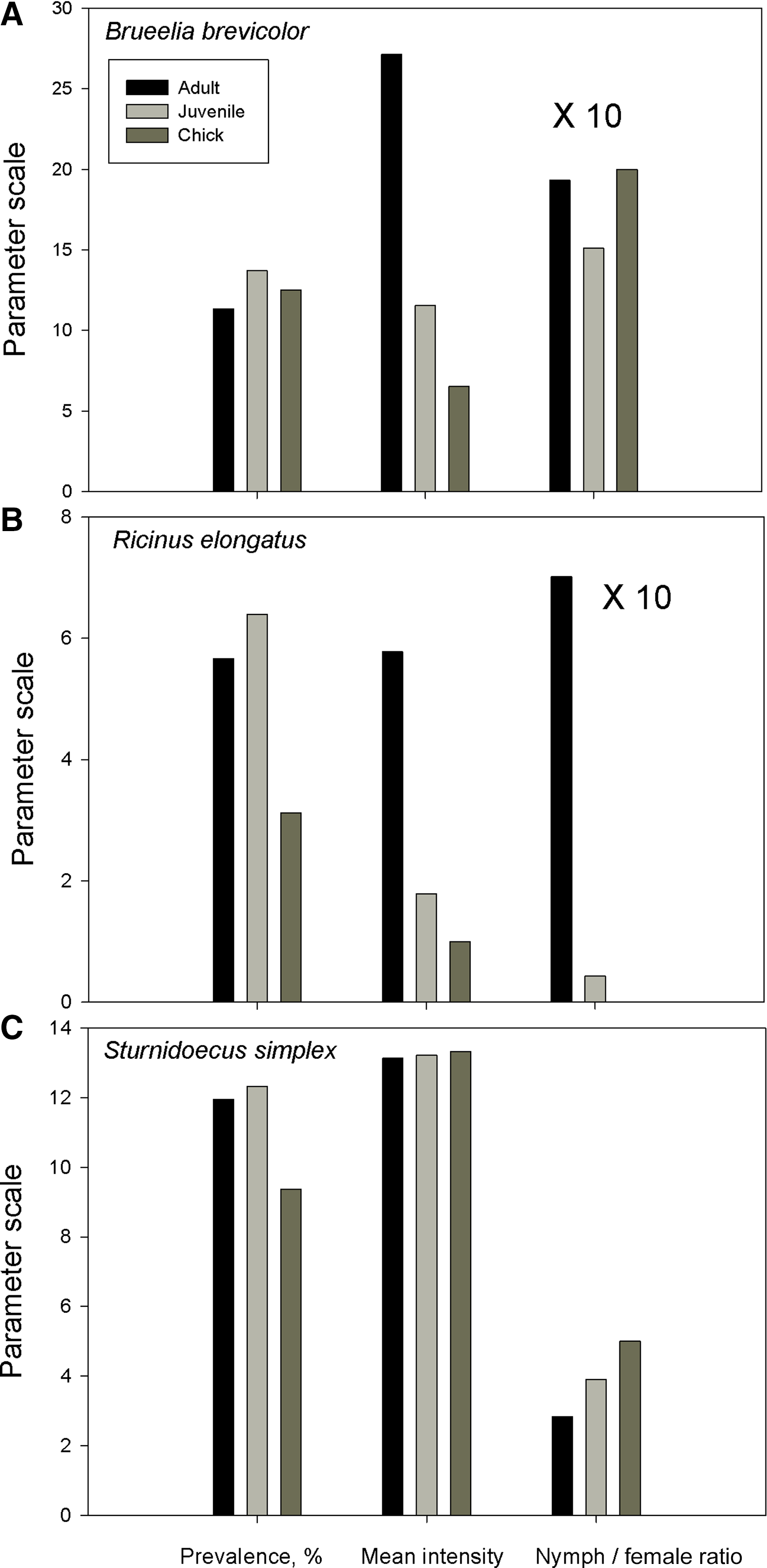
For American robin, lice on chicks, juveniles, and adults were assessed separately. As expected, the mean mass of these birds increased with age, supporting the division into age classes (Table 4). The prevalence of total lice on the three age groups did not differ appreciably or significantly among the three age classes, and although mean intensity tended to increase with age class, these apparent differences were not significantly different (P > 0.05; Table 4). When the three common species of lice were considered separately, the patterns of occurrence of lice on the three host age classes were specific to the louse species (Fig. 1). The most abundant louse, B. brevicolor, had similar prevalence and nymph–female ratio on the three age classes of host, but mean intensity was lower on juveniles and lowest on chicks compared to adults (Fig. 1A). The pattern for mean intensity was similar for R. elongatus, but few nymphs were found on juveniles, and none were found on chicks (Fig. 1B). In contrast, mean intensity for S. simplex was similar on the three age classes, and the nymph–female ratio increased from adults to juveniles to chicks (Fig. 1C). Lice of all species dispersed from adults to chicks in the nest; S. simplex did so in the greatest numbers. Nymphs of B. brevicolor and S. simplex were among the dispersers, and based on the nymph–female ratio, S. simplex nymphs made up the preponderance of dispersers. Nymphs of R. elongatus appeared to be less successful dispersers than those of the other two species, but this observation may be a function of the small number of nymphs on adult robins.
Comparisons of infestation parameters for total chewing louse infestation for American robin (Turdus migratorius) by host age in Manitoba, 1993–2019.

* Comparison of prevalences using Fisher’s exact test, two-sided P-value.
† Mean intensity and mean abundance compared using bootstrap two-sample t-test, two-tailed P-value based on 1000 replications.
‡ Numbers within columns not significantly different (P > 0.05) if followed by the same letter.
Prevalence (percentage of birds infested), mean intensity (mean number of lice on infested birds), and ratio of nymphs to females for three species of lice (Phthiraptera), A, Brueelia brevicolor, B, Ricinus elongatus, and C, Sturnidoecus simplex, on three age classes of Turdus migratorius: adults, juveniles, and chicks, 1993–2019. Note that one parameter (nymph to female ratio) is scaled for two of the louse species (multiplied by 10) so that heights of the bars are legible on a single axis.

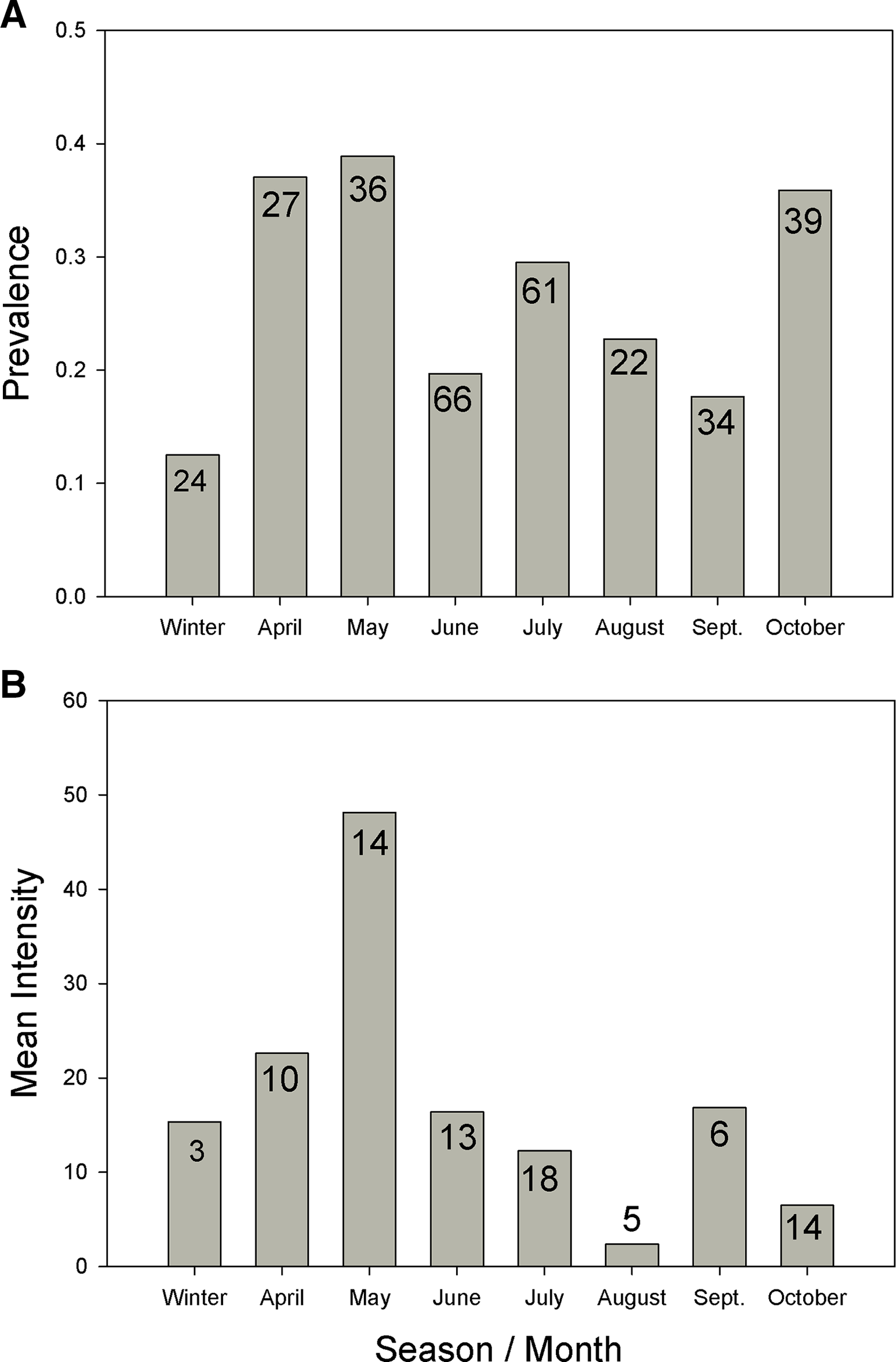
Adult robins that overwintered in Manitoba had the lowest louse prevalence of the year (Fig. 2). In April and May, when most migrants returned, prevalence and mean intensity were at their highest values for the year, with louse mean intensity declining through summer and into the migration period in September and October (Fig. 2).
A, Prevalence (proportion of birds with lice). B, Mean intensity (mean number of lice on infested birds) of lice on Turdus migratorius in winter (November–March) in comparison to other months in Manitoba, 1993–2019. Numbers in the bars indicate sample size of birds; only adult specimens with precise collection dates were included (N = 309).

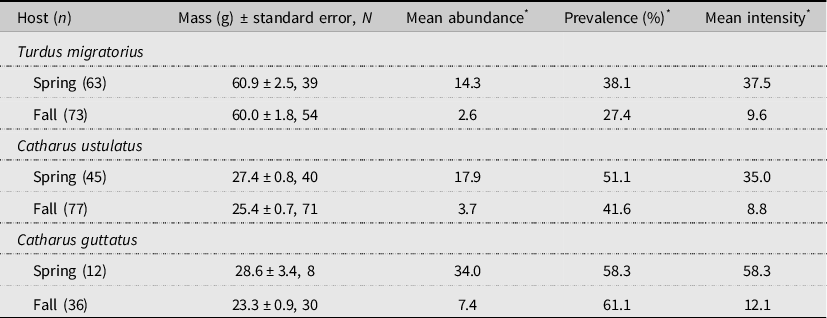
Few Catharus specimens were collected except during migration in spring (April, May, and June) and fall (September and October). Louse abundance on Swainson’s thrushes and hermit thrushes could only be compared with that of American robins for these two migration periods. All three species showed a higher mean abundance of lice when arriving in spring than they did when departing in the autumn, although the difference did not reach statistical significance in a two-way analysis of variance of mean abundance (Table 5). This apparent seasonal difference reflected higher values for prevalence in spring than in the fall for American robin and Swainson’s thrush but not for hermit thrush, although the prevalence did not differ between spring and fall for the three species (Table 5). Mean intensity of louse infestation, however, was higher in spring than in fall (Table 5), explaining most of the apparent difference in abundance between spring and fall.
Comparisons of host mass, mean abundance, prevalence, and mean intensity of infestation by chewing lice populations during spring (April–May) and fall (September–October) migration for adults of three thrush species (Turdus migratorius, Catharus ustulatus, and Catharus guttatus) in Manitoba, 1993–2019.

* Two-way analyses of variance by host species (2.5 df) and season (1.5 df) for mean abundance: species – P = 0.27, season – P = 0.06; prevalence: species – P = 0.07, season – P = 0.31; mean intensity: species – P = 0.37, season – P < 0.04.
On American robin, the three common species (85% or more of the lice) were almost four times more abundant in spring than in fall. The difference was due to declines over summer for B. brevicolor from 6.6 to 0.4 lice per bird and for R. elongatus from 0.6 to 0.2 lice per bird. In both species, the declines for females were greatest, leading to increases in the male–female and juvenile–female ratios. The abundance of S. simplex was similar in spring and fall. On Swainson’s thrush, the three common species (more than 99% of the lice) were almost five times more abundant in spring than in fall. The difference was due to a decline in the dominant species, G. antiqua, from 15.1 to 3.0 lice per bird, with similar declines for males, females, and juveniles. The other two common species on Swainson’s thrush, M. incerta and Philopterus sp., had similar abundance in the two seasons. Too few host specimens of hermit thrush and grey-cheeked thrush were available to consider any seasonal changes in the abundance of individual louse species.
The three Catharus species that hosted chewing lice were similar in size, measured as mass, and about half the size of T. migratorius (Table 1). These differences in body size among hosts had no consistent effect on louse infestation, however. The larger American robin might be expected to support more lice but had the same louse prevalence as C. minimus, which was about half the prevalence for C. guttatus and C. ustulatus, and all four species had similar mean intensities for total lice (Table 3). A similar pattern was evident when only adult hosts were considered and the comparison was restricted to birds collected in spring or fall (Table 5), with no evidence that the larger host supported more lice than smaller hosts did. Within species, where sample sizes were adequate, the sizes of birds with and without lice were similar: for T. migratorius (no lice: 59.6 g ± standard error 1.3, N = 113; with lice: 58.7 g ± standard error 2.7, N = 34) and for C. ustulatus (no lice: 25.5 g ± standard error 0.6, N = 68; with lice: 26.8 g ± standard error 0.8, N = 56). No relationships were detected between the size of individual birds and the intensity of lice on that bird, for T. migratorius (intensity = 7.5 + (0.4 × mass, g), N = 34, P = 0.48) and for C. ustulatus (intensity = 15.9 + (0.5 × mass, g), N = 56, P = 0.90). For these thrushes, the size of the host played no detectable role in louse infestation.
Discussion
This study includes the greatest number of hosts – 774 – to be examined for lice in any one study on birds in this family, spanning the longest period of continuous collection. All species of turdids known to breed regularly in Manitoba have been examined, although sample sizes for veery, grey-cheeked thrush, eastern bluebird (see review of parasites of eastern bluebird by Carleton et al. Reference Carleton, Mertins and Yabsley2012), and mountain bluebird were too small to estimate infestation parameters. Louse data collected from these four hosts provide host records for their lice in the province. Most birds in this study were American robins; the distribution of robins in southern Manitoba and their abundance in urban areas assured they were the dominant thrushes submitted to wildlife rehabilitation hospitals. Sample sizes for two species of Catharus thrushes were sufficient for quantitative assessment, but few previous studies with infestation parameters are available for comparisons with the Manitoba observations. It is worth noting that the Catharus thrushes (e.g., Outlaw et al. Reference Outlaw, Voelker, Mila and Girman2003; Winker and Pruett Reference Winker and Pruett2006; Topp et al. Reference Topp, Pruett, McCracken and Winker2013; Everson et al. Reference Everson, McLaughlin, Cato, Evans, Gastaldi and Mills2019) and their chewing lice (Bueter et al. Reference Bueter, Weckstein, Johnson, Bates and Gordon2009) have been the focus of recent evolutionary studies.
American robin is a widespread and abundant migrant in Manitoba. Most leave the province on fall migration in October–November, but very small numbers may attempt to overwinter. These birds rarely survive after December unless they have access to suitable food resources (Krueger and Taylor Reference Krueger and Taylor2003). Birds return to the province in March–April, sometimes reportedly in large flocks. Robins in southern Manitoba typically have two broods; nest construction begins in April, and some birds will have up to three broods (Krueger and Taylor Reference Krueger and Taylor2003). Higher levels of prevalence and intensity of infestation coincide with the arrival of the birds from migration and the onset of breeding.
Overall infestation of American robin with chewing lice in Manitoba was lower than expected based on other studies of this host, although one Manitoba robin was infested with an exceptional 245 B. brevicolor. Wheeler and Threfall (Reference Wheeler and Threlfall1986) reported 61% of American robins (N = 18) collected during June and July 1984 in Newfoundland were infested with four species of lice, with a mean intensity of 24.6, compared with 24% prevalence and mean intensity of 16.7 in Manitoba. Similarly, Girard et al. (Reference Girard, Goldberg and Hamer2011) found 60% of American robins (N = 25) in Chicago, Illinois, United States of America to be infested with lice. Wheeler and Threfall (Reference Wheeler and Threlfall1986) collected lice using a fumigation technique, with no indication that birds were ruffled. Girard et al. (Reference Girard, Goldberg and Hamer2011) examined birds by visual inspection, reporting hosts as either infested or uninfested, and they did not collect or identify any lice. The sampling methods used in both studies would underestimate levels of infestation relative to our study, in which birds were washed (Clayton and Drown Reference Clayton and Drown2001). Despite the higher efficiency of sampling in the present study, overall louse prevalence in Manitoba was about half that observed in Newfoundland and Illinois, and the mean intensity was about two-thirds that in Newfoundland. In Manitoba, all five species of lice known to infest American robin (Price et al. Reference Price, Hellenthal and Palma2003) were collected, whereas Wheeler and Threlfall (Reference Wheeler and Threlfall1986) collected four. Admittedly, R. elongatus was collected infrequently in our study, and the species was not reported in Newfoundland, perhaps because of low prevalence combined with small sample size. As in Newfoundland, the prevalence and intensity of infestation by amblyceran lice were much less than for ischnocerans, the former of which were rarely collected in Manitoba. This result is opposite to what Lindell et al. (Reference Lindell, Gavin, Price and Sanders2002) and Llanos-Soto et al. (Reference Llanos-Soto, Córdoba, Moreno, Kinsella, Mironov and Cicchino2019) found for the prevalence on two species of Turdus in Costa Rica and on Turdus falcklandii Quoy and Gaimard in Chile, respectively.
Several other studies, in addition to Lindell et al. (Reference Lindell, Gavin, Price and Sanders2002), have reported infestation parameters for chewing lice on Turdus spp. Ash (Reference Ash1960) and Baum (Reference Baum1968) in England and Germany, respectively, examined common blackbirds, T. merula, for chewing lice. In both studies, the overall prevalence of infestation, about 61% in England and 37% in Germany, exceeded the prevalence of infestation of American robins in Manitoba. Similarly, Galloway (Reference Galloway2005) reported that about 50% of the introduced T. merula and song thrushes, T. philomelos, were infested with lice in New Zealand, also greater than the prevalence of infestation of American robins in Manitoba. The prevalence of louse infestations of T. merula and T. philomelos in the Czech Republic, with the exception of Philopterus turdi (Denny), was higher than what we observed for T. migratorius (Sychra et al. Reference Sychra, Literák, Podzemný and Benedikt2008).
The timing of dispersal of lice to T. migratorius was revealed by comparing the numbers of adult lice and nymphs on chicks and juveniles, compared to those on adult birds. Lice quickly infested chicks in the nest, as evidenced by a prevalence for lice on chicks that was close to that for adult hosts, although the mean intensity of lice on juveniles was less than half of that on adults for both B. brevicolor and R. elongatus. Based on nymph–female ratios, both B. brevicolor nymphs and adults dispersed at a similar rate to chicks. This is contrary to the findings of Brooke (Reference Brooke2010), who observed that nymphs of Brueelia merulensis (Denny) and Philopterus turdi (Denny) were more abundant on nestlings than on their parents. Nymphs of R. elongatus never occurred on chicks in the present study, and nymphs of S. simplex were more numerous on chicks than adult lice were. Dispersal to young birds, presumably while still in the nest, by S. simplex was particularly effective, with chicks, juveniles, and adult robins having similar mean intensities of this species. Baum (Reference Baum1968) commonly found chicks of T. merula to be infested in the nest by R. elongatus, indicating this louse species does disperse to chicks of some hosts. The timing of dispersal of lice to other thrush species is unknown.
Infestation parameters for lice infesting Catharus thrushes have rarely been reported previously. Wheeler and Threlfall (Reference Wheeler and Threlfall1986) examined 14 grey-cheeked thrushes, in which the prevalence and intensity of infestation were somewhat lower than what we found for this host in Manitoba, although strict comparisons are problematic because of different collecting techniques and the way in which Wheeler and Threlfall (Reference Wheeler and Threlfall1986) presented their data. They examined only one Swainson’s thrush, which was infested with three Brueelia zeropunctata (= G. antiqua; see Gustafsson and Bush Reference Gustafsson and Bush2017). Oniki (Reference Oniki1990) examined two specimens of veery in April in Brazil, both of which were infested with a Brueelia sp. (likely = Guimaraesiella sp.). In Manitoba, the only specimen of veery examined in the present study had no lice. Kounek et al. (Reference Kounek, Sychra, Capek and Literák2013) reported on Myrsidea spp. infesting several species of Turdidae in Costa Rica, but they did not include data on other species of lice present. All species of hosts examined in their study are nonmigratory, and all have relatively restricted Neotropical breeding ranges.
Louse populations show seasonal patterns of abundance on some bird species (Galloway and Lamb Reference Galloway and Lamb2021), with the pattern more evident for mean intensity than for prevalence (Galloway and Lamb Reference Galloway and Lamb2015). For all three species of Manitoba thrushes, American robin, Swainson’s thrush, and hermit thrush, where sample size was sufficiently large, migrating birds arriving in spring carried more lice than those migrating south in autumn. This seasonal difference was largely due to a higher mean intensity in spring than in autumn. Some migrant American robins begin arriving in Manitoba in March, earlier than other thrush species, and begin nesting as early as April, although the migration continues through at least April (Carey et al. Reference Carey, Christianson, Curtis, de March, Holland and Koes2003). Therefore, we could not distinguish arriving spring migrants from those in the early phases of breeding, and spring collections were likely a mix of migrants and early breeding birds. For Swainson’s thrush and hermit thrush, however, all specimens would have been migrants, because these species nest in the boreal forest further north than where the majority of them were collected in Winnipeg, Manitoba. For all three species, the data are consistent with the hypothesis that populations of lice expand on the wintering grounds and then decline over summer in Manitoba. For American robins that winter in Manitoba, however, mean intensity does not increase, and the prevalence actually drops to its lowest level for the year, suggesting louse populations benefit from some aspect of the wintering grounds but not during winter in Manitoba. This seasonal pattern is consistent with that of European starling (Sturnus vulgaris Linnaeus) (Markov Reference Markov1940) and T. merula (Baum Reference Baum1968). A decline in mean abundance over summer may be caused by a dilution of infestation resulting from lice dispersing from parents onto chicks (Markov Reference Markov1940; Baum Reference Baum1968). Markov (Reference Markov1940) and Baum (Reference Baum1968) believed loss of feathers bearing louse eggs during the moult has an important impact on infestation levels in autumn. The impact of moulting on louse populations is far from clear (Moyer et al. Reference Moyer, Gardiner and Clayton2002), and detailed research is needed before this question can be answered satisfactorily.
In almost all cases, the sex ratio of male to female lice for Manitoba thrushes was less than 1.0, regardless of whether the lice were Amblycera or Ischnocera, as often observed for chewing lice on passeriform birds (Marshall Reference Marshall1981; Clayton et al. Reference Clayton, Gregory and Price1992; Galloway and Lamb Reference Galloway and Lamb2021). The sex ratio in R. elongatus was particularly low: out of 89 adult lice collected from 570 American robins, only eight were males. A low sex ratio appears to be typical for the genus (Rheinwald Reference Rheinwald1968; Nelson Reference Nelson1972). Nelson (Reference Nelson1972) reviewed hypotheses about the scarcity of males of Ricinus spp. He did not support the occurrence of parthenogenesis, as had been suggested by Eichler (Reference Eichler1963), largely on the apparent rarity of this reproductive strategy in chewing lice, especially those infesting birds. He suggested the rarity of males in collections may be in part because of the smaller size of males and that males are easily missed, depending on the collecting method. In the present study, all birds were washed, so the biased sex ratio is unlikely to be the result of males being missed. Nelson (Reference Nelson1972) more strongly supported the hypothesis that the biased sex ratio was the result of differential mortality, as demonstrated by Baum (Reference Baum1968). The additional possibility of the sex ratio being affected by Wolbachia infection cannot be dismissed (Kyei-Poku et al. Reference Kyei-Poku, Colwell, Coghlin, Benkel and Floate2005). Although the number of males collected in the present study was small, they were collected from robins in April, May, July, and September. Detailed research is needed before this question can be fully addressed.
Ricinus elongatus is also unusual compared to other lice infesting thrushes in that its nymph–female ratio is low – 0.51 in this study. In all other species of lice where sample size was adequate, this ratio always exceeded 1.0. The reason for this difference is unknown. Unfortunately, this ratio is not always reported in the literature for Ricinus spp., and these species are often poorly represented in surveys because of their relatively low prevalence and intensity of infestation. On the most heavily infested blackbird in Baum’s (Reference Baum1968) study, he found 15 females and only 11 nymphs. Sychra et al. (Reference Sychra, Literák, Podzemný, Harmat and Hrabák2011) collected seven females and three nymphs of R. elongatus from three of 21 blackbirds examined in the Czech Republic. Dik and Dinçer (Reference Dik and Dinçer2012) also collected R. elongatus from blackbirds in Turkey; four of these R. elongatus specimens were females, and three were nymphs. In a study of louse infestations in birds in Brazil, Enout et al. (Reference Enout, Lobato, Diniz and Antonini2012) collected small numbers of Ricinus spp. on six species of passerines: on all but one host, females outnumbered nymphs. Halajian et al. (Reference Halajian, Sychra, Luus-Powell, Engelbrecht and Papousek2014) reported a low nymph–female ratio for Ricinus mugimaki (Uchida) infesting two species of robin-chats (Cossypha Vigors spp.) in South Africa. Valan et al. (Reference Valan, Sychra and Literák2016) found five species of passerines in Central and South America infested with Ricinus spp. using a fumigation technique for collecting lice. Of these hosts, numbers of nymphs of Ricinus were equal to or less than the number of females for three species of hosts. A notable exception was one specimen of red-eyed vireo, Vireo olivaceus (Linnaeus), infested with three females of Ricinus vireoensis Nelson and seven nymphs. It is possible in some studies that the low nymph–female ratio can be attributed to sampling techniques, but this is not the case in the present study. Reproductive output in many Ricinus spp. may be lower than for females in other families of chewing lice, or perhaps mortality in nymphs is unusually high. Ricinus spp. are primarily blood feeders (Nelson Reference Nelson1972). This opens up the possibility that reproduction can be affected by hormones present in a host’s blood, as suggested by Foster (Reference Foster1969) for R. picturatus (Carriker) infesting orange-crowned warblers (Leiothlypis celata (Say)). The extent to which this occurs and to which it affects the presence and numbers of nymphs requires further investigation.
The chewing lice that infest species of Turdidae offer excellent opportunities for comparative ecological investigation. Many species in this family of birds are abundant and widespread, with species, such as the common blackbird (T. merula) and song thrush (T. philomelos), that have been introduced into distant countries, alongside some species of their chewing lice (e.g., Australia and New Zealand; Palma and Barker Reference Palma and Barker1996; Palma Reference Palma2017). Turdids share the same genera and, in some cases, the same species of lice, allowing for interesting host–parasite comparisons. It is surprising that more extensive study of some of these species – the American robin, for example – has not been done. Relatively low population size is one characteristic of chewing lice on American robin in Manitoba, with a mean abundance of four lice per bird, compared with 7, 19, and 23 on Catharus species. For other Manitoba birds of similar size to robins, such as common nighthawks, two woodpecker species, and the northern saw-whet owl, louse populations have mean abundances of 8, 28, 54, and 10 lice per bird, respectively (Galloway and Lamb Reference Galloway and Lamb2015, Reference Galloway and Lamb2016; Lamb and Galloway Reference Lamb and Galloway2019). We suggest additional studies on Turdidae will provide important data to allow researchers to make broadly based comparisons across diverse geographic and environmental ranges.
Acknowledgements
This research could not have been completed without the assistance of many technical staff and students in the Department of Entomology to wash birds, in particular, Dave Holder and Lisa Babey. The authors thank the staff at the Wildlife Haven and Prairie Wildlife Rehabilitation Centre for the care with which they assessed and processed the birds available for our research. Paula Grieff (Oak Hammock Interpretive Centre, Stonewall, Manitoba) also provided specimens for this study. Spencer Sealy (Department of Biological Sciences, University of Manitoba) provided instruction for separation of Swainson’s from grey-cheeked thrushes; Canadian Wildlife Service, Environment and Climate Change Canada provided research permits to possess and process birds in this study. The authors also thank anonymous reviewers for their helpful comments. This research was funded in part by grants from the National Sciences and Engineering Research Council of Canada and the Sustainable Development Innovations Fund (Manitoba Conservation). Zoe Rempel was the recipient of an Undergraduate Summer Research Assistantship from the National Sciences and Engineering Research Council of Canada. The authors especially thank the Department of Entomology and the Faculty of Agricultural and Food Sciences, University of Manitoba for their continued support.