INTRODUCTION
Anyone who comes to the United States with open eyes cannot fail to be moved by the racial/social inequalities here. It's the elephant in the room. To make work here, and not take that into account seems to me plainly ridiculous, and it makes you part of the problem.
Paul GrahamFootnote 1How can photography be used to address a state of social blindness? How does it render the invisibility of “the elephant in the room” visible? This article considers how the British photographer Paul Graham's first United States photobook American Night (2003) tackles this visual and political problem through a combination of topographical, typological and phenomenological approaches. Such strategies, which are emphatically combined here, are recurring features of Graham's photographic language, transformed from body of work to body of work, and forged in response to and dialogue with a complex American and European history of photographic representation and experimentation.Footnote 2 On a thematic level, Americans Night continues a series of questions already present in Graham's previous books. As Val Williams notes, Graham's interest in the “fissures and pressure points” of society, and his “fascination with seeing, of the partiality of sight, of the personal nature of vision, [resonates] throughout his works of the 1990s.”Footnote 3 In American Night, Graham brings these themes and questions to the foreground while developing a more specific dialogue with an American photographic tradition of representing the nation, its social–racial divide and the urban landscape more widely.
The book is composed of a series of almost white, overexposed photographs of roadsides on the outskirts of different cities, in which a single African American or Hispanic person is seen in the distance. At first glance, these photographs seem to have lost their colour and almost disappear into whiteness. These bleached-out images are then periodically interrupted by and contrasted with a single full-colour photograph of a new middle- to upper-class Californian house, often shown with one or more brand-new cars parked in front of it. At the centre of book, the sequence shifts to a number of dark photographs made in New York's inner city, in which African American and Hispanic people are seen at close range and most often in a state of struggle. Then it is as if the sequence reemerges into a further series of almost invisible, bleached photographs of various outskirts, which are once again punctuated by and contrasted with a full-colour photograph of a Californian house and its car(s). The locales thus suggest a certain geographical dimension of the United States from coast to coast.
At the beginning of the book, Graham quotes from Herman Melville's Moby-Dick (1851). It is a fragment that focusses on “a curious and most puzzling question [that] might be started concerning this visual matter as touching the Leviathan.”Footnote 4 The quote draws our attention to the relationship between vision and consciousness, more specifically on the fact that when one focusses one's gaze “in such a manner as to bring your mind to bear on it, [another thing] will be utterly excluded from contemporary consciousness.”Footnote 5 This “treatise” on the act of seeing and the reference to the white whale and the Leviathan characterize American Night on various levels. According to Graham it resonates with the “blinding white pictures, [and] refers to being in the belly of the beast, … a perfect metaphor for being and traveling in America now.”Footnote 6 For Graham, what are also “especially relevant here are issues of monomaniacal blindness in a human being and how chasing one thing obsessively can drive you to destruction.”Footnote 7 What is evoked here is a parallel between the way in which sight and consciousness play a central role in the fictional character's obsession and psychological blindness and the way in which issues of sight and consciousness underscore the type of social blindness that Graham diagnoses in his book. He has – as he states himself – “always been interested in notions of sight, seeing, and blindness … [and] American Night is primarily about blindness – willful or psychological blindness.”Footnote 8
In this sense, the relationship between “being in the belly of the beast,” various states of invisibility and the idea of blindness as a wilful psychological condition that extend beyond the individual and into society is crucial for Graham. As Val Williams notes, American Night is an “highly parabalistic and many-layered body of work.”Footnote 9 This article will focus on how some of those layers extend into Graham's use of various topographical, typological, and phenomenological approaches to the American city, and its social and racial problems.Footnote 10 It will also question what Graham exposes and illuminates in the process.
WALKING AS A SPACE OF ENUNCIATION
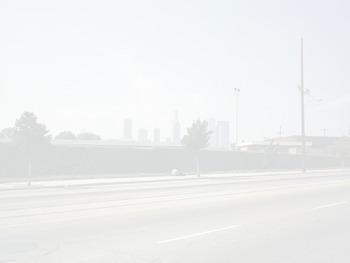
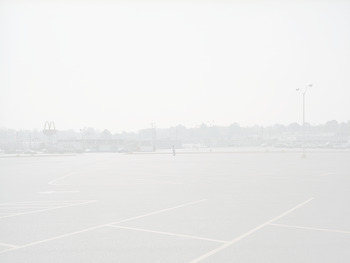
The photographs themselves are noticeably large in the book, most of them placed on the right-hand side of the double spreads – except for the central section – and are framed by a white border. This induces a physical and spatial dimension to the experience of looking, a sense of moving forward in space and a certain level of distanciation. All the photographs are views of the American urban landscape seen from street level, from a viewpoint that could be located in the figure of a walker moving along the sidewalks of American cities. In the almost-white and nearly invisible photographs, the presence of a walker is subtly suggested through a series of clues, which include the constant presence of a section of the road or of a sidewalk in the foreground of each photograph, a slight obliqueness of the compositions, and a tension between a sense of proximity and distance, between a here – the sidewalk, the pavement, the parking lots, etc. – and a there – the urban landscape and the lone person who is barely visible in the distance centred within each photograph (Figures 1 and 2).
Man on Sidewalk, Los Angeles, 2000. © Paul Graham; courtesy Pace/MacGill Gallery, New York.

Man Walking in Car Park, Memphis, 2000. © Paul Graham; courtesy Pace/MacGill Gallery, New York.

This presence is also suggested almost halfway through the book in a sequence of three photographs in which people in the distance are looking back at the walker: Man with Lumber Yard Looking Back, Memphis, 2000, Man at Cross Road Looking Back, Memphis, 2000, Woman Looking Back, San Antonio, 2002. These gazes appear when the photographic sequence approaches the inner city and the eventual encounters with people, and function as a series of acknowledgements or even interpellations of the viewer.
In the dark photographs that make up the centre of the book, the presence of a walker becomes explicit in different ways. The people who were previously seen from a distance are now in close proximity, so close that the photographs contain traces of an almost physical encounter. With regard to these photographs, David Chandler notes that
part of what was so disconcerting about these photographs, part of the almost startled view of the street that Graham asks us to share in, is that the act of looking is in itself bound up with a sense of discomfort. As Graham quickly reacts to the people around him, his lens loosely framing or drawing us close to them, the operation of his camera in these pictures is comprehended as an immediate, felt response to the physical conditions of the street.Footnote 11
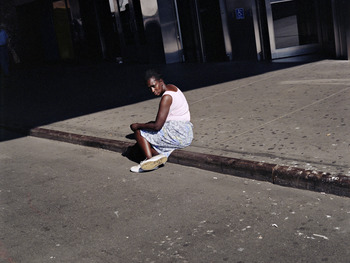
The “sense of discomfort,” the “felt response to the physical conditions of the street,” imply the presence of the walker, of the seer, and it is made incontestable in the third photograph of the central section when a woman stares straight back at the viewer, Woman Sitting on the Sidewalk, New York, 2002 (Figure 3).
Woman Sitting on Sidewalk, New York, 2002. © Paul Graham; courtesy Pace/MacGill Gallery, New York.

These tensions between a here and a there, together with the traces of the presence of the walker/seer, could be defined as a photographic form of enunciation. While the act of enunciation refers to subjectivity within language, to the appropriation and activation of language by a speaker, to the here and now of the act of speaking, a photographic form of enunciation can also be discerned.Footnote 12 It is evoked by the act of walking itself, in the path traced by the walker together with the content of the photographs and their sequencing. According to Michel de Certeau, walking within the city can be considered as “a space of enunciation” and a form of writing as well:Footnote 13
The act of walking is to the urban system what the speech act is to language or to the statements uttered.[Footnote 14] At the most elementary level, it has a triple “enunciative” function: it is a process of appropriation of the topographical system on the part of the pedestrian (just as the speaker appropriates and takes on language); it is a spatial acting-out of the place (just as the speech act is an acoustic acting-out of language); and it implies relations among differentiated positions, that is, among pragmatic “contracts” in the form of movements (just as verbal enunciation is an “allocution”, “posits another opposite” the speaker and puts contracts between interlocutors into action). It thus seems possible to give a preliminary definition of walking as a space of enunciation.Footnote 15
De Certeau goes on to identify the essential elements that support the parallel between linguistic and pedestrian enunciation. These are “indicators” of enunciation and establish the relationship between a here and a there, the present appropriation of space by an “I,” and the introduction of the other walkers in relation to that “I.”Footnote 16 All these indicators can be seen at work in American Night. The here, the appropriation of space by the “I,” is evoked in the foreground of every overexposed picture through the constant reoccurrence of the pavement – sidewalks, roads, parking lots, and so on. The there is made up of a variable number of elements in the distant urban and postindustrial landscapes, such as the skyscrapers in Man on Sidewalk, Los Angeles, 2000 (Figure 1), or the McDonald sign in Man Walking in Car Park, Memphis, 2000 (Figure 2). In addition, the there is also constituted by the individual figures at the centre of the landscapes, who introduce “an other in relation to [the] ‘I.’”Footnote 17
At the centre of the book, the other – seen at a significant distance in the preceding images – is now brought closer, within the sphere of the here, close enough for the “I” to establish an almost physical contact. As it is possible to think of “walking as a space of enunciation,” de Certeau suggests that “there is a rhetoric of walking” and that “the art of ‘turning’ phrases finds an equivalent in an art of composing a path.”Footnote 18 The overall structure of American Night suggests the composition of such a path. The following section will thus consider how we might read the traces of this walker's movements: what kind of enunciation is suggested through this trajectory, its pauses, and the different levels of exposure and visibility?
MAPPING THE AMERICAN CITY
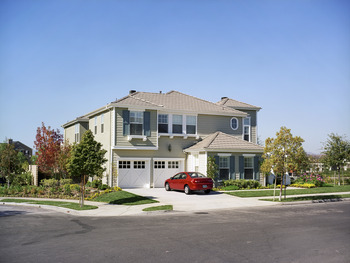
In American Night, the walker's path transits through three different zones, in terms of both the typology of the urban landscapes and their visual representation. Within the structure of the book, these zones are arranged to form a particular pattern, which is repeated, with slight variations. As mentioned previously, several series of overexposed and almost white photographs of roadsides are occasionally punctuated by a full-colour photograph of a high-value residential home and car(s) (Figure 4).
Large House with Dodge, California, 2002. © Paul Graham; courtesy Pace/MacGill Gallery, New York.

At the centre of the book, Graham places a continuous strip of dark images of mostly African American people in the inner city, and then a further series of almost invisible roadsides, which are once again punctuated with the appearance of another high-value property in full colour. Considering the overall sequence from a bird's-eye view and considering the spatial, typological and geographical dimensions that are at play, one could argue that what is evoked through this zoning is a sort of map.Footnote 19 A map in which, as Karen Rosenberg notes, “Graham emphasized the geographical fragmentation and socioeconomical stratification of American life.”Footnote 20 Graham has stated that the cities where he made the almost white photographs were selected to encompass a certain geography: “the locations in American Night were basically along the compass points across the United States … It wasn't about one location; it was about something pervasive.”Footnote 21 As it is impossible to determine where a particular image was made without referring to the captions, which are printed in white at the end of the book, all the photographs seem to represent the same city. They are compounded into the composite image of a city, a visual synecdoche of the American city as a series of fragments or parts that stand for and build up an image of the whole.
The photographs depicting the inner city have all been made in New York, or greater New York, and can also be considered as a synecdoche, as they stand for and evoke a multitude of inner-city areas in America. In a similar way, the photographs of the new houses, which have all been made in California, in turn seem to stand for the type of secluded and privileged suburban or exurban developments located on the outskirts of American cities. By locating various zones within the structure of the book, a hypothetical map or topography of the American city emerges.
As the centre of the book is made of a series of photographs of the inner city, which are surrounded by several layers of almost white and invisible photographs of roads and peripheral urban spaces, it could be argued that the map suggested in American Night has a concentric dimension, a dimension that indicates a movement of expansion from the centre to the peripheries and the countryside.Footnote 22 In these terms, the omnipresent motif of the sidewalk and the road, including the freeways, highways and related sites, acts as a sort of ring-like or web-like system of lines, both encircling and connecting the centre to various peripheral suburban or exurban areas. These roads, these lines, trace the city's expansion, or, as Lewis Mumford puts it, the city's explosion, which, as he argues, has been the result of mechanical and technological inventions of our time, in particular the automobile:
We live in fact in an exploding universe of mechanical and electronic invention, whose parts are moving at a rapid pace ever further and further away from their human center, and from any rational, autonomous human purposes. This technological explosion has produced a similar explosion of the city itself: the city has burst open and scattered its complex organs and organizations over the entire landscape.Footnote 23
This process had previously been defined as a form of “conurbation” by Patrick Geddes, who distinguished the historic city from the diffused spreading of urban development through entire provinces and counties.Footnote 24 Building on Geddes, Mumford acknowledges this distinction on the basis that “the overgrown historic city was still, residually, an entity; [and that] the conurbation is a nonentity, and becomes more patently so as it spreads.”Footnote 25 Mumford then integrates these different urban spaces into an overall entity that he calls a “megalopolitan conurbation.”Footnote 26 Seen from this point of view, American Night offers a synthesis of this process, a virtual map of the American city's explosion into a megalopolitan conurbation and the proliferation of an urban space less distinct and more akin to countless nonentities. Graham here offers a contemporary vision of what Guy Debord, after Mumford, saw as a process of self-destruction in which the environment is indelibly marked by and entirely enslaved to the various “requirements of consumption” that mark our contemporary age. According to Debord,
We already live in the era of the self-destruction of the urban environment. The explosion of cities into the countryside, covering it with what Mumford calls “formless masses” of urban debris, is presided over in unmediated fashion by the requirements of consumption. The dictatorship of the automobile, the pilot product of the first stage of commodity abundance, has left its mark on the landscape in the dominance of freeways that bypass the old urban centers and promote an ever-greater dispersal. Meanwhile, instants of incomplete reorganization of the urban fabric briefly crystallize around the “distribution factories” – giant shopping centers created ex nihilo and surrounded by acres of parking space … The technical organization of consumption is thus merely the herald of that general process of dissolution which brings the city to the point where it consumes itself.Footnote 27
Through the proliferation of overexposed and almost white photographs of freeways, highways, roadsides, parking lots and so forth, American Night offers a powerful image of how this process is at work within the American landscape. What Graham also implies is that it has become an almost invisible phenomenon, as the focus of attention is dictated by cars, by shopping centres, in other words, by a society of consumption “crystalized” around those hubs that cater to the distribution of goods. It is not a coincidence that the new houses in American Night have a parking space embodied within them and brand-new cars parked in front of them. Contrary to Mumford's warnings regarding the formlessness of “urban debris” exploding into the countryside, the structure of American Night appears to suggest a concentric map, hinting at an urban explosion that can be mapped in some ways. Indicated through the oversized and horizontal format of the book itself, the dimension and orientation of this explosion hint at the uncontrollability of capitalist expansionism.
In his book Drosscape: Wasting Land in Urban America (2006), Alan Berger notes that at the beginning of the twentieth century, William Gibson prognosticated that the future of the American city would be characterized by rapid horizontal growth.Footnote 28 Berger goes on to define the by-product of this process of rapid urbanization and horizontal growth of the city as “drosscape,” a term that stands for the waste product of economic and industrial processes. These spaces are, for example, “vacant strips along roadways, seas of parking lots, unused land, surfaces awaiting development, dumping grounds, warehouse districts, a seemingly endless stretch of setbacks and perimeters framing housing communities.”Footnote 29 Suggesting that the “building-out of the horizontal city has formed a new frontier across the American landscape,” Berger defines these places as “liminal” zones:
Much of the landscape surface left in the wake of rapid horizontal urbanization is not a clearly defined, stable, and fixed entity. It is between occupancies and uses, successional phases, and (dis)investment cycles. The term in-between describes a state of liminality, something that lives in transition and eludes classification, something that resists new stability and reincorporation. The in-between landscapes of the horizontal city are liminal because they remain at the margins (or limen, which means “threshold” in Latin), awaiting a societal desire to inscribe them with value and status.Footnote 30
In terms of urban design, Berger stresses the potential of these spaces because they provide “a threshold, or platform, for liminal cultural phenomena to play out.”Footnote 31 Thus, as he puts it, “communitas is cultivated.”Footnote 32 In many respects, the almost white photographs in American Night also emblematize this type of landscape and state of liminality. However, in Graham's work, what is suggested is the disintegration rather than cultivation of a sense of communitas. The barely visible people walking in the distance imply that these are spaces characterized by desolation and marginality, spaces in which people are isolated and struggle to move forward and/or to survive.
The size of the photographs, together with their social and geographical dimensions, suggests that the question of space is central to American Night. Edward W. Soja, building on Henry Lefebvre's work on the notion of space, has demonstrated the importance of dialectically positioning it in a triangular relationship which interlinks space with social and historical dimensions.Footnote 33 The importance of this interconnection is underscored by American Night and the nature of the map that it outlines. The types of zones that are laid out also suggest that the city has moved to another stage of development. As the landscapes in the almost white pictures evoke a postindustrial, post-Fordist no-man's-land on the edges of the inner cities, and the pictures of the new houses stand for the type of isolated, and likely secluded, communities in which the socially affluent section of the population live, American Night evokes an image of the contemporary American metropolis going through what Soja calls a “postmetropolitan transition.”Footnote 34 According to Soja, “During the past thirty years the growth of Outer Cities has both decentered and recentered the metropolitan landscape, breaking down and reconstituting the prevailing monocentric urbanism that once anchored all centrifugal and centripetal forces around a singular gravitational node.”Footnote 35 In American Night the process of decentring and recentring is visualized. What we see in Graham's photographs of the outer city is very similar to Soja's descriptions of the emptied-out spaces left by postindustrialism; a no-man's-land in which Graham introduces individual figures left behind by the new forms of industrialization. Graham's map of the postmetropolitan American city is therefore emphatically characterized by a series of contrasts, a dialectic between topographical, spatial, social/racial dimensions and the levels of exposure and visibility within each zone.
THE DIALECTIC MAP OF THE AMERICAN CITY
From a topographical point of view, the three different zones suggest a dramatic sense of geographical, social and racial division. Within the architecture of the book the overexposed and almost white photographs refer to the transit lines connecting the city centre, its financial headquarters and its skyscrapers – as hinted at in the first photograph, Man on Sidewalk, Los Angeles, 2000 (Figure 1) – and the isolated wealthy houses. On the margin of this massive environment solely built for the car owner, the pedestrian underclass is slowly walking on its fringes, walking long distances to go to work and return home or to buy supplies. Others, seemingly unemployed and homeless, appear to wander aimlessly, or looking for something to survive. Collectively, these men and women seem to be embarked on an epic journey across a vast landscape, endlessly walking like Sisyphean figures, at times staggering, sitting, waiting and then walking again through the harsh space of the outer city. Moving through the debris of postindustrial wastelands, they seem to exist on the margins of a society of consumption to which they have no access. This society of consumption and its social dimensions are embodied by the photographs of new houses, in which wealth, abundance and security seem to be unreachable to the people on the streets. What is at stake here is both the reality of how the American upper class lives, and how they live the “American Dream” in a state of geographical and social separation from the rest of society.
Chandler suggests that Graham “position[s] race at the heart of those divisions.”Footnote 36 This seems clearly supported by the way in which the central part of the book is dedicated to photographs of African American and Hispanic people. What is thus suggested through this zoning is the survival of social and racial segregation, a segregation that is conveyed almost structurally, then – embodied in the actual infrastructure of the landscape.Footnote 37 The reality of what Graham describes has also been repeatedly researched and exposed at an institutional level; the damning 1968 report of the National Advisory Commission on Civil Disorders – known as the Kerner Commission – which President Lyndon B. Johnson appointed to investigate the causes of the 1967 race riots in the United States, strongly suggested that one of the main causes of the riots was rooted in African American reactions to white racism, segregation, poverty and lack of opportunity and that the USA was “moving toward two societies, one black, one white – separate and unequal.”Footnote 38 Thirty years later, roughly at the time when Graham started to work on American Night, the 1998 Milton S. Eisenhower Foundation updated the Kerner Commission reports. Despite improvements, the problems of race, poverty and segregation continue; the racial divide not only persists, but is widening and expanding to new immigrant populations.Footnote 39 According to Soja, such studies demonstrate “that inherent in the new urbanization processes has been an intensification of socio-economic inequalities,” and that cities such as Los Angeles and New York, which are “the extreme cases of the polarization of wealth and poverty in the advanced industrial countries,” contain within themselves a set of “metropolarities.”Footnote 40 In American Night, Graham focusses on how this process of polarization particularly affects African Americans, and how the issue of race appears to be a central factor underlying spatial and social division. In Signs of the Times: The Visual Politics of Jim Crow (2010), Elizabeth Abel hopes that her book
will provoke its readers less to draw comfort from singular breakthroughs of electoral politics than to probe the continuities between the explicit racial laws and signs that traversed a surprisingly large swath of the nation for a surprisingly long time and the more insidious modes and sites of racialization that persist in the twenty-first century, the undeclared color lines that continue to delimit neighborhoods … What modalities of racism still fracture the social landscape after the dismantling of Jim Crow? Where would the racial signs of our times be situated, and what language would they use?Footnote 41
With Abel's “undeclared color lines” in mind, Graham's strategy is to articulate the topographical dimensions of the social/racial contrasts in the American urban environment with another set of contrasts, which operate at the level of perception, most notably between states of visibility and invisibility. Graham thus creates a phenomenological map, which lays out the contrasts between zones of visibility and zones of invisibility in both racial and economic terms. American Night foregrounds the notion of exposure as something that carries both photographic, poetic and political consequences.Footnote 42 The overexposure of the almost white and nearly invisible photographs implies that the film and the retina have been, in a sense, burnt by light. Graham explains that the idea for these photographs emerged from a happy mistake in the darkroom and an optical phenomenon that he experienced one afternoon while coming out of a movie theater:
The first overexposed one was an accident. When I had the print of that, I just left it on the table, gradually looked at it more and more, and realized that it was in fact interesting. Then I started trying to figure out how I could get this effect intentionally … I suffer from the same amount of laziness and procrastination as anyone else, and I remember when I was working in Memphis once I went to a movie in the afternoon. When I came out of the movie into sunlight, my vision was burnt out; there was this blazing afternoon sunshine and I couldn't see anything, and I realized how much that darkroom accident mimicked this optical burnout, which was about invisibility, and just beginning to perceive things.Footnote 43
Graham also recounts that
while completely blinded by the brightness, I noticed this slightly unhinged guy shouting to himself as he walked across the car park. And I realized how amazing this whole scene was. With my overwhelmed, burnt-out vision, this poor man appeared to be crossing a wasteland of whiteness, unnoticed by the world.Footnote 44
This “burnt-out vision” is thus echoed by the fact that what is barely perceived is a “wasteland,” burnt-out liminal spaces, whose surfaces register the marks of the explosion of the city. The distant figures at the center of the landscapes seem to be, in turn, overexposed to this explosion, to the displacement that it produces – they are forced to walk or wander through “formless masses of urban debris” while, on another level, exposed to the fumes of the speeding cars.Footnote 45 Within the immense landscape built for the sole benefit of traffic, they are also exposed to danger, as suggested in Wheelchair Crossing Highway, Richmond, 2002, in which a barely visible man in a wheelchair is dangerously attempting to cross a highway. Barely visible in the distance, the man's exposure coincides with a sense of separation and disappearance, both visually and literally.
Chandler describes this whiteness as “a blinding haze … We see the landscape as if through fine white muslin.”Footnote 46 For him, the tension ushered in by this state of blindness in front of and confronted by the signs of isolation and vulnerability comes with “a sobering and ironic charge: black people [are] hidden in a cloak of whiteness, small grey shadows in a landscape bleached of colour.”Footnote 47 As Graham “position[s] race at the heart of those divisions,” the social and racial connotations of the state of white blindness seems pertinent.Footnote 48 Graham locates, then, what Abel called the “undeclared color lines” not only at the geographical and spatial level but also within the sphere of perception. What is suggested here is the persistence in the twenty-first century America of what W. E. B. Du Bois saw as the problem of the twentieth century; “the problem of the color-line.”Footnote 49 Du Bois's famous analysis of racial discrimination through the visual image of a “veil” separating white from black Americans strongly resonates with the visual experience inferred in the overexposed photographs.Footnote 50 The veil of whiteness that characterizes various sections of American Night echoes this metaphor and proposes a photographic interpretation in which the problem of the “color line” is inseparable from the problem of perception and representation.
Precisely because the viewer of American Night is asked to notice, to become aware of this veil of invisibility, and to question its causes and ramifications, the veil is made visible and is at times lifted. Graham induces the viewer to do so by periodically contrasting the moments of racial invisibility with the appearance of perfectly visible, full-colour views of isolated new houses and cars (Figure 3). As mentioned previously, the fact that these photographs punctuate the sequence suggests both their geographical and social isolation from the rest of the American urban environment, and a sense of exceptionalism.Footnote 51 But the appearance of each photograph produces a perceptual shock, or, as Graham puts it, the sequence “snaps and contrasts into these full-colour pictures of delightful new middle-class homes.”Footnote 52
What first of all snaps to our attention is the dramatic “contrast between abundance and invisibility, between full colour and white blankness.”Footnote 53 In other words, a set of contrasts is generated, between the sphere of wealth, which is perfectly exposed, ostensibly visible, and the overexposed sphere of poverty, which exists under a veil of invisibility. From this contrast, the pristine and immaculate middle-class houses and cars seem to radiate a certain power. Chandler suggests that their “piercing clarity is like being woken suddenly from a daydream.”Footnote 54 The perfect exposure, the quality of the light, the saturation of the colours, the sense of abundance and “delight” stimulate the viewer's attention and desire. However, this awakening is in turn directed toward what looks like a mirage or a dream. According to Chandler,
Here is a suburban house, toy-like against a deep blue sky, its condition too eerily immaculate to be real. With its manicured lawn and scrubbed driveway, not a speck of dust anywhere, the house seems lifted from the set of The Truman Show, as do all those that continue to punctuate the sequence of white landscapes. But Graham's point is as clear as the pictures themselves: this is how prosperity and comfort look, this is how the other half lives; glaringly perfect, the model of an American life – as advertised, and as crisply seen and solidly rendered by his camera as the white landscapes are made unclear and fragile.Footnote 55
What is at stake here is both “how prosperity and comfort looks … how the other half lives,” and how this life, the way it looks – its image – is moulded on “the model of an American life.” As Graham stated, he “wanted to include the American Dream – presented as glorious full-color McMansion.”Footnote 56 What is exposed is the power of this image to hijack our perception. If the American Dream operates as a magnet for light and attention, the social and racial inequalities that underscore it are banished into a state of invisibility. Chandler concludes,
in American Night Graham manipulates the photographic vocabulary, hinting at the part it might play in reinforcing dominant ideals, but finally using it to deftly articulate the condition of a culture that is so focused, so intent on the spotless fruits of its own prosperity, so mesmerized by the ideal images driving its own aspiration, that it refuses to see what trails in its wake. The white blindness, that terrible unseeing, is the American disease, but it is also the pale phantom of America itself, the monstrous whale and the white light that contains all colour but that also negates it.Footnote 57
The perfectly transparent photographs of American dream homes and “the spotless fruits of … prosperity” are also symptomatic of the phantasmagorical dimension of the commodity itself. As Giorgio Agamben writes, “the first great triumph of the commodity takes place under the sign of both transparency and Phantasmagoria.”Footnote 58 He goes on,
It is probable that Marx had in mind the impression felt in the Crystal Palace when he wrote the chapter of Capital on commodity fetishism. It is certainly not a coincidence that this chapter occupies a liminal position. The disclosure of the commodity's “secret” was the key that revealed capital's enchanted realm to our thought – a secret that capital always tried to hide by exposing it in full view … In this sense, the Crystal Palace in Hyde Park, where the commodity unveiled and exhibited its mystery for the first time, is a prophecy of the spectacle, or rather, the nightmare, in which the nineteenth century dreamed the twentieth.Footnote 59
In American Night, the spectacular views of new middle-class houses, their “enchanted realm,” have phantasmagorical dimensions and appear as fetishized commodity objects. As Paul Bonaventura notes, “the buildings radiate an implausibly vivid, mirage-like quality,” or as Williams notes, these images of “perfect lawn[s], shiny car[s], high fence[s] … have an edge of unreality.”Footnote 60 What these almost realtor-style photographs thus present is the image of the American Dream translated as a series of “McMansions,” socially and geographically sealed off from the insecurity of the city.Footnote 61 They provide an image of an archetypal ideal and a powerful vision of the American dream, as exemplified by private property, wealth, privacy and security. With their windows and doors closed and the curtains and blinds drawn, the houses seem to hold a secret hidden in full view. Once again, an alignment is made between the spectacular qualities of a commodity-driven life and its antithesis, the nearly invisible images of the dispossessed.
The sequence of dark photographs located at the centre of the book evokes a zone of the city which was hinted at in the very first photograph of the book – Man on Sidewalk, Los Angeles, 2000 (Figure 1) – in which a group of skyscrapers are visible in the distance. The people photographed here are in the shadows of the vertical city, with its totemic skyscrapers rising high towards the sky to become ever more imposing, visible and spectacular, while casting deep shadows around them. There is an allusion here to the shadows of public housing or housing projects as well, overcrowded living quarters designed to “solve” the problem of former city ghettos but in the end simply offering new forms of social and racial segregation.Footnote 62
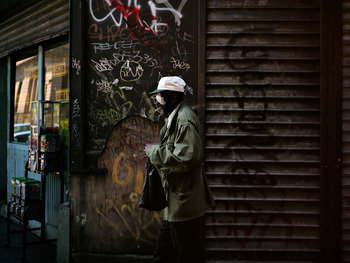
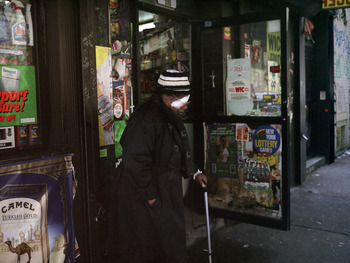
Thus the people previously seen from a distance, somewhere in open wastelands on the outskirts of the city, are now seen up close, and their physical presence comes to the foreground. In an interview, Graham explicitly refers to “the idea of a play within a play,” and makes reference to Hamlet: “In Hamlet, Shakespeare has the characters create ‘The Mousetrap’ … Situating the dark pictures in the center of the book is kind of like that, a project within a project.”Footnote 63 There is indeed a sense that the people in those photographs are trapped in the dark corners of the inner city.Footnote 64 There is also a certain dramatic dimension to the appearances and unfolding of the bodies, gestures, expressions, clothes and dark settings. What is evoked, then, is a series of fragmentary scenes or acts, which are taking place on the dark stages of the inner city's streets. People's appearances in this section bear the traces of their overexposure to the hardship of life in the American city. The most emphatic sign of overexposure is introduced in the first and last photographs of the section – Blinded Man, New York, 1998 and Blinded Woman, New York, 1999 (Figures 5 and 6).
Blinded Man, New York, 1998. © Paul Graham; courtesy Pace/MacGill Gallery, New York.

Blinded Woman, New York, 1999. © Paul Graham; courtesy Pace/MacGill Gallery, New York.

What is evoked here is the idea that an intense overexposure to precarity and violence has literally resulted in an injury to the people's eyes. They stand with an almost stoic posture on the side of the entrances of an eatery in the first photograph and a small grocery store in the second. The blinded man and the blinded woman look like the enigmatic and symptomatic gatekeepers of an obscure and dramatic space in which a sector of the American population lives. The backgrounds are made of walls and surfaces which are covered by countless graffiti-like traces of life (Blinded Man, New York, 1998), and posters advertising a cacophony of consumer products (Blinded Woman, New York, 1999). Aware of the tension between economic endurance and hardship and the invasive presence of advertising and consumption, another liminal space or zone emerges.
In this space, blindness and suffering also evoke what Du Bois saw as the impact of “the veil,” namely that racial prejudice inflicts an actual form of injury, an internal struggle and a splitting of consciousness, a “double-consciousness.”Footnote 65 Not coincidentally, Du Bois uses metaphors of light and darkness to describe the effects of this prejudice, “The very soul of the toiling, sweating black man is darkened by the shadow of a vast despair. Men call the shadow prejudice.”Footnote 66 Such shadows characterize the central section of American Night, and the destructive effect of prejudice particularly resonates with photographs such as Man with No Shirt Crossing the Road, New York, 1998, Woman Sitting on the Sidewalk, New York, 2002 and Man in Wheelchair at Sunset, New York, 2002. Just as Du Bois's “double-consciousness” generates a counterreaction, a form of resistance and striving for emancipation, photographs such as Woman with Fist, New York, 2001, Woman with Golden Face, New York, 2000, Man Exposing Torso, New York, 2000 and Young Man at Dawn, New York, 1998, evoke signs of strength, endurance and vitality.Footnote 67
EXPOSING AMERICA'S BIOPOLITICS
In the central section of the book, the moving closer to, or as Chandler puts it, the “zooming in on the people's bodies and their struggle,” emphasizes how the body is central to American Night.Footnote 68 In this dark zone, as well as in the overexposed ones, people often are in “distress, struggling, physically and emotionally with their environment as if being worn down by it.”Footnote 69 What is suggested here is that a form of biopolitics is at play within the American city. In his 1976 “Lectures at the Collège de France,” Michel Foucault demonstrated how racism and biopolitics go hand in hand.Footnote 70 Although Foucault does not address the United States’ history of slavery and segregation specifically, a form of biopolitics in which the ultimate power of life and death over people's bodies is present in the country's history and is implicitly suggested in American Night. As Graham's images illustrate, the power to “make live and let die” is still covered under a veil of invisibility.Footnote 71
Giorgio Agamben's philosophical archaeology of the concept of life and sovereignty in Western politics has similarly shown how political power attempts to divide and isolate what he calls “naked life” or “bare life” – “the simple fact of living common to all living beings” – from the numerous “form[s]-of-life,” the “possibilities of life” that human beings have it in their power to develop.Footnote 72 This tension between “bare life” and “the possibilities of life” underpins in various ways the central section of American Night. To be in a state of “naked life” or “bare life” is most explicitly evoked in photographs such as Man with No Shirt Crossing the road, New York, 1998, Woman Sitting on the Sidewalk, New York, 2002, Man in Wheelchair at Sunset, New York, 2002 and Old Man at Sunset, New York, 1998, while the desire and power to develop “possibilities of life” emerges in photographs such as Woman with Fist, New York, 2001, Woman with Golden Face, New York, 2000, Man Exposing Torso, New York, 2000 and Young Man at Dawn, New York, 1998. In his essay “What Is a People?”, Agamben delves into how the term “people” itself is founded on a fundamental ambiguity, a biopolitical fracture, an oscillation between these opposite poles:
[an] ambiguity [is] inherent in the nature and function of the concept of people in Western politics. It is as if, in other words, what we call people was actually not a unitary subject but rather a dialectical oscillation between opposite poles: on the one hand, the People as a whole and as an integral body politic and, on the other hand, the people as a subset and as fragmentary multiplicity of needy and excluded bodies … at one pole, the total state of the sovereign and integrated citizens, and, at the other pole, the banishment – either court of miracles or camp – of the wretched, the oppressed, and the vanquished.Footnote 73
This oscillation between naked life and forms-of-life, between the People and the people, is exposed in American Night. One the one hand, there are the photographs of the middle-class houses, belonging to “the total state of sovereign and integrated citizens,” and on the other, the photographs of African American people, whose experience is often “the banishment … of the wretched, the oppressed, and the vanquished.”
These connections, between the biopolitical struggle of the subjects in American Night and the topographical dimension of the book, can be traced, then, in the mapping and zoning of the American city. For Chandler, “the African-Americans that loom from the center of these photographs are for the most part forlorn figures, like refugees on their own streets.”Footnote 74 Forced into a state of bare life, they are isolated into zones of invisibility and indeterminacy, into zones in which they struggle to survive and where they are prone to disappear through an exposure that can be read both politically and photographically. What emerges from this context is the presence of topographical entities within the American city that, as Agamben put it, “are beginning … to look like camps.”Footnote 75 For Agamben, the notion of a camp can be seen “not as historical fact and an anomaly that – though admittedly still with us – belongs nonetheless to the past, but rather in some sense as the hidden matrix and nomos of the political space in which we still live.”Footnote 76 He argues that “the camp is the space that opens up when the state of exception starts to become the rule.”Footnote 77 According to Agamben,
if the essence of the camp consists in the materialization of the state of exception and in the consequent creation of a space for naked life as such, we will then have to admit to be facing a camp virtually every time that such a structure is created, regardless of the nature of the crimes committed in it and regardless of the denomination and specific topography it might have … even certain outskirts of the great post-industrial cities as well as the gated communities of the United States are beginning today to look like camps, in which naked life and political life, at least in determinate moments, enter a zone of absolute indeterminacy.Footnote 78
What Graham therefore makes visible in his phenomenological map of the American city is the existence of these zones of indeterminacy, zones rendered invisible as a result of the blinding power of the American Dream. Not confronting such a state of affairs, a blindness to them, perpetuates the problem. Graham's statement, “to make work here, and not take that into account seems to me plainly ridiculous, and it makes you part of the problem,” underlines this point. The reference to Jose Saramago's novel Blindness (1995) at the end of American Night is also evocative in this respect. As Chandler puts it, “in Saramago's novel the population of an entire, but unnamed, city is afflicted by blindness … The illness leads not only to inevitable social breakdown, but also to moral collapse, where stupidity, brutality and awful abuses of power hold sway.”Footnote 79 According to Graham:
we've learnt to edit out what we don't wish to see on the streets, in life, we've learnt to pass by them, to keep going and that may not matter in small everyday matters but does matter in the bigger picture of life, you know, how we've learnt to edit an entire sector of our population out of our vision, out of our awareness of life today.Footnote 80
New forms of biopolitics are then perpetuated because of a lack of vision and consciousness. In these zones of invisibility, “in which naked life and political life, at least in determinate moments, enter a zone of absolute indeterminacy,” the representatives of the sovereign state, such as the police, exercise the ultimate power of life and death over the people with impunity.Footnote 81 The multiplication of recent cases of unlawful killings by police (and at times by private citizens acting as vigilantes) of African American men, such as Trayvon Martin, Michael Brown, Tamir Rice, Freddie Gray and Eric Garner, amongst others, triggering the #BlackLivesMatter movement in the United States, is a case in point.Footnote 82
Given the title of Graham's book, given the topographical and biopolitical framework that it exposes and the state of blindness that underpins it, it seems appropriate to speak of “dark times.” George Didi Huberman has shown that the expression “dark times,” which Hannah Arendt borrowed from Bertolt Brecht, reaches beyond the Second World War and the Cold War, by taking new forms in our contemporary and spectacular times.Footnote 83 As Didi Huberman notes, Arendt characterized this new form of dark times as a crisis in which “the public realm has lost the power of illumination.”Footnote 84 In American Night, the dark times seem to be precisely exposed as an articulation of the blinding power of the American dream and the biopolitical and topographical legacies of a history of racial segregation and slavery. Graham's effort is to expose and “illuminate” these spectacular and racially inflected dark times. In different ways Graham uses the light, the essential material of photography, the precondition for visibility itself and an entity that can distract and blind us, in order to literally and metaphorically shed a light on the politics of the book.
Through the perfect illumination of the houses, as if under a spotlight, Graham exposes and illuminates different forms of power, the power of wealth and the power of the image of the American Dream. The effort to illuminate the situation is also directly reenacted in the exposure of the people in the central section of the book. Here the act of illumination generates both a painful and a necessary experience, or, as Chandler puts it, “the act of looking is in itself bound up with a sense of discomfort.”Footnote 85 As the walker and the viewer become the uneasy witnesses to a struggle, “one America has become blind to the other, and this invisible country has become accustomed to not being seen.”Footnote 86 At the same time, in some images, the act of illumination takes the form of a blessing, as if the power of people's life is illuminated – for example in Woman with Golden Face, New York, 2000 and Young Man at Dawn, New York, 1998.
Graham's work can thus be seen as a form of resistance, an attempt to illuminate the framework and topography of America's contemporary dark times. Through his variations of exposure, Graham dialectically unveils various states of blindness. It is through these processes of illumination, of exposure, of establishing a visual and physical contact, that Graham attempts to visualize what Arendt called “a minimum of humanity in a world grown inhuman.”Footnote 87American Night should be seen as a challenge to American society, a work that stresses the necessity to see and confront the crisis of its democracy. According to Walter Benjamin, “the crises of democracies can be understood as crises of the conditions of representation [als eine Krise der Ausstellungsbedingungen] of political man.”Footnote 88American Night appears as a crucial reminder of the relevance of this thesis.