

Introduction
In recent years, CPSA presidential addresses have brought attention to the importance of various approaches and subfields of the discipline. For those familiar with my work, it won't come as a surprise that my presidential address explores the role of political parties in Canadian politics, and in particular their place in the 338 constituencies that comprise the Canadian polity. The argument here is that while the focus of much attention relating to our politics has shifted to the parties' national activities, both in the Canadian and comparative contexts, many important questions can only be fully considered by also studying the activities of parties in local communities across the country. As Carty (Reference Carty2002) observed in his presidential address, the local life of parties forms a key part of our political landscape.
More than a century ago, the Frenchman André Seigfried visited Canada and proved to be an astute observer of our politics. Among Seigfried's many penetrating observations was the importance of political parties to Canadian democracy (Reference Siegfried1907). In the decades since many Canadian political scientists have made similar observations regarding the key role parties play in shaping both our electoral and legislative politics and more broadly our political history.
It is not an exaggeration to say that our parties have been at the centre of democratic life for most of our history. Indeed, the Canadian political story is intimately intertwined with the story of our parties. When Carty (Reference Carty and Carty1992) recounts the different historical periods of party organization it is not by coincidence that these map neatly onto Smith's classification (Reference Smith and Carty1992) of styles of governance and national policy priorities, and Johnston and colleagues' identification (Reference Johnston, Blais, Brady, Crête and Carty1992) of periods of electoral realignments. As Meisel (Reference Meisel1963: 370) long ago observed, political parties “are among the relatively few genuinely national forces in Canada,” and, as Peter Aucoin noted, have long formed the foundation for Canadian “party government” (Aucoin, Reference Aucoin1985).
While Katz and Mair (Reference Katz and Mair1995) identify a trend towards interpenetration of party and state in many European countries, in the form of the twenty-first century cartel party, parties have long been intertwined with and central to the maintenance of the Canadian federation. Smith (Reference Smith and Carty1992: 531) refers to the nexus between party and government as “the heart of Canadian politics.” And, as Carty and colleagues (Reference Carty, Cross and Young2000: 14) observe, “Canada, more than any other country, has been defined by its politicians, the political parties and its patterns of party competition”; they conclude that “it is clear that Canada remains a party country” (228).
When considering important questions relating to our politics it is imperative to consider the role of parties and to acknowledge that they are not unitary actors. There are different faces of the parties fulfilling different tasks, offering different democratic opportunities and influencing varying aspects of public life. Comparative work by Katz and Mair (Reference Katz and Mair1994), building on the work of Key (Reference Key1964), highlights three different faces of parties: in elected office, in central office and on the ground. They observe that each has different tasks and objectives and that the balance of influence among them differs both within and across party systems. Carty (Reference Carty2002, Reference Carty2004) has contextualized this characterization of party organization to the Canadian case and, through his franchise metaphor, suggested a stratarchical model in which the different strata of the party exercise authority over discrete competencies (Carty and Cross, Reference Carty and Cross2006; but see also, Cross, Reference Cross2016).
When I teach a graduate seminar in political parties, we begin with an exercise in which students pretend they are sitting next to someone from abroad on a plane who engages them in discussion about their research. This conversation leads to the seatmate asking where she can find this Liberal or Conservative party. Inevitably, students' initial response is to direct the visitor to Parliament Hill. After some pushing, a student will suggest the traveller go to Albert Street in Ottawa where both parties have their national headquarters. It almost never occurs that a student suggests that the parties can be found in communities across the country, in fact, in each of our 338 electoral constituencies in the form of electoral district associations (EDAs).
This is not surprising as the party leaders, parliamentarians, campaign gurus, pollsters and the like dominate so much of our media attention. Nonetheless, tens of thousands of Canadians interact with parties at the community level. Many will never attend question period, may never travel to Ottawa, will never attend a party conference or serve on a provincial or national party committee. Yet they are passionate supporters of their favoured parties, engaging in activities that have profound implications for our politics. To borrow the phrase coined by Gallagher and Marsh (Reference Gallagher and Marsh1988), this is the “secret garden” of our politics.
But it is not just journalists and pundits who focus on the national campaign, we academics are often equally guilty. Marland and Giasson's e-book (Reference Marland and Giasson2015) on the 2015 election with more than 60 contributions includes two that are truly focused on the local campaign. This is consistent with recent election studies. Here, while parties are identified as the crucial players, the focus is primarily on explaining vote choice with an emphasis on the national parties' messages, their advertising and leaders' effects, and voter demographics (see, for example, Kanji et al., Reference Kanji, Bilodeau and Scotto2012; Gidengil et al., Reference Gidengil, Nevitte, Blais, Everitt and Fournier2012). Similarly, an emerging stream of literature on political marketing, reflecting the centralizing tendencies of this phenomenon, largely focuses on the national activities of parties and their personnel (Marland et al., Reference Marland, Giasson and Lees-Marshment2012).
Of course, there are exceptions, perhaps most importantly the book Politics is Local: National Politics at the Grassroots by Carty and Eagles (Reference Carty and Eagles2005) and the work of scholars following in this tradition such as Sayers (Reference Sayers1999), Koop (Reference Koop2011) and Pruysers (Reference Pruysers2015). And, most recently, the promising Local Parliament Project of Loewen, Rubenson and Koop (Reference Loewen, Rubenson and Koop2015). The first comprehensive analysis of party life in the constituencies, however, was not undertaken until Carty's Reference Carty1991 survey of party riding associations and there is no denying that the scholarship on political parties, and electoral politics generally, is heavily weighted in favour of emphasis at the national and regional levels.
All of this may reflect an account of Canadian politics that says local campaigns and party efforts really don't matter which is reflective of much of the comparative literature on parties. As Koop (Reference Koop2010: 894-95) notes regarding the lack of sustained study of local party organizations in Canada, “Despite the important role they play in the ridings, the only attempts to understand them include anecdotal accounts (for example, Thorburn, Reference Thorburn1961) and a survey of constituency associations (Carty, Reference Carty1991).” He goes on to explain this as follows: “For some time, scholars have emphasized far-reaching changes to the structure and practice of partisan politics that appear to render local organizations and their members redundant or even a ‘nuisance.’” Similarly, as Clark observes in the European context, “some argue that local parties are largely irrelevant, particularly since party membership is falling across modern democracies,” and that “implicit in both accounts is the idea that it is the party in office at the national level that is the legitimate level of analysis” (Reference Clark2004: 36).
Writing about European parties, Katz and Mair suggest that we have “entered a new phase in which parties become increasingly dominated by, as well as most clearly epitomized by, the party in public office” (Reference Katz, Mair, Gunther, Montero and Linz2002: 122) and that “one obvious symptom of this change is, of course, the sheer physical withering of the party on the ground” (126). Much has been written about the widespread decline of party membership (Scarrow and Gezgor, Reference Scarrow and Gezgor2010; van Biezen and Poguntke, Reference Van Biezen and Poguntke2014; Whiteley, Reference Whiteley2011) as well as the perceived centralization and professionalization of party campaign efforts (Farrell, Reference Farrell, Richard S. and Crotty2006; Panebianco, Reference Panebianco1988) resulting in the Katz and Mair conclusion regarding the increased relative importance of the central party.
Notwithstanding all of this, I suggest that many questions relating to Canadian politics can only be fully understood when we include in our analyses consideration of local party life. To some extent this may be contextual as our single member plurality (SMP) electoral system dictates that there are 338 mini-campaigns and elections happening concurrently and that winning an election means succeeding in these discrete contests. Candidates are chosen at the local level and members of Parliament (MPs) are elected by appealing to voters in their geographically defined constituencies. These dynamics likely differ in countries with different institutional contexts such as weaker forms of party government or different electoral systems (Cross, Reference Cross2008).
One of the reasons for the lack of sustained, detailed analysis of local party life, I suspect, is the difficulty in systematically gathering comprehensive information. While it is difficult, these obstacles can be overcome. As part of a study of the 2015 election, this address draws upon a survey of more than 300 candidates from the major parties, as well as more than two hundred presidents of EDAs and more than 900 party members. While the response rate varies by party and across surveys, all of the major parties participated and no party is consistently underrepresented.Footnote 1 For example, while Conservatives were relatively weak respondents in the EDA survey, more of their candidates responded than did those from the other parties and vice-versa for the Liberals. The patterns presented here are consistent across data sources providing additional confidence about the validity of the story told. These data, together with that available from Elections Canada regarding the parties' finances and nomination contests, provide a rich array of information of party life on the ground and a valuable resource for addressing issues that too often are considered only at the national level.
The sub-title of this address is “Winning from the Ground Up.” By way of example, my intention is to provide evidence of the importance of considering local party activity to a fuller understanding of two types of winning: the first is the obvious winning the election; the second relates to the election of female MPs, winning in this sense means improving our democracy by increasing the number of women in Parliament. It is not my objective to fully explain either of these phenomena, but rather to illustrate how paying attention to local party activity provides an additional dimension to our understanding.
Electoral Success
In addition to voters' desire for change, popular explanations of the Liberals' victory in 2015 generally focus on their leader's energetic performance, the perception among voters that he was a charismatic candidate, the quality of the party's television advertising, and, from a policy perspective, outmaneuvering the New Democrats by embracing deficits and an infrastructure spending programme. While surely all of these things were important to the ultimate outcome, I suggest we can't fully understand what occurred without paying attention to party activity at the riding level.
In a post-mortem on the campaign, Conservative campaign chair, Jenni Byrne (Reference Byrne2016), argued that her party benefited greatly in its three electoral victories from atrophy, neglect and discord among local Liberal party associations. She wrote that ten years ago, “in the Conservatives' wake was left a weakened and divided Liberal party that had allowed local riding associations to atrophy and die on the vine, with no money and no organization.” Byrne was clearly implying that there is an electoral cost to having moribund EDAs. What she did not go on to say is that this situation had changed dramatically by 2015.
Let me begin here with an anecdote. About one year prior to the election, I accompanied my then 17-year-old daughter to an Equal Voice event to which each of the parties sent a representative, including, for the Liberals, the only non-MP Catherine McKenna, the party's candidate in Ottawa Centre. After the event, my daughter commented that she was immensely impressed with McKenna and thought it terrific that this accomplished woman was going to be her MP. I then explained how our SMP electoral system was certain to ensure that this was not going to happen as the NDP incumbent was well-liked and respected and, as his party was doing well in the polls, was almost certain to be re-elected. To which my daughter rolled her eyes and said, “We'll see.”
McKenna and her team worked extraordinarily hard in her campaign. Nominated almost 18 months prior to the election, she opened her campaign office a year in advance and campaigned constantly, with her team of 500 volunteers, by some accounts, knocking on more than 100,000 doors (Payne, Reference Payne2015). On election day, McKenna turned a 21,000-vote deficit from 2011 into a 3,000 vote victory.
When discussing this with colleagues from across Canada, they inevitably point to a Liberal candidate in their community with a similar experience. In their collection on the 2015 election, Pammett and Dornan (Reference Pammett and Dornan2016) include an account of Liberal candidate Allan Thompson's campaign in the Ontario riding of Huron-Bruce. Thompson announced his candidacy 18 months before the election, won a contested nomination a year out and campaigned full time from then through election day (Thompson Reference Thompson, Pammett and Dornan2016). By examining party activity at the constituency level, we learn that the anecdotes relating to McKenna's and other Liberal candidates' experiences are not isolated examples but are reflective of something occurring in constituencies across the country.
The literature concerning the effect of local campaign activity on election outcomes in Canada is far from comprehensive, but does suggest that local efforts might mean as much as an additional 5 per cent of the vote (see, for example, Carty and Eagles, Reference Carty and Eagles1999, Reference Carty and Eagles2005). This literature, however, focuses almost exclusively on the campaign period: considering voter contact by parties, spending by local campaigns and numbers of volunteers. Other work by Blais and colleagues (Reference Blais, Gidengil, Dobrzynska, Nevitte and Nadeau2003), Coletto (Reference Coletto2010) and Roy and Alcantara (Reference Roy and Alcantara2015) suggests that “strong” local candidates may all contribute to a small electoral premium. These scholars are likely correct in asserting that these factors do have some influence on close races. However, I argue that we need to expand our consideration of local effects to include the vibrancy of EDAs in the period leading up to the campaign. When we do so, we learn that the Liberal party was revitalizing in the period between 2011 and 2015 while the Conservatives were largely stagnant at the local level.
That local activity may have had an effect on the election outcome is suggested by the number of close races and the success of the Liberals in winning more than their share. The number of races that Liberals won or lost by five percentage points or less doubled between 2011 and 2015 and their success in converting these into victories increased dramatically. In 2011, Liberals were involved in 31 close races and won 13; in 2015, they won 34 of 65 close contests. The Conservatives' performance is the mirror inverse. In 2011, they were victorious in 22 of 41 close contests compared to success in 15 of 39 in 2015.
When considering just the traditional measures of campaign activity, we find, for example, that Liberal candidates on average had significantly more volunteers than did their opponents and this is particularly evident in comparison with the Conservatives. Considering only non-incumbents, Liberal candidates averaged 107 volunteers compared to 69 for the Conservatives (p < .05).Footnote 2 When we include all candidates, the Conservatives do better, as their incumbents were better resourced, but continue to trail the Liberals.
But the argument here is that we should also look beyond the campaign period to the vitality of EDAs in the period leading up to the election. Quality candidates, funds for the campaign, volunteers and general signs of party strength are all the result, at least partially in this argument, of local party vitality in the period leading up to the campaign. Parties know that they cannot simply “flip a switch” on the day the election is called and turn dormant EDAs into vibrant associations. This is why party post mortems, after an electoral loss, regularly point to withered local associations as a cause of their defeat and strike plans for local revitalization. This is true not only in Canada but has been written about in regards to parties, for example, in New Zealand, Australia and Ireland (Cross, Reference Cross2016; Cross and Gauja, Reference Cross and Gauja2014; Little and Farrell, Reference Little and Farrell2013).
After its 2011 electoral debacle, the Liberal party made a commitment to revitalizing its EDAs. This is exemplified in their “Roadmap to Renewal” launched prior to their 2012 biennial convention, which states: “The future health of the Party depends primarily and directly on the health of its Electoral District Associations (EDAs) and of its provincial and territorial party affiliates. As a national party, our first priorities must therefore be (i) rejuvenating and rebuilding LPC's [Liberal Party of Canada] inactive or under-performing EDAs with vastly increased grassroots engagement.” (Liberal Party, 2012a, 2). Some of the practical steps recommended in the roadmap include having every EDA engage in a membership drive, creation of a “supporters” class whose members are entitled to participate in party decision making and encouraging discussion of policy issues at the local level feeding into national policy development. The party's “Guide to Policy Development” encourages EDAs “to make policy meetings and discussions a regular part of their activities” acknowledging that this is “critical to the Party's vitality” (Liberal Party, 2012b). Not surprisingly, this view is shared by local association presidents, 9 in 10 of whom, in all three parties, say it is “very important” for their party to have vibrant local associations. The key question is whether there is evidence that the Liberals were more active on the ground than their opponents in the lead-up to the campaign. Indicators of the vitality of EDAs in this period include contested and early nominations, successful membership recruitment and engagement, and increasing the pool of financial contributors.
By examining local association activity we discover that the Ottawa Centre Liberals were not unique in nominating McKenna so long before the election and that the party took a different approach from its opponents in this regard. When we consider ridings where the party was not renominating an incumbent, we find that half of Liberal associations chose their candidate in 2014, compared with 30 per cent of Conservatives and 16 per cent of New Democrats.Footnote 3 On average, non-incumbent Liberal candidates were chosen 278 days prior to the general election. The Liberals clearly had a strategy of nominating candidates early, allowing them a long lead time to campaign.
Liberal nominations were also more likely to be contested, attracting two and often three or more candidates. As 95 per cent of incumbents face no challenger for renomination, it is appropriate to consider EDAs with open nominations: 47 per cent of these Liberal associations had competitive contests compared with one-third for the Conservatives and four in ten for the NDP, and half of these Liberal contests attracted three or more candidates (22% compared with 13% for both the Conservatives and NDP).
When we turn our attention to membership numbers we again see signs of significant Liberal rejuvenation. It is difficult to obtain national party membership numbers as the parties tend to keep these close to their vests. Overall numbers are only available for the Liberals which show a year-over-year increase: 60,000 in 2012, 127,261 in 2013, 200,000 in 2014 and 300,000 in 2015 (Canadian Press 2014; De Souza Reference De Souza2013). These are self-reported and likely are estimations. Nonetheless, they illustrate substantial and continuous growth.
The numbers from the local associations show a similar pattern for the Liberals and something quite different for the other parties. The important takeaway from Table 1 is the pattern: Liberals growing consistently in the years leading up to the election. The large jump in 2014 is likely attributable to the number of nominations held that year. However, this follows on the heels of the 2013 leadership contest so it's an impressive increase. As Young and Cross (Reference Young and Cross2002) report, most party members have traditionally joined to participate in one of these personnel recruitment contests while exiting the party soon afterwards. Thus, even more remarkable is the significant increase in 2015, particularly when compared to the Conservatives.Footnote 4
Mean EDA membership numbers

Differences between Liberals and Conservatives in 2013, and Liberal difference between 2013 and 2014 p < .01.
The Conservative numbers are generally what we expect to find. It's not that they were moribund at the local level, but rather that the Liberals were gaining in strength.
We can also consider whether the parties were attracting new volunteers or were reliant on long established ones. Not only did the Liberals have more volunteers on average, but they also attracted large numbers of new supporters as 71 per cent of their campaign volunteers were not long-time members contrasted with approximately six in ten Conservative and NDP volunteers (p < .05). A similar pattern emerges when considering the number of party events and meetings. Liberal associations lead in each of the three years and average 3.5 more meetings than Conservatives in 2015 and 5 more than New Democrats.
Liberals also led the way in terms of ongoing communications with their members. All of the parties indicate that e-mail is their most common method of communication and 46 per cent of Liberal associations report being in regular e-mail correspondence with their members compared with 36 per cent of Conservatives and 33 per cent of New Democrats.
Finally, in terms of members, given the data just reviewed, it is not surprising that the local parties report very different experiences in terms of difficulty in attracting members. Sixty per cent of Conservative and NDP EDAs report it is more difficult today to recruit members than it was five years ago. For the Liberals only 40 per cent share this sentiment (p < .05).
Two variables relating to party financing are useful in considering the vitality of EDAs: total contribution amounts and the number of contributors. In 2012, the Conservatives were well ahead in terms of the mean amount raised per EDA. Excluding associations that report receiving no contributions that year,Footnote 5 local Conservative associations on average report receiving twice as much as their Liberal counterparts ($18,232 versus $9,539) and close to four times what the New Democrats raised ($5,026). The redrawing of electoral boundaries prior to the 2015 election makes comparisons over these years challenging. Table 2 shows the amount of contributions received in 2012 and 2014 for those associations that were not dramatically affected by redistricting (defined as having at least 75% consistency in the electorate of the old and new district).Footnote 6 While the Conservatives maintained their advantage over this period, the Liberals significantly closed the gap. In 2012 local Liberal parties raised 51 per cent of the amount raised by the Conservatives, by 2014 this increased to 82 per cent. Conservative associations report very similar contribution amounts in these two years, an increase of just $322, while Liberals show an increase of $6,594.
Mean contribution totals per EDA (excluding associations reporting zero and including only those comparable after redistricting).

The data in terms of number of contributors are equally telling. In 2012, for associations that reported receiving contributions, the Conservatives show a slight lead in mean number of contributors over the Liberals and a large lead over the NDP (108 contributors on average compared to 99 and 57). When we compare change over time for trackable associations, we find the Liberals making dramatic gains. As shown in Table 3, by 2014 Liberal associations had increased their total by about 80 per cent while Conservative associations saw their numbers decline so that they now trailed the Liberals by an almost two-to-one margin. The NDP trail on all these measures but do show modest growth.
Mean number of contributors per EDA (excluding associations reporting zero and including only those comparable after redistricting).

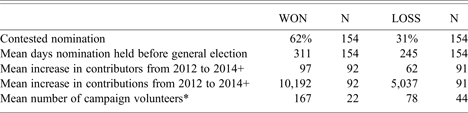
There is at least suggestive evidence that these factors of local association vitality are related to electoral success as they have a significant and positive relationship with the parties' relative finish in the 2015 election. We can consider the relationship between these variables and the relative success of Liberal EDAs as Liberals won approximately half of the ridings they didn't hold entering the campaign and lost the other half. Liberal associations in ridings the party won showed more vitality in the years leading up to the election than did those where they were unsuccessful. As illustrated in Table 4, they were more likely to have contested nominations, had more campaign volunteers and had a dramatically larger increase in number of financial contributions. This analysis includes periods when the party was both performing well in opinion polls and periods when it was shedding support and running third, thus at least partially lessening concerns regarding endogeneity.
Differences between EDA strength in ridings won and lost by the Liberals in 2015 federal election (ridings with a Liberal incumbent running in 2015 excluded)
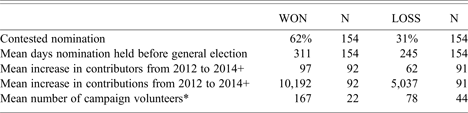
+includes only ridings that are trackable from 2012 – 2014.
* p < .01; other variables are full population, not derived from survey data.
The purpose here is not to argue that one can win an election in an otherwise inhospitable electorate solely by reinvigorating the local EDA. The effect of these measures, occurring in the two to three years prior to the election, is likely mediated through the variables traditionally considered in explaining party electoral performance. The argument here is that these factors can help create an environment that supports a strong campaign effort. Volunteers can more easily be attracted to a vibrant local association and contested nominations with hundreds of new members provide another pool from which to draw canvassers and contributors. Quality candidates are more likely to be attracted to a local party showing signs of life and voters generally may take positive note of a vibrant local association. Carty and Eagles report that local “campaign effects are strongest for the campaigns of the non-governing parties… Of course, it is precisely in these settings that the parties have the greatest potential to improve their parliamentary standings.” (Reference Carty and Eagles1999: 84). Jenni Byrne was not wrong when she talked about the importance of EDA vitality to electoral success. Similarly, the Liberals were not wrong when they looked at their recent defeats and concluded that success in 2015 required a rebuilding of the party from the ground up.
Female Representation in the Candidate Pool
Considerable media attention was paid to the achievement of gender parity in the Trudeau cabinet (Frisk, Reference Frisk2015). At the same time, most remain troubled that women make up only one-quarter of MPs (Equal Voice, 2016). Scholarly analysis of this issue has long identified the importance of parties as gatekeepers to national legislatures (Caul, Reference Caul1999; Gauja and Cross, Reference Gauja and Cross2015; Krook, Reference Krook2010; Norris and Lovenduski, Reference Norris and Lovenduski1993) and the relevance of party rules, practices and internal organizational structures, particularly as relating to candidate nomination, have been highlighted by Erickson (Reference Erickson1991, Reference Erickson, Lovenduski and Norris1993), Young (Reference Young2000), Trimble and Arscott (Reference Trimble and Arscott2003) and Childs (Reference Childs, Cross and Katz2013). It is well understood that increasing the number of women in the House of Commons requires a significant increase in the numbers nominated by the major parties.
The real action in candidate selection and recruitment takes place at the local level (Pruysers and Cross, Reference Pruysers and Cross2016) and much of what we know about women and party nominations is a result of scholarly examination of their experiences in the EDAs. However, these data are not collected and studied after each election (as are, for example, voter data) making it difficult to systematically study change over time and to know whether findings are particular to any one election.
In 2015, 496 women sought a nomination for one of the three major parties: 219 for the NDP, 178 for the Liberals and 99 for the Conservatives. Examining local data tells us that there were many more men contesting nominations in all three parties: 44 per cent of NDP nomination candidates were female, 30 per cent for the Liberals and 22 per cent for the Conservatives.Footnote 7 These numbers are almost identical to the percentages of female candidates nominated by the parties (NDP 43%, Liberals 31%, Conservatives 20%).
At first glance these data suggest that women are not disadvantaged in intraparty nomination contests. In fact, two-thirds of female candidates who sought NDP or Conservative nominations were successful as were six in ten Liberals. The success rate for male nomination candidates is very similar, except in the Conservative party where male candidates were slightly more likely to win a nomination (largely an effect of incumbency).
Another way to consider this is as follows: for the Liberals, women sought the nomination in 152 ridings and 105 of these nominated women; for the Conservatives, 66 of 91 EDAs with a female candidate chose a woman; and, in the NDP, women contested 189 nominations and 146 EDAs selected women. These data suggest that when women seek a nomination, they have as much chance of being nominated as do men which is generally consistent with what Erickson (Reference Erickson1991) found in her examination of 1988 nomination contests.
However, when we dig a little deeper, the picture becomes somewhat less clear. For example, when both a man and a woman contest an open nomination, men are more likely to be victorious in all three parties. In these situations, men were nominated in 54 per cent of Liberal contests, 58 per cent of Conservative ones and six in ten NDP contests. This is a setback from Erickson's finding (Reference Erickson1991: 112) that women won 54 per cent of these contests in 1988.
Perhaps more concerning is the fact that when there is an open contest and a woman stands for the nomination, she is significantly more likely to be challenged than is the case if only a man stands for nomination. While 53 per cent of open Liberal nominations resulted in acclamations, this was true only 35 per cent of the time when a woman stood; similarly, two-thirds of open Conservative nominations resulted in an acclamation but this was true only 42 per cent of the time when a woman put herself forward. For the NDP, while 60 per cent of all open nominations resulted in acclamations, this was reduced to 50 per cent when a female candidate stood. These findings are consistent with recent evidence from the American literature demonstrating that women are more likely to be challenged in primaries (Lawless and Pearson, Reference Lawless and Pearson2008). Thus, it is not as clear as the existing literature suggests that female candidates do not face additional hurdles in winning a party nomination. The 2015 experience suggests that even when women run they are more likely than their male counterparts to attract an intraparty opponent and, if that opponent is a man, odds are they will lose. What is unknown is if this is consistent over recent elections or a one-off anomaly.
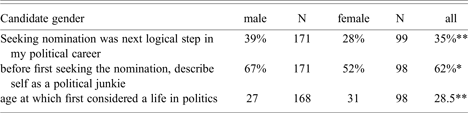
While the literature and the 2015 data suggest this is both a supply and demand issue (though see Ashe and Stewart, Reference Ashe and Stewart2012), a significant challenge continues to be getting more women to run for major party nominations. The question is how to do so. This is obviously a complex question with no single answer. Gidengil and colleagues (Reference Gidengil, Blais, Nadeau and Nevitte2004), O'Neill (Reference O'Neill2015) and Pruysers and Blais (Reference Pruysers and Blaisforthcoming), suggest that many factors beyond institutional barriers, including perceptions of political life, levels of political ambition, and political knowledge and interest all influence this question. Some of this becomes evident in the different opinions and attitudes of those men and women who did seek candidacy in 2015. In this regard, the 2015 findings are consistent with those of Lawless and Fox for the US (Reference Lawless and Fox2005). For example, as shown in Table 5, male candidates are more likely to report that seeking a federal party nomination was the next logical step in their political careers, more likely to report that, prior to their decision to run for Parliament, they were “political junkies” and that they first thought about careers in politics at a younger age than did their female counterparts.
Political Ambition and Candidate Gender
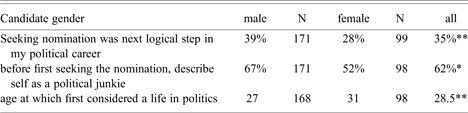
gender differences across rows *p < .05 **p < .10
Given these findings relating to gender differences in political ambition, it is perhaps not surprising that half or more of EDA presidents in all three parties report that it is more difficult to convince qualified women than men to run for office.
An examination of data from the 2015 candidate and EDA surveys does offer suggestions as to what may lead to more female candidates. One partial answer to the question is if parties want more women to seek nominations, they need to ask them to run. In this regard, the data suggest findings generally consistent with earlier studies such as Cross and Young (Reference Cross, Young, Bittner and Koop2013) and Cheng and Tavits (Reference Cheng and Tavits2011).
When candidates are asked what was important to their decision to seek their parties' nomination, a gender difference emerges. Male candidates are more likely to be political self-starters. Two-thirds of female candidates report that they were asked by a party official to seek the nomination compared to half of male candidates. And, as shown in Table 6, being asked by a local party official or search committee is more common than being asked by a national party representative. Slightly more than half of the female candidates were asked by local officials to run while one-third were asked by national party representatives.
When first deciding to seek a party nomination did the following encourage you to run?

gender differences across columns p < .05.
It has long been suggested that party search committees can be instrumental in increasing diversity in the candidate pool (Erickson, Reference Erickson1991: 112–13). All of the parties, to varying degrees, encourage their EDAs to conduct an active search. However, a significant minority of associations do not follow these directives. For example, in the Liberal party, the rules for candidate selection require EDAs provide “documented evidence of a thorough search for potential candidates who are female” unless it is “determined that no such search is necessary” (Liberal Party, 2013: 1.7(a),(b)). Nonetheless 36 per cent of Liberal EDAs, without an incumbent seeking renomination, report not establishing a formal search committee (25% for the Conservatives and 10% for the NDP). This is important as when there is a local search committee the likelihood of a woman contesting the nomination increases by 25 per cent.
It also matters who does the asking. Local party presidents see it as part of their mandate to seek out nomination candidates as eight in 10 local presidents, in associations with open nominations, encouraged someone to run. Cheng and Tavits (Reference Cheng and Tavits2011) found that women are more likely to be nominated in associations that have a woman as local president. We can take this one step further by including all candidates for the nomination and examine the relationship between the president's gender and whether a woman seeks the nomination. In this way, it is possible to examine the relationship between recruitment by a female president and women seeking the nomination without regard to whether they succeed. It has been hypothesized that female presidents may be more likely than their male counterparts to encourage female candidates and that the presence of a female president may make the local association appear more welcoming. The data support this as in two-thirds of the open nominations with a female EDA president there was a female nomination candidate compared with 44 per cent of EDAs with a male president (p < .05).
Cheng and Tavits (Reference Cheng and Tavits2011: 469) suggest it would be useful to know whether having women in other positions on the local executive might also make a difference but they note that these data are “virtually impossible to obtain.” The 2015 EDA survey data suggest a significant relationship between the proportion of local executive positions filled by women and the likelihood of a woman seeking the nomination. When half or more of the positions are filled by women, there is a female candidate in open nominations 62 per cent of the time compared with 40 per cent when men dominate the executive (p < .01). The same dynamics are likely at play here in terms of female party officials being more likely to recruit female candidates. The challenge is that the mean share of female representation on local party executives is 42 per cent, and this ranges from 33 per cent for the Conservatives to 48 per cent for the New Democrats (p < .05). And, in understanding this, we are aided by data from the survey of party members. In the last comprehensive survey of Canadian party members, Cross and Young (Reference Cross and Young2004) found that 59 per cent were male. Sixteen years after that survey, the situation has not improved. Nearly two-thirds of respondents in the members survey are male. Women are underrepresented in the memberships of all three parties as 69 per cent of Conservatives, 63 per cent of Liberals and 57 per cent of NDPers are men. Given the apparent disproportionate representation of men in the parties' memberships, it is not surprising that they are overrepresented on local executives and as presidents. Given the importance of these groups in attracting candidates, it is not surprising that women are underrepresented as nomination candidates, general election candidates and ultimately as MPs.
Women will run when local associations have women on their executives and local EDAs that ask them. But these local associations are male dominated as is the party membership they are drawn from. And when a woman does step forward, she is more likely to attract a challenger than is her male counterpart. Finally, when a man and woman compete against one another for nomination, the male candidate is favoured to win.Footnote 8
The scholarship concerning the political recruitment of women has become more focused on the role of EDAs in identifying barriers and opportunities for female candidates. Collecting these data, through candidate and EDA surveys, on a regular basis will facilitate greater understanding of change over time particularly relating to the effects of changes in party organization and the party system.
Conclusion
The principal point of this address is that we can only fully study many important aspects of Canadian politics by collecting riding level data to include in our analyses. Relying solely on impressions drawn from the national level makes our understanding incomplete at best. Here, by way of example, I've focused on local party vitality in the run-up to the 2015 election and on the question of gender representation in the candidate pool. However, other questions—for example, relating to personalisation of our politics, the issues emphasized during local campaigns, the connections between parties and civil society—can all only fully be answered by including in our consideration the local dimensions of party life. These activities need to be studied not only during campaigns but also between them, as much of consequence occurs, on the ground, in the “quiet” period between elections.