1 Introduction
In recent years the treatment of optionality within Optimality Theory (OT; Prince & Smolensky Reference Prince and Smolensky1993) has received significant attention. One common approach endows speakers with multiple constraint rankings (Reynolds Reference Reynolds1994, Anttila Reference Anttila, Hinskens, van Hout and Wetzels1997, Reference Anttila2006, Reference Anttila and de Lacy2007, Nagy & Reynolds Reference Nagy and Reynolds1997, Boersma Reference Boersma1998, Boersma & Hayes Reference Boersma and Hayes2001), whether by stipulating them directly, deriving them from an original partial ranking or adopting a continuous and stochastic view of rankings. The different rankings produce different outputs for a single input, and the result is variation within a single grammar.
Other work has emphasised perceived drawbacks of these multiple-rankings theories (Riggle & Wilson Reference Riggle and Wilson2005, Nevins & Vaux Reference Nevins, Vaux, Vaux and Nevins2008, Vaux Reference Vaux, Vaux and Nevins2008, Kaplan Reference Kaplan2011, Kimper Reference Kimper2011), chiefly their apparent inability to characterise local optionality (Riggle & Wilson Reference Riggle and Wilson2005), i.e. optional process which can apply to a proper subset of the available loci. For example, in French, ‘schwa’ (which is actually a front rounded vowel – see §3.2) is optionally realised in certain contexts. In a form with many schwas, the realisation of each is independent of the others. To illustrate, (1) contains three schwas in clitics and another in the verb demander.
-
(1)


The judgements given in (2), which form the basis for the analysis of schwa given in Kaplan (Reference Kaplan2011), follow Côté (Reference Côté2000), who departs from the standard characterisation of the variability that this example supports (Dell Reference Dell1973, for example, claims that just the realisations in (a)–(h) are possible). The illicit patterns in (2) violate a prohibition on triconsonantal clusters whose middle segment is more sonorous than its neighbours, and the marginal patterns violate a preference for cluster-medial stops to precede approximants (Côté Reference Côté2000).
-
(2)
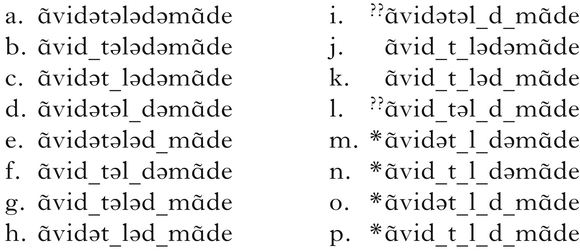
Omission of any one schwa, as in (b)–(e), or two schwas, as in (f)–(j) and (m), is possible, except when it violates the prohibition just mentioned, as in (m). Even omission of three schwas, as in (k), (l), (n) and (o), is possible under the right conditions; again, the ungrammatical forms in (n) and (o) violate the constraint on cluster sonority. Finally, omission of all four schwas in (p) is impossible, again because of the cluster's sonority profile.
According to the work critical of multiple-rankings theories, a multiple-rankings account of (2) fails because of what I will call the harmonic-bounding problem. A variable ranking between Max and *ə is inadequate, because Max⪢*ə preserves all schwas, while *ə⪢Max deletes as many schwas as possible.Footnote 1 There is no ranking which favours intermediate levels of deletion. Consequently, many licit forms in (2) are collectively harmonically bounded (Samek-Lodovici & Prince Reference Samek-Lodovici and Prince1999, Reference Samek-Lodovici and Prince2005) by the candidates with either no deletion or maximal deletion. This is illustrated in (3) with a representative subset of the data from (2). Candidates (ii) and (iii) are collectively harmonically bounded by candidates (i) and (iv).
-
(3)
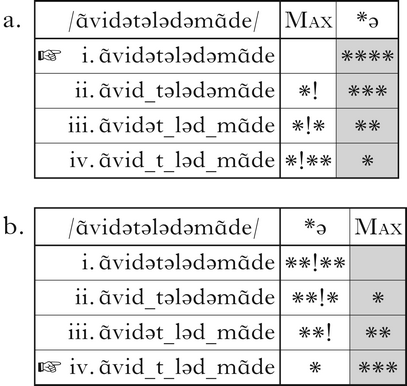
Such reasoning implies that multiple-rankings theories produce only what Kimper (Reference Kimper2011) calls global optionality, whereby an optional process applies exhaustively or not at all. In response, a number of frameworks have been developed that derive variation through other means (Coetzee Reference Coetzee2004, 2006, Riggle & Wilson Reference Riggle and Wilson2005, Kaplan Reference Kaplan2011, Kimper Reference Kimper2011) with the goal of accommodating local optionality. Some of these theories (specifically Riggle & Wilson Reference Riggle and Wilson2005 and Kimper Reference Kimper2011; see §2) supplement the multiple-rankings mechanism with some new device (e.g. serialism), but for ease of exposition I reserve the term multiple rankings for theories that rely exclusively on variation in the constraint ranking within a fully parallel framework, because these are the theories which are susceptible to the harmonic-bounding problem.
A shortcoming of the harmonic-bounding argument is that it relies on a pair of global constraints like Max and *ə. With only two rankings available, an input with more than two licit outputs is out of reach. A successful multiple-rankings analysis of French schwa requires a variable ranking involving more than just Max and *ə. There is a long tradition in OT of projecting position-specific constraints from global constraints to account for phenomena that do not treat all positions or configurations equally (Lombardi Reference Lombardi1994, Zoll Reference Zoll1997, Reference Zoll1998a, Reference Zollb, Beckman Reference Beckman1999, Steriade Reference Steriade1999, Crosswhite Reference Crosswhite2001, Smith Reference Smith2005, Walker Reference Walker2011, among many others). Multiple-rankings theories should have access to those constraints, too.
To that end, this paper investigates the power of a particular multiple-rankings theory, the theory of partially ordered grammars (PO; Anttila Reference Anttila, Hinskens, van Hout and Wetzels1997, 2007, Anttila & Cho Reference Anttila and Yu Cho1998), to produce local optionality using constraints relativised to specific morphosyntactic or prosodic domains. The approach to French developed below adopts constraints that hold for particular morphosyntactic categories. Each schwa in (1) occupies a syntactic position distinct from the other schwas, so position-specific constraints can manipulate each schwa independently of the others.
I apply this strategy to three locally optional processes: English flapping, French schwa deletion/epenthesis and Pima plural reduplication. These processes present diverse challenges, and thereby permit quite different illustrations of PO's suitability for local optionality. Whereas the analysis of French is grounded in morphosyntactically sensitive constraints, the analyses of English and Pima are built on constraints that reference prosodic structure – markedness constraints for English and faithfulness constraints for Pima.
We will see that PO analyses that capitalise on prosodic or morphosyntactic structure are more successful than the harmonic-bounding argument suggests is possible. As long as the loci for an optional process appear in domains that can be distinguished from each other, PO provides an analysis. The difficulty is singling out those domains in a principled way: all PO adds to OT is variation within the constraint ranking, so it must use only independently motivated constraints. PO meets this criterion for English, French and Pima. As examples grow in complexity, the ability to distinguish loci diminishes, but the most complex available data fall within the theory's limits. The supposedly harmonically bounded candidates turn out to be accessible under a sufficiently rich constraint set.
I will argue, therefore, that PO accounts for all available data for English, French and Pima, and therefore offers a plausible approach to local optionality. Furthermore, PO has an advantage over other frameworks in that it relies only on manipulation of the constraint ranking, a core tool of OT. But these analyses also reveal that a PO analysis of local optionality is not trivial: not only does local optionality arise only under the conditions described in the previous paragraph, but an army of constraints may be required to single out each locus for an optional process. The point is not that PO provides a better approach to local optionality than the alternatives, but rather that it is not as ill-equipped for the task as the harmonic-bounding argument claims.
The paper is organised as follows: §2 briefly surveys OT-based theories of variation, and §3 develops PO analyses of English, French and Pima. §4 examines the factorial typology that follows from those analyses. §5 considers the implications of the PO analyses and summarises the results.
2 Theories of optionality
Generally in OT, a particular input has exactly one output form (which is ‘grammatically distinct’ from other candidates; Coetzee Reference Coetzee2003). This is obviously incompatible with optional processes, which require some kind of accommodation. The standard way of changing the input–output mapping in OT involves manipulating the constraint ranking. This is the OT account of cross-linguistic variation, and the multiple-rankings approach to optionality applies it to variation within a single language. Under PO, a grammar is a partial order on the constraint set, rather than a total order. That is, within a language certain constraints may be unranked with respect to each other, and on any evaluation, a ranking between them is chosen. Since different rankings may emerge in different evaluations, a single input may map to multiple outputs.
Chiefly because of the harmonic-bounding problem, several other approaches to variation have been developed. For example, the rank-ordered model of Eval (Coetzee Reference Coetzee2004, Reference Coetzee2006) allows any candidate – even one that is harmonically bounded – which survives to a designated point in an evaluation to be a possible winner. Local Constraint Evaluation (LCE; Riggle & Wilson Reference Riggle and Wilson2005) decomposes each constraint into a set of position-specific clones. The theory exploits Correspondence Theory's system of indexation (McCarthy & Prince Reference McCarthy, Prince, Beckman, Dickey and Urbanczyk1995): for each element that has an index (i.e. that stands in correspondence), there is a position-specific constraint that governs only that element. LCE grafts this construct onto PO: the position-specific clones for Max and *ə can be interleaved in different ways on different evaluations. The grammar might simultaneously contain Max@i⪢*ə@i and *ə@j⪢Max@j, which would yield deletion of only the schwa in position j. On another evaluation these rankings might be reversed, producing deletion only in position i.
The PO framework pursued here resembles LCE in that both theories employ position-specific constraints. But the theories differ in crucial ways. Most importantly, only PO distinguishes positions on substantive grounds. For a locally optional process that applies to each vowel in the input /C1V2C3V4C5V6/, LCE adopts the markedness constraints M@2, M@4 and M@6 to trigger the process at each vowel and the faithfulness constraints F@2, F@4 and F@6 to block it. LCE faces no obstacle in distinguishing any two positions. But under PO, an account is possible only if there is some substantive difference between the positions: stress placement, morphological affiliation, etc. These substantive differences must be compatible with some constraint type, such as positional faithfulness (Beckman Reference Beckman1999), positional licensing (e.g. Walker Reference Walker2011) or positional augmentation (Smith Reference Smith2005). This is a significant hurdle to clear, because each of these constraint types may target only certain kinds of positions (Kaplan Reference Kaplan2015). For example, Smith (Reference Smith2005) requires positional augmentation constraints to enhance a prominent position's salience. An augmentation constraint that targets a weak position or does not improve prominence is illicit and consequently unavailable for use by PO. PO is therefore more restrictive than LCE.
Markedness Suppression (Kaplan Reference Kaplan2011) achieves variation through optional discarding of violations assigned by markedness constraints. The analysis of French proceeds as in (4): *ə outranks Max, but if the right combination of violation marks for *ə is discarded, a candidate that otherwise does not perform well on this constraint can win (⊙ indicates that *ə is eligible for violation-mark discarding, and ◦ represents a discarded mark).
-
(4)
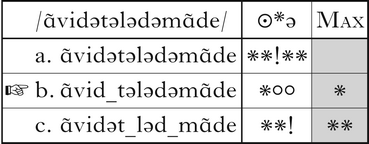
In another evaluation, discarding different violation marks might yield a different winner.
Serial Variation (Kimper Reference Kimper2011) produces local optionality by implementing a multiple-rankings theory within Harmonic Serialism (Prince & Smolensky Reference Prince and Smolensky1993). In Harmonic Serialism, outputs are produced one change at a time in a series of passes through the grammar. Consequently, only one schwa can be deleted on any step, and if the ranking changes between steps, deletion of one schwa might be motivated at an early step while deletion of another is blocked later.
Finally, maximum entropy (Goldwater & Johnson Reference Goldwater, Johnson, Spenador, Eriksson and Dahl2003, Jäger & Rosenbach Reference Jäger and Rosenbach2006, Jäger Reference Jäger, Zaenen, Simpson, King, Grimshaw, Maling and Manning2007, Jesney Reference Jesney2007, Hayes & Wilson Reference Hayes and Wilson2008) assigns every candidate an output probability. Its relevance to local optionality is obvious: even harmonically bounded candidates are possible outputs.
Each alternative to multiple-rankings theories has some means of alleviating harmonic bounding, and PO's success should ultimately be judged against them. But the aim of this paper is to show that PO belongs in the set of theories that provide a reasonable approach to local optionality. The next section presents the heart of this argument.
3 PO and local optionality
What must be demonstrated for us to accept PO as a viable theory of local optionality? If the litmus test is independent manipulation of arbitrarily many loci, PO necessarily fails. Under PO, there must be at least one ranking for each output variant. For a finite constraint set with n constraints, there are n! rankings, so PO generates at most n! distinct variants for a given input (Samek-Lodovici & Prince Reference Samek-Lodovici and Prince1999, Coetzee Reference Coetzee2003); furthermore, n! variants are possible only in the unlikely event that no two rankings yield the same output. So unless the constraint set is infinite – and I am unaware of any such proposal in the literature – there is always a limit to the range of variation PO can generate. Beyond this limit, PO predicts that the variation in at least some loci will be coordinated. The other theories of local optionality mentioned in the previous section do not have a similar limit: given an input with an arbitrary number of loci for an optional process, each of those theories can manipulate any of those loci independently of the others.
In practice, though, the number of relevant loci in any form is well within PO's n! range. For example, I know of no English word with more than two sites for flapping. Similarly, the number of schwas in any French word is limited (they tend to be confined to the first and last syllables of a word), and the number of schwas that can be strung together in a series of clitics is constrained by the syntax. A better measure of PO, then, is whether it can accommodate the level of complexity presented by the system at hand. This is a more modest benchmark, but meeting it would be a non-trivial success. The harmonic-bounding argument, after all, asserts that PO cannot accomplish even this much.
The target in the analyses below, then, is a system that accounts for the most complex attested forms for each locally optional phenomenon. In each case, PO turns out to be versatile enough to produce the available data. Beyond this, the absence of data for more complex configurations means that we simply cannot determine whether PO is correct to predict coordinated variation beyond a certain level of complexity, or if other theories are correct to allow local optionality for any arbitrarily complex form.
A final methodological note: all claims in the analyses below to the effect that the constraint set produces the full range of variation and excludes unattested candidates were verified with at least one of OTSoft (Hayes et al. Reference Hayes, Tesar and Zuraw2013), OT-Help (Staubs et al. Reference Staubs, Becker, Potts, Pratt, McCarthy and Pater2010) or OTWorkplace (Prince et al. Reference Prince, Tesar and Merchant2013). Likewise, the rankings given as necessary to produce each variant were generated with the help of this software.
3.1 English flapping
The approach to local optionality that I pursue here rests on constraints targeting particular prosodic or morphosyntactic elements. By changing which domain-specific constraints are high-ranking, PO can trigger an optional process in one subset or another of the available positions. To illustrate, McCarthy (Reference McCarthy1982) provides the following data on flapping in American English (for a survey of research on flapping, see de Jong Reference De Jong2011).
-
(5)
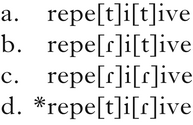
Since the first stop may flap without the second, (5b), flapping is locally optional. McCarthy notes that the second stop in (5) cannot flap independently of the first, (5d), and he points to prosodic structure for an explanation, adopting Selkirk's (Reference Selkirk1980) model of English prosody, as in (6a).Footnote 2
-
(6)
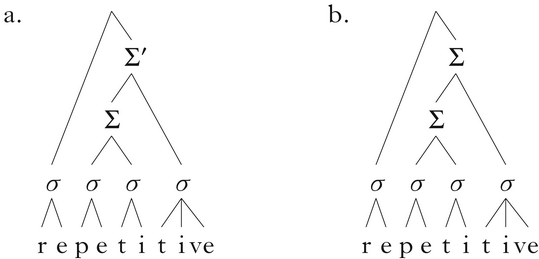
Selkirk posits both feet (∑) and the larger category ∑′. This is reminiscent of the more recent theory of prosodic recursion developed by Ito & Mester (Reference Ito and Mester2007, Reference Ito, Mester, Grijzenhout and Kabak2009a, Reference Ito, Mester and Parkerb, Reference Ito, Mester, Borowsky, Kawahara, Shinya and Sugahara2012, Reference Ito and Mester2013), who argue that the elaborate prosodic hierarchy that languages often seem to exhibit is actually the product of relatively few prosodic categories that undergo recursion. We can easily reinterpret Selkirk's ∑′ as the higher of two ∑ levels, as in (6b). McCarthy argues that flapping targets stops internal to (i.e. not at a boundary of) ∑, but may be extended to the higher domain, ∑′. In terms of (6b), this means flapping occurs within either ∑ domain.Footnote 3
Ito & Mester (Reference Ito and Mester2013) adopt the features [±max] and [±min] to distinguish different levels of recursion. A node that does not dominate any node of the same type is [+min]; if it does dominate such a node, it is [−min]. A node that is not dominated by another node of the same type is [+max], and one that is so dominated is [−max]. All feature combinations are possible, some of which appear in (6b): the higher ∑ is [+max, −min] and the lower one [−max, +min]. Were there a third level of recursion, the middle ∑ would have the features [−max, −min], and in a structure with no recursion, ∑ would be [+max, +min]. By design, Ito & Mester's framework does not allow distinctions to be made between different intermediate levels. For representational simplicity, I henceforth use the labels maximal ([+max]), minimal ([+min]) and intermediate ([−max, −min]). Constraints that refer to these features produce phenomena that are sensitive to one level or another.
What drives flapping? Blumenfeld (Reference Blumenfeld2006) and Katz (Reference Katz2016) treat flapping as lenition; it belongs to the class of processes that weakens unstressed, footed syllables (see Bennett Reference Bennett2012 and references therein). Since flapping exclusively targets this position, it plausibly serves to weaken that syllable and thus enhance the contrast between the prominent stressed syllable and its less prominent footmates – it is both a prominence-enhancing process (from the point of view of the stressed syllable) and a prominence-reducing one (from the point of view of the unstressed syllable). Consequently, I adopt (7) to trigger flapping.Footnote 4
-
(7)

This constraint resembles Crosswhite's (Reference Crosswhite2001) vowel-reduction constraints, which exclude prominent elements from non-prominent positions, and the constraints developed by de Lacy (Reference de Lacy2002b, Reference de Lacy2004), which distinguish heads from non-heads. It is even closer in spirit to the constraints developed by Katz (Reference Katz2016), who unifies (certain) lenition and fortition constraints within a single constraint type. His constraints permit low-sonority consonants like stops only at specified boundaries (here foot-initial position), thereby simultaneously formalising the strength of boundary positions and the weakness of non-boundary positions. As the intricacies of Katz's theory are tangential to the current analysis, I use *StrongOnset/σ̆∑ instead of his formalism.
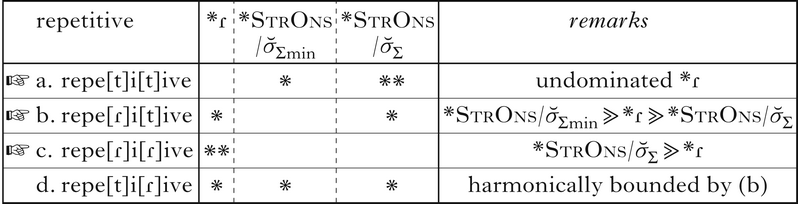
According to (5), only the /t/ in the minimal foot can flap independently of the other one in repetitive. Under the logic of PO, this implies the presence of more available rankings that favour flapping in minimal feet than that favour flapping elsewhere. We can accomplish this with a *StrongOnset/σ̆∑ constraint that targets minimal feet, as in (8). Extending the reasoning from the previous paragraph, if it is advantageous to increase the contrast between stressed and unstressed syllables, it may be especially advantageous within minimal feet – the most local domain containing a stressed syllable.
-
(8)

These constraints are stringent (de Lacy Reference de Lacy2002a): *StrongOnset/σ̆∑ motivates flapping in both loci in repetitive, and *StrongOnset/σ̆∑min does so only for the first one. These constraints penalise all stops, and I assume that other constraints prevent (the equivalent of) flapping of non-coronals. I further assume that flapping violates *ɾ.
A variable ranking involving *StrongOnset/σ̆∑min, *StrongOnset/σ̆∑ and *ɾ accounts for repetitive. (9) shows the violation profiles of the relevant candidates; all possible winners are indicated, and the final column notes for each candidate either the ranking conditions that favour it or the reason it is excluded. By recognising the proclivities of different prosodic levels to trigger flapping, we arrive at a multiple-rankings analysis that does not require the same behaviour of all loci.
-
(9)
Kaplan (Reference Kaplan2011) identifies other words that contain multiple potential flaps. These include (with potential flaps underlined) competitive, Saturday and automatic. Vaux (Reference Vaux and Nevins2008) further provides marketability. These words fall into two categories, based on their prosodic structure. Competitive and Saturday have the same structure as repetitive (for the reasons given in note 3), with both flaps contained within a single maximal foot. They therefore submit to the analysis in (9).Footnote 5 But the flaps in automatic and marketability appear in different feet, as in (10).Footnote 6
-
(10)
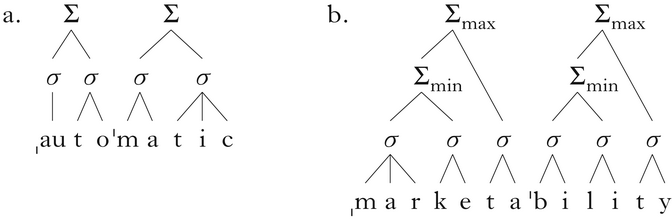
The structure for automatic is straightforward, with the stress pattern motivating two trochees and the potential flaps in the required foot-internal position. For marketability, neither flap immediately follows stress, so recursive structure is necessary to place the flaps inside a foot, similar to repetitive.
In contrast with repetitive, the words in (10) present flaps that appear at the same level of recursion and therefore cannot be distinguished by the features [max] and [min].Footnote 7 Consequently, the constraints considered so far predict global variation, and we must make even finer distinctions to account for the data. This is easily accomplished with versions of *StrongOnset/σ̆∑ and *ɾ that target feet containing primary stress, as in (11).
-
(11)
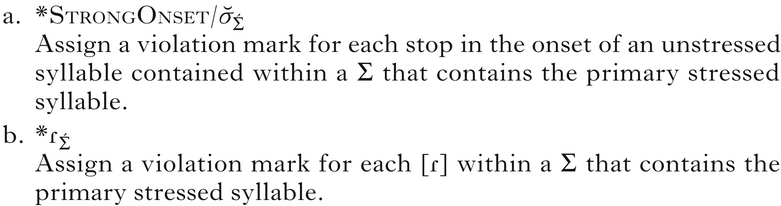
In (10), all potential flaps are subject to *ɾ and *StrongOnset/σ̆∑; only the rightmost ones are subject to the constraints in (11).
The rationale for *StrongOnset/σ̆∑́ is familiar by now: it enhances the contrast between the primary stressed syllable and its unstressed footmates. *ɾ∑́ pushes in the opposite direction, increasing the salience of feet containing primary stress by banning a segment that would weaken that position. These markedness constraints are at odds with each other, but there is nothing contradictory in that (Bennett Reference Bennett2012). Unstressed footed syllables are in both a salient position (a foot) and a non-salient one (the weak syllable of a foot); it is unsurprising that they are consequently subject to conflicting pressures. On one hand, flapping decreases the prominence of weak syllables; localising it to minimal feet or primary stressed feet restricts this weakening to the positions where it can be most effective. On the other hand, lenition in prominent positions is often avoided (Beckman Reference Beckman1999, Smith Reference Smith2005), as formalised by *ɾ∑́. In fact, *ɾ∑́ meets Smith's (Reference Smith2005) criteria for augmentation constraints, because it bans a prominence-reducing element from a prominent position.
The analysis of marketability is presented in (12). *StrongOnset/σ̆∑min plays no role in the analysis (neither potential flap is within a minimal foot), so I omit it.
-
(12)
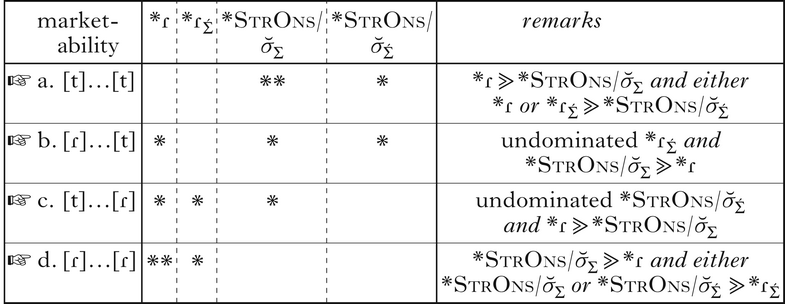
The treatment of automatic is identical. (*StrongOnset/σ̆∑min is active for automatic, but only replicates *StrongOnset/σ̆∑’s effect of motivating flapping in both positions, and thus does not substantively affect the outcome.) The analysis accounts for both marketability-type words, with independently manipulable loci, and repetitive-type words, in which one locus is dependent on the other. I verified using OT-Help that combining the constraints from (9) and (12) does not affect the predicted patterns. It is unclear whether the analysis can be extended to more than two loci, but with no words that present this configuration it is impossible to probe the issue.
The analysis relies solely on markedness constraints. By richness of the base (Prince & Smolensky Reference Prince and Smolensky1993), the analysis must cope with inputs containing stops and inputs containing flaps. An alternative approach with a variable ranking between *StrongOnset and Faith would invariably preserve an input /ɾ/. This seems implausible, so the analysis is constructed to produce variation regardless of the input's contents. Consequently, the markedness constraints that produce the alternation must outrank the relevant faithfulness constraints.
In sum, in the foregoing analysis, variation results from competition between markedness constraints that bear on unstressed footed syllables, positions which are simultaneously prominent and non-prominent. Consequently, position-specific constraints that conform to well-formedness desiderata are available to PO. The next section considers French schwa.
3.2 French schwa deletion/epenthesis
French schwa deletion/epenthesis, which is the subject of a large body of research (Dell Reference Dell1973, Howard Reference Howard1973, Selkirk Reference Selkirk1978, Anderson Reference Anderson1982, Tranel Reference Tranel1987, Côté Reference Côté2000, Gess et al. Reference Gess, Lyche and Meisenburg2012, among many others), is quantitatively and qualitatively different from flapping. Attested examples can exceed flapping's maximum of two loci, and the relevance of clitics presents new analytical possibilities, grounded in morphosyntactic structure. All data are from Côté (Reference Côté2000), unless otherwise noted. Morpheme-by-morpheme glosses are my own, but translations and transcriptions come from the original sources.
The French vowel labelled schwa is a mid front rounded vowel; its specific properties vary across contexts and dialects (Durand et al. Reference Durand, Slater and Wise1987, Fougeron et al. Reference Fougeron, Gendrot, Bürki, Trouvain and Barry2007), and it alternates with Ø in a variety of contexts. (The following discussion follows Côté Reference Côté2000, though other authors provide similar descriptions.) A handful of clitics are of the shape C(ə), such as those in (1) and (2) above. Schwa also appears in the first syllable of some polysyllabic words, as in demander in (1).
Schwa can surface at word boundaries, as in (13), and to the left of certain suffixes: garderai ‘(I) will keep’ optionally hosts a schwa between the stem and the first-person future suffix: [gard(ə)re].
-
(13)

A small number of words contain schwa in both of the first two syllables: e.g. tu devenais ‘you (sg) became’ (Noske Reference Noske1993). All examples of this sort that I am aware of plausibly include prefixes: Dell (Reference Dell1973: 176) treats the initial [də] of devenais as a prefix, and mentions revenir ‘come back’, with the stem venir ‘come’, which permits omission of either schwa in its first two syllables. I will not give a full analysis of these words here, but the approach is straightforward: just as the analysis below of (1) uses constraints targeting each morphosyntactic position that can host schwa in that form, an analysis of devenais can use constraints that capitalise on the fact the schwas in this word belong to different morphemes.
The focus of this section is schwas in clitics and word-initial schwas, because these are the contexts that yield the most robust examples of local optionality. The analysis developed here rests on the (mis)alignment of morphosyntactic units with syllable boundaries and can consequently be extended to account for suffix-preceding schwas in transparent ways. See Kaplan (Reference Kaplan2011) for an analysis of word-final schwa that can be adapted to PO.
Discussion of the underlying status of schwa is warranted. All schwas appear at morpheme edges, except for those in the first syllable of polysyllabic words. I follow Côté (Reference Côté2000) and Côté & Morrison (Reference Côté and Morrison2007), who argue that schwa is underlying only in the latter position. Evidence for this includes the following. Schwa at a morpheme boundary is never contrastive: there are no minimal pairs of the sort [t] vs. [tə]. Word-final schwa may appear in any (or perhaps almost any) consonant-final word, given the right phonological context (Tranel Reference Tranel1981). The possibility of schwa being realised is entirely predictable in these positions. But morpheme-internally, contrasts exist, and schwa is unpredictable: pelouse ‘lawn’ may surface with a schwa after the first consonant ([p(ə)luz]), but place ‘square’ cannot ([plas], *[pəlas]; Noske Reference Noske1993). The only viable account of this contrast involves an underlying schwa in just pelouse; an account based on epenthesis could not distinguish the words. Thus the only schwa in (1) that must be underlying is the one in demander. I assume the remainder are epenthetic, but as discussed in §3.2.4, the analysis is compatible with either view of these schwas.
I begin by establishing the constraints central to the PO analysis of the optionality in (2). The discussion then turns to some of the intricacies of schwa, to demonstrate the robustness of the analysis.
3.2.1 Local optionality in French schwa
In the absence of schwa, how is a consonant that would have been the onset of the syllable with schwa syllabified? Sometimes the answer is straightforward: in [ɑ̃vid_tələdəmɑ̃de] (2b), for example, the [d] from the clitic de may surface as a coda.Footnote 8 The same goes for the other VCCV sequences in the data above arising from schwa's absence between the consonants: they are syllabified as VC.CV, according to Dell (Reference Dell1995). In other cases, such as pelouse, the consonant may syllabify rightward to form a complex onset. But Côté (Reference Côté2000) shows that the omission of schwa may result in segmental sequences that are incompatible with the language's syllabification principles. For example, the underlined schwas in (14) are omissible according to Côté, and the resulting [tfn], [fdl] and [n∫m] clusters cannot be syllabified: [tf], [fd] and [n∫] are illicit codas, and [fn], [dl] and [∫m] are not well-formed onsets.Footnote 9 The [dtl] cluster in (2j) and (2k) presents similar challenges.
-
(14)
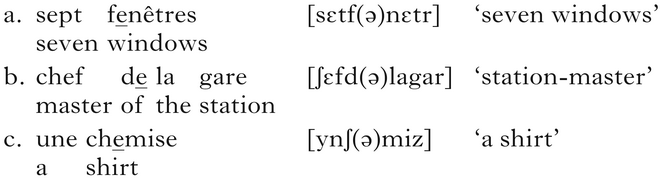
I assume that in situations like these, the consonant left stranded by the absence of schwa remains unsyllabified.Footnote 10 Thus there are three possibilities for the consonants in question: they can be syllabified leftward or rightward, or they may surface outside the syllable structure. Of the data presented so far, only pelouse permits rightward syllabification; consequently, I set that possibility aside and return to it in §3.2.3. In the remainder of the data, then, consonants preceding an omitted schwa either become codas or remain unsyllabified. When schwa appears, they are onsets. With respect to (1), and many of the other examples presented above, these consonants are also morpheme-initial; schwa's appearance can therefore be governed by constraints mandating coincidence between the left edges of morphosyntactic units and the left edges of syllables. The inclusion of schwa, as in [ɑ̃vidətələdəmɑ̃de], facilitates this coincidence. Its absence does not: in [ɑ̃vid_t_lədəmɑ̃de], for example, the first [d] is syllabified as a coda, and [t] surfaces unsyllabified.
Each schwa in (1) is distinguishable from the others syntactically. Constraints requiring coincidence of edges of syntactic heads and syllables, such as Align(Vb, L; σ, L) and Align(Comp, L; σ, L), motivate retention or epenthesis of schwa. The constraints just mentioned block deletion in demander and trigger epenthesis in the complementiser de respectively. (The preposition de ‘of’, though homophonous with the complementiser, would be subject to a different alignment constraint.) Epenthesis in the remaining clitics in (1) is triggered by constraints targeting case features: for te, Align(dat, L; σ, L), and for le, Align(acc, L; σ, L). These constraints require the left edge of the phonological exponent of the relevant case feature to coincide with the left edge of a syllable.
The incorporation of syntactic elements into phonological analyses has a robust history. The edges of phonological units are often argued to coincide with morphosyntactic boundaries (Selkirk Reference Selkirk1986, Chen Reference Chen1987, Hale & Selkirk Reference Hale and Selkirk1987). Such effects occur at all syntactic and prosodic levels; the research just cited concerns higher prosodic categories like phonological phrases and larger syntactic units such as XP, but Cohn (Reference Cohn1989) and Inkelas (Reference Inkelas1989) study word-internal alignment of morphology and prosody (see also Nespor & Vogel Reference Nespor and Vogel1986 and Smith Reference Smith2011 for discussion of the interaction of syntax and phonology). In OT these effects are often captured with alignment constraints (McCarthy & Prince Reference McCarthy and Prince1993) like the ones in the preceding paragraph: McCarthy & Prince (Reference McCarthy and Prince1993: 110) themselves adopt constraints like Align([poss]Af, L; Ft′, R) to enforce the coincidence of prosody and morphology. (This particular constraint bears on the interaction of possessive morphology and feet in Ulwa.) The constraints for schwa are simply additional members of this constraint family.
The Align constraints are variably ranked with *ə. Under Align⪢*ə, schwa surfaces in the position identified by Align. As explained in §1, the ungrammatical forms in (2) possess a [tld] sequence that violates a prohibition on triconsonantal sequences in which the middle consonant is more sonorous than its neighbours. Kaplan (Reference Kaplan2011) formalises this constraint as *CNC, and it is undominated in the current analysis. This yields the grammar in (15), following Anttila's (Reference Anttila, Hinskens, van Hout and Wetzels1997, Reference Anttila and de Lacy2007) practice of specifying only the fixed rankings for a PO grammar.
-
(15)

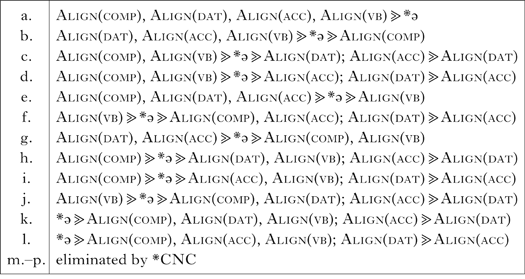
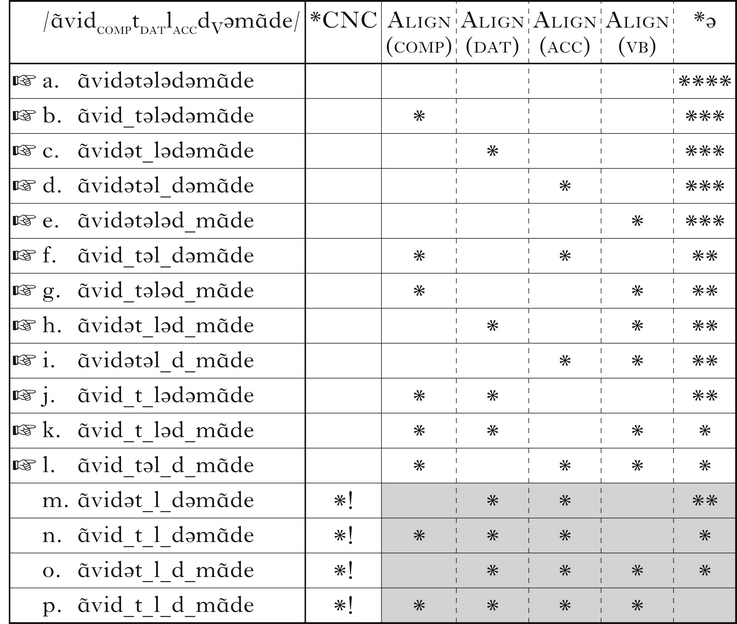
The analysis is given in (16), and the ranking requirements are shown in Table I. Subscripts indicate the morphosyntactic affiliation for each consonant of interest in the input. Syllabification is not shown, but recall that the relevant consonants surface as onsets and satisfy Align only when preceding a schwa. Since the Align constraints trigger epenthesis, they must outrank Dep, which is omitted from tableaux in this section because it has no effect on them.
-
(16)
Ranking requirements for the candidates in (16).

For each output, *ə must outrank the alignment constraints that refer to the positions in which schwa is absent. Generally, but not always, alignment constraints for positions in which schwa appears outrank *ə. Because some candidates are eliminated by *CNC, rankings that would otherwise favour those candidates instead select some other candidate. For example, the ranking of Align(acc) with respect to *ə is inconsequential for candidate (h), [ɑ̃vidət_ləd_mɑ̃de], as long as the conditions in Table I hold. If Align(acc) appears below *ə, this candidate still wins because the comparable candidate without a schwa in le, (o) [ɑ̃vidət_l_d_mɑ̃de], violates *CNC. Consequently, [ɑ̃vidət_ləd_mɑ̃de] emerges as a sort of next-best option.
More constraints can be added, for nominative case (e.g. for the 1st person singular clitic je), determiners (for masculine singular le) and for the negative clitic ne (see §3.2.2). Perhaps all syntactic categories have Align constraints, but only a few such constraints are active, because schwa doesn't appear in all syntactic positions. (Conjunctions, for example, do not contain schwas.) If the relevant stage of analysis includes only a lexical word and its dependent clitics, we will not have to deal with multiple items of the same syntactic category or case at once, so no constraint will control more than one schwa.
The core of the analysis is now in place. Since local optionality most commonly arises via the concatenation of clitics, loci can be manipulated by reference to morphosyntactic properties. The next section turns to the negative clitic ne, which behaves idiosyncratically with respect to schwa. Those idiosyncrasies require no elaboration of the analysis, beyond imposing a fixed ranking between the alignment constraint governing ne and other alignment constraints.
3.2.2 The behaviour of the negative clitic
The negative clitic ne has priority for schwa omission: no other schwa be may omitted if the schwa in ne surfaces. Dell (Reference Dell1973) provides the examples in (17).Footnote 11 In each case, omission of the schwa from another clitic is impossible if ne’s schwa surfaces, even though the resulting form is phonotactically permissible. This is perhaps clearest with (17d): the ungrammaticality of *[tynəd_mɑ̃dpa] contrasts with, say, (2g), [ɑ̃vid_tələd_mɑ̃de], in which omission of the schwa from the same verb and the presence of a preceding clitic's schwa is permitted. Thus the data cannot be explained by phonotactic considerations alone: *CNC, for example, is violated by none of the ungrammatical forms in (17), because they have no triconsonantal clusters.
-
(17)
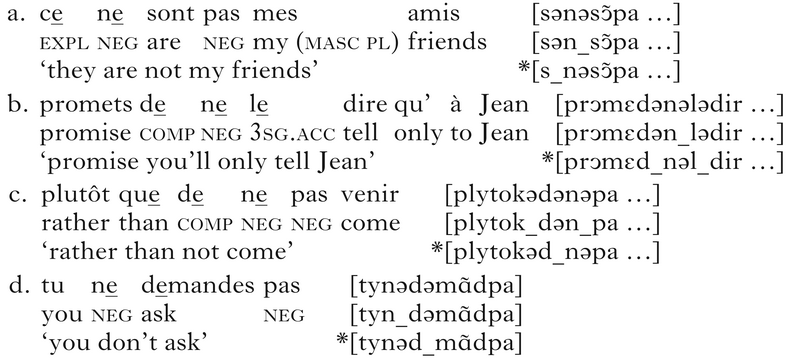
As (17c) shows, the generalisation is not that other schwas are obligatory when the negative clitic appears, but rather that omission of schwa in ne is a prerequisite for omission of other schwas. This restriction holds only if phonotactic considerations do not require the presence of the schwa in ne. Dell provides the examples in (18), in which the schwa in ne is required (by *CNC), but other schwas are optional.
-
(18)
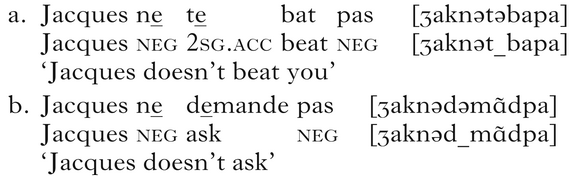
In sum, ne presents two analytical challenges: the impossibility of schwa omission in other positions when an omissible schwa surfaces in ne, and the permissibility of schwa omission in other positions when the schwa in ne is mandatory. Both facts follow from ranking Align(neg) below the other Align constraints. Thus when *ə outranks some other Align constraint, it necessarily also outranks Align(neg), blocking schwa in this clitic any time it is ranked high enough to block it elsewhere. (In this respect the system is reminiscent of the floating constraint blocks of Reynolds Reference Reynolds1994 and Nagy & Reynolds Reference Nagy and Reynolds1997.) The grammar is given in (19). Only the Align constraints used above are shown, but the entire family is ranked below *CNC, and Align(neg) is outranked by all other Align constraints.
-
(19)

The analysis is illustrated in (20) with ce ne sont pas mes amis (17a). Omission of both schwas is prevented by *CNC. When *ə is ranked lowest (20a), both clitics emerge with schwa. Any other ranking, e.g. (20b), yields a schwa in only the first clitic. Because Align(nom) always outranks Align(neg), *[s_nəsɔ̃pa] is impossible. To clarify assumptions concerning syllabification in these tableaux: [ns] is not a possible onset (Dell Reference Dell1995), hence the violation of Align(neg) for the first two candidates. Dell (Reference Dell1995) gives [sn] as a possible word-initial onset, but all of his supporting examples are clear loanwords (e.g. snob); I assume that the native stratum of the lexicon prohibits this onset, and thus the initial [s] in *[s_nəsɔ̃pa] is unsyllabified, violating Align(nom).
-
(20)
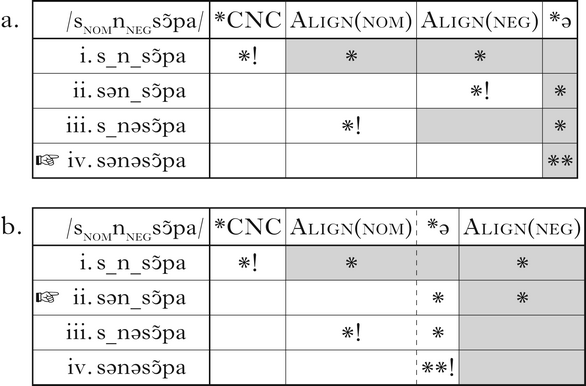
The preceding tableaux show how the analysis captures the basic generalisation that ne has priority for schwa omission. In contrast, *CNC compels ne to surface with a schwa in Jacques ne te bat pas (18a), but the schwa in te may still be omitted. The analysis captures this, too, as (21) shows. Even with Align(acc) invariably outranking Align(neg), the candidate with schwa absent from just the accusative clitic can emerge. ([nt] and [tb] are illicit onsets, hence the violations of Align(acc) and Align(neg).)
-
(21)
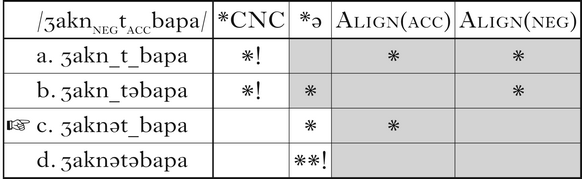
Obviously, if Align(acc) outranks *ə, candidate (d) wins. Candidates (a) and (b) invariably fatally violate *CNC. Both generalisations concerning ne are accounted for.
In sum, the analysis produces local optionality and also accounts for contexts in which the behaviour of one locus determines the behaviour of another. An anonymous reviewer notes that an analysis grounded in (19) may not carry over to other multiple-rankings theories like Stochastic OT, in which there is no formal distinction between fixed and variable rankings: we cannot rank *ə, Align(acc) and Align(neg) close enough to each other to achieve the necessary variability in *ə’s ranking without also allowing Align(neg) to sometimes outrank Align(acc). This may be so, but my concern here is simply to show that some multiple-rankings theory can produce the facts.
3.2.3 Rightward syllabification
In the data so far accounted for, the absence of schwa leads to a violation of an alignment constraint, because the morpheme-initial consonant to the left of the potential schwa cannot be syllabified as an onset. Were such a syllabification possible, Align would not be violated when schwa is omitted. This section considers data permitting that outcome. There are two situations to consider. The first involves a clitic whose consonant can form an onset with the initial segment of the following word, such as (22) (from Dell Reference Dell1973: 207). The second involves morpheme-internal schwas, which I take up below.
-
(22)

Because [sp] is a possible onset (Dell Reference Dell1995), satisfaction of Align(acc) does not require schwa, as (23) shows. Only the crucial syllable boundaries are given, and for purposes of illustration I assume that [s] is unsyllabified in the last candidate (as indicated by <s>), but the same result holds if it forms a complex coda with [r] (contra Dell Reference Dell1995, who argues that complex codas are impossible word-internally and, for reasons that are tangential, that word-final clusters are not tautosyllabic).
-
(23)
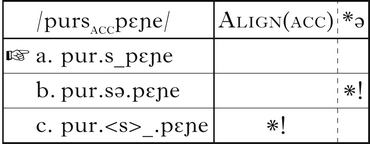
Align(acc) does not trigger schwa epenthesis here, but it is not the only alignment constraint relevant to (22): the winning candidate in (23) violates Align(vb), because the leftmost segment of peigner is not syllable-initial. Consequently, as (24) shows, Align(vb) and Align(acc) can work together to compel epenthesis.
-
(24)
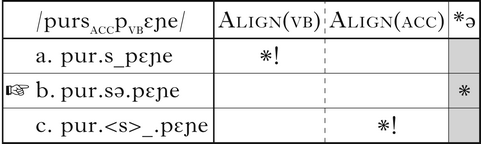
With both Align(vb) and Align(acc) outranking *ə, the leftmost segments of both the clitic and verb must be syllable-initial. Only schwa epenthesis permits such a configuration. As an inspection of (24) shows, promoting *ə above at least one of the alignment constraints yields one of the candidates without schwa. This example shows that the analysis already predicts the correct behaviour of polymorphemic configurations that permit well-formed complex onsets in the absence of schwa. Multiple alignment constraints conspire to trigger schwa's appearance.
But when the two consonants in question are not governed by separate alignment constraints, this strategy fails. Such a situation arises with morpheme-internal schwas, as in pelouse. Align(n) is satisfied whether or not the underlined schwa is present: since [pl] is a licit onset, [p] is syllable-initial even without schwa. In this case no alignment constraint bears on [l], because it is not morpheme-initial, and there is consequently no motivation for retaining the schwa, as shown in (25).
-
(25)
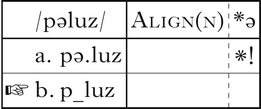
The remedy is simple. The schwa in pelouse (and all forms that present the same challenge, to my knowledge) must be underlying, for reasons given above. Adding Max to the partial ranking with Align and *ə provides a constraint favouring schwa's retention, as in (26).
-
(26)
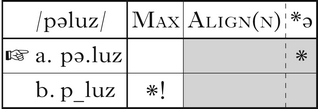
Obviously, when *ə outranks Max, the candidate without schwa wins. The rest of the analysis, which concerns epenthetic vowels, is unaffected by Max. This constraint simply provides another impetus for schwa to be retained when it is underlying and is crucially active when alignment cannot block deletion.
The final grammar is in (27), where Align(X) and Align(~neg) respectively represent all Align constraints and all Align constraints except Align(neg).
-
(27)

3.2.4 Summary
Morphosyntactically informed constraints provide an analysis of local optionality in French. Like the prosodic constraints from the account of flapping, the constraints used here are relativised (this time to morphosyntactic positions) in ways that are independently motivated. PO offers a simple account of the complex examples presented by French, and also accommodates patterns such as the behaviour of ne and local optionality within a word. The system's compatibility with even greater complexity depends on the loci continuing to occupy distinct syntactic positions. In that sense, the analysis is constrained only by the number of categories the syntax provides.
The analysis assumes that schwas in clitics are epenthetic, but morpheme-internal schwas are underlying. Little hinges on this choice, at least with respect to clitics; the appearance or omission of schwa in the PO analysis is driven chiefly by markedness constraints, so, as with flapping, whether schwa is underlying or not is inconsequential. This arrangement again accommodates richness of the base: variation should result whether or not an input clitic contains schwa.
However, the underlying status of morpheme-internal schwas is crucial: were the schwa in pelouse epenthetic, the analysis would fail. Max, which is solely responsible for schwa's appearance in pelouse, would be irrelevant, and *ə would always block epenthesis. But recall that morpheme-internal schwas must be underlying for independent reasons, so the deletion-based analysis follows naturally from the empirical demands of contrasts such as pelouse vs. place. Richness of the base does not present the same issue as it does for clitics: /pəluz/ and /plas/ must be treated differently, with schwa possible only in the former.
3.3 Pima reduplication
Munro & Riggle (Reference Munro and Riggle2004) and Riggle (Reference Riggle2006) describe a pattern of local optionality in the Uto-Aztecan language Pima. Reduplication, which marks the plural forms of various syntactic categories, copies either the first C or CV of the stem, depending on phonotactic considerations (Riggle Reference Riggle2006). C reduplication is shown in (28a) and CV reduplication in (28b). Reduplicants are underlined; following Riggle, I assume that reduplication is infixing.
-
(28)
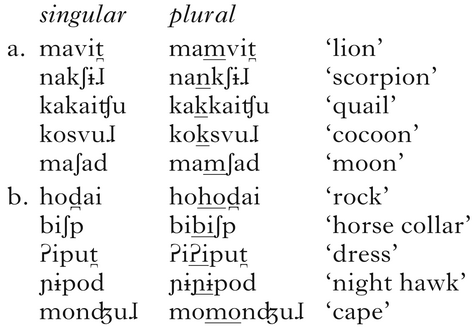
In compounds, reduplication may target any number of stems, as long as it targets at least one. Thus [ˌʔonk-ˈʔus] (salt-tree) ‘tamarack’ has three plural forms: [ˌʔoʔonk-ˈʔus], [ˌʔonk-ˈʔuʔus] and [ˌʔoʔonk-ˈʔuʔus]. Munro & Riggle (Reference Munro and Riggle2004: 116) state that this is a regular property of compounds (with a few exceptions), and that their consultant ‘reports no difference in meaning among plural variants … only memory limits the number of plurals he volunteers'. More examples are given in (29).
-
(29)
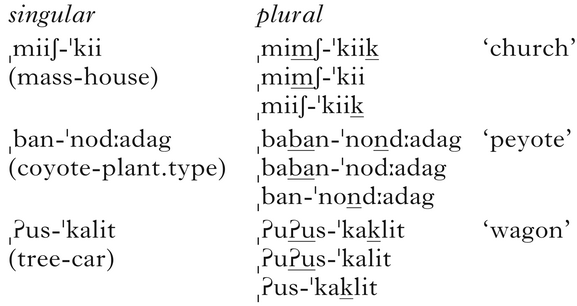
Compounds may have more than two stems, and reduplication may target any combination of them, yielding 2n – 1 variants for n stems (here and subsequently, parentheses indicate morphological constituency as given by Munro & Riggle). For example, [ʔus-ˈkalit]-[ˈvainom] (tree-car)-(knife) ‘wagon-knife’ has seven plural forms, and [vil-ˈgoodii]-[pas-ˈtiil] (apricot)-(pie) ‘apricot pie’, with four stems, has fifteen plurals.Footnote 12 In (30) I give the plural forms with reduplicants in all possible positions. The remaining variants are deducible from these; see Munro & Riggle (Reference Munro and Riggle2004) for the complete list of variants. (Some of these examples show a regular alternation between [v] and [p].)
-
(30)
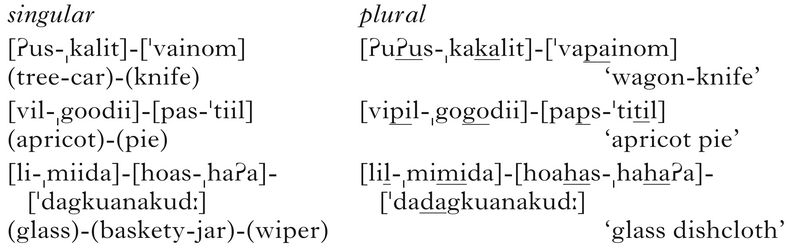
The last of these examples, with five stems, has 31 plural variants.
PO can exploit the internal structure of compounds by requiring reduplicants to appear at various edges within that structure. I assume that each stem projects its own prosodic word (ω) node, leading to recursive configurations like the one in (31). This arrangement is supported by the fact that each stem exhibits the stress pattern of simplex words in the language. Stress is regularly word-initial; a recursive structure permits the maintenance of this generalisation in compounds, which, taken as whole, have non-initial primary stress.
-
(31)
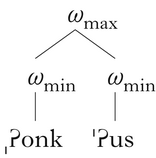
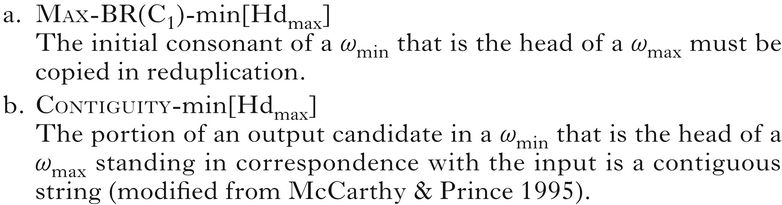
The analysis of simpler compounds like [“ʔonk-ˈʔus] is straightforward. Following Munro & Riggle, reduplication is driven by Max-BR(C1), which motivates reduplication in every stem. I use the revised definition in (32), which is formulated in terms of prosodic structure rather than Munro & Riggle's morphological category ‘stem’. Nothing crucial hinges on this choice.
-
(32)

The reference to ωmin in (32) means that failure to reduplicate in any stem incurs just one violation of Max-BR(C1). For example, the initial consonant in (31) is initial in both a ωmin and the ωmax; failure to reduplicate in this stem could in principle violate Max-BR(C1) twice (once for each ω), but, by (32), it instead incurs a single violation. I restrict things in this way for simplicity in assessing violations, and to more closely replicate Munro & Riggle's analysis.
Munro & Riggle discourage multiple reduplicants with a constraint against multiple exponents of a morpheme; I will instead use Contiguity, which penalises each reduplicant because of the infixal nature of the morpheme. So for /ˌʔonk-ˈʔus/, Max-BR(C1) favours [“ʔoʔ onk-ˈʔuʔ us], while Contiguity favours no reduplication.
Failure to reduplicate altogether is ruled out by RealiseMorpheme (e.g. Kurisu Reference Kurisu2001), which need only dominate Contiguity. Its ranking with respect to Max-BR(C1) (and all other constraints adopted below) is inconsequential. I assume that other constraints compel infixation of each reduplicant; see Riggle (Reference Riggle2006).
The analysis is illustrated in (33). Variation results from a partial order involving Max-BR(C1) and Contiguity. When Max-BR(C1) is high-ranking, each stem reduplicates. The opposite ranking yields a tie between the one-reduplicant candidates. (For perspicuity, subsequent tableaux omit RealiseMorpheme and candidates that violate it.)
-
(33)
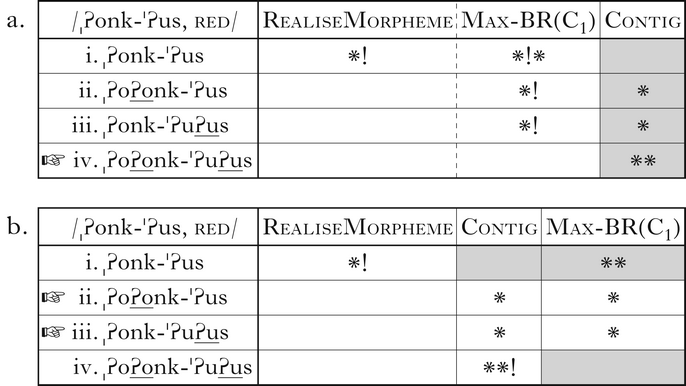
Breaking this tie requires distinguishing one ωmin from another. Max-BR(C1) and Contiguity hold for all ωmin’s, and determine the default behaviour on any evaluation. By adding position-specific versions of these constraints, we can trigger deviant behaviour for particular positions. For the example at hand, the constraints in (34) single out the ωmin that is the head of the ωmax – the ωmin with primary stress. (In general, I assume that the head of any compound or a constituent thereof is the element within the constituent that contains the greatest level of stress.) These are simply positional faithfulness constraints (Beckman Reference Beckman1999). With only two ωmin’s, this is sufficient: when the ω’s behave differently, it is because a position-specific constraint dominates the generic constraints, thereby dictating the behaviour of the head ω and leaving the generic constraints to control the non-head ω.
I adopt the following convention for constraint names. A constraint C-X[Y] holds for ω’s of type X that have the property Y. So Max-BR(C1)-min[Hdmax] holds for ωmin’s that are heads of some ωmax. Also, I henceforth refer to the Max-BR(C1) family as simply Max.
-
(34)
Whereas the PO analyses of English and French were grounded in markedness constraints, the current analysis uses faithfulness constraints. This is a natural consequence of the properties of each system. The analyses of English and French must contend with richness of the base, and therefore require markedness constraints. But richness of the base is irrelevant to optionality in Pima: reduplication should only be possible when the input contains the plural morpheme. Under Correspondence Theory (McCarthy & Prince Reference McCarthy, Prince, Beckman, Dickey and Urbanczyk1995), faithfulness constraints – specifically Max-BR – ensure that reduplication occurs. That the constraint opposing Max-BR(C1) is also a faithfulness constraint is happenstance: I know of no constraint that explicitly militates against reduplication, but Contiguity has this effect because reduplicants are infixes. The choice of constraint type follows from the nature of the optional process under consideration. The fact that the analyses developed here use diverse kinds of constraints supports PO, which imposes no restrictions on which constraints can participate in a variable ranking. It would therefore be surprising if, say, only markedness constraints could be variably ranked, or if variable rankings involving both markedness and faithfulness were unattested. Instead, we find all possible combinations: markedness only (English), faithfulness only (Pima), and both markedness and faithfulness (French, which requires Max to deal with underlying schwas).
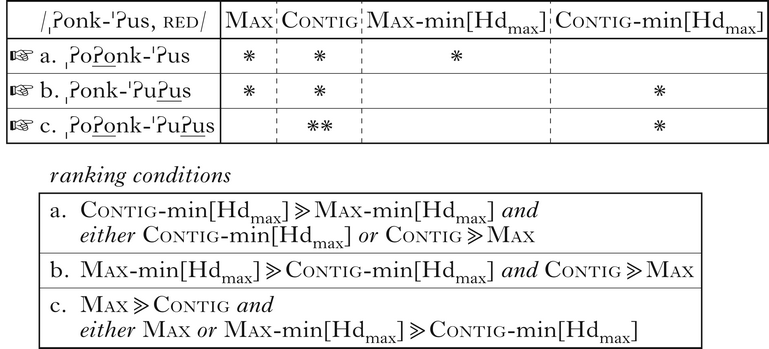
The analysis of /ˌʔonk-ˈʔus/ is given in (35), which shows the ranking conditions for each variant. The system works as follows: generic Max and Contiguity assign violations to the two stems. They are the only constraints that bear on the first stem, so they determine that stem's fate. Both they and the min[Hdmax] constraints can influence the second stem, so the highest-ranking constraint controls that stem. Finally, if the ranking is such that the candidate with no reduplication would be optimal were it not for RealiseMorpheme (e.g. if Contiguity is undominated), one of the candidates with a single reduplicant wins, depending on the ranking of Contiguity-min[Hdmax] and Max-min[Hdmax]: the former favours reduplication in the first stem, and the latter reduplication in the second stem.
-
(35)
Next, consider [ʔus-“kalit]-[ˈvainom], with three stems. The structure in (36) follows the bracketing provided by Munro & Riggle, who state that stem-initial syllables transcribed with no stress actually have a lesser degree of stress. This motivates the placement of /ʔus/ and /ˌkalit/ in separate minimal ω’s; further evidence comes from the presence of stress on /ˌkalit/, which indicates that this stem is initial in some ω.
-
(36)
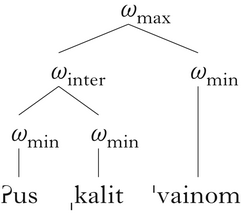
The min[Hdmax] constraints hold for /ˈvainom/, the head of the whole compound. The remaining stems are subject only to the generic constraints. To distinguish one from the other, the constraints in (37) for the head of a ωinter can be used. These will target /ˌkalit/ (but not /ˈvainom/, which is not dominated by a ωinter).
-
(37)
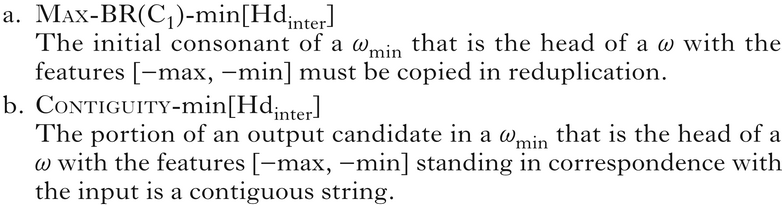
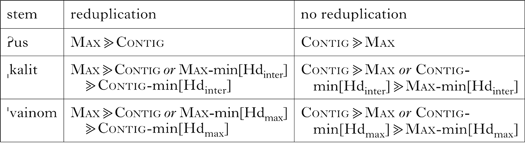
The treatment of [ʔus-“kalit]-[ˈvainom] now works as follows: /ˈvainom/ and /ˌkalit/ are each governed by a pair of positional faithfulness constraints that target them specifically. Generic Contiguity and Max control /ʔus/, and can also influence the other stems when highly ranked. This is summarised in Table II; the analysis is sufficiently complex that providing the ranking requirements for each possible winner is unwieldy, so I adopt a new format, described below.
Ranking conditions for reduplication of each stem in (36).

Any two stems S1 and S2 in (36) can be independently manipulated. Reduplication in S1 but not S2 requires a ‘reduplication’ subranking from Table II for S1 and a compatible ‘no reduplication’ subranking for S2. If the subranking for S1 affects S2, the ranking between these subrankings becomes relevant: the higher constraint in S2’s subranking must outrank the higher constraint in S1’s subranking. For example, Max-min[Hdmax] ⪢ Contiguity-min[Hdmax] triggers reduplication in /ˈvainom/, and Contiguity ⪢ Max blocks it in /ʔus/. Since the latter subranking can also block reduplication in /ˈvainom/, Max-min[Hdmax] must outrank Contiguity if /ˈvainom/ is to reduplicate.
Obviously, it is also possible to produce reduplication in both S1 and S2 by adopting some subranking in each stem's reduplication column. Likewise, reduplication is blocked in both stems – modulo satisfaction of RealiseMorpheme – when some subranking in the no reduplication column for each stem holds.
Turning to [vil-“goodii]-[pas-ˈtiil], with four stems, we have the structure in (38).
-
(38)
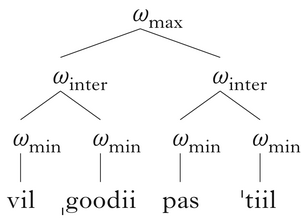
I adopt the same assumptions regarding stringency that held for the analysis of flapping. Thus /ˈtiil/, which is both the head of the ωmax and the head of a ωinter, is subject to the min[Hdmax] constraints, the min[Hdinter] constraints and the generic constraints.
The min[Hdmax] constraints single out /ˈtiil/. Both /ˈtiil/ and /ˌgoodii/ are subject to the min[Hdinter] constraints. By using the min[Hdmax] constraints to prevent the min[Hdinter] constraints from controlling /ˈtiil/, /ˌgoodii/ can be manipulated on its own. The situation is illustrated with sample rankings in (39). In (39a), Max-min[Hdinter] ⪢ Contiguity-min[Hdinter] favours reduplication in both /ˈtiil/ and /ˌgoodii/. But higher-ranking Contiguity-min[Hdmax] blocks it in /ˈtiil/. In (39b), Contiguity-min[Hdinter] ⪢ Max-min[Hdinter] militates against reduplication in either stem, but higher-ranking Max-min[Hdmax] requires it in /ˈtiil/.
-
(39)

However, the analysis so far fails to distinguish /vil/ from /pas/. As non-heads, they are subject only to the generic constraints. One possible remedy is the constraints in (40), which hold for the initial ωmin.Footnote 13
-
(40)
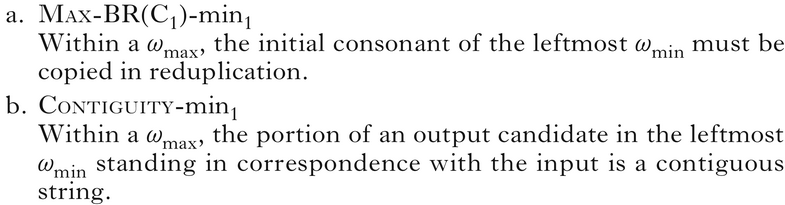
Reference to initial prosodic categories is common in OT (e.g. Beckman Reference Beckman1999, Smith Reference Smith2005, Walker Reference Walker2011), especially in the domain of positional faithfulness. Bennett (Reference Bennett2012) argues that the initial position in any prosodic domain is a licit target for constraints.Footnote 14
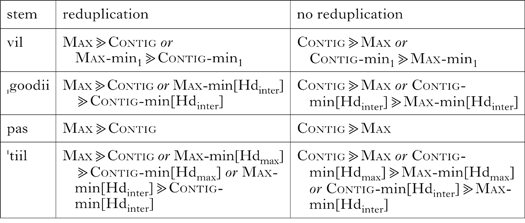
The rankings that affect each stem are given in Table III. The logic behind the analysis is the same as that sketched under Table II.
Ranking conditions for reduplication of each stem in (38).

To take inventory, we now have eight constraints: generic Max and Contiguity, plus six position-specific versions of them. The two min[Hdmax] constraints target the ωmin that is the head of the ωmax, the two min[Hdinter] constraints target the heads of ωinter’s, and the two min1 constraints target the initial ωmin. All of these are positional faithfulness constraints and conform to the requirement that such constraints target prominent positions such as prosodic heads or initial categories.
Despite supporting 8! = 40,320 rankings, these eight constraints do not produce the 31 plural forms of the most complex compound available, [li-“miida]-[hoas-“haʔa]-[ˈdagkuanakud:], in (30). The structure I assume for this word, based on the bracketing provided by Munro & Riggle, is given in (41).
-
(41)
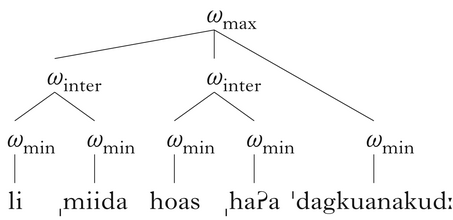
In particular, the analysis treats the heads of the ωinter’s, /“miida/ and /“haʔa/, identically. As (42) shows, the candidates with reduplication at just one of these positions have identical violation profiles. The same goes for any pair of candidates that differ only in which of these two ω’s undergoes reduplication.
-
(42)
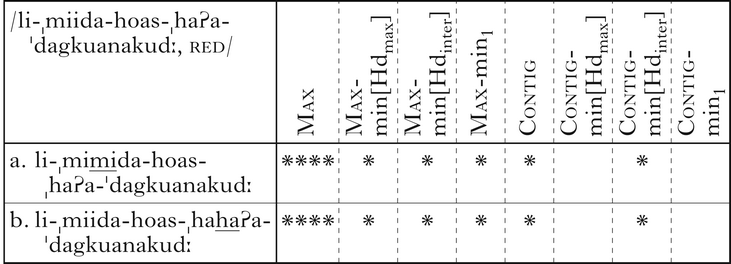
One salient difference between these stems is that /“miida/ is the head of the initial ωinter, and we can adopt the Max and Contiguity constraints in (43) targeting that position.
-
(43)
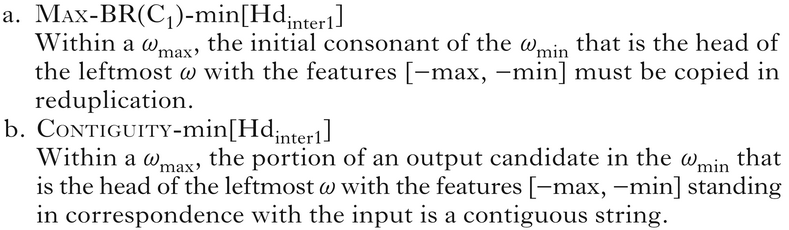
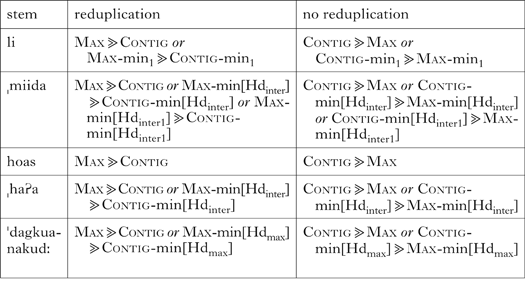
The analysis now accounts for (41), as summarised in Table IV.
Ranking conditions for reduplication of each stem in (41).

We can conclude, then, that a PO analysis of the available Pima data is possible. The ten constraints employed here (plus RealiseMorpheme) produce the full range of attested variation, and are well-formed members of the Max-BR and Contiguity families. As positional faithfulness constraints, they appropriately target positions identified by Beckman (Reference Beckman1999) and Bennett (Reference Bennett2012) as prominent (see also Smith Reference Smith2005, Walker Reference Walker2011 and Kaplan Reference Kaplan2015 for discussion of prominent positions and the factors that contribute to prominence).
Some of these constraints are quite complex, targeting the head of an initial element, for example. So while the analysis uses only well-formed constraints, it is worth acknowledging the constraint complexity that PO requires. The analysis would most likely require even further elaboration in the face of local optionality in compounds larger than the ones considered here, but the absence of such data prevents speculation on the matter. It is also conceivable that larger compounds would instead show coordination among loci as the PO analysis predicts.
The next section addresses some salient typological predictions of the foregoing analyses.
4 Typology
The analyses from the preceding sections make typological predictions for categorical (i.e. non-optional) processes. For each position that can be independently manipulated in these analyses, a language is predicted in which the process at hand targets or fails to target only that position. For example, under (44a), only dative elements undergo schwa epenthesis, and under (44b), flapping occurs only in minimal feet containing secondary stress.
-
(44)

Are these predictions borne out? Exceptional behaviour of morphosyntactic units, as in (44a), is not unusual in prosodic morphology. Possessive morphology in Ulwa was mentioned in §3.2.1: under the analysis of McCarthy & Prince (Reference McCarthy and Prince1993), Align([poss]Af, L; Ft′, R) ensures that possessive morphemes immediately follow the primary stressed foot. McCarthy & Prince adopt an even more specific constraint in their treatment of -um-infixation in Tagalog. This morpheme surfaces as a prefix with vowel-initial stems ([u.ma.ral] ‘teach’) but as an infix with consonant-initial stems ([su.mu.lat] ‘write’). They posit Align([um]Af, L; Stem, L), which is dominated by NoCoda to force infixation when prefixation would yield a coda (*[um.su.lat]), and they note that ‘most other affixes in Tagalog … are of course peripheral’ (Reference McCarthy and Prince1993: 105): alignment constraints governing other affixes must outrank NoCoda, so Align([um]Af, L; Stem, L) must specifically target -um-. Ulwa and Tagalog therefore exhibit the kind of exceptional behaviour predicted by (44a).
Understanding the prediction in (44b) requires a deeper examination of the two interacting constraint families. Each family is stringent, with position-specific constraints targeting subsets of the elements penalised by the generic constraints. These constraints target either primary stress (*ɾ∑́ and *StrongOnset/σ̆∑́) or minimal feet (*StrongOnset/σ̆∑min), and this difference results in the prediction identified above. *StrongOnset/σ̆∑min favours flapping in all minimal feet, but it is outranked by *ɾ∑́ in (44b), which blocks flapping under primary stress. The positions left under *StrongOnset/σ̆∑min’s control are the minimal feet not bearing primary stress: the ones bearing secondary stress.
Taken at face value, this result seems contrary to the ordinary behaviour of prominent positions, which typically host larger inventories than other positions. Positional markedness bans elements from weak positions, often by requiring them to surface in a prominent licensing position. *StrongOnset/σ̆∑min, for example, excludes certain elements from unstressed, footed syllables. From this point of view, flaps should not be banned under primary stress, especially if they surface under secondary stress. But *ɾ∑́ is a positional augmentation constraint (Smith Reference Smith2005): unlike licensing-oriented positional markedness, it bans a prominence-reducing element from a prominent position, and thereby reduces the inventory of segments permitted under primary stress. Not all markedness considerations point in the same direction: flapping in a primary stressed foot can be both undesirable (because it amounts to lenition in prominent position) and advantageous (because it targets the foot's weak syllable). The prediction that secondary stress can behave exceptionally arises from the conflict between two markedness desiderata, and any system that admits both augmentation and licensing predicts patterns of this kind. Nor is the presence of conflicting markedness constraints itself problematic: Bennett (Reference Bennett2012: 146–148) addresses situations like this one, in which a single position is subject to both a ‘strengthening’ constraint and a ‘weakening’ one, and argues that it is to OT's advantage that it admits such arrangements. Smith (Reference Smith2005) notes that languages similar to the one under discussion – wherein a strong position (here primary stress) undergoes augmentation while a weaker one (unstressed footed syllables) simultaneously weakens – are well attested.
Similar reasoning holds for the analysis of Pima. As an inspection of, say, Table III or Table IV reveals, the analysis permits a single prosodic unit to uniquely undergo or resist reduplication. Thus it predicts a language in which that is the invariant outcome. Here it is positional faithfulness constraints that are in conflict. There are different ways to be faithful: failure to reduplicate satisfies Contiguity, but violates Max-BR. Undergoing reduplication does the opposite. We again have opposing constraint families, and when two members of these families that bear on different kinds of positions interact, the result is exceptional behaviour of a particular position.
The prediction that a particular unit is the only one that undergoes reduplication in a language seems to match the standard state of affairs cross-linguistically (McCarthy & Prince Reference McCarthy and Prince1986, Reference McCarthy, Prince, Beckman, Dickey and Urbanczyk1995, Spaelti Reference Spaelti1997). The unusual prediction of the Pima analysis is that a particular unit may exceptionally not host reduplication. But Pima is unusual in allowing simultaneous reduplication at multiple sites, so it is not surprising that an analysis of this language deviates from the norm.
Other aspects of the Pima analysis warrant discussion in this context. First, layering need not be exhaustive, in the sense that if more than two levels of recursion are unwarranted, there will be no ωinter. Thus two otherwise identical positions can behave differently if one is more deeply embedded than the other: one may be subject to a constraint on ωinter’s while the other is not. This provides another way to single out positions in a fashion contrary to expectations of stringency. Second, the analysis rests on positional faithfulness constraints that target different dimensions of prominence (Kaplan Reference Kaplan2015). Some Pima constraints hold for metrically prominent positions (prosodic heads), but others target what Kaplan (Reference Kaplan2015) calls sequentially prominent positions – initial material. Consequently, if a position cannot be singled out through one avenue (perhaps because it is one of several positions with equivalent metrical prominence), it may be accessible using a different approach (if it is word-initial). As with flapping, the prediction that specific positions can behave idiosyncratically comes from combining well-established constraint types. The theory already makes the prediction; that prediction is simply revealed by the demands of local optionality.
Of course, the fact that these predictions are independent of the PO analyses does not make them sound. Verifying their accuracy is an important test of the PO approach to local optionality and, more generally, of the relevant constraint types. Predictions of the sort examined in this section are natural consequences of a theory that includes, say, both augmentation and licensing constraints, or both Ito & Mester's theory of prosodic recursion and positional faithfulness, and they warrant further scrutiny. As the goal here is simply to show that PO can produce local optionality, I leave this task for future research.
Another prediction is worth mentioning. The analyses presented here largely rest on several constraints that are unranked with respect to each other. By imposing some rankings within that set, we can produce more limited optionality, in which the variability of certain specific positions is coordinated in some way, or in which only certain kinds of positions show optionality. I am unaware of any phenomena that show robust characteristics of that sort, but the behaviour of the clitic ne in French (see §3.2.2) indicates that such systems are a possibility. Perhaps systems with limited optionality are underreported, because they are less striking than systems in which optionality is more pervasive, as in French or Pima.
The status of position-specific constraints in Con has consequences for predictions concerning limited optionality. If these constraints do not reside universally in Con but are projected from a schema (e.g. Smith Reference Smith2005) when the learner encounters motivation for them, it is not implausible to think that this schema gives rise to an entire family of constraints at once – all the Max constraints of Pima, for example – so that having seen that one of these constraints is variably ranked, the learner is faced with the question of how to handle the remainder of the family, and adds them to the variable ranking. This might explain the apparent dearth of limited-optionality systems: position-specific constraints are less independent of each other than ordinary constraints.
5 Discussion and conclusion
The three locally optional processes examined here are compatible with PO because the loci of optionality appear in unique domains. In English, flapping occurs at most once in each minimal foot, so reference to head and non-head feet allows PO to motivate flapping in one position but not another. By targeting various levels of prosodic structure, the analysis accommodates multiple flaps in a single maximal foot.
In French, the most elaborate examples of local optionality involve strings of clitics. Because each clitic occupies a unique morphosyntactic position, PO can capitalise on the sensitivity of phonology to syntactic structure and target each position individually.
Finally, in Pima, each ωmin hosts just one locus for reduplication. By targeting different levels of prosodic structure and various prominent positions, PO can single out specific loci.
PO accounts for the available data in each case, but the analyses have clear limits with regard to the number or kinds of loci they can treat as distinct. Beyond these limits, PO predicts coordination between loci. Whether this is a shortcoming is an empirical question, and the available data simply does not provide an answer. In terms of the attested range of variation presented by English, French and Pima, then, PO analyses built on independently motivated constraint families are possible.
This success casts doubt on the harmonic-bounding argument against multiple-rankings theories of variation, at least as it applies to PO. But this does not necessarily mean that PO's approach to local optionality is superior to other theories. Kaplan (Reference Kaplan2011), Kimper (Reference Kimper2011) and Riggle & Wilson (Reference Riggle and Wilson2005) present analyses of French schwa that have at least two clear advantages over the PO analysis presented here: they require fewer constraints to capture the core generalisations (although Riggle & Wilson's analysis requires many instantiations of essentially the same constraint), and they are unquestionably capable of accommodating more complex data should future discoveries necessitate it. These advantages are mitigated by two factors, however. First, the extra constraints which PO requires do not appreciably increase the size of an already enormous constraint set. Furthermore, the absence of data exceeding PO's capabilities means that we cannot say whether PO's limitations are actually liabilities; perhaps these other theories are wrong to predict local optionality ad infinitum.
Moreover, PO has a distinct advantage of its own, in that it produces variation merely by adapting an existing formal construct – ranking permutation – that is at the heart of OT. The result is formal simplicity that characterises optionality as an ordinary, unremarkable feature of phonological systems. In contrast, other theories introduce wholly new constructs, implying that optionality is peripheral and abnormal.
A definitive comparison of these theories might require establishing criteria beyond the ability to produce the attested variants. For example, it has often been observed that certain outputs of an optional process are more common than others (e.g. Dell Reference Dell and Rohrer1977, Anttila Reference Anttila, Hinskens, van Hout and Wetzels1997, Reference Anttila and de Lacy2007, Kaplan Reference Kaplan2011), and the ability to model these asymmetries is a reasonable test for theories of variation (though Coetzee Reference Coetzee2006 argues against placing the entire burden for output frequencies on the grammar). For example, Bayles et al. (Reference Bayles, Kaplan and Kaplan2016) undertake a corpus study of French schwa to assess the accuracy of certain predictions that a handful of theories make concerning the extent to which the frequencies of variants may vary across speakers. They determine that Stochastic OT, Markedness Suppression and the rank-ordered model of Eval most readily accommodate the inter-speaker variation that French exhibits. (PO and Serial Variation are less compatible with their results.) More work along these lines would provide clarity in terms of the differences between theories of optionality and their overall empirical adequacy.
The harmonic-bounding argument fails, in the sense that PO can produce local optionality as long as each locus for an optional process appears in a unique syntactic, morphological or phonological domain that can be singled out by constraints in a principled way. But the harmonic-bounding argument may still remain applicable in other ways. For example, there may be locally optional phenomena that are not conducive to a PO analysis because the loci do not fall in distinct domains, or future descriptive or experimental work may disprove PO's coordinated-variation predictions. Alternatively, further refinement of the analyses developed here might push the coordinated-variation horizon farther away. In fact, acquiring data about more complex instances of local optionality might be a boon instead of a threat to PO: one impediment to elaborating on the above analyses is an absence of clues concerning what form those elaborations should take.
Finally, it remains to be seen whether other multiple-rankings theories besides PO can similarly accommodate local optionality. Alternative ways of making multiple constraint rankings available may be more or less conducive to local optionality in general or to the specific demands of particular locally optional processes. Empirical differences between these theories exist (see Anttila Reference Anttila and de Lacy2007 and §3.2.2 above), and probing them in the context of local optionality may clarify the theoretical landscape.
In sum, PO analyses of local optionality are not as far-fetched as the harmonic-bounding argument suggests, and this framework merits consideration in discussions of how best to approach this kind of phenomenon.