A growing body of research has focused on the development of children's morphological knowledge (e.g. Berko, Reference Berko1958; Anglin, Reference Anglin1993). One question of particular interest has been of potential differences between inflected and derived words, which are two of the fundamental morphological categories (Henderson, Reference Henderson and Ellis1985). Inflectional morphology involves variations in word forms that do not alter the underlying meaning or syntactic category of a word (e.g. plural -s in cats). In contrast, derivational morphology typically involves changes to the syntactic category of a word, which affects the meaning of that word (e.g. adding -er to teach transforms the verb to a noun). Studies examining the representation of morphologically complex words in the developing lexicon have typically used tasks involving the production and/or manipulation of words. Given the many demands involved in such tasks (e.g. Derwing & Baker, Reference Derwing, Baker, Fletcher and Garman1979), the priming methodology might offer an alternative approach to the assessment of the representation of inflected and derived words in the minds of children. We adopted this approach to examine the nature of children's representation of two fundamental types of morphologically complex words across the elementary school years.
Studies investigating spontaneous generation of morphologically complex words have typically reported that mastery of inflections is accomplished in the preschool years, whereas appreciation of derivational morphology tends to occur later (e.g. Clark, Reference Clark1993). In a detailed longitudinal study of three preschool children, Brown (Reference Brown1973; see also deVilliers & deVilliers, Reference deVilliers and deVilliers1973) found that correct use of simple inflections (e.g. present progressive and plurals) was remarkably strong. Berko's (Reference Berko1958) pioneering study examined four- through seven-year-old children's morphological productivity with pseudo-words. She found that children had much more difficulty producing transparent derived forms (zib–zibber and quirk–quirky) compared to inflected forms (wug–wugs). In fact, only 11% of the children were able to produce the correct derived form zibber and none produced the word quirky. Similarly, Carlisle (Reference Carlisle and Feldman1995) found that children in kindergarten and grade 1 performed significantly better on a production task (complete a sentence Farm. My uncle is a ____.) with inflected forms even in comparison to transparent derived forms (e.g. drive–driver). Carlisle's study is one of the very few that has directly compared children's performance with inflected and derived words in the same experiment. Findings such as these have been used to support the near ubiquitous notion that knowledge of inflected forms develops prior to derived forms.
In the face of this general pattern, there are some glimmerings of evidence that young children are quite good at producing certain types of derivational suffixes. Clark & Hecht (Reference Clark and Hecht1982) found that three- to five-year-old children were able to correctly produce derived words with agentive and instrumental -er (e.g. hider) between 55% and 91% of the time. These data suggest that young children have some understanding of the morphological structure of certain types of transparent derived words. They also give us cause to reconsider the relatively widely accepted idea that children perform better with inflected than derived forms. This is the first question addressed in this study.
A second question lies in the developmental trajectory of morphological knowledge. Previous studies suggest that children's ability to extract information about the morphological structure of words increases over time. For example, Derwing & Baker (Reference Derwing, Baker, Fletcher and Garman1979) asked children, teens and adults to complete a morpheme recognition task (e.g. ‘Does bashful come from bash?’ and ‘Does eerie come from ear?’). Children were far more likely than adults to answer that word pairs were related if they shared only one level of connection, whether it was phonological or semantic, even though a morphological relationship typically depends on overlap on more than one dimension. Further, their results suggested a strong developmental trend of increasing awareness of morphological relations from elementary school through to adulthood, in that adults were far more likely to reply that words were related if they shared two dimensions. Anglin (Reference Anglin1993) asked children in grades 1, 3 and 5 to explain the meaning of morphologically complex words and their root forms and to use them in sentences. He found growth in children's knowledge of morphologically complex words across the three grades with a particularly striking increase in knowledge of derived forms between grades 3 and 5. Similar evidence of an increase between these two grades was shown by Carlisle (Reference Carlisle2000). She asked children in grades 3 and 5 to generate base morphemes from transparent derived words (e.g. dry from dryer) as well as to produce complex forms of derived words. Her results showed that children in both grades 3 and 5 were quite proficient at decomposing the complex words, while they performed more poorly in generating derived forms. Notably, children in grade 5 outperformed those in grade 3 on both tasks. These results suggest that there is an increasing capacity for morpheme recognition with age, especially with derived forms in the later elementary school years.
We are left with two key questions: Are inflected and derived words processed in similar or in distinct ways in the developing lexicon? And do children's lexical representations of morphologically complex words change across the elementary years? Previous studies with adults have successfully used the repetition-priming paradigm to examine potential difference between inflected and derived words. Priming tasks have been argued to provide relatively implicit measures of morphological knowledge (e.g. Rueckl, Mikolinski, Raveh, Miner & Mars, Reference Rueckl, Mikolinski, Raveh, Miner and Mars1997). As a result, we employed a priming task to avoid the demands associated with production and manipulation tasks (e.g. Derwing & Baker, Reference Derwing, Baker, Fletcher and Garman1979).
Stanners, Neiser, Hernon & Hall (Reference Stanners, Neiser, Hernon and Hall1979) used this approach with adults. In one experiment, they found equivalent priming effects between identity and inflected words and in the second they found smaller priming effects with derived words than with identity words. They concluded that inflected words are decomposed into their constituent morphemes, while derived words are represented in full form in the lexicon. In sharp contrast, Raveh & Rueckl's (Reference Raveh and Rueckl2000) findings of equivalent priming effects for inflected and derived words support similarity in the representation of morphologically complex words in adulthood. This study employed stringent controls, such as the inclusion of inflected and derived forms that shared the same root word (e.g. adjusts and adjustment versus adjust) and the comparison of these words within the same experiment. On the basis of these results, the authors reasoned that factors other than word class must be responsible for, or at least contributing to, the higher priming effects with inflected than derived words found in prior studies.
There have been some innovative, though limited, attempts to use the priming paradigm to examine the developing lexicon. Giraudo (Reference Giraudo1999) conducted a lexical priming study with eight-year-old English-speaking children with three different types of primes: derived words (e.g. pottery–pot), control words with the same initial letter sequence as the target word (e.g. potato–pot) and unrelated words (e.g. guitar–pot). Typically developing children's reaction times in a lexical decision task were significantly faster in the morphologically related condition than in either the control or unrelated conditions. Recently, Feldman, Rueckl, DiLiberto, Pastizzo & Vellutino (Reference Feldman, Rueckl, DiLiberto, Pastizzo and Vellutino2002) adopted a similar method for use with ten-year-old children. Their study items consisted primarily of inflected words. They found greater priming effects with morphologically related primes (e.g. listed–list or beets–beet) compared to unrelated primes matched on orthographic, though not necessarily phonological, features (e.g. listen–list or beetle–beet). Both of these studies support morphological organization in the developing lexicon.
The results of previous priming and production studies investigating the developing lexicon suggest that morphology does play a key role in its structure. However, both types of studies leave the same questions unanswered. The first lies in potential differences between inflected and derived words, a key focus of adult work (e.g. Stanners et al., Reference Stanners, Neiser, Hernon and Hall1979; Raveh & Rueckl, Reference Raveh and Rueckl2000). Past developmental research conducted by Giraudo (Reference Giraudo1999) and Feldman et al. (Reference Feldman, Rueckl, DiLiberto, Pastizzo and Vellutino2002) with priming methodology focused primarily (or exclusively) on derived and inflected words, respectively, as is the case for much of the production research. Adopting a method similar to Raveh & Rueckl (Reference Raveh and Rueckl2000), we directly compared the priming effects between fully transparent inflected and derived pairs, such as needs–need and needy–need, respectively, and orthographic control pairs such as needle–need.
Secondly, we explored whether lexical representations of morphologically complex words differ between younger and older children. Past research with production measures suggests that knowledge of morphological relationships develops over time, particularly with derived forms (e.g. Anglin, Reference Anglin1993). Using an implicit measure offers an alternative way of assessing children's mental lexicons. To this end, we tested children in grades 1 to 5 with a priming task to determine whether lexical representations of morphologically complex words change across the elementary years.
METHOD
Participants
One hundred children were recruited from elementary schools. Twenty children participated in grade 1 (Mean age=6 ; 9, SD=0 ; 4), grade 2 (Mean age=7 ; 7, SD=0 ; 4), grade 3 (Mean age=8 ; 8, SD=0 ; 5), grade 4 (Mean age=9 ; 8, SD=0 ; 5), and grade 5 (Mean age=10 ; 10, SD=0 ; 5).
Materials
Priming task
We chose thirty sets of word quadruplets that would allow us to assess the priming effects from inflected and derived words in comparison to unrelated control words. Each set consisted of an identity, inflected, derived and control word (e.g. need, needs, needy and needle, respectively). Each identity word appeared unchanged in sound and letter sequence within the three other words of that set. Each control word contained the same initial letter-sound sequences, but not the same root as the other words in the set. The importance of controlling for phonological and orthographic similarity with the base form has been stressed in adult research (e.g. Raveh & Rueckl, Reference Raveh and Rueckl2000) and this stringent test is not met with pairs such as listen–list (e.g. Feldman et al., Reference Feldman, Rueckl, DiLiberto, Pastizzo and Vellutino2002). As in the work with adults, priming studies with children require tight controls for the influence of both orthographic and phonological similarity.
We instituted a number of additional controls on the selection of the stimulus set to ensure interpretable results. First, we controlled for frequency given its well-established influence on word processing and retrieval (e.g. Levelt, Reference Levelt1999). An analysis of variance was conducted to compare word frequencies (grade 3 frequencies from a children's frequency database; Zeno, Reference Zeno1995) between the three key word conditions (inflected, derived and control). This was followed up with paired sample t-tests. Critically, frequencies for the inflected and derived words were similar (t(29)=0·201, p=0·842). Given the need to identify quadruplet sets of items, it was not possible to balance the frequencies of the inflected and derived words with the frequencies of the control items. As such, we chose items with higher frequencies for the control words than for the inflected and derived items, as this would effectively bias the items against the hypothesis under investigation (greater priming effects for the morphologically related than for the control items). This pattern was confirmed in statistical analyses revealing higher frequencies for the inflected (t(29)=2·609, p=0·014) and derived (t(29)=3·042, p=0·005) than for the control words.Footnote 1 Secondly, we chose inflected and derived forms that were highly related in meaning to their respective identity (root) words. Thirdly, we restricted all derivational formations to suffix changes to ensure equivalence between the inflected and derived forms in the position of the affix addition. Finally, as in Raveh & Rueckl's (Reference Raveh and Rueckl2000) work, we used the same root form when comparing across inflected and derived conditions. These stringent constraints help to eliminate several possible confounds.
As noted earlier, each of the thirty quadruplet sets contained an identity, an inflected, a derived and a control word. Each of these words represents a condition (along with the fifth condition of no prime). Each of these sets is shown in the Appendix, such that each row consists of one quadruplet set. Each child in the study received a single word from each quadruplet set, representing only one condition. For example, a given child would see rocket as a prime, but not rock, rocking or rocky. In the no prime condition, the individual would not see any word from that quadruplet set. This condition determined how likely children were to complete a fragment with the identity word in the absence of any priming.
Given that each child saw only one word from each quadruplet set (except for the no prime condition in which they did not see any of the words) and this word changed between children, we needed to ensure that the word frequencies were balanced across the children. To do so we constructed five booklets, each containing six different words from the identity, inflected, derived and control conditions (for a total of twenty-four words per booklet). The six words in each condition formed a block and the frequencies of these blocks were balanced across the booklets. This was determined by multivariate analyses of variance with the within-subject variable of block (five levels) conducted with each condition separately (identity: F(4, 25)=0·499, p=0·737; inflected: F(4, 25)=0·050, p=0·995 and derived: F(4, 25)=0·215, p=0·928); control: F(4, 25)=0·007, p=1·00).
The words were presented on forty-eight cards in a 5·5×8·5-inch laminated and spiral-bound booklet. One word was printed on each page in black lowercase letters in 72-point bold Times New Roman font and each word appeared twice in each booklet (based on Feldman et al., Reference Feldman, Rueckl, DiLiberto, Pastizzo and Vellutino2002). The book rested on a metal stand with a 45-degree angle and the experimenter turned a page every one-and-a-half seconds. Children were assigned to one of these five booklets.
Fragment completion task
To test the effects of the priming, we created a 30-item (one item for each quadruplet set) fragment completion task by constructing word fragments from the identity (root) form of each of the quadruplet sets. Either one or two letters were deleted from the identity words and replaced with underlined blanks (e.g. need became n e _ _ and far became f _ r). There were at least three possible solutions for the fragments: the identity word and at least two other words with grade 3 frequencies in Zeno (Reference Zeno1995). For example, n e _ _ could be completed by need (the identity word), as well as neat, nest or neck. The word fragments appeared on a single page arranged in two columns.
Procedure
We explained to the participants that they would see and hear a set of words. They were told to simply look and listen to each word as it was being read. Children were assigned semi-randomly to a booklet, so that an equal number of children in each grade were shown each study list.
Following the study phase, we gave the children the fragment completion task. They were asked to make each fragment into a word. Each child was given a practice item (e.g. c _ t ) to ensure they understood the task, followed by the 30-item task. After the child attempted to complete each fragment once, the experimenter directed the child's attention to any incomplete fragments. The child was then asked whether a word came to mind for each remaining item.
RESULTS
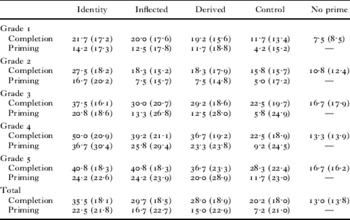
Following Feldman and her colleagues (2002) we focused on completion rates to determine priming effects. Completed fragments were considered correct only if the correct identity form was entered (e.g. n e _ _ completed with need, the identity word, but not neat, nest or neck). The identity form was the root word for the inflected and derived words, but not for the control words. Priming effects were calculated by subtracting the completion rates for the no prime condition from the completion rates of each of the other four conditions. This calculation controls for the likelihood that children might complete each fragment with the identity word simply by chance. These data are reported in Table 1.
Percentages of completion of target words (and standard deviations) by grade level and priming for identity forms, inflected and derived forms, and control words in the fragment completion task

A repeated-measures analysis of variance examined the effects of priming with the within-subjects factor of Prime condition (identity, inflected, derived and control) and the between-subjects factor of GradeFootnote 2 (1, 2, 3, 4 and 5). There was a significant effect of Condition (F(3, 285)=13·940, p<0·001, MSE=14·39), which we followed up with paired sample t-tests with Bonferroni corrections.
The first comparisons were conducted to examine the effects of priming from morphologically related items. These revealed that children were more likely to complete the fragment with the identity form in the inflected and derived conditions than in the control condition (t(99)=3·85, p<0·001, d=0·21 and t(99)=3·24, p=0·002, d=0·17, respectively). This finding indicates that priming is greater when items share a morphological relationship (as in the inflected and derived conditions) compared to when they do not (in the control condition). Further t-tests revealed no significant difference between the Inflected and Derived conditions (t(99)=0·67, n.s.), suggesting that children performed with similar success on the fragment completion task whether they had to extract the root word from inflected or derived forms.
Further t-tests showed that priming was greater in the Identity than in the Inflected (t(99)=2·70, p=0·008, d=0·12) and Derived (t(99)=3·10, p=0·003, d=0·16) conditions. These results indicate that children are more likely to complete a fragment with the root form following the presentation of the root form than of the inflected or derived forms, reflecting a classic repetition priming effect.
There was no evidence of an interaction between Prime condition and Grade (F(12, 285)=0·81, n.s.), suggesting a similar growth rate in priming across all conditions in the different age groups. Thus, while there is significant morphological priming across all grades, the quantity of this priming does not change across the age range tested.
Finally, the significant effect of Grade (F(4, 95)=2·65, p<0·005, MSE=11·35) suggests that there is a gradual increase in performance across grades. Post-hoc Tukey tests revealed that children in grades 4 and 5 performed better than those in grades 1, 2 and 3.
DISCUSSION
The findings presented here inform us of the nature of morphological representations in the developing lexicon. Firstly, the results suggest that children's mental lexicons are organized around morphological principles. Children were more likely to complete a fragment with the root form (e.g. need) if they had been primed with an inflected or derived word (e.g. needs or needy, respectively) than if primed with a control word (e.g. needle). These results bolster prior findings of morphological priming in children (Feldman et al., Reference Feldman, Rueckl, DiLiberto, Pastizzo and Vellutino2002) in the inclusion of controls for both phonological and orthographic similarity. Perhaps more notably, the results suggest that children represent both inflected and derived words according to their morphological components.
Our second finding of a similar growth rate across all conditions over the elementary school years was also unexpected, given previous studies' suggestion that children's ability to extract information about morphology increases over time (e.g. Anglin, Reference Anglin1993). The results indicate that the quantity of priming between the morphologically related and the control condition did not change across the elementary years, nor did it increase differentially for inflected and derived words. At least based on results with the priming paradigm, it seems that the lexical representations of fully transparent inflected and derived words develop at similar rates.
The similarity in priming effects between inflected and derived forms is intriguing because the reports from oral production studies with children have typically found better production and manipulation with inflected than derived forms. Such results have emerged in children's spontaneous speech (e.g. Brown, Reference Brown1973), as well as in children's performance on verbal tasks with both real and nonsense words (e.g. Berko, Reference Berko1958; Carlisle, Reference Carlisle and Feldman1995). These results even hold true for studies that employ transparent derived words (e.g. Berko, Reference Berko1958; Carlisle, Reference Carlisle and Feldman1995). Factors such as phonological and semantic complexity of derived forms have been proposed to explain the developmental lag in the production of these forms (e.g. Tyler & Nagy, Reference Tyler and Nagy1989). In comparison to derived words, inflected forms of base words are typically more semantically and phonologically transparent compared to derived forms of the same base word. And yet, our results demonstrated comparable completion rates in the inflected and derived conditions, suggesting similarity in the lexical representation of these two types of (transparent) words, as uncovered in some adult studies (e.g. Raveh & Rueckl, Reference Raveh and Rueckl2000).
One explanation for these divergent findings lies in the nature of the task. It is possible that priming tasks offer, as advocated in the adult literature, an alternative method of assessment that avoids some of the pronunciation and cognitive demands involved in production and manipulation tasks. Earlier studies comparing inflected and derived words have relied on analyses of children's spontaneous speech (e.g. Brown, Reference Brown1973), performance on verbal tasks (e.g. Carlisle, Reference Carlisle and Feldman1995) and explicit judgments of morphological relationships (e.g. Derwing & Baker, Reference Derwing, Baker, Fletcher and Garman1979). Carlisle (Reference Carlisle, Stone, Silliman, Ehren and Apel2005) suggests production of a word from a novel base in an experimental task might require explicit knowledge of word formation and the ability to manipulate words for a range of purposes. Consequently, these approaches might involve task demands (e.g. pronouncing words or judging morphological relationships) that limit children's full demonstration of their knowledge of morphological words, particularly with derived forms. While production tasks are clearly central to the examination of oral language development, implicit tasks can provide an alternative way of assessing lexical development. In a task without these demands, our results suggest that transparent inflected and derived words are represented in similar ways.
A second possible explanation for the divergent results between previous research and our own lies in the nature of the items we employed. As we already pointed out, we limited our items to strictly transparent forms. While this permitted a greater degree of control between the inflected and derived forms, the equivalent priming effects might have emerged because transparent forms may be relatively accessible to children. It is entirely possible that the inclusion of opaque forms (particularly derived ones) might have lead to a discovery of differences between inflected and derived forms; such a result is likely given prior findings of greater difficulty with derivational forms that undergo phonological changes (Carlisle, Reference Carlisle1988). Nevertheless, our finding of similar performance with transparent inflected and derived forms in a priming task is at odds with earlier findings of greater difficulty with producing derived forms compared to inflected forms, even when these words are entirely transparent (e.g. Carlisle, Reference Carlisle and Feldman1995). Surprisingly, when implicit measures are employed to assess children's morphological knowledge, we find that children have equal success with inflected and derived words. Such results are more in line with the hints of early success with derived forms as uncovered by Clark & Hecht (Reference Clark and Hecht1982).
According to the model outlined by Schreuder & Baayen (Reference Schreuder, Baayen and Feldman1995), children develop representations of morphologically complex words through a two-stage process of affix discovery. This process involves monitoring the growing mental lexicon for connections between form and meaning. First, the lexical system detects patterns of co-activations of developing semantic representations. Secondly, the frequently occurring patterns develop concept nodes, which ultimately lead to the development of corresponding representations at the access level. While this model remains relatively underspecified, a gradual extraction of morphology (and an accompanying similarity in the amount of priming across the elementary years) would be predicted if the detection of co-activations of semantic representation were to occur in tandem with the identification of overlap in phonological and orthographic information. Alternatively, this model might be interpreted, as proposed by Carlisle & Fleming (Reference Carlisle and Fleming2003), as advocating that children initially monitor language for co-occurrences of sound- and/or letter-patterns and then search for meaning to which to attach these units. This view would predict a gradual increase in morphological priming across time, as would models that support rule-based extraction of morphological knowledge (e.g. Pinker, Reference Pinker1991). The findings reported in the present study are in line with the first of these interpretations, such that children seek correspondences between phonology, orthography and semantics as they are exposed to words in oral and written language, which then come to form morphological representations in the lexicon. This gradual extraction of morphological information in tandem with orthographic and phonological information also coincides with the predictions of statistically driven models of acquisition (e.g. Pacton, Fayol & Perruchet, Reference Pacton, Fayol and Perruchet2005). The question of whether such extraction mechanisms result in morphemes per se, or the convergence of phonology, orthography and semantic information, is a question that remains open for future research.
Further, the present findings provide empirical support for Schreuder & Baayen's (Reference Schreuder, Baayen and Feldman1995) prediction that a word's status as inflected or derived on its own cannot predict the manner in which it is processed. Instead, it might be a combination of factors (i.e. word frequency and phonological transparency) that determines whether the word is parsed or represented holistically. Similar proposals have been advocated by connectionist models, in which ‘morphological’ effects emerge from the activation patterns that compute the orthographic, phonological and semantic codes associated with a word (e.g. Rueckl et al., Reference Rueckl, Mikolinski, Raveh, Miner and Mars1997). Regardless of the specific model of representation, these findings clearly support similarity in the representation of inflectional and derivational forms, at least where orthographic and phonological overlap between the two types is comparable.
There are some clear limitations to the present study. Firstly, we examined only suffixes, which limits the generalizability of the findings to inflections and derivations that operate as suffixes. Secondly, we did not control for bias in the types of derivational endings we examined. Our stimulus set was mainly comprised of simpler forms of derived words such as the agentive -er. Further, we included only transparent forms of inflected and derived words to permit a greater degree of control between these two conditions. According to Anglin (Reference Anglin1993), there are well over a hundred derivational affixes and future studies would benefit from sampling a broader range of derived forms. Finally, given our advocacy about the potential role of task demands in explaining our results, it would also be important for future studies to compare children's performance in different modalities (e.g. oral and visual). This may offer insight into the areas where children are having difficulty.
This study contributes to the evidence that morphology plays a role in the representation of morphologically complex words in the developing lexicon. These results suggest that fully transparent inflected and derived words are organized similarly in the lexicon, and that there is stable growth across the elementary school years. The developing lexicon appears to be remarkably well organized in terms of root morphemes from a young age.
APPENDIX
The identity, inflected, derived and control words and their Grade Three frequencies (Freq.) according to Zeno (Reference Zeno1995)