The ability to regulate and control one’s emotions is an important psychological skill that is linked to good mental and physical health (DeSteno et al., Reference DeSteno, Gross and Kubzansky2013; Sheppes et al., Reference Sheppes, Suri and Gross2015) and better functioning in romantic relationships (Levenson et al., Reference Levenson, Haase, Bloch, Holley, Seider and Gross2014). Emotion regulation is defined as the process of shaping what emotions one feels, when one has them, and how one experiences and expresses them (Gross, Reference Gross1998). One key aspect of emotion regulation is the ability to control one’s emotions and behaviors when upset. This ability is sometimes referred to as impulse control (Gratz & Roemer, Reference Gratz and Roemer2004), although we prefer calling it emotional control, to avoid confusion with other forms of impulsive behavior that are not predicated on the experience of negative affect. The ability to control one’s emotions develops gradually across childhood, adolescence, and early adulthood (Zimmermann & Iwanski, Reference Zimmermann and Iwanski2014), and is impacted by both the quality of early environments and early stressful experiences (Kim & Cicchetti, Reference Kim and Cicchetti2010).
In the current research, we adopt a life history perspective to investigate the link between early childhood environments and emotional control in adolescence and adulthood, and then examine its consequences for romantic relationship quality. We propose that variability in emotional control reflects adaptive adjustments to environmental conditions experienced early in life, particularly the degree of unpredictability and harshness in one’s local environment. This evolved, strategic response to childhood environments helps fit an individual’s emotional functioning to current and future environmental demands. We suggest that childhood unpredictability, in particular, should forecast lower emotional control and poorer relationship quality through a process that involves the quality of early parenting and later attachment representations. We test these ideas using three studies that build one upon each other, first investigating the association between childhood harshness and unpredictability and emotional control difficulties in adolescents, and then replicating this association in adults and examining consequences for romantic relationship quality. We conclude by employing the Minnesota Longitudinal Study of Risk and Adaptation (MLSRA; Sroufe et al., Reference Sroufe, Egeland, Carlson and Collins2005) to examine these links prospectively and test the proposed mediating mechanism.
Childhood environments and emotion regulation
Emotion regulation is related to temperamental factors such as negative affectivity and effortful control (Rothbart et al., Reference Rothbart, Sheese, Posner and Gross2014). Extensive research has shown that it is also responsive to early experience. One line of research has focused on the effects of early experiences within the family on the development of emotion regulation in children. According to the tripartite model of the impact of the family on children’s emotion regulation (Morris et al., Reference Morris, Silk, Steinberg, Myers and Robinson2007), children develop better emotion regulation capabilities when their parents are warm and supportive, display positive emotionality, and instruct them in socially acceptable ways to express their emotions. In contrast, neglect or maltreatment by parents or other adults can seriously impair the development of good emotion regulation, leading to poor adjustment in children (e.g., Kim & Cicchetti, Reference Kim and Cicchetti2010). Moreover, exposure to threat in the home or the community (e.g., child abuse, witnessing domestic violence) contributes to greater emotional reactivity and dysregulation (McLaughlin & Lambert, Reference McLaughlin and Lambert2017). These links are mediated by changes in neural networks associated with emotional processing and regulation (McLaughlin et al., Reference McLaughlin, Peverill, Gold, Alves and Sheridan2015), which are predictive of later psychopathology (Weissman et al., Reference Weissman, Bitran, Adam Bryant, Schaefer, Sheridan and McLaughlin2019).
A different line of research has focused on the effects of childhood poverty on socioemotional development. Growing up in poverty alters brain development and impairs various executive functions and regulatory capabilities (Evans & Kim, Reference Evans and Kim2013). Several fMRI studies have shown that brain circuitry associated with emotional processing and regulation is altered in adults who grew up in low socioeconomic conditions (e.g., Liberzon et al., Reference Liberzon, Ma, Okada, Shaun Ho, Swain and Evans2015). Moreover, several short-term longitudinal studies have found links between low SES in early adolescence and lower emotion regulation in late adolescence (e.g., Herd et al., Reference Herd, King-Casas and Kim-Spoon2020).
One concept that links the literature on the effects of early-life stress on emotion regulation is the deficit approach. This line of work addresses how early-life stress impairs the optimal development of traits and capabilities that are conducive to good personal and interpersonal adjustment. This approach seems fitting for the study of emotion regulation difficulties, which are associated with poor adjustment in children and adults (Eisenberg et al., Reference Eisenberg, Spinrad and Eggum2010; Sheppes et al., Reference Sheppes, Suri and Gross2015). An alternative adaptation-based approach, by comparison, focuses on how individuals who develop in stressful environments specialize and adapt some of their traits and capabilities to improve their evolutionary fitness in high-adversity conditions (Ellis et al., Reference Ellis, Bianchi, Griskevicius and Frankenhuis2017; Frankenhuis & de Weerth, Reference Frankenhuis and de Weerth2013). This approach has led to new insights regarding how certain types of childhood environments may shape emotional control capabilities in ways that impact survival and reproduction rather than just personal adjustment. In the current research, we apply an adaptation-based, life history approach to investigate whether and how early childhood environments shape emotional control capabilities and relationship functioning.
Life history theory and emotional control
Life history theory (LHT) is an evolutionary theoretical framework concerned with the tradeoffs organisms make when allocating limited energetic resources to growth, survival, and reproduction across the lifespan in order to maximize their evolutionary fitness (Del Giudice et al., Reference Del Giudice, Gangestad, Kaplan and Buss2016). Because time and resources are limited, greater investment in one life task (e.g., growth) often entails lower or delayed investment in another (e.g., reproduction). These tradeoffs, which are relevant to fundamental questions such as how fast to mature, when to reproduce, how many offspring to have, and how much to invest in each one, are co-dependent and tend to produce coherent, integrated trait clusters that constitute an individual’s life-history strategy (Belsky et al., Reference Belsky, Steinberg and Draper1991). Life histories characterized by an extended growth period, delayed reproduction, and greater parental investment in fewer offspring are associated with a very different set of psychological and physiological traits than life histories characterized by a short growth period, early reproduction, and a large number of offspring, each receiving less investment. Importantly, life history strategies are conditionally adaptive, meaning that different strategies are adaptive under different environmental conditions. Individuals, therefore, should calibrate their life history strategies in response to environmental cues to maximize their fitness. Childhood environments may be particularly important, as they impact the development of fundamental skills and traits that set the stage for later development (Sroufe et al., Reference Sroufe, Egeland, Carlson and Collins2005).
LHT provides a useful framework for understanding how early rearing environments forecast the development of psychological and physiological traits associated with alternative life history strategies. Two relevant environmental parameters have been identified based on a cross-species analysis of factors shaping reproductive strategies (Ellis et al., Reference Ellis, Figueredo, Brumbach and Schlomer2009). Harshness includes all age-specific sources of morbidity and mortality. Harsh environments are inherently risky, although risks can sometimes be predicted and adapted to. In modern industrialized societies, the degree of harshness is often indexed by socioeconomic status (SES), which strongly covaries with rates of morbidity and mortality (Adler et al., Reference Adler, Boyce, Chesney, Cohen, Folkman, Kahn and Syme1994). Unpredictability reflects stochastic changes in the local environment. In unpredictable environments, therefore, risks are harder to predict and prepare for. Unpredictability is often indexed by frequent changes in the local environment, such as economic, residential, and familial transitions (Belsky et al., Reference Belsky, Schlomer and Ellis2012).
When environments are safe and predictable, it is more adaptive to take longer to mature, reproduce at an older age, form long-term pair bonds, and invest highly in a smaller number of children (Belsky et al., Reference Belsky, Steinberg and Draper1991; Chisholm, Reference Chisholm1993; Ellis et al., Reference Ellis, Figueredo, Brumbach and Schlomer2009). Because the risk of premature mortality is lower, individuals can spend more time accumulating material and embodied capital (e.g., skills, knowledge, status) that they can then use to improve the viability and reproductive success of their children, which ultimately promotes their own inclusive fitness (the propagation of their genes). This is generally referred to as a slow life history strategy, which is facilitated by psychological traits that are conducive to long-term investments in growth, relationships, and parenting. Being able to control one’s reactions when one is upset (emotional control) should be an important psychological feature of slow life history strategies (Szepsenwol & Simpson, Reference Szepsenwol and Simpson2019). Emotional control is necessary to maintain stable long-term relationships (English et al., Reference English, John, Gross, Simpson and Campbell2013), which also contribute to parental investment in children (Belsky & Jaffee, Reference Belsky, Jaffee, Cicchetti and Cohen2006). Individuals who are unable to control their emotions and behaviors in upsetting situations are more likely to respond poorly to everyday stressors and negative relationship events, which may escalate relational conflict and undermine relationship quality (Ben-Naim et al., Reference Ben-Naim, Hirschberger, Ein-Dor and Mikulincer2013; Bloch et al., Reference Bloch, Haase and Levenson2014). Being able to control one’s emotions and regulate negative affect is also important for the provision of high-quality parenting (Rueger et al., Reference Rueger, Katz, Risser and Lovejoy2011). Emotional control, therefore, serves a reproductive function by buttressing relationship maintenance and investment in children.
The costs of poor emotional control become less salient when environments are harsh or unpredictable. In such environments, it is more adaptive to mature faster, reproduce sooner, and give birth to a larger number of children (Ellis et al., Reference Ellis, Figueredo, Brumbach and Schlomer2009). The risk and uncertainty inherent in these environments make long-term investments in growth and offspring quality more precarious, given that individuals might die before they reproduce or could have their entire parental investment wiped out if their children become sick and die. Having a larger number of children, even if each one receives less investment, helps to spread the risk and ensures that some children will survive to adulthood (Kaplan & Lancaster, Reference Kaplan, Lancaster, Wachter and Bulatao2003). This often means capitalizing on short-term mating opportunities at the cost of longer-term pair bonds (Szepsenwol et al., Reference Szepsenwol, Griskevicius, Simpson, Young, Fleck and Jones2017). Generally referred to as a fast life history strategy, this pattern of growth and reproduction requires a more opportunistic and less regulated psychological phenotype, one that is more focused on immediate gains than on future rewards (Ellis et al., Reference Ellis, Del Giudice, Dishion, Figueredo, Gray, Griskevicius, Hawley, Jacobs, James, Volk and Wilson2012; Griskevicius et al., Reference Griskevicius, Tybur, Delton and Robertson2011).
Because maintaining long-term romantic relationships and providing quality parenting is less important when environments are harsh and unpredictable, having good emotional control is less valuable. Developing good emotional control is a long and costly process. The brain circuitry associated with emotion regulation is among the last to fully mature and requires a nurturing environment (Evans & Kim, Reference Evans and Kim2013). Moreover, in some situations, having less emotional control may be beneficial. People who respond forcefully to any provocation or who become enraged quickly may fare better in some situations, such as those involving confrontation (Tamir et al., Reference Tamir, Mitchell and Gross2008). Angry and impulsive reactions can help, for example, in fending off mating competitors or gaining immediate material rewards (Buss & Shackelford, Reference Buss and Shackelford1997). Elevated emotional reactivity also helps to mobilize defensive behaviors that can promote safety in risky environments (Bradley & Lang, Reference Bradley, Lang, Cacioppo, Tassinary and Berntson2007). While it is unlikely that such behaviors aid in achieving long-term goals that require cooperating and getting along with others, in a harsh and unpredictable world, these long-term goals are often superseded by short-term ones.
LHT, therefore, views low emotional control not as an impairment, but as a functional and strategic adjustment in the service of fitness goals that plays a key mediating role in linking early harshness and unpredictability with life history strategies in adulthood. This mechanism may be especially prominent during the peak reproductive years. Adolescence is a developmental period during which individuals reach sexual maturity and begin to develop sexual and romantic interests (Collins, Reference Collins2003). This period of prime reproductive activity extends into early and middle adulthood, then winds down toward old age. Relationships during this time are partially shaped by the emotional control skills of the partners (Levenson et al., Reference Levenson, Haase, Bloch, Holley, Seider and Gross2014). Thus, the effects of early-life harshness and unpredictability on emotional control may be especially pronounced during these years when the implications for reproductive behaviors are greater.
Unique effects of early-life harshness and unpredictability
Despite the interest in how early-life stress impacts emotional development, no studies to date have examined the unique, prospective associations between harsh and unpredictable childhood environments and emotional control difficulties in adolescence and adulthood. There is, however, some circumstantial evidence gleaned from studies that have assessed phenotypes indisputably related to emotional control. In one study, for example, lower household income at age 9 prospectively predicted greater externalizing problems at age 24 (Evans, Reference Evans2016), which are reliable correlates of emotional control difficulties (Eisenberg et al., Reference Eisenberg, Spinrad and Eggum2010). In a study that used retrospective measures, childhood SES (indexed by parental education) was associated with negative emotionality, with this connection being partially mediated by exposure to a risky family environment (Lehman et al., Reference Lehman, Taylor, Kiefe and Seeman2009). Similarly, living in a chaotic family environment, a construct that parallels some aspects of environmental unpredictability, partially mediated the effects of low childhood SES on psychological distress and self-regulatory behavior in youths at Grades 7–8 (Evans et al., Reference Evans, Gonnella, Marcynyszyn, Gentile and Salpekar2005). Moreover, in a study that examined these stressors as parallel predictors, low childhood SES and family chaos at age 8.5 both uniquely predicted maladaptive self-control trajectories between the ages of 8.5–11.5 reported by parents (Holmes et al., Reference Holmes, Brieant, Kahn, Deater-Deckard and Kim-Spoon2019).
Relevant research investigating the effects of both early-life harshness and early-life unpredictability on adult emotional functioning is scarce. However, two recent findings from the Minnesota Longitudinal Study of Risk and Adaptation suggest that early-life unpredictability may be a stronger unique predictor of emotional control difficulties in adulthood than early life-harshness. In one study, early unpredictability (changes in parental employment, residence, and cohabitation during ages 0–5) predicted more externalizing behaviors (delinquent and aggressive behaviors and attention problems) at age 16 and, indirectly, at age 23, over and above childhood harshness (low SES at ages 0–16), which was not a significant predictor (Doom et al., Reference Doom, Vanzomeren-Dohm and Simpson2016). In another study, the same prospective measure of early unpredictability at ages 0–5 predicted greater involvement in intimate partner violence (IPV) at ages 20–32, both directly and indirectly through greater conflict in friendship relationships at age 16. Once again, the unique effect of early harshness on IPV was only marginal (Szepsenwol et al., Reference Szepsenwol, Zamir and Simpson2019). Although these studies did not assess emotional control, they did assess known sequela of poor emotional control, making it a plausible psychological mediator of these effects (Eisenberg et al., Reference Eisenberg, Spinrad and Eggum2010; Shorey et al., Reference Shorey, McNulty, Moore and Stuart2015). Together, these results suggest that childhood unpredictability is likely to have a stronger relation with emotional control difficulties in adolescence and adulthood than childhood harshness.
The mediating role of early parenting and attachment representations
One way in which early exposure to environmental stressors is encoded and carried forward to affect life history strategies is through the child’s attachment system (Belsky, Reference Belsky1997; Belsky et al., Reference Belsky, Steinberg and Draper1991; Szepsenwol & Simpson, Reference Szepsenwol and Simpson2019, Reference Szepsenwol, Simpson, Thompson, Simpson and Berlin2021). The information contained in early environments about levels of harshness and unpredictability must be detected and encoded by the growing child to guide their future development. Parents normally serve as the mediating agents, providing their children with information about the local environment through the quality of their parenting, which tends to vary as a function of environmental stressors (Belsky & Jaffee, Reference Belsky, Jaffee, Cicchetti and Cohen2006). The quality and reliability of early parenting are encoded into a set of beliefs and expectations about future interactions with caregivers within the child’s attachment system, which is an innate psychobiological system that regulates proximity-seeking behaviors toward supportive others in times of need (Bowlby, Reference Bowlby1969–1982). The attachment representations and working models that emerge then impact personality and adjustment throughout life (Mikulincer & Shaver, Reference Mikulincer and Shaver2007).
Parents who provide reliable support to their children tend to instill in them positive expectations about the availability of supportive others, referred to as secure attachment. In contrast, parents who provide inconsistent or poor support instill negative expectations about availability, referred to as insecure attachment. Such negative expectations manifest in either chronic hyperactivation of the attachment system to compel a response from caregivers (attachment anxiety) or in chronic deactivation of the attachment system to suppress attachment needs and gain emotional independence (attachment avoidance). Secure attachment is associated with many of the behaviors and psychological traits that make up the slow life history strategy, such as improved functioning in romantic and parental relationships (Waters et al., Reference Waters, Raby, Ruiz, Martin and Roisman2018). Moreover, prospective longitudinal studies have shown that the adverse effects of early-life unpredictability, though not early-life harshness, on parenting and relationship quality are serially mediated by lower support from parents early in life and insecure attachment representations in adolescence and early adulthood (Szepsenwol et al., Reference Szepsenwol, Simpson, Griskevicius and Raby2015, Reference Szepsenwol, Griskevicius, Simpson, Young, Fleck and Jones2017). These findings suggest that early parenting and adult attachment representations serve as important serial mediators of the effects of early-life unpredictability on life history strategies.
The attachment system also has strong links with emotion regulation (Mikulincer & Shaver, Reference Mikulincer and Shaver2019). Through repeated activation of the attachment system, children learn how to regulate their emotions when threatened or upset. Those who develop an ingrained sense of emotional security are also more able to regulate negative emotions that naturally arise in stressful or distressing situations. In a sense, attachment security is a psychological resource allowing individuals to regain emotional equanimity more easily and adaptively. In contrast, anxiously attached individuals tend to respond to stressful situations by exhibiting greater visible distress, whereas avoidantly attached individuals tend to experience greater physiological reactivity (e.g., Maunder et al., Reference Maunder, Lancee, Nolan, Hunter and Tannenbaum2006). Thus, in romantic relationships, secure individuals respond more adaptively than insecure individuals to distressing or stressful situations and experience greater relational well-being as a result (Simpson & Rholes, Reference Simpson and Rholes2017).
In summary, the extant knowledge on early-life stress, attachment, and emotion regulation suggests that attachment representations should play an important role in mediating the link between early childhood environments and emotional control in adulthood. Early-life unpredictability, in particular, may undermine early supportive parenting and forecast both insecure attachment and greater emotional control difficulties in adulthood, which may result in poorer relationship quality.
The current research
The current research includes three studies that examined whether childhood exposure to unpredictability and harshness is associated with emotional control difficulties and, indirectly, low relationship quality. Study 1 examined the association between childhood unpredictability and/or harshness (up to age 8) and emotional control difficulties in a large cross-sectional sample of adolescents (ages 12–16). Study 2 examined this association in a cross-sectional sample of adults, and also examined the indirect link between childhood unpredictability and/or harshness and low relationship quality through emotional control difficulties. Studies 1 and 2 also examined whether the effects of childhood unpredictability and/or harshness on emotional control difficulties are moderated by age.
Study 3 leveraged prospective data from the MLSRA to examine whether exposure to unpredictability and/or harshness in early childhood (approximately the first 4 years of life) predicts emotional control difficulties and low relationship quality in adulthood (age 32) through a cascading process that involves lower maternal supportive presence in early childhood and less secure attachment representations in late adolescence (age 19) and early adulthood (age 26). Study 3 also examined whether early exposure to unpredictability and/or harshness predicts greater observed emotional distress during conflict discussions between participants and their romantic partners, which took place when participants were between 19–36 years old.
Study 1
Study 1 examined the link between childhood exposure to harshness and unpredictability and emotional control difficulties in a large, cross-sectional sample of Israeli adolescents, ages 12–16. We hypothesized that (H1) exposure to childhood unpredictability by age 8 (reported retrospectively) would be associated with more emotional control difficulties at ages 12–16, above and beyond childhood harshness (low SES). We further hypothesized (H2) that this association would be stronger for older adolescents who are closer to their reproductive years.
Method
Participants
Study 1’s participants were 1041 adolescents (ages 12–16; M = 14.45, SD = 1.16) recruited from several schools in Israel. Participants were roughly evenly divided in terms of gender (516 girls, 525 boys). Most were Jewish (88.2%), with a minority reporting other religious affiliations (3.9% Christian, 0.6% Muslim, and 7.3% other). The participants did not receive compensation. Informed consent was obtained from both the participants and their parents. The study was approved by the institutional review board of Reichman University and by the Israeli Ministry of Education’s ethics committee. Our sample size provided us 80% power to find even a very small effect (f 2 = .008).
Procedure
The measures used were embedded within a survey about mental health. We used shorter measures considering the age of the participants. Participants completed the questionnaire online.
Measures
Childhood unpredictability
Childhood unpredictability was assessed by three items used in prior studies (Szepsenwol et al., Reference Szepsenwol, Simpson, Griskevicius and Raby2015) that assess the occurrence of three types of events that signal unpredictability (Belsky et al., Reference Belsky, Schlomer and Ellis2012): Changes in the occupational status of parents, moving to a different house or apartment, and changes inside the family (e.g., parents separating, a parent leaving the home). Participants indicated whether each of these events occurred during their first 8 years of life on a 3-point scale (0 = not at all; 1 = once; 2 = more than once). The items were summed to create a childhood unpredictability count measure reflecting the number of events the person experienced during childhood.
Childhood harshness
Childhood harshness was operationalized as low socioeconomic status and was assessed with a single item. Participants rated their family’s financial situation during their first 8 years of life on a scale ranging from 1 (much below average) to 5 (much above average). The responses were reverse-keyed to create a childhood harshness measure.
Emotional control difficulties
Emotional control difficulties were assessed with the Impulse Control subscale of the Difficulties in Emotion Regulation Scale – Short Form (DERS-SF; Kaufman et al., Reference Kaufman, Xia, Fosco, Yaptangco, Skidmore and Crowell2016). This subscale includes 3 items assessing difficulties in controlling one’s emotions and behavior when upset (e.g., “When I’m upset, I become out of control”). Participants rated each item on a scale ranging from 1 (almost never) to 5 (almost always). Items were averaged to create a measure for emotional control difficulties (α = .87).
Current harshness
Participants rated their family’s current financial situation from 1 (not good) to 5 (excellent), which we reverse-keyed and used as a measure of current harshness.
Results
Descriptive statistics and zero-order correlations between all study variables are reported in Table S1 in the supplemental materials. Of note, childhood unpredictability was significantly correlated with emotional control difficulties (r = .13, p < .001), whereas childhood harshness was not (r = .03, p = .300). Both childhood unpredictability and harshness were positively correlated with current harshness (r = .20, p < .001 and r = .50, p < .001, respectively), which was also associated with greater emotional control difficulties (r = .09, p = .002).
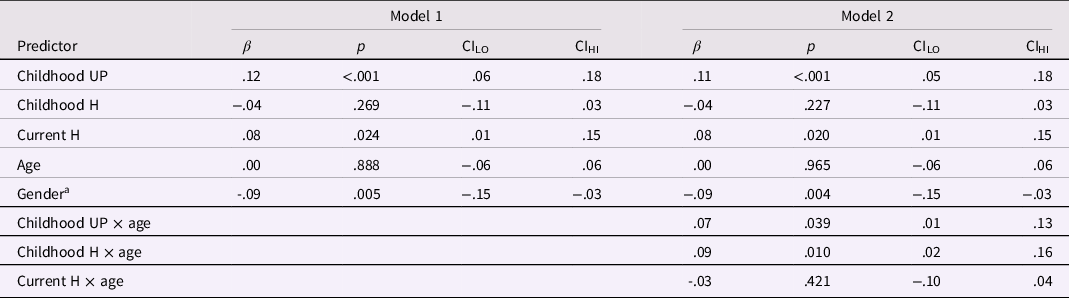
To examine our first hypothesis, we conducted a linear regression predicting emotional control difficulties from childhood unpredictability and childhood harshness, controlling for current harshness, age, and gender (coded −1 = girls, 1 = boys). Consistent with H1, childhood unpredictability, but not childhood harshness, predicted greater emotional control difficulties, which were also predicted by current harshness and gender (being a girl) (see Table 1, Model 1).
Standardized regression coefficients and 95% confidence intervals for models predicting emotional control difficulties (study 1)

Note. UP = Unpredictability; H = Harshness; CILO = 95% confidence interval lower limit; CIHI = 95% confidence interval upper limit. Model 1 R 2 = .03, p = .005; Model 2 R 2 = .04, p = .001.
a Girls = −1, Boys = 1.
To examine whether the effect of childhood unpredictability is moderated by age, we added a second regression step in which we entered the interaction between childhood unpredictability and age (both grand-mean centered). We also controlled for the interactions between childhood harshness and age and between current harshness and age. As seen in Table 1, Model 2, the childhood unpredictability × age interaction was significant, indicating that the childhood unpredictability effect on emotional control difficulties is moderated by age. We then computed the simple slopes of childhood unpredictability for each age. Consistent with H2, the slope increased in size (i.e., became more positive) the older participants were. The slope was not significant for participants 12–13 years of age (e.g., Age 12: β = −.03, p = .727, 95% CI [−.17, .12]), but was significant for participants 14–16 years of age (e.g., Age 16: β = .19, p < .001, 95% CI [.10, .29]). Thus, the effect of childhood unpredictability on emotional control difficulties was stronger for older adolescents (for full simple slopes results, see supplemental Table S2).
Although we did not find an association between childhood harshness and emotional control difficulties, the interaction between childhood harshness and age was significant. Simple slopes analyses for each age revealed that while childhood harshness did not predict greater emotional control difficulties for any of the ages, it did predict less emotional control difficulties in younger participants, ages 12–14 (e.g., Age 12: β = −.25, p = .004, 95% CI [−.41, −.08]). This unexpected finding should be replicated before it is interpreted further.
We also explored whether gender moderated the effect of childhood unpredictability on emotional control by testing the interaction between gender and childhood unpredictability. This interaction was not significant (β = 0.02, p = .464) and was excluded from the final model.
Discussion
Study 1 demonstrates that childhood unpredictability is a unique predictor of emotional control difficulties in adolescence, above and beyond both childhood and current harshness. Moreover, the study shows that the effect of childhood unpredictability is stronger for older adolescents. This result is striking given that more time had passed since the occurrence of the stressor for older adolescents than for younger adolescents, but it is consistent with our hypothesis about a delayed effect of childhood unpredictability that kicks in when adolescents enter their reproductive years and start developing romantic interests. Study 1, however, did not control for current unpredictability. Moreover, it used a single-item measure of childhood SES. These limitations were rectified in Study 2.
Study 2
Study 2 examined whether childhood unpredictability and harshness are associated with emotional control difficulties and relationship quality in a cross-sectional sample of American adults. The study had two goals: first, to replicate the findings of Study 1 in an adult sample while controlling for current unpredictability and, second, to extend these findings by examining the indirect effect of childhood unpredictability and harshness on relationship quality through emotional control difficulties. We hypothesized that (H3) more exposure to childhood unpredictability by age 10 would be associated with more emotional control difficulties, above and beyond current unpredictability and both childhood and current harshness. We also hypothesized (H4) that this association would be stronger in younger adults in their reproductive prime. Finally, we hypothesized (H5) that childhood unpredictability would be indirectly associated with lower relationship quality through greater emotional control difficulties.
Method
Participants
Study 2’s participants were 327 American adults (ages 18–87; M = 38.53, SD = 13.18) recruited through Amazon Mturk. The majority were women (208 women, 116 men, 3 other). Most reported being White (78.3%), having some higher education (33.3%) or a 4-year degree (55.4%), and being in a romantic relationship (81%). The participants were compensated $1.50 for their participation. The study was approved by the institutional review board of the University of Minnesota. Our sample size provided us 80% power to detect a small effect size (f 2 = .024).
Procedure
The measures used in the current investigation were embedded within a larger online survey about childhood stress and personality. Full scales appear in the supplemental materials.
Measures
Childhood unpredictability
Childhood unpredictability was assessed with an expanded version of the questionnaire used in Szepsenwol et al. (Reference Szepsenwol, Simpson, Griskevicius and Raby2015). Three additional items were added to the original three-item scale to increase the reliability of the measure. The scale assessed the occurrence of the same three types of events that signal unpredictability: changes in economic circumstances (occupational, financial), moving to a different environment (house, school), and changes inside the family (people moving in and out of the house, parents getting romantically involved with other people). Participants indicated whether each of these events occurred during their first 10 years of life on a 4-point scale (0 = not at all; 1 = one time; 2 = two times, 3 = three or more times). The 10-year limit was extended from the 8-year limit in Study 1 given this older sample. The items were summed to create a childhood unpredictability count measure.
Childhood harshness
Childhood harshness (low SES) was assessed with a 5-item scale that is an expanded version of 3-item and 4-item childhood SES scales used in prior studies (e.g., Griskevicius et al., Reference Griskevicius, Tybur, Delton and Robertson2011; Szepsenwol et al., Reference Szepsenwol, Simpson, Griskevicius and Raby2015). Participants indicated their agreement with each item (e.g., “my family struggled financially”) on a 1 (strongly disagree) to 7 (strongly agree) scale, relating to the first 10 years of their lives. The items were averaged to create a childhood harshness measure (α = .87).
Current unpredictability
Current unpredictability was assessed using the same approach as childhood unpredictability, except that participants responded about the prior 3 years of their lives. The six scale items largely paralleled the items of the childhood unpredictability scale, with necessary changes to make them relevant to an adult context (Szepsenwol et al., Reference Szepsenwol, Simpson, Griskevicius and Raby2015). As with the childhood unpredictability scale, the items covered changes in economic circumstances (occupational, financial), changes in residence, and changes in romantic circumstances. Participants indicated whether each of these events occurred during the past 3 years on a 4-point scale (0 = not at all; 1 = one time; 2 = two times, 3 = three or more times). The items were summed to create a current unpredictability count measure.
Current harshness
Current harshness (low SES) was assessed with a five-item scale that is an expanded version of 3-item and 4-item current SES scales used in prior studies (e.g., Griskevicius et al., Reference Griskevicius, Tybur, Delton and Robertson2011; Szepsenwol et al., Reference Szepsenwol, Simpson, Griskevicius and Raby2015). Participants indicated their agreement with each item (e.g., “I have enough money to buy things I want”) on a 1 (strongly disagree) to 7 (strongly agree) scale, relating to their current situation. The items were averaged to create a current harshness measure (α = .86).
Emotional control difficulties
Emotional control difficulties were assessed with the Impulse Control subscale of the Difficulties in Emotion Regulation Scale (DERS; Gratz & Roemer, Reference Gratz and Roemer2004). This subscale includes 6 items assessing difficulties in controlling one’s behavior when upset (e.g., “When I’m upset, I become out of control”). Participants rated each item on a scale ranging from 1 (almost never) to 5 (almost always). The items were averaged to create a measure of emotional control difficulties (α = .88).
Relationship quality
Participants who were in a current romantic relationship were asked to complete the short version of the Perceived Relationship Quality Components (PRQC) Inventory (Fletcher et al., Reference Fletcher, Simpson and Thomas2000). These participants (N = 252) rated their current relationship and partner on six items corresponding to six relationship components (satisfaction, commitment, intimacy, trust, passion, love; e.g., “How satisfied are you with your relationship?”) on a scale ranging from 1 (not at all) to 7 (extremely). The items were averaged to create a measure of relationship quality (α = .90).
Education level
Because educational level may explain some of the variability in emotional control difficulties in adults, we controlled for educational attainment, which was assessed with a scale ranging from 1 (some high school or less) to 6 (graduate degree or higher).
Results
Descriptive statistics and zero-order correlations between all study variables are reported in Table S3 in the supplemental materials. Similar to Study 1, only childhood unpredictability was correlated with emotional control difficulties (r = .27, p < .001), which in turn was associated with lower relationship quality (r = −.17, p = .008). The main analysis was conducted in two stages. First, we tried to replicate the results of Study 1 while also controlling for current unpredictability. Second, we examined whether childhood unpredictability and harshness predict relationship quality indirectly through emotional control difficulties.
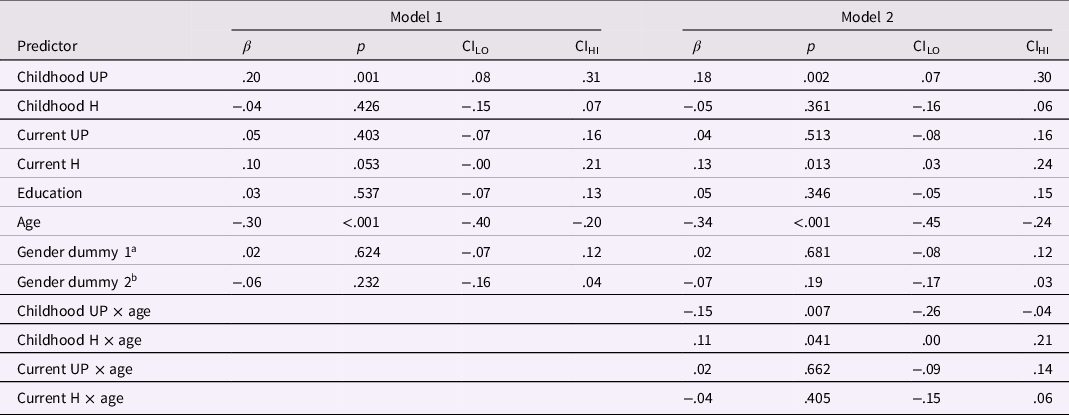
To examine the unique effects of childhood harshness and unpredictability on emotional control difficulties, we ran a linear regression predicting emotional control difficulties from childhood unpredictability and harshness, current unpredictability and harshness, education, age, and gender (represented by two dummy-coded variables with men as the reference group). Consistent with H3, childhood unpredictability, but not childhood harshness, uniquely predicted greater emotional control difficulties (see Table 2, Model 1).
Standardized regression coefficients and 95% confidence intervals for models predicting emotional control difficulties (study 2)
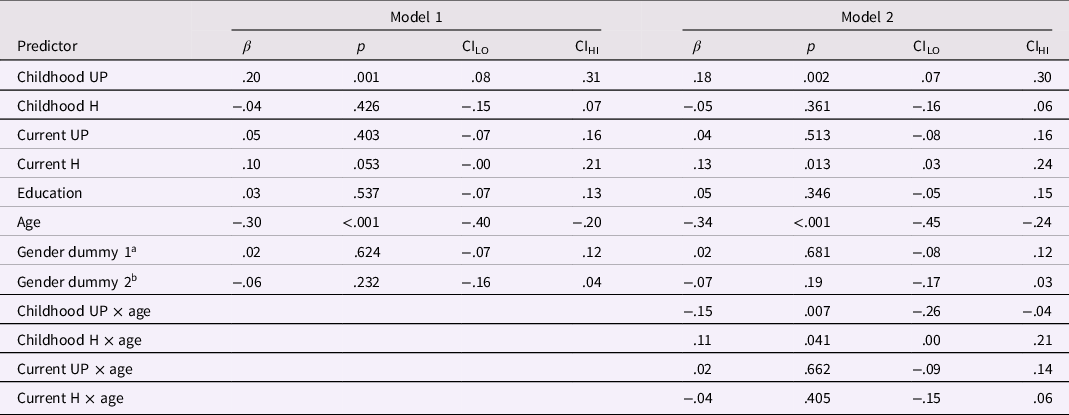
Note. UP = Unpredictability; H = Harshness; CILO = 95% confidence interval lower limit; CIHI = 95% confidence interval upper limit. Model 1 R 2 = .185, p < .001; Model 2 R 2 = .209, p < .001.
a Women = 1, Men or Other = 0.
b Other = 1 Women or Men = 0.
To determine whether the effect of childhood unpredictability is moderated by age, we entered the interaction between childhood unpredictability and age (both grand-mean centered) in a second regression step. As in Study 1, we controlled for the interactions of age with childhood and current harshness, as well as with current unpredictability (see Table 2, Model 2). The childhood unpredictability × age interaction was significant, indicating once again that the childhood unpredictability effect on emotional control difficulties is moderated by age. Consistent with H4, the childhood unpredictability slope decreased in size (becoming less positive) the older the participants were. We computed the simple slopes of childhood unpredictability for three ages representing the breadth of ages in Study 2. The association between childhood unpredictability and emotional control difficulties was strong and highly significant for 25-year-olds (β = .36, p < .001, 95% CI [.20, .52]), weaker but still significant for 40-year-olds (β = .17, p = .006, 95% CI [.05, .29]), and nonsignificant for 55-year-olds (β = −.03, p = .813, 95% CI [−.23, .18]). Inspection of the regions of significance revealed that the slope became nonsignificant for individuals 42.75 years and older (β = .13, p = .05, 95% CI [.00, .26]).
As in Study 1, we also found a significant interaction between childhood harshness and age, but this interaction was in the opposite direction than the childhood unpredictability × age interaction. A significant negative slope for childhood harshness emerged for 25-year-olds (β = −.17, p = .028, 95% CI [−.33, −.02]), such that greater childhood harshness was associated with less emotional control difficulties. The slopes for 40- and 55-year-olds were not significant. Inspection of regions of significance showed that the negative childhood harshness slope became nonsignificant for individuals 29.4 years and older (β = −.13, p = .05, 95% CI [−.27, .00]), and a positive childhood harshness slope on emotional control difficulties (i.e., greater harshness associated with more difficulties) did not emerge even for 87-year-olds, which was the top age in our sample (for full simple slopes results, see Table S4 in the supplemental materials).
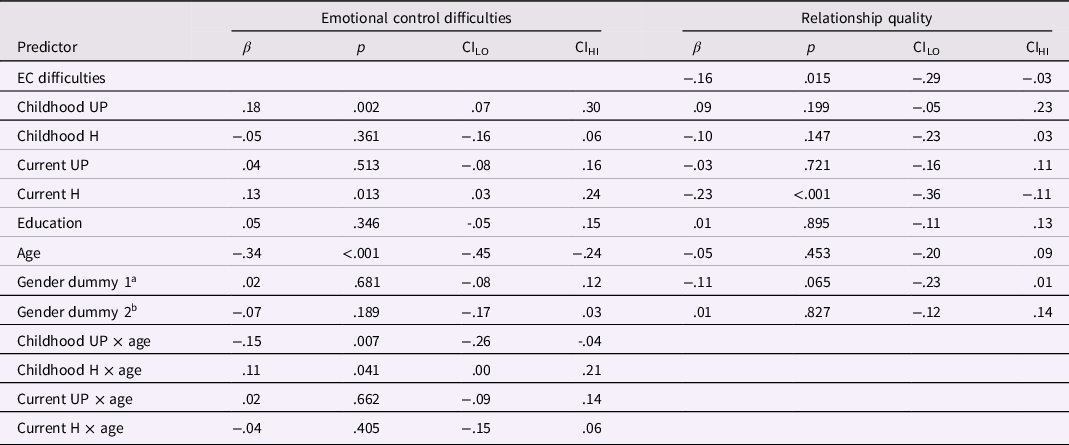
In the second stage of our analysis, we examined a moderated mediation model in which childhood unpredictability predicts emotional control difficulties moderated by age, and emotional control difficulties, in turn, predict relationship quality (for the conceptual model, see Figure S1 in the supplementary materials). The regression model predicting emotional control difficulties was identical to the one used in the previous analysis stage, with similar results. Namely, childhood unpredictability was significantly associated with more emotional control difficulties, but only in younger individuals. Greater emotional control difficulties, in turn, were associated with lower relationship quality (see Table 3). Confidence intervals for the conditional indirect effects of childhood unpredictability on relationship quality were computed for three ages using bias-corrected bootstrapping (k = 5000). These indirect effects were significant for 25- and 40-year-olds (β = −.06, 95% CI [−.13, −.01]) and β = −.03, 95% CI [−.07, −.01], respectively), but not significant for 55-year-olds (β = .00, 95% CI [−.02, .04]). These results indicate that younger individuals who were exposed to childhood unpredictability experience greater emotional control difficulties and, indirectly, lower relationship quality.
Standardized regression coefficients and 95% confidence intervals for moderated mediation model predicting relationship quality (study 2)
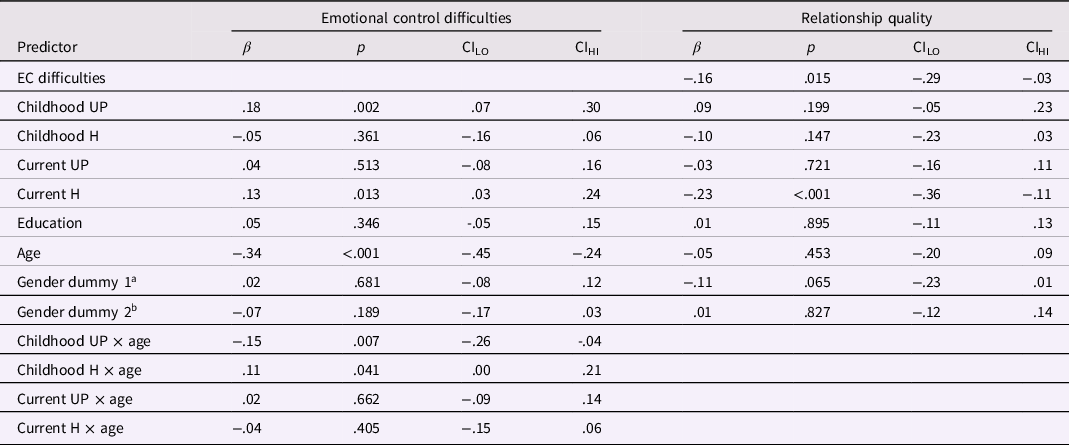
Note. EC = Emotional control; UP = Unpredictability; H = Harshness; CILO = 95% confidence interval lower limit; CIHI = 95% confidence interval upper limit. Emotional control difficulties R 2 = .209, p < .001; Relationship quality R 2 = .11, p = .003. Goodness of fit: χ 2 (4) = 1.94, p = .747; CFI = 1.00; RMSEA = 0.00; SRMR = .016.
a Women = 1, Men or Other = 0.
b Other = 1 Women or Men = 0.
Finally, it is noteworthy that current harshness was uniquely associated with both greater emotional control difficulties and lower relationship quality (see Table 3).
Discussion
Study 2 replicated the main result of Study 1, showing that childhood unpredictability is associated with emotional control difficulties above and beyond childhood harshness. Moreover, it demonstrated that this association exists even when controlling for current unpredictability. This indicates that the effect of childhood unpredictability on emotional control difficulties in adulthood is not due to continuity in unpredictability levels across life, but appears to reflect an enduring influence of the childhood environment on emotion regulation.
As in Study 1, childhood unpredictability interacted with age. Combining the results of the two studies paints an interesting picture. Study 1 involved a sample of adolescents, meaning that older participants, for whom the unpredictability effect was stronger, were closer to their reproductive years. Study 2, in contrast, examined a sample of adults, meaning that younger participants, for whom the unpredictability effect was stronger, were closer to their reproductive years. Taken together, the results of the two studies indicate that exposure to childhood unpredictability predicts greater emotional control difficulties in individuals ages 14 to 43. This age range covers middle adolescence through early-to-middle adulthood, life periods during which people develop romantic interests, form romantic relationships, and start families (Collins, Reference Collins2003). These are also periods of greater emotionality, during which individuals develop their emotion regulation abilities and patterns (Riediger & Klipker, Reference Riediger, Klipker and Gross2014).
Study 2 reveals for the first time that childhood unpredictability indirectly predicts lower relationship quality through greater emotional control difficulties, lending further support to the idea that emotional control serves a reproductive function by improving functioning in romantic relationships. The ability to downregulate negative emotions is essential to effective relationship communication and constructive conflict resolution (Bloch et al., Reference Bloch, Haase and Levenson2014). Individuals who lack this ability are likely to have difficulties maintaining good relationships with their partners, which could hinder their ability to enact a slow life history strategy.
Despite these promising results, Study 2 used retrospective measures of the childhood environment within a cross-sectional design. To better understand the processes through which childhood environments predict emotional control and relationship quality, one must use a prospective longitudinal design. This was done in Study 3.
Study 3
Study 3 leveraged data from the MLSRA (Sroufe et al., Reference Sroufe, Egeland, Carlson and Collins2005), a prospective longitudinal study that has followed individuals from before they were born into middle adulthood. These individuals were born to first-time mothers recruited at free public health clinics in Minneapolis, Minnesota, between 1975 and 1977. At recruitment, all of the mothers were living below the poverty line, so participants were exposed to a variety of stressors during their early years. The MLSRA includes measures of unpredictability and harshness obtained across childhood, which allowed us to examine their prospective associations with emotional control difficulties and relationship quality, both of which were assessed when participants were 32 years old. Moreover, we were able to test additional, prospectively-measured mediating variables, namely, the quality of maternal support received during early childhood and participants’ attachment representations in adolescence and early adulthood. A subset of MLSRA participants who were involved in romantic relationships during the study also participated in observed conflict interactions with their romantic partners at various ages. Independent coders rated the amount of emotional distress displayed during these interactions, which we used to test whether participants exposed to more unpredictability or harshness during early childhood had adult romantic relationships characterized by greater emotional distress.
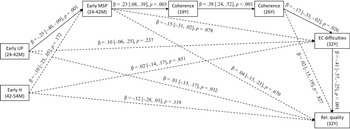
Study 3 had two goals. First, we examined a serial mediation model in which unpredictability and harshness experienced during early childhood (ages 1–4) predict lower maternal supportive presence during this period, which predicts insecure attachment representations in late adolescence (age 19) and early adulthood (age 26), which in turn predict greater self-reported emotional control difficulties and lower relationship quality at age 32 (see Figure 1). Second, we examined whether early-life unpredictability and harshness predict greater emotional distress during conflict interactions with romantic partners (between ages 19–36).
Serial mediation model (Study 3). UP = Unpredictability, H = harshness, MSP = Maternal supportive presence. EC = Emotional control. Covariates not shown: Age 32 harshness, Age 32 unpredictability, Race, and Gender. Full lines depict significant paths; dashed lines depict nonsignificant paths.

We hypothesized that (H6) early-life unpredictability (ages 1–4) would indirectly predict lower relationship quality (age 32) through lower maternal supportive presence (ages 1.5–3.5), lower attachment coherence (security) (age 19 and 26), and greater self-reported emotional control difficulties (age 32), above and beyond current unpredictability and early-life and current harshness. We also hypothesized that (H7) early-life unpredictability (ages 1–4) would predict greater observed emotional distress during conflict interactions with romantic partners (ages 19–36), above and beyond early-life harshness.
Method
Participants
Study 3’s sample consisted of all MLSRA participants who completed the DERS at the 32-year assessment (N = 160; 52.5% female). The sample varied in terms of education. By age 32, 6.8% of participants had not graduated from high school, 13.0% had a GED, 14.8% had a high school diploma, 46.9% had some post-high school education, 11.1% had a 4-year college degree, and 7.4% had a post-baccalaureate degree. The majority of participants were White (65.6%), 10.6% were Black, 18.1% were of mixed race, and 5.6% were of other races.
Procedure
All of the data were collected and coded prospectively as part of the MLSRA project.
Measures
Early-life unpredictability
We used the same early-life unpredictability measure used in prior research from the MLSRA (e.g., Doom et al., Reference Doom, Vanzomeren-Dohm and Simpson2016; Simpson et al., Reference Simpson, Griskevicius, Kuo, Sung and Collins2012). We focused on the first 4 years of life because of the inclusion in the model of maternal supportive presence during these same years. The measure consisted of three items from the Life Events Schedule (LES; Egeland et al., Reference Egeland, Breitenbucher and Rosenberg1980), which was administered to the mothers of the participants when they were 12, 18, and 48 months of age. The items assessed mothers’ life stress during the preceding year stemming from three sources: (a) changes in employment status (e.g., periods of unemployment); (b) changes in residence (e.g., moving to a different house or apartment); and (c) changes in cohabitation status (e.g., whether and how often romantic partners moved in or out of the house/apartment). Mothers’ interview responses to each item were rated by trained coders for the intensity of disruption associated with each event on a scale ranging from 0 (no disruption) to 3 (severe disruption). Interrater reliabilities for each rated item were above .90. An accumulated early-life unpredictability measure was created by summing the three items and averaging across the three assessment periods.
Early-life harshness
We used the same early-life SES measure used in prior research from the MLSRA (e.g., Doom et al., Reference Doom, Vanzomeren-Dohm and Simpson2016; Simpson et al., Reference Simpson, Griskevicius, Kuo, Sung and Collins2012). This measure is based on the two available SES measures within our targeted timeframe of approximately the first 4 years of life when participants were 42 and 54 months old. The 42-month measure was based on mothers’ educational attainment and the revised version of the Duncan Socioeconomic Index (SEI; Duncan, Reference Duncan and Reiss1961; Stevens & Featherman, Reference Stevens and Featherman1981) and the 54-month measure was based on mothers’ SEI alone. A composite early-SES measure was created by computing SES-based z scores of the available items within each of the two assessment periods. These values were then transformed to t scores (M = 50, SD = 10). As expected, 42-month and 54-month scores were positively correlated, r = .41, p = .001, so they were averaged to create a composite early-SES score (up to age 4.5), which was subtracted from 100 to obtain a measure of early-life harshness.
Current unpredictability
The current unpredictability measure was analogous to the early-life unpredictability measure and was the same one used in prior MLSRA research (e.g., Szepsenwol et al., Reference Szepsenwol, Simpson, Griskevicius and Raby2015, Reference Szepsenwol, Griskevicius, Simpson, Young, Fleck and Jones2017). Like the early-life measure, it was based on the LES, which was administered to participants at age 32. Current unpredictability was assessed by three items that inquired about changes in employment status, changes in residence, and changes in cohabitation during the past year. A current unpredictability measure was computed by summing these items.
Current harshness
Current harshness was assessed using highest household SES at age 32 (SEI; Duncan, Reference Duncan and Reiss1961; Stevens & Featherman, Reference Stevens and Featherman1981), as in prior MLSRA research (e.g., Szepsenwol et al., Reference Szepsenwol, Simpson, Griskevicius and Raby2015, Reference Szepsenwol, Griskevicius, Simpson, Young, Fleck and Jones2017). As with the early-life harshness measure, the values were transformed to t scores and subtracted from 100 to obtain a current harshness measure.
Early maternal supportive presence
We used the same early maternal support measure used in prior research from the MLSRA (e.g., Szepsenwol et al., Reference Szepsenwol, Simpson, Griskevicius and Raby2015, Reference Szepsenwol, Griskevicius, Simpson, Young, Fleck and Jones2017). When participants were 24 and 42 months old, they and their mothers were observed in the lab while completing problem-solving and teaching tasks. The tasks gradually increased in complexity, eventually becoming too difficult for the children (the participants) to solve on their own. The mothers were instructed to first allow their child to attempt the task independently and then step in and provide help if/when they thought it was appropriate to do so. The videotaped sessions were rated by trained coders for mothers’ supportive presence on a 7-point scale (ICCs = .84 and .87 for 24 and 42 months, respectively). High scores were given to mothers who showed interest and were attentive to the needs of their child, who responded contingently to their child’s emotional signals, and who reinforced their child’s success. Low scores were given to mothers who were distant, hostile, and/or unsupportive. As expected, the 24- and 42-month scores were positively correlated, r = .43, p = .001, so they were averaged to create a composite early maternal supportive presence score (N = 156).
Attachment representations
The adult attachment interview (AAI; George et al., Reference George, Kaplan and Main1985) was administered at ages 19 (N = 147) and 26 (N = 151) years. The AAI is a well-validated, semi-structured interview assessing the degree to which adults have a coherent narrative about their early childhood experiences, primarily between the ages of 5–12. Participants were asked to describe their early relationships with their caregivers and to reflect on episodes of separation, rejection, abuse, and loss. The transcribed AAI narratives were rated on a set of 9-point scales that assessed attachment-related states of mind and inferred experiences, following Main and Goldwyn’s (Reference Main and Goldwyn1998) coding system. Similar to prior research (e.g., Szepsenwol et al., Reference Szepsenwol, Simpson, Griskevicius and Raby2015, Reference Szepsenwol, Griskevicius, Simpson, Young, Fleck and Jones2017), we used the coherence of mind scale as a dimensional measure of attachment security (ICCs = .77 and .85 for ages 19 and 26, respectively). This scale assesses an individual’s ability to freely explore their feelings about different childhood experiences in an organized/emotionally well-regulated versus a non-organized/emotionally dysregulated manner. Attachment security is inferred from coherence and cooperation during the interview along with believable memories of specific instances of care or support provided by parents.
Emotional control difficulties
As in Studies 1 and 2, emotional control difficulties were assessed with the Impulse Control subscale of the Difficulties in Emotion Regulation Scale (DERS; Gratz & Roemer, Reference Gratz and Roemer2004), administered at age 32 (α = .85).
Relationship quality
Relationship quality was assessed using a semi-structured interview administered at age 32. Participants who were in a relationship at the time (N = 115) answered questions about their feelings and experiences in their current romantic relationship and the characteristics of this relationship. Trained coders rated the overall quality of the relationship on a 1 (poor) to 5 (very good) scale (ICC = .95). High scores were given to relationships characterized by mutual caring, trust, and emotional closeness; willingness to sacrifice self-interests; sensitivity to one another’s needs and wishes; sharing of experiences, as well as enjoyment of each other; loyalty, honesty, and faithfulness; and contribution of the relationship to a positive sense of self, high self-esteem, and self-respect.
Observed distress in conflict interactions
A subset of MLSRA participants (N = 104) who were in romantic relationships were observed during videorecorded interactions with their romantic partners at various ages (between 19–36). The interactions focused on resolving a major conflict in the relationship. In the first phase of the procedure, each partner reported privately on the most salient problems in their relationship. Then, they each reviewed their responses together and chose the problem that caused the most conflict. Each couple was given 10 min to discuss the problem and attempt to reach a resolution, followed by a 4-min “cool down” period during which each couple discussed areas on which they agreed the most in their relationship. Trained coders rated the amount of emotional distress displayed by each partner during the interaction on a scale ranging from 1 (very low) to 7 (very high) (ICC = .95). Because participants were observed in 1–4 interactions, individual emotional distress scores were averaged across all of the interactions. Given the nature of these conflict interactions, in which each partner’s level of emotional distress typically affects the other’s distress, partners’ mean distress scores were highly correlated (r = .62, p < .001). Thus, these scores were averaged to create an emotional distress score describing their interactions. Higher scores indicated that the interactions were characterized by greater displays of emotional distress by both partners.
Results
Descriptive statistics and zero-order correlations between all study variables are reported in Table S5 in the supplemental materials. Of note, the correlation between childhood unpredictability and emotional control difficulties was marginal (r = .15, p = .056). Childhood harshness was negatively correlated with relationship quality (r = −.23, p = .015), but not with emotional control difficulties (r = .07, p = .40). Moreover, emotional control difficulties were associated with lower relationship quality (r = −.43, p < .001) and with greater observed emotional distress during conflict interactions (r = .22, p = .026), and lower relationship quality was associated with greater observer-rated emotional distress (r = −.31, p = .004).
To examine the hypothesized serial mediation model (H6), we fitted a structural path model using Mplus version 8.3 (Muthén & Muthén, Reference Muthén and Muthén1998–2019). Full Information Maximum Likelihood was used to account for missing data on some of the variables. This model, shown in Figure 1, fitted the data fairly well (χ 2 (19) = 27.01, p = .105; CFI = .92; RMSEA = 0.051; SRMR = .073). We controlled for current unpredictability and harshness, gender (coded 0 = Male, 1 = Female), and race (0 = White, 1 = Non-White). Consistent with H6, early-life unpredictability, but not harshness, was significantly associated with poorer maternal supportive presence early in life, which in turn predicted lower attachment coherence (i.e., less security) at age 19, which predicted lower attachment coherence at age 26. Lower attachment coherence at 26, in turn, predicted greater emotional control difficulties at age 32, which was associated with lower relationship quality at 32 (see Figure 1). The only other direct predictors of relationship quality (not depicted in Figure 1) were current unpredictability (β = −.25, p = .002, 95% CI [−.41, −.09]) and current harshness (β = −.17, p = .048, 95% CI [−.33, −.00]).
Next, we examined the indirect paths linking early-life unpredictability to lower relationship quality by computing 95% bootstrap confidence intervals. Consistent with H6, the indirect effect was significant (β = −.016, 95% CI [−.049, −.002]), indicating that early-life unpredictability forecasts lower relationship quality through a cascading process involving poorer early maternal supportive presence, less attachment security in late adolescence and early adulthood, and greater emotional control difficulties.
To determine whether early-life unpredictability or harshness predicts greater emotional distress during conflict interactions with romantic partners (H7), we conducted a linear regression controlling for gender, race, and the number and timing of conflict interaction observations. Because observations took place at various ages during the study (between 19–36), we could not control for current unpredictability and harshness or examine serial mediation through attachment and emotional control. However, as hypothesized, early-life unpredictability predicted greater emotional distress during conflict interactions (β = .21, p = .026, 95% CI [.03, .39]), whereas early-life harshness did not (β = .02, p = .827, 95% CI [−.16, .20]).
Discussion
Study 3 corroborated the main findings of Studies 1 and 2 using a prospective longitudinal design. Early-life unpredictability predicted more emotional control difficulties and lower relationship quality at age 32 via lower maternal supportive presence in early childhood and less secure attachment representations in late adolescence and early adulthood. Moreover, the romantic conflict interactions of MLSRA participants who had been exposed to greater early-life unpredictability were characterized by greater emotional distress, suggesting that early-life unpredictability had a deleterious effect on the emotional tone of their romantic relationships. Together, these findings lend further support to the notion that early-life unpredictability presages the development of a less regulated style of emotional responding, which undermines stable romantic relationships that are important for the enactment of a slow life history strategy.
Study 3 also supported the existence of a parenting-attachment mechanism that mediates the effects of early-life unpredictability on adult outcomes. This same process mediated the effects of early-life unpredictability on male parenting and sociosexuality in prior research (Szepsenwol et al., Reference Szepsenwol, Simpson, Griskevicius and Raby2015, Reference Szepsenwol, Griskevicius, Simpson, Young, Fleck and Jones2017). The attachment system is closely linked with emotion regulation styles and capabilities, with secure individuals displaying better emotion regulation capabilities than insecure ones (Mikulincer & Shaver, Reference Mikulincer and Shaver2019). Moreover, studies have shown that insecure individuals find it harder to control negative emotions that arise in their relationships, and often rely on their partners to regain equanimity (Overall & Simpson, Reference Overall and Simpson2015; Simpson & Rholes, Reference Simpson and Rholes2017).
General discussion
Emotional control is an important psychological skill that impacts both personal and interpersonal adjustment (Levenson et al., Reference Levenson, Haase, Bloch, Holley, Seider and Gross2014; Sheppes et al., Reference Sheppes, Suri and Gross2015). In the current research, we investigated whether childhood exposure to unpredictable and harsh environments forecast greater emotional control difficulties and, indirectly, lower relationship quality. Our hypotheses were supported with regard to childhood unpredictability. Childhood unpredictability predicted greater emotional control difficulties, with these effects becoming stronger as individuals enter their reproductive years during adolescence (Study 1) and weaker as they exit their reproductive years later in life (Study 2). Moreover, childhood or early-life unpredictability forecasted lower adult relationship quality through greater emotional control difficulties (Studies 2 and 3), with these effects mediated by lower early maternal support and insecure attachment in late adolescence and early adulthood (Study 3). All of these effects existed above and beyond those of childhood harshness (low SES), which were inconsistent across studies and largely nonsignificant. Taken together, these findings suggest that the degree of predictability of the local childhood environment serves as an important cue for the development of emotional control capabilities, with important consequences for adult relationship functioning.
The utility of a life history approach
The current research was guided by a life history approach that, unlike a deficit approach, views early environments as shaping agents, with their influence on development reflecting an adaptive process by which individuals specialize and calibrate their traits and capabilities to fit the ecological context signaled by their early environments (Ellis et al., Reference Ellis, Bianchi, Griskevicius and Frankenhuis2017; Frankenhuis & de Weerth, Reference Frankenhuis and de Weerth2013). Two findings of the current research provide support for this approach. First, childhood unpredictability was a stronger, more reliable predictor of emotional control difficulties than childhood harshness. While both harsh and unpredictable environments are stressful, environmental harshness can sometimes be buffered by behavioral modifications. When resources are consistently low, for example, risks to offspring can be offset by greater parental investment (Ellis et al., Reference Ellis, Figueredo, Brumbach and Schlomer2009). The stochastic nature of unpredictable environments, however, make them harder to buffer against. The information conveyed by early unpredictability is that the future is uncertain (Cabeza de Baca et al., Reference Cabeza de Baca, Barnett and Ellis2016), which may create a strong selection pressure for adopting a fast life history strategy. Thus, whereas harshness may have an immediate negative effect on emotional control, as we found in the current research, the lasting impact of childhood unpredictability on adult emotional control should be stronger.
Second, the effect of childhood unpredictability on emotional control difficulties increased with age for adolescents. If childhood unpredictability simply has a disruptive effect on emotional control, we would expect this effect to remain the same or even decrease as individuals become further removed from the source of the disruption. This age gradient is consistent with a reproductive function interpretation of emotional control, which is also consistent with the gradual decline of the effect as individuals become older. That is not to say that variability in emotion regulation reflects only an adaptive process; early life stress can and does impact emotion regulation through a variety of maladaptive processes such as trauma (Kim et al., in press; Zamir, in press) and allostatic load (Evans & Kim, Reference Evans and Kim2013). Some aspects of emotion regulation, however, are particularly well-suited for adaptation-based explanations. Emotional control capabilities have clear behavioral consequences for critical life history domains such as relationships and parenting. They, therefore, have distinct fitness implications.
Limitations and future directions
Some limitations must be considered when interpreting the results of this research. First, we concentrated on one aspect of emotion regulation: emotional control. Other aspects of emotion regulation, such as engaging in goal-directed behavior and the use of emotion regulation strategies, might also have fitness implications. Second, while we suggest tentative explanations regarding the schedule of childhood unpredictability effects on emotional control, we did not examine emotional control longitudinally. Future research should use repeated measures of emotional control to assess its trajectory across the lifespan as a function of childhood unpredictability. Third, although we propose that emotional control difficulties may be adaptive in certain situations, we did not examine these possible benefits. Future research should examine whether individuals who grew up in unpredictable environments gain an advantage in fitness-relevant domains through their less regulated behaviors and emotional displays. Fourth, our research is not genetically-informed. Parents who have trouble controlling their emotions might be more likely to create an unpredictable environment for their children, who have inherited their parents’ poor emotional control. Future studies should control for genetic heritability, either by using genetically-informed designs or by assessing and controlling for emotional control difficulties in the prior generation.
Finally, Studies 1 and 2 used retrospective measures of the early environment. The potential biases of retrospective reports have been demonstrated in the context of adverse childhood experiences (Reuben et al., Reference Reuben, Moffitt, Caspi, Belsky, Harrington, Schroeder, Hogan, Ramrakha, Poulton and Danese2016) and the childhood caregiving environment (Nivison et al., Reference Nivison, Vandell, Booth-LaForce and Roisman2021). Our childhood unpredictability measure might be slightly less susceptible to such biases as it asks about the frequency of objective life events rather than subjective feelings. Moreover, in prior research using both retrospective and prospective measures of childhood unpredictability, the two methods have yielded similar findings (Szepsenwol et al., Reference Szepsenwol, Simpson, Griskevicius and Raby2015), similar to the current research. Despite this, the results from our retrospective studies should be interpreted with caution until further replication with other prospective studies is obtained. Additional evidence is particularly needed for the validity of retrospective early-life measures in adolescent samples (Study 1). The null results found for harshness should also be interpreted with caution. Like prior studies (e.g., Belsky et al., Reference Belsky, Schlomer and Ellis2012; Simpson et al., Reference Simpson, Griskevicius, Kuo, Sung and Collins2012), we used SES as a harshness indicator, which provides only a crude approximation of true morbidity-mortality rates. This is especially true in Study 1, where SES was measured with a single item in a subjective manner. Future studies should examine the effects of childhood harshness on emotion regulation using other harshness indicators. For example, experiencing morbidity or death in one’s immediate environment may serve as a particularly strong harshness cue (Ellis et al., Reference Ellis, Figueredo, Brumbach and Schlomer2009).
Conclusion
Emotional control is an important psychological skill that is related to better relationship functioning (Bloch et al., Reference Bloch, Haase and Levenson2014). As such, it has important implications for reproductive fitness. The current research reveals that emotional control in adolescence and adulthood is responsive to childhood unpredictability, with consequences to adult relationship quality. Life history theory provides an adaptation-based framework for understanding how early environments might shape emotion regulation skills. This approach can help us gain a deeper understanding of the adaptive significance of some seemingly maladaptive traits and behaviors.
Supplementary material
The supplementary material for this article can be found at https://doi.org/10.1017/S0954579421001371
Funding statement
This research received no specific grant from any funding agency, commercial or not-for-profit sectors.
Conflicts of interest
None.