1 Introduction
EU citizens enjoy the legal right to work anywhere in the EU, as if it were one country. But despite this fundamental right, cross-border mobility within the EU remains low. One important reason for this are artificial mobility costs that arise because professional qualifications or social insurance entitlements are often not properly portable. During the past decades, the EU has already looked at many of these practical obstacles to internal mobility in order to reap the economic benefits of a properly function European labour market. In doing so, some of the most blatant barriers to mobility have been removed. The remaining obstacles are therefore likely to be more subtle.
Specifically, this paper explores the distortive effects of public pensions on intra-EU mobility. Conceptually, there are two different ways in which public pensions can distort mobility choices. First, each national pension system may display a mobility bias if its formula inherently discriminates between mobile and immobile workers. Second, mobility distortions may arise from differences between national pension systems even if each of the national pension formulae involved were mobility-neutral. Such distortions occur when pension schemes systematically offer a better deal to some or all of its members in one country than in another, for example due to demographic differences between countries or different levels of redistribution within the respective pension systems.
This second channel through which pension systems may create distortions of labour mobility has been extensively analysed in several papers. Homburg and Richter (Reference Homburg and Richter1993) show how PAYG pensions levy an implicit tax on labour income and how, other things being equal, workers tend to migrate to the country with the lowest implicit pension tax. Jousten and Pestieau (Reference Jousten, Pestieau, Feldstein and Siebert2002) describe the resulting race to the bottom that can drive contribution rates of the PAYG system to zero, thereby forcing the shift to a fully funded pension system. Finally, Breyer and Kolmar (Reference Breyer and Kolmar2002) show that the imposition of equal contribution rates is a sufficient condition to avoid such a race to the bottom and restore the efficient allocation of labour.Footnote 1
In this paper, we explore the first channel, namely the inherent mobility bias any national pension system may display in its pension formula which has received relatively little attention so far. Perhaps most importantly, practically all pension systems require a minimum number of years of contribution for any pension benefit to be paid at all. If contribution periods in other countries are not recognized, this could lead to a situation where internationally mobile workers might not receive any pension at all despite having duly paid their pension contributions for 30 or even 40 years overall albeit in various different countries. As early as 1971, it was attempted comprehensively to address this major obstacle to intra-European mobility with the ingenious directive 1408/71. This directive introduced the principles of totalization of contribution periods and pro-ratization of pensions (explained in detail in the subsequent section) to make pension portable within the EU.
That raises the question whether some inherent mobility distortions survived directive 1408/71. While the existing literature contains some hints at such surviving distortions,Footnote 2 we present a comprehensive formal treatment designed to systematically identify any remaining mobility bias. In order to do so, we examine the impact on national pension systems of a hypothetical job exchange across borders, with two (or more) individuals of equal productivity exchanging their place of work. A national pension system is said to pass the ‘Lodge Test’Footnote 3 of mobility neutrality if its cash flow is not altered by such hypothetical job exchanges. On that basis, we derive necessary and sufficient conditions for pension systems in the EU to be mobility neutral. We find that many public pension systems in the EU continue to display aspects that fail the Lodge Test. The potential for future steps to move towards full mobility neutrality is discussed.
Section 2 formalizes the totalization principle and develops the Lodge Test for mobility neutrality. A necessary and a sufficient condition are derived which national pension systems have to meet in order to pass the Lodge Test. In Section 3, the implications for real life pensions are discussed. We identify certain elements of existing pension systems which do not satisfy the conditions derived in Section 2. The concluding Section 4 of this paper relates our findings to other mobility distorting issues of pension systems and discusses the political difficulties that may arise when trying to achieve mobility neutrality in pensions.
2 Totalization of pensions and the Lodge Test
This section formalizes the totalization principle that is used as a basis to calculate old age pension entitlements for workers who move inside the EU. It then explores which types of pension formulae do not unduly distort mobility when the totalization principle is applied. It proposes a simple formalized test of non-distortion for national pension systems: the ‘Lodge Test’. A national pension system is said to pass the Lodge Test if cross-border job swaps between workers of identical productivity which do not change the aggregate cash flow into that national pension system also do not change the aggregate cash flow out of the pension system in the form of old age pensions once totalization is applied.
To explore the structural implications of the Lodge Test, one necessary and one sufficient condition for a national pension formula to meet the Lodge Test are derived. On that basis, the possible policy implications of the Lodge Test are discussed.
Totalization
To reduce the notational and conceptual complexity, we make a number of simplifying assumptions. First, we assume that an individual is only ever contributing to at most one pension system in one EU member state at a time and that moves between countries or changes of employment status only ever take place at the end of a full year. Second, we assume away non-working qualifying periods such as years of university study or child-raising periods. Third, we assume that the working age extends from 20 to 65 years for everybody.
On this basis, let  be the vector of annual earnings of an individual. And let
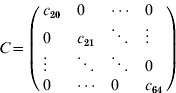 be the diagonal matrix of contribution periods such that the diagonal entry c i=1 if it was a contribution period in any EU member state and c i=0 otherwise. Furthermore, let C 1+ … +C 27=C be the partition of contribution periods among the EU member states for the individual in question. Accordingly, the earnings vector in each EU member state i can be written as
 .
In order to calculate each national pension for a mobile individual by means of totalization, a virtual earnings history is constructed. This virtual earnings vector  is calculated according to directive 1408/71 and subsequent regulations. Only contribution periods are shared between member states. Annual earnings and pension contribution data are not. Therefore, foreign earnings data cannot (and must not) be used for the construction of the virtual earnings vector. Instead, the virtual earnings vector is constructed by extrapolating from the actual national earnings history, and the average earnings during that period in particular. However, these average earnings are to be adjusted for inflation, wage growth, or other parameters depending on the logic of the underlying national pension formula, as specified by EU regulation.
On the basis of the virtual earnings vector  , a virtual pension is then calculated using the standard national pension formula
 of country i applied to the virtual earnings vector. This virtual pension is then pro-rated with the fraction of national contribution years over the total number of EU contribution years
 where tr is the trace function that sums the diagonal elements of a matrix. Each national pension entitlement P i is then calculated in accordance with EU regulation as the maximum of the pension claim based on totalization and pro-ratization
 and the purely national pension claim


The maximum function guarantees that an individual's pension claim derived from totalization and pro-ratization is never lower than without any EU regulation. The totalized pension of a mobile individual is then calculated as  with P i=0 for all countries i where no contribution was made.
Lodge Test
This method of totalization immediately raises the question of the kinds of pension systems it will work properly for, in the sense that it unduly discriminates against neither mobility nor immobility. Conceptually, the key question is how to compare like with like in detecting any undue discrimination. Surely, if an individual moves to a different country, both the salary level and the pension system will in general be different, and there is generally nothing wrong with that. However, there clearly would be something wrong if two individuals with identical skill-sets who swap countries and jobs in a way that does not collectively change the contributions into both national pension systems were then, collectively, to receive different pension claims in either of the two pension systems compared to a situation where each stayed at home. The Lodge Test is met if, and only if, such changes of place of individuals with identical skills and earnings would, under no circumstances, alter the cash flow of the national pension systems in question.Footnote 4
To illustrate the Lodge Test formally, suppose that A and B are two individuals with identical skills and therefore identical potential earnings vectors  in country 1 and
 in country 2. Variables of individuals are denoted by a superscript, while country variables remain indicated by a subscript. As a benchmark, we examine the situation that individual A spends all his working life in country 1 earning
 , while B spends all his working live in country 2 earning
 . Hence, country 1 has to pay a total pension
 and country 2 a total pension of
 to A and B respectively.
As a next step, assume that A and B change places with each other either once or several times. The matrix of contribution periods C for both individuals is now split between the two countries so that C 1A+C 2A=C=C 1B+C 2B with the job swap condition C 1A=C 2B and C 2A=C 1B. As a consequence, the annual earnings vector of individual A is transformed to  and that of individual B is transformed to
 .
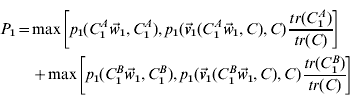
Using the totalization principle, the total pension claim (by A and B together) on country 1 then amounts to
and the total pension claim (by A and B together) on country 2 amounts to
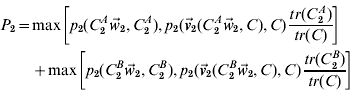
For the Lodge Test to be satisfied, the exchange should not lead to any change in the cash flow of either of the two pension systems. On the contribution side, this is generally satisfied since total earnings subject to contributions have not changed as  and
 . However, on the pension side this is only satisfied if
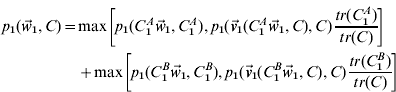
and
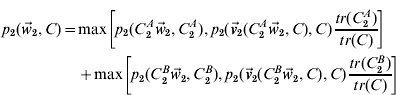
which is already a non-trivial demand on national pension systems. But the Lodge Test has an even stronger implication:
Proposition 1:
A necessary condition for the Lodge Test to be met by a national pension system is that its pension formula p can be written additively separably in annual earnings w k, k=20, …, 64
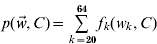
where year specific summands f k depend only on the earnings of that year and the contribution matrix.
Proof:
Imagine a ‘job switch’ arrangement whereby for 45 individuals with an identical skill set that leads to an earnings vector  in the country i whose pension formula we are interested in. Let each of the j=1, …, 45 individuals consecutively work in the country i for exactly one year such that each C ij has one diagonal element c k=1, for k=20, …, 64, and all other elements are zero. In this case, a necessary condition for the Lodge Test to be satisfied is that

for all possible earnings vectors  .
But each summand in this formula depends only on the earnings of one particular year of an individual's working life. Hence, the pension formula can indeed be written in an additively separable way in annual earnings as stated in proposition 1.
Before we turn to the discussion of where the necessary condition of additive separability is violated in practice – it often is – we also need to assert that a class of pension formulae that satisfy the Lodge Test actually exists. The following sufficient condition for the Lodge Test proves this:
Proposition 2:
If a national pension formula can be written as
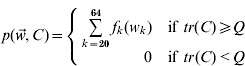
and the ranges of the f k are the same interval of real numbers for all k, then the Lodge Test is met.
A proof for this proposition is provided in the appendix.
The threshold value Q in Proposition 2 is in effect the waiting period for any pension to be obtained at all. The practical significance of this proposition is twofold. First, pension formulae that top up pensions as a function of the number of years of contributions contradict Proposition 2. For example, pension rules that top up the pension level for people with particularly long contribution historiesFootnote 5 are not compatible with Proposition 2. Second, pension formulae where the minimum and maximum pension entitlement that can be gained by a year of earnings vary across the earnings lifecycle so that the ranges of the f k also would be incompatible with Proposition 2, a problem that can also arise in practice.
The question now arises whether these two propositions are perhaps artefacts of the (possibly imperfect) principles of directive 1408/71 and subsequent regulation. Put differently: could a ‘better’ totalization regime be found that would then impose much lighter restrictions (if any) on national pension systems for them to pass the Lodge Test? In particular, could a more complete transmission of not only qualifying periods but also earnings information between member states help?
It turns out that this is not to be the case regarding the necessary condition of additive separability from Proposition 1. Essentially, the result follows from the logic of the Lodge Test quite independently of the specifics of the European totalization regime, as a closer inspection of equation (7) in the proof makes clear. Furthermore, adding foreign earnings information as arguments on the left-hand-side of equation (7) will at best be irrelevant when it comes to assuring equality with the right-hand side, since foreign earnings do not appear as an argument there.
By contrast there is, in principle, potential marginally to relax the requirements of the sufficient condition somewhat if the current European totalization/pro-ratization could be amended. Specifically, a more direct approach could be used instead of totalization in cases where pensions are additively separable along the lines of equation (8). In that case, instead of totalization and pro-ratization one could instead directly refer to the annual pension entitlements f k for the calculation of the pension benefit of a mobile individual. Thereby, one would be able to eliminate the prerequisite for totalization in Proposition 2, that for each country all f k would have to have the same range.
3 Policy implications
In practice, national pension formulae that satisfy additive separability usually (but not always, see above) also satisfy the more technical sufficient conditions so that the following policy discussion will focus on the requirement of additive separability. At first glance, it may appear that the restrictions imposed by additive separability are relatively weak. The full range of distributive options is compatible with additive separability (and also with sufficient conditions), ranging from Bismarckian pensions with a strong link between contribution and benefits and Beveridgian systems with a weak link or no link between contributions and benefits.
However, it turns out that in practice the restrictions imposed by additive separability are far from trivial. Compliance with it would in fact require pension reforms in a large number of member states. In the following, we will discuss the most important aspects of pension systems that would need to be changed to move towards additive separability.
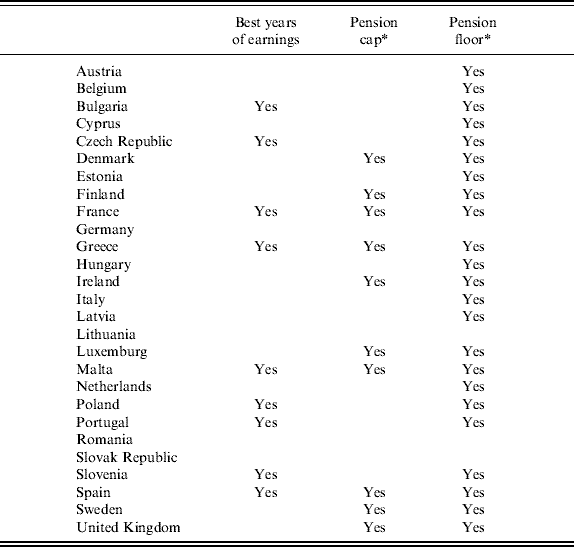
First, an important number of member states as shown in Table 1 currently base their pension calculation on a limited number of ‘best years of earnings’ or last years of earnings. Greece, for example, uses the best five years of earnings (during the last ten years of work) to calculate the pension. Italy is currently using the last five years of earnings to calculate its pension and Austria the best 15 years of earnings. A number of other countries are using similar approaches. The average based on the best (or last) years of earnings is then usually multiplied with a pension factor that is based on the number of contribution years. Clearly, this ‘best years of earning’ or last years of earning notion cannot be written into a pension formula that is additively separable in annual earnings. Such systems therefore do not meet the necessary condition for the Lodge Test to be satisfied.
Selected aspects of EU pension systems in conflict with mobility neutrality
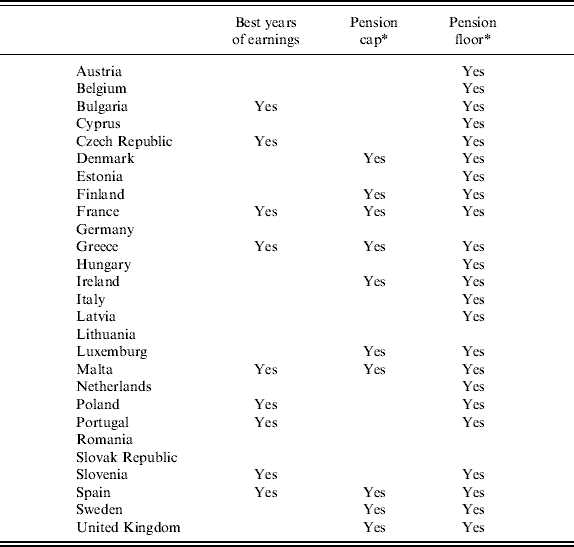
Note: * We indicate all countries that have explicit pension minimum and maximum pensions according to Missoc. There is no guarantee that both minimum and maximum pension are binding in any given year, such that the Lodge Test would actually be violated.
Source: Missoc.
Phasing out such ‘best years of earning’ elements in national pension formulae would clearly be desirable from a worker mobility perspective, as such elements represent a systematic discrimination against mobility. The reason is that under the Lodge Test the individual pension claim based on ‘best years of earning’ is transformed into a fragmented and pro-rated pension claim that is in effect based on the lower ‘average earnings’. As a result, fragmented pension claims of the mobile are systematically below the non-fragmented pension claims of the immobile. And especially volatile or dynamic earnings histories, that are different between best and average earnings can be quite severe.
Overall, we think that the prospects that member states will progressively fade out ‘best years of earnings’ are good. In recent years, many countries in the EU (e.g. Italy, Austria, and France) have either faded out their ‘best years of earnings’ approach completely or increased the number of ‘best years’ to be taken into account substantially. The political motivation for these changes has often had more to do with the fact that pension benefits needed to be cut in view of demographic pressures. Clearly, replacing the average earnings during a small number of best years to earnings by the average earnings over a larger number of years in the pension formulae is one convenient way to achieve such a reduction in benefits.
Second, some member states impose a cap p max on the total pension even when the logic of the pension formula would call for a higher pension. The pension formula in such a country i can typically be written as  with
 so that the cap is binding. Clearly, this maximum operation in the pension formula cannot be written in a way that is additively separable in earnings. It therefore violates the Lodge Test. Sometimes there may even be conceptual ambiguity whether these pension caps are to be applied before or after totalization. Interestingly, such pension caps tend to be biased in favour of mobility. Take the Danish basic pension as an example: each year of residence is worth 1/40th of the standard pension. However, the pension is capped at the standard pension so that anybody with more than 40 years of residence within the relevant age bracket still receives the standard pension. Hence, if somebody with 40 years of residence ‘changes places’, he should, according to the basic principles of totalization, still receive the full standard pension from Denmark. In addition, his migration counterpart who now has residence in Denmark for another five years is entitled to 1/8th of the standard Danish pension. Hence, to the extent that the principles of the EU regulation are applicable to the Danish case, there is a total pension claim on Denmark of 9/8th of the standard pension with mobility compared to only the standard pension without mobility.
The political intention of this is unlikely to be to subsidize mobility. Perhaps the idea is simply to ensure that a basic pension will be provided for every typical inhabitant (who is assumed to have spent less than five years of his life abroad). However, the threshold of five years abroad seems somewhat arbitrary and the economic advantages of this arrangement are not immediately obvious, although they may have to do with the way in which, for example, the Danish welfare state interacts with the basic pension. While the devil is always in the detail, it would seem promising for countries with such pension caps to explore viable and at the same time mobility-neutral alternatives.
Third, many EU member states have arrangements to top up pensions that are deemed to be too low when calculated under the normal pension formula to a pension floor P min. The pension formula in such a country i can typically be written as  with
 so that the floor is binding. Clearly, this minimum operation in the pension formula cannot be written in a way that is additively separable in annual earnings. It, therefore, violates the Lodge Test. Also, there can again be conceptual ambiguity whether these minima should be applied before or after totalization. These top-up benefits are usually intended to fight poverty in old age and also to reward low-income earners who have often diligently worked for decades instead of relying on the welfare state. Clearly, special benefits for relatively poor people in old age generally make good redistributive sense. However, they need not be delivered in a way that is incompatible with the Lodge Test.
For a start, top-up payments for old age pensions can be organized as part of social assistance instead of being part of the pension system. Of course, there may be political concerns about the stigma attached to receiving social assistance in old age. To assuage such concerns, Germany initially developed an insular solution for its ‘Grundsicherung’ (needs-based minimum pension benefit) that was legally neither part of the pension system nor part of social assistance. However, owing to legal and administrative difficulties, this separation was later abandoned and the ‘Grundsicherung’ is now fully integrated into the social assistance law.
In addition, the degree of redistribution within the pension system can, over a large range, be influenced simply by the responsiveness of pension entitlements to pension contributions without resorting to the instrument of a pension top-up. As already pointed out, pretty much the whole range of redistribution choices is available in a mobility-neutral form. If even a flat Beveridgean pension were deemed not to be redistributional enough, even the extreme Hayek pensionFootnote 6 where pension claims correlate negatively with average earnings and contributions could be implemented in a manner that satisfies the Lodge Test.
However, the separation of pension systems in the proper sense and needs-based arrangements for old age is not only legally and politically challenging, its positive effects in the sense of mobility neutrality are also unclear unless satisfactory mobility arrangements were in place for means-tested support in old age as part of the general welfare state.
Furthermore, there are many mobility distortions that the Lodge Test might partially be able to capture in areas that we have assumed away for ease of exposition. For example, there remains the difficult question how periods of child rearing that count towards pension entitlements are allocated among countries in the presence of mobility. There is the unresolved challenge of different retirement ages across the EU with present arrangements routinely failing the Lodge Test. There are the multiple interactions between the pension system and other parts of the welfare state, such as special health care arrangements for pensioners or long-term care insurance. Finally, there is the fact that the mobility arrangements between the EU and the rest of the world are insufficiently integrated with the provisions on intra-EU mobility and therefore also fail the Lodge Test.
4 Concluding remarks
There are some important aspects of the interplay between public pensions and intra-EU mobility that are not covered in this paper but nevertheless deserve to be discussed in relation to the research agenda of the present paper.
First, there is the issue of the income tax treatment of pension contributions and pensions. If one country taxes pension contributions and leaves pension payments untaxed and another country leaves pension contributions tax exempt but taxes pensions, this can induce major mobility incentives, not least at the time of retirement. We decided not to cover this taxation problem in order to keep the complexity of our analysis manageable. To some extent, this can also be justified by the fact that EU member states are generally moving towards deferred taxation of pensions, making contributions tax exempt and only taxing pension payments.
Second, there is the issue of portability of pension schemes from the ‘second pension pillar’ of supplementary pension schemes. They are usually company or sector specific, and are mostly funded schemes. The treatment of this second pillar under intra-EU mobility was recently the subject of a much discussed draft directive of the European Commission.Footnote 7 We decided not explicitly to cover the second pillar because much of the analysis for the first pillar would not be substantially different for the second pillar. But perhaps more importantly, it seems plausible that some of the second pillar pension schemes serve objectives that go beyond providing an income in old age. For example, it might be efficient for companies and employees to agree on reduced portability of company pensions in order to provide better incentives for the company to invest in the (portable) skills of its employees. But equally plausibly, limited portability of public pensions could result from a governance of occupational pension schemes often dominated by the interests of an immobile majority tempted to exploit a mobile minority of workers. Carefully disentangling legitimate and not-so-legitimate reasons for improving the portability of existing contracts ex post – which is what the EU level policy debate currently revolves around – would have been beyond the scope of this paper.
Third, we also do not cover civil service pensions. The reason is again that limited portability of civil service pensions can have efficiency reasons in terms of efficiency wage theory. This is not to say that portability cannot be a major issue here. Quite the reverse: for example, it is difficult to imagine a functioning EU labour market for university professors inside the EU unless the portability of public sector pensions is substantially improved. However, in this paper we have focussed on the normal first pillar of the pension system where the objective function is clearly focused on providing for old age, and mobility neutrality can easily and universally be defended as the relevant efficiency benchmark.
Overall, it would be unrealistic to expect all pension systems in Europe to become mobility neutral in the foreseeable future. But systematic European monitoring of barriers, as seen through the lens of the Lodge Test, would appear to be desirable in order to promote an incremental agenda designed to reduce mobility distortions – not only in the area of pensions but also for other parts of European welfare states. From that could flow non-binding European guidelines on desirable characteristics that could influence national decision-making without replacing it.
The implementation of this agenda will not be easy for two reasons. First, the legal complexity of national systems and their interactions across borders is enormous, with the result that many issues of practical relevance remain to be identified and, in time, resolved by the European courts. Second, because the majority of voters in EU member states still do not engage in intra-EU mobility, there may be political economy incentives for governments to persist in retaining – and even creating from scratch – aspects of the welfare state which are skewed towards the immobile at the expense of the mobile.
However, the conceptual framework presented in this paper may help to cut through the complexity and thus make it more difficult for such problems to go undetected for long.
Appendix
Proof of Proposition 2: For cases where tr(C)<Q, the proof is trivial. We therefore only look at the case tr(C)⩾Q. Also, for notational simplicity, we suppose that all periods of the working life are working periods so that all diagonal elements c kk of matrix C are non-zero.
On that basis, take any immobile individual earning  during working life C in the country in question. Now assume that this working life with exactly the same income in each year was now arbitrarily split between n mobile people C 1+C 2+ … +C n=C but assuming that they all meet the waiting period due to work periods abroad. For the proof, it needs to be shown that the country in question pays in sum exactly the same pension to these n people as it would to the one immobile individual.
By definition, the pension of the immobile individual amounts to  . By contrast, the pension of any mobile individual i calculated on the basis of totalization and pro-ratization. In the process of totalization, all foreign contribution periods j are ‘filled-up’ with virtual earnings v j so that their pension value is equal to the average pension value of the actual domestic contribution years:

The total pension claim of the mobile individual i in the country in question is then calculated using pro-ratization, multiplying the pension claim arrived through this filling-up process with the number of years in country tr(C i) and dividing it through the total number of years worked tr(C):

Hence, the total pension claim paid to the i mobile individuals amounts to

This completes the proof.