Introduction
Coastal dune environments are complex and vulnerable ecosystems, characterized by close interactions between abiotic and biotic components (Maun, Reference Maun2009). In the Mediterranean Sea, Sardinia and Corsica are considered part of the ‘Tyrrhenian Islands’ regional biodiversity hotspot (Medail and Quézel, Reference Medail and Quézel1999). On both islands, coastal sandy dunes are threatened by tourism, urbanization and reduction of habitat (Blasi et al., Reference Blasi, Boitani, La Posta, Manes and Marchetti2007). Under the Mediterranean climate, many adverse factors for plant survival characterize these ecosystems, such as high temperatures on the soil surface, low soil moisture, nutrition and water deficiency, salinity of the substrate and salt spray on the plant surface. Several key factors are known to influence seed germination, including light, temperature and salinity. Salt tolerance is an important trait for species of coastal environments, with higher salinity levels usually reducing or delaying germination of many species (Maun, Reference Maun2009). Seeds that are unable to germinate at high salinity levels might survive during salt exposure and maintain the ability to germinate later (recovery), when salinity decreases due to various environmental events (Baskin and Baskin, Reference Baskin and Baskin1998). Seeds of several species treated with high salinity levels recovered their germination following transfer to distilled water, but variation in recovery percentages was attributed to differences in the temperature regime to which they were exposed (Pujol et al., Reference Pujol, Calvo and Ramírez-Diaz2000). Several studies highlighted the presence of intra-specific variation (inter-population variability) in seed weight, germination and dormancy (Baskin and Baskin, Reference Baskin and Baskin1998). The inter-population variability in seed dormancy and germination can be due to environmental differences or to genetic variations (Cruz et al., Reference Cruz, Perez, Velasco and Moreno2003). Various studies also investigated inter-population variability in salt tolerance for coastal species (Baskin and Baskin, Reference Baskin and Baskin1998), demonstrating that factors such as seed size, distance from the sea and local climate may influence intra-specific differences in salt stress response in some species (Atia et al., Reference Atia, Smaoui, Barhoumi, Abdelly and Debez2011).
Rouya polygama (Desf.) Coincy (Apiaceae), an endangered species of great phytogeographical and ecological interest, occurs in coastal sandy dunes (Santo et al., Reference Santo, Fenu and Bacchetta2013). It is considered a south-west Mediterranean palaeoendemic and belongs to a monospecific genus, which has spread from North Africa to Sardinia and up to Corsica (which represents the northern limit of distribution area of the species; Paradis and Géhu, Reference Paradis and Géhu1992). Apiaceae are reported to have orthodox seeds (Hong et al., Reference Hong, Linington and Ellis1998) and Martin (Reference Martin1946) described three typologies of embryo for this family: rudimentary, spatulate and linear axile, with an endosperm usually firm but watery–fleshy. Vandelook et al. (2012) investigated the factors driving the evolution of the relative embryo length in Apiaceae and indicated that it may have evolved as an adaptation to habitat and life cycle, whereas dormancy was mainly related to temperature at the sampling sites. Stokes (Reference Stokes1952) and Baskin and Baskin (Reference Baskin and Baskin1998) reported seeds of Apiaceae as morphologically dormant (MD) or morpho-physiologically dormant (MPD).
Previous studies on seed germination of Apiaceae highlighted that various species showed the highest germination percentages at low temperatures, e.g. 80% at 5°C for Chaerophyllum temulum L. (Vandelook et al., Reference Vandelook, Bolle and Van Assche2007), 91% at 8–10°C for Heracleum mantegazzianum Sommier & Lewier (Moravcová et al., Reference Moravcová, Perglová, Pyšek, Jarošík and Pergl2005), >80% in the range 10–15°C for both Ferula communis L. and Ferula arrigonii Bocchieri (Sanna et al., Reference Sanna, Mattana, Ventimilla, Bacchetta and Bacchetta2009), or under an alternating temperature regime, as for Apium bermejoi L. Llorens (>80% at 25/15°C and 20/16°C; Cursach and Rita, Reference Cursach and Rita2012). High germination was also recorded for Apium graveolens L. (94%; Thomas et al., Reference Thomas, Biddington and O'Toole1979) and Pastinaca sativa L. (83%; Hendrix, Reference Hendrix1984). The effect of NaCl on seed germination was evaluated in Crithmum maritimum L. (Meot-Duros and Magnè, Reference Meot-Duros and Magnè2008), showing that only 1.6% of the seeds germinated at low salt concentrations (50 mM); seed germination increased when seeds were washed with distilled water, although the highest NaCl concentration (500 mM) permanently affected the capability of seeds to recover. However, no information is available on seed germination of R. polygama and on the key factors stimulating germination, the response to salinity and recovery, and inter-population variability for this species. Therefore, the aims of this study were: (1) to characterize seed germination of R. polygama, under variable light and temperature conditions; (2) to evaluate the effect of NaCl and recovery on its seed germination, and interactions of salinity with temperature; and (3) to investigate inter-population variability in seed germination and in salt stress tolerance.
Materials and methods
Study species and seed lot details
R. polygama is a psammophilous species, growing on coastal sandy dunes of Sardinia, Corsica, Algeria and Tunisia (Santo et al., Reference Santo, Fenu and Bacchetta2013). It is inserted in the ‘Washington Convention’ (CITES), in Annex I of the ‘Bern Convention’ and in Annex II of the ‘Habitat Directive 92/43/EEC’. It is a scapous hemicryptophyte, 15–30(50) cm high, with ascending and flexuous stems. Fruits are schizocarps (consisting of two mericarps) of 8–9 mm, with undulate wings, 2 mm long. Flowering occurs from June to July while fruiting starts in September (Santo et al., Reference Santo, Fenu and Bacchetta2013).
Schizocarps (hereafter called seeds) were collected in Sardinia and Corsica, in their natural populations, at the time of natural dispersal (Table 1). Seed collections in Sardinia were carried out after obtaining permits from the Ministero dell'Ambiente e della Tutela del Territorio e del Mare, as required by European and Italian laws for the species listed in the appendices of the Habitat Directive 92/43 EEC, while seeds from Corsica were provided by the Conservatoire Botanique National de Corse, institution authorized by the Office de l'Environment de la Corse and the Ministry of the Environments of France. Immediately after seed collection the water activity (aw) of each seed lot was measured by a hygrometer (Hygropalm Aw1; Rotronic, Huntington, New York, USA), equipped with the AW-DIO probe (Table 1). Before the start of germination tests, seeds were stored under controlled conditions (20°C and 50% relative humidity). Mean seed mass ( ± 1SD) for each seed lot was calculated by weighing 10 replicates of 20 seeds each (Table 1).
Population data and seed lot details. Seed mass values with the same letters are not significantly different at P<0.05 by Mann–Whitney U-test

CI, Carbonia-Iglesias; OG, Ogliastra; 2A, Ajaccio – these are the provinces in Sardinia and Corsica where seeds were collected.
Germination tests
A preliminary test was carried out in order to evaluate the effect of light on seed germination. Seeds were sown on 1% water agar substrate, which provided a solid, non-sterile medium for germination, in plastic Petri dishes of 90-mm diameter, and then incubated in growth chambers (SANYO MLR-351, Moriguchi, Japan) at different temperature regimes (10, 15, 20°C) both in the light (12 h of irradiance per day) and in the dark. The light inside each growth chamber was provided through nine fluorescent lamps with white light (Mitsubishi OSRAM 40; 53 W each). Darkness was achieved by wrapping dishes in two aluminium foils. The temperatures were chosen because under the Mediterranean climate many coastal species have their range of optimum germination between 10 and 20°C (Thanos et al., Reference Thanos, Kadis and Skarou1995). For each condition, three replicates of 20 seeds each were used. The criterion for germination was visible radicle protrusion. When no additional germination occurred for two consecutive weeks, tests were stopped and the viability of any remaining seeds was checked by a cut test with scalpel and subsequent observation under a binocular microscope. Seeds incubated in the light were scored daily and germinated seeds discarded, while seeds incubated in the dark were scored only at the end of the test to avoid any exposure to irradiance.
In order to evaluate the effect of temperature and inter-population variability, germination tests were conducted on seeds of each seed lot (for seed lot details, see Table 1). Three replicates of 20 seeds each were incubated at a range of constant temperatures (5, 10, 15, 20 and 25°C) and an alternating temperature regime (25/10°C) in the light (12 h of irradiance per day) in growth chambers. In the alternating temperature regime, the higher temperature period coincided with the light period.
To evaluate the effect of salt stress on seed germination, seeds from seed lot SA2 (see Table 1 for details) were sown in different NaCl concentrations (0, 100, 200, 300, 400, 500, 600 mM) and incubated at a range of constant temperatures (10, 15, 20°C) in the light. To evaluate the inter-population variability in salt stress response, seed germination in NaCl solutions was also tested at 15°C for seeds from each population at the concentrations of 0, 200, 400 or 600 mM. The incubation period in the NaCl phase was 40 d. After two consecutive weeks without additional germination under control conditions (0 mM NaCl), non-germinated seeds were washed with distilled water and then sown in new Petri dishes containing 1% water agar substrate for an additional 30 d (recovery phase) at the same incubation temperatures (Santo et al., Reference Santo, Mattana, Frigau and Bacchetta2014).
Data analysis
Final germination percentages were calculated as the average of three replicates ( ± 1SD) on the basis of filled seeds, while mortality was calculated as the percentage of dead seeds on the basis of the sown seeds in each replicate. For NaCl experiments, the recovery percentages (RP) were calculated according to the following equation (Khan and Ungar, Reference Khan and Ungar1984): RP = {[(a− b)/(c− b)] × 100}, where a is the total number of seeds germinated in salt solutions plus those that recovered to germinate in the fresh water, b is the total number of seeds germinated in saline solutions, and c is the total number of seeds. Mortality percentages were the sum of dead seeds of the two phases (NaCl and recovery). Germination rate was calculated using the T 50 parameter (time to reach 50% of germination).
Germination percentages, RP, mortality percentages and T 50 values were analysed by a non-parametric Kruskal–Wallis test, followed by a Mann–Whitney U-test, due to non-satisfactory ANOVA assumptions. Graphs were realized using the software Sigmaplot 11.0 (Systat Software Inc., London, UK), while all the statistical analyses were carried out using the software Statistica 7.0 for Windows (StatSoft Inc., Tulsa, Oklahoma, USA).
Results
Germination tests
Effect of light and temperature
Light did not affect seed germination and no significantly different germination percentages were detected between light and darkness at any of the tested temperatures (10°C: c. 68%; 15°C: c. 80%; 20°C: c. 75 %; data not shown). Therefore all subsequent germination tests were conducted in the light.
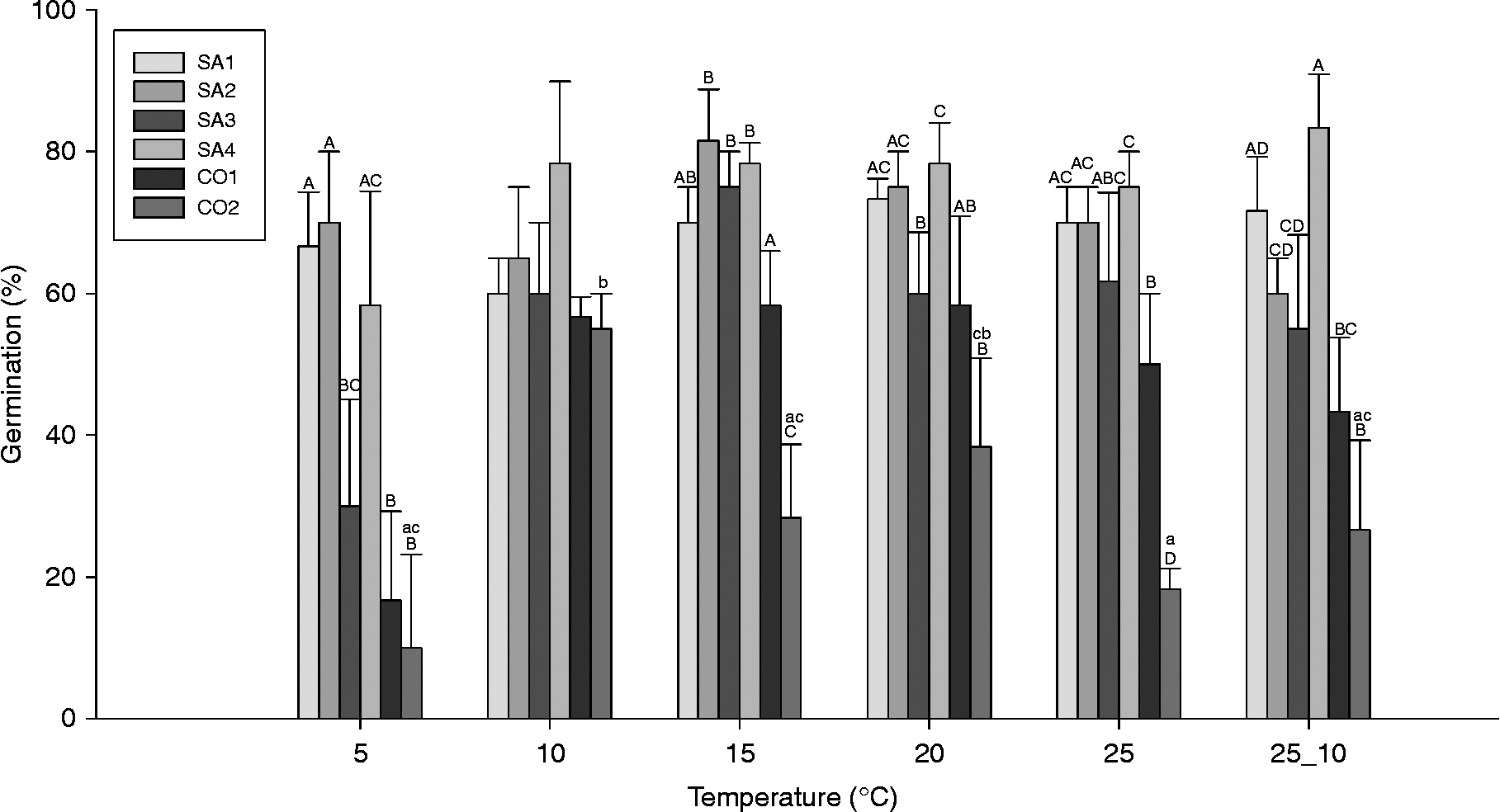
At 5°C final germination differed among populations and low germination percentages (c. 15%) were detected for CO1 and CO2 (Fig. 1). At 10°C, no significant differences were detected among populations (Fig. 1), while at 15°C, germination percentages of CO2 (c. 30%) were significantly lower (P< 0.05) with respect to all other seed lots (Fig. 1). Lower germination percentages were detected for CO2 at 20°C (c. 40%) as well as at 25°C (c. 18%) (Fig. 1). At the alternating temperature regime of 25/10°C, SA4 showed the highest germination percentages (c. 85%) while the lowest values were detected for CO2 (c. 30%) (Fig. 1). For the four Sardinian populations and the Corsican CO1, no significant differences were detected among germination percentages at the different temperatures. For CO2, the highest germination percentages were detected at 10° and 20°C (c. 50%), whereas the lowest were observed at 5° and 25°C (c. 14%) (Fig. 1). Germination rate significantly differed among temperatures for each population (P< 0.01 for SA1 and SA2; P< 0.05 for all other populations, by Kruskal–Wallis test). No significant differences (P>0.05) were detected at the same temperature among populations, with the exception of 15°C, for which T 50 of populations differed significantly (P< 0.05, by Kruskal–Wallis test), with the highest values for CO2 (c. 20 d) and the lowest for SA3 (c. 11 d; data not shown).
Germination percentages in the light at constant (5–25°C) and alternating temperature regime (25/10°C, 12/12 h) for the six populations of Rouya polygama investigated in this study. Codes SA1, SA2, SA3 and SA4 indicate R. polygama populations from Sardinia, while CO1 and CO2 are from Corsica (see Table 1 for the explanation of the population codes). Values with different letters (capitals for different populations at the same temperature and lower-case letters for different temperatures for the same population) were used to indicate significant differences at P< 0.05 (Mann–Whitney U-test). Data are the means ( ± 1 SD) of three replicates.

NaCl stress and recovery of seed germination
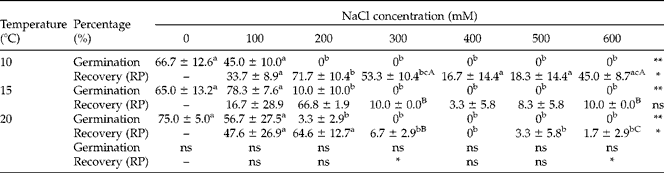
At 0 mM NaCl no differences were detected among temperatures and at all tested NaCl concentrations temperature did not influence germination percentages (Table 2). At 10°C, c. 50% of the seeds germinated at 0 and 100 mM, while germination at NaCl concentrations higher than 100 mM was totally inhibited (Table 2). At 15°C, c. 70% of seeds germinated at 0 and 100 mM (Table 2), while at 200 mM only c. 10% germinated; at concentrations above 200 mM, germination was totally inhibited (Table 2). At 20°C, c. 65% of seeds germinated at 0 and 100 mM (Table 2) and only c. 3% at 200 mM, while at NaCl concentrations above 200 mM no germination occurred (Table 2).
Germination and recovery percentages (RP) at the tested temperatures (10–20°C), at different salt concentrations (0–600 mM NaCl) for R. polygama (population SA2) in the light. In the NaCl phase for all the tested temperatures the period lasted 40 d, while the recovery phase lasted 30 d

P values were considered not significant (P>0.05, ns), significant (P< 0.05, *) and highly significant (P< 0.01, **) by Kruskal–Wallis test. Capital letters in columns are related to the same salinity, while lower-case letters in rows to the same temperature. Values with different letters were used to indicate significant differences at P< 0.05 (by Mann–Whitney U-test).
Independent of the tested temperature, at 100, 200, 400 and 500 mM NaCl, recovery percentages showed values without significant differences. However, at 300 and 600 mM RP differed significantly (P< 0.05) among temperatures (Table 2). In particular, at 300 mM, RP at 10°C (c. 55%) differed significantly (P< 0.05) from that detected at 15° and 20°C (c. 10%), while at 600 mM, RP among the three temperatures differed significantly (Table 2). At 10°C, RP differed among NaCl concentrations, with the higher values (c. 60%) at 200 and 300 mM (Table 2), while RP values detected at 100, 400, 500 and 600 mM did not show significant differences (Table 2). At 15°C, no significant differences were detected among RP, while at 20°C, RP differed among NaCl concentrations, and the higher values (c. 55%) were detected at 100 and 200 mM, while RP were significantly lower at NaCl concentrations higher than 200 mM, ranging from 0% (400 mM) to c. 7% (300 mM, Table 2).
Seed mortality in salt conditions
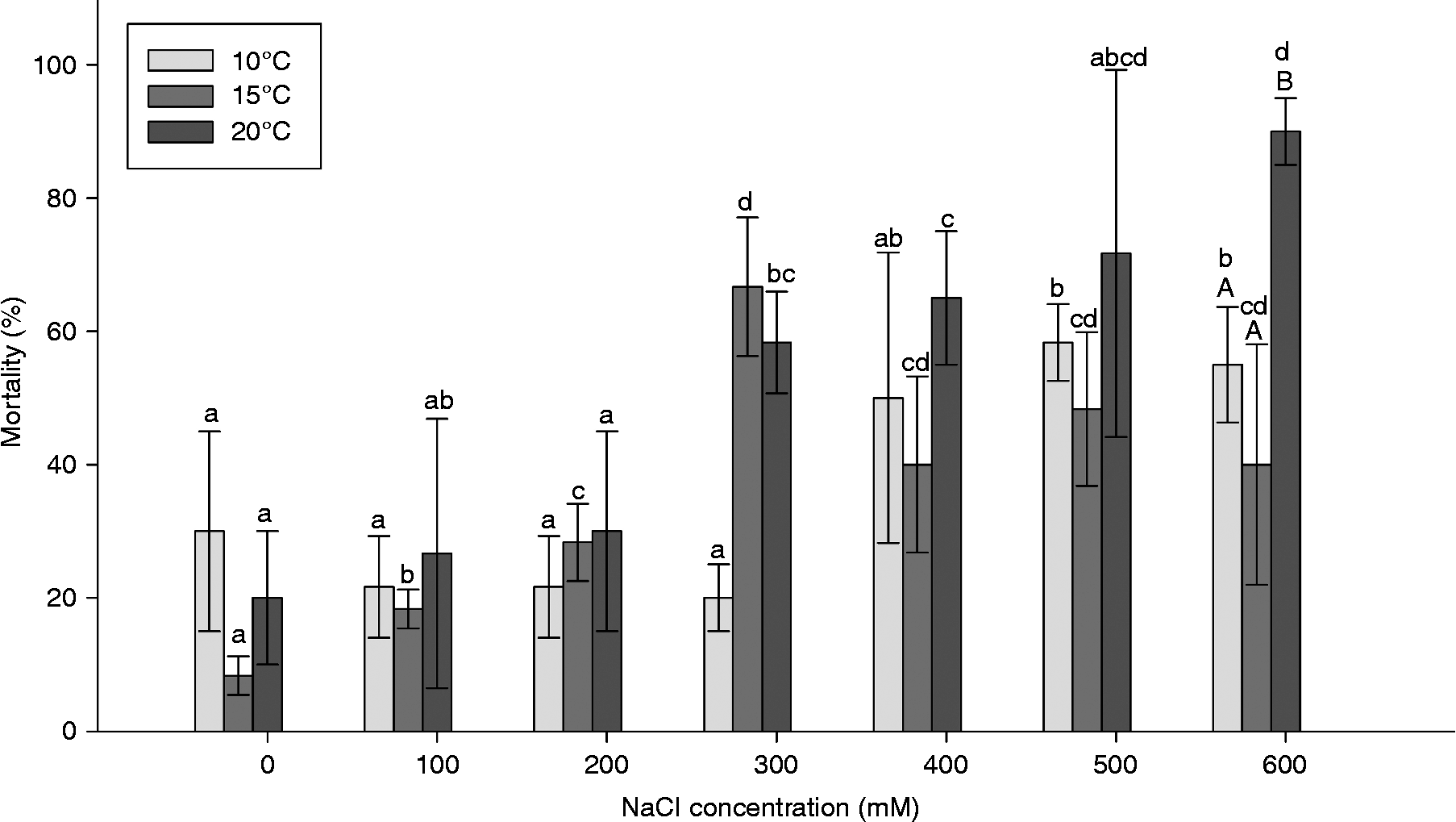
At each tested temperature (10, 15, 20°C), R. polygama seed mortality (population SA2) was enhanced with increasing salinity (Fig. 2). At 10°C, from c. 20% at 300 mM NaCl, mortality increased to c. 60% at the highest NaCl concentrations of 400, 500 and 600 mM. At 15°C, c. 8% of seeds died under control condition (0 mM) and mortality reached the value of c. 64% at 300 mM NaCl. This latter value was not statistically different (P>0.05, by Mann–Whitney U-test) from that detected at 400, 500 and 600 mM (c. 50% of seeds died). At the highest temperature of 20°C, seed mortality showed percentages of c. 30% up to 200 mM, while at 300, 400 and 500 mM the number of dead seeds increased to c. 65%; at the highest NaCl concentration of 600 mM c. 95% of seeds died. Significant differences (P< 0.05, by Kruskal–Wallis test) among temperatures were detected only at 600 mM NaCl, at which the highest temperature of 20°C corresponded the highest seed mortality value (c. 95% cited above) which was significantly different (P< 0.05, by Mann–Whitney U-test) from that detected at 10 and 15°C at the same NaCl concentration.
Mortality percentages of Rouya polygama seeds (population SA2) at constant temperatures (10, 15, 20°C) under different NaCl concentrations (0–600 mM). Values with different letters (capitals for different temperatures at the same NaCl concentration, and lower-case letters for the same temperature at different NaCl concentrations) were used to indicate significant differences at P< 0.05 (Mann–Whitney U-test). Data are the means ( ± 1 SD) of three replicates.

Inter-population variability in NaCl response
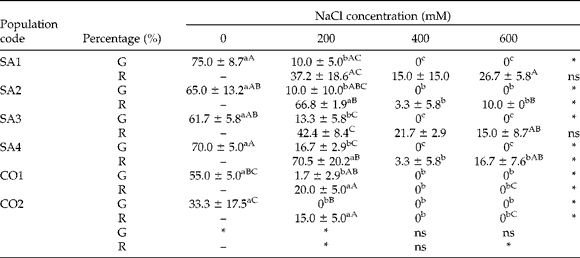
Under control conditions (0 mM NaCl), the four Sardinian populations germinated with percentages of c. 65% and CO2 showed the lowest values (c. 35%; Table 3). At 200 mM NaCl, germination percentages decreased considerably compared with 0 mM values, and differed among populations (Table 3). Germination percentages of Sardinian populations (c. 13%) were significantly different (P< 0.05) from those of CO1 (c. 2%) and CO2 (0%) (Table 3). Germination was totally inhibited at NaCl concentrations above 200 mM, for all populations (Table 3).
Inter-population variability of R. polygama seeds in response to NaCl for germination (G) and recovery (R) percentages at 15°C

P values were considered not significant (P>0.05, ns) and significant (P< 0.05, *), by Kruskal–Wallis test. Values with different letters (capitals for the same salinity and lower-case for the same population) were used to indicate significant differences at P< 0.05 (Mann–Whitney U-test). See Table 1 for an explanation of the population codes (SA for Sardinian populations and CO for Corsican ones).
RP values were higher at 200 mM than at other higher NaCl concentrations, and CO1 and CO2 showed the lowest values (c. 17%; Table 3); the highest RP, with values of c. 70%, were found for SA2 and SA4. At 400 mM, no differences were detected among RPs of Sardinian populations while recovery of CO1 and CO2 was totally inhibited (Table 3). At 600 mM, the highest RP values were detected for SA1 (c. 26%) and this differed significantly (P< 0.05) from all other values (Table 3), while CO1 and CO2 did not recover at this NaCl concentration (Table 3).
Discussion
The capability of R. polygama seeds to germinate with high percentages (up to 83%) in the range of the tested temperatures (5–25°C) suggests that they are non-dormant and that temperature is not a limiting factor for germination of this species. Low germination percentages detected in some populations were due to high seed mortality and not to seed dormancy. Many studies on Apiaceae species reported high germination percentages (>80%) under the optimal temperature for each species [e.g. H. mantegazzianum (Moravcová et al., Reference Moravcová, Perglová, Pyšek, Jarošík and Pergl2005); A. graveolens (Thomas et al., Reference Thomas, Biddington and O'Toole1979); A. bermejoi (Cursach and Rita, Reference Cursach and Rita2012); P. sativa (Hendrix, Reference Hendrix1984)]. Considering the statistically negligible number of imbibed seeds (c. one or two in, at most, one of the three replicates and only at one or two temperatures) we observed that all non-germinated seeds died during the germination tests, under control conditions as well. For R. polygama this pattern may indicate possible germination during a large part of the year, when there is considerable water availability in the soil and temperatures are not excessively prohibitive for seedling establishment (Thanos et al., Reference Thanos, Kadis and Skarou1995). R. polygama seeds achieved high germination percentages both in the light and in the dark, therefore they are not photo-inhibited for germination, contrary to other Mediterranean psammophilous species such as Brassica tournefortii Gouan, Cakile maritima Scop. and Achillea maritima (L.) Ehrend. & Y.P. Guo (Thanos et al., Reference Thanos, Georghiou, Douma and Marangaki1991).
R. polygama seeds showed germination at up to 200 mM of NaCl solution in the substrate, although in substrate with salt solutions lower germination percentages were observed than under control conditions (0 mM NaCl). Many studies have reported that germination percentages decreased with increased salinity stress, and highest germination occurs in the absence of NaCl in the substrate (Vallejo et al., Reference Vallejo, Yanovsky and Botto2010). At concentrations higher than 200 mM, R. polygama seed germination was totally inhibited and recovery showed a good performance only at lower salinity concentrations ( ≤ 200 mM), independent of temperature, while for seeds exposed, in the previous NaCl experimental phase, at NaCl concentrations higher than 200 mM, recovery was unsuccessful or minimal. Only at the low temperature of 10°C did seeds under high salinities (>200 mM) show their recovery capability (Table 2), with performances inversely proportional to the concentration to which seeds were exposed. The highest tested temperature (20°C) interfered with seed recovery and amplified the deleterious effect of salinity on the capability of seeds to recover from saline conditions, as detected previously by Guma et al. (Reference Guma, Padròn-Mederos, Santos-Guerra and Reyes-Betancort2010) for Salsola vermiculata L. Salinity–temperature interactions may have significant eco-physiological implications in terms of time of germination under field conditions, and tolerance and recovery from salinity and temperature stress is also species specific (Ungar, Reference Ungar, Kigel and Galili1995). At high temperatures, salinity exposure could result in a loss of viability and, consequently, poor recovery response. Seeds of some species did not recover or showed little recovery response when subjected to high salinity and temperature stress (Khan and Gul, Reference Khan, Gul, Khan and Weber2006).
R. polygama seed mortality under salt stress conditions was influenced by temperature. In particular, at 600 mM NaCl, the highest tested temperature of 20°C amplified the negative effect of salinity on seed viability (with mortality>95%). At each tested temperature, seed mortality increased proportionally with NaCl concentration, and the increase of temperature increased seed mortality. Several studies have reported that salt stress negatively affected seed germination, with consequent seed mortality, either osmotically (through reduced water absorption) or ionically (through the accumulation of Na+ and Cl–), causing an imbalance in nutrient uptake and toxicity effect (Vallejo et al., Reference Vallejo, Yanovsky and Botto2010).
For R. polygama, different behaviours in germination and recovery capability were detected among populations. Intra-specific variability in germination patterns has been reported for several species and investigated in various studies (Bischoff and Müller-Schärer, Reference Bischoff and Müller-Schärer2010). Germination of the CO2 population was totally inhibited at 200 mM NaCl, highlighting a higher sensitivity of seeds of this population to the lowest salinity. Unlike the other tested populations, CO1 and CO2 did not show a recovery response at NaCl concentrations above 200 mM. Seeds of all populations tested in this study were collected in the same period of natural dispersal and in the same habitat typology for all populations. Differences in salt stress response were also shown among populations of Panicum turgidum Forssk. seeds (El-Keblawy et al., Reference El-Keblawy, Al-Ansari and Al-Shamsi2010) and depended on seed provenance. Also Marchioni-Ortu and Bocchieri (Reference Marchioni-Ortu and Bocchieri1984) observed that germination conditions of a Sardinian population of Crithmum maritimum L. were strikingly different from those necessary for the germination of seeds of the same species from the Atlantic coast (Meadfoot Bay, England).
In conclusion, this study provides new data in terms of seed germination ecology of an endangered species, improving our knowledge on its salt tolerance during the germination process. The achieved results need to be confirmed with further analysis, particularly monitoring natural seed dispersion and germination in the field, and germination experiments should also be carried out under natural conditions, in order to investigate the effect of temporary water availability and seed germination at different depths under the sand surface. Further studies on R. polygama are needed to investigate the germination response of this species at temperatures higher than 25°C and to clarify genetic inter-population variability, considering a higher number of populations and possibly extending to North African populations.
Acknowledgements
The authors thank the Associate-Editor Professor Thanos and the anonymous reviewers for their constructive comments, which helped to improve the manuscript.
Financial support
The Centro Conservazione Biodiversità (CCB) is supported by the Provincia di Cagliari - Assessorato Tutela Ambiente. This research received no specific grant from any funding agency, commercial or not-for-profit sector.
Conflicts of interest
None.