


American politics has increasingly come to be defined by age. In 2024, concerns about Joe Biden’s age (81) ultimately forced him from the presidential race, yet the eventual winner, Donald Trump (78), was also twice the age of the average American (39). Congress was barely younger: the median age of House members was 58, and in the Senate it was 65. This age imbalance is not unique to Washington or even to the United States. Across many democracies, legislators are far older than the citizens they represent (Stockemer and Sundström Reference Stockemer and Sundström2022).
The predominance of older politicians raises an important question: how does the age composition of democratic institutions shape public perceptions of their legitimacy? Institutions dominated by older representatives may appear capable and stable, drawing on their greater experience, knowledge, and resources to project competence (Roberts and Wolak Reference Roberts and Wolak2023). Yet such bodies can also seem detached from contemporary realities. Citizens may worry about declining health and mental acuity among senior leaders, question whether older politicians can adequately address long-term challenges such as climate change, and perceive that politics has become closed off to new voices (McClean and Ono Reference McClean and Ono2024; Munger Reference Munger2022; Sevi Reference Sevi2021). By contrast, decision-making bodies that include younger members alongside their elders can signal intergenerational equity, blend the wisdom of experience with the fresh perspectives of youth, and convey responsiveness to the concerns of a changing society.
We argue that gerontocracy can erode the perceived legitimacy of democratic institutions. To test this claim, we conduct a survey experiment that varies the age composition of a bipartisan state legislative committee and its policy decisions. The results show that incorporating more young people into decision-making processes increases perceptions of procedural fairness and trust in institutions to act in the future, and can also improve evaluations of decisions made on lower-salience issues. These effects are especially strong among young adults and Democrats. Explorations of mechanisms suggest that these legitimacy gains stem, in part, from beliefs that younger politicians better understand the lived realities and future needs of younger generations. We find further support for these patterns in observational data from US state legislatures and in a replication experiment conducted in the United Kingdom. Taken together, these findings suggest that who makes policy decisions – and specifically, whether young people have a seat at the table – can enhance public faith in democratic governance.
Youth Representation and Democratic Legitimacy
Descriptive representation – the extent to which decision-making bodies reflect the diversity of the populations they serve – has long been viewed as central to public perceptions of legitimacy. Democratic theorists argue that citizens are more likely to view institutions as just when historically underrepresented groups are present in deliberations (Mansbridge Reference Mansbridge2015; Phillips Reference Phillips1995). Such inclusion can foster psychological belonging among members of marginalized groups and more broadly signal that institutions are fair, open, and attentive to diverse perspectives (Mansbridge Reference Mansbridge1999). Empirical research supports this view, showing that descriptive representation enhances perceptions that the decision-making process was fair (procedural legitimacy), that the resulting outcomes are right or just (substantive legitimacy), and that institutions can be trusted to act in the public’s best interest (Clayton et al. Reference Clayton, O’Brien and Piscopo2019, Reference Clark and Rogers2026; Gay Reference Gay2002; Hayes and Hibbing Reference Hayes and Hibbing2017; Kao et al. Reference Kao, Lust, Shalaby and Weiss2024). In other words, political legitimacy depends not only on what decisions are made, but also on who is entrusted to make them (Parkinson Reference Parkinson2003).
However, most work on descriptive representation and legitimacy has focused on the gender, race, or ethnicity of representatives, leaving open important questions about whether these effects extend to age. Youth is a distinct social identity: it is both universal and temporary. Every older citizen was once young, while younger citizens can expect eventually to age out of youth. The exclusion of youth from office may therefore seem less unjust than the exclusion of women or racial and ethnic minorities, since young people may be viewed as only temporarily outside positions of authority, not permanently excluded from them. Some citizens may even doubt that age meaningfully shapes political representation at all. Others may worry that younger politicians lack the maturity or judgment leadership requires, or view older politicians as possessing the experience, knowledge, and wisdom they associate with effective governance (Gulzar Reference Gulzar2021; Roberts and Wolak Reference Roberts and Wolak2023). By this logic, institutions dominated by older members may even appear more legitimate, signaling stability and competence rather than exclusion.
We argue, however, that decision-making bodies composed mostly of older members can also appear detached from the everyday realities and future concerns of younger generations. Institutions with a balance of younger and older members may therefore strengthen perceptions of legitimacy through several channels. First, the presence of younger members can convey fairness and inclusivity, countering the sense that political authority belongs to a single generation (Bidadanure Reference Bidadanure2021; Stockemer and Sundström Reference Stockemer and Sundström2022). Second, because they share a similar life stage, younger representatives may be regarded as better able to understand and relate to the needs and concerns of younger citizens (McClean and Ono Reference McClean and Ono2024; Sevi Reference Sevi2021). Third, younger politicians may be seen as more attuned to many contemporary and future policy challenges, from technology and the labor market to climate change, that older representatives might overlook (Hanretty et al. Reference Hanretty, Koskimaa and Leslie2025; McClean Reference McClean2026). Finally, citizens may view younger members as more likely to bring energy and new ideas that complement the institutional memory of older legislators (Munger Reference Munger2022). In short, while gerontocracy may convey competence in some respects, we expect the public to view age-balanced bodies as more legitimate because they signal inclusivity, responsiveness, and shared ownership across generations.
H1: Age-balanced decision-making bodies will be seen as more legitimate than those composed of only older members.
We expect the influence of youth inclusion on legitimacy perceptions to differ depending on the salience of the policy issue under consideration. When citizens lack strong prior opinions about a policy, they may rely more on institutional cues, such as who participates in decision making, to judge whether the process was fair, whether different perspectives were considered, and whether the committee can be trusted to act impartially in the future. In these cases, age-balanced bodies may reassure citizens that the deliberations incorporated the experiences and concerns of multiple generations. By contrast, when an issue is highly salient and opinions are firmly established, legitimacy judgments are likely to depend more on the decision itself than on who made it. We therefore expect the positive effect of age balance on perceived legitimacy to be strongest for lower-salience issues, where institutional cues matter more.
H2: The effect of age balance on legitimacy will be stronger on lower-salience issues than on higher-salience issues.
We also expect these effects to vary based on citizens’ age. Younger citizens, who are often underrepresented in elected office and feel neglected by political institutions (Munger Reference Munger2022; Holbein and Hillygus Reference Holbein and Hillygus2020), may respond especially strongly to the presence of generational peers in leadership roles. For young adults, seeing young legislators can foster a sense of identification, reinforce beliefs in fair treatment, and show that their concerns and life experiences are valued. Older citizens, however, may see age diversity as less important for legitimacy, instead emphasizing the experience, seniority, and wisdom they associate with older leaders.
H3: Younger people will be more positively influenced by age balance than older people.
Finally, we expect partisanship to influence these effects. Support for descriptive representation varies by party, with Democrats more likely than Republicans to back diversity in gender, race, and ethnicity within governing bodies (Grossmann and Hopkins Reference Grossmann and Hopkins2016; Mikkelborg Reference Mikkelborg2025; Weissman Reference Weissman2025). Democrats may also view youth representation more positively because younger voters have largely supported Democratic candidates in recent elections (CIRCLE 2024). Thus, we anticipate that Democrats will be more likely to interpret the inclusion of younger members as evidence of fair and responsive governance, while Republicans may place less weight on age balance as a source of institutional legitimacy.
H4: Democrats will be more positively influenced by age balance than Republicans.
Experimental Design
To test these hypotheses, we conducted an online survey experiment in July 2025 with YouGov using a quota-based sample of the US adult population based on age, gender, race, and region.Footnote 1 A total of 6,029 respondents participated in a between-subjects vignette experiment. Each respondent viewed a short prompt describing a hypothetical state legislative committee tasked with making a recommendation on a specific policy issue. The vignette included text and photos of the eight committee members.
We randomize three features of the vignette. The first – and most important – is the committee’s age composition: respondents viewed either a committee with only older members or an age-balanced committee with younger and older members. To enhance the realism of the vignette, we use photos of actual state legislators from KnowWho (2024), which covers all 7,552 legislators. We first randomly selected fifty legislator photos, then chose twelve with similar monochromatic backgrounds to construct two committees: an older committee (eight members aged 60 or older) and an age-balanced committee (four members 60 or older and four under 40).Footnote 2 The mean age is 69 for our older committee and 47 for our age-balanced committee, compared to mean ages of 56 among state legislators and 48 among respondents.Footnote 3
The second and third randomized elements concern the policy issue and the committee’s final decision. To test H2, which anticipates stronger effects on lower-salience topics, we selected two youth-relevant policy issues that differ sharply in public salience. The ‘higher-salience’ condition describes a proposal to increase renewable energy standards to combat climate change – an issue where attitudes tend to be crystallized, identity-driven, and resistant to persuasion (Egan and Mullin Reference Egan and Mullin2017). The ‘lower-salience’ condition describes a proposal to lower the age of candidacy for all state offices to 18 – a policy widely discussed in youth representation debates abroad but one that has received relatively little public attention in the United States (Stockemer and Sundström Reference Stockemer and Sundström2022). We also randomize whether the committee supports or opposes the proposal. For space reasons, we focus on the age-balance and issue-salience treatments in the main text; analyses of the committee-decision treatment appear in Appendix 2.6.
We also introduced two design features to address concerns raised by recent experimental work on descriptive representation. First, prior studies show that respondents sometimes infer that more diverse decision-making bodies lean ideologically left (for example, Reher Reference Reher2025), potentially confounding evaluations of legitimacy. To mitigate this possibility, we explicitly describe both committees as bipartisan. Second, research highlights that legitimacy judgments are strongly shaped by attitudes towards policy issues and decisions (Agerberg and Wängnerud Reference Agerberg and Wängnerud2026; Esaiasson et al. Reference Esaiasson, Persson, Gilljam and Lindholm2019), raising the risk that the observed effects of age balance may instead reflect the chosen policies or outcome favorability. To address this concern, we included a treatment arm in which the committee was introduced without any policy issue, allowing us to estimate the effect of age balance on perceived legitimacy independent of views about a specific policy or decision.Footnote 4
After viewing the vignette, respondents rated the committee’s legitimacy along three dimensions. Following prior work, we measured whether respondents thought the decision-making process was fair (procedural legitimacy) and the committee reached the right decision (substantive legitimacy) (Clayton et al. Reference Clayton, O’Brien and Piscopo2019; Kao et al. Reference Kao, Lust, Shalaby and Weiss2024).Footnote 5 We also introduced a more forward-looking question on whether the committee could be trusted to make good decisions on a range of policy issues in the future. All items use five-point Likert scales, which we dichotomize for interpretability (1 = strongly agree/agree; 0 = neutral/disagree/strongly disagree).Footnote 6 We then estimate average treatment effects using OLS regression.
Experimental Results
Figure 1 reports our experimental results across four panels: the main effect (H1), followed by effects by policy issue (H2), respondent age (H3), and respondent party (H4). For our three legitimacy outcomes, the left column shows perceptions of whether the decision-making process was fair, the middle whether the committee made the right decision, and the right whether the committee could be trusted to make good decisions on other issues in the future.
Effect of age balance on perceptions of a committee’s legitimacy.
Note: Average treatment effects (ATEs) of age balance on perceptions of whether the decision-making process was fair, whether the committee made the right decision, and whether the committee can be trusted to make good decisions in the future. See Appendix 2.3 for table versions.

Figure 1. Long description
The image contains multiple dot plots showing the average treatment effect (ATE) of age balance on legitimacy perceptions across different categories. The x-axis represents the ATE of age balance on legitimacy perceptions, ranging from -0.1 to 0.3. The y-axis lists various categories such as Main Effect, Age of Candidacy, Renewable Energy, Younger (18-34), Middle-aged (35-64), Older (65+), Democrats, and Republicans. Each dot plot shows the effect size with error bars indicating the confidence interval. The plots are organized into three columns labeled Fair Process, Right Decision, and Trust Committee, and four rows labeled Overall, Policy Issue, Respondent Age, and Respondent Party. Each plot within these categories shows the effect size for different groups or conditions.
Beginning with our first panel, we find support for H1 for two of our three legitimacy measures: fairness and trust. Fairness effects are especially strong, with respondents being 21 percentage points more likely to view an age-balanced committee as representing a fair process than one with only older members. Age balance also increases trust in the committee’s future decision making by 10 percentage points, but has no significant effect on perceived decision quality (3 percentage points, P = 0.12).Footnote 7
Next, we find that the effect of age balance on perceived decision quality varies by policy issue (H2). As predicted, having young people at the decision-making table improves perceptions of decision quality more for lower-salience issues than higher-salience ones. More specifically, we find a significant 6 percentage point boost for right decision for age of candidacy, but no significant effect for renewable energy. By contrast, perceptions of fairness and trust are consistent across issues, with nearly identical estimates of 20–21 percentage points for fairness and 10 percentage points for trust.
Respondent age also moderates the effect of age balance (H3). Age differences are clearest for fairness: age balance enhances perceived fairness more for younger respondents (27 percentage points) than for middle-aged (20 percentage points) or older respondents (13 percentage points). Similar but smaller age differences appear for trust, with estimates ranging from 13 percentage points among younger respondents to 8 percentage points among older respondents, though the difference between these estimates is not significant. For decision quality, age balance has no significant effect for any age group.
Lastly, we find partial support for H4: age balance matters more for Democrats’ perceptions of fairness and trust than for Republicans, with no clear effect for decision quality. Both Democrats and Republicans view age-balanced committees as fair, but the effect for Democrats (26 percentage points) is twice that of Republicans (13 percentage points). Similar but smaller patterns appear for trust: age balance increases trust by 15 percentage points among Democrats compared to 6 percentage points among Republicans. By contrast, age balance does not significantly affect either Democrat or Republican perceptions of whether the committee made the right decision.
In sum, we find support for all hypotheses, though this support varies across our legitimacy measures. For H1 (overall), H3 (age), and H4 (party), age balance has the largest effects on perceived fairness, smaller but substantial effects on trust, and no significant effects on whether the committee reached the right decision. For H2 (policy issue), issue salience matters only for perceptions of decision quality, not for fairness or trust.Footnote 8 Finally, Appendix 2.6 shows that when the committee is introduced without mentioning any policy issue or decision, age balance has an even larger effect on fairness and a similar effect on trust, indicating the results are not driven by respondents’ views on the selected policy issues.
Exploring Mechanisms
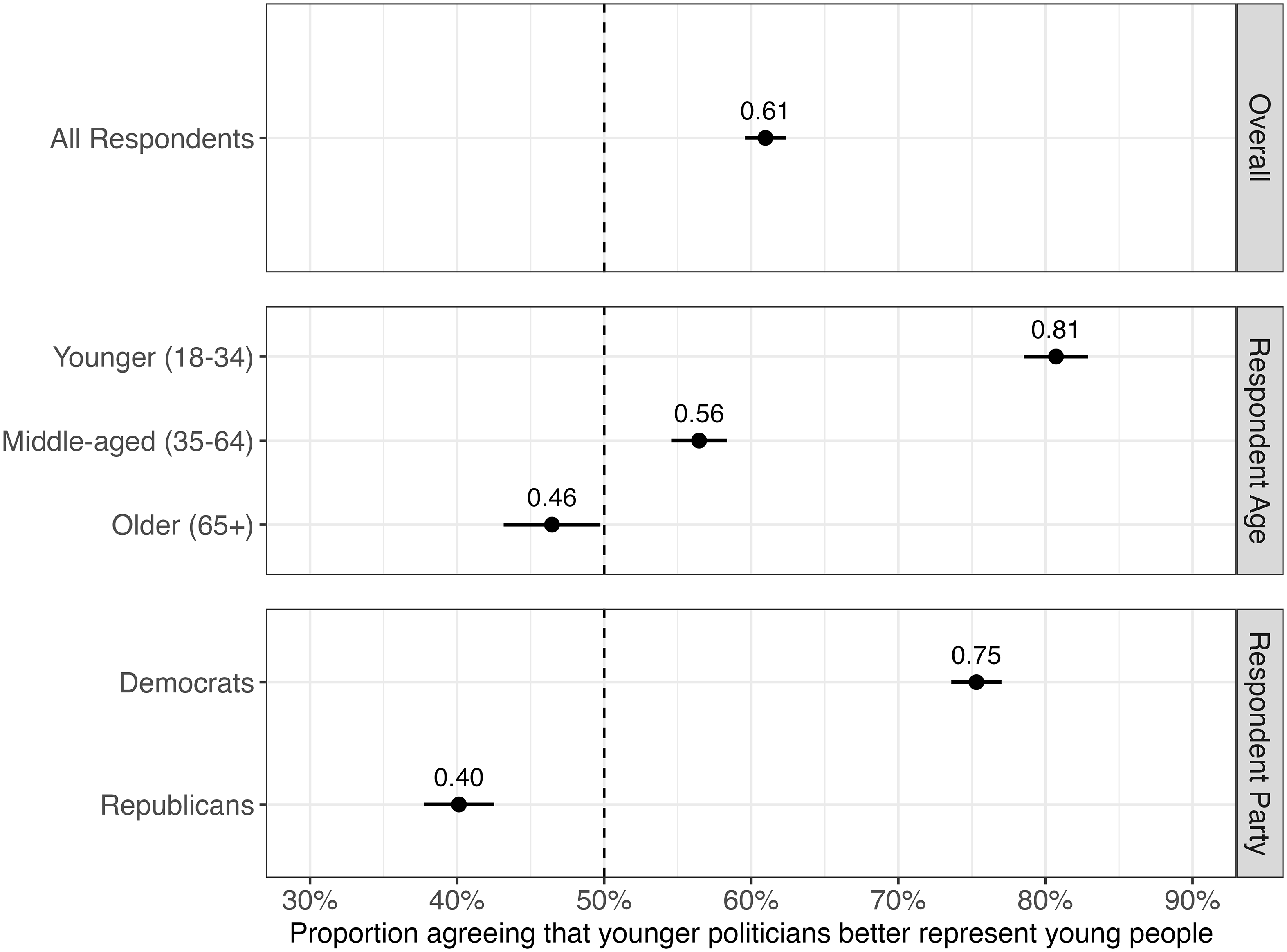
To further explore why age-balanced institutions enhance legitimacy, we first asked respondents, after the vignette, whether younger politicians are better at representing young people than older politicians (Figure 2).
Are younger politicians better at representing young people?
Note: The percentage of respondents, by subgroup, who agree that younger politicians better represent young people.

Overall, 61 per cent agree that younger politicians are better positioned to represent young people. Agreement is higher among young adults (81 per cent) and Democrats (75 per cent). These patterns mirror our experiment: respondents who view younger politicians as better representing young people are also most responsive to age balance in their legitimacy judgments.
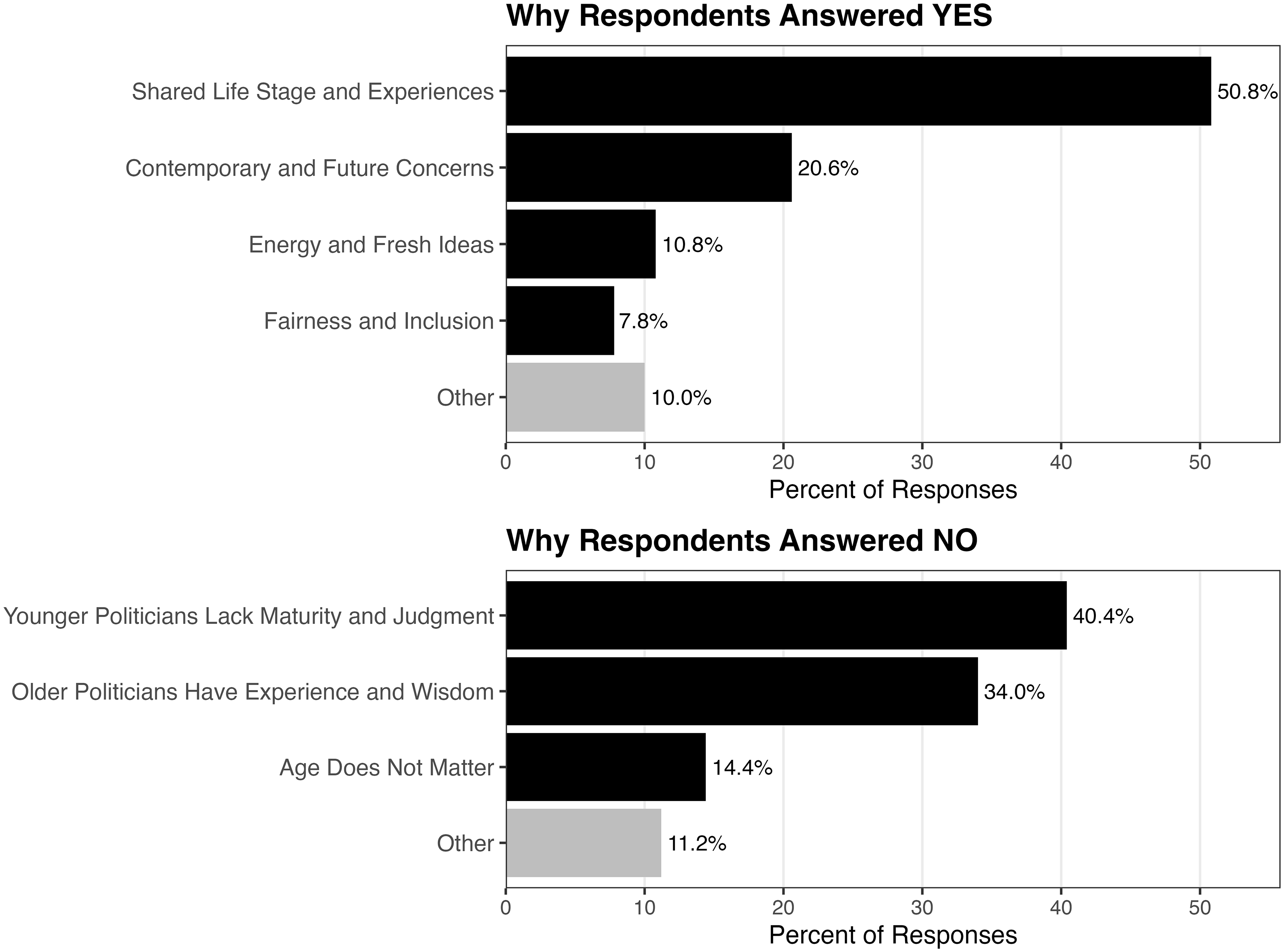
To understand why respondents hold these views, we invited them to explain their reasoning in an open-ended follow-up question. We analyzed these responses by drawing two random samples of 500 respondents – from those who answered ‘yes’ and ‘no’, respectively – and developed coding schemes grounded in our theoretical framework. Earlier, we identified several channels through which younger members might enhance legitimacy: shared life stage and experiences, attunement to contemporary and future concerns, energy and new ideas, and fairness and inclusion. Likewise, we outlined reasons for skepticism: concerns about younger politicians’ maturity and judgment, the value of older politicians’ experience and wisdom, and beliefs that age does not matter for representation. Research assistants then read through the responses and assigned each to one of these categories (see Appendix 3 for details). Figure 3 reports the results.
Why respondents think younger politicians are (not) better at representing young people.
Note: The most common reasons respondents gave for why younger politicians are (not) better at representing young people.

Among respondents who believe younger politicians better represent young people, the dominant explanation is shared life stage: just over half (50.8 per cent) argue that younger politicians better understand young adults because they are closer to their everyday lives. Another 20.6 per cent emphasize contemporary and future concerns, describing younger leaders as more attuned to current challenges and long-term issues affecting younger generations. Smaller shares cite energy and fresh ideas (10.8 per cent) or fairness and inclusion (7.8 per cent).
By contrast, respondents who reject the claim emphasize experience and competence. The most common view (40.4 per cent) is that younger politicians lack maturity and judgment and are not yet ready for office. Another 34.0 per cent cite older politicians’ experience and wisdom as enabling equal or better representation. Finally, 14.4 per cent contend that age does not matter.
Beyond these age-specific mechanisms, two alternative explanations merit consideration. First, because the older committee in our experiment reflected a descriptive majority of older white men, respondents’ reactions may have been driven by intersectional considerations rather than age alone. To address this concern, we searched the open-ended answers for references to gender or race in respondents’ explanations. Such references were rare. Among the 1,000 responses analyzed (500 in each condition), only 1 per cent mentioned gender and fewer than 1 per cent referenced race or ethnicity. Moreover, these infrequent comments typically framed age as one dimension of diversity among others rather than criticizing the panel as consisting of ‘old white men’. Instead, the overwhelming majority of responses justified their answers in terms of age-related experiences, as previously discussed.
Second, respondents may have evaluated younger politicians not only on their capacity to represent young people specifically but on perceived quality more broadly. Research on candidate emergence suggests that members of underrepresented groups who succeed in politics may be stronger than their peers, having overcome greater barriers to entry (Anzia and Berry Reference Anzia and Berry2011; Fulton Reference Fulton2012). If such perceptions shaped our respondents’ evaluations, we would expect their reasoning to reference general competence or quality rather than age-specific considerations. Yet when we searched the open-ended responses for references to candidate quality, competence, or related terms, we found that only a handful of responses made general quality claims that were not tied to the age-specific mechanisms documented above.
Neither intersectional considerations nor perceptions of general candidate quality thus appear to have driven respondents’ reactions. Instead, respondents most often anchor their reasoning in the link between age and experience – but in different ways. Those who agree focus on the type of experience: proximity to youth, contemporary knowledge, and future orientation. Those who disagree focus on the amount of experience: maturity, judgment, and accumulated wisdom. These contrasting intuitions echo our core theoretical mechanisms and help explain why age-balanced institutions enhance perceived legitimacy.
External Validity
We assess the external validity of our experimental findings through two additional analyses. First, using new data on the age composition of US state legislatures (Young Elected Leaders Project 2024) combined with public opinion data from the Cooperative Election Study (2022–2024), we examine whether the patterns observed in our experiment are also reflected in citizens’ evaluations of their state governments. We find that residents of states with younger legislatures report higher trust in state government, even after accounting for party seat shares, gender composition, and legislative professionalism (Appendix 4). As in our experiment, these effects are strongest among younger respondents and Democrats.
Second, we conducted a replication study in the United Kingdom to examine whether our findings hold beyond the US context (Appendix 5). In March 2026, we fielded an online survey experiment with 1,315 respondents recruited through Prolific. The experimental design closely followed the US study: participants evaluated a hypothetical cross-party committee composed either entirely of older councillors or of a mix of younger and older councillors, with no specific policy decision mentioned. Although the US and UK political settings differ in many ways, including the UK’s multiparty system and the role of local councillors rather than state legislators, the results closely match the main findings. Respondents who viewed age-balanced committees judged the decision-making process as significantly fairer, expressed more confidence that the committee would make sound decisions, and reported greater trust overall. As in the US study, these effects were strongest among younger respondents. These results suggest that the positive effects of age-balanced representation are not confined to the United States but can also appear in other democratic contexts.
Discussion
Our findings speak to several veins of research. We contribute to literature showing that people are attentive to legislators’ group memberships when assessing an institution’s legitimacy (Arnesen and Peters Reference Arnesen and Peters2018; Mansbridge Reference Mansbridge1999). While prior work has focused on gender (Clayton et al. Reference Clayton, O’Brien and Piscopo2019, Reference Clark and Rogers2026; Kao et al. Reference Kao, Lust, Shalaby and Weiss2024) as well as race and ethnicity (Clark Reference Clark2019; Clark and Rogers Reference Clark and Rogers2025; Gay Reference Gay2002; Hayes and Hibbing Reference Hayes and Hibbing2017; Tate Reference Tate2004), we show that citizens also value age diversity and identify the distinct ways in which age balance matters for legitimacy. The fact that respondents consistently rate age-balanced committees as more fair and trustworthy – regardless of policy issue, the committee’s decision, or even whether a policy is mentioned – suggests that youth presence carries legitimacy benefits that extend beyond outcome favorability (Agerberg and Wängnerud Reference Agerberg and Wängnerud2026; Esaiasson et al. Reference Esaiasson, Persson, Gilljam and Lindholm2019).
Moreover, we provide evidence for a new mechanism underlying the recent finding that voters often prefer younger candidates (Eshima and Smith Reference Eshima and Smith2022; McClean and Ono Reference McClean and Ono2024; Roberts and Wolak Reference Roberts and Wolak2023; Sevi Reference Sevi2021). Our results suggest that voters favor young candidates in part because they believe younger representatives enhance the legitimacy of decision-making bodies. Our analysis of open-ended responses offers further insights into why people hold this view: respondents emphasize younger politicians’ shared experiences with younger generations, greater attentiveness to contemporary and future challenges, new ideas, and considerations of fairness and inclusion.
Finally, our findings speak to debates about declining trust in democratic institutions (Brady and Kent Reference Brady and Kent2022; Levitsky and Ziblatt Reference Levitsky and Ziblatt2019; Valgarðsson et al. Reference Valgarðsson, Jennings, Stoker, Bunting, Devine, McKay and Klassen2025), particularly among younger citizens (Holbein and Hillygus Reference Holbein and Hillygus2020; Munger Reference Munger2022). We show that gerontocracy – a defining feature of contemporary politics in the United States and many other democracies, such as India and Japan (McClean Reference McClean2026; Stockemer and Sundström Reference Stockemer and Sundström2022) – may carry important legitimacy costs. Efforts to recruit and support more young political leaders may therefore help restore public confidence in democracy at a moment of increasing fragility.
Supplementary material
The supplementary material for this article can be found at https://doi.org/10.1017/S0007123426101823.
Data availability statement
Replication data for this article can be found at https://doi.org/10.7910/DVN/Y00JR5 (Sundström et al. Reference Sundström, McClean and Stockemer2026).
Acknowledgements
We would like to thank Mona Lena Krook, Shiro Kuriwaki, George Quinn, and participants in presentations at the American Political Science Association (APSA) Annual Meeting, Aarhus University, and University of Gothenburg for their helpful feedback on earlier drafts. Additionally, we are grateful to the Center for Youth Political Participation at the Eagleton Institute of Politics at Rutgers University for sharing their Young Elected Leaders Project data, and to the APSA State Politics and Policy Section for awarding this article the 2026 State Politics and Policy Quarterly Best Paper Award.
Financial support
The work was supported by the ERC Starting Grant [project no. 101117889] and the Swedish Research Council [grants no. 2020-03155, 2019-03218, and 2016-02119].
Competing interests
Nothing to disclose.



 Open access

