Introduction
Substantial research has documented the validity and time-course of tobacco abstinence effects (e.g., tobacco withdrawal and craving, mood and sleep disturbance) (see review by Hughes, Reference Hughes2007a). Tobacco abstinence effects can onset within hours of abstinence, peak within the first week, and typically last two to four weeks (Hendricks, Ditre, Drobes, & Brandon, Reference Hendricks, Ditre, Drobes and Brandon2006; Hughes, Reference Hughes2007a). Although not a monotonic phenomenon (Leventhal, Waters, Moolchan, Heishman, & Pickworth, Reference Leventhal, Waters, Moolchan, Heishman and Pickworth2010), the tobacco abstinence syndrome is considered clinically-significant, as it may maintain smoking, cause distress to smokers trying to quit, and predict failure to quit smoking (Baker, Piper, McCarthy, Majeskie, & Fiore, Reference Baker, Piper, McCarthy, Majeskie and Fiore2004; see review by Hughes, Reference Hughes2007b). Furthermore, amelioration of tobacco abstinence effects may partially explain the efficacy of some smoking cessation treatments (Ferguson, Shiffman, & Gwaltney, Reference Ferguson, Shiffman and Gwaltney2006; Piper, Federman, McCarthy, Bolt, Smith, Fiore et al., Reference Piper, Federman, McCarthy, Bolt, Smith and Fiore2008).
Abstinence effects may account for failure to quit smoking particularly among smokers with psychiatric comorbidity. Depression and alcohol use disorders are two psychiatric disorders that are associated with difficulty quitting smoking (Grant, Hasin, Chou, Stinson, & Dawson, Reference Grant, Hasin, Chou, Stinson and Dawson2004; Lasser, Boyd, Woolhandler, Himmelstein, McCormick, & Bor, Reference Lasser, Boyd, Woolhandler, Himmelstein, McCormick and Bor2000), although the influence of these disorders on quitting may vary depending on disorder subtype (e.g., past vs. current major depression) (Berlin, Chen, & Covey, Reference Berlin, Chen and Covey2010; Hitsman, Borelli, McChargue, & Spring, Reference Hitsman, Borrelli, McChargue, Spring and Niaura2003; Hughes & Kalman, Reference Hughes and Kalman2006; Japuntich, Smith, Jorenby, Piper, Fiore, & Baker, Reference Japuntich, Smith, Jorenby, Piper, Fiore and Baker2007; Prochaska, Delucchi, & Hall, Reference Prochaska, Delucchi and Hall2004; Thorndike, Regan, McKool, Pasternak, Swartz, Torres-Finnerty et al., Reference Thorndike, Regan, McKool, Pasternak, Swartz and Torres-Finnerty2008; Ziedonis, Hitsman, Beckham, Zvolensky, Adler, Audrain-McGovern et al., Reference Ziedonis, Hitsman, Beckham, Zvolensky, Adler and Audrain-McGovern2008). Regardless of subtype, most studies have indicated that depressive and alcohol use disorders are associated with more severe abstinence effects (Breslau, Kilbey, & Andreski, Reference Breslau, Kilbey and Andreski1992; Covey, Glassman, & Stetner, Reference Covey, Glassman and Stetner1990; Heffner, Mingione, Blom, & Anthenelli, Reference Heffner, Mingione, Blom and Anthenelli2011; Madden, Bucholz, Dinwiddie, Slutske, Bierut, Statham, et al., Reference Madden, Bucholz, Dinwiddie, Slutske, Bierut and Statham1997; Marks, Hill, Pomerleau, Mudd, & Blow, Reference Marks, Hill, Pomerleau, Mudd and Blow1997; Pomerleau, Marks, & Pomerleau, Reference Pomerleau, Marks and Pomerleau2000; Pomerleau, Mehringer, Marks, Downey, & Pomerleau, Reference Pomerleau, Mehringer, Marks, Downey and Pomerleau2000; Weinberger, Desai, & McKee, Reference Weinberger, Desai and McKee2010).
Far less, however, is known about abstinence effects among smokers with subclinical psychiatric symptoms. This is surprising, given that subclinical psychiatric symptoms are probably more prevalent than diagnosable disorders among smokers and may have more influence on quitting smoking at the population level (Hall, Muñoz, Reus, & Sees, Reference Hall, Muñoz, Reus and Sees1993; Hughes, Reference Hughes1999). The exact prevalence of subclinical depressive symptoms and alcohol consumption among smokers is not known, but available estimates in epidemiological samples indicate that 10‒25% of community-based adults have subclinical depressive symptoms (Horwath, Johnson, Klerman, & Weissman, Reference Horwath, Johnson, Klerman and Weissman1994; Kessler, Zhao, Blazer, & Swartz, Reference Kessler, Zhao, Blazer and Swartz1997) and 8‒20% have subclinical alcohol consumption (Freiberg, Cabral, Heeren, Vasan, & Ellison, Reference Freiberg, Cabral, Heeren, Vasan and Ellison2004). Subclinical psychiatric symptoms have significant functional impairment (e.g., increased days lost from work, utilisation of medical services, and diseases related to their symptoms; Broadhead, Blazer, George, & Tse, Reference Broadhead, Blazer, George and Tse1990; Coder et al., 2008; Johnson, Weissman, & Klerman, Reference Johnson, Weissman and Klerman1992), tend to recur (Kessler et al., Reference Kessler, Zhao, Blazer and Swartz1997) and may predict future diagnosable disorders (Bailey, Martin, Lynch, & Pollock, Reference Bailey, Martin, Lynch and Pollock2000; Horwath et al., Reference Horwath, Johnson, Klerman and Weissman1994). Although subclinical depressive symptoms and alcohol consumption have not been evaluated in tobacco smokers, the known association of depressive and alcohol use disorders with smoking, as well as the association of negative affect and alcohol consumption with smoking lapse (McKee, Krishnan-Sarin, Shi, Mase, & O'Malley, Reference McKee, Krishnan-Sarin, Shi, Mase and O'Malley2006; Shiffman, Engberg, Paty, Perz, Gnys, Kassel et al., Reference Shiffman, Engberg, Paty, Perz, Gnys and Kassel1997; Shiffman & Waters, Reference Shiffman and Waters2004), indicate that subclinical features of these disorders may be important to investigate in smokers. The same could be said of subclinical features of other common psychiatric disorders (e.g., anxiety disorders); however, the extensive literature on smokers with depression and with problematic alcohol use indicates that these are two psychiatric problems that are not only prevalent but clinically-meaningful in smokers (i.e., predict poor cessation outcomes).
As an initial step in studying smokers with subclinical depression and alcohol use, we conducted a prospective, detailed characterisation of tobacco abstinence effects in these groups of smokers. In light of prior literature indicating that tobacco abstinence effects are more severe in smokers with depressive and alcohol use disorders, we hypothesised that abstinence effects would also be more severe in smokers with vs. without subclinical features of these disorders. We did not have explicit hypotheses regarding the time-course of abstinence effects, as few studies in smokers with depressive and alcohol use disorders have documented in detail the time-course of abstinence symptomatology (i.e., in clinical trials, abstinence symptoms typically result in resumption of smoking). Nonetheless, we explored whether the time-course of any effects differed by group (e.g., whether abstinence effects offset at different time-points). Preliminary information on tobacco abstinence effects in smokers with subclinical depressive symptoms and alcohol consumption can suggest whether interventions ought to be tailored to address abstinence effects in these individuals.
Methods
Participants
Adults who wanted to quit smoking were recruited by newspaper advertisements and flyers in the community of a small city in the northeastern US. Following phone screening, those who appeared eligible underwent an in-person intake evaluation. Participants provided informed consent, were administered a structured diagnostic clinical interview, had their medical history evaluated by a registered nurse or psychiatrist, provided a urine sample that was tested for cotinine and recent drug use, and completed self-report assessments. Females were tested for pregnancy. Inclusion criteria included: a) being between ages 18 and 60; b) smoking > 10 cigarettes per day for at least one year; c) reporting Fagerström Test for Nicotine Dependence (FTND; Heatherton, Kozlowski, Frecker, & Fagerström, Reference Heatherton, Kozlowski, Frecker and Fagerström1991) score ≥ 5; d) providing breath carbon monoxide (CO) > 10 ppm; and e) having urinary cotinine concentration ≥ 150 ng/mL. Exclusion criteria included: a) meeting Diagnostic and Statistical Manual of Mental Disorders, Fourth Edition (DSM-IV) [American Psychiatric Association (APA), 2000] criteria for any Axis I disorder, including current alcohol or substance dependence or major depressive disorder, or having psychiatric problems that required immediate attention; b) reporting regular use of any psychoactive medications; and c) having a significant, untreated medical condition or on new medication for a recent medical event. Women were excluded if they were pregnant or lactating. Those who were eligible from the intake evaluation were scheduled for their pre-quit appointment.
Smokers with subclinical depressive symptoms (DEP) had to have a Center for Epidemiological Studies – Depression Scale (CES-D; Radloff, Reference Radloff1977) score ≥ 10 at intake but could not meet DSM-IV (APA, 2000) criteria for current major depression or have more than one past major depressive episode. We initially considered a minimum CES-D score of 16 to indicate DEP status because it is the established criterion for clinically-significant psychological distress (Radloff, Reference Radloff1977) but ultimately chose the score of 10 for two reasons: (1) we aimed to capture individuals without diagnosable major depression and, thus, desired a lower minimum cut-off than conventional standards, and (2) we rationalised that the score of 10 was greater than the average score of 9 among community samples (Weissman, Sholomskas, Pottenger, Prusoff, & Locke, Reference Weissman, Sholomskas, Pottenger, Prusoff and Locke1977) and, thus, would indicate above-average depressive symptoms. The CES-D score at intake was used to determine study eligibility and group status; the mean change in scores from intake to the pre-quit appointment was nominal (an increase of 0.09), suggesting that depressive symptoms were fairly stable over the pre-quit period. Smokers with subclinical alcohol consumption (ALC) had to self-report currently consuming ≥ 20 standard alcohol drinks per month but could not meet DSM-IV (APA, 2000) criteria for current alcohol dependence. We initially considered a minimum weekly alcohol consumption of 16 standard drinks for men and 12 for women because these are empirically-developed criteria for hazardous drinking (Sanchez-Craig, Wilkenson, & Davila, Reference Sanchez-Craig, Wilkenson and Davila1995) but ultimately chose the standard of 20 drinks per month for two reasons: (1) similar to our rationale with depressive symptoms, we aimed to capture individuals without diagnosable alcohol dependence and, thus, desired a lower minimum cut-off than conventional standards, and (2) we rationalised that this level of drinking was likely to include days on which drinking was heavy; indeed, all but one participant reported at least one day of binge drinking (i.e., ≥ 5 drinks for men and 4 for women; Wechsler, Dowdall, Davenport, & Rimm, Reference Wechsler, Dowdall, Davenport and Rimm1995) in the 90 days pre-quit. Furthermore, the cut-off of 20 drinks per month has been used in prior studies (Freiberg et al., Reference Freiberg, Cabral, Heeren, Vasan and Ellison2004). Smokers without subclinical depression or alcohol consumption had to have a CES-D score < 10 and report < 10 alcohol drinks per month, and they could not meet DSM-IV (APA, 2000) criteria for current major depressive disorder or alcohol dependence. Although smokers could belong in both DEP and ALC groups, these individuals were not considered a separate group in statistical analyses due to small sample size (n = 9). Thus, DEP and ALC groups were not mutually exclusive.
Intervention
All participants received 11 sessions of manualised (Cooney, Reference Cooney2000) behavioural smoking cessation counselling over a four-week period based on the 1996 Agency for Health Care Policy and Research Guideline (Katz, Muehlenbruch, Brown, Fiore, & Baker, Reference Katz, Muehlenbruch, Brown, Fiore and Baker2004). At pre-quit, participants received 30 minutes of counselling on how to prepare for the quit day and obtain support for quitting. Participants were scheduled for their quit day, which occurred within five days of the pre-quit appointment, and were instructed to stop smoking on the morning of their quit day (i.e., day 1). During post-quit days 1 to 8, participants received 10‒15 minutes of behavioural counselling daily which provided brief support and advice on continuing tobacco abstinence. Counselling sessions occurred three times in week 2 and twice each in weeks 3 and 4, and included further behavioural strategies on relapse prevention and urge management. Although complex, such an intensive intervention was thought necessary to achieve high rates of continuous smoking abstinence without nicotine replacement therapy or other pharmacotherapy. That is, because this study evaluated nicotine withdrawal symptoms, smoking cessation medications and behavioural strategies to minimise withdrawal were not used, and participants were told they would not receive, and should not use, any pharmacotherapy to stop smoking.
Procedure
The acute post-quit period began on day 1 and ended on day 8. Although some tobacco abstinence effects may persist beyond 8 days (Hughes, Reference Hughes2007a), we selected this as the acute post-quit period in order to assess abstinence effects on a daily basis while minimising participant burden. Graphical inspection of trends among all participants revealed that levels of most abstinence effects on day 8 approximated pre-quit levels. During post-quit days 1 to 8, the first 57 participants attended appointments three times per day (8-9AM, 1-3PM and 5-7PM) and completed a mean of 20.9 [standard deviation (SD) = 6.1] of the 24 appointments. While attempting to minimise participant burden by providing behavioural counselling, the subsequent 49 participants attended appointments two times per day (8-9AM, 5-7PM) and completed a mean of 14.0 (SD = 3.7) of the 16 appointments. There were no differences between participants who completed thrice-daily and twice-daily appointments. Appointments were conducted either at our clinic or in a community location. Participants completed self-report assessments and provided breath samples to evaluate CO at each appointment (MicroCO, Lewiston, ME) and urine samples to evaluate cotinine at one appointment each day (Nicometer, Jant Pharmacal, CA); samples were used to implement the contingency management component of the intervention.
During weeks 2 to 4, participants attended appointments three times in week 2 and twice each in weeks 3 and 4. At each appointment they completed self-report assessments and provided breath and urine samples to evaluate abstinence. Participants did not receive compensation for abstinence but were compensated $10 for attendance at each appointment. Participants were contacted via telephone six times to receive brief counselling and support in their abstinence effort. They attended follow-up appointments on days 28 and 60 to assess smoking status. About half of the 106 participants completed the day 28 appointment and 41% completed the day 60 appointment. All procedures were approved by the Yale University School of Medicine Human Investigations Committee.
Contingent Compensation
During days 1 to 8, a compensation schedule, contingent on biochemically-verified smoking abstinence, was used to compensate participants for not smoking (Roll, Higgins, & Badger, Reference Roll, Higgins and Badger1996). A similar contingent compensation schedule has been effectively used to engender smoking abstinence in prior studies (Ledgerwood, Reference Ledgerwood2008). This design was implemented to ensure high rates of continuous smoking abstinence in participants’ natural environments without the aid of pharmacotherapy. Smoking abstinence was verified if breath CO was < 8 ppm and cotinine was < 100ng/mL (SRNT, 2002). The first 57 participants earned $2.50 for the first CO result < 8 ppm and an additional $0.50 for each subsequent CO result < 8 ppm; the remaining 49 participants earned $3.00 for the first CO result < 8 ppm and an additional $1.00 for each subsequent CO result < 8 ppm. All participants earned an additional $8.00 per day if each urine cotinine result was < 100 ng/mL. If a participant smoked according to self-report, CO or cotinine, compensation was withheld and reset to the initial value. Participants who attended appointments three times per day could earn up to $262 for not smoking for eight consecutive days, while participants who attended appointments two times per day could earn up to $232.
Assessments
At intake, participants provided information on demographics and smoking history. Past and current criteria for Axis I disorders were established with the Structured Clinical Interview for DSM-IV (SCID; First, Spitzer, Gibbon, & Williams, Reference First, Spitzer, Gibbon and Williams1995). Nicotine dependence was assessed with the FTND (Heatherton et al., Reference Heatherton, Kozlowski, Frecker and Fagerström1991). Current symptoms of depression were assessed with the 20-item CES-D (Radloff, Reference Radloff1977), with scores ranging from 0 to 60. Tobacco and alcohol consumption in the 90 days prior to intake was assessed with the Timeline Follow-Back Interview (Brown, Burgess, Sales, Whiteley, Evans, & Miller, Reference Brown, Burgess, Sales, Whiteley, Evans and Miller1998; Sobell & Sobell, Reference Sobell, Sobell, Allen and Wilson2003).
At pre-quit and each appointment during the 8-day post-quit period, participants self-reported the number of cigarettes and standard drinks of alcohol consumed since the previous appointment. They completed the following self-report measures and were instructed to rate these since the previous appointment.
The Minnesota Nicotine Withdrawal Scale (MNWS; Hughes & Hatsukami, Reference Hughes and Hatsukami1986) is an 8-item scale that measures nicotine withdrawal symptoms (i.e., craving, irritability, anxiety, difficulty concentrating, restlessness, increased appetite or weight gain, depression and insomnia) listed in the DSM-IV (APA, 2000). Items are scored on a scale of 0 (not present) to 4 (severe) and are summed to yield a total score (Toll, O'Malley, McKee, Salovey, & Krishnan-Sarin, Reference Toll, O'Malley, McKee, Salovey and Krishnan-Sarin2007).
The Wisconsin Smoking Withdrawal Scale (WSWS; Welsch, Smith, Wetter, Jorenby, Fiore, & Baker, Reference Welsch, Smith, Wetter, Jorenby, Fiore and Baker1999) is a 28-item scale that also measures nicotine withdrawal symptoms listed in the DSM-IV (APA, 2000) (‘I have been irritable, easily angered’) as well as other signs of withdrawal. Items are scored on a 5-point scale ranging from 0 (strongly disagree) to 4 (strongly agree) and are averaged to create subscale scores of Anger, Anxiety, Concentration, Craving, Hunger, Sadness and Sleep.
The Questionnaire of Smoking Urges (QSU; Tiffany & Drobes, Reference Tiffany and Drobes1991) is a 32-item scale that measures tobacco craving. Items are scored on a Likert-type scale (1 = strongly disagree; 7 = strongly agree) and are averaged to create subscale scores of Desire to Smoke and Relief from Negative Affect.
The brief version of the Profile of Mood States (POMS; McNair, Lorr & Droppleman, Reference McNair, Lorr and Droppleman2003) is a 30-item scale of mood states. Items are scored on a 0 (not at all) to 4 (extremely) scale and are summed to create subscales of Tension, Depression, Anger, Vigor, Fatigue and Confusion. A total mood disturbance score is calculated by summing the subscale scores of Tension, Depression, Anger, Fatigue and Confusion and subtracting the Vigour subscale score.
At the day 8 appointment, participants rated symptoms of depression and sleep disturbance since pre-quit via the CES-D and Pittsburgh Sleep Quality Index (PSQI; Buysse, Reynolds, Monk, Berman, & Kupfer, Reference Buysse, Reynolds, Monk, Berman and Kupfer1989), respectively. The PSQI is a 9-item scale that measures sleep disturbance retrospectively over a one-month period but was modified to measure sleep disturbance retrospectively over a one-week period. The seven components (subjective sleep quality, sleep latency, sleep duration, habitual sleep efficiency, sleep disturbances, use of sleep medication and daytime dysfunction) each have a scoring range of 0 (no difficulty) to 3 (severe difficulty), and the component scores are summed to yield a global score (range = 0 − 21).
Data Analysis
The primary aim of this study was to evaluate if the time-course and severity of acute tobacco abstinence effects differed between smokers with and without subclinical depressive symptoms or alcohol consumption. Preliminary data examination indicated that several measures of abstinence effects significantly differed between DEP and non-DEP smokers at the pre-quit assessment, although none differed between ALC and non-ALC smokers. Therefore, pre-quit levels were covaried in all analyses.
Generalised estimating equations (GEEs) modelled main effects of time (post-quit day 1 through day 8), DEP group (yes vs. no), and ALC group (yes vs. no), and interaction effects of time and DEP group and time and ALC group in predicting abstinence effects of: MNWS Total, WSWS subscales, QSU subscales, POMS Total and subscales, CES-D Total and PSQI Global. Separate GEEs were conducted for each abstinence effect. Significant interaction effects indicated that the time-course of abstinence effects differed by group; post hoc GEEs then compared effects on post-quit day 1 to each subsequent post-quit day, separately by group. Significant main effects indicated that the severity of abstinence effects differed by group (i.e., mean effects across post-quit days 1 to 8). Because of the number of separate GEEs, we decided that p-values < .01 would determine significance. Time-invarying covariates included pre-quit levels of each abstinence effect and intake characteristics that differed between groups (see Sample Description): age, race, cigarettes per day, CO level and FTND total score. Because nicotine withdrawal may differ between males and females (Leventhal, Waters, Boyd, Moolchan, Lerman, & Pickworth, Reference Leventhal, Waters, Boyd, Moolchan, Lerman and Pickworth2007), sex was also a time-invarying covariate. The time-varying covariate was biochemically-confirmed smoking abstinence at each daily appointment during the 8-day post-quit period (0 = not abstinent; 1 = abstinent).
Results
Sample Description
Of 493 individuals who underwent the intake evaluation, 158 were eligible to participate. Individuals could be ineligible for multiple reasons, and the most common reasons for ineligibility were: insufficient tobacco use (35%); recent substance use, as indicated by self-report or urine toxicology screen (28%); and psychiatric disorders or problems that required immediate attention (17%). Of 158 eligible individuals, 38 chose not to participate. Of the 120 smokers who completed the pre-quit appointment, 106 smokers completed at least one post-quit assessment and were included in the final sample. Of the 106 participants, 36 were classified as DEP (9 with and 27 without ALC), 31 were classified as ALC (9 with and 22 without DEP), and 48 were classified as having neither subclinical depressive symptoms nor alcohol consumption. The 106 included participants did not differ on any demographic or smoking history characteristic from the 14 individuals who completed only the pre-quit assessment.
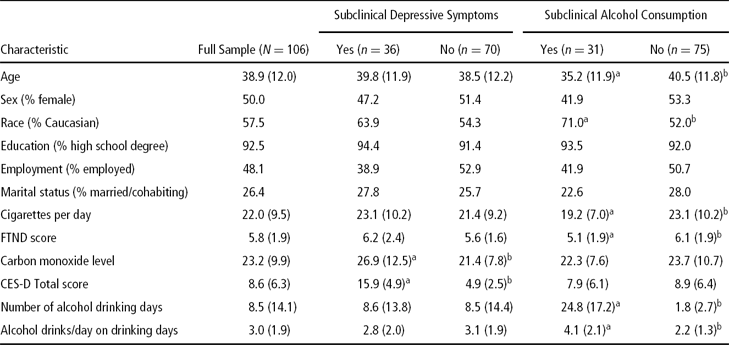
Table 1 provides demographic and smoking history characteristics of the 106 participants. DEP participants had significantly higher CO levels at intake than non-DEP. ALC participants were significantly younger and more likely to be Caucasian, smoked fewer cigarettes per day and had lower FTND scores than non-ALC. Relative to US current daily smokers (Hughes & Callas, Reference Hughes and Callas2010), the current sample was similar in terms of age and gender but had a smaller percentage of Caucasian participants (57.5% vs. 78.4%) and a greater percentage with a high school education (92.5% vs. 79.9%). The current sample smoked, on average, more cigarettes per day than US current daily smokers (22.0 vs. 16.4); this was likely due to study inclusion criteria.
Sample Characteristics.

Note. Superscripts with different letters indicate significant between-group differences, p < .05. FTND = Fagerström Test for Nicotine Dependence. CES-D – Center for Epidemiological Studies – Depression Scale. Number of alcohol drinking days and alcohol drinks/day on drinking days were assessed in the 90 days pre-intake.
Smoking Abstinence
Of the 106 participants, 74 (70%) achieved biochemically-confirmed continuous abstinence from smoking for eight days. The prevalence of 8-day continuous abstinence did not differ between groups [69% DEP vs. 70% non-DEP (χ2 (1) = 0.00, p = .95); 77% ALC vs. 68% non-ALC (χ2 (1) = 1.20, p = .27)]. Breath CO levels significantly changed over time (Wald = 505.14, p < .01), with CO at each of the eight post-quit days significantly lower than at pre-quit (all ps < .01). Urine cotinine levels similarly declined over time (Wald = 503.77, p < .01). After removing monetary contingencies for abstinence at the end of the 8-day period, 32 (30%) and 26 (25%) participants achieved biochemically-confirmed 7-day point prevalence abstinence at day 28 and day 60, respectively. Abstinence prevalence at day 28 (33% DEP vs. 29% non-DEP; 26% ALC vs. 32% non-ALC) and at day 60 (28% DEP vs. 21% non-DEP; 16% ALC vs. 27% non-ALC) did not differ between groups.
Time-course of Abstinence Effects
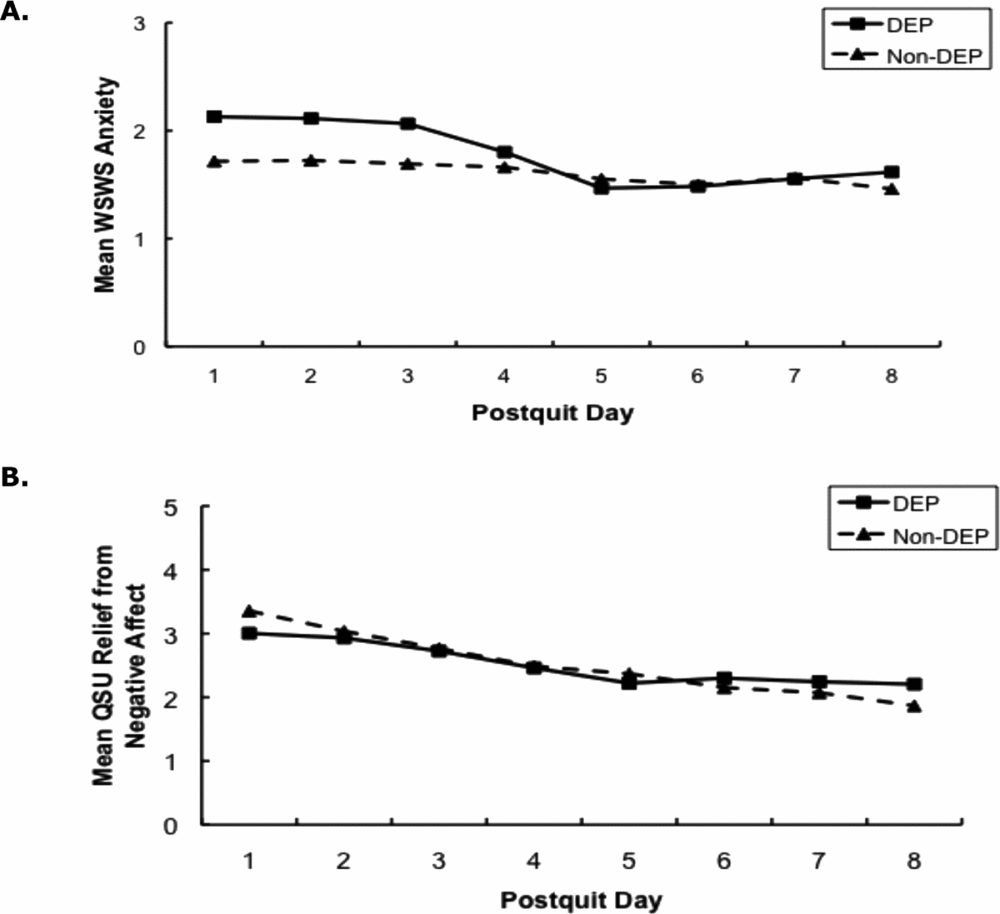
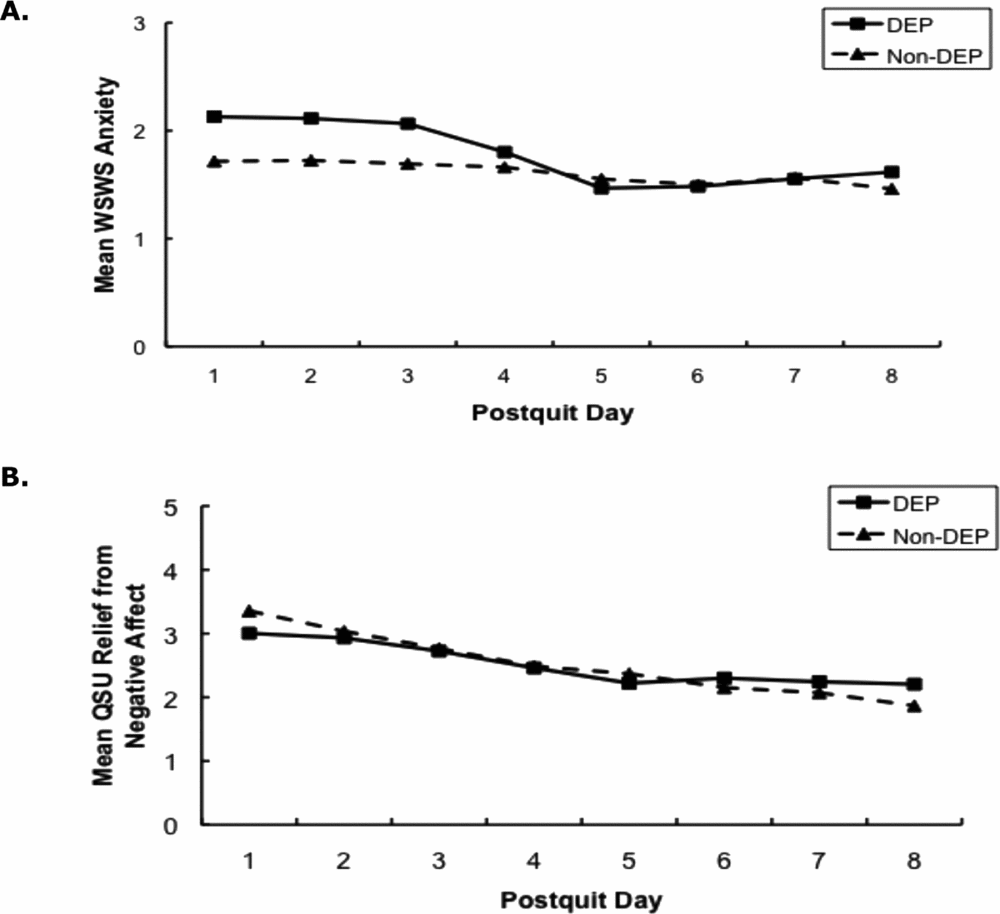
Time and DEP group significantly interacted to predict change in WSWS Anxiety (Wald = 21.18, p < .01) and QSU Relief from Negative Affect (Wald = 20.12, p < .01) subscale scores (Figure 1). Post hoc GEEs revealed that WSWS Anxiety scores were significantly lower, relative to post-quit day 1, on post-quit days 5 to 8 for DEP smokers and on days 6 to 8 for non-DEP smokers. QSU Relief from Negative Affect scores were significantly lower, relative to post-quit day 1, on post-quit days 5 to 8 for DEP smokers and on days 2 to 8 for non-DEP smokers.
Interaction between day and depressive group in predicting time-course of tobacco abstinence effects. Mean scores on the Wisconsin Smoking Withdrawal Scale Anxiety subscale (Panel A) and Questionnaire of Smoking Urges Relief from Negative Affect subscale (Panel B) from post-quit days 1 to 8 are presented.
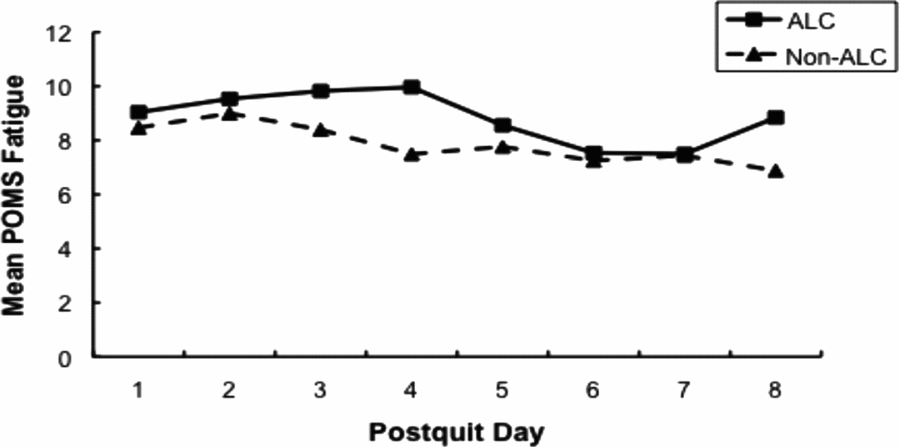
Time and ALC group significantly interacted to predict change in POMS Fatigue subscale scores (Wald = 19.78, p < .01) (Figure 2). Post hoc GEEs revealed that POMS Fatigue scores were significantly lower, relative to post-quit day 1, on post-quit days 6 and 7 for ALC smokers, and on days 4 to 8 for non-ALC smokers.
Interaction between day and alcohol group in predicting time-course of tobacco abstinence effects. Mean scores on the Profile of Mood States Fatigue subscale from post-quit days 1 to 8 are presented.
To minimise potential confounding effects due to the comorbidity of depression symptoms and alcohol consumption in some study participants and in the general US population (Grant & Harford, Reference Grant and Harford1995), subsequent GEEs evaluated whether time still significantly interacted with DEP group and with ALC group to predict change in abstinence effects after covarying alcohol consumption and depressive symptoms, respectively. After additionally covarying pre-quit quantity of alcohol consumption, the interaction effect of time and DEP group in predicting WSWS Anxiety (Wald = 14.27, p < .05) and QSU Relief from Negative Affect (Wald = 15.17, p = .04) was somewhat attenuated but still significant at p < .05. After additionally covarying pre-quit CES-D scores, time and ALC group still significantly interacted to predict change in POMS Fatigue scores (Wald = 19.66, p < .01).
Severity of Abstinence Effects
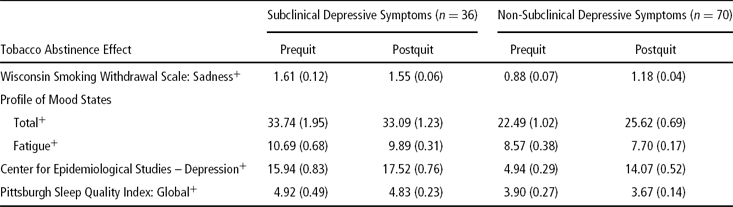
There was a significant main effect of DEP group in predicting scores on scales of: WSWS Sadness (Wald = 8.25, p < .01); POMS Total (Wald = 6.77, p < .01) and Fatigue (Wald = 8.37, p < .01); CES-D Total (Wald = 11.05, p < .01); and PSQI Global (Wald = 7.15, p < .01) (Table 2). On all of these measures, DEP smokers had significantly higher mean post-quit (i.e., averaged across post-quit days 1 to 8) and pre-quit scores than non-DEP smokers, and time and DEP group did not significantly interact to predict any of these scores. There was no significant main effect of ALC group in predicting any abstinence effect.
Main effect of depressive group in predicting tobacco abstinence effects
Note. Estimated marginal means (standard errors) from generalized estimating equations in which there was a significant (p < .05) main effect of depressive group in predicting mean tobacco abstinence effects, averaged across post-quit days 1 to 8, while covarying for pre-quit levels. Crosses indicate significant between-group differences at pre-quit.
To minimise potential confounding effects due to the comorbidity of depression symptoms and alcohol consumption, subsequent GEEs evaluated the main effect of DEP group in predicting abstinence effects after additionally covarying pre-quit quantity of alcohol consumption. The main effect of DEP group remained significant for all measures [WSWS Sadness (Wald = 5.18, p = .02); POMS Total (Wald = 7.30, p < .01) and Fatigue (Wald = 8.64, p < .01); CES-D Total (Wald = 9.25, p < .01); PSQI Global (Wald = 10.21, p < .01)].
Discussion
This prospective study found that smokers with subclinical depressive symptoms experienced a unique time-course and greater severity of some tobacco abstinence effects, and smokers with subclinical alcohol consumption experienced a unique time-course of abstinence-related fatigue but did not differ in overall severity of abstinence effects. However, differences based on depressive group status should be interpreted with caution due to pre-existing differences in measures of abstinence effects.
Smokers with subclinical depressive symptoms experienced a decrease in tobacco craving three days later and a decrease in anxiety one day earlier than smokers without depressive symptoms. They also reported significantly greater mood and sleep disturbance across the acute post-quit period. These findings may demonstrate that smokers with subclinical features of depression experience more severe abstinence effects; however, groups based on depressive status significantly differed on several pre-quit measures of abstinence effects, and this may have confounded post-quit measures of abstinence effects. Pre-quit assessment of abstinence effects may have captured characteristics related to the presence of depressive symptoms (e.g., sleep disturbance; fatigue); accordingly, between-group differences in abstinence effects at pre-quit were expected given the nature of the groups of smokers in this study. Statistical tests of the effect of depressive group on abstinence effects did covary pre-quit scores, yet it is possible that post-quit effects were still confounded by pre-quit levels. In fact, some have argued that statistical tests cannot adequately control for such confounds (Miller & Chapman, Reference Miller and Chapman2001). In a recent randomised clinical trial of two smoking cessation medications, smokers who received placebo medication were more likely to report post-quit depression, anxiety, irritability, emotional lability and disturbances in attention relative to smokers who received active medication (Cinciripini, Robinson, Karam-Hage, Minnix, Lam, Versace, Brown, et al., Reference Cinciripini, Robinson, Karam-Hage, Minnix, Lam, Versace, Brown and Wetter2013). Higher ratings of abstinence effects in the placebo group were attributed mostly to unmedicated nicotine withdrawal but may have been due to other factors, such as the alleviating effects of medication on abstinence symptoms. Nonetheless, this study highlights the difficulty in disentangling explanations for abstinence effects (Cinciripini et al., Reference Cinciripini, Robinson, Karam-Hage, Minnix, Lam, Versace, Brown and Wetter2013). Because of the pre-quit differences between smokers with and without depressive symptoms in the current study, we cannot draw a firm conclusion as to whether more severe post-quit measures of abstinence effects among smokers with subclinical depressive symptoms were due to smoking abstinence per se.
Smokers with subclinical alcohol consumption experienced a unique time-course of abstinence-related fatigue but did not experience greater post-quit severity of any effects. Relative to the first post-quit day, fatigue decreased two days later for smokers with subclinical alcohol use, indicating that fatigue takes longer to improve for this subgroup, while other abstinence effects improve over a similar time-course for smokers with and without subclinical alcohol use. That smokers with subclinical alcohol consumption did not experience more severe abstinence-related effects across the eight post-quit days suggests that only alcohol use disorders are associated with severe tobacco abstinence effects (Heffner et al., Reference Heffner, Mingione, Blom and Anthenelli2011; Marks et al., Reference Marks, Hill, Pomerleau, Mudd and Blow1997; Weinberger et al., Reference Weinberger, Desai and McKee2010). Nonetheless, operationalising subclinical alcohol use with different consumption standards (e.g., meeting hazardous or at-risk drinking guidelines; National Health and Medical Research Council, 2009; National Institute on Alcohol Abuse and Alcoholism, 2010; Sanchez-Craig et al., Reference Sanchez-Craig, Wilkenson and Davila2005) or based on subclinical diagnostic criteria (e.g., having fewer than three criteria for alcohol dependence) may have revealed different results.
Strengths of this study include its prospective design with frequent assessments of the multiple dimensions of the tobacco abstinence syndrome (Shiffman et al., Reference Shiffman, West and Gilbert2004); sophisticated data analytic models that maximised available data; use of contingency management to obtain high rates of abstinence without the use of medications that would have confounded the measurement of abstinence effects; and examination of abstinence effects in participants’ natural environments. Limitations of this study include its exclusive focus on subjective (vs. physiological or cognitive) abstinence effects, dichotomous categorisations of smokers, and lack of information on abstinence effects beyond eight days.
In spite of these limitations, several clinical implications and directions for future research can be drawn from this study. First, if findings are replicated, smokers with subclinical psychiatric features may benefit from interventions tailored to address the differential time-course of some aspects of the tobacco abstinence syndrome. For example, tobacco treatment specialists can educate smokers with subclinical depressive symptoms and alcohol consumption that tobacco craving and fatigue, respectively, may take longer to diminish and can focus on behavioural strategies to manage these specific abstinence effects (e.g., strategies to avoid smoking triggers while craving is still high). Due to the potentially confounding influence of pre-quit measures of abstinence effects, it remains to be determined if smokers with subclinical depressive symptoms need intensified interventions tailored to greater severity of abstinence effects. Second, findings support the need to distinguish among subtypes of psychiatric comorbidity. While smokers with diagnosable depressive and alcohol use disorders have experienced more difficulty quitting smoking in prior studies (Breslau et al., Reference Breslau, Kilbey and Andreski1992; Covey et al., Reference Covey, Glassman and Stetner1990; Grant et al., Reference Grant, Hasin, Chou, Stinson and Dawson2004; Heffner et al., Reference Heffner, Mingione, Blom and Anthenelli2011; Lasser et al., Reference Lasser, Boyd, Woolhandler, Himmelstein, McCormick and Bor2000; Madden et al., Reference Madden, Bucholz, Dinwiddie, Slutske, Bierut and Statham1997; Marks et al., Reference Marks, Hill, Pomerleau, Mudd and Blow1997; Pomerleau & Marks et al., Reference Pomerleau, Marks and Pomerleau2000; Pomerleau & Mehringer et al., Reference Pomerleau, Mehringer, Marks, Downey and Pomerleau2000; Weinberger et al., Reference Weinberger, Desai and McKee2010), smokers with subclinical disorders in the current study did not differ in abstinence success. However, they may have been motivated by the contingent compensation to remain abstinent, while unaided smokers may lapse to smoking in order to relieve distressing abstinence effects. Third, future research can study how smokers with other subclinical psychiatric symptoms (e.g., anxiety) experience acute tobacco abstinence. Finally, participants in this study received frequent behavioural interventions and achieved high levels of smoking abstinence; therefore, similar treatment may help in initiating abstinence for these subclinical groups of smokers.
In conclusion, abstinence-related fatigue took longer to improve for smokers with subclinical alcohol consumption, but other abstinence effects were not unique in time-course or severity for this subgroup of smokers. Differential time-course and greater severity of abstinence effects for smokers with subclinical depressive symptoms was observed but it is unclear whether this is due to the absence of tobacco or to pre-existing differences in severity. Future research can illuminate whether abstinence effects for smokers with subclinical psychiatric features differ with the provision of pharmacological treatment and how any unique abstinence effects predict difficulty quitting smoking. Understanding abstinence effects can inform interventions for smokers who report psychiatric symptoms but not diagnosable disorders.
Acknowledgements
The authors acknowledge Elaine LaVelle, M.S., Ran Wu, M.S., and Peter Hendricks, Ph.D. for assistance with data collection, preparation and interpretation.
Financial Support
This work was supported by the US National Institutes of Health (S.S.O. and S.K., grant number P50-DA13334), (E.N.P., grant number T32-DA007238), (J.L.C., grant numbers R01-AA11197, P50-DA09241 and P50-CA98029), and (S.S.O., grant number K05 AA014715); and the Connecticut Department of Mental Health and Addiction Services. The content is solely the responsibility of the authors and does not necessarily represent the official views of the National Institutes of Health. Funding sources had no further role in study design; in the collection, analysis and interpretation of data; in the writing of the report; or in the decision to submit the paper for publication. The corresponding author had full access to all data in this study and final responsibility for the decision to submit the paper for publication.
Conflict of Interest
None.
Ethical Standards
The authors assert that all procedures contributing to this work comply with the ethical standards of the relevant national and institutional committees on human experimentation and with the Helsinki Declaration of 1975, as revised in 2008.